Organizational Climate and Effectiveness
Relationship in IT Sector: Mediating Effect of
Organizational Commitment
Reetu,
Anshu Yadav
Abstract: Human resource of an organization is considered as a central variable which affects the effectiveness of an organization. In this competitive era employees are considered as an asset to the organization and it is the only resource which can use all other resources within organization in an effective way. Human resource with its skills, capability, talent and intelligence can help an organization to achieve its objectives. The performance of employees will only be high when a favourable environment with growth opportunities will be provided to them. The present study focuses on the effect of organizational climate on organizational effectiveness of IT sector with organizational commitment as a mediator. Data was collected through structured questionnaire with the help of convenient sampling from 350 employees from Delhi and NCR. Process macro along with AMOS was used to measure the mediating effect of commitment between organizational climate and organizational effectiveness. A significant partial mediation using Bootstrapping was found with an indirect effect of organizational climate on organizational effectiveness (β= .32, Boot (LLCI= .8678, ULCI= 1.599). Total effect of organizational climate on Organizational effectiveness was .71, whereas direct effect was .39.
Key Words: Organizational Commitment, Job Organizational climate, Organizational effectiveness, IT sector.
I. INTRODUCTION
Effectiveness is that degree which helps an organization to accomplish its goals and to get success (Robbins, 2001). Due to the impact of organizational effectiveness on organizational performance and objectivity it plays a vital role at every level of organization (Powell and Yalcin, 2010). Effectiveness determines the success of an organization and helps in fulfilling the objectives (Alagheband, 2009) and because of this impact it is the core area of organization theory (Robbins, 2001). Pennings and Goodman (1977) illustrated that organizational effectiveness is an important problem in science as well as social science. In today's era of cut throat competition it is only through organizational effectiveness that an organization can endure and maximize its profits. Peter Drucker (1967) explained effectiveness as, “doing the right things”. It is the degree to which goals of an organization are accomplished (Daft, 1995; Khadivi and Alijani-Farid, 2008). It is the capability of an organization for accessing and absorbing limited resources in a well-organized manner and realizes its objectives (Federman, 2006; Cameron, 1978).
Revised Manuscript Received on September 06, 2019
Reetu, Department of Commerce, P.I.G. Govt. college for woman, Jind, Haryana, India,
Dr. Anshu Yadav, Amity Business School, Amity university, Noida, Uttar Pradesh, India,
When employees are committed it revealed that they are concerned and dedicated. Mowday et al. (1982) explained organizational commitment as trust and faith of employees in goals and values of an organization; wish to stay as a part of the organization and truthfulness to the organization. Porter et al. (1974) added that committed employee will feel attached towards organization, wish to be part of organization, and will put on additional hard work for its success.
The role of organizational commitment between organizational climate and organizational effectiveness has not been addressed adequately in Indian IT sector. Through this study an effort is made to discover the factors highly affecting commitment and satisfaction level of employees and to combat the factors which hinder organizational effectiveness. To establish the relationship between studying variables and setting up the hypothesis various studies were reviewed and it was found that both organizational climate and commitment have a significant impact on organizational effectiveness.
II. REVIEW OF LITERATURE
Sharan (1968) explained that formal structure, objectives and environment are the parameters on which climate of an organization is based. Menon (1971) investigated that commitment and responsiveness of employees is the outcome of their satisfaction by learning new things and providing different type of work in a supportive organizational climate. Lawler et.al (1974) explained that perceived climate share a considerable relationship with performance and satisfaction level of employees. Personal factors such as age of employees, education level, professional training and experience at work place do not affect perception of employees towards climate. When a manager having need for achievement gets an achievement oriented climate his performance will be high. Wiener (1988) was of the opinion that shared values of employees in an organization contribute to organization climate. Uthayasuriyan (2005) found that perception of artisans, supervisors and executives about organizational climate was different in respect attitude of worker’s, characteristics of job, value system, structure of management, and performance and reward relationship.
Steers (1977) said that personal characteristics, job characteristics and work experience had an impact on commitment level of hospital employees, scientists and engineers. Angle et.al (1981) attempted to relate the commitment level of lower level employees and organizational effectiveness of organization providing bus services. Organizational adaptability, turnover and tardiness rate were found to be associated with organizational commitment. Feldman (1981) explained that the relationship between supervisor and employee on different level is affected by age, appearance, behaviour etc. Supervisors consider old age employees more committed than young employees whereas Mottaz (1987) was of the opinion that personal characteristics have little effect on satisfaction level or commitment. Rewards gained from work better predicted the commitment level of employees. Glission and Durick (1988) explained that type of leadership and age of
organization were the two organization characteristics and education was one of the employee’s characteristic that predicted the organizational commitment. Romzek (1989) illustrated that employee feels committed due to time and money attached in an organization in the form of retirement plan. Bowen et.al (1994) institute that married employees remains highly committed to the organization than those who are single. Pettaway (2015) said an organization will be effective when the working condition of employees, job safety, comfort facilities available to employees along with support services are according to the employee’s expectations. Perceived autonomy, experimentation, and collaboration were the factors which influenced affective commitment positively, while confrontation and experimentation were the factors affecting normative commitment positively. Authenticity was found to have links with continuance commitment. (Gabrani et.al, 2016) said that when employees of an organization are satisfied with their pay, promotion, supervisors and co-workers they will feel emotionally attached with the organization.
A. Objectives of the Present Study
Rationale of conducting the study is to check the likely mediating impact of organizational commitment on the relationship between organizational effectiveness and organizational climate. This is an attempt to discover and clarify the factors which helps in achieving higher level of organizational effectiveness. Based on the purpose of study following objectives are framed.
To examine organizational climate and commitment level of employees in IT sector.
To check the impact of climate on organizational commitment in IT sector.
To assess the impact of organizational commitment on effectiveness of IT sector.
To measure the effect of organizational climate on effectiveness in IT sector.
To check the mediating affect of commitment on organizational climate and organizational effectiveness.
III. RESEARCH METHODOLOGY
A. Tools and implementations
B. Hypotheses
Sixteen statements by C.N. Daftuar (1997) were used to measure organizational effectiveness on eight dimensions like consensus, legitimization, self control, need for independence, job involvement, innovation, organizational attachment, and organizational commitment. Organizational climate was measured on nine dimensions (professional help, formalization, professional management, organizational risk taking, standardization, people orientation, centralization, formal communication, concern for welfare) with the help of questionnaire prepared by Shailendra Singh (1989) consisting of thirty statements. Three dimensions (faith in organizational goals and principles, a readiness to put hard work for organization, and strong wish to be member of organization) were used to measure organizational commitment with the help of questionnaire framed by Mowday (1979) consisting of fifteen statements. Four hypotheses were framed on the basis of literature and tested with the help of above stated questionnaire.
H1: there is a significant impact of organizational climate on organizational commitment.
H2: there is a significant impact of organizational commitment on organizational effectiveness. H3: there is a significant impact of job organizational
climate on organizational effectiveness.
H4: Commitment significantly mediates the association among climate and effectiveness.
C. Sampling process
Data was collected from 350 employees from IT sector among Delhi and NCR through convenient sampling. The feedback was analyzed quantitatively with Likert scale. Demographic characteristics of respondents, descriptive statistics and testing of hypothesis were reviewed with SPSS. Process macro was used to test the mediating effect of organizational commitment along with AMOS. Structure Equation Modelling was used for testing model fit.
IV. ANALYSIS AND INTERPRETATION
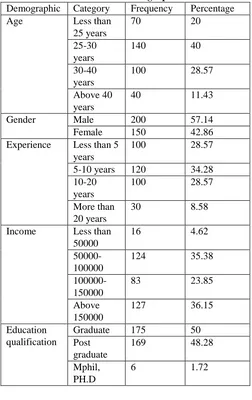
For measuring the mediating effect of organizational commitment data was collected from 350 employees working among IT sector in Delhi and NCR region. Table I illustrates the demographic profile of respondents. When employees were categorised on the basis of gender it was found that there were 200 male and 150 females which show almost equal composition of both the genders. When respondents were distributed according to age, 140 employees were from age group 25-30 followed by age group 30-40 years (100). Minimum numbers of respondents were from age group 40 years and above (40). Employees were also asked over their education qualification. It was recorded that 50% of employees possess only a graduate degree, 48.46% possess post graduate degree and only 1.54% have M.phil/ Ph.D. degree. Talking about their work experience, 100 respondents had an experience of less than 5years, 120 respondents had an experience of 5-10 years, 100 respondents had an experience of 10-20 years and only 30 respondents were from experience group 20 years and above. When respondents were asked about their monthly income group, it was found that 36.15% had income an
[image:3.595.302.555.93.604.2]income above 150000, 23.85% were from income group 100000-150000 whereas 35.38% were from income group 50000-100000.
Table-I: Statistics of Demographic Profile Demographic Category Frequency Percentage
Age Less than
25 years
70 20
25-30 years
140 40
30-40 years
100 28.57
Above 40 years
40 11.43
Gender Male 200 57.14
Female 150 42.86
Experience Less than 5 years
100 28.57
5-10 years 120 34.28 10-20
years
100 28.57
More than 20 years
30 8.58
Income Less than 50000
16 4.62
50000-100000
124 35.38
100000-150000
83 23.85
Above 150000
127 36.15
Education qualification
Graduate 175 50
Post graduate
169 48.28
Mphil, PH.D
6 1.72
Table- II: Reliability statistics
Cronbach Alpha Items
Organizational effectiveness
.78 16
Organizational commitment
.85 15
Organizational climate
.85 30
[image:3.595.304.556.109.509.2]Mean score of organization effectiveness (4.19) also revealed that due to high commitment and good organizational climate the effectiveness was also high. Results further revealed a high and significant correlation between climate and commitment (.63), climate and effectiveness (.67), organizational commitment and effectiveness (.71).
Table- III: Descriptive statistics
Mean S.D. N Correlation
OE OC OCM
OE 4.19 .24 350 1
OC 4.18 .38 350 .67*** 1
OCM 4.29 .26 350 .71*** .63*** 1
[image:4.595.298.556.54.137.2]Note: 1. OCM= Organizational Commitment, OC= Organizational Climate, OE= Organizational effectiveness 2. *** p< .01
Table- IV: Model Fit Indices Chi
-squ are
D. F.
P CMI N/DF
R M R
G FI
A GF I
C FI
IF I
RMS EA
273 .38
16 7
.0 00
1.637 .01 4
.8 24
.77 9
.8 77
.8 80
.070
Table IV depicts the indices of model fitness showing 7 fitness criteria. As shown in the table CMIN/DF is 1.637 which shows that model is good as its acceptable limit is below 4. All values were near to their traditional criteria which showed that model was fit for that study with p value less than .05.
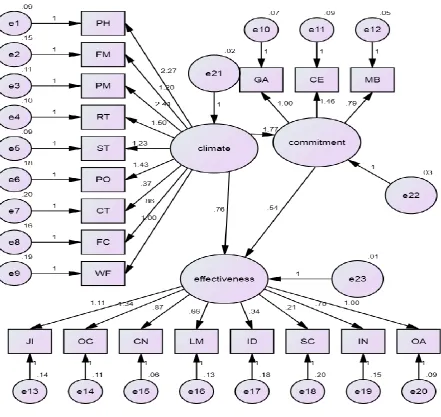
Figure 1: Structural Model of the Study Figure 1 depicts the structural model of the study.
Confirmatory factor analysis was used to test whether the observed measures were related with their own constructs. For model fit and confirmatory analysis various dimensions of organizational climate, organizational commitment and organizational effectiveness were used. Almost each
[image:4.595.73.515.272.689.2]Table- V: Regression Weights of the Model
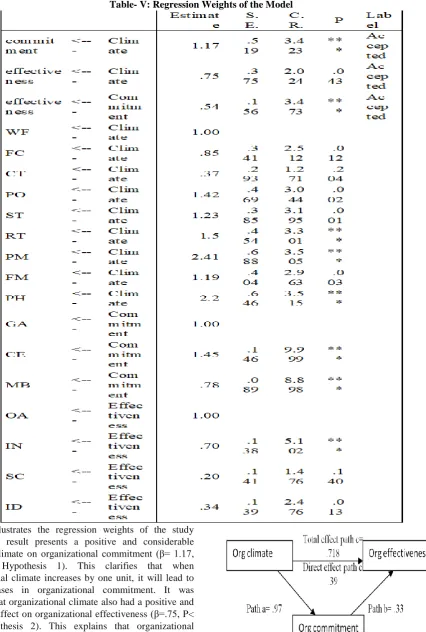
Table V illustrates the regression weights of the study model. The result presents a positive and considerable impact of climate on organizational commitment (β= 1.17, P< 0.01, Hypothesis 1). This clarifies that when organizational climate increases by one unit, it will lead to 1.17 increases in organizational commitment. It was instituted that organizational climate also had a positive and significant affect on organizational effectiveness (β=.75, P< 0.05, Hypothesis 2). This explains that organizational effectiveness is enhanced up to 75% by climate. When the impact of commitment on effectiveness was examined, 54% of variations were depicted by commitment. There found positive and considerable impact of commitment on effectiveness (β= .54, P< 0.01, C.R. = 3.47, Hypothesis 3). Testing for mediation
H4: commitment significantly mediates the association among climate and effectiveness.
Figure 2: Model showing mediating effect with paths
[image:5.595.96.523.52.685.2]Table- VI: Coefficients of the mediating effect
Testing path Β SE(β) 95% CI
Path c: DV = Organizational effectiveness IV =
organizational climate
.718 .06 .581, .856
Path a: DV = Organizational commitment IV =
organizational climate
.96 .10 .760, 1.177
Path b & c’: DV = organizational effectiveness IV =
organizational climate
.39 .07 .242, .548
IV =
Organizational Commitment
.33 .05 .233, .433
Indirect effect Β Boot(S.E.) Boot(LLCI,ULCI) Path (a*b): DV = Organizational effectiveness (hypothesis 4)
IV =
organizational climate MV =
Organizational commitment
.32 .186 .8678, 1.599
Process macro by Hayes was used to test the mediating affect of organizational commitment between organizational climate and organizational effectiveness. Table VI shows different paths and regression coefficients of those paths. Path c explains the association among climate and organizational effectiveness. Path a illustrated the effect of organizational climate on organizational commitment, since the p value is less than .05 it can be said that path a is also significant. When the effect of organizational climate was checked along with organizational commitment as mediator, a significant and positive impact was found (R2= .59, p = .000). Path b depicts the impact of commitment on effectiveness and path c’ measures the direct impact of organizational climate organizational effectiveness. Taking organizational commitment as a mediator when indirect effect of organizational climate on organizational effectiveness was measured, a positive and considerable effect was found (β = .32, Boot (LLCI, ULCI) = .8678, 1.599). Since zero is not included in the Bootstrap confidence intervals, it can be inferred that the mediation was considerable and organizational climate predicts organizational effectiveness with the help of mediator (organizational commitment). After analysing the table it can be determined that commitment considerably mediates the association among climate and effectiveness, hence hypothesis 4 is accepted.
V. CONCLUSION
The study was performed to evaluate the indirect effect of climate on organizational effectiveness through organizational commitment as a mediator in IT sector. The results of present study are similar to those of previous studies. The relationship between organizational culture and
REFRENCES
1. Angle, L. Harold., Perry, L. James. (1981). “An empirical assessment
of organization commitment and organizational effectiveness”, Administrative Science, vol. 26, pp. 1-14.
2. Alaghe Band, A., (2009), “School Health Organizational”, Quarterly
of management in Education, No. 21, pp. 14.
3. Allen, N. J., Meyer, J. P. (1990). “The Measurement and Antecedents
of Affective, Continuance and Normative Commitment to the Organization”, Journal of Occupational Psychology, vol. 63, pp. 1– 18.
4. Ali, A., Patnaik, B. (2014). “Influence of Organizational Climate and
Organizational Culture on Managerial Effectiveness: An Inquisitive Study”, The Carrington Rand Journal of Social Sciences, Vol. 1, No. 2, pp. 1-20.
5. Brown, S.P., Peterson, R.A. (1994). “The effect of effort on sales
performance and job satisfaction”, Journal of Marketing, Vol. 58, No. 2, pp. 70-80.
6. Cameron, Kim. (1978). “Measuring organizational effectiveness in
institution of higher education”, Administrative Science Quarterly, Vol. 23, No. 4, pp. 604-632.
7. Daft, R. L. (1995). “Organizational theory and design”, St. Paul: West Publishing.
8. Drucker, Peter. (1967). “The effective Executive”.
9. Federman, Mark. (2006). “The penguinist discourse: A critical
application of open source software project management to organizational development”, Organization Development Journal, Vol. 24, No. 2, pp. 89-100.
10. Feldman, D.C. (1981). “The multiple socialization of organization
members”, Academy of management Review, Vol. 6, pp. 309-319.
11. Forehand, G. A., Gilmer, B. (1964). “Environmental variations in
studies of organizational behaviour”, Psychological Bulletin, Vol. 62, No. 6, pp. 361-382.
12. Gabrani, A., Hoxha, A. (2016). “Perceived organizational
commitment and job satisfaction among nurses in Albanian hospital: A cross-sectional study”, International journal of healthcare management, Vol. 9, No. 2, pp. 110-118.
13. Gibson, J. L., Ivanevich, J. M., Donnelly, J. H. (1973).
“Organizations: structure, process, behaviour”, Dallas: BPI.
14. Glission, C., Durick, M. (1988). “Predictors of job satisfaction and
organizational commitment in human service organizations”, Administrative Science Quarterly, Vol. 33, pp. 61-81.
15. Khadivi, A., Alijani F. R. (2008). “The relationship between
managers achievement motivation and organizational effectiveness in high schools”, Journal of Natural Sciences of Azad University of Tabriz, Vol. 1, pp. 39-72.
16. Lawler, E. E., Hall, D. T., Oldham, G. R. (1974). “Organizational
Climate: Relationship to Organizational Structure, Process and Performance”, Organizational behaviour and human performance, Vol.11, pp. 139-155.
17. Mayer, J., Allen, N. (1987). “Organizational Commitment: Towards a
three component Model”, Research Bulletine no. 660, University of Western Ontario.
18. Menon, A.S. (1971). "Performance Effects”, Shri Ram Centre for
Industrial Relations and Human Resources, New Delhi, Unpublished manuscript.
19. Meyer, J.P., and Allen, N. J. (1997). “Commitment in workplace:
Theory, research and application”, Thousand Oaks, CA: Sage.
20. Mottaz, C. J. (1987). “An analysis of the relationship between work
satisfaction and organizational commitment”, The Sociological Quarterly, Vol. 28, No. 4, pp. 541- 558.
21. Mowday, R. T., Steers, R. M., and Porter, L. M. (1979). “The
measurement of organizational commitment”, Journal of Vocational Behavior, Vol. 14, pp. 224-247.
22. Mowday, R. T., Porter, L. W., and Steers, R. M. (1982).
“Employee-organizational linkages: The Psychology of commitment,
absenteeism, and turnover”, New York: Academic Press.
23. Nammi, A. Z., Nezhad, M. Z. (2009). “The relationship between
psychological climate and organizational commitment”, Journal of Applied Sciences, Vol. 9, No. 1, pp. 161-166.
24. Pennings, J. M., Goodman, P. S. (1977), “Toward a workable
framework”, in Paul S. Goodman and Johannes M. Pennings (eds), New Perspectives on Organizational Effectiveness (Jossey-Bass, San Francisco).
25. Pettaway, L., Waller, L., Waller, S. (2015). “Surveying organizational
effectiveness: A case study from the United Arab Emirates”,
Proceedings of academy of organizational culture, communication and conflict, Vol. 20, No. 2, pp. 27-36.
26. Porter, L. W., Steers, R. M., Mowday, R. T., Boulian, P. V. (1974).
“Organizational commitment, job satisfaction and turnover among psychiatric technicians”, Journal of Applied Psychology, Vol. 59, pp. 603-609.
27. Powell, K. S., Yalcin, S. (2010). “Managerial training effectiveness:
A meta analysis 1952-2002”, Personnel Review, Vol. 39, No. 2, pp. 227-241.
28. Rahim, A M., Khan, A. A., Uddin, J. S. (1994). “Leaders power and
subordinates’ organizational commitment and effectiveness: Test of a theory in a developing country”, The International Executive, Vol. 36, No. 3.
29. Robbins, S.P. (2001). “Organizational Behaviour”, Prentice Hall,
Upper Saddle River, New York.
30. Romzek, B.S. (1989). “Personal Consequences of Employee
Commitment”, Academy of Management Journal, Vol. 32, No. 3 pp. 649–661.
31. Schneider, B., Bartlett, C. J. (1968). “Individual differences and
organizational climate: The research plan and questionnaire development”, Personnel Psychology, Vol. 21, No.3, pp.323-333.
32. Sharan, N.K., (1968). "The Climate of an Organisation", Indian
Management, Vol. 8, pp. 51- 56.
33. Steers, R. M. (1977). “Antecedents and Outcomes of Organizational
Commitment”, Quarterly Journal of Administrative Science, Vol. 22, pp 46-56.
34. Tagiuri, R., Litwin, G. H., (1968). Organizational Climate:
Exploration of a concept. Boston, MA: Harvard University Press.
35. Uthayasuriyan, K. (2005). “Organizational Climate in Public Sector
Enterprises”, Udyog Pragati, Vol. 29, No. l, Pp.23-31.
36. Ussahawanitchakit, P. (2008). “Organizational learning capability,
organizational commitment and organizational effectiveness: An empirical study of Thai accounting firms”, International Journal of Business Strategy, Vol. 8, No. 3.
37. Wiener, Y. (1982). “Commitment in organizations: A normative
view”, Academy of Management Review, Vol. 7, No.3, pp. 418-428.
AUTHORS PROFILE
Reetu, Mphil, is an assistant professor in department of commerce, P.I.G. Govt. College for woman, Jind, Haryana, India. She is pursuing her PhD on organizational effectiveness and it’s predicting variables like job satisfaction, organizational climate
and organizational commitment from Amity
university, Noida, Uttar Pradesh. She has published two research papers in International Journals. First paper in International Journal of Applied Business and Economic Research titled as “The influence of Job Satisfaction and organizational commitment on organizational effectiveness of Indian navy”, and second paper in Anwesh: International Journal of Management and Information Technology titled as “Job satisfaction among teaching staff in Higher education”.
Dr. Anshu Yadav, PhD, is an assistant professor in Amity Business School, Amity University, Noida, Uttar Pradesh, India. She has a teaching experience of eight years. She has also trained various managers and officers of different banks and armed forces. She
has passed company secretaries executive
examination in 2010. She is an active member of Indian society of training and development. She has various papers published in reputed journals like Management and Labour Studies, international Journal of Applied business and Economic Research, International Journal of Control Theory and
Applications, Zenith International Journal of
Multidisciplinary Research, International journal of Management and Development Studies etc.