International Journal of Innovative Technology and Exploring Engineering (IJITEE) ISSN: 2278-3075,Volume-8 Issue-11, September 2019
Abstract: For representing and manipulating uncertain information like fuzzy, incomplete, inconsistent or imprecise, Neutrosophic relation database model is a more general platform, in the human decision-making process. Neutrosophic sets can easily handle real world problems. A new correlation method is introduced in this paper to construct similarity measure, by which decision making problem that exist in real world situation can be easily handled in regard of multiple existing criteria’s or incomplete or inconsistent information. The selection of the best option of alternative can be done by ranking all the other options as per similarity measure depending on concept of similarity. Later in this paper, an explanatory example is given of the proposed method and the comparison results are also presented to show the effective output.. The application in certain domains of medical diagnosis problems having multiple criteria’s in decision making are also discussed in the end of the proposed method.
Keywords : Maximum approximation, Minimum approximation, Efficient decision making, Similarity measure.
I. INTRODUCTION
In data mining [1] to extract data patterns [2] intelligent methods are used. There are three different types of data mining techniques [3] which are helpful in extracting data. As uncertainty and indeterminacy is present in the real world situations there is a need to explore efficient decision making method for multiple criteria options. Such situations can be easily understood by Neutrosophic logic
In various real problems the fuzzy sets, vague sets and rough sets([4],[5],[6]) are applied on incomplete and uncertain information. The neutrosophic logic is basically the based on concept of different sets i.e classic, intuitionistic, fuzzy [7] and interval valued sets ([8],[9]). Furthermore, the crisp logic always results in 0 or 1 i.e either true or false and in others also the fact of indeterminacy is not taken into consideration, while in the neutrosophic set, indeterminacy is also considered along with truth and falsity membership functions.
However, these expressions where a part of indeterminacy is also included is not included in the scope of the fuzzy logic.
Revised Manuscript Received on September2, 2019.
Dr. Meena Arora*, Department of Information Technology, JSS Academy of Technical Education,, Noida, India. Email: [email protected]
So in such type of cases, the notion of neutrosophic set overcomes the aforementioned issues. For dealing with problems of imprecise data neutrosophic logic was first proposed by Smarandache [10],[11],[12].
The role of Neutrosophic logic is discussed for the issues in data mining. Data mining technique is also used for lifestyle based human disorders [13]. Indeterminacy is the common issue in real scenarios. Recently, neutrosophy technique is used by many researchers for various applications in medical science such as noise reduction and segmentation, image retrieval disease diagnosis like detecting tumours, diagnosis of human disorders like psychological , chronic, cardiovascular [14],[15],[16] and also fatal diseases[17]. This shows that good execution in terms of indeterminacy and performance is provided by neutrosophy. The decision-making issues for indeterminate, inconsistent or incomplete information that exists in natural scenarios the ideal alternative can be obtained by the proposed method via rank ordering of all alternatives which is highly efficient and is proved with the help of examples.
Therefore the main objectives are to state some similarity measure function to form a multi-criteria decision and to do comparison with any previously defined method.
II. RELATED WORK
In practical life scenario problems, the data given is generally imprecise or non-deterministic. Imprecision means the data can be - non-matching, imprecise, inconsistent, misaligned schemas, etc. In general judgments and evaluation or calculation of data is done by humans (or by n intelligent machines by feeding the raw data to them) where certainly knowledge is a constraint. For example it is very easy to decide “whether 6+5 = 11 or not”, and there are no confusions regarding this. As in case of cancer like disease even the doctor will hesitate to confirm this to the patient as a part of evaluation of complete information may remain unpredictable to him.
Florentin Smarandache created three-valued logic called as Neutrosophic logic in 1995 and defined the term Neutrosphy [18] that use an indeterminate value also along with truth & false values i.e IA(x), TA(x), FA(x) also termed as indeterminacy membership, truth membership, falsity membership of a neutrosophic set[19].
An Ideal Technique for Decision-Making
Problems for Uncertain Data and Its Application
In Medical Science
TA: X→]-0, 1+ [ , (1) IA: X→]-0, 1+[ , (2)
FA: X →] -0, 1+ [. (3) Sometimes it becomes difficult to find the exact values of
truth and of falsity, so instead of a numbers approximate them as a subsets. Ranking is basically finding the similarity score between the result and the target value [20]. Similarity measures using Neutrosophic sets are calculated using different techniques in [21], [22]. Method proposed here is more precise and reliable as it gives a closer value to authenticity.
III. CONSTRUCTIVE APPROACH
In this section, a similarity measure function for choosing the alternatives (multi criteria options) is introduced by looking into the concept of T, I, F memberships and listed some basic properties below.
3.1. Definition
Let two neutrosophic sets P and Q and x be a space of points in universe U.
1) Let L = P UQ, where ∀x ∈U, then TL(x) = TP(x) OR TQ(x), IL(x) = IP(x) AND IQ(x) and FL(x) = FP(x) OR FQ(x); 2) Let M = PՈQ be the intersection of P and Q of RNS, where ∀x ∈ U, TM(x) = TP(x) ∧ TQ(x), IM(x) = IP(x) ∨ IQ(x), and FM(x) = FP(x) ∨ FQ(x), where “∧” and “∨” denote minimum and maximum respectively.
3.2. Definition
Let Ȓ (P) and R (P) are maximum and minimum approximation of P w.r.t. (U, R), are two sets whose µ can be defined as:
For R( P) the truth membership will be
TR(P)(x) = minimum y∈U (TA(y)∨FR(x,y)), (4) Therefore
TȒ(P)(x) = maximum y∈U (TA(y)∧TR(x,y)), (5) The indeterminant membership will be
IR(P)(x) = maximum y∈U (IA(y)(1−IR(x,y))), (6) Therefore
IȒ(P) (x) = minimum y∈U ( IA(y) ∨ IR(x,y)), (7) The falsity membership will be similarly
FR(P)(x) = maximum y∈U (FA(y)∧TR(x,y)), (8)
FȒ(P)(x) = minimum y∈U(FA(y)∨FR(x,y)). (9) Let Ȓ (P) and R( P) complement denotes the Neutrosophic
maximum and minimum approximation operators. Let two neutrosophic numbers m1 and m2 are denoted as m1 = (Tm1, Im1, Fm1) and m2 = (Tm2, Im2, Fm2) and the operations on them are defined as follows:
m1⊕m2=(Tm1+Tm2−Tm1·Tm2,Im1·Im2,Fm1·Fm2). (10) Therefore
m xk = (R( P) ⊕ Ȓ (P))(xk ) (k = 1, 2, · · · , l), (11)
m1 ʘ m = (Tm1 ·Tm2, Im1 +Im2 −Im1 ·Im2, Fm1 +Fm2 − Fm1 ·Fm2). (12)
For the efficient decision making process addition of two neutrosophic numbers for finding ranking of sets P and Q as an exclusive OR between two sets is defined. The measure based on similarity concept between neutrosophic numbers is
follows:
S(mxk, m) = (Tmxk.Tm +Imxk.Im+Fmxk.Fm) for i=1 to n. It also satisfies the properties: S(mxk, mxk)= T(mxk); S(mxk, m)= S(m, mxk);
3.3. Definition
The similarity measure {considering mxk = (Tmxk, Imxk, Fmxk) be a neutrosophic number, and m∗ = (Tm∗, Im∗, Fm∗) = (1, 0, 0) be the ideal neutrosophic number}, between m and m∗ is defined as follows:
S(mxk, m∗) = [ (Tmxk ·Tm∗ +Imxk ·Im∗ +Fmxk ·Fm∗ )] / [(sqrt(T 2
mxk +I2 mxk +F2 mxk)) · ( sqrt( (Tm∗)2 +(Im∗)2 +(Fm∗)2)]. (13) According to neutrosophic set property
-0<= S(mxk, m∗)<=1+
Let neutrosophic numbers mxk represents the properties of the alternatives xk (k = 1, 2, n) for decision making in case of multiple attributes. The option xk is nearer to the target alternative x∗ when the value of the Similarity measure S(mxk ,m∗) is bigger and at this point the choice of alternative xk will be better as it will be ideal and this helps in efficient decision making technique for multiple criteria. The best alternative can be obtained by finding out ranking of all options by doing the comparison of the similarity measure value of all alternatives
From the above discussion, an algorithm is developed depending on the similarity measure for efficient decision making problem having multiple criteria’s, to find an optimum solution.
Algorithm
Step1. Read the values of its truth, Indeterminacy and falsity membership functions.
Step2. Evaluate the max and min approximations of P of two neutrosophic sets R (P) and its complement (by Definition 3.2), refer to (4), (5), (6), (7), (8), (9)
Step3. Calculate m xk = (R( P) ⊕ Ȓ (P))(xk ) (k = 1, 2, · · · , l); refer to (11)
Step4. Compute similarity measure
S(mxk, m∗) = [ (Tmxk · Tm∗ +Imxk ·Im∗ +Fmxk ·Fm∗ )] / [(sqrt(T2 mxk +I2 mxk +F2 mxk))·( sqrt( (Tm∗)2 +(Im∗)2
+(Fm∗)2)]. (by Definition 3.3), refer to (13)
Step5. Select the similarity measure whose value is maximum and that will be the efficient decision making among multi- valued attribute.
IV. RESULTS WITH EXPLANATORY EXAMPLE
In order to signify the feasibility of the algorithm suggested, following example has been taken efficient decision making problem for multiple criteria options.
If t is a possible truth degree, i is an indeterminacy degree and f is an impossible degree of Disease S of every Patient ptk∈ U that is diagnosed by Doctor D, denoted by A(ptk ) = (d, e, f), then the decision maker (Doctor D) for the efficient decision making problem needs to know how to evaluate whether Patients ptk ∈ U have Disease A
International Journal of Innovative Technology and Exploring Engineering (IJITEE) ISSN: 2278-3075,Volume-8 Issue-11, September 2019
evaluates every Patient ptk (k = 1, 2, · · · , 5) as shown in Table I.
Suppose Disease A ∈ NS (V) and let A = (0.3, 0.6,0.5)/s1 + (0.7, 0.2,0.1)/s2 + (0.6, 0.4,0.3)/s3 + (0.8, 0.4, 0.5) s4. As per algorithm (Algorithm 1) given in section 3 the values
of similarity measure are calculated considering m∗ = (1, 0, 0). And finally its concluded that s(mp1, m∗). has the maximum value. Therefore, Patient pt1 is more likely to be sick with Disease A. Table 1 can be shown below in the form of Graph as shown in Fig1.
Table I Neutr osoph ic relati
on R betwe en the sympt
oms and diseas
es
Fig. 1. Patient’s probability of different symptoms
Thus, the calculation of ranking of the choices is very important for the making a decision between the options of different alternatives given.
V. COMPARITIVE ANALYSIS
To authenticate the practicability of the proposed method a comparative analysis is done with the other method prescribed by Peide Liu[23]
Let’s consider the Decision Matrix as per Table 1 for P Liu’s Algorithm .Suppose the weight vector of the criteria is w = (0.35,0,25,0.3,0.1) and γ = 1.
As per P Liu’s method the best ranking alternative, is achieved by the following steps (Algorithm 2) :
Step 1: According to Hammer single-valued neutrosophic number-weighted geometric (HSVNNWG) operator collective overall values are , as
s(pt1) = (0.557,0.178,0.482), s(pt2)= (0.484,0.283,0.395), s(pt3)= (0.414,0.318,0.347), s(pt4) = (.465,0.286,0.558), s(pt5) = (0.578,0.233,0.486).
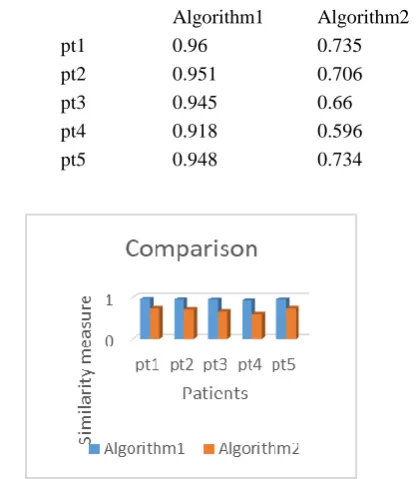
St Step 2: Calculating the similarity measure for s(pti)(i=1,2,3,4,5) i.e s(pt4) = 0.596, s(pt5) = 0.734. Step 3: Ranking the alternatives in an order. One can rank the alternatives as: s(pt4) < s(pt3) < s(pt2) < s(pt5) < s(pt1). Therefore, Patient p1 is more likely to be sick with Disease A, as a result of P Liu’s Algorithm. Comparison in the form of table (Table II) and graph (Fig 2) are shown below.
[image:3.595.331.540.289.529.2]Table II . Comparison of similarity measure of both algorithms
Fig. 2. Comparison analysis of our algorithm with P Liu’s Algorithm
The method for decision matrix proposed in this paper is more sustainable and is based on less calculation for problems having multiple criteria’s with indeterministic or imprecise information.
The highest correlation measure gives the proper medical diagnosis. So, as per the closeness value patient pt1 is more likely be suffering from disease A as per our illustrative example given in section 4. So by getting more appropriate (close) values than given in [23], it can be concluded that proposed method is much more reliable as it gives a more closer value to authenticity option.
VI. APPLICATIONS OF PROPOSED METHOD
This method can be applied in various medical science issues. Few of them are listed below:
pt1 pt2 pt3 pt4 pt5 s
1 (0.7, 0.2, 0.5)
(0.5, 0.3, 0.2)
(0.4, 0.5, 0.2)
(.6, 0.1, 0.7)
(0. (0.3, 0.2, 0.6) s
2 (0.6, 0.2, 0.4)
(0.5, 0.2, 0.8)
(0.2, 0.3, 0.6)
(0.4, 0.5, 0.7)
(0. (0.7, 0.3, 0.5)
s
3 (0.4, 0.1, 0.5)
(0.4,0. 5, 0.4)
(0.5, 0.2, 0.4)
(0.3, 0.6, 0.5)
(0.6, 0.3, 0.5) s
4 (0.1, 0.5, 0.6)
(0.6, 0.1, 0.7)
(0.6, 0.3, 0.4)
(0.5, 0.3, 0.2)
(0.8, 0.1, 0.2)
Algorithm1 Algorithm2
pt1 0.96 0.735
pt2 0.951 0.706
pt3 0.945 0.66
pt4 0.918 0.596
A. Detect tumours using similarity set score based on neutrosophic set in ultrasound image segmentation [24].It is a challenging task to segment the tumors To segment and detect tumors the Similarity score method as proposed above can be applied for this issue. Set score vector method detects the direction of image growing and distance vector between the candidate points and seed regions. Finally, a pre trained deep learning network and transfer learning scheme are used for false positive reduction. The breast ultrasound image can be segmented and tumor can be extracted perfectly by using this method accurately.
B. Seed Point choice for Image Segmentation using Neutrosophic method for Thyroid Nodule Images [25] A test pixel that belongs to the suspicious region is termed as seed. The accurate seed choice is required, due to the haphazard growth of cells that might be malignant or benign [26] as the region growing outcome is sensitive to the underlying seeds so for as image segmentation is concerned. Thyroid nodule malignancy has become one of the vital life-threatening issues. Thyroid malignancy is very higher in number as categorized by American Cancer Society's evaluations in 2018[27]. An irregular cell development is one of the causes of thyroid nodule. By detecting nodule at the initial stages the rate of survival can be improved. To recognize and calculate the seed point automatically a method was proposed by Michahial et al. [28]. The value of entropy in Lesion regions which are homogeneous in ultrasound is high compared to its neighbors. Neutrosophic image enhancement technique is used to select seed point in nodule image automatically. This is very beneficial in malignancy diagnosis in thyroid nodule.
C. Image Retrieval Classifier using Neutrosophic Sets [29] A two phase Content based image retrieval system technique gives good results as compared to image retrieval system based on fuzzy sets [30]. In initial step to represent the content of every image, the set of features are extracted from the image to represent the content in the training database. Then after this step, the distance between the image that has to be evaluated, and all other images in the training database is calculated. The similarity measure proposed in this paper can be used, for retrieving the most similar image from the N most similar images.
VII. CONCLUSION
Based on neutrosophic sets an algorithm for accurately making a decision from the different choices given is presented in this paper. Firstly, the definition of Neutrosophic sets & logic and few operations on the sets are introduced. Then a method for solving reaching to a decision in problems having multiple criteria’s is explored depending on the similarity measure and ranking technique.
The best alternative with all ranking orders can be obtained through this proposed similarity measure method of efficient decision making. The proposed method is also highly
incompleteness and inconsistency in information which is a common scenario in the present world in comparison the present methods. . The usefulness of the defined algorithm is also discussed taking the help of an explanatory example. Then in last section few applications based on similarity measure are also mentioned in the paper to mark the practicality of the defined method in this paper.
REFERENCES
1. Jiawei Han, Micheline Kamber, Jian Pei, “Data mining concepts and techniques”, 2012 by Elsevier.
2. M. Rekha and M. Swapna. Role of fuzzy logic in data Mining, International Journal of Advance Research in Computer Science and Management Studies, 2(12), 2014.
3. E.Hullermeier Fuzzy methods in data mining: status and prospects. Fuzzy Sets and Systems, 156(3), 387-406, 2005
4. J. Mishra , S. Ghosh, “Uncertain Query Processing using Vague Sets or Fuzzy Set: Which one is Better?”, International Journal of Computers, Communications and Control (IJCCC), Vol. 9, No. 6, pp. 730-740, 2014
5. F. Zhao, Z. M. Ma and L. Yan, “A Vague Relational Model and Algebra”, Fourth International Conference on Fuzzy Systems and Knowledge Discovery (FSKD 2007), Vol. 1, pp. 81-85, 2007. 6. F. Zhao and Z. M. Ma, “Vague Query Based on Vague Relational
Model”, AISC 61, pp. 229-238, Springer- Verlag Berlin Heidelberg, 2009.
7. Atanassov, K. (1986). Intuitionistic fuzzy sets. Fuzzy Sets and Systems, 20, 87–96.
8. Atanassov, K. (1994). Operators over interval-valued intuitionistic fuzzy sets. Fuzzy Sets and Systems, 64(2), 159–174.
9. Atanassov, K., & Gargov, G. (1989). Interval-valued intuitionistic fuzzy sets. Fuzzy Sets and Systems, 31(3), 343–349.
10. F. Smarandache, “First International Conference on Neutrosophy, Neutrosophic Probability, Set, and Logic”, University of New Mexico, Vol. 1, No. 3, 2001.
11. F. Smarandache (2002a), “A Unifying Field in Logics: Neutrosophic Logic, in Multiple-Valued Logic”, International Journal, Vol. 8, No. 3, pp.385-438, 2002.
12. F. Smarandache, “Definitions Derived from Neutrosophics, Multiple-Valued Logic”, International Journal, Vol. 8, No. 5-6, pp.591-604, 2002.
13. Sharma,M..G. Singh “Stark Assessment of lifestyle based human disorders using data mining based learning techniques” IRBM 38.6.(2017) : 305-324G
14. Kaur, Prableen and Manik Sharma “Diagnosis of human psychological Disorders using supervised learning and Nature Inspired computing Techniques: A Meta: Analysis.” Journal of medical systems 43.7(2019): 204
15. Gautam, Ritu, PrableenKaur and Manik Sharma “ A comprehensive review on nature inspiredcomputing algorithms for the diagnosis of chronic disorders in human beings” Progress in Artificial intelligence(2019): 1-24
16. Sharma, Manik, Gurvinder Singh and Rajinder Singh “An advanced conceptual diagnostic healthcare framework for Diabetes and Cardiovascular disorders” arXiv preprint arXiv: 1901.10530(2019). 17. Kaur, Prableen and Manik Sharma” A survey on using nature inspired
computing for fatal disease diagnosis” International journal of Information System Modeling and Design(IJISMD) 8.2(2017):70-91 18. F. Smarandache. A unifying field in logics. neutrosophy: neutrosophic
probability, set and logic. Rehoboth: American Research Press, 1998 19. F. Smarandache (2002c), editor, Proceedings of the First International
Conference on Neutrosophy, Neutrosophic Logic, Neutrosophic Set, Neutrosophic Probability and Statistics, University of New Mexico, Gallup Campus, Xiquan, Phoenix, 147p., 2002,
20. Meena Arora, Ranjit Biswas "Rank neutrosophic Armstrongs axioms and functional dependencies" International journal of computer science and communication Vol 1 Dec 2010
21. Rıdvan Şahin “Multi-criteria neutrosophic decision making method based on score and accuracy functions under neutrosophic environment “
International Journal of Innovative Technology and Exploring Engineering (IJITEE) ISSN: 2278-3075,Volume-8 Issue-11, September 2019
Author-1 Photo
and Applied Mathematics(ETPAM-2018)- March 2018
23. Liu, P. The aggregation operators based on archimedean t-conorm and t-norm for single-valued neutrosophic numbers and their application to decision making. Int. J. Fuzzy Syst. 2016, 18, 849–863.
24. Xue Jiang, Yanhui Guo, Yao Lu, "A novel region growing approach using similarity set score and homogeneity based on neutrosophic set for ultrasound image segmentation," Proc. SPIE 11069, Tenth International Conference on Graphics and Image Processing (ICGIP 2018), 110692C (6 May 2019).
25. S. O. Haji, R. Z. Yousif “A Novel Neutrosophic Method for Automatic Seed Point Selection in Thyroid Nodule Images” Biomedical Research international journal Published online 2019 Apr doi: 10.1155/2019/7632308.
26. Acharya U. R., Chowriappa P., Fujita H., et al. Thyroid lesion classification in 242 patient population using Gabor transform features from high resolution ultrasound images. Knowledge-Based systems. 2016; 107:235–245. doi: 10.1016/j.knosys.2016.06.010. [CrossRef] [Google Scholar].
27. Siegel R. L., Miller K. D., Jemal A. Cancer statistics. CA: A Cancer Journal for Clinicians. 2018; 68(1):7–30. doi:10.3322/caac.21442. [PubMed] [CrossRef] [Google Scholar]
28. Michahial S., Thomas B., Kiran S. A novel algorithm to select a seed point automatically in breast ultrasound image. Indian Journal of Science and Technology. 2017; 10(1):1–8. doi: 10.17485/ijst/2017/v10i1/110288. [CrossRef] [Google Scholar] 29. A. A. Salama, Mohamed Eisa, A. E. Fawzy Port “A Neutrosophic Image
Retrieval Classifier” International Journal of Computer Applications (0975 – 8887) Volume 170 – No.9, July 2017 [29] Siegel R. L., Miller K. D., Jemal A. Cancer statistics. CA: A
30. A. A. Salama1, Mohamed Eisa and M. M. Abdelmoghny “Neutrosophic Relations Database” International Journal of Information Science and Intelligent System, 2014.
AUTHORS PROFILE