957
Sleep Wake Scheduling Algorithm Using Enegy
Efficient And Secure Data Transmission
Sujitha S
Abstract: Presently a day's wireless sensor networks (WSNs) pull in the analysts increasingly because of their prevalent applications in environment monitoring, radiation and nuclear-threat detection structure; weapon sensors for boats; battlefield reconnaissance and observation; military power, control, insight, interchanges and focusing on frameworks and biomedical angles. Wireless sensor networks can give minimal effort answer for different real-world issues. Sensors are ease gadgets with restricted capacity, computational power. Wireless Sensor Networks (WSNs) are developing as a promising innovation as a result of their wide scope of utilizations in mechanical, environmental monitoring, military and regular citizen spaces. Because of financial contemplations, the hubs are normally straightforward and minimal effort. They are regularly unattended, be that as it may, and are subsequently prone to experience the ill effects of various sorts of novel assault. This paper proposed to Sleep Wake Scheduling algorithm and their test results are presented to better execution contrasted and existing work.
Keywords: Sleep Wake, WSN, Accuracy, Detection, Classification.
————————————————————
1. Introduction
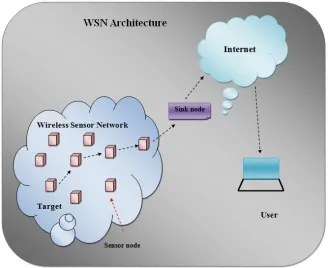
A wireless sensor arrange (WSN) comprises of spatially conveyed self-governing sensors to monitor physical or environmental conditions, such as temperature, sound, pressure, etc. and to helpfully go their data through the system to a principle area. The more current networks are bi-directional, likewise empowering control of sensor action. The advancement of wireless sensor networks was roused by military applications, for example, battlefield reconnaissance; today such networks are utilized in numerous mechanical and customer applications, for example, modern procedure monitoring and control, machine wellbeing monitoring, and so on. The improvement of wireless sensor networks was propelled by military applications, for example, battlefield observation; today such networks are utilized in numerous modern and purchaser applications, for example, mechanical procedure monitoring and control, machine wellbeing monitoring. The WSN is worked of "nodes" – from a couple to a few hundreds or even thousands, where every node is
Figure 1: WSN Architecture
For objective following applications, idle listening is a noteworthy wellspring of energy squander. To diminish the energy utilization during idle listening, duty cycling is one of the most ordinarily utilized methodologies. The possibility of duty cycling is to placed nodes in the sleep state for more often than not, and just wake them up intermittently. In specific cases, the sleep pattern of nodes may likewise be expressly planned, i.e., compelled to sleep or awakened on demand. This is typically called sleep scheduling .As a pay for following performance misfortune brought about by duty cycling and sleep scheduling, proactive wake-up has been read for awakening nodes proactively to get ready for the moving toward objective. In any case, most existing endeavors about proactive wake-up basically awaken all the neighbor nodes in the zone, where the objective is required to touch base, with no separation. Truth be told, it is in some cases superfluous to awaken all the neighbor nodes. To sleep-plan nodes definitely, in order to lessen the energy utilization for proactive wake-up. For example, if nodes know the definite course of an objective, it will be adequate to awaken those nodes that spread the course during when the objective is required to cross their detecting territories. Wireless sensor networks (WSN s) are generally applied in monitoring, detecting, and gathering the data of enthusiasm for the environment. Localization of objective nodes is an essential issue in wireless sensor networks. Up to now, the most existing localization algorithms of WSNs can be arranged into two classes: run based and run free. Range-based algorithms use separation or edge assesses in their area estimations. Without range algorithms use availability data between obscure nodes and grapple nodes. Range-based localization algorithms need to gauge the genuine separations or direction between nearby nodes, and then utilize the deliberate data to find obscure nodes. There will be estimation blunders in commonsense localization frameworks that outcome in loud go estimations. In this
manner, accuracy in the position estimation stage is profoundly touchy to go estimations. Without improving reach estimation or adding some other data identified with localization, the accuracy of the present range-based algorithms can't be improved clearly. Indoor localization of WSNs has been a hot research subject throughout the previous quite a long while. Because of the randomness of targets moving and the confused indoor environment, it is altogether different to find indoor portable objective.
2. Literature Survey
Das, T et al proposed Target tracking is one of the most well known uses of mobile wireless sensor networks (MWSNs), where coverage and data gathering algorithms are establishments to accomplish effective target tracking. Since the portability of sensor nodes is critical in this specific class of utilization, it is pivotal to plan productive systems that can deal with the versatility. In this paper, creator especially focuses on military observation territory where intruder tracking is one of the basic undertakings. Numerous portability models proposed so far in the writing are utilized to reproduce and assess the presentation of the networks. Now and again bunch versatility model is favored over individual portability model to reenact the idea of the application, for example, military observation, catastrophe alleviation, strategic condition and so on. More often than not, bunches are framed at the hour of sensor hub arrangement and become fixed. Zhou Xin-lian et al
959
(ought to be kept away from inner-cluster nodes leaving), others ought to sleep. Thus understands the timetable of higher vitality nodes round sleeping. Reproduction result show by this calendar, EDG (Efficient Data Gathering) diminishes data delay, and to a great extent mitigates the weight of cluster-head, and has evident vitality sparing impact, and ponders hub's portability, can ideally suit to mobile wireless sensor arrange. Gagneja, K. K et al
proposed Heterogeneous Sensor Networks are more dominant and efficient than homogeneous sensor networks. Homogeneous sensor networks perform inadequately on account of routine breaking points and versatility. In this exploration, creator considers to utilize heterogeneous topology to safely route data in a wireless sensor arrange. The given territory of intrigue is at first partitioned into Voronoi clusters, where low-end nodes make clusters with top of the line nodes. Each cluster has only one top of the line hub and various low-end nodes. Voronoi clusters are driven by the separation between the nodes, yet purposed routing technique the "Improved Tree Routing" utilizes hop count to route the data in the system. Nonetheless, Voronoi clusters forget about certain holes in the topology. Jambli, M.N. et al this paper proposing saving energy is an extremely basic issue in wireless sensor networks (WSNs) on the grounds that sensor nodes have serious resource constraints, for example, absence of handling power and restricted in power supply. Since the correspondence is the most energy devouring exercises in WSNs, the power use for transmission or gathering of parcel ought to be overseen appropriately. Transmission power control (TPC) technique is one of the techniques to diminish energy utilization which has been generally examined in mobile ad-hoc networks (MANETs). This technique is executed by adjusting the transmission power in correspondence between nodes. Nonetheless, as mobile wireless sensor networks (WSNs) applications rise, the remarkable attributes of this system, for example, extreme resource constraints and incessant topology change recommend that TPC may be helpful to decrease energy utilization in WSN.
3. Proposed Work
3.1 Sleep Wake Scheduling Algorithm
Sleep-wake scheduling is a powerful component to drag out the lifetime of energy-constrained wireless sensor networks. It is a powerful Mechanism to draw out the lifetime of these
energy-constrained wireless sensor networks. Be that as it may, sleep–wake scheduling could bring about considerable delays on the grounds that a transmitting node needs to wait for its next-hop relay node to wake up. A fascinating profession endeavors to diminish these delays by building up "any cast"- based packet forwarding schemes, where every node entrepreneurially advances a packet to the primary neighboring node that wakes up among numerous candidate nodes. In proposed framework builds up an any cast packet forwarding scheme to diminish the occasion revealing delay and to drag out the lifetime of wireless sensor networks utilizing offbeat sleep–wake scheduling. In particular, thinks about two enhancement problems. In the first place, when the wake-up paces of the sensor nodes are given, Develop an efficient and distributed algorithm to limit the normal occasion detailing delay from all sensor nodes to the sink. Second, utilizing a particular meaning of the system lifetime, study the lifetime-maximization problem to ideally control the sleep–wake scheduling arrangement and the any cast strategy so as to boost the system lifetime subject to a furthest limit on the normal start to finish delay. The advantages are sleep/wake scheduling for low obligation cycle sensor networks, think about synchronization mistake, accomplish given catch likelihood threshold with min energy utilization.
Step 4: Determine the node to be scheduled to sleep. for each CH
Construct Raw data matrix X;
After the data is standardized, it is transformed into a fuzzy matrix R;
The member nodes are divided into k categories;
for each category v
for each node j, k
calculate Del ( between the data from node ;
∑
end for end for
Obtain redundant nodes set { for each node {
send sched_MSG(id_CH, id, state_flag); receive sched_MSG_ACK;
end for
4. Experimental Results
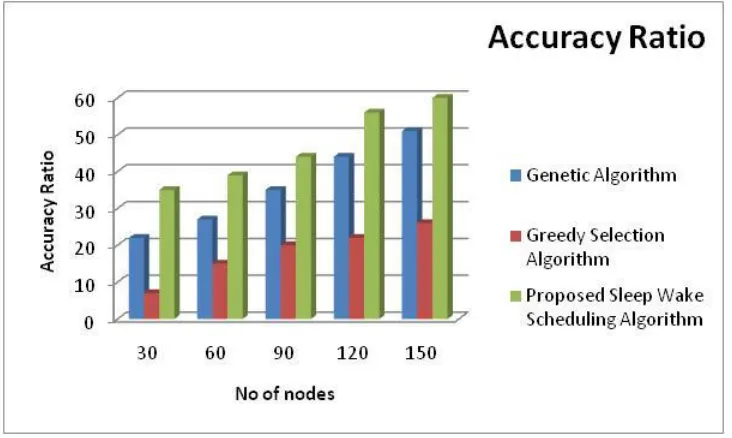
Accuracy Ratio
Genetic Algorithm Greedy Selection Algorithm Proposed Sleep Wake Scheduling Algorithm
22 7 35
27 15 39
35 20 44
44 22 56
51 26 60
The comparison table of accuracy ratio of Genetic Algorithm, Greedy Selection Algorithm and Proposed Sleep Wake Scheduling Algorithm shows the different values. While comparing the Genetic Algorithm, Greedy Selection Algorithm and Proposed Sleep Wake Scheduling Algorithm the Proposed Sleep Wake Scheduling Algorithm is better.
The Genetic Algorithm value starts from 22 to 51, Greedy Selection Algorithm values starts from 7 to 26 and the Proposed Sleep Wake Scheduling Algorithm values starts from 35 to 60. Every time the Proposed Sleep Wake Scheduling Algorithm gives the great results.
Figure 2: Comparison chart of Accuracy Ratio
The comparison chart of accuracy ratio of Genetic Algorithm, Greedy Selection Algorithm and Proposed Sleep Wake Scheduling Algorithm demonstrates the different values. No of nodes in x axis and Accuracy ratio in y axis. The Proposed Sleep Wake Scheduling Algorithm is better than the other two algorithms. The Genetic Algorithm value
starts from 22 to 51, Greedy Selection Algorithm values starts from 7 to 26 and the Proposed Sleep Wake Scheduling Algorithm values starts from 35 to 60. Every time the Proposed Sleep Wake Scheduling Algorithm gives the great results.
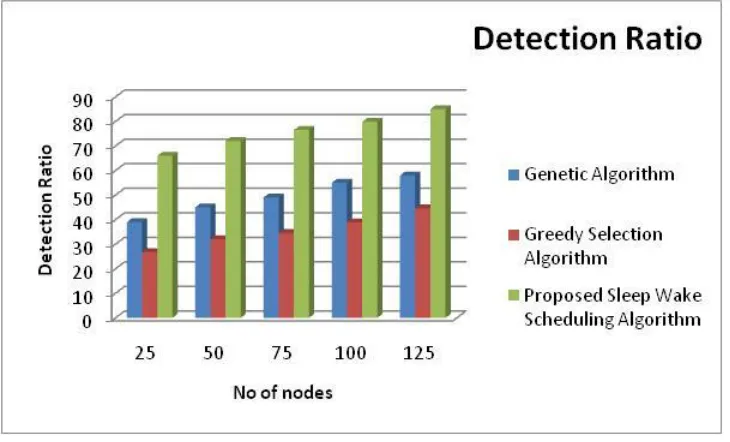
Detection Ratio
Genetic Algorithm Greedy Selection Algorithm Proposed Sleep Wake Scheduling Algorithm
39 26.77 66
45 31.98 72
49 34.56 76.5
55 38.92 79.8
58 44.56 85
Table 2: comparison table of Detection Ratio
The comparison table of Detection Ratio of Genetic Algorithm, Greedy Selection Algorithm and Proposed Sleep Wake Scheduling Algorithm shows the different values. While comparing the Genetic Algorithm, Greedy Selection Algorithm and Proposed Sleep Wake Scheduling Algorithm the Proposed Sleep Wake Scheduling Algorithm is better.
961 Figure 3: Comparison chart of Detection Ratio
The comparison chart of Detection Ratio of Genetic Algorithm, Greedy Selection Algorithm and Proposed Sleep Wake Scheduling Algorithm demonstrates the different values. No of nodes in x axis and Detection Ratio in y axis. The Proposed Sleep Wake Scheduling Algorithm is better than the other two algorithms. The Genetic Algorithm value
starts from 39 to 58, Greedy Selection Algorithm values starts from 26.77 to 44.56 and the Proposed Sleep Wake Scheduling Algorithm values starts from 66 to 85. Every time the Proposed Sleep Wake Scheduling Algorithm gives the great results.
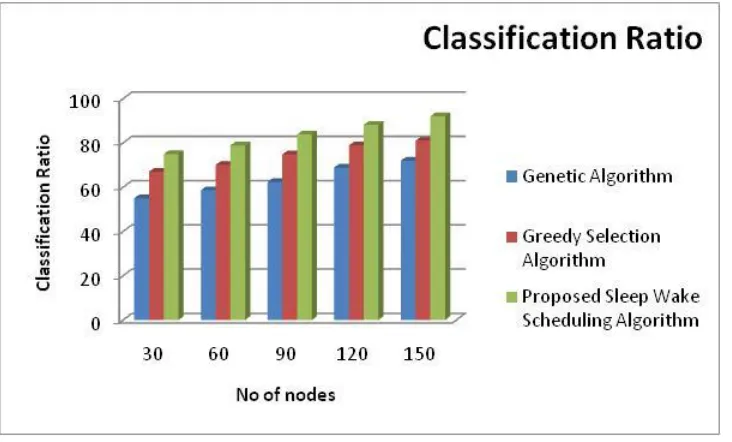
Classification Ratio
Genetic Algorithm Greedy Selection Algorithm Proposed Sleep Wake Scheduling Algorithm
55 67 75
58.6 70.1 78.9
62.3 74.8 83.86
68.9 78.89 88.21
72 81 92.06
Table 3: comparison table of Classification Ratio
The comparison table of Classification Ratio of Genetic Algorithm, Greedy Selection Algorithm and Proposed Sleep Wake Scheduling Algorithm shows the different values. While comparing the Genetic Algorithm, Greedy Selection Algorithm and Proposed Sleep Wake Scheduling Algorithm the Proposed Sleep Wake Scheduling Algorithm is better.
Figure 4: Comparison chart of Classification Ratio
The comparison chart of Classification Ratio of Genetic Algorithm, Greedy Selection Algorithm and Proposed Sleep Wake Scheduling Algorithm demonstrates the different values. No of nodes in x axis and Classification Ratio in y axis. The Proposed Sleep Wake Scheduling Algorithm is better than the other two algorithms. The Genetic Algorithm value starts from 55 to 72, Greedy Selection Algorithm values starts from 67 to 81 and the Proposed Sleep Wake Scheduling Algorithm values starts from 75 to 92.06. Every time the Proposed Sleep Wake Scheduling Algorithm gives the great results.
Conclusion
We propose a trust management scheme that complements the security in networks name hybrid and Efficient intrusion detection Systems. here we used two frameworks for Trust calculation and decision making process. The believe fee is derived using Bayesian inference, and Decision making based totally on Dempster’-Shafer theory, that's a mathematical theory of proof. In proposed system we add energy performance model through using sleep wake scheduling technique in Trust technique. We will gain greater energy consumption and excessive energy efficiency compared to previous active agree with version.
References:
[1] K. Musale, ―Analysis of Cluster Based Routing Protocol for Mobile Wireless Sensor Network,‖ Int. J. Adv. Trends Computer Sci. Eng., vol. 2, no. 1, pp. 124–129, 2013.
[2] S. Yadav and S. S. Yadav, ―Review for Leach Protocol in WSN,‖ Int. J. Recent Dev. Eng. Technol., vol. 2, no. 6, pp. 69–71, 2014
[3] J. D. Gaurkar and K. Dhote, ―Review paper on design of distributed Energy Efficient and Reliable Routing Protocol for Wireless Sensor Networks,‖ Int. J. Res. Emerg. Sci. Technol., vol. 1, no. 4, pp. 41– 46, 2014.
[4] M. Arshad, M. Alsalem, F. a. Siddqui, N. Kamel, and N. M. Saad, ―Efficient cluster head selection scheme
in Mobile Data Collector based routing protocol,‖ 2012 4th Int. Conf. Intell. Adv. Syst., pp. 280–284, Jun. 2012.
[5] P. Madhumathy and D. Sivakumar, ―Mobile Sink Based Reliable And Energy Efficient Data Gathering Technique For WSN,‖ J. Theor. Appl. Inf. Technol., vol. 61, no. 1, pp. 1–9, 2014.
[6] X. Chen and P. Yu, ―Research on hierarchical mobile wireless sensor network architecture with mobile sensor nodes,‖ in 2010 3rd International Conference on Biomedical Engineering and Informatics, 2010, vol. 7, pp. 2863–2867.
[7] N. Marriwala and P. Rathee, ―An approach to increase the wireless sensor network lifetime,‖ in 2012 World Congress on Information and Communication Technologies, 2012, pp. 495–499. [8] V. V. Deshpande and A. R. BhagatPatil, ―Energy
efficient clustering in wireless sensor network using cluster of cluster heads,‖ in 2013 Tenth International Conference on Wireless and Optical Communications Networks (WOCN), 2013, pp. 1–5. [9] ―The Network Simulator ns-2: Documentation.‖ [Online]. Available: http://www.isi.edu/nsnam/ns/ns-documentation.html. [Accessed: 09-May2015]. [10]Ismat, N ―Efficient clustering for Mobile Wireless
Sensor Networks‖, IEEE Conf. on Multi-Topic Conference (INMIC), 2014, pp. 110 – 114.
[11]Hong-Ling Shi ―Energy Efficient and Fault Tolerant Multicore Wireless Sensor Network: E²MWSN‖, IEEE Conf. on Wireless Communications, Networking and Mobile Computing (Wi-COM), 2011, pp. 1 – 4.
[12]Das, T ―Employing cooperative group mobility model for mobile target tracking in MWSN‖, IEEE Conf. on Applications and Innovations in Mobile Computing (AIMoC), 2015, pp. 55 – 61.
963
[14]Gagneja, K.K ―Heuristic clustering with secured routing in Heterogeneous Sensor Networks‖ IEEE Conf. on Security and Privacy of Mobile, Wireless, and Sensor Networks (MWSN), 2013, pp. 9 – 16. [15]Jambli, M.N. ―Transmission power control in mobile