International Journal of Innovative Technology and Exploring Engineering (IJITEE) ISSN: 2278-3075,Volume-8 Issue-11, September 2019
Telugu and Hindi Script Recognition using Deep
learning Techniques
P. Sujatha, D. Lalitha Bhaskari
Abstract: The need for offline handwritten character recognition is intense, yet difficult as the writing varies from person to person and also depends on various other factors connected to the attitude and mood of the person. However, we are able to achieve it by converting the handwritten document into digital form. It has been advanced with introducing convolutional neural networks and is further productive with pre-trained models which have the capacity of decreasing the training time and increasing accuracy of character recognition. Research in recognition of handwritten characters for Indian languages is less when compared to other languages like English, Latin, Chinese etc., mainly because it is a multilingual country. Recognition of Telugu and Hindi characters are more difficult as the script of these languages is mostly cursive and are with more diacritics. So the research work in this line is to have inclination towards accuracy in their recognition. Some research has already been started and is successful up to eighty percent in offline hand written character recognition of Telugu and Hindi. The proposed work focuses on increasing accuracy in less time in recognition of these selected languages and is able to reach the expectant values.
Keywords: offline handwritten character recognition, convolutional neural networks, latin, hindi, Chinese, telugu, English
I. INTRODUCTION
H
andwriting varies from person to person and also with the individual person's style, speed, age, mood and surprisingly even with gender. Including all these factors, handwriting also varies with the language. An individual adopts different style of writing while switching to a different language. Precisely, one's way of writing English, Telugu, and Hindi may be different, depending on his/her style and also on the characters of the language. For example, one person, on an average, has five different styles of writing in one language, and with three different languages, fifteen styles are possible. When it comes to recognizing the handwritten characters of different individuals, it is off the charts. On the other hand, recognizing handwritten characters is difficult and vulnerable to large variations when compared to printed character recognition which have a definite font with a limited number of variations [1]. In a language, there are distinct words are of different lengths and distinctive heights. Recognition of offline handwritten character depends on the main factor style along with the size and length of word levels [2].Revised Manuscript Received on September 05, 2019.
P. Sujatha, Department of Computer Science & Engineering, Andhra University College of Engineering (Autonomous), Andhra University, Visakhapatnam, India
D. Lalitha Bhaskari, Department of Computer Science & Engineering, Andhra University College of Engineering (Autonomous), Andhra University, Visakhapatnam, India
Offline Handwritten recognition is indeed an aid in mail sorting, processing of bank cheques, reading aid for blind, document reading and postal address recognition, form processing, digitalizing old manuscripts. A great deal of work has been proposed for handwritten recognition of languages like English and Asian languages such as Japanese, Chinese etc., rather very few attempts were made on Indian languages like Telugu, Hindi, Tamil etc., and they resulted in the accuracy of not more than 85% [ 3].
Convolutional Neural Networks(CNN’s) solved the above problem with an accuracy of above 90%. CNN’s are used in different pattern recognition from sources like paper documents, photographs, touch screens, medical image analysis and various other devices [4]. CNN’s can be used for online as well as offline character recognition. For online character recognition, digital pen-tip moves are used as inputs and are converted into a list of coordinators whereas in offline character recognition, images of characters are use used as input. Earlier works in handwritten recognition applied high-designed features on both offline and online datasets [5]. Few instances of hand-designed features constitute of pixel densities over regions of image, dimensions, character curvature, and the number of vertical and horizontal lines.
The most percentage of Telugu characters do not contain horizontal, vertical or diagonal lines. Unlike Latin and Chinese, Indic scripts like Telugu script is mostly generated by fusing circular shapes (full or partial) of dissimilar sizes with a little modifiers [7]. These modifiers are either of oblique strokes or a circular shape which throws a big challenge in recognition accuracy.
Hindi is another Indo Aryan language [8 ]. It is not yet legalized as a national language, yet preferred to be one because it is spoken by 425 million people in India as the first language and by more than 120 million people as the second language. Literary Hindi is written in Devnagari script. The Constituent Assembly of India has adopted it as the official language of Republic India [9]. The language of Hindi comprises of 40 consonants, 11 vowels and two sound modifiers. Hindi characters constitutes both horizontal and vertical lines along with strokes and circular shapes. A horizontal line called the 'Shirorekha' is present in Hindi script, from which the characters are suspended. When multiple characters are written collectively, this 'Shirorekha' is extended [10]. The shape of the consonant character gets altered when a consonant is followed by a vowel, and such a character is termed as a modifier or modified character. On the other hand, a diacritic called 'virama' a new character is obtained when a consonant is followed by another consonant. It has an orthographic shape and it is known as compound character. The 'Virama' is employed to repress the inherent vowel that otherwise occurs with each consonant letter. In contrast to Latin scripts, Hindi script does not have the notion of lowercase and uppercase letters [11 ].
II. RELATED WORKS
All the approaches reported in [12-15] have hired handcrafted features for the recognition of characters/strokes. At present, construction of a resilient handcrafted feature for the recognition of Hindi and Telugu characters is a challenging job due to its fundamental composite form. Deep learning architectures have extended enormous popularity for encouraging achievements to determine diverse difficult pattern recognition and computer vision problems. Convolutional neural networks (CNN’s) can be perceived as a unique type of feed-forward multilayer which is expert in directed fashion. The fore most advantage of by using CNN’s is that the salient features are extracted automatically from the input images which are commonly invariant to distortion and shift [16 ]. Another benefit of CNN’s is that the usage of shared weights in its convolutional layers improves its performance as well as diminishes the number of parameters [17]. The digit recognition was first achieved by CNN’s which were leading recognizer for their potential in the digit recognition task. In recognizing the MNIST dataset of digit classes this architecture has been very successful. CNNs are excellent prototypes with image inputs since they are basically obtuse to both translational variance and scale variance of the features in the images. As they have proven to be dominant on recognition tasks in other languages, they are appropriate to be used in Hindi and Telugu literature also. The key contest in any visual recognition task to a machine is how to extract the suitable set of features from the image. Support vector machines (SVMs) are another approach that has also been employed in the literature [18]. But they expelled to be
effective when CNNs, at the lower layer, mined necessary features for them [19]. Certain clustering mechanisms like Kth-nearest neighbor algorithms have also been attempted in the literature [20].These techniques were faster to train and appraisal than the convolutional neural networks.
A complete OCR(Optical Character Recognition) system, which is font, shape independent and using a proper selection of Wavelet scaling function the signatures are calculated [21]. Multi-layer perceptrons (MLP) network is applied for the identification of Telugu characters. During training MLP back propagation method is used so that the recognition can be done efficiently and accurately [22]. Projected a new frill map method, in which every binary pixel value of an image is connected with a frill number that labels the distance to the adjacent black pixel. These frill numbers are used to fragment text lines. Presented two schemes for offline character recognition linking multi-classifier frame works. Used histograms of edges for knowing features of basic symbols [23]. Where a symbol is a basic unit for recognition in Telugu and Hindi scripts [24]. Projected a multiple zone based feature extraction which is an arrangement of two methods [25]. An enormous literature has been reported for handwritten recognition in English and Asian languages such as Chinese, Japanese, etc., and very few efforts on Indian languages like Telugu, Hindi, Tamil, Sanskrit and Kannada [26]. Researchers have recently introduced CNN based approaches for the offline character recognition for English characters [27].Different types of approaches have been proposed till date for the offline recognition of English characters and extraordinary recognition rates are documented in Chinese using CNN [28]. Encouraged by this fact, in the present framework, a handwritten recognition algorithm for Telugu with high accuracy and with minimum training, classification time is proposed and for Hindi features of handwritten characters are extracted using Convolutional Neural Network and Deep Neural Networks. The extracted features are then used to predict the characters using different Classifiers like K Nearest Neighbor classifier, Random Forest Classifier and Multi-Layer Perceptron Classifier. Efficiencies of each are studied under different scenarios.
The organization of the remaining paper is as follows: Section 2 explains about the data collection and preprocessing. Section 3 discusses CNN architecture. Section 4 analyzes the various results and finally the paper concludes with Section 5.
III. DATA EXPLORATION
International Journal of Innovative Technology and Exploring Engineering (IJITEE) ISSN: 2278-3075,Volume-8 Issue-11, September 2019
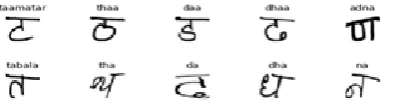
Some consonant-vowels are also included which dissembling be easily subdivide. Additionally, the symbol set also comprises certain symbols which do not have a dialectal interpretation, but have an unchanging outline across writers and help lessen the total number of symbols to be collected. So totally 166 symbols exist which are assigned to Unicode characters. Hindi dataset picked up from UCI contains training and test data. Each having 36 Hindi characters. For each character a folder is created containing the name of the character in English. Each folder contains 1700 images of the respective character. The target labels (the character name in English) is not given separately. Thus, by extracting the character name from the folder data is preprocessed and stored into a labeled array which is further used for training the model. Each image is a 32 * 32 gray scale image which is to be converted into array and then flattened a stored in an image matrix to train the model. Although the dataset comprises of the images of each character independently, quite a few characters within these images were tilted to some extent. This was for the reason that the contributors of the dataset were asked to write on white blank paper with no lines, and some of the words were written in a more slanted mode. This incident occurs very frequently in real life whether or not the page has lines, thus we determined to make our training data more dynamic to this subject by turning an image towards the right by a very little angle with random probability and adding up that image to our training dataset. This data augmentation method supported us to create the model more powerful to some trivial however, so consistent details that might appear in the test dataset. Some characters of vowels and consonants in Hindi are represented in Figure 1(b). Handwritten character recognition is still a research area of burning pattern recognition. Hindi handwritten character recognition is a difficult task considering the similarities between its characters. With the use of Neural Networks for extracting the important features of the character in the images has been very useful in mining the characteristics of the image and hence making the classification of the characters simple using various classifiers [30]. Moreover, experimenting with cropped and partial images of the characters using different neural network architecture has helped understand how the quality of the extracted features change, thus affecting the classification models and its accuracy. To conclude, handwritten character recognition Feature extraction, neural networks and Image processing are the various popular fields of research and the insights of these topics can be obtained from the report.
Figure 1(a). Sample handwritten Telugu characters
Figure 1(b). Sample handwritten Hindi characters
IV. PROPOSED WORK
In the proposed work, the Convolutional Neural Networks(CNN's) are used. CNN's is a deep learning construction for recognition of Telugu handwritten character recognition and Hindi character recognition, which holds an input, convolutional layer, rectified linear unit, pooling layer and fully connected layer continued by an output layer as shown in Figure 2(a) and 2(b) respectively.
Figure 2(a). Visual features in CNN using Telugu characters.
Figure 2(b). Visual features in CNN using Hindi characters.
[image:3.595.310.548.107.381.2]The first step required to initiate the identification is to select a hand written character image for classification. The input layer will hold the raw pixel values of the selected image of height and width 80 X 80 for Telugu characters and the image of height and width 32 X 32 for Hindi. Then it passes the input image to the convolution layer. The responsibility of this layer is to involve random number of filters to proceed along the height and width of the image to yield a feature map. (A filter is a sequence of numbers called weights or parameters). A sample of learned weights of the different layers of the proposed model for an augmented image is shown in Figure 3.
Figure 3. A sample of learned weights of the different layers of the proposed model for an augmented image.
[image:3.595.312.540.532.679.2] [image:3.595.71.260.604.668.2] [image:3.595.69.268.712.764.2]We have achieved an 80 X 80 sequence of numbers in Telugu character and 32 X 32 in Hindi character.
The output of the first convolutional layer creates 32, 4 such feature maps in Telugu and Hindi respectively and transforms it to the next layer through a differentiable function. Lastly, the output is of 3D (80 X 80 X 32) and (32 X 32 X 4) which is transformed to first pooling layer where the image is down-sampled along the spatial dimensions resulting in an output volume of (40 X 40 X 32) for Telugu and (28 X 28 X 4) for Hindi.
It can be mathematically expressed in Eq. 1[31]
l j l ij M i
l i l
j
f
x
k
b
x
j
1
(
) (1)Proceeding in the similar fashion, second convolutional procedure creates 32, 4 different feature maps for Telugu and Hindi. A size of 2 X 2 and 4 X 4 filters results a feature map size of 40 X 40 down sampled into 20 X 20 for Telugu and 28 X 28 is down sampled to 14 X14 for Hindi. Further down-sampling in the pooling layers produces resizing feature maps of size 5 X 5. This subsample layer performed on the input feature maps. Based on the size of the mask, this down-sampling decreases the size of the output feature maps. In this approach, a 2 X 2 mask is used. This can be conveyed using the following Eq. 2[32]
)
(
(
lj lj1l
j
f
down
x
x
b
lj) (2)Where down() signifies a max-pool function through local averaging, multiplicative coefficient and bias respectively. The above function adds up all n X n blocks of the feature maps from preceding layers and selects either highest or average values. The final feature map from the last convention layer is changed into a single dimensional feature vector matrix is taken as 3200 (=128 X 5 X 5) and 100 (=5 X 5 X 4) random nodes which are functionally connected to 138 and 36 output class labels for Telugu and Hindi characters. Errors are minimized through CNN using the following Eq.3[33]
E= ½ 1/PO 0 2
1 1
))
(
)
(
(
d
p
y
p
p
p o
o
o
(3)
Where P,O are patterns .
It is noted that, in order to retain the image size from the previous layer, the proposed work used zero-padding as hyper parameter. Each convolutional layer uses this hyper parameter around the border of an image to control the spatial size. In the proposed work, two activations like RELU [32 ] and Softmax [33] have been employed for the convolution and pooling layers during organization of the output layers. The Softmax activation is used for multiple class logistic regression where as RELU functions as output zero if the input is less than 0, and 1 otherwise. The mathematical notations for both functions are mentioned in the following Eq.4 and 5[34]
j z
j
e
z
)
(
/k z k
k
e
1(4 ) and
f(x)= max(x,0) (5)
Pre-trained model is used for Telugu characters to increase efficiency or accuracy of already existing models or to test new models. We use pre-trained weights of
already trained models to predict new classes. The advantage of using pre-trained models is, they can be used with small training dataset and using less computational power. When a deep neural network is trained, our goal is to locate the optimum values on each of these filter matrices so that when an image is propagated all the way through the network, the output activations can be utilized to precisely find the class to which the image belongs. The process used to find these filter matrix values is gradient descent. When CNN is trained on the Imagenet[ 34] dataset, the filters on the first few layers of the convolutional net learn to recognize low level features followed by higher level specific details. The next few layers gradually learn to recognize trivial shapes using the colors and lines learnt in the earlier layers. Now the reason why the transfer learning works is because, a pre-trained network which is imposed on the imagenet dataset is used and this network has already learnt to recognize the trivial shapes and small parts of diverse objects in its earlier layers. By employing a pre-trained network to do transfer learning, already learnt features are utilized and merely adding a few dense layers at the end of the pre-trained network to assist in recognizing the objects in our new dataset. Therefore, only added dense layers are trained. All this helps in making the training process rapid and need very less training data when compared to training a CNN from the scratch.
Features of handwritten characters for Hindi are extracted using Convolutional Neural Network and Deep Neural Networks. The extracted features are then used to predict the characters using Classifiers. Efficiencies of each are studied under different scenarios.
Feature Extraction: Convolution Neural networks (CNN's) has been the best feature extraction Neural network used so far by various authors. Here, the scope has been tested and experimented by using Dense Neural networks in combination to CNN. “RELU” activation function is used for input and hidden layers and “sigmoid” activation function is used in the output layer. The features extracted from the dense layers are then passed to the classification model. When classifiers are fed with features from this neural network, then their classification accuracy range was 72% to 81%. Following classifiers which are popular for multiclass classification are used to classify the target labels from the extracted features:
Random Forest Classifier: A random forest fits a number of decision tree classifiers on a variety of sub-samples of the dataset and employs averaging to enhance the predictive accuracy. For a model trained and validated on limited number of characters the accuracy was around 70% to 80%.
Multi-Layer Perceptron Classifier: One of the popular classifiers for multiclass classification which uses stochastic gradient descent to optimize log-loss function. For model validated on limited number of character images the accuracy of this classifier was between 75% to 90%.
KNN Classifier: K Nearest Neighbor classifier implements the k-nearest neighbors vote.
International Journal of Innovative Technology and Exploring Engineering (IJITEE) ISSN: 2278-3075,Volume-8 Issue-11, September 2019
In this experiment, Neural Network was configured to extract the features from the images. The output of the second last layer (dense layer) from the Neural Networks consisting of the features was extracted after passing the inputs to the model. This output was then divided as train data and test data to evaluate classifier performance. The classifiers were trained using these extracted features and their corresponding labels from the train data. Test data created above was used to assess the performance of the classifiers. When the classifiers are fed with features from this neural network, then their classification accuracy is in the range of 72% to 81%.
V. RESULTS AND DISCUSSIONS
Telugu and Hindi Character model is experimented using Amazon EC2 server instance with t2.x large instance type on Bitfusion Ubuntu 14 Tensor Flow setup. The python
libraries Numpy, Panda, Matplotlib, Seaborn, Sckit-Learn, Keras [ ] are used for high performance and scientific computation. The proposed work considered 166 different
character classes, where each consists of 270 samples for Telugu character recognition and 32 character classes for Hindi. After resizing the images, the dataset was splitted into 70% images to be used for training and 30% images for
test and validation. The learnable filters of CNN are analyzed such as input image shapes, pooling strategies and
optimizer functions on the model. Table 1 recapitulates the results for all likely groupings of those distinctions on the
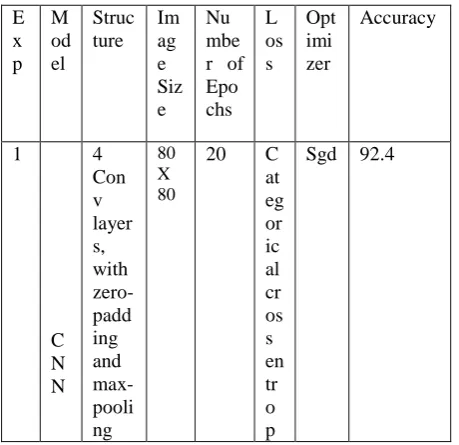
test set. From this table, the recognition accuracy have detected that has reached to maximum when the model contains four convolutional layers, with zero-padding and max-pooling by two fully connected layers. In addition, the
impact of filters size by (7 X 7, 5 X 5 and 3 X 3) also observed. If filter size becomes higher, the model fails to observe tiny details of structurally related character patterns.
However, if the size of the filter is too small it may produce duplicate information which, in turn, would decrease the model accuracy. Hence, filter size of 5 X 5 is chosen for the
[image:5.595.307.533.48.283.2]first convolutional layer and 3 X 3 for the remaining convolutional layers is confirmed to be optimal filter size.
Table 1. Achieved classification accuracy by CNN for Telugu characters
E x p
M od el
Struc ture
Im ag e Siz e
Nu mbe r of Epo chs
L os s
Opt imi zer
Accuracy
1
C N
N 4
Con v layer s, with zero-padd ing and max-pooli ng
80 X 80
20 C
at eg or ic al cr os s en tr o p
Sgd 92.4
by 2 fully conn ected layer s
y
2
Pre-train ed mod el of imag enet
80 X 80
10 C
at eg or ic al cr os s en tr o p y
Ad am
[image:5.595.46.276.564.786.2]93.1
Table 2. Achieved classification accuracy by CNN for Hindi characters
Exp Structur e
Imag e Size
Classifier Accuracy
1
CNN-Random Forest
32 X 32
Random Forest Classifier
71.4
2
CNN-Multi Layer Perceptr
on
32 X 32
MLP Classifier
77.5
3
CNN-KNN
32 X 32
K Neighbors Classifier
81.6
[1] [2]
[6] Even though a high performance in model accuracy reached with the pre-trained model, additionally the model also tried with the generalization techniques like Dropout and Data augmentation functions. Data augmentation consists of applying transformations to the training set in order to increase the dataset size and variation. By increasing the size of the dataset, data augmentation helps prevent over fitting. However, it is not fool-proof, since the augmented images will be highly-correlated. Finally, for parameter updates, the model optimizer is settled to SGD with learning rate 0.1.
The accompanying Figure 4 shows images corresponding to actual and predicted of the first fifty out of which four are misclassified images which show the model is predicting almost correct labels.
Classification Actual
character
Predicted character Correctly classified
characters
[image:6.595.45.301.209.527.2]Misclassified characters
Figure 4. Some correctly classified and misclassified images recognized by the model
VI. CONCLUSION
In this proposed work, a classifier is fed into a deep convolutional neural network for recognizing character image. Aalternative architecture was proposed that captures the low-level textual features of the hand written characters. The network comprises of multiple conventional layers, kernel filters and ReLU activation functions, followed by two Dense layers with Softmax activation function. The training accuracy was observed with different optimizers and classifier like SGD, Adam, Random Forest, Multi Layer and KNN using the Loss function called categorical cross entropy. The outcome of the proposed method is quite impressive with imagenet pre-trained model and when compared against the state of the art algorithms. The method can be further extended to multiple classes (i.e., vattu, gunintham) and can improve recognition accuracy even on a bigger dataset.
REFERENCES
1. D. S. Maitra, U. Bhattacharya and S. K. Parui, "CNN based common approach to handwritten character recognition of multiple scripts," 2015 13th International Conference on Document Analysis and Recognition (ICDAR), Tunis, 2015, pp. 1021-1025. doi: 10.1109/ICDAR.2015.7333916
2. U. Pal, B.B. Chaudhuri,Indian script character recognition: a survey,Pattern Recognition,Volume 37, Issue 9,2004,Pages 1887-1899,ISSN 0031-3203,https://doi.org/10.1016/j.patcog.2004.02.003.
3. Umapada Pal, Ramachandran Jayadevan, and Nabin Sharma. 2012. Handwriting Recognition in Indian Regional Scripts: A Survey of Offline Techniques. 11, 1, Article 1 (March 2012), 35 pages. DOI=http://dx.doi.org/10.1145/2090176.2090177
4. S. Acharya, A. K. Pant and P. K. Gyawali, "Deep learning based large scale handwritten Devanagari character recognition," 2015 9th International Conference on Software, Knowledge, Information Management and Applications (SKIMA), Kathmandu, 2015,pp.1-6. doi: 10.1109/SKIMA.2015.7400041
5. A. Priya, S. Mishra, S. Raj, S. Mandal and S. Datta, "Online and offline character recognition: A survey," 2016 International Conference on Communication and Signal Processing (ICCSP), Melmaruvathur,2016, pp. 0967-0970. doi: 10.1109/ICCSP.2016.7754291
6. S. D. Prasad and Y. Kanduri, "Telugu handwritten character recognition using adaptive and static zoning methods," 2016 IEEE Students’ Technology Symposium (TechSym), Kharagpur, 2016, pp. 299-304.
doi: 10.1109/TechSym.2016.7872700
7. D. Singh, J. P. Saini and D. S. Chauhan, "Hindi character recognition using RBF neural network and directional group feature extraction technique," 2015 International Conference on Cognitive Computing and Information Processing(CCIP), Noida, 2015, pp. 1-4. doi: 10.1109/CCIP.2015.7100726
8. A. Indian and K. Bhatia, "A survey of offline handwritten Hindi character recognition," 2017 3rd International Conference on Advances in Computing,Communication & Automation (ICACCA) (Fall), Dehradun, 2017, pp. 1-6. doi: 10.1109/ICACCAF.2017.8344697\
9. B. K. Verma, "Handwritten Hindi character recognition using multilayer perceptron and radial basis function neural networks," Proceedings of ICNN'95 - International Conference on Neural Networks, Perth, WA, Australia, 1995, pp. 2111-2115 vol.4. doi: 10.1109/ICNN.1995.489003
10. https://en.wikipedia.org/wiki/Virama
11. Y. LeCun, L. Bottou, Y. Bengio and P.Haffiner, Gradient-based learning applied to document recognition. Proceedings of the IEEE, 1998.
12. A. Graves, M. Liwicki, S. Fernandez, R. Bertolami, H. Bunke and J.Schidhuber, A novel connectionist system for unconstrained handwriting recognition. TPAMI, 2009.
13. P. N. Sastry, T. R. V. Lakshmi, N. V. K. Rao, T. V. Rajinikanth and A. Wahab, "Telugu Handwritten Character Recognition Using Zoning Features," 2014 International Conference on IT Convergence and Security (ICITCS), Beijing, 2014, pp.1-4. doi: 10.1109/ICITCS.2014.7021817
14. S. D. Prasad and Y. Kanduri, "Telugu handwritten character recognition using adaptive and static zoning methods," 2016 IEEE Students’ Technology Symposium (TechSym), Kharagpur, 2016. 15. Shin, H.C., Roth, H.R., Gao, M., Lu, L., Xu, Z., Nogues, I., Yao, J.,
Mollura, D., Summers, R.M.: Deep convolutional neural networks for computer-aided detection: CNN architectures,dataset characteristics and transfer learning. IEEE Trans. Med. Imaging 35, 1285–1298 (2016)
16. Bai, J., Chen, Z., Feng, B., Xu, B.: Image character recognition using deep convolutional neural network learned from different languages. In: IEEE International Conference on Image Processing, pp. 2560– 2564 (2014)
17. Raju Dara, Urmila Panduga, “Telugu Handwritten Isolated Characters Recognition using Two Dimensional Fast Fourier Transform and Support Vector Machine”, 2015 International Journal of Computer Applications.
International Journal of Innovative Technology and Exploring Engineering (IJITEE) ISSN: 2278-3075,Volume-8 Issue-11, September 2019
19. Maitra, D. S., Bhattacharya, U., & Parui, S. K. (2015, August). CNN based common approach to handwritten character recognition of multiple scripts. In Document Analysis and Recognition (ICDAR), 2015 13th International Conference on(pp. 1021-1025). IEEE. 20. Atul Negi, Chakravarthy Bhagvati,B.Krishna, An OCR system for
Telugu, 6thICDAR, Seattle, USA, Sept. 2001.
21. C. Vikram, C. Shoba Bindu, C. Sasikala, “Handwritten Character Recognition for Telugu Scripts Using Multi Layer Perceptrons (MLP)”, 2013 International Journal of Advanced Research in Computer Engineering & Technology (IJARCET).
22. S. N. S. Rajasekharan and B. L. Deekshatulu. Generation and Recognition of printed Telugu characters, Computer graphics and image processing 6, 335 – 360, 1977.
23. Lakshmi, C. V., Jain, R., & Patvardhan, C. (2006). OCR of printed Telugu text with highrecognition accuracies. In Computer Vision, Graphics and Image Processing (pp. 786-795). Springer, Berlin, Heidelberg.
24. Koppula, V. K., & Negi, A. (2011, September). Fringe map based text line segmentation of printed Telugu document images. In Document Analysis and Recognition (ICDAR), 2011 International Conference on (pp. 1294-1298). IEEE.
25. Sen, S., Shaoo, D., Paul, S., Sarkar, R., & Roy, K. (2018). Online Handwritten Bangla Character Recognition Using CNN: A Deep Learning Approach. In Intelligent Engineering Informatics (pp. 413-420). Springer, Singapore.
26. Maitra, D. S., Bhattacharya, U., & Parui, S. K. (2015, August). CNN based common approach to handwritten character recognition of multiple scripts. In Document Analysis and Recognition (ICDAR), 2015 13th International Conference on(pp. 1021-1025). IEEE. 27. Yuan, A., Bai, G., Jiao, L., & Liu, Y. (2012, March). Offline
handwritten English character recognition based on convolutional neural network. In Document Analysis Systems (DAS), 2012 10th IAPR International Workshop on (pp. 125-129). IEEE.
28. Zhang, Yuhao. “Deep Convolutional Network for Handwritten Chinese Character Recognition.” (2015).
29. http://lipitk.sourceforge.net/datasets/teluguchardata.html
30. Singh, P., Verma, A., Chaudhari, N.S.: Deep convolutional neural network classifier for handwritten Devanagari character recognition. Inf. Syst. Des. Intell. Appl. 551–561 (2016)
31. Albawi, Saad & Abed Mohammed, Tareq & ALZAWI, Saad. (2017). Understanding of a Convolutional Neural Network. 10.1109/ICEngTechnol.2017.8308186.
32. Janocha, K., & Czarnecki, W. (2017). On Loss Functions for Deep Neural Networks in Classification. ArXiv, abs/1702.05659.
33. Øland, A., Bansal, A., Dannenberg, R.B., & Raj, B. (2017). Be Careful What You Backpropagate: A Case For Linear Output Activations & Gradient Boosting. ArXiv, abs/1707.04199.
AUTHORSPROFILE
Mrs. P Sujatha pursued her MCA from Andhra
University in the city of Visakhapatnam, India in 2004 and Master of Technology from GITAM College of Engineering, Vizag Campus in the year 2009. She is currently working as Research Scholar in the Department of Computer Science and Systems Engineering, Andhra University, India since April 2014. She has 5 years of teaching experience and her research interests are in the fields of Image Processing, Computer vision, Artificial Intelligence and Machine learning.
Prof. D. Lalitha Bhaskari is working as professor in