International Journal of Innovative Technology and Exploring Engineering (IJITEE) ISSN: 2278-3075, Volume-8 Issue-11, September 2019
Abstract: In computational environment the data processing and data transactions are major issue, to overcome this problem of processing and reduce the band width in distributed models. The abstract mentioned here clearly state the novelty of the work regarding to data processing and data utilization. This paper shows that the data provided between nodes that are involved in clusters and that is useful to the data utilization schematic in all kinds of clusters. The proposed approach arranges data into data tables and distributes them transversely nodes in a cluster. It recommends jobs to be processed by the cluster then transfers packaged and encapsulated data into nodes to process the data in parallel. This technique employs an incremental data scheduled computation way that keep away from the costly enumeration of data pattern matching necessary by cluster methods. It improves the data locality by forwarding data to the job supporting cluster. This abstraction is enthused by the data processing and data reduce primitives presented in the various job processing environment and many other functional applications used in data grid, data intensive approaches. The Architectural interface is provided in between clusters and is used to achieve high performance on large clusters of commodity PCs. This approach reduces the data request and its processing when it is signed into data clusters. The proposed approach arranges data into data tables and distributes them across nodes in a cluster. It recommend jobs to be processed by the cluster then transfers packaged and encapsulated data into nodes to progression the data in parallel. It improves the data locality by forwarding data to the job supporting cluster. The proposed approach in this paper is helpful where number of nodes involve in cluster is always increasing due to the high end computations that are involved in distributed environment.
Index Terms: Data integration, Data processing, Scheduling, Data Priority, Data analysis .
I. INTRODUCTION
The Commodity networking hardware is Applicable classically every 100 megabits/second or 1 gigabit/second at the machine level in clusters, but averaging use of resources is significantly low in on the whole utilization of network bandwidth. A cluster is framed with hundreds or thousands of machines, that leads to failures of the machine and is frequently now days due to lack of data. Storage is provided by inexpensive IDE disks attached directly to individual machines. A distributed file system. Such kind development is in-house and is used to manage the data stored on these disks. The file system uses data copies / replication to provide availability and reliability on top of unreliable hardware. Such that data is applicable in almost clusters
Revised Manuscript Received on September 07, 2019
Dr. P. Sunil Gavaskar, Sri Venkateswara University, Tirupathi, AndhraPradesh,India,
D.Udaya Suriya Rajkumar, GGR College of Engineering, Department of Computer Science and Engineering,Vellore.
P.Sudheer, GGR College of Engineering, Department of Computer Science and Engineering,Vellore.
with crisp availability.Data de-duplication (redundancy elimination) and Cluster-level data de-duplication are the main issues even in the today’s technology growth and comply with service-level agreements (SLAs) provided to the users and that kind of cloud, grid security is provided to the user based on the priority as well as data priority. While computation the I/O latency and extra computational overhead are major challenges of cluster-level data de-duplication. Such kind of issues is data reduction, which requires to be implemented with very large-scale cluster data duplication systems [13]. The similarity-based de-duplication scheme uses [3,4] to optimizes the exclusion procedure by bearing in mind the locality and resemblance of data points that are occurred in together the inter and intra node circumstances. Today’s technology like Hadoop and Map Reduce [1, 2, 8] are facing such kind of redundancy elimination while data utilization.
Some of authors are proposed best strategy for data utilization such as
The exploitation of extra nodes in the cluster; thus requires most feasibility over connected and disconnected. According to parallel computational laws, while job computation point of view is concern, the computational nodes not needed and not utilized even in major computation [9].
The expansion of big datasets [10] ,that requires huge storage and its resources are major issues
The usage of replication mechanisms; drawbacks in replication is that uses replicas selection, deletion, sometimes important and most needed replicas are to be deleted, accordingly cloud and grid security over user oriented service-level agreements (SLAs) is concern, the data is loosed, thus results loss of security over user view level. Such that the investigation disclosure that the local de-duplication [7, 15, 16], at cluster level, can causes lack of data utilization and reduce the hashing overhead [8]. The data utilization with priority and is applied between dynamically connected and disconnected nodes. In view of that the proposed dynamically connected and disconnected nodes between clusters is use full where as data utilization into jobs execution. Such kind of nodes are to be connected and disconnected using the dynamic data priority changes and its data utilization between nodes.This paper shows that the data provided between nodes that are involved in clusters and that is useful to the data utilization schematic in all kinds of clusters.
II. RELATED WORK
Priority Based Classical Data Encapsulated
Scheduling For New Era in Computing
Environment
2563
Published By:
Blue Eyes Intelligence Engineering Retrieval NumberK18590981119/2019©BEIESP
In general, users can propose jobs to a scheduling system. Every job having of a position of tasks, and such tasks are mapped by the scheduler to a set of accessible nodes inside a cluster. The solution to data signing problem is to assign tasks to data local nodes so that wastage of bandwidth resource can be reduced. Thus the job completion time will be minimized. Several scheduling algorithm have been developed for improving data locality [6-8], but all of them either ignore to allocate the task to data local nodes or waste the available bandwidth since bandwidth is a scare resource. On behalf of data locality; Delay Scheduling [9, 11] assign free slots to the job that are supporting less number of tasks and lack of data for the task execution. Such kind of data encapsulated data locality can increases throughput when the number of node are to be increased in clusters.
Over the earlier period ten years, the researchers and many others at Google have execute hundreds of unique principle computation which process huge quantity of raw data. Such that the data are used as web request logs, crawled documents, etc., to calculate a variety of categories of base data and derived data [14], that uses a variety of illustration of the graph structure of web documents, summary of the numeral of pages crawled per host, that result set of the majority common queries are used processing. The data are encapsulated with proper clusters and processing information.
The effective utilization of data in job processing requires sheer volumes of data and facilitates data- exhaustive tasks for applications like machine learning, web indexing and huge volume of data parsing is becoming a major issues [12]. Such kind of scenarios need processing power exceeds and that uses the capabilities of individual computers as well as the use of distributed computing [2, 19]. In large-scale data- intensive applications like distributed data processing almost provides minimal abstractions which is also used to hide architectural details. Thus automatically parallelizes computation [17], and supports transparent fault tolerance via data repetition, replication and the copy of data continuously used in computation [3].
A important characteristic need of MapReduce [4, 6, 12] is effortlessness that permit programmers to inscribe functional-style and to code the execution of job in moderate and reliable method. A user submits a job encompass of a map function and a reduce function that are consequently altered into map and decrease tasks, such tasks are scheduled [5] on slot hosted by contribute nodes in the cluster.
The author present network theory-based method to pull out the topological and dynamical network properties of clusters used in the era of big data [18, 20]. The random networks and free-scale networks are best examples of such dynamic networks and such kind of networks are ranked on the beginning of statistical parameters, namely standard deviation, mean and variance.
In some of the Distributed File Systems the loads and, partitions of data are the major issues that influence on response time, bandwidth, and reliability of clusters .So that data is arranged into fixed equal-size splits or unequal-size splits, and distributes splits across cluster nodes. Every split is assigned a map task based on priority. Map tasks process splits and generate in-between outputs that are frequently partition or hashed to one or a lot of decrease tasks [6-5]. In Map Reduce method is assumed that a tree style network topology and master-slave architecture. Cluster supporting
Nodes are extending over various racks that are include in one or many data centers. The proposed approach is better for transferring data request /data response is used clusters .Such that the bandwidth among two nodes is needy on their qualified position in the network topology.
III. PROPOSED WORK
A. Monitor Module:
This module can monitors all the clients involved in the data accessing environment. The Action behind the monitor module is to decide the data required for the computational, and it is depends on the computational needs, in such manner the scheduling of data and computation happens. The data schedule and placement to the corresponding action taking nodes is to be decided by the factor of computational needs and scheduling of computation.
B. On behalf of Monitor module: Actions that are carried out over the Monitor Module.
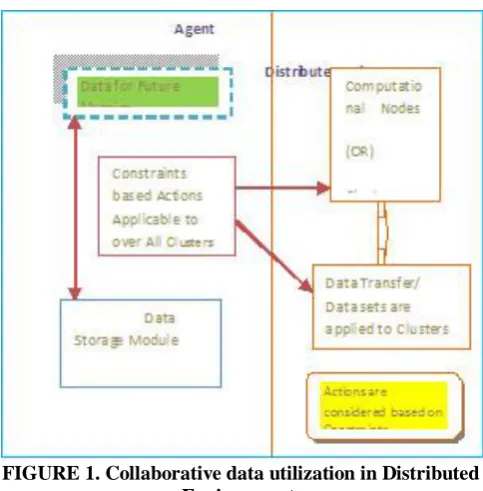
[image:2.595.306.548.375.621.2]The most successive data which is located in action nodes and computational needs of such data are predicted based on the actions taken over the data. Most actions taken data is used in computation and schedule that are happens on such kind of data is considered into the account of data table (DT) and job table (JT).
FIGURE 1. Collaborative data utilization in Distributed Environment.
C.Actions: The Numerical values mentioned in the following table says that number of actions taken over the data that decides data schedule. The following are priority of actions consider over the data utilization.
D1=2 D2=2 D3=7 D4=2 D5=7 D1=5 D2=5 D4=6
International Journal of Innovative Technology and Exploring Engineering (IJITEE) ISSN: 2278-3075, Volume-8 Issue-11, September 2019
≤
D.Mapping constrains:
[image:3.595.311.543.109.298.2]Here queues are cache is applicable or formed when mapping constrains are applied based on job table and data table. Such that three constrains are used to locate as well as to map data while job are processed by the clusters. The constrains are used along with substitution mapping function
a) Map (
b) Map(
Constrains 1: job priority (Jp) is equal to data priority ……> data allocated to job.
JP = Dp….> data allocated to the corresponding job
processing cluster.
Constrains 2: job priority (Jp) is less than to data priority
Dp……> data allocated to job.
JP < Dp….> here job priority is less than data
priority, thus results delay or wait state of jobs Jp, such that
Di placed into queue until the priority matches.
Constrains 3: job priority (Jp) is greater than Dp, and so Jp
is placed immediately into processed or executed with a copy of data is allocated to the corresponding cluster with the following constraint ( Di, Dp > JP )
Mapping based on data constraints’ { Jp == Dp : Jp < Dp :
Jp > Dp } Data copied when mapping satisfy the mentioned
[image:3.595.59.279.376.588.2]constraints.
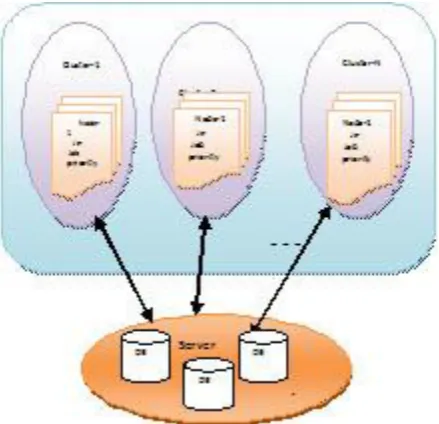
Figure 2. Semantic Representation Of Data Mapping E. Formulation:
Promoting the jobs based on the encapsulated copy of data , such that the problem is considered the following
formulation. Let J = {j1, j2, . . . , jn} be a set of n MapReduce jobs with no data dependencies between them. jirequests DRE ∈{d1,d2,………dm}.In general MapReduce slots are used among server data priority(Dp ) and Server encapsulated data of Cluster(DRE).In such manner job computation uses Map and Reduce phase durations (Dp— Data priority , DRE---Encapsulated priority ), respectively. On behalf of the problem of minimizing the makespan jobs computed and data applicable in the entire model is considered as ‘C’ represent cluster.
∈
Figure 3. Two-stage diagram for Data copies /Data encapsulated and its supportive jobs
where φ(J1,J2…………Jm) is the Set of job sequence. To perform mapping and minimize job execution make span (
F) , we want a job sequence φ∗.In such a way Data encapsulated copies
β (D1,D2…………Dn) are used to reduce job execution make span ( F) ,it also contains DE , such that F(φ∗) ≤ F(β1) for any β(DE) .
An optimal ordering of the jobs used and required encapsulated data copies are specified by the subsequent rule, job ‘j’ precedes job j + 1 if min(Ji , Ei +1)< min(Ji+1, Ei ).
Let consider there are three jobs 1, 2, and 3. Suppose min
(J1, D2) ≤ min (m2, E1) and min (J2, D3) ≤ min (J3, E2). Then, min (J1,.E3)≤ min (J3, E1) apart from perhaps when job 2 is indifferent to both job 1 and 3.
Let us consider a collection of n jobs, where every job ji is denoted by the pair (Ji , Ei ) of map and reduce stage period, respectively. Each job Ji = (Di , Ei )with an attribute Si defined as pursue:
Si= (Ji ,Jm), if min(Ji , Di ) = mi (Di , DE ), otherwise Constraint satisfactions
Algorithm:
Step -1: initialize variable of job table JET = 0 Jp =0;
JET Jp ( JET defines Jp )
2565
Published By:
Blue Eyes Intelligence Engineering Retrieval NumberK18590981119/2019©BEIESP
Di = { 1,2, . . . n }, Dp = { 1,2, . . . m};
Dtv = round off (Di , Dp )
Step-3: Overall Constraints: data constraints’ { Jp == Dp :
Jp < Dp : Jp > Dp }
Step-4: Random generate of Data Priorities: Arrays used in Data priorities and Job Priorities
Step-5: Random Values ‘JP’ Array and ‘DP’ Array are used
to justify Threshold values and its Data utilization. Step-6: Notify Threads: For all {Jp = Dp :Jp < Dp:Jp > Dp } ≠ 0
Step-7: DTV(least)=0. DTV(Mostt)= 0.
Table-1. Job Table
Job execution time Job priority
2 m.sec 1
4 m.sec 2
0.45 m.sec 0
6 m.sec 3
5 m.sec 1.5
3 m.sec 4
0.2 m.sec 5
9 m.sec 2.5
Table-2. Data Table
Pf = f-γ …… (4)
γpf - …..(5)
Consider the data involved and is connected in semantic of cluster ,Where ‘pf’represents fraction of nodes having ‘f ’
degree and parameter ‘γ’ having range of 1< f < n. The mathematical formulation shows that the nodes connected and their connected clusters that are used and are involved in data transfer while jobs execution
Similarly, the formal illustration of priority based random networks is represented in Eq. 4 utilizing the main parameter as depicted in Eq. 5.
=
Where ‘P ‘ is the probability distribution for the (DE), DE is the approximately based on ‘P’ probability distribution of edges among any two nodes (i.e priority of data encapsulated(DE), ‘n’ illustrate the amount of nodes and ‘z’ is considered as z = (n- 1) P .
In addition to cluster semantic, the recital of the overall system was enhanced utilizing data reduction methods. This methods decrease local data after it is shuffling. The quantity of data to be reduced is projected utilizing Eq. 8
(8)
Data priorities are considered into the account of scheduling algorithm; Thus threshold values are evaluated to predict better encapsulated and available data in clusters. Such proposed Dtv can guarantee a value obtained in all the cases and also gives suitable constraints based job execution to provide feasible data utilization. Data priorities are the ratio between the maximum and minimum task importance that are considered into classification. The classification of data is more than 1/(1 + √k) 2
of that obtained by a data priority scheduler, where ‘k’ is the maximum and minimum priorities considered in the all the cases of constraints as stated in the above discussions.
The proposed model of agents based data scheduling always uses the random priorities generation of data. Such kind of data utilization is applicable to all the jobs based on the constraints stated above and its supportive threshold value. In general and earlier, the topological networks are construction based on evaluating and establishing connection (links) between different data utilization nodes and data points. In earlier, the statistical node analysis of the networks are execute and used for optimization and big data reduction. The dynamically optimized networks and such kind of networks are represented and is termed as small-world networks due to dynamic links connected and disconnected between clusters and nodes used in clusters. Here the links are connected and disconnected based on huge amount of data transfer rates and its distance followed by the data availability, data encapsulated and data priority of utilization.
Mathematically, such kind of scale-free and dynamic networks are formally represented and are given as per the Eq. 5 and given utilizing the main parameter as depicted in Eq. 6.Network theory-based approach is proposed using Eq. 4,5,6,7 , thus changes dynamical network properties of clusters used in the topological networks. Earlier, the topological networks are established based on evaluation of relationships (links) that are used between different data utilization nodes and data points. Such that proposed methods are applied based on changes in the order of cluster forming using Eq. 4,5,6,7 and its supportive data locations based on the data priorities.The main contributions of our proposed work are a easy and powerful interface that facilitate automatic parallelization and distribution of scalable computations, combined with an execution of this data request / data response interface. The interface is provided in between clusters that attain lofty performance on large clusters of commodity PCs.As a better reaction to this data used in job processing complexity is allocation of data when it is required by the clusters. The implemented and designed a new data allocation / data encapsulation permit us to convey the easy computations such kind of data copies are trying to carry out better execution ,but conceal the messy details of
clusters used fault tolerance,
parallelization, load
Data Id (Di)
Data Priority Dp
Data Threshold DTV
01 5 9.236
02 6 11.449
03 4 9
04 9 15
05 2 6.414
06 5 9.236
07 7 12.645
International Journal of Innovative Technology and Exploring Engineering (IJITEE) ISSN: 2278-3075, Volume-8 Issue-11, September 2019
[image:5.595.42.296.150.472.2]balancing and data distribution are used in a library fashion
.
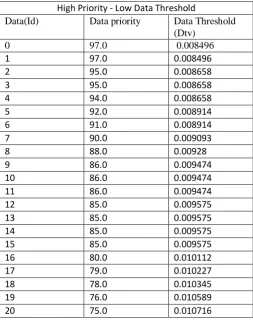
The following are data sets that are considered into the account of data utilization with spot of clusters are used and is used accommodate to data as part of scheduling. The four different categories of data set are taking to predict the better scheduling.TABLE-3. DATA PRIORITIES AND THRESHOLDS High Priority - Low Data Threshold
Data(Id) Data priority Data Threshold
(Dtv)
0 97.0 0.008496
1 97.0 0.008496
2 95.0 0.008658
3 95.0 0.008658
4 94.0 0.008658
5 92.0 0.008914
6 91.0 0.008914
7 90.0 0.009093
8 88.0 0.00928
9 86.0 0.009474
10 86.0 0.009474
11 86.0 0.009474
12 85.0 0.009575
13 85.0 0.009575
14 85.0 0.009575
15 85.0 0.009575
16 80.0 0.010112
17 79.0 0.010227
18 78.0 0.010345
19 76.0 0.010589
20 75.0 0.010716
The total span of data priorities and threshold values are considered with the following four categories of data sets (a). High Priority -Low Data Threshold. (b). Low Priority - High Data Threshold (c). Low Priority - High Data Threshold (d). High Priority - High Data e Threshold. Thus the data sets are used in mapping of data to the job based on above stated constraints and algorithm. The following diagram shows the marginal data utilization in clusters.
0
5
10
15
20
25
30
0 4 6 8 10 12 14 16 18 20 22 24
Job
e
xe
cuti
on
poo
ling
is
parti
ti
on
ini
to
MB(
que
ue
/poo
l
)
min
avg
max
Figure 4. Data Utilization.
The Above mentioned graphical representation shows that the Data priorities and Job priorities mapping while the jobs
are to be used in cluster supported execution environment. Thus, data are transferred between clusters prior to the request of particular data. According those jobs is scheduled only when the data mapping is occurred in overall clusters. On behalf of that Job priority is lesser only when data priorities are becomes maximum .
The proposed method and constraints are considered to generate better mapping and data utilization in all the clusters. Our proposed approach is applicable and that works on a large cluster of commodity machines and is extremely scalable. A typical data is used in computation processes and that .is required encapsulation of data priority that is .applied on thousands of machines. This approach is used to find the system which is simple to use on hundreds of clusters have been execute based on functionality of data mapped around data locality. Almost jobs are executed on various functional supportive or non supportive clusters in every day real life.
IV. CONCLUSION
The proposed approach and the above stated assessment, it is recommended that data considered is always applicable and is encapsulated in the all the supporting clients irrespective of request of data used by clients. The server is having the data and its supportive constraint satisfactions such that server gives mapping of data to the jobs supporting clients. In future the present method is also applicable and that can be expanded to intelligence based data utilization with actions over data scheduling.
REFERENCES
1. J. Dean and S. Ghemawat, ”Mapreduce: simplified data processing onlarge clusters,” USENIX Association OSDI ’Sixth Symposium on Operating Systems Design and Implementation, OSDI, 2004, pp.1-8. 2. S. Chen, S. W. Schlosser”, Map-Reduce Meets Wider Varieties of
Applications”. In IRP-TR-08-05, Technical Report, Intel Research Pittsburgh, 2008, pp.1-8.
3. P. C. Chen, Y. L. Su, J. B. Chang, and C. K. Shieh, ”Variable-Sized Map and Locality-Aware Reduce on Public-Resource Grids,” Future Generation Computer Systems,Vol.27(6), 2011, pp 843-849. 4. Zacharia Fadika , Elif Dede , Madhusudhan Govindaraju , Lavanya
Ramakrishnan “,Benchmarking MapReduce Implementations for Application Usage Scenarios”, IEEE Twelth International Conference on grid Computing, 2011, pp.90-97.
5. Matei Zaharia, Dhruba Borthakur, Joydeep Sen Sarma, Khaled Elmeleegy, Scott Shenker and Ion Stoica, “Delay Scheduling: A Simple Technique for Achieving Locality and Fairness in Cluster Scheduling”, European Conference on Computer Systems, France, 10(1145), 2010.
6. J. Blasco, R. Di Pietro, A. Orfila and A. Sorniotti, "A tunable proof of ownership scheme for deduplication using Bloom filters," IEEE Conference on Communications and Network Security, San Francisco, 2014,pp.481-489.
7. Wu X et. Al.. ,”Data mining with big data”, IEEE Transactions on Knowledge and Data Engineering, 26(1), 2014, pp.97–107.
8. Trovati M,“Reduced topologically real-world networks: a big-data approach”. International Journal of Distributed Systems Technology, 6(2), 2015, pp.13–27.
9. Trovati M, Bessis N”,An influence assessment method based on co-occurrence for topologically reduced big data sets”, Soft computing, Vol.20(5),2015, pp 1–10.
10.Xiaofei Huang, Hui Zhou, Wei Wu,”Hadoop Job Scheduling Based on Hybrid Ant- Genetic Algorithm, International Conference on Cyber- Enabled Distributed Computing and Knowledge discovery, China, 2015, pp.226 –229.
[image:5.595.58.292.586.762.2]2567
Published By:
Blue Eyes Intelligence Engineering Retrieval NumberK18590981119/2019©BEIESP
12.Chen R, Mu Y, Yang G, Guo F “, BL-MLE: block-level message-locked encryption for secure large file deduplication”, IEEE Transaction on Information Forensics Security, 10(12), 2015, pp.2643–2652.
13.Chen X, Li J, Huang X, Ma J, Lou W”, New publicly verifiable databases with efficient updates”, IEEE Transaction on Dependable Secure Computing, 12(5), 2015, pp.546–556.
14.Armknecht F, Bohli J, Karame GO, Youssef F”, Transparent data deduplication in the cloud.”, ACM SIGSAC Conference on Computer and Communications Security, CCS’15, 2015, pp 886– 900.
15.Wu X, Theodoratos D, Peng Z “, Efficiently mining homomorphic patterns from large data trees”, International Conference on Database System for Advanced Applications,DASFAA’ 2016, pp 180–196. 16.Chen X, Li J, Weng J, Ma J, Lou W”, Verifiable computation over
large database with incremental updates. IEEE Transactions on Computers, Vol.65 (10), 2016,pp.3184-3195.
17.Muhammad Habib, Rehman, Assad Abbas,et.al.,” Big Data Reduction Methods: A Survey”, Data Science and Engineering, Vol.1(4), 2016, pp.265-284.
18.Jiazhen Han, Zhengheng Yuan, Yiheng Han, Cheng Peng, Jing Liu and Guangli Li, ”An Adaptive Scheduling Algorithm for Heterogeneous Hadoop Systems”, IEEE Conference on Computer and Information Science, Wuhan, 2017,pp. 845 -850.
19.Oscar Day and Taghi M. Khoshgoftaar, “A survey on heterogeneous transfer learning”, Journal of Big Data, Vol.4(29), 2017, pp. 1-16. 20.Wenfei Fa, Chunming Hu,” Big Graph Analyses: From Queries to
Dependencies and Association Rules”,Data Science and Engineering, Vol.2(1),2017, pp.36–55.
BIOGRAPHIES
Dr. P. Sunil Gavaskar B.E,M.E,PhD.He received PhD From the Department of Computer Science and Engineering, at Sri Venkateswara University, Tirupathi, AndhraPradesh, India.Presently he is working as Professor at Vemu Institute of Technology. His research interest includes Distributed Systems, Data Intensive Grid and Grid Computing. He is acting as R & D coordinator from CSE department in the same institute.
Dr. D.Udaya Suriya Rajkumar. He received PhD from Department of Computer Science and Engineering from Sathyabama University, Chennai. He has been working as an Assistant Professor and also Head of the department, in GGR College of Engineering, Vellore -632 009 since 2007. His research interest includes Wireless Sensor Network, Theory of Computation, Data Mining and Web Mining. He has published five papers in International Journal and two in National Journals. He has attended six international and national conferences.