Int. J. Electrochem. Sci., 13 (2018) 5603 – 5611, doi: 10.20964/2018.06.34
International Journal of
ELECTROCHEMICAL
SCIENCE
www.electrochemsci.org
Mini review
Recent Progress of Electrode Materials for Zinc Bromide Flow
Battery
Tianyao Jiang1, Hang Lin 1, Qingyang Sun1, Guangzhen Zhao1, Junyou Shi1,2*
1
College of Chemical Engineering, Northeastern Electric Power University, Jilin 132012, China
2
College of Forestry, Beihua University, Jilin 132013, China
*
E-mail: [email protected]
Received: 12January 2018 / Accepted: 18 March 2018 / Published: 10May 2018
Saving fossil energy and the widespread application of renewable energy have become important strategies of world government to maintain sustainable development of the society. zinc bromide flow battery can removes the random and intermittent natures of the renewable energy, It becomes one of the most promising technologies with advantages of long cycle life, high energy convention efficiency, flexible system design, deep discharge capability and low cost. In this paper, the focus is on Carbon based material electrode and Carbon nanotube modified electrode.
Keywords: zinc bromine flow battery, Carbon based material electrode, Carbon nanotube modified electrode
1. INTRODUCTION
for the people to balance the supply and demand. The original liquid flow battery is a secondary charge and discharge battery [7], redox reactions are carried out based on electrochemical active substances in electrolyte solutions, it has large energy, fast conversion efficiency, fast reaction time[8, 9], large storage capacity, deep charge and discharge capacity, low maintenance costs[10], it has attracted wide attention, such as iron titanium, iron chromium, all vanadium[11], zinc bromine[12], bromine sulfur, zinc cerium[13], lead storage and vanadium bromide flow battery, the energy and power belong to the two parts of the liquid flow cell, it can be modularized design without interference, the output power and storage capacity can be controlled independently and flexibly. The energy of the battery is determined by the storage capacity of the electrolyte, and the power is decided by the size of the electrolyte storage tank. With the above advantages, the liquid flow battery has a high potential in the energy storage system[14].
The use of zinc-bromide fluid batteries is very important, firstly, regulation of power grid, day and night electricity gap is big, sometimes all the power generation systems are used during the day, which may not meet the needs of users, at low power consumption, there will be a lot of power generation systems that are stagnant, the zinc bromine flow battery can be discharged at night and charged during the day. Secondly, the use of wind energy, due to the instability of wind energy, the output power is poor, zinc bromide battery can be used to store excess energy, and then smooth output to the user. Thirdly, remote power supply, due to geographical, time and other factors, remote power supply will cause insufficient power grid capacity, the traditional approach by changing the delivery route, but will lead to increased costs and long construction time, design flexibility can use zinc bromine flow battery, improve the user's needs. Fourthly, because of the high current density of the zinc bromide flow battery, it can be used in the power equipment of the car. Once the charge is done, the car can usually travel 240Km. These applications laid the position of the zinc bromide flow battery in the energy storage system.
At present, zinc bromine liquid flow battery has excellent flexibility and extensibility space in system design, the energy storage system is highly valued, the future can be applied on a large scale and is expected to replace conventional batteries. The oxidation-reduction reactions of zinc bromide are used to store electrical energy due to its high energy density and low cost[7, 15-19], many scholars think that can be widely used in the field of global storage of zinc bromine flow battery. The electrode material of zinc bromine flow battery is critical to battery power, in order to enhance the efficiency of the battery, many scholars committed to the development of electrodes, explore its structure deeply, active sites in the reaction rate of electrolyte electrode surface, the electrodes can be tested in thousands of cycles of charge and discharge, electrical properties, mechanical properties, corrosion resistance of small changes, the whole cell output power system stable and efficient.
2. ELECTRODE MATERIAL
mutual conversion between electric energy and chemical energy, in other words, the performance of the electrode can determine the battery storage power. At present, many scholars at home and abroad to study the electrode, there are many methods for modifying electrode, such as modification of carbon materials, modification of carbon nanotubes, modification of active functional groups, etc. Some properties of the electrode such as conductivity, stability and corrosion resistance were improved[20, 21], it can achieve ideal performance. The energy efficiency and output voltage of the battery are increased, which lays a good foundation for industrialization.
The electrode can provide the redox active site[22], the physicochemical properties of the electrodes are directly related to Kulun efficiency and voltage efficiency, therefore, the development of high-performance electrodes is critical for the development of liquid flow batteries[23]. There are many kinds of electrode materials in redox flow battery, while the charge transfer resistance is small, in the process of oxidation and reduction of electrolyte of zinc-bromide liquid battery, there is bromine element, the electrolyte has a strong corrosive, will be seriously reduce the operating life of the electrode, the electrode material to high carbon materials corrosion resistance, but the charge transfer resistance will increase, reducing the energy efficiency of the system, comprehensive battery cost considerations, most of the zinc bromide fluid cells use the carbon electrode.
Zinc bromine flow battery electrode surface redox reaction, when charging, Zn2++2e-→Zn, 2Br --2e-→Br2, the total electrode reaction is ZnBr2→Zn+Br2, E=-1.828V (compared to the standard
hydrogen electrode); discharging, Zn-2e-→Zn2+,Br2+2e-→2Br-, The total electrode reaction is
Zn+Br2→ZnBr2, E=+1.828V (compared to the standard hydrogen electrode). When charging, the
system produces elemental zinc, due to the effect of microporous ion exchange membrane, it prevents the diffusion of bromine into the zinc side, allowing bromine and zinc ions to pass the membrane, it will protect the electrochemical active substances from cross-contamination, the discharge of zinc will dissolve into the electrolyte again. Therefore, the zinc bromine flow battery can carry out 100% depth discharge frequently.
The use of carbon based materials has been studied in recent years, it has the advantages of relatively high conductivity, suitable porosity, specific surface area, easy functionalization, low cost, good corrosion resistance and so on[24-29]. Carbon based materials have more kinds of electrodes, a glass carbon electrode and carbon fiber electrode, carbon cloth and graphite electrode, these three materials have higher charge transfer capacity than other types of materials, however there is still a physical limit, the electrode material is hard, so it is difficult to develop flexible and changeable electrode. Nowadays, carbon-based carbon composite materials are mainly developed, increase electrochemical activity areas through the modification of carbon materials or carbon nanotubes, it is helpful for electrolyte oxidation reduction reaction on electrode surface[30], this improves the battery performance.
2.1 Carbon based material electrode
2
). The better electrode has higher surface area, suitable porosity, low electron resistance and high electrochemical redox reactivity, which can raise the overall performance of the battery.
Carbon felt is widely used in electrode materials, however its hydrophilicity and electrochemical activity are poor, many scholars to modify it, the oxidation method to increase the oxygen-containing functional groups (carboxyl, carbonyl, etc.), increasing the redox reactivity of electrolyte and improving the performance of the battery. Common graphite or carbon-based electrode properties have some disadvantages, resulting in poorer electrochemical activity of the active material in the flow battery at the electrode. Jiang treated graphite felt by 500 degrees heat treatment, the electrode surface of the fibers will produce some pores, oxygen-containing functional groups increase, providing more reactive sites, working at 80 mA cm-2 current density and energy efficiency reached 70%[31]. Li using activated carbon coating film modified electrode compared with carbon felt electrode, and activated carbon with high specific surface area and strong adsorption ability, the promoted electrode has better electrochemical activity, it can effectively reduce the internal impedance of the battery and increase the energy efficiency of the system, so the battery can work under the current density of 40 mAcm-2, energy efficiency of 75%[32].
Considering the structure of the electrode material on the electrode performance can affect development of electrode materials for high performance, reduce the polarization of electrode, improve the working current of the electrode. Wang to explore the relationship between the structure of different carbon materials and electrode activity[33], using four kinds of carbon materials modified electrode, BP2000 has the best performance, pore distribution and graphitization degree are appropriate, it can effectively promote the proton transfer, the electrode charge transfer resistance minimum, when the current density is 20mAcm-2 energy efficiency reached 84.4%.
Most scholars are generally devoted to the modification and decoration of electrodes, new features are also being created. In order to improve the activity of Br2/Br- redox reaction, the structure
of electrode was improved to increase the active site and then increase the performance of zinc bromine flow battery. Wang makes cage shaped porous carbon electrode, the bromine element can be combined with complexing agent and transpired through cage holes, improve the activity of electrode, battery efficiency in Kulun reached 98%, working at 80 mAcm-2 current density and energy efficiency reached 81%[34]. Wang use resins, ethyl orthosilicate and block copolymers (F127), double highly ordered mesoporous carbon electrodes are fabricated at the best mass ratio[35], exhibit highly ordered two-dimensional six square hole and banded structure, larger surface area and highly ordered mesoporous structure provides more active sites which can short the transfer path, increase efficiency and reduce the diffusion resistance and improve the mass transfer rate, the adsorption performance is improved, finally, the voltage efficiency reached 82.9% and the energy efficiency reached 80.1% when the current density was 80 mAcm-2, after the 200 cycle test, the performance of the battery has not been significantly attenuated, it is still very stable. The innovation of this electrode provides a practical basis for large-scale application of zinc bromide redox flow battery.
[image:5.596.47.547.301.651.2]
materials electrodes can be developed to improve the industrialization speed of the battery. The membrane material is one of the components of the zinc bromide flow battery, it can protect the electrochemical active substance from cross contamination and reduce the self-discharge of the battery, however it will affect the internal resistance of the battery and increase the cost of the battery. The United States Department of energy in 2011 put forward the "Five Year Plan", the flow battery cost is 150 $/KWh, the life span of 10 years, the battery energy efficiency was 80%. In view of the cost and efficiency of the battery, it is considered whether the physical properties of the liquid bromine can be used to react with the zinc crystallization of the negative electrode. Shaurjo make a small structure zinc bromide flow battery[36], the result is a single-chamber, membrane-free design that operates stably with >90% coulombic and >60% energy efficiencies for over 1,000 cycles, it can achieve nearly 9 Wh/L with a cost of <$100/kWh at-scale.
Table 1. Carbon material
Primary materials
Characteristic Specific surface area(m2g-1)
Cycle times System Efficiency Reference
Graphite-felt electrode
It increases in oxygen
containing functional groups and provides more reaction sites
50 cycles of charge−discharge process
Zinc bromine liquid flow battery
70% (energy efficiency)
[31]
Activated carbon
It reduce internal resistance
2314 10 cycles of charge−discharge process
Zinc bromine liquid flow battery
75% (energy efficiency)
[32]
Commercializ ed carbon materials
The appropriate pore size distribution
1354.7 200 cycles of charge−discharge process
Zinc bromine liquid flow battery 84.4% (energy efficiency) [33] Cage-like porous carbon
It can increase the rate of electrolyte reaction
1665.35 300 cycles of charge−discharge process
Zinc bromine liquid flow battery
81% (energy efficiency)
[34]
Mesostructure carbon
It provides more active sites
1647 200 cycles of charge−discharge process
Zinc bromine liquid flow battery
80.1% (energy efficiency)
[35]
Carbon foam No zinc crystal problem
1000 cycles of charge−discharge process
Zinc bromine liquid flow battery
>60% (energy efficiencies)
[36]
2.2 Carbon nanotube modified electrode
bromine liquid battery, it can increase the reactive sites at the electrode(The active substance in electrolyte, zinc bromide, redox couple), furthermore, the energy efficiency and voltage efficiency of the battery system are improved, many scholars have conducted in-depth research on its. The zinc bromine flow battery has a process of cycle of charging and discharging, the electrode requirements are very harsh, in addition to good conductivity, also have certain requirements on the mechanical properties of itself. The electrolyte solution of the ZnBr2 is corrosive, the concentration of bromine was
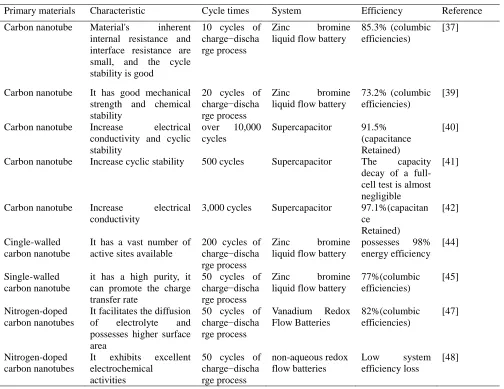
irregular during the operation of the battery, the normal electrode has a great damage after long working under the electrolyte. Considering the characteristics of electrochemical cell electrode (such as impedance), electrode materials manufactured by Nagai for the carbon nanotube[37], the coulomb efficiency of the battery is 85.3%, electrode made by mixing carbon nanotubes with activated carbon, its internal resistance and interface impedance are very small. The electrodes handled by Hu through carbon nanotubes and direct-current electrophoresis have larger porosity and surface area[38], stable properties, the efficiency of the battery is 76.8%. Carbon black, graphite and carbon nanotubes filled polypropylene electrode were manufactured by Jang[39], the electrode formed a good internal network, reduced resistance and cross contamination, and had good mechanical strength and chemical stability. Yang use Black-Phosphorus nanoflakes/CNTs composite paper as electrode, it has excellent electrical conductivity and cycle stability[40]. Zhu used TiO2/Super-Aligned Carbon Nanotube to
make electrode, which can increased the stability of the cycle[41]. Mu used carbon nanotubes/reduced graphene oxide/MnMoO4 composite as electrode, which can increased the electrochemical
properties[42].
The carbon nanotube core atom sp2 hybrid, with high modulus and high strength, it can improve the stability and durability of the modified material as a modified material[43]. According to the number of graphene layers, they are divided into single wall and multi wall, multi walled carbon nanotubes at the beginning of the formation of the tube wall has many small hole defects, however single wall carbon nanotube defects less, with higher uniformity and consistency. The electrode developed with single wall carbon nanotubes and multi walled carbon nanotubes modified electrode[44], single wall has a vast number of active sites available, the electrode has good electrochemical effect and stability, after 200 cycles of charging and discharging, energy efficiency reached 98% by Y.Munaiah. The carbon nanotube modified electrode has strong mechanical properties, after several cycles of charging and discharging, the structure and porosity of the carbon nanotube electrode are difficult to change, finally, the performance of the battery will be greatly improved. The different purity will have a certain degree of influence on carbon nanotubes, higher purity is less impurity, it can provide more active sites for the oxidation reduction of Br-/ Br2 on the
[image:7.596.46.550.230.619.2]
nanotube-chitosan to create a electrode that increased the charge transfer rate[46]. Wang used nitrogen-doped carbon nanotubes/graphite felt to make electrode, the rich porous structure contributes to the diffusion of electrolyte, nitrogen doping can greatly improve the electrochemical performance[47]. In order to explore the electrode properties of zinc bromine flow battery, try to reduce the battery system, it adopt foam electrode and is doped with good conductive metal which can increase the effective area of the contact surface of the electrode and the electrolyte, the performance of the battery will improve greatly.
Table 2. Carbon nanotube material
Primary materials Characteristic Cycle times System Efficiency Reference
Carbon nanotube Material's inherent internal resistance and interface resistance are small, and the cycle stability is good
10 cycles of charge−discha rge process
Zinc bromine liquid flow battery
85.3% (columbic efficiencies)
[37]
Carbon nanotube It has good mechanical strength and chemical stability
20 cycles of charge−discha rge process
Zinc bromine liquid flow battery
73.2% (columbic efficiencies)
[39]
Carbon nanotube Increase electrical conductivity and cyclic stability
over 10,000 cycles
Supercapacitor 91.5% (capacitance Retained)
[40]
Carbon nanotube Increase cyclic stability 500 cycles Supercapacitor The capacity decay of a full-cell test is almost negligible
[41]
Carbon nanotube Increase electrical conductivity
3,000 cycles Supercapacitor 97.1%(capacitan ce
Retained)
[42]
Cingle-walled carbon nanotube
It has a vast number of active sites available
200 cycles of charge−discha rge process
Zinc bromine liquid flow battery
possesses 98% energy efficiency
[44]
Single-walled carbon nanotube
it has a high purity, it can promote the charge transfer rate
50 cycles of charge−discha rge process
Zinc bromine liquid flow battery
77%(columbic efficiencies)
[45]
Nitrogen-doped carbon nanotubes
It facilitates the diffusion of electrolyte and possesses higher surface area
50 cycles of charge−discha rge process
Vanadium Redox Flow Batteries 82%(columbic efficiencies) [47] Nitrogen-doped carbon nanotubes
It exhibits excellent electrochemical
activities
50 cycles of charge−discha rge process
non-aqueous redox flow batteries
Low system efficiency loss
[48]
Carbon nanotubes have excellent conductivity. Scholars can heighten the conductivity of electrode materials by improving the purity, changing the structure, increasing the functional groups, and finally improving the energy efficiency of the zinc-bromine flow battery.
3. CONCLUSION
The zinc bromine flow battery has many advantages and lays its position in the storage battery. Electrode materials not only include carbon based materials, but also carbon nanotubes modified materials. Scholars improve electrical performance by changing carbon structures or increasing functional groups, the electrode provides more active sites for the redox pair which determines the charge transfer rate, ultimately the energy efficiency of the cell depends on the electrode performance. Nowadays, after many scholars' modifications and innovations, the performance of the electrode has changed qualitatively, it has laid a solid foundation for the large-scale application of zinc bromine liquid cell.
References
1. U. Thanganathan, D. Dixon, S. L. Ghatty, B. Rambabu, International Journal of Hydrogen Energy,
37 (2012)17180.
2. W. Wang , Q.T. Luo, B. Li, X.L Wei, L.Y. Li , Z.G. Yang , Advanced Functional Materials,23 (2013)970.
3. B. Dunn, H. Kamath, J.M. Tarascon, Science, 334(2011)928. 4. M. Armand, J.M. Tarascon, Nature, 451 ( 2008) 652.
5. Z.G. Yang, J.L. Zhang, M.C. Kintner-Meyer, X.C. Lu, Chemical Reviews, 111( 2011) 3577. 6. P.K. Leung, X.H Li, C.P.D. León, L. Berlouis, C. T. J. Low, F.C. Walsh, Rsc Advances, 2 (2012)
10125.
7. K.T. Cho, P. Ridgway, A. Z. Weber, S. Haussener, V. Battaglia, V. Srinivasan, Journal of the Electrochemical Society, 159 (2012) 1806.
8. Z.G. Yang, J. Liu, S. Baskaran, C.H. Imhoff, J.D. Holladay, JOM, 62 (2010) 14. 9. A.Z. Weber, M.M. Mench, J.P. Meyers, P.N. Ross, J.T. Gostick, Journal of Applied
Electrochemistry, 41 (2011) 1137.
10.L. Zhang, Q. Lai, J. Zhang, H. Zhang, Chemsuschem, 5(2012) 867.
11.A.A. Shah, H. Al-Fetlawi, F.C. Walsh, Electrochimica Acta, 55 (2010) 1125.
12.M.H. Chakrabarti, S.A. Hajimolana, F.S. Mjalli, M. Saleem, I. Mustafa, Arabian Journal for Science and Engineering, 38 (2013) 723.
13.P.K. Leung, C. Ponce-De-León, C.T. J. Low, A.A. Shah, F.C. Walsh, Journal of Power Sources,
196 (2011) 5174
14.J. Winsberg, T. Hagemann, T. Janoschka, M.D. Hager, U.S. Schubert, Angewandte Chemie, 56 (2017) 686.
15.Y. Shao, X. Wang, M. Engelhard, C. Wang, S. Dai, Journal of Power Sources, 195 (2010) 4375. 16.Q. Lai, H. Zhang, X. Li, L. Zhang, Y. Cheng, Journal of Power Sources, 235 (2013) 1.
17.M.C. Tucker, K.T. Cho, A.Z. Weber , G. Lin, T.V. Nguyen, Journal of Applied Electrochemistry,
45 (2015) 1.
18.C. Ding, H. Zhang, X. Li, T. Liu , F. Xing, Journal of Physical Chemistry Letters, 4 ( 2013) 1281. 19.W. Wang, Q. Luo, Z.M. Nie, M. Vijayakumar, B. Li, Advanced Functional Materials, 23
(2013)970.
21.P. Trogadas, O.O. Taiwo, B. Tjaden, T.P. Neville, S. Yun, Electrochemistry Communications, 48 (2014)155.
22.A.A. Shinkle, A.E.S.Sleightholme, L.T. Thompson, C.W. Monroe, Journal of Applied Electrochemistry, 41 (2011) 1191.
23.X. Sun, T. Souier, M. Chiesa, A. Vassallo, Electrochimica Acta, 148(2014)104.
24.Y. Lu,L. Wang, J. Cheng, J.B. Goodenough, Chemical Communications, 48 ( 2012)6544. 25.B. Huskinson, M.P. Marshak, C. Suh, E. Süleyman, Nature, 505 (2014) 195.
26.T. Gupta, A. Kim, S. Phadke, S. Biswas, T. Luong, Journal of Power Sources, 305 (2016) 22. 27.J.F. Whitacre, T. Wiley, S. Shanbhag, Y. Wenzhuo, A. Mohamed, Journal of Power Sources, 213
(2012) 255.
28.T. Ouchi, H. Kim, X. Ning, D.R. Sadoway, Journal of the Electrochemical Society, 161 (2014)1898.
29.M.D. Slater,D. Kim, E. Lee, C.S. Johnson, Advanced Functional Materials, 23 (2013) 947. 30.H. Zhou, H. Zhang, Z. Ping, B. Yi, Electrochimica Acta, 51 (2006) 6304.
31.M.C. Wu, T.S. Zhao, H.R. Jiang, Y.K. Zeng, Y.X. Ren, Journal of Power Sources,355(2017)62. 32.L. Zhang, H. Zhang, Q. Lai, X. Li, Y. Cheng, Journal of Power Sources, 227(4)(2013) 41. 33.C. Wang, X. Li, X. Xi, P. Xu, Q. Lai, Rsc Advances, 6 (2016) 40169.
34.C. Wang, Q. Lai, P. Xu, D. Zheng, X. Li, H. Zhang, Adv Mater, 29 ( 2017)1605815. 35.C. Wang, X. Li, X. Xi, W. Zhou, Q.Z. Lai, Nano Energy, 21 ( 2016) 217.
36.S. Biswas, A. Senju, R. Mohr, T. Hodson, N. Karthikeyan, Energy & Environmental Science, 10 ( 2016) 114.
37.Y. Nagai, R. Komiyama, H. Miyashita, S.S. Lee, Iet Micro & Nano Letters, 11 ( 2016) 577 38.W.D. Hu, S.H. Xu, C.F. Xu, Journal of functional materials and devices, 18 ( 2012)421. 39.W.I. Jang, W.L. Jin , Y.M. Baek , O.O. Park, Macromolecular Research, 24 (2016) 276. 40.B. Yang, C. Hao, F. Wen, B. Wang, C. Mu, Acs Appl Mater Interfaces, 9 ( 2017) 44478. 41.K.L. Zhu, Y.F. Luo, F. Zhao, J.W. Hou, ACS Sustainable Chem. Eng. 6 ( 2018) 3426 42.X. Mu, J. Du, Y. Zhang, Z. Liang, H. Wang, Acs Appl Mater Interfaces, 9 ( 2017) 35775. 43.B. Ruan, H. Guo, Y. Hou, Q. Liu, Y. Deng, ACS Appl. Mater. Interfaces, 9 ( 2017) 37682. 44.Y. Munaiah, S. Suresh, S. Dheenadayalan, V.K. Pillai, P. Ragupathy, Journal of Physical
Chemistry C, 118 ( 2014) 14711.
45.Y. Munaiah, S. Dheenadayalan , P. Ragupathy , V.K. Pillai, ECS Journal of Solid State Science and Technology, 2 ( 2013) 3182.
46.Y.H. Liu, T.C. Yu, Y.W. Chen, C.H. Hou. ACS Sustainable Chem. Eng. 6 (2018) 3196 47.S.G. Wang, X.S. Zhao, T. Cochell, A. Manthiram, Phys. Chem. Lett. 3 ( 2012) 2164. 48.J. Lee, M.S. Park, K.J. Kim, Journal of Power Sources, 341 ( 2017) 212.