THE
PARADOXES OF HUMANITARIAN ACTION
Fiona Terry
Department of International Relations Research School
of
Pacificand
Asian StudiesAustralian National University
A thesis submitted for the degree of Doctor of Philosophy
of the Australian National University
L
11,-
From mid -1994 to late -1996, the Rwandan refugee camps in Zaire harboured a defeated regime responsible for genocide. While assisting refugees, humanitarian action
strengthened the extremists, and the refugee camps were attacked by their opponents. Thus the system established to protect refugees became the source of their peril. This thesis explores questions raised by the Rwandan refugee crisis about the negative consequences of humanitarian action and the role of refugee camps in war.
The use of refugee camps by combatants has been a widespread feature of the contemporary refugee regime, yet has received scant attention as a phenomenon. This thesis examines four cases in which it occurred: the Afghan refugee camps in Pakistan, the Salvadoran and Nicaraguan camps in Honduras, the Cambodian camps in Thailand, and the Rwandan refugee camps in Zaire. It seeks to demonstrate the mechanisms by which humanitarian action in refugee camps assists insurgents in their struggle against the refugee -generating state, and to assess the relative importance of the contribution of humanitarian assistance vis -à -vis other types of support the combatants received. Humanitarian action is increasingly accused of prolonging conflict, yet such claims are rarely substantiated through assessments of other resources available to belligerents.
In each case the thesis explores the attitudes of the aid organisations to the use of the camps by combatants. It assesses the degree of knowledge the aid organisations acquired about the misuse of humanitarian assistance, and highlights their views on this.
The dissertation investigates why the paradoxes of aid recur and persist in spite of the knowledge attained in the past.
CONTENTS
Abstract
Table
of Contents ivList
of
Tables, Boxesand
Maps viiAbbreviations
viiiAcknowledgements xii
Introduction
11. Refugee Camps, Humanitarian Action and War 5
1.1 Refugees and Humanitarian Action 8
2. The International Aid Regime 13
2.1 Refugees and Refugee Camps 13
2.2 Humanitarian Action 16
3. Scope and Method of the Study 20
1 The
Paradoxes
ofHumanitarian
Action 311. `Complex' Emergencies: A New Phenomenon? 32
1.1 Contemporary Images of a New World Disorder 32
1.2 The `Complex' Environment 36
1.3 The `Complex' Response 42
2. The Paradoxes of Humanitarian Action 46
2.1 Protection 47
2.2 Humanitarian Aid and the Economy of War 55
2.3 Legitimacy 63
2.4 Population Control 68
2.5 Is Aid Significant to the Conduct of War? 72
3. Humanitarian Action and Responsibility 74
3.1 Conceptions of Responsibility 75
3.2 Institutions of Accountability 84
Conclusion 86
2 The Afghan Refugee Camps in
Pakistan
88I. Pakistan as a Military Sanctuary 89
2. Pakistan as a Humanitarian Sanctuary 96
2.1 Protection 97
2.2 War Economy 99
2.3 Legitimacy 100
3. The Relief Response: In the Name of a Just Cause I06
3.1 Different Approach, Same Ends 107
3.2 Contending Images of 'Refugeehood' 110
Conclusion 112
3 The
Nicaraguan
and
Salvadoran
Refugee Camps inHonduras
1171. Honduras as a Military Sanctuary 119
1.1 The Nicaraguan Opposition Forces 121
1.2 The Salvadoran Opposition Forces 126
2. Honduras as a Humanitarian Sanctuary 127
The Salvadoran Refugee Camps 127
2.1 Protection 128
2.2 War Economy 131
2.3 Population Control and Legitimacy 133
The Nicaraguan Refugee Camps 135
2.4 Population Control and Legitimacy 137
2.5 War Economy 139
3. The Relief Response: The Neutrality Void 141
3.1 Politically- oriented 142
3.2 Rights -oriented 144
3.3 Pragmatically -oriented 146
3.4 UNHCR 147
Conclusion 148
4 The
Cambodian
Refugee Camps inThailand
1511. Thailand as a Military Sanctuary 152
2. Thailand as a Humanitarian Sanctuary 163
2.1 Protection 163
2.2 War Economy 167
2.3 Legitimacy 173
2.4 Population Control 177
3. The Relief Response: The Humanitarian Impasse 18I
3.1 The Price of Access 182
3.2 The Crisis of Western Conscience 186
3.3 Taking Sides 189
Conclusion 193
5 The
Rwandan
Refugee Campsin Zaire
1971. Zaire as a Military Sanctuary 200
2. Zaire as a Humanitarian Sanctuary 214
2.1 The Population Exodus and International Response 214
2.2 Population Control and the Quest for Legitimacy 219
2.3 Protection 226
3. The Relief Response: Imperatives Versus Consequences 238
3.1 Weighing the Consequences 241
3.2 The Imperative to Remain 245
Conclusion 259
6 Conclusions
and Implications
2631. Refugee -Warriors and Humanitarian Action 263
1.1 The Relationship Between Aid and Conflict 263
1.2 The Knowledge and Attitudes of Aid Agencies 267
2. Institutional Constraints to Learning 270
2.1 Interpretation of Experience 272
2.2 The Culture of Justification 277
2.3 The Logic of Institutional Preservation 281
3. Implications 288
Appendix
1: Armement Don't Dispose Le FPR 294Appendix 2: Mil -Tec Letter to the Rwandan Minister of Defence 296
Appendix 3: Military Training Schedule and Timetable 306
Appendix 4: Statuts du Front Democratique Rwandais 309
Appendix 5: Rapport de Gestion Financière de la Commission du Patrimoine 315
LIST OF
TABLES, BOXES AND MAPS
TABLES
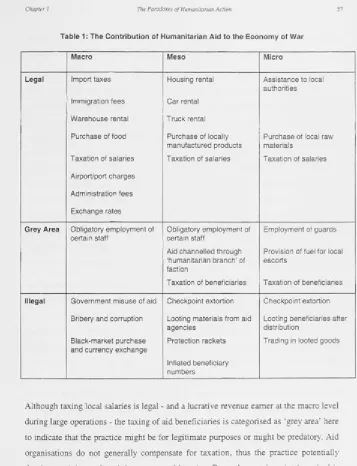
1 The Contribution of Humanitarian Aid to the Economy of War 57
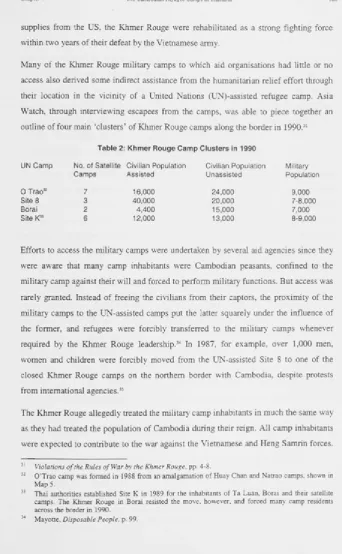
2 Khmer Rouge Camp Clusters in 1990 160
3 Relative Benefits of Military and Humanitarian Sanctuaries to Guerrilla Movements 264
BOXES
1 `Safe Areas' in Bosnia- Hercegovina 52
2 MSF and the Economy of War in Somalia 59
3 Humanitarian Action and Legitimacy in Biafra 67
4 Famine and Population Control in Northern Ethiopia 71
MAPS
1 The Afghan Refugee Camps and Settlements in Pakistan 91
2 The Nicaraguan and Salvadoran Refugee Camps and Settlements in Honduras 120
3 The Cambodian Refugee Camps and Khmer Rouge Strongholds, 1980 I57
4 The Cambodian Refugee Camps on the Thai -Cambodian Border, 1984 165
5 The Cambodian Refugee Camps on the Thai -Cambodian Border, 1986 167
ABBREVIATIONS
AFDL Alliance des Forces Démocratique
pour
la Libération (de Congo) Alliance of Democratic Forces for Liberation (of Congo)AICF Action International Contre la Faim
ALIR Armée de Libération du Rwanda
(Rwandan Liberation Army)
AIRE Association des Journalistes Rwandais en Exil
(The Association of Rwandan Journalists in Exile)
ALNAP Active Learning Network on Accountability and Performance in Humanitarian Assistance
ANC African National Congress
ASEAN Association of South -East Asian Nations
AusAID Australian Agency for International Development
CGDK Coalition Government of Democratic Kampuchea
CIA Central Intelligence Agency of the United States Government
CRS Catholic Relief Services
CZSC Contingent zairois de securité dans les camps (Zairean Contingent for Security in the Camps)
DAC Development Assistance Committee (of the Organisation for Economic Co- operation and Development)
DK Democratic Kampuchea
DoD Department of Defense (of the United States Government)
DPKO Department of Peacekeeping Operations (of the United Nations)
DRC Democratic Republic of Congo
DSL Defence Systems Limited
ECHO European Community Humanitarian Office
ECOMOG Economic Community of West Africa Monitoring Group
EPLF Eritrean People's Liberation Front
(Rwandan Armed Forces)
FDR Front Démocratique Rwandais
(Rwandan Democratic Front)
FMLN Frente Farabundo Martí
para
la Liberación Nacional(Farabundo Martí National Liberation Front)
FOA Friends of the Americas
Frelimo Frente Libertacao Mocambicana
(Mozambique Liberation Front)
FSLN Frente Sandinista de Liberación Nacional
(Sandinista National Liberation Front)
FUNCINPEC Front uni National
pour
un Cambodge independent, neutre, pacifique et coopératif(United Front for an Independent, Neutral, Peaceful and Cooperative Cambodia)
GAO General Accounting Office of the United States Government
HRFOR United Nations Human Rights Field Operation in Rwanda
ICJ International Court of Justice
ICVA International Council of Voluntary Agencies
ICRC International Committee of the Red Cross
ICTR International Criminal Tribunal for Rwanda
IDP Internally displaced person
IFRCRC International Federation of Red Cross and Red Crescent Societies
IRC International Refugee Committee
ISI Inter -services Intelligence Directorate (of the Pakistani military)
KLA Kosovo Liberation Army
KPNLF Khmer People's National Liberation Front
MSF Médecins sans Frontières
MRND Mouvement révolutionnaire national
pour
le développement et ladémocratie
NATO North Atlantic Treaty Organisation
NGO Non -government organisation
NPFL National Patriotic Front of Liberia
NSC National Security Council of the United States Government
NWFP Northwest Frontier Province (of Pakistan)
OAU Organisation of African Unity
OECD Organisation for Economic Co- operation and Development
OLS Operation Lifeline Sudan
PLO Palestine Liberation Organisation
PVO Private Voluntary Organisation
RDR Le Rassemblement
pour
le Retour et la Démocratie au Rwanda (Rally for the Return and Democracy in Rwanda )Renamo Resistencia Nacional Mocambicana (Mozambique National Resistance)
RPA Rwandan Patriotic Army
RPF Rwandan Patriotic Front
RTLM Radio -télévision libre des mille collines
SAF Salvadoran Armed Forces
SPLA Sudan People's Liberation Movement
SRRA Sudan Relief and Rehabilitation Agency
TPLF Tigrayan People's Liberation Front
UN United Nations
UNAMIR United Nations Assistance Mission for Rwanda
UNITA Unido Nacional
para
a Independência Total de Angola (National Union for the Total Independence of Angola)UNBRO United Nations Border Relief Operation
UNPROFOR United Nations Protection Force (in the former Yugoslavia)
US United States
USAID United States Agency for International Development
USCWF United States Council for World Freedom
USSR Union of Soviet Socialist Republics
ACKNOWLEDGEMENTS
I have been extremely fortunate in the level and quality of support that I have received from many quarters during the course of this project. My supervisory panel, Professor Ramesh Thakur, Dr William Maley and Professor Philip Pettit provided inspiration, guidance and friendship throughout the arduous process, with unfailing good humour. I owe them a great debt of gratitude. Many thanks are also due to Professor Andy Mack and Professor Jim Richardson for their enthusiasm for the topic and their readiness to assist when required.
I am deeply grateful for the scholarships that I received from the Australian National University and from the Evans -Grawemeyer Award. The Department of International Relations kindly adopted me once the Peace Research Centre closed, and were generous with their space and resources. Warm thanks to Jan Preston -Stanley, Carol Taylor and Lynne Payne for providing guidance through administrative and technical difficulties. Thanks also to Kay Dancey who brought such excellent technical skills to the production of the maps.
I have greatly benefited from lively debates and discussions on aspects of this work with several people, particularly Peter Hakewill, Tony Jackson, Gérard Prunier, Raymond Apthorpe, Carol Devine, Jennifer Balint, Lorraine Elliott, Greg Fry, Chris Reus -Smit, Wynne Russell, and Patrick Vial. Mathilde Creignou and Christine Dufour at the MSF documentation centre in Paris were incredibly helpful in tracking down sources, and I am grateful to Odile Hardy for assisting in the search for elusive documents. Robert Muller kindly facilitated contact with several people in Geneva. Special thanks to everyone involved in MSF Australia for their support, patience and understanding of my `other' commitment, and for the enthusiasm they showed for my project.
Friends within the humanitarian network showed extraordinary hospitality during my fieldwork, and crucial moral support once I returned to Canberra. Thanks especially to Stephan Oberreit, Karen Farkas, David Shearer, Thierry Durant, Alain Destexhe, Eric Goemaere, Sylvie Lemmet, Joelle Tanguy, ICRC Afghanistan and Peshawar, Refugee Policy Group, Jose -Antonio Bastos, Zouina Bouda, Fred Vigneau, Thomas Gurtner, David Rodin, Catrin Schulte-Hillen, Alfred Boll, Michel Clerc, Mike Toole, Lesley McCulloch, Lisa Drummond, Jan Hastings and Kate Flamsteed. Patrick Vial deserves special gratitude for his love, friendship and support in spite of all that has happened.
In October 1996, Zairean rebels and their Rwandan army allies attacked Rwandan
refugee camps in Eastern Zaire.
It was during the day, around 3 p.m. We heard gunfire, two shots far from us, and we were afraid it was the start of an operation. We took the possessions we could carry and fled... in the meantime, the soldiers encircled the group left in the forest with the children and took them away to massacre them, even the babies... Every time refugees erected camps, others [soldiers] would come and destroy them. There was a little camp near Kibumba where I found many dead. The Banyamulenge destroyed all the camps to disperse the refugees. All the dead [in Kibumba] had been shot.'
Narcisse was a Rwandan refugee who fled the northern camps with 700,000 of his compatriots. Pursued by soldiers, they hid in the forest but Narcisse's wife, like tens of thousands of others, was caught and killed. For the previous two years they had lived under the auspices of the United Nations (UN), receiving humanitarian assistance and protection under international law. Yet neither ultimately saved them.
Those who destroyed the refugee camps justified their act as self- defence: remnants of the Rwandan regime responsible for the 1994 genocide were using them as a base from which to launch raids into Rwanda. The Rwandan Government warned they would
disperse the camps if the international community took no action, yet the UN and its member states remained impassive. The system established to protect the refugees became the source of their peril.
Many questions raised by the Rwandan refugee crisis are at the heart of this inquiry. Why did refugee camps harbour a defeated army and others suspected of crimes against humanity? How did refugee camps and humanitarian aid contribute to the war? What did the UN, donor governments and aid organisations know of the misuse of the camps? What were their attitudes towards this? Why did such an outcome occur?
The Rwandan crisis marked a turning point in the post -Cold War international relief system? First the failure of the UN and its member states to stop the genocide eroded the last vestiges of optimism held by the aid community in a new `humanitarian' world
order. Then humanitarian action became the subject of unprecedented criticism as the
perverse side -effects of humanitarian relief in the refugee camps became conspicuous. The Rwandan crisis has emerged as the symbol of the failure of the international system to mitigate the humanitarian consequences of political crises, and is the archetype invoked in contemporary critiques and discussions of humanitarian action. Posing dilemmas to aid agencies and donor governments, and the subject of the most comprehensive evaluation of an international `humanitarian' response,' the Rwandan crisis has spawned widespread introspection by aid agencies and attention in the academic literature.
Yet for all this attention, the questions raised above remain, for the most part,
unanswered. None of the existing literature in the areas of international relations, refugee studies, humanitarian affairs or peacekeeping provides a comprehensive explanation of how, why, and to what extent refugee camps and humanitarian aid become embroiled in conflict, and the implications for the refugees and humanitarian actors operating therein. Writings within each field of inquiry offer insights into aspects of the problem, but these have not been integrated into a broad and historical analysis to
facilitate deeper understanding of the issues. This thesis contributes to filling this void.
This study explores the questions posed by the Rwandan crisis within the broader context of humanitarian action and the negative consequences that it can generate. The profound paradox of humanitarian action is its potential to contradict its fundamental purpose: it can prolong the suffering it intends to alleviate. This is particularly the case in times of conflict. Humanitarian assistance has been held responsible for fuelling conflicts or protracting their duration from the Biafran secessionist conflict in the Iate
3
Nok,' m1IlwOod
Nte comedi}ur, noF ihe
+)'.
ine senos hxt Ro ed'IN(- liso iS i{1ENbls1,e4 mistab_
This term is borrowed from John Borton, `Recent Changes in the International Relief System', Disasters 17, No. 3 (1993): 187 -201.
The five volume, multi -donor evaluation of the International Response to the Rwandan crisis, published in 1996 was `an unprecedented international collaboration' according to the Head of the Evaluation, Niels Dabelstein. It was overseen by a Steering Committee composed of 19
representatives of the aid community, and cost $1.6 million (all dollars are US unless otherwise stated). See David Millwood (ed.), The International Response to Conflict and Genocide: Lessons
from the Rwanda Experience (Copenhagen: Steering Committee of the Joint Evaluation of
Emergency Assistance to Rwanda, 1996); Niels Dabelstein, `Evaluating the International Humanitarian System: Rationale, Process and Management of the Joint Evaluation of the International Response to Genocide', Disasters 20, No. 4 (1996): 287 -294 at p. 287. In 1999 the UN also commissioned a report into its actions during the genocide. Ingvar Carlsson, Han Sung -Joo and Rufus M. Kupolati, Report of the Independent Inquiry into the Actions of the United Nations During
1960s to the wars in the former Yugoslavia and the Sudan in the 1990s. Yet such claims predominantly rest on the potential for aid to prolong conflict; they are rarely substantiated by assessments of the impact of humanitarian aid in relation to other political, economic and military resources available to belligerents.'
The aim of this thesis is to demonstrate that the unintended negative consequences of humanitarian aid persist and recur, and to explore the reasons why. This inquiry comprises three elements. First, it examines how humanitarian assistance becomes a
political and economic resource for combatants. Second, it assesses the relative importance of humanitarian assistance to these combatant forces vis -à -vis the other
types of support that they receive. Finally, and most importantly, this study explores the reasons why the paradoxes of aid persist and recur in spite of the knowledge that aid organisations acquire of them.
In addressing these interrelated questions, this study examines the `side -effects' of humanitarian action from the perspective of combatants, aid organisations, and their respective sponsors. By situating humanitarian action within the broader political and military context, the study endeavours to avoid either exaggerating or diminishing the significance of aid to the war effort of belligerents, and to identify the circumstances in which aid might be said to prolong conflict. The study analyses the attitudes of aid organisations towards the unintended consequences of their actions, which in turn illuminates some of the reasons why the paradoxes of aid persist. The thesis argues that negative consequences are inherent in humanitarian action, but are exacerbated by the institutionalist logic that underpins the behaviour of aid organisations. It argues that there are institutional barriers to learning that help to explain the persistence of the paradoxes of humanitarian action over a range of cases surveyed, and therefore requires
a particular response by aid organisations.
This inquiry is undertaken in refugee camp settings for several reasons. As a regular feature of the international relief system for the past thirty years, they offer a relatively constant environment in which to examine the recurrence of the negative consequences of humanitarian action. Norms of state sovereignty predominantly relegated aid organisations to refugee camps on the periphery of conflicts during the Cold War (1946-
1989),5 an area that multiplied during the late 1970s as the number of refugees fleeing repression and violence increased dramatically.6 Many of the techniques employed by aid organisations to respond to the needs of displaced and dispossessed populations were developed in refugee camps, and their duration - decades in the case of Palestinian
and Afghan refugee camps
-
constitutes one of the few constants of the humanitarian domain. Refugee camps are obviously also the most pertinent context in which to address the questions raised above in connection with the Rwandan case. This study sheds light on how refugee camps, as one component of the field of humanitarian action, can be of benefit to combatants and hence can be implicated in the suffering that humanitarian action aims to relieve.An investigation of the negative consequences of aid is also pertinent to the broader humanitarian field. This study focuses on four of the paradoxes of humanitarian action. The first is the protective functions of refugee camps and other `protected zones' for combatants. The second is the contribution of aid to the economy of war. The third is the legitimacy that humanitarian action can accord to individuals, political causes or movements. The fourth is the role of humanitarian action in the control of populations. Each will be examined in detail in Chapter 1.
This introductory chapter illustrates the scope and importance of the issues addressed by this study, and situates it within the existing literature on refugee studies and
humanitarian affairs. It then outlines some of the fundamental concepts, structures and actors of the international aid system. The introduction concludes with a discussion of the method of inquiry and the case studies chosen for analysis, and the procedure that the thesis follows.
(1999): 36 -44, esp. pp. 41 -44. s The end of
the Cold War can be signified by one of three events: the collapse of the Berlín Wall in
1989; German reunification in 1990; and the dissolution of the Soviet Union in 1991. According to one author, the most conventional designation is 1989. See `Introduction', in Paul F. Diehl (ed.) The Politics of Global Governance: International Organizations in an Interdependent World (Boulder: Lynne Rienner, 1997), pp. 1 -6 at p. 3.
6 The number of refugees recognised by UNHCR grew from fewer than 3 million in 1975 to approximately 10 million in 1982, and reached a peak of nearly 20 million by 1993. UNHCR, The
1. Refugee Camps,
Humanitarian
Action andWar
This inquiry is located within refugee studies and the burgeoning literature on
humanitarian affairs, but it is also pertinent to international relations and peacekeeping. The use of refugee camps as bases
arrières
by combatants has direct implications for international and regional stability. It compounds the threat to regional harmony posedby refugee flows, and increases the stakes in relations between the governments of asylum countries and the refugee -generating state. It embroils the refugee population in the conflict, and poses practical and ethical problems for humanitarian aid organisations
operating in the camps. Aristide Zolberg, Astri Suhrke and Sergio Aguayo coined the
term `refugee -warriors' to describe this phenomenon in their seminal study on the causes of refugee flows, Escape from Violence: Conflict and the Refugee Crisis in the Developing World.'
Despite the threat that refugee -warriors pose to the `international peace and security'
that the UN is charged with maintaining,' the phenomenon has received scant attention in the international relations and peacekeeping literature.' This lacuna is particularly surprising in light of the continuing relevance of refugee -warriors and the sanctuaries provided by refugee camps in contemporary conflicts: the multinational force in East Timor in late 1999 faced its largest threat from militias sheltering among refugees in
West Timor.
Refugee -warrior communities have been a widespread feature of the international arena for the past fifty years. The Palestinian refugees in the Middle East constituted the first
Aristide R. Zolberg, Astri Suhrke and Sergio Aguayo, Escape from Violence: Conflict and the Refugee Crisis in the Developing World (New York: Oxford University Press, 1989), p. 275.
8 The first purpose issued to the United Nations in Article 1 of the UN Charter is 'to maintain international peace and security'.
' The notable exceptions are the work of Myron Weiner and Gil Loescher on the security implications of international migration and refugee flows. For overviews of the broad strategic implications of refugee flows, of which refugee -warriors are only one aspect, see Myron Weiner, `Introduction: Security, Stability and International Migration', in Myron Weiner (ed.), International Migration and
Security (Boulder: Westview Press, 1993), pp. 1 -35, and Gil Loescher, Refugee Movements and
International Security (London: Adelphi Paper 268, IISSBrassey's, 1992). Sporadic articles like that
of Ben Barber have also appeared in international relations literature, but a survey of prominent works in the peacekeeping literature dealing with conflict, stability and intervention in the Third World, conducted by Howard Adelman, found that the issue is virtually ignored. Ben Barber, 'Feeding Refugees, or War? The Dilemma of Humanitarian Aid', Foreign Affairs 76, No. 4 (1997):
refugee -warrior community,10 and one that still exists today. On the African continent,
Tunisia and Morocco were host to the Algerian resistance opposing the French colonial
government in the 1950s, and another early refugee -warrior community was formed among Tutsi refugees who fled post- independence violence in Rwanda, beginning in 1959. After some thirty years in exile, this community and their descendants successfully reinvaded Rwanda in 1994 under the banner of the Rwandan Patriotic Front," with the ensuing refugee exodus providing the base for a new refugee -warrior community among their opponents. Burundian refugees in Tanzania also engaged in military activities against their home state, and Liberian refugees in Sierra Leone were suspected of assisting the National Patriotic Front of Liberia (NPFL)."
Eritrean insurgents opposing successive Ethiopian Governments operated elaborate
bases in refugee camps in the Sudan throughout the 1960s, 1970s and 1980s, and Ethiopia was host to Sudanese refugees and rebels opposing Khartoum. The armed branch of the South -West African People's Organisation maintained bases beside Namibian refugee camps in Angola, and refugee camps in many of the `front -line states' bordering South Africa provided recruitment grounds for the African National Congress (ANC) resistance. Algeria played host to refugees and Polisario guerrillas from Western Sahara; guerrillas from northern Chad mixed with refugees in Libya; and the Somali refugee camps in Kenya fulfilled some of the functions of a humanitarian sanctuary to a few of Somalia's warring factions in the early 1990s.
In Asia, refugees from East Pakistan were trained and equipped in refugee camps in India before their victorious return to form the state of Bangladesh in 1971, and Pakistan provided sanctuary to Afghan refugees and mujahideen opposing the Soviet -backed regime in Kabul. Refugee camps in Thailand provided sanctuary to rebels trained by the
10
ll
ZoIberg et al., Escape from Violence, p. 277. For more detailed discussion of the Palestinian refugee issue, see Benny Morris, The Birth of the Palestinian Refugee Problem, 1947 -1949 (Cambridge:
Cambridge University Press, 1987).
For a history of the Rwandan exile and armed insurgency see Théo Karabayinga and José Kagabo,
`Les Réfugiés, de l'Exil au Retour Armé', Les Temps Modernes 583 (July- August 1995): 63 -90;
Ogenga Otunnu, `Rwandese Refugees and Immigrants in Uganda', in Howard Adelman and Asti Suhrke (eds), The Path of a Genocide: The Rwandan Crisis from Uganda to Zaire (New Brunswick: Transaction Publishers, 1999), pp. 3 -29 and Ogenga Otunnu, `An Historical Analysis of the Invasion by the Rwandan Patriotic Army (RPA)', in Adelman and Suhrke (eds) The Path of a Genocide, pp.
US Central Intelligence Agency (CIA) from the Hmong hill tribes in Laos and to
Cambodian opponents of the Vietnamese -installed regime in Phnom Penh. More recently, the Burmese refugee camps in Thailand have been attacked by the Rangoon -
sponsored Democratic Karen (Kayin) Buddhist Army for allegedly assisting insurgents
from the Karen National Liberation Army.'3 Refugee camps to the east of Papua New Guinea's border with the Indonesian province of Irian Jaya have also provided sporadic sanctuary to resistance fighters from the Organisasi Papua Merdeka (Free Papua Movement)."
In the Americas, Guatemalan camps were attacked in Mexico for allegedly harbouring insurgents, and Costa Rica housed Nicaraguan refugees and rebels. Honduras was also a compliant host to Nicaraguan contras fighting the Sandinista regime in Managua, but was a reluctant sanctuary for insurgents opposed to the US- backed regime in El Salvador.
Clearly the role of refugee camps in conflict is an important issue which warrants closer analysis due to its implications for stability, and for humanitarian action. Edward Luttwak's recent indictment of the role of humanitarian assistance in war, and his call for a reduction in humanitarian activity, was based largely on observations of the Palestinian, Cambodian and Rwandan refugee camps.15 Such allegations feed into a
larger debate in the humanitarian realm about the negative consequences of humanitarian action. Hence this study traverses the distinct yet overlapping fields of
refugee studies and humanitarian affairs to shed light on the issues.
12
Karen Jacobsen with Steven Wilkinson, `Refugee Movements as Security Threats in Sub -Saharan
Africa', in Myron Weiner (ed.), International Migration and Security (Boulder: Westview Press, 1993), pp. 201 -227 at p. 214.
t3 Hazel Lang, doctoral candidate in the Department of International Relations, Australian National University, writing on the Burmese refugees in Thailand. Personal communication, 11 August 1999.
14 See Alan Smith and Kevin Hewison, `1984: Refugees, "Holiday Camps" and Deaths', in R.J. May (ed.) Between Two Nations: The Indonesia -Papua New Guinea Border and West Papua Nationalism (Bathurst: Robert Brown & Associates, 1986), pp. 200 -217, and Edward P. WoIfers, `Foreword', in Edward P. Wolfers (ed.), Beyond the Border: Indonesia and Papua New Guinea, Southeast Asia and
the South Pacific (Waigani and Suva: The University of Papua New Guinea Press and the Institute of
Pacific Studies, University of the South Pacific, 1988), pp. 13 -39. 15
1.1 Refugees
and Humanitarian
ActionOf the vast literature covering political, Iegal and social aspects of refugee movements, asylum and protection,16 the most concerted attention to the issue of refugee -warriors is found in the legal field. As the body responsible for refugee protection, the Office of the
United Nations High Commissioner for Refugees (UNHCR) deliberated on the ramifications of refugee camps harbouring, or being suspected of harbouring,
combatants following South African Defence Force attacks on refugee camps in neighbouring countries from the late 1970s, and the massacre of Palestinian refugees in the Sabra and ChatilIa camps in Lebanon in September 1982. The Executive Committee of UNHCR addressed the issue between 1982 and 1987, debating the responsibility of states vis-a-vis their obligations to norms of refugee asylum and respect for state sovereignty.'' The literature identifies the inadequacy of existing mechanisms to ensure the physical, as opposed to legal, protection of refugees, but does not address how refugee camps provide a support base for combatants, or the implications for
humanitarian action.
The militarisation of refugee camps is raised elsewhere in the refugee literature as one of several implications of migration and refugee flows for security;'$ in relation to the
instrumentation of refugees as `freedom fighters' for foreign policy purposes during the Cold War;t9 or as one aspect of specific studies of the international response to refugee contexts. The Cambodian refugee camps in Thailand were the most scrutinised example
16
17
16
19
The refugee literature covers a vast array of works in the fields of legal analysis; historical and case studies; emergency assistance; politics and policies of asylum; the causes and consequences of
refugee flows; and refugees and international politics. Some of the main works include: Guy Goodwin -Gill, The Refugee in International Law (Oxford: Oxford University Press, 1996); Gil Loescher and Laila Monahan (eds), Refugees and International Relations (Oxford: Oxford University Press, 1989); B.E. Harrell -Bond, Imposing Aid: Emergency Assistance to Refugees (Oxford: Oxford University Press, 1986); Gil Loescher, Beyond Charity: International Cooperation and the Global Refugee Crisis (New York: Oxford University Press, 1993); Leon Gordenker, Refugees in International Politics (London: Croom Helm, 1987); UNHCR, State of the World's Refugees 1993: The Challenge of Protection (NY: Penguin, 1993); and Zolberg et al., Escape from Violence. See Elly- Elikunda Mtango, `Military and Armed Attacks on Refugee Camps', in Gil Loescher and Laila Monahan (eds), Refugees and International Relations (Oxford: Oxford University Press, 1989), pp. 87 -121, and M. Othman -Chande, `International Law and Armed Attacks in Refugee Camps', Nordic Journal Of International Law 59, Nos 2 &3 (1990): 153 -177.
See chapters in the edited volume by Myron Weiner, International Migration and Security, and Loescher, Refugee Movements and International Security.
of the latter.20 Although these studies contribute to illuminating how refugee camps and humanitarian aid can be manipulated by belligerent parties, and provide important background for this study, they do not examine wider aspects of the process.
The first work to address the broader issue of why and how refugee camps and the aid
distributed therein become assets for guerrilla movements as humanitarian sanctuaries was Jean -Christophe Rufin's 1986 book, Le Piège Humanitaire (The Humanitarian Trap)?' This was complemented by Zolberg, Suhrke and Aguayo's Escape from Violence in 1989. Both works identify the refugee -warrior phenomenon as a by- product of the simultaneous emergence of an effective international refugee regime with the rise of democratic nationalism. Humanitarian aid became a means through which to secure the legitimacy and support of civilians. Rufin's study, as the more developed of the two, provides some elements of the analytical framework for this thesis, linking the three main areas of interest: strategies of insurgency warfare; the legal status and
administrative organisation of refugee camps; and the broader side- effects of humanitarian action. However, while providing a framework through which to examine the relationship between conflict, refugees and humanitarian action, Rufin does not explore the role and attitudes of the aid organisations in the process. This issue needs addressing to shed light on why refugee camps and humanitarian aid have continued to
assist combatants despite awareness of the problem among aid agencies. Some of the
literature on humanitarian action is informative in this regard.
There are obvious overlaps in the fields of refugee studies and humanitarian affairs. Humanitarian concerns are a subset of the broader political, legal, social and economic aspects of the study of refugees, and refugee issues are one subset of the humanitarian
domain that also extends to victims of natural disasters, human rights abuses and political crises within states. The loss of the political appeal of refugees as people `voting with their feet' in the 1990s has increasingly led to their portrayal as a
20 See William
Shawcross, The Quality of Mercy: Cambodia, Holocaust and Modern Conscience (New York: Simon and Schuster, 1984); Linda Mason and Roger Brown, Rice, Rivalry and Politics: Managing Cambodian Relief (Notre Dame: University of Notre Dame Press, 1983); and Josephine Reynell, Political Pawns: Refugees on the Thai -Kampuchean Border (Oxford: Refugee Studies Programme, 1989).
21 Jean -Christophe Ruffin, Le Piège Humanitaire suivi de Humanitaire et politique depuis la chute du
Mur, revised and updated edition (Paris: Jean- Claude Lattès, 1993).
humanitarian issue, exemplified by the subtitle of the latest UNHCR publication, The State of the World's Refugees 1997 -98: A Humanitarian
Agenda"
Adam Roberts remarks that 'in the 1990s, humanitarian issues have played a historically unprecedented role in international politics'.23 Indeed, it is certainly the case that issues and events are labelled `humanitarian' with unparalleled frequency. This trend has coincided with the rise of the notion of `complex emergencies'24 as a euphemism for war, genocide and other manifestations of `disrupted states'25 in the post -Cold War environment, as well as for the required international multi- faceted response. A growing academic industry26 has joined governments, UN departments and non -government organisations (NGOs) in studying the characteristics and effects of the alleged `new
world disorder',27 and the combined civil-military," responses to these.
Within the literature on humanitarian issues, the writings most pertinent to this inquiry
are those addressing the negative impacts of humanitarian action and reappraising the raison
d'être
and effectiveness of aid organisations at responding to crises around the22
UNHCR, The State of the World's Refugees 1997 -98: A Humanitarian Agenda (Oxford: Oxford University Press, 1997).
23 Adam Roberts, `The role of humanitarian issues in international politics in the 1990s',
International
Review of the Red Cross 833 (March 1999), pp. 19-43 at p. 19.
24
Variations on this term include `complex humanitarian emergencies', 'complex political emergencies', and `complex disasters'. The term has also been accorded acronyms
-
CHEs or CPEs. 25The term 'disrupted states' refers to states which are disintegrating through the erosion of government authority and structures, and states which, through committing crimes against their own people, forfeit their right to legitimacy. This term is preferable to 'collapsed' or `weak' states since they preclude crises provoked by the strength of the state, such as the Rwandan genocide in 1994, and the Kosovo crisis in 1999.
26 `Complex
emergencies' have become a distinct subject of analysis, even inspiring the formation of departments dedicated to their study such as the Complex Emergencies Unit of the Centre for Defence Studies, Kings College London.
27 `Complex emergencies' in the 'new world disorder' were the theme of a 1999 edition of Third World
Quarterly (20, No. 1). Together the articles represent some of the lucid, but also the simplistic, generalisations of post -Cold War conflict and the international response to these.
28 A selection of the vast literature on 'humanitarian intervention' that is indicative of the main themes may include: Oliver Ramsbotham and Tom Woodhouse, Humanitarian Intervention in Contemporary Conflict: A Reconceptualization (Cambridge, UK: Polity Press, 1996); Ramesh Thakur and Carlyle A. Thayer (eds), A Crisis of Expectations: UN Peacekeeping in the 1990s (Boulder: Westview Press, 1995); the special issue of International Political Science Review 18 No. 1 (January 1997), dedicated to 'The Dilemmas of Humanitarian Intervention'; François Jean (ed.), Life, Death and Aid: The
Médecins Sans Frontières Report on World Crisis Intervention (London: Routledge, 1993); Sean D. Murphy, Humanitarian Intervention: The United Nations in an Evolving World Order (Philadelphia: University of Pennsylvania Press, I996); Laura W. Reed and Carl Kaysen (eds), Emerging Norms of Justified Intervention (Cambridge, MA: American Academy of Arts and Sciences, 1993); Jonathan Moore, Hard Choices: Moral Dilemmas in Humanitarian Intervention (Lanham, Md: Rowman and Littlefield, 1998); and Larry Minear and Thomas G. Weiss, Mercy Under Fire: War and the Global
world. Although several excellent studies29 of the negative effects of humanitarian relief preceded it, the November 1994 Africa Rights Discussion paper, Humanitarianism Unbound? is widely considered to have `opened the debate on humanitarianism' as it assertively declares.30 Other significant works emerged in the 1990s that analyse the
relationship between aid and the dynamics of conflict,3' and evaluations of the impact of humanitarian action have become a growing component of the work of UN agencies and government donors.32
Several prescriptive works aimed at reducing the negative impact of humanitarian action have recently gained ascendancy, the most renowned of which commandeered the slogan of the Hippocratic Oath of Western medicine, `First, do no harm' (primum non
nocere).33 Embraced as a response to the growing criticism of humanitarian action, it has
29
Morris Davis (ed.), Civil Wars and the Politics of International Relief Africa, South Asia, and the Caribbean (New York: Praeger, 1975); Rufin, Le Piège Humanitaire; Mary B. Anderson and Peter J.
Woodrow, Arising from the Ashes: Development Strategy in Times of Disaster (Boulder; Westview Press, 1989); Larry Minear, Humanitarianism Under Siege: A Critical Review of Operation Lifeline Sudan (Trenton, NJ: Red Sea Press, 1991); François Jean (ed.), Populations in Danger (London: John Libbey, 1992); Alain Destexhe, L'Humanitaire Impossible ou deux siècles d'ambiguïté (Paris: Armand Colin, 1993).
3°
Humanitarianism Unbound? Current Dilemmas Facing Multi- Mandated Relief Operations in
Political Emergencies (London: Discussion Paper No. 5, Africa Rights, 1994), pp. 36 -39. Thomas Weiss also credits this paper with having initiated the debate. Thomas G. Weiss, `Principles, Politics, and Humanitarian Action', Ethics and International Affairs 13 (1999): 1 -28 at p. 2.
3' The volume edited by Joanna Macrae and Anthony Zwi, War and Hunger: Rethinking International
Responses to Complex Emergencies (London: Zed Books in association with Save the Children Fund (UK), 1994) contains excellent articles by David Keen and Ken Wilson, 'Engaging with Violence: A Reassessment of Relief in Wartime', pp. 209 -221; Mark Duffield, 'The Political Economy of Internal War: Asset Transfer, Complex Emergencies and International Aid', pp. 50 -69; and Joanna Macrae and Anthony Zwi, 'Famine, Complex Emergencies and International Policy in Africa: An Overview',
pp. 6 -36; See also Alex de Waal, Famine Crimes: Politics & the Disaster Relief Industry in Africa (Oxford and Bloomington: Africa Rights & the International African Institute in association with James Currey and Indiana University Press, 1997); Gayle E. Smith, 'Relief Operations and Military
Strategy', in Thomas G. Weiss and Larry Minear (eds), Humanitarianism Across Borders: Sustaining Civilians in Times of War (Boulder: Lynne Rienner, 1993), pp. 97 -116; François Jean, 'Aide Humanitaire et Économie de Guerre', in François Jean and Jean -Christophe Rufin, Économie des Guerres Civiles (Paris: Hachette, 1996), pp. 543 -589; and John Prendergast, Frontline Diplomacy:
Humanitarian Aid and Conflict in Africa (Boulder: Lynne Rienner, 1996).
32 The Rwandan crisis, for example, spawned at least five separate evaluations by UN agencies in addition to the comprehensive five- volume multi-donor evaluation. See Comprehensive Report on Lessons Learned from United Nations Assistance Mission for Rwanda (UNAMIR), October 1993 -
April 1996 (New York: Lessons Learned Unit, Department of Peacekeeping Operations, 1996); Antonio Donini and Norah Niland, Rwanda: Lessons Learned: A Report on the Coordination of Humanitarian Activities (New York: United Nations Department of Humanitarian Affairs, 1994); Sue Lautze, Bruce D. Jones, and Mark Duffield, Strategic Humanitarian Coordination in the Great Lakes Region 1996- 1997:An Independent Study for the Inter- Agency Standing Committee (New York: IASC, 1998); Report of the Tripartite (UNICEF/UNHCR/WFP) Lessons Learned Study of the Great
Lakes Emergency Operation since September 1996 (n.p.: United Nations, 1998); and Lessons
Learned from the Burundi and Rwanda Emergencies (Geneva: Eval/04 /96/Rev.1, Inspection and Evaluation Service, UNHCR, 1996).
33
This dictum is associated with the work of American aid consultant, Mary Anderson. The idea
been received as a `new paradigm' of aid in some quarters," joining other reconceptualisations of the purpose and priorities of aid in the era of `complex emergencies'." Yet for all the attention given to mitigating the negative effects of aid, and the `lessons learned' units formed within UN agencies, government donors and NGOs, Larry Minear notes that there is little scholarly analysis of the dynamics of institutional behaviour and change within humanitarian institutions.36 He points to
aspects of organisational culture that impede learning by aid organisations, ideas that Mark Walkup elucidates in more detail through analysing how such culture develops." Although recognising that the problems faced in the Rwandan refugee camps in Zaire were a `rerun of problems unaddressed in Cambodian refugee camps along the Thai border years before',38 Minear restricts his analysis to the post -Cold War period, as do the majority of works analysing humanitarian action.
This thesis demonstrates that one of the reasons for the persistence of the paradoxes of humanitarian action is the emphasis placed on the Cold War /post -Cold War dichotomy. The prevailing discourse laments `how much more complex humanitarian work was now than it had been in the past',39 based on clichés about a new world `disorder'. This study challenges the images underpinning `complex emergencies', arguing that it is not the emergencies that warrant the `complex' label but the international response to them.
34
35
36
37
38
39
on the same subject. For its genesis see Anderson and Woodrow, Rising from the Ashes; Mary B.
Anderson, `International Assistance and Conflict: An Exploration of Negative Impacts', (n.p: mimeo, 1994), Mary B. Anderson, Do No Harm: Supporting Local Capacities for Peace through Aid (Cambridge, MA: Local Capacities for Peace Project, Collaborative for Development Action, 1996); and Mary B. Anderson, Do No Harm: How Aid can Support Peace
-
or War (Boulder: Lynne Rienner, 1999).A recent article claimed that the `Do no harm' maxim emerged in 1996 as 'a new development in the thinking behind relief aid'. Barry Munslow and Christopher Brown, `Complex emergencies: the institutional impasse', Third World Quarterly 20, No. 1 (1999): 207 -221 at p. 210.
For critiques of the current paradigms in the literature see Cindy Collins, `Critiques of Humanitarianism and Humanitarian Action', paper prepared for OCHA Seminar on Lessons Learned on Humanitarian Coordination, Stockholm, 3 -4 April 1998; Humanitarian Assistance and Conflict (Bergen: Report Prepared for the Norwegian Ministry of Foreign Affairs, Chr. Michelsen Institute, 1997); and Weiss, `Principles, Politics, and Humanitarian Action'.
Larry Minear, `Learning to Learn', paper prepared for OCHA Seminar on Lessons Learned on Humanitarian Coordination, Stockholm, 3 -4 April 1998, p. 4.
Mark Walkup, `Policy Dysfunction in Humanitarian Organizations: The Role of Coping Strategies, Institutions, and Organizational Culture', Journal of Refugee Studies 10, No. 1 (1997): 37 -60. John Prendergast also discusses the `seven deadly sins' committed by aid organisations that exacerbate the negative effects of aid. See Prendergast, Frontline Diplomacy, pp. 1 -15.
Minear, `Learning to Learn', p. 8.
Before outlining the analytical framework of this study, it is useful briefly to discuss general aspects of the refugee regime, humanitarian action, and the actors involved in
the provision of international humanitarian aid, since these are central themes of this study.
2. The
International
Refugee Regime2.1 Refugees
and
Refugee CampsThe recognition of individuals and groups as `refugees' is implicitly value -laden, and the appropriateness of the legal definitions, and their ambiguous application, have been the subject of much discussion.'° It is not necessary to delve into this issue here; suffice it to note that the granting of refugee status to individuals under the 1951 Refugee Convention and 1967 Protocol, or to groups under the broader 1969 Organisation of African Unity (OAU) Convention, confers rights on individuals that are not extended to asylum seekers outside the definition, or to persons displaced within their own country. The central tenet of the 1951 definition is that a refugee must have `a well- founded fear of being persecuted' in his or her country of origin, which the 1969 OAU Convention extended to include people who fled more generalised `external aggression, occupation, foreign domination or events seriously disturbing public order'. Some of the issues related to the refugee concept and the notions it implies will be raised in more detail in the case studies.
Although evidence suggests that refugees who settle among the local population generally fare better than those confined to
camps,'
the establishment of refugee camps `was invented as the most efficient method of distributing aid to a constituency that has been labelled as requiring ií'.42 Systems for delivering aid and conducting epidemiological surveillance of the population are easier to establish in camps, and host40
4'
42
See, for example, Zolberg et al., Escape from Violence, pp. 3 -33; Yéfime Zarjevski, A Future Preserved: International Assistance to Refugees (Oxford: Pergamon Press, 1988), pp. 49 -72; Loescher, Beyond Charity, pp. 140 -143; Roger Zetter, 'Labelling Refugees: Forming and Transforming a Bureaucratic Identity', Journal of Refugee Studies 4, No. 1 (1991): 39 -62.
See, for example, Wim Van Damme, `Do refugees belong in camps? Experiences from Goma and
Guinea', The Lancet 346 (5 August 1995): 360 -362.
Eftihia Voutira and Barbara E. Harrell -Bond, 'In Search of the Locus of Trust: The Social World of
governments often prefer to confine refugees to camps to control the impact of their presence on the local population, social services and environment. Moreover, the temporal image portrayed by camps sustains the hope among refugees and host governments that the refugees will return one day to their country of origin. Refugees living in closed camps depend entirely on external assistance whereas those in open camps can interact and trade with the local community and engage in income -generating
activities.
Refugee camps give rise to a complex web of relationships between the host nation
authorities, the local population, the refugees, UNHCR, NGOs, donor governments, and
within each of these groups. The host government is responsible for security in refugee camps and often deploys police, military or paramilitary forces to maintain law and
order. The host country is also responsible for recognising or denying refugee status to asylum seekers and can invite UNHCR to assist in this process and to administer the refugee camps but is not obliged to do so under international law. The mandate of UNHCR is contained in its 1950 Statute, but this is recommendatory and not binding on states. Hence UNHCR's authority `is moral and entails no significant legal sanctions' .43
The management of refugee camps and the coordination of services are usually undertaken by UNHCR. UNHCR enlists the assistance of NGOs to implement projects in the essential sectors of food and nutrition, water and sanitation, health, shelter and site maintenance, assistance to `vulnerable groups', and in other fields such as education, training, agriculture, and environmental management. Other UN agencies such as the United Nations Children's Fund (UNICEF) and the World Food Programme (WFP) are usually present under their respective mandates for children's rights and food aid, and the International Committee of the Red Cross (ICRC) might also provide assistance in accordance with its mandate conferred by international humanitarian law.
NGOs do not have formal mandates specifying their responsibilities. Rather they operate under self -designated charters, or organisational statements of objectives and goals.
Humanitarian NGOs tend to espouse the common objective of alleviating the suffering of vulnerable populations, but beyond this general objective they exhibit as many
43
P. D. Maynard, `The Legal Competence of the United Nations High Commissioner for Refugees',
differences as similarities in ideology and approach to their operations." Some were formed to proselytise, some to espouse a particular cause, and others to specialise in technical assistance. They vary enormously in size, competence and commitment. NGO attitudes to relationships with governments are one of the areas in which they differ most. During much of the Cold War humanitarian aid was tied to the foreign policy interests of donor governments and many NGOs were allegedly direct45 and indirect
vehicles of such policy. The US Government was particularly consistent in this strategy: Eugene Douglas, while US Coordinator for Refugee Affairs, wrote that `refugee policy
has always been in fact a component of foreign policy'.46 Nevertheless, some NGOs accepted, and still accept, high levels of government funding, rejecting the idea that this necessarily ties humanitarian action to the foreign policy of governments. But as
Barbara Harrell -Bond points out, `it is extremely difficult, if not impossible, for a
humanitarian agency that receives substantial amounts of government money to act as an advocate for an oppressed group whose interests contradict those of either donors or
hosts'.47 Other NGOs retain greater independence from governments through securing
funds from the public.
Among the refugees themselves there may be considerable differences in status, religion, ethnicity, education, and political persuasion that can affect, and be affected by, the administrative procedures of a refugee camp. The local `leaders' are usually sought out to liaise between refugee communities and aid organisations, but the dynamics of camp management can alter social relationships significantly. Refugees with qualifications recognised by aid organisations are favoured in employment over those without, and skills in European languages, and logistical functions such as vehicle operation and maintenance, are highly valued. Relations of power and authority exist at all levels in refugee camps 48
44 For a detailed discussion of
the history and purposes of humanitarian NGOs see Yves Beigbeder, The Role and Status of International Humanitarian Volunteers and Organisations: The Right and Duty to Humanitarian Assistance (Dordrecht: Martinus Nijhoff, 1991).
45 The International Rescue Committee (IRC) was allegedly part of the covert network of the CIA throughout the Cold War. See Eric Thomas Chester, Covert Network: Progressives, the International
Rescue Committee and the CIA (Armonk, NY: M.E.Sharpe, 1995).
46 Eugene Douglas, `The Problems of Refugees in a Strategic Perspective', Strategic Review (Fall 1982): 11 -20 at p. 13.
47 Harrell -Bond, Imposing Aid, p. 17.
48 For an excellent discussion of the power relations in a refugee camp see Voutira and Harrell -Bond,
2.2
Humanitarian
ActionDespite its importance as a normative concept in international relations and international law, the term `humanitarian' has eluded definition by the UN or the International Court of Justice (ICJ).49 The term is laden with a multitude of meanings from its broad dichotomous use as the opposite of `political' to its specific use, for example, to classify goods deemed essential to life which may be exempted from an economic embargo.
Of course, charitable acts and benevolence are evident in all cultures and societies.50 The origins of Western humanitarian activity, however, are embedded in two main traditions: religion, and 18th Century European Enlightenment philosophies. Distinctions between these approaches are still evident today: some aid organisations profess a charitable `duty' to assist the less fortunate, while others base their action on the `rights' of people to certain minimum standards. The contemporary framework for humanitarian action owes its origins to the Red Cross movement and the first intergovernmental
agreement signed in 1864, which aimed to `humanise' war through limiting its
consequences. Based on a respect for humanity, it was the first treaty applicable to inter- state conflict at all times and in all circumstances, to which any state could adhere; previous rules to protect the victims of war and regulate permissible conduct were specific to particular conflicts."
Concerned with preserving the dignity and essence of humanity, `humanitarian' encompasses constraints, or things that individuals and governments must not do, and obligations, or things that they should do. International humanitarian law imposes limits
on permissible behaviour during war; human rights law sets the minimum standards to which individuals are entitled by virtue of their membership of humanity; and humanitarian action seeks to restore some of those rights when individuals are deprived of them by circumstance. The `humanitarian imperative' that drives the work of most
49
For a more detailed discussion of the definitional void and the issues involved, see Ramsbotham and Woodhouse, Humanitarian Intervention in Contemporary Conflict, pp. 8 -32; and Minear and Weiss, Mercy Under Fire, pp. 18 -22.
5°
See Ephraim Issac, `Humanitarianism Across Religions and Cultures', in Thomas G. Weiss and Larry Minear (eds), Humanitarianism Across Borders: Sustaining Civilians in Times of War (Boulder: Lynne Rienner, 1993), pp. 13 -22; and Bhikhu Parekh, `Rethinking Humanitarian Intervention',
International Political Science Review 18, No. 1 (1997): 49 -69, esp. pp. 54 -55.
aid organisations declares that there is an obligation to provide humanitarian assistance wherever it is needed, and is predicated on the right to receive, and to offer, humanitarian assistance 52 This right of humanitarian initiative is recognised under international law in times of conflict, provided that such assistance is impartial and receives the consent of belligerent parties."
Humanitarian action posits a universal ethic founded on the principle of equal dignity
for al1.56 The impartiality of humanitarian action is one of three fundamental principles
of humanitarianism that embodies this maxim and promotes its universal acceptance55 Impartial assistance is based solely on need without any discrimination among beneficiaries based on nationality, race, religion or other factors. The second principle, neutrality of humanitarian action, denotes a duty to refrain from taking part in hostilities, or from undertaking any action which furthers the interests of one party to the conflict or compromises those of the other. And the third principle, independence, ensures that humanitarian action is exclusively concerned with the welfare of humanity and free of
all political, religious or other extraneous influences. These principles, particularly neutrality, are the subject of considerable debate: is it morally acceptable to remain neutral when faced with grave abuses of human rights ?56
The purpose of these principles is firstly to facilitate access by aid organisations to victims of conflict, repression or other circumstances - to create a `humanitarian space' which is `detached' from the political stakes of the context; and secondly, to ensure that the assistance given is unconditional, that it is not used as a tool to induce political or
52
See the Code of Conduct for the International Red Cross and Red Crescent Movement and NGOs in Disaster Relief http: / /www.ifrc.org/oubs /code/
73 See Article 23 of the Fourth Geneva Convention of 1949.
56 Rony Brauman, `L'assistance humanitaire internationale', in Monique Canto -Sperber (ed.)
Dictionnaire de Philosophie Morale et Politique (Paris: Presses Universitaires de France (PUF), 1996), pp. 96 -101 at p. 96.
ss Most observers list the first three principles
of the Red Cross, humanity, neutrality and impartiality, as
the fundamental principles of humanitarian action. However, `humanity' denotes respect for the human being, which I consider is the core idea of `humanitarian' rather than one of several principles underpinning it.
56
For discussions of the debate see Denise Planner, `ICRC neutrality and neutrality in humanitarian assistance', International Review of the Red Cross 311 (March 1996): 161 -179; Hans Haug, `Neutrality as a fundamental principle of the Red Cross', International Review of the Red Cross 315 (November 1996): 627 -630; Larry Minear, `The theory and practice of neutrality: Some thoughts on the tensions', International Review of the Red Cross 833 (March 1999): 63 -71; Humanitarianism Unbound: Current Dilemmas Facing Multi- Mandated Relief Operations in Political Emergencies, pp. 24 -36; Rony Brauman, Devant le Mal: Rwanda. Un Génocide en Direct (Paris: Arléa, 1994), pp.
religious compliance. The term `humanitarian space' is often used to invoke a space
`separate from the political',57 but, as later chapters will iIIustrate, such a separation is
seldom possible in practice. The term is used here to imply the existence of certain
operational standards or conditions that permit humanitarian aid to be given in
accordance with its purpose. These include the freedom to assess independently the
needs of the population; retain unhindered access to the population; conduct, monitor and evaluate the distribution of aid; and obtain security guarantees for expatriate and
local personnel, and property.
In some circumstances, the principles of humanitarian action and their operational standards clash. When this occurs, choices must be made about which receives priority. The hierarchy of principles established by each aid organisation varies according to the perceptions of the primary purpose of humanitarian action. Aid organisations have adopted very different perceptions of their role, purpose and their understanding of what constitutes `humanitarian assistance'. In its most common usage, it denotes emergency assistance provided to populations to alleviate life threatening situations, but variations in its reach and interpretation abound. For the United Nations High Commissioner for Refugees, Sadako Ogata, for example, humanitarian assistance is `essentially and above
all else about protection
-
protection of victims of human rights and humanitarian violations'.58 Others suggest that humanitarian action should promote equitableeconomic development and peace initiatives,59 and some aid organisations advocate
`employing humanitarian action as part of a comprehensive strategy to transform
conflict'.fi0 By contrast, Rony Brauman, former president of Médecins sans Frontières
(MSF) contends that the role of humanitarian action, contrary to that of development, is not to transform a society, but to assist it to endure a period of crisis and regain its
57 Daniel Warner, The politics of the politicalhumanitarian divide', International Review of the Red Cross 833 (March 1999): 109 -118.
58
Sadako Ogata, Speech to the Conference on Conflict and Humanitarian Action, Princeton, October 22 -23, 1993, as cited in Weiss and Minear, Mercy Under Fire, p. 21.
59
See Anderson and Woodrow, Arising from the Ashes, and Mary B. Anderson, `Development and the Prevention of Humanitarian Emergencies', in Thomas G. Weiss and Larry Minear (eds),
Humanitarianism Across Borders: Sustaining Civilians in Times of War (Boulder: Lynne Rienner, 1993): 23 -38.
fio Weiss, `Principles, Politics, and Humanitarian Action', p. 3. This article and responses solicited to it