1
Acknowledgements
My thanks go first and foremost for the dozens of hardworking and inspiring campaigners who gave up their time, expertise and advice in writing this report. It is reassuring to know there are people out there fighting to make the world a better place, and where this paper speaks in admiration at what can be achieved online it is in no small part a reflection of their efforts.
My thanks to my Demos colleagues and co-authors Matilda, Agnès and Ben whose work and creative insight during the project has been invaluable, and to Jamie, Carl, Josh, Polly and Alan for their feedback throughout.
Thanks also goes to Facebook for the financial support necessary to carry out this research.
All errors and omissions are entirely my own. Alex Krasodomski-Jones
3
This report presents the results of a study examining the ways in which social action is organised, influenced and encouraged on social media. 2018 finds us squarely in the centre of a storm of digitally-driven action. Some is political, some non-partisan. Some is impactful, and makes the front pages of
newspapers around the world. Some remains below the radar. We set out to explore how campaigners, campaign groups and social media users
themselves felt about the ways in which social action had been impacted by its increasing digitisation: for better and for worse.
Social action on social media is a picture of contrasts. For those for whom the online world feels like home, they see these tools as powerful tools for
changing the world. Young people were optimistic about the power of social media to change society in ways they wanted. It was seen as a tool that could play a part in reshaping the political and social spaces they occupied.
Although slightly more cynical, older Britons broadly agreed. As a medium for change, these digital platforms were felt to be powerful forces, whether that was changing politics, changing society or simply changing the conversation. But not everybody feels at home online, and the power of social platforms can be misused, or not used at all. As part of this research, we interviewed a diverse group of campaigners and campaign groups pursuing different - and often opposing - aims. Our focus has been on the means by which they sought to achieve their goals and the mediums through which they campaigned, and have not judged the relative social value of each. Nevertheless, we cannot ignore that these tools are not available to everybody. Where platforms have been used to cause harm and to spread hate, they have excluded or
suppressed voices in this country and abroad. Causes online live and die by their ability to navigate these spaces: not everyone is able or willing to do it.
We fear th a world where only the
digitally-included are represented and whose visions for society are
articulated, and those who are not represented or whose voices are not heard are left powerless. We hope this report serves as a further reminder that
platforms must ensure their tools for all their potential power - are put to good use.
4
behaviours in relation to social action and social media. We follow this up with the results of 30 interviews and discussions carried out with campaigners and campaign groups, through which we examined their work through the ways it joined up with social platforms. Finally, we include a small piece of data
6
The report presents new evidence for the power of social platforms to mobilise young people into social action.
Nearly two-thirds of young people (64%) see social media platforms as an essential part of achieving social change, and over half of 35-50 year olds agree (55%).
Young women are nearly twice as likely to use social media to campaign on issues important to them (19%) than young men (10%).
Approximately half (55%) of young people in the UK believe social media makes positive offline change more likely to happen.
Half of young people who report using social media to communicate with community groups, charities and campaign groups do so on a daily basis.
The report reaffirms the centrality of social media platforms in the organisation and experience of our lives.
91% felt social media had a net positive impact on them and their community.
7% of young people reported using social media to communicate directly with politicians or political groups in the past twelve months. Extrapolated to the UK population, this equates to approximately half a million young people communicating with political groups online. Of these people, half are in direct contact every week.
Young men were twice as likely to report using social media to
communicate with politicians or political groups than young women (10% vs 5%).
7 Interviewees:
Identified the power of social platforms to reach new audiences and provide platforms for new voices, particularly those traditionally excluded from a platform.
Credited social media with providing new routes into social action for previously excluded or under-informed groups, and of new ways of organising and raising money outside of traditional organisational structures.
However, interviewees also:
Were highly critical of their vulnerability to abuse through social platforms and the ability of platforms to police their spaces. Raised concerns about the extent to which social media allowed
sustained and long-lasing social action.
Social action can be encouraged, strengthened and measured through social media and other digital platforms.
The affordability and accessibility of social platforms have created new civic organisations that are able to successfully operate outside of traditional organisational structures.
Attitudinal, fundraising and offline meetup data all have potential in providing social campaigners with metrics by which to measure their success.
However, there remain significant concerns about:
The misuse and abuse of social media by actors attempting to disrupt positive social change through social media platforms, including the spreading of misinformation and hate, and in particular in regions where platform oversight is weaker.
The impact of algorithmic content curation on the types of messaging and, consequently, the types of groups that find their voices.
8
In light of these findings, Demos recommends:
Measure Digital Community Health
The DCMS should incorporate a measure of digital community health into the yearly Community Life survey, measuring the extent and impact of social action and the quality of community interactions and cohesion as they appear online.
Research and modelling could be supported through co-working with social media platforms (though would not be contingent on this), and would likely take the form of a pilot study in towns and cities in the UK.
Ensure digital literacy is a core component of statutory PSHE
The government should adopt the recommendations made in the 2017 report by the Select Committee on Communications and ensure digital literacy is a core component of the PSHE syllabus in schools; modules tackling citizenship, democracy and human rights ought to include the notion of digital culture and citizenship.
Improve Platform transparency
We recommend social media platforms improve transparency of their platforms in two ways.
Alongside GDPR compliance, platforms might consider extending the levels of data immediately accessible to their users. Currently, we believe data provided by social platforms is difficult to interpret to an average user. A
breakdown of how and why content and advertising is being shown to them on the platform. Where possible, this should be standardised across platforms: GDPR requests provide a likely framework for this.
10
It barely bears repeating that we now live our lives as much online as off.1 The
internet is now a central pillar of British society and a central driver of societal change, and a central force in the organisation, coordination and experience of nearly everything we now do. The web acts as a platform for new groups; it raises new issues, and brings them to a new audience; it provides new routes to funding; new forms of organisation and new forms of offline activism, protest and social action.
A week barely passes without news of another digitally coordinated piece of social action. Viral campaigns, like t
ALS Association in 2014, are regulars in the #trending sidebar. That campaign was estimated to have raised $100m over 30 days, to raise awareness about, and fund research into, Amyothrophic Lateral Sclerosis. Campaign groups, turning to digital platforms, now bring thousands of people out into the a march against the Tampon Tax, opposing marches in support and against the imprisonment of Tommy Robinson, marches in support of unions, the NHS, Brexit, Palestine, animal rights and so on, all of which appeared on our digital streets as well as our offline ones. Participants in social action might act alone, might act in new groups or organisations enabled by social media, or, more worryingly, incited into action by groups looking to exploit these same tools to cause social division and harm.
Alongside organised campaigns for social change, the immediacy of digital platforms often result in large-scale spontaneous demands or pleas for action that take place outside of any given organization. In the wake of terror attacks or natural disasters, thousands take to social platforms to seek and offer help. Away from the headlines, digital platforms are now an essential tool by which we as a society or community or group of friends come together.
This paper focuses on the use of digital platforms to organise social groups. Whether a million person march or a handful of friends at the pub, the internet plays the vital role in bringing people together offline. The
12
Many organisations today ranging from local community groups to non-profit organisations (NPOs), individuals and networks of activists, use social media in some form in their pursuit of social action. The purpose of this section is to review some of the existing academic literature on how effective social media have been in supporting the social action of these groups and how the use of social media has affected their ways of doing and thinking about social action. There is some confusion among scholars and policy-makers about what social media are. Kaplan and Haelein defin a group of internet-based applications that build on the technological foundations of Web 2.0,
.2 User
media, whether it be text, images, audio, video or a combination of some or all of these elements that are created, added and made a available online by
.3 A variety of platforms fall within this definition including
Facebook, Twitter, YouTube and Instagram.
It is worth briefly noting that the question of how to conceptualise the relationship between technology and society and has been the subject of contention within academia.4 Without falling into the pitfall of technological
determinism and oversimplifying the causal relationship between technology and social change it is important to recognise that technology matters to the way we live together socially. 5 To use the words of historian Melvin Kranzberg,
neither good nor bad; .6 This review takes the
soft position that technologies are tools that can be used in a variety of ways, but they shape the range of things we can and cannot accomplish: they have a structuring power in that they alter the landscape in which human interaction takes place, and therefore merit investigation outside of a proven causal
relationship.7
Social Media for Social Action
13 Fundraising
With the advent of crowdfunding and online fundraising platforms such as Gofundme, BT mydonate or Facebook Causes, it has become increasingly common for activists, community groups and NPOs to use social media to fundraise for their cause. The literature on social media and fundraising largely focuses on NPOs and their online fundraising strategies; there is comparatively less research available on how other groups use social media to fundraise for social action. In 2017, online giving represented only a relatively small portion of the total fundraising income of UK NPOs (7.6%). However, online giving is rapidly growing the revenues of UK NPOs from online fundraising grew 12.1% on average between 2016 and 2017 while revenues from traditional fundraising only grew 4.3%.8
Social media seem to be an effective tool for non-profit organisations to reach new donors and audiences. In a study of the online fundraising of 24 American charities, Flannery and colleagues (2009) found that online donors were
disproport
organisations, new donors acquired online accounted for a median of 16% of all new donors and of 27% of all new revenue on 2008.9
Crowdfunding campaigns using internet and social media to mobilise people quickly around causes are a growing market with around £81m raised for good causes in 2015.10 Crowdfunding is a new form a financing a project facilitated
by digital technologies, where a funding comes from many small gifts from a large group of people rather than a few large funders and enable causes unlikely to get funds from traditional donors to receive finance from
elsewhere. Social media seem to have been a key enabler of crowdfunding methods as they have made it possible for individuals and small group to reach a large audience of potential funders. Furthermore, the benefits of crowdfunding campaigns may extend beyond financing and help raise awareness about a cause and build communities of support.11
While these numbers seem to highlight the great potential of social media to fundraise for social action, it is difficult to evaluate to which extent social media use makes individuals more likely to donate to charity or good cause
(particularly online). Using the PEW Internet and American Life Project data set, Mano found that participation in social media increases the level of online donations to charity but does not impact offline contributions.12 Similarly,
14
alumni groups were more likely to donate to their alma mater.13 There is also
initial evidence regarding the interactivity of discrete social media interactions. Through the use of an online experiment, Lee and Hseigh (2013) found that those who sign an online petition were more likely to then donate money to a related charity: 62% of the participants in their study who signed the online petition donated money to the related charity, compared to 41.7% of those who did not sign.14
On the other hand, a recent survey found that internet users were more likely to donate online if when they were engaged in voluntary associations offline and that the frequency social media media use did not influence the general propensity to donate. Respondents who donated to charity online ranked on
measure was associated with a 1 percentage point increase in the likelihood of donating to charity online. In other words, online donations might not be a function of frequency of use of social media but of engagement in social groups offline.15
There is also some evidence that online and traditional donations are motivated by different factors. In a study of online donations on Facebook Causes, Saxton and Wang (2104) found that online donations tended to be smaller than offline gifts contributions where between $0-$50 and that social media seemed to facilitate impulsive donating. They also show that while traditional donors largely make decisions on which charity to give to based on internal characteristics of the fundraising organisation such as efficiency ratio and financial capacity, it does not seem to be the case online. Success
online reach and their ability to access wide audience through their network of fans.16
To summarise, previous research seems to be largely enthusiastic about the efficiency of fundraising online and through social media for social action. Numbers show that revenues from online donations are rapidly growing and a significant albeit small share of the fundraising revenues of NPOs.
15
Awareness Raising and Information sharing
Local community groups, non-profit organisations, individuals and networks of activists, also increasingly use social media to raise awareness and share
information about their cause particularly campaign and advocacy groups. A recent survey of US advocacy groups found that 98% used social media
(especially Facebook and Twitter) to communicate to the public. Furthermore, it found, that 67% of the groups surveyed used Facebook and Twitter as a communication tool on a daily basis.17
Social media seems to be an effective tool in this regard because it provides individuals and organisations with a low cost medium to advertise their cause to a wide audience and potentially at great speed.18 In their survey of US
media had four main benefits in facilitating awareness raising and civic
engagement: 1) Social media help connect individuals to advocacy groups and can strengthen outreach efforts, 2) they enable engaging feedback loops or conversations with the public, 3) they strengthen efforts to promote social action through increased speed of communication, 4) they are a costless effective tool and allow NPOs to do more for less.19 In addition, it is widely
believed that social media create a democratic public space accessible to all citizens and enabling them to bypass the gatekeeping of traditional media and government censorship.20 For instance, many scholars have highlighted
the key role of social media in rapidly sharing information and raising awareness about the abuses of the Egyptian regime during the 2011 Arab Uprisings--in the context of censorship of the traditional media.2122
There is little comparative data available evaluating the effectiveness of social media in raising awareness and sharing information for social action. However, there are many anecdotal examples in the literature of individual and
organisations successfully using of social media to share information or raise awareness about their cause and ignite social action. For instance, in March 2012, Invisible Children, a San Diego-based advocacy NPO bringing awareness to the activities of Joseph Kony an indicted Ugandan war criminal started a
Joseph Kony internationally
16
Northern England in 2014 also found that, individuals and organisation widely used Twitter to share information and updates and to organise relief efforts.24
On the other hand, the literature also highlights some of the potential downsides of using social media when seeking to raise awareness about a cause. In Twitter and Tear Gas, Tufecki points out that social media platforms (most notably Facebook) increasingly use algorithms to sift through content and decide what to prioritise. This has implications for people and
organisations using social media for social change: because of the huge amount of content posted on social media, these platforms cannot show everything to everyone. Algorithms control which posts get visible and which
using algorithm-ruled social media platform when trying to raise awareness for a cause is that there is a risk of the message being drowned or not
reaching its full potential audience.
messaging was widespread on her Twitter feed but that the story was not shown to her through her Facebook feed, despite her friends were posting about it-- this phenomenon was reported by other Facebook users. For some reason the Facebook algorithm had decided not to show her content about the Ferguson protests. She explains that platform algorithms often contain feedback loops: once the algorithms buries a story even a little, it becomes increasingly hidden. In other words, while anyone can post content on social media, social media algorithms act as new gatekeepers and determine how wide a reach a message can get.25
As a result, organisations and individuals using social media to raise awareness
algorithm-trends in Facebook follower counts for Plan International - a development and humanitarian organisation that advances children's rights and equality for girls - over 2 years showed that the followers of their international office grew the most (from 60,000 to 1,27,230), while the following of regional office pages grew by only 5,000-10,000 followers over the two years. Posts about global campaigns attracted far more followers that posts about local campaigns.26
This may place constraints on the ways in which individual and organisations for social action formulate their messages, and has implications for the ability of campaigners whose cause is locally-based or whose message is not
17
individuals and organisations to tell whether their message is not resonating or whether it is failing to be picked up by the content algorithm.2728
The lack of empirical comparative evidence makes it difficult to reach
definitive conclusions on the effectiveness of social media in awareness raising campaigns. Success stories of social media awareness raising campaigns suggest that social media can be a powerful tool to reach wide audiences rapidly, although history rarely remembers the losers, and the science of
Mobilising and recruiting for offline action
Local community groups, non-profit organisations, individuals and networks of activists, also use social media to mobilise people to act offline (eg. volunteer, attend community events, protest). One of the main debates among
academics is whether social media encourages low risk, low cost online activism with little real impact or whether they can be powerful tools driving social action offline.29
There are some examples in the literature of social media being unhelpful when used to mobilise people for offline action. For example, a US housing association keen to revitalise its disengaged membership launched a Facebook Page, but this suffered from a low level of engagement among residents. An event launched on Facebook and other social media platforms was not attended by any new members. Engagement on the platform was
communications tool due to potential digital exclusion, but there was a recognition that it could be a useful as a secondary communications channel.30
In an attempt to explain the role of Social media in the protest and eventual toppling of the Mubarak regime in Egypt in 2011, Lim concludes that social media provided a space and tool for the formation of new networks and the expansion of outstanding networks, helping to enable greater on-the-ground social action. It brokered connections between previously disconnected
groups, sustained longstanding networks of labour opposition, and allowed new connections among middle-class youth opposed to the regime.31
18
media had made it easier for people to access opportunities for civic participation.
In fact, overall the same proportion of people formally volunteer once a month in 2001 and 2016 (27%) and the rates of volunteering among young people (16-25) have increased steadily from 23 to 32% between 2011 and 2016.32 The study
found that young people (16-25) --who are also the segment of the population most likely to use social media frequently--were the group most likely to volunteer regularly.33 These findings suggests that widespread social media
use has not affected rates of offline engagement as suggested by the slacktivist hypothesis.
There is also growing empirical evidence that social media can be an effective mean to recruit people into offline action such as volunteering and protesting. For example, in their study of volunteer behaviour through social media, Kim and Lee found that a wide majority of the American college student they surveyed who had volunteered for a non-profit organisation had joined it through a social media platform (74%). They also found that the perception
decision to volunteer.34 A cross-cultural study of social networking sites for
activism across the US and Latin America, involving extensive surveying of online or offline they all participated equally in offline activism.35
Enjolras and colleagues found that 40% of the participants to the Rose
Marches in Norway had first heard about the demonstration on Facebook and that this was also the case of 26% of participants to other public
demonstration. Among respondents, 18-24 years old were the most likely to use social media (Facebook and Twitter) to access and disseminate news about the demonstrations: 32% reported using Facebook and 51% using
Twitter for this purpose. Interestingly, they also found that social media helped mobilise groups that were less likely to participate in protests--those at the lower end of the household income scale. This suggests that using social media to mobilise for offline action has the potential to increase the diversity of participants involved.36 Using a content interviews and a content analysis of
19
and motivational comments helped organise massive protests demanding justice for the alleged murder.37
The literature also seems to show a positive correlation between social media use and protesting as well as forms of civic participation such as volunteering. In an online survey of college students across Texas, Valenzuela and colleagues found that Facebook users were significantly more likely to engage in form of civic participation such as volunteering or raising money for charity than non-facebook users. One should be cautious in attributing increased likelihood of civic participation to social media use, but at the very least these results suggest that Facebook attracts students who are more civically engaged which also seem to contradict the slacktivism hypothesis.38
Moreover, Chile saw widespread demonstrations against government education and energy policy from 2011 onwards, led by a broad range of groups including university students, unions and environmentalists, and examining the role of social media in these demonstrations found that ,
holding other variables constant, frequent users of social media were nearly 11 times more likely to participate in street demonstrations than nonusers. In addition, those using social media heavily were 7 times more likely to express demands to authorities, and frequent social media users were 3 times more likely to attend citizen forums or political debates than those lightly using social media, or not at all.39
Rather than viewing social media as a barrier or enabler of social action, a more productive approach might be to identify the conditions under which participation in social media encourage social action. To date, there is little large scale comparative research on the topic. However, a comparative case study of successful and unsuccessful attempts by activists to mobilise people for offline action in Indonesia found that social media activism was more likely translate into offline activism when it adopted simple narratives compatible with dominant narratives such as nationalism and religiosity.40 In addition, in
his ethnographic work of large social movements using social media, Gerbaudo found that mobilisation for offline action in the case of the
20
emotionally--and that it was only when the group was repressed by the police and broadcasted by the mass media that it gathered momentum.41 This
suggests that to evaluate the effectiveness of social media for mobilisation one also should look at how social media use relates to the other channels of
communication of the campaign and larger organisational schemes.42
Despite concerns that social media use encourages slacktivism, there is
growing anecdotal and empirical evidence showing that social media can be a potent tool to encourage and organise action offline. In addition, there seems to be a correlation between social media use and likelihood of being engage in forms of civic engagement such as volunteering and protest. This seems to disprove the slacktivism hypothesis and to show the need to move beyond a dichotomous view of online vs offline. In fact, it seems that online and offline activism complement each other and that the difference is one of degree rather than kind.43 More comparative research is needed to understand why in
some cases social media translate into action and others not. Furthermore, the effectiveness of social media for mobilisation should be studied within the complex social context in which they operate rather than in in the abstract.
Social Media and
Social Action
Understanding how social media are used by various groups for social action and how effective a tool they are is crucial, but it is equally important to
and the ways in which individuals and groups go about pursuing it. This section therefore gives a brief overview of how the features of social media may shape the way people do and think about social action.
es change, and they alter the societal architectures of visibility, access, and community, they also affect the contours of the public sphere, which in turn affects social norms and political
44 The incorporation of digital and social media into the practices
21
horizontal ties and connections among diverse autonomous groups globally, the free and open circulation of information, decentralised form of
collaboration and self-directed networking. This logic of networking facilitated by digital technologies provides a new method to organise social movements but also an alternative form for political and social organisation.45
Similarly, Tufecki argues that new digital technologies (especially social media) have enabled the emergence of a leaderless and networked models of protest where protestors operate without formal organisation, leaders and extensive structures. She believes that the spread of this leaderless model of protest organisation and the speed of mobilisation enabled by social media have deep consequences on the ability of protest movements to deliver long-term
change beyond the protest phase. Using the example of the failure of the Arab uprisings to deliver lasting change, she argues that the ease and speed with which social movement can mobilise today thank to social media comes with a disadvantage: participants to quasi-spontaneous protests such as the 2011 anti-Mubarak protest Egypt had little or no experience of collective decision-making. Earlier forms of protests, she argues, and the tedious organising and logistical tasks that they required in the absence of social media helped set leadership and decision making structures. The absence of decision making structures, often resulted in a tactical freeze and t
create a long-term legacy.46
However, the idea that social media encourages spontaneous and leaderless forms of organisation is perhaps an oversimplification. In his ethnographic study of the #OccupyWallStreet, the Indignados in Spain and the Tharir
Square protests, Gerbaudo shows that social media and communication were anything but a non-hierarchical communication environment: a small
minority of activists produce the great majority of the content others consumes and gather most of the attention. This creates asymmetrical relationships and forms of soft leadership that are concealed by the participatory nature of social media.47
Finally, there is a growing sense of concern among observers and policy-makers particularly so since the 2016 US elections and the EU membership referendum that social media is being used by foreign actors to spread rumours aimed at generating negative offline social action in other countries. Researchers at the University of Edinburgh, for instance, identified 419
accounts operated from the Russian Internet Research Agency (IRA)
22
anti-Islam sentiments during the Westminster Bridge terror attack claiming that a muslim woman had walked past a victim ignoring the attack. Similarly, a team of researchers from Swansea University led by Oleksandr Talavera estimates that 150,000 amounts with links to Russia tweeted about Brexit in the run up to the referendum posting almost 40,000 messages a day. in 2016 activists allegedly linked to the Ethiopian diaspora spread a rumour on
Reporters have linked these rumours to attacks against government buildings, tourist lodges and foreign-owned factories were attacked across the region resulting in a six month state of emergency. .
The literature reviewed above presents a mixed bag of conclusions on the impact social media has had on social action and the people and
organisations who are involved therein. New technology has provided these groups with new tools, and where those tools have been dedicated to social action as in the case of fundraising platforms the impact has been largely positive. However, more generalist platforms that are co-opted into use by social action organisations present a greater number of challenges.
Lowering the barriers to entry into social action is a key benefit, with new groups finding it easier to get going and new routes into social action emerging for participants. Expensive and resource- and skills-heavy
requirements have been reduced. This has not, however, been without its costs.
24
Alongside interviews with those looking to enact social change through social media platforms, researchers sought to examine the ways in which social media users perceived, experienced and took part in social action themselves. The survey was designed to measure three key areas.
1. Attitudes
The ways in which survey respondent groups felt about social media and its relationship with social action and change.
2. Experience
The ways in which social media had impacted the ways in which survey respondents had experienced social events and social action.
3. Behaviour
25
Chart 1: Top Social Media Platform Usage (by Age and Platform)
26
Attitudes
We asked a series of questions aimed at establishing how far Britons felt social media was being used to promote social change and social action, including social change that they supported. Respondents broadly felt that social media use was now a key driver of social change, and that changing social attitudes for the better required effort online. Two question profiles are shown below. Chart 2: Extent of agreement with the statement by age group (N = 2000)
Social media makes offline action more effective
27
roundly optimistic: the profile of data for similar questions looked the same. The majority of survey respondents from both age groups felt that social media was a powerful force, and one that could be used to make changes to the world in ways they wanted. When asked whether social media was a good place to get involved with a campaign or cause they believed in, 90 percent of young people felt this was at least somewhat true, and a third felt it was very true (though this number fell to 17 percent for the older group). Some
dissonance was found with one question, asking the extent to which survey respondents believed campaigning for change on social media was a waste of time. Here, survey respondents were more divided.
Chart 4: Extent of agreement with the statement by age group (N = 2000) Campaigning for change on social media is a waste of time
This question saw a roughly even split between those who agreed with the
the older group (36 percent agreed, 34 percent disagreed for 16-25; 29 percent agreed, 36 percent disagreed for 35-50). There was, however, a disparity when broken down by male and female respondent. Women tended to be more optimistic about campaigning for social change online: 41 percent of all men surveyed felt it was a waste of time, compared with 25 percent of women (19 percent among the older cohort). It is possible that at the time of the survey,
28
In light of this optimistic view of social media as a tool for social change, we tested how far young people felt their use of social media was being unfairly criticised by older generations, particularly in light of campaigning on social causes. Interestingly, there was a broad consensus across both age groups: 65 percent of young people agreed with the statement, compared to 56 percent of the 35-50 cohort.
Chart 5: Extent of agreement with the statement by age group (N = 2000)
people use social media
Given a strong indication that our survey respondents felt social media was a strong driver of social change, researchers looked to identify the drivers of influential social action. We asked both cohorts which sources of information were important to them in deciding which causes to support. Although word of mouth was consistently the most important factor in helping someone decide which causes to support (84 percent of the younger group felt it was important, 82 percent of the older group), there was significant differentiation between the younger and older cohorts.
0 % 15 % 30 % 45 %
Strongly Agree
Slightly Agree
Neither Agree nor
Disagree
Slightly Disagree
Strongly Disagree
29
Chart 6: Extent to which sources of information about social causes are important by
When deciding whether to support a cause or charity, how important are the following in helping you to make your decision?
Social media, celebrities and influencers were deemed important by
significantly more young people than older people in helping them decide which causes they ought to support. It is also important to note the weight young people assigned to influencers and celebrities when compared with the older group. Across the board the older cohort felt none of the options were as important. On average, 29 percent of responses from the older cohort found the options to be not important at all compared with 15 percent among the younger group. Taken as a whole, however, non-digital sources are still held to be highly influential across survey respondents.
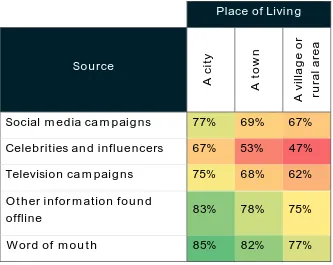
These results varied by where people lived. Across both older and younger survey respondents, the level of urbanisation correlated with an increased assignment of influence to all five of the proposed sources. This suggests that campaigners for social change targeting less urbanised areas may require a different strategy to those operating in cities. The average for each is shown in the table below.
82 %
70 %
76 %
84 % 84 %
62 %
45 %
64 %
75 %
82 %
Social media campaigns
Celebrities and influencers
Television campaigns
Other information found offline
Word of mouth
30
Table 1: Extent to which sources of information about social causes are important by place of living
0)
Place of Living
Source
A
c
it
y
A
t
own
A
v
ill
age
or
rur
al a
re
a
Social media campaigns 77% 69% 67% Celebrities and influencers 67% 53% 47% Television campaigns 75% 68% 62% Other information found
offline 83% 78% 75%
Word of mouth 85% 82% 77%
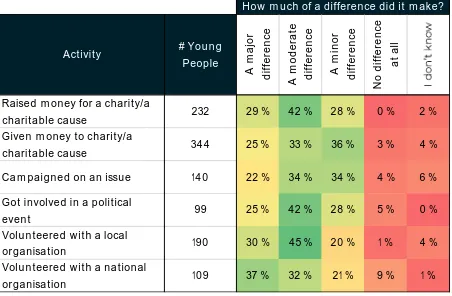
Finally, we asked respondents who had taken part in some kind of social
had actually had. The overwhelming majority of survey respondents felt that, broadly, their actions had
31
Table 2: Estimate of impact by activity for respondents aged 16-25
Raising money was viewed most optimistically by young people: among the 232 survey respondents who had done so in the past twelve months, 70 percent felt it had made a major or moderate difference. Volunteering with national organisations saw the widest disagreement (37 percent felt it had made a major difference while 9 percent felt it had made no difference at all). That one in ten felt it had made no difference is surprising, particularly when compared with volunteering at a local level (1 percent felt their effort had made no difference at all).
In general, survey respondents felt social media was a powerful tool that was central to changing society, and that it played an important role in arsenal available to advocates of social action. Again, it is worth noting that although respondents were positive about the power of social media for positive social change, we are unable to determine what that change would look like: no questions were asked about the specific aims of social action.
Activity # Young
People A m aj or d iff ere n ce A m od era te d iff ere n ce A m in or d iff ere n ce N o d iff ere n ce at a ll
Raised money for a charity/a
charitable cause 232 29 % 42 % 28 % 0 % 2 % Given money to charity/a
charitable cause 344 25 % 33 % 36 % 3 % 4 %
Campaigned on an issue 140 22 % 34 % 34 % 4 % 6 %
Got involved in a political
event 99 25 % 42 % 28 % 5 % 0 %
Volunteered with a local
organisation 190 30 % 45 % 20 % 1 % 4 %
Volunteered with a national
organisation 109 37 % 32 % 21 % 9 % 1 %
32
Experience
Following on from questions of attitudes to social media as a tool for social action, we put a series of questions to the survey panel around their
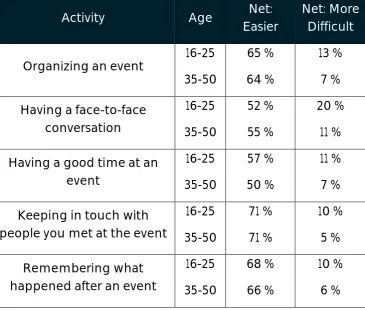
experience of events and the role social media played in them. Through the interviews carried out with campaigners, a successful offline event could be characterised as memorable and with meaningful social interaction. The table below shows how the two cohorts of survey respondents who had attended because of, or organised an event on, social media judged the role of social media in the organisation, experience and aftermath of offline social
[image:33.595.94.460.317.627.2]interactions.
Table 3: Impact of social media on event experiences by age (N=1562)
Activity Age Net:
Easier
Net: More Difficult
Organizing an event 16-25 65 % 13 %
35-50 64 % 7 %
Having a face-to-face conversation
16-25 52 % 20 % 35-50 55 % 11 % Having a good time at an
event
16-25 57 % 11 %
35-50 50 % 7 %
Keeping in touch with people you met at the event
16-25 71 % 10 % 35-50 71 % 5 % Remembering what
happened after an event
16-25 68 % 10 %
35-50 66 % 6 %
The majority of survey respondents felt social media had made these aspects of offline events easier, with 62 percent finding them easier and ten percent finding them more difficult overall, most notably in organisation and
33
media as making each activity more difficult than older people, with one in five noting that face-to-face conversations were made more difficult
compared to one in ten in the older cohort. One possible explanation for the increased polarisation of views among 16-25 year olds is the centrality of social media
media to be as strong a factor in their experience of an event. On average, 22 percent of younger respondents felt social media had no positive or negative impact on their experiences, compared with 28 percent for 35-50 year olds. These numbers broadly matched with an increased willingness to air personal or political views as a result of social media: 85 percent of young male
respondents and 82 percent of young women felt they were more at least slightly more likely to share their views.
These breakdowns did not vary significantly by gender or location hierarchy.
Behaviour
Finally, we asked a number of questions aimed at establishing how survey respondents went about using social platforms to network, communicate with organisations and their community, socialise and carry out social action.
34
Chart 7: % Respondents by age group using social media to communicate with people or groups (N=1930)
The vast majority (89 percent) of people from both age groups surveyed used social media as a tool to communicate with friends and family. On average, one in every eight social media users used the platforms to engage with campaigning groups and one in four a local community group or charity. It is notable that of the groups, only non-party political groups were more likely to be communicated with by the younger cohort. There was some variation in these numbers by gender, as shown in the table below. 21 of the 2,000 respondents to the survey
owing to the size of the sample, they cannot be represented in the charts below.
3% 9%
11%
26% 27%
89%
0% 7%
14% 23%
25%
89%
Other/None of the above Politicians/ political groups Non-party political groups campaigning on an issue Local community groups or charities
Businesses / organisations Friends and family
In the past twelve months, which of the following people or groups, if any, have you used social media or messaging
platforms to communicate with?
35
Chart 8: % Respondents by age group and male/female split using social media to communicate with people or groups
In the past twelve months, which of the following people or groups, if any, have you used social media or messaging platforms to communicate with?
36
We also looked to measure the level of engagement with each group by asking survey respondents to estimate the frequency with which they
communicated with each group. The chart below shows how what proportion of those survey respondents who had used social media to contact a group did so at least once a day.
Chart 9: % Respondents by age using social media to communicate with people or groups at least once a day
How often, on average, do you communicate with the following through social media or messaging platforms? (Net: Once a day or more)
Across the board, young people were more likely to be in contact with any given societal group on a daily basis than the 35-50 cohort. Strikingly, half of young people reported being in contact with a campaigning group, a local community group or charity on social media on at least a daily basis,
suggesting that social media is being used to bring young people into
37
Chart 10: Frequency of contact with group by age (N = 242)
How often, on average, do you communicate with non-party political groups campaigning on an issue on social media or messaging platforms?
0 % 5 % 10 % 15 % 20 % M or e th an fiv e t im es a d ay Four t o fiv e t im es a d ay Tw o to thr ee tim es a da y Onc
e a d
ay A c oup le of t im es a wee k Onc
e a we
ek A c oup le of t im es a mon th Onc
e a mon
38
Chart 11: Frequency of contact with group by age (N=475)
How often, on average, do you communicate with local community groups or charities on social media or messaging platforms?
The profiles for communication with other groups are similar. Although there is a close similarity in the numbers of younger and older social media users interacting with their social circles and societal groups, younger social media users tend to engage with their social circles and other societal groups more often.
Whether this engagement translated into action is the subject of some
gement online was shallow and did not encourage significant offline action, seen as a key driver of social change.
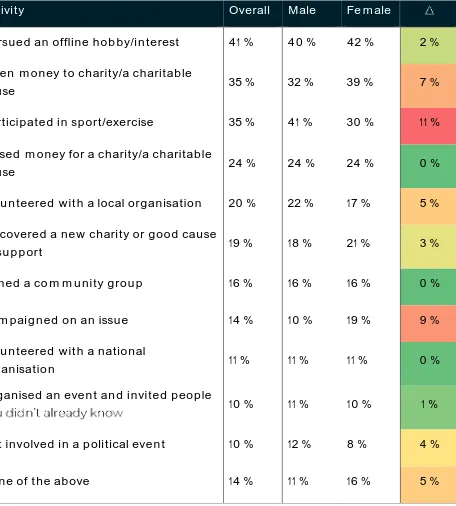
We looked to identify how far social media communication translated to offline action by asking survey respondents a series of questions related to activities they had taken part in having seen, been invited to, heard about or organised through social media. The overall figures and breakdowns by male and female for young people are shown below.
0 % 5 % 10 % 15 % 20 % M or e th an fiv e t im es a d ay Four t o fiv e t im es a d ay Tw o to thr ee tim es a d ay Onc
e a d
ay A c oup le of t im es a wee k Onc
e a we
ek A c oup le of t im es a m on th Onc
e a mon
39
Table 4: % respondents aged 16-25 reporting taking part in an activity offline having seen, been invited to, heard about or organised it through social media or messaging platforms. (N=833)
Activity Overall Male Female
Pursued an offline hobby/interest 41 % 40 % 42 % 2 % Given money to charity/a charitable
cause 35 % 32 % 39 % 7 %
Participated in sport/exercise 35 % 41 % 30 % 11 % Raised money for a charity/a charitable
cause 24 % 24 % 24 % 0 %
Volunteered with a local organisation 20 % 22 % 17 % 5 % Discovered a new charity or good cause
to support 19 % 18 % 21 % 3 %
Joined a community group 16 % 16 % 16 % 0 %
Campaigned on an issue 14 % 10 % 19 % 9 %
Volunteered with a national
organisation 11 % 11 % 11 % 0 %
Organised an event and invited people
10 % 11 % 10 % 1 %
Got involved in a political event 10 % 12 % 8 % 4 %
None of the above 14 % 11 % 16 % 5 %
Many people in the UK report participating in civic social activities because they found out about it on social media. These findings support the NCVO (2018) report on civic participation in the UK which suggests that social media provides more opportunities for people to engage in forms of civic
40
40 percent of 35-50 year old social media users who gave to charity in past 12 months credited social media for helping them to do it. With regards to social action, it is notable that women were nearly twice as likely to report
campaigning on issues than men.
As noted above, fundraising for causes that respondents believed in was one social action that was felt to be highly impactful. According to the survey, people who gave to charity or a cause after hearing about it on social media usually gave small sums, and there was no significant difference between the 2 age categories. Most frequent amount given over a year (mode) by those who gave to charity on social media was £50 in both age category. The survey also revealed young people credit social media with their fundraising efforts more frequently than 35-50 year olds (24 percent vs 15 percent).
This broadly reflects other estimates. A Saxton and Wang (2104) study of donations on Facebook causes found that online donations tended to be smaller than offline gifts contributions where between $0-$50 and that social media seemed to facilitate impulsive donating. The average size in online giving in 2014 was £63.69 according to a Blackbaud report on UK giving trends.48
Conclusion
The survey results show young British social media users as highly aware of the power social platforms have as tools for social change, hopeful about the ways in which they are being used to effect social change, and positive about their offline experiences when combined with social media use.
Social platforms are being used on a daily basis to communicate with friends and family, and by a significant minority to communicate with social and political causes. By comparison with reported communication by 35-50 year olds, young people channelled their communications with non-party political causes more often than into political groups or charities. This may well reflect a difference in the way young people perceive routes to social change.
42
To explore the ways in which people had actively used social media as a tool for social action, we turned to individuals and groups who used it on a daily basis to campaign for causes they believe in.
Researchers conducted thirty interviews with a range of campaigners, campaign groups and influencers who had used social media to promote, organise or coordinate social action across a wide range of concerns and issues, as well as a large forum event held in London. Interviewees included figures from across the so-called political spectrum, though we selected groups primarily concerned with a non-party political agenda. Their work included action on social justice, national identity, community cohesion, minority representation, mental health, women's rights and issues, and had been responsible for marches attended by hundreds of thousands of people
employment and uplift programmes around the UK. A list of the groups and individuals we interviewed and heard from can be found in Annex 1.
Campaigners and campaign groups used a range of social media platforms as part of their work, with Facebook, Twitter, Instagram, YouTube and WhatsApp the most frequently cited. All interviewees agreed that the networks served different purposes. Across the board, Facebook was largely regarded as a platform for sharing content - whether this be videos, pictures, or links to events and fundraising pages - and as a hub for event organisation: a number of campaigners noted that bringing thousands of people to an offline march, protest, or organising a smaller, cause-related gathering was best done on Facebook. Twitter on the other hand was employed to join national and international conversations and networks, and like YouTube was used to host and broadcast content. Instagram was considered to be the most personal and accepting of emotion of the primary platforms and was the space used most often to tell and share stories. Users of WhatsApp agreed it was a means of instigating and maintaining contact with those who did not have other online profiles as well as a good way to communicate locally and in smaller groups.
43
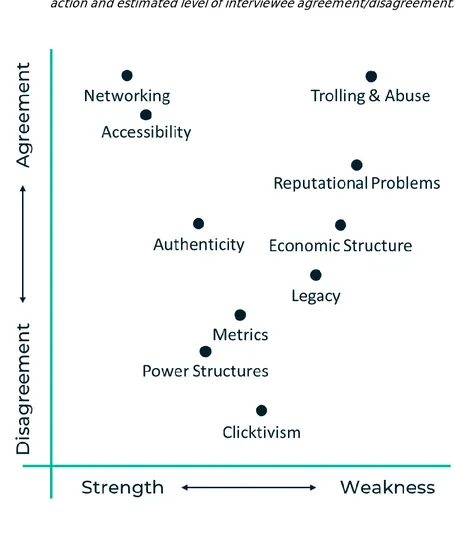
Below are summarised the interviews as they touched on a number of recurrent themes: some were seen as overall strengths of social media as a platform for social good, others as weaknesses. There was a good deal of
[image:44.595.85.540.211.753.2]consensus but also areas of disagreement. The chart below gives an indication of the primary themes that emerged, the degree of consensus and how far they were seen as a net strength or weakness.
44
Strengths
Areas of Agreement
Networking
Interviewees agreed that one of the most useful facets of social media was the speed and ease with which they were able to network with potential partners, funders and those able to provide their campaigning with resources and skills. In this process, social media platforms acted as communication tools, as
reputation management tools and as pitching tools.
In looking to get his social enterprise off the ground, one campaigner used social media as a way to network with established social good organisations and high-net worth individuals, crediting the platforms as providing access to funding and logistical support that otherwise would have been impossible to reach. Others spoke to their online profiles leading to established social action organisations reaching out to them, leading to coordinated campaigning. This
number of our interviewees noted that influential or well-resourced organisations and individuals would take them seriously once they had achieved a certain number of followers.
Finally, interviewees and forum participants raised the issue of global
connectivity, and the strength and encouragement they felt they could find through international collaboration online.
Accessibility
Campaigners agreed that social media has allowed for a greater number of people to become involved in social action, both as participants and as organisers. We heard from campaigners tackling mental health, democratic deficits, female identity, all of whom were working without a budget and for whom alternative pathways to their audience were not available.
45
involved. Most assumed that there was an untapped willingness to contribute to social causes in the UK. Moreover, the ability to participate in social action and social causes online was of particular value to those who want to take part but find traditional channels difficult disabled activists was one good
example raised in the forum.
An organiser of a march credited social media with bringing new types of protesters to the event, many of whom were marching in protest for the first time. Another campaigner circulated events across multiple social media platforms and found that as a result, new people would attend who had not previously been invited. One organiser of academies for marginalised students credited the platforms with bringing new people into the organisation by breaking down traditional barriers to social action groups and communicating directly with young people themselves. Another campaigner stressed the importance of social media as provid
previously been involved in social action to do so in a supportive environment. Accessibility was not limited to participation. Interviewees stressed the ways in which social media platforms had provided the tools for new organisers to quickly and efficiently reach an audience, and do so in ways that in the past had been the preserve of organisations with higher levels of financial and logistical resourcing. Many noted the power of on-demand live video in their work: one Guinness record-breaking mental health festival was livestreamed to an audience of 5,000.
There were, however, concerns about who could be accessed. There was a strong sense that tapping into an existing or fertile group of potential
46
Areas of Disagreement
Power Structures and the Democratic Nature of Social Media Platforms
There was considerable debate among our interviewees as to the extent to which traditional power structures were broken down by social media. The point of contention was the extent to which social media platforms had retrenched existing power structures, and the extent to which they had opened up the public commons to new voices. Overall, the impact of social media on the share of conversation by new groups was seen as positive. Many spoke to the emergence of new and previously unheard voices, particularly among previously marginalised groups, and a sense that they were acting as role models for people who had in the past been denied them.
Nevertheless, a number questioned whether they would have found themselves in a position of strength without the support from previously powerful figures
these new voices replicated old power structures and that poverty, class, race and gender remained barriers to influence online. Although our interviewees celebrated the emergence of new voices, they did not equate this with a complete levelling and democratisation of the conversation.
It ought to also be noted that there remains a significant proportion of Brits not active on social media, many of whom are participating in social action and may not be recognised as a result of an increasing focus on digital evidence for social good.
Interviewees noted that platforms differed in how democratic they were. For instance, YouTube was seen as a difficult platform to use without significant financial investment in equipment and without a dedicated skillset, and was contrasted with the platform Vine which required significantly less investment and saw a greater number of black and minority participation. Where we heard scepticism, it tended to be targeted at the economic model of social platforms as a whole: the accusation levelled as these sites was that
47
influence on the voices that are amplified. Overall, this fell into two broad
of content were likely to receive a broader audience. Second, that algorithmic influence could be gamed and frequently resulted in negative or unhelpful voices being amplified more often than good news stories. Confirming or denying this claim would require a significant research effort and is
unfortunately beyond the scope of this study.
This considered, there was a broad agreement that when compared with - the radio, television and news outlets - social media was significantly easier a space for new groups to find a voice and feel represented in. As noted in the section above, accessibility to social media was rated far higher than for traditional media outlets. When mainstream media paid
attention to campaigners it was often as a direct result of their efforts on social media.
Authenticity
Continuing with the relationship between social media and more traditional media, there was debate over the extent to which social media provided an authentic side to social campaigning. On the most part, interviewees felt that social media provided a greater level of authenticity than traditional
mainstream media, though this was not felt by everybody.
Interviewees tended to see mainstream media as a stamp of approval, giving the cause a degree of legitimacy that social media was unable to. Mainstream media appearances were vital in building a sense of legitimacy among older
-to-struggle could only be captured online. Moreover, many stressed that authenticity depended not only on how they were perceived, but how they carried out their activities: social media provided a direct channel to their target audience through which they could listen and hold conversations instead of just broadcasting.
debate. Even with the increased opportunity for one-to-one and direct
48
meetings they held in which participants in the campaign came together, nothing substantial would have been achieved. Another interviewee agreed: that to really make change happen, nothing compared to a face-to-face, offline meeting.
Finally, a growing awareness of misinformation and disinformation on social media platforms was highlighted by a number of interviewees who said they had taken additional steps to ensure their accounts and campaigns evidenced their activities appropriately. Despite these steps, there was a fear of losing access to audiences who had been targeted by misinformation and who had lost faith in a cause as a result, particularly with regards to humanitarian and peacebuilding causes.
Weaknesses
Areas of Agreement
Reputational Problems, Trolling and Abuse
A key criticism shared by the vast majority of our interviewees was the groups faced a range of problematic online interactions, from disparaging comments through to rape and death threats and the publication of sensitive personal data. One campaigner found himself questioning his sanity in remaining in these online spaces.
Critically, there was agreement that the threat of trolling was impacting on
meant an unwillingness to put up with abuse when voicing support, leading
give up.
Some platforms were deemed better or worse: Twitter in particular came in for
seen as coming from people who were not part of the community, and online spaces focused on single issues insulated social action groups more effectively. There was a resignation among much that
49
better for the cut and thrust of entering the public sphere and to learn how to
Participants noted that the impact on offline events was limited, but equally noted that this environment had a negative impact on those willing to take part in or organise positive social action online. Participants in interviews and in the forum recognised the difficulties in policing online spaces but were highly crit
terms of service.
platforms has impacted the ability of campaign groups. Campaigners noted that reputationally-damaging stories, worries about the impact of using social media, increased fears about data and anti-social media campaigns had
reduced the number of people they were able to reach through the platforms. Economic & Design Structures of Social Media
Interviewees stressed the way social media prioritizes content through its culture and its technology made sustained engagement with a social cause more difficult. The competition for attention was often cited as coming at the expense of good causes, and many questioned the suitability of targeted
advertising machinery as channel for non-commercial causes. A small number of campaigners noted a decreased sense of community when compared with five years previous.
This was further hampered by the demonetization of social action content usually mentioned with regards to YouTube. One respondent described the
the fact that some content is classified as being non-advertising friendly and automatically demonetised. He noted this was
disproportionately likely to impact news content and social justice causes due
difficult by the lack of guidance and consistency as to why and when content the
appeals process was felt to be too slow for the speed of social media. There are likely parallels across the social web.
Financially sustaining social action online was seen as perhaps the most
50
It was further noted that the centralisation of digital communications into monolithic platforms which were difficult to police opened up social action to threats of interference. The impact of foreign state and other hostile attempts
-motivated were also noted: two interviewees and participants in the forum mentioned examples from the 2016 presidential elections in the US, the Brexit campaign in the UK, and the ongoing persecution of the Rohingya population in Myanmar. Four of the groups we spoke to noted that they had been
targeted through content moderation tools reporting, for instance by those looking to supress their voices. The logistical challenges of policing the largest online platforms has brought with it challenges for causes pushing for social change not traditionally in the mainstream.
Areas of Disagreement
Metrics
There was disagreement on the applicability of social media metrics to social action. Many interviewees noted their use of traditional advertising and social
media metrics - - as part of informal impact
assessments. Whether this was an appropriate measure for social good was the subject of debate.
Some campaigners were positive: follower numbers, and in particular levels of
were seen as useful proof that the word was getting out there and evidence that a conversation was taking place. For many, these metrics were what governed the public debate, and it would be lax to ignore them. One
and proof of the impact his work was having.
Others were less sure about the utility of these numbers. For the most part, this boiled down to measuring actual change. Various campaigners prioritised
icipants in a demonstration, regular attendees or students, number of face-to-face networking meetings or
51
The use of social media and advertising metrics in defining best practice may also adversely impact groups not using social media as part of their day-to-day work. One campaigner noted that there were more traditional organisations carrying out valuable social and community work who had been excluded from opportunities and sources of funding by failing to deliver digitally. This was echoed by another campaigner, who added that traditional, established organisations who were not able to evolve or build the skillset required to campaign online may be unfairly discriminated against on new measures of impact. Another described how his team began thinking about their work in terms of advertising metrics - - to the detriment of actual metrics of social good, and another stressed the importance of alternative metrics - money raised, legislative changes, funding pledges - as a truer reflection of effective campaigning.
Legacy
Seen as fundamental to achieving social change, the legacy of social action as promoted through social media also provoked disagreement. Linked to
concerns about the financing of social action online, the majority of
participants had found the transition from the early stages of campaigning to a sustained online presence and conversation more difficult. We heard from more than one group about the difficulty of sustaining the initial burst of interest that is common to digital campaigning. Following rapid growth, sustaining interest tended to require new skills and, above all, money, and in many cases neither were immediately available to the detriment of the cause.
-action: the speed at which causes come and go is often out of sync with the speed of concrete legislative, social or political change. Others agreed; they struggled with the speed at which social media moved, suggesting it made any kind of legacy or lasting organisation impossible.
misleading: social change requires a long-term effort for which campaigners with good intentions may not be prepared for, and is also dependent on factors frequently beyond the control of a campaign. One interviewee noted fallen by the wayside, often simply as a result of bad luck or bad timing.
52
Other campaigns had had significantly more positive experiences. Most often, this translated to an organic, network-driven momentum where centralised control or resourcing were less important. One organiser of a highly successful march we spoke to found similar marches being set up elsewhere in the
world, and in their aftermaths small groups of motivated campaigners got together to continue the work at a local level. Another campaigner echoed this: his work had provoked local, grassroots activism that continued beyond the life of the social media campaign.
Overall, the long-term legacy of social action on social media seemed to be unplanned. The aim was to encourage others to follow suit and to be inspired into action themselves, and where social action was sustained it was organic and not controlled or resourced by a central organization.
Finally, three separate campaigners noted that social media appeared to be
- gh party political action is
outside the remit of this report, it was noteworthy that campaign groups felt social media was more powerful when focusing on a single issue over a broader political agenda, manifesto or stance.
Clicktivism;
The majority of interviewees felt that social media did occasionally lead to lazy, shallow engagement with social action. One described social platforms as reassuringly misleading by giving people a sense they have contributed to
platforms for encouraging casual and easy engagement with difficult issues which leads to absenteeism and passing the buck.
Others were more optimistic. One campaigner described
so-as a useful entry point into social action, no different to signing a petition in the street. Another influencer agreed: even passive, low-level engagement with an important issue was deemed better than no engagement at all. At the very least, it contributed to an environment that was fertile for social action down the line.
view, social media plays a key role in lowering the barriers of entry into social action. By building credibility and engaging with people in a