Open Access
Study protocol
The development, design, testing, refinement, simulation and
application of an evaluation framework for communities of practice
and social-professional networks
Jeffrey Braithwaite*
1,2,3, Johanna I Westbrook
4, Geetha Ranmuthugala
1,2,
Frances Cunningham
1,2, Jennifer Plumb
1,2,3, Janice Wiley
1,2,3, Dianne Ball
5,
Sue Huckson
6, Cliff Hughes
7, Brian Johnston
8, Joanne Callen
4,
Nerida Creswick
4, Andrew Georgiou
4, Luc Betbeder-Matibet
1,2and
Deborah Debono
1,2Address: 1Centre for Clinical Governance Research, Faculty of Medicine, University of New South Wales, Sydney, NSW 2052, Australia, 2Australian
Institute of Health Innovation, Faculty of Medicine, University of New South Wales, Sydney, NSW 2052, Australia, 3School of Public Health and
Community Medicine, Faculty of Medicine, University of New South Wales, Sydney, NSW 2052, Australia, 4Health Informatics Research and
Evaluation Unit, Faculty of Health Sciences, University of Sydney, Cumberland Campus C42, East St, Lidcombe NSW 2141, Australia, 5Australian
College of Health Service Executives, National Office, Macquarie Hospital, Wicks Road, North Ryde, NSW 2113, Australia, 6Effective Practice
Program, National Institute of Clinical Studies, National Health & Medical Research Council, Level 5, Fawkner Centre, 499 St Kilda Road, Melbourne, Victoria 3004, Australia, 7Clinical Excellence Commission, Level 3, 65 Martin Place, Sydney NSW 2000, Australia and 8Australian
Council on Healthcare Standards, 5 Macarthur Street, Ultimo NSW 2007, Australia
Email: Jeffrey Braithwaite* - [email protected]; Johanna I Westbrook - [email protected]; Geetha Ranmuthugala - [email protected]; Frances Cunningham - [email protected]; Jennifer Plumb - [email protected]; Janice Wiley - [email protected]; Dianne Ball - [email protected];
Sue Huckson - [email protected]; Cliff Hughes - [email protected]; Brian Johnston - [email protected]; Joanne Callen - [email protected]; Nerida Creswick - [email protected]; Andrew Georgiou - [email protected];
Luc Betbeder-Matibet - [email protected]; Deborah Debono - [email protected] * Corresponding author
Abstract
Background: Communities of practice and social-professional networks are generally considered to enhance workplace experience and enable organizational success. However, despite the remarkable growth in interest in the role of collaborating structures in a range of industries, there is a paucity of empirical research to support this view. Nor is there a convincing model for their systematic evaluation, despite the significant potential benefits in answering the core question: how well do groups of professionals work together and how could they be organised to work together more effectively? This research project will produce a rigorous evaluation methodology and deliver supporting tools for the benefit of researchers, policymakers, practitioners and consumers within the health system and other sectors. Given the prevalence and importance of communities of practice and social networks, and the extent of investments in them, this project represents a scientific innovation of national and international significance.
Methods and design: Working in four conceptual phases the project will employ a combination of qualitative and quantitative methods to develop, design, field-test, refine and finalise an evaluation framework. Once available the framework will be used to evaluate simulated, and then later
Published: 15 September 2009
BMC Health Services Research 2009, 9:162 doi:10.1186/1472-6963-9-162
Received: 22 June 2009 Accepted: 15 September 2009
This article is available from: http://www.biomedcentral.com/1472-6963/9/162
© 2009 Braithwaite et al; licensee BioMed Central Ltd.
existing, health care communities of practice and social-professional networks to assess their effectiveness in achieving desired outcomes. Peak stakeholder groups have agreed to involve a wide range of members and participant organisations, and will facilitate access to various policy, managerial and clinical networks.
Discussion: Given its scope and size, the project represents a valuable opportunity to achieve breakthroughs at two levels; firstly, by introducing novel and innovative aims and methods into the social research process and, secondly, through the resulting evaluation framework and tools. We anticipate valuable outcomes in the improved understanding of organisational performance and delivery of care. The project's wider appeal lies in transferring this understanding to other health jurisdictions and to other industries and sectors, both nationally and internationally. This means not merely publishing the results, but contextually interpreting them, and translating them to advance the knowledge base and enable widespread institutional and organisational application.
Background
Scholars within the health [1], aviation [2], manufactur-ing [3], finance [4], education [5] and military [6] sectors have argued that collaborating communities and linked, professionalised networks are significant determinants of important outcomes such as work satisfaction [7], motiva-tion [8], recruitment and retenmotiva-tion [9], high performance [10], organisational resilience [11], safer organisations [12] and systems renewal [13]. However, there is a paucity of empirical research, as opposed to normative claims in the literature, to support these arguments. Given the sub-stantial resources invested in supporting collaborating structures, the absence of evidence of their effectiveness is a significant problem. This is especially so given the potential benefits of optimizing the performance of large, complex sectors, such as the health system, which is the specific focus of our project.
Communities of practice can be defined as "groups of people who share a concern, a set of problems, or passion about a topic, and who deepen their knowledge and expertise in this area by interacting on an ongoing basis" [14]. Social networks are "set [s] of people ... ['actors'] ... with some pattern of interactions or 'ties' between them ... [eg] friendships among a group of individuals, business relationships between companies" [15]. In one sense they are two sides of the same coin, but communities of prac-tice scholars have tended to emphasise learning processes while social network scholars have focused on underlying structural properties.
These kinds of clustered relationships abound in health care and other industries. They can be naturally-occurring [eg, groups of clinicians who share professional responsi-bilities, refer patients to each other, jointly manage care and collaborate over complex cases] or mandated [eg, purpose-designed, sponsored, initiated and funded by organisational leaders] [16]. They can also be tangible and geographically-anchored [eg, in one section of an organi-sation such as a teaching hospital or general practice] or
virtual and geographically-dispersed [eg, international colleagues with common interests linked via telecommu-nications]. Terms for related phenomena include teams [17], sub-cultures [18], micro-systems [19], inter-profes-sional practices [20] and integrated services [21].
Communities of practice [14,22] and social-professional networks [23,24] are increasingly seen as crucial determi-nants in understanding and enhancing group-oriented services. Most literature supports a position that, although there is much to understand, services to patients [clients, customers, purchasers or consumers in other industries] and workplace cultures can be expected to improve where communities of practice and social-professional networks are emphasised and strengthened, whether these are nat-urally-occurring and emergent, or mandated and purpose-designed networks [16]. These tend to be theoretical or conceptual claims, however, rather than concerted empir-ical demonstrations.
At the same time, potentially negative consequences have been noted. Wenger and colleagues argue that communi-ties of practice can encourage the hoarding of information to the detriment of others, curtail improvement and progress, and create in-group and out-group rivalries [14]. Buchanan suggests that networks can be a negative as well as positive force, and can mean all the eggs are in one bas-ket. For instance, if a network [eg, electricity grid, compu-ter system, or clinical collaboration] fails, delecompu-terious consequences can result [23]. Communities of practice and social-professional networks can marginalise others, create factions and silos, become vehicles for elitism or isolationism, strengthen us-and-them behaviours and impede organisational sharing [14,22-31]. Thus we should not accept that communities of practice and social-professional networks are universally useful.
eventuated. Many authoritative commentators agree that analytic evaluation methods and tools are lacking [32-34]. Thus, there is strong consensus amongst scholars that it is vital to develop an appropriate evaluation framework and model with supporting data-gathering tools. If we are to be confident that communities of practice and social networks enable organisational success, and to under-stand how and to what extent they do so, we need to be able to quantify their contribution to satisfaction, motiva-tion, recruitment and retenmotiva-tion, performance, resilience, safety and renewal. Conversely, if these kinds of collabo-rative structures prove less useful than expected, we need to understand their limitations.
The case for the project
We reviewed the literature on communities of practice and social-professional networks. Significant researchable characteristics of communities of practice include how learning is enabled and constrained, what can be achieved by actively cultivating them, their relationships to organi-sational learning, interactivity amongst participants within and between communities of practice, how mem-bers join and are socialised, the mechanisms of participa-tion, and the stages of their development [14,22,28-30]. The literature indicates that the core features of social-pro-fessional networks are their deep structure, how they ena-ble change, how information is facilitated by and in them, the processes of information distribution and search, the circumstances in which phase transitions occur, connect-edness of hubs and nodes and the conditions which dic-tate their robustness or fragility [23-27]. In our review of social-professional networks, we applied some of these central concepts to key patient safety issues [16]. We con-cluded that "Clinicians, like other professionals, work best when they are allowed to flourish in groupings of their own interests and preference, are empowered ... and nurtured and influenced by their peers rather than controlled by others" [16].
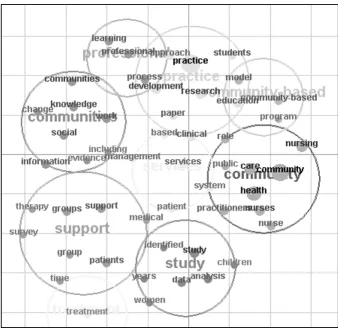
We also conducted a comprehensive analysis of the com-munities of practice literature pertaining to the health sys-tem [35]. We examined the Medline, CINAHL and Embase databases and performed a snowballing search for additional literature. We identified 624 references of which 90 were research papers. Content analysis of the 624 publications via Leximancer, a data mining tool, allowed us to construct Figure 1 which maps the overarch-ing themes in the literature - the social and professional nature of communities of practice, and their strong rela-tionship to service provision and treatment. There are five major themes in the 90 research papers: organisational change [eg, how communities of practice promote pro-ductive change, and how change effects communities of practice]; the impact of technology on communities of practice; the contribution of communities of practice to professional and inter-professional learning and the
shap-ing of organisational knowledge; learnshap-ing processes within communities of practice, including mechanisms of collaboration, structured reflection and the development of shared competencies; and barriers to participation in communities of practice, particularly mono-professional, organisational, institutional and service boundaries and silos. We concluded our review by synthesising the litera-ture as follows: "The systematic analysis reveals that the com-munity of practice idea has been empirically applied in the health sector in useful ways, but research is sporadic, and many studies are descriptive and centred on one profession or loca-tion. The transferability and generalisability of findings is lim-ited. A difficulty with the empirical studies is ... a lack of specificity in their claims. For example, at times the argument is made that team work has improved but what 'good team work' means is not clarified. There is scope for more far-reach-ing, rigorous and systemic research" [35]. This background work leads to the current protocol.
Aims
This project's specific aims are to develop and design, test in the field, and then refine, simulate and apply a frame-work, model and tools which can be used to evaluate communities of practice and social networks for their effectiveness and sustainability. We will work in the health system for compelling reasons. As a large, diverse industry (9.3% of GDP)[36] the health system supports many types of policy, managerial and clinical communi-ties of practice and social-professional networks compris-ing diverse occupational groups, and traverses the public and private sectors. These characteristics and complexities mirror other key industries, greatly enhancing the poten-tial to transfer findings, theories and project outcomes beyond the health sector.
The project thus more broadly aims to realise a scientific innovation of importance. Without an evaluation frame-work, model and tools, sponsors will continue to be unin-formed as to what communities of practice and social networks deliver; will be unable to identify and measure their strengths and weaknesses; and will be frustrated in their efforts to achieve desirable outcomes, and returns on investment. This has profound implications for how com-munities of practice and social-professional networks are enabled, configured and resourced. Such research is at the heart of a crucial question: how well do groups of profes-sionals work together and how could they be organised to work together more effectively?
work; an innovative, tested, refined framework, model and tools for researching and evaluating communities of practice and social-professional networks; and the gather-ing of original data from the field usgather-ing the tools to illu-minate progress. Our data gathering tools [questionnaires, interview schedules, case study designs, focus group processes, critical incident mapping proto-cols] will employ new approaches.
We will inform our work using theories on teams [17], inter-professional learning [37], network structures [25,38], change [39] and group dynamics [40]. These are fundamental concepts to our enquiry, guiding our think-ing, particularly in the initial and model-building phases. We will, however, mainly inform our project using the empirical literature to rigorously build our research designs on the basis of prior research results. Few research projects are both empirically and theoretically multi-modal in the one study.
Methods and design
Conceptual framework
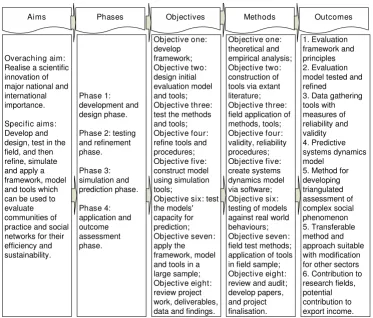
This is a comprehensive effort to execute a rigorous evalu-ation methodology, and deliver tools for the benefit of researchers, policymakers, practitioners and consumers. We have the opportunity to achieve both meaningful and transferable advances in the knowledge base of the disci-pline and to incorporate novel and innovative aims and concepts into the project design. Through the support of key stakeholders within the Australian health system, we will have access to a wide range of workplace communi-ties and networks, including hundreds of clinicians, to test and refine our models. The overarching aims, phases, objectives, methods and outcomes in the approach are depicted in Figure 2. Ethics approval for the study was granted by the University of New South Wales' Human Research Ethics Committee, application number 09085. Informed consent from participants is a key component of the approval.
[image:4.612.134.473.93.422.2]Map of the content analysis of the health communities of practice literature
Figure 1
Methodology
The methodology is conceptualised in four major phases, matched to the aims and objectives and commensurate with the research approach. Each phase has two compo-nents, and involves a little over a year's work to achieve the project's objectives.
Phase 1: development and design phase
The project will produce an evaluation framework founded on empirically-grounded evaluation principles. Initially we will drill further into the literature and derive from this assessment a set of fundamental, working eval-uation principles. Work feeding into this process includes seminal contributions by Wenger and colleagues [14,22,30] and Watts [41], Strogatz [27] and Barabási [25] as well as our work in health systems social structures and change [42-44].
Secondly, armed with the initial framework, we will design a preliminary evaluation model. There are many evaluation types [45], but our previous research suggests
that a triangulated, multi-method model is best suited to this problem. Our earlier work on the evaluation of edu-cation processes [44,46], information management [47] and information and communication technologies [48] demonstrates this kind of model can be comprehensive, have high utility and yield robust data. This phase includes the design of data-gathering tools [including questionnaires, interview schedules, case study protocols for video ethnographic work, critical incident maps, and focus group question schedules] to make assessments of communities of practice and social networks, taking into account recent designs [eg, Verburg and Andriessen's] [49]. A key step is the identification of outcome measures to assess the effectiveness of communities of practice and social-professional networks. We have identified indica-tors for work satisfaction (5 indicaindica-tors) [50], motivation (6) [51], recruitment and retention (5) [52], high per-formance (18) [53], organisational resilience (5) [11], safer organisations (7) [16] and systems renewal (11) [54,55], totalling 57 indicators against which metrics are designated.
[image:5.612.118.492.92.410.2]Conceptual framework, design and methods
Figure 2
Conceptual framework, design and methods.
Aims Objectives Methods Outcomes
Overaching aim: Realise a scientific innovation of major national and international importance.
Specific aims: Develop and design, test in the field, and then refine, simulate and apply a framework, model and tools which can be used to evaluate communities of practice and social networks for their efficiency and sustainability. Objective one: develop framework; Objective two: design initial evaluation model and tools; Objective three: test the methods and tools; Objective four: refine tools and procedures; Objective five: construct model using simulation tools;
Objective six: test the models' capacity for prediction; Objective seven: apply the framework, model and tools in a large sample; Objective eight: review project work, deliverables, data and findings.
Objective one: theoretical and empirical analysis; Objective two: construction of tools via extant literature; Objective three: field application of methods, tools; Objective four: validity, reliability procedures; Objective five: create systems dynamics model via software; Objective six: testing of models against real world behaviours; Objective seven: field test methods; application of tools in field sample; Objective eight: review and audit; develop papers, and project finalisation. 1. Evaluation framework and principles 2. Evaluation model tested and refined
3. Data gathering tools with measures of reliability and validity 4. Predictive systems dynamics model
5. Method for developing triangulated assessment of complex social phenomenon 5. Transferable method and approach suitable with modification for other sectors 6. Contribution to research fields, potential contribution to export income. Phases Phase 1: development and design phase.
Phase 2: testing and refinement phase
Thirdly, in phase 2, we aim to test the model and tools across a focused sample of communities of practice and social-professional networks. Peak Australian stakeholder groups have agreed to involve a wide range of members and participant organisations in this study. These include networks or communities of clinicians identified by the National Institute of Clinical Studies, accreditation sur-veyors of the Australian Council on Healthcare Standards, managerial members of the Australian College of Health Service Executives and clinical, managerial and policy groups associated with the Clinical Excellence Commis-sion. We will identify, in conjunction with these stake-holder partners, representative samples of differing types of communities of practices and social-professional net-works (naturally-occurring, mandated, geographically-anchored, geographically dispersed) and enrol them in our study. We aim to make comparisons between groups and across group types.
The testing component will yield experience which will, fourthly, enable us to refine the tools, including their validity and reliability. Differing approaches to examine validity and reliability will be taken. Work on the reliabil-ity of social network data is important, and optimum out-comes can be achieved by re-applying social network questionnaires and comparing consistency of results [56-58]. We have validated questionnaires and used multi-method approaches to corroborate discrete multi-methods con-vergently [44,46-48,59].
Phase 3: simulation and prediction phase
Phase 3 involves two components: fifthly, simulating the systems dynamics [60] of communities of practice and social networks and sixthly, testing the models' capacity for prediction [61]. Communities of practice and social networks are complex adaptive systems within larger com-plex adaptive systems. They can be modelled via simula-tion tools that facilitate the mapping of variables within and external to them. This enables us to understand rela-tionships between parts of the system and to run predic-tive simulations. Governing features of complex systems include feedback, processes, resources, accumulation of flows into stocks and time delays [62]. In the case of a community of practice of emergency clinicians, for exam-ple, key variables include levels and training of staff, work-force casualisation, delays in processes, incentives and disincentives, and factors which enable and constrain behaviours and attitudes. In this phase we will also con-duct controlled simulation experiments. We will develop role plays [n = 20] of case scenarios and test in the labora-tory the dimensions of role behaviours and decision-mak-ing processes under controlled conditions. Theorised barriers and enablers will be tested in idealised
circum-stances in this way to analyse the scope of the boundaries and assess hypotheses and predictions.
Phase 4: application and outcome phase
Having derived the refined evaluation framework, model and tools we will seventhly apply them on a large scale to a sample of communities of practice and social networks identified across Australia, covering the public and private sectors, in order to achieve a sample broadly representa-tive of the health care system. In this phase we will gather sufficient data on communities of practice and social-pro-fessional networks to assess their value, and judge the extent to which they contribute to work satisfaction, moti-vation, recruitment and retention, performance, resil-ience, safety and renewal. We will test the results and calibrate them against the predictive simulation data drawn from phase 3.
This leads to our eighth component - a review of the research outcomes to interpret results and make final observations on the findings. We will use an arm's length, expert panel to triangulate judgements. Such a process fur-ther strengthens project outcomes, closing the feedback loop and helping to determine whether communities of practice and social-professional networks realise the results intended for them.
Discussion
This protocol provides a conceptual framework and research design for evaluating hard-to-research social sci-ence manifestations which are key determinants of health systems performance. A multi-methods, phased research design is important and innovative, and has been matched to the phenomena under investigation. This rep-resents a bold approach to creating and then testing an evaluation model.
Study strengths and limitations
Strengths
Limitations
Objective measures are hard to achieve in social science research, as is generalisability, thus we have incorporated triangulation techniques in our design and seek transfera-bility of findings rather than strict generalisatransfera-bility. Never-theless, our results by definition will fall short of the gold standard, and will not produce level 1 evidence. Balancing this limitation is the reality that a strict test of this kind cannot be applied against research in this mould. Thus, other safeguards, including seeking data from multiple sources and assessing the extent to which they converge or diverge, constitute an effective, alternative approach.
Conclusion
This is a large, comprehensive research project which will deliver outcomes both specifically relevant to health sys-tems and transferable to the large number of organisa-tions, systems and sectors which are affected by the effectiveness, or otherwise, of communities of practice and social-professional networks. In developing a rigor-ous evaluation methodology and delivering tools for researchers, policymakers, practitioners and consumers, the research project also demonstrates innovation and tests novel approaches in design. By interpreting and translating results for applications both within and beyond the health system, the project will advance under-standing of how professionals work together, and how to optimise this interaction to improve organisational effec-tiveness and service delivery.
Competing interests
The authors declare that they have no competing interests.
Authors' contributions
JB and JIW designed the study, phases, protocol and instruments, and wrote the manuscript. GR, FC, JP and JW are members of the research team, and commented on an earlier draft of the manuscript. DB, SH, CH and BJ are industry partners, are members of the expert advisory committee, and provided input into the initial conceptu-alisation of the project. JC, NC, AG and LB-M commented on an earlier draft of the manuscript, and are members of the expert advisory committee. DD commented on an ear-lier draft of the manuscript and developed the ethics application, and steered it through the approval process. All authors approved the final version of the manuscript.
Acknowledgements
This research was supported under Australian Research Council's Discovery Projects funding scheme (project number DP0986493).
References
1. Kvarnström S, Cedersund E: Discursive patterns in multiprofes-sional healthcare teams. Journal of Advanced Nursing 2006,
53(2):244-252.
2. Stout R, Salas E: The role of trainee knowledge structures in aviation team environments. International Journal of Aviation Psy-chology 1997, 7(3):235-250.
3. Coupland C, Blyton P, Bacon N: A longitudinal study of the influ-ence of shop floor work teams on expressions of 'us' and 'them'. Human Relations 2005, 58(8):1055-1081.
4. McKee T: Building successful teams in the midst of transition. The Journal for Quality and Participation 2003, 26(1):43.
5. Bleakley A: Broadening conceptions of learning in medical education: the message from teamworking. Medical Education
2006, 40(2):150-157.
6. Wright MC, Kaber DB: Effects of automation of information-processing functions on teamwork. Human Factors 2005,
47(1):50-66.
7. Rosenfeld LB, Richman JM, May SK: Information adequacy, job satisfaction and organizational culture in a dispersed-net-work organization. Journal of Applied Communication Research 2004,
32(1):28-54.
8. Ardichvili A, Page V, Wentling T: Motivation and barriers to par-ticipation in virtual knowledge-sharing communities of prac-tice. Journal of Knowledge Management 2003, 7(1):64-77.
9. Haesli A, Boxall P: When knowledge management meets HR strategy: an exploration of personalization-retention and codification-recruitment configurations. The International Jour-nal of Human Resource Management 2005, 16(11):1955-1975. 10. Pathirage CP, Amaratunga DG, Haigh RP: Tacit knowledge and
organisational performance: construction industry perspec-tive. Journal of Knowledge Management 2007, 11(1):115-126. 11. Weick K, Sutcliffe K: Managing the unexpected: resilient performance in
an age of uncertainty 2nd edition. San Francisco, CA: John Wiley & Sons, Inc; 2007.
12. Weingart SN, Page D: Implications for practice: challenges for healthcare leaders in fostering patient safety. Quality & Safety in Health Care 2004, 13(suppl_2):ii52-56.
13. Antonacopoulou E, Ferdinand J, Graca M, Easterby-Smith M:
Dynamic capabilities and organizational learning: socio-political tensions in organizational renewal. London: Advanced Institute of Management Research Working Paper Series; 2005. 14. Wenger E, McDermott R, Snyder W: Cultivating communities of practice
Boston, Massachusetts: Harvard Business School Press; 2002. 15. Newman MEJ, Watts DJ, Strogatz SH: Random graph models of
social networks. Proceedings of the National Academy of Sciences of the United States of America 2002, 19(99 (Suppl 1)):2566-2572. 16. Braithwaite J, Runciman WB, Merry A: Towards safer, better
healthcare: harnessing the natural properties of complex sociotechnical systems. Qual Saf Health Care 2009, 18:37-41. 17. Gosling AS, Westbrook JI, Braithwaite J: Clinical team functioning
and IT innovation: a study of the diffusion of a point-of-care online evidence system. Journal of the American Medical Informatics Association 2003, 10:246-253.
18. Braithwaite J, Westbrook MT, Iedema R, Mallock NA, Forsyth R, Zhang K: A tale of two hospitals: assessing cultural landscapes and compositions. Social Science & Medicine 2005, 60:1149-1162. 19. Mohr JJ, Batalden PB: Improving safety on the front lines: the
role of clinical microsystems. Quality & Safety in Health Care 2002,
11(1):45-50.
20. Braithwaite J, Travaglia J: The ACT Health inter-professional learning and clinical education project: discussion paper #2 [inter-professional practice]. 2005:1-16 [http://health.act.gov.au/ c/health?a=sp&did=10153142]. Canberra: ACT Health Department 21. Ballard DJ: Indicators to improve clinical quality across an
integrated health care system. International Journal of Quality in Health Care 2003, 15:13i-i23.
22. Wenger E: Communities of practice: learning, meaning and identity Cam-bridge: Cambridge University Press; 1998.
23. Buchanan M: Nexus: Small worlds and the groundbreaking science of net-works New York: WW Norton; 2003.
24. Watts DJ: Six degrees: The science of a connected age New York: WW Norton; 2004.
25. Barabási A-L: Linked: The new science of networks Boulder, Colorado: Perseus; 2002.
26. Johnson S: Emergence: the connected lives of ants, brains, cities and soft-ware London: Penguin; 2001.
27. Strogatz SH: Exploring complex networks. Nature 2001,
Publish with BioMed Central and every scientist can read your work free of charge
"BioMed Central will be the most significant development for disseminating the results of biomedical researc h in our lifetime."
Sir Paul Nurse, Cancer Research UK
Your research papers will be:
available free of charge to the entire biomedical community
peer reviewed and published immediately upon acceptance
cited in PubMed and archived on PubMed Central
yours — you keep the copyright
Submit your manuscript here:
http://www.biomedcentral.com/info/publishing_adv.asp
BioMedcentral
28. Boland R, Tenkasi R: Perspective making and perspective tak-ing in communities of knowtak-ing. Organization Science 1995,
6(4):350-372.
29. Honeyman A: Communities of practice. British Journal of General Practice 2002, 52(481):621-622.
30. Lave J, Wenger E: Situated learning: Legitimate Peripheral Participation
Cambridge: Cambridge University Press; 1991.
31. Cott C: 'We decide, you carry it out': A social network analy-sis of multidisciplinary long-term care teams. Social Science and Medicine 1997, 45(9):1411-1421.
32. Lesser EL, Storck J: Communities of practice and organiza-tional performance. IBM Systems Journal 2001, 40(4):831-841. 33. Dubé L, Bourhis A, Jacob R: Towards a typology of virtual
com-munities of practice. Interdisciplinary Journal of Information, Knowl-edge, and Management 2006, 1:69-93.
34. Mattick JS, Gagen MJ: Accelerating networks. Science 2005,
307:856-858.
35. Greenfield D, Travaglia J, Nugus P, Braithwaite J: A review of health sector community of practice literature: final report. 2007 [http://www.med.unsw.edu.au/medweb.nsf/page/
ClinGov_Monographs ]. Sydney: Centre for Clinical Governance Research, UNSW
36. Australian Institute of Health and Welfare: Australia's health. Can-berra: AIHW 2008 [http://www.aihw.gov.au/].
37. Braithwaite J, Travaglia J: Inter-professional learning and clinical education: an overview of the literature. 2005:1-59 [http:// health.act.gov.au/c/health?a=sp&did=10153142]. Canberra: ACT Health Department
38. Edwards N: Clinical networks. British Medical Journal 2002, 324:63. 39. Braithwaite J: Organisational change, patient-focused care: an Australian perspective. Health Services Management Research
1995, 8(3):172-185.
40. Levi D: Group dynamics for teams Thousand Oaks, CA: Sage; 2007. 41. Watts DJ, Strogatz SH: Collective dynamics of 'small-world'
networks. Nature 1998, 393:440-442.
42. Braithwaite J: Analysing social structural and cultural change in acute settings using a Giddens-Weick paradigmatic approach. Health Care Analysis 2006, 14:91-102.
43. Braithwaite J: An empirical assessment of social structural and cultural change in acute settings. Health Care Analysis 2006,
14:185-193.
44. Braithwaite J, Westbrook M, Travaglia J, Iedema R, Mallock N, Long D, Nugus P, Forsyth R, Jorm C, Pawsey M: Are health systems changing in support of patient safety? A multi-methods eval-uation of education, attitudes and practice. International Journal of Health Care Quality Assurance 2007, 20(7):585-601.
45. Øvretveit J: Action evaluation of health programmes and changes: a hand-book for a user-focused approach Oxford: Radcliffe Medical Press; 2002. 46. Westbrook M, Braithwaite J, Travaglia J, Long D, Jorm C, Iedema R:
Promoting safety: varied reactions of doctors, nurses and allied health professionals to a safety improvement pro-gram. International Journal of Health Care Quality Assurance 2007,
20(7):555-571.
47. Braithwaite J, Travaglia J, Westbrook MT, Jorm C, Hunter C, Carroll K, Iedema R, Ekambareshwar M: Evaluation of the Incident Infor-mation Management System in New South Wales - over-view report. 2006 [http://www.med.unsw.edu.au/medweb.nsf/page/ ClinGov_Monographs ]. Sydney: Centre for Clinical Governance Research, University of New South Wales
48. Westbrook JI, Braithwaite J, Georgiou A, Ampt A, Creswick N, Coi-era E, Iedema R: Multi-method evaluation of information and communication technologies in health in the context of wicked problems and socio-technical theory. Journal of the American Medical Informatics Association 2007, 14:746-755.
49. Verburg RM, Andriessen JHE: The assessment of communities of practice. Knowledge and Process Management 2006, 13(1):13-25. 50. Faragher EB, Cass M, Cooper CL: The relationship between job
satisfaction and health: a meta-analysis. Occupational and Envi-ronmental Medicine 2005, 62:105-112.
51. Denier E: Guidelines for national indicators of subjective well-being and ill-well-being. Applied Research in Quality of Life 2006,
1:151-157.
52. Holton JA: Rehumanising knowledge work through fluctuat-ing support networks: a grounded theory. In The 37th World Congress of the International Institute of Sociology: 2005; Stockholm, Swe-den International Institute of Sociology; 2005.
53. Roberts J: Limits to communities of practice. Journal of Manage-ment Studies 2006, 43(3):623-639.
54. Watson J, Ovseiko P, eds: Health care systems: major themes in health and social welfare London: Routledge; 2005.
55. Boon H, Verhoef M, O'Hara D, Findlay B: From parallel practice to integrative health care: a conceptual framework. BMC Health Services Research 2004, 4:15.
56. Creswick N, Westbrook J: Examining the socialising and prob-lem-solving networks of clinicians on a hospital ward. Confer-ence Proceedings of Social SciConfer-ence Methodology ConferConfer-ence of the Australian Consortium for Social and Political Research (ACSPR) 2006 [http://www.acspri.org.au/conference2006//proceedings/].
57. Creswick N, Westbrook J: The medication advice-seeking net-work of staff in an Australian Hospital renal ward. In Third International Conference on Information Technology in Health Care: Socio-technical Approaches: 2007; Amsterdam IOS Press; 2007:217-232. 58. Creswick N, Westbrook J: Social network analysis of
medica-tion advice-seeking interacmedica-tions among staff in an Australian hospital. International Journal of Medical Informatics in press. 59. Braithwaite J, Hu W, Sorensen R, Patterson R, Meyerkort S, Salkeld
G, Zhang K, Mallock N, Iedema R, Betbeder-Matibet L: Report: Evaluation of the Clinical Practice Improvement Training Program. Sydney: Centre for Clinical Governance Research in Health, University of New South Wales; 2002.
60. Cook R, Rasmussen J: "Going solid": a model of systems dynam-ics and consequences for patient safety. Quality & Safety in Health Care 2005, 14:130-134.
61. Lattimer V, Brailsford S, Turnbull J, Tarnaras P, Smith H, George S, Gerard K, Maslin-Prothero S: Reviewing emergency care sys-tems I: insights from syssys-tems dynamics modelling. Emergency Medicine Journal 2004, 21:685-691.
62. Sterman JD: Business dynamics: systems thinking and modeling for a com-plex world Boston: McGraw-Hill; 2000.
Pre-publication history
The pre-publication history for this paper can be accessed here: