R E S E A R C H A R T I C L E
Open Access
Using co-design to develop interventions
to address health literacy needs in a
hospitalised population
Rebecca L. Jessup
1,2,3*, Richard H. Osborne
4, Rachelle Buchbinder
1,2and Alison Beauchamp
5,6Abstract
Background:Health literacy describes the cognitive and social skills which determine the motivation and ability of individuals to gain access to, understand and use information in ways which promote and maintain good health. Suboptimal health literacy is common and is believed to impact up to 60% of Australians. Co-design is a
participatory approach to the development of interventions that brings together to staff and patients to design local solutions to local problems. The aim of this study is to describe a staff and patient co-design process that will lead to the development of health literacy interventions in response to identified health literacy needs of hospital patients.
Methods:A mixed methods, two-step sequential explanatory design. Step 1: hospitalised patients surveyed and data analysed using hierarchical cluster analysis to establish health literacy profiles. Step 2: clusters presented as vignettes to patients and clinicians to co-design interventions to address needs.
Results:Eight health literacy clusters were identified from surveys. Seven patients attended two patient workshops and 23 staff attended two staff workshops. Three key themes were identified: organisational, provider-patient, and patient self-care. Within these, five sub-themes emerged:“Good quality communication during hospital stay”,“Social support for health”,“A good discharge”,“Care across the continuum”and“Accessing quality information when home”. Fifteen potential interventions were produced, including changes to message design and delivery, staff training in assessing for understanding, social support to improve understanding, improving communication consistency across the care continuum, and strategic dissemination of web-based resources.
Conclusion:This study identified fifteen strategies to address health literacy needs of a hospital population. Implementation and evaluation will identify sets of strategies that have the maximum patient, clinician and organisational benefit. This approach allows for the development of locally-driven, contextually-appropriate interventions to address health literacy needs.
Keywords:Health literacy, Interventions, Co-design, Solutions
Background
Health literacy describes ‘the cognitive and social skills which determine the motivation and ability of individ-uals to gain access to, understand and use information in ways which promote and maintain good health’ [1]. Although the health literacy field is less than 30 years
old, it is founded in century old bioethical principles of patient autonomy, non-maleficence, beneficence, and justice [2]. These principles assume that health care or-ganisations and clinicians deliver care that is sensitive to a patient’s ability to act intentionally, with understand-ing. An adequate level of health literacy is required for an individual to be able to provide informed consent, and to understand all the information and support they require to appropriately manage acute illness and chronic conditions. The provision of high quality health care in hospitals requires that organisations and * Correspondence:[email protected]
1
Monash Department of Clinical Epidemiology, Cabrini Institute, Melbourne, Australia
2Department of Epidemiology and Preventive Medicine, Monash University, Melbourne, Australia
Full list of author information is available at the end of the article
clinicians recognise, and can be responsive to, individual differences in health literacy.
In the field of health literacy to date, most research has focused on reading, comprehension and numeracy skills (functional health literacy). The instruments that measure functional health literacy have provided much of our understanding of the prevalence of low health lit-eracy in communities, and the impact an individual’s health literacy has on their health outcomes. Population-based studies assessing functional health lit-eracy have found prevalence rates of low health litlit-eracy in the USA to be around 36% [3], and approximately 60% in Australian and Canada [4,5].
However, measuring only functional health literacy overlooks the complex interaction of contextual factors, cultural and personal values, social resources and indi-vidual motivations that influence a person’s ability to understand and act upon information related to their health. The result has been that, while we know that people with low functional health literacy have poorer knowledge about their chronic disease [6–9], lower self-management and medication adherence [10, 11], poorer disease outcomes [7,9,12], greater use of hospital services [13–15], and increased mortality [16,17], we have little understanding of how individual, social and cultural contexts influence an individual’s health literacy. There has been little exploration of the role health professionals and organisations play in providing services that accom-modate people with different health literacy needs [1,18]. Additionally, most studies investigating the effect of inter-ventions to improve health literacy have focused only on modifying the readability and comprehensibility of written health information [16].
The Health Literacy Questionnaire (HLQ) is a nine-domain, multidimensional self-report health liter-acy instrument that provides insight into an individual’s competencies, supports and experiences with health practitioners and services [19]. In doing so, the HLQ provides an opportunity not only for clinicians to better understand their patient’s health literacy needs, includ-ing their social support for health, cultural preferences, personal values and motivations, but for organisations to understand and make efforts to address areas of health literacy need across the communities they serve. One method that organisations can use to develop interven-tions to address the needs of their users is through co-design.
Co-design is a participatory approach to the develop-ment of interventions that brings together staff and pa-tient experience to design local solutions to local problems [20]. This approach means that solutions are produced with an understanding of the local context, and that the end result meets all stakeholder needs. The use of co-design harnesses the collective creativity of
staff and managers in the system as well as the users of the system, ensuring local ownership. Solutions designed in this way are more likely to be acceptable to both pro-viders and end users, and therefore adopted and sus-tained [21]. This study aimed to use a co-design process to create ideas for health literacy interventions, led by patients and staff in response to identified health literacy needs of hospital patients.
Methods
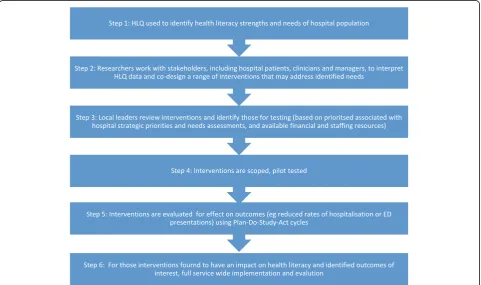
A mixed methods, two-step sequential explanatory de-sign was employed for this study (Fig. 1), based on the Ophelia (OPtimising Health LIteracy and Access) process [22]. Ophelia is a rigorous, evidence based process for identifying, implementing and evaluating health literacy interventions in organisations. It was de-veloped and trialled in the primary health (community health services) setting [23]. The Ophelia process in-volves six key steps (Fig. 2) underpinned by three evidence-based, complex system approaches to interven-tion development: interveninterven-tion mapping, quality im-provement collaboratives, and realist synthesis [22]. The research reported in this article focuses on the results from step 2 of the Ophelia process, with a brief descrip-tion of the results of step 1 (used to inform step 2 and described previously [24]).
Step 1
The cross-sectional survey of hospitalised patients using the HLQ has been described in detail previously [19]. The survey was conducted at a public hospital located in an area of high socioeconomic disadvantage in Mel-bourne Australia. The population serviced by the hos-pital has lower levels of educational attainment, a higher proportion of migrants, and higher rates of unemploy-ment compared with state averages [20], and where health literacy has been found to be lower than at other hospitals [21]. The HLQ is a self-report measure of health literacy that consists of nine conceptually distinct domains across 44 items: 1.Feeling understood and sup-ported by health care providers; 2. Having sufficient
in-formation to manage health; 3. Actively managing my
health; 4.Social support for health; 5.Active appraisal of health information; 6. Ability to actively engage with healthcare providers; 7. Navigating the healthcare sys-tem; 8. Ability to find good health information; and 9.
Understand health information well enough to know what to do[22]. The survey has been validated for use in a number of settings [25–28]. Each domain is an inde-pendent construct.
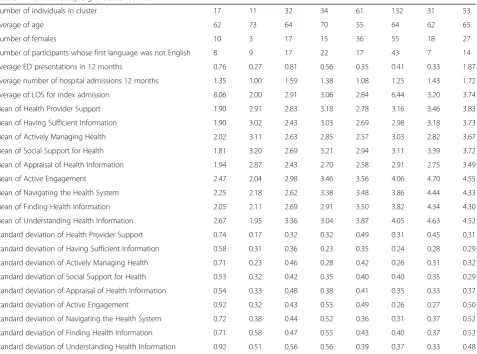
on similarities in patterns of distribution across variables [30]. Clusters were presented as means (SD) for each do-main score in each cluster, and accompanied by infor-mation about sociodemographic distributions across the cluster. The method for choosing the number of clusters for analysis has been previously described [22], and was guided by an aim to minimise the variance within each domain of each cluster (e.g., if the SD is > 0.6 for one or
more of the domains it may indicate that there are still significant subgroups within the cluster); and ensuring that clusters represent different patterns of needs and strengths across the nine domains of the HLQ. Eight clusters were chosen for this study (Table1). This num-ber provided a clinically meaningful distribution of strengths and needs and was the solution that most closely met our requirements of low variation within the
Fig. 1Two phase sequential explanatory design employed to co-create health literacy interventions for hospitalised patients
[image:3.595.60.539.89.282.2] [image:3.595.58.540.427.712.2]cluster (SD < 0.6) (Cluster solutions available as Add-itional File1). Hierarchical cluster analysis of the survey data was performed using Ward’s method for linkage using SPSS Version 22 [31].
Clusters were made relevant and user friendly for pa-tients and hospital clinicians and managers through the writing of patient stories (clinical vignettes) – illustra-tions of how a typical person within each cluster might be impacted by living with that health literacy profile (Fig. 3). Each cluster corresponded to one single vi-gnette. Vignettes were written by the lead author who was a clinician at the health service (and so was familiar with the types of patients attending for care), with mem-ber checks made with two health service clinicians as well as all other lead authors to determine the accuracy of the interpretation.
Step 2
Patient participants were recruited from individuals who had responded to the step 1 survey. Purposive critical case sampling [32] was used to identify twelve respon-dents (six for each workshop) with a range of health
literacy profiles and demographic/clinical backgrounds, to ensure representative groups of patients were in-cluded. We contacted a total of 21 participants by phone until 12 consented to participate. We then followed up by providing a copy of the information and consent form in the mail and asked the participant to bring this with them to the workshop. We also phoned each participant the day before the workshop to confirm attendance. We based the number of invited participants on recom-mended numbers (based on the scientific literature) for non-commercial focus groups, which recommend 5–8 participants [33]. Numbers larger than this may not allow all participants to actively participate and small or
‘mini’focus groups are considered to be more
[image:4.595.62.540.95.449.2]comfort-able for participants [33]. The patients selected for the workshop were selected to represent the spread of health literacy capability (i.e., lower, mixed and higher, with over-sampling of people in the low health literacy clusters), socio-demographic characteristics (age, sex), chronic disease and hospital use profiles who were rep-resentative of the step 1 survey respondents and the population serviced by the index hospital [34]. Table 1Health literacy eight cluster solution
Number of individuals in cluster 17 11 32 34 61 132 31 53
Average of age 62 73 64 70 55 64 62 65
Number of females 10 3 17 15 36 55 18 27
Number of participants whose first language was not English 8 9 17 22 17 43 7 14
Average ED presentations in 12 months 0.76 0.27 0.81 0.56 0.35 0.41 0.33 1.87
Average number of hospital admissions 12 months 1.35 1.00 1.59 1.38 1.08 1.25 1.43 1.72
Average of LOS for index admission 8.06 2.00 2.91 3.06 2.84 6.44 3.20 3.74
Mean of Health Provider Support 1.90 2.91 2.83 3.18 2.78 3.16 3.46 3.83
Mean of Having Sufficient Information 1.90 3.02 2.43 3.03 2.69 2.98 3.18 3.73
Mean of Actively Managing Health 2.02 3.11 2.63 2.85 2.57 3.03 2.82 3.67
Mean of Social Support for Health 1.81 3.20 2.69 3.21 2.94 3.11 3.39 3.72
Mean of Appraisal of Health Information 1.94 2.87 2.43 2.70 2.58 2.91 2.75 3.49
Mean of Active Engagement 2.47 2.04 2.98 3.46 3.56 4.06 4.70 4.55
Mean of Navigating the Health System 2.25 2.18 2.62 3.38 3.48 3.86 4.44 4.33
Mean of Finding Health Information 2.05 2.11 2.69 2.91 3.50 3.82 4.34 4.30
Mean of Understanding Health Information 2.67 1.95 3.36 3.04 3.87 4.05 4.63 4.52
Standard deviation of Health Provider Support 0.74 0.17 0.32 0.32 0.49 0.31 0.45 0.31
Standard deviation of Having Sufficient Information 0.58 0.31 0.36 0.23 0.35 0.24 0.28 0.29
Standard deviation of Actively Managing Health 0.71 0.23 0.46 0.28 0.42 0.26 0.31 0.32
Standard deviation of Social Support for Health 0.53 0.32 0.42 0.35 0.40 0.40 0.35 0.29
Standard deviation of Appraisal of Health Information 0.54 0.33 0.48 0.38 0.41 0.35 0.33 0.37
Standard deviation of Active Engagement 0.92 0.32 0.43 0.55 0.49 0.26 0.27 0.50
Standard deviation of Navigating the Health System 0.72 0.38 0.44 0.52 0.36 0.31 0.37 0.52
Standard deviation of Finding Health Information 0.71 0.58 0.47 0.55 0.43 0.40 0.37 0.52
Participants were not paid, but expenses were reim-bursed. Each patient workshop ran for two hours.
Purposeful critical case sampling was also used to identify potential participants among clinicians and managers. An ‘all of staff’ email was sent by the Chief Executive Officer seeking expressions of interest from staff to participate in the workshops. From those staff who responded, we sought 23 staff (12 for each work-shop) who would represent a broad cross-section of front line clinicians and managers from the wards and outpatient departments and who would therefore be likely to recognise the narratives in the vignettes. In areas where we had low numbers of staff responses, we asked managers from these wards/departments to iden-tify local leaders and directly approach them to partici-pate in the workshops, as they would be influential in adopting identified interventions. To create efficiencies around the time required for staff to attend the work-shops, attendees were sent the participant information and consent forms to bring with them to the workshop and provided with pre-reading consisting of a summary of the purpose and results of step 1, the aims of the workshops, and the vignettes for discussion in the work-shop. Each clinician workshops ran for 45 min.
The first workshop was facilitated by an experienced researcher who had previously run more than 20 Ophe-lia workshops (AB). This was used as a training exercise, with the lead author learning the process (RJ). The lead author then facilitated the remaining three workshops,
with support from at least one other experienced author who was in attendance (AB and RB). Eight vignettes were designed, with five presented at each workshop. Vi-gnettes used in each workshop were selected in part by the profile of workshop participants and to ensure that all vignettes were presented at least once to staff and pa-tients. Each workshop was run as a single group (all par-ticipants together, all of the time), with each participant invited to contribute their thoughts on the seeding ques-tions for each vignette. Workshops were recorded and transcribed with the permission of participants.
Within each workshop, seeding questions were used to test the accuracy of the clinical vignettes in representing ‘usual’types of patients presenting for care, and to guide discussions in a consistent and systematic way. The questions were slightly different across the groups:
Patients
1. Do you recognise the person in this story as someone who could be from your community? 2. What do you think this person’s main issues are? 3. What do you think we could do to improve care for
this person?
Clinicians and managers
[image:5.595.68.539.88.176.2]2. What could you do to support this person in understanding and managing their condition? 3. What could your organisation do to improve
systems and services if there were many people like this in the service?
At the end of each workshop, the unique ideas created in each group were collated and presented back to par-ticipants to assess the interpretive accuracy of data col-lected (initial respondent validation) [35]. These data were then coded across three theoretical themes using von Wagner’s [36] framework of health literacy and health actions, and Paasche-Orlow & Wolf’s [37] evidence-based review of the causal pathways that link health literacy to health outcomes. These three theoret-ical themes are:
1) Interventions at the organisational, process policy level to address systems access and use;
2) Interventions at the provider-patient interface; and 3) Interventions for patient self-care to address health
literacy and disease management.
Thematic analysis is an iterative and reflective process. As we wanted to ensure our conclusions accurately reflected the content of the workshops, two review au-thors (RJ and AB) separately coded all the workshop data using an iterative constant comparative method [38]. The process involved three stages– initial coding, focused coding to reduce overlap and redundancy of coding, and finally, theoretical coding using the themes identified above [39]. Two cross-checks to compare emerging themes was performed to assess for the
accuracy of inferences at each stage. Where a difference was found, the author was asked to demonstrate from the raw data how their interpretation was reached until agreement was found. Where agreement was not found, a third reviewer (RHO) was consulted. A pragmatic ap-proach was adopted when drawing final inferences from this study, with a focus on the development of useful knowledge directly related to health literacy for the index hospital setting. Final inferences were verified by both subject specialists (RB and RHO). Most import-antly, and consistent with the co-design process, the data was then referred back to those who attended the workshops (final respondent validation).
Results
The survey element of step 1 has been presented previ-ously [24]. In brief, 384 patients completed question-naires. Mean age was 64 years (range 22–96) and 49% were female. Eight separate health literacy clusters were identified (Table1).
[image:6.595.56.538.507.734.2]Seven patients (60% attendance rate) attended the two patient workshops (Table 2), three attended the first workshop and four attended the second. Of the patient participants, the median age was 74 years (range 65–85), 2 were female, 43 were in the lowest health literacy clus-ter, 4 had not completed secondary education, 4 re-ported an income less than $30,000 and 4 rere-ported having three or more chronic conditions. There was a total of 23 staff participants (96% attendance rate), in-cluding 15 nurses (managers, chronic disease specialists, educators, emergency triage, ward and home based), 2 renal dialysis technicians, an Aboriginal and Torres Strait Islander liaison officer, 2 patient experience
Table 2Patient participant demographic and clinical characteristics
Descriptor n=7
Age (years) : median (range) 74 (65–86)
Sex (female) 2
Completed secondary education 4
Household income less than $30,000 4
Diabetes 2
Arthritis 4
Heart condition 3
Back pain 3
Stroke 3
Cancer 1
Anxiety/ Depression 4
≥3 chronic conditions 4
Length of hospital stay in days: median (range) 2 (1–18)
Combined number of admissions in previous 12 months (median, range) 26 (1, 1–12)
co-ordinators, a transcultural and language services co-ordinator, and a pharmacist.
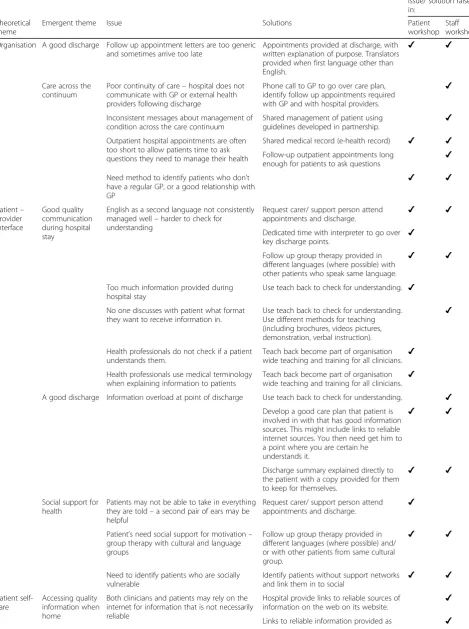
Across the workshops, a total of 171 ideas to improve the care and services for the personas described in the vignettes’ (intervention ideas) were generated (range 26 to 61 per workshop). Thematic saturation was reached across both patient and staff workshops. Fifteen general strategies across five themes emerged from the analysis and were then grouped across theoretical themes (Table 3). These are presented below, organised according to intervention points across the patient journey from hos-pital to home.
Good quality communication during hospital stay
Clinicians and patients identified that five main require-ments for ensuring communication with patients is of ‘good quality’were:
1) Developing rapport with the patient so that a relationship of trust is established.
“Maybe health care providers can be trained in being more sensitive in talking to patients. [The hospital could run] workshops and create guides for training.”
Clinician, Workshop 2
2) Identifying the patient’s preferred format for receiving information. Where appropriate, have the patient demonstrate relevant self-management skills.
“What sort of format would he [the patient] like information in? Work out the best way to engage him?”Clinician, Workshop 4
“Monitor his log books, [get him to] show us how he calculates and administers his insulin [while he is still in hospital].”Clinician, Workshop 4
3) Use plain language–avoid medical‘jargon’.
“Too much jargon–she’s only had basic education–she needs things put out plainly.”Patient, Workshop 3
4) Use a mechanism to check for understanding.
“[To determine] whether [a patient] can follow
instructions, get them to explain to you what the issue is and what they need to be doing to deal with it. Not really about education - it’s also about where they are in terms of their other life factors.”Clinician, Workshop 4
“Can we give them some sort of testing to see if they have got it [the information]?”Patient, Workshop 1
5) Avoid overloading the patient–deliver information in bite size pieces across their hospital stay.
“It’s important that in every contact we just try and educate in bits and pieces. Each point of contact with coaching adds up.”Clinician Workshop 4
Social support for health
Participants in the workshop identified that social sup-port provides several advantages to patients trying to process complex information. This was regarded as be-ing of particular importance for patients from culturally and linguistically diverse communities, for whom the communication task is more complex. Three overall strategies were suggested:
6) Have a family member or friend attend key appointments.
“I reckon what he needs is someone to go with him, whose got a bit a nouse, can read what needs to be read and is prepared to spend some time with him and give him what he needs.”Patient, Workshop 1.
“He needs something better than an interpreter because they’re there and gone in a flash. He needs someone to go with him. That’s all he needs.”Patient, Workshop 3
7) Group physical therapy and education sessions for people going through the same health experience, allows for sharing of information, resources, and strategies from the‘lived experience’.
“Talking with other people who have similar problems to yourself, sharing your grizzles and problems.” Patient, Workshop 1
“[For outpatient group physical therapy, e.g., cardiac rehabilitation] try and group patients with similar background/ same language for interpretation but also for building social networks with people from same background.”Clinician, Workshop 4
8) Identifying patients who do not have a‘support person’(socially isolated), and providing them with a case manager.
Table 3Workshop thematic analysis
Issue/ solution raised in:
Theoretical theme
Emergent theme Issue Solutions Patient
workshop Staff workshop
Organisation A good discharge Follow up appointment letters are too generic and sometimes arrive too late
Appointments provided at discharge, with written explanation of purpose. Translators provided when first language other than English.
✔ ✔
Care across the continuum
Poor continuity of care–hospital does not communicate with GP or external health providers following discharge
Phone call to GP to go over care plan, identify follow up appointments required with GP and with hospital providers.
✔
Inconsistent messages about management of condition across the care continuum
Shared management of patient using
guidelines developed in partnership. ✔
Outpatient hospital appointments are often too short to allow patients time to ask questions they need to manage their health
Shared medical record (e-health record) ✔ ✔
Follow-up outpatient appointments long enough for patients to ask questions
✔
Need method to identify patients who don’t have a regular GP, or a good relationship with GP
✔ ✔
Patient– Provider interface
Good quality communication during hospital stay
English as a second language not consistently managed well–harder to check for understanding
Request carer/ support person attend
appointments and discharge. ✔ ✔
Dedicated time with interpreter to go over key discharge points.
✔
Follow up group therapy provided in different languages (where possible) with other patients who speak same language.
✔ ✔
Too much information provided during hospital stay
Use teach back to check for understanding. ✔
No one discusses with patient what format they want to receive information in.
Use teach back to check for understanding. Use different methods for teaching (including brochures, videos pictures, demonstration, verbal instruction).
✔
Health professionals do not check if a patient understands them.
Teach back become part of organisation wide teaching and training for all clinicians. ✔
Health professionals use medical terminology when explaining information to patients
Teach back become part of organisation wide teaching and training for all clinicians.
✔
A good discharge Information overload at point of discharge Use teach back to check for understanding. ✔
Develop a good care plan that patient is involved in with that has good information sources. This might include links to reliable internet sources. You then need get him to a point where you are certain he
understands it.
✔ ✔
Discharge summary explained directly to the patient with a copy provided for them to keep for themselves.
✔ ✔
Social support for health
Patients may not be able to take in everything they are told–a second pair of ears may be helpful
Request carer/ support person attend appointments and discharge.
✔
Patient’s need social support for motivation– group therapy with cultural and language groups
Follow up group therapy provided in different languages (where possible) and/ or with other patients from same cultural group.
✔ ✔
Need to identify patients who are socially vulnerable
Identify patients without support networks
and link them in to social ✔ ✔
Patient self-care
Accessing quality information when home
Both clinicians and patients may rely on the internet for information that is not necessarily reliable
Hospital provide links to reliable sources of information on the web on its website.
✔
“Somehow the system has to pick up that this person doesn’t quite comprehend and put a minder with them or at least contact them once a month‘just remember Bill, next week you’ve got this appointment’.”Patient, Workshop 3
A good discharge
Participants perceived that most of the information patients require to manage their care at home is pro-vided at the point of discharge, and that it is deliv-ered in an inconsistent manner. The following strategy was suggested:
9) Written information (possibly with pictures where appropriate) should be provided as part of discharge. This should be discussed with the patient, in the presence of a carer and/or interpreter where required.
“You get a discharge summary to give to your GP, but in a sealed envelope and not discussed, and follow up appointments are posted out but often too late. Should be given while in hospital.”Patient, Workshop 1
“I reckon a piece of paper with it all written out....Instead they rattle off all these things and you say right oh and you get out the door and you’ve forgotten what the bloody hell they said…. if you had a piece of paper with it written out in big print that everybody could read, it wouldn’t hurt.”Patient, Workshop 3
“Should be sent home with a written plan as to what to do when she gets out of bed, for each step in the day
–make it really simple.”Patient, Workshop 1
Care across the continuum
Many participants perceived that the communication between the hospital and the patient and GP was poor. Letters relating to post-discharge follow up ap-pointments were too generic and provided no infor-mation about the purpose of the appointment - only
the date, time, location and speciality. Further, due to delays in postage and handling, sometimes these let-ters were received after the appointment date. Follow up appointments were perceived to be so short that they did not allow for proper understanding of infor-mation or questions. In addition, participants felt that there was little to no communication between the hospital and their GPs. Participants suggested the fol-lowing strategies:
10) Hospital follow up appointment dates should be provided at or before discharge, with a written explanation of purpose. Translators should be provided on request. When patients do not attend follow up appointments, they should be contacted by phone.
“The outpatient letters are very general and don’t have enough specific information, they could be more user friendly, less jargon so people know where they are going and for what purpose.”Clinician, Workshop 2
“There are other issues where people get inconsistent information about appointments from in hospital and after discharge.”Patient, Workshop 3
“If people miss 2 or 3 outpatient appointments they are discharged from the service. This is often a big barrier ...did anyone follow him up to say why didn’t you attend appointment?”Clinician, Workshop 4.
11) The hospital should contact the GP directly to discuss outcomes of the patient’s hospital stay and any follow up appointments required.
“As an organisation, shouldn’t we be contacting the GP to say this patient needs to see you within 7 days of discharge? Sometimes discharge summaries don’t get sent to the GP.”Clinician, Workshop 2
[image:9.595.56.542.99.191.2]12) A shared medical record between the hospital and GP would be ideal, as well as shared use of disease management guidelines so that information is consistent between hospital and GP.
Table 3Workshop thematic analysis(Continued)
Issue/ solution raised in:
Theoretical theme
Emergent theme Issue Solutions Patient
workshop Staff workshop
part of patient care plan.
Clinicians not always aware of information available in different languages
Hospital communications office provide information in different languages for different presentations
“We need electronic medical records to improve communication between providers (e-health).”Patient, Workshop 1
“For patients to trust what health care providers are telling them patients need consistent information, the same story across all providers.”Clinician, Workshop 4
“[We need to have] care pathways so all health care providers know what the pathway is and how to deliver it.”Clinician, Workshop 4
13) Follow up appointments should be long enough to allow patients to ask questions.
“The time consultants spend with patients is very small. Even making lists doesn’t work, as soon as they hit the chair in the office they are out the door again.”
Clinician, Workshop 2
Accessing quality information when home
Many participants reported a lack of trust in the infor-mation provided on the internet. This was felt to be a barrier for patients having information to manage their health. Participants identified several options for provid-ing patients with information followprovid-ing discharge:
14) Provide links to trusted sources of information through the hospital’s website.
“Maybe the [hospital] communications office can put up something on their site, FAQs, reputable sites etc.”
Clinician, Workshop 2
15) Provide appropriate brochures and pamphlets, in a patient’s first language, during the hospital stay and at discharge. The discharge plan could also provide credible website addresses.
“Develop a good care plan that he’s involved with that has good information sources. This might include links to reliable internet sources.”Clinician Workshop 4
Discussion
This study identified five key themes that impact on a hospitalised patient’s health literacy;“Good quality com-munication during hospital stay”, “Social support for health”, “A good discharge”, “Care across the con-tinuum” and “Accessing quality information when home”. Across these themes, 15 strategies were identi-fied to address health literacy needs in individuals and populations. These strategies included changes to the
way health information messages are designed and deliv-ered, training programs for staff on how to educate with sensitivity and assess for understanding, using social support for health as a tool to improve understanding, improving communication between hospitals and pri-mary care providers to ensure consistency of informa-tion and follow up of care, and strategic communicainforma-tion of quality information online.
These strategies were derived using the Ophelia process to profile patients at a public hospital [18], and then to engage patients and clinicians in the co-design of health literacy interventions. The cross-sectional sur-vey provided rich, context specific health literacy data and was presented in a user-friendly way through a pa-tient story to illustrate what representative papa-tient groups look like, including their specific health literacy profiles (strengths and weaknesses). This resulted in the design of locally-relevant commentary about patients and their health literacy needs and the development of interventions to service these needs that are more likely to be acceptable to both the clinicians and patients. Using the Ophelia process resolves the disconnect be-tween what organisations, clinicians and patients value, and the co-design approach allows for the development of interventions that clearly address identified health lit-eracy needs for this specific local population.
Cluster analysis provides a unique method for applying a non-linear approach to assessing individual and popu-lation health literacy. By non-linear we mean that the focus is moved away from specific ‘cut points’that clas-sify a patient as either ‘low’or ‘adequate’health literacy based on specific scores (e.g. a = x, b = x), and focuses in-stead on meaningful data about the health literacy strengths and needs of individuals within a ‘cluster’. In practice, this might mean that a group of individuals might score really low for ‘understanding health infor-mation well enough to know what to do’ but identify as having very high‘social support for health’.Scoring really well in a category such as social support or health pro-vider support, might mediate low scores in another such as understanding or finding health information. When we label patients as having ‘low’ health literacy on the basis of low reading or numeracy skills, we fail to see the potential of many factors that influence their ability to be literature about their own health condition.A patient may be illiterate but have a very supportive partner that acts as a‘surrogate’reader, helping them understand the health information provided. Our findings demonstrate that categorising patients as having overall‘high’or‘low’ health literacy is not useful in identify health literacy needs, or in developing interventions to address health literacy requirements within populations.
to read and understand written information, and attempted to improve the composition or method of de-livery of messages (including signage, brochures and in-structional material) so that it is user-friendly [40, 41]. We found that strategies to improve written material were also important to participants in this study, how-ever they formed only two of the 15 strategies identified by participants. Greater emphasis was placed on the im-portance of supportive relationships in responding to health literacy needs: between clinician and patient dur-ing the hospital stay, between the patient, carer and the hospital - ensuring carer’s involvement at times of key information provision; and between the hospital, the pa-tient and the GP.
We previously found that being from a culturally and linguistically diverse background not only presents chal-lenges for finding and understanding information, but also presents challenges around differing healthcare de-livery contexts. Social support for health has been identi-fied as a mediator of low health literacy in a number of studies [15, 42–44]. In our study, participants felt that encouraging patients to have carers to support them at key appointments may be of particular value for patients from a culturally and linguistically diverse background.
The reality of any hospital admission means that mul-tiple health professionals will be involved in each pa-tient’s care. Invariably, this means that patients are receiving, and are required to process, a large amount of complex and unfamiliar information from different pro-fessionals in a short period of time. This presents a chal-lenge for hospitals and clinicians in ensuring each patient receives the information they require in order to manage their condition appropriately when they return home. Teach back is an evidence based intervention aimed at improving clinician-patient communication and patient knowledge retention [45–47]. Across the workshops, a number of strategies themed under “Qual-ity communication during hospital stay”, and “A good discharge”, could be actioned through the application of teach back education. This method is suggested as a health literacy intervention by the Australian Commis-sion on Safety and Quality in HealthCare [48], but as yet is not routinely used in the Australian and most other health care setting. Our research further supports adop-tion of this strategy in improving outcomes for patients in the hospital setting.
Strengths and limitations
As the HLQ is a self-report measure of health literacy, it enables respondents to provide an indication of their self-perceived ability to achieve specific tasks related to managing their health (such as reading, understanding or completing medical forms). The benefit of this type of instrument is that it provides a rich data set on how
socially connected patients feel engaged with their health, including feeling supported by health profes-sionals and family, and how easy they find it to navigate their way around health systems. However, the disadvan-tage of self-report instruments are that higher and lower scores may reflect inflated or deflated views of compe-tency [49].
The interventions designed for this population may or may not be appropriate for other hospital populations as patient needs may differ in other hospital settings. The Ophelia process should be tested in other populations, including at other hospitals and with more patient par-ticipants, to determine if there are common themes that arise.
All patients who participated in the workshops were over the age of 65. While we aimed to sample approxi-mately one third under 65 (in line with response rates for the survey), on the day only individuals over the age of 65 attended. This may have been due to the work-shops being run during working hours. This resulted in only seven patients (60% of those invited) attending the two patient workshops for patients. While we feel that by the end of the second workshop we had reached the-matic saturation, a further workshop with more patients may have resulted in generation of new ideas. We over-estimated the likelihood that patients would attend (hav-ing agreed to by phone) and in future we would oversample patient participants to allow for non-attendance.
A major strength of this study, using a two-step se-quential explanatory design, is that the interventions were specifically designed to respond to the health liter-acy challenges of this population, capturing the whole spectrum of what we now know form an individual’s array of health literacy strengths and needs. The identifi-cation of strategies common across the workshops, veri-fied by two independent researchers reviewing the transcripts and through member checks, suggests that these findings are valid for this hospital population. These findings are now in the process of being imple-mented, and future research in this hospital population will provide insight into whether these strategies can generate meaningful impacts, such as reducing poten-tially avoidable admissions or readmissions, and improv-ing patient and staff experiences across the care continuum. Further research is required to identify whether these strategies are relevant to other patient populations.
Conclusion
analysis to create user-friendly clinical vignettes, pro-vided a locally driven, contextual approach to the co-design of interventions by patients and clinicians. Im-plementation and evaluation will assist to identify those strategies that have the maximum patient, clinician and/ or organisational benefit. Further research may provide guidance into whether these interventions are applicable to the wider healthcare context.
Additional file
Additional file 1:Cluster analysis, This additional file presents 3–13 and a 16 cluster solutions. The 8 cluster solution was the solution chosen for analysis as it presented the least amount of variation within clusters (based on the SD’s). (XLSX 48 kb)
Acknowledgements
The authors would like to thank the staff and patients of Northern Health for their support and participation in this study.
Funding
A Deakin University Higher Degree Research Grant assisted with the cost of materials and printing of surveys. RLJ was funded by a National Health and Medical Research Council (NHMRC) PhD Scholarship #1075250. RHO was funded in part by a NHMRC Senior Research Fellowship #APP1059122. AB was funded by an ARC Linkage Industry Fellowship. RB was funded by an NHMRC Senior Principle Research Fellowship #APP1082138. The funding bodies supporting this research had no influence on the study and collection, analysis, and interpretation of data and in writing the manuscript.
Availability of data and materials
The datasets generated during and/or analysed during the current study are available from the corresponding author on reasonable request.
Authors’contributions
The study and overall design was conceived by RLJ, RB, RHO, AB and operationalized by RLJ and AB. RLJ led the data collection. RJ and AB undertook the statistical analysis. RLJ wrote the first draft. RB, RHO and AB contributed to the analysis strategy and all drafts. All authors contributed to the interpretation of the results. All authors critically reviewed the manuscript and approved the final version.
Ethics approval and consent to participate
Step 1 of this study was approved by the Northern Health (study no. P11/13) and Deakin University (study no. 2014–137) Human Research Ethics Committees. Step 2 was approved the Northern Health (LNR/16/NH/50) and Deakin University (2016–111) Human Research Ethics Committees. Informed written consent was obtained from all participants.
Consent for publication
Not applicable.
Competing interests
The authors declare that they have no competing interests.
Publisher’s Note
Springer Nature remains neutral with regard to jurisdictional claims in published maps and institutional affiliations.
Author details
1Monash Department of Clinical Epidemiology, Cabrini Institute, Melbourne, Australia.2Department of Epidemiology and Preventive Medicine, Monash University, Melbourne, Australia.3Northern Health, Melbourne, Australia. 4Health Systems Improvement Unit, Deakin University, Melbourne, Australia. 5Department of Medicine-Western Health, The University of Melbourne, 176 Furlong Road, St Albans, Victoria, Australia.6Australian Institute for
Musculoskeletal Science (AIMSS), The University of Melbourne and Western Health, 176 Furlong Road, St Albans, Victoria, Australia.
Received: 5 June 2018 Accepted: 6 December 2018
References
1. Nutbeam D. Health literacy as a public health goal: a challenge for contemporary health education and communication strategies into the 21st century. Health Promot Int. 2000;15(3):259–67.
2. Beauchamp T, Childress J. Principles of biomedical ethics. New York: Oxford University Press; 2013.
3. Kutner M, Greenburg, E., Jin, Y., & Paulsen, C. . The Health Literacy of America's Adults: Results from the 2003 National Assessment of Adult Literacy. National Center for Education Statistics 2006;NCES 2006–2483. 4. Australian Bureau of Statistics. Health Literacy, Australia 2006. In: ABS.
Canberra: ABS (Australian Bureau of Statistics); 2008. Retrieved from:http:// www.ausstats.abs.gov.au/ausstats/subscriber.nsf/LookupAttach/4102. 0Publication30.06.093/$File/41020_Healthliteracy.pdf.
5. Murray TSHJ, Willms D, Shilington R, Desjardins R. Health Literacy in Canada: A Healthy Understanding 2008 (Ottawa: 2008). 38 pages. In: Learning CCo. Ottowa: The Canadian Council on Learning; 2008. Retrieved from:https:// escholarship.org/uc/item/890661nm.
6. Williams MV, Baker DW, Parker RM, Nurss JR. Relationship of functional health literacy to patients' knowledge of their chronic disease: a study of patients with hypertension and diabetes. Arch Intern Med. 1998;158(2):166– 72.
7. Schillinger D, Grumbach K, Piette J, Wang F, Osmond D, Daher C, et al. Association of health literacy with diabetes outcomes. JAMA. 2002;288(4): 475–82.
8. Gazmararian JA, Williams MV, Peel J, Baker DW. Health literacy and knowledge of chronic disease. Patient Educ Couns. 2003;51(3):267–75. 9. Williams MV, Baker DW, Honig EG, Lee TM, Nowlan A. Inadequate literacy is
a barrier to asthma knowledge and self-care. Chest Journal. 1998;114(4): 1008–15.
10. Souza JG, Apolinario D, Magaldi RM, Busse AL, Campora F, Jacob-Filho W. Functional health literacy and glycaemic control in older adults with type 2 diabetes: a cross-sectional study. BMJ Open. 2014;4(2):e004180.
11. Gazmararian JA, Kripalani S, Miller MJ, Echt KV, Ren J, Rask K. Factors associated with medication refill adherence in cardiovascular-related diseases: a focus on health literacy. J Gen Intern Med. 2006;21(12):1215–21. 12. Omachi TA, Sarkar U, Yelin EH, Blanc PD, Katz PP. Lower health literacy is
associated with poorer health status and outcomes in chronic obstructive pulmonary disease. J Gen Intern Med. 2013;28(1):74–81.
13. Baker DW, Parker RM, Williams MV, Clark WS. Health literacy and the risk of hospital admission. Journal Gen Intern Med. 1998;13(12):791–8.
14. Cho YI, Lee S-YD, Arozullah AM, Crittenden KS. Effects of health literacy on health status and health service utilization amongst the elderly. Soc Sci Med. 2008;66(8):1809–16.
15. Baker DW, Gazmararian JA, Williams MV, Scott T, Parker RM, Green D, et al. Functional health literacy and the risk of hospital admission among Medicare managed care enrollees. Am J Public Health. 2002;92(8):1278–83. 16. Baker DW, Wolf MS, Feinglass J, Thompson JA, Gazmararian JA. J H. health literacy and mortality among elderly persons. Arch Intern Med. 2007;167(14): 1503–9.
17. Sudore RL, Yaffe K, Satterfield S, Harris TB, Mehta KM, Simonsick EM, et al. Limited literacy and mortality in the elderly. The health, aging and body composition study. J Gen Intern Med. 2006;21:806–12.
18. Beauchamp A, Buchbinder R, Dodson S, Batterham RW, Elsworth GR, McPhee C, et al. Distribution of health literacy strengths and weaknesses across socio-demographic groups: a cross-sectional survey using the health literacy questionnaire (HLQ). BMC Public Health. 2015;15(678).
19. Batterham R, Hawkins M, Collins P, Buchbinder R, Osborne R. Health literacy: applying current concepts to improve health services and reduce health inequalities. Public Health. 2016;132:3–12.
20. Dawda PKA. Experience Based Co-design: a toolkit for Australia. In: Consumer Health Forum of Australia AHaHA. Canberra: ACT: Prestantia Health; 2017. Retrieved from: https://chf.org.au/experience-based-co-design-toolkit.
22. Batterham RW, Buchbinder R, Beauchamp A, Dodson S, Elsworth GR, Osborne RH. The OPtimising HEalth LIterAcy (Ophelia) process: study protocol for using health literacy profiling and community engagement to create and implement health reform. BMC Public Health. 2014;14(1):694. 23. Beauchamp A, Batterham RW, Dodson S, Astbury B, Elsworth GR, McPhee C,
et al. Systematic development and implementation of interventions to OPtimise health literacy and access (Ophelia). BMC Public Health. 2017;17(1): 230.
24. Jessup RL, Osborne RH, Beauchamp A, Bourne A, Buchbinder R. Health literacy of recently hospitalised patients: a cross-sectional survey using the health literacy questionnaire (HLQ). BMC Health Serv Res. 2017;17(1):52. 25. Hawkins M, Gill S, Batterham R, Elsworth GE, RH O. The health literacy
questionnaire (HLQ) at the patient-clinician interface: what do patients and clinicians really mean by their HLQ scores? BMC Health Serv Res. 2017. 26. Nolte S, Osborne RH, Dwinger S, Elsworth GR, Conrad ML, Rose M, et al.
German translation, cultural adaptation, and validation of the health literacy questionnaire (HLQ). PLoS One. 2017;12(2):e0172340.
27. Maindal HT, Kayser L, Norgaard O, Bo A, Elsworth GR, Osborne RH. Cultural adaptation and validation of the health literacy questionnaire (HLQ): robust nine-dimension Danish language confirmatory factor model. Springerplus. 2016;5(1):1232.
28. Morris RL, Soh S-E, Hill KD, Buchbinder R, Lowthian JA, Redfern J, et al. Measurement properties of the health literacy questionnaire (HLQ) among older adults who present to the emergency department after a fall: a Rasch analysis. BMC Health Serv Res. 2017.
29. Goeman D, Conway S, Norman R, Morley J, Weerasuriya R, Osborne RH, et al. Optimising health literacy and access (OPHELIA) of service provision to community dwelling older people with diabetes receiving home nursing support. Journal of Diabetes Research. 2016.
30. Tashakkori A, Teddlie C. Sage handbook of mixed methods in social & behavioral research. Los Angeles: Sage; 2010.
31. IBM Corp. IBM SPSS statistics for windows. Armonk New York: IBM Corp; 2013.
32. Patton MQ. Qualitative evaluation and research methods: SAGE publications, inc; 1990.
33. Krueger RA, Casey MA. Focus groups: a practical guide for applied research: Sage publications; 2014.
34. Victoria State Government. Index of Relative Socioeconomic Disadvantage. Available at:www.abs.gov.au/websitedbs/censushome.nsf/home/seifa. Accessed July 2017.2015.
35. Lincoln YS, Guba EG. Naturalistic inquiry: Sage; 1985.
36. von Wagner C, Steptoe A, Wolf MS, Wardle J. Health literacy and health actions: a review and a framework from health psychology. Health Educ Behav. 2009;36(5):860–77.
37. Paasche-Orlow MK, Wolf MS. The causal pathways linking health literacy to health outcomes. Am J Health Behav. 2007;31(1):S19–26.
38. Glaser BG. The constant comparative method of qualitative analysis. Soc Probl. 1965;12(4):436–45.
39. Charmaz K. Constructing grounded theory: Sage; 2014.
40. Pignone M, DeWalt DA, Sheridan S, Berkman N, Lohr KN. Interventions to improve health outcomes for patients with low literacy. J Gen Intern Med. 2005;20(2):185–92.
41. University NCRTIE-bPCNCC, Berkman ND. Health literacy interventions and outcomes an updated systematic review: Agency for Healthcare Research and Quality Rockville, MD; 2011.
42. Jordan JE, Buchbinder R, Osborne RH. Conceptualising health literacy from the patient perspective. Patient Educ Couns. 2010;79(1):36–42.
43. Lee S-YD, Arozullah AM, Cho YI. Health literacy, social support, and health: a research agenda. Soc Sci Med. 2004;58(7):1309–21.
44. Osborne RH, Batterham R, Elsworth G, Hawkins M, Buchbinder R. The grounded psychometric development and initial validation of the health literacy questionnaire (HLQ). BMC Public Health. 2013;13(1):658. 45. White M, Garbez R, Carroll M, Brinker E, Howie-Esquivel JI.“Teach-back”
associated with knowledge retention and hospital readmission in hospitalized heart failure patients? J Cardiovasc Nurs. 2013;28(2):137–46. 46. Kripalani S, Bengtzen R, Henderson LE, Jacobson TA. Clinical research in low-literacy populations: using teach-back to assess comprehension of informed consent and privacy information. IRB: Ethics & Human Research. 2008;30(2):13–9.
47. Tamura-Lis W. Teach-back for quality education and patient safety. Urol Nurs. 2013;33(6):267.
48. Australian Commission on Safety and Quality in Health Care. Health Literacy. Taking action to improve safety and quality. In: ACSQHC; 2014.