RESEARCH ARTICLE
SEaRCH
™
expert panel process:
streamlining the link between evidence
and practice
Ian Coulter
1, Pamela Elfenbaum
2, Shamini Jain
2and Wayne Jonas
2*Abstract
Background: With rising health care costs and the diversity of scientific and clinical information available to health care providers it is essential to have methodologies that synthesize and distill the quality of information and make it practical to clinicians, patients and policy makers. Too often research synthesis results in the statement that “more and better research is needed” or the conclusions are slanted toward the biases of one type of stakeholder. Such conclu-sions are discouraging to clinicians and patients who need better guidance on the deciconclu-sions they make every day.
Method: Expert panels are one method for offering valuable insight into the scientific evidence and what experts believe about its application to a given clinical situation. However, with improper management their conclusions can end up being biased or even wrong. There are several types of expert panels, but two that have been extensively involved in bringing evidence to bear on clinical practice are consensus panels, and appropriateness panels. These types of panels are utilized by organizations such as the National Institutes of Health, the Institute of Medicine, RAND, and other organizations to provide clinical guidance. However, there is a need for a more cost effective and efficient approach in conducting these panels. In this paper we describe both types of expert panels and ways to adapt those models to form part of Samueli Institute’s Scientific Evaluation and Research of Claims in Health Care (SEaRCH™) program.
Discussion: Expert Panels provide evidence-based information to guide research, practice and health care decision making. The panel process used in SEaRCH seeks to customize, synthesize and streamline these methods. By mak-ing the process transparent the panel process informs decisions about clinical appropriateness and research agenda decisions.
Keywords: Clinical expert panel, Research expert panel, Policy expert panel, Patient expert panel, Subject matter experts, Methodology, Appropriateness, Scientific evaluation and review of claims in health care
© 2016 Coulter et al. This article is distributed under the terms of the Creative Commons Attribution 4.0 International License (http://creativecommons.org/licenses/by/4.0/), which permits unrestricted use, distribution, and reproduction in any medium, provided you give appropriate credit to the original author(s) and the source, provide a link to the Creative Commons license, and indicate if changes were made. The Creative Commons Public Domain Dedication waiver (http://creativecommons.org/ publicdomain/zero/1.0/) applies to the data made available in this article, unless otherwise stated.
Background
When attempting to develop evidence-based medicine, health professions face several challenges in trying to base their practices on evidence. One source of informa-tion is scientific evidence derived from research stud-ies. However, since a single study is seldom definitive, a systematic review of the numerous studies published in the literature is preferable. Systematic reviews of the lit-erature provide a method of assessing the quality of each
individual study [1, 2], as well as assessing the overall level of evidence based on the entire published literature for a particular intervention in a given population [2–5]. In a separate article in this series of articles we describe a rapid and reliable way of getting sound evidence through systematic reviews called the Rapid Evidence Assessment of the Literature (REAL©) [6]. However, while clinical research, systematic reviews and their publications are necessary, they are not sufficient to ensure that the rel-evant evidence has been properly assembled or that it can influence practice and clinical decision making. This may occur because of the paucity of studies available,
Open Access
because of the poor quality of the studies, because of the restricted nature of the populations in clinical studies or because of the impossibility of doing the studies for either ethical issues or methodological or resource reasons [6, 7]. The result is that much of health care occurs in a clinical space in which the evidence is indeterminate or uncertain. When good evidence does not exist to guide practice, clinicians must base their approach on their own clinical intuition, on what they were taught in their training or on what the experts recommend. However, such approaches lack transparency and rigor and are often fraught with error. Coulter has termed this “thera-peutic anarchy” where in effect each clinician does his/ her own thing or the market drives what is done rather than patient needs and preferences [7, 8]. The situation is even worse for patients who may not even have the basic knowledge or experience on how to interpret evidence but are also asked to make decisions about treatment choices and preferences.
Expert panels
One approach that has emerged to overcome this prob-lem has been the use of expert panels (EP). While in systematic reviews the opinion of experts is considered at the bottom of the evidence hierarchy, in expert pan-els, which combine evidence and clinical acumen, the opinions are made transparent and subjected to criti-cal appraisal. This overcomes the major objection to the opinion of experts vs. systematic reviews and has the additional value of allowing the introduction of informa-tion closer to clinical practice and a better interface with research evidence.
Samueli Institute uses the following expert panels: a Clinical Expert Panel (CEP), and a Research Expert Panel (REP), with others designed for policy (PoEP) and patient expert panel (PaEP) decisions, in development. These types of panels form a part of the Scientific Evalu-ation and Review of Claims in Health Care (SEaRCH™) process. [6] They draw on the best in existing models of expert panels, but differ in that they are designed to com-plement the evidence process in the SEaRCH program to better clarify both research agenda needs and facilitate practice decisions. They also differ from other EPs in that the process for doing them is structured and streamlined to ensure they can be conducted rapidly and in an objec-tive and cost effecobjec-tive manner. Furthermore, they can be customized in response to a client’s needs.
Samueli Institute’s EP processes have drawn from three methods developed over time to deal with the application of evidence to practice. These are the National Institutes of Health Consensus Development Conference (NIH CDC), the Institute of Medicine (IOM) report process and the RAND Expert Panel process. Because we draw
on these three methods they will be described briefly in what follows.
NIH consensus panels
The National Institute of Health (NIH) consensus devel-opment conference method for resolving evidence judg-ment issues was begun in 1977 by NIH as a method by which the scientific community could bring relevant research to bear on the quality of health care [8–10]. The purpose of the NIH Consensus Development Confer-ence (CDC) is to bring clinical practice more in line with research and so improve the quality of care. “To achieve this, the focus is on the scientific community bring-ing to the attention of the health professions the results of research and the impact on the quality of care.” [8, 9] Given its purpose the membership of the NIH panels favors research experts in both the clinical and related aspects of the topic.
NIH panels focused largely on questions of efficacy and safety [10], and are intended to resolve scientific issues (controversies) [11]. However, the issues chosen have to be resolvable by evidence. There is testimony from experts, audience participation and the end product of the panel is consensual statements (i.e. 100 % agreement). A panel of experts is chosen and reviews the evidence for or against a procedure. Recently, panels are provided with a systematic literature review and the original literature. Over 2 days panelists also hear testimony from experts. These hearings are open to audience participation who may also comment. At the end of this process the panel is then cloistered until the final consensual recommenda-tions are completed. These are then issued publicly. The topics chosen can either be disease based (e.g. breast cancer) or procedure based (e.g. mammography). The focus is on the state of the science rather than the state of current practice. Commentators have described the NIH process as a combination of three models: the judi-cial process using testimony and a jury; a scientific meet-ing where research evidence is presented; and the town meeting where interested citizens can make comments [9, 10]. Ultimately, however, the recommendations are made by a select few with scientific expertise and made behind closed doors. Consensus panels may also com-ment on the state of the science and make recommenda-tions about both present and future research needs.
the science. In addition, the judgment processes used for the final conclusions are also done behind closed doors and so are not completely transparent.
The NIH panel places a premium on research find-ings, and gives less weight to clinical experience or acu-men (although in the testimony phase it may hear this). This undermines the credibility of the NIH panels with the very persons it seeks to influence—practitioners and patients. Additionally, the panels favor largely scien-tific (not clinical experts) in both the clinical and related aspects of the topic [8, 9]. Related to this, they focus on efficacy and not effectiveness and on the state-of-art practices and not usual practice. This makes their guide-lines less useful to practitioners. This panel is an expen-sive process which means it cannot be repeated very often. Where technology is transforming practice rapidly, the findings can become obsolete very quickly. Consen-sus statements are considered by NIH to be historical documents after 5 years and they do not recommend that decisions be based on these statements after that time. Unfortunately, updates to these statements are rarely conducted, due to the costs of conducting the compre-hensive systematic reviews and the rarity of gathering an NIH panel. This is limiting in areas of health care that are changing rapidly, where answers about particular clinical procedures are needed expediently, and where it is recog-nized that evidence-based clinical decision-making needs to be informed via timely updates and re-assessment of the literature [13]. Research by RAND has shown that the impact of the NIH panels on care is not strong in chang-ing physician behavior [10–12].
Another limiting factor of NIH panels is that they are consensus-based, and while minority reports are pos-sible, participants are strongly encouraged to agree on assessments and recommendations. Such consensus panels may be more prone to bias from dominant panel members [11]. The recommendations include only those for which there is consensus, and the panels are clois-tered until such consensus is met [12]. This often means that the result is the “lowest common denominator”. The evidence for the clinical impact of the NIH panels on changing behavior of health care providers has not been strong. The emphasis on efficacy rather than effectiveness and not on the state of the current practice has limited the relevance of the panel findings for a broader health care audience.
In situations where the evidence is insufficient to derive consensus statements or as part of the consensus panel for clinical practice, a state of the science special panel can be created. This panel is also further limited by the relative lack of transparency and specificity related to gap assessment and research recommendations. Little systematic information is given on how group decisions
are made regarding literature gap assessment, includ-ing the relevance of a particular gap for clinical practice or policy, or the types of research designs best suited to address specific gaps. Finally, as noted by the Institute of Medicine (IOM), many expert panels do not make a clear distinction between the quality of evidence vs. strength of recommendations. While the NIH State-of-the-Sci-ence Panels are ostensibly run when there is a perception that the evidence base is “weaker”, the methods used in assessing the quality of evidence may vary and strength of recommendations often varies. Recommendations from these “State-of- the-Science” panels are not pre-sented based on the relevance of a particular gap in terms of research, practice, or policy.
Institute of medicine reports
The Institute of Medicine (IOM) also produces reports that often summarize evidence and make recommenda-tions about practice and research. While their methods can vary, the basic approach is similar to the NIH CDC in that they pick scientific experts, receive outside input and sequester the participants and seek consensus when-ever possible. Unlike the NIH CDC, the panels usually meet several times and have more time for discussion and analysis. In addition, the reports are longer and more thoroughly developed. However, despite a recent IOM report on criteria for systematic reviews and guidelines, each panel does not yet always conduct or rely on sys-tematic reviews and their processes are sometimes even less transparent than those of NIH [12, 13]. Their impact on clinical practice also varies. While IOM works hard to reduce clear conflict of interest of panel members, they do not structure the conduct of any SRs done and the experts in a way to prevent bias during the assessment and consensus process. Thus, the bias of panel members with more dominant voices can influence the outcome.
RAND expert panels for appropriateness of care
The RAND method has been extensively described elsewhere in the literature. One of its essential features vis-a vis the NIH or IOM approaches is that the RAND approach is oriented less to scientific experts and more to clinical experts [8, 9]. In addition, the RAND process has carefully evaluated the optimum process for creat-ing diverse and multi-stakeholder input, allowcreat-ing for bias reduction and wider audience relevance.
Coulter [13, 14] has described the RAND panel in pre-vious publications and this will be drawn on here [14,
(five academically based and four practicing clinicians). In addition, the RAND expert panel evaluation of the evidence process departs from that of the NIH CDC and IOM. The main differences between these and the RAND panel process are described below.
First, in a RAND panel an extensive review of the lit-erature is conducted and a systematic review written (a meta-analysis if this is possible, but a synthesis if it is not) [23]. In the RAND clinical appropriateness panel pro-cess, research staff (with input from clinical expertise) then creates a set of possible clinical indications to which the evidence might be applied. These indications cat-egorize patients in ways that they usually present to the clinic. This includes such things as their symptoms, past medical history, the results of previous diagnostic tests and patient preferences. “The objective is to create lists that are detailed, comprehensive, and manageable. They must be detailed enough so that the patients covered by the category are relatively homogeneous so that the pro-cedure would be equally appropriate for all of them. To be comprehensive they must include all the indications for doing the procedure that occur in practice. However, they must be short enough that the panelists can com-plete them within a reasonable space of time.” [8, 9].
After these lists are compiled, the process uses a modi-fied Delphi method where the indications created are sent to the nine panelists along with the literature synthe-sis. The panelists then independently rate the appropri-ateness of the procedure based on the evidence from the literature review and their clinical experience. The ratings for appropriateness are from 1 to 9, with 1 representing extremely inappropriate and 9 extremely appropriate. Appropriate care is defined as when “the expected health benefit to the patient (relief of symptoms, improved functional capacity, reduction of anxiety, etc.) exceed expected health risks (pain, discomfort, time, cost, etc.) by a sufficiently wide margin that the procedure is worth doing” [14, 15]. The panelists are instructed to evaluate the risks and benefits based on commonly accepted best clinical practice for the year in which the panel is con-ducted. Considering an average group of patients with each listed indication, presenting to an average practi-tioner in the US, the ratings should reflect the panelist’s own best clinical or expert judgment. In this way the judgments are a combination of evidence from the lit-erature and clinical acumen or experience with realistic variations as they often happen in the clinic. This forms a bridge from evidence to practice in a more realistic way than simple evidence summaries do, but with a more systematic and balanced process than individual clinical opinion.
These ratings are quantitatively summarized by the research staff. Then, in a second round of ratings the
panelists are brought together in a face-to-face meeting. Each panelist is shown his/her rating for each indication, and the distribution of the ratings of the panel as a whole is presented for each indication. Individual panelists must reconsider their judgment and although they are not forced to defend it in most cases, where the individ-ual does differ from the group, he/she will usindivid-ually do so or at least explain the logic or evidence for that position. Following the discussion, the panelists re-rate the appro-priateness of the procedure again. From the second rat-ing, it is possible to determine the degrees of agreement in the panel, and to calculate the average median ratings, and the average dispersion measures for the procedures. Consensus is not required. However, in most instances the dispersion decreases during the second rating as the panelists come closer to a consensus. Once the work of the expert panel is completed, the team then compiles a set of indications for performing a procedure based on the evidence and their clinical experience, which can then be used to compare to actual practice. This allows researchers to calculate a rate of appropriate/inappropri-ate care present in practice.
In the RAND panels, consensus is not required but its degree is measured. RAND has utilized two approaches to measure consensus. In the first there is consensus if all raters’ responses fall within one of the three point ranges of the scale (i.e. 1, 2, 3; 4, 5, 6; 7, 8, 9). This would mean all the raters agreed that the procedure should not be performed (1, 2, 3); they agreed that it was question-able or uncertain (4, 5, 6); or, they agreed that it should be performed (7, 8, 9). The second method is to define agreement if all the ratings fell within any 3 point range. Furthermore, agreement can be determined using both methods but by rejecting one extreme high or low rat-ing. Similarly, disagreement can be calculated using two methods; if at least one rater chose a 1 and one chose a 9; or if at least one rater fell in the lowest three point region and at least one in the highest. As with disagree-ment, the extreme ratings can be discarded. A procedure can be judged inappropriate if its median rating is in the range 1–3, and without disagreement; uncertain if the median rating is in the range 4–6, and appropriate if it is 7–9, without disagreement. Finally, the outcome can also be that the panelists disagreed on the proper rating (they were indeterminate) [13–16].
reliability [20], compared panels occurring in different countries on the same procedures [21], compared pan-els occurring at different times [20], and investigated the impact of panel membership on the judgments of appro-priateness [17]. These studies show that, when these steps are applied, extreme variation across the panels does not occur. The first formal test of reproducibility of the RAND panels [20] tested the reliability of three parallel panels for two procedures, hysterectomy and coronary revascularization, conducted within the same time frame. Comparing the reproducibility of the panels with what physicians do daily, the study concluded that the RAND method is much less variable than physicians making independent decisions. Coulter et al. [17] have compared the panel ratings of a multidisciplinary panel versus an all specialty panel for spinal manipulation for low back pain and shown that those who use this procedure are more likely to rate it as appropriate for more conditions than those who do not [7, 17–22].
SEaRCH™ Expert Panels
The SEaRCH Expert Panel Process draws heavily on the work done at NIH, IOM and RAND. The process inte-grates the most reliable and useful aspects of these pan-els. The desire to create a streamlined approach was driven by the need to reduce cost and create more effi-cient and transparent expert panels.
One example of streamlining is to have expert pan-elists utilize the online technology database to enter data related to appropriateness ratings. Another is to hold meetings via teleconference, which allows for reduced costs as well as the inclusion of key expert panelists that otherwise may not be able to attend an in-person meet-ing. This also allows for the overall panel process to happen more expediently and to be more inclusive of the right experts for balance. In addition, it allows for a greater variety of panel types to be developed to serve different purposes, such as panels focused on policy and patient preferences.
Currently, the SEaRCH Expert Panel Process (SEPP) uses expert panels for two primary purposes –clini-cal appropriateness and research agendas. A Clini–clini-cal Expert Panel (CEP) is used to determine when care is appropriate or inappropriate combining both evidence and clinical acumen, similar to the RAND process. A Research Expert Panel (REP) is designed to examine the state-of-science and to identify and prioritize gaps in the scientific evidence vis-à-vis practice. Both the CEP and REP are used particularly in areas where the evidence is either lacking in quality or insufficient to determine appropriate care using usual consensus or guideline processes. While the two expert panels differ,
the processes they use are similar and will be described jointly below.
SEaRCH Expert Panel Process (SEPP)
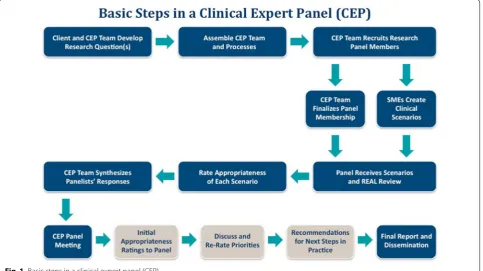
A request for a SEaRCH Expert Panel Process (SEPP) typically comes from an outside person or group who needs a balanced and objective way to make research or clinical recommendations on a particular topic. The requestor often seeks to obtain an evidence-based, expert judgment to help determine the appropriateness for clinical use of, or develop the research needs for, a prod-uct, practice, program or policy. In the case of a clinical expert panel (CEP), the requestor seeks recommenda-tions for an intervention within a given setting or rec-ommendations around a particular treatment approach in various settings. In the case of a research expert panel (REP), the requestor seeks specific research recommen-dations based on current gaps in the evidence and may include an assessment of available resources and readi-ness to conduct such research. The following describes the steps in the SEaRCH Expert Panel Process (SEPP). Figure 1 provides a flow chart of the CEP process.
The first step of the SEPP is for an Expert Panel Man-ager to meet with the client to create and refine the ques-tion to be answered. This meeting also examines the focus of the other integrated SEaRCH components such as the REAL (Rapid Evidence Assessment of the Litera-ture) which is a streamlined, reliable, systematic review process; [22, 23] and the Claim Assessment Profile (CAP) [23, 24], which provides a detailed descriptive evalu-ation of the intervention (product, practice, program or policy) and claim (efficacy, effectiveness, efficiency, relevance, cost and outcome). The CAP and REAL pro-cesses involved in SEaRCH are described in the compan-ion pieces in this issue. Next, a balanced team is created for the successful conduct of the panel. The selection of panel members is key for obtaining valid judgments from a panel. Panelists are always selected to ensure no conflict of interest in the area. They are also selected to provide a diversity of experience and knowledge within the panel. The SEPP process uses specific criteria to select the most qualified panel members.
been established and the clinical scenarios created, the actual panel process begins.
Each panelist integrates information from the REAL and/or CAP evidence with their own clinical judgment for each scenario. They rate the appropriateness of use of the intervention for each scenario and enter their ratings into an online database. The use of the database allows for less error, more opportunity for statistical review and a much faster turnaround of results for phase II.
The second phase of the CEP consists of all nine pan-elists meeting face to face, either in person or through virtual means to review their clinical appropriateness rat-ing scores and discuss them among the group. After the panel discussion, panelists are asked to re-rate the sce-narios using the online database. The computerized pro-gram can be used to tabulate the new re-rated scenarios.
Conducting research expert panels
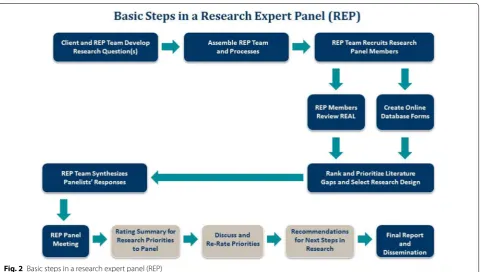
As the flow chart in Fig. 2 demonstrates, the initial steps in the research panel are similar for the research and clinical expert panels. The following methodological pro-cesses focus on the specifics of conducting the Research Expert Panel.
Similar to the Clinical EP, the Research EP is a two-phased process. However, in this case, initial ratings entered in the online technology database are not based on appropriateness of clinical care, but rather on
elucidating and clarifying research gaps, as well as identi-fying research designs to address the most relevant gaps.
Similar to the Clinical EP, the Research EP member integrates his/her knowledge and expertise with the available evidence from the REAL and/or CAP, and then enters this information into a computerized database. The initial ratings provided by the research expert pan-elists help to systematize and make transparent specific recommendations on research directions in particular gap areas. In the case where research recommendations are being made specifically for an institution that wishes to carry out a research project, tailored recommenda-tions also are based on the available resources for that institution (when explicated through the CAP). The pro-cess for convening the Research Expert Panel in Phase II is similar to the Clinical Expert Panel.
The goal of the research expert panel meeting, how-ever, is for the panelists to discuss areas where they may disagree on gaps and next research priorities. As with the clinical expert panel, after the panel discussion, panelists are then asked to re-rate the research form. Panelists input their ratings in the database which tabulates the scores.
The last phase of the process is to summarize and deliver the panel recommendations in a report with quantified ratings. Recommendations and specific con-tent of each summary report will vary depending on the
[image:6.595.58.542.91.362.2]type of panel (research vs. clinical appropriateness) and the question(s) that the client is seeking to answer. For these panels, the summary includes an in depth descrip-tion of the EP methodology and recommendadescrip-tions based upon the findings.
Panel variations: making panels more patient centered
It is important to note that this panel model can be modi-fied to address questions on multiple issues related to health care such as policy implementation and patient-centeredness. For example, a Policy Expert Panel (PoEP) is a derivative of the Research Expert Panel and focuses on making evidenced based policy judgments (payment, coverage, scope of practice) to direct implementation of a practice claim. In fact, this panel is often used to explore direct implementation issues even when a policy issue is not a factor.
One of the biggest challenges in all panel processes is that they have difficulty obtaining patient input early and continuously in the decision making. Usually, patient rep-resentatives are placed on advisory boards where input comes late in the decision making process. In addition, patients may feel intimidated or lost when on panels with scientists and clinical experts, especially if they are not trained or comfortable executing their role and using the panel methodology. The Samueli SEPP has patients and patient interest groups involved in every phase of the
process,. It may even be deemed appropriate to convene a Patient-only Expert Panel (PoEP) to achieve a complete patient perspective. Patients can be incorporated into panels in various ratios such as equal (1:1:1 with scien-tists and clinicians) or weighted toward patients (2:1:1). In addition, use of the anonymous Delphi and virtual meet-ing processes can further empower patient input more deeply in judging either clinical or research relevance, making both methods more patient-centered. The REAL review process also trains all potential panel members (no matter their expertise) in how to use the results of a systematic review. Special training of the patient panel members and of panel moderators also enhances commu-nication and input from the patient’s perspective [23, 25].
Conclusions and discussion
There is an essential need for evidence-based informa-tion to guide research, practice and health care decision making. Expert panels contribute to evidence-based decision making in both research and practice by closing the gap between the usual evidence summaries and the needs of clinicians, policy makers, patients and research-ers for using such evidence in daily decisions. There is a clear need for more transparent, systematized, and effi-cient processes for expert panels, especially in terms of providing recommendations. This process seeks to fill those gaps. As part of the SEaRCH program, Samueli Institute streamlined an expert panel process that was
[image:7.595.59.541.87.359.2]driven by the need for cost effective, efficient and trans-parent approaches to addressing health care needs. It is designed to expand diverse stakeholder input into the research judgment process. This allows for easier delivery of expert opinion and patient input for making decisions about research priorities and clinical appropriateness. This methodology is integrated with other SEaRCH com-ponents such as the Rapid Evidence Assessment of the Literature (REAL) and the Claims Assessment Profile (CAP). This methodology is still new and will need to be validated in the future. The use of information from these three evidence based components, will allow for more customized, expedient and evidence-based recommen-dations on therapeutic claims of interest.
The expert panel process is the final step in the inte-grated SEaRCH process described in this series of arti-cles. It improves the link between research evidence, research agendas, real world practice decisions and patient needs and preferences. Together these integrated strategies allow development of true evidence-based health care.
Abbreviations
CAP: claims assessment profile; CEP: clinical expert panel; EP: expert panel; IOM: Institute of Medicine; NIH CDC: National Institutes of Health Consensus Development Conference; PaEP: patient expert panel; PoEP: policy expert Panel; REAL©: Rapid Evidence Assessment of the Literature; REP: research expert panel; SEaRCH™: scientific evaluation and review of claims in healing;
SEPP: SEaRCH™ expert panel process; SME: subject matter expert; SR: system-atic review.
Authors’ contributions
IC, PE, SJ and WJ developed and designed the methodology of the Clinical Expert Panel and the Research Expert Panel. All were involved in the drafting of the manuscript and revising it for important intellectual content and have given final approval of the version to be published and take responsibility for all portions of the content. IC, PE, SJ and WJ have made substantial contribu-tions to the conception and design of the Expert Panel Process, have been involved in the drafting and critical review of the manuscript for important intellectual content. All have given final approval of the version to be pub-lished and take public responsibility for the methodology being shared in this manuscript. All authors read and approved the final manuscript.
Authors’ information
This project was partially supported by award number W81XWH-08-1-0615-P00001 (United States Army Medical Research Acquisition Activity). The views expressed in this article are those of the authors and do not necessarily represent the official policy or position of the US Army Medical Command or the Department of Defense, nor those of the National Institutes of Health, Public Health Service, or the Department of Health and Human Services.
Author details
1 RAND Corporation, 1776 Main Street, Santa Monica, CA 90401, USA. 2 Samu-eli Institute, 1737 King Street, Suite 600, Alexandria, VA 22314, USA.
Acknowledgements
The authors would like to acknowledge Mr. Avi Walter for his assistance with the overall SEaRCH process developed at Samueli Institute, and Ms. Viviane Enslein for her assistance with manuscript preparation.
Competing interests
The authors declare that they have no competing interests.
Received: 1 May 2015 Accepted: 14 December 2015
References
1. Graham R, Mancher M, Wolman D, Greenfield S, Steinberg E. Institute of Medicine. Clinical Practice Guidelines We Can Trust. Washington, DC: The National Academies Press; 2011.
2. Egger M, Juni P, Bartlett C, Holenstein F, Sterne J. How important are comprehensive literature searches and the assessment of trial quality in systematic reviews? Empirical study. Health Technol Assess. 2003;7:1–76. 3. Linde K. Systematic reviews and meta-analyses. In: Lewith G, Jonas W,
Walach H, editors. Clinical research in complementary therapies: prin-ciples, problems and solutions. London: Churchill Livingstone; 2002. p. 187–97.
4. Higgins J, Green S (eds.). Cochrane Handbook for Systematic Reviews of Interventions Version 5.1.0 [updated March 2011] The Cochrane Collabo-ration 2011. West Sussex, England: The Cochrane CollaboCollabo-ration; 2011. 5. Scottish Intercollegiate Guidelines Network (SIGN): a Guideline
Devel-oper’s Handbook (http://www.sign.ac.uk/). Accessed 15 Jan 2015. 6. Jonas W, Crawford C, Hilton L, Elfenbaum P: Scientific Evaluation and
Review of Claims in Health Care (SEaRCH™). a streamlined, systematic, phased approach for determining “what works” in health care. to be published in BMC Res Notes. 2015.
7. Jonas W, Lewith G, Walach H. Balanced research strategies for comple-mentary and alternative medicine. In: Lewith G, Jonas W, Walach H, edi-tors. Clinical research in complementary therapies: principles, problems and solutioins. London: Churchill Livingstone; 2002. p. 1–29.
8. Coulter I. Evidence summaries and synthesis: necessary but insufficient approach for determining clinical practice of integrated medicine? Integr Cancer Ther. 2006;5:282–6.
9. Perry S, The NIH. Consensus development program, a decade later. N Engl J Med. 1987;317:485–8.
10. Andreasen P. Consensus conferences in different countries. Int J Technol Assess Health Care. 1988;4:305–8.
11. Coulter I, The NIH. Consensus conference on diagnosis, treatment and management of dental caries throughout life: process and outcome. J Evid Based Dent Pract. 2001;1:58–63.
12. Kanouse D, Brook R, Winkler J, Kosecoff J, Berry S, Carter G, Kahan J, et al. Changing medical practice through technology assessment: an evalua-tion of the NIH consensus development program. Santa Monica: RAND; 1989.
13. Kosecoff J, Kanouse D, Rogers W, McCloskey L, Winslow C, Brook R. Effects of the National Institutes of Health Consensus Development Program on Physician Practice. JAMA. 1987;258:2708–13.
14. Robin Graham, Michelle Mancher, Dianne Miller Wolman, Sheldon Green-field, and Earl Steinberg, Editors; Committee on Standards for Developing Trustworthy Clinical Practice Guidelines; Board on Health Care Services; Institute of Medicine. Clinical Practice Guidelines We Can Trust. Washing-ton, DC: The National Academies Press; 2011.
15. Coulter I, Adams A. Consensus Methods, Clinical Guidelines, and the RAND Study of Chiropractic. ACA J Chiropr. 1992;50–61.
16. Coulter I, Shekelle P, Mootz R, Hansen D. The use of expert panel results the RAND panel for appropriateness of manipulation and mobilization of the cervical spine. Santa Monica: RAND; 1997.
17. Fink A, Brook R, Kosecoff J, Chassin M, Solomon D. Sufficiency of clinical literature on the appropriate uses of six medical and surgical procedures. West J Med. 1987;147:609–14.
18. Chassin M. How do we decide whether an investigation or procedure is appropriate? In: Hopkins A, editor. Appropriate investigation and treat-ment in clinical practice. London: Royal College of Physicians; 1989. 19. Park R, Fink A, Brook R, Chassin M, Kahn R, Merrick N, Kosecoff J, Solomon
D. Physician ratings of appropriate indications for six medical and surgical procedures. Am J Public Health. 1986;76(766):772.
20. Merrick N, Fink A, Park R, Brook R, Kosecoff J, Chassin M, Solomon D. Derivation of clinical indications for carotid endarterectomy by an expert panel. Am J Public Health. 1987;77:187–90.
• We accept pre-submission inquiries
• Our selector tool helps you to find the most relevant journal
• We provide round the clock customer support
• Convenient online submission
• Thorough peer review
• Inclusion in PubMed and all major indexing services
• Maximum visibility for your research
Submit your manuscript at www.biomedcentral.com/submit
Submit your next manuscript to BioMed Central
and we will help you at every step:
22. Shekelle P, Kahan J, Bernstein S, Leape L, Kamberg C, Park R. The Repro-ducibility, of a method to identify the overuse and underuse of medical procedures. N Engl J Med. 1998;338:1888–95.
23. Crawford C, Boyd C, Jain S, Khorsan R, Jonas W. Rapid Evidence Assess-ment of the Literature (REAL©): streamlining the systematic review pro-cess and creating utility for evidence-based health care. To be published in BMC Res Notes. 2015.
24. Hilton L, Jonas W: Claim Assessment Profile: a method for capturing health care evidence in the Scientific Evaluation and Review of Claims in Health Care (SEaRCH™). to be published in BMC Res Notes. 2015. 25. Jonas W, Rakel D. Developing optimal healing environments in family