O R I G I N A L R E S E A R C H
In vitro Transport Ability of
ABCC2
(G1249A)
Polymorphic Variant Towards Anticancer Drugs
This article was published in the following Dove Press journal: OncoTargets and Therapy
Guo Lian1
Jia Yuan2
Yuan Gao1
1Department of Pharmacy, Xiangyang
Central Hospital, Affiliated Hospital of Hubei University of Arts and Science, Xiangyang, Hubei 441021, People’s Republic of China;2Department of
Oncology, Xiangyang Central Hospital, Affiliated Hospital of Hubei University of Ats and Science, Xiangyang, Hubei 441021, People’s Republic of China
Objective:Multidrug resistance-associated protein 2 (MRP2), encoded byABCC2gene, is involved in the efflux of certain anticancer drugs. Here we observed whether the ABCC2
(G1249A) polymorphism impacts the transport abilities of MRP2-dependent paclitaxel, docetaxel, and doxorubicin in recombinant LLC-PK1 cell lines.
Methods: LLC-PK1 cell lines transfected with ABCC21249Gwild-type and ABCC21249A
variant alleles were used to evaluate the sensitivity, intracellular accumulation, and trans-membrane transport of paclitaxel, docetaxel, and doxorubicin.
Results: The recombinant ABCC21249Avariant cell line showed higher IC50 values for
paclitaxel and doxorubicin than ABCC21249Gwild-type cell system (p<0.01). Intracellular
accumulations of paclitaxel and doxorubicin in cells transfected with ABCC21249Avariant
allele were significantly decreased compared to cells transfected withABCC21249Gwild-type
allele (p<0.01). The efflux ratios of paclitaxel and doxorubicin acrossABCC21249Acell line
were significantly increased compared with ABCC21249G cell system (p<0.01). However,
ABCC2(G1249A) polymorphism had no effect on the transport activity of MRP2-mediated
docetaxel.
Conclusion:Our results indicate thatABCC2(G1249A) polymorphism affects the transport activities of MRP2-dependent paclitaxel and doxorubicin, resulting in greater efflux of these anticancer drugs.
Keywords:ABCC2, polymorphism, sensitivity, accumulation, transport
Introduction
Paclitaxel, docetaxel, and doxorubicin are important anticancer drugs for the
treat-ment of breast cancer, advanced renal cell carcinoma and other cancers.1–4However,
chemotherapy often leads to the occurrence of multidrug resistance (MDR) in various
tumor cells.5 Impacts of anticancer drugs on MDR cancers might be greatly
decreased due to the high expression of multidrug resistance-associated protein
2 (MRP2) transporting agents from tumor cells.6 The efflux of anticancer drugs
from cancer cells may decrease their anticancer efficacy even more significant for
protecting the tumor cells directly. Paclitaxel, docetaxel, and doxorubicin are trans-ported from cancer cells by MRP2, which belongs to the ATP-binding cassette
transporter, subfamily C; and MRP2 is encoded by the ABCC2gene.7,8The
over-expression of MRP2 in tumor cells has promoted the ability to extrude a large number
of anticancer drugs.9
Single nucleotide polymorphisms (SNPs) in genes which encode metabolic anticancer drug enzymes and transporters that pump compounds out of tumor
cells have been found to result in the inter-individual differences.10 Genetic
Correspondence: Yuan Gao Department of Pharmacy, Xiangyang Central Hospital, Affiliated Hospital of Hubei University of Arts and Science, 136 Jingzhou Road, Xiangyang, People’s Republic of China
Tel +86 18327506946 Email [email protected]
OncoTargets and Therapy
Dove
press
open access to scientific and medical research
Open Access Full Text Article
OncoTargets and Therapy downloaded from https://www.dovepress.com/ by 118.70.13.36 on 25-Aug-2020
mutations in transporter proteins might change the phar-macokinetics and further affect the absorption and
distribution.11,12 A variety of SNPs within ABCC2 gene
have been reported, such as C-24T, G1249A, C2366T, and G3542T and so on, with different allele frequencies across
ethnic and racial individuals.13Early researches concluded
somewhat controversial results concerning the extent to
which ABCC2 SNPs change the function and activity of
MRP2.
G1249A variant is one of the most common ABCC2
SNPs, which was reported to be associated with the inter-individual differences in chemotherapy response and severe toxicity.14A clinical study has indicated that subjects
expres-sing the ABCC2 (G1249A) variant could increase MRP2
transport activity in enterocytes.12 This was considered as
a mechanism to explain the decreased absorption of the
β1-selective blocker and MRP2 substrate, talinolol, in
indi-viduals carryingABCC2(G1249A) mutation. In fact, results
from in vitro studies have stated inconsistentfindings. Recent
research indicates that ABCC2 (G1249A) SNP has higher
efflux activity of MRP2-mediated sorafenib.15In other study,
ABCC2(G1249A) was found to reduce the apparent affinity
for glutathione and glucuronide-conjugated substrates.16
However, some researchers demonstrated that ABCC2
(G1249A) polymorphism had no influence on the efflux of
MRP2-dependent 17β-estradiol-D-glucuronide and
leuko-triene C4 and 2,4-dinitrophenyl-S- glutathione in the
recom-binant LLC-PK1 cell line.17 These different data from
previous studies indicated that the effects ofABCC2SNPs
on the transport ability of MRP2-mediated substrates show
a specific-drug manner. Therefore, in the current research, we
aimed to verify the effect ofABCC2(G1249A)
polymorph-ism on the transport activity of MRP2-mediated anticancer drugs, including paclitaxel, docetaxel, and doxorubicin.
Materials and Methods
Materials
Paclitaxel, docetaxel, and doxorubicin were purchased from Sigma-Aldrich (St Louis, MO, USA). MK-571 and puro-mycin were obtained from Selleck (Shanghai, China). All drugs were dissolved in DMSO. Cell Counting Kit-8 (CCK8) was purchased from Pepro Tech (Wuhan, China). Pig kidney cells (LLC-PK1) were purchased from Wuhan Bafeier Biological Co. Ltd (Wuhan, China). LLC-PK1
stable transfected with empty vector (pcDNA3.1),
ABCC21249Gwild-type allele andABCC21249Avariant allele were obtained from Biofavor Biotech (Wuhan, China).
Dulbecco’s modified eagle medium (DMEM) and fetal
bovine serum (FBS) were purchased from PAN-Biotech
(Aidenbach, Germany). MRP2 and β-actin monoclonal
antibody were purchased from Abcam (Cambridge, UK). HRP-conjugated IgG was also obtained from Abcam (Cambridge, UK). BCA protein assay kit was obtained from Innova Biosciences (Cambridge, UK).
Cell Culture
The four types of LLC-PK1 cell lines were cultured in DMEM medium supplemented with 10% FBS, 1%
anti-biotic-antimycotic solution and 2 μmol/L puromycin.
Puromycin was used to screen the stable recombinant cells. Both cell lines were grown at 37°C in a moderately
humid atmosphere of 5% CO2.
Characterization of MRP2 Expression by
Western Blotting
After cells were cultured for 48 h, the medium was removed and sterile PBS was used to wash cells. Then, cells were decomposed on ice for 30 min by RIPA lysis buffer (Beyotime, Shanghai, China). The cell lysate was centrifuged at 12,000 g for 12 min at 4°C, and then the concentration of total protein in the supernatant was detected by BCA kit. The loading buffer was added and mixed with supernatant, then
boiled for 5 min at 100°C. 50 μg of total protein in each
sample was loaded on 8% gels at 70 V for 3 h; then, protein
was transferred onto a 0.45-μm NC membrane at 275 mA for
90 min. 5% of non-fat milk was used to block the
non-specific binding for 1 h. Blots were incubated with
primary MRP2 antibody (dilution 1:1000) andβ-actin
anti-body (dilution 1:1000) overnight. Next, goat anti-rabbit IgG secondary antibody (dilution 1:3000) was used to incubate with blots at room temperature for 1.5 h. Protein expressions were measured by chemiluminescence detection system
(Thermo Scientific).
Cytotoxicity of Anticancer Drugs
The CCK8 assay was carried out to detect the half maximal
inhibitory concentration (IC50) of several anticancer drugs in
the four types of LLC-PK1 cell lines. Briefly, the four types
of LLC-PK1 cell lines (1×10⁴ cells/well) were grown in
96-well plates and cultured for 24 h. The medium was then replaced by fresh medium containing different contents of
paclitaxel (10–400 nM), docetaxel (1–60 nM), and
doxoru-bicin (10–300 nM). After treatment with 24 h, 100μL
med-ium containing 10μL CCK8 reagent was added into each
OncoTargets and Therapy downloaded from https://www.dovepress.com/ by 118.70.13.36 on 25-Aug-2020
well, and continue to incubate for 1 h at 37°C in a moderately
humid atmosphere of 5% CO2. Absorbance of cells in each
well was detected using a Victor 31420 Multilabel Counter
(PerkinElmer, MA, USA). The IC50values of each drug were
assessed based on dose–inhibition curve.
Intracellular Accumulation of Anticancer
Drugs
The four types of LLC-PK1 cell lines (2×10⁵cells/well) were
grown in 6-well plates and cultured for 24 h. After cells
reached at least 90% confluence, the old medium was
replaced with 1 mL of fresh medium containing paclitaxel (50 nM), docetaxel (10 nM), and doxorubicin (30 nM). Then, the cells were incubated for 4 h to allow intracellular accu-mulation of these drugs. After medium was discarded, cells were washed twice with sterile PBS and collected into micro-centrifuge tubes. Cells were decomposed on ice for 30 min by RIPA lysis buffer and centrifuged at 12,000 g for 12 min at 4°C, and then the concentration of total protein in the super-natant was detected by BCA kit to normalize the levels of drugs. Anticancer drugs in supernatant were acquired using liquid-liquid extraction technology (tertiary butyl methyl ether). The contents of drugs were determined by UPLC-MS/MS analyses (Agilent, Japan).
Transepithelial Ef
fl
ux Assay
To determine paclitaxel, docetaxel, and doxorubicin efflux
across LLC-PK1 monolayers, the four types of LLC-PK1
cell lines (2×10⁵cells/well) were grown in transwell
insert-plate unit in 500 μL of complete medium for 24 h. The
transepithelial electrical resistances (TEER) of monolayer LLC-PK1 cells were measured using a Millicell-ERS
(Millipore, Billerica, MA). Efflux assay contained the
trans-membrane efflux of apical-to-basal (A→B) and (B→A), and
paclitaxel (50 nM), docetaxel (10 nM), and doxorubicin (30 nM) were added into the A chamber and B chamber,
respectively. MRP2 inhibitor (MK-571, 2 μM) was used to
assess the suppressed test of transmembrane efflux. Briefly,
cells were incubated with MK-571 for 120 min, and then anticancer drugs were added to intervene cells for 4 h. Apparent permeability values (Papp) were calculated to evaluate the efflux ability of drugs.18
Statistical Analysis
Data were shown as mean ± SD and analyzed by
SPSS19.0 software (La Jolla, CA, USA). Student’s
inde-pendent t-test was performed when the difference
between means was significant. P <0.05 were
consid-ered as statistical significant.
Results
Levels of MRP2 Overexpression in
ABCC2
1249Gand
ABCC2
1249ARecombinant
Cell Lines
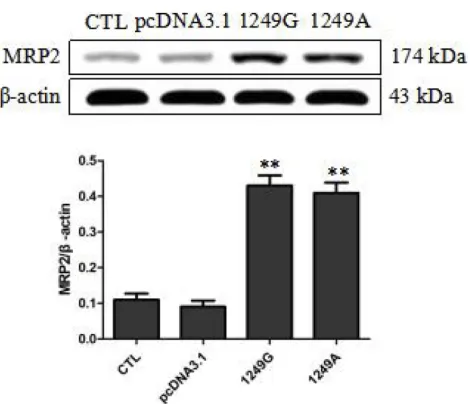
Similar expression levels of MRP2 inABCC21249Gwild-type
andABCC21249Avariant recombinant cell lines were observed
by Western blot (Figure 1). MRP2 expression levels in cells
transfected with empty vector were significantly lower than
recombinant cells transfected with 1249G wild-type allele and 1249A variant allele (p<0.01). These data confirmed the
over-expression ofABCC21249Gwild-type andABCC21249Avariant
genes in LLC-PK1 cells, indicating thatABCC2(G1249A)
SNP does not impact the expression of this protein.
Recombinant
ABCC2
1249Gand
ABCC2
1249ACell Lines Show Altered Resistance to
Anticancer Drugs
The sensitivity of the four types of LLC-PK1 cells to
pacli-taxel, docepacli-taxel, and doxorubicin was assesses based on IC50
values. The two types of recombinant cells transfected with
ABCC21249GandABCC21249Aalleles displayed higher IC50
values for these anticancer drugs than cells transfected with empty vector (p<0.01,Table 1). IC50values for paclitaxel was
2.09-fold higher inABCC21249A cells than in ABCC21249G
Figure 1Overexpression levels of wild-type and variant MRP2 in stable recombi-nant LLC-PK1 cell lines. Compared with pcDNA3.1 group, **p<0.01.
Abbreviations:CTL, untransfected LLC-PK1 cells; pcDNA3.1, transfected with empty vector; 1249G, transfected with 1249G wild-type allele; 1249A, cells trans-fected with 1249A variant allele.
OncoTargets and Therapy downloaded from https://www.dovepress.com/ by 118.70.13.36 on 25-Aug-2020
cells (p<0.01). IC50 values for doxorubicin was 2.78-fold
higher in ABCC21249A cells than in ABCC21249G cells
(p<0.01). However, the IC50 values for docetaxel in
ABCC21249A cells was similar toABCC21249Gcells. These
data suggested thatABCC2(G1249A) SNP affects the
sensi-tivity of cells to anticancer drugs with a drug-specific manner.
ABCC2
1249AVariant Allele Impacts the
Intracellular Accumulation of Anticancer
Drugs
Intracellular accumulation of these anticancer drugs was assessed in the four types of LLC-PK1 cells. The two
types of recombinant cells transfected with ABCC21249G
and ABCC21249A alleles displayed lower intracellular accumulation for these anticancer drugs than cells
trans-fected with empty vector (p<0.01, Table 2). Intracellular
accumulation of paclitaxel was 3.11-fold lower in
ABCC21249A cells than in ABCC21249G cells (p<0.01). Intracellular accumulation of doxorubicin was 2.68-fold
lower in ABCC21249A cells than in ABCC21249G cells
(p<0.01). However, the Intracellular accumulation of
doc-etaxel in ABCC21249A cells was similar to ABCC21249G
cells. These data suggested that ABCC2 (G1249A) SNP
affects the transport abilities of anticancer drugs with
a drug-specific manner.
ABCC2
1249AVariant Allele Affects the
Transport Ability of Anticancer Drugs
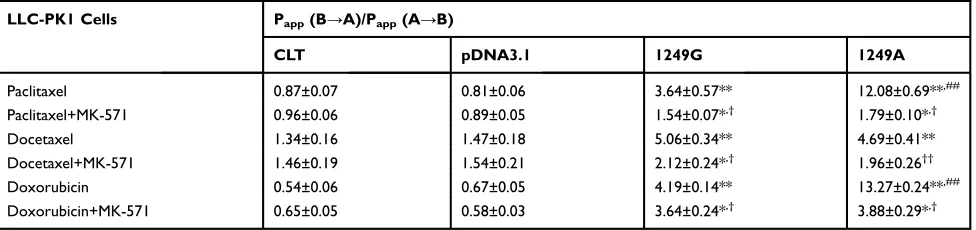
The efflux ratios (Papp (B→A)/Papp (A→B)) of paclitaxel,
docetaxel, and doxorubicin across the four types of LLC-PK1 monolayers were also assessed. The two types of
recom-binant cells transfected with ABCC21249G and ABCC21249A
alleles displayed higher efflux ratios for these anticancer drugs than cells transfected with empty vector (p<0.01,Table 3). The
efflux ratio of paclitaxel was 3.32-fold higher inABCC21249A
cells than inABCC21249Gcells (p<0.01). The efflux ratio of
doxorubicin was 3.17-fold higher inABCC21249Acells than in
ABCC21249Gcells (p<0.01). However, the efflux ratio of
doc-etaxel inABCC21249Acells was similar toABCC21249Gcells.
These data suggested thatABCC2(G1249A) SNP affects the
efflux activities of MRP2-mediated anticancer drugs with
a drug-specific manner.
Discussion
Acquired paclitaxel, docetaxel, and doxorubicin resistance of breast cancer cells is involved in the overexpression of
MRP2 transporter.19–21Genetic polymorphism ofABCC2
gene response to anticancer drug chemotherapy in breast
tumor patients.22 ABCC2 (G1249A) polymorphism was
demonstrated to be associated with the risk of resistance
to multiple drugs, such as antiepileptic agents.23Here we
present direct proof indicating that the common G1249A
SNP in ABCC2 gene substantially induces the transport
ability of MRP2-mediated paclitaxel and doxorubicin, decreases the content of these drugs that accumulates within the four types of cell lines. Since MRP2 could
lead to multidrug resistance, the present findings might
be helpful for improving such resistance in case of pacli-taxel and doxorubicin as well as other chemotherapeutic drugs. Our data also provide testable assumption concern-ing why patients with cancers can differ so widely in the response to paclitaxel and doxorubicin. The cell line used in our research, LLC-PK1 derived fro, a pig kidney, has been shown to be useful to observe transport proteins
functionality.24Therefore, we selected LLC-PK1 cell line
to study the effects ofABCC2polymorphism on the
trans-port of paclitaxel, docetaxel and doxorubicin. Wefirst used
different concentrations of anticancer drugs to intervene LLC-PK1 cells to assess the cytotoxicity of agents. The
Table 1ABCC2(G1249A) Polymorphism Alters the Sensitivity of Recombinant Cell Systems to Anticancer Drugs
LLC-PK1 Cells IC50(nM)±SD
CLT pDNA3.1 1249G 1249A
Paclitaxel 45.6±6.7 39.8±5.9 136.4±7.3** 285.4±6.7**,## Docetaxel 9.3±1.4 11.6±1.2 39.4±3.7** 34.5±5.2** Doxorubicin 30.4±3.8 28.4±3.1 84.6±3.5** 236.4±5.2**,##
Notes:Compared with pcDNA3.1 group, **p<0.01; compared with 1249G group, ##
p<0.01.
Abbreviations:CTL, cells untransfected LLC-PK1 cells; pcDNA3.1, transfected with empty vector; 1249G, transfected with 1249G wild-type allele; 1249A, cells transfected with 1249A variant allele.
Table 2 Effects of ABCC2 (G1249A) Polymorphism on the Intracellular Accumulation of Paclitaxel, Docetaxel, Sorafenib, and Doxorubicin
LLC-PK1 Cells C (ng/mg Protein)±SD
CLT pDNA3.1 1249G 1249A
Paclitaxel 253.1±8.4 238.1±9.5 95.4±6.5** 30.7±5.7**,## Docetaxel 76.3±6.4 79.4±5.9 34.1±4.7** 37.9±5.4** Doxorubicin 198.6±8.4 208.8±7.2 82.3±6.4** 30.7±5.4**,##
Notes:Compared with pcDNA3.1 group, **p<0.01; compared with 1249G group, ##
p<0.01.
Abbreviations:CTL, cells untransfected LLC-PK1 cells; pcDNA3.1, transfected with empty vector; 1249G, transfected with 1249G wild-type allele; 1249A, cells transfected with 1249A variant allele.
OncoTargets and Therapy downloaded from https://www.dovepress.com/ by 118.70.13.36 on 25-Aug-2020
IC50 values of paclitaxel, docetaxel, and doxorubicin in
LLC-PK1 control cells were 45.6, 9.3, and 30.4 nM, respectively. Then, we used paclitaxel (50 nM), docetaxel (10 nM), and doxorubicin (30 nM) to intervene recombi-nant cell systems to Conduct follow-up experiments, and these drugs did not affect the cell morphology.
We conducted control tests to make sure that the inves-tigated alterations in the transport of paclitaxel and
doxor-ubicin in the recombinant ABCC21249G and ABCC21249A
cell lines were not due to difference in the expression levels of MRP2. Our results from Western blot assay displayed that MRP2 was overexpressed at similar levels in
ABCC21249G and ABCC21249A cell systems. Our results
are consistent with previous studies in vivo,22,25 but
dis-agree with other researches.26,27As one of the usual in vitro methods to help transporter observation to data, recombi-nant cell systems over-expressing MRP2 have some limita-tions, for instance, the different expression levels of MRP2 in different laboratories may result in altered results, and
endogenous efflux activity in cells might also complicate
the interpretation of results. Nevertheless, the present on vitro systems make the observation of characteristics of a single protein feasible and lower the complexity. The
differences might reflect the complexity of the in vivo
environment, as well as changes among the in vivo and in vitro contexts. Therefore, it makes us to further verify our results in other recombinant cell system, including cancer cells, as well as studies in vivo.
These data indicated that the ABCC2 (G1249A) SNP,
which leads to a Val-Ile replacement in the MRP2 protein.
This mutation may change the interaction among the specific
substrate-recognizing domain of MRP2 and drugs,28and it
can explain that 1249A SNP increases the transport activities of MRP2-mediated paclitaxel and doxorubicin, but not
docetaxel. Our results showed that intracellular accumula-tions of paclitaxel and doxorubicin were 3.11-fold and 2.68-fold lower in cells transfected with 1249A allele than cells transfecting with 1249G, respectively. Therefore, this was
sufficient to result in a dramatic decrease in sensitivity to
paclitaxel and doxorubicin. This may reflect the resistance of
cancer cells to paclitaxel and doxorubicin.
Since the MRP2 might pump paclitaxel, docetaxel and
doxorubicin out of cells,29we further check that the effects
ofABCC2(G1249A) SNP on transmembrane transport of
these anticancer cells. Moreover, we observed the efflux
ratios of paclitaxel, docetaxel and doxorubicin in the pre-sence and abpre-sence of the MRP2 antagonist, MK-571. Our
data suggested that nearly the efflux of these drugs was
eliminated in the presence of MRP2 antagonist, indicating that MRP2 was responsible for most of the transport investigated in this test. However, our results displayed thatABCC2(G1249A) SNP has no effect on the efflux of MRP2-mediated docetaxel. Since MRP2 displays altered
affinities for different substrates,30 it may be necessary to
explain our findings. Indeed, an early study has
demon-strated thatABCC2(G1249A) polymorphism may impact
MRP2 activity in a substrate-specific manner.16 In
addi-tion, we observed the efflux ratios of paclitaxel, docetaxel
and doxorubicin in the presence and absence of the MRP2
antagonist and discovered that efflux of these drugs was
eliminated in the presence of MRP2 antagonist. But there
are still significant statistical differences between the
efflux ratios of two types of recombinant cells and cells
transfected with empty vector. It would be explained that
the discrepancy was resulted from insufficient inhibition of
MRP2 by antagonist or other transportation mechanisms.
Furthermore, our study turned out conflicting results of
paclitaxel and docetaxel which are the same group of
Table 3 Effects of ABCC2(G1249A) Polymorphism on the Efflux Activity of Paclitaxel, Docetaxel, Sorafenib, and Doxorubicin in Recombinant LLC-PK1 Monolayers
LLC-PK1 Cells Papp(B→A)/Papp(A→B)
CLT pDNA3.1 1249G 1249A
Paclitaxel 0.87±0.07 0.81±0.06 3.64±0.57** 12.08±0.69**,## Paclitaxel+MK-571 0.96±0.06 0.89±0.05 1.54±0.07*,† 1.79±0.10*,† Docetaxel 1.34±0.16 1.47±0.18 5.06±0.34** 4.69±0.41** Docetaxel+MK-571 1.46±0.19 1.54±0.21 2.12±0.24*,† 1.96±0.26†† Doxorubicin 0.54±0.06 0.67±0.05 4.19±0.14** 13.27±0.24**,## Doxorubicin+MK-571 0.65±0.05 0.58±0.03 3.64±0.24*,† 3.88±0.29*,†
Notes:Compared with pcDNA3.1 group, *p<0.05, **p<0.01; compared with 1249G group,##
p<0.01; compared with without inhibitor group,†p<0.05,††p<0.01. Abbreviations: CTL, cells untransfected LLC-PK1 cells; pcDNA3.1, transfected with empty vector; 1249G, transfected with 1249G wild-type allele; 1249A, cells transfected with 1249A variant allele.
OncoTargets and Therapy downloaded from https://www.dovepress.com/ by 118.70.13.36 on 25-Aug-2020
anticancer drugs. This phenomenon may be explained by the fact that paclitaxel and docetaxel can interact with different domains of MRP2 protein, and further effect protein conformation.
Conclusions
Collectively, more detailed researches of structure-activity associations in MRP2 protein are needed to verify the
functional roles of ABCC2 (G1249A) polymorphism and
other SNPs. Our in vitro recombinant cell lines may pro-vide a useful tool for investigating the cause of poor chemotherapy response and drug resistance.
Acknowledgments
The authors would like to thank the Department of Pharmacy,
Xiangyang Central Hospital, Affiliated Hospital of Hubei
University of Arts and Science. Guo Lian and Jia Yuan are co-first authors.
Disclosure
All authors declare that there is no conflict of interest.
References
1. Tiainen L, Tanner M, Lahdenperä O, et al. Bevacizumab combined with docetaxel or paclitaxel asfirst-line treatment of HER2-negative metastatic breast cancer. Anticancer Res. 2016;36(12):6431–6438. doi:10.21873/anticanres.11241
2. Carbognin L, Sperduti I, Nortilli R, et al. Balancing activity and tolerability of neoadjuvant paclitaxel- and docetaxel-based chemother-apy for HER2-positive early stage breast cancer: sensitivity analysis of randomized trials. Cancer Treat Rev. 2015;41(3):262–270. doi:10.1016/j.ctrv.2015.02.003
3. Bronte G, Andreis D, Bravaccini S, et al. Sorafenib for the treatment of breast cancer. Expert Opin Pharmacother. 2017;18(6):621–630. doi:10.1080/14656566.2017.1309024
4. Shafei A, El-Bakly W, Sobhy A, et al. A review on the efficacy and toxicity of different doxorubicin nanoparticles for targeted therapy in metastatic breast cancer.Biomed Pharmacother.2017;95:1209–1218. doi:10.1016/j.biopha.2017.09.059
5. Hida K, Kikuchi H, Maishi N, Hida Y. ATP-binding cassette transporters in tumor endothelial cells and resistance to metronomic chemotherapy.
Cancer Lett.2017;400:305–310. doi:10.1016/j.canlet.2017.02.006 6. Wang Z, Sun X, Feng Y, et al. Dihydromyricetin reverses MRP2-mediated
MDR and enhances anticancer activity induced by oxaliplatin in colorectal cancer cells.Anticancer Drugs.2017;28(3):281–288. doi:10.1097/CAD. 0000000000000459
7. Vos K, Sciuto CL, Piedade R, et al. MRP2/ABCC2 C1515Y polymorph-ism modulates exposure to lumefantrine during artemether-lumefantrine antimalarial therapy. Pharmacogenomics. 2017;18(10):981–985. doi:10.2217/pgs-2017-0032
8. Andersen V, Svenningsen K, Knudsen LA, et al. Novel understanding of ABC transporters ABCB1/MDR/P-glycoprotein, ABCC2/MRP2, and ABCG2/BCRP in colorectal pathophysiology. World J Gastroenterol. 2015;21(41):11862–11876. doi:10.3748/wjg.v21.i41.11862
9. Oliveira C, Joshee L, Bridges CC. MRP2 and the transport kinetics of cysteine conjugates of inorganic mercury. Biol Trace Elem Res. 2018;184(1):279–286. doi:10.1007/s12011-017-1163-3
10. Platt A, Xia Z, Liu Y, Chen G, Lazarus P. Impact of nonsynonymous single nucleotide polymorphisms on in-vitro metabolism of exemes-tane by hepatic cytosolic reductases. Pharmacogenet Genom. 2016;26(8):370–380. doi:10.1097/FPC.0000000000000226 11. Abla N, Chinn LW, Nakamura T, et al. The human multidrug
resis-tance protein 4 (MRP4, ABCC4): functional analysis of a highly polymorphic gene. J Pharmacol Exp Ther. 2008;325(3):859–868. doi:10.1124/jpet.108.136523
12. Haenisch S, May K, Wegner D, Caliebe A, Cascorbi I, Siegmund W. Influence of genetic polymorphisms on intestinal expression and rifampicin-type induction of ABCC2 and on bioavailability of talinolol.Pharmacogenet Genom.2008;18(4):357–365. doi:10.1097/ FPC.0b013e3282f974b7
13. Wen X, Joy MS, Aleksunes LM. In vitro transport activity and trafficking of MRP2/ABCC2 polymorphic variants. Pharm Res. 2017;34(8):1637–1647. doi:10.1007/s11095-017-2160-0
14. Han B, Gao G, Wu W, et al. Association of ABCC2 polymorphisms with platinum-based chemotherapy response and severe toxicity in non-small cell lung cancer patients. Lung Cancer. 2011;72 (2):238–243. doi:10.1016/j.lungcan.2010.09.001
15. Wei D, Zhang H, Peng R, Huang C, Bai R. ABCC2 (1249G > A) polymorphism implicates altered transport activity for sorafenib.
Xenobiotica.2016;47:1–7.
16. Megaraj V, Zhao T, Paumi CM, Gerk PM, Kim RB, Vore M. Functional analysis of nonsynonymous single nucleotide polymorph-isms of multidrug resistance-associated protein 2 (ABCC2).
Pharmacogenet Genomics. 2011;21(8):506–515. doi:10.1097/FPC. 0b013e328348c786
17. Hirouchi M, Suzuki H, Itoda M, et al. Characterization of the cellular localization, expression level, and function of SNP variants of MRP2/ ABCC2. Pharm Res. 2004;21(5):742–748. doi:10.1023/B:PHAM. 0000026422.06207.33
18. Dessilly G, Elens L, Panin N, Benjamin RS. ABCB1 1199G>A polymorphism (rs2229109) affects the transport of imatinib, nilotinib and dasatinib. Pharmacogenomics. 2016;17(8):883–890. doi:10.22 17/pgs-2016-0012
19. Němcová-Fürstová V, Kopperová D, Balušíková K, et al. Characterization of acquired paclitaxel resistance of breast cancer cells and involvement of ABC transporters.Toxicol Appl Pharmacol. 2016;310:215–228. doi:10.1016/j.taap.2016.09.020
20. Ehrlichova M, Vaclavikova R, Ojima I, et al. Transport and cytotoxi-city of paclitaxel, docetaxel, and novel taxanes in human breast cancer cells. Naunyn Schmiedebergs Arch Pharmacol. 2005;372 (1):95–105. doi:10.1007/s00210-005-1080-4
21. Chaisit T, Siripong P, Jianmongkol S. Rhinacanthin-C enhances dox-orubicin cytotoxicity via inhibiting the functions of P-glycoprotein and MRP2 in breast cancer cells.Eur J Pharmacol.2017;795:50–57. doi:10.1016/j.ejphar.2016.12.002
22. Tecza K, Pamula-Pilat J, Lanuszewska J, Grzybowska E. Genetic polymorphisms and response to 5-fluorouracil, doxorubicin and cyclophosphamide chemotherapy in breast cancer patients.
Oncotarget. 2016;7(41):66790–66808. doi:10.18632/oncotarget. 11053
23. Chen P, Yan Q, Xu H, Lu A, Zhao P. The effects of ABCC2 G1249A polymorphism on the risk of resistance to antiepileptic drugs: a meta-analysis of the literature.Genet Test Mol Biomarkers.2014;18 (2):106–111. doi:10.1089/gtmb.2013.0362
24. Schinkel AH, Smit JJ, van Tellingen O, Beijnen JH, Wagenaar E, van Deemter L. Disruption of the mouse mdr1a P-glycoprotein gene leads to a deficiency in the blood-brain barrier and to increased sensitivity to drugs. Cell. 1994;77(4):491–502. doi:10.1016/0092-8674(94) 90212-7
25. Jabir RS, Naidu R, Annuar MA, Ho GF, Munisamy M, Stanslas J. Pharmacogenetics of taxanes: impact of gene polymorphisms of drug transporters on pharmacokinetics and toxicity. Pharmacogenomics. 2012;13(16):1979–1988. doi:10.2217/pgs.12.165
OncoTargets and Therapy downloaded from https://www.dovepress.com/ by 118.70.13.36 on 25-Aug-2020
26. Kiyotani K, Mushiroda T, Kubo M, Zembutsu H, Sugiyama Y, Nakamura Y. Association of genetic polymorphisms in SLCO1B3 and ABCC2 with docetaxel-induced leukopenia.Cancer Sci.2008;99 (5):967–972. doi:10.1111/j.1349-7006.2008.00765.x
27. Sun N, Sun X, Chen B, et al. MRP2 and GSTP1 polymorphisms and chemotherapy response in advanced non-small cell lung cancer.Cancer Chemother Pharmacol.2010;65(3):437–446. doi:10.1007/s00280-009-1046-1
28. Subramanian N, Condic-Jurkic K, O’Mara ML. Structural and dynamic perspectives on the promiscuous transport activity of P-glycoprotein.
Neurochem Int.2016;98:146–152. doi:10.1016/j.neuint.2016.05.005
29. van Hasselt JG, van Calsteren K, Heyns L, et al. Optimizing antic-ancer drug treatment in pregnant cantic-ancer patients: pharmacokinetic analysis of gestation-induced changes for doxorubicin, epirubicin, docetaxel and paclitaxel. Ann Oncol. 2014;25(10):2059–2065. doi:10.1093/annonc/mdu140
30. Ellis LC, Hawksworth GM, Weaver RJ. ATP-dependent transport of statins by human and rat MRP2/Mrp2. Toxicol Appl Pharmacol. 2013;269(2):187–194. doi:10.1016/j.taap.2013.03.019
OncoTargets and Therapy
Dove
press
Publish your work in this journal
OncoTargets and Therapy is an international, peer-reviewed, open access journal focusing on the pathological basis of all cancers, potential targets for therapy and treatment protocols employed to improve the management of cancer patients. The journal also focuses on the impact of management programs and new therapeutic
agents and protocols on patient perspectives such as quality of life, adherence and satisfaction. The manuscript management system is completely online and includes a very quick and fair peer-review system, which is all easy to use. Visit http://www.dovepress.com/ testimonials.php to read real quotes from published authors.
Submit your manuscript here:https://www.dovepress.com/oncotargets-and-therapy-journal
OncoTargets and Therapy downloaded from https://www.dovepress.com/ by 118.70.13.36 on 25-Aug-2020