R E S E A R C H A R T I C L E
Open Access
Exploring the impact of mentoring functions on
job satisfaction and organizational commitment
of new staff nurses
Rhay-Hung Weng
1, Ching-Yuan Huang
2*, Wen-Chen Tsai
3, Li-Yu Chang
4, Syr-En Lin
5, Mei-Ying Lee
6Abstract
Background:Although previous studies proved that the implementation of mentoring program is beneficial for enhancing the nursing skills and attitudes, few researchers devoted to exploring the impact of mentoring functions on job satisfaction and organizational commitment of new nurses. In this research we aimed at examining the effects of mentoring functions on the job satisfaction and organizational commitment of new nurses in Taiwan’s hospitals.
Methods:We employed self-administered questionnaires to collect research data and select new nurses from three regional hospitals as samples in Taiwan. In all, 306 nurse samples were obtained. We adopted a multiple regression analysis to test the impact of the mentoring functions.
Results:Results revealed that career development and role modeling functions have positive effects on the job satisfaction and organizational commitment of new nurses; however, the psychosocial support function was incapable of providing adequate explanation for these work outcomes.
Conclusion:It is suggested in this study that nurse managers should improve the career development and role modeling functions of mentoring in order to enhance the job satisfaction and organizational commitment of new nurses.
Background
Nurse turnover and turnover intent have received con-siderable worldwide attention because of their influence on patient safety and health outcomes. The turnover intent among new nurses is often higher than that among senior nurses [1]. Nurse turnover in the first year of practice ranges between 35% and 60% [2]. With the high turnover incidence among new nurses, it is imperative that retention strategies be effective and that these strategies be examined closely. When new nurses perform their duties in hospitals, they often have little or no experience in clinical nursing but they are required to bear full responsibility of patient care. Owing to limited clinical skills, experience, and full responsibility of patient care, new nurses would often bear heavy work pressure. Work pressure and nurse
attitudes toward jobs have significant impact on job satisfaction and organizational commitment among hos-pital nurses [3-5]. Researches from various countries have confirmed that job satisfaction and organizational commitment are statistically significant predictors of nurse absenteeism or turnover, or their intent to quit [1,6,7]. Thus, in order to reduce the nurses’ intent to leave, nurse managers should urgently address the issue of improving the job satisfaction and organizational commitment of new nurses.
Proenca and Shewchuck [8] indicate that learning and career development opportunities are two important fac-tors that would influence the retention of new nurses. Mentors play a vital role in providing these opportunities. Moreover, mentors can facilitate professional socializa-tion of the new nurses in nursing; facilitate their transi-tion into the workplace and social culture of the organization; and make them feel welcome in peer groups, with coworkers and the organization [9]. In addi-tion, mentoring can promote the transfer of knowledge * Correspondence: [email protected]
2Department of International Business and Trade, Shu-Te University, Taiwan
Full list of author information is available at the end of the article
and values that support a hospital’s mission. Therefore, a mentoring program is seen as a useful approach in improving the retention of new nurses [10,11].
The mentoring program is a formal relationship between a senior nurse and junior nurses of a hospital directed toward the advancement and support of the junior nurses [2,9]. It is a useful approach for new nurses as it provides them with effective and systematic support in the nursing practice, facilitates their professional devel-opment, and enhances the coordination of care within the unique context of general practice [12]. Tourigny and Pulich [13] argue that apart from the positive influence on medical care quality, mentoring programs play an impor-tant role in improving the work performance of the new nurses and establishing their attitudes toward the organi-zations they work for. Therefore, after the implementation of the new nurse mentoring program, mentors provide career development advice, psychosocial support, and role modeling functions to their mentees [9,10,12,14].
Psychosocial support functions include acceptance, counseling, and friendship. Friendship is provided by informal interactions at work, and by a willingness to discuss a variety of topics. Career development functions include sponsorship, protection, challenging assign-ments, exposure, and visibility. Exposure and visibility involve creating opportunities where important decision makers can observe and appreciate a person’s compe-tence, abilities, and special talents. Career development functions focus on the organization and the mentee’s career, whereas psychosocial support functions affect the mentee at a more personal level and extend to other areas of life [15-17]. Besides, mentees have observed that mentors play a significant role in shaping their views on how they would act as mentors, thus highlight-ing the importance of role modelhighlight-ing. Role modelhighlight-ing is behaving and acting in a way that others can emulate; a role model displays appropriate attitudes, values, and behaviors to learn and follow [18-20]. In other words, role modeling functions focus on the fact that mentees would try to imitate the mentor’s behavior because of their respect for and trust in the mentors.
Although it has been proven in previous studies that the implementation of a mentoring program is beneficial in terms of enhancing nursing skills and attitudes, few researchers have explored the impact of mentoring functions on the job satisfaction and organizational commitment of new nurses. Hence, the aim of this paper was to examine the effects of the different mentoring functions on the work outcomes through a survey of new nurses in Taiwan.
Methods
1 Data Source and Analysis
We employed self-administered questionnaires to collect research data. For our subjects, we selected new nurses
from three regional hospitals in Taiwan. In the course of the study, the participating hospitals facilitated formal meetings with head nurses, provided contact informa-tion on 308 eligible nurses who had been working in their hospital for two years or less, and gave their full support and coordination in the conduct of the research. We sent out 308 questionnaires over two months to survey the new nurses anonymously.
In all, 306 nurse subjects were obtained with an over-all valid response rate of 99.35%. Because over-all the research data are self-reported and collected through the same questionnaire during the same period of time, a common method variance (CMV) may result in a sys-tematic measurement error and may further bias the estimates of the true relationship between the theoreti-cal constructs [21]. We have adopted some procedural techniques designed to address the CMV problem. These included protecting respondent anonymity, and reorganizing and trimming scale items. Besides, we also used Harman’s one-factor test to check for the presence of CMV in the data. The Harman’s one-factor test results were as follows: twenty factors had an eigenvalue greater than 1, and forty-four factors accounted for 97.85% of the variance. Thus, CMV was not considered a serious threat to this study [21]. After testing for CMV, reliability, and validity, we conducted a multiple regression analysis to test the impact of the mentoring functions.
2 Ethical consideration
The ethical issues of this study were reviewed and approved by the ethical committee of three sample hos-pitals. During the process of questionnaire collection, we also sent out informed consent form to 308 eligible nurses to be sure that they agreed to participate in this survey.
3 Measurement
3.1 Research Variables
Questionnaire items were designed based on existing theoretical constructs and literature. Three mentoring experts and six nurse managers made some modifica-tions and the contents of the questionnaires were vali-dated by experts. The five-point Likert scale (1 = do not agree at all or not satisfied at all; 5 = extremely agree or extremely satisfied) was used as the measurement method. In addition, the construct validity of the ques-tionnaire was tested by the confirmatory factor analysis.
[22], Sosik & Godshalk [20], and Eby et al [23]. Nine items were prepared, including three items in three dimensions: career development function, psychosocial support function, and role modeling function with a Cronbach’s a value of 0.912. The mean value of the career development function, psychosocial support func-tion, and role modeling function is 3.49 (SD = 0.64), 3.49 (SD = 0.73), and 3.90 (SD = 0.66), respectively.
3.1.2 Job satisfaction: After referencing literatures on job satisfaction [17,20,24,25], and evaluating the nurses’ work responsibilities and experience, job satisfaction is defined as the nurses’overall state of satisfaction. Lan-kau & Scandura [24] point out that the Minnesota Satis-faction Questionnaire (MSQ) is a well-constructed scale for measuring work satisfaction in the mentoring pro-gram. Therefore, we modified the MSQ and created a total of five items with a Cronbach’sa value of 0.865 and a mean of 3.59 (SD = 0.57).
3.1.3 Organizational commitment: Organizational commitment refers to the belief in and acceptance of organizational goals and values such that nurses are willing to make considerable efforts to achieve them, and are willing to remain with the organization [21,25-27]. The Organization Commitment Question-naire (OCQ) developed by Mowday et al. [28] is accepted as the most widely used unidimensional mea-sure of organizational commitment. It contains three dimensions: value commitment, effort commitment, and retention commitment [26]. Therefore, we developed a total of six items with a Cronbach’sa value of 0.913 based on the OCQ and a mean of 3.40 (SD = 0.63). 3.2 Control Variables
We used sample source, mentee’s age [24,29], mentee’s gender [24], mentee’s education level [24], mentee’s nur-sing experience [24,30], mentor’s nursing ladder [20,30], mentoring period [24,29], and frequency of interactions with the mentor [24,29,30] as control variables in our regression models. Previous literatures have highlighted these variables and their significant influence on job satisfaction or organizational commitment. Frequency of interactions with the mentor was defined as the men-tee’s perceived degree of frequency rate of interaction with mentor per month. With respect to the measure-ment method, the five-point scale (1 = Seldom; 2 = Sometimes; 3 = Normally; 4 = Usually; 5 = Always) was used. Nursing experts involved in the study suggested that the factors “mentor had been trained for mentor-ing” and “mentor had the experience of mentoring” affect the work outcome of the new nurses in the men-toring program. Therefore, we included these two fac-tors as control variables in the follow-up regression. 3.3 Measure Validity and Reliability
All measures were subjected to a confirmatory factor analysis (CFA) using the AMOS 6.0 to test for
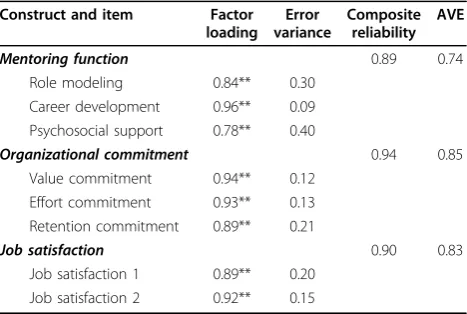
unidimensionality, and convergent and discriminant validity [31]. Since job satisfaction does not include dif-ferent dimensions, this study divided the five items of this construct into two composite indicators: the average value for the odd number items is named“job satisfac-tion 1,” and the average value for the even number items is named“job satisfaction 2.”After the CFA analy-sis, this model generated acceptable fit indices (c2/df = 2.535; GFI = 0.969; AGFI = 0.931; RMR = 0.010; CFI = 0.988; NFI = 0.981; RFI = 0.967; IFI = 0.989; TLI = 0.980; RMSEA = 0.071). Table 1 show that the minimum value of the composite reliability of all the research constructs is 0.89 and the minimum average variance extracted (AVE) is 0.74. This indicates that every research construct possesses good internal consis-tency. In addition, Table 1 shows that the factor load-ings of all the research construct items reach statistically significant levels. This indicates that the measurement model has good convergent validity [32]. The CFA results also showed that the square roots of all the AVE values of every research construct are higher than the pairwise correlation coefficients; the correlation coeffi-cients between mentoring function and organizational commitment, between mentoring function and job satis-faction, and between organizational commitment and job satisfaction are 0.54, 0.63, and 0.75, respectively. This also shows that the measurement model of all the research constructs had good discriminate validity [32].
Results
[image:3.595.305.539.565.722.2]The mean age of the sample was 26.83 (SD = 3.87). Thirty-five percent of the sample had earned a Bachelor of Science degree or higher in nursing and seventy per-cent of the new nurses had nursing experience of more than one year. The mean period of the mentoring pro-gram was 3.97 (SD = 2.43), and the frequency rate of
Table 1 Assessment of Convergent and Discriminant Validity (n = 306)
Construct and item Factor
loading Error variance
Composite reliability
AVE
Mentoring function 0.89 0.74
Role modeling 0.84** 0.30
Career development 0.96** 0.09 Psychosocial support 0.78** 0.40
Organizational commitment 0.94 0.85 Value commitment 0.94** 0.12
Effort commitment 0.93** 0.13 Retention commitment 0.89** 0.21
Job satisfaction 0.90 0.83
Job satisfaction 1 0.89** 0.20 Job satisfaction 2 0.92** 0.15
interaction between the mentors and mentees was 3.60 (SD = 0.86). In particular, most mentors earned the level III of the nursing ladder or higher (69.93%), had been trained for mentoring (62.09%), and had prior mentoring experience (83.66%) (Table 2). Besides, other summary statistics from the survey were shown in Table 3.
During the survey period, we found that all the hospi-tals that were part of the study have an existing formal program that required mentors to give guidance and assistance to new staff nurses for at least two months. We found that the new staff obtained clinical guidance and mentor assistance for nearly four months, during which interaction with their mentors was frequent. Nur-sing managers usually assigned senior nurses–who had achieved the level III of the nursing ladder or higher–as mentors to guide the new staff nurses. Besides, mentors often not only had to be trained for mentoring but also usually had to have mentoring experience. Training pro-gram for mentoring in Taiwan is often designed for mentors. The types of this program include classes, seminar, workshop, or conference. The topics of all types of this program are related to the mentor’s role and responsibilities, the mentor’s communication skills, the mentor’s clinical evaluation ability, mentor’s case teaching ability, mentor’s teaching evaluation and feed-back, medical ethics and laws, or mentor’s experience sharing. Therefore, there were some requirements related to the mentor’s qualifications and these not only focused on clinical expertise but also placed importance on the mentoring abilities and experiences of senior nurses who wanted to be mentors.
Overall, the current mentoring program for new staff nurses actually works as intended. Respondents gener-ally felt that this program is indeed capable of producing the effects of the career development, psychosocial sup-port, and role modeling functions on them. Of these three functions, the level of the role modeling function as perceived by the mentees is the highest (mean = 3.90) as compared with the levels of the career develop-ment and psychosocial support functions, which are relatively lower (mean = 3.49). Thus, the mentors who served as senior nurses actually produced a role model-ing effect on the new nurses; however, the mentees per-ceived relatively limited functions that concerned the psychological and development of new nurses (including career development and psychosocial support functions). We should focus on this finding and view it as a critical issue that requires our efforts to improve in the future.
[image:4.595.58.538.501.724.2]Before conducting the multiple regression analysis, we adopted the Kolmogorov- Smirnov test to examine the
Table 2 Frequencies and Percentages on Selected Respondent Characteristics (n = 306)
Variable Frequency % Variable Frequency %
Sample Source Mentor’s nursing ladder
Hospital A 81 26.47 Level I 31 10.13
Hospital B 108 35.29 Level II 61 19.93
Hospital C 117 38.24 Level III 119 38.89
Sex Level IV 83 27.12
Female 301 98.37 Level V 12 3.92
Male 5 1.63 Mentor had been trained for mentoring
Education level No 14 4.58
AA and lower 199 65.03 Yes 190 62.09
BS or higher 107 34.97 Unknown 102 33.33
Nursing experience Mentor had the experience of mentoring
< 3 mo 32 10.46 No 13 4.25
4-6 mo 31 10.13 Yes 256 83.66
7-12 mo 27 8.82 Unknown 37 12.09
1 to 2 yr 94 30.72
2 to 3 yr 24 7.84
> 3yr 98 32.03
** p < .05
Table 3 Means, Standard Deviation and Correlation Matrix for Research Constructs
Variable Means SD (A) (B) (C) (D) (E)
Role Modeling Function (A)
3.90 0.66 1
Career Development Function (B)
3.49 0.64 0.64** 1
Psychosocial Support Function (C)
3.49 0.73 0.59** 0.63** 1
Job Satisfaction (D) 3.59 0.57 0.54** 0.54** 0.42** 1 Organizational
Commitment (E)
3.40 0.63 0.48** 0.49** 0.37** 0.70** 1
residual normality of the regression models. The result of the Kolmogorov-Smirov test showed that the residual nor-mality of each regression model was acceptable (p > 0.05). Besides, the residual analysis plot showed that our regres-sion models did not violate the assumptions of linearity and homogeneity. We also assessed the multicollinearity of the models by examining the variance inflation factor (VIF) and found that all VIF values for independent vari-ables were less than 7. This suggested that the multicolli-nearities of each regression model were not serious.
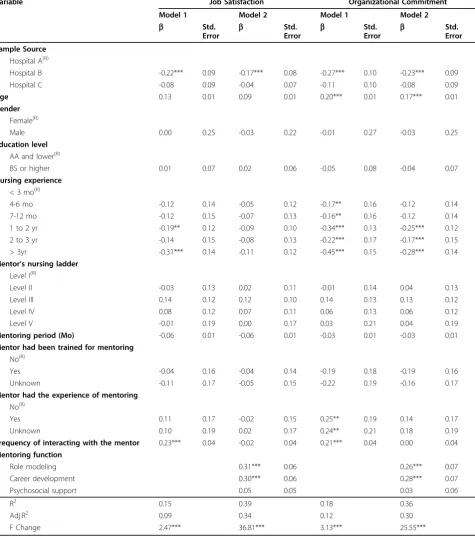
Table 4 shows the results of our multi-regression ana-lysis for job satisfaction. The result of Model 1 indicates that three control variables–sample source, nursing experience, and frequency of interaction with the men-tor–would significantly affect job satisfaction. After including the variables of the mentoring functions, only the career development function (b= 0.31) and the role modeling function (b= 0.30) were found to be signifi-cantly and positively related to job satisfaction; however, the coefficient of the psychosocial support function was not significant (Model 2). The results of the regression analysis for organizational commitment showed that four control variables–sample source, nursing experience, mentor had prior mentoring experience, and frequency of interactions with the mentor–would have a significant influence on organizational commitment (Model 1). After including the variables of the mentoring functions, we also found that the impact of the career development function (b= 0.28) and the role modeling function (b= 0.26) on organizational commitment is significantly posi-tive, but the coefficient of the psychosocial support func-tion is not significant (Model 2).
Discussion
Bahniuk [33] and Allen [34] have proven that the men-toring program enhances the job satisfaction of the mentees. During the mentoring process, mentors would often assign challenging and learning tasks to mentees in order to improve the mentees’knowledge and skills, provide career guidance, support the advancement of job position, help in resolving task-related problems, and further promote their overall growth. In this way, mentees improve their knowledge and skills and have a clear picture about their career development and posi-tion advancement [35-37]. The knowledge and experi-ence exchange and learning opportunities in the mentorship were found to increase the mentees’sense of confidence toward their job, decrease their anxiety for the future, satisfy their career development needs and further create a high level of job satisfaction [7,19,38]. All the above mentioned benefits for mentees primarily stem from the career development function. Furthermore, McNeese-Smith & Nazarey [39] had used content analysis to analyze the interview data of 30
nurses. They found that apart from personal factors, the learning opportunities provided by the organization are critical factors that have a highly positive relationship with organizational commitment. In addition to provid-ing a number of learnprovid-ing opportunities, mentorprovid-ing pro-grams also provide insight into the hospital systems and regulations; create room for performance feedbacks, dis-cussions, and feedback friendship and offer the neces-sary clinical support. These career-related functions are vital for establishing a sense of organizational identity and organizational belonging. The organizational com-mitment of mentees is positively related to their sense of organizational identity and organizational belonging. Fang [40] proposed and tested a dual-process model of organizational commitment that connects organizational practices and specific job characteristics to the emotions and cognitions of employees. He found that an indivi-dual’s perceptions of organizational support are key emotional and cognitive processes that mobilize com-mitment in the workplace. Overall, study results have proven a significant positive relationship between career development function and job satisfaction or organiza-tional commitment of new staff nurses.
Table 4 Results of multiple regression analysisa(n = 306)
Variable Job Satisfaction Organizational Commitment
Model 1 Model 2 Model 1 Model 2
b Std.
Error
b Std.
Error
b Std.
Error
b Std.
Error
Sample Source Hospital A(R)
Hospital B -0.22*** 0.09 -0.17*** 0.08 -0.27*** 0.10 -0.23*** 0.09
Hospital C -0.08 0.09 -0.04 0.07 -0.11 0.10 -0.08 0.09
Age 0.13 0.01 0.09 0.01 0.20*** 0.01 0.17*** 0.01
Gender Female(R)
Male 0.00 0.25 -0.03 0.22 -0.01 0.27 -0.03 0.25
Education level AA and lower(R)
BS or higher 0.01 0.07 0.02 0.06 -0.05 0.08 -0.04 0.07
Nursing experience < 3 mo(R)
4-6 mo -0.12 0.14 -0.05 0.12 -0.17** 0.16 -0.12 0.14
7-12 mo -0.12 0.15 -0.07 0.13 -0.16** 0.16 -0.12 0.14
1 to 2 yr -0.19** 0.12 -0.09 0.10 -0.34*** 0.13 -0.25*** 0.12
2 to 3 yr -0.14 0.15 -0.08 0.13 -0.22*** 0.17 -0.17*** 0.15
> 3yr -0.31*** 0.14 -0.11 0.12 -0.45*** 0.15 -0.28*** 0.14
Mentor’s nursing ladder Level I(R)
Level II -0.03 0.13 0.02 0.11 -0.01 0.14 0.04 0.13
Level III 0.14 0.12 0.12 0.10 0.14 0.13 0.13 0.12
Level IV 0.08 0.12 0.07 0.11 0.06 0.13 0.06 0.12
Level V -0.01 0.19 0.00 0.17 0.03 0.21 0.04 0.19
Mentoring period (Mo) -0.06 0.01 -0.06 0.01 -0.03 0.01 -0.03 0.01
Mentor had been trained for mentoring No(R)
Yes -0.04 0.16 -0.04 0.14 -0.19 0.18 -0.19 0.16
Unknown -0.11 0.17 -0.05 0.15 -0.22 0.19 -0.16 0.17
Mentor had the experience of mentoring No(R)
Yes 0.11 0.17 -0.02 0.15 0.25** 0.19 0.14 0.17
Unknown 0.10 0.19 0.02 0.17 0.24** 0.21 0.18 0.19
Frequency of interacting with the mentor 0.23*** 0.04 -0.02 0.04 0.21*** 0.04 0.00 0.04
Mentoring function
Role modeling 0.31*** 0.06 0.26*** 0.07
Career development 0.30*** 0.06 0.28*** 0.07
Psychosocial support 0.05 0.05 0.03 0.06
R2 0.15 0.39 0.18 0.36
Adj.R2 0.09 0.34 0.12 0.30
F Change 2.47*** 36.81*** 3.13*** 25.55***
a
Standardized regression coefficients are shown in the table ** p < .05; *** p <.01;(R)
Conclusion
This cross-sectional study examined the influence of career development, psychosocial support, and role modeling functions on the job satisfaction and organiza-tional commitment of new staff nurses.
The results indicated that the development of mentor-ing programs for new staff nurses in Taiwan has reached a mature state and that the interactions between new nurses and their mentors are frequent, useful, and enduring. To serve as mentors, nurse man-agers assigned senior nurses who had been trained for mentoring, had previous mentoring experience, and had at least achieved the level III of the nursing ladder. In addition, mentoring programs for new nurses are indeed capable of generating the role modeling, psychosocial support, and career development functions. It is worth noting that mentors do exhibit a higher degree of nur-sing knowledge and technical capabilities; thus, the role modeling function appears to be significant in the toring process. However, it is likely that nursing men-tors are not concerned about the psychosocial needs (for example, high praise from their mentors and the establishment of friendship in the workplace) and career anxieties or directions of new nurses. Therefore, the psychosocial support and career development functions, as perceived by new nurses, appear to be lower in Tai-wan. Despite being perceived to be relatively lower by the new nurses, these two functions positively influence their job satisfaction and organizational commitment. If nurse managers want to improve the mentoring pro-grams for new staff nurses, they should encourage men-tors towards the direction of lending psychosocial support, providing directions on career development, giving opportunities for self-expression and promotion, and assigning challenging tasks that provide more learn-ing opportunities for the new nurses. Effective mentor-ing will reinforce the job satisfaction of the new nurses and their commitment to the hospital.
In addition, the results of this study show that the role modeling function provided by mentors will positively influence the job satisfaction and organizational com-mitment of new staff nurses. If the nursing mentors can exhibit a high degree of nursing professionalism and attitude, win the mentees’ confidence and respect, and be seen as benchmarks, it will facilitate the mentee’s adaptation to their jobs and workplaces and will further enhance their job satisfaction and improve their organi-zational commitment. Therefore, while selecting senior nurses as mentors for new nurses, nurse managers should carefully consider their expertise and abilities. Besides expertise and abilities, nursing managers should reinforce the mentor’s professional attitudes about nur-sing care and assist in improving their mentoring
abilities in order to strengthen the role modeling func-tions of the mentoring programs.
Limitations and future research suggestions
Since this study has a cross-sectional design, it has cer-tain empirical limitations with regard to the verification of the relationship between research constructs. There-fore, it is suggested that future researchers use a study with a longitudinal design to further consider the impact of mentoring functions on job satisfaction and organiza-tional commitment. In addition, we used Harman’s one-factor test to assess the seriousness of common method biases. Although test results indicated that CMV was not considered a serious threat to this study, we suggest that if future researchers can overcome the data-collec-tion and time-limitadata-collec-tion problems, they can try to use the temporal, proximal, psychological, or methodological separation of measurement to attenuate the CMV problem.
Furthermore, this study only surveyed new staff nurses of Taiwan’s hospitals; therefore, the findings cannot be generalized to other countries. Future researchers may collect samples from different countries and continue to test the assumptions of this research. Finally, future researchers can continue to investigate from different perspectives in order to explore the influential factors and the impact of these factors on the different dimen-sions of work outcomes (such as patient safety perfor-mance) and further strengthen the integrity of the theory of mentorship in nursing.
Appendix.1 Construct Measurement Items
Mentoring Function
Career development
The mentor gave me many important assignments that provided me with opportunities to learn nursing skills, for example, case analysis.
The mentor provided me with many suggestions about career development and highlighted the relevant concerns.
The mentor gave me a lot of information about posi-tion advancement opportunities.
Psychosocial support
I would discuss my private concerns and problems with my mentor.
I actually see my mentor as my“real”friend. After work, I still kept in touch with my mentor. Role modeling function
I tried to adapt my mentor’s behavior.
I really respect and admire my mentor’s nursing expertise and skills.
Job Satisfaction
With regard to the promotion opportunities in this job, I feel...
With regard to the sense of achievement while finish-ing my jobs, I feel...
With regard to the performance feedbacks, I feel... With regard to whether my salary and welfare are commensurate with the workload, I feel...
With regard to the interactions with my coworkers, I feel...
Organizational Commitment
Effort commitment
I am willing to put in extra efforts for my hospital. I am willing to make an all-out effort to keep up with the hospital’s development.
Value commitment
I feel a sense of pride in doing my job at this hospital. My current work environment is the ideal one, which I always hoped to work in.
Retention commitment
Even though there are better opportunities outside, I will not leave this hospital.
I have strong commitment to continue providing my services at this hospital until retirement.
Acknowledgements
This study was supported by a grant from the National Science Council in Taiwan (NSC 96-2629-H-041-001-SSS). The author would like to thank the editor and the anonymous reviewers for their constructive comments and recommendations.
Author details
1Department of Hospital and Health Care Administration, Chia Nan
University of Pharmacy and Science, Taiwan.2Department of International Business and Trade, Shu-Te University, Taiwan.3Department of Health
Services Administration, China Medical University, Taiwan.4Department of Nursing, Jen-Ai Hospital, Taiwan.5Department of Nursing, Saint Paul’s
Hospital, Taiwan.6Department of Nursing, St. Martin De Porres Hospital, Taiwan.
Authors’contributions
WRH conceived of the study and made substantial contributions to study design, data acquisition, and data analysis and result interpretation. He also took responsibility for drafting and revising the manuscript. HJY performed the statistical analysis, assisted in interpreting the results and writing the manuscript. TWC was involved in designing the study, interpreting the analysis results and providing many important directions for literature review and discussion. CLY, LMY, and LSE took responsibility for data collection, participated in the data analysis and contributed to discussions. All authors read and approved the manuscript.
Competing interests
The authors declare that they have no competing interests.
Received: 11 June 2009 Accepted: 16 August 2010 Published: 16 August 2010
References
1. Beecroft PC, Dorey F, Wenten M:Turnover intention in new graduate nurses: A multivariate analysis.J Adv Nurs2008,62:41-52.
2. Halfer D, Graf E, Sullivan C:The organizational impact of a new graduate pediatric nurse mentoring program.Nurs Econ2008,26:243-249. 3. Lu H, While AE, Barriball KL:Job satisfaction among nurses: A literature
review.International Journal of Nursing Studies2005,42:211-227. 4. Chu CI, Hsu HM, Price JL:Job satisfaction of hospital nurses: An empirical
test of a causal model in Taiwan.Int Nurs Rev2003,50:176-182. 5. Brief AP, Aldag RJ:Antecedents of organizational commitment among
hospital nurses.Work and Occupations1980,7:210-221.
6. Lee TY, Tzeng WC, Lin CH, Yeh ML:Effects of a preceptorship programme on turnover rate, cost, quality and professional development.J Clin Nurs 2009,18:1217-1225.
7. Salt J, Cummings G, Profetto-McGrath J:Increasing retention of new graduate nurses: A systematic review of interventions by healthcare organizations.J Nurs Adm2008,38:287-296.
8. Proenca EJ, Shewchuck :Organizational tenure and the perceived importance of retention factors in nursing homes.Health Care Manag Rev 1997,22:65-73.
9. Beecroft PC, Santner S, Lacy ML, Kunzman L, Dorey F:New graduate nurses’perceptions of mentoring: Six-year programme evaluation.J Adv Nurs2006,55:736-747.
10. Andrews M, Wallis M:Mentorship in nursing: A literature review.J Adv Nurs1999,29:201-207.
11. Greene MT, Puetzer M:The value of mentoring: A strategic approach to retention and recruitment.J Nurs Care Qual2002,17:63-70.
12. Gibson T, Heartfield M:Mentoring for nurses in general practice: An Australian study.J Interprof Care2005,19:50-62.
13. Tourigny L, Pulich M:A critical examination of formal and informal mentoring among nurses.Health Care Manager2005,24:68.
14. McCloughen A, O’Brien L:Development of a mentorship programme for new graduate nurses in mental health.Int J Ment Health Nurs2005,
14:276-284.
15. Ragins BR, Cotton J:Mentor functions and outcomes: A comparison of men and women in formal and informal mentoring relationships.J Appl Psychol1999,84:529-550.
16. Scandura TA:Mentorship and career mobility: An empirical investigation.
J Org Behav1992,13:169-174.
17. Scandura TA:Mentoring and organizational justice: An empirical investigation.J Vocat Behav1997,51:58-69.
18. Kram KE:Mentoring at work: Developmental relationships in organizational life.Glenview, IL: Scott, Foresman 1985.
19. Scandura TA, Williams EA:An Investigation of the moderating effects of gender on the relationships between mentorship initiation and protégé perceptions of mentoring functions.J Vocat Behav2001,59:342-363. 20. Sosik JJ, Godshalk VM:Leadership styles, mentoring functions received,
and job-related stress: A conceptual model and preliminary study.J Org Behav2000,21:365-390.
21. Podsakoff P, Organ D:Self-reports in organizational research: Problems and prospects.J Manag1986,12:531-544.
22. Raabe B, Beehr TA:Formal mentoring versus supervisor and coworker relationships: Differences in perceptions and impact.J Org Behav2003,
24:271-293.
23. Eby LT, Lockwood AL, Butts M:Perceived support for mentoring: A multiple perspectives approach.J Vocat Behav2006,68:267-291. 24. Lankau MJ, Scandura TA:An investigation of personal learning in
mentoring relationships: content, antecedents, and consequences.Acad Manag J2002,45:779-790.
25. Laschinger HK, Finegan J, Shamian J:The impact of workplace empowerment, organizational trust on staff nurses’work satisfaction and organizational commitment.Health Care Manag Rev2001,26:7-23. 26. Meyer JP, Allen NJ:A three-component conceptualization of
organizational commitment.Hum Resour Manag Rev1991,1:61-89. 27. Payne SC, Huffman AH:A longitudinal examination of the influence of
mentoring on organizational commitment and turnover.Acad Manag J 2005,48:158-168.
28. Mowday RT, Steers RM, Porter LW:The measurement of organizational commitment.J Vocat Behav1979,14:224-247.
29. Godshalk VM, Sosik JJ:Aiming for career success: The role of learning goal orientation in mentoring relationships.J Vocat Behav2003,
63:417-437.
31. Bollen KA:Structural equations with latent variables.New York: John Wiley & Sons 1989.
32. Fornell C, Larcker DF:Evaluating structural equation models with unobservable variables and measurement error.J Mark Res1981,
48:39-50.
33. Bahniuk MH, Dobos J, Kogler Hill SE:The impact of mentoring, collegial support, and information adequacy on career success: A replication.
J Soc Behav Pers1990,5:431-451.
34. Allen TD, Russell JEA, Maetzke SB:Formal peer mentoring: Factors related to protégés satisfaction and willingness to mentor others.Group Organization Manag1997,22:488-507.
35. Fawcett DL:Mentoring–what it is and how to make it work.Association of Operating Room Nurses2002,75:950-954.
36. Gibson T, Heartfield M:Mentoring for nurses in general practice: An Australian study.Journal of Interprofessional Care2005,19:50-62. 37. Tourigny L, Pulich M:A critical examination of formal and informal
mentoring among nurses.The Health Care Manager2005,24:68-76. 38. Underhill CM:The effectiveness of mentoring programs in corporate
settings: A meta-analytical review of the literature.J Vocat Behav2006,
68:292-307.
39. McNeese-Smith DK, Nazarey M:A nursing shortage: Building organizational commitment among nurses/practitioner application.
J Healthc Manag2001,46:173-187.
40. Fang SR:An emperical study on relationship value, relationship quality and loyalty for retailing bank industry.J Manag2002,19:1097-1130. 41. Scandura TA, Williams EA:Mentoring and transformational leadership:
The role of supervisory career mentoring.J Vocat Behav2004,65:448-468. 42. Wanberg CR, Welsh ET, Hezlett SA:Mentoring research: A review and
dynamic process model.Hum Resour Manag2003,22:39-124. 43. Donaldson SI, Ensher EA, Grant-Vallone EJ:Longitudinal examination of
mentoring relationships on organizational commitment and citizenship behavior.J Career Development2000,26:233-249.
Pre-publication history
The pre-publication history for this paper can be accessed here: http://www.biomedcentral.com/1472-6963/10/240/prepub
doi:10.1186/1472-6963-10-240
Cite this article as:Wenget al.:Exploring the impact of mentoring
functions on job satisfaction and organizational commitment of new staff nurses.BMC Health Services Research201010:240.
Submit your next manuscript to BioMed Central and take full advantage of:
• Convenient online submission
• Thorough peer review
• No space constraints or color figure charges
• Immediate publication on acceptance
• Inclusion in PubMed, CAS, Scopus and Google Scholar
• Research which is freely available for redistribution