When an Algorithm Cannot Help You Find a Wife:
Modeling Two-Sided Matching Markets Using
Stochastic Matching
MSc Thesis (Afstudeerscriptie)
written by
Wouter P.J. Kroese
(born August 14th, 1989 in Heemstede, Netherlands)
under the supervision of Dr Michael Franke, and submitted to the Board of Examiners in partial fulfillment of the requirements for the degree of
MSc in Logic
at theUniversiteit van Amsterdam.
Date of the public defense: Members of the Thesis Committee:
August 17, 2015 Dr Maria Aloni
Acknowledgements
Most of all I want to thank my supervisor Michael Franke. You have been a great supervisor and taught me a lot about doing research. I really appreciate the fact that you managed to have me preserve the fun of chasing my own ideas and playing around in my model, but con-tinually helped me to make this all contribute to a decent academic work. I was furthermore impressed on your quick and thorough understanding of my work, with corresponding helpful feedback, although it was outside your field most of the time. Next to my supervisor I want to thank Maria Aloni, Nina Gierasimczuk, Sonja Smets and Ulle Endriss for being part of my committee. I also want to thank Femke Bekius for her thorough and helpful proof reading.
I want to thank Alvin Roth from Stanford University for helping me to pin down the core of my ideas and welcoming me to the weekly Market Design coffees, where he introduced me to many interesting researchers. Amongst them was Peter Biro, who has been extremely helpful, both at Stanford University as through online correspondence. I want to thank Peter for guiding me through the field of Stochastic Matching. I am also flattered by, and thankful for, Peter’s invitation to work together on further research. I want to thank Jonathan Bendor, Marcus Feldman, Steve Callander and Daniel McFarland from Stanford University for looking at my work from an Economics, Biology, Business and Sociology perspective respectively. I want to thank Vaclav Petricek for inviting me to the headquarters of datingsite eHarmony in Los Angeles, to discuss how my work could be directly applied to help people find the love of their lifes. I also want to thank Bogdan State from Facebook for investigating opportunities to work with data from Facebook. Furthermore I want to thank Pieter Gautier from the Vrije Universiteit and Matthijs van Veelen from the Universiteit van Amsterdam for discussing the economics of love with me.
Abstract
Table of contents
1 Introduction 1
1.1 Motivation . . . 1
1.2 Thesis build-up . . . 3
2 Theoretical framework 7 2.1 Secretary Search Problem (Martin Gardner 1960) . . . 7
2.1.1 Solution to Secretary Search Problem . . . 8
2.1.2 Importance for this thesis . . . 8
2.1.3 Differences compared to our model . . . 8
2.2 Stable Marriage Problem (Shapley and Gale 1962) . . . 9
2.2.1 Deferred Acceptance Algorithm . . . 9
2.2.2 Deferred Acceptance Algorithm always obtains a stable matching . 10 2.2.3 Extensions . . . 10
2.2.4 Optimal stable matching for the proposing side of the market . . . . 11
2.2.5 Pessimal stable matching for the accepting side of the market . . . 12
2.2.6 Complexity class . . . 12
2.2.7 Importance of Deferred Acceptance Algorithm for this thesis . . . . 13
2.2.8 Shortcomings of Deferred Acceptance Algorithm . . . 13
3 Model 15 3.1 Goal of the model . . . 15
3.2 The model . . . 17
3.2.1 Agents, relationships and preferences . . . 17
3.2.2 Deferred Acceptance Algorithm . . . 18
3.2.3 Simulations . . . 18
3.2.4 Update rule . . . 18
3.2.5 Blocking pair counter . . . 19
vi Table of contents
4 Convergence towards stability 21
4.1 Introduction . . . 21
4.1.1 Roth-Vande Vate Algorithm . . . 22
4.1.2 Obtaining the right sequence of blocking pairs in our model . . . . 24
4.1.3 Proof of convergence towards a stable matching in our model . . . 25
4.2 Optimality of obtained matchings . . . 29
4.2.1 Existence of suboptimal matchings . . . 29
4.2.2 Our model obtaining suboptimal matchings . . . 30
5 Understanding the model 31 5.1 Research questions . . . 31
5.2 Preferences . . . 32
5.3 Deferred Acceptance Algorithm with different parameter settings . . . 34
5.3.1 Rounds before stable matching is obtained . . . 35
5.3.2 Equality of the stable matching optimal for male agents and the stable matching optimal for female agents . . . 37
5.3.3 Payoffs in optimal stable matchings . . . 42
5.3.4 Increasing the number of agents . . . 43
5.3.5 Summary on simulations in the Deferred Acceptance Algorithm . . 45
5.4 Simulations in our model with different parameter settings . . . 46
5.4.1 Percentage of agents in a relationship . . . 46
5.4.2 Stability . . . 47
5.4.3 Payoffs . . . 52
5.4.4 Summary on simulations in our model . . . 56
5.5 Investigating why our model obtains higher average payoffs . . . 58
5.5.1 Exhaustive investigation of stable matchings . . . 60
5.5.2 Obtained average ranks . . . 66
5.5.3 Egalitarity in our model . . . 67
5.5.4 Summary of exhaustive investigation of all stable matchings . . . . 69
6 Extending our model for simulating real-world two-sided matching markets 71 6.1 Guaranteeing limited access to the market . . . 72
6.2 Finding the right parameter settings . . . 73
6.2.1 Advanced method for investigating preference agreement . . . 73
6.2.2 Advanced method for investigating symmetry . . . 75
Table of contents vii
6.4 Inserting pickiness in accepting potential partners . . . 81
6.4.1 Inserting a cost of being in a relationship . . . 82
6.4.2 Dynamic pickiness . . . 85
6.4.3 Relative dynamic pickiness . . . 85
6.5 Simulations with relative dynamic pickiness with multi-dimensional prefer-ences . . . 86
6.6 Value of our model . . . 87
7 Discussion 91 7.1 Discussion on using our model for solving the Stable Marriage Problem . . 91
7.2 Discussion on using our model for simulating real-world two-sided markets 92 7.3 Discussion on research method . . . 93
8 Conclusion 95 9 Further research 97 9.1 Simulations . . . 97
9.2 Formal proofs of important results . . . 99
Chapter 1
Introduction
1.1
Motivation
The greatest value of Game Theory is possibly in supporting people or institutions in making better strategic choices. Game Theory potentially is very valuable by its application to social and economic problems. Game Theory could for example be used to learn how markets can be designed such that more preferred equilibria will be obtained. Many real-world problems however seem to complex and noisy for Game Theory to have value in supporting to make better decisions. This thesis will form a starting point for investigating the power of agent-based models, for better understanding real-world two-sided matching markets. We are convinced that agent-based models can be of great power for explaining dynamics and results in real-world markets from a bottom-up perspective. Therefore, we build a stochastic matching model for two-sided markets, where two groups of agents have preferences over the agents of the other side of the market and have to be matched in pairs. This thesis forms a starting point for using agent-based models to better understand the behaviour of agents in real-world two-sided markets like the job market, people renting a house and people in search of a romantic partner. Our goal is to build a model that could be further extended by researchers and policy makers such that they can use it to understand and improve the outcomes in two-sided markets respectively.
This thesis will be focusing on two-sided matching problems, so called Stable Marriage
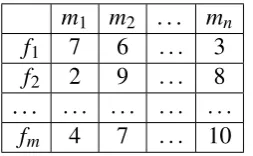
Problems, consisting of two sets of agents, M={m1, . . . ,mn}, the male agents, and F =
{f1, . . . ,fm}, the female agents. All agents of M have a complete, strict and transitive
preference order overF and the other way around. This means every agent is able to rank
2 Introduction
attractive and finds no two agents equally attractive. The goal of the agents is to be paired with an agent they prefer the most. Gale and Shapley (1962) devised the Deferred Acceptance Algorithm which gives us a stable matching for every instance of the Stable Marriage Problem [6]. In stable matchings no two agents would rather be matched with each other, than with the agent they are currently matched with. Furthermore these matchings are optimal in the sense that for one side of the market, all agents are better off than in any other stable matching.
The Deferred Acceptance Algorithm provides us with an elegant tool to find stable matchings for two-sided markets where both sides of the market have preferences over one another. In many real-world cases, however, there is no central authority to execute such an algorithm and agents do not have the resources to have an overview and access to the whole market. This might keep agents from finding a stable matching. Take the job market and people in search of a romantic partner as examples: A man has no overview of every potential job or every potential partner, let alone does he have the time to get the chance to apply for every job or date every woman. Furthermore, job offers will be valid for limited time only and women won’t wait forever after offering their love to a man.
Illustrated and inspired by people in search of a romantic partner, we build a model for two-sided markets where all agents have preferences over one another but where there is no central authority. In our model agents furthermore have limited resources such that they have no full overview of, and access to, the whole market.
1.2 Thesis build-up 3
interested to find out whether our agent-based model can be extended, such that it can be used to simulate real-world two-sided matching markets, like people in search of a romantic partner or the job market.
1.2
Thesis build-up
Theoretical Framework
In Chapter 2, we cover the theoretical framework consisting of the Secretary Search Problem and the Stable Marriage Problem. The Secretary Search Problem is used for defining our model. The solution to the Stable Marriage Problem, the Deferred Acceptance Algorithm, is an elegant and efficient procedure that always gives a stable matching in two-sided matching markets. We use the results of this algorithm as a benchmark for the results of the simulations of our model. We also discuss how our model differs from the models and problems discussed in this chapter.
Model
In chapter 3, we define the basis of our stochastic model for simulating real-world two-sided matching markets. We describe how payoffs and utility of agents are defined. We then describe how agents get the opportunity to pair up and to which rules they adhere when they decide to do so.
Convergence towards a stable matching
In chapter 4, we prove that our model will ultimately converge with probability 1 towards a stable matching. Which means that our model ends up in matchings between the two sides of the market where no two agents form a blocking pair, which means they had rather been paired with one another than with their partner in the obtained matching. We furthermore show that our model can converge towards stable matchings other than the ones resulting from the Deferred Acceptance Algorithm.
Simulations
In chapter 5, we start by describing how preferences are randomly generated, based on the two
4 Introduction
Thereafter, we will first investigate, by running simulations, what the effects of changing the parameter values on the results of the Deferred Acceptance Algorithm are. In particular, we will investigate what the effects are of making the preferences of agents more or less objective or symmetric on the number of rounds it takes to obtain the stable matching in the Deferred Acceptance Algorithm. In addition we consider the payoffs the agents obtain in these matchings.
Thirdly, we investigate why our model obtains better results than the Deferred Acceptance Algorithm. We do this by listing all stable matchings for 450 instances of the Stable Marriage Problem with uniform random preferences. For every instance we then run 500 simulations in our model and investigate which stable matchings are more often obtained than others.
Extensions
In chapter 6 we make extensions to our model and thereby take a first step towards modeling real-world two-sided markets. First we construct a more advanced procedure to investigate the symmetry and objectivity in preferences. We then extend and adjust our model where the agents and simulations seem to differ critically from real-world two-sided matching markets. Thereafter, we construct a model for instances of the Stable Marriage Problem with relatively objective preferences, in which agents have some awareness of their attractiveness. We furthermore add a cost to being in a relationship by having agents meet less new agents once they are in a relationship. This will make it less attractive for agents to start a relationship when single, since it reduces the chance of finding a better partner when they are in one. Following, we will therefore extend our model with pickiness which makes agents not want to start a relationship with any agent they meet when single.
Discussion
In Chapter 7 we will discuss possible downsides of our research method and possible points of improvement for our model.
Conclusion
1.2 Thesis build-up 5
Further research
Chapter 2
Theoretical framework
We use two mathematical problems as theoretical framework, the Secretary Search Problem and the Stable Marriage Problem. The Secretary Search Problem is mainly an inspiration for constructing our model. Because of the crucial differences between our model and the Secretary Search Problem, the solution to the Secretary Search Problem seems to be of little value for our model. As opposed to the Secretary Search Problem the solution to the Stable Marriage Problem, the Deferred Acceptance Algorithm, will be of great value for our research. In the first place, the proof that shows that there always exists a stable matching will form an important element in several of our proofs. Furthermore, the resulting matching from the Deferred Acceptance Algorithm will form a benchmark for assessing the results obtained in our model.
2.1
Secretary Search Problem (Martin Gardner 1960)
The Secretary Search Problem was first mentioned by Martin Gardner in a column in the Scientific American in 1960 as explained by Ferguson [5]. The problem is as follows:
A businessman hasnapplicants for the position of secretary. The potential secretaries are
8 Theoretical framework
2.1.1
Solution to Secretary Search Problem
There is an elegant solution to this problem, first published by Lindley [9]. The optimal
stopping rule is always rejecting the first ne applicants after the interview (where e is the
base of the natural logarithm) and then stopping at the first applicant who is better than every applicant interviewed so far (or continuing to the last applicant if this never occurs).
Sometimes this strategy is called the 1e stopping rule, because the probability of stopping at
the best applicant with this strategy is about 1e, already for moderate values ofn.
2.1.2
Importance for this thesis
There are a number aspects about the Secretary Search Problem that inspired our model on two-sided markets. In a lot of real-world two-sided markets it is hard to have an overview of all possible partners. Furthermore, it is hard to know which opportunities will come later on and where you have to decide on the specific moment an opportunity comes along whether to take your chances or let the opportunity go. The Secretary Search Problem elegantly models an agent’s consideration on whether the current opportunity is the best that will ever come or that the agents deems it likely that better opportunities will come along later. Furthermore, our model and the Secretary Search Problem involve stochasticity in similar ways.
2.1.3
Differences compared to our model
The most important difference between our model and the Secretary Search Problem is that we will model two-sided markets. In the Secretary Search Problem all applicants want the job, where in two-sided markets, like the search for romantic partners it takes two to tango. To stick with the secretary example: In our model the applicants can apply for different jobs, over which they all have their preferences. On the one hand this makes our model more
complex such that it will be harder to find elegant results like then÷estopping rule. On the
other hand we might find interesting dynamics because of the interaction between the two sides of the market.
2.2 Stable Marriage Problem (Shapley and Gale 1962) 9
also possible that they do not get to “date" and thus pair up with every possible partner. On the other hand it is possible that an agent “dates" a potential partner more than once.
The final important difference between the Secretary Search Problem and our model will be that in the Secretary Search Problem the businessman has to employ a “stopping rule". When the businessman accepts a candidate he will meet no other candidates anymore and cannot come back from his decision. In our model agents will however keep meeting new
possible partners, also when they are already paired with an agent. A male agentma can
decide to break up with female agent fbwhen male agentmameets an agent fc with whom
male agent mawould rather be paired up with than with his current partner female agent
fb, but can only do so if agent fc also prefers being paired with male agentmaabove being
paired with her current partner.
2.2
Stable Marriage Problem (Shapley and Gale 1962)
The Stable Marriage Problem was first mentioned, and directly solved, by Gale and Shap-ley [6]:
In a community ofnmen andnwomen all people from the one sex rank all people from
the other sex according to their preferences. Assumed is there are no ties in the ranking. Gale and Shapley first ask whether there is a way to marry all the men and women such that we obtain a stable matching. Thus, does there exist a matching where male agents are matched with female agents, in which there is no blocking pair, consisting of a man and a woman who would have rather married each other than the partner they are assigned to in this matching. Secondly, Gale and Shapley ask whether we can find a stable matching optimal for either all males or all females in the case multiple stable matchings exist. Here optimal means that every person from this sex is at least as well off in this matching as under any other stable matching [6].
2.2.1
Deferred Acceptance Algorithm
Shapley and Gale devised the Deferred Acceptance Algorithm, which for any Stable
Mar-riage Problem, with any number of male agentsn, any number of female agentsmand any
10 Theoretical framework
Each man proposes to his favorite woman. Each woman who receives more than one proposal rejects those that proposed her, except her favorite of her proposers. These women don’t accept their favorite proposers right away but engage with them to allow for the possi-bility that someone they like more might propose later. In the second stage all the rejected men propose to their next best choices. Each woman that received proposals chooses her favorite from the set consisting of the man she is engaged with (if she was proposed before) and the new proposers. Again she gets engaged with her new favorite and rejects all others.
This second stage is iterated until (withinn2−2n+2 stages) every woman will have received
a proposal. Since as long as not all women have received a proposal there will be rejections and thus new proposals. However, no man can propose to a woman more than once. When the last woman gets her proposal, each woman will have to accept the man she is engaged with. We now have every man matched with a woman in a stable matching.
2.2.2
Deferred Acceptance Algorithm always obtains a stable
match-ing
Theorem 1(Gale and Shapley, 1962). The Deferred Acceptance Algorithm always obtains a stable matching.
Proof. Assume maleAand femaleBform a blocking pair, which means they are not matched
with each other, but would rather have been matched with one another than with the agents
they are currently matched with. If maleAwould have preferred femaleBabove his current
match, he would however have proposed femaleBbefore he would have proposed his current
match. There thus must have been a man who femaleBlikes more then maleA, since she did
not accept maleAat that moment. MaleAand femaleBthus not form a blocking pair and
since this would hold for any blocking pair we thus have obtained a stable matching [6].
Note that there is complete duality for the proposing party and the proposed party, and we could thus switch the roles of the males and the females.
2.2.3
Extensions
The Deferred Acceptance Algorithm also results in a stable matching for instances of the Stable Marriage Problem with unequal numbers of male and female agents. When we have
nagents of the proposing party (males) andmagents of the accepting party (females) and
2.2 Stable Marriage Problem (Shapley and Gale 1962) 11
proposed to. Whenn>mthen the procedure continues until every agent from the proposing
party (males) is either engaged with an agent of the accepting party (females) or rejected by everyone of them.
Furthermore, we can extend this solution to instances where some possible partners are unacceptable to some agents. In this case, it could happen that some agents prefer being single over being matched with some of the agents of the other side of the market. This means that it could be the case that the Deferred Acceptance Algorithm obtains a stable matching in which not all agents are matched.
2.2.4
Optimal stable matching for the proposing side of the market
The Deferred Acceptance Algorithm not only gives a stable matching, it also gives the opti-mal matching for the proposing side of the market (in this case the opti-males). This means that every person from the proposing side of the market is at least as well off under the matching obtained by the Deferred Acceptance Algorithm, as under any other stable matching [6].
Theorem 2(Gale and Shapley, 1962). The Deferred Acceptance Algorithm always results in the optimal stable matching for the proposing side of the market.
Proof. We call a female agent (accepting) “possible” for a male agent (proposing) if there
exists a stable matching in which they are matched. We now do a proof by induction (where the empty matching at the beginning of the procedure forms the base case). Assume that somewhere during the Deferred Acceptance Algorithm no male is yet rejected by any of the
females with whom he would form a pair in a stable matching. Now assume femaleBhas
proposals from maleA,B,C andDof which she rejects maleD. We now must prove that
femaleBis “impossible” for maleD. We know that malesA,BandCpreferred femaleB
above all other females, except the ones that malesA,BandChave proposed to before, but
got rejected by and which thus are impossible to malesA,BandC. Now consider a matching
where femaleBis paired with maleDand where all other males are matched with females
that are possible to them. This means at least one of the male agents, say maleB, is paired
with a female that is less favorable to them than femaleB. This means that the matching is
unstable because femaleBand this maleBwould rather be with each other than with their
current match. Thus this assumed matching is unstable and thus femaleBis impossible for
maleD. We now have shown that the Deferred Acceptance Algorithm gives the optimal
12 Theoretical framework
2.2.5
Pessimal stable matching for the accepting side of the market
The Deferred Acceptance Algorithm thus gives a stable matching that is the optimal stable matching for the proposing side of the market (in this case the males). For the accepting side of the market (females), the Deferred Acceptance Algorithm, however, gives us the least optimal stable matching. Where in the least optimal stable matching every agent from the accepting side of the market is always worse off under the matching obtained by the Deferred Acceptance Algorithm than under any other stable matching.
Corollary 2.1. The Deferred Acceptance Algorithm always results in the pessimal matching for the accepting side of the market.
Proof. Suppose the Deferred Acceptance Algorithm with the male agents as proposing party
gives us the optimal stable matchingµs for male agents. We claim this stable matching is the
pessimal stable matching for the female agents, meaning that every female agent would be at least as good off in any other stable matching. We now do a proof by contradiction. Suppose
female agent fais matched with male agentmainµs, but there exists a stable matchingµw
in which female agent fa is matched with a male agentmy, who she finds a worse partner
than male agentma. Let female agent fx be the partner of male agentmainµw. We know,
however, that male agent ma prefers female agent fa above female agent fx, since in the
optimal stable matching for malesµsmale agentmais paired with female agent fa. We thus
have thatµwis no stable matching, which contradicts our assumption. We thus have shown
thatµs is the pessimal stable matching for the female agents.
2.2.6
Complexity class
Theorem 3. The Deferred Acceptance Algorithm is in complexity class P.
Proof. Assume we have an instance of the Stable Marriage Problem with n male agents
andmfemale agents. Assume that the male agents are the proposing party in the Deferred
Acceptance Algorithm. The Deferred Acceptance Algorithm consists of rounds in which the male agents that are not engaged propose to their favorite female agent that they are not rejected by yet. The female agents then engage with their favorite proposer or stay engaged
2.2 Stable Marriage Problem (Shapley and Gale 1962) 13
rejections take place. The Deferred Acceptance Algorithm finishes when either all male or all female agents are engaged. Since all agents will only propose or reject every agent once,
we know that withinm×nstages either all male agents will be engaged or all female agents
will be proposed to. We can thus conclude that the Deferred Acceptance Algorithm obtains a
stable matching within polynomial time (O(q2), whereqis the largest ofnandm). When
n=mwe have that it takes at mostn2−2n+2 stages to obtain a stable matching [6].
2.2.7
Importance of Deferred Acceptance Algorithm for this thesis
The Deferred Acceptance Algorithm will be very important for our research. In the first place we use the fact that there always exists a stable matching for any instance of the Stable Marriage Problem in many of our proofs. Furthermore, the optimal stable matchings that result from the Deferred Acceptance Algorithm form the benchmark that we will compare the outcomes of our simulations to. Although properties like fairness and optimality are hard to define, stable matchings seem good outcomes for two-sided matching problems since we have that every agent will be matched and since there exists no pair of agents that would rather be matched with one another than with their current partner.
2.2.8
Shortcomings of Deferred Acceptance Algorithm
The Deferred Acceptance Algorithm is more than an elegant result for a mathematical problem. In the 1980s Alvin Roth applied the Deferred Acceptance Algorithm to solving many real-world matching problems including the assignment of new doctors to hospitals, students to schools, and organs to transplant recipients [10] [11] [12]. Alvin Roth and Lloyd Shapley were awarded the Nobel prize in economic science “for the theory of stable allocations and the practice of market design” in 2012. Alvin Roth and Lloyd Shapley have shown that by introducing a central authority we can better match children to schools and doctors to hospitals. For many real-world two-sided matching markets it is however not realistic to apply the Deferred Acceptance Algorithm for finding a stable or in any other sense good matching.
Central authority
14 Theoretical framework
Overview of the market
Even if agents have strict preferences over every possible pair they could be part of, in many real-world situations agents would not have a full overview of the whole market. A recent graduate could for example be able to rank every possible job, but she might not be able to be aware of every possible vacant position.
Access to the market
Chapter 3
Model
3.1
Goal of the model
The Deferred Acceptance Algorithm thus provides us with an elegant procedure to find optimal stable matchings for instances of the Stable Marriage Problem. We have observed that in many real-world two-sided matching markets there is no central authority to execute this algorithm and agents do often not have the resources to have an overview of, and access to, the whole market at any time. Besides that, it also seems to be the case that in many real-world two-sided matching markets agents do not behave anything like agents in the Deferred Acceptance Algorithm. In this thesis we want to use agent-based modeling to improve and better understand the matching process in two-sided markets that are too complex or noisy to execute the Deferred Acceptance Algorithm. We do this by constructing a model that takes into account the shortcomings of the Deferred Acceptance Algorithm. In the first place the goal of our model is to provide researchers with a tool to simulate and better understand the behaviour of agents in real-world two-sided matching markets. We however will find that our model can also be directly used to obtain stable matchings in which on average higher payoffs are obtained than in the Deferred Acceptance Algorithm and higher than in an randomly chosen stable matching, without having the need of a central authority. Furthermore, we find that our model obtains stable matchings that on average are both more egalitarian than the stable matchings obtained with the Deferred Acceptance Algorithm and than a randomly selected stable matching in two ways. Firstly, the differences in average payoffs between the male and female agents are on average smaller. Secondly, the difference in payoffs between the best and worst scoring agent of an instance is smaller.
16 Model
over all agents from the other side of the market but where there is no central authority and agents have limited time and resources to find their optimal partner. Just as in the Secretary Search Problem agents have no overview of all potential partners. In our model, agents from different sides of the market meet each other in sequence and can only decide to match with an agent from the other side of the market, when at the moment they meet, they both choose to. In our model, randomness influences with which agents of the other side of the market an agent gets the chance to form a relationship with and when this possibility to pair up occurs. This is also the case in the Secretary Search Problem. The agents in our model have no overview of the market and do not know which agents they will meet next, nor can they review their decision later on. As opposed to the Secretary Search Problem agents do not meet all agents serially. This means not every agent of the other side of the market has to be met and it could be the the case that an agent meets a particular agent more than once. Contrary to the Secretary Search Problem, where no new applicants are met after the businessman accepted a candidate, in our model agents keep meeting agents after they
started a relationship and our model does allow for break-ups. Thus when male agentma
is in a relationship with female agent fa, and male agentmameets female agent fb, then if
male agentmaand female agent fb, who is matched with male agentmb, would rather be
matched with one another than with their current partners (and thus form a blocking pair),
then male agentmastarts a relationship with female agent fband male agentmband female
agent faare left single.
3.2 The model 17
3.2
The model
3.2.1
Agents, relationships and preferences
We have a set of n male agents M = {m1, . . . ,mn} and a set of m female agents F =
{f1, . . . ,fm}. Our simulations consist ofk daterounds. We define the functionP(x,z) =y
which represents agent x having a relationship with agent y at dateround z and where
P(x,z) =0 represents agent xbeing single at dateround z. IfP(x,z) =ythen P(y,z) =x.
Agents cannot be in a relationship with more than one agent. Preferences of all agents of one side of the market over all agents of the other side of the market are strict, transitive and
complete, meaning that for every two possible partners female agents faand fb, male agent
mceither prefers being in a relationship with female agent faabove being in a relationship
with agent fbor the other way around. All male agents assign a preference score to being in
a relationship with every one of the female agents and all female agents assign a preference score to being in a relationship with every one of the male agents. These scores are assigned
by the preference functionu:M×F→R×Rwhereum(mi,fj)is the preference scoremi
assigns to being in a relationship with fjanduf(mi,fj)is the preference score fjassigns to
being in a relationship withmiwith 0<um(mi,fj)≤10 and 0<uf(mi,fj)≤10. Agents
can only be in a relationship with maximally one agent at every dateround, who has to be from the other side of the market. Agents prefer being in a relationship above being single
and we thus haveum(x,0) =0 anduf(0,x) =0 for any agentx.
Although many similar matching problems are based on preferences expressed by ranking agents, we choose to express our preferences in preference scores ranging from zero to ten. There are several reasons why we choose to do so. In the first place it allows us to use the
preference agreement factor pand symmetry factorswhen generating preferences, that will
18 Model
3.2.2
Deferred Acceptance Algorithm
When preferences are assigned we start with the Deferred Acceptance Algorithm from
Shapley and Gale [6] to obtain the stable matchingµmwith optimal outcomes for all agents
inM, and the stable matchingµf with optimal outcomes for all agents inF. These results
will form a benchmark for the results of the simulations in our model.
3.2.3
Simulations
We then run simulations consisting of k daterounds. At round 0 all agents are single (
∀x∈F∪M:P(x,0) =0). Every dateroundl, with 0≤l≤kall of the agents are matched
with an agent of the other side of the market forming the one-to-one bipartite dateround graph
Gl= (Dm,Df,E), whereDm=MandDf =F (in Chapter 6 we investigate an extension of
our model whereDm⊆M,Df ⊆F, and thus not all agents meet an agent from the other
side of the market every dateround). Every edge inE fromGl consisting of a male agent
mi∈M and a female agent fj∈F represents a date at dateroundlin which male agentmi
and female agent fj get the opportunity to pair up, which we will call being in a relationship.
Note that it could be the case that an agent meets the same agent as the one he was already in a relationship with before the dateround started.
3.2.4
Update rule
In our model agents are myopic and behave according to simple deterministic update rules, called the "Better response dynamics" by Ackermann et al. [1]. When agents are single, they will start a relationship with any agent they would get the chance to. Suppose a male agent
mais in a relationship with female agent fbbut gets the chance to start a relationship with a
female agent fc, because they date in a dateround and female agent fcprefers being matched
with male agentmaabove her current situation. Then if that male agentmaprefers female
agent fcabove female agent fb, then male agentmaand female agent fcstart a relationship
and female agent fbis left single. Formally we thus have: If{mi,fj} ∈E ofGlthen agents
mi and fj date at dateround l and ifum(mi,fj)>um(mi,fp) and uf(mi,fj)>uf(mp,fj),
where P(fj,l−1) =mp, P(mp,l−1) = fj, and P(mi,l−1) = fp and P(fp,l−1) =mi,
thenP(mi,l) = fj,P(fj,l) =mi. Every dateroundlall couples in the one-to-one matching
Gl= (Dm,Df,E)all sequentially decide whether they start a new relationship in a randomized
3.2 The model 19
that agents fpandmp, that were left bymiand fjrespectively during dateroundl, will not
have a date in dateroundlthat results in pairing with a new partner, we haveP(mp,l) =0,
P(fp,l) =0. After every dateroundl we will have obtained a matching µl consisting of
all pairs(mi,fj)such thatP(mi,l) = fjandP(fj,l) =mi(which means it does not have to
contain all agents).
3.2.5
Blocking pair counter
One of the great things about the Deferred Acceptance Algorithm is that it not only ensures that a stable matching is obtained that is optimal for the proposing side of the market. It is also clear when this stable matching is obtained. Even though our model will eventually converge towards a stable matching, as we will prove in the next chapter, it is not directly clear when a stable matching is obtained. We therefore extended our model with a blocking pair counter (where a blocking pair consists of a pair of agents that would rather be matched with each other than with their current partners, which could also mean not being matched), that counts the number of blocking pairs in the obtained matching after every dateround. This
means that every dateround we have to check for alln×m(withnmale agents andmfemale
agents) possible pairs whether they form a blocking pair. Only if the number of blocking pairs is 0, we have obtained a stable matching. Note that in the model explained above every single male and single female agent form a blocking pair.
3.2.6
Utility
Although our agents behave according to simple rules in which they continually aim to be in a relationship that they assign the highest preference score to, it is important to think about the utility of the agents in our model. This is the case because this utility helps us to assess results obtained in our model. This utility is also important when we investigate in Chapter 6 what other, less myopic, strategies agent could use to obtain higher utilities. In our model we will start with setting the utility of an agent equal to the preference score assigned to its
partner at the last dateround. Thus in a simulation withkdaterounds,πmi=um(mi,P(mi,k))
Chapter 4
Convergence towards stability
4.1
Introduction
The first question we want to answer is whether our model will always converge towards a stable matching. At first sight this seems trivial since there are only finitely many matchings and we know from the Deferred Acceptance Algorithm that a stable matching exists. This would mean that at some point in our simulation we would randomly have generated a dateround in which all agents of one side of the market date the agent with whom they would be paired in this stable matching. It could however be the case that at that point an agent is in a relationship with an agent he finds more attractive than the agent he dates (and thus is matched with) in this optimal stable matching, and would therefore not start a relationship with this agent. This would imply that the optimal stable matching that resulted from the Deferred Acceptance Algorithm would not be obtained at that moment. It is per definition
the case that if we obtained a stable matchingµlwithout a blocking pair somewhere during
the simulation after dateroundl, withl<k, that no mutations take place and our matching
will stay the same and thusµl=µk. When we have a positive number of blocking pairs in
matching µl then we know we have no stable matching. Supposemiand fjform a blocking
pair forµl. Since every pair consisting of a male and female agent has a positive probability
of dating each other in every dateround p(daterounds consist of random bipartite graphsGp
betweenM andF) and since we only have a finite number of agents the probability that we
will never obtain a dateround pwith{mi,fj} ∈E ofGpfor some dateround pwith p>l
goes to zero when we increase the number of daterounds in our simulation. Note however
that there might be more blocking pairs that need to be satisfied than the blocking pairs inµl
22 Convergence towards stability
there always exists a finite sequence of blocking pairs that could be satisfied consecutively in our model such that we obtain a stable matching, without any blocking pairs.
4.1.1
Roth-Vande Vate Algorithm
Theorem 4(Roth-Vande Vate(1990)). For any instance of the Stable Marriage Problem for any matchingµ0there exists a finite sequence of matchingsµ0, . . . ,µi, . . . ,µk such thatµk is
stable andµiis obtained fromµi−1by satisfying a blocking pair. [13]
To find out whether our simulations will eventually converge towards a stable matching we will start with the proof of Roth and Vande Vate, that shows that from any unstable matching we can always obtain a stable matching by subsequently satisfying a finite number of blocking pairs [13]. The proof of Roth and Vande Vate shows that from any unstable
matching there exists a finite sequence of matchingsµ0, . . . ,µi, . . . ,µksuch that µkis stable
and µi is obtained from µi−1 by satisfying a blocking pair. There are only finitely many
matchings since F and M are finite. If every blocking pair has at any point a positive
probability of being satisfied, it will thus be the case that for every matching there is a positive probability that exactly the finite sequence of blocking pairs needed to obtain a stable matching is generated. This means that when blocking pairs are randomly satisfied there will be convergence towards a stable matching.
Proof. Suppose that we have a set ofnmale agentsMand a set ofmfemale agentsF and
an unstable matchingµ0={(m1,f1), . . . ,(mk,fk)}withmi∈M, fj∈F,k≤nandk≤m.
We shall show that we can reach a stable matching by successively satisfying finitely many blocking pairs. The Roth-Vande Vate algorithm works as follows. We gradually extend a
setS⊆(M∪F). Initially letS(0) ={/0}. Now suppose there exists a blocking pair(mi,fj)
forµ0(if there exists no blocking pair we are done). Now letµ1be the next matching in the
finite sequence described in the theorem with(mi,fj)∈µ1by satisfying the blocking pair
(mi,fj). Now we extendSby havingS(1) ={mi,fj}. Note that if(mi,fj)forms a blocking
pair forµ1, it would not be contained inS(1). We now construct the needed sequence of
matchings ending with a stable matching by extendingSsuch that no blocking pairs forµ(k)
are contained inS(k). We prove this by induction (with the extension ofS(0)toS(1)as the
base case). Suppose we have a setS(k)such that no two agents are part of it, that would form
a blocking pair forµk+1and such thatµk+1does not match any agent inS(k)with an agent
outsideS(k). Now ifµk+1is not stable, there exists a blocking pair(mk+1,fk+1)such that at
4.1 Introduction 23
First, suppose that(mi,fj)is a blocking pair forµkwithmicontained inS(k), such that it
is the blocking pair such that among all blocking pairs(m,fj),miis the most preferred partner
of fjinS(k). Now formµk+2by satisfying this blocking pair and letS(k+1) =S(k)∪ {fj}.
Ifmiwas unmatched inµk+1, thenS(k+1)contains no blocking pair forµk+2. Otherwise
there could be a blocking pair(mg,fh)forµk+2such thatmiis matched with fhinµk+2and
withmg and fh both contained inS(k+1). Here we choose (mg,fh) such that among all
blocking pairs(m,fh),mgis the most preferred partner of fhinS(k+1). The next matching
in the sequenceµk+3is now formed by satisfying this blocking pair. We continue this process
until we reach a matching µt, witht >k such that no blocking pairs for µt are contained
in the set S(t)≡S(k+1). Note that we know that this must eventually happen, since we
have finitely many agents and no male agent ever gets matched with a less preferred partner
and thus no blocking pair appears twice in the finite sequence of matchings µk+2, . . . ,µt.
NowS(t)is the set we need, which strictly containsS(k)and contains no blocking pairs forµt.
For the second case we consider blocking pairs(mi,fj)forµk with fjcontained inS(k),
such that it is the blocking pair such that among all blocking pairs (mi,f), fj is the most
preferred partner ofmiinS(k). We can now simply proceed as in the first case, with the roles
ofmiand fjswitched.
For the third case all blocking pairs(mi,fj)forµk are disjoint fromS(k). We can then
simply select one of these blocking pairs and satisfy it to obtain the next matching in the
sequence and letS(k+1)≡S(k)∪ {mi,fj}.
S(k+1)containsS(k)and contains no blocking pairs forµk+2. ObtainingS(k+1)with
this algorithm always takes finitely many steps sinceS(k)can be strictly increased until a
stable matching is obtained, but it can never grow larger thanM∪W.
We thus obtain the sequence of blocking pairs that we need to satisfy to reach a stable
matching starting fromµ0. Since we never satisfy a pair twice when adding a new agent to
S, it follows that the number of steps in the path to stability is at most mnand thus finite.
Thus, if we randomly satisfy blocking pairs, than from any unstable matching µ we will
eventually obtain a stable matchingµs, since there always is a positive probability that the
needed finite sequence of blocking pairs needed to obtain stable matchingµs will be satisfied
24 Convergence towards stability
If we start with the empty matching and run the Roth-Vande Vate algorithm, then the resulting stable matching will depend on the order in which the agents arrive. This is called the random order mechanism.
4.1.2
Obtaining the right sequence of blocking pairs in our model
From the Roth-Vande Vate proof [13] we know that from any unstable matching we can ob-tain a stable matching by satisfying a finite number of blocking pairs. In our model all agents randomly meet another agent from the other side of the market every dateround. Agents will only form a relationship when they meet an agent with whom they form a blocking pair. We now need to show that in our model, every blocking pair in the finite sequence of the Roth-Vande Vate algorithm has a positive probability of being the next blocking pair to be satisfied at the right moment during the simulation. In our model it is not the case that we randomly satisfy blocking pairs, since an agent can only start a new relationship once every dateround. Thus, when the Roth-Vande Vate algorithm for example gives us a sequence in which an agent is part of three consecutive blocking pairs it is not trivial that there is a positive probability that this sequence of blocking pairs can be obtained. It could for example be the case that there is no dateround possible in which only the second of the three consecutive blocking pairs can be satisfied, at the moment needed. This could be the case since in every possible dateround in which this blocking pair is satisfied, also other blocking pairs will be satisfied.
We thus cannot conclude from the Roth-Vande Vate proof that eventually we will always obtain a stable matching in our model. We do however know that from any unstable matching, there exists a dateround, in which all single agents meet another single agent and every other agent meets the agent they are already in a relationship with, such that we can obtain a
matching µc in which every agent is matched. For this matching µc there of course also
exists a finite sequence of blocking pairs that can be satisfied sequentially to obtain a stable matching. Since all agents are now matched we know there exist daterounds in which all
agents meet the agents they were already paired with inµcexcept the two agents in the next
blocking pair in the finite sequence, say(mi,fj)and their partners inµc, say(mi,fj).
4.1 Introduction 25
cannot use interchanges to prove convergence towards stability in our model.
4.1.3
Proof of convergence towards a stable matching in our model
To prove that our model always converges towards a stable matching we use a proof of Diamantoudi et al. [4] who made a generalization of the proof of Roth and Vande Vate [13]. Diamantoudi et al. [4] have shown that we can always find a finite sequence of blocking pairs that can be satisfied consecutively to obtain a stable matching for the Stable Roommate Problem with strict preferences. The Stable Roommate Problem is a generalization of the Stable Marriage Problem in which there is only one group of agents. Here all agents have preferences over being paired with the agents in this group, for which a stable matching needs to be obtained.
Theorem 5. For any instance of the Stable Marriage Problem with n male and m female agents, for any arbitrary matching µ0there exists a finite sequence of blocking pairs that
has a positive probability of being satisfied consecutively to result in a stable matchingµs,
by iteratively generating random bipartite graphs consisting of n pairs (mi,fj)who meet sequentially in random order and will satisfy a blocking pair at that moment if they form one.
Proof. We know from Shapley and Gale that for any instance of the Stable Marriage Problem
there exists a stable matching µs [6]. Assume we have an unstable matching µc for an
arbitrary instance of the Stable Marriage Problem for which µs is a stable matching. For
any matching µ and a stable matching µs for this instance letn(µ,µs)be the number of
pairs(mi,fj) that are both part of µ and µs. Diamantoudi et al. show that from µc there
always exists a finite sequence of blocking pairs that can be satisfied to obtain a matching
µpsuch thatn(µp,µs)>n(µc,µs)[4]. Since we only consider cases with finite number of
agents, there thus is a finite sequence of blocking pairs that can be satisfied to obtain a stable matching. We will show that there always is a positive probability of consecutively satisfying this sequence of blocking pairs in our model, and thus that our model will always converge towards a stable matching.
We thus start with an arbitrary unstable matchingµcand we fix the stable matchingµs.
Now the first step in the strategy of Diamantoudi et al. [4] is to obtain a matchingµein which
no blocking pair exists that forms a pair in µs and in which every agent is matched. First
26 Convergence towards stability
in which all agents meet the agents they are paired with in µc and where all single male
agents meet a single female agent, who will pair up since in our model all agents prefer being
matched above being single. This dateround will give usµd. Now if there exists a blocking
pair (mi,fj)for µd such that(mi,fj)∈µs, then we know that there exists a dateround in
which all agents meet the same agent they are paired with in µd except formi and fj and
their partners, in whichmiand fjdate each other before their partners do (who will start a
relationship since they were left bymiand fj). After this dateround we obtain a matchingµe
andn(µe,µs)>n(µc,µs)and in which all agents are matched. Which means we are done
for the unstable matchingµc.
Now if there are pairs of agents that form a blocking pair inµethat are a part ofµs, then
we repeat the procedure we used to obtainµefromµd. We repeat this procedure until we
obtained a matchingµf such that no blocking pair(ma,fa)exists such that(ma,fa)∈µs.
Now suppose µf is not stable. Diamantoudi et al. have shown that we now know the
following [4]:
1. Inµf all agents are matched.
2. There exists no pair of agents(mi,fj)∈µs such that bothmiand fjprefer each other
above their current partner inµf.
3. There exists no pair of agents(mi,fj)∈µf such that bothmiand fj prefer each other
above their partner inµs.
Diamantoudi et al. now define the following function h(where µ(i)is the agent that
agentiis matched with inµ) [4]:
h(i) =
µf(i) ifµf ≻iµs
µs(i) otherwise.
Every agent thus "points" to the agent of the other side of the market they would prefer to be with if they could choose between their partner in the current matching and the one in the stable matching. Because of 2. and 3. and the fact that we only have finitely many agents,
we can partition the set of all agents in cyclesc= (m1,f2,m3, . . . ,fk)consisting of an even
number ofkagents such thath(mi) = fi+1 andh(fi) =mi+1fori<kandh(fk) =m1. We
also know that either all male agents or all female agents in a cycle prefer being inµf above
4.1 Introduction 27
of those two prefer being in µs above being inµf. Ifmiis this agent, then all male agents
in his cycle prefer matching µs overµf and all the female agents preferµf over µs. If fj
would be this agent, then all female agents in her cycle prefer matchingµs overµf and all
the male agents preferµf overµs. Diamantoudi et al. [4] also show that if for any agenti,
µf(i)̸=µs(i)then agentiis part of a cycle with at least four members.
Now assume there exists a blocking pair(m1,fj)forµf (for which 2. and 3. thus holds).
Then either one of the two prefersµsoverµf. Let this agent bem1without loss of generality.
We know that m1is part of a cyclec1= (m1,f2,m3, . . . ,fk)withk≥4. We thus have that
all male agents in this cycle prefer µs over µf and all female agents in this cycle prefer
µf overµs. We now have thatµs= [(m1,f2),(m3,f4), . . . ,(mk−3,fk−2),(mk−1,fk), . . .]and
µf = [(m3,f2),(m5,f4), . . . ,(mk−1,fk−2),(m1,fk), . . .][4]. We now need to show first that
there exists a finite sequence of blocking pairs that can be satisfied to obtain a matchingµk
such thatn(µk,µs)>n(µf,µs). We then need to show that we can obtain this sequence in
our model.
When we would satisfy (m1,fj) we would obtain a matching µg with n(µg,µs) =
n(µf,µs)−1 if µf(fj) =µs(fj) (since the pair (µs(fj),fj)∈ µs would be broken) and
with n(µg,µs) = n(µf,µs) if µf(fj)̸= µs(fj). We have that fk is single under µg and
h(mk−1) = fk. Thus(mk−1,fk)forms a blocking pair that we could satisfy to obtainµh.
If we would have thatµf(fj)≠ µs(fj) then n(µh,µs)>n(µf,µs). Note that the two
blocking pairs we have satisfied now consist of four different agents. This means that there
exists a dateround such that if that dateround would be generated in our model at µf we
would obtain matchingµhwithn(µh,µs)>n(µf,µs). In this dateround every agent meets
the same agent as it is matched with in µf except (m1,fj) and(mk−1,fk)who meet each
other and the partners they left behind who meet each other after being left behind. It does not matter which male agent that is left single meets what other female agent that is left single.
If howeverµf(fj) =µs(fj)then we obtainµh= [(m3,f2),(m5,f4), . . . ,(mk−1,fk),(fk−2),
(m1,fj),(µs(fj)), . . .]withn(µh,µs) =n(µf,µs)by first satisfying blocking pair(m1,fj)and
then blocking pair(mk−1,fk)forµf. We now show that(mk−3,fk−2)is a blocking pair for
µhwhich we could satisfy to obtain a matchingµk such thatn(µk,µs)>n(µf,µs).
Whenk≤6 this is trivial since fk−2prefers being matched withmk−3above being single
28 Convergence towards stability
paired with inµsabove being paired with their match inµf [4]. Note that the three blocking
pairs we could satisfy consecutively to obtain a matchingµk such thatn(µk,µs)>n(µf,µs)
now consist of six different agents. This means that there exists a dateround in which
ev-ery agent meets the same agent as it is matched with inµf except(m1,fj),(mk−1,fk)and
(mk−3,fk−2)who meet each other before every on of the male agents that is left single meets
by the female agents in these blocking pairs meet one of the female agents that are left single
by the male agents in these blocking pairs. When we generate this dateround atµf we would
obtain matchingµk withn(µk,µs)>n(µf,µs).
Now for the case where k=4 (which is the only case fork<6 sincek must be even
andk≥3) we haveµs= [(m1,f2),(m3,f4), . . . ,(µs(fj),fj), . . .]andµf = [(m1,f4),(m3,f2),
. . . ,(µs(fj),fj), . . .]. After satisfying(m1,fj),(m3,f4)becomes a blocking pair since m3
prefers f4above f2and f4is left single bym1. After satisfying(m1,fj)and(m3,f4)
consec-utively, we would obtainµi= [(m1,fj),(m3,f4),(f2), . . . ,(µs(fj)), . . .]. Now since(m1,fj)
forms a blocking pair forµf, we know female agent fjprefersm1toµs(fj) =µf(fj). We
have that(m1,fj)does not blockµssinceµsis stable. Thusm1prefers f2to fj, which means
(m1,f2)blocksµi. [4]
We can however not guarantee that we can obtain a dateround in which blocking pair
(m1,f2)will be satisfied after satisfying(m1,fj)and(m3,f4)and thus forming µi. This is
the case since we cannot satisfy a blocking pair that containsm1twice in one dateround. This
means that we have to letm1and f2pair in a second dateround.
Now we need to show that our model could generate the daterounds in which these
blocking pairs are satisfied consecutively such that we would obtain a matchingµkfromµf
withn(µk,µs)>n(µf,µs). We start with dateroundd1= [(µs(fj),f2),(m1,fj),(m3,f4), . . .],
where all other agents meet the partner they are already matched with inµf. Here,(µs(fj),f2)
is no blocking pair since(µs(fj),f2) is no blocking pair for µs either (since µs is stable)
and since f2 prefersm3overm1 (and thus since f2 does not preferm1 over µs(fj)it does
also not preferm3overµs(fj)). We now obtain the matchingµi= [(m1,fj),(m3,f4),(f2),
. . . ,(µs(fj)), . . .]. Now consider dateroundd2= [(m1,f2),(µs(mj),fj), . . .], where all other
agents meet the partner they are already matched with inµi. If our model generatesd2forµi
then we would obtainµk= [(m1,f2),(m3,f4), . . . ,(µs(fj)),(fj), . . .]by satisfying(m1,f2).
We now have obtained a matchingµksuch thatn(µk,µs) =n(µf,µs) +1. Note that by
4.2 Optimality of obtained matchings 29
. . .]for whichn(µl,µs) =n(µf,µs) +2.
We have now covered all the possible cases. We thus have shown that for any instance of the Stable Marriage problem, for any unstable matching there always exists a finite sequence of blocking pairs, that can be satisfied to obtain a matching which has strictly more pairs in common with a particular stable matching. Furthermore we have shown that this sequence always has a positive probability of being satisfied consecutively in our model. Since there are only finitely many agents this means that our model will eventually converge towards a stable matching. Note however that this does not mean that we can always identify a finite number of simulations after which we know a stable matching will be obtained. There namely always is a positive probability that we have not obtained a stable matching, since for example our model would have generated a dateround in which all agents meet the agents they were already in a relationship with over and over. We do however know that for infinite number of daterounds the probability of obtaining a stable matching in our model goes to 1.
4.2
Optimality of obtained matchings
4.2.1
Existence of suboptimal matchings
The Deferred Acceptance Algorithm always gives us the optimal stable matching for the proposing side of the market. It is however also possible that other stable matchings exist.
Theorem 6. There exist stable marriage problems for which not every stable matching is an optimal stable matching for one of the two sides of the market.
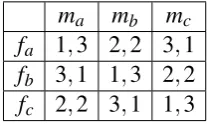
We can show this using a simple counterexample (Table 4.1) from the famous paper by
Shapley and Gale [6], in which we have three male agents{ma,mb,mc}and three female
agents{fa,fb,fc}and preferences that are expressed in Table 4.1. Here the first number is
the rank the male agent (row) assigns to being matched with the female agent (column) and the second number is the rank the female agent assigns to being matched with the male agent
(thus for male agentmafemale agent fais his most preferred candidate while male agentma
is the least preferred candidate of female agent fa).
The matchingµ1={(ma,fc),(mb,fa),(mc,fb)}is stable since there exists no blocking
30 Convergence towards stability
ma mb mc
fa 1,3 2,2 3,1
fb 3,1 1,3 2,2
[image:39.595.238.342.108.171.2]fc 2,2 3,1 1,3
Table 4.1 Example of a stable matching problem in which a stable matching exists that is not optimal for either sides of the market
favorite to their least favorite). There exists however a stable matching in which a male agent
(even all male agents) are better off, namely the matchingµ2={(ma,fa),(mb,fb),(mc,fc)}
where all male agents are matched with their most favorite female agent. This is the matching that would result from the Deferred Acceptance Algorithm with the male agents as proposing party. There also exists a stable matching in which all female agents are better off, namely
the matching µ3 ={(ma,fb),(mb,fc),(mc,fa)} where all male agents are matched with
their most favorite female agents. This is the matching that would result from the Deferred Acceptance Algorithm with the female agents as proposing party.
4.2.2
Our model obtaining suboptimal matchings
Theorem 7. Our model does not necessarily converge to one of the optimal stable matchings that is the result of the Deferred Acceptance Algorithm.
Proof. We can show this using a simple counterexample. Take the same example (Table
4.1) from the Shapley and Gale paper as in the previous theorem with the stable matching
µ1={(ma,fc),(mb,fa),(mc,fb)}, that is not optimal for either side of the market. Remember
we start every simulation with single agents who would start a relationship with any agent they meet the first dateround. If we would thus have that in the first dateround we obtain
a bipartite graph G1 exactly similar to the suboptimal stable matching µs then we will
immediately obtain the suboptimal stable matching µs and sinceµs is stable it will be the
result of the simulation in our model.
Chapter 5
Understanding the model
5.1
Research questions
The goal of our model is to simulate real-world two-sided matching markets. We start by
explaining how preferences in the utility functionu:M×F→R×Rare randomly generated,
based on the parameters pands. Here pis the preference agreement factor that affects the
objectivity of the preferences within one side of the market andsis the symmetry factor that
affects the symmetry of the preferences between the two sides of the market.
We first investigate, by running simulations, what the effects are of changing the parame-ter values on the results obtained with the Deferred Acceptance Algorithm of Shapley and Gale [6]. We specifically examine what the effects are of changing the preference agreement
factor p, the symmetry factor s and the number of agents in the market. We investigate
the effect of changing these parameters on the number of rounds it takes to reach the op-timal stable matching in the Deferred Acceptance Algorithms and what the payoffs of the agents in the obtained matchings in this algorithm are. We also investigate what the effects of changing these parameters are on the percentage of the simulations in which the opti-mal stable matching for opti-male agents is equal to the optiopti-mal stable matching for feopti-male agents.
32 Understanding the model
Algorithm.
One of the goals of this thesis is to provide researchers with a model that can be extended, such that it simulates real-world two-sided matching markets. It is therefore important to provide the reader with thorough understanding of our model. To be able to extend our model, it is crucial to understand the effects of changing the parameter settings in both our model and in the Deferred Acceptance Algorithm. This chapter contains a relatively detailed investigation of the effects of changing parameter settings in both our model and the Deferred Acceptance Algorithm. To ensure that the reader does not have to miss the most important conclusions, without having to dive into all the details, we end section 5.3, 5.4 and 5.5 with summaries. In these summaries the reader finds the most important results of the simulations in the Deferred Acceptance Algorithm, our model and our exhaustive research of all stable matchings, respectively.
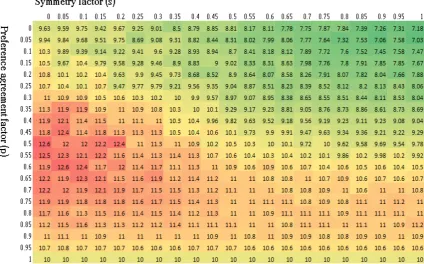
We find that our model will on average converge to stable matchings with average payoffs higher than, or equal to, the average payoffs in the two stable matchings that result from the Deferred Acceptance Algorithm, independent of the parameter settings. The greatest
difference we find for subjective preferences in which there is no symmetry (p=0 ands=0).
In order to better understand why our model yields higher payoffs we investigated all possible matchings for 450 instances of the Stable Marriage Problem with 10 male and 10 female
agents, with p=0 ands=0. For all instances we investigate which matchings are stable
and what the average payoffs in these stable matchings are. We then run 500 simulations in our model until a stable matching is reached for every instance, to examine which stable matchings are more often obtained.
5.2
Preferences
The values of the preference function u are assigned randomly. There are however two
parameters that affect the values assigned by u to every pair consisting of a male and a
5.2 Preferences 33
however, there is some subjectivity in place, it seems to be important whether this matter
of taste is symmetric. Thus, whether it is the case that when a male agentmahighly prefers
being in a relationship with female agent fb, then this female agent fb also likes agent
marelatively more. We therefore introduce two parameters that influence the preferences
assigned by the preference functionu. The first parameter is the preference agreement factor
pwith 0≤p≤1. The second parameter is the symmetry factorswith 0≤s≤1. The higher
p, the more similar the preferences of agents within one side of the market over the other
side of the market are. The highers, the closerum(mi,fj)anduf(mi,fj)are.
The values for the functionuare generated by first generating four lists:gm= (a1, . . . ,am)
(which represents the objective preferences of the male agents over the female agents),g f =
(b1, . . . ,bn)(which represents the objective preferences of the female agents over the male
agents), sm= ((c11, . . . ,c1m)1, . . . ,(cn1, . . . ,cnm)n)(which represents the subjective
prefer-ences of the male agents over the female agents) ands f= ((d11, . . . ,d1n)1, . . . ,(dm1, . . . ,dmn)m)
(which represents the subjective preferences of the female agents over the male agents) with
n the number of male agents and m the number of female agents, and ai,bj,ci j,dji∈R
where 0<ai ≤10, 0 <bj ≤10, 0<ci j ≤10, 0< dji≤ 10 and where ai, bj, ci j and
dji are all randomly generated and 1 ≤i ≤n and 1≤ j ≤m. With preference
agree-ment factor pand symmetry factors, we now have thatum(mi,fj) = paj+ (1−p)ci j and
uf(mi,fj) =s(um(mi,fj)) + (1−s)(pbi+ (1−p)dji). Note that whenp=0 the preferences
are fully subjective and when p=1 all male agents have exactly the same preferences over
the female agents and the other way around. Fors=1,um(mi,fj) =uf(mi,fj)for any two
agentsmiand fj. If we have p=0 ands=0, then the preferences are uniformly random.
Note that whenum(mi,fj) =uf(mi,fj), this does not automatically mean thatmiand fjrank
each other the same way over all agents of the other side of the market, since it might for
example be the case that male agentmiand fj both assign a preference score of 9 to each
other, but that there exists no male agent that agent fjlikes more thanmiwhile there exists
some female agent fk thatmiassigns a score of 9.5 to, who is thus ranked better by him than
fj.
If our model generates preferences for any agent mi,fj and fk where uf(mi,fj) =
uf(mi,fk)then we slightly increaseuf(mi,fj)with 0.0001 if j<koruf(mi,fk)with 0.0001
if k< j to ensure we have strict preferences. The same holds for the preferences of the