Prevention of Parametric Rolling through Multi-Objective
Optimisation
Haipeng Liu
1, Osman Turan
1, Evangelos Boulougouris
1ABSTRACT
International Maritime Organisation is developing new intact stability criteria which include parametric rolling and they will have a larger impact on particular ship types. A benchmark study of those criteria on C11 containership is presented herein. Moreover, the authors investigate the impact to the overall design from the introduction of the new criteria as one of the objectives in a multi-criteria design optimisation which is solved using Genetic Algorithms.
KEY WORDS
Parametric Rolling; Resistance; Ship Design; Multi-Objective Optimisation; NSGA-II Genetic Algorithm
INTRODUCTION
In the late 1930s, parametric rolling was firstly studied in Germany (Paulling 2007). However, in October 1998, a post-Panamax C11 class containership, experienced a very severe storm in the North Pacific Ocean while traveling from Kaohsiung to Seattle. The C11 containership lost one-third of its containers and damaged another one-third containers as well. The investigation revealed that this was caused by parametric rolling (France 2003). After this serious accident, this phenomenon has attracted more attention from researchers to carry out more in depth research studies in order to predict and prevent parametric rolling. Post-Panamax C11 containership has been widely used for benchmark study on parametric rolling.
The existing stability criteria (2008 IS code) are limited to the dynamic stability information provided by the GZ-φ curve. They do not provide enough safety against more complex risks associated with the performance of the intact ship in waves. Therefore, the International Maritime Organisation (IMO) is developing the next generation of intact stability criteria to fill the gap. Five stability failure modes have been taken into consideration by the IMO working group (Working Group 2012):
Parametric rolling
Pure loss of stability
Broaching/Surf-riding
Dead ship condition
Excessive acceleration
The proposed criteria have three levels with different sophistication. Level 1 and level 2 constitute a vulnerability layer while level 3 constitutes a performance-based layer. The lower the level it is, the more conservative it is. Level 1 uses a simplistic approximation, while level 3 uses the most advanced method, i.e. time-domain numerical simulation. The procedure starts with level 1 and progresses to next level until the vessel passes the criteria.
If the vessel passes any level of the criteria, the process is completed and the ship is judged as safe against the relevant stability failure mode. However, if the ship fails to pass the top level criteria, it means the ship is vulnerable and it has to be re-designed until it passes the criteria. At present, IMO is mainly focusing on developing the vulnerable layer.
This paper deals with the first of the failure modes, namely parametric rolling (PR). As a ship vulnerable to PR has to be re-designed, there will be constraints and objectives such as minimizing the impact to resistance and if possible even reduce it. Genetic algorithms have been widely used in multi-objective optimisation due to its population-based nature which allows the several element generation of the Pareto optimal set with a single run (Coello 2002). Here, a multi-objective evolutionary algorithm is proposed as a solution to the multi-objective optimisation problem in integrated parametric rolling and resistance (IPRR) design process. The objectives of IPRR process are optimised by a multi-objective genetic algorithm “Nondominated sorting genetic algorithm II (NSGA II).
In the following paragraphs, the details of vulnerability layer of parametric rolling will be introduced. By applying the checking procedure on a C11 containership model, the ship is judged as vulnerable to parametric rolling. Then, a multi-objective optimisation is processed to decrease or eliminate the parametric rolling problem and reduce the resistance at the same time. The effect of the decision variables on design objectives is established. The optimum design is also achieved through NSGA II algorithm and the result satisfies all the requirements.
PARAMETRIC ROLLING
In the following paragraphs, a short description of the applied criteria and their levels in vulnerability layer will be presented.
Level 1 vulnerability criterion
As defined by current draft criteria (Working Group 2014), if the ratio of GM variation in reference wave ∆GM/GM is larger
than the standard RPR, the ship is vulnerable to parametric rolling; otherwise it is non-vulnerable. Here GM is the metacentric
height of the loading condition in calm water including free surface correction and ∆GM is the change of metacentric height which can be estimated using two different methods. In the first method, two different drafts are used and Simpson’s rule is applied to calculate the moment of inertia and the average GM variation is achieved. This method is not suitable to a tumblehome hullform but it is applicable to a ship with non-even keel (Working Group 2014). In the second method, ΔGM may be determined as one-half difference between the maximum and minimum GM calculated in sinkage and trim on a series of waves with wave length equals to ship length and the wave height equals to 1/60 of wave length. As C11 is the conventional container ship, the second method is used for the benchmark study.
Level 2 vulnerability criteria
Level 2 criteria (Working Group 2014), are comprised by “two checks”. If the vessel doesn’t pass any check, it is judged as vulnerable to parametric rolling and the vessel has to be checked in performance-based layer.
First Check
The first check aims to test whether the vessel’s speed is within the vulnerable region for PR and GM variation satisfies the
PR safety requirement. The probability of C1 in the first check is a sum of the product of Ci and the wave weighting factor Wi.
The 16 wave series applied in this check are discretisation of the applied wave spectrum. The weighting factor is the occurrence probability among the wave series for each wave case. The wave lengths vary from 22.57 m to 63.68 m and the
wave heights vary from 0.35 m to 5.95 m. The value for criterion 1 in each case, C1i is 0 if both speed check and GM relevant
check satisfy with the specific condition as the vessel is considered not vulnerable to PR; otherwise C1i is 1.
Parametric rolling occurs when the encounter frequency is equal to the double of the natural roll frequency. The speed
corresponds to the resonance speed VPRi which is given by the following Equation 1.
i
2 ( , )
2
i i i i
PR
GM H
V g
T GM
[1]
For GM relevant conditions for avoiding the PR risk region are that ΔGM(Hi, λi)/GM(Hi, λi) < Rpr and GM(Hi, λi) > 0. Here,
the average metacentric height corresponding to the loading condition under consideration, GM(Hi, λi); and the one-half of
the difference between the maximum and minimum values of the metacentric height GM in wave, ΔGM(Hi, λi); are
If total probability of C1 is greater or equal to the standard value Rpr0 of 0.06 the ship is judged as potentially vulnerable and it needs to be checked by the second check; otherwise the vessel is not vulnerable and it passes the evaluation of parametric rolling problem.
Second Check
When C1 is not smaller than Rpr0, the designer should apply the second check. The ship performance is simulated under
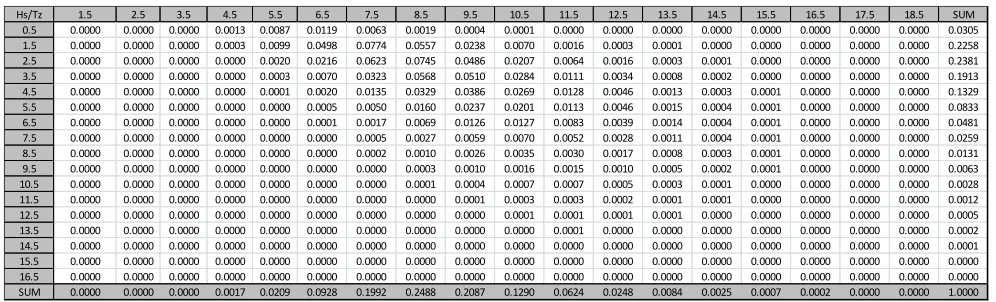
NO.34 standard wave cases (IACS 2001). Each wave case has the corresponding weighting factor Wi, which represents the
sample wave’s occurrence probability among all the 306 wave cases, as shown in table 1.According to the criteria, if the vessel in each wave case experiences the roll angle which is larger than 25 degrees, the vessel is judged as vulnerable to
parametric rolling and C2i is 1, otherwise is 0. An analytical method based on the simplification of Mathieu’s equation is used
to predict the roll amplitude as given in equation [2] (CGIS 2014). GM variation in waves is calculated quasi-statically. Ikeda’s simplified method, based on an empirical formula, is used for the damping prediction (Kawahara 2009). It divides the roll damping into the frictional, the wave, the eddy, the bilge keel and the lift damping components.
) ( ) 0
where Ixx+Jxx: virtual moment of inertia in roll; R: nonlinear roll damping;
W: ship weight GM: metacentric height
xx xx
I J R W GM
(
[2]
For the second check, if the total probability sum C2 which is the product of C2i and wave weighting factor Wi, is greater than
standard Rpr0 0.06, the ship is judged vulnerable to parametric rolling and the ship should be checked by level 3; if not, it is
[image:3.612.58.556.383.534.2]judged as non-vulnerable to parametric rolling and the ship passes the parametric rolling failure mode and it should be checked for the other stability failure modes.
Table 1: No.34 Wave Scatter Relevant Weighting Factor of Sea State in the North Atlantic
Hs/Tz 1.5 2.5 3.5 4.5 5.5 6.5 7.5 8.5 9.5 10.5 11.5 12.5 13.5 14.5 15.5 16.5 17.5 18.5 SUM
0.5 0.0000 0.0000 0.0000 0.0013 0.0087 0.0119 0.0063 0.0019 0.0004 0.0001 0.0000 0.0000 0.0000 0.0000 0.0000 0.0000 0.0000 0.0000 0.0305 1.5 0.0000 0.0000 0.0000 0.0003 0.0099 0.0498 0.0774 0.0557 0.0238 0.0070 0.0016 0.0003 0.0001 0.0000 0.0000 0.0000 0.0000 0.0000 0.2258 2.5 0.0000 0.0000 0.0000 0.0000 0.0020 0.0216 0.0623 0.0745 0.0486 0.0207 0.0064 0.0016 0.0003 0.0001 0.0000 0.0000 0.0000 0.0000 0.2381 3.5 0.0000 0.0000 0.0000 0.0000 0.0003 0.0070 0.0323 0.0568 0.0510 0.0284 0.0111 0.0034 0.0008 0.0002 0.0000 0.0000 0.0000 0.0000 0.1913 4.5 0.0000 0.0000 0.0000 0.0000 0.0001 0.0020 0.0135 0.0329 0.0386 0.0269 0.0128 0.0046 0.0013 0.0003 0.0001 0.0000 0.0000 0.0000 0.1329 5.5 0.0000 0.0000 0.0000 0.0000 0.0000 0.0005 0.0050 0.0160 0.0237 0.0201 0.0113 0.0046 0.0015 0.0004 0.0001 0.0000 0.0000 0.0000 0.0833 6.5 0.0000 0.0000 0.0000 0.0000 0.0000 0.0001 0.0017 0.0069 0.0126 0.0127 0.0083 0.0039 0.0014 0.0004 0.0001 0.0000 0.0000 0.0000 0.0481 7.5 0.0000 0.0000 0.0000 0.0000 0.0000 0.0000 0.0005 0.0027 0.0059 0.0070 0.0052 0.0028 0.0011 0.0004 0.0001 0.0000 0.0000 0.0000 0.0259 8.5 0.0000 0.0000 0.0000 0.0000 0.0000 0.0000 0.0002 0.0010 0.0026 0.0035 0.0030 0.0017 0.0008 0.0003 0.0001 0.0000 0.0000 0.0000 0.0131 9.5 0.0000 0.0000 0.0000 0.0000 0.0000 0.0000 0.0000 0.0003 0.0010 0.0016 0.0015 0.0010 0.0005 0.0002 0.0001 0.0000 0.0000 0.0000 0.0063 10.5 0.0000 0.0000 0.0000 0.0000 0.0000 0.0000 0.0000 0.0001 0.0004 0.0007 0.0007 0.0005 0.0003 0.0001 0.0000 0.0000 0.0000 0.0000 0.0028 11.5 0.0000 0.0000 0.0000 0.0000 0.0000 0.0000 0.0000 0.0000 0.0001 0.0003 0.0003 0.0002 0.0001 0.0001 0.0000 0.0000 0.0000 0.0000 0.0012 12.5 0.0000 0.0000 0.0000 0.0000 0.0000 0.0000 0.0000 0.0000 0.0000 0.0001 0.0001 0.0001 0.0001 0.0000 0.0000 0.0000 0.0000 0.0000 0.0005 13.5 0.0000 0.0000 0.0000 0.0000 0.0000 0.0000 0.0000 0.0000 0.0000 0.0000 0.0001 0.0000 0.0000 0.0000 0.0000 0.0000 0.0000 0.0000 0.0002 14.5 0.0000 0.0000 0.0000 0.0000 0.0000 0.0000 0.0000 0.0000 0.0000 0.0000 0.0000 0.0000 0.0000 0.0000 0.0000 0.0000 0.0000 0.0000 0.0001 15.5 0.0000 0.0000 0.0000 0.0000 0.0000 0.0000 0.0000 0.0000 0.0000 0.0000 0.0000 0.0000 0.0000 0.0000 0.0000 0.0000 0.0000 0.0000 0.0000 16.5 0.0000 0.0000 0.0000 0.0000 0.0000 0.0000 0.0000 0.0000 0.0000 0.0000 0.0000 0.0000 0.0000 0.0000 0.0000 0.0000 0.0000 0.0000 0.0000 SUM 0.0000 0.0000 0.0000 0.0017 0.0209 0.0928 0.1992 0.2488 0.2087 0.1290 0.0624 0.0248 0.0084 0.0025 0.0007 0.0002 0.0000 0.0000 1.0000
SAMPLE SHIP
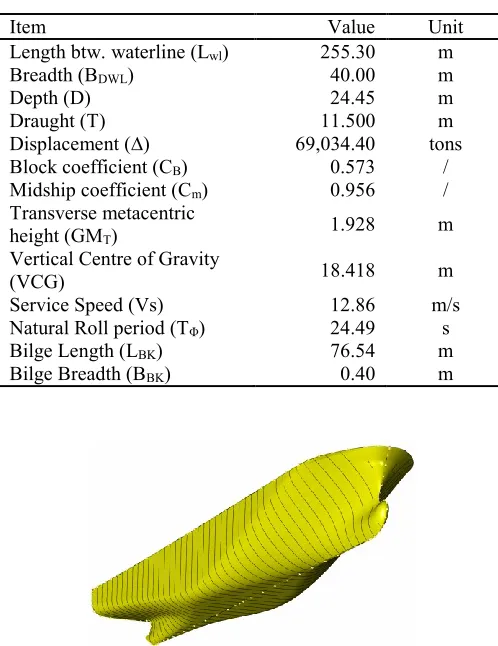
Table 2: Main Parameters of C11 Containership
Item Value Unit
Length btw. waterline (Lwl) 255.30 m
Breadth (BDWL) 40.00 m
Depth (D) 24.45 m
Draught (T) 11.500 m
Displacement (∆) 69,034.40 tons
Block coefficient (CB) 0.573 /
Midship coefficient (Cm) 0.956 /
Transverse metacentric
height (GMT) 1.928 m
Vertical Centre of Gravity
(VCG) 18.418 m
Service Speed (Vs) 12.86 m/s
Natural Roll period (TΦ) 24.49 s
Bilge Length (LBK) 76.54 m
[image:4.612.180.429.68.391.2]Bilge Breadth (BBK) 0.40 m
Figure 1: C11 Container Ship Hullform Model in Maxsurf
A tool has been developed at the Department of Naval Architecture, Ocean & Marine Engineering at the University of Strathclyde. It is based on a code written in MS VBA in MS Excel using the automation tools of the Maxsurf suite (Maxsurf Modeler 2014).
With analysis from the existing tool, the result of the benchmark study is summarised in table 3 and it has a good agreement.
As shown, C1 and C2 is both larger than standard Rpr0 0.06, and it demonstrated that the C11 container vessel is vulnerable to
[image:4.612.179.434.72.263.2]parametric rolling. Therefore, it is necessary to improve the ship hull to avoid parametric rolling occurrence.
Table 3: Comparison between Current Calculation Result and IMO Published Result of Parametric Rolling
Organisation Lpp (m) ∆GM/GM RPR C1 C2
SLF- IMO 262 1.056 0.356 0.437 0.073
University of Strathclyde 262 1.067 0.400 0.436 0.068
Note
Non-vulnerable
Vulnerable
OPTIMISATION
proposed by Japan in the relevant IMO sub-committee (CGIS 2014). The proposed method considers the roll motion assuming heave and pitch balanced quasi-statically. Resistance was processed by Maxsurf Resistance software. The optimised hull will then also be tested by the existing parametric rolling criteria. A case study on the optimisation of a containership based on C11 has been performed and is presented herein.
1)
Hull Generator
Input variables in optimisation are the waterline length Lwl, breadth B, draft T, block coefficient Cb and midship coefficient
Cm. To investigate these decision variables’ effect on design objectives, the new design series were generated by Maxsurf
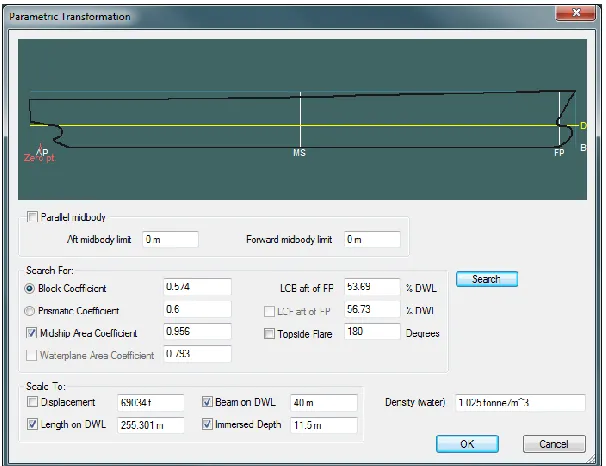
Modeler software. The hull geometry is produced from an original ship by a “parametric transform” method, as shown in figure 2, based on Lackenby hull variation method (Lackenby 2001). The transformation moves the sections fore and aft until
the required parameters are met. The reasonable variations of Cb, Cp or LCB are restricted within a ±5%. In Maxsurf Modeler,
[image:5.612.155.458.259.492.2]the new LCB position and either a new block or prismatic coefficient can be searched, followed by constraint values for a maximum of three of displacement, waterline length, beam and draft. The scenario studied here is that the designer would like to search for better solution in the proximity of the existing design whether the weights and the general arrangement are mature and acceptable. In that respect the difference between the new and the original design displacements are minimised.
Figure 2: Parametric Transform Dialogue in Maxsurf
2)
Stability Analysis
There are several stability issues which should be checked in practice. In this paper, the parametric rolling problem is involved in the optimisation process. After identifying the optimum design candidates, the existing parametric rolling criteria are applied to these designs and then the optimum design can be selected. All the stability calculations were carried out using the Maxsurf Stability software (Maxsurf Stability 2014).
3)
Resistance Analysis
As the procedure to eliminate the parametric rolling vulnerability is affecting the hullform, the resistance was also included as
a design objective. Holtrop’s method (Holtrop1982) calculated in Maxsurf Resistance software was selected for the
Figure 3: Resistance Calculated by Holtrop’s Method
4)
Multi-objective Optimisation
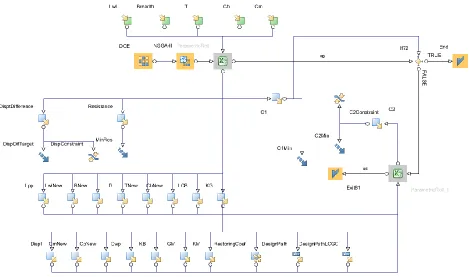
The optimisation was performed using the modeFRONTIER software (modeFRONTIER 2014). As shown in figure 4, the
flow integrates the input decision variables, design objectives, optimisation loop which is programmed with VBA code in MS Excel, initial designs and optimisation algorithms. All evaluations of ship performance have been automated.
There are five input variables of ship principal parameters, ship length L, Breadth B, draft T, block coefficient Cb and
midship coefficient Cm. All variables are set in the reasonable small range. Due to the fact that GM is affected by breadth (B),
the lower boundary of B is restricted to change within -3% to avoid negative GM. These input parameters are sent to Excel application where ship hull transformation, parametric rolling prediction and resistance automated prediction are completed.
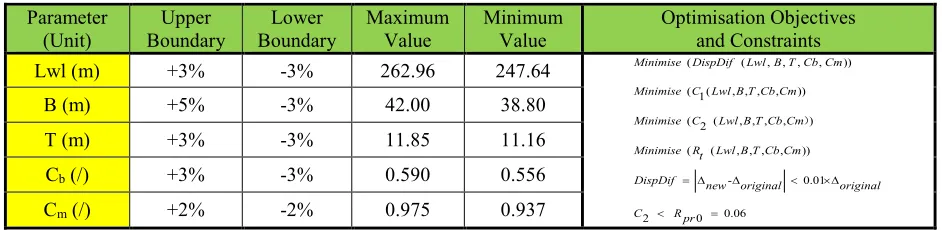
The displacement difference between the new design and the original design and the C2 value in level 2 second check in
parametric rolling are set as constraints. The design objectives are minimisation of displacement difference (DispDif)
between original design ∆original and new design ∆new, resistance Rt, parametric rolling C1 value and C2 value. The variable
range, design objectives and constraints are summarised in table 4.
The selected main particulars of hullform were searched by Deb’s Non-dominated Sorting Genetic Algorithm II (NSGA-II) (Deb 2002). The optimisation process combined with relevant softwares to achieve the optimum design is described in figure
5. 20 initial DOE designs combined with 150 generations are set in DOE properties and scheduler properties and 3000
designs have been generated. After deleting duplicated and error designs, it involves 1342 (44.7%) feasible designs and 184 (6.1%) Pareto designs.
Table 4: Input Variables, Objectives and Constraints Setting in modeFRONTIER
Parameter
(Unit) Boundary Upper Boundary Lower Maximum Value Minimum Value Optimisation Objectives and Constraints
Lwl (m) +3% -3% 262.96 247.64 ( ( , , , , ))
(1( , , , , ))
( 2 ( , , , , )
( ( , , , , ))
- 0.01
0.06
2 0
Minimise DispDif Lwl B T Cb Cm
Minimise C Lwl B T Cb Cm
Minimise C Lwl B T Cb Cm
Minimise Rt Lwl B T Cb Cm
DispDif new original original
C R pr
)
B (m) +5% -3% 42.00 38.80
T (m) +3% -3% 11.85 11.16
Cb (/) +3% -3% 0.590 0.556
[image:6.612.71.542.563.678.2]Figure 4: Work Flow in modeFRONTIER
Conceptual Design
Optimisation Objectives
Decision
Variables Constraints
Modify Input Parameters Run Simulation Model
Output Results Obtain Objective Parameters
Optimisation Scheduler (NSGA-II)
Pareto Designs
Multi-Criteria Decision Maker
Optimum Design Candidates
Existing Stability Criteria Check
Optimum Design Automation
[image:7.612.178.431.365.708.2]Process
RESULT AND DISCUSSION
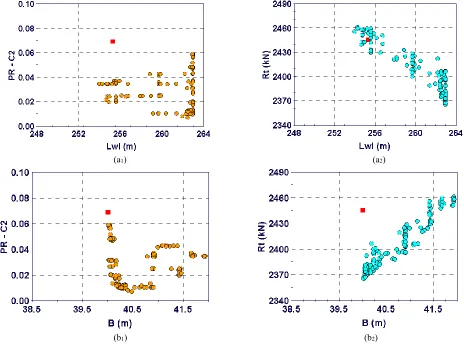
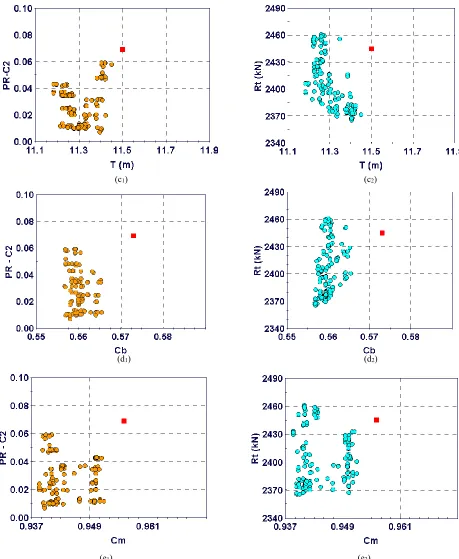
The main aim of this paper is to decrease parametric rolling performance and reduce the resistance through multi-objective optimisation. The objectives of hullform variation, parametric rolling performance and resistance were optimised by the NSGA II genetic algorithm. It is necessary to analyse the influence of each variable on the design objectives. Figure 6 shows
the Pareto designs of this investigation with the five input variables on C2 of parametric rolling (figure a1 to figure a5) and
resistance Rt (figure b1 to figure b5). From the Pareto design distribution given in figure 6, compared to the original design no.
0 (shown in red point), the Pareto designs could be achieved by increasing length, increasing breadth, decreasing draft,
decreasing Cb and decreasing Cm.
Although the minimisation of C1 value is a design objective, all the C1 values are larger than the standard Rpr0 and all the
designs are needed to be applied to second check. It was assumed that giving C1 design objective a weight to 0 would be a
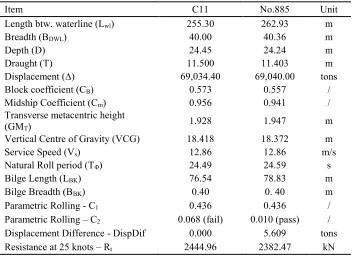
[image:8.612.67.531.296.650.2]valid scenario. For the other three objectives, it was assumed that all of them are equally important and therefore the weight was uniformly distributed to them. The designs were ranked according these weights. The 10 optimum designs are shown in table 5. The optimum design according to this ranking was the No.885 design. Additional calculations proved that it complied also with the existing intact stability criteria (2008 IS code). Its main particulars compared to those of the original design are listed in table 6. The resistance of the new design compared to that of original design is shown in figure 7. It is evident that the optimisation managed to keep the displacement the same, solve the parametric rolling problem and at the same time reduce the resistance by 2.5%.
(a1) (a2)
Figure 6: Effects of Five Variables on C2 of Parametric Rolling and Resistance Rt
(b1)
(b2)
(d2)
(d1)
(e1) (e2)
Table 5: Top 10 Optimum Design Ranks
Table 6: Main Particulars of C11 and the No.885 Optimum Design
Item C11 No.885 Unit
Length btw. waterline (Lwl) 255.30 262.93 m
Breadth (BDWL) 40.00 40.36 m
Depth (D) 24.45 24.24 m
Draught (T) 11.500 11.403 m
Displacement (∆) 69,034.40 69,040.00 tons
Block coefficient (CB) 0.573 0.557 /
Midship Coefficient (Cm) 0.956 0.941 /
Transverse metacentric height
(GMT) 1.928 1.947 m
Vertical Centre of Gravity (VCG) 18.418 18.372 m
Service Speed (Vs) 12.86 12.86 m/s
Natural Roll period (TΦ) 24.49 24.59 s
Bilge Length (LBK) 76.54 78.83 m
Bilge Breadth (BBK) 0.40 0. 40 m
Parametric Rolling - C1 0.436 0.436 /
Parametric Rolling – C2 0.068 (fail) 0.010 (pass) /
Displacement Difference - DispDif 0.000 5.609 tons
Resistance at 25 knots – Rt 2444.96 2382.47 kN
[image:10.612.115.496.239.705.2]CONCLUSION
In this paper, the procedure to check whether the vessel is vulnerable to the proposed draft vulnerability criteria of parametric rolling or not was presented. An optimisation process was developed to investigate the main impact of five design variables on parametric rolling performance and resistance. A tool was developed for the automation of the overall process with Visual
Basic Application in Excel. A multi-objective optimisation process was integrated in modeFRONTIER and the NSGA II
genetic algorithm was utilised to optimise the design objectives. Compared to the original design, increasing length, breadth, decreasing draft, block coefficient, midship coefficient could improve the ship safety to parametric rolling and reduce the resistance. The achieved optimum design passes the parametric rolling criteria while the resistance has also been reduced.
ACKOWLEGEMENTS
This project was funded by Lloyd’s Register. All internal information relevant to second generation of intact stability was kindly provided by Royal Institution of Naval Architects. The support from Lloyd’s Register and Royal Institution of Naval
Architects is gratefully acknowledged.
REFERENCES
Coello, C.A.C., Lamont, G.B., and Veldhuizen D.A.V., “Evolutionary Algorithms for Solving Multi-Objective Problems.”
Kluwer Academic Publishers, New York, 2002
Correspondence Group on Intact Stability (CGIS), “Working Version of Draft Explanatory Notes on the Vulnerability of Ships to the Parametric Rolling Stability Failure Mode.” Sub-Committee on Ship Design and Construction, SDC 2/INF.10 Annex 17, 59-74, 12 December 2014.
Deb, K., Pratap A., Agrawal S., and Meyarivan. T, “A Fast and Elitist Multiobjective Genetic Algorithm: NSGA-II.” IEEE Transactions on Evolutionary Computation, Vol. 6, No.2, April 2002
France, W.N., Levadou M., Treakle T.W., Paulling J.R., Michel R.K. and Moore C. "An investigation of head-sea parametric rolling and its influence on container lashing systems." Marine Technology, 40.1: 1-19, 2003
Holtrop, J. and Mennen G.G.J, “An Approximate Power Prediction Method.” International Shipbuilding Progress, Vol. 29, No.335, 1982
International Association of Classification Societies (IACS), “No.34 Standard Wave Data.” 2001
Kawahara, Y., Maekawa K., and Ikeda Y. “A Simple Prediction Formula of Roll Damping of Conventional Cargo Ships on the
Basis of Ikeda’s Method and Its Limitation.” The 10th International Conference on Stability of Ships and Ocean Vehicles, St.
Petersburg , Russia, 2009
Lackenby, H. “On the Systematic Geometrical Variation of Ship Forms.” RINA-Transaction, Vol 92, 1950
Maxsurf Modeler Version 20, “Maxsurf Modeler User Manual.” Bentley Systems, 2014
Maxsurf Resistance Version 20, “Maxsurf Resistance User Manual.” Bentley Systems, 2014
Maxsurf Stability Version 20, “Maxsurf Stability User Manual.” Bentley Systems, 2014
modeFRONTIER 4.5.4, ESTECO srl, “ modeFRONTIER User Manual.” 2014
Paulling, J.R., “On Parametric Rolling of Ships.” Proceedings of 10th International Symposium on Practical Design of Ships and
Other Floating Structures, Houston, 2007
Amendments to Part B of the 2008 IS Code on Towing and Anchor Handling Operations: Report of Working Group (Part 1), Annex 2, SDC 2/WP.4, 18 February 2014
Working Group, “Summary of the Methodologies for the Second Generation Stability Criteria Available for SLF 54” Annex 3,