Collins, Oonagh and Cussen, Eddie (2013) A neutron diffraction study of
structural distortion and magnetic ordering in the cation-ordered
perovskites Ba2Nd1−xYxMoO6. Journal of Solid State Chemistry, 200.
pp. 215-220. ISSN 0022-4596 , http://dx.doi.org/10.1016/j.jssc.2013.01.023
This version is available at
https://strathprints.strath.ac.uk/42686/
Strathprints is designed to allow users to access the research output of the University of Strathclyde. Unless otherwise explicitly stated on the manuscript, Copyright © and Moral Rights for the papers on this site are retained by the individual authors and/or other copyright owners. Please check the manuscript for details of any other licences that may have been applied. You may not engage in further distribution of the material for any profitmaking activities or any commercial gain. You may freely distribute both the url (https://strathprints.strath.ac.uk/) and the content of this paper for research or private study, educational, or not-for-profit purposes without prior permission or charge.
Any correspondence concerning this service should be sent to the Strathprints administrator:
A neutron diffraction study of structural distortion and magnetic ordering in the
cation-ordered perovskites Ba
2Nd
1-xY
xMoO
6Oonagh M. Collins and Edmund J. Cussen*
WestCHEM, The Department of Pure and Applied Chemistry, The University of Strathclyde, Thomas
Graham Building, 295 Cathedral Street, Glasgow, G1 1XL, Scotland
E-mail: [email protected]
Tel: +44 141 548 2797
Abstract
The cation ordered perovskites Ba
2Nd
1-xY
xMoO
6(0.04
≤
x
≤
0.35) have been synthesised by
solid-state techniques under reducing conditions at temperatures up to 1350°C. Rietveld
analyses of X-ray and neutron powder diffraction data show that these compounds adopt a
tetragonally-distorted perovskite structure. The tetragonal distortion is driven by the bonding
requirements of the Ba
2+cation that occupies the central interstice of the perovskite; this
cation would be underbonded if these compounds retained the cubic symmetry exhibited by
the prototypical structure. The size and charge difference between the lanthanides and
Mo
5+lead to complete ordering of the cations to give a rock-salt ordering of Nd
3+/Y
3+O
6and
MoO
6octahedra. The I4/m space group symmetry is retained on cooling the
x
= 0.1, 0.2 and
0.35 samples to low temperature
ca
. 2 K. Ba
2Nd
0.90Y
0.10MoO
6undergoes a gradual distortion
of the MoO
6units on cooling from room temperature to give two long
trans
bonds (2.001(2)
Å) along the
z
direction and four shorter apical bonds (1.9563(13) Å) in the
xy
plane. This
distortion of the MoO
6units stabilises the 4d
1electron in the d
xzand d
yzorbitals whilst the d
xyorbital is increased in energy due to the contraction of the Mo-O bonds in the
xy
plane. This
bond extension along
z
is propagated through the structure and gives a negative thermal
expansion of -13×10
-6K
-1along c. The overall volumetric thermal expansion is positive due
to conventional expansion along the other two crystallographic axes. With increasing Y
3+content this distortion is reduced in
x
=0.2 and eliminated in
x
=0.35 which contains largely
regular MoO
6octahedra. The
x
=0.1 and
x
=0.2 show small peaks in the neutron diffraction
Introduction
Complex perovskite oxides continue to be widely studied as they provide both a source of
new physical phenomena and a tuneable system for the development and testing of theory.
The incorporation of combinations of cations into the structure can be used to induce
chemical ordering and access new electronic states that are not present in the component
phases. A classic example of this is can be seen by comparing the complexity of the
room-temperature magnetoresistive phase[1, 2] Sr
2FeMoO
6with SrFeO
3[3] and SrMoO
3.[4, 5] We
have been examining related Mo
5+perovskites[6] and have seen that in the
electronically-localised phase Ba
2NdMoO
6the degeneracy of the 4d
1configuration of Mo
5+in the
octahedral ligand field leads to a distortion and a structural transition from tetragonal to
triclinic symmetry at
ca
. 140(10) K.[7] Cooling this material further leads to
antiferromagnetic ordering of both the Nd
3+and Mo
5+cations at 15 K.
Ba
2SmMoO
6shows similar structural and electronic behaviour although the temperature
dependence is very different.[8] The tetragonal to triclinic distortion occurs at 353 K with no
significant distortion of the MoO
6octahedra. These octahedra undergo distortion over a
narrow temperature range close to the Néel temperature of 130 K. Studies of the related
compounds Ba
2Ln
MoO
6have so far suggested that the Nd and Sm compounds are unique in
showing this distortion. A detailed study of Ba
2-xSr
xErMoO
6induced a high temperature
structural distortion shown in Figure 1 that matched that observed in Ba
2NdMoO
6. However,
the MoO
6octahedra in the tetragonal phases of the Ba
2-xSr
xErMoO
6series showed no
tendency to distort and no compositions gave the triclinic phase. [9]
The cubic phase Ba
2YMoO
6shows exceptionally strong antiferromagnetic coupling with a
Weiss constant of
ca
. -140 K.[6, 10-12] The geometric frustration of the face-centred cubic
magnetic moment on cooling due to the formation of a valence bond state.[10, 12, 14] We
have previously established that by introducing Y
3+into Ba
2NdMoO
6gives a solid solution
that undergoes a transition to a room temperature cubic phase for doping levels of
≥
40 % Y
substitution.[7] For
x
< 0.25 the series Ba
2Nd
1-xY
xMoO
6show magnetic transitions in the
range 10-15 K. In this paper we report a neutron diffraction study of these compounds in
order to probe the nature of the low temperature phase. This allows us to identify any
distortion of the MoO
6units and examine the nature of the low temperature magnetic state of
Experimental
Samples were synthesised using conventional solid-state techniques. Stoichiometric mixtures
of BaCO3, MoO3, Nd2O3 and Y2O3 were mixed and heated at temperatures up to 1350°C in
5% H
2in N
2as described previously.[7] The progress of the reactions was followed using
X-ray powder diffraction. After repeated regrinding and repressing of the reaction mixtures and
repeatedly heating the samples over between 3 and 5 days at 1350°C, the diffraction pattern
could be completely indexed using a unit cell indicative of a cation-ordered perovskite.
Further heating caused no change in the diffraction profile and so indicated that the reaction
was complete.
Powder neutron diffraction profiles were measured at various temperatures using the
time-of-flight high-resolution powder diffractometer (HRPD), installed at the ISIS spallation source
at the Rutherford Appleton Laboratories, Didcot, U.K. For this experiment
ca
. 4 g of sample
was housed in a cylindrical vanadium can, with an internal diameter of 11 mm. Diffraction
patterns were recorded over the time-of-flight range 30–130 ms in back-scattering, 90° and
30° detector banks, in order to sample a d-spacing range from 0.6 to 8 Å. Crystal and
magnetic structures were determined using the Rietveld method[15] of structure refinement
using the GSAS suite of programs.[16] A shifted Chebyshev function was used to fit the
background empirically and a convolution of exponential and pseudo Voigt functions was
Results
Neutron diffraction data collected at room temperature from Ba
2Nd
0.96Y
0.04MoO
6and
Ba2Nd0.90Y0.10MoO6 can be satisfactorily fitted using the tetragonal space group I4/m
observed in Ba
2NdMoO6 at room temperature.[6] Trial refinements showed that the
compounds are stoichiometric in oxygen and there is no evidence of site mixing between Mo
and Nd/Y. The trivalent charge on Nd/Y and oxide stoichiometry indicates that the
molybdenum is present in the 5+ oxidation state. Other studies of the Ba
2Ln
MoO
6phases
show that these compositions remain stoichiometric in oxide,[7, 9, 11] with any site mixing
between the
Ln
and Mo cations reaching a maximum value of
ca
. 3 % that is below the
detection limit for typical neutron diffraction data.[12] . The structures were refined in a
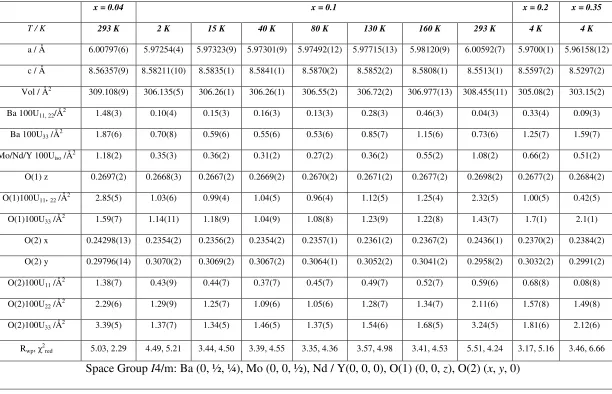
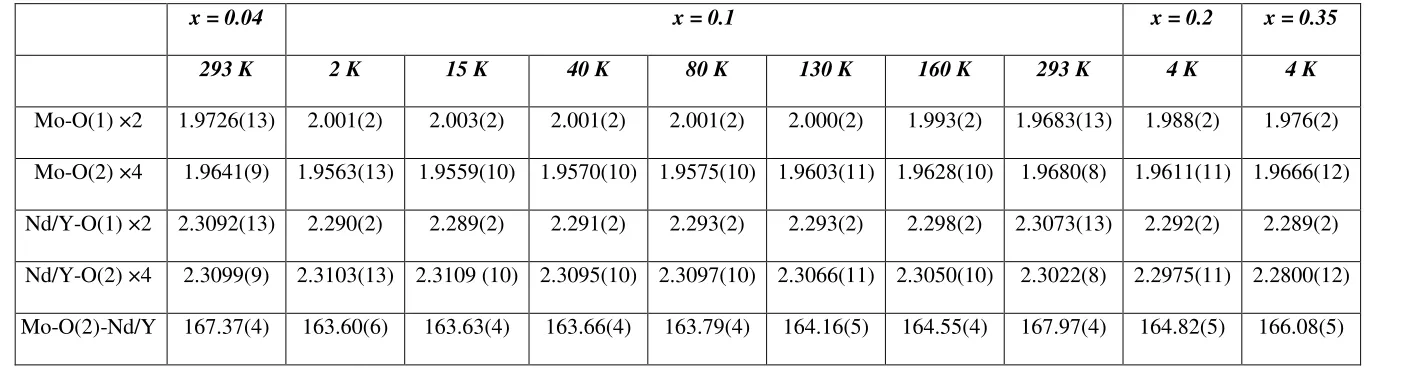
straightforward manner to give the atomic parameters and bond lengths collected in Tables 1
and 2 respectively. Additional datasets were collected from Ba
2Nd
0.90Mo
0.10O
6at
temperatures down to 2 K. The neutron diffraction data collected from this compound at
temperatures of 40 K and above can be indexed using the I4/m space group observed at room
temperature, albeit with a considerable expansion of the c lattice parameter on cooling the
material.
Neutron diffraction data collected from Ba
2Nd
0.90Y
0.10MoO
6at 15 K and 2 K contained
additional peaks at large d-spacings that are systematically absent in the body-centred
tetragonal cell observed at higher temperatures. As shown in Figure 2 there was no
significant change in the diffraction pattern at shorter d-spacings indicating that the
crystallographic structure was largely unchanged. Magnetisation measurements on this
material show a magnetic transition at 15(1) K and the strong temperature dependence of
neutron diffraction Bragg peaks around this temperature is indicative of long-range magnetic
which contains a primitive magnetic cell of the same dimensions as the nuclear cell, but
allows additional reflections due to the loss of the body-centred translational symmetry.
The magnetic scattering in Ba2Nd0.90Y0.10MoO6 is significantly weaker than in Ba2NdMoO6.
Ba
2NdMoO
6contains antiferromagnetically ordered moments on both Nd
3+and Mo
5+and
unconstrained refinement of this magnetic model failed to provide a stable refinement
indicating that the data collected from Ba
2Nd
0.90Y
0.10MoO
6at 2 K only provide information
on a single antiferromagnetically ordered moment in the unit cell. The special positions
occupied by Nd and Mo in the unit cell mean that it is not possible to identify in
a priori
manner which of the two ions is responsible for the magnetic scattering. However the
moment refines to a value,
ca
. 2
B, which is too large to arise from scattering from the S=
1/
2,
Mo
5+ions. The magnetic peaks can be satisfactorily fitted by refining a moment aligned
along the
z
-direction of the unit cell which is antiferromagnetically coupled to other magnetic
species related by the (1/2, 1/2, 1/2) translation to form ferromagnetically ordered chains that
are coupled antiferromagnetically. This structure can be described using the colour spin flips
in conjunction with the crystallographic symmetry of the tetragonal space group; namely the
4-fold axis (black), the mirror plane (black) and the translational symmetry (red).[17] This
symmetry constrains the magnetic moments to lie along the
z
-direction and allows refinement
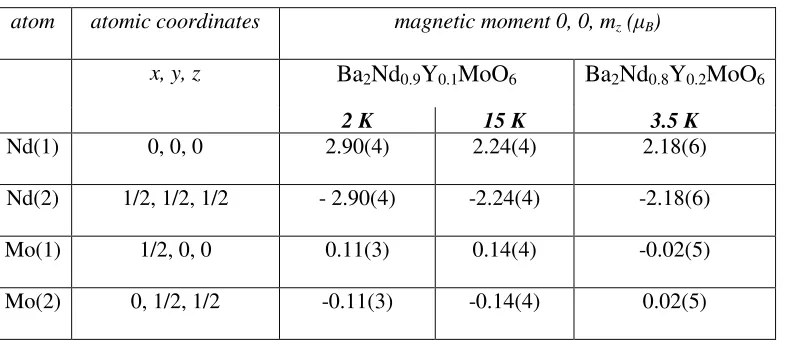
of moments on both the Nd and Mo positions in the unit cell as indicated in Table 3. The
moment refines to a value of 2.90(4) and 2.24(4) µ
Bper Nd
3+at 2 K and 15 K respectively.
Attempts to refine a moment on the Mo site gave a values of
ca
. 0.12(4)
Bthat are close to
the detection limits of the data and greatly reduced from the anticipated value of gS = 1
B.
Although the structure does not undergo a crystallographic transition there are considerable
changes in the structure on cooling. These are most clearly shown in the dimensions of the
MoO
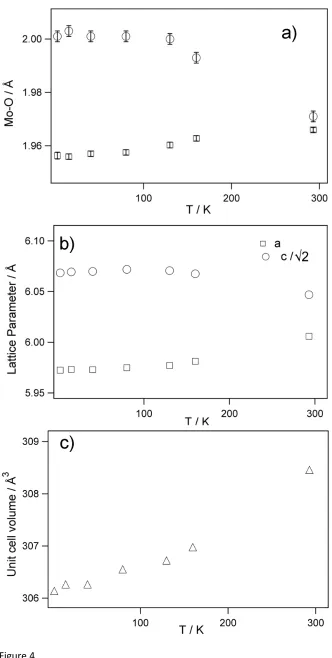
6octahedra and increase in the c-parameter on cooling. Figure 4 shows the variation in
The same tetragonal model was used to fit data collected from Ba
2Nd
0.80Y
0.20MoO
6at 4 K.
These data contained similar Bragg peaks at high d-spacing indicative of long-range
antiferromagnetic ordering and refinement of the magnetic model gave an ordered moment of
2.18(6) µ
Bper Nd
3+and -0.02(5)
Bper Mo
5+. The tetragonal nuclear structure is preserved
in Ba
2Nd
0.65Y
0.35MoO
6but the magnetic Bragg peaks are absent in data collected at 4 K as
shown in Figure 3. Structural parameters and bond lengths from all of these refinements are
Discussion
Neutron diffraction data have provided a full crystallographic description of compounds in
the series Ba2Nd1-
xY
xMoO6 that confirms that these phases are tetragonal at low temperature
for 0.10
≤
x
≤
0.35. This distortion is driven by the bonding requirements of the large Ba
2+cation that occupies the central interstice of the cubic perovskite structure. Whereas
Ba
2YMoO
6is cubic, Ba
2NdMoO
6is distorted in order to maintain acceptable distances
between the Ba
2+cation and the oxide anions. At room temperature Ba
2Nd
0.90Y
0.10MoO
6shows a range of Ba-O distances of 4 × 2.8662(5), 4 × 3.00774(8) and 4 × 3.1782(6) Å giving
a total bond valence of 1.91.[18]
If Ba
2Nd
0.90Y
0.10MoO
6were to form a cubic perovskite with the same mean Mo-O and
Nd/Y-O distances observed in the tetragonal room temperature phase this would give a face-centred
cubic structure with a lattice parameter of 2×
<
Mo-O> + 2×<Nd/Y-O> = 8.54487 Å. The
resultant 12 Ba-O bond lengths of 3.0258 Å would give an unacceptably low value for the
bond valence of 1.66 indicating that Ba
2+would be underbonded in this hypothetical
structure. The observed distortion increases the bond valence for Ba
2+but both the MoO6 and
Nd/YO
6octahedra remain largely regular at room temperature despite the reduction to
tetragonal symmetry.
On cooling Ba2Nd0.90Y0.10MoO6 the MoO6 octahedra undergo an elongation of the apical
Mo-O bonds. This is accompanied by a smaller contraction of the four equatorial distances so
that by 2 K these bond lengths are 2.001(2) and 1.9563(13) Å respectively. All other bond
lengths in the structure show the expected contraction on cooling and there are no significant
changes in bond angles. Consequently the extension of the apical Mo-O distance is
propagated through the structure and leads to negative thermal expansion of -13×10
-6K
-1insufficient to offset the positive thermal expansion in the
ab
plane and so this phase exhibits
overall positive volumetric thermal expansion as shown in Figure 4.
Distortions of similar size have arisen in other d
1 systems, such as NaTiO2, [19] where a JahnTeller distortion leads to a reduction in the electronic energy by distortion of the ligand field.
As there is no change in symmetry on cooling Ba
2Nd
0.90Y
0.10MoO
6the degeneracy is not
lifted. However, the distortion of the MoO
6units is greatly increased and this stabilises the
4d
1electron in the d
xzand d
yzorbitals whilst the d
xyorbital is increased in energy due to the
contraction of the Mo-O bonds in the
xy
plane. The behaviour of Ba2Nd0.90Y0.10MoO6 differs
from the related molybdate phases[7, 8] Ba
2NdMoO
6and Ba
2SmMoO
6in that it retains
tetragonal symmetry; Ba
2NdMoO
6and Ba
2SmMoO
6show a slightly larger distortion with
bond lengths of
ca
. 2.01 and 1.95 Å in structures which have undergone a crystallographic
transition to a triclinic phase ( 1
I
).
Ba
2Nd
0.80Y
0.20MoO
6and Ba
2Nd
0.65Y
0.35MoO
6have the same tetragonal symmetry as
Ba2Nd0.90Y0.10MoO6 at low temperature but the magnitude of the MoO6 distortion reduces
with increasing Y-content as shown in Figure 5. In Ba
2Nd
0.80Y
0.20MoO
6at 4 K the difference
in Mo-O distances has reduced to 0.027(2) Å and in Ba
2Nd
0.65Y
0.35MoO
6the MoO
6octahedra
are largely regular.
The unambiguous observation of long-range antiferromagnetic order in Ba
2Nd
0.90Y
0.10MoO
6and Ba2Nd0.80Y0.20MoO6 shows that the distortion of the Mo
5+coordination environment in
these phases is sufficient to stabilise the anisotropic antiferromagnetic structure observed in
Ba
2NdMoO
6. In the absence of this distortion of the MoO
6octahedra, related tetragonal
phases in the Ba
2-zSr
xErMoO
6series remain paramagnetic to 2 K.[9] The reduction in the
magnitude of the MoO
6distortion associated with the replacement of Nd
3+with Y
3+reduces
the magnetic transitions observed in the bulk susceptibility data[7] to Néel transitions rather
than the formation of disordered spin glass states.
The Néel temperature of Ba2NdMoO6 is 15(1) K and so the observation of magnetic Bragg
peaks at 15 K in Ba
2Nd
0.90Y
0.10MoO
6shows that the Néel temperature is unchanged by the
introduction of 10% Y
3+into the superexchange pathway. Combined with the observation
that the ordered moment per Nd
3+in Ba
2Nd
0.80Y
0.20MoO
6is similar to Ba
2Nd
0.90Y
0.10MoO
6this implies that strength of the magnetic exchange within the ordered portion of the material
is not significantly diminished from Ba2NdMoO6.
Conclusion
The structural chemistry of Ba
2Nd
1-xY
xMoO
6has been examined in detail and shows that
Mo
5+can drive unusual bonding and magnetic behaviour in this solid solution. Neutron
powder diffraction data collected from Ba2Nd0.90Y0.10MoO6 between room temperature and 2
K show that the MoO
6octahedra undergo a gradual extension of the Mo-O apical bond. In
contrast to Ba
2NdMoO
6the symmetry remains tetragonal over the whole temperature range.
Long range antiferromagnetic order persists with increasing Y
3+doping up to
Ba
2Nd
0.80Y
0.20O
6. This compound shows a greatly reduced distortion of the MoO
6units. The
distortion disappears along with the antiferromagnetic ordering in Ba2Nd0.65Y0.35MoO6 which
shows a largely regular molybdenum coordination environment despite the presence of
tetragonal symmetry.
Acknowledgements
This work was funded by The Royal Society, EPSRC and the University of Strathclyde. We
Figure Captions
Figure 1 The crystal structures of (a) Ba2YMoO6 (cubic) and (b) Ba2NdMoO6
(tetragonal).[6, 10] Yellow and red octahedra represent Y/NdO
6and MoO
6octahedra
respectively. The unit cell of the primitive perovskite substructure is shown as a
p. The subtle
structural distortion in (b) is most evident in the rotation of the NdO
6and MoO
6units in
opposite senses about the four-fold axis represented by a dashed line.
Figure 2 Neutron diffraction data collected from Ba
2Nd
0.9Y
0.1MoO
6at (a) and (b) room
temperature and (c) and (d) 2 K. The observed, calculated and difference curves are shown
by dots and solid lines. The allowed reflections are marked. The magnetic reflections at 2 K
are shown by the upper tick marks and the most intense peaks are indicated by arrows.
Figure 3 Neutron diffraction data collected from (a) Ba
2Nd
0.80Y
0.20MoO
6and (b)
Ba
2Nd
0.65Y
0.35MoO
6at 4 K. The magnetic reflections are indicated in (a) by the upper set of
tick marks.
Figure 4 The variation in (a) Mo-O distances, (b) lattice parameters and (c) cell volume in
Ba
2Nd
0.90Y
0.10MoO
6as a function of temperature. The error bars in Mo-O distances indicate
one standard deviation in the refinement against neutron diffraction data. The small standard
deviations reflect the precision afforded by the excellent resolution of the neutron diffraction
data and the high space group symmetry. The standard deviation in the lattice parameters is
Figure 5 The variation in Mo-O distances as a function of composition in Ba
2Nd
1-xY
xMoO
6derived from neutron diffraction data collected at 2 or 4 K. Values for Ba2NdMoO6 and
Ba
2YMoO
6are taken from the literature.[6, 10] Error bars indicate one standard deviation
Table 1 Fit and structural parameters for Ba
2Nd
1-xY
xMoO
6derived from Rietveld refinement against neutron diffraction data.
x = 0.04 x = 0.1 x = 0.2 x = 0.35
T / K 293 K 2 K 15 K 40 K 80 K 130 K 160 K 293 K 4 K 4 K
a / Å 6.00797(6) 5.97254(4) 5.97323(9) 5.97301(9) 5.97492(12) 5.97715(13) 5.98120(9) 6.00592(7) 5.9700(1) 5.96158(12)
c / Å 8.56357(9) 8.58211(10) 8.5835(1) 8.5841(1) 8.5870(2) 8.5852(2) 8.5808(1) 8.5513(1) 8.5597(2) 8.5297(2)
Vol / Å2 309.108(9) 306.135(5) 306.26(1) 306.26(1) 306.55(2) 306.72(2) 306.977(13) 308.455(11) 305.08(2) 303.15(2)
Ba 100U11, 22/Å2 1.48(3) 0.10(4) 0.15(3) 0.16(3) 0.13(3) 0.28(3) 0.46(3) 0.04(3) 0.33(4) 0.09(3)
Ba 100U33 /Å2 1.87(6) 0.70(8) 0.59(6) 0.55(6) 0.53(6) 0.85(7) 1.15(6) 0.73(6) 1.25(7) 1.59(7)
Mo/Nd/Y 100Uiso /Å2 1.18(2) 0.35(3) 0.36(2) 0.31(2) 0.27(2) 0.36(2) 0.55(2) 1.08(2) 0.66(2) 0.51(2)
O(1) z 0.2697(2) 0.2668(3) 0.2667(2) 0.2669(2) 0.2670(2) 0.2671(2) 0.2677(2) 0.2698(2) 0.2677(2) 0.2684(2)
O(1)100U11, 22 /Å2 2.85(5) 1.03(6) 0.99(4) 1.04(5) 0.96(4) 1.12(5) 1.25(4) 2.32(5) 1.00(5) 0.42(5)
O(1)100U33 /Å2 1.59(7) 1.14(11) 1.18(9) 1.04(9) 1.08(8) 1.23(9) 1.22(8) 1.43(7) 1.7(1) 2.1(1)
O(2) x 0.24298(13) 0.2354(2) 0.2356(2) 0.2354(2) 0.2357(1) 0.2361(2) 0.2367(2) 0.2436(1) 0.2370(2) 0.2384(2)
O(2) y 0.29796(14) 0.3070(2) 0.3069(2) 0.3067(2) 0.3064(1) 0.3052(2) 0.3041(2) 0.2958(2) 0.3032(2) 0.2991(2)
O(2)100U11 /Å2 1.38(7) 0.43(9) 0.44(7) 0.37(7) 0.45(7) 0.49(7) 0.52(7) 0.59(6) 0.68(8) 0.08(8)
O(2)100U22 /Å2 2.29(6) 1.29(9) 1.25(7) 1.09(6) 1.05(6) 1.28(7) 1.34(7) 2.11(6) 1.57(8) 1.49(8)
O(2)100U33 /Å2 3.39(5) 1.37(7) 1.34(5) 1.46(5) 1.37(5) 1.54(6) 1.68(5) 3.24(5) 1.81(6) 2.12(6)
Rwp, χ2red 5.03, 2.29 4.49, 5.21 3.44, 4.50 3.39, 4.55 3.35, 4.36 3.57, 4.98 3.41, 4.53 5.51, 4.24 3.17, 5.16 3.46, 6.66
Table 2 Bond lengths (Å) and angles (°) of Ba
2Nd
1-xY
xMoO
6derived from Rietveld refinement against neutron diffraction data.
x = 0.04 x = 0.1 x = 0.2 x = 0.35
293 K 2 K 15 K 40 K 80 K 130 K 160 K 293 K 4 K 4 K
Mo-O(1) ×2 1.9726(13) 2.001(2) 2.003(2) 2.001(2) 2.001(2) 2.000(2) 1.993(2) 1.9683(13) 1.988(2) 1.976(2)
Mo-O(2) ×4 1.9641(9) 1.9563(13) 1.9559(10) 1.9570(10) 1.9575(10) 1.9603(11) 1.9628(10) 1.9680(8) 1.9611(11) 1.9666(12)
Nd/Y-O(1) ×2 2.3092(13) 2.290(2) 2.289(2) 2.291(2) 2.293(2) 2.293(2) 2.298(2) 2.3073(13) 2.292(2) 2.289(2)
Nd/Y-O(2) ×4 2.3099(9) 2.3103(13) 2.3109 (10) 2.3095(10) 2.3097(10) 2.3066(11) 2.3050(10) 2.3022(8) 2.2975(11) 2.2800(12)
Table 3 Magnetic Structure of Ba
2Nd
0.9Y
0.1MoO
6and Ba
2Nd
0.8Y
0.2MoO
6.*
atom atomic coordinates magnetic moment 0, 0, mz ( B)
x, y, z
Ba2Nd0.9Y0.1MoO6
Ba2Nd0.8Y0.2MoO6
2 K 15 K 3.5 K
Nd(1) 0, 0, 0 2.90(4) 2.24(4) 2.18(6)
Nd(2) 1/2, 1/2, 1/2 - 2.90(4) -2.24(4) -2.18(6)
Mo(1) 1/2, 0, 0 0.11(3) 0.14(4) -0.02(5)
Mo(2) 0, 1/2, 1/2 -0.11(3) -0.14(4) 0.02(5)