ACCEPTED MANUSCRIPT
Benchmark numerical simulations of rarefied
non-reacting gas flows using an open-source DSMC code
Rodrigo C. Palharini1
Instituto de Aeron´autica e Espa¸co, 12228-904 S˜ao Jos´e dos Campos, SP, Brazil
Craig White2
School of Engineering, University of Glasgow, Glasgow G12 8QQ, UK
Thomas J. Scanlon3, Richard E. Brown5
Department of Mechanical & Aerospace Engineering, University of Strathclyde, Glasgow G1 1XJ, UK
Matthew K. Borg4, Jason M. Reese6
School of Engineering, University of Edinburgh, Edinburgh EH9 3JL, UK
Abstract
Validation and verification represent an important element in the development of
a computational code. The aim is establish both confidence in the algorithm and its suitability for the intended purpose. In this paper, a direct simulation Monte Carlo solver, calleddsmcF oam, is carefully investigated for its ability to solve low and high speed non-reacting gas flows in simple and complex geometries. The test cases are: flow over sharp and truncated flat plates, the Mars Pathfinder probe, a micro-channel with heated internal steps, and a simple micro-channel.
For all the cases investigated, dsmcF oam demonstrates very good agreement with experimental and numerical data available in the literature.
Keywords: DSMC, Benchmark, Open-source, Rarefied gas dynamics,
Aerodynamics, Low/high speed flows.
1Postdoctoral Research Fellow, Division of Aerodynamics. 2Lecturer, University of Glasgow.
3Senior Lecturer, James Weir Fluids Laboratory.
4Professor, Centre for Future Air-Space Transportation Technology. 5Lecturer in Mechanical Engineering.
ACCEPTED MANUSCRIPT
1. Introduction
The accuracy and reliability of computer predictions is the focus of much study and debate in the fluid dynamics community. Computational codes can only be considered reliable if they pass a through rigorous process of verification
and validation (V&V). In an effort to standardize the V&V process, a significant
5
amount of literature has been produced on the subject, e.g., [1–8]. The present study adopts the V&V definition stated in Ref. [5], i.e.,
Verification: the process of determining that an implemented model is
capable of correctly performing the task it was designed for.
Validation: the process of determining the degree to which a model is an
10
accurate representation of the real world from the perspective of the intended use of the model.
In other words, verification deals with mathematics and numerics; the con-ceptual model that relates to the real world is not an issue. Validation deals with the actual physics and addresses the accuracy of the conceptual model with
15
respect to the real world, i.e., as measured experimentally [4, 6].
In this paper, high and low speed inert gas flows are investigated in sim-ple and comsim-plex geometries using the direct simulation Monte Carlo (DSMC) method [9]. DSMC is the dominant computational technique for numerical investigations of gas flows that fall within the transition-continuum Knudsen
20
number (Kn) range; where
Kn= λ
L, (1)
andλis the mean free path of the gas, andLis a characteristic length scale of the system. When the Knudsen number is small (Kn <0.01), non-equilibrium effects are insignificant and the standard Navier-Stokes-Fourier (NSF) equations can accurately predict the gas behavior. As Kn increases (0.01< Kn <0.1),
25
ACCEPTED MANUSCRIPT
slip and temperature jump, and the NSF equations with slip and jump
bound-ary conditions can still be used effectively. However, once the Knudsen number increases into the transition-continuum (0.1 < Kn < 10) and free-molecular
30
(Kn >10) regimes, the NSF equations cannot predict the gas behavior. Re-course to solutions of the Boltzmann equation must be made, and DSMC has proven to be the most reliable method for this purpose in the transition regime, where non-equilibrium effects dominate the gas behavior but inter-molecular
col-lisions are still important. Different forms of Knudsen number can be required
35
to predict different types of continuum breakdown, e.g., a Knudsen number based on local flow gradient lengths can be used across shock waves [10–12].
This paper is intended to be an extension of the DSMC code and results published by Scanlonet al. [13], and demonstrates new developments and ca-pabilities of thedsmcF oamcode.
40
2. Code development and new features
DSMC is a stochastic particle-based method that provides a solution to the Boltzmann equation by emulating the physics of a real gas. A discrete set of simulator particles are tracked in time and space as they interact with each other
and the boundaries of the simulation domain. Particle movements are handled
45
deterministically according to the local time step and their velocity vectors. Once all movements have been completed, inter-molecular collisions are calcu-lated in a stochastic manner in numerical cells. The first key assumption of the method is that a single DSMC simulator particle can represent any number of real atoms or molecules. This can drastically reduce the computational expense
50
of a simulation. Second, it is assumed that particle movements and collisions can be decoupled, which increases the allowable time-step size by several orders of magnitude in comparison with fully-deterministic particle methods, such as molecular dynamics.
The dsmcF oam code is employed in the current paper to solve rarefied
55
ACCEPTED MANUSCRIPT
Pathfinder probe, and pressure-driven flow in micro- channels. This new
free-ware, based on Bird’s algorithms, has been developed within the framework of the open-source computational fluid dynamics toolbox OpenFOAM [14], in conjunction with researchers at the University of Strathclyde, as described in
60
Ref. [13]. Recent dsmcF oam code improvements [15, 16] not described in Ref. [13] include: a robust measurement framework, vibrational molecular en-ergy, the quantum-kinetic (QK) chemistry model [17], and new boundary
con-ditions, such as implicit, prescribed pressure inlets and outlets for low speed flows [18].
65
3. Code sensitivity
The accuracy of a DSMC simulation relies principally on four main
con-straints: (i) the computational cell size must be smaller than the local mean free path if possible collision partners are restricted to a particle’s current cell, which is the case in dsmcF oam; (ii) the simulation time step must be chosen
70
so that particles only cross a fraction of the average cell length in each time step, and the time step must also be smaller than the local mean collision time; (iii) the number of particles per cell must be large enough to preserve
colli-sion statistics; and (iv) the statistical scatter is determined by the number of samples, and for steady state problems sampling must not be started until a
75
sufficient transient period has elapsed.
In this section we examine whether the DSMC requirements described above are rigorously respected. For this purpose, rarefied flow over a zero-thickness flat plate was chosen as a test case.
The freestream conditions are the same to those investigated by Lengrandet
80
ACCEPTED MANUSCRIPT
In the computational solution, the geometry was constructed as a 3D flat
85
plate, 0.1 m long and 0.1 m wide, positioned 0.005 m downstream of the uni-form nitrogen stream that is parallel to the plate itself. Further details of the freestream conditions are given in Table 1. Based on these properties, and con-sidering the flat-plate length as the characteristic length, the Knudsen number (KnL) and Reynolds number (ReL) were 0.0235 and 2790, respectively.
90
Table 1: Freestream conditions for flat-plate simulations.
Parameter Value Unit
Velocity (V∞) 1503 m/s
Temperature (T∞) 13.32 K Number density (n∞) 3.719×10²⁰ m−3
Density (ρ∞) 1.729×10⁻⁵ kg/m3
Pressure (p∞) 6.831×10⁻² Pa
Dynamic viscosity (µ∞) 9.314×10⁻⁷ N.s/m2
Mean free path (λ∞) 2.350×10⁻³ m
Overall Knudsen (KnLp) 0.0235
Overall Reynolds (ReLp) 2790
The computational domain used for the calculation was made large enough such that flow disturbances did not reach the upstream and side boundaries, where freestream conditions were specified. A schematic of the computational domain and boundary conditions is given in Fig. 1. Side I-A represents the flat-plate surface, and diffuse reflection with complete thermal accommodation
95
to the surface temperature is the boundary condition applied to this surface.
Side I-B represents a plane of symmetry. Sides II and III are boundaries with the specified freestream conditions; particles crossing into the computational domain are generated at these boundaries. Finally, side IV is defined as a vacuum boundary condition; the option for vacuum is suitable for an outflowing
100
ACCEPTED MANUSCRIPT
(a) (b)
zero-thicknes s 3D flat plat
e
x y z
Region 2 Region 1
x
IV
I-A y
M∞
I-B
III
Lp
H II
M∞
Figure 1: (a) 3D flat plate computational domain, and (b) specified boundary conditions.
In order to examine the effect of the grid resolution on the wall heat transfer and pressure coefficients, a set of simulations using standard, fine, and coarse
meshes were performed. Grid independence was investigated by performing
105
calculations for different numbers of cells in the x- and y-directions, and then comparing with a solution calculated on the standard grid. Figure 1 shows the standard computational domain which was divided into two regions. Region 1 consists of 10 cells along side I-B and 80 cells along side II, while region 2 consists of 200 cells distributed along side I-A and 80 cells normal to the plate
110
surface, i.e., along side IV. In this way, the effect of altering the cell size in the
x-direction may be analyzed for coarse and fine grids by halving or doubling the number of cells with respect to the standard grid, while the number of cells in the y-direction is kept constant. The same procedure is adopted for the
y- direction, i.e., the cell size is altered keeping the number of cells in thex
-115
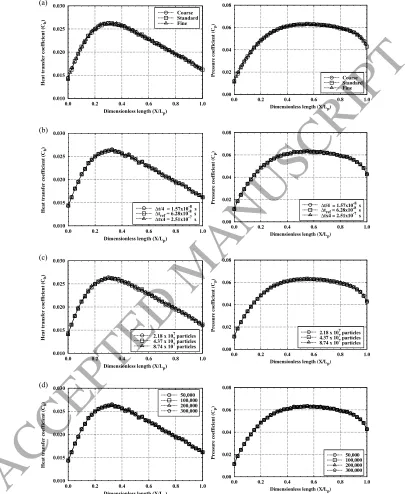
direction constant. According to Figure 2(a), the grid sensitivity analysis shows
good agreement for the three mesh sizes investigated indicating that the results were essentially grid-independent.
In a similar manner to the grid independence study, the influence of the time step size on the aerodynamic properties was examined. The time step is chosen
120
to be smaller than both the mean collision time (MCT) and the cell residence time (∆tres), with the latter being the time taken by a DSMC particle to cross a
ACCEPTED MANUSCRIPT
the reference time step (∆tref) was set to be 6.28× 10⁻⁸ s. Then, two time
steps different from the ∆tref were investigated (∆tref)/4 and ( ∆tref)×4. As
125
shown in Fig. 2(b), the resulting simulations are essentially independent of the time step size, so long as the time step and cell size requirements are respected, in conjunction with the other good DSMC practice conditions described above. In DSMC simulations the intermolecular collisions are the principal driver in the flow-field development. These intermolecular collisions occur in each
130
cell, and sufficient particles should be employed not only to reduce the sta-tistical error during the sampling process, but also to ensure the accuracy of the simulated collision rate. However, the use of a large number of particles greatly increases the computational effort. The balance between computational expense and accuracy has been studied by many authors [20–23], and 30-40
par-135
ticles per cell is commonly employed [24–28]. However, there are some DSMC
simulations [29, 30] that employed as few as 10 particles per cell, and some com-putations [31] as many as 50 to 120. The number of particles required is heavily influenced by the choice of collision model, and it is well- known that the majo-rant frequency scheme can use fewer particles than the no time-counter-method
140
(NTC). Recent work has focused on reducing the number of particles required even further [32] using novel collision partner selection schemes. dsmcF oam
uses the NTC method, so requires a reasonably large number of particles in order to recover the collision statistics.
In order to clarify this issue, we executed an additional study to consider
145
the influence of the number of simulated particles on thedsmcFoam solution of a hypersonic flow over a flat plate. Considering that the standard mesh corre-sponded to a total of 43.7 million particles (or 13 particles per cell on average),
two new cases were investigated using the same mesh. These cases corresponded, on average, to 21.8 and 87.4 million particles in the entire computational
do-150
main. The effects of such variations on the heat transfer and pressure are shown in Fig. 2( c). According to these results, the standard grid with a total of 43.7 million particles is considered sufficient for the present computations.
ACCEPTED MANUSCRIPT
of time steps that results are sampled over (Ns) [24–30]. Since the macroscopic
155
properties of the flow are obtained by sampling all particles within a cell, the number of samples must be sufficient to minimize the statistical error. The magnitude of the statistical error reduces with the square root of the sample size, and it is important to determine the value of Ns that provides acceptable
data scattering. For this purpose, the standard grid with approximately 43.7
160
million particles was run for 50,000, 100,000, 200,000, and 300,000 sampling
time steps. Figure 2(d) shows very good agreement across the range of number of samples considered. Based on these plots, an Ns of 300,000 was considered
as providing an acceptable fluctuation level for the case investigated.
In this section, hypersonic non-reacting gas flow simulations over a zero
165
thickness flat plate were performed. Grid spacing, time step size, number of particles per cell, and number of computational samples were examined in
or-der to test that the assumptions adopted as standard would lead to results independent of the grid, time step and number of statistical samples. On ex-amining these results, no appreciable changes were observed; however, altering
170
the parameters mentioned above, significantly impacted on the computational efficiency of the simulations. In the next section, we adopted the standard pro-cedure for all of the simulations, and the results obtained usingdsmcF oamare
ACCEPTED MANUSCRIPT
0.010 0.015 0.020 0.025 0.0300.0 0.2 0.4 0.6 0.8 1.0
H eat tr an sfe r coe ffi ci en t (C h )
Dimensionless length (X/Lp)
Coarse Standard Fine (a) 0.00 0.02 0.04 0.06 0.08
0.0 0.2 0.4 0.6 0.8 1.0
Pressure coefficient (C
p
)
Dimensionless length (X/Lp)
Coarse Standard Fine 0.010 0.015 0.020 0.025 0.030
0.0 0.2 0.4 0.6 0.8 1.0
H eat tr an sfe r coe ffi ci en t (C h )
Dimensionless length (X/Lp) ∆t/4 = 1.57x10⁻⁸s ∆tref= 6.28x10⁻⁸s ∆tx4 = 2.51x10⁻⁷s (b) 0.00 0.02 0.04 0.06 0.08
0.0 0.2 0.4 0.6 0.8 1.0
Pressure coefficient (C
p
)
Dimensionless length (X/Lp) ∆t/4 = 1.57x10⁻⁸ s ∆tref = 6.28x10⁻⁸ s ∆tx4 = 2.51x10⁻⁷ s
0.010 0.015 0.020 0.025 0.030
0.0 0.2 0.4 0.6 0.8 1.0
H eat tr an sfe r coe ffi ci en t (C h )
Dimensionless length (X/Lp) 2.18 x 10⁷particles 4.37 x 10⁷particles 8.74 x 10⁷particles
(c) 0.00 0.02 0.04 0.06 0.08
0.0 0.2 0.4 0.6 0.8 1.0
Pressure coefficient (C
p
)
Dimensionless length (X/Lp)
2.18 x 10⁷ particles
4.37 x 10⁷ particles 8.74 x 10⁷ particles
0.010 0.015 0.020 0.025 0.030
0.0 0.2 0.4 0.6 0.8 1.0
H eat tr an sfe r coe ffi ci en t (C h )
Dimensionless length (X/Lp) 50,000 100,000 200,000 300,000 (d) 0.00 0.02 0.04 0.06 0.08
0.0 0.2 0.4 0.6 0.8 1.0
Pressure coefficient (C
p
)
Dimensionless length (X/Lp)
50,000 100,000 200,000 300,000
Figure 2: (a) Effect of varying the number of cells, (b) the time step, (c) the number of
samples, and (d) number of DSMC particles per cell on the heat transfer (left column) and
[image:9.595.82.487.158.652.2]ACCEPTED MANUSCRIPT
4. Benchmark test cases for dsmcFoam
175
The validation strategy consists of comparing the results obtained using
dsmcFoam with other numerical, analytical, or experimental results available in
the literature. In the following sections, the validation process fordsmcFoam is discussed in detail.
4.1. Benchmark Case A: Flow over sharp and truncated flat plates
180
Rarefied hypersonic flow over flat plates has been studied theoretically,
ex-perimentally, and numerically by many authors, e.g., [33–40]. The extremely simple geometry makes the flat plate one of the most useful test cases for nu-merical validation purposes.
The test cases we choose to validatedsmcFoam for non-reacting flows are
185
based on the experimental-numerical study conducted by Lengrandet al. [19] and All`egre textitet al. [37]. In their experimental work, sharp and truncated
flat plates of 0.1 m length (Lp), 0.1 m width (Wp), and 0.005 m thick (Tp) were
positioned in a flow of nitrogen at two angles of incidence, 0◦ and 10◦. The physical model was supplied with an internal water cooling system which
main-190
tained the wall temperature at 290 K. Wall pressure and heat flux measurements were made by placing pressure transducers and chromel-alumel (Ch/Al) ther-mocouples along the longitudinal symmetry axis of the flat plates. In addition, density flowfield measurements were carried out by employing an electron beam
fluorescent technique. The uncertainties in the experimental pressure, heat flux
195
and density measurements were estimated to be 15
In addition to the experimental work, numerical simulations were performed using the NSF equations [19, 37] and the DSMC method [19, 37, 39]. The NSF results were obtained at ONERA using an implicit finite-volume method taking into account velocity slip and temperature jump at the wall. The DSMC
in-200
ACCEPTED MANUSCRIPT
by Lengrand et al. [19], vibrational molecular energy was neglected and the
Larsen-Borgnakke model [41] was employed for rotational-translational energy
205
exchange. Particle collisions and collision sampling were performed using the variable hard sphere (VHS) model and the time-counter technique (TC) [9], re-spectively. However, the diatomic molecular collision (DMC) model [42] and the null-collision technique (NCT) [43] were adopted by Tsuboiet al.[39]. Since the data and assumptions employed in each method are available in the literature,
210
the discussions below are limited only to details considered necessary.
In order to validate dsmcFoam, 3D sharp and truncated flat plates, as il-lustrated in Fig. 3, with the same dimensions as in Lengrand et al. [19] and All`egre et al. [37], were modeled. In the present computational solution, the two plates were immersed in nitrogen gas with an inlet imposed 0.005 m
up-215
stream of the plate. The freestream conditions (Table 1) and the computational
domains are similar to those presented in Section 3. The computational mesh was composed of 4.7 million and 3.4 million cells for the sharp and truncated cases, respectively. On average, 13 DSMC particles per cell were employed in the simulations; the VHS collision model was applied, and the energy exchange
220
between the translational and rotational modes was modeled using the Larsen-Borgnakke algorithm [41]. The NTC [44] technique was used to control the
molecular collision sampling. The value of rotational collision number (Zrot)
was set to be 1 for the sharp plate to match that used by Lengrandet al. [19]. No information forZrot in the truncated flat-plate case was given by All`egreet
225
al.[37], therefore we used Zrot= 1 andZrot= 5 to compare with their results.
Additional simulation parameters are given in Table 2.
The resulting normalized density (ρ/ρ∞) contours for zero-thickness, sharp,
and truncated flat plates are shown in Fig. 4, compared with other numerical and experimental results. Despite the different energy redistribution models
230
ACCEPTED MANUSCRIPT
(a)x
IV
I-A y
M∞
III
Lp
H II
Sharp flat plate
IV III
(b)
x
IV
I-A y
M∞
I-B
III
Lp
H II
Truncated flat plate
Bevel angle = 20 deg. Thickness = 5 mm
Flat plate length (Lp) = 0.1 m Flat plate width (Lw) = 0.1 m
Figure 3: 2D schematic of sharp (a) and truncated (b) flat plates.
Table 2: Numerical parameters for the flat-plate simulations.
Parameters Zrot ω dref [m] ∆t[s] M CT [s] λ∞[m]
Sharp 1 0.74 4.17×10⁻¹⁰ 6.28×10⁻⁸ 1.90×10⁻⁵ 3.35×10⁻³
ACCEPTED MANUSCRIPT
0.0 1.0 0.0 1.0 X/Lp Y/H 0.7 0.8 0.9 1.2 1.3 1.5 1.6 1.0 1.1 1.4 0.7 1.1DSMC [Tsuboi et al.]
dsmcFoam 0.8 0.9 1.2 1.3 1.5 1.6 1.0 1.1 1.4 0.7
1.1 0.9 0.8
1.2 1.3 1.5 1.0 1.1 1.4 0.7 1.1 1.6 0.8 0.9 1.2 1.3 1.5 1.6 1.0 1.1 1.4 0.7
1.1 0.9 0.8
1.2 1.3 1.5 1.6 1.0 1.1 1.4 0.7
1.1 0.9 0.8
1.2 1.3 1.5 1.0 1.1 1.4 0.7 1.1 1.6 0.5 1.0
0.0 0.25 0.5 0.75
0.0 1.0 0.0 1.0 X/Lp Y/H 0.7 0.8 0.9 1.2 1.3 1.5 1.6 1.0 1.1 1.4 0.7 1.1
DSMC [Tsuboi et al.]
dsmcFoam 0.8 0.9 1.2 1.3 1.5 1.6 1.0 1.1 1.4 0.7
1.1 0.9 0.8
1.2 1.3 1.5 1.0 1.1 1.4 0.7 1.1 1.6 -0.9 0.8 0.9 1.2 1.3 1.5 1.6 1.0 1.1 1.4 0.7 1.1 0.5
0.0 0.25 0.5 0.75 1.0
1.0
X/Lp Y/H
0.7
Experiments [Allègre et al.]
dsmcFoam symmetry line 1.0 0.0 - 0.2 1.7 1.7 1.8 1.8 1.9 1.9 2.0 0.7 0.8 0.9 1.0 1.1 1.2 1.3 1.4 1.5 1.6 1.1 1.2
1.3 1.41.5
1.6
2.2 2.1 2.0
0.0
X/Lp 1.0
0.0
Figure 4: Density ratio (ρ/ρ∞) contours around zero thickness (top left), sharp (top right),
ACCEPTED MANUSCRIPT
The normalized density (ρ/ρ∞) and temperature (T/T∞) distributions
nor-mal to the sharp flat-plate surface at the non-dimensional streamwise location
235
X/Lp= 0.75 are shown in Fig. 5. Good agreement is found between the DSMC
calculation and the experimental results. The density peak is captured well by the present simulation, and the normalized density profile follows the same trend of the numerical and experimental results performed by Tsuboiet al.[39] and Lengrandet al.[19], respectively. The NSF simulations of Lengrandet al.[19]
240
were not able to predict correctly the density profile at the position considered. Analyzing the translational and rotational temperature profiles in Fig. 5(b), a difference between the rotational and translational temperatures is observed, which indicates thermally non-equilibrium conditions. The normalized tem-perature is low close to the surface, increases to a maximum value inside the
245
shock layer at Y = 0.05 and then declines to the freestream temperature at the
upper boundary condition. In general, there is very close agreement of trans-lational and rotational temperature profiles from dsmcFoam and the CNRS DSMC code [19].
0.0 0.2 0.4 0.6 0.8 1.0 1.2
0.6 0.8 1.0 1.2 1.4 1.6 1.8 2.0
Dimensionless height (Y)
Density ratio (ρ/ρ∞)
X/Lp = 0.75
dsmcFoam DSMC [Tsuboi et al.] DSMC [Lengrand et al.] Exp. [Lengrand et al.] N-S [Lengrand et al.]
(a)
0.0 0.2 0.4 0.6 0.8 1.0
0 10 20 30 40 50
Dimensionless height (Y)
Temperature ratio (T/T∞) X/Lp = 0.75
Empty symbols - dsmcFoam Full symbols - DSMC [Lengrand et al.]
Ttra
Trot
(b)
Figure 5: (a) Normalized density (ρ/ρ∞) and (b) normalized temperature (T/T∞) profiles
ACCEPTED MANUSCRIPT
Figure 6 shows the heat transfer (Ch), pressure (Cp) and skin friction (Cf)
250
coefficients along the flat plates. For the sharp flat plate case (left column) the comparison of thedsmcFoam results with the experimental data is better than than found by Lengrand et al. [19] and Tsuboi et al. [39]. The skin friction coefficient shows good agreement with the Lengrand et al. [19] DSMC results at the leading edge and from position X/Lp ∼= 0.4 to 1.0. When the NSF
255
calculations for Chand Cpfor a rarefied flow over a sharp flat plate are compared
with experimental and DSMC results, it is clear that the CNRS NSF simulations were unable to capture the surface quantities for the conditions investigated.
According to Lengrandet al.[19], possible sources of experimental error are related to uncertainties in the freestream conditions, measurement procedures,
260
and the influence of the leading edge bluntness or bevel angle. In order to investigate the impact of the leading edge bluntness, Fig. 6 (right column) shows
comparisons of the dsmcFoam results with experimental data from All`egreet al. [37] and previous DSMC simulations. From the heat transfer (Ch) plot,
excellent agreement is seen between the DSMC simulations apart from at the
265
leading edge (X/Lp = 0) where the dsmcFoam results do not tend to zero.
Both computations demonstrated significant difference when compared with experimental data.
In contrast with Ch results, the pressure coefficient (Cp) shows very good
agreement between numerical and experimental data. However, the numerical
270
results show slightly higher values for Cpat the flat-plate leading edge. For the
skin friction coefficient along the truncated flat plate, no numerical results were available in the literature. Since the value of Zrotwas not specified in Ref. [37],
dsmcFoam computations for rarefied gas flow over the truncated flat plate were
performed with Zrot= 1 and 5; however, no significant differences in the surface
275
quantities were observed.
In summary, hypersonic non-reacting gas flow over three-dimensional zero-thickness, sharp, and truncated flat plates was simulated usingdsmcFoam. Ex-cellent agreement between numerical and experimental data for the density con-tours was found. The results also demonstrated that the shape of the leading
ACCEPTED MANUSCRIPT
0.015 0.020 0.025 0.030 0.0350.0 0.2 0.4 0.6 0.8 1.0
Heat transfer coefficient (C
h
)
Dimensionless length (X/Lp)
dsmcFoam DSMC [Tsuboi et al.] DSMC [Lengrand et al.] Exp. [Lengrand et al.] N-S [Lengrand et al.]
0.01 0.02 0.03 0.04 0.05 0.06
0.0 0.2 0.4 0.6 0.8 1.0
Heat transfer coefficient (C h )
Dimensionless length (X/Lp) dsmcFoam DSMC [Allegre et al.] Exp. [Allegre et al.]``
0.00 0.02 0.04 0.06 0.08
0.0 0.2 0.4 0.6 0.8 1.0
Pressure coefficient (C
p
)
Dimensionless length (X/Lp)
dsmcFoam DSMC [Tsuboi et al.] DSMC [Lengrand et al.] Exp. [Lengrand et al.] N-S [Lengrand et al.]
0.00 0.05 0.10 0.15 0.20
0.0 0.2 0.4 0.6 0.8 1.0
Pressure
coefficient
(C
p
)
Dimensionless length (X/Lp) dsmcFoam DSMC [Allegre et al.] Exp. [Allegre et al.]``
0.03 0.04 0.05 0.06 0.07 0.08
0.0 0.2 0.4 0.6 0.8 1.0
Skin friction coefficient (C
f
)
Dimensionless length (X/Lp)
dsmcFoam DSMC [Lengrand et al.]
0.00 0.04 0.08 0.12 0.16
0.0 0.2 0.4 0.6 0.8 1.0
Skin friction coefficient (C
f
)
Dimensionless length (X/Lp)
dsmcFoam
Figure 6: Comparisons of heat transfer (Ch), pressure (Cp), and skin friction coefficients (Cf)
fromdsmcFoam simulations and independent numerical/experimental data for sharp ( left)
and truncated (right) flat plates.
edge can affect the flow and shock structure over the plate. For the aerodynamic properties on a sharp flat plate, satisfactory agreement was found from the lead-ing edge up to X/Lp= 0.2; however, certain discrepancies were observed further
along the plate. In contrast, the truncated case exhibited differences between the numerical and experimental data in the leading edge region, while better
ACCEPTED MANUSCRIPT
agreement was evident towards the trailing edge. Comparisons between the
DSMC and NSF results demonstrate that the continuum approach, even when using slip velocity and temperature jump boundary conditions, cannot be used with confidence to predict these types of thermodynamically non-equilibrium flows.
290
4.2. Benchmark Case B: Flow over a 70◦ blunted cone
The flow over blunt bodies at high speeds and high altitudes displays com-plex flow interactions, and requires a precise determination of the heating rate,
aerodynamic forces, and the flowfield surrounding the body. The characteriza-tion of the wake region is also a key factor for the success of re-entry missions.
295
In an experimental set-up, a 70◦blunted cone, identical in geometric
propor-tions to that of the Mars Pathfinder probe, was chosen by the AGARD Working Group 18 [45]. Rarefied flow experiments were performed in five different facil-ities: the SR3 wind tunnel at CNRS-Meudom, the V2G, V3G and HEG wind
tunnels at DRL-G¨ottingen, and the LENS wind tunnel at the Buffalo Research
300
Center (Calspan, University of Buffalo, USA). The experimental test conditions used in each of these experimental facilities are available in Ref. [45].
All`egre et al. [46–48] provided detailed information regarding experiments conducted at CNRS-Meudon. The CNRS group employed three freestream flow conditions, representative of different levels of rarefaction, and three probe
305
models, each one having a base and afterbody sting diameter of 0.05 and 0.0125 m, respectively.
The CNRS model utilized for the flowfield density measurements was made of brass, water cooled, with a wall temperature remaining close to 290 K during all measurements. An electron beam fluorescent technique was used to
mea-310
sure the density field around the blunted cone [46]. For the aerodynamic force
measurements, the model was made of aluminum, uncooled, with the wall tem-perature estimated to be close to 350 K. The model was directly attached to an external balance providing direct measurements of drag, lift, and pitching moment, and indirect determinations of the center of pressure at different
ACCEPTED MANUSCRIPT
gles of attack [47]. For heat transfer measurements, a steel model was used
in which the wall temperature was kept close to 300 K [48] . Chrome-alumel (Ch/Al) thermocouples were embedded through the wall thickness at nine lo-cations along the forebody, base plane, and sting, and the thin-wall technique was applied to measure the heat fluxes on the steel probe.
320
An extensive set of simulations at these experimental test conditions were completed using both DSMC [49–58] and Navier-Stokes [59–62] methods prior
to the release of the experimental data. In this way, it was possible to perform a blind validation test of the computational codes.
In the present work, the simulated freestream conditions are the same as
325
those used in the SR3 low-density wind tunnel (case 1) [46–48]. The Mars Pathfinder probe was immersed in a non-reacting uniform nitrogen flow of ve-locity, mass density, and temperature equal to 13.316 m/s, 1.73×10⁻⁵ kg/m3,
and 13.316 K, respectively. Energy exchange was allowed between the transla-tional and rotatransla-tional modes and was controlled by the Larsen-Borgnakke
phe-330
nomenological model [41]. Molecular collisions were modeled using the variable hard sphere (VHS) model [63], and the no-time-counter (NTC) collision sam-pling technique [44]. In addition, simulation parameters for N2 are: reference
diameter (dref), rotational collision number (Zrot) and viscosity index (ω) set
equal to 4.17×10⁻¹⁰m, 5, and 0.74, respectively [9].
335
Figure 7(a) shows the experimental model configuration and Fig 7(b) gives an amplified view of thedsmcFoamcomputational grid. The computational grid was composed of a mixture of 7.1 million hexa- and polyhedral cells with, on average, 10.5 simulated particles per cell. A uniform hexahedral mesh, with cell sizes smaller than the freestream mean free path, is used for most of the domain,
340
with some polyhedral cells to capture the surface geometry. Each simulation was performed using 240 processors on the parallel machine at the University of Strathclyde, and 10 days were required to fully resolve each of the cases.
The computational domain was large enough so that the upstream, down-stream, and upper boundary conditions could be specified as freestream. In
345
ACCEPTED MANUSCRIPT
0◦ angle of attack. Undisturbed freestream conditions were imposed 0.02 m
upstream of the probe, and the computational domain normal to the probe ex-tended a distance 0.08 m in they- andz-directions. The surface temperature was set at 290 K, 300 K, and 350 K for the density, heat transfer and aerodynamic
350
force measurements, respectively. The surface boundary condition assumed the gas-surface interaction to be diffuse, with full thermal accommodation at the specified surface temperature.
(a) (b)
Mars Pathfinder Probe
x
y z
9 8 7 6
5 4 3 2 1
Ma
Rn α
Locations S/Rn (Rn - 12.5 mm) Thermocouples
0.00 0.52 1.04 1.56 2.68 3.32 5.06 6.50 7.94
1 2 3 4 5 6 7 8 9
50
45
20
10 0.4
70o 20o
10 35 Rn = 12.5
Rj = 2.08 Rc = 2.08
75
120.4
Figure 7: (a) Experimental 70◦ blunted cone model for heat transfer measurements with
thermocouple locations from [48], and (b) schematic of the corresponding dsmcFoam 3D
computational mesh.
In Fig. 8 experimental density flowfields at different angles of attack [46] are compared with the results from thedsmcFoam calculations. Qualitatively, the
355
results show a good level of agreement between the experimental anddsmcFoam
results. According to All`egre et al.[46] the flowfield density measurement ac-curacy is estimated to be 10%, except in the region encompassing the forward
shock wave, which is characterized by high density gradients and has a higher uncertainty.
360
simula-ACCEPTED MANUSCRIPT
tions, developed at the NASA Johnson Space Flight Center [64] and available
in Ref. [49]. In Fig. 9, excellent agreement of the density ratio (ρ/ρ∞), overall
temperature (Tov), and Mach number (M) contours at 0◦degree angle of attack
is found between the codes; where
Tov= Ttransξtrans+Trotξrot
ξtrans+ξrot , (2)
with Ttrans and Trot the translational and rotational temperatures of the gas,
respectively, andξtrans andξrotthe number of degrees of freedom in the
ACCEPTED MANUSCRIPT
0 10 20 30 50 60 70 80 40 Level 1 2 3 4 5 6 7 8 9 A B C D E F G H I J ρ/ρ∞ 0.1 0.2 0.3 0.4 0.5 0.6 0.7 0.8 0.9 1.1 1.3 1.5 1.7 2.0 2.5 3.0 4.0 5.0 6.0 7 5 4 2 3 6 D BA 8 9 C E F G H I J D C B A SR3 experiments dsmcFoam Z [mm]-20 0 20 40 60 80
α = 0o
0 10 20 30 50 60 70 80 40 Level 1 2 3 4 5 6 7 8 9 A B C D E F G H I J ρ/ρ∞ 0.1 0.2 0.3 0.4 0.5 0.6 0.7 0.8 0.9 1.1 1.3 1.5 1.7 2.0 2.5 3.0 4.0 5.0 6.0 7 5 4 2 3 6 D B A 8 9 C E F G H I J D C B A dsmcFoam Z [mm]
-20 0 20 40 60 80
SR3 experiments α = 10o
0 10 20 30 50 60 70 80 40 Level 1 2 3 4 5 6 7 8 9 A B C D E F G H I ρ/ρ∞ 0.2 0.3 0.4 0.5 0.6 0.7 0.8 0.9 1.1 1.3 1.5 1.7 2.0 2.5 3.0 4.0 5.0 6.0 6 4 4 2 3 5 C A 8 7 B E F G H J B A dsmcFoam Z [mm]
-20 0 20 40 60 80
1
C
9 D
SR3 experiments α = -10o
Figure 8: Density ratio (ρ/ρ∞) distributions from dsmcFoam, and from the SR3
ACCEPTED MANUSCRIPT
0.000.04
0.08
0.12
-0.04 0.00 0.04 0.08 0.12
y [m]
1.5
1.01 1.1
6 4
0.5 0.4
0.6 2
0.3 0.2
0.1 0.3
0.35 0.35
2 1.01 1.5 1.1
dsmcFoam DAC
0.00
0.04
0.08
0.12
-0.04 0.00 0.04 0.08 0.12
y [m]
400
400 300 200 100 50 500
800 600
DAC
dsmcFoam
0.00
0.04
0.08
0.12
-0.04 0.00 0.04 0.08 0.12
y [m]
1 2 3
4
8 12 1
dsmcFoam DAC
Figure 9: (top left) Density ratio (ρ/ρ∞), (top right) overall temperature (Tov), and (bottom)
Mach number (M) distributions fromdsmcFoam and from the DAC simulations [49] at 0◦
ACCEPTED MANUSCRIPT
The aerodynamic forces and moments have also been experimentally and
numerically investigated [47, 51, 53] for different angles of attack. In Figs. 10
365
and 11 a satisfactory concurrence is found between the experimental data and
dsmcFoamsimulations. According to All`egreet al.[47], the global uncertainty in the aerodynamic coefficients and forces did not exceed±3%, and the maximum difference between measured and simulated results was 8.6% on the normal force at 30circ angle of attack. Table 3 shows the drag and lift coefficients, and the
370
axial and normal forces coefficients, from the experimental measurements and numerical predictions using thedsmcFoam code.
1.3 1.4 1.5 1.6 1.7 1.8
-5 0 5 10 15 20 25 30 35
Drag coefficient (C
d
)
Angle of attack (α)
SR3 experiments DAC dsmcFoam
-0.4 -0.3 -0.2 -0.1 0.0
-5 0 5 10 15 20 25 30 35
Lift coefficient (C
l
)
Angle of Attack (α)
SR3 experiments dsmcFoam
Figure 10: Drag (Cd) and lift (Cl) coefficients at different angles of attack (α).
1.3 1.4 1.5 1.6 1.7 1.8
-5 0 5 10 15 20 25 30 35
Axial force coefficient (C
A
)
Angle of attack (α)
SR3 experiments dsmcFoam
0.0 0.1 0.2 0.3 0.4 0.5
-5 0 5 10 15 20 25 30 35
Normal force coefficient (C
N
)
Angle of attack (α) SR3 experiments dsmcFoam
ACCEPTED MANUSCRIPT
Table 3: Experimental anddsmcFoam-calculated aerodynamic and force coefficients.
Angle Drag Lift Axial force Normal force
exp. calc. % diff. exp. calc. % diff. exp. calc. % diff. exp. calc. % diff. 0o 1.657 1.652 0.302 0.000 0.000 0.000 1.657 1.652 -0.302 0.000 0.000 0.000
5o 1.629 1.642 0.798 -0.057 -0.062 8.772 1.628 1.642 0.860 0.084 0.080 -4.762
10o 1.615 1.611 -0.248 -0.133 -0.143 7.519 1.614 1.615 0.0620 0.148 0.140 -5.405
15o 1.569 1.561 -0.510 -0.200 -0.213 6.500 1.568 1.568 0.000 0.213 0.200 -6.103
20o 1.538 1.496 -2.731 -0.249 -0.269 8.032 1.530 1.504 -1.700 0.291 0.266 -8.591
30o 1.432 1.350 -5.726 -0.324 -0.351 8.333 1.402 1.344 -4.137 0.434 0.398 -8.294
The effect of the angle of attack on the heat transfer (Ch) and pressure (Cp)
coefficients is shown in Figs. 12 and 13. In this set of plots, the results are presented as a function of the normalized arc distance (s/Rn) measured from
375
the forebody stagnation point to the end of the sting. Here, the dsmcF oam
results are compared with DSMC computations provided from the DAC [50]
and molecular gas dynamics simulator (MGDS) [40] codes, as well as with the experiments performed at the CNRS facilities [48].
According to Fig. 12, dsmcF oam shows a good agreement with DAC and
380
MGDS for all angles of attack considered. The heat transfer coefficient is cap-tured well by the numerical codes at the forebody and sting regions; however, a significant difference in Chis seen between computations and experiments at
the probe shoulder (S/Rn≈2). This difference is even higher when the angle of
attack is increased, as shown in Fig. 14. At 30◦angle of attack, the flow is
com-385
pressed against the probe shoulder generating high heating rates in this region. Nevertheless, there is no thermocouple at this position; the last thermocouple on the forebody region is located at S/Rn= 1.56 but the simulated heat transfer
peak occurs at S/Rn ≈= 2.0. For this reason, the peak in the heat transfer is
not captured by the CNRS experiments. Even at locations where
thermocou-390
ples are present, both dsmcF oam and MGDS predict higher heat fluxes than the experiments. Again, at 30◦angle of attack, MGDS predicts a slightly lower
heat flux at the stagnation point, compared todsmcF oam. MGDS used a mesh refinement algorithm to ensure cells stay smaller than the local mean free path, whereasdsmcF oamuses a fixed grid, so the cells in the high density region near
ACCEPTED MANUSCRIPT
the stagnation point may be larger than the local mean free path.
0.0 0.1 0.2 0.3 0.4
0 2 4 6 8 10 12 14
Heat transfer coefficient (C
h
)
S/Rn
α = 0°
dsmcFoam DAC MGDS SR3 experiments
0.0 0.1 0.2 0.3 0.4
0 2 4 6 8 10 12 14
Heat transfer coefficient (C
h
)
S/Rn
α = 10°
dsmcFoam MGDS SR3 experiments
0.0 0.1 0.2 0.3 0.4
0 2 4 6 8 10 12 14
Heat transfer coefficient (C
h
)
S/Rn
α = 20°
dsmcFoam SR3 experiments
0.0 0.1 0.2 0.3 0.4 0.5
0 2 4 6 8 10 12 14
Heat transfer coefficient (C
h
)
S/Rn
α = 30°
dsmcFoam MGDS SR3 experiments
Figure 12: Heat transfer coefficients (Ch) along the Mars Pathfinder surface fromdsmcFoam,
DAC, MGDS and CNRS experiments at different angles of attack (α).
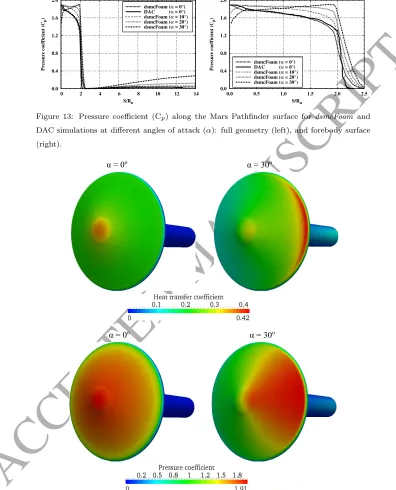
Figure 13 shows the pressure coefficient along the Mars Pathfinder probe surface. Excellent agreement is found between thedsmcF oamand DAC codes for 0◦angle of attack. As the angle of attack is increased, the pressure coefficient
increases at the probe shoulder, following the same trend as the heat transfer
400
ACCEPTED MANUSCRIPT
0.0 0.4 0.8 1.2 1.6 2.0
0 2 4 6 8 10 12 14
Pressure coefficient (C
p
)
S/Rn
dsmcFoam (α = 0°) DAC (α = 0°) dsmcFoam (α = 10°) dsmcFoam (α = 20°) dsmcFoam (α = 30°)
0.0 0.4 0.8 1.2 1.6 2.0
0.0 0.5 1.0 1.5 2.0 2.5
Pressure coefficient (C
p
)
S/Rn
dsmcFoam (α = 0°) DAC (α = 0°) dsmcFoam (α = 10°) dsmcFoam (α = 20°) dsmcFoam (α = 30°)
Figure 13: Pressure coefficient (Cp) along the Mars Pathfinder surface fordsmcFoam and
DAC simulations at different angles of attack (α): full geometry (left), and forebody surface (right).
α = 0o α = 30o
α = 0o α = 30o
Figure 14: (top) Heat transfer (Ch) and (bottom) pressure (Cp) coefficient contours at 0o
[image:26.595.82.478.163.653.2]ACCEPTED MANUSCRIPT
When a probe enters a planetary atmosphere at high velocities, the
fore-body flowfield is dominated by a strong shock wave that causes the excita-tion, dissociation and possibly ionization of the gas surrounding the vehicle. This highly thermochemically non-equilibrium flow rapidly expands around the
405
probe shoulder into the near wake region with a significant increase in rarefac-tion [49, 58, 65]. The flowfield complexity for the Mars Pathfinder probe is shown in Fig. 15(a). Due to this complexity, the aerothermodynamics of the
wake may not be measured accurately; according to Wright and Milos [66] the uncertainty in the aeroheating measurements in this region is typically assumed
410
to be in the range of 50-300%. This level of uncertainty plays a significant role in the vehicle design and the correct selection of a thermal protection system (TPS).
In order to compare the results obtained using the dsmcFoam code with
those from DAC simulations provided by Moss et al. [49], normalised density,
415
velocity, and temperature profiles are presented at four different locations in the probe afterbody region as depicted in Fig. 15(b).
(a) (b)
Diffuse shock
wave Separation of thick
boundary layer
Rapid expansion and freezing: high vibrational temp; low T, p and ρ
Weak shock and recompression
Recirculating flow: possibly unsteady
Shear layer: steep gradients of U, T and ρ
Wake closure: possibly subsonic
X1 = 0.0095 X2 = 0.015 X3 = 0.03 X4 = 0.06
Figure 15: (a) Schematic of the planetary probe flow structure [58], and (b) macroscopic
properties measurement locations.
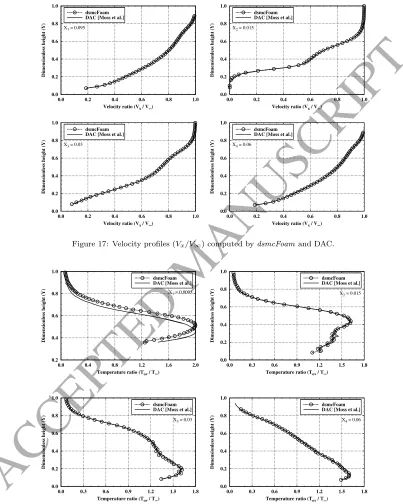
From Figs. 16 to 18, it is clear that there is very good agreement between the DAC and dsmcF oam simulations. However, for the density and temperature profiles at location X1 = 0.0095, some slight discordance is observed. In this
420
ACCEPTED MANUSCRIPT
between the two simulations may have some influence on the flowfield structure.
0.02 0.03 0.04 0.05 0.06 0.07
0.5 1.0 1.5 2.0 2.5 3.0 3.5 4.0
Dimensionless height (Y)
Density ratio (ρ/ρ∞)
X1 = 0.0095
dsmcFoam DAC [Moss et al.]
0.0 0.2 0.4 0.6 0.8 1.0
0.0 0.4 0.8 1.2 1.6 2.0 2.4 2.8
Dimensionless height (Y)
Density ratio (ρ/ρ∞)
X2 = 0.015
dsmcFoam DAC [Moss et al.]
0.0 0.2 0.4 0.6 0.8 1.0
0.0 0.4 0.8 1.2 1.6 2.0 2.4 2.8
Dimensionless height (Y)
Density ratio (ρ/ρ∞)
X3 = 0.03
dsmcFoam DAC [Moss et al.]
0.0 0.2 0.4 0.6 0.8 1.0
0.0 0.4 0.8 1.2 1.6 2.0 2.4 2.8
Dimensionless height (Y)
Density ratio (ρ/ρ∞)
X4 = 0.06
dsmcFoam DAC [Moss et al.]
Figure 16: Density profiles (ρ/ρ∞) computed bydsmcFoamand DAC.
To summarize this section, simulations have been performed using the
dsm-cFoamcode for non-reacting flows over both flat plates and the Mars Pathfinder
probe. The present data are compared with experimental and numerical
solu-425
tions available in the open literature. Assuming the average uncertainty in the experimental data to be approximately 10% [19, 37, 46–48], a satisfactory level
ACCEPTED MANUSCRIPT
0.0 0.2 0.4 0.6 0.8 1.00.0 0.2 0.4 0.6 0.8 1.0
Dimensionless height (Y)
Velocity ratio (Vx / V∞) X1 = 0.095
dsmcFoam DAC [Moss et al.]
0.0 0.2 0.4 0.6 0.8 1.0
0.0 0.2 0.4 0.6 0.8 1.0
Dimensionless height (Y)
Velocity ratio (Vx / V∞) X2 = 0.015
dsmcFoam DAC [Moss et al.]
0.0 0.2 0.4 0.6 0.8 1.0
0.0 0.2 0.4 0.6 0.8 1.0
Dimensionless height (Y)
Velocity ratio (Vx / V∞) X3 = 0.03
dsmcFoam DAC [Moss et al.]
0.0 0.2 0.4 0.6 0.8 1.0
0.0 0.2 0.4 0.6 0.8 1.0
Dimensionless height (Y)
Velocity ratio (Vx / V∞) X4 = 0.06
dsmcFoam DAC [Moss et al.]
Figure 17: Velocity profiles (Vx/V∞) computed bydsmcFoamand DAC.
0.2 0.4 0.6 0.8 1.0
0.0 0.4 0.8 1.2 1.6 2.0
Dimensionless height (Y)
Temperature ratio (Tov / T∞) X1 = 0.0095
dsmcFoam DAC [Moss et al.]
0.0 0.2 0.4 0.6 0.8 1.0
0.0 0.3 0.6 0.9 1.2 1.5 1.8
Dimensionless height (Y)
Temperature ratio (Tov / T∞) X2 = 0.015
dsmcFoam DAC [Moss et al.]
0.0 0.2 0.4 0.6 0.8 1.0
0.0 0.3 0.6 0.9 1.2 1.5 1.8
Dimensionless height (Y)
Temperature ratio (Tov / T∞) X3 = 0.03
dsmcFoam DAC [Moss et al.]
0.0 0.2 0.4 0.6 0.8 1.0
0.0 0.3 0.6 0.9 1.2 1.5 1.8
Dimensionless height (Y)
Temperature ratio (Tov / T∞) X4 = 0.06
[image:29.595.82.485.159.663.2]dsmcFoam DAC [Moss et al.]
ACCEPTED MANUSCRIPT
4.3. Benchmark Case C: flow in patterned 2D microchannels
The previous test cases have been for hypersonic flows, but progress has also
430
been made in the extension of thedsmcFoam code to subsonic, pressure-driven flows in micro- or nano-scale geometries. In contrast to the previous cases where the Knudsen number is high because the gas density is low, micro-scale devices
often operate in standard atmospheric conditions. The Knudsen number is high in these types of problems because the characteristic length scaleLis small.
435
dsmcFoam has previously been benchmarked for planar Poiseuille flow with
defined pressure inlets and outlets [67], where comparison to analytical solu-tions for the non-linear pressure profile were presented. The general starting point for the treatment of an inlet or outlet boundary condition in DSMC is
to impose a particle flux. The rate of particle insertion, ˙N, can be computed
440
from the equilibrium Maxwell-Boltzmann distribution, which requires bound-ary values of temperature, density, and velocity. The streaming velocity profiles for internal micro-scale flows at the inlet and outlet boundaries are generally not known a priori, so the boundary conditions described below use the the-ory of characteristics to calculate the local streaming velocity as the simulation
445
proceeds.
Wang and Li [18] proposed an inlet boundary condition with target gas prop-erties of pressure pin and temperatureTin, prescribed at the inflow boundary.
The perfect gas law is used to calculate the inlet number densitynin,
nin= pin
kBTin. (3)
Based on the theory of characteristics, the stream-wiseuinand tangentialvin
ve-locities at two-dimensional inlet boundary facesf, using values from the bound-ary cell centresj, are calculated as
(uin)f =uj+pin−pj
ρjaj , (4)
and
ACCEPTED MANUSCRIPT
where uj and vj are first order extrapolations from the cells attached to the
relevant boundary face, ρ is mass density and a is the local speed of sound. The pressure pj is calculated in these boundary conditions from the overall
temperature as:
pj =ρjR
3Ttr+ ¯ζrotTrot
3 + ¯ζrot
j
. (6)
At the exit boundaries, only the pressure is defined and the boundary con-ditions are those first proposed by Nanceet al.[68]:
(ρout)f =ρj+pout−pj
(aj)2
, (7)
(uout)f =uj+pj−pout
ρjaj , (8)
(vout)f=vj, (9)
(Tout)f=pout/
h
R(ρout)f
i
. (10)
The pressurepj is again calculated from Eq. (6). The process for selecting the
required translational and rotational energies for particles at the boundaries is standard in DSMC, and details can be found in Ref. [9].
Here, we investigate a pressure-driven flow through a micro-channel with two
450
heated steps on its lower surface, as shown in Fig. 19, which was first considered using DSMC by Fang and Liou [69]. The inlet pressure is 0.73 atm and the inlet
temperature is 300 K, giving an inlet Knudsen number, based on the channel heightHand the VHS mean free path, of around 0.08. Cases with inlet-to-outlet pressure ratios (pin/pout) of 2.5 (Case 1) and 4 (Case 2) are investigated here,
455
using the inlet and outlet boundary algorithms described above. All surfaces are considered to be fully diffuse, with temperatures of 323 K and 523 K forT1and
T2, respectively. The non-uniform, non-isothermal geometry greatly increases
ACCEPTED MANUSCRIPT
T1T1
T1 T1
T2 T2
H
h
pout pin
Tin
x y
Figure 19: 2D schematic of the patterned microchannel with different wall temperatures. Dashed lines are measurement locations.
The channel height H is 0.9 µm and the aspect ratio is 6.7. The steps
460
inside the channel have a height h of 0.3 µm, a length of 1.0287µm, and re-spective leading edge positions of 1. 4787 µm and 3.4713 µm. The working gas is nitrogen, with standard VHS parameters ofω= 0.77 anddref = 4.17×
10−10 m at a reference temperature of 273 K, and Larsen- Borgnakke energy
exchange performed on a ‘single molecule’ basis, where each collision partner is
465
considered in turn for relaxation with a constant rotational relaxation number of 5. Vibrational energy is excluded from the calculations because of the rel-atively low temperatures involved. Many of these parameters are not defined in Fang and Liou [69], so there may be some uncertainty in the results. 7656 rectangular computational cells, and a constant time step of 1× 10⁻¹¹ s were
470
used in thedsmcFoamsimulations; post-processing of the results confirmed that these parameters met good DSMC practice throughout the entire domain. The
dsmcFoam results that follow have been sampled for 200,000 time steps after
steady state was achieved. Case 1 comprised around 220,000 DSMC particles, and Case 2 had 300,000. The simulations were performed in parallel on two
475
cores of a desktop PC equipped with an i7 processor, and took around 24 hours
for each simulation. Figure 20 shows the contours of overall temperatureTov
for Case 2.
Figure 21 shows a comparison of the overall temperature profiles for the
pin/pout = 2.5 case, along two lines for the length of the channel. These two
480
locations are illustrated by the dashed lines in Fig. 19; the first location is at the top of the steps, while the second one is mid-way between the top of the steps and
ACCEPTED MANUSCRIPT
Figure 20: Contours of constant overall temperature, forpin/pout= 4.
can be seen here, with the peaks in the temperature profiles corresponding to the locations of the steps. The results for Case 2 also show excellent agreement,
485
but have been omitted for conciseness.
300 320 340 360 380 400 420 440 460 480
0 1 2 3 4 5 6
Tov
(K)
x/h
Step - Fang & Liou (2002) Top-Mid - Fang & Liou (2002) Step - dsmcFoam
Top-Mid - dsmcFoam
Figure 21: Comparison of temperature distribution results from from Fang and Liou [69], and
dsmcFoamforpin/pout= 2.5.
Figure 22 shows the heat transfer at the upper surface for bothpin/pout= 2.5
and 4. In general, the agreement between the DSMC results is very good, but
dsmcFoampredicts a slightly higher heat transfer fromx/h= 2.4 to 3.4 for both
pressure ratios. The peak heat transfer around the step locations are lower for
490
ACCEPTED MANUSCRIPT
rarefied and so heat transfer from the gas to the surface is reduced.
-1 0 1 2 3 4
0 1 2 3 4 5 6
q
(
×
10
6 J/
s)
x/h
Case 1 - Fang & Liou (2002) Case 2 - Fang & Liou (2002)
Case 1 -dsmcFoam
Case 2 -dsmcFoam
.
Figure 22: Comparison of the results for heat transfer at the upper surface from Fang and
Liou [69] anddsmcFoam.
4.4. Benchmark Case D: Knudsen minimum
In order to compare micro-scale results fromdsmcFoam to available experi-mental data, a series of 2D isothermal pressure-driven Poiseuille flows of nitrogen
495
gas are solved over a large range of Knudsen number. Figure 23 is a sketch of the simple geometry.
p
outh
L
p
inT
inFigure 23: 2D micro-channel geometry for pressure-driven Poiseuille flow.
The variable hard sphere collision model is used with the standard nitrogen
properties at a reference temperature of 273 K, i.e. viscosity coefficientω= 0.74 and reference diameterdref = 4.17 ×10⁻¹⁰ m. The mass flux ˙mis measured
ACCEPTED MANUSCRIPT
and normalized as follows:
Q= mL˙
√
2RT
h(pin−pout), (11)
where L and h are the length and height of the 2D planar Poiseuille flow channel, respectively, and R is the specific gas constant; T is the isothermal temperature that the simulations were performed at, which is 273 K. This value is used for the boundary condition of the inlet gas temperature, and is also
505
the temperature assigned to the fully diffuse surfaces of the channel walls. The
inlet pressurepinand outlet pressurepoutare set using the boundary conditions
procedure of§4.3. A rarefaction parameterδmis defined as the averageKnm of
the inlet and outlet Knudsen numbers (based on the VHS mean free path and the channel heighth) in each case:
510
δm=
√
π
2Knm
. (12)
1.2 1.6 2 2.4 2.8 3.2
0.01 0.1 1 10
Q
δm
dsmcFoam
Karniadakis (2005) Ewart et al. (2007)
Figure 24: Normalised mass flow rate, showing the Knudsen minimum phenomenon.
ACCEPTED MANUSCRIPT
previous DSMC results [70] using nitrogen gas in a channel of the same aspect
ratio. Experimental results from Ewart et al. [71], which were obtained with
515
helium gas, are also plotted for comparison. The two sets of DSMC results are in good agreement, and the agreement with experimental data is excel-lent at lowKn and reasonable at high Kn. It has previously been noted [72] that the asymptotic value thatQ obtains is proportional to ln (L/h); since the experimental work was performed on geometries with very large aspect ratio
520
(L/h= 1000), it is expected that the DSMC results for an aspect ratio of 20 will not match exactly. Unfortunately, it is not possible to simulate an aspect ratio of 1000 using DSMC, as the velocities would be too low to obtain a con-verged solution in a practical time scale. The famous Knudsen minimum [73] can clearly be observed in Fig. 24, where the normalized mass flow rate has a
525
minimum at aboutKn = 1.
5. Conclusions
The verification and validation of new developments and features in the
dsmcF oamcode have been presented for high and speed non-reacting flows in different geometries. First, sensitivity analyses were carried out for mesh, time
530
step, number of samples and particles was carried out for a flow over a zero-thickness flat plate. Choosing cell sizes, time steps, number of particles, and number of samples withing the ranges dictated by good DSMC practice, led to solutions that were independent of these simulation parameters.
The validation procedure aimed to compare computed dsmcF oam results
535
with other numerical and experimental data available in the literature. Four
different geometries were employed in the investigation: sharp and truncated flat plates, the Mars Pathfinder probe, a micro-channel with heated steps, and a simple micro-channel. In the flat plate cases, the density contours and temper-ature profiles showed a good concurrence between numerical and experimental
540
ACCEPTED MANUSCRIPT
edges of the sharp and truncated flat plates, respectively. In addition,
conven-tional CFD results showed marked differences from both the DSMC simulations and experimental data, demonstrating that rarefied gas effects are not captured
545
well by a continuum-based solver.
Hypersonic rarefied non-reacting gas flows over the Mars Pathfinder probe were also investigated. ThedsmcF oamsolver demonstrated its capabilities to successfully resolve hypersonic flows over such complex geometries.
Aerody-namic surface quantities, the flow structure in the shock and wake regions, the
550
drag, lift, and axial and normal forces acting on the probe all show a high level of agreement with CNRS experiments as well as numerical results from the DAC and MGDS codes.
In addition to the high speed benchmark cases, low speed gas flow through a micro-channel with two heated steps was considered in order to further validate
555
the new pressure-driven dsmcF oam boundary conditions. The results were compared with published DSMC simulations, and an excellent level of agreement was found. In order also to compare with available micro-scale experimental data, normalized mass fluxes were calculated over a range of Knudsen numbers to demonstrate that the Knudsen minimum in Poiseuille channel flow can be
560
captured. The results of these cases further validates the work reported in
Refs. [15, 67] on subsonic, prescribed pressure inlets and outlets.
6. Acknowledgements
The authors acknowledge the financial support provided by Conselho Na-cional de Desenvolvimento Cient´ıfico e Tecnol´ogico (CNPq/Brazil) under Grant
565
ACCEPTED MANUSCRIPT
References
[1] P. J. Roache, Need for control of numerical accuracy, Journal of Spacecraft
570
and Rockets 27 (2) (1990) 98–102.
[2] G. Sheng, M. S. Elzas, T. I. Oren, Cronhjort, Model validation: a systemic and systematic approach, Reliability Engineering ans System Safety 42 (1993) 247–259.
[3] P. J. Roache, Verification of codes and calculations, AIAA Journal 36 (5)
575
(1998) 696–702.
[4] P. J. Roache, Verification and validation in computational science and en-gineering, Hermosa Publishers, Albuquerque, NM, 1998.
[5] American Institute of Aeronautics & Astronautics Staff, AIAA guide for the verification and validation of computational fluid dynamics simulations.,
580
American Institute of Aeronautics and Astronautics, 1998.
[6] W. L. Oberkampf, T. G. Trucano, Verification and validation in computa-tional fluid dynamics, Progress in Aerospace Sciences 38 (SAND2002-0529) (2002) 209–272.
[7] W. L. Oberkampf, T. G. Trucano, C. H. Hirsch, Verification, validation,
585
and predictive capabilities in computational engineering and physics, Tech. Rep. 2003-3769, Sandia National Laboratories (2003).
[8] W. L. Oberkampf, M. F. Barone, Measures of agreement between
computa-tion and experiment: validacomputa-tion metrics, Journal of Computacomputa-tional Physics 217 (2006) 5–36.
590
[9] G. Bird, Molecular Gas Dynamics and the Direct Simulation of Gas Flows,
Clarendon, Oxford, 1994.
[10] I. D. Boyd, G. Chen, G. V. Candler, Predicting failure of the continuum fluid equations in transitional hypersonic flows, Physics of Fluids 7 (1) (1995) 210–219.