0022-538X/91/020632-09$02.00/0
Copyright © 1991,AmericanSociety forMicrobiology
The Integrity of the Stem Structure of
Human
Immunodeficiency
Virus
Type 1 Tat-Responsive Sequence RNA Is Required for
Interaction
with the
Interferon-Induced 68,000-Mr
Protein Kinase
SOPHIE ROY,' MICHAELAGY,2 ARA G. HOVANESSIAN,3 NAHUMSONENBERG,1,4
ANDMICHAEL G. KATZE2*
DepartmentofBiochemistry' and McGill Cancer Center,4 McGill University, Montreal, CanadaH3GI Y6; Department of
Microbiology, School of Medicine, RegionalPrimateResearch Center, University of Washington, Seattle, Washington 981952; and Unite de Virologie etImmunologie Cellulaire, URA Centre National de la Recherche Scientifique 1157,
InstitutPasteur, 75724Paris, France3
Received 22August 1990/Accepted 29 October 1990
A number of eucaryotic viruses have devised strategies to minimize the deleterious effects on protein synthesiscausedbyactivationoftheinterferon-induced, double-stranded-RNA-activatedprotein kinase,P68. In a recent report, we described the down regulation of the P68 protein kinase in cellsinfected by human
immunodeficiency virustype1(HIV-1) (S. Roy,M.G. Katze,N. T.Parkin,I.Edery,A.G.Hovanessian,and
N.Sonenberg,Science247:1216-1219, 1990).Wenowpresentevidence that suchadecrease in amounts of P68 could be essential for HIV-1 replication because of thepresenceoftheTat-responsivesequence(TAR sequence)
presentinthe5' untranslated region of HIV-1mRNAs,which activates the P68 kinase.Wefound that
poly(A)'
mRNAspreparedfrom HIV-l-infected cells efficiently activatedtheprotein kinaseasdidmRNAs fromstablytransformed celllinesconstitutively expressing theTARregion. Furthermore,wefound thatTAR-containing
RNAs complexed withpurified P68 protein kinaseinvitrobytwoindependentassaysandcould be cross-linked toP68kinasepresentinaHeLacellextract.Experiments usinginvitro-synthesized wild-typeand mutant TAR RNAsrevealed thatboththeefficientbindingtoand theactivation ofP68 kinaseweredependentonthe TAR RNA stem structure. The TAR-P68complex could be competedoutbya synthetic RNAthatboundtoand activated the protein kinasebutnotbyasynthetic RNA that boundwith lowaffinityand didnotactivate P68. Thepossible biologicalconsequencesofaP68-TAR interactionthatmayinclude the switch fromlatenttoactive
virusreplicationarediscussed.
The double-stranded RNA (dsRNA)-dependent kinase P68(also called dsl, DAI,orPI/eIF2 kinase) isoneofmany
interferon-induciblegenes(28, 30, 36, 40, 48, 60). Asaresult
ofactivation by dsRNA, P68 kinase undergoes autophos-phorylation and catalyzes the phosphorylation of the alpha subunit of eucaryotic initiation factor 2 (eIF-2) (12; for a recent review, see reference 18). This causes trapping of
eIF-2 inacomplexwithguaninenucleotideexchangefactor (eIF-2B) andGDP (38, 46). Limitations in functional eIF-2 hinder theinitiation stepof protein synthesis by preventing thetransfer of initiator Met-tRNA(via the ternarycomplex
eIF-2-GTP-Met-tRNAj)
tothe40S ribosomalsubunit before bindingto an mRNAmolecule.Activation oftheP68 kinase has been suggested toplaya
role in the interferon response to viral infection, but no
definitive proof has been obtained (for reviews, see refer-ences 30 and 36). A number of eucaryotic viruses have
devised strategies to minimize the deleterious effects on
protein synthesis caused by activation of the kinase (for reviews, see references51 and 56). Adenovirus encodes an
RNApolymerase III product,VAl RNA,which bindstoand sequesters P68 (13, 21, 33, 50), whereas influenza virus blocks P68 activity by activating acellular inhibitor of P68
(22, 29). Poliovirus induces degradation of the kinase, al-though what remains is highly phosphorylated (3), while otherviruses, suchas encephalomyelocarditis virus,
vesic-ular stomatitis virus, and vaccinia virus, sequesterthe P68
*Correspondingauthor.
kinase in a detergent-insoluble form (6, 19, 39). Down regulation ofthe P68 kinase wasrecently described during
productiveinfectionbyhumanimmunodeficiencyvirus type 1 (HIV-1) (44). Decreased amounts of interferon-induced P68 kinasewerealso observedinestablished cell linesstably expressingthe HIV-1trans-activatorprotein Tat,suggesting that Tatcontrols P68 activity duringHIV-1 infection (44).
The downregulationof the P68kinasemaybeessential for HIV-1 replication to prevent the translational inhibitory effects causedby activation of the kinase. Previous studies haveshown that fusion of theTat-responsive regioninthe 5' untranslated region (UTR)of HIV-1 mRNAs(termed TAR; 42) to aheterologous mRNA(chloramphenicol
acetyltrans-ferase [CAT]) exhibited cis- and trans-inhibitory effectson
translation in vitro (7, 34). These inhibitory effects, which
weredependentontheRNAsecondarystructurein the TAR region,couldbe reversedby addition of purifiedeIF-2B and
were prevented by high concentrations ofpoly(I)-poly(C)
that block activation of the P68 kinase (7). Moreover, synthetic RNAscontaining TARCAT sequences stimulated phosphorylationof the P68 kinase and the alphasubunit of eIF-2 inreticulocytelysateand NIH3T3 cellextracts(7, 54). Takentogether,these studiessuggestedthat the TARregion could activateP68 in vitro.
Apertinent questionis whether the TARregionactivates P68 in vivo. Tobegintoaddress thisquestion,wemonitored theability ofpoly(A)+ RNAfrom HIV-1-infected cells and from cells constitutively expressing the TAR region to stimulate autophosphorylation ofhighly purified P68. Our results demonstrate that preparations of TAR containing
632
on November 10, 2019 by guest
http://jvi.asm.org/
vitro and can be cross-linked to P68present in a HeLa cell extract. Bothefficient binding to and activation of the P68 kinase are dependent on the integrity of the RNA stem structure. Possible biological consequences of the
interac-tion between TAR-containing RNAs and P68 kinase are
discussed.
MATERIALS AND METHODS
Isolation ofpoly(A)+ from CEM and HeLa S3 cells. CEM cells were infected with the LAV isolate of HIV-1 as described previously (1, 44). A mock infection was carried out atthe sametime. Total RNA was extracted by guanidine hydrochloride precipitation and phenol-chloroform extrac-tion (58) 3 days after infecextrac-tion, when over 90% of cells expressedviral proteins, as determined by indirect
immuno-fluorescence. RNA was also extracted from HeLa S3 cell lines stably expressing CAT under the control of the HIV-1 long terminal repeat (LTR) (HeLa/TARCAT) or under the controlofthesimian virus40(SV40) promoter(HeLa/CAT).
These cell lines were established by cotransfection of the CAT expression vectors pU3RIII (containing the HIV-1 LTR; 55) or pSV2CAT (containing the SV40 promoter; 14) with pSV2neo (57) by the calcium phosphate precipitation method (59). Clones resistant to G418 (450 ,ug/ml) were screened for CAT activity (14). Clones expressing similar amounts ofCATactivitywereexpandedfor RNA isolation. Polyadenylated RNA was purified from total RNA by
oli-go(dT)-cellulose chromatography (47).
Site-directed mutagenesis. Mutations were introduced in the TAR region by oligonucleotide-directed mutagenesis in M13 by useofthe two-primer method(61). The mutations were confirmed before and after subcloning in pSP64TAR
CAT(34)by sequencingwith thedideoxy-chain termination
method (49). The compensatorymutantTAR1,111,1',III'was constructed by subcloning, using the Sacl site at position
+34in the HIV-1 TAR sequence.
Invitro transcriptions.TheSP64TARCAT constructs (34) werelinearized withHindlll(atnucleotide +80 in the HIV-1 sequence), phenol extracted, passed through a G-50 spun
column, and ethanolprecipitated.
Uncapped SP6-derived transcripts were generated in the presenceof
[k-32P]UTP
or[5-3H]CTP
asdescribedby Green etal. (16). The32P-labeled
RNAsusedinthe RNAmobilityshift assay were purified on 8% polyacrylamide-8 M urea
gels,eluted in 0.5 Mammoniumacetate-1mMEDTA-0.1% sodium dodecyl sulfate (SDS) (15), and recovered by two
phenol extractionsfollowed by ethanolprecipitation. In vitro kinase assay. The in vitro kinase reaction was
performed by mixing -50 or -100 ng of immunoaffinity-purifiedP68kinase (13) with the indicated amounts of RNA inabuffercontaining17 mMTrishydrochloride (pH 7.5), 75 mM KCl, 1 mM EDTA, 2 mMMgCl2, 2 mM MnCl2, 1 FM ATP, 0.8 mMdithiothreitol, 0.3 ,ig of bovine serumalbumin per ,ul, and
[-y-32P]ATP
(10 ,uCi; Du Pont BiotechnologySystems)at30°Cfor 15 min. The final volume of the reaction mixture was40
RI.
Thereactionwas stopped by addition of 20pI
of 3x electrophoresis buffer, 10jig
ofRNaseA, and 1jil
of 1MMgCl2
followed by boiling. The samples weresubjectedtoelectrophoresison anSDS-10%polyacrylamide geland autoradiography. Quantitations of P68 kinase auto-phosphorylationwereperformed byscanning of X-ray films with an LKB laser densitometer. In some experiments, the RNAs were incubated with 1
,ul
ofRNase III (300jig/ml;
containing 50 mM Tris hydrochloride (pH 7.5), 130 mM NH4Cl, and 10 mM Mg(OAc)2 for 30 min at 37°C. After
phenol-chloroform extractionand ethanolprecipitation, the RNase III-treated RNAs were tested in the in vitro kinase assay.
In vitro binding assays of P68 kinase and TAR RNAs.The RNAmobilityshiftassay wasperformedessentially
accord-ing to Konarska and Sharp (24), with modifications previ-ously described (43). Briefly, -250 to500 ng of immunoaf-finity-purified P68 kinase (13) waspreincubated in a buffer
containing10mMTrishydrochloride (pH 7.5), 1 mM
dithio-threitol, 1 mMEDTA, 50mMNaCl,0.5 Uof RNasin per
RI,
0.09 ,ugof bovineserumalbumin perjil, and 0.05% (vol/vol)glycerol at 30°C for 10 min. 32P-labeled RNA (2,000 cpm, 2.94 x 10⁶ cpm/jig; gel purified) was added for a further
incubation of 10 min. The final volume of the reaction
mixturewas 20 ,ul. Samples were loaded on a1.5-mm-thick 5% polyacrylamide gel (30:0.8, acrylamide/bisacrylamide)
containing 5% glycerol, which had been preelectrophoresed for30 minat30 mA. Electrophoresiswascarriedoutin0.5x Tris-borate-EDTA at a constant currentof30 mAfor2.5 hat
4°C. The gel was dried andexposed toX-ray film with an
intensifying screen at -70°C. The second in vitro binding
assay used has been described elsewhere (21). Briefly, the P68 kinase was purified from interferon-treated 293 cells, utilizing Sepharosebeadscoupledto amonoclonalantibody
to P68 kinase (MAb-Sepharose). 32P-labeled TAR RNA (150,000 cpm) was added to the immunoprecipitated P68
kinase for a 20-min incubation at 30°C. To control for nonspecific sticking, RNA was added to MAb-Sepharose
that had beenexposedto aninterferon-treated bovinekidney
cellextract (the bovineP68 kinaseisnotretainedon
MAb-Sepharose since the monoclonal antibody against P68 is
specific forthe humankinase).Thecomplexeswerewashed
in 10 mMTrishydrochloride(pH
7.5)-100
mMKCl-0.1 mM EDTA-100 U ofaprotinin per ml-20% glycerol andresus-pendedinabuffercontaining50 mM Tris
hydrochloride
(pH7.5), 150 mMNaCl,0.05%Nonidet P-40,carrier tRNA, and 1% SDS. After phenol-chloroform extraction and ethanol
precipitation, TAR RNA specifically bound to P68 was
analyzed by electrophoresis on an8% polyacrylamide-8 M ureageland then autoradiographed.
UV-induced cross-linking assay.
Cross-linking
wasper-formed essentially as describedby Pelletier and Sonenberg
(35). Briefly, 30
jig
ofan interferon-treated HeLa S10 ex-tract (44) was incubated with 32P-labeled TAR RNA (1.5 x 10⁶cpm, 2.94 x10⁶
cpm/,jg)
inabuffercontaining5 mMN-2-hydroxyethylpiperazine-N-2'-ethanesulfonic
acid(HEPES; pH7.6), 150 mMKCl,2mMMgCl2, 3.8%
(vol/vol)
glycerol, 20
jiM
dithiothreitol, and 1.5 mM ATPat30°Cfor 10min. Thereactionmixturewasplacedunderagermicidal
lamp (254 nm) at a distance of 2 cm for 30 min. The
UV-irradiated samplesweretreated with 20
jig
of RNase A at37°Cfor 30 min.Four-fifths of thesamplewassubjected
toimmunoprecipitation using a polyclonal antibody raised in mouseagainstP68kinase(27)and
protein
A-Sepharosethat had been prereacted with rabbit anti-mouseimmunoglobu-lin. The immunoprecipitated
proteins
wereanalyzed by
SDS-10% polyacrylamide gel electrophoresis
(PAGE)
andautoradiography in parallel with the
remaining
fifth of the UV-irradiatedproteins.
on November 10, 2019 by guest
http://jvi.asm.org/
HIV-1 MOCK 1 2 3 4 5 6
CAT TARCAT
1 2 3 4 5 6 7 8 9 10 11 12 13
4.-RNA(pg/ml) 0.1 1 10 01 1 10 RNA(fj/rl)0 1 25 5 1 25 5 1 25 5 1 2.5 5
FIG. 1. Activation ofthe P68kinasebyTAR-containing poly(A)+ RNAs. (A)Poly(A)+RNAswereisolated from HIV-1-infected(lanes 1 to 3) and mock-infected (lanes 4 to 6) CEM cells 3 days after infection and tested in the in vitro kinase assay, using -100 ng of immunopurifiedP68 asdescribed in Materials and Methods. (B) Poly(A)+ RNAsisolated from celllinesstablyexpressingtheCATgeneunder thecontrol of theSV40promoter(CAT;lanes 2 to7) or the HIV-1 LTR(TARCAT; lanes8to13)weretested in thein vitrokinaseassay, using - 50 ngof immunoaffinity-purified P68 asdescribedinMaterials and Methods. Lane1, No RNA.
RESULTS
Activation of the P68 kinase by TAR-containing poly(A)+ RNAs.Productive infection by HIV-1waspreviously shown to be associated with a decrease in the amount of the P68 kinase (44). This virus-induced control of P68 likely repre-sents a strategy to avoid inhibition of protein synthesis
causedby activation ofthisprotein kinase by viral mRNAs. Todetermine whether HIV-1 mRNAs have the potential to
activate the P68 kinase, poly(A)+ RNA was isolated from
HIV-1-infected and mock-infected CEM cells 3 days after infection. At this time, over 90% of cells were found to expressviral proteins, as determined by indirect
immunoflu-orescence(1, 44). Thesepoly(A)+ RNAsweretested inanin
vitrokinase assay that consisted of incubating
immunoaffin-ity-purified P68 kinase with increasing amounts of RNA in the presenceof
[-y-32P]ATP
(Fig. 1A). The activating poten-tial of the mRNAs was measured by the degree of P68 autophosphorylation. Detectable amounts of phosphory-lated P68 were seen with as little as 0.1 ,ug of mRNA per mlfrom HIV-1-infectedcells(lane 1). Kinaseactivity increased dramatically (-20-fold) with 1
pg/ml
(lane 2) and then decreased with 10jig/ml
(lane 3). This result is consistent with the observation that high concentrations of dsRNAinhibit activation of the P68 kinase (9, 20, 23). In contrast, mRNAs from mock-infected cells were poor activators of P68 kinase at 1
p.g
of RNA per ml (compare lane 5 with lane 2). Significant phosphorylation of P68 kinase was apparentonly in the presence of 10
jig
of mRNA per ml (lane 6).Activation ofP68kinase by HIV-1 mRNAs may be due, at least in part, to the presence of the secondary structure in
the TAR sequence of the 5' UTR of viral mRNAs. To examine this possibility, we used a HeLa cell line stably
expressingthe indicator CAT gene under the control of the HIV-1 LTR (HeLa/TARCAT). The activating potential of mRNAs isolated from this cell line was compared with that from a HeLa cell line stably expressing CAT under the control of the SV40 promoter(HeLa/CAT). Poly(A)+ RNA wasisolated from clones expressing similar amounts of CAT
activityandtested in the in vitro kinase assay. mRNAs from the HeLa/TARCAT cell line were better activators of P68 thanweremRNAsfrom theHeLa/CAT cell line at all mRNA concentrations tested (Fig. 1B; compare lanes 2 to 7 with lanes 8 to 13). In the presence of 2.5
jig
of mRNA per ml from the HeLa/TARCAT cell line, which resulted in maxi-malkinase activity, the amount of phosphorylated P68 was over10-fold greater than that observedbythesameconcen-trationof mRNA from theHeLa/CAT cell line(comparelane 12with lane6). These resultsareconsistentwith the notion that the TAR sequence, in the 5' UTRofmRNAs,activates theinterferon-inducible P68kinase, asdefinedbytheability of the kinase toundergo autophosphorylation inanin vitro kinase assay. However, these results do not exclude the
possibilitythat other dsRNA structures synthesized during
HIV-1infection also activateP68.
Secondary structurewithin the TARregion isrequired for binding to and activation of the P68 kinase. Since earlier reports (7, 34) demonstrated that translational inhibition
conferred bythe TARregionwasdependentontheintegrity ofthestem-loop structure,wewishedtoexamine theability
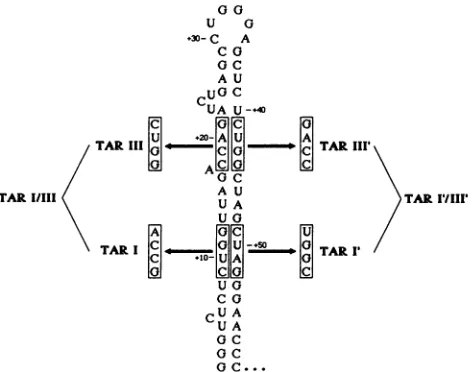
of TAR RNAs with decreased secondarystructure to stim-ulateautophosphorylation of P68 kinase inanin vitro kinase assay. We introduced eight nucleotide substitutions on ei-ther side of the stem of TARby site-directed mutagenesis
(Fig. 2; 45). The mutations were designed so that when presentalonetheyarepredictedtodisrupt base pairing,but when combined together they are compensatory and
pre-00
U G
+30-C A CG aC A U
cUGC
UA U-.40
TU1/l AAAU A
TAR IIII lIIc I *Ic TAR III'
GI ACl c
aOCGG AUA
TARI/III UA TARI/III'
U A
Ga cC
cU
a U A GC...FIG. 2. Stem mutants in thepredicted secondarystructureofthe TAR region. Nucleotides shown in boxes were changed to those indicatedby site-directedmutagenesis. The compensatory mutant TARI,III,I',III'wasconstructedby subcloning, usingtheSaclsite atposition +34.
on November 10, 2019 by guest
http://jvi.asm.org/
[image:3.612.133.492.84.204.2] [image:3.612.324.560.499.685.2]2 3 4 5 6 7 8 9 10 11 12 13 14 15 16 17 18 19 20 21
q_ _-_mm
RNA(pg/ml) 0 .01 .1 1 3 .01 .1 1 3 01 1 1 3 .01 .1 1 3 .001 .01 .1 1
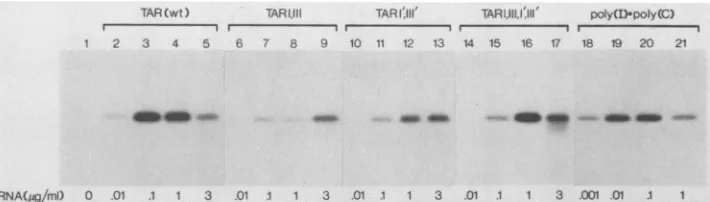
FIG. 3. Activationof the P68 kinase by wild-type (wt) and mutant TAR RNAs.3H-labeledTAR RNAscomprising nucleotides+1 to +80 of the HIV-1LTR weresynthesized by SP6 polymerase and tested in the in vitro kinase assay, using -50 ng of immunoaffinity-purified P68 asdescribed inMaterials and Methods (lanes 2 to 17). Various concentrations of the synthetic dsRNApoly(I)-poly(C)were tested in parallel (lanes 18to21).Lane 1, No RNA.
dictedtorestorebase pairing. The mutations were subcloned
intoplasmidpSP64TARCAT.This construct generates RNA which begins at nucleotide +1 of the HIV-1 LTR and thus has the samenucleotide sequence at its 5' end as do HIV-1 mRNAssynthesizedinvivo (34). 3H-labeled RNAs
compris-ingnucleotides +1 to +80 of the HIV-1 TAR sequence and
synthesized in vitro by SP6 polymeraseweretested(Fig.3).
Phosphorylation ofthe P68kinase could be detected in the presenceofaslittleas0.01jig of wild-typeTAR RNA perml
(lane2). Theextentofphosphorylation washighest with0.1 and 1
jig/ml
(lanes3 and4)andthendecreasedwith 3jig/ml
(lane 5). Mutants TAR I,III and TAR I',III', predicted to
disrupttheintegrityof the stem,activated the P68 kinase but to amuchlesserdegree (lanes 6 to 13). In the presence of 1
jig/ml,
theamountsofphosphorylated P68 by TARI,II and TARI',III' were decreased -3- and -17-fold, respectively,compared with that by wild-type TAR RNA at the same
concentration (compare lanes 8 and 12 withlane 4). In the presenceof3
jig/ml,
the extent ofautophosphorylation by TARI',III'wassimilartothatwith1jig
ofTARI,IIIperml but was still less than that with 0.1 and 1jig
of wild-typeTARRNA perml (compare lanes 9 and 13 withlanes 3 and
4). Activation of the P68kinase bythe double mutantTAR I,III,I',III', predicted to restorebase pairingin the stemof
TARRNA,wassignificantlygreaterthan thatobservedwith the mutants TAR I,III and TAR I',III' but somewhat less
thanthatwiththewild-typeRNA(lanes 14to17). Although maximal kinase activity occurred with 0.1
jig
ofwild-type RNA per ml(lane3),asimilardegreeof P68phosphorylation required 1jig
of TAR I,III,I',III' per ml (lane 16). Thedegree of phosphorylation decreased with 3
jig
of TARI,III,I',III' per ml (lane 17), as was observed with the
wild-typeRNA. Theseresultsprovide evidence that activa-tion ofthe P68 kinase is dependent on the integrity ofthe stemstructurein TAR RNA. Theoverallactivating potential of wild-type TAR RNA was comparable to that of the
synthetic dsRNA poly(I)-poly(C) (lanes 18 to 21) although 10-fold-more TAR RNA was required for maximal kinase activity.
Since activators of P68 kinase such as poly(I)-poly(C)
werepreviously shown to bind toP68 (13), we next exam-ined the binding capacity of wild-type and mutant TAR RNAsbyavariety ofmethods. WefirstperformedanRNA
mobilityshift assay inwhich
32P-labeled
wild-typeor mutant TAR RNAs were incubated with immunoaffinity-purifiedP68 kinase. Ribonucleoproteincomplexes wereresolvedon a nondenaturing polyacrylamide gel and then
autoradio-graphed(Fig. 4A). Wild-typeTAR RNAformed adiscrete
complexwith 0.25 jigof P68(lane 2). Inthe presenceof 0.5
jig of P68, the amount of protein-bound RNA increased although thecomplex was more diffused (lane 3), suggesting that more than one kinase molecule bound to the RNA. Mutants TAR I,II (lanes 5 and 6) and TAR I',III' (lanes 8 and 9), whichwere pooractivators of the kinase, failed to form stable complexes with P68, although upon longer exposurefaintnucleoprotein complexes could be seen in the presence of 0.5 jig of P68 (data not shown). The double mutant TAR 1,III,I',III' formed a discrete complex in the presence of 0.25 jig of P68 (lane 11) which was more
prominent butmorediffusein the presenceof0.5 jigof P68 (lane 12). Complexformation wasslightlyless efficient than that observed with thewild-typeRNA(compare lane 3 with lane 12). Lanes 4 and 10also contained a slower-migrating
RNA. This minor band, which appeared occasionally, is presumably due to the formation of an alternative RNA structure.
Furtherevidence thatbindingof TAR RNAto P68 kinase is dependent on the integrityof the RNA secondary struc-ture wasobtainedby usinganassaypreviouslydescribedby Katze et al. (21). P68-specific MAb-Sepharose (26) was
incubated with an extractfrominterferon-treated 293 cells
(an adenovirus type 5 human embryonic kidney cell line).
After removal ofunbound proteins, 32P-labeled wild-type
and mutant TAR RNAs were added. The RNAs were extracted from the column withphenol-chloroform,ethanol
precipitated, analyzed onadenaturingurea-polyacrylamide gel,and autoradiographed. Tocontrolfornonspecific
bind-ing, the RNAswereaddedtoMAb-Sepharose preincubated
withaninterferon-treated cell extractofbovineorigin. Since the monoclonal antibody is species specific and recognizes only thehuman P68
kinase,
the RNAsarenotexpectedtobe retained on this column lacking P68. Specific binding toimmunoprecipitated P68 could be detected only with the
wild-type and double-mutant TAR I,III/I',III' RNAs (Fig.
4B, lanes 1 and7). AlthoughthemutantTARI,IIIand TAR I',III' RNAs did bind weakly to immunoprecipitated P68,
the interaction was nonspecific since these RNAs bound
withasimilarefficiencytothe columnlackingP68(compare
lanes 3and4 and lanes5and 6). These results demonstrate thatTAR RNAbindingtothe P68kinase isdependentonthe
integrity of the stem-loop structure and correlates with activation of the kinase.
Previous studies have demonstrated that the P68 kinase contains high- and
low-affinity
RNAbinding
sites(13).
High-affinity binding was correlated with activation of the
kinase, whereas low-affinity binding was correlated with inhibition of the kinaseactivity (13).In
light
of theseresults,TARRNAswhichactivate P68 should bindtoP68with
high
_Ad 4_ _N
on November 10, 2019 by guest
http://jvi.asm.org/
[image:4.612.131.486.82.183.2]TAR(wt) ARI5II 6 T8I'l T9R10 111211
1 2 3 4 5 6 7 8 9 10 11 12
complexes[
1 23
2 3 4
I
Ao\
5 6 .7 8
4
p68 + - + - + - +
-tree_-mi * ^j
*
*^-^
p6(pg): 0 .25 .5 0 25 .5 0 25 .5 0 .25 .5
FIG. 4. Binding ofwild-type (wt) andmutant TARRNAstoimmunoaffinity-purified P68 kinase. (A)32P-labeled TAR RNAssynthesized by SP6 polymerase were incubated in the absence or presence of immunoaffinity-purified P68, and complexes were resolved on a nondenaturing polyacrylamide gelasdescribed inMaterials and Methods. (B)32P-labeledTAR RNAssynthesizedby SP6 polymerasewere addedtoSepharose beadscoupledto amonoclonalantibody against P68 kinase, which had beenprereacted withaninterferon-treated 293 cellextract(+)or aninterferon-treated bovinekidney cellextract(-)(the P68 kinase of bovineoriginisnotretainedonthecolumn since the monoclonal antibody isspecific for the human P68). The boundRNAs were recovered by phenol-chloroform extraction and ethanol precipitation and were analyzedon apolyacrylamide-urea gelasdescribed in Materials and Methods.Thearrowheadontheright indicates thefull-lengthTAR RNA(80-mer).
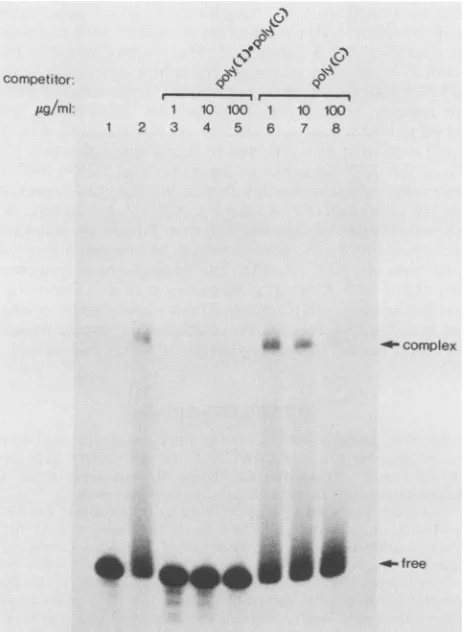
affinity. To obtain evidence for a high-affinity interaction between P68kinaseand TARRNAs,weperformedthe RNA
mobility shift assay in the presence of competitor RNAs
which bindtoP68 withdifferent affinities (Fig. 5). Addition
ofaslittleas 1 ,ugofpoly(I)-poly(C) perml, which bindsto and activates P68, abrogated TAR RNA binding to the
kinase (lane 3). In contrast, poly(C), which binds with low
affinityandfails toactivateP68 (13), was a poorcompetitor.
Addition of1and10 ,ugofpoly(C)permldidnot preventP68 bindingto TAR RNA; complex formation was reduced by less than fourfold in the presence of 100 ,ug/ml (lane 8). Theseresults suggest ahigh-affinity interaction between the P68kinase and TAR RNA.
Covalentcross-linking ofTAR RNAs to P68kinasein a
celi
extract.Toprovidefurther evidence for the specificity of the
interaction between TAR RNA and the P68 kinase, we
performed UV-induced covalent cross-linking studies in
cytosolicextractsfrominterferon-treated HeLa cells, using
32P-labeled
TAR RNA as aprobe. Following RNasediges-tion,cross-linked proteinswereanalyzed bySDS-PAGE and
autoradiography(Fig. 6). Although several radiolabeled pro-teins were observed, proteins of approximately 40 and 70
kDacross-linked mostefficiently. Todetermine whether the
-70-kDa
protein
was the P68kinase,
the UV-cross-linkedcell extract was subjected to immunoprecipitation, using a
polyclonalantibody tothekinase (27),prior toanalysis by SDS-PAGE and autoradiography. This antibody
immuno-precipitated a radiolabeled protein of -70 kDa; no other
radiolabeledproteinswere apparentafter immunoprecipita-tion. Amonoclonal antibody againstthe kinase(26)didnot
immunoprecipitate radiolabeledproteins, suggestingthat the
epitope
recognized
by the antibody was not accessible because of the presence of the RNA. These results demon-strate that TAR RNA binds toP68 kinase in acell extract and further supports the specificity of this interaction.DISCUSSION
Inthisstudy,wedemonstrated that mRNAsisolated from
HIV-1-infectedcells andfromanestablished cell linestably expressing a heterologous gene under the control of the HIV-1 LTRactivate the P68 kinase. These results point to theTARsequencein the 5' UTRas astrongactivator ofthe kinase. Thus, HIV-1 resembles other viruses which have been showntoexpress RNAsthatcanactivateP68(2, 3,31).
We also showed that TAR RNAs bindto P68, as do other
activators(13).Our results suggesta
high-affinity
interaction between the P68 kinase and TAR RNA, sinceon November 10, 2019 by guest
http://jvi.asm.org/
[image:5.612.74.546.77.396.2]r - .19,~~~~1
.4
'
09
1 10 100 1 10 100
1 2 3 4 5 6 7 8
[image:6.612.61.293.71.387.2]_ free
FIG. 5. Mobility gel electrophoresis analysis of P68 kinase bind-ingto TAR RNA: effect of competitors. Approximately 0.3 ,ug of immunoaffinity-purified P68waspreincubated in the absence (lane 2) or presence of various concentrations of the synthetic RNA poly(I)-poly(C) (lanes 3to 5)orpoly(C) (lanes 6to8) priorto the addition of 32P-labeled TAR RNA synthesized in vitro by SP6 polymerase. Ribonucleoprotein complexeswereresolvedon a
non-denaturing polyacrylamide gelasdescribed in Materials and Meth-ods. Lane1, Free DNA.
protein complex formationwasabolishedinthepresenceof
anRNAcompetitorthatbinds toP68 with high affinity but
was not affected by an RNA competitor that binds to P68 with low affinity (Fig. 5). Furthermore, wefound that intact
basepairing in thestem ofTAR RNAs isacritical require-mentforbindingtothekinase(Fig. 4).Itisnoteworthythat Marciniaketal. (32) recently identified and characterized a
HeLa nuclearprotein of68 kDa whichboundspecifically to TAR RNA. However, this protein is unlikelytobe the P68 kinase because itshowed specificity for the loopsequence.
In agreement with this view, the binding capacity and activation potential of a TAR RNA mutant with a
four-nucleotide substitution in the loop (+31 to +34; 45) were
indistinguishablefromthose of thewild-typeRNA(datanot shown). Thisfindingindicates thatbindingtoandactivation of theP68 kinase isdependent solelyonintact basepairingin the TAR RNA stem structure.
We also provide directevidence for the activation of the P68 kinase by TAR RNAs synthesized in vitro by SP6 polymerase. Spurious transcription by SP6 polymerase in the reverse orientation could give rise to smallamounts of dsRNA species (47), which might be responsible for the activation of the kinase. Recently, it was claimed that
FIG. 6. UV-induced cross-linking of TAR RNA to P68 kinase
presentinacellextract. 32P-labeled TAR RNA synthesized by SP6 polymerasewasincubated with 30,ug ofaninterferon-treatedHeLa cell lysate and then UV irradiated as described in Materials and Methods. Sampleswereresolvedby SDS-PAGE and
autoradiogra-phy (lane 1) or were subjected to immunoprecipitation using a
polyclonal antibody against the P68 kinase priortoSDS-PAGEand autoradiography (lane 2). The molecularmassesof standardproteins
areindicated in kilodaltonsontheright.
contaminating dsRNAs were present in preparations of in vitro-transcribed RNAs containing the TAR sequence (17).
However,weconsider thisunlikely in view of the
observa-tion thatthe activation of P68 by SP6-derived TAR RNAs
wasdependent onthe template transcribed. Indeed,
nucle-otide substitutions predicted to disrupt basepairing in the TARsecondarystructurewerepooractivators of the kinase compared with RNAs with the wild-type TAR sequenceor
with compensatory mutations (Fig. 3). Nonetheless, these results do notrigorously exclude the presenceofa dsRNA contaminant in our preparations, and it was of utmost importancetoruleoutthepossibilitythat such contaminants
were responsible for the activation of the kinase. Our first
attempttoeliminatepotentialdsRNAcontaminants included gel purification of the TAR RNAs. For reasons that are
uncleartous, thegel-purified RNAsdid activate the kinase but with reduced efficiency. We therefore performed addi-tional experiments to distinguishthe P68 kinase activation byTARRNAs from thatbypotentialdsRNA contaminants. First, we examined the chromatographic profile of SP6-derived TAR transcripts on CF11 cellulose. The eluate fraction enriched for TAR RNAs in 15% ethanol-85% STE (0.1MNaCl,0.05 M Tris[pH 7.0],0.001 MEDTA)atroom temperature coeluted with the fraction that activated the kinase (data not shown). The 100% STE eluate fraction, previouslyshowntobe enriched fordsRNAssynthesizedas
viralreplicativeintermediates and expectedtocontain
con-taminating dsRNA species (11), exhibited no detectable activatingactivity (datanot shown). Secondand most
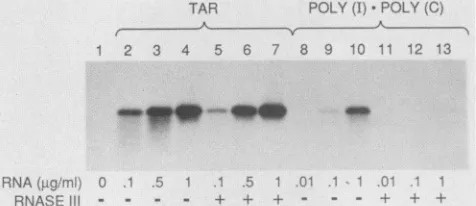
con-vincingly,weexamined the effect of TAR RNAdigestion by RNase IIIonactivation ofthe P68 kinase(Fig. 7).RNaseIII, under high-salt conditions, is highly selective for dsRNA structureswhich includesyntheticandviral dsRNAs(41).In Competitor:
ag/ml.
-200
-97
-s
-68
-43
_ complex
I....
-29
4b
on November 10, 2019 by guest
http://jvi.asm.org/
[image:6.612.390.482.72.291.2]TAR POLY(1)-POLY(C)
1 2 3 4 5 6 7 8 9 10 11 12 13
_w
RNA(pgii) 0.11 1 .5 Oi 1 04
RNASEIII- - - - + + + - - -+ + +
FIG. 7. Effectof RNaseIIItreatmentof TAR RNAonactivation of the P68 kinase. 3H-labeled TAR RNAs synthesized in vitro by SP6polymerase and poly(I)-poly(C)weretreated with RNase III(+)
orweremocktreated(-) for 30 minat37°C. The RNAs recovered after phenol-chloroform extraction and ethanol precipitation were
testedat various concentrations in thein vitro kinase assay, using
-100 ng of immunoaffinity-purified P68 kinase, as described in
Materials andMethods. Lane 1, No RNA.
contrast,TARRNAisnotsignificantly cleaved byRNase III (less than 10%), possibly because of its imperfect dsRNA structure (data not shown). RNase III treatment of TAR RNAs did not result in a significant reduction in P68 auto-phosphorylation (Fig. 7;compare lanes2to4with lanes 5to
7). To ensure that the RNase III preparation was active,
poly(I)-poly(C) was treated ina similarfashion and lost its
activation potential (compare lanes 8 to 10with lanes 11 to
13). Taken together, these results strongly suggest that the activation of thekinase by TARRNAis due tothe integrity of the RNAstem-loopstructure andnottothepresenceofa
dsRNA contaminant. It couldbe argued that the formation of TAR-TAR homodimers may be responsible for the ob-served activation of P68. We consider this possibility less likely, sinceheating and quick cooling of the RNAs did not affect their ability to activate the P68 kinase (42a). Such a
treatment is expected to disrupt intermolecular but not intramolecularbase pairing.
Activation of theP68 kinase by the TAR region in the 5' UTR of HIV-1 mRNAs may bearrelevance to the mecha-nism of latency characteristic of HIV-1 infections. It is temptingto speculatethatsuch activation in cells harboring lowamountsof viral mRNAsmayprevent premature trans-lation of viral proteins. This would allow latently infected cells to escape immune surveillance and act as viral
reser-voirs. However, theswitch from latenttoactivereplication wouldnecessitateamechanismtodepress P68 kinase activ-ityand thuspermit viralgeneexpression. HIV-1appearsto have evolved such amechanism, since active viral
replica-tion was shown to be associated with a decrease in the
expression ofP68, and the trans-activator protein Tat was
suggested to mediate this reduction (44). The Tat protein required for HIV-1 replication may be synthesized upon
antigenic stimulation of latently infected cells or secreted
from productively infected cells (8, 10). This molecular model oflatency isconsistent withrecentresults by Pomer-antz et al. (37). They demonstrated that cell lines
nonpro-ductively infected with HIV-1 expressed only very low
levels of singly and multiply spliced viral mRNAs which encode the regulatory proteins such as Tat and Rev. It is possiblethatthetranslation of these regulatory proteinswas
inhibited as a result of activation of the P68 kinase, thus preventingthe switchtoaproductively infected state.
It is relevantto note that the activity of another dsRNA-dependent interferon-induciblegene, 2'-5'A synthetase, has
also beenimplicated in theregulation of HIV-1gene expres-sion. Productive HIV-1 infectioncorrelated withatransient activation of 2'-5'A synthetase (53), resulting in the
synthe-sis of2'-5' oligoadenylateswhich, inturn, activate RNase L (a latentendoribonuclease specific forsingle-stranded RNA; for reviews, see references 30 and 36). TAR RNAs were foundtobindtoand activate2'-5'A synthetase (52, 54), and the Tat protein was reported to block this activation (52). Thus, the TAR sequence in the 5' UTR of HIV-1 mRNAs mayplay anegative regulatory role in viralgeneexpression via the activation of P68 kinase and 2'-5'A synthetase. It is aninteresting possibility that the up-regulation inamountsof these proteins by theadministration of interferon may pro-long viral latency and delay the appearance ofsymptoms associated with AIDS in seropositive patients. This view is consistent with results obtained fromclinical trials in which thebeneficial effects of alpha interferonon disease progres-sionwere greaterin theearlystagesof HIV-1 infection(4,5,
25).
ACKNOWLEDGMENTS
Wethank BarbaraHettingerfor technical assistance,NeilParkin for establishing the HeLa/CAT and HeLa/TARCAT cell lines, Donald Court for providing the RNase III, and Isaac Edery for helpful discussions throughout the course of this work.
This work was supported by NIH grantsAl22646 and RR 00166 toM.G.K. andby grants from the American Foundation forAIDS research (000946-7-RGR; AmFAR/Drexel Durnham Lambert re-searchgrant)and CancerResearchSociety(Montreal)toN.S. N.S. is therecipientof a Medical Research Council Scientist award from theMedical Research Council ofCanada; S.R. is arecipient of a Cancer Research Society (Montreal) studentship; and A.G.H. isa research fellow ofthe Centre Nationale de la Recherche Scienti-fique, France, of which the Unite de Virologie et Immunologie Cellulaire isaresearchgroup (URA 1157).
REFERENCES
1. Agy, M. B., M. Wambach, K. Foy, and M. G. Katze. 1990. Expression of cellular genes in CD4 positive lymphoid cells infected by the human immunodeficiency virus, HIV-1: evi-dence forahostprotein synthesisshut-offinduced by cellular mRNAdegradation.Virology 177:251-258.
2. Bischoff,J., and C. E. Samuel. 1989. Activation of the human P1/eIF-2ot proteinkinase by individual reovirus s-class mRNAs: slmRNAisa potentactivator relative to s4 mRNA. Virology 172:106-115.
3. Black, T. L., B. Safer, A. Hovanessian, and M. Katze. 1989. The cellular68,000-Mrprotein kinase is highly autophosphorylated andactivatedyetsignificantlydegraded during poliovirus infec-tion:implicationsfor translationalregulation. J. Virol. 63:2244-2251.
4. Brook, M. G., D. Gor, S. Forster, J. R. W. Harris, D. J.Jeffries, andH.C.Thomas. 1989.Anti-HIV effects ofalpha-interferon. Lancet i:42.
5. deWit, R., C. A. B. Boucher, K. H. N. Veenhof, J. K. M. E. Schattenkerk, P. J. M. Bakker,and S. A. Danner. 1988. Clinical and virologicaleffects of high-dose recombinantinterferon-a in disseminated AIDS-relatedKaposi's sarcoma. Lancet ii:1214-1217.
6. Dubois, M. F., and A. G.Hovanessian. Virology, in press. 7. Edery, I., R.Petryshyn, and N. Sonenberg. 1989. Activation of
double-stranded RNA dependent kinase (dsl) by the TAR region of HIV-1 mRNA: a novel translational control mecha-nism. Cell 56:303-312.
8. Ensoli, B., G. Barillari, S. Z. Salahuddin, R. C. Gallo, and F. Wong-Staal. 1990. Tat protein of HIV-1 stimulates growth of cells derivedfromKaposi's sarcoma lesions of AIDS patients. Nature(London)345:84-86.
9. Farrell, P. J., K. Balkow, T. Hunt, R. J. Jackson, and H. Trachsel. 1977. Phosphorylation of initiation factor eIF-2 and
on November 10, 2019 by guest
http://jvi.asm.org/
[image:7.612.67.305.74.177.2]protein from human immunodeficiency virus. Cell 55:1189-1193.
11. Franklin, R. M. 1966. Purification and properties of the replica-tive intermediate of the RNA bacteriophage R17. Proc. Natl. Acad. Sci. USA55:1504-1511.
12. Galabru, J., and A. G. Hovanessian. 1987. Autophosphorylation of the protein kinase dependent on double-stranded RNA. J. Biol. Chem. 262:15538-15544.
13. Galabru, J., M. G. Katze, N. Robert, and A. G. Hovanessian. 1989. The binding of double-stranded RNA and adenovirusVAl RNA to the interferon-induced protein kinase. Eur.J.Biochem. 178:581-589.
14. Gorman, C. M., L. F. Moffat, and B. H. Howard. 1982. Recombinant genomes which express chloramphenicol acetyl-transferase in mammalian cells. Mol. Cell. Biol. 2:1044 1051. 15. Grabowski, P. J., R. A. Padgett, and P. A. Sharp. 1984.
Messenger RNA splicing in vitro: an excised intervening se-quence and a potential intermediate. Cell 37:415-427.
16. Green, M. R., T. Maniatis, and D. A. Melton. 1983. Human 3-globin pre-mRNA synthesized in vitro is accuratelyspliced in Xenopus oocyte nuclei. Cell 32:681-694.
17. Gunnery, S., A. P. Rice, H. D. Robertson, and M. B. Mathews. Proc. Natl. Acad. Sci. USA, in press.
18. Hovanessian, A. G. 1989. Thedouble-stranded RNA-activated protein kinase induced by interferon: dsRNA-PK. J. Interferon Res. 9:641-647.
19. Hovanessian, A. G., J. Galabru, E. Meurs, C. Buffet-Janvresse, J. Svab, and N. Robert. 1987. Rapid decrease inthelevels ofthe double-stranded RNA-dependent protein kinase during virus infection. Virology 159:126-136.
20. Hovanessian, A. G., andI. M. Kerr. 1979. The (2'-5') oligoade-nylate (pppA2'-5'A 2'-5'A) synthetase and protein kinase(s) from interferon-treated cells. Eur. J. Biochem. 93:515-526. 21. Katze, M. G., D. DeCorato, B. Safer, J. Galabru, and A. G.
Hovanessian. 1987. AdenovirusVAl RNA complexes with the 68000 Mr protein kinase to regulate its auto-phosphorylation and activity. EMBO J. 6:689-697.
22. Katze, M. G., J. Tomita, T.Black,R. M.Krug, B. Safer, andA. Hovanessian. 1988. Influenza virus regulates protein synthesis during infection by repressingautophosphorylation andactivity of the cellular68,000-Mr protein kinase. J. Virol. 62:3710-3717. 23. Kimchi, A., A. Zilberstein, A. Schmidt, L. Shulman, and M. Revel. 1979. The interferon-induced protein kinase PK-i from mouse L cells. J. Biol. Chem. 254:9846-9853.
24. Konarska, M. M., and P. A. Sharp. 1986. Electrophoretic separation of complexes involved in the splicingofprecursorsto mRNA. Cell 46:845-855.
25. Lane, H. C., J. Feinberg, V. Davey, L. Deyton, M. Baseler, J. Manischewitz, H. Masur, J. A. Kovacs, B. Herpin, R. Walker, J. A. Metcalf, N. Salzman, G. Quinnan,and A. S. Fauci. 1988. Anti-retroviral effectsofinterferon-ainAIDS-associated Kapo-si'ssarcoma. Lancetii:1218-1222.
26. Laurent, A. G., B. Krust, J. Galabru, J. Svab, and A. G. Hovanessian. 1985. Monoclonal antibodies to an interferon-induced Mr 68,000 protein and their use for the detection of double-strandedRNA-dependentprotein kinase in human cells. Proc. Natl. Acad. Sci. USA82:4341-4345.
27. Laurent, A. G., B. Krust, J. Svab,and A.G.Hovanessian. 1984. Characterisation of the interferon-mediated protein kinase by polyclonal antibodies. Biochem. Biophys. Res. Commun. 125: 1-7.
28. Lebleu,B., G. C.Sen,B. Shaila,B.Carer, and P.Lengyel.1976. Interferon, double-stranded RNA and protein phosphorylation. Proc. Natl. Acad. Sci. USA 73:335-341.
29. Lee, T. G., J. Tomita, A. G. Hovanessian, and M. G. Katze. 1990. Purification and partial characterization of a cellular inhibitor of the interferon-induced 68,000 Mr protein kinase from influenzavirus-infected cells.Proc. Natl. Acad. Sci. USA 87:6208-6212.
30. Lengyel, P. 1982. Biochemistryofinterferons and theiractions. Annu. Rev. Biochem. 51:251-282.
synthesis incells infected witha mutant adenovirus defective for VA RNA1. Virology164:106-113.
32. Marciniak,R.A., M. A. Garcia-Blanco,and P. A.Sharp. 1990. Identification and characterization ofa HeLanuclear protein that specifically binds to the trans-activation-response(TAR) element of humanimmunodeficiency virus. Proc. Natl. Acad. Sci. USA87:3624-3628.
33. O'Malley, R. P., T. M. Mariano, J. Siekierka, and M. B. Mathews. 1986. Amechanism forthecontrol ofprotein synthe-sisby adenovirusVARNA1. Cell44:391-400.
34. Parkin, N. T., E. A.Cohen,A.Darveau,C.Rosen,W.Haseltine, and N.Sonenberg. 1988. Mutationalanalysisofthe 5'noncoding region of human immunodeficiency virus type 1: effects of secondarystructure ontranslation. EMBO J. 7:2831-2837. 35. Pelletier, J., and N. Sonenberg. 1985. Photochemical
cross-linking ofcapbindingproteinstoeucaryoticmRNAs.Effectof mRNA 5' secondarystructure.Mol. Cell. Biol. 5:3222-3230. 36. Pestka,S.,J. A. Langer,K. C.Zoon,and C. E. Samuel.1987.
Interferons andtheir actions.Annu.Rev.Biochem. 56:727-777. 37. Pomerantz,R.J., D. Trono, M. B.Feinberg,and D. Baltimore. 1990. Cells nonproductively infected with HIV-1 exhibit an
aberrantpattern of viralRNAexpression:amolecularmodel for latency. Cell61:1271-1276.
38. Proud, C. G. 1986.Guanine nucleotides, protein phosphoryla-tion and the control of translation. Trends Biochem. Sci. 11:73-77.
39. Rice, A. P., andI.M. Kerr. 1984. Interferon-mediated double-strandedRNA-dependentproteinkinase is inhibitedinextracts
from vacciniavirus-infected cells.J.Virol. 50:229-236. 40. Robert, W. K., A. G.Hovanessian,R. E.Brown,M.J.Clemens,
and I. M. Kerr. 1976. Interferon-mediated protein kinase and low molecular weight inhibitor of protein synthesis. Nature (London)264:477-480.
41. Robertson, H.D.,and T. Hunter. 1975. Sensitivemethods for the detection andcharacterization of double helical ribonucleic acid. J. Biol. Chem. 250:418-425.
42. Rosen, C.A., J. G.Sodroski,and W. A. Haseltine. Thelocation ofcis-actingregulatorysequencesin thehuman Tcell
lympho-tropicvirus type III(HTLV-III/LAV) longterminalrepeat.Cell 41:813-823.
42a.Roy, S. Unpublished data.
43. Roy,S.,U.Delling, C.-H.Chen,C. A.Rosen,and N.Sonenberg. 1990. Abulge structureinHIV-1 TAR RNAisrequiredforTat binding and Tat-mediated trans-activation. GenesDev. 4:1365-1373.
44. Roy,S.,M.G.Katze,N. T.Parkin,I. Edery,A.G.Hovanessian,
and N. Sonenberg. 1990. Control ofthe interferon-induced 68 kilodalton protein kinase by the HIV-1 tat gene product. Sci-ence247:1216-1219.
45. Roy,S., N.T.Parkin, C.Rosen, J. Itovitch, and N. Sonenberg. 1990. Structural requirements for trans activation of human immunodeficiency virus type 1 long terminal repeat-directed
gene expression by tat: importance ofbase pairing, loop
se-quence, and bulges in the tat-responsive sequence. J. Virol. 64:1402-1406.
46. Safer, B. 1983. 2B or not 2B: regulation of the catalytic
utilizationofeIF-2. Cell33:7-8.
47. Sambrook, J., E. F. Fritsch, and T. Maniatis. 1989. Molecular cloning: a laboratory manual, 2nd ed. Cold Spring Harbor Laboratory, Cold Spring Harbor,N.Y.
48. Samuel,C. E. 1979. Mechanism of interferonaction:
phosphor-ylationofproteinsynthesisinitiation factor eIF-2 in interferon-treated human cellsbyaribosome-associatedkinase
processing
site specificity similar to hemin-regulated rabbit
reticulocyte
kinase. Proc.Natl. Acad. Sci. USA 76:600-604.
49. Sanger, F.,S.Nicklen,and A.R.Coulson. 1977. DNA sequenc-ing with chain-terminating inhibitors. Proc. Natl. Acad. Sci. USA 74:5463-5467.
50. Schneider, R.J.,B. Safer,S.M.Munemitsu,C.E.Samuel, and T. Shenk. 1985. Adenovirus VAlRNA prevents
phosphoryla-tion oftheeukaryotic initiation factor2asubunit
subsequent
toon November 10, 2019 by guest
http://jvi.asm.org/
infection. Proc. Natl. Acad. Sci. USA 82:4321-4325.
51. Schneider,R. J., and T.Shenk.1987. Impactof virus infection
onhostcell proteinsynthesis. Annu. Rev. Biochem. 56:317-332.
52. Schroder, H. C., D. Ugarkovic, R. Wenger, P. Reuter, T. Okamoto, and W. E. G. Muller. 1990.Binding of Tatproteinto
TAR region of human immunodeficiency virus type 1 blocks TAR-mediated activation of (2'-5') oligoadenylate synthetase. AIDS Res. Human Retroviruses 6:659-672.
53. Schroder, H. C., R. Wenger, Y.Kuchino, and W. E. G. Muller. 1989. Modulation ofnuclear matrix-associated (2'-5') oligoade-nylate metabolism and ribonuclease L activity in H9cells by humanimmunodeficiency virus. J. Biol. Chem. 264:5669-5673. 54. SenGupta, D. N., and R. H. Silverman. 1989. Activation of interferon-regulated, dsRNA-dependentenzymesby human
im-munodeficiency virus-1 leader RNA. Nucleic Acids Res. 17: 969-978.
55. Sodroski, J., C. Rosen, F. Wong-Staal, S. Z. Salahuddin, M. Popovic, S. Arya, R. C. Gallo, and W. A. Haseltine. 1985. Trans-acting transcriptional regulation of human T-cell leuke-miavirus typeIIIlong terminalrepeat. Science 227:171-173. 56. Sonenberg. N. 1990. Measures and countermeasures in the
modulation of initiation factor activities by viruses. New Biol.
2:402-409.
57. Southern, P. J., andP.Berg. 1982. Transformation of
mamma-lian cellstoantibiotic resistance withabacterialgeneunder the control of theSV40 early regionpromoter.J.Mol.Appl.Genet. 1:327-341.
58. Strohman, R.C., P. S. Moss, J. Micou-Eastwood, D. Spector, A. Przybyla, and B. Paterson. 1977. Messenger RNA formyosin polypeptides: isolation from single myogenic cell cultures. Cell 10:265-273.
59. Wigler, M., R. Sweet, G. K. Sim, B. Wold, A. Pellicer, E. Lacy, T.Maniatis, S. Silverstein, and R. Axel. 1979. Transformation of mammalian cells withgenesfromprocaryotesandeucaryotes. Cell 16:777-785.
60. Zilberstein, A.,P.Federman, L. Shulman, and M. Revel. 1976. Specific phosphorylation in vitro ofaprotein associated with ribosomes of interferon-treated mouse L cells. FEBS Lett.
68:119-124.
61. Zoller, M. J., and M. Smith. 1982. Oligonucleotide-directed mutagenesis using M13-derivedvectors:anefficient and general
procedure for the production of point mutations inanyfragment ofDNA. NucleicAcids Res. 10:6487-6500.