James L. Thomason, Liu Yang and Ross F. Minty
ARE SILANES THE PRIMARY DRIVER OF INTERFACE STRENGTH
IN GLASS FIBRE COMPOSITES ?
(EXPLORING THE RELATIONSHIP OF THE CHEMICAL AND
PHYSICAL PARAMETERS WHICH CONTROL COMPOSITE
INTERFACIAL STRENGTH)
James L. Thomason1, Liu Yang2 and Ross F. Minty3
Department of Mechanical and Aerospace Engineering, University of Strathclyde, Glasgow, UK
1Email: [email protected], 2Email: [email protected], 3Email: [email protected]
Keywords: interface, interphase, residual stress, silane, glass fibre
Abstract
It is probably not an overstatement to say that organosilanes are the most important chemicals used in the glass fibre, and consequently the composites, industry. One of the best-known assertions about silanes is that they promote chemical bonding across the fibre-matrix interface. This concept was fixed in the collective consciousness of the composites community early in its history when developments were focussed strongly on reactive matrices. Indeed, the chemical bridging mindset is strongly entrenched in the interface research community and extends to most other fibre-matrix combinations. However, the development of thermoplastic matrix composites raises questions about the simplistic chemical bridging model of silanes at the interface. A growing number of researchers have also commented on residual stress contributing to the stress transfer capability at the fibre-matrix interface. We will review experimental data on the temperature dependence of the apparent interfacial shear strength (IFSS) in glass fibre-polypropylene and of glass fibre-epoxy composites. This phenomenon is characterised by a large drop in IFSS when the test temperature is raised above the matrix glass transition temperature. These results can be shown to support the hypothesis that the apparent IFSS in composites can be largely explained by residual thermal stresses in the system.
1. Introduction
ECCM18 - 18th European Conference on Composite Materials
Athens, Greece, 24-28th June 2018 2
James L. Thomason, Liu Yang and Ross F. Minty
chemical bridging mindset is strongly entrenched in the interface research community and extends to most other fibre-matrix combinations. However, the development of thermoplastic composites raises questions about the simplistic chemical bridging model of silanes at the interface.
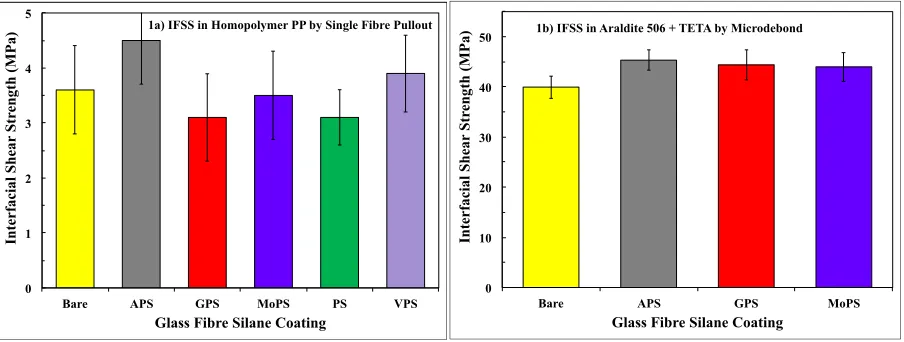
[image:2.595.73.525.327.498.2]The data in Figure 1a show the IFSS in GF-Polypropylene (GF-PP) samples measured by single fibre pullout where the glass fibres were bare or coated with a single silane [3]. The results indicated that there was little signicant difference in the IFSS of glass with homopolymer PP whether or not silane coupling agent was present. The implication of this result was that the apparent IFSS measured in this system was simply a result of a combination of residual stress and static friction. More recently we have performed a similar exercise for epoxy resin based composites [4]. Figure 1b shows the results for IFSS of a GF-epoxy system where, once again, the glass fibres were either uncoated or coated with one of three of the most commonly used silanes in the glass fibre industry [1,2]. Once again it can be seen that the presence or absence of silane at the interface makes little significant difference to the measured level of apparent IFSS. In fact the slightly lower value obtained for the bare unsized glass fibres can be explained by the fact that the lack of a protective coating significantly lowers the average fibre strength and hence the higher values of IFSS are not detectable as the fibres in such samples break before debonding is achieved, hence lowering the average level of IFSS obtained.
Figure 1. Influence of silane sizing on glass fibre – polymer interfacial strength
Despite the high level of attention commonly focussed on chemical influences, such as the application of silane coupling agents, on the level of composite IFSS, a number of authors have also commented on the role of shrinkage stresses contributing to the stress transfer capability at the fibre-matrix interface [3-13]. Most composite materials are processed at elevated temperature and then cooled. Since in most cases, the thermal expansion coefficients of matrix polymers are much greater than that of the reinforcement fibres, this cooling process results in a build-up of compressive radial stress (σR)
at the interface. Assuming that the coefficient of static friction (µs) at the interface is non-zero these
compressive stresses will contribute a frictional component τfs =µs.σR to the apparent shear strength of
the interface. In the case of thermoplastic polymer matrices where there may often be little or no chemical bonding across the interface, these static frictional stresses can make up a large fraction of the apparent IFSS [7-10]. Most of the available models [5-13] of this phenomenon indicate that the level of residual compressive stress at the interface should be directly proportional to ΔT, the difference between matrix solidification temperature and the composite operating or test temperature. Consequently, this implies that the apparent IFSS in composites should also be dependent on the test temperature. We recently reported the development of the TMA-microbond apparatus for the measurement of IFSS using the microbond test operated in the temperature controlled environment of a thermo-mechanical analyser [5,6,14]. This was used to measure the apparent IFSS in a GF-PP
0 1 2 3 4 5
Bare APS GPS MoPS PS VPS
In
te
rfac
ial
S
h
ear
S
tr
en
gth
(M
P
a)
Glass Fibre Silane Coating
1a) IFSS in Homopolymer PP by Single Fibre Pullout
0 10 20 30 40 50
Bare APS GPS MoPS
In
te
rfac
ial
S
h
ear
S
tr
en
gth
(M
P
a)
Glass Fibre Silane Coating
ECCM18 - 18th European Conference on Composite Materials
Athens, Greece, 24-28th June 2018 3
James L. Thomason, Liu Yang and Ross F. Minty
system in the -40 °C to +100 °C range. The results are summarised in Figure 2a which show that the IFSS exhibits a highly significant inverse dependence on testing temperature with a major change in IFSS in the glass transition region of the PP matrix [5]. The dashed line in Figure 2a shows the potential contribution to the apparent IFSS obtained from residual thermal compressive stress combined with a value for µs of 0.6 [15,16]. This analysis showed that the majority of the interfacial
[image:3.595.72.523.201.371.2]shear transfer capability at room temperature in this system can be attributed to residual radial compressive stress at the fibre-matrix interface.
Figure 2. IFSS versus temperature in GF-PP and GF-Epoxy
Table 1. Thermoplastic systems where residual stress has explained the measured value of IFSS.
Systems and IFSS measurement
Room temperature IFSS in Glass fibre - Polyamide [17] Room temperature IFSS in Glass fibre - PBT [18] Room temperature IFSS in Glass fibre - Polypropylene [19] Room temperature IFSS in Glass fibre - Polyamide [20] Room temperature IFSS in Jute fibre - Polypropylene [12] Temperature dependence of IFSS in glass fibre - Polypropylene [5] Room temperature IFSS in Flax and Sisal fibre - Polypropylene [21] Temperature dependence of IFSS in Coir fibre - Polypropylene [22]
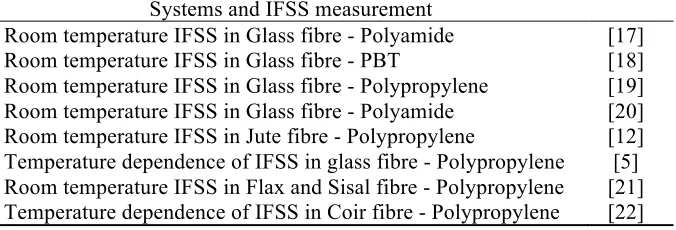
Furthermore Table 1 lists the wide range of thermoplastic based composite systems which we have investigated where measured values the measured of IFSS can be fully explained by this concept of residual interfacial radial compressive stress combined with static friction. It is interesting to note from this Table that the well reported poor interfacial strength performance of natural fibre composites (and other polymeric fibres such as aramid) can be explained by the high transverse coefficient of thermal expansion of the fibres without having to resort to discussing the interfacial chemistry. It is notable that many researchers have attempted to change the interfacial chemistry in natural fibre by the application of silanes without any major significant improvement in IFSS values.
Whereas this residual stress concept is readily understandable in thermoplastic systems where there may be little or no expectation of chemical bonding across the interface, it becomes challenging to expectations in thermosetting matrix systems where there is a long history of the use of silanes and the chemical bonding theory at interface. However, we have also recently reported similar temperature dependence of the IFSS in a GF-epoxy (GF-EP) system. Figure 2b shows IFSS values obtained for a
0 4 8 12 16
-50 -25 0 25 50 75 100
IF
S
S
(
MPa
)
Temperature (°C ) GF-PP IFSS
Thermal Stress Model
2a) Bare GF – Homopolymer PP
0 10 20 30 40 50 60
0 25 50 75 100 125 150
IF
S
S
(
MPa
)
Temperature (°C ) GF-Epoxy IFSS
Thermal Stress Model
Thermal+Shrinkage Stress Model
[image:3.595.131.469.450.565.2]ECCM18 - 18th European Conference on Composite Materials
Athens, Greece, 24-28th June 2018 4
James L. Thomason, Liu Yang and Ross F. Minty
aminosilane sized glass fibre in an epoxy matrix, measured across a 20 °C to 150 °C temperatures range [6]. It can be clearly seen that there is a significant temperature dependence of the IFSS in this thermosetting system. The IFSS falls from 54 MPa at 20 °C to just 2 MPa at 150°C with the highest rate of change of IFSS in the region of matrix Tg which is in the range 70-90 °C [6]. The magnitude of the IFSS with this GF-EP combination is much greater than for the GF-PP at any particular temperature. This supports the general expectation that the stress transfer capability of the GF-EP interface is much greater than that of GF-PP. However, there is also a striking similarity in the form of the IFSS versus temperature dependence for these two very different composite systems. Both systems exhibit a significant step-change in the IFSS around the associated matrix Tg.
Similar to Figure 2a the dashed line in Figure 2b shows the potential contribution in this GF-EP system to the apparent IFSS obtained from typical residual thermal compressive stress models combined with a value for µs of 0.6. It can be seen that using this value of ms the the contribution of
residual stress to the apparent IFSS is very low. Indeed to obtain a reidual stress generated value of IFSS at room temperature would require a very high level of µs (>6) for this system. A similar low
level of contribution of thermal stresses to the interfacial stress transfer capability in carbon fibre – epoxy has been reported [8,9]. Proponents of the hypothesis that chemical bonding should be considered as the main principal mechanism accounting for the measured high level of IFSS in GF-EP may not be surprised by this result. Nevertheless, one significant difference in the residual stress and strain in the thermosetting (epoxy) and thermoplastic (polypropylene) systems is the fact that thermosetting systems also experience volume changes during polymerisation known as cure shrinkage. Cure shrinkage can result in significant volume changes of epoxy resins undergoing isothermal curing. In a recent paper Jakobsen actually suggested that the residual stresses in an Eglass-epoxy composite were mainly due to the result of cure shrinkage rather than the mismatch between the fibre and matrix thermal expansion coefficients [23]. Figure 2b also shows the total residual stress contribution to the apparent IFSS that would be present in this system assuming an isothermal volumetric cure shrinkage value of -6%. It can be seen that the residual radial interfacial stress obtained from such a level of cure shrinkage is significantly greater than the residual thermal stress. This result appears to be well aligned with the statement of Jakobsen discussed above [23].
Consequently it is clear from the data in Figure 2 that the sum of thermal and cure shrinkage related residual radial interfacial stress is of an appropriate magnitude in order for realistic values of µs (=0.6)
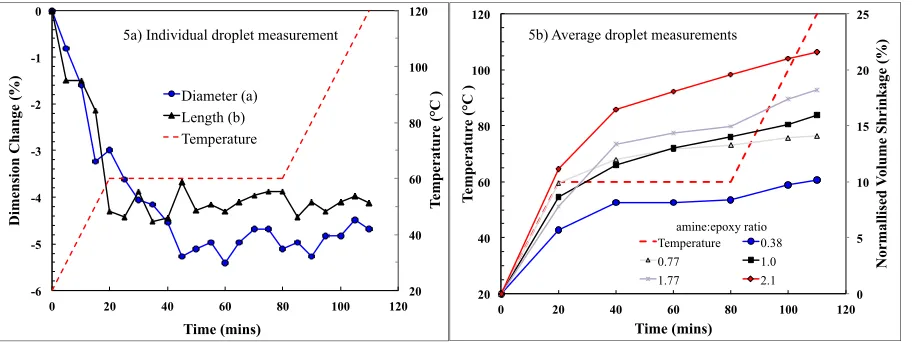
to deliver an interfacial stress transfer contribution of the same order of magnitude as the experimentally determined IFSS. It appears from these results that it is possible to make the case for residual stress combined with static adhesion also being the major contributor to the apparent interfacial adhesion in a GF-EP system. However, a major challenge to this hypothesis is the weight of opinion that the chemistry and chemical reactions in the system must in some way play a role in the stress transfer capability of the interface. In order to maintain the primary hypothesis of residual compressive stress being a major contribution to the apparent IFSS it becomes necessary to investigate how the chemistry of the polymerising matrix system could affect the major drivers of this residual stress. In order to explore these concepts further we have investigated the effect of varying the chemical nature of the epoxy matrix on the IFSS of an aminosilane coated GF-EP system where the epoxy to curing agent ratio has been systematically varied. The cure shrinkage of these different epoxy matrices have also been characterised with a novel method using curing microbond samples.
2. Experimental
James L. Thomason, Liu Yang and Ross F. Minty
[image:5.595.184.411.223.395.2]calorimetry (DSC) was carried out in a TA Instruments Q2000 DSC under nitrogen. The pre-cured epoxy material was cut down to specimen sizes with a mass in the range of 15-20 mg. These samples were subjected to a DSC heat-cool-heat cycle from -10 °C to +150 °C at 10 °C/minute. The Tg values reported are mid-point values from the second heating ramp. The cure shrinkage of epoxy microdroplets was observed in a Mettler Toledo FP90 hot-stage using a Olympus BX51 microscope. The hot-stage heating schedule was similar to the microbond samples oven curing, heat to 60 °C at 2 °C per minute, isothermal for 60 minutes, then heating to 120 °C. Images were recorded at one minute intervals. The droplet images were approximated as ellipses and the dimensions were used to obtain an estimate of the droplet volume. Ten droplets were measured at each of five R ratios investigated.
Figure 3. Interfacial strength and matrix Tg versus amine:epoxy group ratio
3. Results and Discussion
3.1. IFSS dependence on epoxy matrix stoichiometry
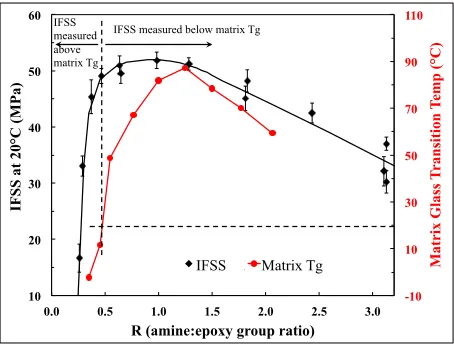
Figure 3 presents the IFSS results obtained for the OC-APS fibres as a function of the matrix R value (amine:epoxy group ratio). Each data-point represents an average of approximately 40 individual successful microbond measurements. The line in this Figure is added purely as a guide to the apparent trend. The primary observation in this Figure is that the IFSS exhibits a broad peak about the stoichiometric value (R=1) for this epoxy matrix system. Consequently, a reasonable conclusion could be that small local variations in the matrix composition around the fibre (in the interphase if one exists) due to epoxy or amine groups present in the fibre sizing may not lead to significant variations of the IFSS. It appears that local variations in the value of R of greater than ±0.5 from the stoichiometric ratio would be necessary to significantly change the IFSS. Nevertheless, a second important observation is the extremely steep drop in IFSS when the R ratio drops below approximately 0.5. It can be seen that if for any physical reason R<0.5 it would have serious consequences for the apparent adhesion in this system and presumably also for the mechanical performance of a composite. When modelling the residual compressive stresses (from both thermal and cure shrinkage) at the fibre-matrix interface, the temperature at which such stresses are “frozen-in” and cannot easily relax away is an important parameter. In epoxy based systems it is accepted that the characteristic temperature at which this occurs is the matrix Tg. The results for the DSC determined cured polymer Tg are also shown in Figure 3 as a function of the system stoichiometry. The maximum Tg for this epoxy system appears to be in the range 1<R<1.2 close to the calculated stoichiometric ratio. Samples with either an excess of epoxy or an excess of hardener gave a much lower Tg value. This Tg dependence of stoichiometry has been observed in epoxy resins by other researchers [24-26]. Comparison of the general trends observed in Figure 3 for IFSS and matrix Tg as a function of the matrix stoichiometry
-10 10 30 50 70 90 110
10 20 30 40 50 60
0.0 0.5 1.0 1.5 2.0 2.5 3.0
M
atr
ix G
las
s
T
ran
si
ti
on
T
emp
(°
C
)
IF
S
S
at 20°
C
(M
P
a)
R (amine:epoxy group ratio) IFSS . Matrix Tg
IFSS measured above matrix Tg
ECCM18 - 18th European Conference on Composite Materials
Athens, Greece, 24-28th June 2018 6
James L. Thomason, Liu Yang and Ross F. Minty
reveal some similarity with a maximum value occurring around R=1 and both IFSS and Tg reducing as R moves away from unity (in either direction). A particularly interesting correlation is the position of the large step down in IFSS when R<0.5. It is also at this approximate value of R that the matrix Tg drops below room temperature. Consequently, the very low values of IFSS observed for R<0.5 in Figure 3 were measured at a temperature above the matrix Tg when presumably there is little remaining residual interfacial stress to contribute to the measured IFSS. This appears to be the same phenomenon observed in Figure 2b where the experiment design involved a fixed matrix Tg (≈80 °C for R=1) and measurement of IFSS at temperatures above and below this value. In Figure 3 the experiment is designed with a constant IFSS measurement temperature but a changing epoxy matrix Tg. In both cases a similar effect can be observed of reduced IFSS when the measurement temperature is above the Tg of the matrix polymer. Further work to characterise the system IFSS as a function of both R value and temperature is planned [4,27].
3.2. IFSS dependence on epoxy matrix stoichiometry
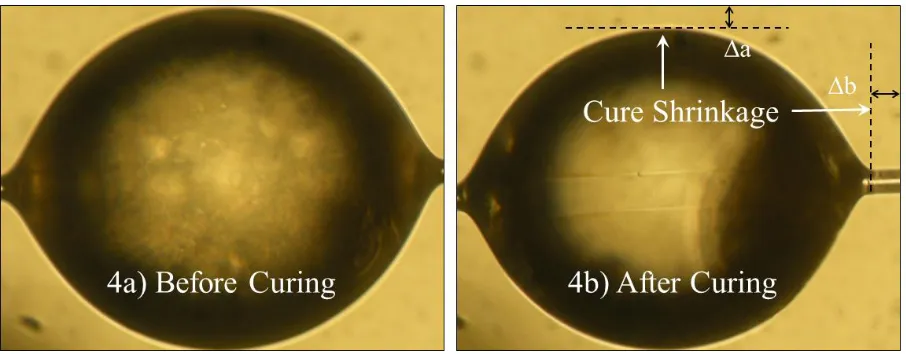
[image:6.595.71.524.377.554.2]Figure 4 compares photomicrographs of an epoxy microdroplet sample before and after curing. Given that the magnification is the same in both pctures it can be clearly seen that the cured droplet has shrunk considerably compared to the original uncured liquid droplet. Figure 5a shows a plot of the change in the length and diameter of an individual microdroplet during the two hour cure schedule. By approximating the droplet shape to that of an ellipsoid it is possible to calculate the total droplet volumetric cure shrinkage during thedroplet curing. Results for the volumetric shrinkage normalised
Figure 4. Optical micrographs showing epoxy microdroplet cure shrinkage
James L. Thomason, Liu Yang and Ross F. Minty
Figure 5. Change in epoxy microdroplet dimensions during curing
4. Concluding remarks
The results presented here can be interpreted as providing further support for the hypothesis that most of the apparent interfacial shear strength measured in fibre-reinforced composites can be attributed to a combination of residual radial compressive stress and static friction at the fibre-matrix interface. The IFSS of a glass fibre-polypropylene and a glass fibre-epoxy system showed a highly significant inverse dependence on testing temperature, with a major step change in the glass transition region of the matrix. The measured values of IFSS in many thermoplastic composite systems can be explained by the effect of residual thermal stress alone. When the temperature dependence of the glass fibre-epoxy IFSS was compared to the potential contribution to the interface stress transfer capability, analysis indicated that the magnitude was insufficient to explain the magnitude the of system IFSS. However, when the additional potential residual stress generated by a 6% cure shrinkage of the epoxy matrix was considered, then the magnitude of the residual stress at the interface was found to be of the same order of magnitude as the measured IFSS. Results, from the same system, on the room temperature dependence of the IFSS as a function of the matrix amine:epoxy group ratio revealed a strong dependence of the IFSS and the matrix thermal and mechanical properties on this ratio. At R<0.5 a correlation was observed between large reduction of IFSS with the lowering of the matrix Tg below room temperature. Hence the IFSS in these composite systems drops dramatically if either the test temperature is physically raised above the matrix Tg or the matrix Tg is chemically lowered below the test temperature. Direct optical measurement of the cure shrinkage of IFSS microdroplets revealed volumetric shrinkage in the range 11-21% during curing depending on the matrix R ratio. Consequently only a fraction of the measured epoxy matrix cure shrinkage is required to be frozen in to obtain an interfacial compressive stress capable of producing an interfacial stress transfer capability of equivelant magnitude to the measured value of the interfacial shear strength.
References
[1] J.L. Thomason. Glass fibre sizings: A review of the scientific literature. Blurb Inc. 2012. ISBN: 798-0-9573814-1-4. URL: http://www.blurb.co.uk/b/6244677-glass-fibre-sizings
[2] J.L. Thomason. Glass fibre sizing: A review of size formulation patents. Blurb Inc. 2015. ISBN: 798-0-9573814-3-8. URL: http://www.blurb.co.uk/b/6244662-glass-fibre-sizing
[3] J.L. Thomason and G.E. Schoolenberg. An investigation of glass fibre/polypropylene interface strength and its effect on composite properties. Composites 25:197-203,1994
20 40 60 80 100 120 -6 -5 -4 -3 -2 -1 0
0 20 40 60 80 100 120
T emp er atu re (° C ) D ime n si on C h an ge (%) Time (mins) Diameter (a) Length (b) Temperature
5a) Individual droplet measurement
0 5 10 15 20 25 20 40 60 80 100 120
0 20 40 60 80 100 120
N or mal li se d V ol u me S h ri n k age (%) T emp er atu re (° C ) Time (mins)
Temperature 0.38
0.77 1.0
1.77 2.1
amine:epoxy ratio
ECCM18 - 18th European Conference on Composite Materials
Athens, Greece, 24-28th June 2018 8
James L. Thomason, Liu Yang and Ross F. Minty
[4] R.F. Minty. The influence of matrix stoichiometry on interfacial adhesion in composites for wind turbine applications. PhD Thesis University of Strathclyde, UK 2018.
[5] J.L. Thomason and L. Yang. Temperature dependence of the interfacial shear strength in glass-fibre polypropylene composites. Compos Sci Technol 71:1600-1605,2011.
[6] J.L. Thomason, L. Yang, Temperature dependence of the interfacial shear strength in glass–fibre epoxy composites, Compos Sci Technol 96:7-12,2014.
[7] L. Di Landro and M. Pegoraro. Evaluation of residual stresses and adhesion in polymer composites. Compos Part A 27:847-53,1996.
[8] A. Pegoretti, C. Della Volpe, M. Detassis, C. Migliaresi, H.Wagner, Thermomechanical behaviour of interfacial region in carbon fibre/epoxy composites. Compos Part A 27:1067-1074,1996. [9] M. Detassis, A. Pegoretti, C. Migliaresi, Effect of temperature and strain rate on interfacial shear
stress transmission in carbon/epoxy model composites. Compos Sci Technol 53:39-46,1995. [10] H.D. Wagner, J.A. Nairn. Residual thermal stresses in three concentric transversely isotropic
cylinders. Compos Sci Technol 57:1289-1302,1997.
[11] J.L. Thomason. Interfacial strength in thermoplastic composites – at last an industry friendly measurement method? Compos Part A 33:1283-1288,2002.
[12] J.L. Thomason. Dependence of interfacial strength on the anisotropic fiber properties of jute reinforced composites. Polym Compos 31:1525–34,2010.
[13] L. WenBo, Z. Shu, H. LiFeng, J.WeiCheng, Y. Fan and W. RongGuo. Interfacial shear strength in carbon fiber poly(phthalazinone ether ketone). Polym Compos 34:1921-1926,2013.
[14] L. Yang, J.L. Thomason. Development and Application of Micromechanical Techniques for Characterising Interface Strength in Composites. Polym Test 31:895–903,2012.
[15] G.E. Schoolenberg In: Karger-Kocsis J. editor. Polypropylene: Structure, Blends and
Composites, Chapter 3.6. Chapmann and Hall, 1995.
[16] V. Rao and L.T. Drzal. The dependence of interfacial shear strength on matrix and interphase properties. Polym Compos 12:48-56,1991.
[17] J.L. Thomason. Micromechanical Parameters from Macromechanical Measurements on Glass Reinforced Polyamide 6,6. Compos Sci Technol 61:2007-2016,2001.
[18] J.L. Thomason. Micromechanical Parameters from Macromechanical Measurements on Glass Reinforced Polybutyleneterepthalate. Compos Part A 33:331-339,2002.
[19] J.L. Thomason. Micromechanical Parameters from Macromechanical Measurements on glass reinforced polypropylene. Compos Sci Technol 62:1455-1468,2002.
[20] J.L. Thomason. Structure-property relationships in glass reinforced polyamide: 1) The effects of fibre content.' Polym Compos 27:552-562,2006.
[21] J.L. Thomason, L. Yang and F. Gentles. Characterisation of the Anisotropic Thermoelastic Properties of Natural Fibres for Composite. Fibers 5:36,2017.
[22] J.L. Rudeiros Fernández. Investigation of the mechanical performance of natural fibres and their composites. PhD Thesis University of Strathclyde, UK 2016.
[23] J. Jakobsen, M. Jensen, J.H. Andreasen, Thermo-mechanical characterisation of in-plane properties for CSM E-glass epoxy polymer composite materials – Part 1: Thermal and chemical strain, Polym Test 32:1350-1357,2013.
[24] F. Meyer, G. Sanz, A. Eceiza, I. Mondragon and J. Mijović. The effect of stoichiometry and cure on structure and properties of epoxy networks. Polymer 36:1407-1414,1995
[25] F. Garcia, B. Soares, V. Pita, R. Sánchez and J. Rieumont. Mechanical properties of epoxy networks based on DGEBA and aliphatic amines. J Appl Polym Sci 106:2047-2055,2007.
[26] Y. Calventus, S. Montserrat and J.M. Hutchinson. Enthalpy relaxation of non-stoichiometric epoxy-amine resins. Polymer 42: 7081-7093,2001.