
International Journal of Innovative Technology and Exploring Engineering (IJITEE) ISSN: 2278-3075, Volume-8 Issue-8, June, 2019
Abstract: Modern technology blessed us with many amenities. Those invention of modern science has lessened our workload with many others flexibility. Modern technology has been growing up significantly after the implementation of artificial intelligence (AI) in various sector. Machine Learning (ML), Natural language processing (NLP), Expert system (ES), Computer Vision (CV), Planning & Optimization (P&O), Robotics (RT), Deep Learning (DL), Image Recognition (IR) all are intertwined with AI. Deep learning, one of the most interesting affiliate of AI which terminate the provision of usual invention. One can think of various type of innovation about which only come to their imagination. Some devising work which appears in front of us seems like as a human being is doing that output. The algorithm that deep learning use is more efficient and acceptable for those modern amenities which are called the blessings of modern science. All that devising works in modern age is used by us but could not understand the way how that devising element perform or what the mechanism is. This project gives one a clear view about the deep learning. This paper focus on those algorithms and working procedure which is needed for developing innovative things and which make deep learning more acceptable to us.
Index Terms: Machine learning (ML), Natural language processing (NLP), Expert system (ES), Computer vision (CV), Planning & optimization (P&O), Robotics (RT), Deep Learning (DL), Image recognition (IR).
I. INTRODUCTION
AI has many functionalities among them DL is one. A machine can think or process data like a human brain by means of DL. It is mainly a subset of ML. DL mainly imitates the way of working of a human brain with all the possible way of thinking and processing a data how human brain process [1]. DL is coming through the path of inventing something which is capable of doing or solving all the problem like a human brain do. Investors have investing huge amount to implement this subset of ML so that their invention could do like a human brain do. For example google invest above 1.1 billion for a self-driving car [2]. Toyota spend almost 100 million and Toyota AI ventures are in a search for those companies which are wanted to possess that opportunity to work on AI [3].
DL is used vigorously in IR. Among all the methods convolutional neural network of DL is used to describe the IR process. Bags of visual words is the base of this process. This
Revised Manuscript Received on June 05, 2019
Thaharim Khan, Department of Computer Science and Engineering, Daffodil International University (DIU), Dhaka, Bangladesh.
Masud Rabbani, Department of Computer Science and Engineering, Daffodil International University (DIU), Dhaka, Bangladesh. Shah Md. Tanvir Siddiquee, Department of Computer Science and Engineering, Daffodil International University (DIU), Dhaka, Bangladesh. Ahmed Al Marouf, Department of Computer Science and Engineering, Daffodil International University (DIU), Dhaka, Bangladesh.
process represent image as a histogram and after that convert it as a classifier. Spatial geometry is added into the bow description as this process is on order less statistics. A spatial pyramid approach mobilized into the pipeline for counting the visual word inside the set of image [4].
IR is not only a process to describe the beneficiary exertion of DL, there is also some other needful project like saturating auto-encoder [5], self-driving car and so on which has lessened the workload of human being and make life easier. DL is also used in software engineering. According to a statistic almost 84.7% paper in software engineering used DL to solve the problem [6]. All this project is done by dint of DL. If it is considered deeply then we can found that our modern technology is dependent prodigiously in DL. It is necessary now to know the working mechanism of DL for developing new amenities to upgrade modern technology or to cope up with modern technology.
The remaining part of the paper is embodied as follows. Section 2 summarizes some related works. Section 3 describes the methodology. Section 4 summarizes the working procedure. Section 5 summarizes result analysis & comparison .Section 6 summarizes discussion Finally Section 7 concludes the paper.
II. RELATED WORKS
DL is one of the most talked topic now. It has changed the whole way of devising something new in this era of modern technology. Many other work has been done on the basis of DL and we are now enjoying the propitiousness. DL is used in IR which is solved by the convolutional neural network methods of DL for classifying an image. This process is work through the bags of visual words. Which at first represent the image as a histogram and then convert it as a classifier. A spatial pyramid approach is mobilized into it for counting the visual word. Again a spatial geometry is used in Bow description as it is a part of odorless geometry [7].
Another work for DL is to solve software related problem and among all the software engineering task about 41 task is used DL model for the betterment. Among those problem bug reports summarization is one. Where Auto Encoder of DL model is used to encode the bug reports or summarizing the report in an unsupervised way. The quantity of the words is reckoning by the information contain in the hidden state. Based on this measurements of word the informative sentences are identified [8].
Again visual question and answering is another revolution which is developed on the basis of joining the NLP with computer vision.
An Overall Workflow of Deep Learning in
Modern Technology
This process measure the performance of language and image processing through LTML and convolutional neural network. This model can give accuracy about 40.06 % which is almost correct. Again stacked attention network and dynamic memory network model is used for semantic representation [9].
III. METHODOLOGIES OF DEEP LEARNING
[image:2.595.346.505.144.273.2]AI is the most common buzzword for this modern era of technology. Now we are in such a situation where we cannot think of our existence for a single time without the help of technology. AI now entering into its best level .By simplifying AI we get many affiliate of it. “Fig. 1”,shows that affiliation of AI. Deep learning is one of it.
Fig. 1. Affiliation of AI [10]
[image:2.595.46.279.250.352.2]Deep neural network that term is goes for DL as most of artifice of neural network is used for DL [11]. DL is used the sequence of human brain so that it could learn properly everything and work accordingly. There is so many hidden layers in DL to get the output in this methodology every node is connected with each other so that it could find the best output with full accuracy. Every node connected means this process could classify every problem too deeply and observe every steps. “Fig. 2”,shows the basic methodology of DL.
Fig. 2. Connectivity of every node in deep learning [12].
As we learn before that DL is the working on the main theorem of neural network because of it DL is often called deep neural network [13].Behind the flawless accomplishment of DL there is some technique which make it so preferable. “Fig. 3”, shows that technique for DL which is used at the time of implementation of DL.
Fig. 3. Technique of deep learning.
A. Fully Connected Neural Network (FCNN):
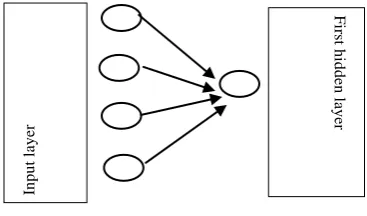
Fully connected neural networks is such a technique which work according to its naming convention like in this technique each and every node is connected with its previous node. “Fig. 4”,shows the workflow of fully connected neural network.
[image:2.595.328.512.459.567.2]
Fig. 4. Fully connected neural network
Here each and every node has an activation function which is responsible for changing the output of that given input. There is mainly two types of activation function those are (i) linear (ii) nonlinear function [13].
B. Convolutional Neural Network (CNN):
Convolutional neural network is formed on the cornerstone of visual context of human brain [14]. Because of it this Convolutional neural network simplify the problem like image classification, image processing, image segmentation etc. “Fig. 5”, shows the processing of convolutional neural network .
Fig. 5. Convolutional neural network [15]
For determining the cluster of each and every node convolutional preserve a filter or kernel. This process mainly help to extract the visual view of an image through a small chunk [16].
C. Recurrent Neural Network (RNN):
This process mainly used for various input length with sequence of data. This means it can predict the next step of work by checking the previous step. This is a very useful process for those which need to work with a sequence of data as it seems like it gives a short time memory for sequencing [17]. For example stock
exchange price prediction could be possible because of it as it could predict the next Hidden
Layer
Output Layer Input
Layer
Hidden Layer
DL
FCNN CNN RNN GAN DRL
AI
ES CV P&O RT
IR NLP
ML
DL
In
p
u
t
la
y
er
O
u
tp
u
t l
ay
er
Hidden layer
In
p
u
t
la
y
er
F
ir
st
h
id
d
en
la
y
[image:2.595.61.266.502.616.2]International Journal of Innovative Technology and Exploring Engineering (IJITEE) ISSN: 2278-3075, Volume-8 Issue-8, June, 2019
price because it is trained with its previous price [18].
D. Generative Adversarial Network (GAN):
This is the combination of two neural networks those are (i) Generator network (ii) Discriminator network. Both of this two network always compete with one another. This competition make this process so acceptable. Among the 2 part generator network always tries to create spurious data whereas the other one tries to detect if there is any existence of false data or not [19]. If this process is continuing for a long term then at one time the generator network start to produce fake data which is as like as real data [20]. This happen because every time when a generator network is caught by discriminator that time generator network tries to save the real data and again when it approaches to produce something then the real data is produced as it is saved on memory [21].
E. Deep Reinforcement Learning (DRL):
This process is something which is used to learn a machine to interact with an environment with its basic needs [22]. With this process the machine learn what will be the output of a process according to its input, what will happen during the process and what phases it needs to passes through. After completing the phases it gets reward signal. In this process a machine also learn how to modify the environment for receiving the reward signal [23].
IV. WORKING PROCEDURE OF DEEP LEARNING
Unsupervised and new data are prepared for input. After that all the data set are extract into the feature and make group the object which is made from the data set. This group helps the administrator to find the data leakage. After that according to problem DL algorithm is used for getting the best result. After getting the information the testator find the path of data
leakage[24]. “Fig. 6”, shows the algorithm of DL.
.
Fig. 6. Algorithm of DL.
V. RESULT ANALYSIS AND COMPARISON OF DEEP LEARNING
DL has now become one of the most talked topic. It has now change the outlook of people towards the technology. Day by day the amount of publication on DL is increasing according to a statistics from Jan. 2006 to Jun 2017 rapidly increase the amount of publication from springer database. Table 1. Show the report of publication repetitively with year.
TABLE 1. NUMBER OF PUBLICATION ON DEEP LEARNING ACCORDING
TO YEAR FROM SPRINGER DATABASE [25]
Year Number of
publications
2006 39
2007 49
2008 54
2009 73
2010 62
2011 77
2012 116
2013 129
2014 149
2015 266
2016 706
2017 879
[image:3.595.320.534.48.186.2]
Another statistic is also collected from IEEE database about the increasing rate of publication on deep learning. Table 2. Shows the report of that statistic with year.
Table 2. Number of publication on deep learning according to year from IEEE Database [25]
Year Publications Journals & Magazines
2006 33 2
2007 41 3
2008 51 5
2009 68 1
2010 88 17
2011 85 9
2012 104 18
2013 176 29
2014 409 41
2015 889 133
2016 1841 241
2017 359 252
This table proves that modern technology is rapidly growing with deep learning. From 2006 to 2017 the increasing number of publication and journals prove the efficiencies of deep learning.
VI. DISCUSSION
The invention of AI is one of the revolution for the modern technology. Now people can invent or do something like that what is only they can think. This process has been accelerate with the implementation of DL in every sphere of modern era. Now gray scale image coloring is not a big matter to do, it can be done manually by the development of digital image processing [26]. Now-a-days videos which have no sound are not very tough for anyone to hear because sound can be added to the video by the means of recurrent neural network [27]. Again for Iris recognition is become easy because of DL and it is more preferable now a days to use convolutional neural network instead of conventional Iris sensor [28]. DL become one of the core part in medical science. Magnetic resonance imaging (MRI) is the revolution in this sector which is processed to take image from human brain and predict the probable disease for human [29]. CNN is used most commonly used for image processing. Like image segmentation, classification all that can be done by the means of CNN [30].
Unsupervised
data Objec
t featur e
DL Algorith
m
Result
[image:3.595.45.289.513.567.2]Like all this deep learning slowly enter into the every spare of our day to day life. It can be possible to develop a new component for the betterment of human life which is used in everyday life. To make this development people need to learn properly the algorithm and working procedure of DL.
VII. CONCLUSION
DL is one of the best solution to develop the modern technology with best amenities. This can be done if the properties and mechanism of DL is familiar to everyone. All the algorithms in DL has its own way to solve problem some algorithm is used for image processing only, some are used for biometrics, some are for medical science. Realizing the capabilities of each and every algorithm DL can be implemented for making a better solution. This project is work on making DL familiar and to make everyone know about the pros and cons of DL. Our decade is growing rapidly with modern new innovations to cope up with this circumstances one need to be learned about the working procedure of DL. Again the statistical table show the rapid growing situation of DL. During this current decades DL is the better solution for security purpose as face recognition, voice recognition is combined and make an effective result. Which reduce the error percentage to 10-20%. All of this circumstances stated above it can be easily predict that DL is one of the versatile and more effective topic for modern technology. This project focus on that of the betterment of technology by DL with its functionality and working procedure.
REFERENCES
1. Investopedia: Investopedia, LLC,”Deep learning” Updated 15 June 2017,[Online]
https://www.investopedia.com/terms/d/deep-learning.asp, Retrieved on October 25, 2018
2. BUSINESS INSIDER, Updated 10 May 2018,Available from: https://www.businessinsider.com/google-self-driving-car-investment-exceeds-1-billion-2017-9 , Retrieved on October 20, 2018. The Economic Times, Updated July 12, 2017, Available from: https://economictimes.indiatimes.com/small-biz/money/toyota-invest s-100-million-in-fund-for-ai-robotic-startups/articleshow/59555926.c ms, Retrieved on October 30, 2018.
3. K. Yu, Y. Lin, and H. Lafferty, “Learning image representations from the
pixel level via hierarchical sparse coding” ,CVPR 2011. Liou C Y, Cheng W C, Liou J W, et al. Autoencoder for words, Neurocomputing, 139: 84-96,2014.
4. Dumitru Erhan,Yoshua Bengio,Aaron Courville,Pierre-Antoine,Pascal Vincent, “Why does unsupervised pre-training help deep learning? ” , The Journal of Machine Learning Research,11: 625-660,2010. 5. Weston J, Ratle F, Mobahi H, et al. Deep learning via Semi-supervised
embedding, Neural Networks: Tricks of the Trade.Springer Berlin Heidelberg, 639-655, 2012.
6. Xiaochen Li, He Jiang, Dong Liu, Zhilei Ren, and Ge Li. 2018. Unsupervised Deep Bug Report Summarization. ICPC'18.
7. Stefanie Anna Baby, Ashwini Pokle,” Visual Question Answering”, [Available]http://web.stanford.edu/class/cs224n/reports/6909280.pdf. 8. Becominghuman.ai, Updated November 30, 2017, Available from: https://becominghuman.ai/what-is-artificial-intelligence-ai-4bde325e 5462, Retrieved on October 30, 2018.
9. MathWorks:The MathWorks, Inc. “What is deep learning”, Available from: https://www.mathworks.com/discovery/deep-learning.html, Retrieved on October 20, 2018.
10. D. Yu, K. Yao, H. Su, G. Li, and F. Seide,”KL-divergence regularized deep neural network adaptation for improved large vocabulary speech recognition” ICASSP, 2013.
11. Zeomag: Zeolearn LLC,”Five Important Techniques That You Should Know About Deep Learning ”Updated May 9, 2018, Available from: https://www.zeolearn.com/magazine/five-important-techniques-that-y ou-should-know-about-deep-learning, Retrieved on October 30, 2018. 12. M. Zeiler, R. Fergus, “Stochastic pooling for regularization of deep
convolutional neural networks” ICLR, 2013.
13. Wikipedia: The Free Encyclopedia. Wikimedia Foundation Inc. 2 November 2018, at 00:35 (UTC).Encyclopedia online. Available from https://en.wikipedia.org/wiki/Convolutional_neural_network. 14. M. Zeiler, “Hierarchical convolutional deep learning in computer
vision”.
15. Wikipedia: The Free Encyclopedia. Wikimedia Foundation Inc. 3 November 2018, at 00:31 (UTC)..Encyclopedia online. Available from https://en.wikipedia.org/wiki/Recurrent_neural_network.
16. Baccouche M, Mamalet F, Wolf C, et al. Spatio-Temporal Convolutional Sparse Auto-Encoder for Sequence Classification, in: BMVC, 2012.
17. A. Subramanya, L. Deng, Z. Liu, and Z. Zhang, “Multi-sensory speech processing: Incorporating automatically extracted hidden dynamic information”, ICME, July 2005..
18. F. Triefenbach, A. Jalalvand, K. Demuynck, J.-P. Martens, “Acoustic modeling with hierarchical reservoirs” , IEEE Transactions on Audio,Speech, and Language Processing, 21(11):2439–2450, November 2013.
19. Wikipedia: The Free Encyclopedia. Wikimedia Foundation Inc. 12 November 2018, at 12:32 (UTC)..Encyclopedia online. Available from https://en.wikipedia.org/wiki/Generative_adversarial_network 20. R. van Dalen and M. Gales, “Extended VTS for noise-robust speech
recognition”.
21. Wikipedia: The Free Encyclopedia. Wikimedia Foundation Inc. 11 November 2018, at 22:19 (UTC)..Encyclopedia online. Available from https://en.wikipedia.org/wiki/Reinforcement_learning.
22. XenonStack - A Stack Innovator, “Automatic Log Analysis using Deep Learning and AI for Microservices”, Updated July 21, 2017,Available from:
https://www.xenonstack.com/blog/data-science/log-analytics-deep-m achine-learning-ai/ ,Retrieved on October 30, 2018.
23. Mapr: MapR Technologies, Inc, “Demystifying AI, Machine Learning and Deep Learning”, Updated August 16, 2017, Available from: https://mapr.com/blog/demystifying-ai-ml-dl/,Retrieved on October 30, 2018.
24. R.Vargas,A. Mosavi,L. Ruiz,"DEEP LEARNING: A REVIEW",Advances in Intelligent Systems and Computing, 2017. 25. Marra F.: A Deep Learning Approach for Iris Sensor Model
Identification. Pattern Recognition Letters (2017).
26. Lee T.: David M Hierarchical Bayesian inference in the visual cortex. JOSA 20, 1434-1448 (2003).
27. Vaezipour, A. Mosavi, U. Seigerroth, “Visual analytics and informed decisions in health and life sciences”, International CAE Conference, Verona, Italy (2013).
28. M. Zeiler and R. Fergus, “Visualizing and understanding convolutional networks”, pages 1–11, 2013.
AUTHORSPROFILE
International Journal of Innovative Technology and Exploring Engineering (IJITEE) ISSN: 2278-3075, Volume-8 Issue-8, June, 2019
Masud Rabbani is currently working as a Lecturer in Department of Computer Science and Engineering (CSE) of Daffodil International University (DIU), Dhaka, Bangladesh. He received his Bachelor degree from the Department of Computer Science and Engineering (CSE), Khula University of Engineering & Technology (KUET) in 2014. His research interest lies within Machine Learning, Data Mining & Human Computer Interaction. He also acts as a principal researcher of DIU HCI (Human Computer Interaction) Research Lab.
Shah Md. Tanvir Siddiquee is currently working as a Senior Lecturer in Department of Computer Science and Engineering (CSE) of Daffodil International University (DIU), Dhaka, Bangladesh. He received his Bachelor degree from the Department of Computer Science and Engineering (CSE), Hajee Mohammad Danesh Science & Technology University (HSTU) in 2012 and MSc in CSE from South Asia University, New Delhi, India in 2014. His research interest lies within Machine Learning, Data Mining and Cloud Computing. He also acts as a principal researcher of DIU HCI (Human Computer Interaction) Research Lab.
Ahmed Al Marouf is currently pursuing M.Sc. Engg in Computer Science and Engineering (CSE) from Islamic University of Technology (IUT), Gazipur, Bangladesh. He received his Bachelor degree from the Department of Computer Science and Engineering (CSE), IUT in 2014. He is a graduate researcher of Systems and Software Lab (SSL) in the CSE department of IUT.
![Table 2. Number of publication on deep learning according to year from IEEE Database [25]](https://thumb-us.123doks.com/thumbv2/123dok_us/8200669.260722/3.595.320.534.48.186/table-number-publication-deep-learning-according-ieee-database.webp)
