
Intrusion and intrusion detection
John McHugh
CERTCoordination Center∗, Software Engineering Institute, Carnegie Mellon University, Pittsburgh, PA 15213-3890, USA E-mail: [email protected]
Published online: 27 July 2001 –Springer-Verlag 2001
Abstract.Assurance technologies for computer security have failed to have significant impacts in the marketplace, with the result that most of the computers connected to the internet are vulnerable to attack. This paper looks at the problem of malicious users from both a historical and practical standpoint. It traces the history of intrusion and intrusion detection from the early 1970s to the present day, beginning with a historical overview. The paper de-scribes the two primary intrusion detection techniques, anomaly detection and signature-based misuse detection, in some detail and describes a number of contemporary research and commercial intrusion detection systems. It ends with a brief discussion of the problems associated with evaluating intrusion detection systems and a dis-cussion of the difficulties associated with making further progress in the field. With respect to the latter, it notes that, like many fields, intrusion detection has been based on a combination of intuition and brute-force techniques. We suspect that these have carried the field as far as they can and that further significant progress will depend on the development of an underlying theoretical basis for the field.
Keywords:Computer misuse – Intrusion detection – In-trusive anomalies – Intrusion signatures – Intrusion de-tection systems (IDS) – IDS evaluation
1 Introduction
The principal unsolved technical problem found by the working group was that of how to provide multilevel resource and information sharing systems secure against the threat from a malicious user. This problem is neither hopeless nor solved. It is, however, perfectly clear to the
∗CERT and CERT Coordination Center are registered service
marks of Carnegie Mellon University
panel that solutions to the problem will not occur spontaneously, nor will they come from the various well-intentioned attempts to provide security as an add-on to existing systems.
Although these words could have been written today, they come from one of the seminal documents in com-puter security, a report [3, Preface] prepared by James P. Anderson & Co. for then Major Roger R. Schell of the USAF in 1972. In the nearly 30years since the prepar-ation of the Anderson report, little has changed, except that we are, perhaps, less sanguine about the solvabil-ity of the problem. The line of research and development proposed in the report has produced a few fairly secure systems, but none that have achieved commercial success or wide-scale deployment. The problems posed by mali-cious users are rampant, and the inability of commodity operating systems to provide more than minimal protec-tion has led to a variety of attempts to secure computing systems through add-on or external means. Firewalls and similar mechanisms form the principle line of defense for many installations. Intrusion Detection Systems (IDSs), the primary topic of this paper, are an attempt to iden-tify both successful and unsuccessful attempts to abuse computer systems.
2 Intrusions, intrusive activities, penetrations, and exploits
From the earliest days of computer security, the possibil-ity that malicious users could defeat protection mechan-isms was an area of serious concern. Due to the relatively limited networking of early systems and the prevalence of multiuser batch systems, coupled with the fact that pub-licly accessible services (such as present-day web servers) were almost unknown, most of the early efforts con-centrated on mechanisms that untrusted insiders could use to access sensitive materials on multi-level secure systems.1 Under this model, the primary threat is from legitimate users of the system who try to gain access to material for which they do not have authorization. By the early 1970s, timesharing and other multiuser systems were well established and there were growing pressures to support multi-level operations on these systems, whether they were actually capable of supporting them or not. In 1970, the Defense Science Board’s Task Force on Com-puter Security supported by Willis H. Ware of the RAND Corporation issued a report [81] that laid the groundwork for the development of adequate computer systems for the processing of multi-level data. As noted in the Anderson report [3], the Ware report did not get the attention it deserved,2and systematic approaches to building multi-level secure systems did not emerge until the mid 1970s.
Early multi-user operating systems provided minimal security features and those that were present were often directed towards protecting the data associated with one task from accidental corruption by another. While mod-erately successful in this respect, such mechanisms were often trivial to defeat. For example, in the mid-1960s, the resident engineer for a site where the author was em-ployed gave him a list of about a dozen techniques that a job could use to gain supervisor mode with complete ad-dressability to all physical memory on systems running the IBM OS-360MFT operating system.
In the meantime, security flaws that could be ex-ploited by untrusted users were discovered in a number of systems that were considered to be secure. Paul Karger and Roger Schell performed an evaluation [44] of the Mul-tics operating system and discovered flaws that would allow an untrusted user to access or modify protected in-formation. Work at the Naval Research Laboratory [74] uncovered flaws in the sharing mechanisms of Univac’s Exec-VIII operating system for the 1108 that would al-low users of a language processor such as the FORTRAN
1 A multi-level secure computing system is one that is capable
of supporting a mandatory access control policy that bases access decisions on the classifications assigned to the information objects that it stores and clearances given to users on whose behalf pro-cesses seek access.
2 Although the Ware report contained no sensitive information,
it was classified at the CONFIDENTIAL level to control dissemi-nation of its contents. This, combined with its emphasis on stating requirements rather than suggesting solutions probably reduced its impact substantially.
compiler to capture files from other concurrent users of the same processor. Experiences such as these led to sys-tematic investigations of flaws and exploitations as well as techniques to design and build secure systems.
Although there are earlier discussions of the issues associated with malicious users, James P. Anderson’s 1980report “Computer Security Threat Monitoring and Surveillance” [5] set up the first coherent framework for an investigation of intrusions and intrusion detection. We will use the following definitions, given by Anderson in this paper, supplementing them later, as necessary.
Threat: The potential possibility of a delib-erate, unauthorized attempt to: (a) Access information
(b) Manipulate information (c) Render a system unreliable or
unusable
Risk: Accidental and unpredictable ex-posure of information, or violation of operations integrity due to mal-function of hardware or incomplete or incorrect software design. Vulnerability: A known or suspected flaw in the
hardware or software design or op-eration of a system that exposes the system to penetration or its infor-mation to accidental disclosure. Attack: A specific formulation or execution
of a plan to carry out a threat. Penetration: A successful attack; the ability to
obtain (unauthorized) access to files and programs or the control state of a computer system.
Note that threat class (c) includes what are commonly called “denial of service” attacks today. Attacks that mis-appropriate computing resources also fall into this cate-gory.
Penetrator Not Authorized to use
Data/Program Resource
Penetrator Authorized to use
Data/Program Resource Penetrator
Not Authorized Use Of Computer
Case A:
External Penetration Penetrator
Authorized Use Of Computer
Case B:
Internal Penetration
Case C:
[image:3.612.47.294.56.207.2]Misfeasance
Fig. 1.General cases of threats (after [5])
Masqueraders are internal users by definition, but they may be successful external penetrators who have assumed an internal identity or legitimate users who as-sume the identity of another for whatever reason. Pen-etrations by legitimate users typically involve abuses of the privileges that are necessary to carry out their regu-lar duties. Clandestine users are typically highly skilled in the technical aspects of penetration and take steps to erase or disguise the traces of their penetrations. They typically achieve complete control of the penetrated com-puting system and modify its operating system so as to make subsequent discovery very difficult.
Early descriptions of vulnerabilities typically assume that the penetrator has obtained an internal identity and is capable of writing programs to exploit the vulnera-bility. Two vulnerabilities from the early 1970s serve to illustrate the approaches of the time.
2.1 Multics
In performing a vulnerability analysis of Multics, Karger and Schell found a number of flaws that might be ex-ploited by penetrators. One of these allowed ordinary users to change the access time stamps on segments allow-ing clandestine users to cover their tracks. Another was more subtle and serves to illustrate ways in which vulner-abilities are introduced and propagated, even in systems that have security as a strong design goal [44, P. 20].
While experimenting with the hardware subverter,3 a sequence of code was observed which would cause the hardware of the 645 to bypass access checking. Specifically, the execute instruction in certain cases described below would permit the executed instruction to access a segment for reading or writing without the corresponding permissions in the SDW.. . .
3The hardware subverter was a program that periodically
probed security sensitive and potentially troublesome hardware in-structions on the host hardware. It looked for hardware failures and
This hardware bug represents a violation of one of the most fundamental rules of the Multics de-sign – the checking of every reference to a seg-ment by the hardware. This bug was not caused by fundamental design problems. Rather, it was caused by carelessness by the hardware engineer-ing personnel.
The bug was introduced as a field change thus es-caping the design analysis processes associated with the Multics hardware and software development.
2.2 Exec-VIII
Exec-VIII was a multiprocessing operating system for the Univac 1108 series of mainframes. Univac claimed that Exec-VIII was secure in the sense that it enforced an isolation policy that prevented one job from accessing resources belonging to another job. On the strength of these claims, some government agencies considered use of Exec-VIII in environments with a mix of classified and unclassified computing.
Executing programs on the 1108 used two address segments, one for code and one for data by convention. By making the code reentrant, code for a single pro-gram, such as a compiler, could be shared among a num-ber of simultaneous jobs. Univac assumed that the code segments were immutable, but the segmentation hard-ware provided no mechanism for enforcing this while al-lowing the necessary write access to the corresponding data segment. Mike Lay of the University of Maryland Computer Science Faculty discovered a mechanism [74] whereby a re-entrant processor (or REP) could be forced to transfer control to an error handler in a user program that would then be able to modify the core image of the REP. Code to carry out the penetration was developed by David Stryker of NRL. The code inserted in the modifica-tion could, for example, access or modify any files owned by any user who invoked the REP. Once modified, the REP would persist in its modified state until no jobs were using it. Since REPs are never swapped out, the exploit would have to be repeated periodically, however, this was done by having the breaking code awaken periodically, determine if the target REP was still modified, and repeat the modification, if necessary.
Both the 1108 and the Multics penetrations required deep knowledge of the relevant hardware and software features of the targeted systems. While none of the Multics flaws were carried beyond the demonstration stage, Stryker’s penetration appears to have been reduced to a fairly simple tool that could have been (but was not) widely distributed and used by relatively unskilled insiders.
It was not until the mid-to-late 1980s that networked computing became sufficiently ubiquitous for penetra-tions to become widespread. Network-wide penetrapenetra-tions were a subject of Science Fiction in the 1970s, John Brun-ner’s 1975 novel [12] “The Shockwave Rider” being one of the best known examples. Early research work at highly networked enclaves such as Xerox PARC developed pro-grams [69] that may have served as the prototypes (or at least inspiration) for similar malicious efforts during the late 1980s. Many of the penetrations or intrusions of the early-to-mid-1980s were enabled by gross negli-gence on the part of vendors and system administrators. Many vendors shipped systems with predefined admin-istration or maintenance accounts (User name: system, Password: manager was used by one vendor) and many system operators neglected to change the passwords on these accounts. The widespread use of the Unix operating system among academic sites contributed to the problem since the BSD Unix networking model created large net-works of trusted peer machines, simplifying the spread of compromises from one machine to another. A 1987 note by Brian Reid [65] describes an episode of break-ins that originated with a machine serving as a mail gateway be-tween Unix and IBM systems at Stanford University. This machine had a guest account (User name: guest, Pass-word: guest) as well as a directory /usr/spool/atthat was universally writable. Commands placed in this di-rectory could easily be made to execute with superuser privileges. The intruder was thus able to assume the iden-tity of any user on the gateway machine, and by taking advantage of peer accounts on other machines was able to masquerade as that user on the peers. Reid estimates that 30to 60machines at Stanford were compromised and that at least 15 Silicon Valley companies, nine universi-ties, and three government laboratories were penetrated in this way.
Another line of intrusive activity began in the mid-1980s. Computer viruses spread through floppy disks ap-parently appeared on Apple II computers as early as 1981 [70]. In 1985, Fred Cohen published a book [19] entitled “Computer Viruses”. The first MS-DOS viruses appeared in 1986 and virus writing (and shortly after the development of anti-virus products as well) became a growth industry that persists to this day. Until fairly recently, most PC-class machines were not networked and early viruses spread primarily through physical con-tact involving infected floppy disks. Infections via the downloading of infected executables from dial-up bulletin boards was a secondary infection mechanism. Until the advent of Windows macro and scripting viruses in the late 1990s, virus penetrations were largely considered disjoint from more traditional intrusions, and we will not consider them further at this time.
In addition to penetrations enabled by poor adminis-trative practices, direct attacks on system software and services in the spirit of the earlier Multics and Exec-VIII attacks continued to be developed in the late 1980s. The
first “race condition” exploit took advantage of the fact that file creation on Unix is not an atomic action but requires separate system calls to create an “i-node” for the file and to link it into the directory structure; this apparently took place in the summer of 1988. It is pos-sible for a process other than the one creating the file to gain access to the i-node if a context switch between the creating and intervening process occurs between the two system calls. Robert T. Morris, Sr., then Chief Scientist at the National Computer Security Center, hypothesized the exploit, but doubted its feasibility. His son, Robert T. Morris, Jr., implemented the exploit [56] on a machine in the Morris home.
On 2 November 1988, the first internet-wide attack and penetration occurred. This attack took the form of a self-replicating program or “worm” that propagated it-self from system to system using a variety of transmission techniques. The worm is attributed to Robert T. Morris, Jr., who was prosecuted and convicted of federal crimes in connection with the incident. The “Morris Worm,” as it is now known, exploited a misconfiguration in thesendmail
program that allowed mailed commands to be executed on a remote system. The feature used was intended for debugging the sendmail program, but was enabled in binary versions distributed by several vendors. In add-ition, the worm also spread by overflowing a string vari-able in the finger daemon, a service widely availvari-able on Unix systems that allowed outsiders to obtain informa-tion about system users. The worm code also contained an efficient password cracking program that attempted to determine user passwords on systems that it infected. It used the trusted peer relationships reflected in .rhosts files to spread itself as well. Details of the worm and its impact on the internet appear in a number of publica-tions, including papers by Spafford [73] and Seely [68]. It is worth noting that none of the penetration mech-anisms used by the Morris Worm can be considered as security flaws, per se. Reid had already commented [65] on the folly of the peer trust represented by the .rhosts mechanism. Thesendmail misconfiguration was due to the extreme difficulties involved in configuringsendmail
properly, reducing it to a trial-and-error process that was facilitated by the ability to execute remote commands. The overflow potential infingerdreflects a software en-gineering failure of a kind that persists to this date.
In response to the Morris Worm, DARPA established the Computer Emergency Response Team, now known as the CERT Coordination Center of CERT/CC at the Software Engineering Institute (SEI). The CERT advis-ories4, which started in late 1988, allow major thrusts of intrusive activities on the internet to be traced.5 From
4 Available online athttp://www.cert.org.
5 More recently, Mitre, in cooperation with the CERT/CC and
1988 through late 1996, there appear to have been rela-tively few intrusions enabled by buffer overflows. In late 1996, the online magazinePhrack published a cookbook for buffer overflows [59] and the number of such incidents rose dramatically. A search of the CERT advisories shows buffer overflows becoming increasingly important, start-ing in early 1997. A keyword search of the CVE for the term “buffer overflow” results in about 25% of the entries and candidate entries6being identified. A substantial per-centage of the incidents reported to the CERT/CC during the past few years have involved a buffer overflow exploit of some kind. There are several reasons for the popularity of these exploits:
– The vulnerabilities are ubiquitous, as seen above. This increases the likelihood that attacks against random targets will succeed.
– A successful attack has a high probability of yielding administrator or superuser privileges on the target, since the subverted process typically runs with these privileges.
– Exploit scripts or programs for these attacks are read-ily available on the internet and require minimal skills to execute.
As is the case with many other classes of attacks, buffer overflows have evolved in complexity and
sophis-6 The search was made against version 20001013 of the CVE
which contains 1077 entries and 678 candidate entries. Of these, 434 or 24.7% contain the terms “buffer” and “overflow”.
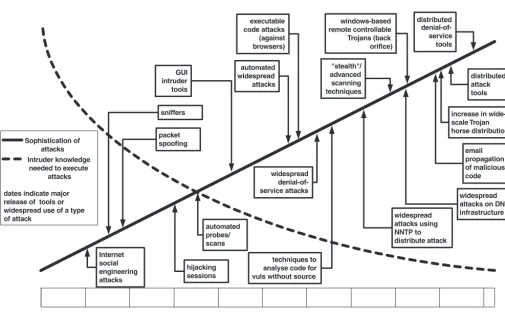
1990
1991
1992
1993
1994
1995
1996
1997
1998
1999
2000
hijacking sessions sniffers
packet spoofing
GUI intruder tools
automated widespread attacks
widespread denial-of-service attacks
"stealth"/ advanced scanning techniques
email propagation of malicious code
distributed attack tools distributed
denial-of-service tools executable
code attacks (against browsers)
widespread attacks on DNS infrastructure increase in wide-scale Trojan horse distribution
automated probes/ scans
Internet social engineering attacks
techniques to analyse code for vuls without source
widespread attacks using NNTP to distribute attack windows-based
remote controllable Trojans (back orifice)
Sophistication of attacks Intruder knowledge
needed to execute attacks
[image:5.612.51.556.413.724.2]dates indicate major release of tools or widespread use of a type of attack
Fig. 2.The evolution of attack sophistication and devolution of attacker skill
tication. Early attacks involved data explicitly read by the target program. Subsequently, it was discovered that variables used to hold the values of environment variables could also be used as attack vectors. Recently overflows based on format strings have been used.
In 1992, the first widespread appearances of what are now known as “root kits” started to appear [15]. Intruders would gain access to a system as an ordinary user, typ-ically by obtaining a password to a user account through guessing, social engineering, or other means. They would then attempt to become root by exploiting a vulnerability on the system. Once root access was obtained, subverted versions of various system utilities such as su, ftpand
ftpd would be installed and remote access permissions enabled to facilitate subsequent reentry by the intruder. This line of intrusion has been refined over time with the addition of numerous modified utilities intended to hide the intruder’s activities from other users, administrators and auditors.
Often, substantial time elapses between the discovery of a potential vulnerability and the development of an ex-ploit. Bellovin hypothesized TCP hijacking in 1989 [11], but exploits did not actually appear until 1995 [16]. As noted above, Morris demonstrated a race condition vul-nerability in 1988, but the first widespread incident of this kind apparently occurred in 1991 [14].
have grown in complexity, they have been increasingly automated. This has reduced the skill required to launch the attacks. Recent research using CERT/CC data [7] in-dicates that this automation may be the trigger for large-scale intrusive activity on the internet.
Over the years, there have been a number of attempts to create taxonomies for classifying vulnerabilities. One of the most complete was developed by Krsul [48]. Krsul notes that about 63% of the vulnerabilities in his database resulted from invalid assumptions made by the program-mer about the environment in which the program will run. A recent examination of the CERT/CC vulnerability database found that 58% of the vulnerabilities it contains have a similar origin [37], a figure that is in good agree-ment with Krusl. Interestingly enough, many of the Mul-tics vulnerabilities found by Karger and Schell fall into this category, indicating the persistence of the problem. Of the remaining vulnerabilities in the CERT database, configuration problems, either with default configurations that are never changed or due to the complexity of config-uring the system securely, account for another 10%, while inherently insecure protocols contribute about 5%. Imple-mentation errors account for only about 2%.
3 The early history of intrusion detection
The history of an area of endeavor ultimately becomes a trace of recorded (usually written) documents. In the early stages, scholars may be able to draw on direct ac-counts from participants as well as on the writings of those who were present or involved in the field from the start. The author is fortunate to know many of the early visionaries and practitioners in the intrusion de-tection field. In addition to first-hand accounts and the (sometimes obscure) writings of these individuals, recent books, such as Rebecca Bace’s excellent “Intrusion Detec-tion” [10] contain a wealth of material on and references to the early developments in the field. In preparing this survey, I have relied on Bace’s book and the sources she cites, supplemented by accounts from some of the early participants in the field.
In the beginning, there was audit. Financial systems have been designed to provide information that allows a specialized auditor to inspect the records with an eye to detecting fraud and error. As computers replaced ledgers in the 1950s and 1960s, it was natural to include auditing functionality as part of the programs. By the mid-to-late 1960s financial auditing of computer programs was well established. Since computer time was expensive, it was an obvious and logical extension to collect audit information on the usage of the computer as well. With the advent of multiuser systems, detailed records of user resource con-sumption were required to determine how to spread the computer costs among users in an equitable fashion.
The Ware report [81] defines requirements for audit-ing, noting that activities such as accessing files, changing
their contents or classification, etc., must be recorded. Ware also notes that trusted individuals such as secu-rity administrators, system operators, and maintenance personnel should have their actions audited along with those of normal users. Anderson’s 1972 Computer Secu-rity Technology Planning study also called for the provi-sion of a security surveillance system [4, PP. 51–52] for the collection of data that may indicate attempted or actual security violations. The questions raised by Anderson – what to detect, how to analyze it, and how to protect the surveillance system and its data from attack – remain at the heart of IDS research today.
The late 1970s produced a number of government-led computer security initiatives, both within DoD (Depart-ment of Defense) and at NIST (National Institute of Stan-dards and Technology). Security audit was a considera-tion in these studies. In 1980, James Anderson produced another report [5], this time for an Air Force customer who processed large amounts of classified data using mainframe computers. The customer’s security staff per-formed a detailed manual review of audit data, looking for information that would indicate security violations. As the volume of processing increased, this task consumed excessive amounts of time. The task was also complicated by the facts that some necessary information was not cap-tured, lots of unnecessary information was captured and some information was captured many times. Anderson in-troduced the threat taxonomy that is illustrated in Fig. 1 and categorized internal intruders as masqueraders, legit-imate users, or clandestine users. The report then goes on to characterize computer usage and to define the sorts of activities that should be recorded for surveillance pur-poses. He then suggests ways in which the amount of data to be analyzed can be reduced, suggesting that statisti-cal data on user and group behavior can be compared to summary observations, i.e., counts of activities, to detect abnormal behavior. The security officer would be alerted when either a clear security violation (or attempted vio-lation) occurred or when an abnormal statistic was com-puted. The detailed observations would be available for subsequent evaluation by the security officer. The Ander-son report served as a blueprint for early work at SRI and at TRW [6], and much of the work in intrusion de-tection carried out through the mid-1980s was strongly influenced by his approach.
3.1 The early 1980s
Lunt worked on the project at Sytex and later went to SRI, where she joined and led the IDES project which had been started in 1984 by Dorothy Denning and Pe-ter Neumann. The IDES (Intrusion Detection Expert System) project at SRI was one of the most significant (and persistent7) of the early IDS research efforts. The SRI work resulted in Dorothy Denning’s seminal paper (discussed below) first presented at the IEEE Security and Privacy Symposium in 1986 [24] and subsequently elaborated upon in 1987 [25]. The IDES model is based on the assumption that it is possible to establish pro-files to characterize the normal interactions of subjects (typically users) with objects (typically files, programs, or devices). The profiles are actually statistical models of subject behavior and the system attempts to detect anomalous behaviors, i.e., those sufficiently unusual with respect to the profile to be considered suspect. The pro-files have both static (long-term stable) and dynamic properties (computed over relatively short intervals) to allow the system to accommodate changing user behav-ior. The profiles are supplemented by an expert system that uses a rule base that describes activities that repre-sent known security violations. This prevents a user from gradually training the system to accept illegal behaviors as normal.
TRW was involved in two, apparently unrelated, in-trusion detection efforts. One, performed for a govern-ment customer [53, Sect. 3.4], used an expert system with the knowledge base coming from the expertise of seasoned system security experts provided by the customer. The system was applied to existing audit data and mimicked the behavior of human security officers, building a case against the intruder. In early tests, it performed well, finding the one planted intrusion in a set of actual au-dit data as well as identifying a previously undetected problem.
While the previous projects were motivated by the problems associated with protecting classified material in a DoD environment, the customer for TRW’s Discov-ery [75] system was internal. DiscovDiscov-ery was directed to-wards detecting intrusions and misuse of the online data-base that supported TRW’s credit system. In particular, the system was intended to discover unauthorized in-quiries. Audit data was collected from the some 400 000 inquiries made on the system each day and processed in batch mode using a hybrid system that provided both statistical and expert system rules. Discovery represents the first applications-based IDS where intrusions against an application as opposed to a platform or network are sought.
3.2 IDES and Denning’s model
Dorothy Denning’s 1987 paper [25] “An Intrusion Detec-tion Model” reflects the work done at SRI in the
early-to-7 IDES led to NIDES, which led to today’s Emerald System.
These subsequent systems are discussed further in Sect. 4.8.1.
mid-1980s.8 Although the paper has been highly influen-tial, reading it now is somewhat disappointing, primarily because many of the questions that it raises (and leaves unanswered) remain unanswered to this day.
As was the case with many early workers in the IDS field, Denning assumes that intrusive activities are dis-tinct from normal activities and that the IDS task is largely the discovery of appropriate models for normal behavior so that intrusive activity can easily be distin-guished. Much of the motivation in the introduction to the paper is speculative and, although intuitively appeal-ing, offered without supporting evidence. The list of ex-amples given includes the following:
Leakage by legitimate user: A user trying to leak sensitive documents might log into the system at unusual times or route data to remote print-ers not normally used.
Inference by legitimate user: A user attempting to obtain unauthorized data from a database through aggregation or inference might retrieve more records than usual.
Denning then goes on to describe the six primary com-ponents of the model: subjects, objects, audit records, profiles, anomaly records and activity rules. The profiles characterize subject behavior and are the key to the de-tection aspects of the model. Activity rules describe the actions to be taken by the system when certain condi-tions are recognized. They can “...update profiles, detect abnormal behavior, relate anomalies to suspected intru-sions and produce reports”. Audit records are triggered by an action and record the subject attempting the ac-tion, the acac-tion, the object targeted by the acac-tion, any ex-ception condition which may have resulted, the resource consumption of the action and a uniquely identifying time stamp. Audit records are compared to the profiles and, using the appropriate rules, events that correspond to ab-normal conditions are identified. The model is purely op-erational and has no explicit knowledge of security mech-anisms or of vulnerabilities and exploits.
The measures that enter into the profiles are relatively simple consisting of event counters (e.g., logins per hour or commands per session), interval timers (e.g., time be-tween compile commands or time bebe-tween logins), and resource usage measures (e.g., pages printed per day or cpu usage per session). There are a variety of models based on these measures that can be part of a profile. The simplest may represent fixed limits. For example, more than four password failures for a given account in a 5 min period may indicate a guessing attack. Other models reflect statistical properties of single measures.
8 The original submission of the paper to TSE occurred in
For example, a user may remain logged in an average of 37 min per session with a standard deviation of 10min.
Assuming that the distribution is fairly normal, sessions longer than 57 min or shorter than 17 min should occur less than 5% of the time. Multivariate statistical, Markov process and complex time series models are also possible. The profile mechanism allows models to be kept at the level of individual users and to be aggregated to create classes of users. This allows detection of users whose ac-tions are internally consistent, but at odds with those of peers in similar positions. The aggregations can be performed to aggregate the objects affected by actions as well. Subject-class aggregation might group privileged users while object-class aggregation might group exe-cutable files. This would permit a subject-class–object-class profile that considered how privileged subjects as a group interact with executable files as a class.
Profiles can be created in a variety of ways, manually by a security officer, explicitly but automatically when a subject or object is introduced into the system, or au-tomatically from a template when a subject first uses a given object. Since profiles have a per-subject, per-object, per-action granularity, the number of profiles to be main-tained is proportional to the product of the numbers of subjects, objects and actions. This is mitigated by the fact that most subjects access only a subset of the system objects and not all actions are applicable to all subject– object pairs, but can still pose problems.
Denning suggests a number of profiles that should be useful for detecting intrusions. These include things such as login and session activity, with models for frequency of login, session duration, login location, etc., command or program execution behavior, with models for execu-tion frequency for various commands, resource usage for commands, permission failures and resource exhaustion records, and file-access activity, with models for access frequencies, read and write behavior, access failures, and resource exhaustion.
Activity rules serve to both detect anomalous behav-ior and update profiles so that the system can track the evolution of user and system behavior. Rules are triggered by a number of actions. Audit-record rules are triggered by the creation of a new audit record that matches an ac-tivity profile. They may result in the update of the profile and or the issuance of an anomaly record. Periodic ac-tivity update rules are triggered by the expiration of a counter and result in the update of period-based activ-ity profiles, e.g., logins per hour, and possibly issuance of an anomaly record. Anomaly record rules are trig-gered by the creation of an anomaly record and bring it to the immediate attention of the security officer. Peri-odic anomaly analysis rules generate summary reports of anomalous activity for the period covered.
Thus far, the paper seems to be setting the framework for an experimental evaluation of the proposed model, but it ends abruptly with conclusions that offer questions rather than answers.
There are several open questions:
– Soundness of Approach:Does the approach ac-tually detect intrusions? Is it possible to dis-tinguish anomalies related to intrusions from those related to other factors?
– Completeness of Approach:Does the approach detect most, if not all intrusions, or is a signifi-cant proportion of intrusions undetectable by this method?
– Timeliness of Approach:Can we detect most in-trusions before significant damage is done? – Choice of Metrics, Statistical Models, and
Pro-files: What metrics, models, and profiles pro-vide the best discriminating power? Which are cost-effective? What are the relationships be-tween certain types of anomalies and different methods of intrusion?
– System Design:How should a system based on the model be designed and implemented? – Feedback: What effect should detection of an
intrusion have on the target system? Should IDES automatically direct the system to take certain actions?
– Social Implications: How will an intrusion-detection system affect the user community it monitors? Will it deter intrusions? Will the users feel that their data is better protected? Will it be regarded as a step towards “big brother”? Will its capabilities be misused to that end?
For the most part, these questions remain unanswered today. In addition to these questions, the issue of false alarms should also be raised, though it may be being obliquely addressed under the soundness issue. As we will see below, the problem is a difficult one. The ad hoc na-ture of the IDES and other early approaches is indicated by the lack of any sort of underlying theory that might shed light on the first four of Denning’s questions. Later research, like the early work, seems to be based almost entirely on intuition.
3.3 The late 1980s and early 1990s
In the late 1980s, a number of other notable systems were developed, mostly relying on a combination of statistical and expert systems approaches. In several cases, notably Haystack [71] and NADIR [38], the analysis engines incor-porated commercial database management systems such as Oracle and Sybase, taking advantage of their abili-ties to organize the underlying audit data and to gener-ate triggers when certain criteria were met by the data. NADIR remains in use at Los Alamos and is under active refinement to accommodate new threats and to adapt it to new target systems.
Dockmaster [67]. It used a hybrid expert system and sta-tistical analysis approach and examined audit log data from the Multics “Answering System”, which controlled user logins augmented with data from other sources. MI-DAS is notable in being one of the first systems deployed on a system connected to the internet and was in use from 1989 until the mid-1990s when Dockmaster was retired.
Wisdom and Sense, developed at Los Alamos and Oak Ridge, was another hybrid statistical and expert sys-tem [77]. It used nonparametric (distribution-insensitive) statistical techniques to derive its rule base from histor-ical audit data. Like many other machine learning ap-proaches, it suffered from a number of problems, includ-ing the difficulty of obtaininclud-ing traininclud-ing data known to be intrusion free, high false alarm rates, and excessive mem-ory requirements for manipulating the rule bases. The first two problems persist to the present time.
Up until this time, IDS systems used some form of au-dit data collected from the hosts being protected. The Network System Monitor, developed at the University of California at Davis changed this. NSM-monitored net-work traffic directly on an ethernet segment and used this as its primary source of data for analysis [36]. In the 2-month test reported in their paper, NSM monitored over 100,000 network connections and identified over 300 of them as being intrusive. Only a few of these connec-tions were discovered by the administrators of the af-fected systems. Today, most commercial IDS systems use directly sensed network data as their primary (or only) data source.
4 Approaches to intrusion detection
In order to detect intrusions, some source of informa-tion in which the intrusion is manifest must be observed and some analysis that can reveal the intrusion must be performed. The first efforts at intrusion detection used operating-system auditing mechanisms to provide the data to be analyzed. This was soon augmented with additional auditing that was believed to be security relevant. In addition, applications can be enhanced to provide audit data that might contain evidence of at-tacks on the application. Systems that obtain the data to analyze from the operating system or applications subject to attack are called host based. The alterna-tive to host-based sensing is to observe the traffic that goes to and from the system or systems being moni-tored and look for signs of intrusion in that data. In this section, we will first examine the issues associated with host/applications and network-based sensing. We will then examine the two primary analytical approaches, misuse detection and anomaly-based intrusion detection. This will be followed by brief (and necessarily incom-plete) surveys of some current commercial and research systems.
4.1 Host/applications-based data collection
As we have seen, the earliest proposals for intrusion de-tection were based on the use of audit data from the host being monitored. Initially, the audit data used was that provided by the system to support its administra-tion and to provide for proper user accounting. It was soon realized that additional information was needed. The Trusted Computer System Evaluation Criteria [27] (TCSEC or “Orange Book”) set forth audit criteria, starting with class C2, listing the events to be audited. These included the use of identification and authenti-cation mechanisms (logins etc.), introduction of objects into the program’s address space (file opens and program executions), deletion of objects, administrative actions, and “other security relevant events.” The requirements included protecting the audit trail from unauthorized access or tampering and specified in some detail the information that the audit records should contain. In addition, the audit mechanism was required to support selective auditing of individual users. Additional require-ments, primarily having to do with classification labels (B1) and covert channels (B2), and cumulative audit thresholds (B3) appear at higher levels of the TCSEC, but any systems that claim to support C2-level secu-rity should have the basic auditing capabilities described above. These include Windows NT and Solaris.9 It is also possible to supplement the general purpose logging mechanisms of many operating systems with specialized logging. CERT/CC provides guidelines for configuring some of these specialized logging mechanisms as a part of its “Security Improvement Module” series [13, De-tecting Signs of Intrusion]. Most host-based systems col-lect data continuously as the system is operating, but periodic snapshots of the system state can also pro-vide data that has the potential to reveal unexpected changes.
The early intrusion detection literature makes the as-sumption that some sort of audit data will be sufficient to detect intrusions, but provides no basis, other than intu-ition, to justify the assumption. Intrusions can manifest themselves in many ways. Even if the intrusive activity does not directly manifest itself in the audit trail,10 it may be possible to infer something about the activity from the activity that is audited. For example, if a badly formed input to a process (such as the finger daemon) that monitors a network port causes the process to termi-nate abnormally, we would be much more likely to audit the abnormal termination rather than the message caus-ing it. At the same time, not loggcaus-ing the message reduces
9 The Solaris BSM audit mechanism provides the ability to
col-lect detailed security relevant data at the system call level. Unfor-tunately, the data is difficult to use and poorly documented. IDS projects that have attempted to use this source have had to reverse engineer the data and write specialized tools for it [32, 52].
10 During the Lincoln Lab IDS evaluation, it was noted that
our ability to learn its source or to make a determination as to whether it was maliciously constructed or the re-sult of an error in some other software component. On the other hand, unselective logging of messages may greatly increase the audit and analysis burdens, while selective logging requires both detailed knowledge of the correct message formats and possibly substantial computing on each input to determine if the input should be logged. The information necessary to determine this is often not available.
The choice of items to audit and the level of detail to record introduce a bias into the intrusion detection process. If the analysis technique involves looking for par-ticular patterns in the audit trail as indications of intru-sion, failing to audit the necessary material will make it impossible to detect certain intrusions. For systems that attempt to detect unusual usage patterns, the effects of this bias may be more subtle, but we know of no re-search that addresses the problem directly, although the recent work of Maxion and Tan [54] addresses the issue indirectly.
Wherever the information is obtained, there are choices to be made. Most modern operating systems pro-vide for a substantial amount of auditing; however, the more detail collected, the more the collection activity is likely to impact system performance and the more stor-age space will be required to store the audit data. If the data is analyzed on the collecting host (or on a host that is part of the monitored environment and used for other processing) in real time, the analytical effort may create a substantial performance impact on top of the sens-ing impact. Offline analysis will also be affected by the amount of data collected. At the same time, collecting too little data raises the risk that attack manifestations will be missed. In the absence of a theoretical basis for charac-terizing intrusive activity, only ad hoc techniques, guided by experience, are available.
4.2 Network-based data collection
The alternative to host-based sensing is to observe the traffic that goes to and from the system or systems be-ing monitored and look for signs of intrusion in that data. This approach has the advantage that a single sensor, properly placed, can monitor a number of hosts and can look for attacks that target multiple hosts. It has the dis-advantage that it cannot see attacks such as those made from a system console, those made from a dial-up mo-dem connected directly to the host, or those arriving over a path that does not traverse the network segment be-ing monitored. Encrypted connections are also difficult to monitor.
Nonetheless, network monitoring is the method of choice for many commercial intrusion detection systems. There are a number of reasons, including the ease of constructing a dedicated platform that combines net-work sensing with data reduction and analysis. We
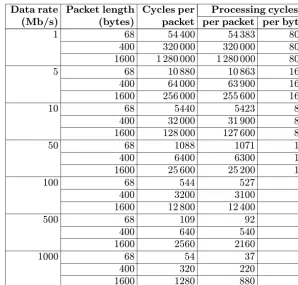
exam-ine one such platform, Snort, in Sect. 4.7. Constructing a network-based data-collection system is fairly straight-forward. All that is required is a network interface de-vice that can be placed in promiscuous mode, so that it will see all the traffic on the network segment to which it is connected, and some mechanism for recording the traffic or portions of it. The libpcap[40] library is of-ten used for this purpose. For modest data rates, com-modity platforms, such as PCs, suffice as network sens-ing devices. Unfortunately, network data rates are ris-ing rapidly, with most network segments beris-ing upgraded from 10megabits/s to 100 megabits/s, and gigabit seg-ments are becoming common. While the speed of the segment does not necessarily indicate the amount of traf-fic carried on the segment, traffic rates are increasing to consume the available bandwidth. Figure 3 illustrates the nature of the problem. It shows the number of memory cycles available to process each packet for a variety of packet lengths (in bytes) and data rates (in megabits/s) for two modes of processing, the first in which only the 68 bytes of header information is input and processed and one in which the entire packet is transferred and pro-cessed. These figures assume a 100 MHz processor bus that transfers 32 bits per memory cycle. The processing time available is calculated by subtracting the time re-quired to transfer the packet or packet header into ory from the packet duration and converting to mem-ory cycles at 10ns per cycle. For the kinds of process-ing algorithms used in IDSs, memory cycles are more likely than CPU cycles to be the limiting factor. Mem-ory speeds seem to increase at a much slower rate than CPU clock speeds. For reference purposes, 5 megabits/s is near the useful capacity of a 10baseT ethernet while 50 and 500 megabits/s probably represent useful capacities for 100baseT and gigabit network segments.
The shortest packet length, 68 bytes, essentially rep-resents header information only. If only the header is transferred into processor memory, 17 cycles will be re-quired, leaving the remaining cycles available to process the header. This means that some processing can be ac-complished for the headers of longer packets, even at network speeds of up to a gigabit. On the other hand, no realistic processing of the packet contents is likely to be possible for data rates above 50megabits/s, since even a simple pattern match against a single pattern is likely to require more memory cycles per byte than are available.
Data rate Packet length Cycles per Processing cycles
(Mb/s) (bytes) packet per packet per byte
1 68 54 400 54 383 800
400 320 000 320 000 800
1600 1 280 000 1 280 000 800
5 68 10880 10863 160
400 64 000 63 900 160
1600 256 000 255 600 160
10 68 5440 5423 80
400 32 000 31 900 80
1600 128 000 127 600 80
50 68 1088 1071 16
400 6400 6300 16
1600 25 600 25 200 16
100 68 544 527 8
400 3200 3100 8
1600 12 800 12 400 8
500 68 109 92 2
400 640 540 2
1600 2560 2160 2
1000 68 54 37 1
400 320 220 1
[image:11.612.152.450.54.339.2]1600 1280 880 1
Fig. 3.Memory cycles per packet processing time (100 MHz, 32-bit bus)
be able to present different results to the IDS and the tar-get system. If an attacker becomes aware of the presence of a network IDS, he may attempt to disable the IDS be-fore attacking the target network. These and other issues associated with network sensing are discussed in detail by Ptacek and Newsham [62].
4.3 Intrusion detection and the signal detection problem
Intrusion detection can be viewed as an instance of the general signal detection problem [9, 31]. In this case, in-trusion manifestations are viewed as the signal to be de-tected while manifestations of “normal” operations are considered to be noise. In classical signal detection ap-proaches, both the signal and the noise distributions are known, and a decision process must determine if a given observation belongs to the signal-plus-noise distribution or to the noise distribution. Classical signal detectors use knowledge of both distributions in making a decision, but intrusion detectors typically base their decisions either on signal (signature-based detectors) or noise (anomaly-based detectors) characterizations. Each approach has strengths and weaknesses. Both suffer from the difficulty of characterizing the distributions. A recent technical re-port by Stefan Axelsson [9] develops a useful taxonomy of intrusion detection techniques. In our discussions of the primary approaches, we will generally follow the Axelsson taxonomy.
4.4 Anomaly-based intrusion detection – is strange bad?
Anomaly-based intrusion detectors equate “unusual” or “abnormal” with intrusions. Given a complete character-ization of the noise distribution, an anomaly-based de-tector recognizes as an intrusion any observation that does not appear to be noise alone. Characterizing the noise distribution so as to support detection is non triv-ial. Characterization approaches have ranged from sta-tistical models of component/system behavior to neural networks and other AI techniques to approaches inspired by the human immune system. The primary strength of anomaly detection is its ability to recognize novel at-tacks. Its drawbacks include the necessity of training the system on noise, with the attendant difficulties of track-ing natural changes in the noise distribution. Changes may cause false alarms while intrusive activities that ap-pear to be normal may cause missed detections. It is difficult for anomaly-based systems to classify or name attacks.
Style Model Method Examples
Self-learning Non time series Rule-modeling W&S [77] Descriptive statistics IDES [26] NIDES [41] EMERALD [61] JiNao [42] Haystack [71]
Time series Neural net Hyperview(1) [21]
Immune inspired Forrest, et al. [82]
Programmed Descriptive statistics Simple statistics MIDAS(1) [67] NADIR(1) [38] Haystack(1) [71]
Simple rule based NSM [36, 57]
Threshold ComputerWatch [28]
Tripwire [45]
[image:12.612.107.486.54.305.2]Default deny State series modeling DEPM [46, 47] JANUS [33] Bro [60]
Fig. 4.Anomaly-based intrusion detectors (after [8]). The number in parenthesis indicates the level for a multilevel detection scheme
intrusions, they often raised an excessive number of false alarms. Part of the problem is that neither the noise char-acteristics (normal usage) nor the signal charchar-acteristics (intrusions) have been adequately studied. Maxion and Tan [54] have taken steps towards matching data char-acteristics to anomaly detector charchar-acteristics in ways that are useful in predicting detector behavior. Although most of their results were obtained from artificial data, they performed one experiment on natural data obtained from Solaris BSM audit logs. They noted that the dif-ferences in the regularity of the data from user to user in their data set would make it difficult to use the same detector to detect anomalous behaviors across the en-tire user set. The signal/detector mismatch could trans-late into a substantial false alarm rate. This is consis-tent with other experiences with anomaly detection ap-proaches. More work of this kind is needed to determine the effective limits of the anomaly detection approach in practice.
In addition to assuming that anomalies equate to in-trusions, the anomaly detection approach to intrusion detection makes another, more subtle assumption. It as-sumes that intrusions will be accompanied by manifesta-tions that are sufficiently unusual so as to permit detec-tion. It is unclear that this is necessarily the case. As was pointed out by both Anderson [5] and Myers [58], we need to be concerned with the highly skilled intruder who takes steps to understand the system under attack and to avoid detection. We suspect that little appears in the literature concerning the practices of such intruders and that the data used to test or evaluate IDSs does not reflect their approaches.
4.5 Misuse detection – patterns of misbehavior
In order for a signature-based IDS to detect attacks, it must possess an attack description that can be matched to sensed attack manifestations. This can be as simple as a specific pattern that matches a portion of a net-work packet or as complex as a state machine or neural network description that maps multiple sensor outputs to abstract attack representations. If an appropriate ab-straction can be found, signature-based systems can iden-tify previously unseen attacks that are abstractly equiva-lent to known patterns. They are inherently unable to detect truly novel attacks and suffer from false alarms when signatures match both intrusive and non-intrusive sensor outputs. Signatures can be developed in a variety of ways, from hand translation of attack manifestations to automatic training or learning using labeled sensor data. Because a given signature is associated with a known at-tack abstraction, it is relatively easy for a signature-based detector to assign names (e.g., Smurf, Ping-of-Death) to attacks.
Style Model Method Examples
Programmed State modeling State transition USTAT [39]
Petri net IDIOT [20]
Expert system NIDES [41]
EMERALD [61]
MIDAS-direct [67]
DIDS [72]
MIDAS(2) [67]
String matching NSM [36, 57]
Simple rule-based NADIR [38]
NADIR(2) [38]
ASAX [34]
Bro [60]
JiNao [42]
[image:13.612.138.466.54.299.2]Haystack(2) [71]
Fig. 5.Signature-based intrusion detectors (after [8]). The number in parenthesis indicates the level for a multilevel detection scheme
can be detected on a single packet basis. Exploits that require multiple steps to be carried out require the IDS to consider multiple data items, whether a series of net-work packets or a set of audit records. All of the ap-proaches represented in Fig. 5 encode some representa-tion of known attacks into a form that can be compared against the sensed data. An attack is recognized when the sensed data matches a pattern. With relatively few exceptions, signature-based systems operate with fairly concrete data representations. Signatures that are too specific will miss minor variations on a known attack, while those that are too general can generate large num-bers of false alarms. Some of the more successful systems, such at the STAT family [80], use a sufficiently abstract representation for some classes of attacks to be able to recognize attacks that are “new” in the sense that they were unknown at the time the signature was created. This behavior is the exception and, in general, signature-based IDSs, like virus detectors, have to be updated when new attacks are discovered. Most commercial systems fall into this category and the ease and frequency of updates is an issue in choosing the system to deploy.
4.5.1 Signatures are hard – an example
To illustrate some of the problems associated with defin-ing and usdefin-ing signatures, we consider an example, based loosely on the Morris Worm’s fingerd attack [68, 73]. This was one of the first buffer overflow attacks. The finger service listens for requests on port 79 and, when a connection is established, reads a single line, terminated with a CRLF pair. Neither the current standard (RFC-1288 [83]) nor the original (RFC-742 [35]) specify the
length of the line. In the original implementation, charac-ters were read with agetsinput routine which continued to transfer characters until anullcharacter was encoun-tered. In describing the attack, Seeley [68] notes:
The most straightforward signature for detecting this attack would be one that alerts on all messages with a content length greater than 512 that are destined for the finger port, port 79. Now, what if observations of net-work traffic indicated that due to malfunctioning soft-ware elsewhere in the network, malformed packets with lengths greater than 512 destined for port 79 were com-mon? These packets would probably effect a denial of service attack on the finger service if they overwrote the return address with a “random” value, but the precise ef-fect might be unpredictable. If we assume that we only want to deal with serious intrusions rather than acciden-tal denial of service, a more specific signature is needed.
Looking for the hand-crafted code that executes the shell seems to be an obvious approach. We could look for this pattern in the body of the message so that the com-bination of excessive length and identifiable code would constitute the signature. Since the message will modify the program stack to replace the return address of the affected subroutine with an address that lies within the buffer, i.e., the address of the sequence of instructions that executes the shell, another possibility would be to look for the address of this code in the portion of the mes-sage that overlays the return address. This will require some computation, since variations on the attack could place code anywhere in the buffer, and any number that falls between the origin of the buffer and the end of the message is suspect. Since most IDS signature description languages do not have this power, the code itself is proba-bly the best bet.
A clever attacker could attempt to hide the code that calls the shell by adding code to modify the region in which it is stored prior to executing it. A simple loop to “XOR” the code region with a constant would suffice. Since this kind of modification can be performed in ar-bitrary ways, there is no pattern that can easily detect variations on the original attack. Given that distinguish-ing malicious messages from garbage is hard, how easy is it to observe the effects of the attack? When the at-tack code is executed, a command interpreter or shell (/bin/sh) inherits port 79 and awaits further input. The shell typically issues a prompt to indicate that it is await-ing input, and since it is operatawait-ing with root or superuser privileges, by convention, its prompt consists of a “#”. By looking for this output from the supplantedfingerd, we might be able to detect the fact that fingerd has been replaced by a root shell. However, on most systems, the attacker can specify the prompt to be used as an ar-gument to the shell when it is started. The command can be set to some arbitrary value, even perhaps to a re-sponse that fingerdmight emit such as “User list un-available”.
If host-based sensing rather than network-based sens-ing is used, a different picture is presented. Packets that crash fingerd will probably create log entries indicat-ing the abnormal termination of the process, with reasons for the termination that might include illegal instruction
execution, segmentation faults, or other illegal address failures. A successful buffer overflow attack results in an exec call which should also be logged. From the descrip-tion of fingerdgiven above, it is clear that finger uses the exec system call to execute the localfingerprogram. If this is the only use of exec, its presence in the log with any other argument is a clear intrusion signature. How-ever, the intruder has the ability to modify log files at this point, and unless the logs are adequately protected from modification, the intruder may be able to erase this signa-ture before it is detected.
This scenario presents a sort of “cat and mouse” game between the intruder and the IDS. While the bulk of present-day intrusions appear to come from scripts [7] that repeat exactly the same set of actions on many ma-chines, a more sophisticated intruder can easily modify the attack to avoid simple signature-based detection as seen above.
4.6 Commercial systems
Beginning in the late 1980s, IDSs moved from the labora-tory to the commercial arena. Today, there is a thriving commercial market which is in a constant state of flux. Any attempt at a comprehensive survey is almost certain to be out of date as soon as it is finished. In addition, objective data concerning the performance of commer-cial systems is often difficult to find, and the information available from vendors is usually more marketing oriented that technical. In many cases, the algorithms, data files, etc., used in commercial systems are proprietary. Over the next few years, we can anticipate further mergers of IDS companies accompanied by rapid evolution of the systems that they field. More and more, IDS is being viewed as a component in a more comprehensive security solution, and companies that build multiple security com-ponents such as vulnerability scanners and firewalls are starting to integrate these components into comprehen-sive system management systems.
There is also a movement towards interoperability of components from multiple vendors. The IETF Intru-sion Detection Working Group (IDWG) is in the process of defining a protocol for exchanging alert information among IDS systems. Major vendors in the system man-agement area are now supporting IDS systems as part of their management suites.
it difficult to react to new attacks quickly. False alarms are a significant problem in many commercial systems. In a recent presentation at RAID 2000, Julisch reports [43] false alarm rates of tens of thousands per month for one commercial system (NetRanger) deployed on an opera-tional network.
In the following paragraphs, several systems are de-scribed briefly to give the reader a feeling for the variety of systems currently available. The choices are largely arbitrary.
4.6.1 ISS
RealSecurefrom Internet Security Systems11 is a real-time IDS. It uses a three-part architecture consisting of a network-based recognition engine, a host-based recogni-tion engine and an administrator’s module. The network recognition engine runs on dedicated workstations to provide network intrusion detection and response. Each network recognition engine monitors a network segment looking for packets that match attack signatures. When a network recognition engine detects intrusive activity, it can respond by terminating the connection, sending alerts, recording the session, reconfiguring firewalls, etc. It also passes an alarm to the administrator’s module or a third-party management console.
The host-based engines analyze log data to recognize attacks. Each host engine examines its system’s logs for evidence of intrusions and security breaches. Log data may contain information that is difficult or impossible to infer from network packet data. The host engine may pre-vent further incursions by terminating user processes or suspending user accounts. It may also take actions similar to those performed by a network engine.
Multiple recognition engines are managed by an ad-ministrative module. The result is comprehensive protec-tion, easily configured and administered from a single lo-cation. The administrative module is supplied with both recognition engines and is also available as a plug-in mod-ule for a variety of network and systems management environments.
ISS also makes a vulnerability scanner which it is in the process of integrating with its intrusion detection sys-tem. This will allow the IDS to be configured in such a way that alerts for attacks against vulnerabilities known not to exist in the protected network can be suppressed.
4.6.2 Cisco Systems
In the past several years, Cisco’s IDS products have evolved from a stand-alone hardware/software platform known as NetRanger to an enterprise-wide system con-sisting of sensors and management facilities. Audit trails from Cisco’s routing products can also be fed into the
11 http://www.iss.net.
management and analysis facilities. In addition to raising alarms or alerts, the Cisco IDS products can also be used to reconfigure routing tables to block attacking sources as seen in the following quotation from the current online product data [18]:
– Reset TCP connections after an attack begins. The Sensor can reset individual TCP connec-tions after an attack to eliminate the threat. Communication between all other connections continues, thereby decreasing the likelihood of denial of service problems that can occur after shunning TCP-based attacks.
– Shun the attack. Shunning is a term that refers to the Sensor’s ability to use a network device to deny entry to a specific network host or an entire network. To implement shunning, the Sensor dynamically reconfigures and reloads a network device’s access control lists. This type of automated response by the Sensor should only be configured for attack signatures with a low probability of false positive detection, such as an unambiguous SATAN attack. In case of any suspicious activity that does not trigger automatic shunning, you can use a Director menu function to shun manually.
CautionShunning requires careful review be-fore it is deployed, whether as a set of automatic rules or operational guidelines for staff. In case an alarm is generated from a critical host or network, NetRanger can be configured to never shun that host or network. This safety mechan-ism prevents denial of service attacks using the NetRanger infrastructure.
The caution is indicative of an unsolved problem in intrusion response. If the system reacts automatically by refusing connections from the network or host believed to be responsible for the intrusion, attackers have the oppor-tunity to create denial of service attacks by spoofing an attack from a critical source. Accidental false alarms can have a similar effect.
4.6.3 Tripwire
Tripwireis a file integrity assessment tool12that is useful for detecting the effects of an intrusion. Tripwire creates a database of critical system file information which in-cludes file lengths and cryptographic checksums based on each file’s contents. Tripwire compares current infor-mation with a previously generated baseline and identi-fies changed files. Tripwire will report modified files, but the user must decide whether the modifications resulted from an intrusion. Since most monitored files are not
12 http://www.tripwire.com. Both commercial and
![Fig. 1. General cases of threats (after [5])](https://thumb-us.123doks.com/thumbv2/123dok_us/913869.604035/3.612.47.294.56.207/fig-general-cases-of-threats-after.webp)
![Fig. 4. Anomaly-based intrusion detectors (after [8]). The number in parenthesis indicates the levelfor a multilevel detection scheme](https://thumb-us.123doks.com/thumbv2/123dok_us/913869.604035/12.612.107.486.54.305/anomaly-intrusion-detectors-parenthesis-indicates-levelfor-multilevel-detection.webp)
![Fig. 5. Signature-based intrusion detectors (after [8]). The number in parenthesis indicatesthe level for a multilevel detection scheme](https://thumb-us.123doks.com/thumbv2/123dok_us/913869.604035/13.612.138.466.54.299/signature-intrusion-detectors-number-parenthesis-indicatesthe-multilevel-detection.webp)
