Abstract: Objectives: In the age that requires much focus on the creativity and destructive innovation, team or group-based work environments are prevalent and it is increasingly important for organizations to find and nurture innovative employees who attached to the organizations. In this study, we empirically tested a causal model to foresee innovative behavior consolidating the literatures on organizational commitment and social loafing. Method: With 435 samples collected from employees currently working in various industries in Korea, an empirical test was implemented using SPSS 23 and LISREL 8.54 statistical software package. CFA, a step-wise hierarchical regression, and bootstrapping for medication effect analysis were conducted for hypothesis tests. Results: Results from SPSS and structural equation modelling (SEM) using LIREL revealed that affective commitment was significantly and negatively related to social loafing, whereas normative commitment and continuance commitment were positively related to social loafing. And social loafing had a significantly and negatively effect on innovative behavior and social loafing played a partial mediating role on the relations between the subscales of organizational commitment and innovative behavior. Conclusion: This study provides findings that those who emotionally attached to organization (affective commitment) were more likely not to be involved in social loafing behavior in workgroup settings, whereas those who have obligation to remain with the organization (normative commitment) and who were sensitive to the perceived costs associated with leaving organization (continuance commitment) were more likely to pay less efforts when working collectively than when working individually. And social loafing had a significant and negative effect on innovative behavior and played a mediating role in the relations between the three components of organizational commitment and innovative behavior. Given the findings from the current study, managers and management are recommended to pay more attentions to these differential effects of individual employees’ commitment type on workgroup and innovative behavior, and to pay further attempts finding initiatives to minimize social loafing behaviors, which in turn give adverse effects on innovative behavior.
Keywords: affective commitment, normative commitment, continuance commitment, social loafing, innovative behavior
Revised Manuscript Received on October 05, 2019.
* Correspondence Author
Byung-Yoon Chun, Department of Tax & Management, Gwangju University, Gwangju City, Korea. Email: [email protected]
Ho-Pyo Hong*, Department of Business Administration, Gwangju University, Gwangju City, Korea. Email: [email protected]
I. INTRODUCTION
T
he past era when production was the sources of value creations has been radically changed to the present age that requires focus on the creativity and destructive innovation. With such massive demand from the current environment, organizations further depend on their individual employees to innovate procedures, operations, and methods of their job, in order to achieve competitive edges in global competitions1-3. It is the individual employees who demonstrate the creativity and innovation within organization. And innovative behavior by employees in organizations requires a comprehensive cognitive efforts from individual innovators4. Thus it has been increasingly important for contemporary organizations to find and nurture innovative employees who attached and committed to organizations. Moreover, current working environment has changed to, instead of working alone, team or workgroup-based disparate range of tasks, which have become prevalent and imperative. Interactional activities in task performance within team or workgroup setting has significantly risen over the past decade5. This leads to attention on group productivity6 and in particular much research attention has paid to studying the phenomena of social loafing behavior.Factors causing individual employees to involve in the innovative behaviors have been surveyed using different foundations such as the literatures on organizational justice7,
8, psychological contract 9, and job design10. Despite of these
independent literatures, there exists lack of comprehensive research taking organizational commitment and social loafing into consideration. Therefore, in this study, we consolidated the each subscales of organizational commitment and social loafing to test a causal model to predict the innovative behaviors of individual employees.
Our intention, therefore, is threefold: (1) to identify the differential impacts of each component of organizational commitment on a tendency for individual to pay less effort when working collectively than working individually, so-called “social loafing”.; (2) to unravel the effect of social loafing on the innovative behavior; (3) to test if social loafing behaviors of employees in organization plays a mediating role in the relations with each subscales of organizational commitment and innovative behavior.
Understanding Three Components of
Organizational Commitment in Workgroups and
their Relationships with Innovative Behavior
II. LITERATUREREVIEWANDHYPOTHESES
Dynamic flexibility has been seek by organizations due to the rapid rises in managerial instability and unpredictability which mostly derived from globalization, sudden changes in customer preferences, severe global competition, and so on. Due to the fact that organizations tend to increase temporary employment for part-time and peak time and IT technology growth which has been interrupted even after regular work hour, employees working in such organizations are likely to have different levels of perceived commitments to the organization. In this regard, it has been the main subject by management to find out the ways that increase commitment to the organization, which in turn contribute to the innovative behaviors that organizations are to benefit from such behaviors3. However, little effort has been made to identify the different impacts of the subscales of organizational commitment when employees work in workgroup settings and its consequences on the innovative behaviors of employees.
As one of the most common forms, Meyer & Allen (1990) proposed three-component model of commitment, arguing that commitment has three different components which correspond with different psychological states. Those are affective commitment (AC; emotional attachment to the organization), normative commitment (NC; obligation to remain with the organization), and continuance commitment (CC; perceived costs associated with leaving the organization)11. Affective commitment is directed generally by positive emotional feelings about an organization, whereas normative commitment is forced by moral obligations and continuance commitment is induced by side-bets. Social loafing is the disposition for individuals to pay less effort when working collectively than working individually. As social loafing pays less work effort than what is formally demanded by the company12 and it results in decreased performance of individuals in groups. Social loafing can be traced to the experiment that participants exerted themselves with less individual effort in a group rope-pulling experiment than if they did alone. Therefore, we developed the following hypothesis.
Hypothesis 1. Organizational commitments who employees possess have different effects on social loafing in such that AC and NC are negatively related to social loafing, whereas CC is positively related to social loafing.
Innovative behavior was defined as the intentional creation, introduction and application of new ideas with a work role, group or organization13 and furthermore innovation behavior are neither expected in their formal role as employees, nor form an explicit contract between the employee and the organization. So such behaviors are entirely non-mandatory behavior and are not officially appreciated by organizational reward system14. In this sense, social loafing is one form of group productivity loss, whereas innovative behavior contributes to create a competitive advantage. Therefore, innovative behaviors may be the opposite outcome of social loafing, and are more likely to be the positive or negative results from the subscales of organizational commitment, depending on the subscales (AC, NC, and CC). With these inferences, we developed the hypotheses below.
Hypothesis 2. Social loafing is negatively related to innovative behavior.
Hypothesis 3. Social loafing plays a mediating role in the relationship with the each subscales of organizational commitment and innovative behavior.
III. RESEARCHMETHODOLOGY
A. Research Sample
In this individual level research, a structured questionnaire survey was conducted and it was designed to respond by organizational members. The questionnaire survey was conducted in Korean and survey data was collected from employees in various local companies in Korea. After removing missing responses, ultimately 435 survey samples were utilized to analyze the study. The samples are made up of 52.4% of female, an average age of 37.3 years (SD = 9.2), an average education of 15.4 years (SD = 1.5), 88.0% of permanent employment, and an average tenure of 9.3 years (SD = 5.8). These were included as control variables.
B. Measures
The measures for assessing the latent variables were adapted from previous studies with satisfactory validity and reliability confirmed. With a few exception in demographic questionnaire items, all the measures were rated on a 5 Likert scale ranging from 1 to 5 (“strongly disagree” to “strongly agree”), unless otherwise indicated.
Organizational commitment was defined as an individual’s psychological attachment to the organization11 (that is, we conceptually took attitudinal perspective15) and we used the questionnaire items developed for Korean employee by Lee et al. (2001)16. It composed of 15 items with subscales as AC, NC, and CC. Each subscales had 5 items respectively and the sample questionnaire was “I do not feel like part of the family at my organization®” for AC, “If I got another offer for a better job elsewhere, I would not feel it was right to leave my organization” for NC, and “I would not leave this organization because of what I would stand to lose” for CC.
Social loafing was defined as the tendency for individuals to expand less effort when working collectively than when working individually17. We used 10 questionnaire items developed by George (1992)18. The sample questionnaire was “I put forth less time than other members of his or her work group.”
Innovative behavior was defined as the intentional creating, introduction and application of new ideas within a work role, group or organization, in order to benefit role performance, the group, or the organization19. To test this perceived innovative behavior of employee, we employed the 6 items measures developed by Scott & Bruce (1994). A sample of the items were “I search out new technologies, processes, techniques, and/or product ideas.”
C. Control Variables
Gender, age, education period, employment type, and tenure were recorded and included as control variables. Gender and the type of employment were dummy-coded respectively as male = 1 and female = 0; permanent = 1 and temporary = 0. Educational
than high school as 12, college graduate as 14, university graduate as 16, and over graduate school as 18.
IV. DATAANALYSIS
A. Validity
To test the hypotheses, statistical software packages such as SPSS 23 and LISREL 8.54 were used. And CFA (Confirmatory Factor Analysis) for entire survey items was performed to ensure the discriminant validity. The procedures for the CFA were followed by the suggestion made by Jöreskog & Sörbom20. All the survey items except 2 items in NC were exceeded .4 in terms of factor loading value. In return, the very 2 items in NC were deleted because those showed unacceptable as recommended by Stevens21 which the factor loading should be greater than .4 to ensure the validities of the measurement tools.
To assess the potential bias issue of CMV (common method variance), the chi-square, NFI, CFI, IFI, SRMR, and RMSEA were tested by comparing a five-factor model (AC, NC, CC, social loafing, and innovative behavior) with Harman’s one-factor model (no dimension of variables). It is
suggested that it will be the better model fit when the higher NFI, CFI, and IFI are and the lower SRMR and RMSEA are. The results showed that the chi-square statistic and fit indices reported a considerable advancement in the five-factor model. Therefore, the five-factor model demonstrated the better fit to the data than the one-factor model which all items were loaded on a single construct. This meant to be there were no significant potential bias issue of CMV. The results indicate that our research model fit to the data as shown in Table I below.
B. Reliability
[image:3.595.129.467.337.397.2]To test the internal consistency, we conducted reliability test with Cronbach’s alphas which all resulted in good measures. The Cronbach’s alpha for respective measures were 0.85 for AC, 0.84 for NC, 0.80 for CC, 0.89 for social loafing, and 0.91 for innovative behavior. Since all the scales in the current study exceeded 0.7 as suggested by Nunnally & Bernstein22, internal-consistency reliabilities for all measures were achieved.
Table I: Summary of Measurement Model Comparison
Models χ2 df NFI CFI IFI SRMR RMSEA
Five-factor model 1228.83 367 .91 .94 .94 .066 .077
One-factor model 4115.74 377 .71 .73 .73 .15 .19
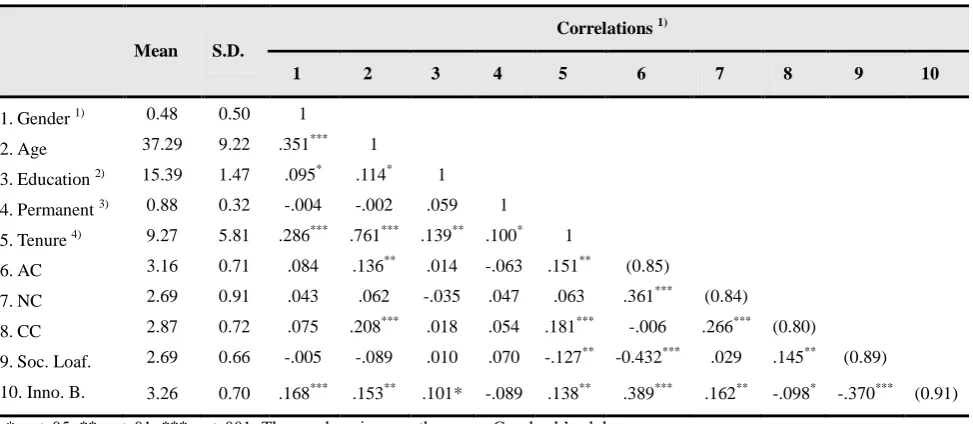
Table II: Means, Standard Deviations, and Correlations (N = 435)
Mean S.D.
Correlations 1)
1 2 3 4 5 6 7 8 9 10
1. Gender 1) 0.48 0.50 1
2. Age 37.29 9.22 .351*** 1
3. Education 2) 15.39 1.47 .095* .114* 1
4. Permanent 3) 0.88 0.32 -.004 -.002 .059 1
5. Tenure 4) 9.27 5.81 .286*** .761*** .139** .100* 1
6. AC 3.16 0.71 .084 .136** .014 -.063 .151** (0.85)
7. NC 2.69 0.91 .043 .062 -.035 .047 .063 .361*** (0.84)
8. CC 2.87 0.72 .075 .208*** .018 .054 .181*** -.006 .266*** (0.80)
9. Soc. Loaf. 2.69 0.66 -.005 -.089 .010 .070 -.127** -0.432*** .029 .145** (0.89)
10. Inno. B. 3.26 0.70 .168*** .153** .101* -.089 .138** .389*** .162** -.098* -.370*** (0.91)
* p < .05, ** p < .01, *** p < .001; The numbers in parentheses are Cronbach’s alphas.
1) Male = 1, female= 0
2) Transformed the level of education to 12 = high school graduate or less, 14 = college graduate, 16 = university graduate, and 18 = over graduate school
3) Dummy coded for employment type as permanent = 1, temporary = 0
4) Transformed to continuous variable such <1 year as 0.5, 1~5 years as 2.5 years, 5~10 years as 7.5 years, 10~15 years as 12.5 years, and over 15 years as 17.5 years
V. FINDINGS
Before the hypotheses testing, Pearson correlations for all the variables with means and standard deviations were analyzed and presented in the above Table II. As predicted,
innovative behavior was significantly and positively correlated with AC (γ=.389, p<.001) and NC (γ=.162, p<.01), but negatively correlated with
[image:3.595.58.545.429.641.2]social loafing was also shown strong negative correlation with AC (γ= -.432, p<.001), whereas it was shown positive correlation with CC (γ=.145, p<.01). But social loafing had no statistical correlation with NC (γ=.029, n.s.). One of the findings worthy to mention was that the longer tenure was shown a significantly negative correlation with social loafing (γ= -.127, p<.01) and positive correlation with innovative behavior (γ=.138, p<.01). This means anyone who has longer period of work is likely to avoid social loafing behavior in workgroup settings and to further involve in innovative behavior rather than whoever has shorter tenure.
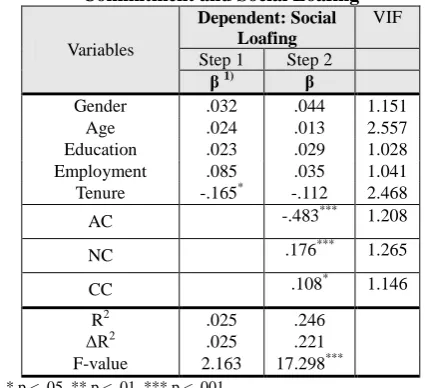
[image:4.595.58.271.445.639.2]To test the Hypothesis 1, regression analysis was conducted and the results are presented in Table III. For the regression model, Dubin-Watson 1.858 is determined to have no correlations among residuals as it is very close to the reference value of 2 and not close to 0 or 4. Therefore, this regression model can be interpreted as appropriate. The test results for H1 elaborated that AC was significantly and negatively related to social loafing (-.483, p<.001), whereas NC and CC were positively related to social loafing (respectively .176, p<.001; .108, p<.05). Unlike our hypothesis, NC was positively related to social loafing. Such a result indicates those who are involved in NC are also likely to act social loafing in group tasks. Therefore, H1 were partially supported. VIF (Variance Inflation Factor) values were also checked to ensure potential multi-collinearity issues. 2.557 was the highest VIF value which indicated far smaller than the traditional threshold value of 10 23. Therefore, it could be concluded there are no multi-collinearity issues.
Table III: Relationship between Organizational Commitment and Social Loafing
Variables
Dependent: Social Loafing
VIF
Step 1 Step 2
β 1) β
Gender .032 .044 1.151
Age .024 .013 2.557
Education .023 .029 1.028
Employment .085 .035 1.041
Tenure -.165* -.112 2.468
AC -.483*** 1.208
NC .176*** 1.265
CC .108* 1.146
R2 .025 .246
ΔR2
.025 .221
F-value 2.163 17.298***
* p < .05, ** p < .01, *** p < .001 1) Standardized regression coefficients (β)
To test the H2 and H3, a hierarchical regression analysis was conducted and the detailed results were shown as in Table IV. After controlling the control variables, gender, age, educational period, employment type, and tenure, the three independent variables and mediating variable were entered in order. With the analyses, we observed that social loafing was statistically significant and negatively related to innovative behavior (-.258, p<.001). This result supported H2.
To test the H3, a mediation analysis was conducted and the process of the analysis was followed by the suggestion of Baron & Kenny24. According to them, the mediation effect is supported when four fundamental phases below are met: (Phase 1) the path from the independent variable to the dependent variable should be statistically significant; (Phase 2) the path from the independent variable to the mediating variable should also be statistically significant; (Phase 3) the path from the mediating variable to the dependent variable should be statistically significant while controlling the independent variables; (Phase 4) When and if all the conditions are met, a medication effect is proven to be existed. And in Phase 3 it is argued that there is a partial mediation effect when there exists any statistically significant effect of the independent variable on the dependent variable or that there is a full mediation effect when there exist no statistically significant effect of the independent variable on the dependent variable. And there should be observed statistically significant differences between effects from independent variable toward dependent variable. Such differences are the same as mediation effect and it can be verifiable through Sobel test as well.
The test results with these phases were also presented in Table IV. In step 2, AC and CC were statistically significant to innovative behavior, while NC was not (.334, p<.001; -.138, p<.01; .073, n.s., respectively), so the first phase was met except NC. And for the second phase all the subscales of organizational commitment were met as in the previous test results for H1 (Table III). Social loafing in Table IV was statistically significant with innovative behavior as seen in step 3 (-.258, p<.001), which leads to meet the 3rd phase. Therefore, based on all the results, it can be argued that social loafing played a mediation role in the relationship between independent variables (AC and CC) and dependent variable (innovative behavior), excluding the mediation effect in between NC and innovative behavior due to the fact that 1st phase was not met.
Table 4: Hierarchical Regression Analysis Predicting Innovative Behavior
Variables
Dependent: Innovative Behavior1)
Step 1 Step 2 Step 3
B SE B SE B SE
(constant) 2.546*** .384 1.684*** .393 2.583*** .417
Gender 2) .167* .071 .119* .150* .065 .107* .166** .063 .118**
Age .004 .006 .059 .005 .005 .071 .006 .005 .074
Education 3) .038 .023 .080 .040 .021 .084 .044* .020 .092*
Employment 4) -.217* .103 -.101* -.154 .095 -.071 -.135 .092 -.062
Tenure .007 .009 .061 .002 .008 .021 -.001 .008 -.008
AC .328*** .047 .334*** .205*** .051 .209***
NC .056 .038 .073 .091* .037 .118*
CC -.135** .045 -.138** -.108* .044 -.110*
Social Loafing -.276*** .052 -.258***
R2 .055 .201 .252
R2 .055 .146 .050
F-value 4.973*** 13.386*** 15.839***
* p < .05, ** p < .01, *** p < .001
1) Unstandardized regression coefficient (B), standardized
regression coefficients (β) 2) Male = 1, female = 0
3) Transformed 12 = high school graduate or less, 14 = college graduate, 16 = university graduate, and 18 = over graduate school
4) Dummy coded for employment type as permanent = 1, temporary = 0
5) Transformed to continuous variable such <1 year as 0.5, 1~5 years as 2.5 years, 5~10 years as 7.5 years, 10~15 years as 12.5 years, and over 15 years as 17.5 years
VI. DISCUSSION
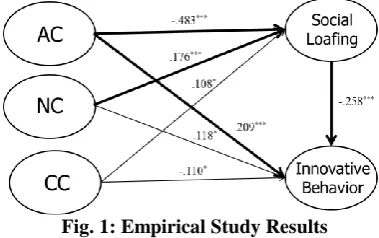
To better elaborate the results of the study, graphical presentation is given as below Figure 1.
Fig. 1: Empirical Study Results
In this study, we tested a causal model to predict innovative behavior, taking three components of organizational commitment and social loafing. This model provided a good fit with the data.
In the current study, we first identified the differential effects of each component of organizational commitment on social loafing behavior. That is, AC had a strong and negative effect on social loafing, whereas NC and CC had a positive effect on social loafing. From there findings, we can be argued that those employees who are emotionally attached to the organization were more likely disengaged in social loafing behavior, while those employees who have a strong belief about his/her responsibility to the organization (in other words, who believe it is the right and moral thing to do) and who have viewed the commitment as a recognition of costs associated with leaving the organization or as a lost
“side-bets” were likely to involve in paying less effort in workgroups.
We also found out that the most of subscales of organizational commitment were related to innovative behavior. AC and NC were positively related, but CC was negatively related to innovative behavior. Unlike the other two components, those who have CC to the organization, they are likely not to take proactive intrinsic innovative behavior. And we found that social loafing had a strong negative effect on innovative behavior. All the three components of organizational commitment had indirect effects on innovative behavior through the mediating variable of social loafing.
Under the reasonable assumption that innovative behaviors are discretionary, involving in innovative behaviors may be the outcomes of AC or NC of employees. Namely, employees make their own decision if they go for in innovative behaviors or not. Our study results uncovered that the extent to which employees emotionally attached to or have obligation to remain with the organization seem to more engage in innovative behavior than employees are sensitive to perceived costs linked with leaving organization.
A few comments worthy noting before concluding the results are those who have worked longer period is likely to avoid social loafing in workgroups and to more engage in innovative behavior than the ones worked shorter period; and the older tends to be CC and to involve in innovative behavior than the younger.
VII. CONCLUSION
There may have little efforts made to identify impacts of the three components of organizational commitment on working group or team settings and their consequences on the innovative behavior of individual employees. In this regard, the current study would be a fresh attempt to shed light on the implications of the three components of organizational behavior on social loafing and innovative behavior from organizational members in Korea. It is hoped that the findings from this study offer a preliminary empirical basis for managers and management to better understand the importance of understanding different components of organizational commitment and
of encouraging innovative
behaviors when working
ACKNOWLEDGMENT
This study was conducted by research funds from Gwangju University in 2019, Korea.
REFERENCES
1. Van de Ven AH. Central problems in the management of innovation. Management Science. 1986;32(5):590-607.
2. Paine JB, Organ DW. The cultural matrix of organizational citizenship behavior: Some preliminary conceptual and empirical observations. Human Resource Management Review. 2000;10(1):45-59.
3. Ramamoorthy N, Flood PC, Slattery T, Sardessai R. Determinants of Innovative Work Behaviour: Development and Test of an Integrated Model. Creativity and Innovation Management. 2005;14(2):142-50. 4. Kanter RM. When a thousand flowers bloom: Structural, collective,
and social conditions for innovation in organizations. Research in Organizational Behavior. 1988;10:169-211.
5. Katzenbach JR, Smith DK. The discipline of teams: Harvard Business Press; 2008.
6. Ilgen DR. Teams embedded in organizations: Some implications. American Psychologist. 1999;54(2):129.
7. Adams JS. Inequity in social exchange. Advances in experimental social psychology. 2: Elsevier; 1965. p. 267-99.
8. Thibaut JW, Walker L. Procedural justice: A psychological analysis: L. Erlbaum Associates; 1975.
9. Rousseau DM. New hire perceptions of their own and their employer's obligations: A study of psychological contracts. Journal of organizational behavior. 1990;11(5):389-400.
10. Hackman JR, Oldham GR. Work redesign. 1980.
11. Allen NJ, Meyer JP. The measurement and antecedents of affective, continuance and normative commitment to the organization. Journal of occupational psychology. 1990;63(1):1-18.
12. Latane B, Williams K, Harkins S. Many hands make light the work: The cause and consequences of social loafing. Journal of Personality and Social Psychology. 1979;37(6):822-32.
13. Janssen O. Job demands, perceptions of effort-reward fairness and innovative work behaviour. Journal of Occupational and Organizational Psychology. 2000;73(3):287-302.
14. Organ DW. Organizational citizenship behavior: The good soldier syndrome: Lexington Books/DC Heath and Com; 1988.
15. Meyer JP, Allen NJ. A three-component conceptualization of organizational commitment. Human resource management review. 1991;1(1):61-89.
16. Lee K, Allen NJ, Meyer JP. The Three-Component Model of Organisational commitment: An application to South Korea. Applied Psychology. 2001;50(4):596-614.
17. Karau SJ, Williams KD. Social Loafing: A meta-analytic review and theoretical integration. Journal of Personality and Social Psychology. 1993;65(4):681-706.
18. George JM. Extrinsic and intrinsic origins of perceived social loafing in organizations. Academy of Management Journal. 1992;35(1):191-202.
19. West MA, Farr JL. Innovation at work: Psychological perspectives. Social Behaviour. 1989;4(1):15-30.
20. Jöreskog KG, Sörbom D. LISREL 8: Structural equation modeling with the SIMPLIS command language. Chicago: Scientific Software International, Inc.; 1993.
21. Stevens JP. Applied multivariate statistics for the social sciences. 5th ed. New York, NY: Routledge; 2012.
22. Nunnally JC, Bernstein IH. Psychometric Theory. 3rd ed. New York: McGraw-Hill; 1994.
23. Cohen P, West SG, Aiken LS. Applied multiple regression/correlation analysis for the behavioral sciences: Psychology Press; 2014. 24. Baron RM, Kenny DA. The moderator–mediator variable distinction in
social psychological research: Conceptual, strategic, and statistical considerations. Journal of personality and social psychology. 1986;51(6):1173-82.
AUTHORSPROFILE
Byung-Yoon Chun, Ph.D. Professor in Tax & Management with Gwangju University, Korea. Earned his Ph.D. from Chosun University in Korea and MBA at Northern Arizona University in US. Research interests are organizational health, work stress, well-being, motivation,
leadership, and presenteeism.