The Role of the Verb in the
Development of Syntax:
Evidence from the Structural Priming
Paradigm
Thesis submitted in accordance with the requirements of the
University of Liverpool for the degree of Doctor of Philosophy by
Michelle Sabrina Peter
i Contents
Page no. Section 1: Review
Chapter 1: How do we develop adult-like syntactic 2
representations? An introduction to theories
of syntax acquisition and development
Chapter 2: A review of the adult priming literature 34
Section 2: Experimental Data
Chapter 3: When and how do children develop knowledge 63
of verb argument structure? Evidence from verb
bias effects in a structural priming task
Chapter 4: The effect of verb frequency on structural 111
priming in adults
Chapter 5: Are adults sensitive to prime surprisal with non- 149
alternating dative verbs? Evidence from the
structural priming paradigm
Chapter 6: The effect of verb semantic class on structural 179
priming in children and adults
Section 3: Final Discussion
Chapter 7: General Discussion 213
References 245
ii
List of Tables
Number Title Page no.
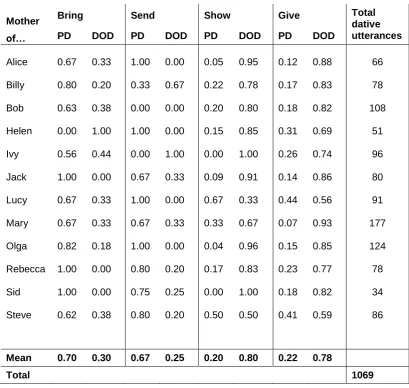
Table 3.1 Proportion of PD and DOD utterances and 80
total number of dative utterances in each mother’s
spontaneous speech to her child for each verb
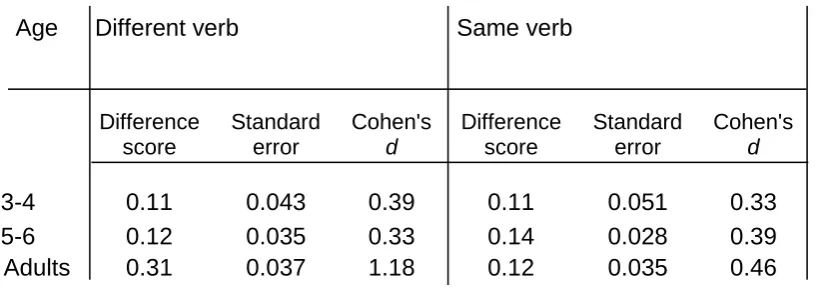
Table 3.2 Size of priming effect in the Different verb and 94
Same verb condition – calculated both as the
proportion of DODs produced in each prime
condition (difference score) and as effect
sizes (Cohen’s d)
Table 3.3 Size of target verb effect in Different verb and 96
Same verb condition – calculated both as the
proportion of DODs produced with DOD-biased
target verbs minus the proportion of DODs
produced with PD-biased target verbs (difference
score) and as effect sizes (Cohen’s d)
Table 3.4 Size of priming effect when prime verb bias and 99
structure were the same (Match), and when prime
verb bias and prime structure were different (Mismatch) – calculated both as the difference
between the proportion of DODs produced in
each prime condition (difference score) and as
iii
Table 4.1 Mean (SD) number of DOD, PD, and other 124
responses after DOD and PD primes
Table 4.2 Mean (SD) proportion of DODs after DOD and PD 125
primes for both DOD- and PD-biased prime verbs
Table 4.3 Sentences presented to participants during the
137
practice session
Table 4.4 Mean (SD) acceptability rating for DOD and PD 139
sentences with DOD- and PD-biased verbs
(maximum score = 5, minimum score = 1)
Table 4.5 Mean (SD) ratings, mean (SD) DOD responses 141
from Study 4a, and difference scores
Table 5.1 Percentage of DOD responses after DOD and PD 160
primes (sentences with matching prime bias and
prime type are grammatical, sentences with
mismatching prime bias and prime type are
ungrammatical
Table 5.2 Percentage of DOD responses after DOD and PD 171
primes
Table 6.1 Mean (SD) proportion of passives produced after 196
active and passive primes, and size of priming
iv
produced in each prime condition (difference score)
and as effect sizes (Cohen’s d)
Table 6.2 Size of priming effect for ET and TE verbs 198
calculated both as the proportion of passives
v
List of Figures
Number Title Page no.
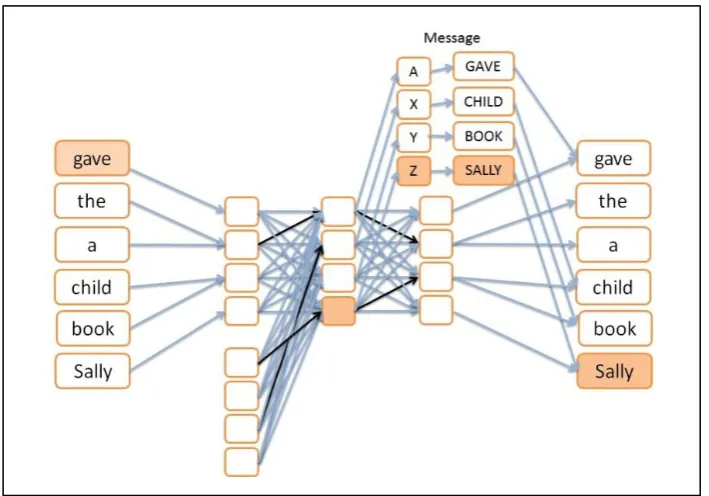
Figure 2.1 Simplified Dual-path model: The acquisition 48
of verb bias (taken from Chang, Janciauskas, &
Fitz, 2012)
Figure 2.2 Simplified Dual-path model: Structural Priming 50
(taken from Chang, Janciauskas, & Fitz, 2012)
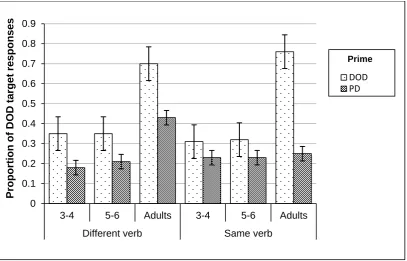
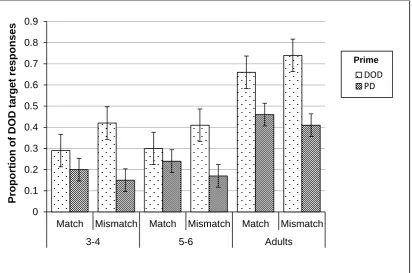
Figure 3.1 Mean proportion of DOD responses after DOD 92
and PD primes when prime and target verbs
were different (Different verb) and the same
(Same verb)
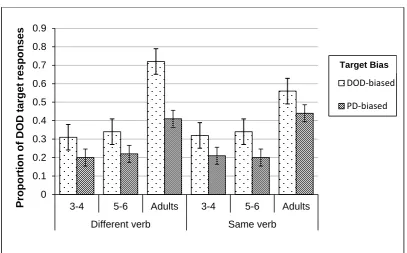
Figure 3.2 Mean proportion of DOD responses in the 93
Different and Same verb condition with DOD-
and PD-biased target verbs
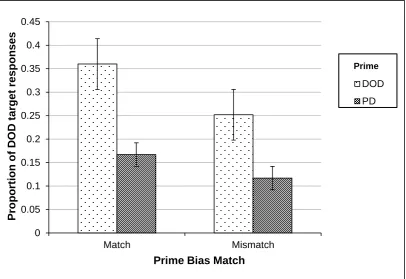
Figure 3.3 Mean proportion of DOD responses when prime 98
verb bias matched prime structure (Match), and
when prime verb bias mismatched prime
structure (Mismatch)
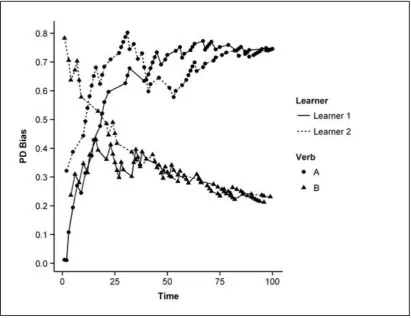
Figure 3.4 Development of target verb bias for two verbs 108
(A and B) over 100 exemplars for two
hypothetical learners (learner 1 and learner 2)
vi
verb bias matched prime structure (Match), and
when prime verb bias mismatched prime
structure (Mismatch)
Figure 4.2 Five-point rating scale for acceptability with trial 136
sentence above as presented to participants
Figure 4.3 Correlation between the rated acceptability of 142
prime sentences and the magnitude of priming
by verb
Figure 5.1 Percentage of DOD responses after DOD and 161
PD primes for grammatical and ungrammatical
primes
Figure 5.2 Percentage of DOD responses after DOD and 172
PD primes for DOD- and PD-only verbs
presented in their grammatical forms for Study
5a and Study 5b
Figure 6.1 Mean proportion of passive responses after 197
passive and active primes by age group
Figure 6.2 Mean proportion of passive responses after 199
vii
List of Appendices
Appendix Title Page no.
A Parent consent form and Information sheet 266
(Study 3b and 6)
B Head of Nursery/School consent form (Study 3b 269
and 6)
C Adult consent form (Study 3b, 4a, 4b, 5a, 5b, and 6) 270
D Table to show raw number of DOD and PD 271
utterances in each mother’s spontaneous speech
to her child for each verb
E Sentence stimuli (Study 3b) 272
F Sentence stimuli (Study 4a) 273
G Example of acceptability rating sheet: practice 274
session and first page of test session (Study 4b)
H Sentence stimuli (Study 5a) 276
I Sentence stimuli (Study 5b) 277
J Sentence stimuli (Study 6) 278
K Mean (SD) age of acquisition of prime and 280
target verbs taken from Kuperman, Stadthagen-.
viii
Acknowledgements
There are a number of people who are owed my unreserved gratitude. First, I
would like to thank my parents, Catherine and Kingsley, for instilling in me
the importance of education, and for giving me the confidence to undertake
this challenge; I am eternally grateful to you for your unfailing support.
Second, I thank my husband, Joss. Your willingness to uproot your life and
become a (temporary) Northerner has made this all possible. I honestly could
not have done any of this without you! To Maxine (a.k.a. Molecule Max):
Endless cups of tea and numerous trips to Caffè Nero have made this
journey a lot easier to bear - I promise I’ll repay the favour. To Marius: Thank
you for introducing me to the most delicious rye bread ever! Thanks also for
keeping me sane when I felt like throwing my computer out of the window because my models wouldn’t converge in R; I am forever in your debt. To
Katie: Thanks for your unbounded enthusiasm for research, and for life in general; you’ve never failed to remind me to keep persevering. I would like to
thank my supervisors, Caroline and Julian, whom I admire greatly. Thank
you, Caro, for inspiring me to pursue a career in child language research, for
always encouraging me to think for myself, and for helping me to develop as
a researcher. Thank you, Julian, for your honesty when reading (and
re-reading) my work; I always know where I am with you. Finally, thanks to the
children of the schools and nurseries who indulged my fondness for language bingo – in the end, I can safely say that it has all been worth it.
This research was supported by a faculty studentship from the University of
ix Abstract
In recent years, researchers have tended to use structural priming to
distinguish between the core predictions of nativist and constructivist theories
of syntax acquisition. Although this has been useful for our understanding of what early syntactic knowledge is like, this focus on children’s initial
representations, rather than on the process of development, means that it is still unclear how children’s syntactic knowledge becomes adult-like. To
address this issue, this thesis used structural priming to investigate the role
of the verb in the development of syntax. In particular, the present work explored how two lexical effects - verb overlap and verb bias – influence
structure choice in children and adults for dative and transitive structures. A
number of conclusions were drawn: First, the present work revealed there to
be a complex relationship between knowledge about syntactic structure and
knowledge about verbs; children as young as three have already formed
abstract representations of the dative structure, but have also already begun
to learn the syntactic preferences of dative verbs. Thus, it was concluded
that neither nativist nor constructivist theories can fully explain the abstract and lexical patterning of children’s early syntactic knowledge. Second, the
findings showed that experience with verbs is important for the strengthening
of verb-structure links across development. Third, the present work indicated
that adults seem to track the frequency with which verbs occur in their
syntactic structures, and that this knowledge can affect the way in which
these syntactic representations are stored and activated. The implications of
these findings for theories of syntactic development are discussed, and
1
2
Chapter 1
Chapter 1
How do we develop adult-like syntactic representations? An introduction to theories of syntax acquisition and development
1.1. Thesis introduction and outline
1.2. An introduction to theories of syntax acquisition
1.2.1. Lexical constructivist approaches to syntax acquisition 1.2.1.1. Pivot grammar
1.2.1.2. The verb-island hypothesis 1.2.1.3. The usage-based model
1.2.2. Early abstraction approaches to syntax acquisition
1.2.2.1. Innate principles and parameters (universal grammar)
1.2.2.2. The semantic bootstrapping hypothesis 1.2.2.3. The syntactic bootstrapping hypothesis
1.3. Problems with lexical constructivist and early abstraction accounts as theories of syntactic development
3
Chapter 1
Chapter 1: How do we develop adult-like syntactic representations? An introduction to theories of syntax acquisition and development
1.1. Thesis introduction and outline
A well-known effect in language is that speakers tend to echo the syntactic
structure of the sentences that they have recently encountered - an effect
known as structural priming. Over the past few decades, the findings from
structural priming studies in adults have provided insight into the nature of
adult syntactic representations, and have been instrumental in shaping
theories of sentence processing. More recently, researchers have used structural priming to investigate the nature of children’s early syntactic
knowledge. This work, however, has tended to focus on distinguishing
between early abstraction accounts of syntax acquisition - which argue that children’s syntactic representations are abstract from early on in the
acquisition process (e.g., Gertner, Fisher & Eisengart, 2006; Hirsh-Pasek &
Golinkoff, 1996), and lexical constructivist accounts which argue instead that
these representations are initially built around concrete, item-specific
schemas, but gradually become abstract through a process of learning and
generalisation (e.g., Olguin & Tomasello, 1993; Tomasello, 2000). Some of
the early work on structural priming in children seemed to support the latter position: that children’s syntactic knowledge is initially lexically-based
(Savage, Lieven, Theakston, & Tomasello, 2003). More recent work from the
child priming literature, however, has suggested that these early
4
Chapter 1 2008; Rowland, Chang, Ambridge, Pine, & Lieven, 2012). This approach of
using structural priming to test what young children know about syntax at the
beginning has indeed been a useful way of distinguishing between the core
predictions of nativist and constructivist theories of acquisition. However, this focus on the nature of children’s initial representations, rather than the
process of development, means that it is still unclear how children acquire
adult-like syntactic knowledge.
The aim of the current work was to address this issue by looking at
how priming changes with age in a paradigm that can be used in the same way with adults and young children. By studying both children’s and adults’
responses in a series of structural priming tasks, this thesis explores what
knowledge children bring to the language learning task, how this knowledge
changes over development, as well as how acquisition mechanisms interact
with the input to build mature linguistic knowledge. In particular, this work
focuses on the role that the verb plays in structural priming to investigate the
relationship between syntactic structure and the verb lexicon in children and
adults.
The aim of the first chapter is to outline the predictions made by
lexical constructivist and early abstraction accounts of syntax acquisition,
and to provide an evaluation of these theories with empirical research. This
chapter also describes the developmental priming studies that have focused
on adjudicating between them.
The aim of chapter two is to review the adult priming literature. This
5
Chapter 1 can tell us about adults’ syntactic representations and how they are linked to
the verb lexicon. The chapter ends by discussing the motivation for the
thesis: that investigating lexical effects on structural priming in children and
adults can tell us about the development of syntactic structure, and the
relationship between the verb lexicon and syntactic structure across
development.
In chapter three, the aim was to investigate when and how children
develop knowledge of verb argument structure for the dative. The chapter
reports the results from study 3a: an analysis of the Manchester corpus
conducted to identify the syntactic preferences (verb biases) of four familiar
alternating dative verbs in child-directed speech; and study 3b: a structural
priming study that investigated whether children (as young as 3;0) and adults’ knowledge of the biases of these verbs influences their choice of
prepositional and double object datives in a priming task (a version of this
chapter has been published in the Journal of Memory and Language).
In chapters four and five, we explored, in more detail, some of the
adult priming effects in chapter 3, in order to investigate possible
explanations of the age-related differences reported in chapter 3. In study 4a,
we report on a structural priming study that explored whether modulating the
frequency of biased alternating dative verbs affects dative structure choice in
adults. The chapter also reports the findings from study 4b: a grammaticality
judgement task that investigated whether structural priming is modulated by
the perceived grammaticality of prime sentences with low-frequency dative
6
Chapter 1 The aim of chapter five was to use structural priming to explore
whether adults are sensitive to prime surprisal with ungrammatical primes
containing non-alternating dative verbs. The chapter presents the findings
from study 5a, which tested whether adults are primed more strongly by
ungrammatical prime sentences than by grammatical prime sentences; and
study 5b, which tested whether grammatical prime sentences with
non-alternating dative verbs (some of those verbs used in study 5a) influence adults’ choice of prepositional and double object datives.
In chapter six, we turned to transitive structures to investigate how
children and adults store knowledge about the verb-structure preferences of
transitive verbs from different semantic classes. The chapter reports the findings from study 6 which tested whether children’s (as young as 5;0) and
adults’ knowledge of the biases of these verbs influences their choice of
active and passive target sentences.
The final chapter concludes by discussing the implications of the
findings as a whole for theories of syntactic acquisition and development. It
also identifies the direction for future research and discusses the need for a
testable theory of syntactic development that considers the pattern of
children’s item-based and abstract syntactic knowledge across development.
1.2. An introduction to theories of syntax acquisition
In all languages, words are ordered and combined according to grammatical
rules. In particular, the construction of sentences in grammars that rely on
7
Chapter 1 and not individual words (Chomsky, 1957). The fact that children are not
explicitly taught the rules that stipulate how these categories are manipulated
means that in order to form meaningful utterances, children must have
access to, and store knowledge about, a range of abstract, complex, and
often seemingly arbitrary syntactic patterns. For example, when learning the
rules for the formation of the transitive structure in English, children must
learn (amongst other information): a) the grammatical marking of semantic
roles such as agent and patient; b) how to map these semantic roles onto
syntactic positions (e.g., subject and object); c) that while some verbs can be
used transitively, others cannot (e.g., The boy fought his opponent/*The boy
swam his opponent), and d) that altering word order can have semantic
consequences (e.g., The girl pushed the boy means something different from
The boy pushed the girl). Remarkably, children seem to acquire this
knowledge with no formal teaching and, for most, with apparent ease. The
question is, how are they able to correctly assign words to the different
categories required by their language, and how are they able to combine
these categories to produce language that is not only grammatical, but
meaningful too?
One school of thought - the early abstraction account, suggests that children’s early syntactic representations are abstract, and are acquired at an
early stage in development (Chomsky, 1965; Naigles, 1990; Pinker, 1984).
On this view, syntax acquisition is driven by early (and for some, innate)
knowledge of structure and linking rules (Fisher, 2002; Pinker, 1984). An alternative approach, however, is that children’s syntactic representations
8
Chapter 1 items heard in the input (Bannard & Matthews, 2011; Childers & Tomasello,
2001; Lieven, Pine, & Baldwin, 1997; Maratsos, 1979; Rubino & Pine, 1998). On this view – the lexical constructivist account, the abstraction of syntactic
patterns, through a process of generalisation across sentences, does not to
occur until later (Tomasello, 2000). The aim of this chapter is to first, outline
the predictions made by lexicalist and early abstraction theories of syntax
acquisition, and then, to discuss the priming literature that has attempted to
distinguish between these two approaches.
1.2.1. Lexical constructivist approaches to syntax acquisition Lexical constructivist accounts of syntax acquisition start with the lexical specificity of children’s early speech. These theories propose that children’s
early syntactic representations are limited, at first, to knowledge of the
behaviour of individual lexical items, or narrow conceptual/semantic
categories (e.g., Goldberg, 1999; Tomasello, 1992). According to these
accounts, rather than initially representing syntactic information in an
abstract form, as claimed by early abstractiontheories, children start out with
item-based representations that only link together elements with shared
semantic and positional features. Then, through a process of generalisation
(using mechanisms like analogy and distributional learning), and through the
comparison of patterns that share form (i.e., sentence position) and meaning,
there is a gradual emergence of abstract categories (Tomasello, 2003). As a
result, children eventually cease to rely on item-based schemas, and employ
these abstract categories in order to generalise across utterances
9
Chapter 1 Tomasello, 2005; Pine, Lieven, & Rowland, 1998; Tomasello, 2000). On this
approach, the ability to recognise the distributional regularities of the input
(through statistical learning and domain-general pattern recognition) is
fundamental for the formation of abstract syntactic categories (Cartwright &
Brent, 1997; Gerken, Wilson, & Lewis, 2005; Redington, Chater, & Finch,
1998). Thus, not only does the lexical constructivist account predict that
children make use of a number of statistical cues (such as item repetition
and positional order), but it also suggests that the language to which children
are exposed is crucial in the development of syntax (de Marneffe, Grimm,
Arnon, Kirby, & Bresnan, 2012; Huttenlocher, Vasilyeva, Cymerman, &
Levine, 2002).
1.2.1.1. Pivot grammar
For lexical constructivist approaches, therefore, the acquisition of syntactic categories relies heavily on children’s ability to extract patterns in the
language by paying attention to the distribution of words in sentences. One
of the earliest theorists to argue that children are able to perform this type of analysis was Braine (1963). Through observations of children’s spontaneous
speech, he proposed that many of children’s early two-word combinations
are characterised by the pairing of an open class word – a low frequency
word with a variable position that also occurs alone (e.g., a verb, or an adjective) – with a “pivot word”. Pivot words are a small class of high
frequency words that: a) always appear in a fixed position (either at the
beginning or end of an utterance); b) appear frequently in an utterance; c) do
10
Chapter 1
could be an adjective like more or gone, a verb like want or jump, or a
preposition like off. From this, Braine put forward his theory of pivot
grammar, which posits that the two-word combinations that children produce
reflect the order in which they have been heard in the input. So, for example,
the theory predicts that a child who has heard language in which the pivot
word more most frequently appears at the beginning of an utterance, will only
produce more + X combinations like “more juice”, and not combinations like
“juicemore”. Similarly, a child who hears the pivot word off produced most
often in a final position in an utterance, should only produce X + off
combinations like “shoe off”, and not “off shoe”.
While this allows us to predict what children will and will not say, the
evidence does not seem to fit the theory: Pivot words do occur in isolation,
and children do produce utterances in which one pivot word is combined with
another (e.g., more gone;Bowerman, 1973). One other problem for this
account is that Braine considers children’s early knowledge of categories and
rules as completely different from the abstract syntactic knowledge held by
adults. This misses the fact that children know more about language than
just positional word order. For example, Bloom (1970) reported that a child,
Kathryn, produced the utterance “Mummy sock” on two different occasions in
two different contexts: once when picking up a sock that belonged to her mother, and another time when Kathryn’s mother was putting a sock on
Kathryn. It is likely that on the first occasion, the intended meaning was, “this
is Mummy’s sock”, but that on the second occasion, Kathryn wanted to
express the idea that, “Mummy is putting my sock on”. This suggests that
11
Chapter 1 one to express possession and one to indicate causation – a prediction not
made by Braine’s purely positional theory. Probably, the biggest limitation of
the pivot grammar account, however, is that it does not explain how children
manage to move on from a formulaic system that only includes two word
classes, to an adult-like system in which there are a number of syntactic
categories, as well as rules by which these categories are combined. As
such, this theory does not provide an account of how syntactic development
happens.
1.2.1.2. The verb-island hypothesis
More evidence to account for the lexical specificity of children’s early speech
comes from work by Tomasello (1992) who collected a detailed corpus of his daughter Travis’ early multi-word speech (between the age of 1;0 and 2;0),
noting all instances in which these utterances included verbs and other
predicates. He found that Travis used semantically-similar verbs in quite
different ways from each other. For example, she produced simple
utterances with cut (e.g., cut + X), but a wider variety of utterances with draw
(e.g., draw + X, draw X on Y, and, draw X for Y). Tomasello also noted that
Travis’ performance with each verb tended to start off simply, and get
progressively more complex. From these findings, he proposed his
verb-island hypothesis - the idea that children initially treat each verb
independently as if it had its own island of organisation. On this view,
children do not initially establish links between other verbs, but only create
12
Chapter 1
This can explain why Travis’s use of cut differed from her use of draw: she
did not have verb general knowledge of argument structure because she had
only learned about how cut and draw behaved on a verb-by-verb basis.
One limitation of corpus data, of course, is that having a record of
what a child has said is not the same as having a record of what that child
has the knowledge to say. Nevertheless, the results from the experimental
data (in particular elicited-production tasks) seem to fit with the observational
findings (e.g., Olguin & Tomasello, 1993). For example, in Tomasello and Brooks’ (1998) elicited-production study, three-year olds were unable to use
novel verbs transitively if these verbs had been taught in an intransitive
structure, suggesting that children of this age do not generalise new verbs
into an abstract verb category for use in other verb-frames, but instead form
lexically-specific schemas based on what they have heard in the input. In
other words, as predicted by the verb-island hypothesis, young children do
not apply the syntactic rules to all the lexical items to which these rules apply
because they do not yet have the verb-general knowledge to do so.
There are, however, some limitations to Tomasello’s (1992) theory.
For example, other findings have revealed that it is not only verbs that act as
islands; Pine, Lieven, and Rowland (1998) showed that children also build
item-based schemas around pronouns. To add to this, work by Akhtar (1999)
has indicated that two-year olds have more verb-general knowledge than
they have been credited with. Findings from her task revealed that, although
two-year olds were more willing than four-year olds to use novel verbs in a
non-canonical (ungrammatical) word order (e.g., subject-object-verb (SOV);
subject-13
Chapter 1 verb-object (SVO) word order over 50% of the time, suggesting that children
of this age are able to generalise their knowledge of agent-patient roles to other verbs. More criticism of Tomasello’s interpretation of children’s
conservatism comes from Fisher (2002) who argues that, as is shown in a number of studies (Naigles, 1990; Fisher, 1996), a child’s interpretation of a
novel verb will differ according to the context in which that verb is
encountered. As such, we should not expect a child who hears a verb in one
structure to assume that it can be generalised to others.
1.2.1.3. The usage-based model
The lexically-based nature of children’s early syntactic knowledge can also
be explained by the usage-based model of language acquisition - a central
tenet of which is that syntactic acquisition is achieved by the repeated use of
constructions, and is driven by cognitive and social skills (Tomasello, 2000).
A key claim of the usage-based model is that language is made up of a
number of constructions into which various items can be slotted, and that
each of these constructions is associated with a particular meaning. To use
language productively, children must learn which items fit appropriately into
the slots in various constructions. Fundamental to the usage-based model is
that children do not need innate linguistic knowledge to do this; they need
only employ the socio-cognitive skills (e.g., pattern-finding and
intention-reading) that they use for other types of learning (Goldberg, 1999;
14
Chapter 1 On this model, a child begins with a small number of lexically-based
schemas that have been rote-learned from the input (e.g., eat dinner, eat
cake). Using pattern-finding and intention-reading skills, the child begins to
recognise the similarity in meaning across these constructions (i.e., they all
involve eating something). This information is stored so that she can produce an “eat + X” combination with a number of different X items. This knowledge,
however, is still tied to the way in which eat behaves. To move on from
item-based schemas like this, she will need to analogise across the various
constructions that she encounters. In doing so, similarities between the “eat
+ X” schema that she has, and the other item-based schemas that she learns
will gradually emerge. As such, her knowledge about that construction will
become more abstract and thus, more adult-like. A number of studies have
found support for the predictions made by this theory. For example,
Matthews, Lieven, Theakston, and Tomasello (2005) showed that children
aged 2;9 were more likely to adopt a weird word order with low frequency
verbs than with high frequency verbs, while older children (aged 3;9)
preferred the canonical SVO word order irrespective of the verb’s frequency.
Similarly, Akhtar’s (1999) study revealed that the tendency for children to
correct from a weird word order to the canonical SVO order increased with age. Thus, these results support the idea that young children’s syntactic
representations begin as item-specific schemas and gradually become more
abstract as experience with a verb and its argument structure accumulates.
One problem for this theory, though, is that the results that support the
predictions only really account for the language that children produce, and
15
Chapter 1 have suggested that young children do seem to have abstract knowledge of
syntax at an age much earlier than that claimed by usage-based models. In
particular, the results from preferential-looking tasks have revealed that
children are able to generalise across novel verbs from early on in the
acquisition process (by as young as 21 months with the active transitive;
e.g., Naigles, 1990; Gernter, Fisher, & Eisengart, 2006). Thus, while
usage-based accounts can explain why children do not generally show that they are
operating with abstract syntactic knowledge in their language production until
they are around 3;5 years old (e.g., Akhtar, 1999; Akhtar & Tomasello,
1997), they cannot explain why they show earlier abstract knowledge in their
language comprehension.
1.2.2. Early abstraction approaches to syntax acquisition
In contrast to lexical constructivist accounts, early abstraction theories of
syntax acquisition claim that young children are sensitive to the abstract
formal properties of the speech that they hear, such that they are able to
represent this information at a level that is independent of lexical items from
the very beginning of the syntax acquisition process (e.g., Valian, 1986). An
argument central to these theories is that the input provides few, if any,
constraints for learners trying to determine a referent in a real world scene
(Quine, 1960). For this reason, early abstraction theories assume that
children are endowed with powerful biases that help them to limit the number
of hypotheses about the language that they are learning, with the more
traditional of these theories arguing that knowledge of linguistic categories
16
Chapter 1
1.2.2.1. Innate principles and parameters (universal grammar)
One such theory is that of Chomsky (1986) who proposes there to be an
innate system of general principles applicable to all of the languages of the
world. This system, known as Universal Grammar (UG), includes innate
knowledge of categories and constraints, which enables us to generate an
infinite number of novel utterances (i.e., a generative syntax). On this view,
children have innate knowledge of phrase structure (i.e., knowledge of
syntactic categories and the rules by which to combine these categories to
form meaningful utterances), innate principles of language (i.e., the
knowledge that these rules refer to the phrase structure of sentences not
individual words), and innate parameters of language (i.e., parameters that
are set according to the language being learnt, and allow us to learn any one
of the world’s languages)1
. Unlike lexical constructivist accounts, within the
theory there is no initial period in which children will represent language in
the form of concrete, item-based schemas because it is assumed that
children have abstract syntactic knowledge from the outset. Furthermore,
while lexical constructivist theories claim that children employ
domain-general cognitive mechanisms in the acquisition of syntactic categories and
rules, UG proposes that children make use of innate linguistic mechanisms
specifically designed for this purpose.
1
17
Chapter 1 So, why do these theories claim that children need to bring such
powerful innate knowledge of linguistic categories and constraints to the
language learning task? One argument is that although learners are likely to
have been exposed to different speech input, they all end up with a similar grammar. This convergence, Chomsky (1975: 11) argues, “…can be
explained only on the assumption that these individuals employ highly restrictive principles that guide the construction of the grammar”. Probably
the most well-known argument that is used to support UG, however, is that of
the poverty of the stimulus. The premise of the argument is that the linguistic
input to which children are exposed is not sufficiently rich to allow them to
learn the complexities of their language. Since children only ever encounter a
small number of the word combinations that are possible, they will simply not
be able to explore all of the distributional relations in the input. It is
acknowledged that a child will need to employ probabilistic skills to learn the
rules that are specific to the language she is learning, but central to the theory is that language acquisition is “…constrained by what appears to be
innate and domain-specific principles of linguistic structures, which ensure that learning operates on specific aspects of the input” (Yang, 2004: 455).
The theory of UG is an elegant solution to a complex problem; by
co-opting powerful innate linguistic knowledge and mechanisms, UG constrains
the potentially infinite number of hypotheses that the child would have to test
to achieve adult-like knowledge of grammar. To this end, it can explain why
children are able to learn the intricacies of syntactic knowledge despite an
impoverished input, as well as why they seem to do this so quickly, and with
18
Chapter 1 to find reliable, empirical evidence of the innate linguistic knowledge and
mechanisms that are proposed. Take, for example, the argument of convergence – the idea that all children share the same grammar despite
experiencing different input. This argument is not supported by any empirical
research; in fact, recent findings have found evidence inconsistent with this idea (see Street & Dąbrowska, 2010, who found substantial individual
differences in what native speakers know about the syntax of their
language). The theory also makes no specific predictions about the
constraints and biases with which children are equipped (Tomasello, 2004). Furthermore, it makes claims that are unfalsifiable; the theory’s assumptions
about human languages claim to be universal, but it is not possible to verify this because fewer than 10% of the world’s spoken languages have full
descriptions of grammar (Evans & Levinson, 2009). These assumptions, therefore, are generalisable only to a small proportion of the world’s spoken
languages.
In sum, the theory of UG is supported by little empirical evidence,
makes claims that are untestable, and serves more as a description of a small sample of the world’s spoken languages. As such, it describes only
what knowledge children might bring to the language learning process, and
not how children might use this innate knowledge to acquire all of the
complexities of their language.
1.2.2.2. The semantic bootstrapping hypothesis
In an attempt to address the shortcomings of UG, Pinker (1984) proposed
19
Chapter 1 (but somewhat implausible) assumption of the UG account - that children
acquire knowledge about syntactic categories despite there being no
evidence in the input to guide this process. His account of verb argument
acquisition explains how children use universal innate biases and
cross-situational observations of real word events to bootstrap their way into
syntax. On this account, there is assumed to be a systematic relationship
between thematic roles and syntactic functions to which children are innately
sensitive. As such, children learn syntactic categories by making use of a
canonical mapping scheme and innate linking rules, allowing them to map
certain thematic roles onto certain syntactic positions. Consider the following
example:
Example 1
The dog bit the cat
A child who hears the above sentence will initially use context and her
knowledge of f-structure (the aspects of semantic structure that may contain
syntactic expression) to attempt to identify its meaning. She then uses innate
linking rules to map semantic categories onto syntactic categories (e.g., dog
and cat refer to objects and are therefore nouns, bit is an action and is
therefore a verb, and the is a determiner). Since English typically follows
SVO word order, when a child hears a transitive sentence like, “The dog bit
the cat”, contextual information and her innate canonical mapping rules will
20
Chapter 1 to generalise new predicate-argument sequences that also conform to this
pattern. Thus, on this account, the acquisition of verb argument structure
relies on children initially hearing canonical sentences (i.e., active transitive
sentences with agent-patient verbs; The dog bit the cat). Once they have
successfully learned the rules and built a partial representation for these
types of sentences, they will be able to map thematic roles onto syntactic
functions for predicate-argument sequences that do not fit with this schema
(e.g., passive transitive sentences with theme-experiencer verbs; The boy is
being frightened by the clown), or in which the contextual information is not
rich enough (e.g., active transitive sentences with abstract nouns and
non-physical verbs; The situation justified the measures, Pinker, 1984).
The semantic bootstrapping hypothesis is a logical nativist attempt to
explain how a child would feasibly link her innate knowledge of UG to the
language that she hears. However, it assumes that children only initially hear
sentences with canonical semantic-syntactic correspondences. Braine
(1988) points out that, actually, children do sometimes hear language in
which there are ambiguous mappings between verbs and the real world. For
example, action words are often used as nouns (e.g., Did you have a nice
sleep?/Shall we go for a walk?). If, as the theory claims, children learn syntax
after parsing a sentence only once, then they would end up with an
inaccurate grammar should they wrongly interpret these types of sentences.
Whilst, in theory, the semantic bootstrapping hypothesis works well to
explain the bootstrapping problem, in reality, it assumes a great deal of
21
Chapter 1 that the language that children actually hear will allow them to use semantics
to learn about syntax.
1.2.2.3. The syntactic bootstrapping hypothesis
Pinker’s (1984) semantic bootstrapping theory (and indeed those of other
nativists such as Valian, 1986) proposes that we build into the syntax
acquisition mechanism a huge amount of linguistic knowledge; knowledge of
semantic categories, syntactic categories, linking rules, phrase structure
rules, and movement rules (see Pinker, 1984; Valian, 1986, for examples).
There are, however, early abstraction theories, that do not assume quite this
level of innate linguistic knowledge. One example of this is the syntactic
bootstrapping account (e.g., Fisher, 2002) which proposes that children use
both the syntactic structure of sentences and structure-mapping rules to
guide their learning of new verbs and other argument-taking predicates (e.g.,
Fisher, 1996, 2002; Fisher, Hall, Rakowitz, & Gleitman, 1994; Landau &
Gleitman, 1985; Lidz, Gleitman, & Gleitman, 2003; Naigles, 1990). The
existence of structure-mapping rules is necessary for this theory because
learning verbs simply by associating them with events in the real world is
considered too difficult a task. This is because some verbs are argued to be
associated with concepts that are too far removed from what might be
perceived from observing it in real life (Gilette, Gleitman, Gleitman, &
Lederer, 1999). Similar to lexical constructivist accounts, the ability to extract
distributional regularities from the environment is considered necessary for
verb learning, but, on the syntactic bootstrapping account, these
22
Chapter 1 Gleitman, 2002). Thus, a key assumption is that once children are able to
identify nouns, they will make use of unlearned structure-mapping rules that
bias them to assign each participant in an event to a different thematic
argument (Fisher, Gertner, Scott, & Yuan, 2010; Gernter & Fisher, 2012).
Given the systematic relationship between the semantic argument-taking
properties of verbs (Fisher, Gleitman, & Glietman, 1991), children should
expect each term in a sentence to be a semantic argument of a predicate
term (Fisher, Klinger, & Song, 2006). Thus, in contrast to lexical
constructivist accounts, children do not analogise across an inventory of
item-based schemas to generalise their knowledge of semantic categories
(like agent and patient) to new predicate-argument structures. By having
these unlearned rules, the theory predicts that children will be able to
distinguish, for instance, between transitive verbs (where the predicate takes
two noun phrase arguments), and intransitive verbs (where the predicate
takes only one noun phrase argument). Furthermore, because these biases
are present from early on, the acquisition of abstract categories is argued to
happen quickly and early in development. This is not the case for lexical
constructivist theories in which the emergence of semantic categories via
abstraction across item-based schemas is predicted to be slow and gradual.
Findings from preferential-looking studies have been instrumental in
supporting claims that children exploit syntactic cues (e.g., the number of
nouns in a sentence) to learn the meaning of new verbs. One example of this comes from Naigles’ (1990) preferential-looking task in which children (mean
age 2;1) watched two screens each showing a novel event. One screen
23
Chapter 1
the other depicted a non-causative action (e.g., Look! The bunny and the
duck are gorping). Preferential-looking tasks are designed for use with
children who are too young to reliably produce certain sentence types, and
require that they look at one of two video screens whilst simultaneously
hearing a sentence describing an event depicted on one of the screens. It is
presumed that children indicate comprehension of the sentence by looking more often or longer at the screen that matches the sentence. In Naigles’
task, children looked longer at the scene depicting the non-causal action
when they heard the novel verb in the intransitive, and longer at the causal
action when they heard the novel verb in the transitive. Since the children
had no prior experience with these verbs, this was interpreted as evidence
that children as young as two use innate knowledge of semantic relations,
like agent and patient, to extrapolate the meaning of novel sentences. Other
work has demonstrated similar findings (e.g., Gertner, Fisher, & Eisengart,
2006), and has revealed that the structure-mapping bias predicted by the account is powerful enough to narrow down the possibilities of a verb’s
meaning even when the utterance is heard in the absence of its associated event. For instance, in Yuan and Fisher’s (2006) task, 28-month old children
heard novel verbs used transitively (e.g., Jane blicked the baby) and
intransitively (e.g., Jane blicked), in a dialogue between two women. Later
on, the children were told to “Find blicking!” in a video depicting that event.
Children who had heard the novel verb used transitively, looked reliably
longer at the event with two participants, and the children who had heard the
novel verb used intransitively looked longer at the event with one participant.
24
Chapter 1 associated event, they were still able to use the number of nouns as a
scaffold for their interpretation of these novel sentences.
Supported by empirical findings, the syntactic bootstrapping
hypothesis provides a straightforward explanation of how children are able to
exploit syntactic cues to guide their sentence interpretation with new verbs.
The account, however, does not offer a perfectly convincing story about the
acquisition of syntax. For instance, one criticism of this approach is that if,
as predicted, children use syntactic cues to learn new verbs, they must have
some knowledge of syntax from very early in the acquisition process. Yet,
research has revealed that not only do children fail to generalise their
knowledge of SVO word order to other verbs (Tomasello, 1992), but they are
not always able to use syntax as a guide for understanding sentences with
novel verbs (Fisher, 1996). Goldberg (2004) raises a further problem for the
account: the surface structure available to children does not always
complement what is semantically expressed; there are many situations in
which the number of noun phrases that are expressed does not match the
number of semantic participants that are conceptualised in the scene. For
example, in the sentence “Pat buttered the toast”, two noun phrases are
expressed linguistically: Pat and the toast. However, there are actually three
semantic participants involved: Pat, the toast, and the butter (being spread
on the toast). So,in cases like this one, children cannot use the number of
noun phrases to bootstrap into syntax. Finally, the syntactic bootstrapping account does not make clear how children’s early partial sentence
representations develop into phrase structure grammar. As such, the
25
Chapter 1 thematic roles to an adult-like understanding of syntactic roles remains
unanswered.
1.3. Problems with lexical constructivist and early abstraction accounts as theories of syntactic development
In sum, there is compelling evidence to support both approaches to syntax
acquisition but, currently, neither approach can fully explain the pattern of children’s early syntactic knowledge. Early abstraction accounts like the
theory of universal grammar, have problems explaining why children’s early
speech is not adult-like; if children have innate knowledge of linguistic
parameters and principles that help them to constrain the possible
hypotheses about the language that they are hearing, why do they make
overgeneralisation errors in their early speech? In addition, if children have
such powerful innate linguistic knowledge that affords them the potential to
produce an infinite number of novel utterances, why is it that a large
proportion of their early multi-word utterances are explained by a relatively
small number of lexically-based schemas (Lieven, Pine, & Baldwin, 1997)? In
other words, unlike lexical constructivist accounts, which predict a close
relationship between the lexicon and syntactic structure, early abstraction accounts have problems explaining the lexical specificity of children’s early
speech. That is not to say that lexical constructivist accounts are without their
issues. Although accounts like the usage-based theory can explain why children’s early speech tends to be built around highly frequent item-based
fragments, they, like nativist accounts, struggle to explain how children are
26
Chapter 1 grammar. These accounts also have difficulty explaining why children show
evidence of abstract knowledge in their language comprehension (i.e., why
they are able to understand sentences with novel verbs from early in the
acquisition process) (e.g., Naigles, 1990; Gertner, Fisher, & Eisengart,
2006).
To add to this, both elicited-production and preferential-looking tasks -
the traditionally-preferred paradigms used to test the abstractness of children’s syntactic representations, may contain methodological flaws that
make it difficult to draw firm conclusions about the way in which children
represent syntax. First, both types of paradigm use novel verbs. This is
because the use of novel verbs allows a high degree of control over the
language to which the children are exposed, ensuring that the speech
produced or comprehended is creative and does not occur as a result of
previous experience. The problem with this is that, as argued by Fisher
(2002), using novel verbs in production tasks also introduces the possibility
that young children will have difficulty producing these new verbs after only a
few experimental sessions; the increased cognitive load (as a result of the
additional memory demands when learning new verbs) during
elicited-production tasks might make it difficult for children to access the appropriate
syntactic representations (Valian, Solt, & Stewart, 2009). Another
disadvantage of using novel verbs is that it is not always clear that children will have learned the verb’s meaning. For example, while the use of
preferential-looking tasks has many advantages (e.g., enabling researchers
to test children at a much earlier stage of the acquisition process than elicited
27
Chapter 1 children understand the meaning of verbs that they have never encountered
before. They may instead test whether or not children can tell the difference between a pair of sentences – which, arguably, might not rely on abstract
syntactic knowledge. For example, in Naigles’ (1990) task, it may simply be
that for intransitive sentences, children associated the word ‘and’ with the
absence of causation, in which case, knowledge of abstract syntax might not
be necessary in determining that “The bunny and the duck are gorping” is a
non-causal event. Another problem with these types of tasks is that the time
spent looking at the screens is not a fail-safe measure of whether or not
children understand the sentences that they are hearing. For instance, in Gertner et al.’s (2006) study, children may have just looked longer at the
correct screen because they preferred to look at the first-mentioned
character who, as the agent, is always the protagonist. Alternatively, children
may look longer at the incorrect screen because they find the discrepancy
between the video and the sentence more interesting (Ambridge & Rowland,
2013). Thus, while these studies might claim that young children are able to
use syntactic knowledge to understand novel sentences, they do not provide
conclusive evidence that this knowledge is sophisticated enough to enable
them to generalise across a range of sentence types. Further still, in
production tasks, children are exposed to each novel verb many times during
training sessions. Effectively, the novel verbs are primed in one structure
before the child is encouraged to use it in another, making it potentially more
difficult for the child to use the novel verbs in a different way.
An alternative way of adjudicating between lexical constructivist and
28
Chapter 1 uses familiar verbs and tests for the effects of priming directly. Not only does
the structural priming paradigm obviate the need for novel stimuli by using
familiar verbs, but the degree of overlap in lexical content between prime and
target sentences can be controlled, allowing for the investigation of different levels of abstractness in children’s early syntactic representations. The next
section reviews the developmental priming literature. First, we explain how
the structural priming paradigm works. Then, we describe the effects that have been found, and discuss what these effects can tell us about children’s
early syntactic representations.
1.4. A review of the developmental priming literature
Speakers tend to re-use the syntactic structure of the sentences that they
have recently encountered. This effect is known as structural priming (e.g.,
Bock, 1986). In production priming tasks, participants are usually presented
with sentences that use a particular structural form (a prime), and it is then
observed whether they re-use this structure (rather than an alternative one)
when producing a new sentence (a target). Comprehension priming tasks
are slightly different: Participants are tested to see whether the structure of
the prime to which they have previously been exposed facilitates their
processing of subsequent syntactically-similar sentences. Both production
and comprehension studies tend to use sentences containing dative or
transitive verbs. This is because these types of verb can often alternate
between structures that are semantically-similar but are
syntactically-different. For example, a dative verb like give can alternate between the
29
Chapter 1
transitive verb like hit can alternate between the active and the passive. This
means that by observing, for instance, whether participants are more likely to
produce a DOD target after a DOD prime (compared to after a PD prime),
researchers can conclude that this effect has occurred as a result of
similarities in structure across sentences, and not similarities in meaning.
Consider the following example:
Example 2
(a) DOD prime: A journalist sent the editor an article
(b) DOD target: The boy threw the girl a ball
(c) PD target: The boy threw a ball to the girl
After hearing 2(a), participants are more likely to produce 2(b) than they are
to produce 2(c), even though sentences 2(b) and 2(c) are essentially
equivalent in meaning. As there is no similarity in lexical content and little
similarity in meaning across 2(a) and 2(b) (aside from the act of object transfer), repetition of the prime’s structure indicates that participants are
primed by the syntax of the sentence. In other words, this effect is structural.
As a result, effects of structural priming are widely interpreted as evidence
that syntax is represented abstractly and that these representations are used
to generalise across similarly-structured sentence types. Thus, the key
reason that structural priming has been researched so extensively is that it
can be used to test theories of how we process and represent syntactic
30
Chapter 1 Over the past few decades, the findings from structural priming
studies in adults have provided insight into the nature of adult syntactic
representations, and have been instrumental in shaping theories of sentence
processing. More recently though, researchers have used structural priming
to look at how children represent syntactic structure early in the language
learning process. So far, the child studies have focussed on trying to
distinguish between early abstraction and lexical constructivist accounts of
acquisition by investigating, a) whether children show evidence of abstract
structural priming from a young age, thus supporting early abstraction
accounts of acquisition, or b) whether priming effects in children are initially
lexically-dependent (i.e., priming is observed only when there is lexical
overlap between primes and targets), thus supporting lexical constructivist
accounts of acquisition.
An early study by Savage, Lieven, Theakston, and Tomasello (2003)
supported the lexical constructivist approach. Three, four-, and six-year olds
heard active and passive prime sentences, before describing animations of
causative events. The amount of lexical overlap across prime and target
sentences was manipulated so that half of the children heard primes that had
high lexical overlap with targets (i.e., pronouns/grammatical morphemes in
the prime could be used in the production of the target), while the other half
heard primes with low lexical overlap. Interestingly, the three- and four-year
olds were only primed when there was high lexical overlap. In other words,
they showed no evidence of abstract structural priming. The six-year olds, on
the other hand, showed evidence of priming in both conditions. These
31
Chapter 1 but becomes more abstract with development (e.g., Matthews, Lieven,
Theakston, & Tomasello, 2005; Pine et al. 1998; Tomasello, 2000). However,
it is worth noting that the absence of abstract priming in the youngest children could be an artefact of the task’s design. For example, the prime
sentences in this study had unusual structures not typical in everyday
speech (e.g., in the high lexical overlap condition the agent and patient were
described using the same pronoun; Itis pushingit). This kind of repetition
may have made these primes more salient for the youngest children, which
could explain why priming for this group was only found in the high overlap
condition. In addition, the number of trials in the task is considerably smaller
than in subsequent studies that have found robust structural priming in
children as young as three (e.g., five trials in Savage et al. vs. 12 trials in
Rowland et al., 2012). It may be that the inclusion of only five trials was not
enough to detect a significant abstract priming effect in the youngest
children.
Shimpi, Gámez, Huttenlocher, and Vasilyeva (2007), however,
reported very different results. In their production task, three- and four-year
olds heard blocks of ten prime sentences (dative and transitive), before
describing blocks of target pictures. Structural priming was found for the
four-year olds, but not for the three-year olds. However, when the task was
altered so that the children repeated each prime sentence before
immediately describing the target pictures, both three- and four-year olds
showed evidence of structural priming. Thus, it may be that the use of a more constrained procedure increased the salience of the prime’s structure.
32
Chapter 1 detection of priming effects in young children. It also serves as a reminder
that failure to find evidence of abstract structural priming in young children
does not always reflect absence of syntactic knowledge, but might instead be
attributable to task demands.
Most of the production studies since then have indicated that children
have acquired at least some abstract syntactic representations that enable
them to generalize across similarly-structured sentences by about the age of three. For example, in Bencini and Valian’s (2008) study, three-year olds
who were primed with passives (e.g., The chair is covered by the blanket)
were more likely to produce passive sentences (e.g., The car is lifted by the
truck) compared to those primed with actives and those not primed at all.
More recently, Messenger, Branigan, McLean, and Sorace (2012) tested
whether three-year olds would show abstract structural priming with active
and passive primes containing agent-patient (AP; hit) and theme-experiencer
(TE; frighten) verbs. They found that three-year olds produced 28% and 24%
more active responses after active primes than after passive primes with AP
verbs and TE verbs, respectively. Interestingly, the priming effect was even
stronger for passive primes; children produced 58% and 45% more passive
responses after passive primes than after active primes with AP verbs and
TE verbs, respectively. As prime and target sentences did not share a verb,
the findings indicate that from as young as three, children have formed an
abstract representation of both the passive and the active that allows them to
generalise across other similarly-structure sentences.
33
Chapter 1 (2008a) task, three- and four-year olds acted out DOD and PD sentences
(e.g., Give the lion the ball/Give the ball to the lion) while their
eye-movements were tracked. The authors found that children’s interpretation of
target dative sentences was influenced by prior processing of dative prime
sentences that contained a different verb (see their Experiment 2b),
suggesting that children as young as three possess verb-general
representations that they employ during comprehension.
In short, the findings from the child priming studies provide compelling
support for early abstraction accounts of syntax acquisition; in both
production and comprehension, children show that they have abstract
knowledge of syntactic structure that: a) allows them to generalise across
other similarly-structured sentences, and b) is independent of lexical items.
The next chapter reviews the findings from the comparatively broader adult
priming literature. We also discuss the need for a single priming task that can
assess structural priming in children and adults, before explaining why investigating the lexical effects on children’s and adults’ structure choice can
34
Chapter 2
Chapter 2
A review of the adult priming literature
2.1. Outline
2.2. The adult priming literature 2.2.1. Priming in production 2.2.2. Priming in comprehension 2.2.3. Priming across languages
2.3. Error-based learning as a mechanism for structural priming 2.4. What has structural priming told us about the nature of adult
syntactic representations?
2.4.1. Prime surprisal: Evidence from experimental research and connectionist models
2.4.1.1. Prime surprisal: Predictions and assumptions of the Dual-path model.
2.5. Why should we investigate structural priming in children and adults?
35
Chapter 2
Chapter 2: A review of the adult priming literature
2.1. Outline
This chapter begins with a review of the adult priming literature. First, we
describe the various effects that have been found, and then discuss what these effects tell us about adults’ syntactic representations and how they are
linked to the verb lexicon. We then discuss the need for a priming task that
can assess structural priming over development, before explaining why investigating lexical effects on children’s and adults’ structure choice can
inform us about the development of syntax and of verb-structure links.
2.2. The adult priming literature 2.2.1. Priming in production
One of the earliest studies to report evidence of structural priming in adults
was a production study by Bock (1986). In the task, adults heard and
produced dative and transitive prime sentences describing a series of
pictures. Dative primes were presented in either the double object dative
(DOD) (1a) or the prepositional object dative (PD) (1b) structure, and
transitive sentences were presented in either the active (1c)or the passive
36
Chapter 2 Example 1
(a) The man is reading the boy a story
(b) The man is reading a story to the boy
(c) Lightning is striking the church
(d) The church is being struck by lightning
After producing each dative prime, adults described a semantically-unrelated
target picture that could be described using either a DOD or PD, and after a
transitive prime, they described a picture that could be described using either
an active or a passive. Bock found that adults produced 23% more PD
targets after PD primes than after DOD primes, and 22% more DOD targets
after DOD primes. They were also 8% more likely to produce active
descriptions after active primes and produced 8% more passive descriptions
after passive primes. In other words, adults tended to echo the syntax of the
prime sentence even though they could have produced a target sentence to
convey the same meaning using the alternative syntactic structure.
Remarkably, this repetition of the prime structure was found not to be
deliberate; post-experimental questions revealed that adults: a) did not
believe there to be a relationship between the sentences and the pictures; b)
did not feel that their target descriptions had been influenced by the
sentences that they had heard; and c) believed that the task merely involved
recognition of sentences and pictures.
One possibility, of course, is that the adults were primed by the
repetition of the closed-class and function words in the prime sentences (i.e.,