Scalable Algorithms in the Cloud I
Microsoft Summer School
Doing Research in the Cloud
Moscow State University August 1 2014
Geoffrey Fox
http://www.infomall.org
School of Informatics and Computing Digital Science Center
Gartner Emerging Technology Hype Cycle 2013
http://www.kpcb.com/internet-trends
My focus is Science Big Data but note
Note largest science ~100 petabytes = 0.000025 total
Jobs
Jobs v. Countries
5
McKinsey Institute on Big Data Jobs
• There will be a shortage of talent necessary for organizations to take advantage of big data. By 2018, the United States alone could face a
shortage of 140,000 to 190,000 people with deep analytical skills as well as 1.5 million managers and analysts with the know-how to use the analysis of big data to make effective decisions.
• At IU, Informatics aimed at 1.5 million jobs. Computer Science covers the
140,000 to 190,000 6
NIST Big Data Sub Groups
NBD-PWG (NIST Big Data Public
Working Group) Subgroups & Co-Chairs
• There were 5 Subgroups
• Requirements and Use Cases Sub Group
– Geoffrey Fox, Indiana U.; Joe Paiva, VA; Tsegereda Beyene, Cisco
• Definitions and Taxonomies SG
– Nancy Grady, SAIC; Natasha Balac, SDSC; Eugene Luster, R2AD
• Reference Architecture Sub Group
– Orit Levin, Microsoft; James Ketner, AT&T; Don Krapohl, Augmented Intelligence
• Security and Privacy Sub Group
– Arnab Roy, CSA/Fujitsu Nancy Landreville, U. MD Akhil Manchanda, GE
• Technology Roadmap Sub Group
– Carl Buffington, Vistronix; Dan McClary, Oracle; David Boyd, Data Tactics
• See http://bigdatawg.nist.gov/usecases.php
• And http://bigdatawg.nist.gov/V1_output_docs.php
Big Data Definition
• More consensus on Data Science definition than that of Big Data
• Big Data refers to digital data volume, velocity and/or variety that: • Enable novel approaches to frontier questions previously
inaccessible or impractical using current or conventional methods; and/or
• Exceed the storage capacity or analysis capability of current or conventional methods and systems; and
• Differentiates by storing and analyzing population data and not sample sizes.
• Needs management requiring scalability across coupled horizontal resources
• Everybody says their data is big (!) Perhaps how it is used is most important
What is Data Science?
•
I was impressed by number of NIST working group members
who were self declared data scientists
•
I was also impressed by universal adoption by participants of
Apache technologies – see later
•
McKinsey says there are lots of jobs (1.65M by 2018 in USA)
but that’s not enough! Is this a field – what is it and what is
its core?
– The emergence of the 4th or data driven paradigm of science
illustrates significance - http://research.microsoft.com/en-us/collaboration/fourthparadigm/
– Discovery is guided by data rather than by a model – The End of (traditional) science
http://www.wired.com/wired/issue/16-07 is famous here
Data Science Definition
•
Data Science
is the extraction of actionable knowledge
directly from data through a process of discovery,
hypothesis, and analytical hypothesis analysis.
12
• A Data Scientist is a practitioner who has sufficient knowledge of the overlapping regimes of expertise in business
needs, domain knowledge, analytical skills and
13 M an ag em en t Se cu ri ty & Pr iv ac y
Big Data Application Provider
Visualization Access Analytics Curation Collection System Orchestrator DATA SW DATA SW
I N F O R M A T I O N V A L U E C H A I N
IT V A LU E CH A IN Data Cons umer Data Provider
Horizontally Scalable (VM clusters)
Vertically Scalable Horizontally Scalable
Vertically Scalable Horizontally Scalable
Vertically Scalable
Big Data Framework Provider
Processing Frameworks (analytic tools, etc.)
Platforms (databases, etc.)
Infrastructures
Physical and Virtual Resources (networking, computing, etc.)
DA
TA SW
K E Y :
SW Service Use Data Flow Analytics Tools Transfer DATA
Top 10 Security & Privacy
Challenges: Classification
Infrastructure security Secure Computations in Distributed Programming Frameworks Security Best Practices for Non-Relational Data Stores Data Privacy Privacy Preserving Data Mining and Analytics CryptographicallUse Case
Template
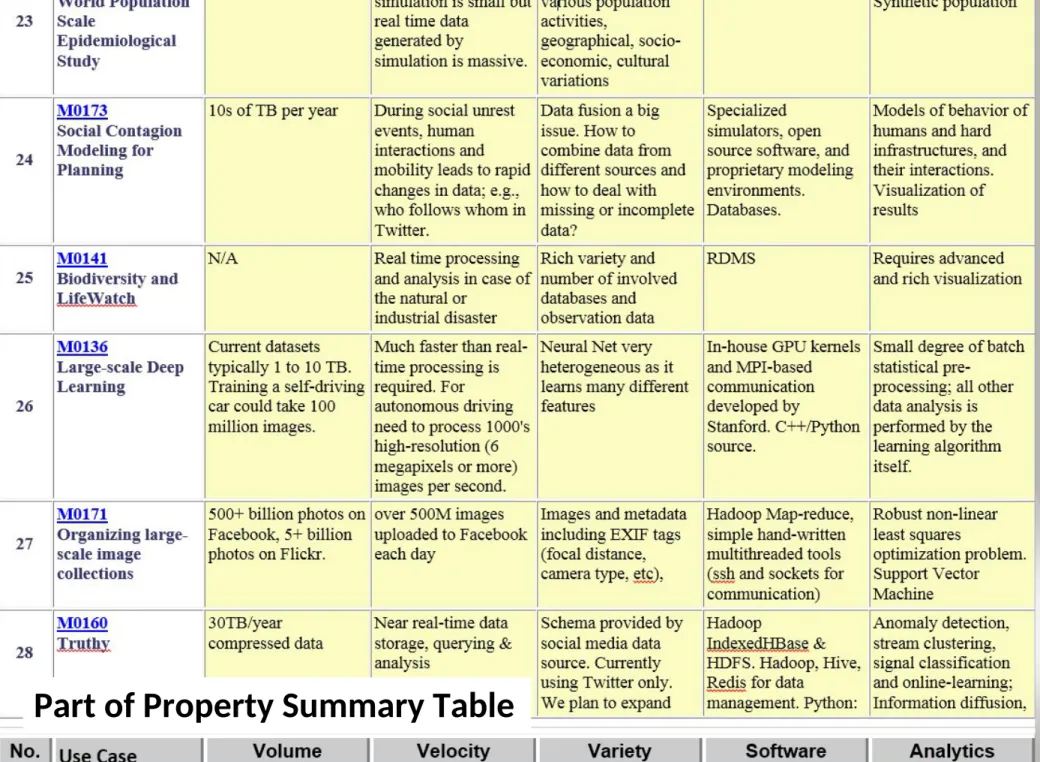
• 26 fields completed for 51 areas
• Government Operation: 4
• Commercial: 8
• Defense: 3
• Healthcare and Life Sciences: 10
• Deep Learning and Social Media: 6
• The Ecosystem for Research: 4
• Astronomy and Physics: 5
• Earth, Environmental and Polar Science: 10
• Energy: 1
51 Detailed Use Cases:
Contributed July-September 2013
Covers goals, data features such as 3 V’s, software,
hardware
• http://bigdatawg.nist.gov/usecases.php
• https://bigdatacoursespring2014.appspot.com/course (Section 5)
• Government Operation(4): National Archives and Records Administration, Census Bureau
• Commercial(8): Finance in Cloud, Cloud Backup, Mendeley (Citations), Netflix, Web Search, Digital Materials, Cargo shipping (as in UPS)
• Defense(3): Sensors, Image surveillance, Situation Assessment
• Healthcare and Life Sciences(10): Medical records, Graph and Probabilistic analysis, Pathology, Bioimaging, Genomics, Epidemiology, People Activity models, Biodiversity
• Deep Learning and Social Media(6): Driving Car, Geolocate images/cameras, Twitter, Crowd Sourcing, Network Science, NIST benchmark datasets
• The Ecosystem for Research(4): Metadata, Collaboration, Language Translation, Light source experiments
• Astronomy and Physics(5): Sky Surveys including comparison to simulation, Large Hadron Collider at CERN, Belle Accelerator II in Japan
• Earth, Environmental and Polar Science(10): Radar Scattering in Atmosphere, Earthquake, Ocean, Earth Observation, Ice sheet Radar scattering, Earth radar mapping, Climate
simulation datasets, Atmospheric turbulence identification, Subsurface Biogeochemistry (microbes to watersheds), AmeriFlux and FLUXNET gas sensors
• Energy(1): Smart grid
17
Table 4: Characteristics of 6 Distributed Applications Application
Example Execution Unit Communication Coordination Execution Environment Montage Multiple sequential and
parallel executable Files Dataflow(DAG) Dynamic processcreation, execution
NEKTAR Multiple concurrent
parallel executables Stream based Dataflow Co-scheduling, datastreaming, async. I/O
Replica-Exchange Multiple seq. andparallel executables Pub/sub Dataflow andevents Decoupledcoordination and messaging
Climate Prediction (generation)
Multiple seq. & parallel
executables Files andmessages Master-Worker, events
@Home (BOINC)
Climate Prediction (analysis)
Multiple seq. & parallel
executables messagesFiles and Dataflow Dynamics processcreation, workflow execution
SCOOP Multiple Executable Files and
messages Dataflow Preemptive scheduling,reservations
Coupled
Fusion Multiple executable Stream-based Dataflow Co-scheduling, datastreaming, async I/O
HPC-ABDS
Integrating High Performance Computing with
Apache Big Data Stack
• HPC-ABDS
• ~120 Capabilities • >40 Apache
• Green layers have strong HPC Integration opportunities
• Goal
Workflow-Orchestration
Application and Analytics: Mahout, MLlib, R…
High level Programming
Basic Programming model and runtime SPMD, Streaming, MapReduce, MPI
Inter process communication Collectives, point-to-point, publish-subscribe
In-memory databases/caches Object-relational mapping
SQL and NoSQL, File management
Data Transport
Cluster Resource Management
File systems DevOps
IaaS Management from HPC to hypervisors
Kaleidoscope of Apache Big Data Stack (ABDS) and HPC Technologies
Cross-Cutting Functionalities
Message Protocols Distributed
Coordination
Security & Privacy Monitoring
~120 HPC-ABDS Software
Some Especially Important or Illustrative
HPC-ABDS Software
•
Workflow:
Python or Kepler
•
Data Analytics:
Mahout, R, ImageJ, Scalapack (GML, LML)
•
High level Programming:
Hive, Pig
•
Parallel Programming model:
Hadoop, Spark, Giraph
(Twister4Azure, Harp), MPI; Storm, Kapfka (Sensors)
•
Data Management:
Hbase, MongoDB
•
Distributed Coordination:
Zookeeper
•
Cluster Management:
Yarn, Slurm
•
File Systems:
HDFS, Lustre
•
DevOps:
Chef, Puppet, Docker, Cobbler
•
IaaS:
Amazon, Azure, OpenStack, Libcloud
SPIDAL (Scalable Parallel Interoperable Data Analytics Library)
Getting High Performance on Data Analytics
• On the systems side, we have two principles:
– The Apache Big Data Stack with ~120 projects has important broad functionality with a vital large support organization
– HPC including MPI has striking success in delivering high performance, however with a fragile sustainability model
• There are key systems abstractions which are levels in HPC-ABDS software stack where Apache approach needs careful integration with HPC
– Resource management
– Storage
– Programming model -- horizontal scaling parallelism
– Collective and Point-to-Point communication
– Support of iteration
– Data interface (not just key-value)
• In application areas, we define application abstractions to support:
– Graphs/network
– Geospatial
– Genes
51 Use Cases: What is Parallelism Over?
• People: either the users (but see below) or subjects of application and often both
• Decision makers like researchers or doctors (users of application)
• Items such as Images, EMR, Sequences below; observations or contents of online store
– Imagesor “Electronic Information nuggets”; pixels within images
– EMR: Electronic Medical Records (often similar to people parallelism)
– Protein or Gene Sequences;
– Material properties, Manufactured Object specifications, etc., in custom dataset
– Modelled entities like vehicles and people
• Sensors – Internet of Things
• Events such as detected anomalies in telescope or credit card data or atmosphere
• (Complex) Nodes in RDF Graph
• Simple nodes as in a learning network
• Tweets, Blogs, Documents, Web Pages, etc.
– And characters/words in them
• Files or data to be backed up, moved or assigned metadata
• Particles/cells/mesh points as in parallel simulations
Features of 51 Big Data Use Cases
I
• PP (26) Pleasingly Parallel or Map Only: bunch of independent tasks
• MR (18) Classic MapReduce MR (add MRStat below for full count)
• MRStat (7) Simple version of MR where key computations are
simple reduction as found in statistical averages such as histograms and averages
• MRIter (23) Iterative MapReduce or MPI (Spark, Twister)
• Graph (9) Complex graph data structure needed in analysis – Giraph or fourth form of MapReduce (MPI like!)
• Fusion (11) Integrate diverse data to aid discovery/decision making; could involve sophisticated algorithms or could just be a portal – loosely coupled dataflow
• Streaming (41) Some data comes in incrementally and is processed this way – very important for much commercial web and
Features of 51 Big Data Use Cases II
• Classify (30) Classification: divide data into categories (machine learning) with lots of different methods including clustering, SVM, learning networks, Bayesian methods, random Forests
• S/Q (12) Index, Search and Query. Key to commercial applications and suitable for MapReduce
• CF (4) Collaborative Filtering for recommender engines; another key commercial application running under MapReduce; typical algorithm is k nearest neighbors
• LML (36) Local Machine Learning (Independent for each parallel
entity). Pleasing parallel running R or Image processing etc. on each item in parallelism.
• GML (23) Global Machine Learning: Deep Learning, Clustering, LDA, PLSI, MDS,
– Large Scale Optimizations as in Variational Bayes, MCMC, Lifted Belief
Features of 51 Big Data Use Cases III
• Workflow (51) Universal “orchestration” or dataflow between different tasks in job
• GIS (16) Geographical Information System. Geotagged data and often displayed in ESRI, Microsoft Virtual Earth, Google Earth, GeoServer, ESRI, Minnesota Map Server etc.
• HPC (5) Classic large-scale simulation of cosmos, materials, etc. generating (visualization) data to be analyzed for turbulence, particle trajectories etc.
• Agent (2) Simulations of models of data-defined macroscopic
entities represented as agents. Use in simulations of cities (vehicle flow)or spread of information in complex system.
Global Machine Learning aka EGO –
Exascale Global Optimization
• Typically maximum likelihood or 2 with a sum over the N data
items – documents, sequences, items to be sold, images etc. and often links (point-pairs). Usually it’s a sum of positive numbers as in least squares
• Covering clustering/community detection, mixture models, topic determination, Multidimensional scaling, (Deep) Learning
Networks
• PageRank is “just” parallel linear algebra
• Note many Mahout algorithms are sequential – partly as MapReduce limited; partly because parallelism unclear
– MLLib (Spark based) better
• SVM and Hidden Markov Models do not use large scale parallelization in practice?
10 Security & Privacy Use Cases
•
Consumer Digital Media Usage
•
Nielsen Homescan
•
Web Traffic Analytics
•
Health Information Exchange
•
Personal Genetic Privacy
•
Pharma Clinic Trial Data Sharing
•
Cyber-security
•
Aviation Industry
•
Military - Unmanned Vehicle sensor data
7 Computational Giants of
NRC Massive Data Analysis Report
1) G1:
Basic Statistics e.g. MRStat
2) G2:
Generalized N-Body Problems
3) G3:
Graph-Theoretic Computations
4) G4:
Linear Algebraic Computations
5) G5:
Optimizations e.g. Linear Programming
6) G6:
Integration e.g. LDA and other GML
Implementing Big Data
Useful Set of Analytics Architectures
•
Pleasingly Parallel:
including
local machine learning
as in
parallel over images and apply image processing to each image
- Hadoop could be used but many other HTC, Many task tools
•
Search:
including collaborative filtering and motif finding
implemented using
classic MapReduce
(Hadoop); Alignment
•
Map-Collective
or Iterative MapReduce
using Collective
Communication (clustering) – Hadoop with Harp, Spark …..
•
Map-Communication
or Iterative Giraph:
(MapReduce) with
point-to-point communication (most graph algorithms such as
maximum clique, connected component, finding diameter,
community detection)
– Vary in difficulty of finding partitioning (classic parallel load balancing)
•
Large and Shared memory:
thread-based
(event driven) graph
algorithms (shortest path, Betweenness centrality) and Large
memory applications
4 Forms of MapReduce
(1) Map Only MapReduce(2) Classic (3) Iterative Map Reduceor Map-Collective Map-Communication(4) Point to Point or
Input map reduce Input map reduce Iterations Input Output map Local Graph BLAST Analysis Local Machine Learning Pleasingly Parallel
High Energy Physics (HEP) Histograms Distributed search
Recommender Engines
Expectation maximization
Clustering e.g. K-means Linear Algebra,
PageRank
Classic MPI
PDE Solvers and Particle Dynamics Graph Problems MapReduce and Iterative Extensions (Spark, Twister) MPI, Giraph
Integrated Systems such as Hadoop + Harp with Compute and Communication model separated
Clouds and HPC
2 Aspects of Cloud Computing:
Infrastructure and Runtimes
• Cloud infrastructure: outsourcing of servers, computing, data, file space, utility computing, etc..
– Azure exemplifies
• Cloud runtimes or Platform: tools to do data-parallel (and other) computations. Valid on Clouds and traditional clusters
– Apache Hadoop, Google MapReduce, Microsoft Dryad, Bigtable, Chubby and others
– MapReduce designed for information retrieval/e-commerce (search, recommender) but is excellent for a wide range of
science data analysis applications
– Can also do much traditional parallel computing for data-mining if extended to support iterative operations
Clouds have highlighted SaaS PaaS IaaS
• Software Services are building blocks of
applications
• The middleware or
computing environment including HPC, Grids …
• Nimbus, Eucalyptus,
OpenStack, OpenNebula CloudStack plus Bare-metal
• OpenFlow – likely to grow in importance
Infra structure
IaaS
Ø Software Defined
Computing (virtual Clusters)
Ø Hypervisor, Bare Metal
Ø Operating System
Platform
PaaS
Ø Cloud e.g. MapReduce
Ø HPC e.g. PETSc, SAGA
Ø Computer Science e.g. Compiler tools, Sensor nets, Monitors
Network
NaaS
Ø Software Defined Networks
Ø OpenFlow GENI
Software (Application Or Usage)
SaaS
Ø Education Ø ApplicationsØ CS Research Use e.g. test new compiler or storage model
(Old) Science Computing
Environments
• Large Scale Supercomputers – Multicore nodes linked by high performance low latency network
– Increasingly with GPU enhancement – Suitable for highly parallel simulations
• High Throughput Systems such as European Grid Initiative EGI or Open Science Grid OSG typically aimed at pleasingly parallel jobs
– Can use “cycle stealing”
– Classic example is LHC data analysis
• Grids federate resources as in EGI/OSG or enable convenient access to multiple backend systems including supercomputers
• Use Services (SaaS)
– Portals make access convenient and
– Workflow integrates multiple processes into a single job
Clouds HPC and Grids
• Synchronization/communication PerformanceGrids > Clouds > Classic HPC Systems
• Clouds naturally execute effectively Grid workloads but are less clear for closely coupled HPC applications
• Classic HPC machines as MPI engines offer highest possible performance on closely coupled problems
• The 4 forms of MapReduce/MPI with increasing synchronization
1) Map Only – pleasingly parallel
2) Classic MapReduce as in Hadoop; single Map followed by reduction with fault tolerant use of disk
3) Iterative MapReduce use for data mining such as Expectation Maximization in clustering etc.; Cache data in memory between iterations and support the large collective communication (Reduce, Scatter, Gather, Multicast) use in data mining
4) Classic MPI! Support small point to point messaging efficiently as used in partial differential equation solvers. Also used for Graph algorithms
Increasing Synchronization in Parallel Computing
• Grids: least synchronization as distributed
• Clouds: MapReduce has asynchronous maps typically processing data
points with results saved to disk. Final reduce phase integrates results from different maps
– Fault tolerant and does not require map synchronization
– Dominant need for search and recommender engines
– Map only useful special case
• HPC enhanced Clouds: Iterative MapReduce caches results between
“MapReduce” steps and supports SPMD parallel computing with large
messages as seen in parallel kernels (linear algebra) in clustering and other data mining
• HPC: Typically SPMD (Single Program Multiple Data) “maps” typically processing particles or mesh points interspersed with multitude of low
latency messages supported by specialized networks such as Infiniband and technologies like MPI
– Often run large capability jobs with 100K (going to 1.5M) cores on same job
– National DoE/NSF/NASA facilities run 100% utilization
– Fault fragile and cannot tolerate “outlier maps” taking longer than others
– Reborn on clouds as Giraph (Pregel) for graph Algorithms
– Often used in HPC unnecessarily when better to use looser synchronization
Parallel Global Machine Learning
Examples
Use of MDS and Clustering
• Big Data often involves looking for “structure” in data collections and then classifying points in some fashion.
• “Unsupervised” investigation is one approach and here two useful techniques are clustering and MDS (Multi Dimensional Scaling).
• Clustering does what name suggests – it finds collections of data that are near each other and associates them as a cluster.
• MDS takes data and maps them into Euclidean space. It can be used to
reduce dimension -- say to three dimensions so it can be visualized – or to take data that is not in a Euclidean space and map it into one.
• Kmeans is a simple famous clustering algorithm that works on points in a Euclidean space. There are also clustering algorithms that work for non-Euclidean spaces and there also fancier clustering algorithms for non-Euclidean data.
• Gene sequences are a good example of data points that are not Euclidean but one can calculate an estimate of distances between them. MDS maps points so distances in mapped Euclidean space are “near” distances in original space whether Euclidean or not.
Lessons / Insights
•
Data Science is interesting
•
4
important machine and software
architectures
•
Discussed features of Big Data applications
•
Integrate
(don’t compete)
HPC with “Commodity Big data”
(Google to Amazon to Enterprise Data Analytics)
– i.e. improve Mahout; don’t compete with it
– Use Hadoop plug-ins rather than replacing Hadoop