AND ATTITUDE REGARDING PREVENTION OF MULTIDRUG-
RESISTANT TUBERCULOSIS AMONG TUBERCULOSIS
PATIENTS AT SELECTED SETTING,
CHENNAI.
DISSERTATION SUBMITTED TO
THE TAMIL NADU Dr.M.G.R. MEDICAL UNIVERSITY,
CHENNAI
IN PARTIAL FULFILMENT OF REQUIREMENT FOR THE DEGREE OF
MASTER OF SCIENCE IN NURSING
AND ATTITUDE REGARDING PREVENTION OF MULTIDRUG-
RESISTANT TUBERCULOSIS AMONG TUBERCULOSIS
PATIENTS AT SELECTED SETTING,
CHENNAI.
Certified that this is the bonafide work of Ms.T.L.THILAGAVATHY, Omayal Achi College of Nursing,
No.45, Ambattur road, Puzhal, Chennai-600 066.
COLLEGE SEAL:
SIGNATURE : ______________________________
Dr.(Mrs) S.KANCHANA
R.N., R.M., M.Sc.(N)., Ph.D., POST DOC(RES),
Principal & Research Director,
Omayal Achi College of Nursing,
Puzhal, Chennai ± 600 066, Tamil Nadu.
DISSERTATION SUBMITTED TO
THE TAMIL NADU Dr.M.G.R. MEDICAL UNIVERSITY,
CHENNAI
IN PARTIAL FULFILMENT OF REQUIREMENT FOR THE DEGREE OF
MASTER OF SCIENCE IN NURSING
AND ATTITUDE REGARDING PREVENTION OF MULTIDRUG-
RESISTANT TUBERCULOSIS AMONG TUBERCULOSIS
PATIENTS AT SELECTED SETTING,
CHENNAI.
Approved by the Research Committee in December 2014
PROFESSOR IN NURSING RESEARCH
Dr.(Mrs.) S.KANCHANA _________________
R.N., R.M., M.Sc.(N)., Ph.D., POST Doc(RES), Principal & Research Director, ICCR,
Omayal Achi College of Nursing,
Puzhal, Chennai ± 600 066, Tamil Nadu.
MEDICAL EXPERT
Dr.LAKSHMI MURALI _________________
M.D., (TB & RD) Deputy Director, DHS-RNTCP,
TB cell unit, DMS Building, Chennai-600 006.
CLINICAL SPECIALITY ± HOD AND RESEARCH GUIDE,
Prof.Mrs.M.SUMATHI _________________
R.N., R.M., M.Sc.(N)., [Ph.D(N)],
Professor and Head of the Department, Medical Surgical Nursing, Omayal Achi College of Nursing,
Puzhal, Chennai ± 600 066, Tamil Nadu.
DISSERTATION SUBMITTED TO
THE TAMIL NADU Dr.M.G.R. MEDICAL UNIVERSITY,
CHENNAI
IN PARTIAL FULFILMENT OF REQUIREMENT FOR THE DEGREE OF
MASTER OF SCIENCE IN NURSING
Gratitude opens our hearts, encourages us to savor that each gift comes our way, and magically frees us from jealously guarding our possessions.
I thank God for blessing me more than I deserve. I want to praise you forever and
ever as you were my shadow during all my sorrows and happiness.
I hanker my deep sense of gratitude to the Vice Chancellor and Research
Department of The Tamil Nadu Dr.M.G.R Medical University, Guindy for giving me
an opportunity to undertake my Postgraduate degree in Nursing at this esteemed university.
I wish to express my deep sense of gratefulness to the Managing Trustee,
Omayal Achi College of Nursing for giving me an opportunity to pursue my Postgraduate degree at this esteemed institution.
I express my deep sense of gratitude to the Research Coordinator,
Dr.K.Rajanarayanan, B.Sc., M.B.B.S., FRCH (London), International Centre for
Collaborative Research (ICCR), Omayal Achi College of Nursing and Honorary Professor in Community Medicine for his tremendous suggestions, expert guidance with regard to approval and ethical clearance for conducting the study.
I owe a debt of gratitude to Dr (Mrs.) S. Kanchana, Principal and Research
Director, ICCR, Omayal Achi College of Nursing for her expert guidance, Patience, Valuable suggestions and encouragement throughout the study.
I express my humble gratitude to Dr (Mrs) D.Celina, Vice Principal, Omayal
Achi College of Nursing for her thought provoking valuable advices and inspiration during my study.
I also thank the Ethical Committee members for the suggestions during the
supporting and encouraging me, for her expert guidance, constant motivation, immediate correction and enduring patience during my mistakes which helped me in completing my study.
I express my earnest gratitude to Prof.(Mrs).Jose Eapen Jolly Cecily, Medical
Surgical Nursing for her extensive encouragement, constant emotional support, scholarly suggestions and guidance throughout the study.
,W¶VP\LPPHQVHSOHDVXUHWRWKDQNP\&ODVVCo-ordinators Dr (Mrs) P.Jayanthi,
Mrs.Ruth Rani Princely, Mrs.Manonmani, for their timely guidance, constant support
and inspiration that helped me to complete the study.
I express my note of gratitude to Mr. Yayathee Subbarayau, Research Fellow
(ICMR), ICCR, Omayal Achi College of Nursing and all the HODs and faculty for their
provoking ideas and moral support given towards the progress of the study.
I immensely thank The Director, Dr (Mrs) Lakshmi Murali, MD (Chest and
TB), District Tuberculosis Centre, for providing setting permission for conducting the
study and for guiding me, and Mrs.Nevis, Staff Nurse and the Mrs.Ajitha, Health Visitor of the centre for supporting and helping me during data collection.
I thank all the Medical and Nursing experts who refined and validated the
research tools used for the present study.
I extend my deepest gratitude to Prof. Venkatesan, M.Sc., Ph.D.,
Biostatistician, Madras Medical College, Chennai, for his efficient guidance and
assistance to travel the statistics ocean.
My sincere thanks to Mr.Victor Dhanaraj, Headmaster, Shree Jethmal
Tikamchand Chajed Jain Mission Higher Secondary School for editing in English and
I extend my gratitude to the librarians Mr.N.Muthukumaran, M.A., B.Ed.,
MLIS., M.Phil, Mr.T.M.Ashokan, B.A., MLIS., M.Phil and Ms.Uma Maheswari,
B.Com., MLIS, for their co-operation in collecting the related literature for the study.
A deep sense of gratitude to Mr.G.K.Venkataraman, Elite computers for
typing, aligning and executing the manuscript.
I engrave my affectionate and very special gratitude to my creators
Mr.P.Thangamani and Mrs.C.Leelabai, uncle Mr.Raj, brothers Mr.Ajithraj and
Mr.Harikumar for providing me a moral support, encouraging, motivating and being as
a part in this study.
My heartfelt thanks to my Amigos Ms.C.Saranya, Mrs.Asha and shadower
Mr.Arun Lal for their constructive ideas and encouragement made to cover this ozone.
I extend my deep sense of gratitude to my friends Mrs. P. Rosy, Mrs. Susan
Jinu, Mrs.Gayathri, Ms. Monicka and Mrs.Pichammal and to all M.Sc.Nursing II
year (2014-16) Batch for their constant encouragement and for the peer suggestions.
And a word of thanks to my seniors Ms.Sandra Jeba Malar, Ms. Priyadharshini,
Ms.Janani, Ms.Sharon Grace Joseph and Ms. Sulu Susan Rajan for their moral
support and valuable suggestions in the study.
I wish to thank all my friends and well wishers for their love, support and
AIDS - Acquired Immunodeficiency Syndrome
ANOVA - Analysis of Variance
DOTS - Directly Observed Treatment Short Course
HIV - Human Immunodeficiency Virus
ICCR - International Centre for Collaboration Research
ICTC - Integrated Counseling and Testing Centre
IERB - Institution Ethical Review Board
INH - Isoniazid
IPD - Inpatient Department
MDR-TB - Multidrug-Resistant Tuberculosis
NRHM - National Rural Health Mission
OPD - Outpatient Department
PHC - Primary Health Centre
PMDT - Programmatic Management of Drug Resistant Tuberculosis
RMP - Rifampicin
RNTCP - Revised National Tuberculosis Control Programme
TB - Tuberculosis
UVGI - Ultraviolet germicidal irradiation
WHO - World Health Organization
CHAPTER NO. CONTENT PAGE NO. ABSTRACT
1 INTRODUCTION
1.1 Background of the study 2
1.2 Significance and need for the study 4
1.3 Statement of the problem 7
1.4 Objectives 7
1.5 Operational definitions 7
1.6 Assumptions 9
1.7 Null hypotheses 9
1.8 Delimitations 9
1.9 Conceptual framework 9
1.10 Outline of the report 12
2 REVIEW OF LITERATURE
2.1 Concepts of Review of Literature 13
2.2 Sources ofReview of Literature 13
2.3 Organization of Review of Literature 14
2.3.1 Critical and scientific reviews related to prevalence of
MDR-TB
14
2.3.2 Critical and scientific reviews related to risk factors of
MDR-TB
16
2.3.3 Critical and scientific reviews related to diagnostic
measures of MDR-TB
17
2.3.4 Critical and scientific reviews related to treatment for
MDR-TB
18
2.3.5 Critical and scientific reviews related to knowledge and
attitude regarding prevention of MDR-TB
19
3 RESEARCH METHODOLOGY
3.1 Research approach 21
3.4 Setting of the study 22
3.5 Population 22
3.6 Sample 23
3.7 Sample size 23
3.8 Criteria for sample selection 23
3.9 Sampling technique 23
3.10 Development and description of the tool 25
3.11 Content validity 27
3.12 Ethical consideration 27
3.13 Reliability of the tool 28
3.14 Pilot study 28
3.15 Data collection procedure 29
3.16 Plan for data analysis 32
4 DATA ANALYSIS AND INTERPRETATION 33
5 DISCUSSION 48
6 SUMMARY,CONCLUSION,IMPLICATIONS, RECOMMENDATIONS AND LIMITATIONS
51
REFERENCES 56
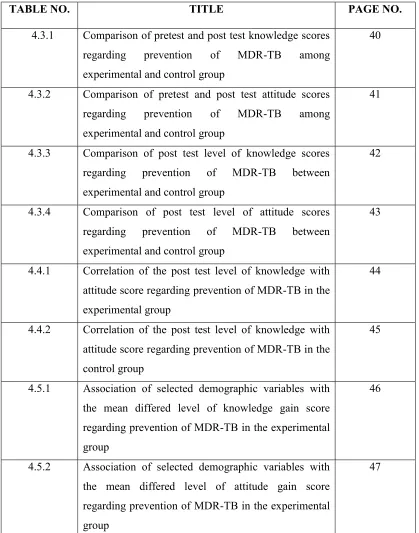
TABLE NO. TITLE PAGE NO.
1.1.1 Global incidence of Tuberculosis by comparing
between India and other country
2
1.1.2 Global morbidity and mortality rate of TB and MDR-TB in the year of 2014
3
1.1.3 Statistics on prevalence of MDR-TB 3
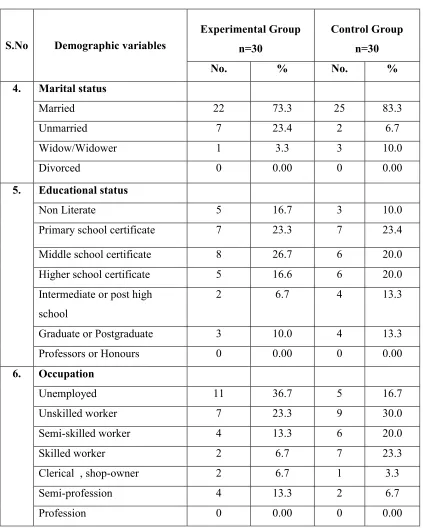
4.1.1 Frequency and percentage distribution of selected
demographic variables of Tuberculosis patients such as age in years, gender and religion in experimental and control group
34
4.1.2 Frequency and percentage distribution of selected
demographic variables of Tuberculosis patients such as marital status, educational status and occupation in experimental and control group
35
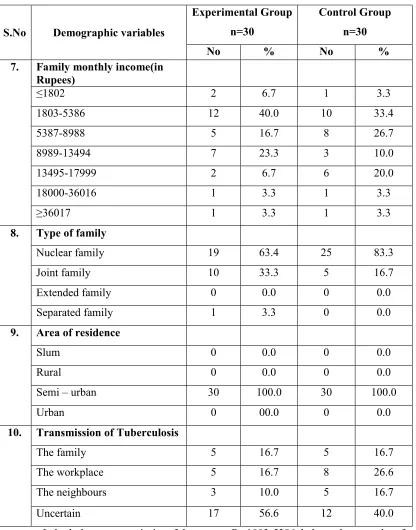
4.1.3 Frequency and percentage distribution of selected
demographic variables of Tuberculosis patients such as family income, type of family, area of residence and transmission of TB in experimental and control group
36
4.1.4 Frequency and percentage distribution of selected
demographic variables of Tuberculosis patients such as health care resources, personal habits and co-morbid illness in experimental and control group
37
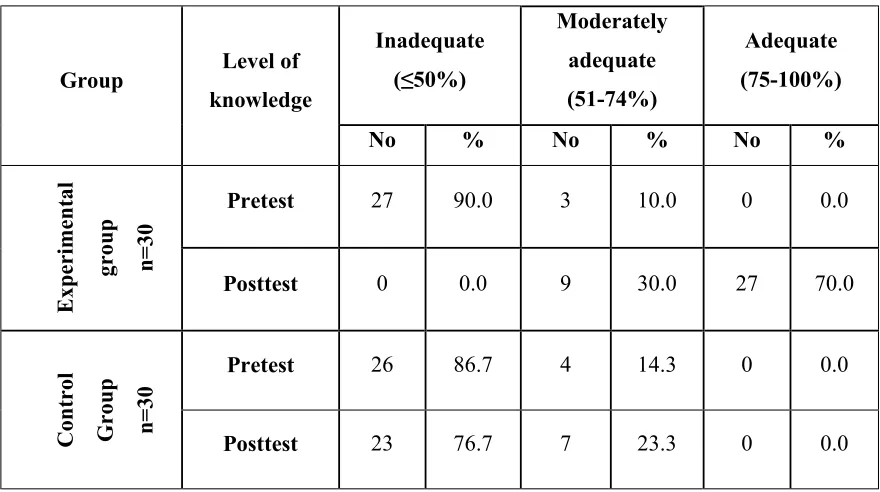
4.2.1 Frequency and percentage distribution of pre and the
post test level of knowledge regarding prevention of MDR-TB among the experimental and control group
38
4.2.2 Frequency and percentage distribution of pre and the
post test level of attitude regarding prevention of MDR-TB among the experimental and control group
TABLE NO. TITLE PAGE NO.
4.3.1 Comparison of pretest and post test knowledge scores
regarding prevention of MDR-TB among experimental and control group
40
4.3.2 Comparison of pretest and post test attitude scores
regarding prevention of MDR-TB among experimental and control group
41
4.3.3 Comparison of post test level of knowledge scores
regarding prevention of MDR-TB between experimental and control group
42
4.3.4 Comparison of post test level of attitude scores
regarding prevention of MDR-TB between experimental and control group
43
4.4.1 Correlation of the post test level of knowledge with
attitude score regarding prevention of MDR-TB in the experimental group
44
4.4.2 Correlation of the post test level of knowledge with
attitude score regarding prevention of MDR-TB in the control group
45
4.5.1 Association of selected demographic variables with
the mean differed level of knowledge gain score regarding prevention of MDR-TB in the experimental group
46
4.5.2 Association of selected demographic variables with
the mean differed level of attitude gain score regarding prevention of MDR-TB in the experimental group
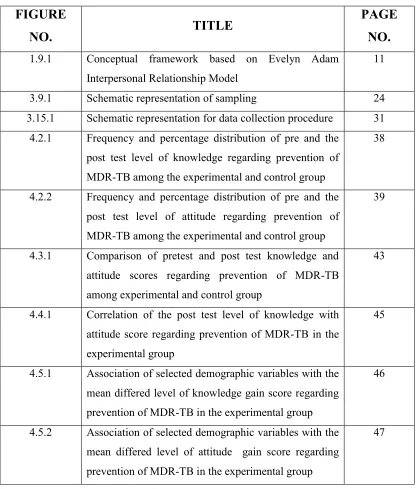
FIGURE
NO.
TITLE
PAGE
NO.
1.9.1 Conceptual framework based on Evelyn Adam
Interpersonal Relationship Model
11
3.9.1 Schematic representation of sampling 24
3.15.1 Schematic representation for data collection procedure 31
4.2.1 Frequency and percentage distribution of pre and the
post test level of knowledge regarding prevention of MDR-TB among the experimental and control group
38
4.2.2 Frequency and percentage distribution of pre and the
post test level of attitude regarding prevention of MDR-TB among the experimental and control group
39
4.3.1 Comparison of pretest and post test knowledge and
attitude scores regarding prevention of MDR-TB among experimental and control group
43
4.4.1 Correlation of the post test level of knowledge with
attitude score regarding prevention of MDR-TB in the experimental group
45
4.5.1 Association of selected demographic variables with the
mean differed level of knowledge gain score regarding prevention of MDR-TB in the experimental group
46
4.5.2 Association of selected demographic variables with the
mean differed level of attitude gain score regarding prevention of MDR-TB in the experimental group
APPENDIX TITLE PAGE NO.
A Ethical clearance certificate
IEC approval certificate
i ii
B Letter seeking and granting permission for conducting
the main study
iii
C Content validity
L/HWWHUVHHNLQJH[SHUW¶VRSLQLRQIRUFRQWHQWYDOLGLW\ ii)List of experts for content validity
iii)Certificate of content validity
iv v vi
D Certificate for English editing
Certificate for Tamil editing
x xi
E Informed consent
i)Informed consent request form-English ii)Informed written consent form- English iii)Informed consent request form-Tamil iv)Informed written consent form- Tamil
xii xiii xiv xv
F Copy of the tool for data collection
i)English ii)Tamil
xvi xxiii
G Plagiarism report xxxii
H Coding for the demographic variables xxxiii
I Blue print of data collection tool xxxvi
J Intervention tool xxxvii
K Dissertation Execution plan-Gantt chart
selected setting, Chennai.
INTRODUCTION
Tuberculosis (TB) remains a major global health problem with devastating social and economic costs .TB spreads from person to person by the release of droplets containing the bacilli (Mycobacterium Tuberculosis) into the air .TB usually affects the lungs, but it can also affect other parts of the body such as the brain, kidneys or the spine .The most essential drugs used for the treatment of TB (anti-TB drugs) are Isoniazid, Rifampicin, Pyrazinamide, Ethambutol and Streptomycin. It is a curable and preventable disease and yet it causes significant morbidity and mortality.
India has the highest TB burden of all the country in the world, accounting for an estimated one- fifth TB cases worldwide. It has an estimated prevalence of million TB
cases, with 2 million new cases occurring each year (World Health Organization,
2013). Similarly, Multidrug-Resistant Tuberculosis (MDR-TB) detection from 2009
Aim and objective: To assess the effectiveness of Self Care Module on knowledge and attitude
regarding prevention of Multidrug-Resistant Tuberculosis (MDR-TB) among Tuberculosis (TB)
patients. Methodology: A quasi experimental, equivalent control group design was chosen to
assess the level of knowledge and attitude regarding Self Care Module conducted at selected
setting, Chennai. 60 Tuberculosis (TB) patients who fulfilled the inclusion criteria were selected as
samples using non probability purposive sampling technique. Self Care Module consists of lecture
cum discussion, video show and reinforcement regarding prevention of MDR-TB. The pre and post
test level of knowledge and attitude was assessed using structured interview schedule and 4 point
Likert scale respectively. Results: The findings of the study revealed that the comparison of post
test level of knowledge and attitude scores regarding prevention of MDR-TB between experimental
and FRQWUROJURXSWKHFDOFXODWHGXQSDLUHG¶W¶YDOXHZDVDQGUHVSHFWLYHO\ZKLFKGHQRWHV
very high statistical significance at p<0.001level. The correlation between the post test level of
NQRZOHGJH ZLWK DWWLWXGH VFRUH µU¶ YDOXH ZDV VLJQLILHV PRderate positive correlation .The
significant level of association was identified between age, gender and educational status with mean
differed knowledge and attitude regarding prevention of MDR-TB in the experimental group.
Conclusion: Hence the Self Care Module developed by the investigator proved to be an effective
aid in enhancing the knowledge and attitude regarding prevention of MDR-TB among Tuberculosis
(TB) patients.
Although adequate knowledge about importance of drug compliance of Tuberculosis patients are provided, most of the patients are not aware about the consequences of post TB. So the researcher was fervent to develop a module on prevention of MDR-TB through Self Care Module, which is a set of instructions with components such as respiratory, household and environmental hygiene, diet and importance of vaccination for MDR-TB among Tuberculosis patients through education, video show and MDR-TB Module.
OBJECTIVE
To assess the effectiveness of Self Care Module on knowledge and attitude
regarding prevention of Multidrug-Resistant Tuberculosis(MDR-TB) among Tuberculosis (TB) patients.
METHODOLOGY Research Design
Quasi experimental, equivalent control group design.
Variables
Independent Variable
Self Care Module
Dependent Variables
Knowledge and attitude regarding prevention of MDR-TB among Tuberculosis
patients
Setting
District Tuberculosis Centre, Karayanchavadi, Chennai
Population
Target population- All the patients medically diagnosed with Tuberculosis
Sampling
The patients diagnosed with tuberculosis, who fulfilled the inclusion criteria by
non probability purposive sampling technique.
Intervention
Self Care Module comprised of
x Lecture cum discussion on MDR-TB (Disease condition and treatment with
prevention)
x Video show on preventive measures of MDR-TB
x Pictorial module on overview of MDR-TB.
Measurements and tool
The pre and post test level of knowledge was assessed using structured interview
schedule. It consists of20 multiple choice questions and categorized into 2 components
about the disease condition, treatment and prevention of MDR-TB.
The pre and post test level of attitude was assessed using 4 point Likert scale
consisting of 10 statements out of which 5 were positive and 5 negatively worded statements
RESULTS
The findings of the study revealed that the comparison of post test level of
knowledge and attitude scores regarding prevention of MDR-TB between experimental
and control group, the calculated unpaired ¶W¶ YDOXH ZDV and 18.42 respectively
which denotes very high statistical significance at p<0.001 level.
The correlation between the post test level of knowledge with attitude score was
calculated using Karl Pearson correlation FRHIILFLHQW ZLWK µU¶ YDOXH RI VLJQLILHV
DISCUSSION
There was a significant improvement of knowledge and attitude regarding
prevention of Multidrug-Resistant Tuberculosis (MDR-TB) among Tuberculosis (TB) patients in the post test after administration of Self Care Module. Thus Self Care Module was an effective education tool in improving the knowledge and attitude of Tuberculosis (TB) patients regarding prevention of MDR-TB.
CONCLUSION
Researcher concluded that utilization of Self Care Module developed by the investigator will help to improve the knowledge and attitude regarding MDR-TB prevention in OPD and IPD of various hospital .It enhances the regular compliance of medication and prevents from MDR-TB. The findings of the study reveals that there is a significant difference in the pre test and post test level of knowledge and attitude regarding prevention of MDR-TB among Tuberculosis (TB) patients. This proves that the module is more effective and shows that as knowledge increased attitude also increased.
IMPLICATIONS
The nurse plays a essential role in building the knowledge and attitude on
preventive aspects. The intervention is cost effective, reliable and can be incorporated by the nurses in all the specialized hospitals in preventing MDR-TB. The study enables the nurse educator to incorporate the findings in nursing curriculum with evidence based practice. A nurse administrator can organize the training programme for the caregivers
and other patients with TB for reducing the disease burden. The findings of the study can
Internal Examiner:
INTRODUCTION
7KH VLQJOH ELJJHVW WKUHDW WR PDQ¶V FRQWLQXHG GRPLQDQFH RQ WKH SODQHW LV WKH
micro-organisms (Joshua Lederberg). India is undergoing a epidemiologic,
demographic and health transition. At present communicable or infectious disease is the leading cause of illness and death. Infectious diseases are caused by pathogenic micro-organisms, such as bacteria, viruses, parasites or fungi; it can be spread from one person
to another directly or indirectly (World Health Organization (WHO), 2006).Globally
there are 13 notifiable communicable diseases, amongst Tuberculosis is the leading
cause of death.
Tuberculosis (TB) remains a major global health problem with devastating social
and economic costs. TB spreads from person to person by the release of droplets containing the bacilli (Mycobacterium Tuberculosis) into the air. TB usually affects the lungs, but it can also affect other parts of the body such as the brain , kidneys or the spine .The most essential drugs used for the treatment of TB (anti-TB drugs) are Isoniazid, Rifampicin, Pyrazinamide, Ethambutol and Streptomycin. It is a curable and preventable disease and yet it causes significant morbidity and mortality.
In some extent, use of anti-TB drugs, has contributed significantly to the
emergence of Drug-Resistant TB in India .Depending upon the number of drugs to which bacilli are resistant ,various types of TB are originated such as :Mono Drug Resistant TB, Poly Drug Resistant TB, Multidrug-Resistant TB (MDR-TB) and Extensively Drug
Resistant TB. Drug resistance arises due to irregular and incomplete treatment, poor
treatment management, non-availability of certain drugs and no monitoring of treatment.
MDR-TB is a specific form of drug resistant TB due to bacilli resistant to at least
,QERWKWKHFDVHVWKHSDWLHQWZKR¶VQRWUHFHLYLQJDVWURQJHQRXJKGRVDJHRIWKH drugs over a long enough period of time to kill the bacilli, so the organisms are given time to develop resistance to one or more of the drugs.
The diagnosis of MDR-TB in field conditions is a challenge. Because of slow
growth of M .Tuberculous bacilli it takes a long time to isolate the bacilli on culture .The goal of TB treatment is to prevent the further development and spread of MDR-TB. A standard treatment is administered for the treatment of MDR-TB patients, into two phases which are initial Intensive phase followed by the Continuation phase. The regimen comprises of 6 drugs in the intensive phase (6 months) and 4 drugs in the Continuation phase (18 months).
Every year, on 24th March ,the World marks World TB day (WTBD), is
celebrated to mobilize the political and social commitment for further progress towards eliminating Tuberculosis as a public health burden .This year World TB day 2015 paves
the theme: ³Reach the 3 million: Reach , Treat ,Cure Everyone with TB and accelerate
progress towards the bold goal of ending TB by 2035´.The WHO denotes the importance
of eliminating the access barriers to all recommended Tuberculosis diagnostics and drugs ,and addresses Tuberculosis and MDR-TB as global health security threats .As there is a urgent need to fight against the disease.
1.1
BACKGROUND OF THE STUDYIndia has the highest TB burden of all the country in the world, accounting for an
estimated one-fifth TB cases worldwide. It has an estimated prevalence of million TB cases, with 2 million new cases occurring each year. About 280,000 people die from TB
in India annually. (WHO, 2013)
[image:21.612.109.525.611.716.2]
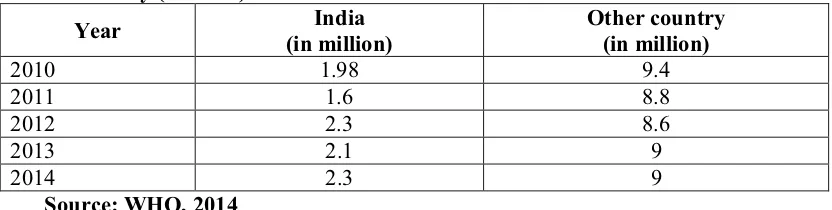
Table: 1.1.1 Global incidence of Tuberculosis by comparing between India and other country (2010-14)
Year India
(in million)
Other country (in million)
2010 1.98 9.4 2011 1.6 8.8 2012 2.3 8.6
2013 2.1 9
2014 2.3 9
Table: 1.1.2 Global morbidity and mortality rate of TB and MDR-TB in the year of 2014
TB and Co-infection Morbidity Mortality
Tuberculosis 9.6 million 1.5 million
TB and HIV 1.2 million 0.4 million
TB among women 3.2 million 480,000
TB in children 1.0 million 140,000
MDR-TB 480,000 190,000
Source: WHO, 2014
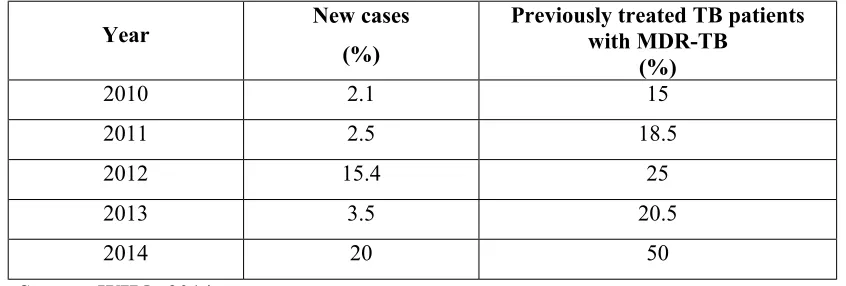
Table: 1.1.3 Statistics of MDR-TB prevalence among new cases of MDR-TB and previously treated TB patients with MDR-TB
Year New cases
(%)
Previously treated TB patients with MDR-TB
(%)
2010 2.1 15
2011 2.5 18.5
2012 15.4 25
2013 3.5 20.5
2014 20 50
Source: WHO, 2014
There is tripling in MDR-TB in 2013 detection compared with 2009.Extensively
drug-Resistant TB (XDR-TB) has been reported by 100 countries in 2013. On average,
an estimated 9% of people with MDR-TB have XDR-TB. If all notified TB patients (6.1 million, new and previously treated) had been tested for drug resistance in 2013, an estimated 300 000 cases of MDR-TB would have been detected.
Only 48% of the MDR-TB patients in the 2011 cohort of detected cases were
successfully treated. 16% died, 24% did not have their treatment outcome documented or
interrupted treatment, and 12% were not cured despite receiving treatment.
India's Revised National Tuberculosis Control Programme (RNTCP) has an
[image:22.612.105.528.285.428.2]patients, with an intermediate goal of successfully treating at least 90 percent of all new and at least 85 percent of all previously treated patients.
Despite these achievements, India's efforts to control TB and MDR TB still suffer
from too few laboratories, slow diagnostic tools, inadequate management of treatment, insufficient supplies of second-line drugs, and shortages of trained personnel.
RNTCP expects to treat about 1,60,000 MDR-TB and 4,100 XDR-TB cases over
the next 5 years (2012-2017). Therefore new tools are required by 2025, for enhancing
the treatment for MDR-TB crisis thereby to provide a quality care.
1.2 SIGNIFICANCE AND NEED FOR THE STUDY
India has a long and distinguished tradition of research in Tuberculosis and MDR-TB. Directly Observed Treatment Short Course (DOTS) is effective in preventing the emergence of MDR-TB and reverses the incidence of MDR-TB. So we have to end MDR-TB by stopping the TB development and spread.
National Strategic Plan TB India (2012-2017)
Newer strategies have been developed as a comprehensive National Strategic Plan under the 12th Five Year Plan of Government of India (2012) and they have identified the thrust areas such as:
x Strengthening and improving the quality of basic DOTS services
x Further strengthen and align with health system under National Rural Health
Mission(NRHM)
x Deploying improved rapid diagnosis at the field level
x Expand efforts to engage all care providers
x Strengthen urban TB Control
x Expand diagnosis and treatment of drug resistant TB
x Improve communication and outreach
x Promote research for development and implementation of improved tools and
The END TB global strategy and targets for Tuberculosis prevention, care and control after 2015:
x Their goal is to end the global Tuberculosis epidemic
x Vision is to provide a world free of Tuberculosis-zero deaths, disease and
suffering due to Tuberculosis
x The components of this strategy are ;
Integrated, patient-centered care and prevention
Bold policies and supportive systems
Intensified research and innovation(WHO)
The essential elements of the DOTS-Plus strategy framework for the management of multidrug-resistant TB are;
x Sustained government commitment
x Accurate, timely diagnosis through quality assured culture and drug susceptibility
testing
x Appropriate treatment utilizing second-line drugs under strict supervision
x Uninterrupted supply of quality assured anti-TB drugs and
x Standardized recording and reporting system.
These component addresses that the Multidrug-resistant TB awareness will strengthen the existing TB control programme.
Specific measures are being taken within the Revised National Tuberculosis Control Programme (RNTCP) to address the MDR-TB problem through appropriate management of patients and strategies to prevent the propagation and dissemination of MDR-TB.
Ascora (2014) conducted a study to drug Resistance in Mycobacterium
Berhanu Seyoum, Meaza Demissie, Alemayehu Worku, Shiferaw Bekele,
Abraham Aseffa (2014) conducted a cross-sectional study aimed at determining the
prevalence and drug resistance patterns of Mycobacterium tuberculosis among new smear positive pulmonary tuberculosis patients visiting TB diagnosis and treatment facilities among 357 patients at selected health facilities in eastern Ethiopia. The findings reveal that the prevalence of MDRTB is relatively low in the study area and hence expanding diagnostic capacity for mycobacterial culture and DST is a vital step in this regard.
Indian researcher with evidence Sasee (2011) suggested that certain data had been
the contributing factor for developing MDR-TB; they are age group, education,
occupation, history of smoking and type 2 diabetes. Researcher Issakidis (2010)
conducted a study and understood that TB with HIV co-infection patients may develop MDR-TB due to family caregivers being transverse to maintain mental and physical health of those patients by leading into treatment adherence.
Dhammika Nayoma Magana (2011) the results of experimental studies
performed with strains resistant to INH, SM or RMP suggested that, in clinical settings, there was a strong selection pressure for drug resistance-conferring mutations that cause minimal fitness defects.
Bikram Singh Datta, Ghulam Hassan, Syed Manzoor Kadri, Waseem Qureshi,
Mustadiq Ahmad Kamili, Hardeep Singh (2010) conducted a study to assess the profile
of Multidrug-Resistant Tuberculosis (MDR-TB) and Extensively Drug-Resistant Tuberculosis (XDR-TB) among 970 cases in tertiary care hospital setting, Kashmir valley of India. The findings denotes that for effective treatment of MDR-TB and XDR-TB, early case detection, improved laboratory facilities, availability of appropriate treatment regimens, and financial assistance in resource-limited settings through effective political intervention are necessary for better patient adherence and overall cure
Patient with MDR-TB face the prospect of lengthy and often unpleasant
Healthcare providers have the responsibility of providing quality patient care to achieve MDR-TB control. Effective control of MDR-TB will be possible if all these agencies come together and work towards a common goal with complete co-operation.
The researcher had practical experience in the speciality of Medical Surgical Nursing, in that view most of the TB patients had lack of knowledge regarding TB and MDR-TB. In OPD or IPD stay in hospital the explanation of treatment regimen is must. So the researcher prepared a module regarding prevention of MDR-TB. This promotes a quality of life for the TB patients.
1.3 STATEMENT OF THE PROBLEM
A quasi experimental study to assess the effectiveness of Self Care Module on knowledge and attitude regarding prevention of Multidrug-Resistant Tuberculosis (MDR-TB) among Tuberculosis ((MDR-TB) patients at selected setting, Chennai.
1.4 OBJECTIVES
1. To assess and compare the pre and post test level of knowledge and attitude
regarding prevention of MDR-TB among the experimental and control group.
2. To assess the effectiveness of Self Care Module on knowledge and attitude regarding
prevention of MDR-TB between the experimental and control group.
3. To correlate the post test level of knowledge with attitude score regarding prevention
of MDR-TB in the experimental and control group.
4. To associate the selected demographic variables with the mean differed level of
knowledge and attitude regarding prevention of MDR-TB in the experimental group.
1.5 OPERATIONAL DEFINITIONS 1.5.1 Effectiveness
It refers to the outcome of the Self Care Module on knowledge and attitude regarding prevention of Multidrug -Resistant Tuberculosis (MDR-TB) among Tuberculosis patients which was assessed using structured interview schedule and 4
1.5.2 Self Care Module
It is a set of instruction structured by the investigator for the Tuberculosis patients in order to prevent from Multidrug-Resistant Tuberculosis (MDR-TB).The set of instructions includes,
¾ Lecture cum discussion on general information regarding Multidrug- Resistant
Tuberculosis, its disease condition, treatment and preventive methods using power point presentation for 5-7 members in a group with the duration of 20-30 minutes.
¾ Video show regarding the preventive measures of MDR-TB for 5-7 members in a
group for about 15 minutes.
¾ Reinforcementon overview of MDR-TB through Pictorial booklet to enhance the
knowledge. 1.5.3 Knowledge
It refers to the level of understanding and information gained through Self Care Module by the Tuberculosis patients regarding the prevention of MDR-TB and was evaluated by the structured interview schedule developed by the investigator.
1.5.4 Attitude
It refers to the level of perception of Tuberculosis patients regarding prevention
of Multidrug-Resistant Tuberculosis through the utilization of Self Care Module and was assessed by the 4 point Likert scale.
1.5.5 Prevention of Multidrug-Resistant Tuberculosis
It refers to the process of reducing the chance of MDR-TB occurrence through
Self Care Module with components such as Hygienic practices-Respiratory hygiene/cough etiquette, techniques to wear mask, steps in collecting the sputum and hygiene, hand washing technique; Household hygiene; MDR-TB and HIV; MDR-TB and Diabetes; Medication; Regular follow up are explained to the TB patients through education, video show and reinforce through pictorial booklet.
1.5.6 Tuberculosis patients
It refers to the patients who are under 20-70 years of age and medically diagnosed with Tuberculosis confirmed either in their sputum smears/X-ray/scan/biopsy
1.6 ASSUMPTIONS
1. Self Care Module may improve the knowledge and provide favourable attitude
among Tuberculosis patients.
2. The Tuberculosis patients may have some knowledge and attitude on prevention of
MDR-TB.
1.7 NULL HYPOTHESES
NH1: There is no significant difference in the post test level of knowledge and attitude
regarding prevention of MDR-TB between the experimental and control group at p<0.05 level.
NH2: There is no significant relationship between the post test level of knowledge and
attitude regarding prevention of MDR-TB in the experimental and control group at p<0.05 level.
NH3: There is no significant association of selected demographic variables with the
mean difference level of knowledge and attitude regarding prevention of MDR-TB in the experimental group at p<0.05 level.
1.8 DELIMITATION
1. The study is delimited to a period of four weeks.
2. The study is delimited only to the Tuberculosis patients.
1.9 CONCEPTUAL FRAMEWORK
A conceptual framework or conceptual model is a set of highly abstract, related constructs that broadly explains phenomena of interest, expresses assumptions, and
reflects a philosophical stance (Nancy Burns and Susan K. Grove, 2009).
Interaction theories are based on the relationships among persons. Emphasis is
JLYHQRQWKHSHUVRQ¶VSHUFHSWLRQVVHOIFRQFHSWDQGDELOLW\WRFRPPXQLFDWHDQGSHUIRUP roles thereby goal is achieved through reciprocal interaction.
Evelyn Adams was one of the earliest nurse theorists born in 1929, she had
focused oQ QXUVH¶V LQGHSHQGHQW FRQWULEXWLRQ WR KHDOWK services and insisted that the
helping relationship and the system process are important to achieve professional goal. Adam focused on the following component;
x Interaction
x Assessment
x Goal setting
x Intervention
x Change in behavior
Interaction
Human relationship between the beneficiary and the professional aids the helpee
to live more satisfactorily. In interaction phase, the nurse investigator and the patient together interacted and developed helping relationship. This relationship and systemic process helped the nurse investigator to render Self Care Module with less difficulty.
Assessment
Assessment is the instrument used in collecting information about the
beneficiary. This phase refers to the assessment of demographic variables and to find the effectiveness of Self Care Module on knowledge and attitude regarding prevention of MDR-TB among experimental and control group. Nurse investigator used structured interview schedule and 4 point Likert scale to assess the knowledge and attitude.
Goal Setting
At the end the investigator and the TB patients strive to achieve changes in
behavior. In this study the goal is to enhance the knowledge and attitude regarding the prevention of MDR-TB.
Intervention
Change in behavior
The new behavior is indicated as positive outcome in the attainment of adequate
knowledge and favourable attitude regarding prevention of MDR-TB. This may be reinforced by providing MDR-TB Module. This indicates the satisfaction of the needs. If the need not satisfied, reassessment was done and re-education was given.
CONCLUSION
The framework guides the investigator to have a interactive relationship with the
1.10 OUTLINE OF THE REPORT
Chapter 1: Deals with the background of the study, significance and need for the study,
statement of the problem, objectives, operational definitions, null hypotheses, assumptions, delimitations and conceptual framework
Chapter 2: Focuses on critical and scientific review of literature related to the present
study
Chapter 3: Enumerates methodology of the study
Chapter 4: Presents the data analysis and data interpretation
Chapter 5: Deals with the discussion of the study
Chapter 6: Gives the summary, conclusion, implications, recommendations and
limitations of the study.
REVIEW OF LITERATURE
SECTION 2.1: CONCEPTS OF REVIEW OF LITERATURE
This chapter deals with the literature review which determines what is known and
unknown about a particular concept. According to Barbara Krainovich, (Wood and
Judith Haher, 2002), the review of literature is considered as a ³systematic and critical
review of the most important scholarly literature on a particular topic´. In particular
³Critical review is meant as summarization and evaluation of the ideas and information
of an article´. It means thinking carefully and clearly and taking into consideration about both the strengths and weaknesses of the content under the review.
.
The three main purposes of reviewing the literature is to describe what is
known already about a topic ,provides background for designing a research study and
answers questions about clinical practice ,developing new projects and making decisions
in nursing (Marilyn and Judith, 2011).
The design used in this study was quasi experimental, equivalent control group
design to find the effectiveness of Self Care Module on knowledge and attitude regarding prevention of Multidrug-Resistant Tuberculosis (MDR-TB) among Tuberculosis (TB) patients.
SECTION 2.2: SOURCES OFREVIEW OF LITERATURE
This literature review was entailed through the various sources such as primary:
SECTION 2.3: ORGANIZATION OFREVIEW OF LITERATURE
SECTION 2.3.1: Critical and scientific reviews related to prevalence of MDR-TB
SECTION 2.3.2: Critical and scientific reviews related to risk factors of MDR-TB SECTION 2.3.3: Critical and scientific reviews related to diagnostic measures of
MDR-TB
SECTION 2.3.4: Critical and scientific reviews related to treatment for MDR-TB
SECTION 2.3.5: Critical and scientific reviews related to knowledge and attitude regarding prevention of MDR-TB
SECTION 2.3.1: CRITICAL AND SCIENTIFIC REVIEWS RELATED TO PREVALENCE OF MDR-TB
Critical Reviews
Researchers (Surendra Sharma, Sanjeev Kumar, Saha, Ninoo George, Arora,
Deepak Gupta, Urvashi Singh, 2012) conducted a cross-sectional descriptive study to
assess the prevalence of MDR-TB among Category II pulmonary TB patients and found
that it was very significant. Many Indian researchers (Kondapaka, KiranKumar,
Vishnu, 2011; Surapaneni, 2010) conducted studies to assess the proportion of the TB
patients having MDR-TB at the initiation of retreatment regimen and it was concluded that one third of the retreatment pulmonary TB cases are needed of Ethambutol in the continuation phase of new TB case treatment in view of high INH resistance.
Few Indian researchers (Subhakar, et.al, 2010) studied to ascertain the
prevalence of MDR-TB among new cases of sputum-positive pulmonary TB and interpreted that prevalence was low among new cases.
Scientific Reviews
Hassan S.O. (2014) conducted a study to Drug Resistance in Mycobacterium
Tuberculosis Isolates from Northeastern Sudan conventional and molecular techniques with 100 samples, the study showed that drug resistant tuberculosis increased steadily and provided potentially valuable information on resistant genes circulating in the community
Subhakar Kandi, et al (2013) conducted an analytical, observational, prospective
of retreatment regimen among 100 patients in a tertiary hospital, Hyderabad. The findings shows that one third of the retreatment pulmonary TB cases had MDR-TB at the initiation of the treatment and recommended that there is a need to include Ethambutol in the continuation phase of new TB case treatment in view of high INH resistance.
Evans Sagwa (2012) conducted the study on the burden of adverse events during
treatment of drug-resistant tuberculosis in Namibia. The objective of this study was to
assess the prevalence, profile and outcome of adverse events (AEs) associated with treatment of DR-TB and to explore possible influences of HIV disease on the occurrence of adverse events. The findings are adverse events of varying severity are common during treatment of DR-TB, particularly in the intensive phase of therapy.
Elisabeth Sanchez, et al (2012) conducted study to measure the prevalence of
drug resistance TB among 988 patients in Swaziland. The findings assert that the prevalence of MDR-TB is more common among previously treated tuberculosis patients and they recommend for need of wide-scale intervention in this resource limited area as there is lack of health personnel, diagnostic and treatment facilities.
Deepak Almeida, Camilla Rodrigues, Zarir F. Udwadia, Ajit Lalvani, G. D.
Gothi, Pravin Mehta, (2011) compared the incidence of multidrug resistance in 150
consecutive Mycobacterium tuberculosisisolates obtained from a rural center (in
Sakawar, India) and an urban tertiary care center (in Mumbai, India). The study highlights an alarmingly high percentage of multidrug-resistant M. tuberculosis isolates in Mumbai as compared with that at the rural center.
Deivanayagam CN, et al, (2010) mounted a study to assess the prevalence and
SECTION 2.3.2: CRITICAL AND SCIENTIFIC REVIEWS RELATED TO RISK FACTORS OF MDR-TB
Critical Reviews
Researcher (Marahatta SB, 2010) in his study updated Multidrug-Resistant
Tuberculosis burden and risk factors had revealed that prevalence of the drug resistant Tuberculosis has risen to the highest rate ever recorded in the history. Few researchers
(Atre SR, Chatterjee, 2010) applied a study to find the risk factors associated with
MDR-TB among Category I TB patients and found gender and co-morbid illness are important predictors of MDR-TB development.
Scientific Reviews
karthickeyan Duraisamy, et al (2014) conducted population based study to
describe demographic, clinical, and risk characteristics associated with treatment outcomes for all patients with Multidrug-Resistant Tuberculosis among 179 patients who got registered in the Revised National Tuberculosis Control Programme in Kerala and assessed that outcomes among patients consuming alcohol remained poor.
Bhatt G, Vyas S, Trivedil K (2012) conducted a study to assess the socio
demographic profile, housing environment, health-seeking behaviour, present and past history regarding treatment of MDR-TB by the cross sectional design among 81 patients with the age group of 16-45years.The study was carried out through personal interviews using pre-designed, pre-tested proforma and the findings revealed that most of the patients perceived some degree of improvement based on their factors following the treatment.
Dennis Falzon (2012) did a descriptive study to assess the Multidrug-resistant
tuberculosis around the world with 88% of estimated MDR-TB cases occur in middle-
or high-income countries, and 60% occur in Brazil, China, India, the Russian Federation and South Africa and the findings reveals that although progress has been noted in the expansion of MDR-TB care, urgent efforts are required in order to provide wider access to diagnosis and treatment in most countries with the highest burden of MDR-TB.
Sachin 5 $WUH 'HVLUHH 7% '¶6RX]D, Tina S Vira, Anirvan Chatterjee,
MDR-TB among Category I new sputum smear-positive cases, at the onset of therapy in an case control method among 514 patients in four selected wards of Mumbai. The data was collected through semi-structured interviews and drug susceptibility test results and the findings denote that these screening tools were useful for diagnostic and treatment facilities for MDR-TB.
Molly F Franke, et al (2011) performed a retrospective study review to identify
risk factors for default from MDR-TB therapy and conducted home visits to assess mortality among patients who defaulted from such therapy with 671 patients and found that the proportion of patients who defaulted from MDR TB treatment was relatively low and the large proportion of patients who had culture-positive sputum at the time of treatment default underscores the public health importance of minimizing treatment default.
SECTION 2.3.3: CRITICAL AND SCIENTIFIC REVIEWS RELATED TO DIAGNOSTIC MEASURES OF MDR-TB
Many researchers (Antonino Catanzaro, Timothy C Rodwell, Donald G
Catanzaro, Richard S Garfein, Roberta L Jackson, Marva Seifert, 2015) aimed to
compare the performance of several recently developed assays for detecting multi and extensively drug-resistant tuberculosis in a large multinational field trial and evaluated that these assays provided the clinicians with timely detection of resistance to the drugs
tested. Researchers (Ling, Zwerling, Pai, 2010) conducted meta-analysis study to screen
patients at risk of drug-resistant TB and detected that Genotype MDTBR being an excellent accuracy for rifampicin resistance and suggested it as a rapid screening tool.
Indian researcher (Susan E Dorman, 2011) in her study observed for current
tools and strategies for diagnosis of MDR-TB are inadequate specifically in settings with a high prevalence of HIV infection and denotes that there is a clear need for development, introduction and effective implementation of cost-effective new tools that
contribute to improvement in patient centered outcomes. (Giovanni, Alberto, Daniela,
Madhukar, 2011) studied current standards and challenges for the diagnosis of
Multiple researchers (Pieter, Robin, Paul,2011; Helden, Murray, Thomas,
2010) assessed for the rapid diagnosis for controlling Drug-susceptible and DR-TB in
communities which signifies where they found drug-susceptibility testing being highly reliable and sensitive diagnostic tool to find out MDR-TB.
SECTION 2.3.4: CRITICAL AND SCIENTIFIC REVIEWS RELATED TO TREATMENT FOR MDR-TB
Critical Reviews
Researchers (Kwok-Chiu, Wing-Wai, Chang, 2012) conducted studies regarding
management of difficult multidrug-resistant tuberculosis and extensively drug-resistant tuberculosis and they observed that preventive strategies include prompt diagnosis, DOTS strategy and drug-resistance programmes, also suggested immunotherapy may
also have a role in the future.
Multiple researchers (Falzon ., et al, 2010; Blanc., et al, 2011) analysed on the
production of guidelines for the programmatic management of drug-resistant tuberculosis and recommended to support the wider use of rapid drug susceptibility testing for INZ and Rifampicin.
Scientific Reviews
Anita Rani Kansal , Rajinder Mahal , D. Behera , Neeta Singla (2014) study was
undertaken to analyse the outcomes of MDR-TB patients treated at the Tuberculosis Research Centre, among 600 patients in Chennai and outcomes of this small group of MDR-TB patients treated with the RNTCP's STR is encouraging in this setting. Close attention needs to be paid to ensure adherence, and to the timely recognition and treatment of ADRs
Ibrahim I Elmahallawy et al (2012) conducted a study to assess treatment
Shama D Ahuja, et al (2012) conducted a Meta analysis among 32 patients to identify studies reporting the treatment outcomes of microbiologically confirmed TB. The findings revealed that the success and the survival rate are improved in MDR-TB treatment with the use of Fluoroquinolones, Ethionamide or Prothionamide. The recommendation is to optimize MDR-TB treatment.
Evans Sagwa (2012) conducted the study on the burden of adverse events during
treatment of drug-resistant tuberculosis in Namibia. The objective of this study was to
assess the prevalence, profile and outcome of adverse events (AEs) associated with treatment of DR-TB and to explore possible influences of HIV disease on the occurrence of adverse events. The findings are adverse events of varying severity are common during treatment of DR-TB, particularly in the intensive phase of therapy.
Atun RA, Lebcir R, Drobniewski F, Coker RJ (2010) conducted a study to
determine the impact of an effective programme of Multidrug-Resistant Tuberculosis control on a population that is witnessing an explosive HIV epidemic among injecting drug users using 2000 patients in Tamil Nadu where the study proves that prevalence of MDR-TB is already high as the HIV epidemic matures then the impact of MDRTB grows substantially if MDRTB control strategies are ineffective.
SECTION 2.3.5: CRITICAL AND SCIENTIFIC REVIEWS RELATED TO KNOWLEDGE AND ATTITUDE REGARDING PREVENTION OF MDR-TB Critical Reviews
Researchers (Isara, Akpodiete, 2015) conducted cross-sectional study on
concerning about the knowledge of MDR-TB among health care workers and patients in Southern Nigeria, datas were collected using a structured interviews administered TXHVWLRQQDLUHDQGIRXQGWKDWWKHUHZDVODFNRINQRZOHGJHIRUERWK+&:¶VDQGSDWLHQWV
regarding MDR-TB. Indian researchers (kansal Anita Rani, Mahal Rajinder, Behera,
Sarin Rohit, 2014) conducted a study to assess learning need, knowledge and attitude
(Jango Bati, Mengistu Legesse, Girmay Medhin, 2013) did a community-based cross sectional study to assess the level of Knowledge, attitude and practices about MDR-TB in Itang special district using interviewed pre-tested questionnaire and interpreted that majority of the study participants had no correct information about the causative factor of MDR-TB and the main symptoms.
Few researchers (Farley, Tudor, Mphahlele, Franz, Perrin, Dorman, 2012)
conducted operational evaluations of infection control in drug-resistant TB settings at a national level using structured interviews with key informants and demonstrated that
they need to improve and standardize infection control infrastructure. (Omotayo David,
Adebanjo, 2011) investigated the knowledge, attitudes and practices of healthcare
professionals about prevention and control of MDR-TB at Lesotho hospital by means of a semi-administered questionnaire. The findings of the study showed that the attitude of respondents towards patients suffering from MDR-TB did not influence their practices.
Scientific Reviews
Kar M, Logaraj M (2011) conducted a cross-sectional study to assess the
awareness, attitude and treatment seeking behavior regarding Tuberculosis. Out of 1985 people, 56% had heard about Tuberculosis but 80% were not aware of the cause and mode of spread of Tuberculosis among the people of rural Tamil Nadu. The result shows that only 34% of people were aware of the treatment for Tuberculosis as free of cost.
SUMMARY
This chapter reveals that the risk factors were been the major component for the
prevalence of MDR-TB and comparing with various studies indicates that the mortality and the morbidity rate of MDR-TB can be reduced by promoting the knowledge through various educational resources.
RESEARCH METHODOLOGY
Research Methodology is a research designed to develop or refine methods of
obtaining, organizing or analyzing date. (Denise .F. Polit and Cheryl. Tatano Beck)
This chapter explains the methodology adopted to assess the effectiveness Self Care Module on knowledge and attitude regarding prevention of Multidrug-Resistant Tuberculosis (MDR-TB) among Tuberculosis (TB) patients .The phases of the study includes research design, variables, setting, population, sample and sample size, criteria for sample selection, sampling technique, description of the tool, content validity and reliability of the tool, pilot study, data collection procedure and plan for data analysis.
3.1RESEARCH APPROACH
The quantitative research approach was used in this study.
3.2 RESEARCH DESIGN
The research design used in this study was quasi experimental, equivalent control group design.
GROUP PRE
TEST(O1)
INTERVENTION (X) (On the day of pretest)
POST TEST(O2)
(At the end of 7th
day)
Experimental group
Level of knowledge and attitude
regarding prevention of
MDR-TB by using structured interview schedule and
4 point Likert scale respectively.
Self Care Module regarding prevention of MDR-TB among Tuberculosis patients,
administered through
x Education about MDR-TB
x Video show on preventive
measures of MDR-TB
x Reinforcement on overview
of MDR-TB through Pictorial booklet
x Level of
knowledge and attitude regarding
prevention of MDR-TB by using
structured interview schedule
and 4 point Likert scale respectively
x Administration
of Self Care
Module Control group
Followed centre routine
3.3 VARIABLES
3.3.1 Independent Variable
The independent variable in the study was Self Care Module
3.3.2 Dependent Variable
The dependent variable in this study was knowledge and attitude regarding
prevention of MDR-TB among TB patients.
3.3.3 Extraneous Variables
Age, gender, education, occupation, type of family, area of residence, family
history of Tuberculosis and chronicity of disease.
3.4 SETTING OF THE STUDY
The study was conducted at District Tuberculosis Centre, Karayanchavadi,
Chennai. This is a complete Government controlled Primary Health Centre with only Outpatient service and they cover 14 rural and semi-urban areas with the population of 2,800 peoples. The services available are Directly Observed treatment Short Course Therapy (Monday to Saturday), Integrated Counseling and Testing Centre (on 7XHVGD\¶V), lab and microbiology (from Monday to Saturday). Among this the treatment population comprises of 130 Pulmonary Tuberculosis patients, 10 Extra pulmonary and 5 MDR-TB patients. The hospital routine been followed were general education on Acquired Immunodeficiency Syndrome and Tuberculosis with complications.
3.5 POPULATION 3.5.1 Target population
All the patients medically diagnosed with Tuberculosis confirmed either in their
sputum smears/X-ray/scan/biopsy
3.5.2Accessible population
3.6 SAMPLE
The Tuberculosis patients who fulfilled the inclusion criteria were the samples of the study.
3.7 SAMPLE SIZE
Sample size comprised of 60 Tuberculosis patients, 30 each in experimental and control group who fulfilled the inclusion criteria.
3.8CRITERIA FOR SAMPLE SELECTION
3.8.1 Inclusion criteria
Tuberculosis patients who
x are willing to participate in the study
x are in the age group between 20 -70 years
x can understand English or Tamil
x is under DOTS therapy
x are with Pulmonary and Extra-pulmonary Tuberculosis
x are with co-morbid illness of HIV, Diabetes Mellitus and Cancer only
3.8.2 Exclusion criteria Tuberculosis patients who
x are with visual and hearing impairment and mentally challenged
x have attended any programme on prevention of MDR-TB within 6 months
x are with MDR-TB
3.9 SAMPLING TECHNIQUE
3.9.1 SCHEMATIC REPRESENTATION OF SAMPLING
.
TARGET POPULATION- All the patients medically
diagnosed with Tuberculosis confirmed either in their sputum smears/X-ray/scan/biopsy
ACCESSIBLE POPULATION- Patients medically diagnosed with
Tuberculosis, who fulfilled the inclusive criteria at District Tuberculosis centre
SAMPLING TECHNIQUE-Non probability purposive
sampling
SAMPLE- Patients who
fulfilled the inclusion criteria
SAMPLE SIZE- Sample size comprised of 60
Tuberculosis patients, 30each in experimental and control group who is fulfilled the inclusive criteria
3.10
DEVELOPMENT AND DESCRIPTION OF THE TOOL
The tool constructed for this study has two parts3.10.1 Data Collection Tool
It consists of three sections
Section A- Demographic variables
Demographic variables consisted of age, gender, educational status, occupational status, type of family, area of residence, family history of Tuberculosis, chronicity of disease, health care resources, personal habits and co-morbid illness.
Section B-Assessment of knowledge
This section consists of structured interview schedule to assess the level of
knowledge.
Structured interview schedule which consisted of 20 multiple choice questions and categorized into 2 components about the disease condition (meaning, epidemiology, risk factors, causes, signs and symptoms, diagnosis, complication) including treatment and preventive measures of MDR-TB
Components Questions
Disease condition 12
Treatment and prevention 8
Scoring and interpretation
7KH FRUUHFW DQVZHU ZDV JLYHQ µ¶ PDUN DQG ZURQJ DQVZHU ZDV JLYHQ µ¶PDUN 7KH UDZ VFRUH ZDV converted into percentage to interpret the level of knowledge, the level of knowledge was categorized as;
Score Interpretation
75-100% Adequate knowledge
51-74% Moderately adequate knowledge
Section C: Assessment of attitude
4 point Likert scale consisting of 10 statements was used to assess the attitude regarding prevention of MDR-TB among Tuberculosis patients. Out of 10 statements 5 were positive and 5 negatively worded statements. The raw score was converted into percentage to interpret the level of attitude.
Questions Strongly
agree Agree
Strongly
disagree Disagree
Positive statements 4 3 2 1
Negative statements 1 2 3 4
Scoring Key
Percentage Level of attitude
50% Unfavourable attitude
51-74% Moderately favourable attitude
75-100% Favourable attitude
3.10.2 Part b-Intervention tool
The intervention was provided as follows;
x Preliminary Assessment-Demographic variables, Structured interview schedule
and 4 point Likert scale
x Group-Tuberculosis patients under 20-70 years of age
x Venue-District Tuberculosis centre (Waiting hall)
x Time-8AM to12PM (1 month period of May 2015)
The intervention tool consisted of,
x Education Lecture cum discussion on MDRTB (The disease condition
-meaning, epidemiology, risk factors, causes, signs and symptoms, diagnosis, complication including treatment and preventive measures of MDR-TB)
x Video show on preventive measures of MDR-TB (Hygienic practices-Respiratory
and hygiene, hand washing technique; Household hygiene; MDR-TB and HIV; MDR-TB and Diabetes; Medication; Regular follow up)
x Pictorial Booklet with the overview of MDR-TB (meaning, epidemiology, risk
factors, causes, signs and symptoms, diagnosis, complication including treatment and preventive measures of MDR-TB)
3.11 CONTENT VALIDITY
The content validity of the data collection tool and intervention tool was
obtained from the following field of expertise,
x Pulmonologist - 1
x Medical Surgical Nursing - 3
All the experts had their consensus and then the tool was finalized.
3.12 ETHICAL CONSIDERATION
The study was approved by Institution Ethical Review Board (IERB) held on
December 2014 by International Centre for Collaborative Research (ICCR)
committee, Omayal Achi College of Nursing.
The investigator considered and followed the principles while proceeding the research.
A.BENEFICENCE
a) The right to freedom from harm and discomfort
The study was highly beneficial for the samples (Tuberculosis patients) as it
enhanced the knowledge and attitude on MDR-TB. b) The right to protection from exploitation
The investigator explained the procedure and ensured that none of the samples
would be exploited or denied fair treatment.
B.RESPECT FOR HUMAN DIGNITY a) The right to self determination
The investigator gave full freedom to the samples to decide voluntarily to
b) The right to full disclosure
The investigator described the nature of the study and obtained oral and written
consent from the samples and covert data collection had been followed.
C.JUSTICE
a) The right to fair treatment
The investigator selected the study participants based on the research
requirements, and followed centre routine after the pre test and after the completion of post test the intervention was also given for the control group samples.
b) The right to privacy
The investigator maintained the samples privacy by following covert entities
throughout the study.
D.CONFIDENTIALITY
The researcher maintained confidentiality in the data provided by the study samples with an identification number.
3.13 RELIABILITY OF THE TOOL
Variable Method Value Inference
Knowledge (Structured interview
schedule)
Test-retest
method ³U´ Highly reliable
Attitude
(4 point Likert scale) Split half method ³U´ Highly reliable
3.14 PILOT STUDY
The pilot study is a trial run preparation for the main study. The pilot study was
tuberculosis patients, who fulfilled the inclusive criteria were selected by non-probability purposive sampling technique to conduct the pre-experimental study.
A brief explanation was given regarding the purpose and benefits of the study and written consent was obtained from the samples. The data collection was carried out by assessing the pre test level of knowledge and attitude using structured interview schedule and 4 point Likert scale. Then the investigator administered Self Care Module that is education on prevention of MDR-TB through PPT, video show for 45 minutes of about 5-7 patients in a group and a Pictorial booklet had been given to overview and reinforce about MDR-TB to the Tuberculosis patient.
The post test was conducted after 7 days. The findings gave the evidence that the tool was reliable and practicable to implement in the main study. To prove the effectiveness of Self Care Module by comparing the two groups, the pre experimental design was changed as quasi-experimental for the main study.
3.15 PROCEDURE FOR DATA COLLECTION
The main study was conducted after obtaining formal permission from the Principal, Omayal Achi College of Nursing. Ethical committee clearance was obtained from the International Centre for Collaborative Research (ICCR) and research setting permission obtained from the Deputy Director of District Tuberculosis Centre,
Karayanchavadi, Chennai.
The investigator selected 60 samples using non probability purposive sampling
technique from District Tuberculosis Centre, Karayanchavadi, Chennai. The nurse
investigator met the study samples together in the waiting room and gave introduction about self and the study. After giving brief introduction and explanation about the study to the samples, the data was collected from each individual. Confidentiality was strictly maintained during the process of data collection.
The participants were made to sit comfortably in a well ventilated waiting hall. First for the experimental group the investigator assessed the pre test level of knowledge
and attitude using structured interview schedule and 4 point Likert scale respectively.
After the pre test the investigator administered Self Care Module on prevention
of MDR-TB which consists of (the meaning, epidemiology, risk factors, causes, signs and symptoms, treatment, complication and preventive measures of MDR-TB), lecture cum discussion on MDR-TB including video show on prevention of MDR-TB, and distributed Pictorial Booklet regarding MDR-TB to reinforce their level of knowledge and attitude. It took about 45 minutes to 1 hour for administering the intervention.
On the seventh day, the investigator conducted the post test using the same structured interview schedule and 4 point Likert scale. Similarly for the control group, pre test and the post test was conducted and followed the hospital routine by providing information regarding tuberculosis and its treatment. The investigator administered the