An Evaluation of the RAPID Assessment-based
Process Improvement Method for Small Firms
Aileen Cater-Steela, Mark Tolemana and Terry Routb a)University of Southern Queensland, Toowoomba, Australia b) Software Quality Institute, Griffith University,Brisbane, Australia
Correspondence: [email protected]
Abstract
With increasing interest by the software development community in software process improvement (SPI), it is vital that SPI programs are evaluated and the reports of lessons learned disseminated. This paper presents an evaluation of a program in which low-rigour, one-day SPI assessments were offered at no cost to 22 small Australian software development firms. The assessment model was based on ISO/IEC 15504 (SPICE). About twelve months after the assessment, the firms were contacted to arrange a follow-up meeting to determine the extent to which they had implemented the recommendations from the assessment.
Comparison of the process capability levels at the time of assessment and the follow-up meetings revealed that the process improvement program was effective in
assessors, and the need to record costs and benefits. Based on a meta-analysis of the program and its outcomes, advice and recommendations are provided to small firms and assessors. As well as providing validation of the assessment model and method, the outcomes from this research have the potential to better equip practitioners and consultants to undertake software process improvement, hence increasing the success of small software development firms in domestic and global markets.
1. Introduction
Assessment-based software process improvement (SPI) programs are based on formal frameworks and promote the use of systematic processes and management practices for software engineering [1]. These approaches identify best practices for the management of software engineering. When applied, SPI programs enable organisations to understand, control and improve development processes.
evaluate the effectiveness of process improvement programs, or investments in SPI are wasted [4]. This paper provides a meta-analysis of an assessment-based SPI program which was carried out in 22 small software development firms in Australia. The next section (§2) explains the background of the SPI program, the assessment model and method. The outcomes of the program are summarised (in §3), and then the discussion considers issues related to the SPI program. Finally, recommendations are provided to improve the method, and advice is given to small firms and assessors to ensure maximum benefit is gained from investment in SPI programs.
2. Background
Software Engineering Australia (SEA) (Queensland) provided funding for the Software Quality Institute (SQI) to deliver a process improvement program to 22 small software development firms. Each firm participated in an initial process
assessment and the progress of 20 of the firms was reviewed at a follow-up meeting 7 to 16 months after the assessment.
2.1 RAPID Model
The process improvement program used the Rapid Assessment for Process Improvement for software Development (RAPID) model and method [5]. The RAPID method is based on Technical Report (TR) version of the emerging
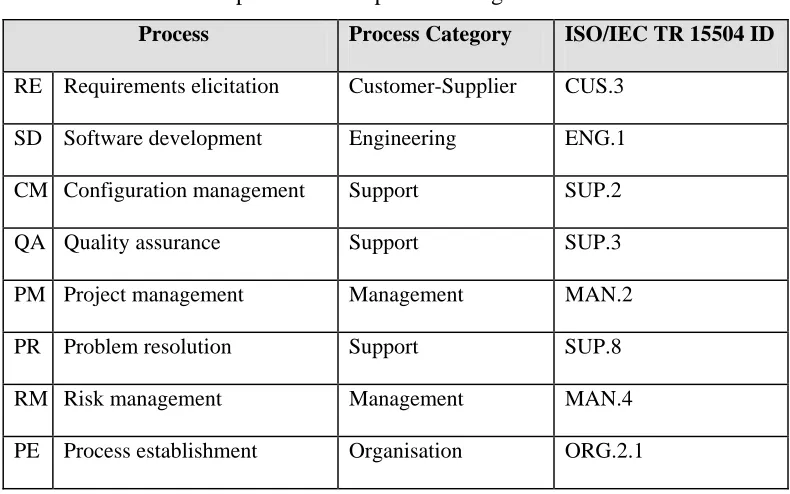
resolution, project management, risk management, and process establishment. As shown in table 1, all five process categories of ISO/IEC TR 15504 are represented.
Table 1 RAPID processes and process categories
Process Process Category ISO/IEC TR 15504 ID
RE Requirements elicitation Customer-Supplier CUS.3
SD Software development Engineering ENG.1
CM Configuration management Support SUP.2
QA Quality assurance Support SUP.3
PM Project management Management MAN.2
PR Problem resolution Support SUP.8
RM Risk management Management MAN.4
PE Process establishment Organisation ORG.2.1
The process capability dimension of the model was also constrained to meet the limitation of one-day assessments. Although SPICE provides for capability levels from zero (incomplete) to five (optimising), only questions relating to levels one to three were included in the RAPID assessment model, enabling rating levels of level 0 (incomplete), level 1 (performed), level 2 (managed) and level 3 (established). The RAPID method collects evidence only by interview, but participants may illustrate issues under discussion by reference to documents.
assessment plan, assessment instrument, assessment report, feedback form, follow-up meeting and final report.
2.2 RAPID assessment procedure
The team leader and support assessor conducted on-site interviews at each firm with key people involved in managing the software development effort of the organisation. For each of the eight processes examined, the assessors followed the script of the assessment instrument to determine the extent to which the process attributes have been achieved using a four point scale: not achieved; partially achieved; largely achieved; and fully achieved. The capability level (0, 1, 2 or 3) for each of the eight processes was then determined, based on the organisation’s achievement of the process attributes.
For each firm, an assessment report was compiled including strengths, weaknesses, process attribute ratings and capability levels, and recommendations for improvement to the organisation. A follow-up meeting was held 7-16 months after the assessment. For nine of the firms, the follow-up meeting included a formal reassessment; the other follow-up meetings were less formal. After the follow-up meeting, a final report was compiled detailing the extent to which the recommendations had been implemented.
3. SPI program outcomes
Software engineering researchers are urged to use quantitative analysis focusing on statistical analysis of numerical data, as well as qualitative analysis focusing on textual and numerical data [7]. In analysing the outcomes of the SPI program,
questionnaire and assessment ratings, while qualitative analysis was conducted on the textual content of the assessment and final reports. The use of qualitative techniques with software process research is recommended [7, 8] to provide opportunities for triangulation and synergy.
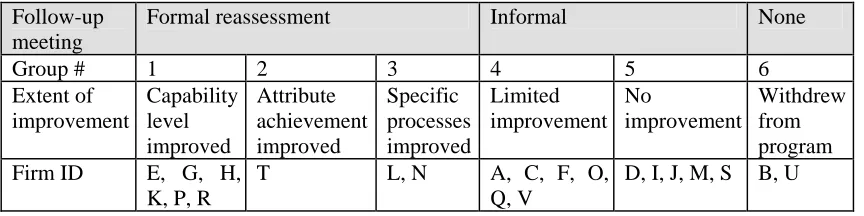
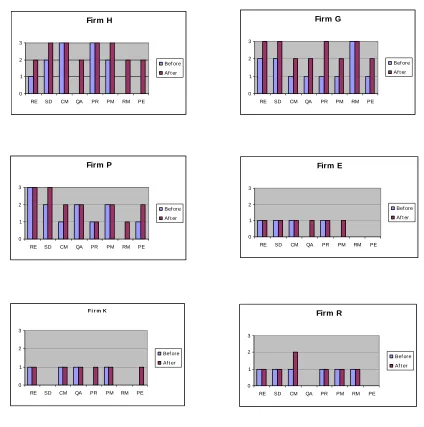
As summarised in table 2, nine firms were formally reassessed, and six of these had improved their process capability levels, the other three exhibited
[image:6.595.84.516.423.531.2]improvements, but not enough to gain a higher capability level rating. A further 11 firms participated in the follow-up meetings, but were not formally reassessed. Of this group (informally reassessed), six firms reported that they had implemented some of the recommendations; and five firms did not report any improvement, but provided reasons why the recommendations had not been actioned. A detailed account of the experiences of these firms was reported previously in [9].
Table 2 Extent of improvement by firms grouped by outcome Follow-up
meeting
Formal reassessment Informal None
Group # 1 2 3 4 5 6
Extent of improvement Capability level improved Attribute achievement improved Specific processes improved Limited improvement No improvement Withdrew from program Firm ID E, G, H,
K, P, R
T L, N A, C, F, O,
Q, V
D, I, J, M, S B, U
Figure 1 Process capability levels at initial assessment and follow-up meeting for group 1 firms
Firm H
0 1 2 3
RE SD CM QA PR PM RM PE
Bef ore Af t er
Firm G
0 1 2 3
RE SD CM QA PR PM RM PE
Bef ore Af t er
Firm E
0 1 2 3
RE SD CM QA PR PM RM PE
Bef ore Af t er
Firm P
0 1 2 3
RE SD CM QA PR PM RM PE
Bef ore Af t er
F i r m K
0 1 2 3
RE SD CM QA PR PM RM PE
Bef ore Af t er
Firm R
0 1 2 3
RE SD CM QA PR PM RM PE
Bef ore Af t er
4. Evaluation and discussion
The qualitative analysis of the assessment and final reports identified many issues related to SPI for small firms. In this section, insights gained specifically related to the firms participating in the study are explored (§4.1), followed by a discussion of the issues relating to the plan and execution of the SPI program (§4.2).
4.1 Issues specifically related to these firms
Detailed qualitative analysis of the 22 assessment reports and 20 final reports
prompted further investigation of specific issues related to the 22 firms. This section discusses the elapsed time from the assessment to follow-up meeting, the need for mentoring, the readiness of firms for SPI, the role of firm owner/manager, and finally the advice provided by the assessors.
Elapsed time from assessment to follow-up. In formulating the SPI program, it was envisaged that the follow-up meetings would be conducted 6 months after the initial assessment to evaluate the effectiveness of the program. When the firms were contacted by the assessors for the follow-up meeting, many wished to defer the meeting due to current workloads. In fact, the time period from the initial assessment to the follow-up meeting ranged from 7 to 16 months, with a mean of 12 months and standard deviation of 2.4 months.
extent of adoption of the recommendations. To evaluate the relationship between the type of follow-up meeting and the time period from the initial assessment to the follow-up meeting, an analysis of variance was performed. Firms which were formally reassessed held their follow-up meetings after a shorter time period than firms not formally reassessed (p=.026). The extent of elapsed time could have been influenced by how promptly the assigned assessor contacted the firm to arrange the follow-up meeting, but in many cases, firms deferred the follow-up meetings, citing work commitments and pressing deadlines.
To further explore the relationship of time period and program outcome, Spearman rank correlation tests were performed for the process capability levels of the nine formally reassessed firms. The statistical analysis indicates that longer time periods (from assessment to follow-up) are associated with lower process improvement for two of the processes: quality assurance (rs=-.608, p=.042) and project management (rs=-.644, p=.031).
The finding that a shorter follow-up period was more effective in this program is in contrast to the conclusion reached by Varkoi [10] in Finland. After analysing results from a SPICE-based SPI program involving 20 small firms in Finland, Varkoi [10] decided to extend the time-frame from 6 months for the pilot phase to 12 months for the harvesting phase, although the participants in the study considered two years to be the optimal length for an improvement program.
and that it is better to adopt a narrow focus of improvement actions. The problem with a 6 month time-frame is that many firms (such as C, G, N, T) had designed new processes, but had not yet used them at the time of the follow-up meeting. This confirms the view of Paulk et al. [12] and Krasner [13]: it can take two years for process changes to demonstrate results.
It appears that more research is needed to investigate the optimal time period from assessment to reassessment. Although planning needs to encourage achievement of short term goals, many rewards are not evident until a much longer time-frame.
Mentoring. Small firms need external assistance in planning and implementation of
the improvements as they have scarce resources and limited possibilities to keep up-to-date with the state-of-the-art research and practice [10, 14]. On-going mentoring was not provided to firms although three firms mentioned that lack of mentoring inhibited their SPI progress (firms F, G, M).
half of these successful organisations have a ‘formal mentoring program to impart skills and knowledge’ [17].
The analysis of the process improvement program reported here supports the view put forth by Thong, Yap and Raman [18]: for small businesses operating in an
environment of resource poverty, high quality external expertise is even more critical than top management support.
Readiness for SPI. After analysing reports which indicate that the vast majority of
organisations in the US and UK are at the initial level of maturity, Smith et al. [19] assert that it is clear that only a handful of companies are ready for SPI ‘because their software health is so bad (that is if they have any development process at all)’ [19]. They go on to warn that in order to be ready for SPI, a visible and defined software process must already be in place. The opinion that low maturity organisations find it much more difficult to change and implement SPI is shared by Diaz and Sligo [20] based on these reasons: low maturity firms do not collect metrics; they focus on defining core processes, not on improvement; and it takes a lot of effort to get started to overcome scepticism and to be sure of management support and long term
commitment. Other researchers also believe it is pointless to try to implement high maturity processes into low maturity projects [21, 22]. Recently, Rainer and Hall [23] determined that factors impacting on SPI adoption varied for low maturity and high maturity organisations.
seven of the eight processes. In this discussion, these five firms are classed as high capability and the remaining 17 firms are referred to as low capability firms. As shown in table 2, two of the high capability firms (G, P) are included in Group 1, having achieved sufficient improvement to increase the capability level of some of the eight processes. Two of the other highly rated firms (D, F) experienced seriously disruptive events which they reported prevented them from implementing the recommendations from the assessment. The remaining high level firm, firm S
expressed the opinion that the RAPID assessment was too brief to be of any value.
However, some of the firms with low initial capability were also successful in the program. The gains achieved by the four low capability firms (E, H, K, R) in Group 1 were certainly more modest than those of the higher capability group, but still a notable achievement. Furthermore, seven low capability firms (A, C, N, O, Q, T, and V) reported that they had successfully implemented some of the recommendations, citing improvements in terms of defining their methodologies, developing templates, recording problem reports, and formalising testing procedures.
Therefore, this research indicates that low-rigour SPICE-based assessments are effective for small firms with poorly defined processes.
Role of firm owner/manager. An interesting aspect of the SPI program was the high
classified as full-time operators [24]. However, the program outcomes in this study did not vary significantly depending on whether the managing director was present or not.
Lack of senior management commitment is recognised by Debou and Kuntzmann-Combelles [25], Abrahamsson [26], El Emam et al. [27], and Wilson, Hall and
Baddoo [28] as a major bottleneck to the success of SPI initiatives, but for most small firms, the business operator is often involved in all aspects of the business and would therefore instigate the SPI and participate heavily in it.
Advice provided by assessors. Nine assessors were involved in the SPI program and
all had completed the SPICE certification training course, ensuring the consistency of capability levels ratings. However, the various assessors provided a valuable and diverse range of advice to the firms, drawing on their personal knowledge and expertise. The specific advice provided most frequently was MS Project (8
instances), Visual Source Safe for configuration management (7 instances), and the Project Management Body of Knowledge (PMBOK) (5 instances).
4.2 Meta analysis of SPI program: lessons learnt
In this section, issues relating to the RAPID method are raised, and improvements to the procedures are suggested. In the conclusion section, specific recommendations are made to practitioners and consultants.
process improvement program, commenting that it was an effective introduction to SPI; that it provided an accurate review of the current status of development
processes; and that it motivated them to improve their planning and documentation. Many expressed regret that they were unable to put more resources into implementing the recommendations, but the timing of the program clashed with two urgent
deadlines: the modifications for year 2000, and the introduction of the Australian Government’s Goods and Services Tax legislation.
Negative comments were made by only one firm (S). With 60 full-time staff, 2 part-time and 8 contractors, Firm S was the largest included in the program, and felt that the one-day assessment was too brief to be of any real value.
Role of assessor. It was intended that the follow-up assessments be conducted by one of the assessors who performed the initial assessment, but due to limited SQI staff availability, this was not always possible. In three of the Group 5 firms, the follow-up assessor was not one of the initial assessors. If one of the initial assessors had
Research has shown that ‘small firms are averse to consultants and reluctant to seek external help’ [29]. This was confirmed by Hall, Rainer and Baddoo [21] who found that companies did not highly value the input of external consultants. Therefore, the assessors, as external consultants, need to develop a relationship with the developers in small firms. One of the lessons learnt in the SataSPIN project [10] was the need for continuous contact, as well as contacting the firms at least once per month. Varkoi [10] recommended that assessors also make contact with more than one person at each firm.
Cost benefit analysis. Only one of the follow-up meetings recorded an estimate of the investment made by the firm. Firm O reported that the program consumed 155 hours of staff time and included the purchase of Visio software. Most of the firms did not know the extent of resources involved because they did not have a measurement process in place. Low maturity firms typically do not have metrics for effort or defects. Each firm invested time in preparation and involvement in the RAPID assessment and follow-up meetings. At each firm, senior members of the
development teams worked with the sponsor to review the recommendations and formulate action plans. The effort of each firm in implementing the actions varied. Some firms released staff to attend training courses or to evaluate software
development tools; others incurred costs to purchase and implement tools.
one company was the competitive advantage provided by quoting the capability ratings in promotional material.
The program could be improved by including a procedure for the follow-up meeting in the RAPID method. Although a template for the final report was included, limited guidance was provided to the follow-up assessors. It is also recommended that firms are requested to keep a record of SPI effort, costs and benefits. Such a record could be summarised in the final report, and published as success stories of SPI for small firms. These accounts of SPI success would encourage other small firms to embark upon process improvement. Managers are loath to adopt standards without
information about trade-offs between increase in quality and cost of achieving that quality [30].
5. Conclusion and recommendations
From the analysis of the current literature and also the assessment and final reports, the following recommendations are made to assist small firms undertaking SPI, and also assessors involved in such projects:
• Before commencing SPI, ensure the organisation is stable and not undergoing major disruptions from internal or external events.
• Firms should draw on expertise of external assessors/consultants as mentors.
• The SPI action plan, derived from the assessment recommendations, should be realistically achievable within the evaluation time-scale.
• Plan the evaluation from the start of the SPI program. This will be a source of motivation.
Recommendations to assessors
The evaluation of the SPI program highlighted areas of improvement and the following recommendations are made to improve assessments:
• Provide detailed information to the sponsor about the method and model prior to the assessment.
• Assessors should meet the sponsor prior to the assessment, not just plan by phone/email. Need to nurture a relationship of confidence and trust.
• Ensure that the follow-up assessor is one of the initial assessors.
• Include a template for sponsors to record all costs and benefits from the time of the initial assessment to the follow-up assessment.
• Provide documented guidance to the follow-up assessors for the procedure for the follow-up meetings.
• Devise a feedback form for the sponsor to complete at the time of the follow-up meeting.
• During the time period from the initial assessment to the follow-up assessment, encourage the assessor to contact the sponsor at least on a monthly basis to provide ongoing support and develop trust.
This research answers the call to reduce the scepticism and uncertainty which exists in relation to the accuracy and usefulness of software process assessments and the
References
[1] S. Dutta, M. Lee, and L. Van Wassenhove, "Software engineering in Europe: a study of best practices," IEEE Software, vol. 16, pp. 82-90, 1999.
[2] N. Fenton, S. L. Pfleeger, and R. L. Glass, "Science and substance: a challenge to software engineers," IEEE Software, vol. 11, pp. 86-95, 1994.
[3] M. Wood, J. Daly, J. Miller, and M. Roper, "Multi-method research: an
investigation of object-oriented technology," Journal of Systems and Software, vol. 48, pp. 13-26, 1999.
[4] E. Mustonen-Ollila and K. Lyytinen, "Why organisations adopt information system process innovations: a longitudinal study using Diffusion of Innovation theory," Information Systems Journal, vol. 13, pp. 275-297, 2003.
[5] T. P. Rout, A. Tuffley, B. Cahill, and B. Hodgen, "The rapid assessment of software process capability," presented at SPICE 2000 - 1st International Conference on Software Process Improvement and Capability dEtermination, Limerick,2000.
[6] ISO/IEC TR 15504, "Information Technology -Software process assessment, Parts 1-9," ISO/IEC TR 15504:1998(E), 1998.
[7] W. Scacchi, "Qualitative techniques and tools for measuring, analyzing, and simulating software processes," in Experimental Software Engineering Issues: critical assessment and future directions, LNCS 706, H. D. Rombach, V. Basili, and R. W. Selby, Eds., Proceedings International Workshop 1992, Dagstuhl Castle, Germany ed: Springer-Verlag, 1993, pp. 27-29.
improvement," in Proceedings of 6th European Conference on Information Systems (ECIS), Baets, Ed. Aix-en-Provence, France, 1998, pp. 451-466. [9] A. P. Cater-Steel, M. A. Toleman, and T. P. Rout, "After the assessment: actions and reactions of 22 small Australian firms," in Proceedings of 4th International SPICE Conference on Process Assessment and Improvement. Lisbon, Portugal, 2004, pp. 54-63.
[10] T. Varkoi, "SataSPIN- a network for software companies to improve
processes," presented at Software and Systems Standards for the Real World Seminar, Brisbane,2004.
[11] V. R. Basili, "The role of experimentation in software engineering: past, current, and future," in Proceedings of the 18th International Conference on Software Engineering: IEEE Computer Society Press, 1996, pp. 442-449. [12] M. C. Paulk, C. Weber, B. Curtis, and M. B. Chrissis, "Capability Maturity
Model: Guidelines for Improving the Software Process." Reading, MA: Addison-Wesley, 1995.
[13] H. Krasner, "Accumulating the Body of Evidence for the Payoff of Software Process Improvement - 1997", 1997, accessed 14 Mar,
http://www.utexas.edu/coe/sqi/archive/krasner/spi.pdf
[14] K. Kautz, "Even in very small software enterprises metrics can make sense!," presented at SPI'98 The European Conference on Software Process
Improvement: Improvement in Practice: Reviewing Experience, Previewing Future Trends, Monte Carlo,1998.
[16] J. Herbsleb and D. R. Goldenson, "A systematic survey of CMM experience and results," in Proceedings of the 18th International Conference on Software Engineering. Berlin: IEEE Computer Society Press, 1996, pp. 323-330. [17] M. C. Paulk, D. R. Goldenson, and D. M. White, "The 1999 Survey of High
Maturity Organizations," Software Engineering Institute, Carnegie Mellon University, Pittsburgh CMU/SEI-2000-SR-002, Feb, 2000.
[18] J. Y. L. Thong, C.-S. Yap, and K. S. Raman, "Top management support, external expertise and information systems implementation in small business," ISR, vol. 7, pp. 248-267, 1996.
[19] W. L. Smith, R. I. Fletcher, E. M. Gray, and R. B. Hunter, "Software process improvement: the route to software quality?," in Software Quality
Management II Vol 1: Managing Quality Systems, M. Ross, C. A. Brebbia, G. Staples, and J. Stapleton, Eds. Southampton Boston: Computational
Mechanics Publications, 1994, pp. 193-211.
[20] M. Diaz and J. Sligo, "How software process improvement helped Motorola," IEEE Software, vol. 14, pp. 75-81, 1997.
[21] T. Hall, A. Rainer, and N. Baddoo, "Implementing software process improvement: an empirical study," Software Process Improvement and Practice, vol. 7, pp. 3-15, 2002.
[22] T. Kaltio and A. Kinnula, "Deploying the defined SW process," Software Process Improvement and Practice, vol. 5, pp. 65-83, 2000.
[23] A. Rainer and T. Hall, "Key success factors for implementing software
[24] ABS, "8127.0 Characteristics of Small Business", Australian Government, 2004, accessed 8 Sept,
http://www.abs.gov.au/ausstats/[email protected]/0/E49E3B4DC3595C92CA2568A90
0139377?Open
[25] C. Debou and A. Kuntzmann-Combelles, "Linking software process improvement to business strategies: experiences from industry," Software Process: Improvement and Practice, vol. 5, pp. 55-65, 2000.
[26] P. Abrahamsson, "Rethinking the concept of commitment in software process improvement," Scandinavian Journal of Information Systems, vol. 13, pp. 69-98, 2001.
[27] K. El Emam, D. R. Goldenson, J. McCurley, and J. Herbsleb, "Success or Failure? Modeling the Likelihood of Software Process Improvement," International Software Engineering Research Network (ISERN) ISERN-98-15, 1998.
[28] D. N. Wilson, T. Hall, and N. Baddoo, "A framework for evaluation and prediction of software process improvement success," The Journal of Systems and Software, vol. 59, pp. 135-142, 2001.
[29] P. B. Cragg, "Benchmarking information technology practices in small firms," European Journal of Information Systems, vol. 11, pp. 267-282, 2002.
[30] S. L. Pfleeger, N. Fenton, and S. Page, "Evaluating software engineering standards," IEEE Computer, vol. 27, pp. 71-79, 1994.