Complete Citation: Hingst, Raymond D. (2006). Tuckman’s theory of group
development in a call centre context: does it still work? In 5th Global Conference on Business & Economics - Proceedings, Global Conference on Business & Economics. ( 5th Global Conference on Business & Economics, 6-8 July 2006, Cambridge, UK. )
Accessed from USQ ePrints http://eprints.usq.edu.au
Tuckman’s theory of group development in a call centre
context: does it still work?
Ray Hingst, University of Southern Queensland, Toowoomba, Australia.
ABSTRACT
Tuckman’s four stage model has endured as the most widely accepted explanation of group development since its inception in 1965. Largely by virtue of the appeal of the rhyming phases: forming, storming, norming and performing; but also because the model has held an intuitive appeal to those who have experienced group dynamics as a process of evolution from formation to termination. Based on a review of research into group development over a near twenty year period, Tuckman’s model had a firm foundation in published evidence. The model was subject to revision in 1977, with Mary-Ann Jensen, when a fifth, adjourning stage, was added. The most obvious impacts of the addition of the extra stage were the more explicit alignment of the model with the concept of finite group duration; and further exposition of the model’s limited ability to effectively encompass changes in group membership.
Those few researchers who have pursued the challenge to develop group theory which adequately addresses temporal change to membership have invariably noted the paucity of research in the field. Unfortunately, this has also led to the construction of complex models, usually derived from laboratory research, which retain neither the simplicity of Tuckman’s original, nor show evidence of being tested within the wider scope of working life within organisations.
This paper presents findings which indicate that Tuckman’s model remains relevant to the development of groups within call centres, particularly during the period of initial training of newly selected employees and subsequently, with minor modification through the inclusion of an additional temporary ‘phase’, to describe conditions imposed on groups by transience of group membership within the operational arena on the ‘floor’ of a call centre.
INTRODUCTION
Tuckman’s iconic four stage model has endured as one of the most widely cited and broadly accepted explanations of group development since its inception in 1965. (Welbourne 2001; Tindale et al. 1998; Schermerhorn 2002; Samson and Daft 2003; Robbins et al. 2001; Robbins et al. 2000; Napier and Gershenfeld 1999; Mallott 2001, 2001; Keeling 2000; Odgers and Keeling 2000; Hare 1992; Forsyth 1990; Dwyer 2002; Chimaera Consulting 2001; Bounds, Dobbins, and Fowler 1995) Its success can be largely attributed to the resonance of the easily recognised phases: forming, storming, norming and performing, but also because the model held an intuitive appeal to those who had experienced group dynamics as a process of evolution from formation to completion. Tuckman’s model had a firm foundation in published evidence, based as it was on a review of research into group development over an almost twenty year period. (Tuckman 1965)
developmental stages and the lack of specificity of the ‘determinants of the rate of movement through these stages.’ (Levine and Moreland 1998, 447)
Those few researchers who have pursued the challenge to develop group theory adequately addressing temporal change to membership have invariably noted the paucity of research in the field. (Arrow and McGrath 1993) Unfortunately, this has also led to the construction of complex models, usually derived from laboratory research often of the behaviour of undergraduate psychology students, which retain neither the simplistic appeal of Tuckman’s original, nor show evidence of being tested within the wider scope of working life within organisations. This is perhaps because research of this nature within organisations is more problematic, in terms of gaining access to suitable subjects and the difficulty identifying suitable surroundings in the first instance, than studies conducted on compliant students under readily controlled laboratory conditions. (Arrow and McGrath 1993; Arrow 1997; Levine and Moreland 1991; Levine and Moreland 1998; Moreland 1985)
This article attempts to address both the level of sophistry, and the lack of field based derivation, by suggesting modification of Tuckman’s four stage model as a result of research conducted in an organisation subject to constant transience of group membership specifically, an Australian, 180 seat, quasi-government, inbound telephone call centre (CC).
The results of qualitative research during which data was primarily gathered from the extended interview of participants occupying management, leadership and operator levels within the CC will presented. An overview of the research methodology employed to generate data will be provided so that the major findings of the article can be reviewed. Finally, an additional step to supplement Tuckman’s four stage model of group development will be described and justified so that conclusions from the research can be drawn.
REVIEW OF THE PROBLEM
Organisations ‘implement’ groups to achieve productive outcomes beyond the scope of individuals working in isolation from each other. (Eunson 2005; Bounds, Dobbins, and Fowler 1995; Dwyer 2005; Robbins et al. 2000; Robbins et al. 2001) Groups take time to develop into teams and require an investment by the organisation and members concerned in sponsorship and support to progress from a collection of people coming together for the first time to a interdependent, cohesive and functioning unit. (Robbins et al. 2001; Welbourne 2001; Napier and Gershenfeld 1999) Any action or event which jeopardizes the fulfillment of this process of development has the net result of reducing the effectiveness of the capability of the organisation to achieve its objectives. Such an impact can have its genesis in the manner in which the work to be performed is carried out, or the disruption might occur as a consequence of disturbance to relationships within the group. One such possible influence, of acute concern to this research, is when a new member, or small number of new members relative to the size of the existing group, seeks to join an established team. Moreland and Levine posit that, in these circumstances:
The entry of a newcomer into the group can threaten this development by forcing members to alter their relationship with one another… This threat is presumably greater in more established groups, which may respond to newcomers by demanding a great deal of assimilation and permitting very little accommodation. Socialization should thus be easier in groups that are poorly developed. (Paulus 1989, 156-7)
revert, albeit temporarily, to the preceding stage of development in the sequence. The primary focus for study of the impact of new members on Tuckman’s sequential model of group development should then be the performing stage as this is where the greatest potential exists for a reduction in group cohesiveness and effectiveness in terms of interpersonal relationships and task performance.
SUMMARY DESCRIPTION OF RESEARCH PROCEDURES
A combination of qualitative and basic quantitative research techniques were employed for the collection and analysis of data. The process commenced with a survey questionnaire to obtain in-house data relating to the population of the CC. Some basic statistical analysis of the quantitative data was performed to establish the demographic profile of the sample. The additional purpose of the questionnaire was to identify, by virtue of their experience with group membership within the centre, potential candidates for in depth interview in the second stage of the research plan. The final research methodology employed was the focus group which enabled researcher interaction with the group to ensure that the initial perceptions formed from preliminary analysis of interview data were ‘on target’ and to offer the opportunity for extended discussion of key themes which had emerged from the data to this point.
MAJOR FINDINGS
The CC provides a ‘team’ based structured work environment characterised by high levels of staff mobility between ‘teams’, (transient group membership), facilitated in large part, through task competence of all Customer Service Officers (CSOs) achieved by thorough orientation training provided to all newly selected employees. In conjunction with the effect of the organisation’s code of behaviour, this job preparation creates a culture within ‘teams’ accepting of new members and resigned to the loss or replacement of existing members, as a natural feature of the Call Centre (CC) landscape. As an exception to the claims by Moreland and Levine earlier, even though established groups are frequently subject to the arrival of ‘newcomers’, they behave more like ‘poorly developed’ groups requiring little ‘assimilation’ before the new member is ‘accommodated’ within the membership of the ‘team’, with consequent limited, measurable reduction in the productive output of the ‘team’. Moreland and Levine offer their own potential explanation for this apparent contradiction.
If a newcomer is similar to someone who has entered the group in the past, especially someone who completed the socialization process successfully, then the group will be relatively open to him or her… Knowledge about a newcomer acquired through prior experience with similar persons should thus make his or her socialization easier… prior experience with similar persons may allow the group to develop more effective socialization tactics that it can use later with the newcomer. (Paulus 1989, 159)
So rather than behaving like a poorly developed team, staff at the CC have not only become accustomed to the phenomenon of transient group membership, they have become more practiced at the skills required to quickly establish and sustain the arrival of new ‘team’ members, effectively reducing opportunities for diminished task performance, and the consequent loss of overall productivity by the centre.
Confirmation of Tuckman’s sequential model of development in groups subject to stable membership for the duration of their life, was provided by the experience of the CC staff who had completed their initial induction training under the guidance and direction of a trainer, with the same cohort of colleagues. The adjourning stage of development was also found to be relevant under these conditions. Group members gained their first insight into the strength of the interpersonal relationships shaped in the training environment, when confronted with reassignment to functional teams on the floor of the centre, an appreciation which they would have cause to reflect upon as they progressed on their career path as members of a number of different ‘teams’ during their employment.
EXTENSION OF TUCKMAN’S 1965 MODEL OF GROUP DEVELOPMENT
account for changes to group membership, a situation not deliberately countenanced by either the four stage or later, five stage models of group development.
Having accepted the basic validity of Tuckman’s 1965 model in describing adequately situations where group membership remains stable, it now proposed that the model of sequential group development can be supplemented to include the additional, temporary ‘phase’ of conforming which occurs as a developmental sub-stage in groups when a new member or members seek entry into an existing group.
The first three stages of group development are claimed to have some potential to accommodate the arrival of new members within an existing group. The fourth, performing stage of group development is that which is attained by a group which has a continuing existence beyond changes to its membership. The transition from ‘outsider’ to group member is characterised by a period of learning about the existing interpersonal relationships between other group members and acquiring an understanding of group culture, norms and tasks. During this process, it is argued that, rather than each member of the group reorienting themselves to each other and seeking to establish closer alignment with group leaders and testing the group’s task standards, the remaining members of the group focus their attention, in terms of group dynamics, on the new member/s, forming perceptions about the individual/s, gaining knowledge about their task competence, and assessing how the interpersonal relationships of the group will be affected by the inclusion of the new members. In the CC environment investigated during this research, the influence of Tuckman’s storming stage was effectively muted by the influence of the organisation’s code of behaviour however; it seems unlikely that the existing structure of interpersonal relationships would be cast into doubt, in the absence of such a behavioural code, upon the integration of a new member into a group. The potential for this kind of disturbance to group relationships, with a concomitant effect on its task performance, is however acknowledged, particularly in the rare event, (in a CC at least due to the deliberate elimination of such personality types during the selection process), where a dominant character exerts a strong, disruptive influence on interpersonal relationships or task performance when joining a group. Similarly, it is unlikely that, again due to the structured CC environment, a new member or members joining an existing group would be able to significantly challenge task performance standards or the established norms of work ‘team’ behaviour. Rather it is far more likely that the new member will progress through a process of familiarisation with accepted group practice with the potential, once their credibility as worthwhile contributor has been verified by the group, to influence the group agenda in much the same manner as existing group members were able to at the time the new member joined. Tuckman and Jensen foresaw differences between groups with stable membership from the time of their formation to the adjournment of the group and those experiencing transient membership. (Tuckman and Jensen 1977) The following addition to Tuckman’s 1965 model is proposed to address these differences.
For the purpose of contextual specification, it is assumed that the target group has previously progressed through Tuckman’s developmental stages of forming, storming and norming and has reached the stage of performing where, coincidently, it has become a team. For the purposes of this variation to Tuckman’s model, if a new member joins an existing group prior to it having culminated its development at the performing stage, then it is believed that this change to the group membership will be accommodated within the particular stage of evolution that the group has reached or by temporary regression to the preceding stage of development. Consequently, the first three stages in Tuckman’s sequence of group development are considered to be robust enough to encompass change to membership by reverting to a former stage until the issues presented are resolved. The arrival of the new member in a group, it is further assumed, would be preceded by some form of announcement by the wider organisation, to the existing members of the group of the imminent inclusion of a new member.
In terms of the proposed variation to the model, it is envisaged that when a new member or members join an existing team, the group will take a slightly retrograde, sideways step from the performing stage, but not to the extent where it reverts to the norming stage for which Tuckman provides the following description:
In an organisational environment where transient group membership is widely accepted, there is usually little resistance to the inclusion of new members by the group, in fact the new member often makes a most welcome contribution to the output of the group. The feeling of ‘ingroup’ cohesiveness is retained by existing members in a bond of solidarity with each other, tempered by the limited strength of prevailing relationships, to such an extent that the newly acquired member feels compelled to accept, rather than influence, the groups culture and identity. The new member may feel constrained by restricted opportunities to offer ‘intimate, personal opinions’ on task related matters as they feel that these should be better kept to themselves, until they are more freely engaged by the group, for fear of covert or overt rejection by their peers. In most cases, unless a prominent reputation preceded them into the group, a newly trained member is typically regarded as a neophyte, capable of performing the job required of them but with much to learn about the depth and subtlety involved with the work.
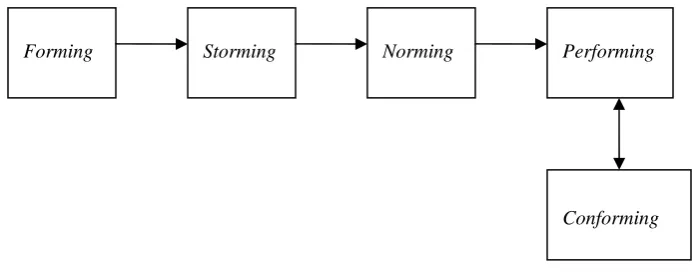
[image:5.595.104.453.440.577.2]The group then finds itself in the newly mooted conforming phase of development. This phase is characterised by a greater degree of uncertainty within the interpersonal realm than within the task realm, as the group already harbours expectations about the level of task competence of the new member. In the relationship realm however, the personal and character attributes of the new member are subject to scrutiny by the established members of the group, rather than each group member re-evaluating their relationship with each of their existing colleagues. Conversely, the new member experiences a period of uncertainty about the nature of the group and its members’ personalities, during which they attempt to both learn about the prevailing group relationships and the group’s established modus operandi. Accepted mechanisms, within an organisation, which can help new members to progress through the conforming phase, are particularly useful tools for leaders to employ in the assimilation of the new member into teams. Within the subject CC, a code of behaviour assists with this aspect of group development by prescribing accommodating behaviours to be observed by all participants in the process. At the conclusion of the conforming phase, the group returns to the familiar performing stage of Tuckman’s model. Figure 1 illustrates the relationship between the existing four stage model of group development proposed by Tuckman in 1965 and the additional conforming phase.
Figure 1 Proposed revision of Tuckman’s four stage model of group development to include an additional, conforming phase.
Forming Storming Norming Performing
Conforming
Although based on the experience of workers in a CC environment, the conforming phase is thought to have wider implications for organisations which experience the condition of transient, rather than static, group membership. Further investigation into the application of this addition to Tuckman’s model of group development in a range of organisational contexts is warranted. Some examination of the impact on groups of the departure of members has been conducted (Rose 1989; Keyton 1993), this research was unable to add evidence from the experience of CC workers with this relatively common occurrence beyond anecdotal contributions to the data.
CONCLUSION
This paper set out to establish how adequately Tuckman’s sequential model of group development described conditions experienced in an organisation where transience of group membership was an anticipated feature of working life. It was discovered that, in situations where groups experience stable membership and identifiable leadership and a finite life, for instance in an induction training team within a CC environment, that ample evidence exists to prove the merits of the 1965 four stage model and its subsequent five stage variant.
It was also found that, in circumstances where groups are exposed to transient membership, weaker interpersonal relationship bonds develop between members, thus in part, facilitating the new member joining an existing group. An accepted and widely recognized organisational code of behaviour can play a significant role in enabling the transition of members between groups.
Significantly, when new members seek to join an existing group, a period of mutual investigation commences during which the attention of the group is focused on the new arrival and the new member attempts to acquire as much information about group culture and the other members of the group as they can within the shortest possible time. There was no evidence gathered within the CC environment to suggest that existing group members are forced to re-examine the extant interpersonal relationships as a consequence of a new arrival in the group thus paving the way for the addition of the conforming phase to Tuckman’s model.
Recommendations for further research
This research was conducted within a CC context with the environmental constraints and conditions which make this type of organisation distinct from more traditional white collar work places. The extent to which the conforming phase of group development is a product of a rigorously monitored, Taylorist construct needs to be tested in a broader range of group-based organisations subject to regular, if not necessarily frequent, changes of membership to ensure its validity as a worthwhile addition to Tuckman’s iconic model.
Although this research recognised at the outset that transience of group membership included departures from a group, the data collected was inconclusive regarding the true impact that this might have on a group’s performance. Further research therefore needs to be conducted into the stage of group development experienced when a member leaves a group with or without replacement by another member.
Data collection on which this research is based was conducted during a relatively brief period from November 2002 until February 2003. A longitudinal study of the application of the conforming phase to a CC environment would provide confirmation of the validity of the proposed variation to Tuckman’s model.
Finally, although it was accepted that for the purposes of this paper the distinction between the terms ‘group’ and ‘team’ were of little material consequence, it could be profitable to investigate this question more thoroughly within a CC context, being dependant as they are on ‘team’ based structures.
REFERENCES
Arrow, Holly. 1997. Stability, bistability, and instability in small group influence patterns. Journal of Personality and Social Psychology 72 (1):75-85.
Arrow, Holly, and Joseph E. McGrath. 1993. Membership matters. Small Group Research 24 (3):334.
Bounds, G. M., G. H. Dobbins, and O. S. Fowler. 1995. Management A Total Quality Perspective. Cincinnati: South-Western College Publishing.
Chimaera Consulting. 2002. Famous Models (Stages of Group Development) [Internet Web-site]. Chimaera Consulting Limited 2001 [cited 29/11/02 2002]. Available from http://www.chimaeraconsulting.com/tuckman.htm.
Dwyer, Judith. 2002. Communication in Business. 2nd Edition ed. Sydney: Pearson Education Australia Pty Ltd. ———. 2005. Communication in Business. 3rd ed. Sydney: Pearson Education Australia.
Eunson, Baden. 2005. Communicating in the 21st Century. Brisbane: John Wiley & Sons Australia Ltd. Forsyth, Donelson R. 1990. Group dynamics. 2nd ed. Belmont, California: Brooks/Cole Publishing Company. Hare, A. Paul. 1992. Groups, teams, and social interaction : theories and applications. New York: Praeger Publishers.
Keeling, Pattie Odgers & Lewis B. 2000. Administrative Office Management. Cincinnati: South-Western Educational Publishing. Keyton, Joann. 1993. Group termination: completing the study of group development. Small Group Research 24 (1):84-100. Levine, J.M., and R.L. Moreland. 1998. Small groups. In The handbook of social psychology, edited by D. T. Gilbert and S. T.
Levine, John M., and Richard L. Moreland. 1991. Culture and socialization in work groups. In Perspectives on socially shared cognition, edited by L. B. Resnick and J. M. Levine. Washington DC: American Psychological Association. Mallott, Mary. 2002. Computer Skills for Administrators [Internet Web-site]. University of Hawaii, West O'ahu 2001 [cited 6
December 2002]. Available from http://socrates.uhwo.hawaii.edu/BusAd/Flower/330/tuckman/sld014.htm. ———. 2002. Tuckman's Group Development Model, [Internet]. University of Hawai'i, West O'ahu,, 25 September 2001 [cited
10 October 2002]. Available from http://uhtv.hawaii.edu:7070/vamgen/courses/flower/mallott.smil.
Moreland, R.L. 1985. Social categorization and the assimilation of "new" group members. Journal of Personality and Social Psychology 48 (5):1173-1190.
Napier, Rodney W., and Matti K. Gershenfeld. 1999. Groups : theory and experience. sixth ed. Boston: Houghton Mifflin Company.
Odgers, Pattie, and Lewis B. Keeling. 2000. Administrative Office Management. Cincinnati: South-Western Educational Publishing.
Paulus, Paul B., ed. 1989. Psychology of group influence. 2nd ed. Hillsdale, New Jersey: Lawrence Erlbaum Associates, Inc., Publishers.
Robbins, Stephen P., Rolf Bergman, Ian Stagg, and Mary Coulter. 2000. Management. 2nd ed. Sydney: Prentice Hall Australia Pty Ltd.
Robbins, Stephen P., Bruce Millet, Ron Cacioppe, and Terry Waters-Marsh. 2001. Organisational Behaviour. 3rd ed. Sydney: Pearson Education Australia Pty Ltd.
Rose, Steven R. 1989. Members leaving groups: theoretical and practical considerations. Small Group Behavior 20 (4):524-535. Samson, Danny , and Richard L. Daft. 2003. Management, Pacific Rim edition. Melbourne: Nelson Australia Pty Limited. Schermerhorn, John R. (Jnr). 2002. Management. 7th Edition ed. New York: John Wiley & Sons Inc.
Tindale, R. Scott, Linda Heath, John Edwards, Emil J. Posavac, Fred B. Bryant, Yolanda Suarez-Balcazar, Eaaron Henderson-King, and Judith Myers, eds. 1998. Theory and research on small groups. New York: Plenum Press.
Tuckman, Bruce W. 1965. Development Sequence in Small Groups. Psychological Bulletin 63 (6):384-399.
Tuckman, Bruce W., and Mary-Ann C. Jensen. 1977. Stages of small-group development revisited. Group & Organization Studies Vol 2 (No. 4):419-427.