Simulating the cross-linguistic pattern of Optional Infinitive errors in children’s declaratives and Wh- questions
Daniel Freudenthal, Julian M. Pine Department of Psychological Sciences
University of Liverpool
Gary Jones Division of Psychology Nottingham Trent University
Fernand Gobet
ABSTRACT
One of the most striking features of children’s early multi-word speech is their tendency to produce non-finite verb forms in contexts in which a finite verb form is required (Optional Infinitive [OI] errors, Wexler, 1994). MOSAIC is a computational model of language learning that simulates developmental changes in the rate of OI errors across several different languages by learning compound finite constructions from the right edge of the utterance (Freudenthal, Pine & Gobet, 2006a; 2009; Freudenthal, Pine, Aguado-Orea & Gobet, 2007). However, MOSAIC currently only simulates the pattern of OI errors in declaratives, and there are important differences in the cross-linguistic patterning of OI errors in declaratives and Wh- questions. In the present study, we describe a new version of MOSAIC that learns from both the right and left edges of the utterance. Our simulations demonstrate that this new version of the model is able to capture the cross-linguistic patterning of OI errors in declaratives in English, Dutch, German and Spanish by learning from declarative input, and the cross-linguistic patterning of OI errors in Wh- questions in English, German and Spanish by learning from interrogative input. These results show that MOSAIC is able to provide an
integrated account of the cross-linguistic patterning of OI errors in declaratives and Wh- questions, and provide further support for the view, instantiated in MOSAIC, that OI errors are compound-finite utterances with missing modals or auxiliaries.
1. Introduction
One of the challenges facing computational approaches to language development is to develop models whose behaviour can be directly compared with that of language-learning children. Another is to show that these models can be extended beyond one particular language to simulate the cross-linguistic data. MOSAIC (Model of Syntax Acquisition in Children) is a computational model of language acquisition that attempts to meet these challenges by using the same learning mechanism to simulate the behaviour of language-learning children in several different languages. Previous work with
MOSAIC has shown that the model is able to simulate cross-linguistic variation with respect to the Optional Infinitive (OI) phenomenon in terms of the interaction between a mechanism that learns from the right edge of the utterance and differences in the
distributional properties of OI and non-OI languages (Freudenthal, Pine & Gobet, 2006a; Freudenthal, Pine, Aguado-Orea & Gobet, 2007). However, although MOSAIC provides a good fit to the developmental pattern of OI errors in four different languages (English, Dutch, German and Spanish), it currently only does so for declarative utterances.
occur at high rates in declaratives, but at very low rates in Wh- questions. In the present paper, we investigate whether it is possible to simulate these differences using the same learning mechanism. The aim is to provide a unified account of the pattern of OI errors in declaratives and Wh- questions in terms of the interaction between psychologically motivated constraints on learning and differences in the distributional properties of the language to which children are exposed.
1.1. The Optional Infinitive Phenomenon
One of the most striking features of children’s early multi-word speech is the tendency to produce non-finite verb forms in contexts in which an adult would produce a finite verb form. For example, English-speaking children produce utterances such as 1a instead of the correct 1b; Dutch children produce utterances such as 2a instead of the correct 2b; German children produce utterances such as 3a instead of the correct 3b; and Spanish children (occasionally) produce utterances such as 4a instead of the correct 4b:
English * (1a) That go there That go-INF there
(1b) That goes there That go-FIN there
Dutch
* (2a) Mama ijs eten
German
* (3a) Papa Kaffee trinken Papa coffee drink-INF (3b) Papa trinkt Kaffee Papa drink-FIN coffee
Spanish * (4a) Jugar al fútbol
(He) play-INF football (4b) Juega al fútbol (He) play-FIN football
These errors involve the use of a non-finite verb form (zero-marked in English, but marked with the infinitival morpheme –en in Dutch and German and –ar in Spanish) in contexts in which a finite verb form is obligatory. Since they tend to occur at a stage when the child is also producing correctly marked finite forms, they have come to be known in the literature as Optional Infinitive (OI) errors (Wexler, 1994).
A number of theories have been proposed to account for the occurrence of OI errors in children’s speech. For example, Hyams (1996) argues that children can leave functional heads such as I (Inflection) and D (Determiner) underspecified in the underlying
probably that of Wexler (1994, 1998; Schütze & Wexler, 1996).
Wexler’s theory is designed to explain the occurrence of OI errors in obligatory subject languages such as English Dutch, and German (Wexler, 1994), and the near absence of such errors in INFL-licensed null subject languages such as Spanish and Italian (Wexler, 1998). According to Wexler (1998), children have correctly set all the inflectional and clause structure parameters of their language from a very early age, but are subject to a ‘Unique Checking Constraint’ (UCC) that prevents them from checking the D-feature of the subject DP against more than one D-feature. Obligatory subject languages such as English, Dutch and German require the checking of two D-features (Tense and Agreement). The UCC therefore results in the under-specification of Tense or Agreement in the underlying representation of the sentence and the occurrence of OI errors. INFL-licensed null subject languages such as Spanish require the checking of only one D-feature (Tense) on finite verbs. As a result, OI errors are rare in these languages.
Wh- questions (e.g. Dutch: Waar dat gaan? German: Wo das gehen? (Where that go-INF?)).
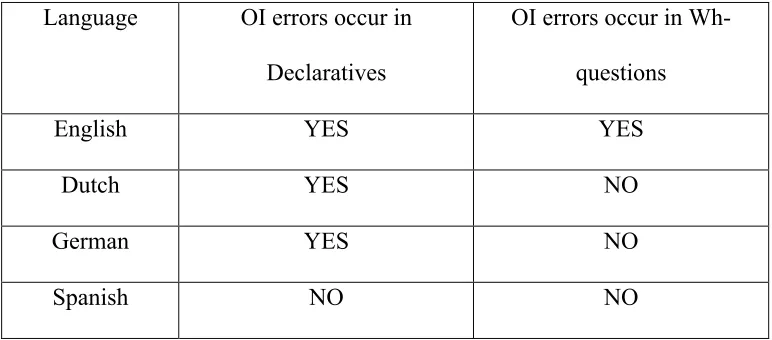
Table 1: Presence and absence of OI errors in declaratives in Wh- questions in English, Dutch, German and Spanish
Language OI errors occur in Declaratives
OI errors occur in Wh- questions
English YES YES
Dutch YES NO
German YES NO
Spanish NO NO
This pattern of results (summarised in Table 1) is inconsistent with the predictions of other generativist accounts. For example, according to Rizzi’s truncation account, OI errors reflect the truncation of structures below TP. Since truncation below TP
necessarily implies the absence of CP (because CP is higher than TP in the sentence structure), and since Wh- questions require the presence of CP, OI errors are predicted to occur in declaratives, but not in Wh- questions. Rizzi’s account can therefore explain the absence of OI errors in Dutch and German Wh- questions. However, it cannot explain the occurrence of OI errors in English Wh- questions. According to Wexler’s Unique
Thus, it is a feature of V2 languages that, when the first position of a matrix clause is filled, the second position must be filled by a finite verb form (see examples 5 and 6).
Dutch
(5a) Ik lees een boek I read-FIN a book (5b) Gisteren las ik een boek Yesterday read-FIN I a book
German
(6a) Ich lese ein Buch I-read-FIN a book (6b) Gestern las ich ein Buch Yesterday read-FIN I a book
Since Wexler assumes that Dutch and German children know this fact from early in development, and since the first position of a Wh- question is always filled by a Wh- word, Dutch and German children are constrained to produce a finite main verb or a finite auxiliary in second position, and OI errors do not occur. Wexler’s account can therefore explain both the occurrence of OI errors in English Wh- questions and the absence of OI errors in Dutch and German Wh- questions, and hence provides an integrated account of the cross-linguistic patterning of OI errors in both declaratives and Wh- questions.
1.2. An alternative account of Optional Infinitive errors.
patterning can also be understood in terms of the interaction between a relatively simple learning mechanism (MOSAIC) and cross-linguistic differences in the distributional statistics of the input that children receive (Freudenthal et al., 2006a, 2007, 2009). MOSAIC is a computational model of language learning, with no built-in knowledge of syntactic categories or rules, which takes as input corpora of orthographically transcribed child-directed speech and learns to produce as output ‘child-like’ utterances that become progressively longer as learning proceeds. As a result of these characteristics, MOSAIC can be used to generate corpora of utterances at different stages of development, and hence to model the behaviour of children in different languages across a range of Mean Length of Utterance (MLU) values.
MOSAIC simulates OI errors because it has a strong utterance-final bias in learning. This bias results in the production of partial utterances that were present as utterance-final phrases in the input to which the model was exposed. The utterances in the input that give rise to OI errors are compound finites: utterances that contain both a finite verb (usually a modal or auxiliary) and a non-finite verb. Thus, MOSAIC learns to produce utterances resembling English OI errors such as Go there and That go there as truncated versions of utterances such as (That can) go there and (Does) that go there? Similarly, MOSAIC learns to produce utterances resembling Dutch OI errors such as IJs eten and Mama ijs eten as truncated versions of utterances such as (Mama wil) ijs eten (Mummy wants to eat ice cream) and Wil Mama ijs eten? (Does Mummy want to eat ice cream?).
fewer OI errors as the length of their utterances increases. MOSAIC simulates this phenomenon because of the way that compound finites pattern in OI languages. In compound finites, the finite verb precedes the non-finite verb. Since MOSAIC produces increasingly long utterance-final phrases, the early (short) phrases it produces are likely to contain only non-finite verb forms. As the phrases MOSAIC produces become longer, finite modals and auxiliaries start to appear, and OI errors are slowly replaced by
compound finites.
The mechanisms implemented in MOSAIC build knowledge of sentence structure by learning sequences from the input and generalising across those sequences. MOSAIC is therefore often regarded as a usage-based model of language learning (cf. Goldberg, 1995; 2006; Lieven, Pine & Baldwin, 1997; Pine, Lieven & Rowland, 1998; Tomasello, 2000; 2003, MacWhinney, 2004). However, although the mechanisms implemented in MOSAIC are certainly consistent with a usage-based analysis, it is important to recognise that MOSAIC is a relatively simple distributional analyser, with no access to semantic information, which is not sufficiently powerful to acquire many aspects of adult syntax. MOSAIC is therefore not itself a realistic model of the language acquisition process. What MOSAIC does provide, however, is a powerful means of testing hypotheses about the relation between linguistic variation in children’s early language and cross-linguistic differences in the language to which they are exposed. For example,
Freudenthal et al. (2006a) showed that the hypothesis implemented in MOSAIC — that OI errors are truncated compound finites — is able to explain the developmental
qualitative difference in the rate of OI errors between Dutch/German and Spanish and the more subtle quantitative difference in the rate of OI errors between Dutch and German. MOSAIC has also been shown to simulate several other phenomena in children’s multi-word speech, including the pattern of subject omission errors in English (Freudenthal, Pine & Gobet, 2007), the relation between subject provision and finiteness marking in English and Dutch (Freudenthal et al. 2006b), and differences in the referential properties of OI errors in English, Dutch and German (Freudenthal et al. 2009).
The results of these simulations suggest that it is possible to explain a number of key features of children’s early multi-word speech in terms of the interaction between a resource-limited distributional learning mechanism and the surface properties of the language to which young children are exposed. However, they are not necessarily
Dutch, German and Spanish. It is unclear whether a generativist version of this
mechanism, which modelled OI errors in terms of the interaction between an utterance-final bias in learning and the acquisition of more abstract structural representations, could achieve a similar level of fit to the data.
1.3. Limitations of the current version of MOSAIC
The results of previous studies using MOSAIC show that it is possible to simulate the cross-linguistic patterning of OI errors surprisingly well in terms of the interaction between processing limitations in learning and differences in the distributional properties of the language to which children are exposed. However, one obvious weakness of the version of MOSAIC used in these studies is that it only simulates the cross-linguistic patterning of OI errors in declaratives.
There are two reasons for this state of affairs. The first is that, like many distributional
utterance-final phrases learned from questions (e.g. He go home from Did he go home?)1.
Given the obvious prosodic, pragmatic and structural differences between declaratives and questions, this feature of the model might be regarded as somewhat implausible, particularly in view of recent evidence that even very young children can distinguish between declaratives and questions in the input (Seidl, Hollich & Jusczyk, 2003; Homae, Watanabe, Nakano, Asakawa & Taga, 2006; Soderstrom, Ko & Nevzorova, 2011, Geffen & Mintz, 2012; in press; Frota, Butler & Vigário, 2014). For example, Geffen and Mintz (in press) show that by 12 months children can distinguish between declaratives and polar interrogatives even in the absence of prosodic cues, and argue that although infants initially use phonological information to distinguish between sentence types, they have already begun to learn generalisations about the corresponding word-order patterns before the onset of multi-word speech.
The second reason is that MOSAIC learns exclusively from the right edge of the
utterance. That is to say, the model only encodes words or strings in the input when all of the material to the right of the target word or string has already been encoded in the network. This feature of the model has the advantage that it allows direct investigation of the effects of assuming an utterance-final bias in learning, uncomplicated by other
factors. However, it also means that the model is only able to simulate errors that occur as utterance-final phrases in the input. Thus, MOSAIC is able to simulate truncation errors
1
(e.g. Go there from He wants to go there). However, the model is unable to simulate errors that involve the omission of sentence-internal elements (e.g. Play train from Play with the train). It is therefore unable to simulate OI errors in Wh- questions (e.g. by learning Where he go? from Where did he go?).
In view of these problems, the aim of the present paper is to describe a new version of MOSAIC that eliminates the weaknesses of the previous version by 1) distinguishing between declaratives and questions in its input, and 2) learning from both edges of the utterance. The new version of the model represents utterance-internal omission errors as concatenations of utterance-initial and utterance-final strings and hence has the potential to simulate both OI errors with subjects in declaratives (e.g. He _ go there) and OI errors in Wh- questions (Where _ he go?). As a result, it has several important advantages over the previous version of the model.
First, by incorporating some sensitivity to the left as well as the right edge of the utterance, it implements processing limitations in learning in a more realistic way. For example, it is consistent with a wealth of evidence that humans show primacy as well as recency effects in sequence and list learning (Murdock, 1962; Jahnke, 1965; Bellezza, Andrasik & Lewis, 1982; Hulme, Roodenrys, Schweickert, Brown, Martin & Stuart, 1997; Gupta, 2005; Gupta, Lipinski, Abbs & Lin, 2005)2.
2 This issue is not as straightforward as it might at first appear, since recency effects are
Second, it allows the model to represent a much wider range of error types. For example, it allows the model not only to represent truncated utterances (e.g. (He wants to) go there, but also utterances with missing utterance-internal elements (e.g. Kick (the) ball or He (wants to) go there). This is an important development since sentence-internal omission errors of this kind are a characteristic feature of children’s early multi-word speech, which is often described as ‘telegraphic’ because of the high frequency with which such errors occur (Brown, 1973).
Third, and most important, it has the potential to provide an integrated account of the cross-linguistic patterning of OI errors in both declaratives and Wh- questions. Of
course, it should be noted that a model that simulates OI errors through utterance-internal omission has the potential to produce OI errors in declaratives and Wh- questions not only in English, but also in Dutch, German and Spanish. It is therefore not at all clear that MOSAIC will be able to simulate both the high levels of OI errors in English Wh- questions and the low levels of OI errors in Dutch, German and Spanish Wh- questions. This issue will be addressed in the present study by running simulations of children’s use of Wh- questions across the four languages using the same version of the model as that absence of rehearsal (e.g. Neath, 1993; Sikström, 2006). Moreover, primacy (and
recency) effects have also been found in non-human species (monkeys and pigeons), where active elaboration processes are unlikely to play a major role (Wright, Santiago, Sands, Kendrick & Rook, 1985). These findings can be explained in terms of the
used to simulate the pattern of OI errors in children’s declarative utterances. The only difference between the declarative simulations and the Wh- question simulations is that the declarative simulations will focus on utterances learned from declarative input and the Wh- question simulations will focus on utterances learned from interrogative input.
To summarise, the aim of the present paper is to describe a new version of MOSAIC that learns from both the right and the left edge of the utterance, and to investigate the extent to which it is able to provide an integrated account of the cross-linguistic
patterning of OI errors in declaratives and Wh- questions. The new version of MOSAIC is designed to learn structures with missing sentence-internal elements and hence to simulate a wider range of error types than previous versions of the model. It also differentiates between declaratives and questions in the input, learning declarative structures from declarative input and interrogative structures from interrogative input. This allows us to investigate whether it is possible to simulate differences in the cross-linguistic patterning of OI errors across declaratives and Wh- questions in terms of the interaction between the same learning mechanism and cross-linguistic differences in the distributional patterning of declarative and interrogative input.
The remainder of the paper is organised as follows. First, we describe the new version of MOSAIC, together with its mechanism for producing utterances with missing
2. MOSAIC
MOSAIC is an unsupervised learning mechanism that accepts as input corpora of orthographically transcribed child-directed speech, and produces as output ‘child-like’ utterances that become progressively longer as learning proceeds. Some of these
utterances are produced by rote (i.e. have occurred as utterances or parts of utterances in the input). Others are produced generatively (i.e. by substituting words into frames that have occurred as utterances or parts of utterances in the input). Since the average length of MOSAIC’s output increases with learning, MOSAIC can be used to simulate
developmental changes in children’s speech as a function of increasing MLU.
2.1. The MOSAIC Network
The basis of MOSAIC is an n-ary discrimination net that consists of nodes and arcs connecting those nodes. At the head of the network is an empty root node. Nodes directly beneath the root node are called primitive nodes and are used to store the words that MOSAIC encodes. Nodes at deeper levels in the network are used to encode the phrases that have been encoded in the model. The arcs or ‘tests links’ that connect nodes are used to store the difference between the nodes they connect. A MOSAIC network is slowly built up from exposure to the input it receives. As MOSAIC sees more input it creates more nodes, and nodes at deeper levels in the network. The model thus stores (and is hence able to produce) more and longer utterances as a function of learning.
2.2. Edge-first learning in MOSAIC
of exposition, we first describe right edge learning. We then describe left edge learning, and the way in which the products of right edge learning and left edge learning are combined within the model.
2.2.1. Right edge learning
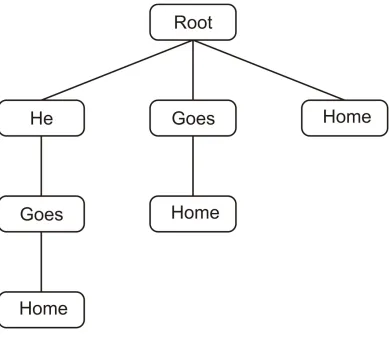
To illustrate right edge learning, consider an empty MOSAIC network that is shown the utterance: He goes home a number of times. MOSAIC’s right edge learning mechanism will only encode a word or phrase when everything that follows that phrase in the utterance has already been encoded in the network. This mechanism can be likened to a moving window or buffer. Whenever an unknown word or word transition is
encountered, the contents of the buffer are emptied, and only the most recently encountered word is left as a target for encoding. Thus, on the first presentation of He goes home, the model will process the utterance in a left-to-right fashion. When it reaches the end of the utterance, the buffer will contain the word home, and a node for this word will be created. On the second presentation of the utterance, the buffer will contain the phrase goes home when reaching the end of the utterance. The model will now attempt to encode this phrase, but since no primitive node exists for the word goes this primitive node will be created first. On the third presentation, a non-primitive node containing the phrase goes home will be created. A fourth presentation will result in a primitive node for the word he, while a fifth presentation will result in the creation of a non-primitive node for the phrase he goes home. Fig. 1 shows the model after five presentations of the utterance He goes home.
utterance-final frames that have occurred in the input — see section on generating output from MOSAIC below). Previous work with MOSAIC has shown that this mechanism allows the model to simulate variation in the developmental patterning of OI errors across several different languages (Freudenthal et al., 2006a; 2007; 2009; 2010).
Fig. 1: A MOSAIC network after it has seen the phrase He goes home five times.
2.2.2. Left-edge learning
Left edge learning works in a similar way to right edge learning, except that it is
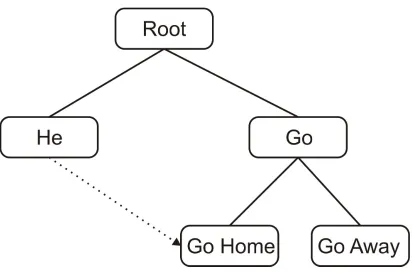
of the utterance, displaying a (small) primacy and a (larger) recency effect in learning. However, MOSAIC also combines the products of right and left edge learning by associating utterance-initial and utterance-final elements on the basis of their co-occurrence in utterances in the input. This process is illustrated in Fig. 2. The network depicted in Fig. 2 has encoded the utterance-initial word he and the utterance-final
phrases go home and go away. The word he and the phrase go home have been associated on the basis of their co-occurrence in the utterance He can go home, allowing the model to produce the utterance he go home. Since the difficulty of associating utterance-initial and utterance-final elements would be expected to increase as a function of the distance between the elements in the target utterance, the probability (p) of associating utterance-initial and utterance-final elements within the model is governed by the formula: p = 1/d, where d is the number of words intervening between the relevant utterance-initial and utterance-final elements.
Fig. 2: A MOSAIC network that has associated the word He and the phrase Go home.
2.3. Learning Speed
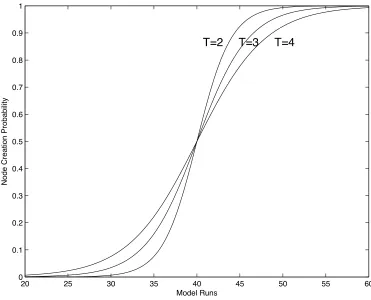
In the examples presented so far, MOSAIC has been described as if nodes were created in the model whenever the opportunity arose. In fact, however, node creation in MOSAIC is slow and probabilistic, and words and phrases typically have to be encountered many times before they are encoded. Input corpora are fed through the model several times and the node creation probability (NCP) increases with every exposure to the input. Node-creation is governed by the following formula:
NCP
=
1
1
+
e
(m−u/c
)/t
"
#
$
%
&
'
where: NCP = Node Creation Probability,
m = a constant, set to 40 for these simulations, c = corpus size (number of utterances),
u = total number of utterances seen,
t = a constant, set to 3 for these simulations, d = distance to the edge of the utterance.
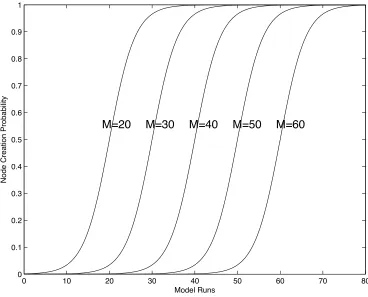
Since developmental functions tend to be non-linear, this formula is designed to result in a basic sigmoid curve when NCP is plotted against the number of utterances to which the model has been exposed. One important feature of the formula is that it includes the term (m-u/c)/t where m and t are constants, c is corpus size and u is the total number of
Fig. 3: Differences in the pattern of rate of change in NCP as a function of changes in m
has the effect of reducing the rate at which the NCP changes as a function of the amount of input seen, with each increase in t resulting in a decrease in the rate at which the NCP changes (see Fig. 4). Setting the constant t to 3 is therefore simply a convenient way of slowing down learning such that the size of the network, and hence the MLU of the model’s output, does not increase so quickly with each exposure to the corpus that it would be necessary to stop the model in mid-run in order to match its MLU to the MLU points of interest in the child data.
0 10 20 30 40 50 60 70 80
0 0.1 0.2 0.3 0.4 0.5 0.6 0.7 0.8 0.9 1
Model Runs
Node Creation Probability
Fig. 4: Differences in the pattern of rate of change in NCP as a function of changes in t
A second important feature of the formula is that the base number is raised to 𝑑, where d is the distance to the edge of the utterance (or length of the phrase being encoded). This feature of the formula has the effect of decreasing the probability of learning words or sequences as a function of their distance from the edge of the utterance.
Raising the base number to 𝑑 rather than d simply prevents the d parameter having so great an effect on NCP that the model is never able to fully learn longer utteranes. The term d is also used to implement a bias for right edge learning over left edge learning. When considering a left edge phrase for encoding, the term d is incremented by 2 before computing the NCP. This results in left edge learning being slower than right edge
20 25 30 35 40 45 50 55 60
0 0.1 0.2 0.3 0.4 0.5 0.6 0.7 0.8 0.9 1
Model Runs
Node Creation Probability
T=3 T=4
determining the shape of the developing network. However, this is because these terms directly implement the theoretical claims instantiated in MOSAIC that children are subject to a strong recency effect and a weaker primacy effect in learning. It is thus the inclusion of these terms in the NCP formula that allows us to test the idea that it is possible to simulate the cross-lingusitic patterning of OIs in declaratives and Wh- questions in terms of the interaction between edge-first learning and differences in the distributional properties of the input language.
2.4. Generating output from MOSAIC
There are two mechanisms for generating output from MOSAIC. The first is a rote production mechanism that is only able to produce utterances that were present in the model’s input. The second is a generative production mechanism that allows the model to produce novel utterances by substituting items for each other on the basis of their
distributional similarity. The first of these processes involves traversing all of the branches in the network. When a terminal node (or end-of-utterance marker) is
encountered, the phrase encoded in that branch is produced together with concatenations of that phrase and all the utterance-initial words and chunks with which it has been associated. This process results in the production of all the (utterance-final) phrases and all the utterances with missing internal elements that are represented in the network. The only restriction applied to this mechanism is that utterance-initial and utterance-final elements can only be concatenated if they are anchored. That is to say, utterance-initial elements can only be concatenated if the last word in the element has occurred in
to increase the plausibility of MOSAIC’s output by ruling out sentence internal omission errors in which the beginning or the end of the utterance is not a semantically plausible unit. For example, it prevents the model from producing utterances such as The (boy) wants a drink on the assumption that, whatever the status of young children’s
grammatical knowledge, they would be unlikely to make such errors because including the word the without including the word that it modifies (in this case boy) would make neither semantic nor pragmatic sense.
The generative production mechanism works by tracking the contexts (preceding and following words) in which the words encoded in the model have been encountered in the input. Words that share a sufficient amount of overlap (20% for the present simulations) in both the words that precede and the words that follow them are considered equivalent and can be substituted when generating output from the model, resulting in phrases and concatenations that were not present in the input. Several authors have shown that words with high overlap in terms of shared sentential contexts are likely to be of the same syntactic class (e.g. Redington, Chater & Finch, 1998; Mintz 2003).
2.5. Chunking
tends to result in utterances that are neither grammatical nor typical of child speech. MOSAIC avoids such unwanted substitutions by implementing a chunking mechanism. According to theories based on chunking (Chase & Simon, 1973; Gobet & Simon, 1998; Gobet et al., 2001), frequently encountered stimuli are grouped into larger structures that can be retrieved as one unit. Chunking in MOSAIC is implemented by registering the frequency with which nodes in the model are visited when processing the model’s input. When the frequency for a multi-word phrase exceeds a predetermined threshold, a new node at the primitive level is created to encode that multi-word phrase. The multi-word phrase is subsequently treated as one unit by the generativity mechanism. That is,
individual words that make up the multi-word phrase cannot be substituted in the context of the newly created chunk. The chunking mechanism, which is described in more detail in Freudenthal, Pine and Gobet (2005), also allows MOSAIC to learn utterances that contain frequent phrases more quickly than would otherwise be the case, and plays an important role in determining the type of utterances with missing internal elements that the model represents. Thus, the fact that left edge learning is restricted to one chunk rather than one word means that, although utterance-initial omission errors tend to be anchored at the left edge of the utterance (e.g. That (can) go there or Where (does) that go?), they can also occur further to the right of the utterance, provided the target utterance begins with a high frequency string (e.g. That one (can) go there or Where is (he) going?).
2.6. Running Simulations in MOSAIC
file consists of learned utterance-final phrases together with internal-omission rote-learned phrases (i.e. concatenated utterance-initial and utterance-final phrases); and generated (novel) utterance-final phrases together with internal-omission generated phrases (i.e. concatenated utterance-initial and utterance-final phrases where one of the two phrases is novel). both utterance-final strings and concatenations of utterance-initial and utterance-final strings that have been learned directly from the input, and utterances generated by substituting words into utterance-final frames and concatenations of utterance-initial and utterance-final frames using the generativity mechanism described above. Because the size of the network grows as a function of the amount of input to which the model has been exposed, the average length of the model’s output increases with every cycle through the input corpus. Output files can therefore be selected for analysis on the basis of their MLU and compared with data from children at the same stage of development. Because MOSAIC’s output consists of sets of utterance types rather than utterance tokens, corpora of child utterances are also reduced to sets of utterance types before matching output files are selected.
3. The Simulations 3.1 Input corpora
Kempen & Gillis, 2001) and consist of approximately 14,000 input utterances for Matthijs and 13,000 input utterances for Peter. The data for the Spanish child are part of the Madrid corpus (Aguado-Orea & Pine, in press) and consist of approximately 25,000 input utterances. The data for the German child constitute a dense corpus (consisting of over 140,000 parental utterances) made available to us by the Max Planck institute for Evolutionary Anthropology in Leipzig (Behrens, 2006). Since this dataset is considerably larger than all of the other corpora, a random sample of 30,000 maternal utterances was extracted from the German corpus to serve as input to the model.
3.2. Preparation of the input corpora
Preparation of the input corpora involved extracting all parental speech from the relevant transcripts, and deleting all filler material, pauses, hesitations, false starts, and utterances where one or more words were unintelligible to the transcriber. This is the same
procedure as that used in Freudenthal et al. (2007). However, preparation of the input for the present simulations departed from Freudenthal et al. in one important respect.
and words learned from questions as separate entries is not intended as a realistic way of
representing children’s knowledge of the words themselves; it is simply an
implementational convenience that makes it possible to determine whether partial phrases in the model’s output were learned from interrogative or declarative contexts in the input. Moreover, although it does have some effect on the speed with which the model learns particular words (because it changes the frequency statistics of words in the input), previous work with MOSAIC has shown that it actually has little effect on the output of the model. For example, Freudenthal et al. (2009) used the same strategy to keep track of information about whether infinitive forms had been learned from modal or non-modal contexts and found that representing infinitive forms that had and had not been learned from modal contexts as separate lexical entries had very little effect on the patterning of finite and non-finite forms in the model’s output. We therefore decided to use this strategy again in the new version of the model.
3.3. Preparation of the child data
Preparation of the child data proceeded in a similar manner to the preparation of the input data. The transcripts of individual recording sessions were aggregated into batches
child did not produce a sufficiently large number of utterances at this point in development.
3.4. Running the simulations
Simulations were run by feeding the input corpora through the model several times and generating output (of increasing average length) after each exposure to the input set. The output files that most closely matched the MLU of the children at the different
developmental stages were then selected for analysis. In order to establish the reliability of the results, 10 simulations were run for each child by feeding the same input corpus through models that were initialized with different random seeds. The results were then averaged across the 10 simulations and compared with the results for the corresponding child. For the simulations of OI errors in declaratives, Root Mean Square Error measures (RMSEs) were used to assess the fit between the child and the average model. RMSEs provide a measure of the extent to which the patterning of the data across several
different categories (e.g., non-finite, simple finite and compound finite) diverges between two cases (e.g., child and model). Comparing the RMSEs for the simulations using the old and the new versions of the model is therefore a good way of identifying any
substantive changes in the model’s fit to the child data. For the simulations of OI errors in Wh- questions, RMSEs were not used, since, for these simulations, there were only two categories: Wh- questions that included an OI error and Wh-questions that did not (see below). For the simulations of OI errors in declaratives, analysis was restricted to declarative output that included at least one verb other than the copula. For the
Table 2. Example declarative output Anne’s Model
Push it up Go on the road Like cake Better stop then Play with me So to see you Slipped over Fit in that box That wake you up It fits
Open cupboard Looks pretty And see something Let’s see space off In he fits
Can’t get out Shut the lid
Just having a sleep Think she is You can eat it
He wants more fence Go on then
Eat out of your mouth please Have her hair
Opening the settee You do them If you hide Anne’s broke it Forgot your hair We could do that Do them
Can’t have some toast Eat crying
Get Mummy’s back
Turn door Jump still You stop that You get it then Come not fishes He tastes beautiful It’s not to read Do them that way I won’t fit
Hide them
Push them that table Told him
Table 2: Example declarative output (continued) Becky’s Model
In go Then eat I did take it Like ice cream Have a key Take of it It on want it It doesn’t go here They want that Doesn’t go in there Disturbed him now Gone again
Do on the people You know Go now then Want pizza To put that
Try hard
They don’t do it
Take say rock a bye baby You pull that
Might like it Took them off Don’t want black You can’t find
Becky wants upside down He sit on here
Pull it away
I want you want that I take it
That doesn’t fit in Know you need that I don’t want it Push that on here
Having ice cream Throw one Like there Go in
Wonder why He’s hiding Get other red one Take the bag Turn it
Table 3: Example Wh- question output Anne’s Model
What hold?
What won’t he want? What you have to go? What say her name was? What eat now?
What can you see? How do you want? What found? Where need me? Where taking the shop? What else can we see? What I eat?
What we doing there? What I find?
What didn’t they called? What get?
What go with then?
What do you want then? What’re you doing hair? What’s that monkey doing? What you eat that for? What’s she find? Who’s he got to do? What’s he found to go? What’re you gonna have? What we play with today? What’re you doing now? Where’s the horse gone? What’re you eat about that? Who’s he gonna do?
What’s that baby doing? What’re you doing there? Where didn’t we going? What do about that then?
What we do now then? What’s he found? How does it go? What found there? What I eat then? What you find? Where are you going? Who’s he find to go? What she have to go? Where you read them? Who you see?
What’re you tell me? What eat then?
Table 3: Example Wh- question output (continued) Becky’s Model
What else do you know? Where you going? What do you like? What we looking for? When we going? What do you are? Who do you mean? What we done here? What is he doing? Where that go? Where does it hurt? Where’s he going? What can you hear? What I done?
What are I missing? What make?
Where’s want that?
What did you say it colour’s? Who do you think that is? Where goes?
What do you think? What look like?
What have we done here? What have you got there? What do you need to Sukie? Where that one go?
What did you say that about? Where go?
Who you see?
Who do you think it is? What did you say it about? What have you bought there? What’s this doing in here? What you done then?
What you remember? What do you eat? Where’re you going? Where you want it? What I done here? Where are you going? Where that goes? What see?
What buy have? Where you want that? Where’s it gone? What we done? What we buy?
What were you saying? When going?
generated 50-utterance samples of declarative multi-word output for each of two English models at an MLU of approximately 2.5. Table 3 provides corresponding randomly-generated 50-utterance samples of Wh- question output. It can be seen from Table 2 that, although MOSAIC produces some declarative utterances (marked in bold) that are clearly anomalous (approximately 10%), the majority of utterances in the declarative samples consist either of grammatically acceptable strings (e.g., I won’t fit, He tastes beautiful, It doesn’t go here, He’s hiding) or of strings that include plausible omission errors (e.g., Open cupboard, That wake you up, Want pizza, He sit on here). This also appears to be true of the Wh- question samples presented in Table 3, which include a small number of anomalous utterances (approximately 10% in each case), with the majority being made up of correct questions (e.g., What do you want?, How does it go?, Where’re you going?, Who do you mean?) and questions from which either the auxiliary or both the subject and the auxiliary have been omitted (e.g., What I eat?, Where you going?, What look like?, What found?).
3.5. Coding and data analysis 3.5.1. OI errors in declaratives
The analysis of OI errors in declaratives employed the same analysis routines that were used in Freudenthal et al. (2007). Analysis was restricted to utterance types rather than tokens and each utterance was assigned to one of three categories: simple-finite
utterances, compound-finite utterances or non-finite utterances.
or third person singular verb forms in Dutch or German, and utterances containing third person singular verb forms and irregular past tense verb forms in English).
Compound finite utterances were defined as utterances containing both an
unambiguously finite verb form and a verb form that was not unambiguously finite (e.g., utterances containing a singular present tense verb form and a form matching the
infinitive in Dutch or German, and utterances containing a modal and an infinitive or an auxiliary and a perfect or progressive participle in English).
Non-finite utterances were defined as utterances that did not include an
unambiguously finite verb form (e.g., utterances containing infinitive or plural present tense verb forms in Dutch and German and utterances containing zero-marked verb forms in English).
An important feature of this coding scheme is that it treats all ambiguous verb forms as if they were nonfinite verb forms. This feature of the coding scheme is necessary because there are some finite verb forms in Dutch, German and English that are indistinguishable from the infinitive. Thus, although there is strong evidence that Dutch, German and English children do produce infinitive verb forms in contexts in which a finite verb form is required, it is actually impossible to be sure whether the verb form included in any particular utterance is an infinitive as opposed to a finite plural present tense verb form (in Dutch and German) or a zero-marked finite present tense verb form (in English).
treating all zero-marked forms in the same way makes it trivially easy to simulate the data. For this reason, the analysis of English was restricted to utterances that contained a third person singular subject (e.g. He go(es)), since the provision of a zero marked form in a third person singular context is clearly incorrect.
3.5.2. OI errors in Wh- questions
The analysis of OI errors in Wh- questions was restricted to non-subject questions that contained both a Wh- word and a main verb3. As with the analysis of OI errors in declaratives, the main focus of this analysis was on determining whether the utterances produced by the children and the models were marked for finiteness. For English, this means that the source of ambiguity that exists in declarative utterances is removed. In English Wh- questions, finiteness marking is carried by the modal or auxiliary. Thus, any utterance that contains a non-finite verb and lacks a modal or auxiliary (e.g. Where go?) can automatically be classified as an OI error. It is therefore unnecessary to restrict the analysis of Wh- questions to utterances containing a third person singular subject. For Dutch, German and Spanish, the analysis proceeded in a similar manner. Utterances that contained a finite main verb or modal/auxiliary where classified as finite, whereas
3
utterances that contained only a non-finite main verb were classified as non-finite. However, since in Dutch and German Wh- questions, non-finite and plural finite verb forms can be distinguished on the basis of their position in the utterance (i.e. non-finite verb forms occur in utterance-final position whereas plural finite verb forms are always followed by a plural NP subject), plural verb forms were classified as finite if they were followed by a plural NP subject. Thus, the correctly formed Wh- question: Wo spielen sie? (Where play they?) was classified as finite, whereas the incorrect Wh- Questions Wo sie spielen? (Where they play?) and Wo spielen? (Where play?) were classified as non-finite.
4. Results
4.1. Modelling the rate of OI errors in declaratives in Dutch, Spanish and German.
One of the key strengths of MOSAIC is that it provides a unified cross-linguistic account of the developmental patterning of OI errors in declaratives. In a first set of simulations we therefore investigate whether it is still possible to simulate this patterning using the new version of the model. Figures 5 and 6 show the results for the Dutch simulations with the new version of the model (c), as well as the simulations (b) and child data (a) reported in Freudenthal et al. (2007). The figures for the new simulations include error bars because they report results averaged across 10 runs of the model, each of which was initialised with a different random seed.
Thus, although neither the old nor the new versions of the model capture all of the fine detail of the child data (particularly the pronounced drop in the proportion of OI errors between the second and third MLU points), both models simulate the very high rates of OI errors in Dutch during the early stages, and the substantial drop in the level of OI errors across the MLU range.
(a) Data for Matthijs (b) Old Model for Matthijs
[image:40.612.98.521.222.621.2](c) New Model for Matthijs
Fig. 5: Data, old and new model for Matthijs.
0 0.2 0.4 0.6 0.8 1
1.5 2.1 2.8 3.5 MLU Pr op or ti on Non-finite Simple Finite Comp. Finite 0 0.2 0.4 0.6 0.8 1
1.4 2.2 3.0 3.9 MLU Pr op or ti on Non-finite Simple Finite Comp. Finite 0 0.2 0.4 0.6 0.8 1
(a) Data for Peter (b) Old Model for Peter
[image:41.612.103.520.95.444.2](c) New Model for Peter
Fig. 6: Data, old and new model for Peter.
Figure 7 shows the results for the Spanish simulation with the new version of the model (c), as well as the simulation (b) and child data (a) reported in Freudenthal et al. (2007). Again it is clear that the new simulations show the same pattern as the old simulation. RMSEs for the old simulation are .06, .05 and .11. RMSEs for the average of the new simulations are .09 .06 and .09. Thus, although again there are some minor differences between the child and the model data, both models simulate the low level of OI errors in Spanish across the MLU range and the high level of simple-finite utterances.
0 0.2 0.4 0.6 0.8 1
1.5 2.2 3.1 4.1 MLU Pr op or ti on Non-finite Simple Finite Comp. Finite 0 0.2 0.4 0.6 0.8 1
1.4 2.3 3.1 4.1
MLU Pr op or ti on Non-finite Simple Finite Comp. Finite 0 0.2 0.4 0.6 0.8 1
(a) Data for Juan (b) Old Model for Juan
[image:42.612.100.518.84.479.2](c) New Model for Juan
[image:42.612.100.522.115.235.2]Fig. 7: Data, old and new model for Juan.
Figure 8 shows the results for the German simulation with the new version of the model (c), as well as the simulation (b) and the child data (a) reported in Freudenthal et al. (2007). These results are also very similar to those for the old simulation. RMSEs for the old simulation are .05, .05, .02 and .04. RMSEs for the average of the new simulations are .08, .06 .03 and .08. Thus, like the old model, the new model simulates the lower level of OI errors in German than in Dutch during the early stages, and the less pronounced drop in the level of OI errors across the MLU range.
0 0.2 0.4 0.6 0.8 1
2.2 2.9 3.8
MLU Pr op or ti on Non-finite Simple Finite Comp. Finite 0 0.2 0.4 0.6 0.8 1
2.2 3.2 4.0
MLU Pr op or ti on Non-finite Simple Finite Comp. Finite 0 0.2 0.4 0.6 0.8 1
2.2 3.1 3.8
(a) Data for Leo (b) Old Model for Leo
[image:43.612.103.520.89.442.2](c) New Model for Leo
Fig. 8: Data, old and new model for Leo.
It is clear from these results that the new version of MOSAIC continues to simulate both the apparent qualitative difference in the rate of OI errors between Dutch/German and Spanish and the more subtle difference in the rate of OI errors between Dutch and German. These results show that neither the addition of left edge learning, nor the exclusive focus on declaratives in the model’s input, seriously affect MOSAIC’s ability to simulate the cross-linguistic data. It is therefore possible to simulate the developmental patterning of OI errors in Dutch, Spanish and German declaratives in terms of a mechanism that learns from both edges of the utterance and learns declaratives exclusively from declarative input.
0 0.2 0.4 0.6 0.8 1
1.3 2.2 3.0 4.6 MLU Pr op or ti on Non-finite Simple Finite Comp. Finite 0 0.2 0.4 0.6 0.8 1
1.4 2 3.1 4.5 MLU Pr op or ti on Non-finite Simple Finite Comp. Finite 0 0.2 0.4 0.6 0.8 1
4.2. Modelling the rate of OI errors in declaratives in English
In addition to simulating the pattern of OI errors in Dutch, German and Spanish
declaratives, MOSAIC is also able to simulate the developmental patterning of OI errors in English declaratives. However, simulating the pattern of OI errors in English is complicated by the fact that English is such a morphologically impoverished language that it is only possible to unambiguously identify OI errors in a restricted set of contexts. For this reason, previous work with MOSAIC has focused on the pattern of OI errors in utterances with third person singular subjects (e.g. He go out instead of He goes out and She do it instead of She does it). Simulating this pattern a particularly strong test of the new version of MOSAIC because strings such as He go out and She do it do not occur as sequences in English declarative input. The new version of the model is thus totally reliant on its mechanism for concatenating utterance-initial and utterance-final phrases when producing such errors.
(a) Data for Anne (b) Old Model for Anne
[image:45.612.94.522.90.654.2](c) New Model for Anne
Fig. 9: Data, old and new simulations for Anne.
(a) Data for Becky (b) Old Model for Becky
0 0.2 0.4 0.6 0.8 1
2.2 3.1 3.4 MLU Pr op or ti on Non-finite Simple Finite Comp. Finite 0 0.2 0.4 0.6 0.8 1
2.1 2.8 3.3 MLU Pr op or ti on Non-finite Simple Finite Comp. Finite 0 0.2 0.4 0.6 0.8 1
2.2 2.8 3.4 MLU Pr op or ti on Non-finite Simple Finite Comp. Finite 0 0.2 0.4 0.6 0.8 1
2.3 3.1 3.6 MLU Pr op or ti on Non-finite Simple Finite Comp. Finite 0 0.2 0.4 0.6 0.8 1
2.2 2.8 3.2
(c) New Model for Becky
Fig. 10: Data, old and new models for Becky.
These results show that it is possible to replace MOSAIC’s old mechanism for simulating OI errors with subjects with a new mechanism that concatenates utterance-initial words or chunks and utterance-final phrases. This mechanism allows MOSAIC to learn OI errors with subjects from subject + modal/auxiliary + verb structures rather than from questions in the input, and hence eliminates an important weakness of the earlier version of the model.
4.3. Simulating the pattern of OI errors in English, German and Spanish Wh- questions The simulations reported above show that it is possible to develop a unified account of the development patterning of OI errors in English, Dutch, German and Spanish declaratives without relying on interrogative input. However, distinguishing between declaratives and questions in the input also has the advantage that it opens up the possibility of simulating the cross-linguistic patterning of OI errors in both declaratives and Wh- questions using exactly the same learning mechanism.
0 0.2 0.4 0.6 0.8 1
2.2 2.8 3.4 MLU
Pr
op
or
ti
on Non-finite
Table 4: Proportions of OI errors in Wh- questions for Anne, Becky, Leo and Juan at three developmental stages (number of contributing utterances and MLU in parentheses).
T1 T2 T3
Anne (English) .70 (47, 2.49) .42 (45, 3.29) .07 (27, 3.64) Becky (English) .69 (42, 2.47) .42 (24, 3.22) .08 (178, 3.68)
Leo (German) .17 (6, 2.40) .00 (34, 3.57) .00 (22, 3.76) Juan (Spanish) .00 (23, 2.46) .03 (35, 3.45) .00 (48, 3.96)
Table 4 provides data on the proportion of OI errors in Wh- questions at three MLU points for the English, German and Spanish children whose declarative data were simulated earlier. Data from the two Dutch children are not included since neither produced sufficiently high numbers of Wh- questions to allow a meaningful analysis to be performed. It can be seen from Table 4 that, consistent with the previous literature, OI errors occur at much higher rates in the English than in the German and Spanish children during the early stages (0.70 in Anne and 0.69 in Becky compared with .17 in Leo and .00 in Juan). However, it is also clear that the German child, Leo, and the Spanish child, Juan, produce few Wh- questions of any kind at T1. In order to obtain a more reliable estimate of the proportion of OI errors in Wh- questions in German and Spanish during the early stages, we therefore analysed the data from the 6 typically developing German-speaking children in the Szagun corpus (Szagun, 2001) and 5 Spanish-German-speaking children from the Aguirre, Irene, Marrero/Albalá and Ornat corpora (López Ornat, 1994), all of
[image:47.612.120.486.133.277.2]Table 5: Proportions of OI errors in Wh- questions in German and Spanish at three developmental stages (number of contributing utterances and MLU in parentheses).
German
T1 T2 T3
Anna .14 (14, 2.41) .00 (53, 3.09) .00 (65, 3.49) Emely N/A (0, 2.34) .00 (2, 2.91) .00 (12, 3.83) Falko .25 (4, 2.56) .13 (8, 3.30) .00 (16, 3.76)
Lisa .00 (4, 2.47) .00 (12, 2.99) .00 (29, 3.86) Rahel .22 (9, 2.56) .00 (17, 3.87) .00 (34, 4.50) Soeren .33 (3, 2.47) .13 (8, 3.63) .02 (86, 3.85)
Spanish
T1 T2 T3
Alfonso .00 (8, 2.66) .00 (3, 3.14) N/A
Idaira .00 (9, 2.45) .00 (15, 3.38) .00 (17, 3.98) Irene .00 (5, 2.54) .00 (23, 3.11) .00 (165, 3.93) Magda .00 (56, 2.52) .00 (29, 3.07) N/A
María .00 (10, 2.44) .00 (9, 3.26) .00 (14, 3.94)
Although there are still few Wh- questions during the early stages in most of the children’s speech, the data presented in Table 5 confirm that the rate of OI errors in Wh- questions is much lower in German and Spanish than it is in English. However, they also suggest that the rate of OI errors in Wh- questions is higher in German than it is in
errors in Wh- questions at T1, the average rate of OI errors in German at T1 is .23, with most of the German children producing at least one OI error (see Table 6 for a list of examples). The implication is that there is an early stage during which German children do make OI errors in Wh- questions, but that such errors occur at much lower rates in German than they do in English.
Table 6: Examples of OI errors in German Wh-questions
Child Error Gloss
Leo Wo stecken? Where put-INF?
Anna Wo mit machen?
Wo Claudi die Tasse ausspuelen? Wo machen?
Was mit machen?
Where with do-INF?
Where Claudi the cup rinse-INF? Where do-INF?
What with do-INF?
Falko Wo der passen? Where that fit-INF
Rahel Wo malen?
Wo das gemacht
Where paint-INF Where that make-PERF
Soeren Wo da hingehen Where there go-INF?
Table 7 presents results for the English, German and Spanish simulations. In each case, the proportion of OI errors is an average based on 10 runs of the model. It is clear from Table 7 that, although MOSAIC underestimates the level of OI errors in
MLU range. MOSAIC thus provides a reasonable fit to the cross-linguistic patterning of OI errors in Wh- questions.
Table 7: Average Proportions of OI errors for Anne, Becky, Leo and Juan’s models at three developmental stages (SD and Average MLU in parentheses).
T1 T2 T3
Anne (English) .48 (.06, 2.59) .30 (.06, 3.10), .16 (.05, 3.80) Becky (English) .48 (.06, 2.58) .33 (.05, 3.16) .23 (.05, 3.69) Leo (German) .24 (.05, 2.51) .11 (.04, 3.17) .07 (.03, 3.78) Juan (Spanish) .04 (.01, 2.48) .02 (.00, 3.13) .01 (.01, 3.83)
questions by learning Wh- questions with missing auxiliaries from the input, one possible explanation for the much lower rate of OI errors in German and Spanish is that the rate of compound-finite questions is also much lower in German and Spanish than in English.
This possibility was investigated by searching Leo’s and Juan’s corpora for Wh- questions and distinguishing between simple finites (i.e. those that included only a finite verb form) and compound finites (i.e. those that included both a finite and a non-finite verb form). This analysis revealed that the proportion of compound-finite Wh- questions in Leo’s input was .31 and the proportion of compound-finite Wh- questions in Juan’s input was .28. These proportions suggest that it is possible to explain the lower rate of OI errors in Wh- questions in German and Spanish as opposed to English in terms of the lower rate of compound-finite Wh- questions in the input (approximately 30% in German and Spanish as opposed to 100% in English). However, they also raise the question of why the rate of OI errors is so much lower in German Wh- questions than it is in German declaratives (where compound finites also occur at a rate of approximately 30%).
to be learned in the early stages. The rate at which OI errors in declaratives occur in the early stages therefore tends to be considerably higher than the rate at which compound finites occur in the input (i.e. 60% rather than 30%). OI errors in Wh- questions, on the other hand, can only be represented as utterance-internal omission errors and hence can only be learned by associating utterance-initial and utterance-final elements. Since the model’s ability to associate utterance-initial and utterance-final elements is dependent on the distance between these elements in the target utterance, and since the distance
between the utterance-initial Wh- word and the utterance-final non-finite verb in compound questions is relatively large, OI errors in Wh- questions do not tend to occur until the model has learned some relatively long utterance-final phrases. By this time the model also tends to have learned a relatively large number of correct finite questions from the right edge of the utterance. The rate at which OI errors in Wh- questions occur in the early stages therefore tends to be lower than the rate at which compound-finite Wh- questions occur (i.e. somewhere between 0 and 30%).
subject NP, and are therefore at least three words long (e.g. Was willst du? (What want-FIN you?)). Spanish, on the other hand, is a pro-drop language in which simple-finite Wh- questions do not necessarily include a subject NP, and can therefore be only two words long (e.g. ¿Qué quieres? (What want-FIN (you)?)). Since, in order to qualify as a Wh- question, an interrogative utterance must include an (utterance-initial) Wh- word, and since Wh- words tend to occur closer to the right edge of the utterance in Spanish simple-finite questions than in German simple-finite questions, MOSAIC tends to learn simple-finite Wh- questions earlier in Spanish than it does in German.
5. Discussion
The aim of the present paper was to describe a new version of MOSAIC that learns from both the right and the left edge of the utterance, and to investigate the extent to which it was able to provide an integrated account of the cross-linguistic patterning of OI errors in declaratives and Wh- questions. The new version of MOSAIC learns structures with missing sentence-internal elements and is hence able to simulate a wider range of error types than previous versions of the model. It also differentiates between declaratives and questions in the input, learning declarative structures from declarative input and
interrogative structures from interrogative input. It therefore allows us to investigate the extent to which it is possible to simulate differences in the cross-linguistic patterning of OI errors in declaratives and Wh- questions in terms of the interaction between the same learning mechanism and cross-linguistic differences in the distributional patterning of declarative and interrogative input.
model still provides a good fit to the data on OI errors in Dutch, Spanish and German declaratives. More specifically, the model is able to simulate both the large, apparently qualitative, difference in the rate of OI errors in Dutch and Spanish during the early stages and the more subtle quantitative difference in the rate of OI errors between Dutch and German. Previous work with MOSAIC has shown that the model simulates these effects in terms of the interaction between right edge learning and differences in the proportion of utterance-final verb forms that are non-finite in the three languages. The present simulations suggest that adding left edge learning and restricting the model to learning declaratives from declarative input has little effect on this interaction. The implication is that the effects of right edge learning in MOSAIC are relatively robust, and hence unlikely to be affected by minor changes to the underlying mechanism.
implemented in MOSAIC. Thus, MOSAIC still simulates OI errors as compound finite utterances with missing finite modal/auxiliary verbs, and MOSAIC still simulates cross-linguistic variation in OI errors in terms of differences in the way in which compound finite verb forms pattern in different languages.
In a final set of simulations, it was shown that, in addition to simulating the data on OI errors in declaratives, the new version of MOSAIC also provides a reasonable fit to the developmental data on OI errors in Wh- questions. These simulations show that it is possible to simulate OI errors in Wh- questions as utterance-internal omission errors and hence to extend MOSAIC’s account of the cross-linguistic patterning of OI errors in declaratives to explain the cross-linguistic patterning of OI errors in Wh- questions. More specifically, they show that the higher proportion of OI errors in English than in German or Spanish Wh- questions can be explained in terms of the absence of simple-finite Wh- questions in English, which means that all English Wh- questions are potential sources of OI errors. This explanation of the cross-linguistic patterning of OI errors in Wh-
English because English does not allow subject/main-verb inversion, but are rare in Spanish and German because the majority of Wh- questions in these languages are
simple-finite questions formed by subject/main-verb inversion. The implication is that the difference between English and German reflects the fact that German allows
subject/main-verb inversion, whereas English does not. One way of distinguishing between these two accounts is to look at the rate at which OI errors occur in Wh- questions in an OI language like French, which is an SVO language (like English), but also a language that allows subject/main-verb inversion (like German). Interestingly, OI errors appear to be rare in Wh- questions in French (Crisma, 1992), which is consistent with the view, implemented in MOSAIC, that the absence of subject/main-verb inversion in English is the critical factor.
When taken as a whole, the results of the present study show that MOSAIC is able to provide a unified account of the cross-linguistic patterning of OI errors in declaratives and Wh- questions. However, these results also have a number of more general implications for the field as a whole. First, they show that imposing psychologically realistic constraints on a distributional learning mechanism such as MOSAIC can be a surprisingly powerful means of simulating patterns of error in young children’s speech. Thus, although OI errors have typically been interpreted in the generativist literature as evidence for highly structured linguistic knowledge on the part of the child, the
the model. The only difference between the simulations is that OI errors in declaratives are learned from declarative input and OI errors in Wh- questions are learned from interrogative input. The implication is that previous research may have underestimated the extent to which it is possible to explain the often rather complex pattern of errors in children’s speech in terms of processing limitations in learning.
understood in terms of the interaction between the processing constraints built into MOSAIC’s learning mechanism and the distributional properties of the input language.
Finally, our results illustrate the value of an approach that uses computational modelling techniques to understand the relation between the distributional properties of the language to which children are exposed and the speech that children actually produce. This approach has allowed us to use the constraints inherent in developmental and cross-linguistic data to build an integrated account of the pattern of errors in children’s speech, and to show that treating OI errors as compound finites with missing modals and
Acknowledgements
References
Aguado-Orea, J. & Pine, J. M. (in press). Comparing different accounts of the development of verb inflection in early child Spanish. PloS One.
Behrens, H. (2006). The input-output relationship in first language acquisition. Language and Cognitive Processes, 21, 2-24.
Bellezza, F. S., Andrasik, F. & Lewis, R. P. (1982). The primacy effect and automatic processing in free recall. Journal of General Psychology, 106, 175-189.
Bol, G. W. (1996). Optional subjects in Dutch child language. In C. Koster & F. Wijnen (Eds.), Proceedings of the Groningen Assembly on Language Acquisition (pp. 125-135). Groningen: Centre for Language and Cognition.
Boser, C., Lust, B., Santelmann, L., & Whitman, J. (1992). The syntax of CP and V2 in early child German (ECG): the strong continuity hypothesis. NELS 22: Proceedings of the Twenty-Second Annual Meeting of the North East Linguistic Society (pp. 51-66). Amherst, MA: GLSA.
Brown, R. (1973). A first language: The early stages. Cambridge, MA: Harvard University Press.
Chase, W. G. & Simon, H. A. (1973). Perception in chess. Cognitive Psychology, 4, 55-81.
Crisma, P. (1992). On the acquisition of Wh- questions in French. Geneva Generative Papers, 2, 115–122.