that enable calculations to be made. Increased computing power has allowed scientists to do things that previously were too difficult because of the com-plexity of the mathematics and the large number of calculations involved. Graphical interfaces make it easier for non-experts to undertake molecular mod-elling and thus use it to support experi-mental work. The calculations them-selves become an experiment as parame-ters are varied and the results of the cal-culations analysed.
Molecular modelling is being used suc-cessfully in designing drugs and under-standing proteins, DNA, lipids, carbohy-drates and enzyme reactions (1-4). It is still a relatively new area in the pulp and paper industry but it is already beginning to make a mark. It has been a tool used by researchers since the 1980’s to help under-stand the reactivity of lignin and to propose bleaching mechanisms (5-9). More recent-ly it has also been used to understand wet end chemistry and the chemical interac-tions that take place (10-14).
Embarking on molecular modelling can be a daunting task for a non-expert. It is important to have some understanding of the basic theory involved in order to avoid many of the potential pitfalls that might arise (15). When starting out a novice is faced with a large number of acronyms for example HF/STO-3G and B3LYP/6-31G(d), each defining the type of calculation. The user needs to decide what is the best method to apply and more importantly how to determine if the cal-culated results make sense.
The purpose of this paper is to describe at a basic level what is involved in molec-ular modelling and what sorts of calcula-tions are possible. The advantages and disadvantages of the different approaches are discussed. The paper presents results of calculations that have been undertaken to support experimental work investigat-ing the interactions between the compo-nents of wood pitch and pitch fixatives (16). By understanding how different fix-atives interact with different components papermakers and chemical suppliers will be able to better tailor and design
reten-tion aid systems to a particular paper mills requirements.
What is molecular modelling?
In the past molecular modelling would have been considered to be the construc-tion of model molecules using kits of coloured balls representing different atoms and rods representing the bonds between them. These models enabled chemists to visualise the structure of the molecules in three dimensions. By rotat-ing bonds, changrotat-ing bond lengths etc, the chemist was able to investigate the behav-iour of the molecules and the interactions with other molecules. Today this is car-ried out using computers. Computers have extended applications for which molecular modelling can be used.
There are three main types of calcula-tions, sometimes referred to as the level of theory, used when doing molecular modelling. These are:
1. Molecular mechanics 2. Semi-empirical 3. Ab Initio.
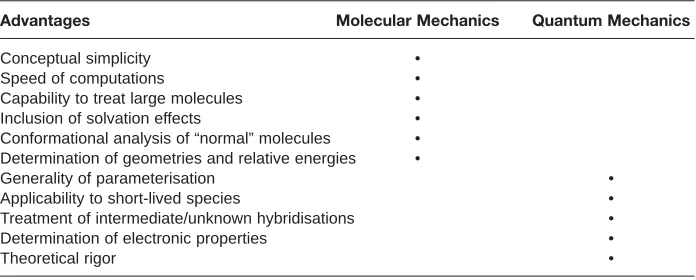
Each method has its own strengths and weaknesses. Thus, research is required to find the best method for a particular theo-retical investigation. In evaluating meth-ods computational time and cost are important factors to consider, as higher levels of theory are more expensive in terms of computing time. Table 1 com-pares quantum mechanics and molecular mechanics.
The calculations involved in molecular mechanics are much simpler than the semi-empirical calculations while the ab initio calculations are the more rigorous. As a result the molecular mechanics culations are faster and the ab initio cal-culations take longer and use more com-puting power. Molecular mechanics is the method of choice for computing the struc-tures and energies of medium to large molecules (50-100+ atoms).
Molecular mechanics (MM) is an empirical method based on a simple clas-sical-mechanical model of molecular structure (17). MM models molecules as a series of balls and springs. The
calculat-The use of molecular modelling in studying
pitch deposition
KAREN R STACK1AND BRIAN F YATES2.
1Research Fellow and corresponding author ([email protected]), 2Associate Professor
School of Chemistry University of Tasmania
Private Bag 75, Hobart, Tasmania 7001.
SUMMARY
Molecular modelling is proving to be a useful tool in understanding the funda-mental interactions between molecules and surfaces. With the use of the super-computer at Australian National University (ANU) calculations on quite large mole-cules such as triglycerides and polymers can be made. The effect of the chemical structure of different fixatives on the inter-action with the various components within pitch can be understood with the use of molecular modelling. Care is needed in choosing the most appropriate method to model the interactions. Geometry optimi-sation at the higher level of theory using quantum mechanics is needed. Comparison of different quantum mechan-ical methods yielded similar results indi-cating that the methods using the less computing power would be adequate in helping to gain a more fundamental understanding of the interactions that occur between various fixatives and pitch.
KEYWORDS
Pitch deposition, molecular mod-elling, wood extractives, fixatives
INTRODUCTION
Major developments in physical and bio-logical sciences over the past ten to twenty years have been helped by increased com-puting power and the development of pro-grams to model behaviour of molecules. This rapid developing field of science is called Molecular Modelling. It is also referred to as Computational Chemistry.
ed energy is the sum of contributions aris-ing from the ‘ideal’ bond distances, angles, torsional angles and non-bonded contributions such as the van der Waals and charge-charge interactions (18). In the calculations a set of equations, called a force field, is used. The parameters used to define the force fields have been derived experimentally and also by calcu-lation. In calculating the energy of any system only the nuclei positions are con-sidered and the electrons are included implicitly. This can lead to inaccuracies as molecular orbital interactions are unac-counted for (19). This method has the advantage that more atoms can be includ-ed in the calculations comparinclud-ed with higher levels of theory (18,19). Some commonly used force fields are AMBER, CHARMM, MM2 and MM3. AMBER and CHARMM have been constructed for biological molecules and are not really suitable for assessing geometries of steri-cally congested molecules (15). MM2 and MM3 were developed for aliphatic alka-nes (20).
Semi-empirical and ab initio methods calculate the energy of a molecule by con-sidering the interaction of each electron with the average field of all the other elec-trons. Quantum mechanics gives a math-ematical description of the behaviour of electrons using wave functions (21). Account is taken of the kinetic energy of the particles and Coulombic interactions between the electron and nuclei. Semi-empirical methods simplify the calcula-tion by neglecting core orbitals. These methods are based on quantum mechan-ics, but also include values obtained through empirical parameterization (22). Ab initio calculations only use mathe-matical approximations called basis sets to calculate the atomic and molecular orbitals, thereby removing experimental
bias, and can be applied to systems where experimental data is not available. The calculations are more complex and require more computing time than for MM (21). The most common type of ab initio calculation is the Hartree Fock (HF) calculation. An alternative to the ab initio method is Density Functional Theory (DFT) which looks at the total electron density rather than a wavefunction to cal-culate the energy of a molecule (23).
What is involved in doing the cal-culations?
After deciding what calculations are required the user must provide some start-ing information. This input generally contains three parts:
• The geometry of the molecule which includes either a set of cartesian coor-dinates or a list of atom types, bond lengths, bond angles and dihedral angles. This geometry is just a start-ing point created usstart-ing a computer package that defines the appropriate bond lengths and angles.
• The kind of calculation to be done eg single point energy calculation or optimised geometry calculation to find the minimum energy conforma-tion
• The starting set of mathematics and approximations given by a command that indicates the method being used and the basis set. For example the command line HF/6-31G(d) indicates that Hartree Fock approximation will be used using a basis set of 6-31G(d). The basis set is a table a numbers which mathematically estimates where the electrons might be. There are differ-ent basis sets depending on the degree of accuracy required. However, the greater the degree of accuracy of the basis set the larger the calculation.
Solvation
The molecular mechanics and molecular orbital calculations treat the molecules as being alone in a vacuum. There are no neighbouring molecules of any kind and also no solvent. For many applications the gas phase calculations adequately model and predict the information required. For other systems where molecules are in solution and solvent-solute interactions are important then it may be important to model the systems in the presence of sol-vent molecules. The interaction between the solvent and solute molecules may have a significant effect on the way the molecules in the complex interact. The simplest way to take into account the influence of the solvent is to include the appropriate dielectric constant. This assumes that the major effect of the sol-vent is to screen the electrostatic interac-tions of the solute (1). This method has clear limitations as it does not consider solvent-solute interactions.
Another method used to account for solvation is to construct a solvent shell consisting of anywhere from several dozen to several hundred solvent molecules about the solute. The size of the system usually prohibits analysis by quantum mechanical methods.
The third approach is to treat the sol-vent as a continuum which is charac-terised by a bulk dielectric constant. The solute molecule is placed in a cavity in the solvent. In the calculations the surface of the cavity is divided into small tesserae. The free energy of solvation is deter-mined and is equal to the free energy change to transfer a molecule from vacu-um to solvent. The main contributions to the solvation come from:
1. The cavitation energy of the formation of the hole which preserves the dis-solved species in the solvent
2. The electrostatic interaction of the solute with the solvent
[image:2.595.34.382.101.241.2]3. The dispersion and repulsion energies The third approach is the one undertak-en in this paper. The results of including solvation are compared with the gas phase calculations in order to determine the best approach to model the pitch-fixative interactions. It is very easy to generate numbers from the calculations and also create 3-D models on the computer screen but to ensure they are meaningful they need to have some basis in the experi-mental work.
Table 1
Comparison of Quantum and Molecular Mechanics
Advantages Molecular Mechanics Quantum Mechanics
Conceptual simplicity •
Speed of computations •
Capability to treat large molecules •
Inclusion of solvation effects •
Conformational analysis of “normal” molecules • Determination of geometries and relative energies •
Generality of parameterisation •
Applicability to short-lived species •
Treatment of intermediate/unknown hybridisations •
Determination of electronic properties •
EXPERIMENTAL
Laboratory studies of deposition behaviour of model pitch dispersions and various polymeric fixatives have been previously reported and the experimental procedure described (16).
Theoretical Calculations
The chemical structures of the resin acids, fatty acids, triglycerides and model struc-tures for the fixatives investigated were first drawn in Spartan®. Initial geometry optimisation of each molecule and then the complex formed between the wood extractives and the model polymeric fixa-tives was carried out using molecular mechanics and the MM3 force field on the Pentium cluster of fifteen dual proces-sor Pentiums using a Linux operating sys-tem at School of Chemistry University of Tasmania. Further optimisation of the geometry was undertaken using ab initio calculations through the supercomputer at the Australian Partnership for Advanced Computing (APAC) facility in Canberra using the Gaussian 03 program. Both Hartree Fock and density functional theo-ry were used with a variety of basis sets.
The heat of formation (Hf) for each sin-gle component and interaction was obtained via the Gaussian 03 program using Hartree Fock and density functional theory. The minimum basis set STO-3G as well as the split-valence basis set 6-31G(d) which added a set of d polarisation func-tions to each heavy atom were used.
Solvation Free Energy (∆Gsol) for the individual molecules and also complexes were determined using the polarisable continuum model with both HF and DFT levels of theory using Gaussian 03 pro-gram on the APAC super computer.
RESULTS AND DISCUSSION
A series of laboratory experiments had been undertaken and previously reported (16) to investigate the interaction between various polymeric fixatives and wood resin extractives that lead to pitch forma-tion. In this study model compounds of abietic acid, oleic acid and triolein were used to represent the major components of wood resin extractives. The fixatives investigated were polyethyleneimine (PEI), cationic polyacrylamide (CPAM), a medium and a high charged co-polymer of polyacrylamide and poly (diallyl-dimethyl ammonium chloride) (denoted by MCD PAMDAD and HCD
PAM-DAD). The results of the experiments in which each of the four different fixatives were added to the individual model com-ponents at pH7 in the absence and pres-ence of fibres are shown in Figures 1 and 2. In the absence of fibres (Fig. 1) abietic acid, oleic acid and triolein show a strong deposition tendency. The addition of the fixatives appears to reduce this deposition
tendency indicating that an interaction between the fixative and wood resin com-ponent is occurring. The results indicate that slight differences in the fixative -wood resin interaction occurs between the various fixatives, with CPAM and the two copolymers reducing the deposition ten-dency of abietic acid to a greater extent than PEI while PEI and CPAM reduce
Fig. 1 Deposition of abietic acid, oleic acid and triolein in the absence of fibres at pH 7.
blank PEI CPAM MCD
PAMDAD
HCD PAMDAD 120
100
80
60
40
20
0
Abietic acid Cleic acid Triolein
% deposition
Fig. 2 Deposition of abietic acid, oleic acid and triolein in the presence of fibres at pH 7 (Error bars indicate ±1 std.dev. from mean).
blank
Triolein
% Deposition of Single Component vs Fixative
PEI CPAM
Fixative
MCD PAMDAD
HCD PAMDAD 100%
80%
60%
40%
20%
0%
% fibre-deposition % DCS % Surface deposition
% T
riolein
blank
Oleic Acid
PEI CPAM
Fixative
MCD PAMDAD
HCD PAMDAD 100%
80%
60%
40%
20%
0%
% fibre-deposition % DCS % Surface deposition
% Oleic Acid
blank
% Deposition Single Component-Abietic Acid
PEI CPAM Fixative
MCD
PAMDAD PAMDADHCD 100%
80%
60%
40%
20%
0%
% fibre-deposition % DCS % Surface deposition
[image:3.595.260.516.189.675.2]oleic acid deposition and the high charged copolymer reduces triolein deposition.
In the presence of fibres (Fig. 2) all the fixatives appear to selectively attach abi-etic acid onto fibres at 1 kg/tonne addi-tion. Oleic acid, on the other hand, appears to be stabilised in the dissolved colloidal fraction in the absence of fixa-tive and the addition of PEI was found to have very little impact. The addition of CPAM and the copolymers appear to reduce the amount of oleic acid in the col-loidal phase and deposit it onto fibres and other surfaces. The medium charge co-polymer exhibited greater preference in fibre-attachment of the oleic acid. Polyethylenimine (PEI) was found to preferentially interact with triolein.
To further understand the results of the deposition work and gain a better under-standing of how the different fixatives interact with wood resin components some molecular modelling calculations were then undertaken. Abietic acid and oleic acid were modelled as deprotonated species in order to investigate the interac-tions between the charged species under neutral pH conditions. At neutral pH most of the species present would be negative-ly charged and hence they would interact with positively charged fixatives. Triolein is a neutral species and was mod-elled as such. Models of the fixatives were constructed by combining several monomers together. The oligomers were only a representation of the fixatives as the molecular weights of the polymers were very large. The end group of the oligomers were also "capped" with a -CH2CH3functionality to prevent interac-tion with the end group.
Literature searching provided several possible structures for cationic polyacry-lamide (24,25). These tended to differ in groups attached to the cationic nitrogen (-CH3, -C2H5) and structure of the major
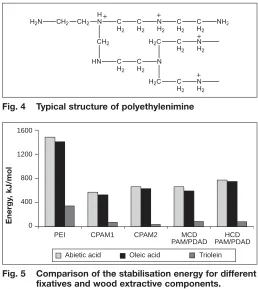
branching chain. Two different types of CPAM as shown in Figure 3 were thus modelled in order to investigate the effect of the chemical structure on the interaction. Different structures of PEI were also modelled as PEI can have primary, sec-ondary and tertiary cationic nitrogens in its structure (Fig. 4). It is generally thought that the number of primary and tertiary amine groups is equal and amount to 25% of the total amines present, mak-ing 50% secondary amines (26).
The stabilization energy was calculat-ed at different levels of theories and using different basis sets. The stabilisation energy (SE) was calculated to gain an understanding of the stability of the com-plexes formed. The SE is calculated from the change in Hfbetween the single com-ponents and the complex formed between the two components.
SE = (HfA + Hf B)- Hf complex
If there is a strong stabilisation energy this indicates that the complex has a lower energy than the single components, and therefore is more likely to be formed. A strong stabilisation energy therefore would result in the polymer binding to the com-ponent and increasing deposition tendency. The calculations performed in the gas phase predict that some differences in the interaction between the different fixatives
and the wood extractives occur. The methods employed show a strong depen-dence on the charge-charge interactions between the fixative and the wood resin extractive components. PEI at the same charge density is predicted to form the strongest interaction followed by the copolymers (Fig. 5) though the differ-ences calculated are much more that the experimental deposition results would suggest (16).
What is the best method to use?
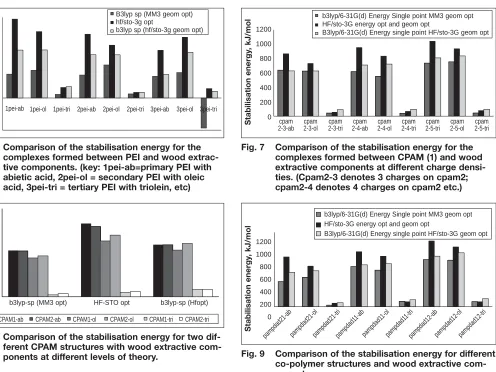
The method used to calculate the stabili-sation energy particularly for PEI appears to be important as shown in Figure 6. In this figure the results at three different levels of theory are compared for the interaction between primary, secondary and tertiary PEI with abietic acid, oleic acid and triolein. The optimisation of the geometry at the lowest level of theory (MM3) followed by single point calcula-tion of the energy at a higher level of the-ory using density function thethe-ory results in lower values of the stabilisation energy and also some negative values compared to when the geometry is reoptimised at a higher level of theory. Experimental deposition results showed that a complex is formed with triolein (16) and so the negative results indicate that the way the calculations are performed does not
prop-Fig. 3 The monomers of CPAM-1 (left) and CPAM-2 (right)
Fig. 4 Typical structure of polyethylenimine
Fig. 5 Comparison of the stabilisation energy for different fixatives and wood extractive components.
(B3lyp/6-31G(d) single point energy calculation with MM3 geometry optimisation).
PEI CPAM1 CPAM2 MCD
PAM/PDAD PAM/PDADHCD 1600
1200
800
400
0
Abietic acid Oleic acid Triolein
Energy
[image:4.595.304.562.69.358.2] [image:4.595.33.292.70.215.2]erly represent the real system. Re-optimi-sation of the geometry using ab initio methods (HF/STO-3G) appears to over-come this problem and a positive stabili-sation energy is obtained for the interac-tion with triolein though it is significantly lower than the interaction with abietic and oleic acid. This is due to the strong charge interaction between the cationic amine group of PEI and the deprotonated carboxylic acid groups of abietic acid and oleic acid.
The Hartree Fock (HF/STO-3G) calcu-lations predict that abietic acid interacts with primary amine and secondary amine groups in PEI more strongly than oleic acid and that oleic acid interacts more strongly with a tertiary amine group. Slightly different predictions are obtained from the density functional theory (B3LYP/6-31G(d)) calculations which indicate that the stabilisation energy of the complexes with a primary and sec-ondary amine are similar.
What is the effect of charge and chemical structure?
One of the main benefits of molecular modelling is to be able to investigate the effect of modifying the chemical structure
of a fixative and determining the effect this may have on the interaction with the other chemical components.
Interaction with PEI
Calculations of the stabilisation energy show that the type of cationic amine in the PEI affects the strength of interaction with abietic acid as well as oleic acid (Fig. 6). A primary amine forms the most sta-ble complex while the tertiary amine forms the weakest complex. Steric effects appear to be contributing to this.
Interaction with CPAM
The stabilisation energy calculated for the interaction between CPAM-2 and abietic acid, oleic acid and triolein is shown in Figure 7. The CPAM was modelled with three, four and five charges (CPAM2-3, CPAM2-4, CPAM2-5). HF/STO-3G again appears to calculate higher results for the stabilisations of the complexes. Increasing the charge on the fixative was found to increase the stabilisation energy with oleic acid and abietic acid using the three different calculation methods. Varying the structure of the CPAM was found to have very little effect on the
sta-bilisation energy calculated (Fig. 8) for the interaction with abietic acid and tri-olein though some difference was observed when interacting with oleic acid particularly when the geometry of the complexes were optimised at the higher levels of theory.
Interaction with copolymer
In order to investigate the relative stabili-ties of differently charged co-polymers, a high, medium and low charged model co-polymer were investigated. The model of a low charged polymer was made from a 2:1 ratio of neutral PAM:charged polyDADMAC. The medium charged was a 1:1 ratio of the two monomer groups. The highly charged co-polymer was an oligomer comprising a 1:2 ratio. In order to maintain consistency, the oligomers each comprised six monomer groups. Computational calculations (Fig. 9) predicted an increase in the complex stability with abietic acid and oleic acid as the charge ratio of the charged co-poly-mer increased. This is due to the charge-charge interactions influencing the stabil-isation energy. As charge increases, Coulombic attraction would increase and
Fig. 6 Comparison of the stabilisation energy for the complexes formed between PEI and wood extrac-tive components. (key: 1pei-ab=primary PEI with abietic acid, 2pei-ol = secondary PEI with oleic acid, 3pei-tri = tertiary PEI with triolein, etc)
1pei-ab 1pei-ol 1pei-tri 2pei-ab 2pei-ol 2pei-tri 3pei-ab 3pei-ol 3pei-tri 1000
800
600
400
200
0
-200
-400
B3lyp sp (MM3 geom opt) hf/sto-3g opt
b3lyp sp (hf/sto-3g geom opt)
Stabilisation energy
, KJ/mol
Fig. 7 Comparison of the stabilisation energy for the complexes formed between CPAM (1) and wood extractive components at different charge densi-ties. (Cpam2-3 denotes 3 charges on cpam2; cpam2-4 denotes 4 charges on cpam2 etc.)
cpam
2-3-ab cpam2-3-ol cpam2-3-tri 2-4-abcpam 2-4-olcpam cpam2-4-tri cpam2-5-tri cpam2-5-ol 2-5-tricpam 1200
1000
800
600
400
200
0
b3lyp/6-31G(d) Energy Single point MM3 geom opt HF/sto-3G energy opt and geom opt
B3lyp/6-31G(d) Energy single point HF/sto-3G geom opt
Stabilisation energy
, kJ/mol
Fig. 8 Comparison of the stabilisation energy for two dif-ferent CPAM structures with wood extractive com-ponents at different levels of theory.
CPAM1-ab CPAM2-ab CPAM1-ol CPAM2-ol CPAM1-tri CPAM2-tri 1200
1000
800
600
400
200
0
b3lyp-sp (MM3 opt) HF-STO opt b3lyp-sp (Hfopt)
Stabilisation energy KJ/mol
Fig. 9 Comparison of the stabilisation energy for different co-polymer structures and wood extractive com-ponents.
pampdad21-abpampdad21-olpampdad21-tripampdad1 1-ab
pampdad1 1-ol
pampdad1 1-tri
pampdad12-abpampdad12-olpampdad12-tri
1200 1000
800
600
400
200 0
b3lyp/6-31G(d) Energy Single point MM3 geom opt HF/sto-3G energy opt and geom opt
B3lyp/6-31G(d) Energy single point HF/sto-3G geom opt
Stabilisation energy
[image:5.595.65.561.64.436.2] [image:5.595.38.339.64.404.2]affect the complex energy. Little differ-ence was predicted for complexes with triolein, as the complex only involved charge-neutral interactions.
Effect of Solvation
Calculations were performed to calculate the free energy of solvation and the vated stabilisation energy. Including sol-vation does result in a substantial percent-age increase in the computation time and memory requirements. Single point calcu-lations in the solvent using the optimised gas phase molecular structure were under-taken. Calculations of the larger complex-es with triolein could not be performed because of memory limitations.
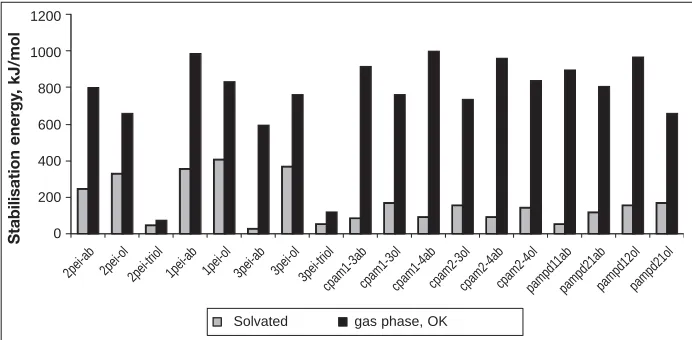
Figure 10 shows the calculated stabili-sation energy of the interaction between the fixatives studied (PEI, two types of CPAM and a PAM/polyDADMAC co-polymer and abietic acid, oleic acid and triolein. The results show that including solvation effects dramatically reduces the calculated stabilisation energy. The decrease in the strength of interaction between the fixative and abietic acid and oleic acid is due to the strong solvent-solute interactions between the individual components and water. A greater decrease appears to occur with the abietic acid compared to the oleic acid. The solvent effects also appear to decrease the inter-action with the CPAM and copolymers fixatives compared to PEI. Despite this stable complexes are formed.
There does not appear to be a direct correlation with the deposition results in Figures 1 and 2 and the theoretical calcu-lations of the stabilisation energy of the complexes formed. The calculations indi-cate a stronger interaction with PEI and the three wood resin components
com-pared to the other fixatives. This is not reflected in the deposition results except for the triolein. There may be several rea-sons for this. The first being that the cal-culations were performed on models of the fixatives consisting of only 6 monomer units when in reality there is considerably more. The interaction may be occurring but a complex is formed that is stabilised in the colloidal fraction and not attached to the fibres or deposited.
CONCLUSIONS
Molecular modelling is a powerful tech-nique for helping to understand the interac-tions between molecules. As computing power increases and as more people become familiar with molecular modelling techniques it will become a powerful tool for papermakers and chemical suppliers.
Care is needed, however, in choosing the correct approach for calculations. It is important that some check be made to ensure that the approach undertaken is valid such as comparing the predicted results with experimental data.
Modelling the effect of the charge and chemical structure of different fixatives provides insight into the parameters and interactions that are important. Calculations show that PEI interacts more strongly with abietic and oleic acid than CPAM and PAM/poly DADMAC co-mers. Increasing the charge on the poly-mer increased the interaction and the type of cationic nitrogen was also important.
For the purpose of the fixative-pitch sys-tems being modelled it was found that opti-mising the geometry at the lowest level of theory and then a single point calculation of the energy at a higher level of theory seemed adequate for modelling the interac-tions with abietic acid and oleic acid. This
approach was not appropriate for the tri-olein complexes as negative stabilisation energies were obtained. Reoptimisation of the geometry at the higher level of theory (Hartree Fock) with a minimum basis set (STO-3G) was needed.
Including the effect of solvation greatly increases the computing time and memory required. Some of the larger triolein com-plexes could not be calculated using ab ini-tio methods. The calculated values show that the strength of interaction between the solute molecules decreases due to strong solvent-solute interactions compared to gas phase calculations. Differences in the trends between the solvation calculations and the gas phase calculations were evi-dent indicating that it is important to include solvation when predicting trends in interactions between fixatives and wood extractive components.
ACKNOWLEDGEMENTS
Financial support for this project was pro-vided by Norske-Skog Paper and an ARC Linkage grant. Computing time on the Super Computer at the Australian Partnership for Advanced Computing National Facility was obtained through the Merit Allocation Scheme.
Lynsey Maher is acknowledged for carrying out the MM3 geometry optimisa-tion and energy calculaoptimisa-tions at B3LYP/6-31G(d). The assistance and advice from the computational chemistry group in the School of Chemistry, University of Tasmania was greatly appreciated.
REFERENCES
(1) Grant G and Richards G, Computational Chemistry, Oxford University Press, New York, (1995).
(2) Hinchliffe A, Modelling Molecular Structures, John Wiley, West Sussex, (1994). (3) Leach A, Molecular modelling Principles and
Applications, Longman, Singapore, (1996). (4) Goodman J, Chemical applications of
molec-ular modelling, Royal Society Chemistry, Cambridge, (1998)
(5) Glasser W and Glasser H,- Evaluation of lignin's chemical structure by experimental and computer simulation techniques., Paperi ja
Puu 2:71-83 (1981).
(6) Elder T and Worley S, - The application of molecular orbital calculations to wood chem-istry. The dehydrogenation of coniferyl alco-hol., Wood Sci. Technol. 18:307-315 (1984). (7) Jurasek L,- Toward a three-dimensional model
of lignin structure., J. Pulp Paper Sci. 21:274-279 (1995).
(8) Durbeej B and Eriksson L,- Formation of β -O-4 lignin models - a theoretical study.,
Holzforschung 57:466-478 (2003).
[image:6.595.34.380.71.241.2](9) L’Ecuyer N, Laplante M and Robert S,
Fig. 10 The effect of solvation on stabilisation energy for different fixative and wood extractive components.
2pei-ab 2pei-ol 2pei-triol 1pei-ab 1pei-ol 3pei-ab 3pei-ol 3pei-triol
cpam1-3abcpam1-3olcpam1-4abcpam2-3olcpam2-4abcpam2-4olpampd1 1ab
pampd21abpampd12olpampd21ol
1200
1000
800
600
400
200
0
Solvated gas phase, OK
Stabilisation energy
, kJ/mol
Molecular simulation and reaction mecha-nisms of the reductive bleaching of mechanical pulps by amineboranes., 13th ISWFPC
Conference Proceedings, Auckland, New
Zealand, 265-271(2005)
(10) Gaudreault R, Van de Ven T and Whitehead M,- Molecular modeling of poly(ethylene oxide) model cofactors; 1,3,6triOgalloyl_ -D-glucose and corilagin., J. Mol Model 8:73-80 (2002).
(11) Vercoe D, Stack K, Blackman A, Yates B and Richardson D,- An Innovative Approach Characterizing the Interactions Leading to Pitch Deposition J. Wood Chem. Tech. 24(2): 115(2004)
(12) Stack K, -The Use of molecular modelling to study pitch deposition and interactions with fixative, Proc. First Applied Pulp and Paper
Molecular modelling symposium., Montreal,
p135 (2005).
(13) Gaudreault R – Salt necessary for PEO-cofac-tor association: The role of molecular mod-elling in PEO flocculation mechanisms, Proc.
First Applied Pulp and Paper Molecular mod-elling symposium., Montreal, p155 (2005).
(14) Vercoe D - Gaining insight into interactions
leading to wood pitch deposition: Correlations between theoretical and experimental results.,
Proc. First Applied Pulp and Paper Molecular modelling symposium., Montreal, p195 (2005).
(15) Lipkowitz K, - Abuses of molecular mechan-ics: pitfalls to avoid., J. Chem Educ. 72(12): 1070-1075 (1995)
(16) Maher L, Stack K, McLean D and Richardson D,- Adsorption behaviour of cationic fixatives and their effect on pitch deposition, 59th
Appita Annual General Conference Proceedings, Auckland New Zealand, 115-122
(2005).
(17) Hinchliffe, A, Chemical Modeling from Atoms to Liquids., 161-184, John Wiley & Sons, Ltd: West Sussex. (1999)
(18) Young, D C, Computational Chemistry: A Practical Guide for Applying Techniques to Real World Problems. p49-59, John Wiley & Sons, Inc.: New York. (2001)
(19) Burkert, U and Allinger, N L, Molecular Mechanics. 1-15, American Chemical Society: Washington, D. C. (1982)
(20) Allinger N, Yuh Y and Lii J-H,- Molecular mechanics. The MM3 force field for hydro-carbons. 1., J. Am.Chem.Soc.,
111(23):8551-8556 (1989).
(21) Young, D C, Computational Chemistry: A Practicle Guide for Applying Techniques to Real World Problems. p19-29, John Wiley & Sons, Inc.: New York. (2001)
(22) Young, D C, Computational Chemistry: A Practicle Guide for Applying Techniques to Real World Problems. p32-41, John Wiley & Sons, Inc.: New York. (2001)
(23) Young, D C, Computational Chemistry: A Practicle Guide for Applying Techniques to Real World Problems. p.42-48, John Wiley & Sons, Inc.: New York.( 2001)
(24) Lindström, T, Söremark, C, Heinegård, C, and Martin-Löf, S, – The importance of electroki-netic properties of wood fiber for papermak-ing, Tappi J, 57(12): 94-96(1974.).
(25) Lindström, T and Wågberg, L, – Effects of pH and electrolyte concentration on the adsorption of cationic polyacrylamides on cellulose.,
Tappi J,. 66(6): 83-85(1983).
(26) Aloi, F G and Trsksak, R M, Retention of Fines and Fillers During Papermaking, Gess, J M, Editor. p61-108, TAPPI Press: Atlanta. (1998).
Original manuscript received 1 August 2006, revision accepted 4 September 2007 Towards complete impregnation of wood chips
with aqueous solutions. Part 3. Black liquor penetration into pine chips, Pap. Puu 83(8):608–609 (2001).
(13) Aurel, R, Stockman, L and Teder, A – Flisens impregnering vid sulfitkokning, Del 2, Sven.
Papperstidn. 61(21):937–944 (1958).
(14) Malkov, S, Tikka, P, Kuzmin, V and Baltakhinov V – Efficiency of chip presteam-ing—result of heating and air escape process-es, Nord. Pulp Pap. Res. J. 17(4):423–425 (2002).
(15) Matsumara, J, Booker, R E, Donaldson, L A and Ridoutt, B G – Impregnation of radiata pine wood by vacuum treatment: Identification of flow paths using fluorescent dye and confo-cal microscopy, IAWA J. 19(1):25–33 (1998). (16) Paranyi, N I and Rabinovitch, W –
Determination of Penetration Rates of Liquid Media into Wood Using a Quartz Spiral Balance. Part I—Water and an Air-dry Spruce Chip, Pulp Pap. Mag. Can. 56(3):166–169 (1955).
(17) Woods, N I – Determination of Penetration Rates of Liquid Media into Wood Using a Quartz Spiral Balance. Part II: Water and a Pre-Treatment Spruce Chip, Pulp Pap. Mag.
Can. 57(5):147 (1956).
(18) Uhmeier, A – Pressure-Impregnation Technique for Wood Chips, J. Pulp Pap. Sci. 23(4):J163–J165 (1997).
(19) Robertsén, L, Pekkala, O and Leminen, A – Impregnation of wood with white and black liquor, SPP Progress ’99, Krakow, p.IV-4-5 (1999).
(20) Malkov, S – Studies on Liquid Penetration into Softwood Chips—Experiments, Models and Applications, Doctoral Thesis, Helsinki University of Technology, Espoo, pp.20–21. (2002).
(21) Stone, J E – The effective capillary cross-sec-tional area of wood as a function of pH, Tappi
J. 40(7):540–541 (1957).
(22) Hartler, N – Penetrerings- och diffusions-förhållandena vid sulfatkoket, Pap. Puu 44(7):366–369 (1962).
(23) Akhtaruzzaman, A F M and Virkola, N-E – Influence of chip dimensions in kraft pulping. Part IV. Effect on screened pulp yield and effective alkali consumption; predictive math-ematical methods, Pap. Puu 61(12):806–809 (1979).
(24) Akhtaruzzaman, A F M and Virkola, N-E – Influence of chip dimensions in kraft pulping. Part III. Effect on delignification and a mathe-matical model for predicting the pulping parameters, Pap. Puu 61(11):741–747 (1979). (25) Gullichsen, J – Fiber line operations, In Gullichsen J and Fogelholm, C-J (eds.) Papermaking Science and Technology -Book 6A: Chemical pulping, Fapet Oy, Helsinki, p.A44 (1999).
(26) Pekkala, O. – On the extended delignification using polysulphide or anthraquinone in kraft pulping, Pap. Puu 64(11):735–736 (1982). (27) Marcoccia, B, Prough, J R, Engström, J and
Gullichsen, J – Continuous cooking applica-tions, In Gullichsen J and Fogelholm, C-J (eds.) Papermaking Science and Technology - Book 6A: Chemical pulping, Fapet Oy, Helsinki, p.A530 (1999).
(28) Ingruber, O V – Alkaline Digester Systems, In Grace, T.M., Leopold, B. and Malcolm, E.W. (eds.) Pulp and Paper Manufacture -Volume 5: Alkaline Pulping, Joint Textbook Committee of the Pulp and Paper Industry (TAPPI/CPPA), Atlanta (GA), pp.167–173 (1989).
(29) Liiri, J – Sahanpurun keittoprosessin ja sen lämpötilasäädettävyyden tutkiminen jatkuva-toimisella Enso-Bauer M & D –keittimellä, Master’s thesis, Lappeenranta University of Technology, Lappeenranta, pp.15–17 (1979). (30) Miele, J J, Marois, M, Chasse, R F, Chamblee,
J W, Weston, J D and Prough, J R Method for pulping sawdust. U.S. Pat. 6,325,888 B1 (2001).
(31) Rantasuo, P – Framställning av sågspånscellu-losa med Enso-Bauer M&D-kokare, Norsk
Skogind. 30(6):187 (1976).
(32) Anon. – The biggest and the best environmen-tal and energy equipment available today,
FiberSpectrum 3(2):11 (2004).
(33) Hultholm, T – Impregnation behaviour of the active ions in the kraft process, Doctoral Thesis, Åbo Akademi University, Turku, pp.93–95 (2004).
(34) Gold, V, Loening, K L, McNaught, A D and Sehmi, P (eds.) – Compendium of Chemical Technology - IUPAC recommendations, Blackwell Scientific Publications, Oxford, pp.121–122 (1987).
(35) Wilson, K. – Bestämning av effektivt alkali i svartlut, Sven. Papperstidn. 71(11):446–447 (1968).
(36) Korpinen, R – Simulering och optimering av sågspånskok i laboratorieskala, Master’s the-sis, Åbo Akademi University, Turku, pp.47–50 (2002).
(37) Rekunen, S, Jutila, E, Lähteenmäki, E, Lönnberg, B and Virkola, N-E – Examination of reaction kinetics in kraft cooking, Pap. Puu 62(2):80–81 (1980).
(38) Alén, R – Basic chemistry of wood delignifi-cation, In Stenius P. (ed) Papermaking Science and Technology - Book 3: Forest Products Chemistry, Fapet Oy, Helsinki, p.65 (2000).
(39) Korpinen, R and Fardim, P – Characterisation of sawdust-like wood materials, Proc. 9th
EWLP, Vienna, pp.316–318 (2006).
(40) Bail, C M – Sawdust pulping continues to grow; technology improves yield, strength,
Pulp Pap. 53(2):105–107 (1979).
Original manuscript received 27 June 2007, revision accepted 23 October 2007