*Corresponding author
E-mail addresses: [email protected]; [email protected] Received August 27, 2018
J. Math. Comput. Sci. 9 (2019), No. 1, 87-101 https://doi.org/10.28919/jmcs/3867
ISSN: 1927-5307
Multi-objective optimization model formulation for regional bus scheduling problem
SAIDY RAPHAEL1,*, HALIDI LYEME2 AND DMITRY KUZNETSOV1
1Department of Applied Mathematics and Computational Sciences, Nelson Mandela African Institution of Science
and Technology, P. O. Box 447, Arusha, Tanzania
2Department of Mathematics, Muslim University of Morogoro, P. O. Box 1031, Morogoro, Tanzania Copyright © 2019 the authors. This is an open access article distributed under the Creative Commons Attribution License, which permits unrestricted use, distribution, and reproduction in any medium, provided the original work is properly cited.
Abstract: In this paper we present a model for scheduling and routing of regional passenger’s buses in Tanzania. A
multi-objective optimization model for scheduling of the regional passenger's bus routing problem was formulated where by a mixed-integer programming was used to address the conflicting objectives of maximization of profit and minimization of the running costs. The set of real data collected from SUMATRA, EWURA and buses companies in Arusha were used as model input parameters. The analysis of the model was carried out to determine how the routes provide maximum profit and minimize running costs also the lexicographic goal programming method has been employed to solve the proposed model. Based on the analysis and cost dealings, best routes were selected. The results show significant improvements and cost savings for the regional passenger’s bus transport system.
Keywords: regional bus routing; multi-objective optimization; lexicographic goal programming.
1. Introduction
Transport is an essential tool in helping the creation of a single socio-economic space that would
result to free movement of goods and persons. Transport service industry comprises of several
modes which range from air, water, railways, pipelines and road transports. Road passenger
transport is now identified as one of the most important means of facilitating movement of people
and parcels in the country. Furthermore, people are now depending much on road transport due to
the poor condition of other inland transport systems notably railways. The significant role played
by this mode of transport is due to its accessibility, flexibility and affordability to most of the
Tanzanian citizens. For many years, the transport sector in Tanzania has helped to increase access
to farming implements, movement of farm products, integrate markets, strengthening competition,
tourism, foreign investment, promote trade, and has contributed to government revenues [1]; [2] .
How to transport passengers to and from their designated terminals is an important question facing
many bus companies and managers and hence needs a careful and planed schedule of different
routes. Bus scheduling is a process that deals with the proper assignment of buses to a given route
to serve the expected daily passenger demand. Using too many buses incurs additional operational
cost to the company and using too few buses will decrease the service quality and increases the
waiting time of passengers at the bus stops [3].
For a long time, most passenger road transport companies in Tanzania have got poor performance
in operation and even some of them failed totally to operate their business activities due to various
problems. Example Kamata, Scandinavia, Zafanana, Mwanahapa, Kibo, Lang'ata, Summry just to
mention few are no longer operating due to various problems [1]. [4] elaborates that performance
of passenger’s road transport services for many companies in Tanzania is continued to be provided
with significant high costs and not systematically planned. The bus routing problem is one of the
major problems facing many bus companies and managers in the world. In many cities in Tanzania
such as Dar es Salaam, Arusha, Mwanza, Tanga and Mbeya, most companies that provide this
service have inadequate knowledge on how to route and schedule their buses. This problem has
of the customer’s needs in the transportation market. There are a number of studies have
investigated on scheduling of vehicles for public transportation systems. However, among those
studies the problem on how to route and schedule their buses has not received much consideration.
[5] presented a model and related analysis for scheduling and routing of public buses in Kuwait.
The approach used is simpler and more realistic for applying the model to real problems of public
transportation planning problems. The linear programming model is developed to determine the
optimal number of seats required for the selected routes at a given time slots. [6] have developed
a new intercity bus schedule for the Saudi Public Transport Company (SAPTCO) model for
maximize profit and yield additional revenue, were the main objectives was to evaluate the
maintenance and the operations department through developing a new fleet assignment model
(new bus schedule). The model proposed a new assignment system which considers maximizing
the utilization of any bus in the fleet. The study done by [7], developed the heuristics approach for
solving a largescale vehicle-scheduling problem with route time constraints. In their work a new
formulation for multi depot vehicle scheduling (MDVS) and multi depot vehicle scheduling
problem with route time constraints (MDVSRTC) have been proposed. [8] proposed a linear
programming model for the bus scheduling problem specifically for Kuwait Public Transport
Company (KPTC) the aims were to improve current scheduling operations, reducing the running
costs of different routes with better service to the passengers and increasing their efficiency, for
each time slot the linear program was applied separately and then combined the results into a final
solution. In addition, the model appeared to be very helpful in defining optimal number of assigned
seats per route per time slot.
The multi-objective mixed integer linear programming model based on Tchebycheff methods for
VRP with a heterogeneous fleet was proposed by [9], in which the objectives of the model were to
minimize the total internal costs, while minimizing some environmental considerations as the
𝐶𝑂2and 𝑁𝑂𝑋 emissions. The results showed a positive contribution towards a more sustainable
balance between economic, environmental and social objectives. Computational results show good
flow problem to produce timetables and bus routes/schedules for inter-city bus carriers with the
aims to maximize the profits. In the study by [11] a mixed integer mathematical model for the
integration of Anbessa city bus and Addisababa light rail transit was formulated, the objective of
their study was to maximize number of simultaneous arrivals. The results showed that the proposed
model reduces waiting time by decreasing headways to achieve synchronization. [12] formulated
a multi-objective mathematical model for urban school bus routing problem (USBRP). The
objectives of the model were to minimize the bus route distance, to balance student walking
distance with bus route distance, and to perform both load-balancing and length-balancing between
the routes. The model appeared to be very helpful in consideration of student walking distance and
load-balancing. Among those studies the problem of minimization of route cost has not received
much consideration. In this study, we considered the bus routing problem faced by regional bus
passengers in Arusha city, which has 19 bus routes that connect different parts from Arusha city to
different cities of Tanzania together with different bus companies operating in these routes. In this
paper, we present a multi-objective optimization model and goal programming algorithm that will
maximizing the total profit and minimizing total internal costs in order to improve current
scheduling operations and reduce the total running cost with better service to the passengers.
2. Problem Formulation
The regional bus passenger routing problem was formulated as a Multi-objective Optimization
Problem (MOOP) with two conflicting objectives these are, maximization of profit and
minimization of running costs. The model contains of the uncertainties of the problem (the decision
variables), the known data (the parameters), the control of the system (the constraints) and two
optimization drivers (objective functions).
Model Assumptions
The assumptions of the model are:
(i) No bus can exceed its capacity and each customer is picked at the original node.
(iii)Routes must also meet a maximum allowable driving time per day
(iv)The passenger carrying capacity of bus is based on the international bus carrying capacity
(v) Bus must depart from and return to the original node
(vi)Every bus can be assigned to any routes without considering route characteristics such as
distance
(vii)Normal maintenance costs are assumed to be fixed
Notation of the Mode
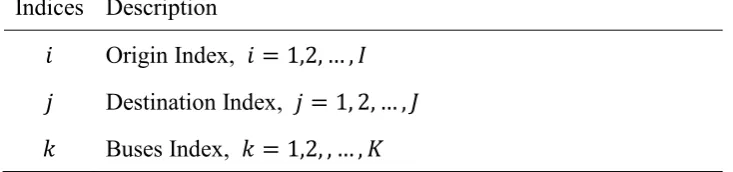
Indices Description
𝑖 Origin Index, 𝑖 = 1,2, … , 𝐼 𝑗 Destination Index, 𝑗 = 1, 2, … , 𝐽 𝑘 Buses Index, 𝑘 = 1,2, , … , 𝐾
2.1 Decision Variables of the Model
The decision variables in the model are the quantities of transportation of customer from original
node to destinations.
Table 1 define the decision Variables and description.
Variable Description
k ijk
A Binary variable, equal to 1 if bus k 𝜖 {1… K} travels from original node i to
destination node j (i≠j).
𝑈𝑖𝑗 1 if bus k picked customer from node i to node jby some bus, 0 otherwise.
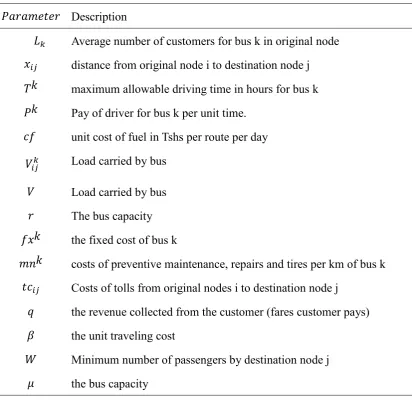
2.2 Parameters of the Model
The parameters are the recognized values (data) that are required by the model as an input to
Table 2: Parameters and description.
𝑃𝑎𝑟𝑎𝑚𝑒𝑡𝑒𝑟 Description
𝐿𝑘 Average number of customers for bus k in original node
𝑥𝑖𝑗 distance from original node i to destination node j
𝑇𝑘 maximum allowable driving time in hours for bus k
𝑃𝑘 Pay of driver for bus k per unit time.
𝑐𝑓 unit cost of fuel in Tshs per route per day
𝑉𝑖𝑗𝑘 Load carried by bus
𝑉 Load carried by bus
𝑟 The bus capacity
𝑓𝑥𝑘 the fixed cost of bus k
𝑚𝑛𝑘 costs of preventive maintenance, repairs and tires per km of bus k 𝑡𝑐𝑖𝑗 Costs of tolls from original nodes i to destination node j
𝑞 the revenue collected from the customer (fares customer pays)
𝛽 the unit traveling cost
𝑊 Minimum number of passengers by destination node j 𝜇 the bus capacity
2.3 Objective Function
The multi-objective optimization problem formulated in this research consists of two objective
functions, this are: Maximizing Total Net Profit (max TNP) and Minimizing the Total Internal
Costs (min TIC) in cost of running buses (cost of drivers, energy costs, fixed cost of vehicles–
depreciation, inspection, insurance, maintenance costs and toll costs) from planning routing in
Passenger buses.
(i) Total Net Profit
Maximize TNP =
\ 0
ij k ij i N
q L u
− ij k ijk
i N j N i j
x L A
(ii)Total Internal Costs
Minimization of all variable costs incurred in (TZS). The variable costs in running buses includes:
cost of drivers (CD), energy costs (EC), fixed cost of buses–depreciation (FC), maintenance
costs (MC) and toll costs (TC).
𝑇𝑉𝐶 = 𝐶𝐷 + 𝐸𝐶 + 𝐹𝐶 + 𝑀𝐶 + 𝑇𝐶
The objective function is given as follows:
1 0 0 1 1 1 0 0 1 0 0 1
Minimize TIC
K I J K I K I J K I J K
k k k k k k k k
ij ijk ij ij ijk k ijk j ij ij j ijk
k i j k i k i j k i j k
j i j i j i
p A cf x A fx A mn x u tc A
= = = = = = = = = = = =
=
+
+
+
+
2.4 Model Constraints
The greatest combination of the decision variables k ijk
A and 𝑈𝑖𝑗 is found with respect of the
defined constraints or limitations. In this paper the constraints of the system are as follows:
Ensures that a customer has no incoming and out- going arcs unless it is visited:
ij ji
j N j N
j i j i
u u i N
=
Each bus departs from the original node once or doesn’t, which means no more than k buses
(fleet size) depart from the node:
(
)
1
1 ; 1,...,
J k ijk j
A k K
=
=
Flow conservation on each node:
(
)
0 0
1 1
0 1,..., ; 1,...,
J J
k k
ijk kji
j j
j j
A A k K i I
= =
− = = =
Ensure that no bus can be overloaded:
(
)
1
; 1,...,
J k
ijk k
j
A r k K
=
=
Restrict average number of customers from original node to the destination in a specific route:
(
)
0 1
=W ; 1,..., ; 1,...,
J k
ijk k jk
j j
A L k K i I
=
= =
Restrict the total load a bus carries depending on whether it arrives or leaves a customer:
(
)
0 1
1 0
; 1,..., ; 1,...,
J K
k
k ijk
j k
j k
k
L A k K i I
k
v
= =
= =
.3. Lexicographic Goal Programming Formulation
In goal programming formulation, the decision-maker orders the priority of the objective functions.
The core objective of Goal Programming is to concurrently satisfy a number of goals relevant to
the decision-maker. Firstly, the problem is solved for the top most importance objective first, and
then this value is never allowed to get worse. The problem is solved for the following priority and
so on, until the problem is solved.
3.1 Preemptive Goal Programming: Is a special case of goal programming in which the goals
are divided into sets and each set is given a priority; i.e., first, second, third, and so on. The concept
is that a higher priority goal is considered as more important than a lower priority goal. Then, for
each priority, a target value is determined and the deviation variables are introduced. These
deviation variables may be positive or negative (represented by 𝑑𝑖+ 𝑎𝑛𝑑 𝑑𝑖− ). The positive
deviation variable 𝑑𝑖+ represents the quantification of the over-achievement of the 𝑖𝑡ℎ goal while
the negative deviation variable 𝑑𝑖− represents the quantification of the under-achievement of
the 𝑖𝑡ℎ goal.
Lastly for each priority, if the desire is to overachieve then, minimize 𝑑𝑖+ or if underachieve then,
minimize 𝑑𝑖− , or if to satisfy the target value exactly then minimizing both 𝑑 𝑖
+ and 𝑑 𝑖 − is
Table 3 Procedure for Achieving a Goal
Minimize Goal If goal is achieved
𝑑𝑖+ Minimize overachievement 𝑑𝑖+ = 0, 𝑑𝑖− ≥ 0
𝑑𝑖− Minimize underachievement 𝑑
𝑖− = 0, 𝑑𝑖+ ≥ 0
𝑑𝑖++ 𝑑 𝑖
− Minimize both overachievement and underachievement 𝑑
𝑖+ = 0, 𝑑𝑖− = 0
The solution is attained by initially optimizing with respect to the first-priority goals without regard
to the values of lower priority objectives. Then, holding constant the value of the first-priority
objective function, the optimal solution is obtained for the second-priority goals. The feasible
solution space for this second problem is the set of alternate optima for the first problem. The
process continues until all priorities are considered. If no alternate optima exist at the end of a
particular stage, we have reached the end of the computations, so we must be satisfied with the
current values of the lower priority objectives [13]:[14]:[15]. 3.1.1 Formulation of the First Objective
Min TNP = ij k ijk
i N j N i j
x L A
− \ 0ij k ij i N
q L u
with other Constraints:
ij ji
j N j N
j i j i
u u i N
=
(1)(
)
0 0
1 1
0 1,..., ; 1,...,
J J
k k
ijk kji
j j
j j
A A k K i I
= =
− = = =
(2)(
)
0 1
=W ; 1,..., ; 1,...,
J k
ijk k jk
j j
A L k K i I
= = =
(3)(
)
11 ; 1,...,
J k ijk j
A k K
=
=
(4)(
)
1
; 1,...,
J k
ijk k
j
A r k K
= =
(5)(
)
0 1 1 0; 1,..., ; 1,...,
J K k k ijk j k j k k
L A k K i I
k
v
= =
= =
Solve the above Objective and get 𝐺1 = 𝑧1∗ = value 1.
3.1.2 Formulation of the Second Objective
1 0 0 1 1 1 0 0 1 0 0 1
Min TIC 1 1
K I J K I K I J K I J K
k k k k k k k k
ij ijk ij ij ijk k ijk j ij ij j ijk k i j k i k i j k i j k
j i j i j i
p A cf x A fx A mn x u tc A d d
= = = = = = = = = = = =
+ −
=
+
+
+
+
+ +Subject to the Constraints:
Min TNP = ij k ijk i N j N
i j
x L A
− \ 0ij k ij i N
q L u
− d1++d1−= 𝑧1∗
with other Constraints:
ij ji
j N j N
j i j i
u u i N
=
(1)(
)
0 0
1 1
0 1,..., ; 1,...,
J J
k k
ijk kji
j j
j j
A A k K i I
= =
− = = =
(2)(
)
0 1
=W ; 1,..., ; 1,...,
J k
ijk k jk
j j
A L k K i I
= = =
(3)(
)
11 ; 1,...,
J k ijk j
A k K
=
=
(4)(
)
1
; 1,...,
J k
ijk k
j
A r k K
= =
(5)(
)
0 1 1 0; 1,..., ; 1,...,
J K k k ijk j k j k k
L A k K i I
k
v
= =
= =
(6)d
d1+, 1−≥ 0.
Solve the above Objective and get 𝐺2 = 𝑧2∗= value 2.
3.1.3 The Lexicographic Goal Programming is formulated as follows:
Min Z=𝑑1++ 𝑑2+
Subject to the Constraints:
Min TNP = ij k ijk
i N j N i j
x L A
− \ 0ij k ij i N
q L u
1 0 0 1 1 1 0 0 1 0 0 1
Min TIC 1
1
K I J K I K I J K I J K
k k k k k k k k
ij ijk ij ij ijk k ijk j ij ij j ijk k i j k i k i j k i j k
j i j i j i
p A cf x A fx A mn x u tc A d d
= = = = = = = = = = = =
+ −
=
+
+
+
+
+ += 𝐺2 = 𝑧2∗ = value2 with other Constraints
ij ji
j N j N
j i j i
u u i N
=
(1)(
)
0 0
1 1
0 1,..., ; 1,...,
J J
k k
ijk kji
j j
j j
A A k K i I
= =
− = = =
(2)(
)
0 1
=W ; 1,..., ; 1,...,
J k
ijk k jk
j j
A L k K i I
= = =
(3)(
)
11 ; 1,...,
J k ijk j
A k K
=
=
(4)(
)
1
; 1,...,
J k
ijk k
j
A r k K
= =
(5)(
)
0 1 1 0; 1,..., ; 1,...,
J K k k ijk j k j k k
L A k K i I
k
v
= =
= =
(6)d
d1+, 1−, d+ d−
2 ,
2 ≥ 0.
4. Results
The analysis of the model was done by the lexicographic goal programming algorithm where by
in this method first, the problem is solved for the first priority goal for our case is maximization of
profit, and then its value is never allowed to deteriorate. Then the problem is solved for the second
priority goal which was minimization of running costs.
The model is developed in GLPK Integer Optimizer version 4.57 using GLPSOL (LP/MIP) solver
and performed on an Intel(R) Core (TM) i5-7200U [email protected] GHz Dell Laptop computer with
4 GB of RAM. Goals for the preemptive goal programming model are provided in Table4 along
Table 4.Goals for the Preemptive Goal Programmings
Objective Goal Results Priority
Maximize Profit 15,094,100 1
Minimize Running costs 6,465,098,615 2
The model has been run and an integer optimal solution found and the output is displayed within
few seconds. Table 5 shows the outcomes of the last formulated objective function in which all
deviation variables are zero, this means that all goals are perfectly satisfied. Table 5. Deviation Variable Values
Deviation Variable Values
𝑑1+ 0
𝑑1− 347,759,000
𝑑2+ 0
𝑑2− 17,479,100
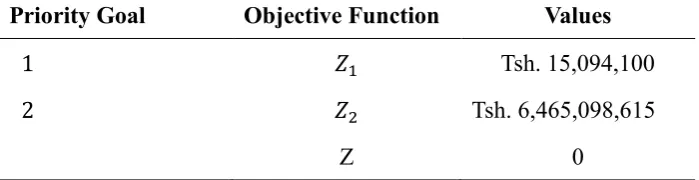
The values for all objective functions are shown in Table 6 which gives the maximum profit and
minimum running costs for both objectives, the best value was determined to be Tsh
15,094,100/day and Tsh 6,465,098,615/day respectively.
Table 6. Objective Function Value
Priority Goal Objective Function Values
1 𝑍1 Tsh. 15,094,100
2 𝑍2 Tsh. 6,465,098,615
Z 0
Also 9 routes selected are more profit among 19 routes, table 7 show the results. With regard to
the values of the objective functions the proposed system shows good performance in the rise profit
by 15%, furthermore a reduction in the running costs by 17.16% as compared with the current
existing situation of scheduling and routing system used by bus companies. We recommended the
management of bus companies to adopt the proposed system because the findings from the study
show that the new model gives better performances on the total profit and reduction on the running
bus companies.
Table 7. Routes selected which are more profit Regional Centre’s Routes
From To Status from analysis
Arusha Moshi Selected
Arusha Babati Selected
Arusha Singida Not Selected
Arusha Tanga Selected
Arusha Dodoma Not Selected
Arusha Morogoro Selected
Arusha Dar es salaam Selected
Arusha Shinyanga Selected
Arusha Tabora Not Selected
Arusha Mwanza Not Selected
Arusha Iringa Not Selected
Arusha Musoma Not Selected
Arusha Lindi Not Selected
Arusha Bukoba Not Selected
Arusha Kigoma Not Selected
Arusha Mtwara Selected
Arusha Mbeya Selected
Arusha Songea Selected
Arusha Sumbawanga Not Selected
5. Conclusion
The aims of this work were to formulate and analyze the multi-objective optimization model for
scheduling of the regional passenger's bus routes problem. The developed model has two main
regional passenger’s bus. The multi-objective optimization model for scheduling of the regional
passenger's bus routes problem was solved by the lexicographic goal programmingmethod. Firstly,
the problem is solved for the most important goal, and then its value is never permitted to be
worsen. The problem is solved for the next goal and so on until the problem is solved. The model
was applied with the use of the real data collected from SUMATRA, EWURA and buses companies
in Arusha. Sensitivity analysis will also be conducted to assess major model parameters such as
the effect of changing unit travel costs as well as variable costs in order to advice bus owner and
decision makers.
Acknowledgement: The authors thank African Development Bank (AfDB) scholarship that was
necessary to cover all related costs towards this study.
Conflict of Interests
The authors declare that there is no conflict of interests.
References
[1] H. A. Abbas, Evaluation of Performance of Passenger Road Transport Companies in Tanzania: The Case of Dar es Salaam City, 2010.
[2] O. W. Mushi, Service Quality and Customer Satisfaction in Transport Service Industry in Tanzania, 2013. [3] D. Mengistu and I. D. Kitaw, Modeling and Analysis of City Bus Scheduling System : Case of Anbessa City
Bus Service Enterprise ( ACBSE ) Modeling and Analysis of City Bus Scheduling on Anbessa City Bus Service Enterprise ( ACBSE ), 2013.
[4] M. Kilonyzi, Operational and policy constraints affecting road transport operators in Tanzania, 2001. [5] M. Atash, J. Alnaqi and M. Savsar, Scheduling and Routing of City Buses at Kuwait Public Transport, Int. J.
Appl. Oper. Res., 2012.
[6] M. K. Hasan and A. A. Al Hammad, Intercity Bus Scheduling for the Saudi Public Transport Company to Maximize Profit and Yield Additional Revenue, J. Serv. Sci. Manag., 3 (3) (2010), 373–382.
[7] A. Haghani and M. Banihashemi, Heuristic approaches for solving large-scale bus transit vehicle scheduling problem with route time constraints, Transp. Res. Part A Policy Practice, 36 (2002), 309-333.
Company, Int. J. Appl. Oper. Res. 1 (3)( 2012), 11–32.
[9] J. C. Molina, I. Eguia, J. Racero, and F. Guerrero, Multi-objective Vehicle Routing Problem with Cost and Emission Functions, Procedia - Soc. Behav. Sci., 160 (2014), 254–263.
[10] H. Yan, S., and Chen, A scheduling model and a solution algorithm for intercity bus carriers., Transp. Res. Part A, 36 (2002), 805-825.
[11] E. B. and B. B. Motuma Demeke, Integrating Anbessa City Bus with Addis Ababa Light Rail Transit: Case of Merkato Terminal, 2015.
[12] R. Bowerman, B. Hall, and P. Calamai, A multi-objective optimization approach to urban school bus routing: Formulation and solution method, Transp. Res. Part A Policy Pract., 29 (2) (1995), 107–123.
[13] D. . Orumie, U. and Ebong, An efficient method of solving lexicographic linear goal programming problem., Int. J. Sci. Res. Publ., 3 (2013), 1–8.
[14] N. Khan, S. U., Yousaf, S. M. and Afgan, Multi-objective compromise allocation stratified sampling in the presence of non-response using quadratic cost function., Int. J. Bus. Soc. Sci., 5(2014), 162–169.