Quantifying the Discord: Order Discrepancies in
Message Sequence Charts
Edith Elkind1, Blaise Genest2, Doron Peled3, and Paola Spoletini4
1
Department of Computer Science, Hebrew University, Jerusalem, Israel 2
CNRS/IRISA, Campus de Beaulieu, 35042 Rennes Cedex, France 3
Department of Computer Science, University of Warwick Coventry CV4 7AL, United Kingdom
and Department of Computer Science, Bar Ilan University, Ramat Gan 52900, Israel
4
Dipartimento di Elettronica e Informazione, Politecnico di Milano via Ponzio 34/5 - 20133, Milano, Italy
Abstract. Message Sequence Charts (MSCs) and High-level Message Sequence
Charts (HMSC) are formalisms used to describe scenarios of message passing protocols. We propose using Allen’s logic to study the temporal order of the mes-sages. We introduce the concept of discord to quantify the order discrepancies between messages in different nodes of an HMSC and study its algorithmic prop-erties. We show that while discord of a pair of messages is hard to compute in gen-eral, the problem becomes polynomial-time computable if the number of nodes of the HMSC or the number of processes is constant. Moreover, for a given HMSC, it is always computationally easy to identify a pair of messages that exhibits the worst-case discord, and compute the discord of this pair.
1
Introduction
Message Sequence Charts (MSCs) and High-level Message Sequence Charts (HMSC) are very useful tools for describing executions of communication protocols. They pro-vide an intuitive visual notation, which is widely used in practice and has been formally described in the MSC standard [11]. A related notation was also adopted as part of the UML standard. Intuitively, an MSC is described by a set of processes and a set of
mes-sages between these processes. The notation allows us to specify the order in which
each process sends and receives messages. An HMSC is a graph whose nodes are la-beled with MSCs. An execution of an HMSC is a concatenation of MSCs that appear on a path in this graph. Using HMSC notation, one can describe alternative behaviors of systems, or even use it as a scenario-based programming formalism [10]. The reader is referred to Section 2 for formal definitions.
sets of MSCs [7]. Another problem is related to global choice [4, 3], where some pro-cesses behave according to one MSC scenario and other propro-cesses behave according to another MSC scenario, resulting in new behaviors.
Continuing this line of research, in this paper we identify another ambiguity of the MSC notation. Namely, in the definition of an HMSC, a concatenation of MSCs along a path intuitively suggests that messages that appear in an earlier MSC precede in time any message that appears in a later MSC. In fact, in some frameworks such as live
se-quence charts [6] there is a hidden assumption of such synchronous nature. However,
according to the MSC semantics, this is is not the case: independence between events happening in different sets of processes may allow messages in later MSCs to over-lap or even sometimes appear earlier than messages in previous MSCs. Moreover, it is not clear how to achieve this kind of synchronization without an additional mecha-nism or extra messages. Clearly, this discrepancy may result in users misinterpreting the notation and, as a result, designing protocols that do not work as intended. This is reminiscent of the concept of race conditions: the straightforward visual interpreta-tion of concatenainterpreta-tion is different from the intended semantics. However, unlike for race conditions, this discrepancy has not been studied before.
In this paper, we provide a formal treatment of this issue. We introduce the notion of discord of a pair of messages in different nodes of an HMSC. Intuitively, the discord of two messages is the worst possible discrepancy between their order in an execution and their “ideal” order, in which the message in the MSC that appears earlier on the path precedes the message in the MSC later on the path. To formalize this intuition, we need several tools that we introduce below.
We start our study of the message order in MSCs and HMSCs by defining the con-cept of a chain. Informally, a chain is a sequence of events where any adjacent pair of events is ordered either by being a send-receive pair, or by belonging to the same pro-cess line. Hence, a chain represents a possible flow of information. Clearly, the order between messages is determined not only by the relevant messages themselves, but also by chains between their endpoints. We characterize the possible message orders by de-scribing the possible communication patterns between their endpoints. We then project each such pattern on a global timeline and classify the resulting scenarios. To do so, we use a subset of Allen’s interval logic [1]. Allen’s logic is a formalism for describing the relative order of time intervals. For example, Allen’s logic formulaAdBexpresses the fact thatAhappens duringB, i.e.,Astarts afterBstarts and ends beforeBends. It has been widely studied in the context of artificial intelligence and knowledge representa-tion, and its expressive power and computational properties are well understood [12]. As messages can easily be seen as time intervals, it provides a convenient language for describing the message order. We introduce a natural ordering on Allen’s logic prim-itive predicates and define the discord of a pair of messages in an MSC as the worst possible Allen’s logic primitive predicate (according to this ordering) that corresponds to the communication pattern of this pair.
the discord can be computed in polynomial time. We then focus on characterizing the discord of an HMSC by a single parameter. To this end, we define the discord of an HMSC as the worst possible discord of a pair of messages in this HMSC. Surprisingly, it turns out that this quantity can be computed in time polynomial both in the size of the MSC graph and the number of processes. Intuitively, the reason for that is that it is easy to identify a pair of messages that exhibits the worst-case behavior for a given HMSC and compute the discord of such a pair. The study of discords provides also a generic study of the existence of communication chains, which we believe will be interesting in its own right in studies of layered combination of communication algorithms.
2
Preliminaries
2.1 Message Sequence Charts
Following [11], we formally define message sequence charts (MSCs), MSC concatena-tion, and high-level message sequence charts (HMSCs).
Definition 1. A Message Sequence Chart (MSC) is a tupleC= (P, E, P,M, <p:p∈P), where
– Pis a finite set of processes;
– Eis a finite set of events;
– P:E7→ Pis a function that maps every event to the process on which it occurs;
– Mis a finite set of messages. Each messagem ∈ Mconsists of a pair of events (s, r)for send and receive;
– For each processp∈ P,<pis a total order on the events of that process.
We define a relation <as <= Sp∈P <p ∪{(s, r) | (s, r) ∈ M} and let <∗ be
the transitive closure of <. We require<∗ to be acyclic. We assume that MSCs are FIFO, that is, if two messages(s1, r1)and(s2, r2)are between the same processes, i.e.,P(s1) =P(s2)andP(r1) =P(r2), thens1< s2impliesr1< r2.
We will occasionally abuse notation and writem∈Cinstead ofm∈ M.
Definition 2. LetC1, C2be two MSCs whereC1= (P1, E1, P1,M1, <1
p:p∈P1),C2=
(P2, E2, P2,M2, <2
p:p∈P2)with P1 = P2 = P andE1 ∩E2 = ∅. Define their concatenation as an MSC(C1;C2) = (P, E, P,M, <p:p∈P), whereE = E1∪E2, M=M1∪M2, the functionPis given byP(e) =P1(e)ife∈E1andP(e) =P2(e)
ife∈E2, and for eachp∈ P we define<
p=<1p∪<2p∪{(e1, e2)|P1(e1) =P2(e2)}.
Notice that there are no sends in one MSC that are received in the other. This def-inition can be naturally extended to sequencesC1, C2, . . . , Cn of three or more MSCs
by setting(C1;C2;. . .;Cn)=((. . .(C1;C2);C3). . .).
Definition 3. A High-level Message Sequence Chart (HMSC) is a tupleH = (G,C, V0, λ), whereG = (V,E)is a directed graph with the vertex setV = {v1, . . . , vn}
and the edge set E ⊆ V × V, C = {C1, . . . , Cn} is a collection of MSCs with a
nodes, andλ:V 7→ Cis a bijective mapping between the nodes of the graph and the MSCs inC. To simplify notation, we assumeλ(vi) =Ci. Each vertex ofGis reachable
from one of the initial nodes. An execution of the HMSC is a finite MSC(Ci;. . .;Cj)
obtained by concatenating the MSCs in the nodes of a path vi, . . . , vj of the HMSC
that starts with some initial nodevi ∈ V0. The size|H|of an HMSCH is defined as
|H|=|E1|+· · ·+|En|+|V|+|E|, whereEiis the set of events of the MSCCi.
Given a pathL= (vi, . . . , vj)inGof length at least2, we denote byλ(L)the MSC that
is obtained by concatenating the MSCs alongL, i.e.,(Ci;. . .;Cj). The set of executions
of an HMSC is also referred to as the set of MSCs generated by that HMSC.
We can define infinite executions in a similar way. This requires defining the con-catenation of an infinite sequence of MSCs, which is the limit of the sequence of finite concatenations of prefixes. As this does not add to the results in the paper, we only refer the reader to, e.g., [9].
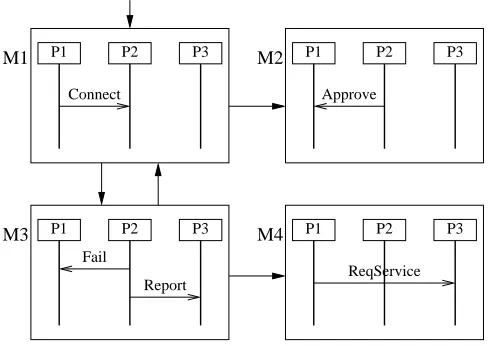
M1 M2
M3 P1 P2 P3 M4
P1 P2 P3 P1 P2 P3
P1 P2 P3
Connect
Fail
Approve
[image:4.595.186.430.307.480.2]ReqService Report
Fig. 1. An HMSC
communications. Consider the path (M1, M3, M4). According to the HMSC semantics, process P2 does not necessarily have to send itsReportmessage in M3 before process P1 has progressed according to M4 to send itsReq servicemessage. However, process P3 must receive theReportmessage before theReq servicemessage.
2.2 Allen’s logic
Allen’s logic [1] is a formalism that allows one to express temporal relationships be-tween time intervals. It has 13 primitive relations that correspond to possible relation-ships between two intervals, such as “AprecedesB” or “Ahappens duringB”. Each primitive relation describes a total order between the endpoints of these intervals. When working with MSCs, we normally assume that no two events can happen at the same time, i.e., no two intervals have a common endpoint. Therefore, to represent relation-ships between two messagesm1 = (s1, r1)andm2 = (s2, r2), we will only use 6 of these primitives, namely:
p —m1precedesm2(i.e.,s1< r1< s2< r2); p−1 —m1is preceded bym2(i.e.,s2< r2< s1< r1); o —m1overlapsm2(i.e.,s1< s2< r1< r2);
o−1 —m1is overlapped bym2(i.e.,s2< s1< r2< r1); d —m1is duringm2(i.e.,s2< s1< r1< r2);
d−1 —m1containsm2(i.e.,s1< s2< r2< r1).
Observe that fort∈ {p,o,d}the predicateAtBis equivalent toBt−1A.
A B A
B
[image:5.595.205.409.420.447.2]A B
Fig. 2. Allen’s logic relationships:ApB,AoB, andAd−1 B
An Allen’s logic formula consists of concatenation of one or more of these 6 letters, and is interpreted as a disjunction of the corresponding predicates. For example, the formulaApod−1B says that eitherA precedesB, orA overlapsB, orB happens during (is included in)A. Given the semantics of the primitive predicates, it is easy to see that this formula says thatAstarts beforeB, but may end before (p), during (o), or after (d−1)B. There are several operations that can be performed on Allen’s logic formulas, such as composition and intersection. However, in this paper we only use the Allen’s logic as a means to describe the relationships between messages. Therefore, we will not formally define these operations.
3
Relationships between Messages
1
r
s1 s2
2
[image:6.595.256.360.112.184.2]r
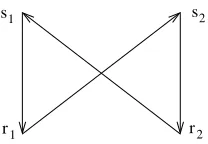
Fig. 3. Impossible relation between messages
Given an MSCC, a chain fromx ∈ E toy ∈ E is a sequence of events(x =
ei1, ei2, . . . , eik−1, eik=y)such thateij ∈Eforj= 1, . . . , k, and every adjacent pair (eij, eij+1)in the chain is either a send and the corresponding receive, oreij appears
before (above)eij+1 in the same process line. Clearly,x <
∗ yif and only if there is a
chain of messages fromxtoy. Now, consider a pair of messages(s1, r1)and(s2, r2). By definition, there is always a chain froms1 tor1and froms2tor2. Moreover, for any(a, b)∈ {s1, r1} × {s2, r2}, we have one of the following three cases: (1) there is a chain of messages fromatob; (2) there is a chain of messages frombtoa; (3) there is no chain in either direction. As there are four pairs of points, this corresponds to34 = 81
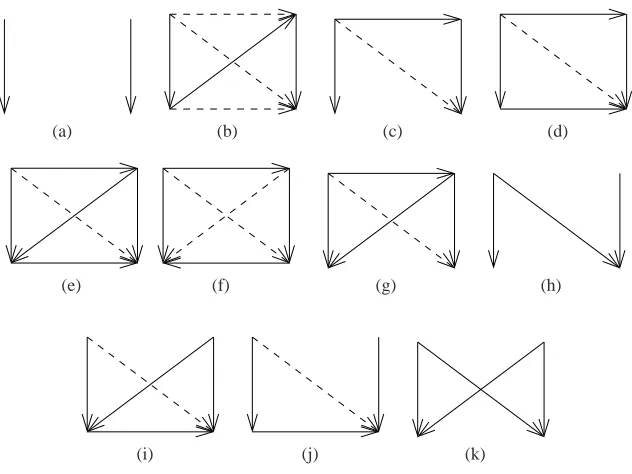
combinations. However, not all of them are possible, as MSCs do not admit cycles (see Figure 3). In fact, for two messages there are exactly twenty possible combinations of orders between their endpoints. We list them in Figure 4. In these figures, the messages correspond to the vertical arrows, and dashed arrows correspond to relationships derived by transitive closure.
The patterns in Figure 4 correspond to the following Allen’s logic relationships: (a)pp−1oo−1dd−1; (b)p; (c)pod−1; (d)po; (e)o; (f)d−1; (g)od−1; (h)poo−1dd−1; (i)od; (j)opd; (k)oo−1dd−1. Except for cases (a) and (k), which are symmetric, each other case has a symmetric twin that can be obtained by swapping the left and the right message.
To decide between these cases, it suffices to calculate the transitive closure relation <∗. While in general transitive closure algorithms run in cubic time [8, 16], it has been
observed [2] that in the MSC case one can be more efficient since each event has at most two successors. Formally, we have the following proposition.
Proposition 1. [2] Given an MSCM with messagesm1,· · · , mt, one can decide in
timeO(t2)the relation between everymi, mj,1≤i, j≤t.
We will now derive a corollary that will be useful in bounding the running time of our algorithms.
Corollary 1. Given an HMSCH = (G,C,V0, λ),|C|=n, one can compute the rela-tion<∗for all MSCs inCin timeO(|H|2). Moreover, one can compute the relation<∗ for all concatenated MSCs of the form(Ci;Cj), whereCi, Cj ∈ C, in timeO(n|H|2).
Finally, given the relation<∗ for all concatenated MSCs of the form(Ci;Cj), where
Ci, Cj ∈ C, one can compute the Allen’s logic relationship for all pairs of messages
(a) (b) (c) (d)
(e) (f) (g) (h)
[image:7.595.151.467.112.349.2](i) (j) (k)
Fig. 4. The possible orders between messages (up to symmetry)
Proof. LetEibe the set of events of the MSCCi. By Proposition 1, we can compute
<∗forCi in timeO(|Ei|2). Therefore, computing<∗ for allCi,i = 1, . . . , n, takes
timeO(|E1|2+· · ·+|E
n|2) =O((|E1|+· · ·+|En|)2) =O(|H|2).
Similarly, computing the relation<∗for(Ci;Cj)can be done in timeO((|Ei|+
|Ej|)2). As(|Ei|+|Ej|)2≤2|Ei|2+ 2|Ej|2, computing<∗for all MSCs of the form
(Ci;Cj),i, j= 1, . . . , n, can be done in timeO(n(|E1|2+· · ·+|En|2)) =O(n|H|2).
Now, fix1≤i, j ≤n. Given the relation<∗for(C
i;Cj), the Allen’s logic relationship
for any pair(m, m′),m ∈C
i,m′ ∈ Cj, can be computed in constant time. As there
areO(|Ei||Ej|)such pairs, computing the Allen’s logic relationship for all of them can
be done in timeO(|Ei||Ej|) =O((|Ei|+|Ej|)2). Summing over alli, j = 1, . . . , n,
we obtain the bound ofO(|H|2), as claimed.
2
4
Definition of Discord
Consider a concatenated MSC(C1;C2). For any two messagesm1= (s1, r1)∈C1 andm2= (s2, r2)∈C2, we know thats1< r1ands2< r2. Now, intuitively, the best possible scenario for(C1;C2)is when all messages inC1precede all messages inC2. In this case, we also haver1 < s2, and thus we obtain s1 < r1 < s2 < r2. This corresponds to case (b) in Figure 4. Note that this scenario is only possible whenC1 has a unique maximal evente,C2has a unique minimal evente′, andeande′occur on the same process, i.e.,P(e) =P(e′).
Conversely, the worst possible case is when some messagem2inC2may be com-pletely unordered with respect to a messagem1 inC1. That is, for somem1 andm2 as above, the situation is described by case (a) in Figure 4, or by the Allen’s logic for-mulam1pp−1oo−1dd−1m2. In this case, at worst, the Allen logic formula allowsm2 to actually precedem1, since the disjunction permits in particular thatm1p−1m2. All remaining scenarios lie, as will be formulated below, between these two cases. We will now introduce a measure of discrepancy, which we call the discord, which will allow us to order them more precisely,
Given a concatenation of two MSCs(C1;C2), two messagesm1 = (s1, r1)∈C1 andm2 = (s2, r2) ∈ C2 are said to be out of order if r1 does not precedes2, i.e., ¬m1pm2. In Figure 4, this happens in cases (a), (c), (d), (h), and (j). Note that in our setting, the cases (e), (f), (g), (i), and (k) are impossible: in each of these cases, there are chains of messages starting from events ofm2and ending in events ofm1, which cannot happen under concatenation.
We now classify all primitive Allen logic predicates according to how well they order the endpoints of the projected intervals, i.e., represent the order between the events of the two messagesm1 andm2. Recall that in the ideal case, i.e., when the order between the intervals is described by the Allen logic predicatep, we haves1 < r1 < s2 < r2. In this case, there are zero events in{s2, r2}that precede those in{s1, r1}. Under the worst case, i.e., ifm2fully precedesm1, we count four inversions: namely, s2< s1,s2< r1,r2< s1ands2< r1. We thus order the predicates according to how many of these four relationships are inverted. In case of a tie, we give preference to the relationships that involves1to those that involver1.
Definition 4. The total order≺is the transitive closure of the partial order≺0given by≺0={(p,o),(o,d−1),(d−1,d),(d,o−1),(o−1,p−1)}.
Remark 1. Observe that the number of inversions inp−1is 4, as explained above, in o−1it is3, indandd−1it is 2, inoit is 1, and inpit is 0. Therefore, our decision thatd−1 ≺dmay appear quite arbitrary. We made this choice for two reasons. First, we do think that the time when the messages are sent is more important than the time when they are received, as the designer has more control over the former, and second, it is convenient to have a total order to work with. However, we believe that many of our ideas and results will apply for different orders, including some that are not total.
Definition 5. Consider a sequence of MSCs(C1, . . . , Ck)and a pair of messagesm1∈
C1,m2=Cksuch that in the MSCC= (C1;. . .;Ck)we havem1Rm2, whereRis a
R, i.e.,discordC(m1, m2) =t, wheret∈ {p,p−1,o,o−1,d,d−1},tappears inR,
and for allt′that appear inRwe havet′t.
Let us now apply this definition to the six cases that can occur for a pair of mes-sages in a concatenated MSC, as illustrated in Figure 4. In case (a) the mesmes-sages are in relationshippp−1oo−1dd−1. The worst elementary predicate in this formula isp−1, so we conclude that the discord between the messages isp−1. For case (b), there is only one relationp. Similarly, for case (c) the discord isd−1, for case (d) it iso, for (h) it iso−1, and for (j) it isd. We conclude that the value ofdiscordC(m1, m2)can be any
elementary Allen’s logic predicate.
We now extend the definition of a discord to messages in HMSCs.
Definition 6. Given an HMSCH = (G,S,V0, λ)and a pair of messagesm1∈λ(v),
m2∈λ(v′), letdiscord
H(m1, m2) = max≺{discordλ(L)(m1, m2)|L= (v, . . . , v′)},
wheremax≺Ais the maximum element of the setAwith respect to≺.
Consider now the HMSC in Figure 1. For the path (M1, M2), the discord isp, since the maximum event of M1, which is a receive, precedes the minimum event of M2, which is the send of messageApprove. On the other hand, for the path (M1, M3, M1), we have that theReportmessage of M3 corresponds to theConnectmessage of M1 as in case (h) of Figure 4, which means a discord ofo−1. The discord of (M3, M4) isd due to the relative ordering betweenReportin M3 andReqServicein M4.
We will now state a simple observation that allows us to computediscordH(m1, m2).
Claim 1 Consider an HMSCH = (G,C,V0, λ). For anyv, v′ ∈ V,v 6=v′, and any m1∈λ(v),m2∈λ(v′), we havediscordH(m1, m2) = max≺{discordλ(L)(m1, m2)| L = (v, . . . , v′)is a simple path}. Also, for two messagesm1, m2 ∈ λ(v), we have
discordH(m1, m2) = max≺{discordλ(L)(m1, m2)|L= (v, . . . , v)is a simple cycle}.
Intuitively, this is true because removing a loop from a path from v tov′ can only increase the discord betweenm1andm2. Hence, the path that exhibits the worst-case discord is loop-free.
5
Computing the Discord of a Pair of Messages
For a simple pathL= (v =vi1, . . . , vik =v
′), computingdiscord
λ(L)(m1, m2)for m1 ∈ λ(v),m2 ∈ λ(v′)is easy. Namely, first we run the transitive closure algorithm
to determine the causal relationships between the endpoints ofm1 andm2. We then identify the corresponding scenario of Figure 4 and apply the case analysis presented after Definition 5. The running time of this algorithm is quadratic in the total number of messages inλ(L).
is coNP-hard. However, we will now provide an alternative way of verifying whether
DiscordH(m1, m2) =t, wheret∈ {p,p−1,o,o−1,d,d−1}. As we will see later, it
can be used to construct an efficient algorithm for computingDiscordH(m1, m2)in the
important special case when the number of processes is constant.
We will first define a related problem that will be useful for stating our results.
PATH WITH NO CHAIN: Given an HMSCH = (G = (V,E),C,V0, λ), a pair of
nodesv, v′∈ V, and a pair of eventse∈λ(v), e′ ∈λ(v′), is there a pathLfromvtov′ inGsuch that in the MSCλ(L)there is no chain of events frometoe′? We will write
PNCH(e, e′) = 1if such path exists andPNCH(e, e′) = 0otherwise.
Proposition 2. Given an HMSCH = (G= (V,E),C,V0, λ), a pair of nodesv, v′ ∈ V, and a pair of messagesm1= (s1, r1)∈λ(v),m2= (s2, r2)∈λ(v′), we have
– discordH(m1, m2) =pif and only ifPNCH(r1, s2) = 0.
– discordH(m1, m2) = oif and only ifPNCH(r1, s2) = 1,PNCH(s1, s2) = 0,
andPNCH(r1, r2) = 0.
– discordH(m1, m2) =d−1if and only ifPNCH(r1, r2) = 1andPNCH(s1, s2) =
0.
– discordH(m1, m2) =dif and only ifPNCH(s1, s2) = 1and for any pathL =
(v, . . . , v′)inG, the MSCλ(L)contains a chain froms1tos2or a chain fromr1 tor2.
– discordH(m1, m2) =o−1if and only if there exists a pathL = (v, . . . , v′)inG
such that the MSCλ(L)contains no chain froms1tos2and no chain fromr1to r2, andPNCH(s1, r2) = 0.
– discordH(m1, m2) =p−1if and only ifPNCH(s1, r2) = 1.
Proof. The analysis forp,o, andp−1is straightforward.
If discordH(m1, m2) = d−1, then there is a path L = (v, . . . , v′) that
satis-fiesdiscordλ(L)(m1, m2) = d−1. Clearly,λ(L)contains no chain fromr1 tor2, so
PNCH(r1, r2) = 1. Also, for any pathL′fromvtov′, we havediscordλ(L′)(m1, m2)∈
{p,o,d−1}, soL′ contains a chain froms1 tos2. Hence,PNC
H(s1, s2) = 0.
Con-versely, if PNCH(r1, r2) = 1, then there is a pathL from v tov′ with no chain
from r1 tor2, so it cannot be the case that discordλ(L)(m1, m2) ∈ {p,o}. Hence,
discordλ(L)(m1, m2) d−1. On the other hand,PNCH(s1, s2) = 0means that any
pathL′fromvtov′contains a chain froms1tos2, so we havediscordλ(L′)(m1, m2)6∈ {d,o−1,p−1}. Other cases can be analyzed similarly.
2
Note that to check ifdiscordH(m1, m2) =tfort∈ {p,p−1,d−1,o}, it suffices
to make a small number of calls toPNCH. However, to check ifdiscordH(m1, m2) =
t fort ∈ {d,o−1}, callingP N C
H is not enough. Indeed, to verify, e.g., whether
discordH(m1, m2) = d, we have to check that any path between the corresponding
nodes contains either one of two chains: a chain froms1tos2or a chain fromr1tor2, and this check cannot be simulated by calls toP N CH.
5.1 Computational hardness
We will now show that for HMSCs the problem of upper-boundingdiscordH(m1, m2)
DISCORD(H,t, m1, m2): Given an HMSCH, a predicatet∈ {p,p−1,o,o−1,d, d−1}, and two messagesm1, m2inH, is it the case thatdiscord
H(m1, m2)t?
Theorem 1. The problem DISCORD(H,t, m1, m2)is coNP-complete.
Proof. To see that DISCORD(H,t, m1, m2)is in coNP, observe that the complementary problem of checking whetherdiscordH(m1, m2) ≻ tis in NP: a certificate can be
provided by a pathLsuch thatdiscordλ(L)(m1, m2) ≻ t. In particular, fort = pa certificate is a path with no chain fromr1tos2, fort=oit is a path with no chain from r1tor2, fort=d−1it is a path with no chain froms1tos2, fort=dit is a path with no chain froms1tos2and no chain fromr1tor2, and fort=o−1it is a path with no chain froms1tor2.
The coNP-hardness proof is by reduction from 3SAT. Suppose that we are given a 3CNF formula with a set of variables x1, . . . , xn and a set of clauses c1, . . . , cm.
Letlj1, l2j, l3j be the literals that appear in thejth clause, i.e.,cj = lj1∨l2j ∨l3j,lkj ∈
{x1, . . . , xn,x1, . . . ,¯ x¯n}. We construct an HMSCH as follows. SetP ={p1, p2, p3,
p4, px1, p¯x1, . . . , pxn, p¯xn, pc1, . . . , pcm}. The HMSCHhas the following structure. Its
underlying graphGhas a sourcev0, a sinkv1,nvariable gadgetsX1, . . . , Xn andm
clause gadgetsY1, . . . , Ym. The variable gadgetXiconsists of four verticesui0,u1i,u2i,
u3i and four edges(u0i, ui1),(u0i, u2i),(u1i, u3i),(u2i, u3i). The clause gadgetYiconsists of
five verticeswi0,wi1,wi2,wi3,w4i and six edges(w0i, wi1),(w0i, wi2),(w0i, wi3),(w1i, wi4),
(w2
i, w4i),(w3i, wi4). The source, the vertex gadgets, the clause gadgets, and the sink are
all connected in series as depicted in Figure 5. More precisely, there is an edge fromv0 to the vertexu0
1, for alli= 1, . . . , n−1there is an edge fromu3i tou0i+1, there is an edge fromu3
n tow01, for alli = 1, . . . , m−1there is an edge fromwi4tow0i+1, and finally there is an edge fromw4
mtov1.
v0 v1
p2
m1
X1 X2 Xn Y1 Ym
p1 p3 p4
[image:11.595.174.442.458.511.2]m2
Fig. 5. The high-level structure of the HMSCHused in the proof of Theorem 1.
It remains to define the MSCs that are placed in the vertices ofG. The MSC inv0 consists of a single message(s1, r1)fromp1top2. The MSCs in the verticesu0i,u3i,
w0j,wj4are empty for alli= 1, . . . , n,j= 1, . . . , m. Fori= 1, . . . , n, the MSC inu1i
consists of a message fromp2topxi, and the MSC inu
2
i consists of a message from
p2top¯xi. Forj = 1, . . . , m,k= 1,2,3, the MSC inw
k
j contains a message fromplk j
topcj, wherel
k
j is thekth literal ofcj. Finally, the MSC inv1hasm+ 1messages: a
message from eachpcj,j = 1, . . . , m, top3, and a messagem2 = (s2, r2)fromp3to
i u0 i u1 i u2 i u3 2 xi
p p
2 xi
p p (a) cj cj j c l l j w0 j w1 j w2 j w3 j w4 p p p p p p l1 j j 2 3 j (b)
Fig. 6. (a) The gadgetXi; (b) The gadgetYj
We claim that the original 3CNF formula is satisfiable if and only if the tuple
(H,p, m1, m2)constitutes a “no”-instance of DISCORD(H,p, m1, m2), i.e., there is a pathLfromv0tov1such that the MSCλ(L)contains no chain fromr1tos2.
Indeed, suppose that our formula is satisfiable, and letT = (t1, . . . , tn), ti ∈
{T, F} be a satisfying assignment for it. Consider a pathLthat satisfies the follow-ing conditions:
– Lstarts atv0and ends atv1;
– L∩Xi={u0i, u1i, u3i}ifti=FandL∩Xi={u0i, ui2, u3i}ifti=T;
– L∩Yj ={wi0, wkj, w4j}for somek ∈ {1,2,3}such thatlkj is true underT, i.e.,
lk
j =xz andtz = T orlkj = ¯xz andtz = F. Note that suchljkis guaranteed to
exist sinceT has to satisfycj.
First, note that in the corresponding MSCλ(L)there is no chain fromr1to any event of any of the processespcj,j= 1, . . . , m. Indeed, the only message received bypcj in
λ(L)is from someplk
j such thatl
k
j is true underT. Sincelkj is true underT, inλ(L)
the processplk
j receives no messages whatsoever. Asp3only receives messages from
pcj,j= 1, . . . , m, we conclude that inλ(L)there is no chain fromr1tos2.
Conversely, suppose that there is a pathLsuch that in the corresponding MSCλ(L)
there is no chain from r1 tos2. Consider a satisfying assignmentT = (t1, . . . , tn)
such thatti = F ifL∩Xi = {u0i, u1i, u3i}andti = T if L∩Xi = {u0i, u2i, u3i}.
Note that for anyj = 1, . . . , m, ifL∩Yj = {wi0, wkj, w4j}for somek = 1,2,3, it
must be the case thatplk
j receives no message fromp2inλ(L), because otherwise there
would be a chain of messages fromr1tos2. Hence, the literallk
[image:12.595.197.423.113.308.2]cjis satisfied. As this holds for anyj = 1, . . . , m, we have successfully constructed a
satisfying assignment for our instance of 3CNF.
2
Remark 2. Clearly, the proof of Theorem 1 implies that PATH WITH NOCHAINis NP-hard. Moreover, we can consider a weaker version of DISCORD, in which the Allen logic predicate is not part of the input. Namely, fort∈ {p,p−1,o,o−1,d,d−1}, let
DISCORDt(H, m1, m2)be the problem of checking whetherdiscordH(m1, m2)t.
Obviously, for t = p−1 this problem is trivially in P: the answer is always “yes”. Our proof shows that fort = pthis problem is coNP-hard. To show that it is hard fort= o, we can modify the reduction by changing the direction ofm1 (i.e., setting P(s1) =p2,P(r1) =p1) and adding to the MSC inv0a messagem′1= (s′1, r1′)from p1top4withr1<p1s
′
1. Then in any path inH there is a chain fromr1tor2, and there is a path with no chain froms1tos2if and only if the 3CNF formula has a satisfying assignment. Similarly, to show that DISCORDd−1(H, m1, m2)is coNP-hard, we change the direction ofm1, to show that DISCORDd(H, m1, m2)is coNP-hard, we change the direction ofm2, and to show that DISCORDo−1(H, m1, m2)is coNP-hard, we change the direction of bothm1andm2. We conclude that all five non-trivial versions of the problem are coNP-hard.
5.2 Polynomial-time algorithms for bounded number of processes
In our hardness result, both the size of the graphGand the number of processesP are unbounded. It turns out that this is necessary: if either of these parameters is constant, there is an algorithm whose running time is polynomial in the other parameter.
This is easy to see if the size of the graph is constant. In particular, the naive al-gorithm described in the beginning of this section will run in polynomial time: in a graph with a constant number of vertices, there is a constant number of simple paths and cycles, and one can compute the discord along a path in polynomial time.
The case when the number of processes is constant is considerably more compli-cated. Our algorithm for this setting is based on Dijkstra’s shortest path algorithm com-bined with dynamic programming approach. The underlying idea is that given a pair of eventse∈λ(v),e′∈λ(v′)and a subset of processesS, we can check if there is a path Lfromvtov′ such that the set of processes reachable fromeinλ(L)is exactlyS. A
straightforward generalization of this idea allows us to compute the discord of any pair of messages in an HMSC in polynomial time for any fixed value of|P|. Formally, we prove the following result.
Theorem 2. It is possible to computediscordH(m1, m2)in timeO(n324|P||H|2).
We start by describing an algorithm for PATH WITH NO CHAIN. Next, we show how to generalize it to computediscordH(m1, m2). Note that just like in Dijkstra’s
algorithm, we simultaneously check whether there is a path with no chain from a given evente∈C=λ(v)to all other events. Therefore, this algorithm can be easily adapted to compute the discords for all pairs of messages inHin timeO(n324|P||H|3).
LetKbe a strict upper bound on the number of events on any process line in any MSC inH. Re-number all events so thatek
process linepjin the MSCCi. For the purposes of the algorithm, we will introduce two
dummy eventsemini,j andemaxi,j on each process line of every MSC inH. The eventemini,j
precedes all eventsek
i,j, and the eventemaxi,j follows all eventseki,j. It is important to
note that these are not send or receive events, so they have no effect on the information flow inH. However, we will occasionally talk about chains to and from these events, where a chain is defined in the same way as for regular events. We say that a processpj
is reachable fromealong a pathv = (v, . . . , vi)if in the MSC(C;. . .;Ci)there is a
chain frometoemaxi,j .
The outline of the algorithm is presented in Figure 7. First, for each MSCCiand
all l = 1, . . . ,|P|, the procedure ComputeX(); checks whether there is a chain from emini,l to all other events in this MSC. More precisely, for k = 1, . . . , K−1,
ComputeX();setsX(i, j, k, l) = 1if inCi there is a chain fromemini,l toeki,j and
X(i, j, k, l) = 0otherwise. Also, it setsX(i, j, K, l) = 1if inCithere is a chain from
emini,l toemaxi,j , andX(i, j, K, l) = 0otherwise. Note that forj 6= l there can be no
chain fromemin
i,j toemini,l . By Corollary 1, we can implementComputeX();in time
O(|H|2).
PNCH(e, eki,j); 1. ComputeX(); 2. ComputeY();
3. forall i′ such that (v
i′, vi)∈ E
4. forall S ⊆ P
5. if Y[S, i] = 0 break;
6. forall pl∈ P \ S
7. if X(i, j, k, l) = 1 break;
8. return ‘‘yes’’;
Fig. 7. The algorithm forPNCH(e, eki,j). The implementation ofComputeY();is given in
Figure 8.
Now, for anyS ⊆ PletY(S, i)be a variable that indicates whether there is a path LinGfromvtovisuch that inλ(L)none of the processes inSis reachable frome. We
setY(S, i) = 1if such a path exists andY(S, i) = 0otherwise. The values ofY(§, i)
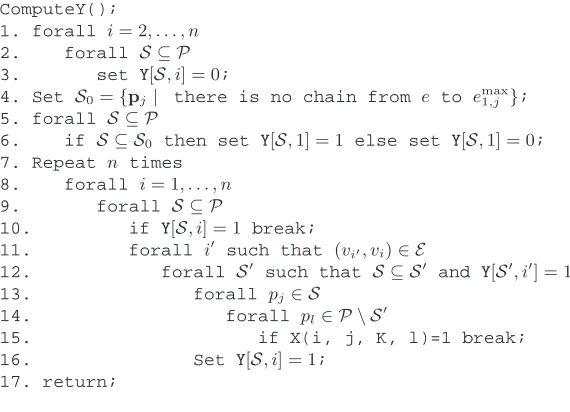
are computed by the procedureComputeY();given in Figure 8. We will discuss how to implementComputeY();later on.
Now, assume that we have computedY(S, i), X(i, j, k, l), for all S ⊆ P,i = 1, . . . , n,i, j = 1, . . . ,|P|,k= 1, . . . , K. Then there is a path with no chain frometo ek
i,j if and only if the conditions in the lines 3 — 7 hold, i.e., there is a pathLof the
form(v, . . . , vi′, vi)and a setS ⊆ Psuch that for any processplthat is reachable from
ealongL′ = (v, . . . , vi′)(i.e., a process inP \ S), there is no chain fromemini,l toeki,j.
For a fixed eventek
i,jthis condition can be verified in timen2|P||P|.
(recall thatY(S,1) = 1if and only if there is no chain frometoemax1,j for anypj∈ S)
and setsY[S, i] =Y(S, i). The algorithm then repeats a Dijkstra-like “relaxation” step ntimes. During each step, the value of eachY[S, i]may be changed from 0 to 1.
ComputeY();
1. forall i= 2, . . . , n
2. forall S ⊆ P
3. set Y[S, i] = 0;
4. Set S0={pj| there is no chain from e to e
max 1,j };
5. forall S ⊆ P
6. if S ⊆ S0 then set Y[S,1] = 1 else set Y[S,1] = 0;
7. Repeat n times
8. forall i= 1, . . . , n
9. forall S ⊆ P
10. if Y[S, i] = 1 break;
11. forall i′ such that (v
i′, vi)∈ E
12. forall S′ such that S ⊆ S′ and
Y[S′, i′] = 1
13. forall pj∈ S
14. forall pl∈ P \ S′
15. if X(i, j, K, l)=1 break;
[image:15.595.135.420.174.380.2]16. Set Y[S, i] = 1; 17. return;
Fig. 8. The implementation ofComputeY();
The correctness of the algorithm follows from two simple claims.
Claim 2 IfY(S, i) = 0, that at any point in the execution ofComputeY();we have Y[S, i] = 0.
Proof. The proof is by induction on the execution of the algorithm. The claim is
clearly true after the initialization step. Now, suppose that at some point we change the value ofY[S, i]from 0 to 1 for someS, i. This means that we have discovered some i′,S′ such that(v
i′, vi) ∈ E,Y[S′, i′] = 1. By inductive assumption, this means that
there exists a pathLfromvtovi′ such that in the MSC(C;. . .;Ci′)there is no chain
frometo any of the processes inS′. Moreover, we also haveX(i, j, K, l) = 0for any pl∈ P \ S′ and anypj ∈ S, i.e., in the MSC(C;. . .;Ci′;Ci)there is no chain from
emini,l toemaxi,j . Now, suppose that in(C;. . .;Ci′;Ci)there is a chain from eto some
pj∈ S. As there are no events that are sent from one MSC and are received in another
MSC, this chain would have to go through someemax
i′,l ,emini,l ,l= 1, . . . ,|P|. Ifpl∈ S′,
this means that there is a chain in(C;. . .;Ci′)frome topl, a contradiction. On the
other hand, ifpl∈ P \ S′, there is a chain fromemini,l toemaxi,j , a contradiction again. We
conclude thatY(S, i) = 1. 2
Claim 3 If for someS, i, there exists a path(v, . . . , vi′, vi)of lengthlsuch that in the
MSC(C;. . .;Ci′;Ci)there is no chain frometo any of the processes inS, then afterl
Proof. The proof is by induction onl. The claim is obviously true forl= 1. LetS′be
the set of all processes that are not reachable fromealong(C1, . . . , Ci′). By inductive
assumption, afterl−1steps we haveY[S, i′] = 1. Also, by construction, in(C;. . .;C
i′)
there is a chain frometoemaxi,l for anyl ∈ P \ S′. Hence, we haveX(i, j, K, l) = 0
for any pl ∈ P \ S′,pj ∈ S. Therefore, during thelth step, our algorithm will set
Y[S, i] = 1. 2
It is not hard to verify that the running time ofComputeY()isO(n|E|22|P||P|2). Indeed, the running time of this procedure is dominated by the cycle in lines 8–16, which is repeatedntimes. During each such cycle, we consider each edge ofEexactly once (in lines 8 and 11), for each such edge we consider two subsets ofP, and for each choice of these subsets we consider a pair of processes and do a constant-time check for this pair.
The overall running time of our algorithm can then be expressed asO(n|E|22|P||P|2+ |H|2) =O(n322|P||H|2).
Now, suppose that we are given a pair of messagesm1 = (s1, r1)∈λ(v),m2 = (s2, r2)∈λ(v′). By Proposition 2, we can check whetherdiscordH(m1, m2) = tfor
t∈ {p,o,d−1,p−1}by making at most three calls toPNC
H();. However, to decide
betweendiscordH(m1, m2) = danddiscordH(m1, m2) = o−1, we need additional
tools. Fortunately, it turns out that one can modifyPNCH();to solve this problem.
To verify whetherdiscordH(m1, m2) =d, we first computePNCH(s1, s2). If we
havePNCH(s1, s2) = 0, then discordH(m1, m2) ≺ d, so the answer is negative.
Otherwise,discordH(m1, m2)6=dif and only ifGcontains a pathLfromvtov′such
that inλ(L)there is no chain froms1tos2and no chain fromr1tor2. To find such a path, we first computeX(i, j, k, l)usingComputeX();. We then defineY′(S,S′, i)
as follows: for anyS,S′ ⊆ P and anyi = 1, . . . , n, setY′(S,S′, i) = 1if there is
a pathLfromv tovi such that inλ(L)none of the processes inS is reachable from
s1and none of the processes inS′is reachable fromr1. It is straightforward to modify
ComputeY();so that it computesY′(S,S′, i)instead ofY(S, i). The running time
of the modified version isO(n|E|24|P||P|2), as we have to consider all possible pairs of subsets ofP in adjacent nodes.
Now, suppose that we have computedY′(S,S′, i)for allS,S′ ⊆ P,i= 1, . . . , n.
Assume thatv′ =vi∗ ands2 =eki∗,j,r2 =ek
′
i∗,j′ We havediscordH(m1, m2)≻dif
and only if there exists a tripleS,S′, i′such that
(1) (vi′, vi∗)∈ E;
(2) Y′(S,S′, i′) = 1;
(3) for anypl∈ P \ Swe haveX(i∗, j, k, l) = 0;
(4) for anypl∈ P \ S′we haveX(i∗, j′, k′, l) = 0.
These conditions can be verified in timeO(n22|P||P|). Hence, the overall running time
of our algorithm isO(n324|P||H|2), which proves Theorem 2.
6
From Pairs of Messages to HMSCs
end, we extend the definition of discord from pairs of messages to entire HMSCs by defining the discord of an HMSCHto be the worst discord over all pairs of messages inH. Formally, we setDiscord(H) = max≺{discord
H(m1, m2)|m1∈λ(v), m2 ∈
λ(v′),(v, v′)∈ E∗}, whereE∗is the transitive closure of the edge setE, andmax≺A
is the maximal element of the setAwith respect to≺.
According to this definition, one can computeDiscord(H)by computing the dis-cords for all pairs of messages inH. However, in general, computingdiscordH(m1, m2)
is coNP-hard, so this approach is not efficient. Quite surprisingly, it turns out that there exists a different approach that allows us to computeDiscord(H)in polynomial time. It is based on the fact that while it may be hard to check whether there exists a chain be-tween two events, it is easy to prove that there is no chain bebe-tween two extremal events, for a suitable definition of extremality.
In the rest of the section, we describe polynomial-time algorithms for checking that
Discord(H) =tfort∈ {p,p−1,o,o−1,d−1}. To check whetherDiscord(H) = d, we can simply run all these algorithms and return “yes” if all of them return “no”. We analyze the efficiency of these algorithms in terms ofn = |V|,|P|and|H|; observe that we can assumen=O(|H|),|P|=O(|H|).
For the cases t ∈ {p,o,d−1}, we will make use of a set E⋆ ⊂ V × V,
con-structed as follows: (v, v′) ∈ E⋆ if and only if (v, v′) ∈ E or there exists a path (v = vi1, vi2, . . . , vik−1, vik = v
′)such that forj = 2, . . . , k−1 the MSC λ(v
ij)
has an empty message set. Note thatE⋆is a subset of the transitive closure ofE, i.e.,
(v, v′)∈ E⋆implies that inGthere is a path fromvtov′.
To constructE∗, we can run the depth-first search from each node ofV, backtracking
as soon as we discovered a node whose MSC has a non-empty message set. Clearly, this algorithm finds a path fromvtov′if and only if(v, v′)∈ E⋆. Moreover, as depth-first
search runs in timeO(|V|+|E|) =O(|H|), the total running time of this algorithm is O(n|H|).
Discord(H) = p. We will show thatDiscord(H) =pif and only if for any(v, v′)∈ E⋆, and anym1∈λ(v),m2∈λ(v′)we havediscord
(λ(v);λ(v′))(m1, m2) =p. Indeed, if for some suchm1, m2we havediscord(λ(v);λ(v′))(m1, m2)6=p, then
ob-viouslyDiscord(H)6=p. Conversely, consider any pair of messagesm1= (s1, r1)∈ λ(v), m2 = (s2, r2) ∈ λ(v′) and any path L = (v = vi1, . . . , vik = v
′). We
show by induction on kthat if our condition holds thendiscordλ(L)(m1, m2) = p. The proof is based on the fact that for any three time intervals A, B, C, we have ApB∧BpC =⇒ ApC. Fork= 2, the statement is obvious. Now, supposek >2. If for each j = 2, . . . , k−1, the MSC λ(vij) has an empty message set, then we
haveλ(L) = (λ(v);λ(v′)), sodiscord
λ(L)(m1, m2) =p. Now suppose that for some j ∈ {2, . . . , k−1}the MSCλ(vij)has non-empty message set and consider some
m = (s, r)∈ λ(vij). SetL
′ = (v
i1, . . . , vij),L
′′ = (v
ij, . . . , vik). By induction
hy-pothesis,discordλ(L′)(m1, m) =p,discordλ(L′)(m, m2) =p, so inλ(L′)there is a
chain fromr1tos, and inλ(L′′)there is a chain fromrtos2. We conclude that inλ(L)
there is a chain fromr1tos2, i.e.,discordλ(L)(m1, m2) =p.
we compute the relation<∗for the concatenated MSC(λ(v);λ(v′))(this can be done in timeO(n|H|2)for all(v, v′)∈ E⋆by Corollary 1) and use it to check the discord of
all pairsm1∈λ(v),m2∈λ(v′)(again, by Corollary 1 this takes timeO(n|H|2)).
Discord(H) = o. The algorithm and the analysis are similar to the previous case. Namely,Discord(H) = oif and only ifDiscord(H) 6= p(which can be verified in polynomial time, as described above) and for any(v, v′)∈ E⋆and anym1= (s1, r1)∈
λ(v), m2 = (s2, r2) ∈ λ(v′)we have discord(λ(v);λ(v′))(m1, m2) ∈ {p,o}. The running time of this algorithm isO(n|H|2).
The proof is based on the fact that for any pathL= (v =vi1, . . . , vik =v
′), any
(L′, L′′)such thatL′ = (vi1, . . . , vij),L
′′ = (v
ij, . . . , vik)and anym = (s, r) ∈
λ(vij), if discordλ(L′)(m1, m) ∈ {p,o} anddiscordλ(L′′)(m, m2) ∈ {p,o} then discordλ(L)(m1, m2) ∈ {p,o}. To see this, note thatdiscordλ(L′)(m1, m)∈ {p,o} implies thatλ(L′)has chains froms1tosand fromr1tor, anddiscordλ(L′′)(m, m2)∈ {p,o}implies thatλ(L′′)has chains fromstos2and fromrtor2. Hence, inλ(L)there
are chains froms1tos2and fromr1tor2, i.e.,discordλ(L)(m1, m2)∈ {p,o}.
Discord(H) = d−1. The algorithm and the analysis are similar to the previous two cases. Namely,Discord(H) =d−1if and only ifDiscord(H)6=p,o(which can be verified in polynomial time, as described above) and for any(v, v′) ∈ E⋆and any
m1 = (s1, r1)∈λ(v),m2= (s2, r2)∈λ(v′)we havediscord(λ(v);λ(v′))(m1, m2)∈
{p,o,d−1}. The running time of this algorithm isO(n|H|2).
The proof uses the fact that for any pathL= (v=vi1, . . . , vik=v
′), any(L′, L′′)
such thatL′ = (v
i1, . . . , vij), L
′′ = (v
ij, . . . , vik) and anym = (s, r) ∈ λ(vij),
ifdiscordλ(L′)(m1, m) ∈ {p,o,d−1}anddiscordλ(L′)(m, m2) ∈ {p,o,d−1}then discordλ(L)(m1, m2)∈ {p,o,d−1}. Indeed,discordλ(L′)(m1, m)∈ {p,o,d−1}
im-plies thatλ(L′)contains a chain froms1tos, anddiscordλ(L′′)(m, m2)∈ {p,o,d−1}
implies thatλ(L′′)contains a chain fromstos2. Hence, inλ(L)there is a chain from s1tos2, i.e.,discordλ(L)(m1, m2)∈ {p,o,d−1}.
Discord(H) = p−1. IfDiscord(H) =p−1, there exists a pair of nodesv, v′ ∈ V, a pair of messagesm1 = (s1, r1) ∈ λ(v),m2 = (s2, r2) ∈ λ(v′)and a pathL = (v =vi1, . . . , vik =v
′)such thatdiscord
λ(L)(m1, m2) = p−1, i.e., inλ(L)there is no chain froms1tor2. LetC=λ(v),C′=λ(v′), andC¯=λ(vi2, . . . , vik−1).
Letsbe a maximal send event in(C; ¯C)such there is a chain froms1tos, and let rbe the corresponding receive. Set p = P(s),q = P(r). It is easy to see that in L there is no chain fromstor2, or, equivalently,(s, r)p−1m2. Therefore, without loss of generality we can assumem1 = (s, r), i.e.,s1is a maximal send event in(C; ¯C). This implies that in(C; ¯C)there are no send events onpthat happen afters1, and there are no send events onqthat happen afterr1(for any such event, there would be a chain froms1to this event). Moreover, inC′there is no chain from any event ofporqtor2.
This suggests the following algorithm. For each pairv, v′ ∈ V, and each pair of messagesm1 = (s1, r1) ∈ λ(v),m2 = (s2, r2) ∈ λ(v′)do the following. Setp =
nodes other thanv, v′that have send events onporq. Output “yes” if all of the following four conditions hold:
(1) inλ(v)there are no send events onpafters1; (2) inλ(v)there are no send events onqafterr1;
(3) inλ(v′)there is no chain from any event ofporqtor2(in particular,P(r2)6=p, q);
(4) the HMSCH(v, v′, p, q)contains a path fromvtov′.
If (1) — (4) are all true, then the pair(m1, m2)provides a witness thatDiscord(H) =
p−1. Conversely, by the reasoning above, ifDiscord(H) = p−1, then there is a pair
(m1, m2)that satisfies (1) — (4).
The running time of this algorithm can be bounded byO(|H|3). To see this, note that there areO(|H|2)pairs of messagesm1∈λ(v),m2 ∈λ(v′). For each such pair,
conditions (1) — (3) can be verified in timeO(|H|)assuming that the relation<∗for λ(v′)has been precomputed (by Corollary 1, we can precompute<∗for all MSCs that
appear inH in timeO(|H|2)). Condition (4) corresponds to solving a single instance of reachability problem, so it can be checked in timeO(|H|)as well.
We can change the order of operations so that the algorithm runs in timeO(|P|2|H|2). This is more efficient if|P|2<|H|, which is likely to be the case in practice. First, we compute the transitive closure of each MSC inH; by Corollary 1, this can be done in timeO(|H|2). Then for eachv∈ V, each eventeinλ(v), and eachp∈ P, we use the information about the transitive closure to check whether inλ(v)there is a chain from any event ofptoe. There areO(|H|)events,|P|processes, and for each pair(p, e), e∈Ei, this computation takesO(|H|)steps, so this can be done in timeO(|P||H|2).
Next, fix a pairp, q∈ Pand setV0(p, q) ={v∈ V |λ(v)has no send events onp, q}. Consider a modified version of depth-first search onG that backtracks as soon as it reaches a node inV \V0(p, q). This algorithm discovers a path fromvtov′if and only
if the HMSCH(v, v′, p, q)contains a path fromv tov′. From any givenv, it runs in
timeO(|H|). For eachvi ∈ V we will do the following. Find the last send event onp,
identify the corresponding receive and check whether it is onqand there are no send events onqafter it. This can be done in timeO(|H|). Then we run fromvi the
modi-fied version of the depth-first search described above. For anyvjdiscovered during this
search and for each receive event ofCj =λ(vj), we check if it is not reachable from
any event ofporqusing the precomputed information.
For each triple(p, q, v), we traverse each edge ofEat most twice, and do a constant-time computation for each event ofH. Hence, the computation that has to be done for each triple(p, q, v)takesO(|H|)steps, and the total running time of our algorithm is O(|P||H|2+|P|2n|H|) =O(|P|2|H|2), as claimed.
Discord(H) = o−1. SupposeDiscord(H) =o−1. Then there exists a pair of nodes v, v′ ∈ V, a pair of messagesm1= (s1, r1)∈λ(v),m2= (s2, r2)∈λ(v′)and a path L= (v=vi1, . . . , vik =v
′)such thatdiscord
λ(L)(m1, m2) =o−1, i.e., inλ(L)there is a chain froms1 tor2, but no chain froms1 tos2 and no chain fromr1tor2. Let C=λ(v),C′=λ(v′), andC¯=λ(vi2, . . . , vik−1).
is no chain fromstor2, we would have(s, r)p−1(s1, r2), a contradiction. On the other hand, a chain fromr1tostogether with a chain fromstor2gives a chain fromr1tor2 inλ(L), a contradiction again. By a similar argument, in( ¯C;C′)there is no chain from any receive eventrtos2.
Setp=P(r1),q=P(s2). It follows that inCthere are no send events onpafter r1, inC′there are no receive events onqbefores2, and inC¯ there are no sends onp and no receives onq. Obviously, inCthere is no chain froms1to any event ofq, and inC′ there is no chain from any event ofptor2. Moreover, it cannot be the case that p=q,q=P(s1)orp=P(r2).
Consequently, we have the following algorithm for checking whetherDiscord(H) =
o−1. First check thatDiscord(H)=6 p−1. Then for each pairv, v′ ∈ V, and each pair
of messagesm1 = (s1, r1) ∈ λ(v),m2 = (s2, r2) ∈ λ(v′) do the following. Set p=P(r1),q =P(s2). LetH(v, v′, p, q)be the HMSC obtained by deleting fromH
all nodes other thanvandv′that have send events onpor receive events onq. Output “yes” if the following six conditions hold:
(1) we havep6=q,q6=P(s1),p6=P(r2); (2) inCthere are no send events onpafterr1; (3) inC′there are no receive events onqbefores2;
(4) inCthere is no chain froms1to any event ofq; (5) inC′there is no chain from any event ofptor2; (6) the HMSCH(v, v′, p, q)contains a path fromvtov′.
Suppose that for somev, v′ ∈ V,m1 ∈ λ(v),m2 ∈ λ(v′)(1) — (6) are all true. By (6), there exists a pathL= (v=vi1, . . . , vik =v
′)inH(v, v′, p, q). Setλ(v) =C,
λ(v′) = C′,C¯ = λ(vi2, . . . , vik−1). Suppose that λ(L)contains a chain froms1 to s2. Asq 6=P(s1), p, this chain must contain a receive event onq. By (3), there is no such event inC′, and by construction ofH(v, v′, p, q), there can be no such event in
¯
C. Finally, by (4) there is no such event inC. Hence, inλ(L)there is no chain froms1 tos2. Similarly, a chain fromr1tor2 must contain a send event onp, and there is no such event inC (by (2)),C′ (by (5)), orC¯(by construction ofH(v, v′, p, q)). Hence,
the pair(m1, m2)provides a witness thatDiscord(H) = o−1Conversely, by the rea-soning above, if for some pair(m1, m2)we havediscordH(m1, m2) =o−1, then our
algorithm will succeed. As in the previous case, this algorithm can be implemented in timeO(|H|3)or, by changing the order of operations, inO(|P|2|H|2).
7
Conclusions
We proposed using Allen’s logic for detecting and measuring message order discrep-ancy in HMSCs. We believe that Allen’s logic can be a versatile tool for other message order-related problems in MSCs and HMSCs, such as, e.g., race conditions and message overtake. Allen’s logic is very well studied from algorithmic perspective [12]; while in this paper we did not use these results, they may be very useful for other applications of Allen’s logic for message order analysis.
shown a coNP-hardness result for computing the discord of a pair of messages in an HMSC, as well as polynomial-time algorithms for restricted versions of this problem. In contrast, we showed how to find the worst-case discord of an HMSC in polynomial time. We believe that the concept of discord will be useful in avoiding design errors in HMSCs. In particular, it can be applied when one wants to partition a large HMSC into smaller components: one should prefer partitions with small discord. Finally, con-sider an MSC-based programming approach such as the “play-in, play-out” framework of [10], which practically assumes synchronous MSC concatenation. Calculating dis-cords allows one to quantify the potential for relaxing the synchronization assumption and check for possible hazards. This may increase concurrency and efficiency of the implementation and thus can be useful in protocol design.
References
1. James F. Allen, Maintaining Knowledge about Temporal Intervals. Communications of ACM, vol. 26:11, pp. 832–843, 1983.
2. Rajeev Alur, Gerard Holzmann, Doron Peled, An Analyzer for Message Sequence Charts. Software — Concepts and Tools 17, pp. 70–77, 1996.
3. R. Alur, K. Etessami, M. Yannakakis, Realizability and Verification of MSC Graphs. Theoretical Computer Science 331(1): pp. 97–114, 2005.
4. H. Ben-Abdallah, S. Leue, Syntactic Detection of Process Divergence and Non-local Choice in Message Sequence Charts. In TACAS’97, LNCS 1217, pp. 259–274, 1997 5. D. Brand and P. Zafiropulo, On Communicating Finite-State Machines. Journal of the
ACM, 30(2), pp. 323–342, 1983.
6. W. Damm, D. Harel, LSCs: Breathing Life into Message Sequence Charts. Formal Methods in System Design 19(1), pp. 45–80, 2001.
7. E. Elkind, B. Genest, D. Peled, Detecting Races in Ensembles of Message Sequence Charts, In TACAS’07, LNCS 4424, 2007.
8. R. W. Floyd, Algorithm 97 (Shortest Path), Communications of the ACM 1962, 356. 9. B. Genest, M. Minea, A. Muscholl and D. Peled. Specifying and Verifying Partial Order
Properties using Template MSCs. In FOSSACS’04, LNCS 2987, pp. 195–210, 2004. 10. D. Harel, R. Marelly, Come, Let’s Play: Scenario-Based Programming Using LSCs and
the Play-Engine. Springer Verlag, 2003. 11. ITU Z120 standard recommendation, 1996.
12. A. Krokhin, P. Jeavons, P. Jonsson, Reasoning about Temporal Relations: The Tractable Subalgebras of Allen’s Interval Algebra. J. ACM 50(5), pp. 591–640, 2003.
13. M. Lohrey and A. Muscholl. Bounded MSC communication. Information and Computa-tion 189, pp. 135–263, 2004.
14. A. Muscholl, D. Peled. Message Sequence Graphs and Decision Problems on Mazurkiewicz Traces. In MFCS’99, pp. 81–91, 2001.
15. D. Peled. Specification and Verification of Message Sequence Charts. In FORTE’00, IFIP CP 183, pp. 139-154, 2000.