Analytical bit error rate performance of DS-CDMA
ad hoc networks using large area synchronous
spreading sequences
X. Liu, H. Wei and L. Hanzo
Abstract: The performance of large area synchronous (LAS) direct sequence code division multiple access (DS-CDMA) assisted ad hoc networks is investigated in the context of a single-hop infinite mesh of rectilinearly located ad hoc nodes. It is shown that LAS DS-CDMA exhibits a sig-nificantly better performance than the family of traditional spreading sequences used in a quasi-synchronous DS-CDMA scenario having a low number of resolvable multipath components and a sufficiently high number of RAKE receiver branches. The benefits of LAS codes in ad hoc networks are multifold: (i) Their performance is noise-limited, rather than interference-limited, provided that the multipath and multi-user interference arrives within their interference free window. (ii) Under the same conditions LAS codes are robust against the ‘near – far’ effects imposed by ad hoc networks operating without base-station-aided power control, without accurate synchronisation and without implementationally complex interference cancellers.
1 Introduction
The family of large area synchronous (LAS) [1]spreading codes exhibits an interference free window (IFW), where the off-peak aperiodic auto-correlations and cross-correlations become zero [2]. These attractive correlation properties assist us in eliminating the effects of both the multipath interference (MPI) and multiple access interfer-ence (MAI). Initial comparative studies between LAS-CDMA and traditional code division multiple access (CDMA) were presented, for example in[1].
LAS codes are generated by combining large area (LA) [3, 4]codes and loosely synchronous (LS)[4, 5]codes. Li [3] proposed various construction schemes for LA codes and analysed the performance of LA-CDMA, which exhib-ited higher spectral efficiency than traditional CDMA. Stanczak et al. [5] focused their attention on contriving systematic methods for the construction of LS codes. Choi and Hanzo[6]investigated the design of efficient and flex-ible LAS codes having an increased duty ratio, which resulted in a higher number of codes and hence a higher number of supported users than previous designs. An entire LAS-CDMA network was studied in [7]. For the detailed construction methods of LA, LS and LAS codes please refer to[3 – 5].
Again, as a benefit of having an IFW, LAS codes have the ability to support asynchronous operation in ad hoc net-works, provided that both the propagation delay and the multipath-induced dispersion are limited to the duration of the IFW. If this condition is satisfied, the system’s perform-ance becomes essentially noise-limited, rather than interference-limited. Ad hoc networks have been studied
for decades and have evolved to sensor networks and mesh networks [8, 9], both of which potentially support a large number of nodes in the network. Although the appli-cation of LAS codes in cellular networks is limited by the low number of available spreading codes, this impediment is less restrictive in ad hoc networks, since the nodes only communicate with their neighbours. In this paper, we will focus our attention on a comparative study of LAS codes and traditional spreading sequences in direct sequence code division multiple access work is based on the follow-ing basic properties of ad hoc networks. First, there is no central base station (BS) control and hence no BS-aided power control and no synchronisation can be used. Secondly, each node has to have a low cost and hence global positioning system based synchronisation should ideally also be avoided. Finally, a cost-efficient implemen-tation has to avoid complex multi-user detection or interference cancellation techniques, despite potentially encountering challenging near – far scenarios. As argued above, LAS codes have the potential to meet all the above-mentioned requirements of ad hoc networks and the novel contribution of this paper is to quantify the benefits of LAS-CDMA ad hoc networks.
The outline of this paper is as follows. In Section 2 the system model of LAS DS-CDMA is described. The bit error rate (BER) performance of such a system is investi-gated in Section 3. Our comparative study of LAS codes and traditional spreading sequences is presented in Section 4. Finally, Section 5 provides our conclusions.
2 System model
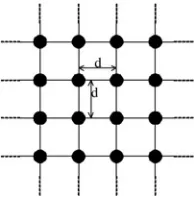
For the sake of maintaining mathematical tractability and for gaining valuable insights into more realistic practical mobile wireless networks, we consider an infinite mesh of rectilinearly located nodes, as seen inFig. 1. This idealised, but tractable topology allows us to examine the system’s performance [10 – 12]. Its infinitely repeated structure results in a scenario having the highest possible interference #The Institution of Engineering and Technology 2007
doi:10.1049/iet-com:20050549
Paper first received 4th October 2005 and in revised form 10th January 2007 The authors are with School of Electronics and Computer Science, University of Southampton, Southampton SO17 1BJ, UK
and conveniently eliminates any system performance dependence on the size of the network. We use (ud, vd) for denoting the location of nodes on the two-dimensional plane, whereuandvare integers anddis the minimum dis-tance between any two adjacent nodes.
Every node in the network has four neighbours, connected by the edges, as seen inFig. 1. We assume that the maximum affordable transmit power only supports com-munications between immediate neighbours. If a packet has to be sent from a source node to a destination node that is not an immediate neighbour, it has to be relayed by the intermediate nodes. Each node is assigned a spreading sequence for transmitting such that the shortest distance between any two nodes using the same spreading sequence is maximised. Each node is assumed to have an equal prob-ability of transmitting or receiving signals to or from one of its neighbours. If a uniform geometric traffic generation model is used, the network is homogeneous and hence it is possible for us to study a single receiving reference node, rather than considering all nodes.
We will focus our attention on the system’s single-hop performance under the above assumptions, rather than con-sidering a particular routing strategy. We assume that each node transmits or receives with the probability of 0.5, respectively, and that there is always sufficient data in the node’ buffer. Without loss of generality, the receiving refer-ence node is assumed to be located at the co-ordinate (0, 0) of the two-dimensional plane and receives from the trans-mitting node located at (0, d). Hence all the other nodes are regarded as interferences, which interfere with a prob-ability of 0.5 according to their transmission probprob-ability of 0.5.
Consider K simultaneously transmitting nodes in the context of wireless ad hoc networks, where each transmit-ting node transmits at the same constant power level Pt, since cost-efficient ad hoc networks routinely dispense with power control. The multipath channel has the channel impulse response (CIR) of[13]
hk(t)¼X Lp1
l¼0
hkld(tlTc)ejqkl (1)
wherehk(t) is the complex-valued low-pass equivalent CIR
of the multipath channel experienced by the transmitting node k. Furthermore,Lpis the total number of resolvable paths, which is assumed to be identical for all nodes, hkl
is the fading envelope of the lth path of the transmitting node k,d(t) is the Dirac delta function,Tcis the chip dur-ation andqklis the phase-shift of thelth path of the
trans-mitting node k. In general, the phase angles fqklg are deemed to be independently and uniformly distributed in [0, 2p), while the fading amplitudes fhklg are independent Nakagami-m distributed random variables having a
probability distribution function ofp(hkl) expressed as[13]
p(hkl)¼2m mkl kl h
2mkl1
kl
G(mkl)Vmklkl e
mkl=Vklh2
kl (2)
In (2) mkl is the Nakagami-m fading parameter, which
characterises the severity of the fading on the lth path of the transmitting node k,Vkl is the second moment ofhkl,
which corresponds to the average path loss on the lth path of the transmitting nodek[13], andG(.) is the gamma func-tion [14]. We assume a negative exponentially decaying multipath intensity profile given by[15, 16]
Vkl¼Vk0e
hl
, k¼1,. . .,K andl¼1,. . ., Lp1 (3)
Vk0 ¼E{h2kl}¼rka (4)
whereh.0 is the rate of average power decay, which is assumed to be identical for all nodes, rk is the distance
between the receiving reference node and the transmitting node k, whereas a.2 is the path loss exponent [13], which is also assumed to be identical for all nodes.
[image:2.595.117.214.29.129.2]The signal xk(t) transmitted by node k is given by
[16 – 19]
xk(t)¼pffiffiffiffiffiffiffi2Ptak(t)bk(t)ejfk (5) where fk is the carrier phase of the transmitting node k,
which is assumed to be uniformly distributed in [0, 2p). The spreading code ak(t) and the data signal bk(t) are
defined as
ak(t)¼ X
1
j¼1 akjwT
c(tjTc) (6)
bk(t)¼ X
1
j¼1 bkjwT
s(tjTs) (7)
where akj[f21, 1g is a binary spreading sequence
having a period L, bkj[f21, 1g is the binary data
sequence, wT(t) is the rectangular pulse having a period
T and Ts is the symbol duration satisfying Ts¼LTc. The signal y(t) received by the reference node is given node is given by
y(t)¼X K
k¼1
X Lp1
l¼0
ffiffiffiffiffiffiffi
2Pt
p
ak(tlTctk)
bk(tlTctk)hklejukl þn(t) (8)
wheretkis the propagation delay of the transmitting nodek,
ukl¼fk2 qklis the phase-shift of thelth path if the
trans-mitting nodekat the receiving reference node andn(t) is the complex-valued low-pass equivalent additive white Gaussian noise. Generally, ukl is independently and
uni-formly distributed in [0, 2p) andtkis assumed to be
uni-formly distributed in the range of [tk0,tk0þtmax], where tk0¼rk/c is the shortest delay or line-of-sight (LOS)
delay between the transmitting node k and the reference node, where cis the velocity of light. Furthermore,tmaxis the maximum propagation delay relative to the LOS delay, which is assumed to be identical for all nodes.
3 BER analysis
Let us assume that the reference node is receiving signals from the transmitting nodequsing maximal ratio combin-ing (MRC) and the RAKE receiver combines a total ofLr branches. Then the output Zqiof its correlation receiver at
the ith branch is given by
Zqi¼Re
ðTsþiTcþtq
iTcþtq
y(t)aiejuqia
q(tiTctq) dt
( )
¼DqiþI(S)qiþI(M)qiþnqi
(9)
whereaiis the branch or finger weight of the RAKE
recei-ver [16],Dqiis the required signal, whileI(S)qiis the MPI
imposed by the other paths of node q, I(M)qi is the MAI
incurred by other nodes and nqi conditioned on the finger
weights faig of the RAKE receiver and the qth user’s
spreading sequenceaq(t)[16].
The required signalDqican be expressed as
Dqi¼pffiffiffiffiffiffiffi2PtTsbq0hqiai (10)
The MPII(S)qiand its variances(2S)qiare given by
I(S)qi¼pffiffiffiffiffiffiffi2PtTcaiX
Lp1
l¼0
l=i
hqlcos (uqluqi)
[bq,1cqq(jL)þbq0cqq(j)] (11)
s2(S)qi¼PtTc2a2i X
Lp1
l¼0
l=i
Vq0ehl[c2qq(jL)þc2qq(j)] (12)
where we havej¼l2i, andckq(j) is the discrete aperiodic
cross-correlation function of the spreading sequences fakj jj¼0,. . .,L21gandfaqjjj¼0,. . .,L21g, or for short akjandaqjwhich is defined as (5) in[18].
The MAII(M)qiand its variances(2M)qiare given by
I(M)qi¼pffiffiffiffiffiffi2PTcaiX
K
k¼1
k=q X Lp1
l¼0
hklcos (ukluqi)
[bk,1rkq(tc)þbk0@kq(tc)] (13)
s2(M)qi¼PtTc2a2iX
K
k¼1
k=q X Lp1
l¼0
Vk0ehl T 2 c
t2 max
X
l0
j¼l Sj(1)(t)
min{t0j,1}
max{tj,0}
2 4
X
lþ
j¼l0 Sj(2)(t)
min{tþj,1}
max{t0j,0}
3 7
5 (14)
where we havez¼(l2iþj) modLand the partial integral Sj(i)(t)jt1
t2¼S
j
(i)
(t2)2Sj(i)(t1), andSj(i)(t) is given by
Sj(i)(t)¼1
4w1(z)t 4þ1
3[w1(z)(jti)þ2w2(z)]t 3
þ1
2[2w2(z)(jti)þw3(z)]t 2þ
w3(z)(jti)t(15)
ti¼ t, if i¼1
tþ, if i¼2
(16)
The coefficientsv1(z),v2(z) andv3(z) in (15) are given by
w1(z)¼[ckq(zþ1L)ckq(zL)]2
þ[ckq(zþ1)ckq(z)]2
w2(z)¼ckq(zL)[ckq(zþ1L)ckq(zL)]
þckq(z)[ckq(zþ1)ckq(z)]
w3(z)¼c2kq(zL)þc2kq(z)
(17)
The parameters t2, t0, tþ defining the integral area and their integer partsl2,l0,lþare given by
t ¼tk0tq0tmax
Tc , l ¼ btc
t0¼tk0tq0
Tc
, l0¼ bl0c
tþ¼
tk0tq0tmax
Tc , lþ¼ btþc
The Gaussian noisenqiand its variances(2N)qiare given by
nqi¼Re ai ðTs
0
n(t)aq(t)C(t)ejuqidt
(18)
s2(N)qi¼a2iN0Ts (19)
Consequently, the SINR encountered on the ith path of transmitting node q at the receiving reference node is denoted by 2giwheregiis given by
gi¼ D
2
qi
2 s2
(S)qiþs2(M)qiþs2(N)qi
h i (20)
The term bit error probability (BEP) will be used inter-changeably with the BER Pbjh(g), which is conditioned on
the fading envelope vector h. When using binary phase shift keying (BPSK) for transmitting from node n to the receiving reference node, the BEP is given by applying the Gaussian approximation as[20]
Pb(g)¼Q
ffiffiffiffiffiffiffiffiffiffiffiffiffiffiffi X Lr1
i¼0 2gi
v u u t 0 @
1
A (21)
whereg represents the vector constituted byfgig,Lris the total number of RAKE receiver branches and Q(x) is the GaussianQ-function. Fir the sake of conveniently evaluat-ing the average BER, we will use an alternative definite integral of the form ofQ(x), which was formulated in (2) of [20].
Finally, the average BER at the reference node receiving from the transmitting nodeqis given by[20]
Pb¼1
p
ðp=2
0
Y Lr1
i¼0
misin2u
¯
giþmisin2u
mi
du (22)
where 2g¯i is the average signal to interference-plus-noise
ratio (SINR) of the transmitting node q at the receiving reference node, and the SINR-related term g¯i in (22) is
given by
¯
gi¼ YS(i)
L2 þ
YM(i)
L2 þ
1
gSNR
1
ehi (23)
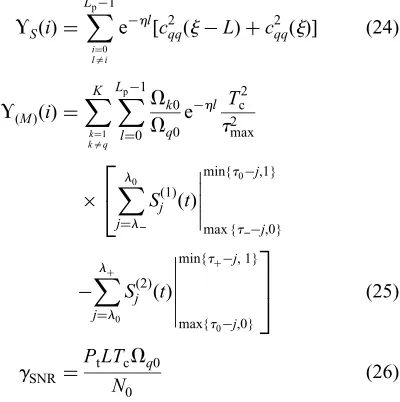
where YS(i) and YM(i) are the MPI and the MAI related
account the received interference power. They are formu-lated as
YS(i)¼X Lp1
i¼0
l=i
ehl[c2qq(jL)þc2qq(j)] (24)
Y(M)(i)¼X K
k¼1
k=q X Lp1
l¼0
Vk0 Vq0e
hl Tc2
t2 max
X
l0
j¼l Sj(1)(t)
min{t0j,1}
max {tj,0}
2 4
X
lþ
j¼l0 Sj(2)(t)
min{tþj, 1}
max{t0j,0}
3 7
5 (25)
gSNR¼PtLTcVq0
N0 (26)
4 Performance of LAS DS-CDMA
We will compare the achievable performance of a number of systems, namely that of quasi-synchronous LAS DS-CDMA and quasi-synchronous DS-CDMA using both Walsh-Hadamard (WH) codes and Orthogonal Gold (OG) codes, as well as asynchronous LAS DS-CDMA and asyn-chronous DS-CDMA using random random signature sequences. BPSK modulation is used in all of the above systems.
We investigate the attainable performance of the system using LAS-CDMA-2000-like physical layer parameters [21], where the corresponding spreading gain is G¼151. For the sake of a fair comparison we whould need both WH and OG codes having a length of L¼151 chips. However, no such codes exist, and the most similar ones are those having a length of L¼128 and L¼256 chips. When considering asynchronous DS-CDMA using random sequences, we assume that the spreading gain of the random sequences is the same as that of the LAS-CDMA-2000 codes, namely G¼151, which is also equal to the length Lof the random signature sequences.
Fig. 2 shows that the BERs of all systems considered decrease, as the SNR increases. This can be readily seen from (23), wherePb(g) is a monotonically decreasing func-tion ofgSNR. However, it may also be concluded from (23) that increasing the transmitted power is only capable of mitigating the transmitted power substantially improves the achievable BER performance of the quasi-synchronous
LAS DS-CDMA system. The quasi-synchronous
DS-CDMA systems using both 256-chip and 128-chip WH codes exhibit a poor performance owing to their high auto-correlation function side-lobes. In contrast, the quasi-synchronous DS-CDMA systems using 256-chip and 128-chip OG codes exhibit a better performance, as a benefit of their good correlation properties. It is worth noting that the performance of quasi-synchronous DS-CADA systems is dominated by a limited number of high cross-correlation values found between the spreading sequences used by the desired node and the interferers at a time – displacement of j¼0. Unfortunately, there are several OG codes having a high cross-correlation value at or near the displacement ofj¼0. These cross-correlation values are proportional to the spreading gain of the code concerned. This is the reason that the quasi-synchronous DS-CDMA systems using 256-chip and 128-chip OG
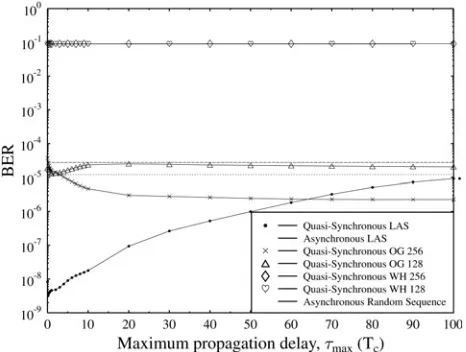
exhibit a similar performance. The asynchronous LAS DS-CDMA system performs slightly better than the asyn-chronous DS-CDMA system using random sequences, as a consequence of its lower MPI resulting from its IFW, given the parameters of Lp¼4 and i¼3. The quasi-synchronous LAS DS-CDMA system performs best, since its IFW cancels most of the MPI, given the parameters of Lp¼4 and i¼3. Hence the quasi-synchronous LAS DS-CDMA system becomes essentially noise-limited, rather than interference-limited, which is also the reason that it benefits most from increasing the transmitted power. In order to demonstrate the capability of LAS codes in terms of mitigating both MPI and MAI, we letgSNR!1
in Fig. 3. Fig. 3 shows that the BER of the
quasi-synchronous LAS DS-CDMA system degrades, as the maximum propagation delay increases, since the effects of less accurate synchronization inflict a higher MAI. Even the asynchronous LAS DS-CDMA system performs slightly better than the asynchronous DS-CDMA arrangement using random sequences, since most of the MPI is eliminated by the asynchronous LAS DS-CDMA scheme, given the par-ameters of Lp¼4 and i¼3. The maximum propagation delay has a marginal effect on the quasi-synchronous DS-CDMA scheme using WH codes and the system having a higher spreading gain has almost no advantages, since the MPI dominates the achievable performance, as it can be concluded from their associated auto-correlation and cross-correlation functions. The quasi-synchronous system using 256-chip OG codes performs best at a large maximum propagation delay, mainly as a consequence of its higher spreading gain, while the LAS codes exhibit increased auto-correlation side-lobes outside the IFW.
In our further investigations, the system’s performance for various m values exhibits similar performance trends to the m¼1 scenario, since the performance is mainly dependent on the correlation properties of the spreading
Fig. 2 BER against the received per-bit SNRgSNR
All nodes are assumed to transmit with a probability of 0.5 at the same power levelPt
An infinite number of nodes are placed on a simple infinite rectilinear grid, with the minimum distance between adjacent nodesd¼30 m. Maximum propagation delay istmax¼2Tcand the chip duration is
2ms
Total number of resolvable paths isLp¼4, and the RAKE receiver combinesLr¼3 paths
IFW width isi¼3
Rate of average negative exponential power decay ish¼0.2 Nakagami-mfading parameter ism¼1.0
Pathloss exponent isa¼4.0
[image:4.595.311.542.25.209.2] [image:4.595.86.286.61.262.2]sequences and less critically on the Nakagami fading parameter, as suggested by our analysis in Section 3. However, when the number of resolvable multipath components, Lp, is high, LAS DS-CDMA inevitably encounters serious MPI and MAI. There is a large BET discrepancy between Lp¼8 and Lp¼12, because there are high auto-correlation side-lobes atj¼+8 outside the IFW. On the other hand, increasing the total number of RAKE receiver branches dramatically improves the per-formance of the quasi-synchronous LAS DS-CDMA system, when the total number of resolvable paths is assumed to be Lp¼4. This performance improvement is attributed to the RAKE receiver, which benefits from the associated time-diversity.
5 Conclusion
In conclusion, LAS DS-CDMA was investigated in the context of an ad hoc network obeying an infinite rectilinear mesh topology. The system exhibits a significantly better per-formance than the family of traditional spreading sequences used in a quasi-synchronous DS-CDMA scenario having a
low number of resolvable multipath components and a suffi-ciently high number of RAKE receiver branches.
6 References
1 Li, D.: ‘The perspectives of large area synchronous CDMA technology for the fourth-generation mobile radio’,IEEE Commun. Mag., 2003,41, (3), pp. 114 – 118
2 Lee, W.C.Y.: ‘Analysis and realization of a physical CDD system’, Wiley J. Wirel. Commun. Mobile Comput., 2003,3, (5), pp. 571 – 583 3 Li, D.: ‘A high spectrum efficient multiple access code’. in Fifth Asia-Pacific Conf. on Communications and Fourth Optoelectonics and Communication Conf., Beijing, China, October 1999), vol. 1, pp. 598 – 605
4 Wei, H., and Hanzo, L.: ‘On the uplink performance of LAS-CDMA’, IEEE Trans. Wirel. Commun., 2006,5, (5), pp. 1187 – 1196 5 Stanczak, S., Boche, H., and Haardt, M.: ‘Are LAS-codes a miracle ?’.
IEEE Global Telecommunications Conf., San Antonio, Texas, USA, vol. 1, November 2001, pp. 589 – 593
6 Choi, B.-J., and Hanzo, L.: ‘On the design of LAS spreading codes’. in IEEE 56th Vehicular Technology Conference 2002-Fall, Vancouver, British Columbia, Canada, September 2002, pp. 2172– 2176 7 Ni, S., Wei, H., Blogh, J.S., and Hanzo, L.: ‘Network performance of
asynchronous UTRA-like FDD/CDMA systems using loosely synchronised spreading codes’. IEEE 58th Vehicular Technology Conf. 2003-Fall, Orlando, Florida, USA, October 2003, vol. 2, pp. 1359-1363
8 Niculescu, D.: ‘Communication paradigms for sensor network’,IEEE Commun. Mag., 2005,43, (3), pp. 116 – 122
9 Bruno, R., Conti, M., and Gregori, E.: ‘Mesh networks: commodity multihop ad hoc networks’, IEEE Commun. Mag., 2005, 43, (3), pp. 123 – 131
10 Silvester, J.A., and Kleinrock, L.: ‘On the capacity of multihop slotted networks with regular structure’,IEEE Trans. Commun., 1983,31, (8), pp. 974 – 982
11 Xie, L.-L., and Kumar, P.: ‘A network information theory for wireless connuniction: scaling laws and optimal operation’,IEEE Trans. Inf. Theory, 2004,50, (5), pp. 748 – 767
12 Hekmat, R., and Mieghem, P.V.: ‘Interference in wireless multi-hop ad-hoc networks and its effect on network capacity’,Wirel. Netw., 2004,10, (4), pp. 389 – 399
13 Proakis, J.G.: ‘Digital communication’ (McGraw-Hill Companies, Inc, 2001, 4th edn.)
14 Abramowitz, M., and Stegun, I.A.: ‘Handbook of mathematical functions, with formulas, graphs, and mathematical tables’ (Department of Commerce, USA, 1972)
15 Turin, G.L., Clapp, F.D., Johnston, T.L., Fine, S.B., and Lavry, D.: ‘A statistical model of urban multipath propagation’,IEEE Tans. Veh. Technol., 1972,21, (1), pp. 1 – 9
16 Eng, T., and Milstein, L.B.: ‘Coherent DS-CDMA performance in Nakagami multipath fading’,IEEE Trans. Commun., 1995,43, (2/ 3/4), pp. 1134 – 1143
17 Geraniotis, E., and Ghaffari, B.: ‘Performance of binary and quaternary direct-sequence spread-spectrum maultiple-access systems with random signature sequence’, IEEE Trans. Commun., 1991,39, (5), pp. 713 – 724
18 Lehnert, J.S., and Pursley, M.B.: ‘Error probabilities for binary direct-sequence spread-spectrum communications with random signature sequences’,IEEE Trans. Commun., 1987,35, (1), pp. 87 – 98 19 Pursley, M.B.: ‘Performance evaluation for phase-coded spread-spectrum multiple-access communication-part I: system analysis’,IEEE Trans. Commun., 1977,25, (8), pp. 795 – 799 20 Simon, M.K., and Alouini, M.-S.: ‘A unified approach to the
performance analysis of digital communication over generalized fading channel’,IEEE Proc., 1998,86, (9), pp. 1860 – 1877 21 ‘Physical layer specification for LAS-2000’, June 2000, CWTS/China
Fig. 3 BER against the maximum propagation delay t
max-expressed in terms of the chip duration Tc
All nodes are assumed to transmit with a probability of 0.5 at the same power levelPt
An infinite number of nodes are placed on a simple infinite rectilinear grid, with the minimum distance between adjacent nodesd¼30 m Chip duration is 2ms
Noise is ignored, that isgSNR!1
Total number of resolvable paths isLp¼4, and the RAKE receiver
combinesLr¼3 paths IFW width isi¼3
Rate of average negative exponential power decay ish¼0.2 Nakagami-mfading parameter ism¼1.0
Pathloss exponent isa¼4.0
[image:5.595.46.279.30.206.2]