Restructuring
effective employment and social legislation and policies, across the EU 27, EFTA, EEA and EU candidate and
pre-candidate
countries.
European Commission
Europe Direct is a service to help you find answers
to your questions about the European Union
Freephone number (*):
00 800 6 7 8 9 10 11
(*) Certain mobile telephone operators do not allow access to 00 800 numbers
or these calls may be billed.
More information on the European Union is available on the Internet (http://europa.eu).
Cataloguing data as well as an abstract can be found at the end of this publication.
Luxembourg: Publications Office of the European Union, 2012
ISBN 978-92-79-25057-6
doi:10.2767/66114
© European Union, 2012
The European economy is slowly emerging from the deepest recession in decades. The economic crisis resulted in a large drop in economic activity in the EU, along with millions of jobs lost and a high human cost. The economic and financial crisis is also speeding up new developments on the international competition front with the rise of successful companies in emerging countries that are increasingly competing with European businesses in the upper segments of the market.
The competitiveness of the European economy and the preservation of activities and jobs in Europe will depend more and more on the capacity of European companies to boost their competitiveness through innovating and quickly and smoothly adapting to change.
As underlined in the Annual Growth Survey, the EU needs to use this crisis to address decisively the issue of its global competitiveness so that it comes out stronger and becomes a smart, sustainable and inclu-sive economy delivering high levels of employment, productivity, competitiveness and social cohesion.
The positive export performance of some Member States shows that success in global markets rests not only on price competitiveness but also on wider factors such as sector specialisation, innovation, and skill levels that enhance real competitiveness. In that regard, the structural weaknesses predating the crisis which had not been tackled adequately are becoming glaringly obvious.
The EU has built up a strong system of employment and social protection that, combined with a rela-tively high level of education, has been the basis for its economic and social prosperity over the last few decades. However, at a time when the business environment is changing fast, some aspects of that system are making it more difficult to quickly and smoothly reallocate resources, and especially human resources, from declining activities to emerging ones.
On the other hand, that system, built around the principle of job stability, is less and less capable of giving individual workers a real chance of a secure professional future when their jobs are at risk, because it does not sufficiently encourage them to adapt to change.
The economic and financial crisis and the faster pace of change that it is causing make it more important than ever for Europe to address those two weaknesses. Recognising the need for economic adjustment as a vital feature of future growth and job creation, the Commission wants to encourage permanent business adaptation to fast-changing economic circumstances while maintaining a high level of employment and social protection.
The Green Paper Restructuring and anticipation of change: What lessons from the economic crisis? is a sign of the Commission’s determination to put in place all possible mechanisms and frameworks that support and encourage business adaptation while, at the same time, creating the conditions that will allow workers and regions to accompany that process and avoid unemployment and social distress.
Anticipating, managing and mitigating the nega-tive consequences of restructuring
This report presents an overview of the European Union’s main strategies, policies and actions that aim to help anticipate, prepare and manage restructuring and change. Particular emphasis is placed on efforts to mitigate the negative consequences of restructuring on individual workers and the wider community.
Coping with the crisis The report has been written against the background of the most serious economic and financial crisis for many decades, which has had a severe impact on the levels of restructuring and change throughout the European Union. Over the period 2002–10, more than 11 000 cases of restructuring were recorded by the European Restructuring Monitor (ERM), with the ratio of announced job losses/ job creations standing at 1.8:1. In the period 2008–10, that ratio increased to 2.5:1. The crisis, from which the EU has not yet fully emerged, has tested the ability of both the EU and the individual Member States to cope with high levels of change and, as such, provides the backdrop to the report.
The crisis of the past two years has had a severe impact on the labour market. The level of restructuring has increased considerably as companies struggle to cope with extremely challeng-ing circumstances. Chapter 1 of the report examines the main restructurchalleng-ing developments across Europe, looking at recent levels of restructuring and the numbers of jobs lost and created. It looks in detail at restructuring in the automotive industry, a major sector for the EU economy (the European Restructuring Monitor announced that job losses in the sector from the first quarter of 2008 to the end of the second quarter of 2010 amounted to more than 160 000). It also gives examples of some initiatives undertaken at company level to preserve employment in the context of the economic crisis. It also looks at Member States’ responses to the crisis, including labour market reforms and the widespread use of short-time working in some countries, which has served to cushion the labour market effects of the crisis. Furthermore, it examines the role of industrial policy during the crisis, focusing in particular on the steel and automotive industries.
Restructuring as a nec-essary part of business life
However, it should not be forgotten that, even in normal times, restructuring is a part of daily business life, and a process that is necessary in order to ensure that organisations keep pace with change and remain competitive in a global market. Restructuring is therefore a vital and constant part of organisational life and can create as well as destroy jobs. It is also a reaction to larger-scale changes, such as global warming and climate change.
The EU’s wealth of expe-rience in dealing with restructuring
Over the past few decades, the EU has built up a wealth of experience in examining and dealing with how best to anticipate and manage restructuring in order to mitigate its negative impacts as far as possible. There are many examples of best practice at the level of individual Member States, which have been drawn together and showcased in a range of recent EU-funded projects on restructur-ing. The challenge now is to try to build on and use this experience to formulate a framework at European level on anticipating and managing restructuring. The European Commission has, in its October 2010 communication on industrial policy, as well as in other recent policy papers, touched on some of the relevant issues, and has indicated that it will consult the EU-level cross-sector social partners on such a framework.
Dealing with restructuring in a positive way involves both anticipating and managing it. In order to limit the negative impact of restructuring as much as possible, it is vital that anticipatory measures are put in place as far as possible. There are examples of initiatives such as economic and finan-cial observatories and early warning systems in some EU Member States, although these are not replicated in all, and could be developed further in those where they are present. The anticipation of restructuring is key to mitigating the adverse effects as far as possible, as it enables the actors to plan and take action to lessen the impact in advance of the restructuring event.
The crucial role of competence and skills development...
Competence and skills development sits at the core of forward-looking employment policy and is a subject that is integral to best practice in the management of restructuring. The demand for a highly qualified labour force remains a key source of future growth. From a market standpoint, it is essential that the qualifications, competences and skills of mobile EU professionals are recognised in a fast, simple and reliable way if we are to meet this surge in demand.
On 19 December 2011, the European Commission adopted a proposal to modernise the Professional Qualifications Directive (1) in order to adapt it to an evolving labour market. Chapter 2 of this report therefore examines competences and skills in the context of the future direction of the EU economy and the restructuring that the EU has undergone in the past few years. This includes issues such as lifelong learning and the importance of ensuring that all workers have the opportunity to develop their skills and competences throughout their working life. It is also important to ensure that skills are transferable, as this will improve employability and aid movement between companies and between sectors if necessary.
A particular focus is placed on the skills needs and skills policy of the automotive sector, and on the skills needs of SMEs (in 2008, according to Eurostat figures, out of the nearly 20.8 million companies in the EU, 99.8 % were SMEs and they accounted for around 67.4 % of all employment by enterprises). These businesses cannot offer as targeted an approach to training and skills devel-opment as their larger counterparts.
1
…and of the EU support funds
The EU makes a range of funds available to Member States in order to support restructuring, and this plays an important role in helping to anticipate and manage restructuring. Chapter 3 of this report examines the role of State aid provided by Member States, including the Commission’s policy response to the economic crisis, involving aid both to the financial sector and to the real economy. It also examines the role of the European Social Fund (over 400 000 enterprises have received assistance from the ESF and more than 7 million have been supported by activities funded by it) and the European Globalisation Adjustment Fund (a total of 29 applications were submitted to the Commission in 2009, with an amount requested per worker varying between slightly above EUR 500 and over EUR 15 700, with an average of EUR 5 698); it gives examples of where the funds have succeeded in helping to manage restructuring.
Finally, this chapter looks at the impact of restructuring in the EU regions and how EU funds have helped specific regions to manage restructuring.
Legislation and social dialogue shape the employee involvement framework for the response to restructuring
Restructuring in the EU is covered by a body of legislation, in the form of a number of directives, largely in the field of informing and consulting the workforce about changes that are likely to affect them. Chapter 4 examines this framework and also looks at the implementation of EU law and the preparation of possible new initiatives in this area.
Social dialogue also plays an important part in shaping responses to restructuring, at both EU and national level. There are a number of joint actions at EU level on the management of change, and a range of sectoral initiatives that have successfully managed change. A number of transnational agreements on restructuring also cover issues such as social responsibility, anticipating change, and mitigating the negative consequences of change.
Initiatives and tools available at national level to anticipate and manage restructuring
A wide range of measures have been taken by Member States to support restructuring, focusing on anticipation and management of the process, and Chapter 5 reviews them. In particular, it exam-ines the findings of a large-scale Commission-funded project undertaken in 2009–10, designed to showcase examples of best practice in the anticipation and management of restructuring in each of the 27 EU Member States and to stimulate debate at both national and EU level on these issues.
Facing up to future challenges
The future challenges that the EU is facing are many and varied, and Chapter 6 examines the main issues and how they might be addressed. One of these is the psychosocial effects of restructuring, including the effects not only on the workers who are losing their jobs, but also on the ‘survivors’ and the line managers in an organisation. Managing the psychosocial effects of restructuring is of prime importance as this will help to ensure that the negative consequences of the restructuring process have as little effect as possible on those involved in the process.
Climate change is another huge challenge for the EU and an issue that has been a focus for EU policymakers for some time. There are many potential impacts of climate change on employment, such as effects on specific sectors, the changes to skills policies that will be needed in a green economy and the challenges of moving to a low-carbon economy. It is likely that climate change will require a significant and coordinated response from the European Union in order to ensure that the full benefits of the green economy are harnessed by the EU economy.
In terms of sectoral impacts, the transport sector is an industry that will be significantly affected by the move to a low-carbon economy and challenges include the development of green jobs, the types of skills that will be needed in the sector, and best practices in restructuring.
Future challenges also include the best way forward for EU industrial policy and, most specifically, the links between industrial policy and employment and skills policies.
Many of the relevant issues are highlighted in the Commission’s October 2010 communication on industrial policy, which sets out the main challenges for industrial policy in a globalised economy.
The challenges of eco-nomic and social change and the need for a com-mon approach
Tentative lessons on anticipation and man-agement of restructuring
The Commission has initiated a range of activities over the past 15 years with the aim of trying to help organisations and stakeholders manage restructuring in a way that has the least possible negative impact on workers, their families and the surrounding community. These include two consultations with the EU-level social partners on the issue of managing change.
The Commission has also, over the past two decades, funded a wide range of research, in the form of studies or analyses aimed at identifying good practices, measures or actions to better anticipate restructuring and manage it in a responsible way. There is a significant degree of convergence between the good practices and measures highlighted in these studies, enabling the following tentative messages to be identified.
• Measures to anticipate and manage restructuring differ in individual Member States, depending on factors such as national culture, national industrial relations and employment systems, national welfare and social security systems and national skills and training strategies. Nevertheless, there is clearly scope for transposing initiatives or parts of initiatives across borders, adapting them to different national contexts.
• Active social partner involvement is crucial in many of the schemes available to anticipate and manage restructuring.
• Where a wide range of actors participate in measures, this is a strengthening factor. Partnerships can provide a broad spectrum of expertise and human resources to support organisations that are trying to manage restructuring. This can also limit the effects of restructuring on the wider region, community and employees’ families.
• SMEs have specific challenges when engaging with the anticipation and management of restruc-turing in a socially responsible way. They often lack the resources, both financial and in terms of personnel, to go much beyond statutory compliance.
• Anticipation of restructuring is a powerful tool that can limit its adverse effects. However, there needs to be greater emphasis on anticipation and preparation of restructuring.
• European funds play an important role in some of the newer EU Member States and in south-ern Europe.
• While redundancy should always be a last resort, active measures should take precedence over passive measures.
• Training is a crucial and core issue when considering the anticipation and management of restructuring.
• The impact of restructuring on the health of the individuals concerned should be monitored closely, and adverse effects, such as psychosocial, but also physical impacts, should be mitigated as much as possible. This concerns those who are made redundant, those overseeing the redundancies (line managers) and the ‘survivors’ of restructuring.
CHAPTER 1 RESPONDING TO THE CRISIS
...
13
1. RECENT LEVELS OF RESTRUCTURING IN THE EUROPEAN UNION ... 14
1.1. THE EMPLOyMENT IMPACT OF RESTRUCTURING IN EUROPE ... 18
1.2. RESTRUCTURING ACTIvITy DURING THE ECONOMIC CRISIS ... 20
1.3. JOB LOSSES ... 21
1.4. RESTRUCTURING INvOLvING JOB CREATION ... 29
1.5. EMPLOyMENT-MAINTAINING INITIATIvES DURING THE CRISIS ... 31
1.6. TENTATIvELy EMERGING FROM RECESSION? ... 34
2. LABOUR MARKET REFORMS ... 37
3. SUPPORTING LABOUR MARKETS DURING THE CRISIS: SHORT-TIME WORKING ... 43
3.1. SHORT-TIME WORKING ARRANGEMENTS ... 43
3.2. PHASING OUT CRISIS-RELATED LABOUR MARKET MEASURES ... 47
3.3. THE WAy FORWARD ... 47
4. THE ROLE OF INDUSTRIAL POLICY IN RESTRUCTURING DURING
A PERIOD OF CRISIS ... 48
4.1. CHALLENGES AND OPPORTUNITIES DRIvING FUTURE RESTRUCTURING ... 49
4.2. IMPLICATIONS FOR INDUSTRIAL POLICy MEASURES ... 53
4.3. SECTOR-SPECIFIC INDUSTRIAL POLICIES FOR RESTRUCTURING ... 54
4.4. THE WAy FORWARD ... 57
5. ACCESS TO FINANCE IN THE CRISIS ... 57
CHAPTER 2 DEVELOPING COMPETENCES
...
61
1. THE IMPORTANCE OF LIFELONG LEARNING ... 63
1.1. PLANNED NEW PROPOSAL ON THE vALIDATION OF INFORMAL LEARNING ... 65
1.2. THE EUROPASS FRAMEWORK ... 65
1.3. EU POLICy ON LIFELONG LEARNING AND SKILLS DEvELOPMENT ... 66
2. THE ROLE OF SKILLS IN IMPROVING LABOUR MARKET MOBILITY ... 67
2.1. GENERAL v SPECIFIC COMPETENCES ... 68
2.2. TRANSFERABLE SKILL SETS ... 69
2.3. FUTURE SKILLS NEEDS ... 71
2.4. THE ROLE OF DIFFERENT ACTORS IN SKILLS DEvELOPMENT ... 71
3. SECTOR STUDIES AND THE NEW SKILLS FOR NEW JOBS INITIATIVE ... 73
3.1. NEW SKILLS FOR NEW JOBS INITIATIvES ... 73
3.2. SECTORAL STUDIES OF INNOvATION, SKILLS AND JOBS ... 74
3.3. EvOLUTION OF OCCUPATIONS IN THE EU ... 76
3.4. EMERGING COMPETENCES ... 78
3.5. WORK AND LIFE QUALITy IN NEW AND GROWING JOBS ... 80
4. EUROPEAN SECTOR COUNCILS ON JOBS AND SKILLS ... 82
4.1. RECOMMENDATIONS AND POLICy OPTIONS IN THE FEASIBILITy STUDy ... 84
5. SKILLS INITIATIVES IN THE AUTOMOTIVE SECTOR ... 87
5.1. EUROPEAN PARTNERSHIP FOR THE ANTICIPATION OF CHANGE IN THE
AUTOMOTIvE INDUSTRy ... 88
5.2. ANTICIPATION OF SKILLS NEEDS —
TOWARDS A EUROPEAN SECTOR COUNCIL ... 91
6. TRAINING IN SMALL AND MEDIUM-SIZED ENTERPRISES ... 92
6.1. SMEs IN EUROPE ... 92
6.2. GUIDE FOR TRAINING IN SMEs ... 93
6.3. TRAINING — A KEy TO SUCCESS AND ADAPTATION ... 95
6.4. FINANCIAL AND ORGANISATIONAL MEANS ... 95
6.5. HR AND SKILLS DEvELOPMENT POLICy ... 96
6.6. LESSONS LEARNED ... 97
CHAPTER 3 THE EU’S ROLE WITH REGARD
TO RESTRUCTURING SUPPORT
...
99
1. THE ROLE OF STATE AID ...100
1.1. THE COMMISSION’S POLICy RESPONSE TO THE FINANCIAL CRISIS ... 101
1.2. WAy FORWARD ... 104
2. THE ROLE OF THE EUROPEAN SOCIAL FUND...105
2.1. ADAPTABILITy IN THE ESF OPERATIONAL PROGRAMMES 2007–13 ... 106
2.2. ESF INTERvENTIONS AT THE DIFFERENT STAGES OF THE RESTRUCTURING
AND CHANGE PROCESS ... 107
3. THE ROLE OF THE EUROPEAN GLOBALISATION ADJUSTMENT FUND ...111
3.1. THE FUNCTIONING OF THE EGF ... 111
3.2. OvERvIEW OF APPLICATIONS RECEIvED IN 2009 ... 113
3.3. NExT STEPS ... 117
4. THE IMPACT OF RESTRUCTURING IN THE EU REGIONS ...117
4.1. THE INFLUENCE OF GLOBALISATION ... 117
4.2. MANAGEMENT OF RESTRUCTURING UNDER THE EUROPEAN REGIONAL
DEvELOPMENT FUND ... 124
CHAPTER 4 DIALOGUE AND LAW
...127
1. EU LABOUR LAW AND RESTRUCTURING ...128
1.1. MAIN EU LABOUR LEGISLATION RELATING TO RESTRUCTURING ... 129
1.2. IMPLEMENTING AND ADAPTING LEGISLATION ... 130
1.3. PREPARATION OF NEW INITIATIvES... 133
2. EUROPEAN-LEVEL SOCIAL DIALOGUE ON MANAGEMENT AND ANTICIPATION
OF CHANGE ...133
2.1. UNDERSTANDING WHAT HAPPENS ... 134
2.2. SECTOR-LEvEL SOCIAL DIALOGUE ... 136
3. TRANSNATIONAL COMPANY AGREEMENTS AND RESTRUCTURING ...139
3.1. AN EMERGING PHENOMENON ... 139
3.2. ADDRESSING SPECIFIC RESTRUCTURING EvENTS ... 140
3.4. ANTICIPATING CHANGE... 142
3.5. ADDRESSING RESTRUCTURING IN GLOBAL AGREEMENTS ... 143
3.6. COMMISSION’S ROLE IN PROMOTING TRANSNATIONAL COMPANy
AGREEMENTS ... 144
4. CROSS-BORDER MERGERS ...145
4.1. EMPLOyEE PARTICIPATION IN CROSS-BORDER MERGERS ... 145
4.2. EUROPEAN COMPANIES (SEs) ... 146
CHAPTER 5 MEMBER STATE ACTIONS TO SUPPORT RESTRUCTURING
...150
1. RESTRUCTURING IN THE MEMBER STATES ...151
2. ORGANISING TRANSITIONS ...156
2.1. CLASSIFyING ExISTING SCHEMES AND MECHANISMS ... 157
2.2. RESULTS OF A COMPARATIvE EvALUATION ... 161
2.3. THE ROLE OF FLExICURITy IN SECURING TRANSITIONS... 162
CHAPTER 6 ISSUES AND CHALLENGES
...167
1. PSYCHOSOCIAL EFFECTS OF RESTRUCTURING AND MENTAL HEALTH
IN THE WORKPLACE ...168
1.1. THE EU FRAMEWORK, STRATEGIES AND ACTIONS ... 169
1.2. THE PSyCHOSOCIAL RISKS OF RESTRUCTURING AND CHANGE ... 172
1.3. MENTAL HEALTH AND WELL-BEING AT WORK... 177
2. THE IMPACT OF CLIMATE CHANGE ON EMPLOYMENT ...179
2.1. OvERALL IMPACT OF CLIMATE CHANGE ON EMPLOyMENT ... 179
2.2. SECTORAL IMPACT OF CLIMATE-CHANGE POLICIES ... 180
2.3. CLIMATE-CHANGE POLICIES AND SKILLS ... 182
2.4. THE TRANSITION TO A LOW-CARBON ECONOMy ... 182
3. THE IMPACT OF RENEWABLE ENERGY POLICY ON EMPLOYMENT ...183
3.1. THE BENEFITS OF THE RES SECTOR ... 184
4. CHALLENGES FOR THE TRANSPORT SECTOR ...188
4.1. OvERvIEW OF THE EU TRANSPORT SECTOR... 190
4.2. DECARBONISATION AND GREEN JOBS ... 191
4.3. DEMOGRAPHy: HEADING FOR SKILL AND LABOUR SHORTAGES ... 194
4.4. INTEGRATION IN THE TRANSPORT SECTOR ... 195
4.5. FROM NATIONAL PUBLIC MONOPOLIES
TO EUROPEAN PRIvATE MONOPOLIES? ... 196
4.6. THE EFFECTS OF THE ECONOMIC CRISIS ... 197
4.7. ExISTING PRACTICES IN RESTRUCTURING ... 198
4.8. EU ACTIONS TO SOFTEN THE SOCIAL EFFECTS OF RESTRUCTURING ... 199
4.9. OBJECTIvES FOR THE FUTURE ... 200
5. THE FUTURE OF INDUSTRIAL POLICY ...201
5.1. AN INTEGRATED INDUSTRIAL POLICy FOR THE GLOBALISATION ERA ... 201
5.2. IMPROvING THE FRAMEWORK CONDITIONS FOR INDUSTRy ... 201
5.5. TACKLING STRUCTURAL ExCESS CAPACITIES ... 203
5.6. THE ROLE OF MANAGEMENT AND WORKER REPRESENTATIvES ... 203
5.7. TOWARDS A NEW EU GOvERNANCE FOR INDUSTRIAL POLICy ... 204
5.8. SUSTAINABLE INDUSTRIAL POLICy ... 204
5.9. ENERGy-INTENSIvE INDUSTRIES AND INTERNATIONAL ASPECTS ... 208
5.10. DEvELOPING A SUSTAINABLE INDUSTRIAL POLICy ... 209
5.11. THE FUTURE ... 210
CHAPTER 7 MAIN ECONOMIC AND SOCIAL CHALLENGES —
THE RESPONSE OF THE EU
...212
1. PRINCIPLES EXPRESSED IN AND RESULTING FROM THE COMMISSION’S
CONSULTATIONS OF EUROPEAN SOCIAL PARTNERS ...213
1.1. THE 2002 CONSULTATION OF THE EUROPEAN SOCIAL PARTNERS
ON ANTICIPATING AND MANAGING CHANGE ... 213
1.2. THE 2003 EUROPEAN SOCIAL PARTNERS’ WORK ON MANAGING CHANGE ... 216
1.3. THE 2005 CONSULTATION OF THE EUROPEAN SOCIAL PARTNERS
ON RESTRUCTURING AND EMPLOyMENT ... 217
2. PRINCIPLES RESULTING FROM ANALYTICAL WORK
AND STAKEHOLDERS’ VIEWS ...219
2.1. SOURCES: STUDIES, REPORTS, RESTRUCTURING FORA ... 219
3. MAIN ISSUES RELATING TO THE ANTICIPATION
AND MANAGEMENT OF CHANGE ...222
3.1. THE IMPORTANCE OF TIMELy ACTION ... 223
3.2. A MULTILEvEL, MULTI-ACTOR ISSUE... 224
CHAPTER 8 CONCLUSIONS
...229
1. TEN TENTATIVE LESSONS ON THE ANTICIPATION AND MANAGEMENT
OF RESTRUCTURING...230
SOURCES AND FURTHER READING
...234
1. RECENT LEVELS OF RESTRUCTURING IN THE EUROPEAN UNION ... 14
1.1. THE EMPLOyMENT IMPACT OF RESTRUCTURING IN EUROPE ... 18
1.2. RESTRUCTURING ACTIvITy DURING THE ECONOMIC CRISIS ... 20
1.3. JOB LOSSES ... 21
1.4. RESTRUCTURING INvOLvING JOB CREATION ... 29
1.5. EMPLOyMENT-MAINTAINING INITIATIvES DURING THE CRISIS ... 31
1.6. TENTATIvELy EMERGING FROM RECESSION? ... 34
2. LABOUR MARKET REFORMS ... 37
3. SUPPORTING LABOUR MARKETS DURING THE CRISIS: SHORT-TIME WORKING ... 43
3.1. SHORT-TIME WORKING ARRANGEMENTS ... 43
3.2. PHASING OUT CRISIS-RELATED LABOUR MARKET MEASURES ... 47
3.3. THE WAy FORWARD ... 47
4. THE ROLE OF INDUSTRIAL POLICY IN RESTRUCTURING DURING
A PERIOD OF CRISIS ... 48
4.1. CHALLENGES AND OPPORTUNITIES DRIvING FUTURE RESTRUCTURING ... 49
4.2. IMPLICATIONS FOR INDUSTRIAL POLICy MEASURES ... 53
4.3. SECTOR-SPECIFIC INDUSTRIAL POLICIES FOR RESTRUCTURING ... 54
4.4. THE WAy FORWARD ... 57
The economic crisis of the past two years has had a severe impact on the labour market, as organi-sations are obliged to make redundancies in sig-nificant numbers in order to try to respond to the external environment. Over the period 2002–10, over 11 000 cases of restructuring were recorded by the European Restructuring Monitor, based at the European Foundation for the Improvement of Living and Working Conditions (Eurofound) in Dublin, Ireland, with a ratio of 2:1 regarding announced job losses to announced job creation. The level of recorded restructuring announce-ments has, of course, increased over the past two years, accompanied by higher levels of job losses, although it would seem that both announced job losses and cases of restructuring peaked during the first quarter of 2009.
The crisis has, however, had an uneven impact in terms of sector, with some sectors hit much harder than others. The automotive sector, which is a manufacturing sector in the EU, has been hit hard by the crisis due to reduced demand. By contrast, other sectors, such as the retail sec-tor, appear to have weathered the crisis com-paratively well, with job creation, certainly more recently, outweighing job losses in this sector.
In terms of employment, the automotive sector is vital in the EU, both in terms of direct and indirect employment. In order to weather the recent crisis, employers in this sector have resorted to a range of initiatives, the most common of which has been short-time working, which aims to bridge difficult, but temporary, economic circumstances.
In response to these challenges, the EU institu-tions have been trying to put in place a sustain-able labour market policy response, in the form of an integrated strategy based on factors such as interventions in employment protection, life-long learning and activation policies. These may help to improve the adjustment capacity of labour markets and smooth the employment and social impact of restructuring, increasing participation and enhancing workers’ employability through better skills. The ultimate goal is to return to strong growth. The Europe 2020 strategy, which is based on seven flagship policies, contains two policies that are relevant to the labour market:
An agenda for new skills and jobs, aimed at mod-ernising the labour market, notably by develop-ing skills which better match with labour market needs and enhancing labour mobility prospects; and the Youth on the Move initiative, which aims to remove obstacles to reaching greater educa-tional attainment and higher employment rates for young people.
More widely around the EU, short-time working has been one of the major policy responses of organisations, and one that appears to have had the desired effect in terms of maintaining employ-ment levels. However, there are limitations to this measure, and it is particularly important to ensure that short-time working is phased out correctly and not viewed as a long-term option, as this will undermine recovery and growth.
It is not easy to see a clear way forward, follow-ing on from the recent crisis, but it is clear that recovery will come and that EU employment and industrial policy must be in a position to face up to the challenges of the future, in order to ensure that recovery and growth in the EU is strong and smooth. To this end, industrial policy has begun to be more active in supporting the transition of industries by setting up public-private partner-ships, fostering innovation and coordinating Mem-ber States’ policies. In addition, in its strategies on restructuring, industrial policy is also trying to better incorporate initiatives from other policies, as it is clear that only a holistic approach will lead to sustainable growth in the future. The Commis-sion’s October 2010 communication on industrial policy makes this clear.
1. RECENT LEVELS
OF RESTRUCTURING
IN THE EUROPEAN UNION
data on the employment impacts of large-scale organisational restructuring.
Using a network of national correspondents based in each of the EU 27 Member States plus Norway, the ERM captures basic descriptive and quantitative data concerning each reported case of restructuring involving over 100 announced job losses or job creations or, in the case of companies employing more than 250 persons, announced restructurings affecting at least 10 % of the workforce.
It should be noted that this definition only cap-tures reported mass or large-scale restructur-ing processes. It, therefore, only corresponds to the tip of the iceberg in terms of job creation and losses most likely to be captured by national media. Firstly, the information does not include the impact on subcontractors unless these also
satisfy the thresholds, and ignores local spillover effects indirectly generated on employment in a given area. Secondly, it is well known that the main flows of job losses and creation in a given country overwhelmingly come from small-scale losses and creation. However, these large-scale proc-esses are highly meaningful, for several reasons. They are dramatic in scope and affect a large number of people, both the workers given notice, their dependants and their families. Furthermore, as they often relate to major employers in a loca-tion, they can have a disproportionate impact on the local and, sometimes, the regional economy, often including important spillover effects.
The value of the ERM database also stems from the distinctions it allows regarding various organi-sational dimensions of restructuring. Box 1.1 sum-marises the types of restructuring identified in the ERM.
Box 1.1:
Type of restructuring
Relocation: When the activity stays within the same company, but is relocated to another location within the same country.
Outsourcing: When the activity is subcontracted to another company within the same country.
Offshoring/delocalisation: When the activity is relocated or outsourced outside of the country’s borders.
Bankruptcy/closure: When an industrial site is closed or a company goes bankrupt for economic reasons not directly connected to relocation or outsourcing.
Merger/acquisition: When two companies merge or, during an acquisition, which then involves an internal restructuring programme aimed at rationalising an organisation by cutting personnel.
Internal restructuring: When the company undertakes a job-cutting plan, which is not linked to another type of restructuring defined above.
Box 1.2 gives information about the methodology used by the ERM.
Box 1.2:
Measuring the employment effects of restructuring, the ERM methodology
The information contained in the ERM comes from correspondents in each of the EU Member States, together with Norway, who submit fact sheets on the basis of articles published in national newspapers and the business press in the country in question of enterprise restructuring, where this is defined as cases which:
• affect at least one EU Member State;
• entail an announced or actual reduction of at least 100 jobs; or
• involve sites employing more than 250 people and affecting at least 10 % of the workforce; or
• create at least 100 jobs.
In principle, all instances of restructuring that meet these criteria should be included in the ERM, although how far this is the case in practice depends on both the diligence of the national correspondents concerned in reviewing the sources in question and the extent to which the news sources (a selection of three to five business or economy-oriented newspapers is screened in each country) actually report relevant cases. Both may vary between Member States, partly with the size of the country, since a case of restructuring involving the loss of, say, 30 jobs at a worksite employing 250 people is likely to be more newsworthy in a small country than a large one. The cases excluded because they do not meet the criteria (either because the worksite concerned or the job losses involved are too small) are also likely to vary between countries. In this case, the cases excluded might be expected to vary inversely with the size of the country, though this is not necessarily so, since the typical size of enterprise itself tends to vary across countries, there being a much larger number of small and medium-sized enterprises in the southern Member States in particular than in other parts of the EU.
There is an acute lack of solid evidence on the employment effects of restructuring at European level. While the ERM is not fully representative of the employment effects of restructuring, it is the only EU-wide attempt to measure restructuring directly. Moreover, the ERM is very timely (2) and is based on publicly available information. This characteristic, together with the fact that it identifies the companies and establishments undergoing restructuring, makes the ERM a particularly useful measure from a policy perspective.
Potential biases in the ERM
The ERM defines job loss as intended redundancies, which are not notified to any public authority but rather ‘announced’ either in the media or some other public domain. The thresholds for inclusion in the ERM database are: at least 100 jobs or involving sites employing more than 250 people and affecting at least 10 % of the workforce. There is no stipulation of the time within which the intended job loss is to occur.
The major advantage of the ERM is that it records events very early in the dismissal process and will capture those who come to leave very early in the dismissal process. It will, however, almost certainly overestimate the actual number affected by the restructuring. The early warning feature of the ERM is one of its major strengths as information is usually available long before the reduction of the workforce is enacted. Another major strength of the ERM is that it is based on information
in the public domain. There are no issues of privacy and the identification of specific cases allows the process of structural change to be observed at the company level.
However, the major problem with the ERM is whether the macro picture that it depicts is representative of job losses in general. How, then, can we expect the ERM to be biased with respect to job losses in general? A priori, there is reason to suppose the following.
Firm size bias occurs by definition due to the ERM thresholds. Moreover, even within the firm size definitions, there will almost certainly be an over-representation of large firms and large workforce reduction as these are more likely to be reported in the media. As firm size is correlated with a number of important factors, such as economic sector, size bias will lead to many types of bias. For example, the large firm bias probably leads to a higher reporting rate in the ERM for manufacturing relative to services. The manufacturing bias may, in turn, lead to bias as regards region and gender. The fact that the sampling error will be greater when firms are small may lead to inconsistencies over time (if firm size varies over time) and between countries with differing firm size distributions. The most obvious impact of large firm bias impacts on small Member States, such as Malta and Cyprus, as they have very few firms of the size that fall under the ERM thresholds. Indeed, the ERM database provides very poor information on restructuring in these countries.
Regional bias, apart from that which follows from the large firm bias mentioned earlier, is likely to occur when media coverage is not evenly spread throughout the country. While most of the designated newspapers are formally national, there may well be some national or regional capital city bias.
Country size bias is also likely. In absolute numbers, there are obviously many more job losses in large countries. In terms of national impact, restructuring involving, for example, 100 employees will be a less frequently occurring and more media-prominent event in Greece or Portugal than in Germany or the United Kingdom. This suggests that the reporting frequency will be higher in smaller than in larger countries. This could seriously flaw comparisons between countries (but not over time). Note that because there are more large firms in large countries, this leads to better coverage in the ERM. Thus, there are likely to be conflicting tendencies to bias as regards country size, leaving little indication of the size and direction of the bias.
Type of restructuring bias (in terms of internal restructuring, relocation, closure etc.) may also occur if public and media focus is more concentrated on certain types of restructuring. Otherwise there is little to suggest that bias occurs in this aspect of the ERM.
The ERM also reports cases of job creation. As the major part of ERM cases are identified in newspapers, one could presume, in accordance with the journalist adage that ‘the best news is bad news’, a higher rate of reporting of job losses relative to job creation.
Regarding the information collected, the sample ERM fact sheet (Table 1.1) illustrates the basic data that the system is designed to capture.
This section of this chapter gives a basic descrip-tive overview of the employment effects of large-scale restructuring in the EU 27 and Norway from the ERM dataset from 2002 to the end of the second quarter of 2010. Then, it turns to look in more detail at recent data covering the period 2008 to the second quarter of 2010, which covers the mini-cycle before, during and after the acute economic and financial crisis from the fourth quarter of 2008 to the first quarter of 2009, when restructuring activity also peaked. This section
includes brief features looking at instances of early retirement captured in ERM cases in the recent period and at restructuring developments in the car manufacturing sector, and concludes with some brief examples of company and social partner initiatives which have helped to mitigate the negative employment impacts of the most severe European recession in recent memory (3).
1.1. THE EMPLOYMENT IMPACT OF RESTRUCTURING IN EUROPE
Between the beginning of 2002 and the end of the second quarter of 2010, over 11 000 cases of large-scale restructuring (Box 1.3) in EU Member States (including the new Central and Eastern European Member States from 2005 onwards) were recorded by the ERM.
The ratio of cases of announced job losses to announced job creation was around 2:1 over the period (4). The cases recorded (5) were associ-ated with announced job losses totalling just over 3.8 million and announced job creation of just over 2.0 million. The annual median size of restructuring cases varied between 200 and 250 over the period covered for both job gain and job losses (Table 1.1).
(4) However, note that the ERM only began recording announced job creation cases towards the end of 2003. (5) Excluding cross-national EU or world cases (to avoid
[image:20.595.154.520.304.438.2]double counting).
Table 1.1:
Large-scale restructuring in Europe. an overview of ERM cases 2002–10 (*)
Cases Employment Median case size
Job
losses createdJobs lossesJob createdJobs lossesJob createdJobs
2002–07 4 341 2 622 2 509 713 1 532 048 210.0 250.0
2008 1 032 535 527 124 278 781 227.5 200.0
2009 1 650 359 651 557 203 295 200.0 220.0
2010* 345 183 144 162 61 566 230.0 200.0
Total 7 368 3 699 3 832 556 2 075 690 205.0 231.0
Source:ERM.
* 2010, q1 and q2only.
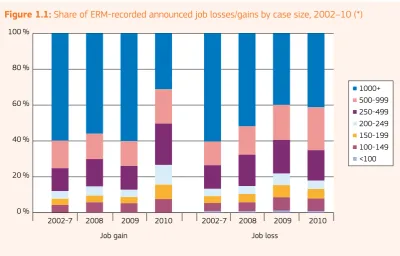
As Figure 1.1 indicates, the distribution of announced job losses and gains is heavily con-centrated in larger-scale restructurings. In part, this is for reasons of large-firm bias and media coverage bias, which are inherent in the ERM (Box 1.2). It is possible to discern patterns compar-ing year-on-year shifts in the composition of announced job losses by case size. The share
Figure 1.1:
Share of ERM-recorded announced job losses/gains by case size, 2002–10 (*)
0 % 20 % 40 % 60 % 80 % 100 %
2002-7 2008 2009 2010 2002-7 2008 2009 2010
Job gain Job loss
1000+ 500-999 250-499 200-249 150-199 100-149 <100
Source:ERM.
* 2010, q1 and q2only.
In terms of announced job creation, large-scale cases involving at least 1 000 new jobs account for the majority (approximately 60 %) of overall job creation recorded in the ERM in the period 2002–09. The pattern in the first semester of 2010 as growth has resumed has, however, been quite distinctive: the share of jobs in medium-sized cases involving 150–499 jobs has doubled (from 21 % to 42 %).
Over the period 2002–07 to 2010, the median number employed in companies announcing major job losses has risen from 800 to 900 and the share of larger employ-ing units (6) (500 or more employed in the affected units) announcing job losses has not decreased: in fact, it has increased, from 58 % to 60 %.
Box 1.3:
What is the employment impact of restructuring?
The word ‘restructuring’ has several meanings and some definitions of restructuring might include events that do not have any impact on employment levels or that, through a reorganisation of work, may have an impact on the workforce in some other way. Similarly, the relationships between restructuring and employment are neither simple nor straightforward.
The term ‘restructuring’ has come to be associated with the enactment of structural change below the macro or national level: there are reports of the restructuring of sectors, companies and establishments. Restructuring is also seen as more of an active process initiated by employers, in contrast to the more passive and deterministic long-term forces of structural change and economic development. Even if it is driven by the need to maintain or enhance profitability and to ensure, by so doing, the survival of the company (and thus jobs) in the long term, restructuring is primarily perceived as having a negative impact on employment levels at particular workplaces. Nonetheless, the more abstract concept of structural change (i.e. the reallocation of resources to more productive uses) is generally viewed in positive terms. Job creation in new companies and sectors of the economy is, together with cheaper goods and services, the main benefit of structural change. However, to define this job creation as restructuring is both contrary to public perceptions of the term as well as being somewhat illogical. It is also a complex theoretical problem insofar as restructuring is also often defined by its negative effect on jobs and no clear-cut definition has yet emerged.
Nonetheless, job creation is related to restructuring in the short term in one particular context — when jobs are lost in one company or location in order to be moved to another company or location. This occurs either through the process of outsourcing or offshoring. Jobs may be lost due to offshoring, for example, in Germany, but not from the EU. Some evidence, for example in the ERM, indicates that much job creation in the newer Member States emanates from companies located in the old EU 15. Similarly, significant technological changes have already triggered restructuring processes in which the loss of (unskilled) jobs has gone hand in hand with the creation of (skilled) jobs. In the meantime, it is obvious that not all job creation is linked to change, let alone to restructuring.
1.2. RESTRUCTURING ACTIVITY DURING THE ECONOMIC CRISIS
As noted at the beginning of this chapter, the past two years have been extremely difficult for the EU economy, due to the financial and economic crisis that it has been experiencing during this time and from which it has not yet fully emerged. The crisis has, naturally, caused the level of restructuring in the EU to increase, due to the higher incidence of bankruptcies and closures. The trends of the past two years have been captured by ERM data.
Figure 1.2:
Restructuring activity during the crisis (by quarter)
0 50 000 100 000 150 000 200 000 250 000 300 000
Total announced job losses/gains Loss Total announced job losses/gains Gain
0 100 200 300 400 500 600 700 800
No of cases (Gains) No of cases (Losses)
2008q1 2008q2 2008q3 2008q4 2009q1 2009q2 2009q3 2009q4 2010q1 2010q2
Source:ERM.
Declining ERM restructuring activity since the second quarter of 2009 coincides with the onset of recovery in output, although unemployment levels only began to stabilise at the end of the first quarter of 2010.
1.3. JOB LOSSES
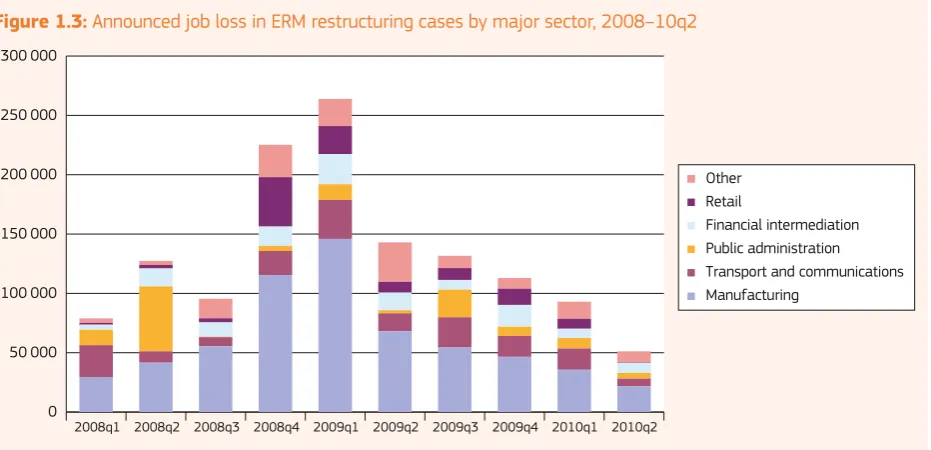
The sectors most affected by large-scale restructuring job losses during the peak quar-ters of the economic crisis were manufactur-ing, retail and financial intermediation. Public administration, which had accounted for 17 %
Figure 1.3:
Announced job loss in ERM restructuring cases by major sector, 2008–10q2
0 50 000 100 000 150 000 200 000 250 000 300 000
Other Retail
Financial intermediation Public administration Transport and communications Manufacturing
2010q2 2010q1 2009q4 2009q3 2009q2 2009q1 2008q4 2008q3 2008q2 2008q1
Source:ERM.
The next section of this chapter looks in more detail at recent restructuring activity in the auto-motive sector, a major manufacturing sector for the EU, and one that has experienced a significant level of restructuring in recent years.
1.3.1. SECTOR IN FOCUS: AUTOMOTIVE MANUFACTURING
Within the broad manufacturing sector, announced job losses were most acute in automotive manu-facturing, which accounted for over a quarter of all manufacturing job losses. Demand for cars and trucks has been severely affected by the eco-nomic downturn. Europe’s automotive industry, with the assistance of the public authorities, has experimented with various remedies to endure and survive the slump while preparing for the next generation of vehicles and consumers.
The automotive sector remains vital as an employer in Europe — more than 2 million workers are directly employed and nearly 10 million work in supply-chain activities. It is also a major hub of research and development activity, a source of tax revenues and a positive contributor to the EU’s trade balance with the rest of the world. This last
fact is important as it signals that the industry in Europe is internationally competitive.
Nonetheless, the scale of the slump in demand for cars has raised questions over the viability of parts of the automotive industry, especially in a context of local and global overcapacity, esti-mated to be in the range of 20 to 30 %. Two main stimulus paths have been identified for the sector: one short-term and the other more medium-term, both involving relatively large public investment. In the short term, car scrappage premiums intro-duced by a number of Member States’ govern-ments have provided a boost to production and sales, especially of smaller, economical cars. In the medium-term, climate-change imperatives are motivating large-scale public investment such as the European Investment Bank’s Euro-pean Clean Transport Facility, which will under-write research, development and production of less polluting, more energy-efficient vehicles (7).
various flexibility measures — including short-term working, shift reductions and temporary plant closures — have been deployed to con-front the consequences of a fall-off in demand
for passenger vehicles, which was over 25 % year-on-year at the height of the crisis (8). While these measures may have absorbed some, per-haps many, potential job losses, according to Eurostat short-term business statistics data there was nonetheless a net decline of nearly
(8) European Automobile Manufacturers Association (ACEA), 2009.
[image:25.595.73.412.261.536.2]8 % in automotive sector employment between the first quarter of 2008 and the first quarter of 2009. The sector also accounted for the largest single share of announced job losses by sector in ERM restructuring cases during 2008–10. For an overview, see Figure 1.4.
Figure 1.4:
Breakdown of ERM job losses by sub-sector (within NACE 34, automotive manufacture)
2010 2009 2008
2007 2006 2005 2004 2003 2002 0 10 000 20 000 30 000 40 000 50 000 60 000 70 000 80 000
Manufacture of parts/accessories for motor vehicles (NACE 34.3) Manufacture of bodies for motor vehicles (NACE 34.2)
Manufacture of motor vehicles (NACE 34.1) Non-specific auto manufacture (NACE 34)
Source:ERM.
* 2010, q1 and q2only.
As Figure 1.4 illustrates, announced ERM job losses in the sector in the 30-month period from the first quarter of 2008 to the end of the second quar-ter of 2010 amounted to more than 160 000. Of these, the majority were in supply-chain firms (NACE 34.3) rather than in original equipment manufacturers (OEMs, NACE 34.1), in contrast to the earlier period, when OEM job loss announce-ments predominated. The increasing share of job loss announcements in the manufacture of auto parts/accessories is suggestive evidence that the
The sector’s problems were thrown into stark per-spective by the plight of two of the big three US car manufacturing groups. The US administra-tion guided Chrysler and General Motors through fast-track bankruptcies in the second quarter of 2009 and financed their restructuring with over USD 60 billion in public funding. General Motors announced the cut of 8 369 out of 48 000 jobs at its European Opel plants in February 2010. An additional 850 partial retirement jobs are due to be cut when current workers retire. The plan included the closure of the Belgian plant in Antwerp, where 2 606 people are employed, 3 900 job cuts in Ger-many and 900 jobs in Spain. PSA Peugeot Citroen announced, in late 2009, the loss of 6 000 jobs in its factories in France between January 2010 and December 2013 in a performance plan aimed at restoring the profitability of the group.
In the early part of the crisis, car sector restruc-turings revealed in particular the vulnerability of temporary and fixed-term workers, who consti-tuted a front-line buffer of numerical flexibility for manufacturers. BMW announced in February 2008 that it would cut a total of 8 100 jobs, mainly in its German operations. Temporary agency work-ers accounted for 5 000 of these jobs. The deci-sion of the company to let go at short notice of 850 of its temporary agency staff at its Cowley (UK) plant, which produces the new Mini, caused an outcry in the United Kingdom. Union leaders accused the company of taking advantage of the basic level of protections afforded agency workers in the United Kingdom. In the case of Skoda Auto’s announcement of 4 000 job losses in December 2008 in its Czech operations, all were temporary
agency worker positions. Similarly, volkswagen, in March 2009, announced that it would be cutting all 16 500 temporary jobs in its worldwide operations.
When consumer demand returned in 2009 as a result of scrappage incentives, much of the slack was taken up by hiring/firing temporary workers. The ERM records one case of 1 000 jobs created at Skoda Auto, Mladi Boleslav (Czech Republic) in March 2009, attributed to increased demand arising from scrappage schemes in neighbouring Member States, notably Germany. Less than a year later, vW Skoda announced 2 440 job losses at its Czech units (including Mladi Boleslav), prin-cipally temporary workers taken on to deal with scrappage scheme demand.
Figure 1.5:
Automotive sector job losses/gains recorded on ERM
2008–10q2 — countries most actively restructuring
Job gains Job losses
0 5 000 10 000 15 000 20 000 25 000 30 000
France Germany Sweden United Kingdom Czech Republic Belgium Italy Spain Hungary Romania Slovakia Poland
Source:ERM.
* 2010, q1 and q2only.
Since 2008, there have been 13 very large-scale cases of business expansion in auto manufactur-ing involvmanufactur-ing the announced creation of at least 1 000 jobs. All but one were in the Central and Eastern European Member States (including four in the Czech Republic, three in Poland and two each in Hungary and Romania). This was a con-tinuation of previous trends and shows clearly a shift — though not explicitly, or necessarily, an offshoring — of productive capacity in the sector from older to newer Member States.
At company level, the ERM picked up a number of concrete examples of the above shifts. Autoliv, a manufacturer of safety equipment including seatbelts and airbags, announced a major world-wide restructuring involving 3 000 announced job losses in July 2008. Subsequently, specific job loss announcements were made at facilities in Hasselholm, Sweden (August 2008) and Gournay-en-Bray, France (March 2009) while 800 new jobs were announced (also in March 2009) as the com-pany expanded production at Jelcz-Laskowice in
Poland. In 2008, auto components manufacturer, Faurecia, announced 1 250 job losses at its French units between 2009 and 2011, and 1 000 new jobs at its facilities in Písek and Karviná in the Czech Republic. Similar patterns can be observed in cases involving a number of other automotive component manufacturing firms including Keiper, Johnson Control and Mahle.
1.3.2. TYPE OF RESTRUCTURING: RISING CONTRIBUTION OF BANKRUPTCY/CLOSURE TO OVERALL JOB LOSS
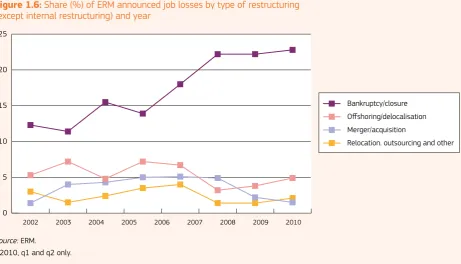
Internal restructuring represents a kind of catch-all or default category for restructuring and has tended to account for around 70 % of announced job losses in ERM cases for any given period since 2002. Of the other categories of restructuring that the ERM captures, the most important is the combined bankruptcy/closure category, which accounted for a sharply increased proportion of announced job losses during the crisis period in 2008–10 (up from 14 % in 2002–07 to 22 % of total in 2008–10).
The factors leading to this increased incidence of restructuring borne of business failure are not difficult to identify. Reduced demand, difficul-ties in accessing credit and receiving payment
[image:28.595.62.524.417.681.2]are all customary features of a recession that make trading difficult even for stronger com-panies. In the period immediately preceding the crisis, a combination of low interest rates, easy credit and excessive debt/leverage may also have weakened the financial foundations of many companies by encouraging them to over-extend. Firms that are already over-borrowed or structurally weak may not have the commer-cial resilience to withstand a more challenging commercial environment during a recession. The largest single bankruptcy in the period was that of UK high street retailers Woolworths in late 2008, where the closure of over 800 stores resulted in over 27 000 announced job losses; the firm’s former German subsidiary, Woolworths Deutschland, also declared bankruptcy in May 2009 with the announced loss of over 5 000 jobs. Figure 1.6 shows announced job losses by type of restructuring and year.
Figure 1.6:
Share (%) of ERM announced job losses by type of restructuring
(except internal restructuring) and year
0 5 10 15 20 25
Relocation. outsourcing and other Merger/acquisition
Offshoring/delocalisation Bankruptcy/closure
2010 2009 2008 2007 2006 2005 2004 2003 2002
Source:ERM.
At national level, the increased share of bank-ruptcy/closure-related job losses was notable in Greece, Italy, Portugal, Slovenia, Finland and the United Kingdom (more than 15 percentage points in each country). At aggregate EU level, the increase in the share of bankruptcy/closure-related announced job losses was matched by a decline in the share of offshoring/relocation/ outsourcing announced job losses. This is consist-ent with expected patterns of business behaviour during an economic downturn — higher levels of business failure and retrenchment and less emphasis on expansion or diversification via off-shoring and relocation. From this perspective, the most recent data showing an increase in the share of offshoring may be considered a hopeful signal of recovery.
1.3.3. EARLY RETIREMENT AS A MEANS OF DEALING WITH JOB LOSS
There are many ways in which the effects of restructuring involving job losses can be miti-gated. Traditionally, and particularly when a larger part of the workforce was engaged in more tra-ditional heavy industry sectors, early retirement was a favoured means of allowing older work-ers to leave the workforce in a relatively non-traumatic way.
However, the past 10 years have seen a with-drawal or reduction of incentives to early retire-ment — in both the public and private sectors — in line with a policy consensus (9) that emphasises the importance of broadening labour market par-ticipation and of increasing the effective retire-ment age (10). The move to reduce early retirement incentives has been made all the more pressing by empirical evidence that countries with gener-ous and easy-to-access early retirement schemes have also been those which have suffered the sharpest declines in the employment levels of
(9) Council of the European Union, Joint Employment Report 2008/09, ‘To sustain progress, it is essential to avoid using early retirement schemes to regulate supply as in past downturns’.
(10) See, for example, the Polish government’s recent proposed reform of early retirement provisions for certain strenuous occupations (http://www.eurofound.europa.eu/ eiro/2008/11/articles/pl0811019i.htm).
55–64-year-olds. Old-age employment rates are particularly sensitive to retirement incentive struc-tures, which vary considerably from country to country. Research also largely confirms that early retirement has not been successful at aggregate level in one of its ancillary objectives (11) — con-tributing to increased youth employment by ‘free-ing up’ jobs for younger workers.
However, there are strong interests in maintain-ing early retirement arrangements, which can be attractive for different reasons for a variety of stakeholders, including unions, employees and employers. While some governments have recently attached more stringent limitations to access to early retirement benefits (e.g. France, Poland and Sweden) (12), others have rediscovered the short-term attractions of early retirement as a cost-saving measure and/or as a politically acceptable means of gaining numerical flexibil-ity in the public service. An illustrative example is the early retirement scheme for civil servants introduced by the Irish government in April 2009. The scheme was included in an emergency budget as one of a number of measures explicitly target-ing public sector cost savtarget-ings (13). ERM national correspondents also report increased recourse to early retirement in Latvia, Luxembourg and Hungary and Romania (14).
The ERM shows some evidence of the persist-ence of early retirement as one form of labour-shedding during restructuring, especially amongst large companies. In the ERM in 2008–10, 80 cases make explicit mention of early retirement. Early
(11) Though there may be counter examples at firm level: Group Michelin in June 2009 announced the offer of early retirement benefits aimed primarily at those within five years of retirement with the aim of creating vacant positions to be filled by the 500 new hires Michelin expects to make annually.
(12) Carley, M., Industrial relations developments in Europe, 2008 (http://www.eurofound.europa.eu/eiro/studies/ tn0903029s/tn0903029s.htm).
(13) Dobbins, T., Emergency budget includes public service pay review and early retirement (http://www.eurofound.europa. eu/eiro/2009/04/articles/ie0904019i.htm).
retirement features in particular in cases from the following countries — Belgium, France and Spain (10 cases), United Kingdom (7), Italy and Norway (6). As a rule, early retirement tends to be one of a range of measures deployed when restructur-ing as, by definition, it relates only to that part of a company’s workforce between 50 and 60 (15) years of age and the statutory retirement age (generally 65). Other measures may include partial retirement, part-time working, relocation, retraining and voluntary redundancies; the mix of measures in specific restructurings is generally agreed on the basis of social partner negotiations.
Early retirement has, in the past, been associated with restructuring arising from privatisation where states have bought industrial peace by offering generous early retirement packages to workforces affected by post-privatisation restructuring job losses. Three examples of company restructur-ing involvrestructur-ing the use of early retirement are now described, focusing on the Italian airline Alitalia, the Italian telecommunications group Telecom Italia, and the Austrian retail bank BAWAG.
Alitalia’s new phase as a private company began in January 2009 after the Italian investor group Compagnia Aerea Italiana (CAI), acquired the ‘new’ Alitalia, leaving the Italian government with the old company’s debts and its least profitable units. Employment in the privatised Alitalia totalled 12 600 compared with 21 500 in the combined ‘old’ Alitalia and Air One, the smaller Italian airline, with which it merged. Prior to the acquisition and in a context of sustained industrial action, the Ital-ian government and main trade unions reached a deal which made use of the full range of Italian social shock absorbers (ammortizzatori sociali) to cushion the effects of redundancies for over 3 000 of the Alitalia employees. The agreement included recourse to the ‘extraordinary’ Wages Guarantee Fund (Cassa Integrazione Guadagni Straordinaria, CIGS) for four years. After this period, redundant workers benefit for three years from the ‘mobility’ programme, which supports their incomes until they reach retirement age (or find a new job). The Italian state — through the
(15) Though, in the case of Hellenic Petroleum (EL) early retirement was offered to workers as young as 47–48.
National Social Security Institute (Istituto Nazion-ale Previdenza SociNazion-ale, INPS) — pays an allow-ance equal to 80 % of the average wage lost by the workers.
At Telecom Italia, the announcement of 5 000 job losses in June 2008 led to strike action which was resolved when the restructuring plan was largely deferred to 2009–10. The job cuts were planned to be effected with recourse to a mobil-ity procedure (procedura di mobilita), which is an administrative prelude to dismissal, with a view to early retirement, which would guarantee up to 90 % of salary for the redundant workers.
BAWAG, the Austrian retail bank, formerly owned by the Austrian Federation of Trade Unions (ÖGB), announced its intention to reduce its workforce by 400 during 2008 without recourse to compulsory redundancies. The bank was taken over in 2007 by a consortium led by the US private equity firm Cerberus Capital Management following losses incurred on currency derivative investments. The takeover was facilitated by a large injection of public funds by the Austrian state. Employees within seven years of the official retirement age were allowed to opt for early retirement, in which case they continued to receive at least 60 % of their last take-home pay until reaching the legal retirement age — 60 for women and 65 for men.
Other large-scale restructurings with significant elements of early retirement include those at:
• Eon-Energy, August 2008;
• Air France-KLM, May 2009;
• Michelin, June 2009;
• volvo Europa, October 2008;
• Malta Shipyards, June 2008;
• Birmingham City Council, February 2010; and
• vattenfall Europe, March 2010.
EU, albeit in a more limited way than in previous decades. Early retirement is clearly still an option for organisations that are faced with the need to make large-scale redundancies, although this does have implications for the balance of age and experience in an organisation’s workforce, and for the wider workforce as a whole, within the context of EU policy targets concerning the level of employment for older workers.
1.4. RESTRUCTURING INVOLVING JOB CREATION
Although cases of announced job losses have gen-erally outweighed those announcing job creation during restructuring events, there was a marked shift to job-creating, as opposed to job-destroying, cases of restructuring in the ERM in the years up to 2008. This is reflected in the fact that while cases of business expansion only began to be included in the data set late in 2003 (the original focus of the ERM was on the negative employ-ment consequences of industrial change), in 2007, they accounted for the majority of individual restructuring cases. The year 2007 was also the first in which the aggregate positive employment impact of all cases exceeded the aggregate nega-tive employment impact.
Since the second quarter of 2008, however, announced job losses have exceeded job crea-tion in every quarter and, in aggregate, by a ratio of around 3:1. Nevertheless, there has also been a sharp decline in the level of reported job creation by quarter in the most recent period — with the somewhat surprising exception of the first quar-ter of 2009, near the height of the crisis, when low-price retailers (Asda, Tesco) and restaurant chains (KFC) in the United Kingdom announced major countrywide expansions.
Data contained in the latest ERM quarterly pub-lication, which tracks developments in the third quarter of 2010, shows that some sectors are now beginning to recover and to create jobs. For example, it would seem that the automotive manufacturing sector is slowly recovering from the deep decline of 2008 and 2009. In the third quarter of 2010, several auto manufacturing
companies that between September 2008 and the end of 2009 announced the dismissal of large numbers of employees are now creating new jobs. In Sweden, the volvo group has been responsible for three cases of job creation announcements. volvo Trucks announced it will hire 200 employees at its plant in Tuve, Gothenburg. volvo Power-train announced it has permanently employed 150 people, who are part of 350 fixed-term recruitments the company made during last year. Furthermore, volvo Pv announced that 140 fixed-term employees will be permanently employed at the factory facility in Torslanda. volkswagen Slovakia announced it is to create 1 000 new jobs at its Bratislava plant by September, while PSA Peugeot Citroën announced the recruitment of 900 new employees to be employed in various plants across France before the end of 2010. The company also announced that it will reintroduce a third shift at its plant in Portugal, which was abol-ished in 2009. This decision will result in 300 new jobs; the third shift was planned to be opera-tive in November 2010 and to last six months. Whether it continues thereafter will depend on market conditions.
In the computer and related activities sector, the largest case of job creation refers to Hewlett Packard (HP), which announced it is to create 700 new jobs at its plant near Glasgow, as the company is setting up an IT service hub. In 2009, HP announced the loss of 700 manufacturing jobs at the same plant following the decision to trans-fer production to the Czech Republic. These jobs were expected to be gone by October 2010 but with the newly created jobs in IT services, the plant will return to employing around 1 300 peo-ple. In Ireland, the Internet company Google has announced the creation of 200 jobs for graduates with strong IT skills as a result of a new operations centre in Dublin. The new centre was expected to be operational by the end of 2010 and it will focus mainly on Google’s geographical products such as Google Maps and Google Local.
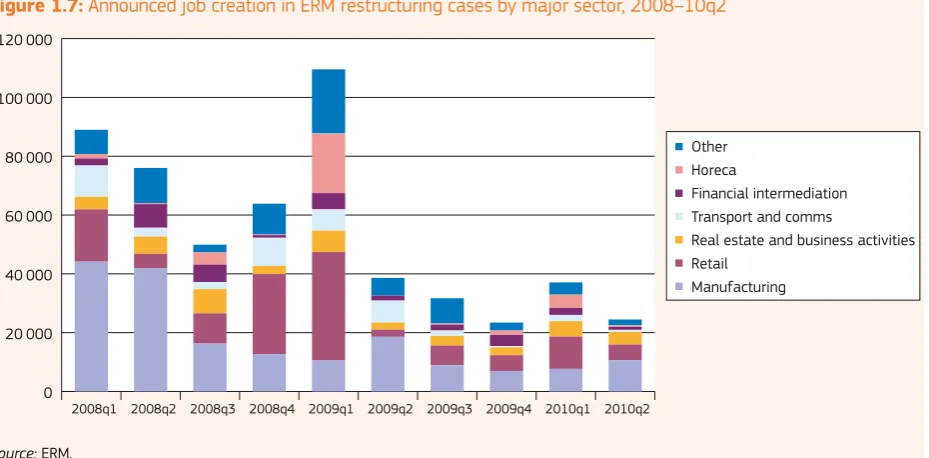
of 2008, before the onset of the economic crisis. Thereafter, manufacturing accounts for a declin-ing share of job creation and the principal source of announced job creation has been the retail
[image:32.595.62.527.227.456.2]sector. From the first quarter of 2008 to the sec-ond quarter of 2010, around 30 % of announced job creation were in the retail sector and around 25 % in manufacturing.
Figure 1.7:
Announced job creation in ERM restructuring cases by major sector, 2008–10q2
0 20 000 40 000 60 000 80 000 100 000 120 000
Other Horeca
Financial intermediation Transport and comms
Real estate and business activities Retail
Manufacturing
2010q1 2010q2 2009q4
2009q3 2009q2 2009q1 2008q4 2008q3 2008q2 2008q1
Source:ERM.
* 2010, q1 and q2only.
Box 1.4 looks at the retail sector, which has been one of the sole motors of job creation in the EU over the past few months.