S
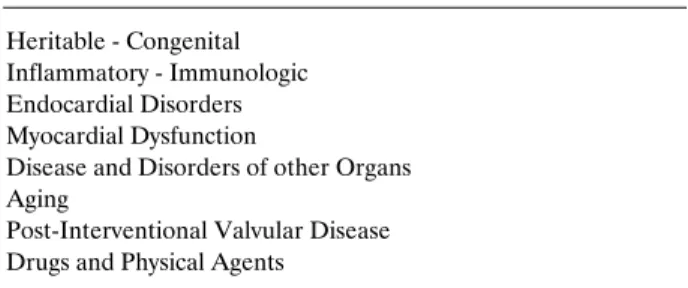
tructural abnormalities and disor-ders of cardiac valve function re-sult in valvular heart disease. The etiology of valvular heart disease has changed dramatically in the last forty to fifty years1-3. A significant reduction in the incidence of acute rheumatic fever and its sequelae, the increase of life expe-ctancy, the recognition of new causes of valvular heart disease and the advance-ment of technology are responsible for the metamorphosis in the etiology and pathogenesis of valvular disorders (Figu-re 1). Clinical entities which a(Figu-re associat-ed with valvular heart disease are shown in Table 1.
Heritable-Congenital
Heritable disorders of connective tissue origin
Connective tissue abnormalities are of etiologic importance in a broad spectrum of cardiovascular disorders. The Marfan syndrome and the Ehlers-Danlos syndro-me, well recognized heritable disorders of connective tissue, represent accepted examples of this association. The associa-tion between adult polycystic kidney di-sease and cardiovascular didi-sease of con-nective tissue has been recognized with increasing frequency during the last de-cades. Aortic root dilatation, aortic vular regurgitation and floppy mitral val-ve (FMV)/mitral valval-ve prolapse (MVP)/ mitral valvular regurgitation, have been described in patients with adult polycystic kidney disease4. Isolated valvular
abnor-malities, such as FMV/MVP, multivalvu-lar prolapse, annuloaortic ectasia, certain forms of isolated aortic regurgitation, and pulmonary artery dilatation, have been reported to be of connective tissue etiology1,4
.
Congenital heart disease
Bicuspid aortic valve.Congenital aortic ste-nosis is a well defined anomaly which can be of different severity. Bicuspid aortic valve without clinically significant ste-nosis at birth is a common congenital ano-maly in adults with a male predominance. Most patients develop aortic valvular re-gurgitation or aortic stenosis and all have an increased risk of infective endocardi-tis. The association of bicuspid aortic val-ve with coarctation of the aorta and tho-racic aortopathy, manifest as aortic root dilatation or aortic dissection, has clinical significance in terms of comprehensive diagnosis and long-term prognosis.
Mitral stenosis, mitral regurgitation.
Congenital mitral valvular stenosis is a rare finding in adults. Atrioventricular septal defects and corrected transposition of the great vessels are among the congenital abnormalities that produce mitral regurgi-tation in adults.
Inflammatory - Immunologic
Rheumatic fever. A variety of
epidemio-logic studies have shown that the inciden-ce of rheumatic fever and the prevaleninciden-ce of rheumatic heart disease have declined
Etiology of Valvular Heart Disease
in the 21st Century
HARISIOSBOUDOULAS
Division of Cardiology, College of Medicine and Public Health, The Ohio State University, Columbus, Ohio, USA
Manuscript received: July 15, 2002; Accepted: August 20, 2002 Address: Harisios Boudoulas The Ohio State University, 473 West, 12th Avenue, 2nd floor, Columbus, Ohio, 432 10 e-mail: [email protected]
Key words: Valvular heart disease, etiology.
dramatically over the last decades in developed countries (Figure 1). A number of reasons have been postulated to explain such a decrease: improvement in living standards, better access to medical care, wider use of antibiotics, as well as natural changes in the streptococcal strains. In the developing countries, however, the situation is similar to that of industria-lized nations in the early 20th century, when rheuma-tic fever was one of the leading causes of death and disability in young people. Recently, important pro-gress towards the development of an effective vaccine to protect against streptococcal nasopharyngeal infe-ction opens up the possibility of better control of rheu-matic fever in these countries5
.
The clinical presentation of acute rheumatic mi-tral valvulitis is mimi-tral regurgitation. The most com-mon chronic valvular abnormality resulting from rheu-matic fever is mitral stenosis. Aortic valve insufficiency is common and in rare instances, the tricuspid valve may also be involved.
Acquired Immune Deficiency Syndrome (AIDS).
Cardiac involvement based on postmortem examina-tions of patients with AIDS includes myocardial di-sease, pericardial disease or endocardial disease
with valvular involvement1,2. The most common
endocardial lesion reported in patients with AIDS is nonbacterial thrombotic endocarditis (NBTE) with
Figure 1.Factors contributing to the metamorphosis in the etiology and pathogenesis of valvular heart disease.
Table 1. Valvular Heart Disease: Etiology Heritable - Congenital
Inflammatory - Immunologic Endocardial Disorders Myocardial Dysfunction
Disease and Disorders of other Organs Aging
Post-Interventional Valvular Disease Drugs and Physical Agents
valvular vegetation formation which can involve all four valves, but left-sided lesions are more common. Vegetations consist of platelets within a fibrin mesh and a few inflammatory cells. Thromboembolic phe-nomena may occur. Right heart involvement with infective endocarditis occurs in patients who are addicted to intravenous drugs in general, and in par-ticular in patients with AIDS.
Kawasaki’s disease. Kawasaki’s disease is an acu-te febrile illness which affects infants and young chil-dren. In about 20% of the patients, vasculitis of the coronary vasa vasorum leads to coronary arterial aneurysm formation, thrombosis and myocardial in-farction. Less often, mitral regurgitation, acute or chronic, may occur1,2.
Cardiovascular syphilis. Despite extensive public educational efforts and the availability of effective antibiotic treatment for syphilis, cases of cardio-vascular syphilis still occur. Aortitis occurs in the tertiary form of syphilis in 70-80% of patients with untreated syphilis. Cardiovascular syphilis may present as aortic regurgitation, aortic aneurysm or coronary ostial stenosis. Aortic regurgitation, the most common complication of syphilitic aortitis, usually occurs in the second or third decade after the infection1
.
Seronegative spondylarthropathies. A group of
immunologic syndromes such as ankylosing spon-dylitis, Reiter’s disease, psoriatic arthropathy, ar-thritis of inflammatory bowel disease, Whipple’s disease and Bechet’s disease which may be associat-ed with valvular heart disease, are all groupassociat-ed under the term “seronegative spondylarthropathies”. They are distinguished from rheumatoid arthritis by the absence of rheumatoid factor and the presence of HLA-B27 antigen. However, the precise role of this antigen in the pathogenesis of the spondylar-thropathies is not clear. Aortic regurgitation,
secon-dary to aortic dilatation, is the primary valvular le-sion described in ankylosing spondylitis. The aortic ring is dilated and the cusps appear to be somewhat rolled and inverted. The most significant morpho-logic changes are encountered in the proximal three to four centimeter of the aorta. Mitral valvular regur-gitation may also occur.
Systemic lupus erythematosus. Systemic lupus ery-thematosus may produce mitral valve and tricuspid valve disease. Libman and Sacks described four pa-tients with an atypical form of verrucose endocar-ditis, with involvement of all four valves and the mural endocardium6
. The clinical picture included pericar-ditis and systemic embolic phenomena. A high corre-lation between lupus pericarditis and Libman-Sacks verrucose endocarditis has been a consistent finding since the original report. Valvular heart disease in patients with systemic lupus erythematosus has been reported regardless of the presence or absence of an-tiphospholipid antibodies.
Cardiac valve disease associated with the
antiphos-pholipid syndrome. The syndrome is caused by the
appearance of circulating antiphospholipid (aPL) antibodies. aPL are spontaneously acquired immuno-globulins directed against negatively charged phos-pholipids. aPL antibodies were initially found in sera of patients with systemic lupus erythematosus. They have since been found occasionally in other conne-ctive tissue diseases, malignancies, infectious di-sorders, may be induced by drugs and also may be present in subjects without any underlying disorder7
. aPL in vitro act as an anticoagulant that prolongs the clotting time, although no specific deficiency of the clotting factors is detectable. Despite its anti-coagulant behavior in vitro, patients with aPL present with a high incidence of arterial and venous throm-bosis. The presence of aPL antibodies and either arterial or venous occlusive events constitute “the
antiphospholipid syndrome”7
. Valvular lesions may involve the mitral and the aortic valves, usually re-sulting in mitral or aortic regurgitation; in certain cases the valvular regurgitation may be severe enough to require surgical intervention. The pathogenesis of valvular lesions is not clear. It is likely that deposition of thrombi is the initial valve abnormality that subse-quently promotes an inflammatory response.
The isolated finding of aPL antibodies in the ab-sence of clinical manifestations requires no treat-ment. Patients with thromboembolic manifestations should be fully anticoagulated. Patients with valvular involvement should be managed the same way as
patients with valvular heart disease of other etio-logies.
Endocardial disorders
NBTE. NBTE, referred to in the earlier literature as marantic endocarditis, occurs most often in patients with malignant disease, but may also complicate other chronic wasting diseases, such as tuberculosis, uraemia, or AIDS. The initiating factor in the patho-genesis of NBTE is not known8
. Endothelial damage caused by circulating cytokines such as tumor ne-crosis factor or interleukin-1, which can be increased in patients with malignancy or chronic wasting di-seases, might trigger platelet deposition. Sterile ve-getations, (Libman-Sacks endocarditis), sometimes develop in patients with systemic lupus erythema-tosus. The diagnosis of NBTE is frequently made at autopsy, however, echocardiographic recognition now complements its clinical suspicion.
Infective endocarditis. Although infective
en-docarditis may occur on a previously normal valve, it is most often seen in valves deformed by congenital or rheumatic disease, or on FMV producing MVP and mitral valvular regurgitation1,4. Degenerative car-diac diseases, such as calcified mitral or aortic valves, also predispose to the development of infective carditis. Infective endocarditis may result in endo-cardial vegetations with thromboembolic potential, valvular destruction, endomyocardial lesions and acute valvular regurgitation. The incidence of infe-ctive endocarditis increases with age and thus, is less common in children. The distribution ranges from 24% to 45% for the mitral valve alone, 5% to 36% for the aortic valve alone and 5% to 35% for the aortic and mitral valves combined. Tricuspid valve invol-vement with infective endocarditis is less common, but may be frequent in addicts who take intravenous drugs; the pulmonary valve is rarely involved.
Endomyocardial fibroelastosis. Endomyocardial
fibroelastosis may be associated with valvular heart disease but it is rare in developed countries.
Myocardial dysfunction
Ischemic heart disease. Mitral regurgitation is common in patients with ischemic heart disease. This is related to papillary muscle dysfunction in combination with left ventricular segmental contraction abnormalities due to ischemic cardiomyopathy, or in rare cases due to papillary muscle rupture. Tricuspid regurgitation
on an ischemic basis may also occur in patients with septal or right ventricular infarction, or chronic ischemic cardiomyopathy.
Dilated cardiomyopathy. Mitral regurgitation is
also common in patients with dilated cardiomyopa-thy and is due to changes in left ventricular architect-ure, wall motion abnormalities and papillary muscle dysfunction. Tricuspid regurgitation may occur as a result of changes in right ventricular architecture, papillary muscle and right ventricular dysfunction.
Hypertrophic cardiomyopathy. Mitral
regurgita-tion is common in patients with hypertrophic car-diomyopathy. It is related to the systolic anterior mot-ion of the mitral valve which may produce obstructmot-ion of the left ventricular outflow tract and mitral regurgi-tation. The incidence of FMV/MVP in patients with hypertrophic cardiomyopathy, is the same as in the general population1,4.
Diseases and disorders of other organs
Chronic renal failure. Valvular abnormalities occur in patients with chronic renal failure9
. Dystrophic calci-fication as well as infective endocarditis may cause valvular heart disease in these patients. Mitral annu-lar calcification preferentially involves the posterior mitral leaflet but can affect both leaflets. Mitral re-gurgitation is usually the sequel of the calcification, but when it is severe may cause mitral stenosis or may extend to the aortic valve and produce aortic stenosis as well.
Carcinoid heart disease. Cardiac abnormalities
occur in over two-thirds of patients with carcinoid, but only a quarter of them develop clinically appa-rent right-sided valvular heart disease. The tricuspid and/or pulmonary valve are the usually affected val-ves, but in rare cases left sided valvular heart disease has been described10.
Carcinoid plaques may appear on either the atrial or ventricular side of the leaflets and are composed of fibrous connective tissue with no elastic fibers.
Aging
Calcific aortic stenosis, mitral annular calcification. Although there has been a dramatic reduction in rheu-matic valve disease in the industrialized countries over the past 40 years, there has not been a similar reduction in valve surgery. This is because the types of patients being referred for surgery have changed. Calcific aortic stenosis and mitral annular
calcifi-cation are common valvular abnormalities in the elderly and their incidence has increased due to in-crease in life expectancy (Figure 1).
Although the incidence of degenerative valve disease increases with age, aging itself does not ap-pear to be the only factor, because valve disease is not present universally in the elderly. Moreover, the initial lesion of calcific aortic valve disease seems to involve an active process similar to that of atheros-clerosis, including lipid deposition, macrophage in-filtration, and production of osteopontin and other proteins1,2.
Mitral annulus calcification also occurs primarily in the elderly patients, however, it may be present in younger patients with the Marfan syndrome and chronic renal failure1,9
.
Taking into consideration that atherosclerotic coronary artery disease is to a certain extent a preven-table condition, the same principles for prevention should be applied to degenerative valve disease. Accordingly, early forms of aortic stenosis and pro-bably, of aortic sclerosis and mitral annulus calci-fication should be considered as indicators for im-plementation of measures generally used to treat atherosclerotic vascular disease.
Post-Interventional valvular disease
Balloon valvulotomy. Balloon mitral valvulotomy is
effective treatment for many patients with valvular mitral stenosis. Long-term results after the proce-dure depend on baseline patient characteristics but residual mitral stenosis is present in most of the ca-ses and mitral regurgitation may also occur. The results of balloon aortic valvulotomy are less sa-tisfactory and this procedure at best is considered as a short-term palliative procedure for elderly patients with symptomatic aortic valvular stenosis. Significant residual aortic stenosis is always present and aortic insufficiency is often seen following aortic valvulo-tomy1
.
Valve reconstructive surgery. Mitral valve recon-struction is possible in a high percentage of patients with FMV/MVP, mitral valvular regurgitation. With reconstructive surgery, many of the long-term pro-blems associated with valve prostheses can often be avoided and thus, early operation in less sympto-matic patients with significant mitral regurgitation may be recommended. Mitral valve repair can be performed in a significant number of young patients with rheumatic valvular disease. The result, however,
in this group of patients is less optimal as compared to patients with mitral regurgitation secondary to FMV/MVP.
Valve replacement. Prosthetic heart valves have
certain hemodynamic limitations even when function-ing “normally”. These devices represent a type of iatrogenic valvular heart disease. Prosthetic valves are prone to several complications such as valvular thrombosis or regurgitation and infective endocar-ditis which may further compromise valvular function.
Drugs and physical agents
Chronic use of ergotamine products. Patients who have been treated with ergotamine products for migraine headaches may develop valvular heart disease. Mitral regurgitation in combination with mitral stenosis and/or tricuspid regurgitation with stenosis are the most common valvular abnormalities. The lesions are characterized by irregular proliferation of myofibro-blasts within an avascular myxoid or collagenous matrix that encases the leaflets and chordal structures. The fibrotic endocardial process forms proliferative mounds reminiscent of those seen in patients with carcinoid valve disease1,2,10. The mechanism by which ergot alkaloid agents induce valvular disease is un-clear. The similarities in chemical structure of sero-tonin, methysergide and ergotamine and the simi-larities in the valvular abnormalities produced by these chemicals, strongly suggest a common patho-physiological mechanism for ergot alkaloid-associat-ed valve disease and carcinoid valve. For manage-ment of this disorder, discontinuation of the drug is an important measure. Cessation of therapy may be associated with an improvement of valvular lesions. Otherwise, the patients have to be managed conven-tionally, with appropriate medical and surgical inter-ventions as they apply for the treatment of valvular heart disease of other etiologies.
Appetite suppressant drugs and cardiac valve
di-sease. Reports on the efficacy of the combination of
fenfluramine and phentermine in the treatment of obesity appeared in 1992. In 1997, a series of 24 pa-tients who had taken the fenfluramine-phentermine combination for an average of 11 months and valvular regurgitation have been reported2
. Histologic find-ings were similar to those reported in serotonin re-lated valvular abnormalities. For this reason, the drugs were withdrawn from the market. Other re-ports later confirmed the association between the cardiac valve disease and these drugs, although the
magnitude of risk was much lower2,11
. The proba-bility of developing valvular heart disease was related to time of exposure to therapy and the amount of drug used. All these drugs with exception of phentermine act via the serotonin pathways. The main difference between what happened with the appetite suppres-sant drugs and the ergot alkaloid drugs was that in the former the valve damage occurred after only a few months of treatment, in the latter valvular abnorma-lities occurred only with very long periods of therapy.
Radiation induced valvular disease. Although the heart is generally resistant to the effects of ionizing radiation, damage to the pericardium, myocardium, endocardium, microvasculature and epicardial coro-nary arteries may occur after significant exposure to radiation. When the endocardium is involved, fibrosis and fibroelastosis may distort the atrioventricular valves and result in mitral and tricuspid regurgita-tion. The more common clinical expression of radia-tion valvular heart disease occurs months or years after the exposure.
Trauma induced valvular disease. Aortic
regur-gitation is the most common clinically recognized valvular lesion as a result of chest trauma. This is se-condary to aortic valve rupture or cusp perforation. In autopsy studies, rupture of an atrioventricular valve has been reported to be more common than rupture of the aortic valve. Rupture of the atrioven-tricular valves, however, is usually associated with other significant cardiac injuries and frequently with cardiac rupture. This explains why rupture of the aortic valve has been reported more frequently in clinical series. Nevertheless, isolated mitral valve rupture may also occur after chest trauma. Complete rupture of a left sided papillary muscle results in mas-sive mitral regurgitation and death. Survival may occur with lesser degrees of mitral regurgitation resulting from rupture of the head of a papillary muscle, rupture of chordae tendineae, or rarely, a tear in one of the leaflets. Variable degrees of mitral regurgitation can also result from simple contusion of the papillary muscles. Tricuspid valve regurgitation can result from rupture of a papillary muscle, rupture of chordae tendi-neae, a torn leaflet, or simple contusion of the papil-lary muscle.
Etiology of common valvular abnormalities in clinical practice
Many medical disorders may cause or may be associated with valvular heart disease. The most
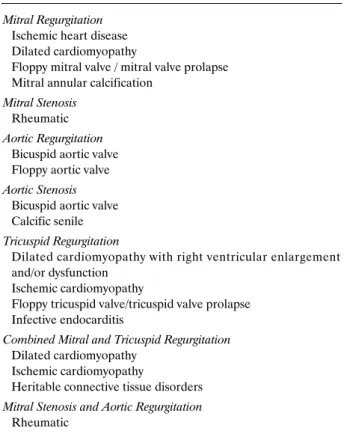
common causes of valvular disease and multivalvular diseases are shown in table 2. Patients with valvular heart disease and multivalvular involvement require consideration of the etiologies of the valvular invol-vement. For example, cardiomyopathy is a common etiology in patients with combined mitral and tricus-pid regurgitation. Heritable connective tissue disor-ders also cause mitral and tricuspid regurgitation as well as aortic and mitral valvular regurgitation. When mitral stenosis is one of the lesions in patients with multivalvular disease, rheumatic heart disease is the most likely cause1.
Recent advances in imaging techniques and he-modynamic studies allow clinicians to better define
Table 2.Common Cause of Valvular Disease and Multivalvular Involvement.
Mitral Regurgitation Ischemic heart disease Dilated cardiomyopathy
Floppy mitral valve / mitral valve prolapse Mitral annular calcification
Mitral Stenosis Rheumatic Aortic Regurgitation
Bicuspid aortic valve Floppy aortic valve Aortic Stenosis
Bicuspid aortic valve Calcific senile Tricuspid Regurgitation
Dilated cardiomyopathy with right ventricular enlargement and/or dysfunction
Ischemic cardiomyopathy
Floppy tricuspid valve/tricuspid valve prolapse Infective endocarditis
Combined Mitral and Tricuspid Regurgitation Dilated cardiomyopathy
Ischemic cardiomyopathy
Heritable connective tissue disorders Mitral Stenosis and Aortic Regurgitation
Rheumatic
valvular structure and the pathophysiology of valvu-lar heart disease in clinical practice. When combined with careful clinical history taking and thoughtful clinical examination, the correlation of laboratory studies with the clinical picture should permit defini-tion of the etiology of valvular heart disease in the majority of the patients (Figure 1).
References
1. Boudoulas H, Vavuranakis M, Wooley CF: Valvular heart disease: The influence of changing etiology on nosology. J Heart Valv Dis 1994; 3: 516-526.
2. Soler-Soler J: Valve Disease. Worldwide perspective of valve disease. Heart 2000; 83: 721-725.
3. Boudoulas H, Gravanis MB: Valvular heart disease. Cardio-vascular Disorders, Gravanis MB (ed), Mosby 1993; 64-117. 4. Boudoulas H, Wooley CF: Mitral Valve: Floppy Mitral
Valve, Mitral Valve Prolapse, Mitral Valvular Regurgita-tion. Futura Publishing Company, Inc, Second edition, 2000.
5. Dale JB: Group A streptococcal vaccines. Infect Dis Clin North Am 1999; 13: 227-243.
6. Libman E, Sacks B: A hitherto undescribed form of val-vular and mural endocarditis. Arch Intern Med 1924; 33: 701-737.
7. Asherson RA, Cervera R: Antiphospholipid antibodies and the heart. Lessons and pitfalls for the cardiologist. Circula-tion 1991; 84: 920-923.
8. Lopez JA, Ross RS, Fishbein MC, Seigel RJ: Non-bacterial thrombotic endocarditis: A review. Am Heart J 1987; 113: 773.
9. Boudoulas H: Involvement of other structures of the heart and other disease processes induced by renal failure. Car-diorenal disorders and diseases, Leier CV, Boudoulas H (eds) Mount Kisco, NY: Futura Publishing Co., Inc 1991 Second Edition, 1992, pp 57-81 and 193-225.
10. Ross EM, Roberts WC: The carcinoid syndrome: Compa-rison of 21 necropsy subjects with carcinoid heart disease to 15 necropsy subjects without carcinoid heart disease. Am J Med 1985; 70: 339.
11. Weissman NJ, Tighe JF, Gottdiener JS, et al: Sustained-Release Dexfenfluramine Study Group. An assessment of heart-valve abnormalities in obese patients taking dexfen-fluramine, sustained-release dexfenfluramine or placebo. N Engl J Med 1998; 339: 725-732.