Austria
Kathrin Schreckenberg
Contents
1. TEMPERATE FORESTRY IN AUSTRIA . . . 123
1.1 Forest cover, type and tenure . . . 123
1.2 Forest institutions . . . 123
1.3 Role of forestry in the Austrian economy . . . 123
2. HISTORY OF INVOLVEMENT IN TROPICAL FORESTRY . . . 123
3. STRUCTURE OF AID DELIVERY . . . 124
3.1 The Department of Development Co-operation . . . 124
3.2 Bilateral co-operation and NGOs . . . 124
3.3 Multilateral co-operation . . . , .... 125
4. TROPICAL FORESTRY DEVELOPMENT POLICIES . . . ~ ... 125
4.1 General development co-operation policies . . . 125
4.1.1 Volume of funding . . . 125
4.1.2 Regional focus . . . 126
4.1.3 Sectoral distribution . . . 126
4.2 Co-operation in the tropical forestry sector . . . 127
4.2.1 Multilateralforestryco-operation . . . 127
5. THEMATIC AND REGIONAL DISTRIBUTION OF FORESTRY PROJECTS . . . 127
6. RESEARCH AND TRAINING . . . 128
7. PROJECT CYCLE MANAGEMENT . . . 128
8. REVIEWS AND PROJECT PROFILES . . . 129
9. CONCLUSION . . . 130
REFERENCES . . . 130
KEY CONTACTS . . . _ . . . 130
ACRONYMS . . . 130
1.
TEMPERATE FORESTRY IN
AUSTRIA
1.1
Forest cover, type and tenure
Forest cover in Austria may once have been as high as 7 5%, but by the beginning of the 19th century it had been reduced to around 30%, primarily due to pressure for agricultural land. Active reforestation measures since then have ensured that Austria is now one of the most densely forested countries in Europe with 46% (3,878,000 ha) of its land area classified as forest and an additional 2,000 ha being afforested each year (BMLF, 1995a).
About 77% of the country's forests consist of conifers (primarily spruce), which make up the natural vegeta-tion in the mountainous alpine regions, but were also introduced for economic reasons in some of the lowland areas. These plains and foothills are otherwise domi-nated by broadleaves, the proportion of which has been increasing due to forest policy changes in the 1970s (BMLF, 1995a).
Fully one-third (1.3 million ha) of Austria's forests serve a protective function. Though this does not exclude timber production, protection against natural hazards such as soil erosion and avalanches is given management priority in these often steep and ecologi-cally marginal areas. Some 80% of Austria's forests is in private hands. 213,000 individuals own forests of less than 200 ha, accounting for nearly half of all forests, with another third being managed by major forest enterprises (BMLF, 1995b). The 16% owned by the Republic of Austria is managed by Austrian Federal Forests, an organisation structured like a private enterprise (Siegel, n.d.).
1.2
Forest institutions
The forest has been under legal protection since medieval times when rules provided for the conserva-tion of the forest to secure raw material supplies (charcoal) for mining, saltworks and metalworks. The Imperial Forest Law of 1852 further emphasised the need to preserve the protective function and ecological benefits of the forest. The Austrian Forest Law (adopted in 1975 and amended in 1987) underlines the shift from perceiving forests as a source of raw material to seeing them as an irreplaceable component of the environ-ment. Thus it stipulates that forest exploitation must always be followed by reforestation, and permanent clearing is only permitted in exceptional cases. Clearfel-ling of areas over 0.5 ha requires special permission and is completely forbidden for areas over 2 ha. Leisure access to forests is guaranteed for all, although certain activities (such as berry-picking) are limited to prevent overexploitation (BMLF, 1995b).
The Federal Ministry of Agriculture and Forestry (Bundesministerium fur Land- und Forstwirtschaft, BMLF) is responsible for formulating forest policy and legislation as well as coordination of forestry activities at the national level. Compliance with forest legislation is monitored by a three-tier Forest Authority (Siegel, n.d.). All owners of more than 1 ha of forest are obliged to be members of provincial agricultural chambers which provide advice and promote their members' interests (BMLF, 1995a). A number of
1. TEMPERATE FORESTRY IN AUSTRIA • 123
voluntary assoc1at10ns also represent the interests of smaller farm foresters. Subsidies and credits are provided to encourage improved forest management (BMLF, 1995b).
Austria has a particularly well-developed land-use planning system in which a key role is played by the Torrent and Avalanche Control Service established over 100 years ago (BMLF, 1995b). Based within the BMLF and of special importance in such a mountainous country, this service is responsible for carrying out country-wide hazard mapping and implementing the necessary protective measures ranging from reforesta-tion at high altitudes to construcreforesta-tion of physical barriers. Both hazard maps and data from the 5-yearly national forest inventory contribute to the Forest Development Plan. First drawn up in 1991 and due to be renewed every 10 years, this Plan provides a framework for political decisions concerning forests at national and provincial level, and is also increasingly used for general land-use and transport planning (BMLF, 1995b).
1.3
Role of forestry in the Austrian
economy
Austria is an important net exporter of forest products, and export income per capita is the third highest in Europe after Finland and Sweden (Kuusela, 1994). For the majority of small forest owners, however, forestry is a supplementary and usually off-season activity. Only 33% of forest enterprises constitute a primary source of income (BMLF, 1995a). Overall the forestry sector employs around 8,500 people and accounts for 0.6% of GNP (BMLF, 1995a).
Perhaps more important than its contribution to the economy is the forest's importance as an integral element of the country's cultural landscape. With the majority of the population living in small towns and rural communities, there is a vivid interest in all matters relating to agriculture and forestry (Siegel, 1995). Thus there is widespread concern among both the public and forestry professionals about evidence of forest damage. In 1994 40% of trees were found to have suffered some level of canopy defoliation and nearly 8% were classified as moderately or severely defoliated according to internationally agreed standards. This is thought to be due to a combination of air pollution and acid soils which makes trees more susceptible to pests and diseases and less resistant to climatic stress. Large populations of game and the cattle-grazing, which still takes place in 10% of forests, have also taken their toll on natural regeneration. In addition to these factors are the problems that arise from overuse of the forests by people themselves, particularly in the form of leisure pursuits such as skiing and mountain-biking which can have a damaging impact on ecologically fragile areas (BMLF, 1995b).
2.
HISTORY OF INVOLVEMENT IN
TROPICAL FORESTRY
continental Austro-Hungarian Empire and Austria's subsequent incarnation as a small Central European state, both of which were primarily concerned with internal and European politics (Pilz, 1996; Ederer, n.d.). Austria therefore had none of the active overseas relationships developed by the European colonial powers and also by the Scandinavian countries, nor any history of involvement in tropical forestry on which to base its new programme of development assistance (Ederer, n.d.).
3.
STRUCTURE OF AID DELIVERY
3.1
The Department of Development
Co-operation
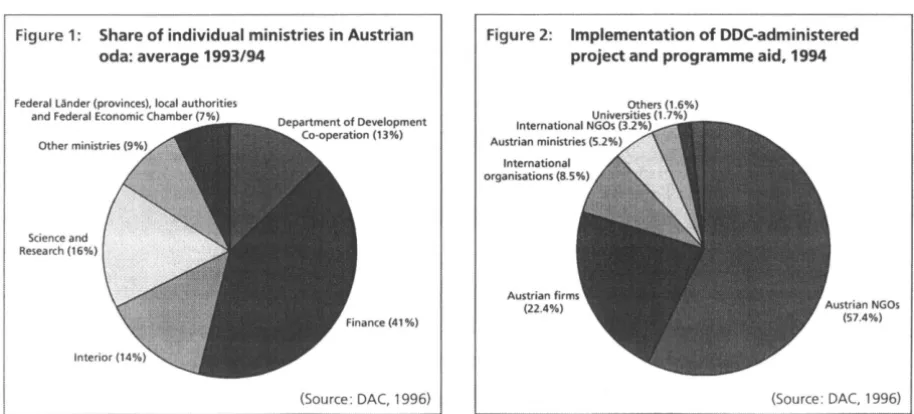
The administration of Austrian aid is dispersed over many Ministries (Figure 1). The Department of Development Co-operation (DDC), which is formally charged with overall coordination of the aid policy of the government, has itself shifted location several times. Originally located in the Foreign Ministry, it was then moved to the Chancellor's office (Bundes-kanzleramt, BKA) in 1991, only to be re-integrated into the Foreign Ministry in 1995 (BMaA, 1995). In practice, however, the DDC has control over only 10-16% of the aid budget including bilateral aid, contribu-tions to the United Nacontribu-tions Development Programme and a few small United Nations agencies, and part of Austria's scholarship programme (DAC, 1996). The DDC is also responsible for promoting public informa-tion about development issues within Austria, which it achieves both through its own information service and through collaboration with a number of NGOs (Pilz, 1996).
[image:3.589.53.510.538.745.2]The largest part of Austria's official development assistance (oda) (34-44%) is administered by the Finance Ministry which is responsible for contributions to international financial institutions, debt relief and concessional official export credits. The Interior Min-istry administers aid for refugees within Austria, the Ministry of Science and Research deals with part of the scholarship programme, and the Ministry of Agricul-ture manages food aid, contributions to FAO, etc. (DAC, 1996).
Figure 1: Share of individual ministries in Austrian ada: average 1993/94
Federal lander (provinces), local authorities and Federal Economic Chamber (7%)
Science and Research (16%)
(Source: DAC, 1996)
In spite of recommendations by the OECD's Devel-opment Assistance Committee (DAC, 1996) that staff-ing levels be increased, the DDC has had to 'downsize' in recent years. All its sector specialists, including the environment adviser, have been 'contracted out' to universities, consultancies and NGOs, and a similar system is being considered for country or regional specialists. Concentration of aid on a smaller number of priority focal countries (see section 4.1.2) has been accompanied by the setting up of regional offices in each of the countries to play a greater role in the development of country, regional and sector pro-grammes (BMaA, 1995). In some cases regional offices are staffed by DDC or embassy personnel while, in others, staff are provided by NGOs in ~ unique approach in which NGO staff are given the status of consultants to the Ministry (DAC, 1996).
3.2
Bilateral co-operation and NGOs
Austria does not use an official agency to implement its bilateral programme, which accounted for only 12.6% of total oda in 1995 (equivalent to Sch 1 billion) (Pilz, 1996). Instead, the DDC relies on numerous voluntary agencies, private or nationalised companies, consultan-cies, international organisations, etc., with a total of 74 different implementing agencies being involved in 1994 (Figure 2).NGOs are considered to be particularly good at reaching the poorest sectors of populations even in countries in which it is not possible to collaborate directly with governments. They also play a very important role in educating the Austrian public about conditions in developing countries and increasing their support for development co-operation activities (Pilz, 1996). Thus in some of Austria's priority countries (e.g. Senegal, Kenya) support is exclusively given to projects co-financed with NGOs. In others like Bhutan, on the other hand, the low level of engagement of Austrian NGOs has meant that all projects are implemented through consultancies (BMaA, 1995). In general, consultancies play a more important role in implement-ing projects for which specific technical know-how is required (Pilz, 1996).
Many Austrian NGOs have very few funds of their own and rely heavily on government co-financing of
Figure 2: Implementation of DOC-administered project and programme aid, 1994
International organisations (8.5%)
Austrian firms
(22.4%) Austrian NGOs
(57.4%)
4. TROPICAL FORESTRY DEVELOPMENT POLICIES • 125
their projects (DAC, 1996). To be eligible for co-financing, projects must be in line with the govern-ment's three-year programme of development co-operation (see section 4.1) and:
• address the basic needs of the poorest people; • aim to increase the capacity for self-help of target
groups;
• involve target groups in the planning and imple-mentation of activities;
• have clearly defined objectives which can be realised within a specified time period.
The level of co-financing can be up to 75% of project costs for projects in one of Austria's priority countries (see section 4.1.2) and up to 35% for those in other countries, with a maximum Ministry contribution of Sch 1 m. per year per project. Decisions about co-financing are taken twice a year by a Programme Committee within the Foreign Ministry (BMaA, n.d. a). Collaboration with NGOs requires a continuous process of in-depth dialogue to achieve a compromise between the NGOs' desire to take their decisions in an independent manner, and the Ministry's responsibility for implementing an overall development policy (Pilz, 1996). This tension is particularly evident in the government's wish to concentrate projects in particular countries and sectors while the reality is that NGO projects tend to be small and widely dispersed around the world (BMaA, 1995).
The government contributes about 70% to the cost of sending out volunteers through the Austrian Develop-ment Service. In 1994 140 volunteers were working in nine countries, principally Uganda, Zimbabwe, Ecua-dor, Nicaragua and Papua New Guinea. Key sectors for volunteers are technology, handicrafts, trade and health (BKA, 1994).
3.3
Multilateral co-operation
Austria's entry into the European Union in 1995 reversed a trend of declining multilateral co-operation (DAC, 1996). Austria's contribution to the EU devel-opment budget was Sch 850 m. in 1995 and, from 1998, additional contributions of about Sch 4.5 billion over a period of five years will be required for the European Development Fund. Rather than seeing this as an opportunity to reduce its own bilateral development aid, Austria sees EU assistance as being complementary to its own. In particular it recognises that a good quality bilateral assistance programme will ensure that it has a stronger voice in determining the EU's development policies (Pilz, 1996).
Austria makes relatively small contributions to the various United Nations organisations with the exception of the United Nations Industrial Development Organi-sation, which is located in Vienna (BMaA, 1996).
4.
TROPICAL FORESTRY
DEVELOPMENT POLICIES
4.1
General development co-operation
policies
The law governing development aid dates from 1974 and, in spite of several attempts, has not yet been
updated (DAC, 1996). Development co-operation is considered to be an integral component of Austria's foreign policy and, far from being neutral, is expected to contribute to the promotion of peace and good governance, and a reduction in discrimination (Pilz, 1996). The country's aid policy orientations are out-lined in the rolling 'Three Year Programme of Austrian Development Aid' which is updated every year. How-ever, the three-year programme primarily covers the activities for which the DDC is responsible and which account, on average, for less than 15% of total oda. Any policy initiative taken by the DDC to improve the quality or orientation of aid can, therefore, be out-weighed by activities in other parts of the programme. There is no development strategy coverin\ all aid activities (DAC, 1996).
4.1.1
Volume of funding
Public support for development co-operation is very high. It is, however, characterised by a misconception that Austria spends much more on development
co-operation than it actually does (Pilz, 1996). In 1994
..wfl
Austria spent Sch 7.5 billion on oda, equivalent to • 0.33% of its GNP, compared to only Sch 3.7 billion in 1989 (BMaA, n.d. b). As a percentage of GNP, Austria's aid has fluctuated in recent years (Figure 3 ). This is primarily due to the fact that most of the funds are outside of the DDC's control and can vary greatly from year to year. These include expenditure for refugees within Austria, imputed students' costs (i.e. the estimated costs of waiving Austrian tuition fees for students from developing countries) and concessional official export credits 1, which together account foralmost half the aid programme (55% in 1994). The DAC has criticised the reporting of these costs as oda, as the developmental significance of the costs is not always clear and the benefits are not focused on Austria's priority countries or sectors (DAC, 1996).
The DDC's own small resources consist, to about two-thirds, of firm budget appropriations and, to one-third, of a supplementary budget which may take a long time to negotiate and, in 1995, was only released in the last quarter, leading to uncertainties and delays in providing funding to NGOs. The fact that government budgets can only be committed for one year at a time can be a major headache for NGOs trying to plan for the financial needs of longer-term projects (DAC, 1996).
Austria's volume of development aid should be seen within the context of its generous support to the countries in transition to a market economy in Eastern and Central Europe. In 1993 this amounted to 0.22% of GNP, the highest proportion within the OECD (BMaA, 1995). It is also keen to promote debt relief at the international level and announced debt cancella-tions of Sch 1 billion in 1995 (BMaA, 1996).
Since 1993 all bilateral technical aid has been in the form of grants rather than loans (Pilz, 1996). However,
Figure 3: Austrian oda disbursements as a percentage of GNP, 1983-94
0.4 ... .
~
···!··\\ ...
~···;···
0.3
···f···-~···1···~-:.:.
... .~
\
I
··iii('···.\···~-'···
~
\
~--~Z . I
..,0.2 ···~···!···
()
) i
'#.
0.1 ... .
0.0 I I I I I I I I I I I I
1983 1984 1985 1986 1987 1988 1989 1990 1991 1992 1993 1994 Year
(Source: DAC, 1996)
the major part of Austrian aid is tied. Concessional export credits, imputed students' costs and aid for refugees are for obvious reasons tied. In addition, the major part of DOC-administered aid is also tied as it is implemented by Austrian NGOs, firms and consultancy bureaux (DAC, 1996).
4.1.2 Regional focus
Austrian aid used to consist of a widely dispersed series of individual projects that were chosen based on personal contacts and political considerations (Pilz, 1996). Some countries have always had a large Austrian presence, such as Nicaragua, which saw a wide range of activities implemented by solidarity groups, churches and NGOs supported by the huge wave of public sympathy engendered by the collapse of the Somosa dictatorship (Pilz, 1996). Other countries, however, had just one or two projects depending on the interests of the implementing NGOs.
Given the size of its aid programme, the administra-tion has now recognised that a meaningful contribuadministra-tion can be achieved only if activities are concentrated geographically and sectorally (DAC, 1996). There is therefore an ongoing shift towards a recipient country approach with efforts being concentrated in five key regions in which a total of 8 priority or focus countries (in italics below) and 11 'co-operation' countries have been selected.
Central America Nicaragua, Costa Rica, El
Salvador and Guatemala; Sahel region Burkina Faso, Cape Verde and
Senegal;
East Africa Ethiopia, Rwanda2, Uganda,
Burundi, Kenya and Tanzania; Southern Africa Mozambique, Namibia and
Zimbabwe;
Himalaya/Hindukush Bhutan, Nepal and Pakistan.
2. Rwanda was originally considered a priority country but all aid other than relief was suspended in 1994 (BMaA, 1995).
To be selected for co-operation, countries must fulfil a number of criteria:
• suffer from poverty
• be located in one of the five key regions
• be the subject of longer-term Austrian development co-operation experience
• have safety conditions and logistic infrastructure conducive to successful collaboration
• have local structures or institutions capable of implementing projects (BMaA, 1995; DAC, 1996). Additional criteria apply for 'priority' countries:
• development of a comprehensive co-operation programme based on a detailed sectoral a~alysis • extensive Austrian co-operation experience in
several sectors
• evident efforts by the national government to protect human rights, support democratisation and promote a careful use of natural resources • regular development policy dialogue supported by
appropriate local structures
• high degree of compatibility between the recipient country and Austrian development policy (BMaA, 1995; DAC, 1996).
It was hoped that by the end of 1997 a country programme would have been developed for each of the priority countries, as well as for some of the other 11 co-operation countries. These will be developed in discussion with partner governments, NGOs, technical experts from North and South and other donors and will provide the general guidelines for development co-operation between Austria and the partner country (Pilz, 1996). Increasingly, country programmes will be drawn up and coordinated by the regional offices, which are also responsible for the preparation, im-plementation and supervision of individual projects (DAC, 1996). Country programmes are complemented by three-year indicative co-operation programmes, country-specific sectoral programmes to guide the thematic content of particular activities, and annual programmes of activities (BMaA, 1996).
In budgetary terms the intention is to work towards achieving annual aid budgets of Sch 40-80 m. for priority countries and around Sch 20 m. for co-operation countries within the 1996-9 period (BMaA, 1996). After current projects have been concluded the only projects to be funded in non-priority countries will be those funded through co-financing mechanisms with NGOs and other organisations (BMaA, 1996).
The trend towards concentration has already had a marked impact, with the proportion of bilateral aid being spent on the key regions and countries increasing from only 24% in 1991 to 61% in 1994 (BMaA, 1995), and expected to rise to 70% by 1999 (BMaA, 1996). Given the limited proportion of aid funds at the disposal of the DDC, however, its own concentration of funds on a small number of countries will have little impact on the general spread of Austrian aid, which remains very wide (DAC, 1996).
4.1.3 Sectoral distribution
5. THEMATIC AND REGIONAl DISTRIBUTION OF FORESTRY PROJECTS • 127
directly reduces poverty, satisfies the basic needs of a growing population, builds viable political economies and establishes the capacity for fruitful participation in the world economy' (Pilz, 1996). Within these global aims Austria particularly provides support in those areas in which it has a comparative advantage, long-standing experience and the right implementing agen-cies (DAC, 1996). These include vocational training, primary health care, water supply, promotion of democracy, transport, energy, rural development, for-estry, mining, promotion of small enterprises, and tourism (Pilz, 1996). For most of these sectors, policy papers already exist or are being prepared (BMaA, 1996). Gender-balanced development is considered an important cross-cutting theme (Pilz, 1996).
For each of the key regions and priority countries, sectors of particular interest have been highlighted. In the longer term it is planned to concentrate the thematic spread of projects to four sectors in priority countries and two in co-operation countries (BMaA, 1996). Forestry is not considered a priority sector for any of the regions but is deemed important in Bhutan and Pakistan. In other countries forestry activities are included as components of projects in other sectors (e.g. rural development in Burkina Faso, agricultural production in Nicaragua) (BMaA, 1995).
4.2
Co-operation in the tropical forestry
sector
Austria has no stated policy on aid in the tropical forestry sector. Until 1992 the volume of funding devoted specifically to forestry-related projects was fairly small, standing at about Sch 6. 7 m. in both 1991 and 1992, equivalent to 0.1% of total oda or 0.15% of bilateral aid (BKA, n.d.). This was suddenly increased ten-fold when, at the United Nations Con-ference on Environment and Development (UNCED) in 1992, the Austrian Government announced a three-year (1993-5) special programme of Sch 200m. (US$ 18m.) to support rain forest conservation in developing countries (Pilz, 1996).
The Rain Forest Initiative (see section 5) was in part the product of growing public concern within Austria about the state of tropical forests. In 1990 this had already resulted in the Austrian Parliament passing a resolution aimed at prohibiting the import of tropical timber from countries that did not demonstrate sustainable forest management. Austrian importers agreed voluntarily not to bring in such timber, but due to the critical reactions of some producer countries a new law was adopted in 1993 establishing a voluntary quality mark for timber from sustainably managed tropical, temperate and boreal forests (DAC, 1996). An Advisory Board chaired by the Federal Ministry for the Environment and including representatives of govern-mental organisations, of the timber industry, environ-mental NGOs and social and economic partnership organisations has been appointed to set up the labelling scheme.
4.2.1
Multilateral forestry co-operation
The Austrian Ministry of Agriculture and Forestry has provided support to FAO's Tropical Forest Action Programme. It also provides funds to the Consultative
Group on International Agricultural Research (Sch 16.5 m. in 1996), within which Austria attaches particular importance to the Centre for International Forestry Research and the International Centre for Research in Agroforestry (BMaA, 1996). The BMLF supports both the International Union of Forestry Research Organisa-tions, of which it is one of the three founding members, and its Special Programme for Developing Countries for which it provides a secretariat located in the Viennese Federal Forest Research Institute. The BMLF further contributes to forestry aid by making its staff available for postings in development projects.
In close collaboration with FAO, Austrian forestry training centres have organised courses for foresters from developing countries with a special focus 't>n forest technology, benefiting in particular from Austria's own experience of ecologically sound harvesting methods in steep terrain. Training has also been provided in the technical and biological stabilisation of soil erosion and the prevention of avalanches in mountainous areas, as well as in the hazard mapping as carried out by the Austrian Service for Torrent and Avalanche Control.
Austria made a relatively high contribution of Sch 400 m. to the pilot phase (1991-3) of the Global Environmental Facility (DAC, 1996). For the 1994-7 period its contribution amounted to 1% of the total US$ 2 billion committed (BMaA, 1996).
5.
THEMATIC AND REGIONAL
DISTRIBUTION OF FORESTRY
PROJECTS
When the Rain Forest Initiative was announced by the Chancellor in 1992, Austria had relatively little experience in the field of tropical forestry projects and it was not immediately clear how this additional sum of money would be spent. On the initiative of the DDC environment adviser, an intensive round of informal discussions was launched involving everybody in Austria interested in tropical forests. This process resulted in the definition of a number of positive and negative criteria for selecting suitable projects to be funded within the Rain Forest Initiative.
Another selection criterion was the decision to support forestry activities carried out by local people rather than large companies - including activities ranging from subsistence-level activities to profit-oriented family or community enterprises. Support was also given to sustainable agriculture in forest buffer zones, ecotourism development in forest areas, scale village rehabilitation of degraded areas and small-scale sustainable timber extraction by local people (BMaA, 1995). Large-scale industrial logging projects were ruled out as the available budget seemed insufficient to tackle this question successfully. Never-theless, in order to acknowledge the importance of this area, funding was provided for the timber certification work of the Forest Stewardship Council (FSC) (Wein-gartner, DDC environment adviser, pers. comm., 1996).
With respect to implementation it was decided that the public and political desire for Austrian 'ownership' of projects was such that multilateral activities had to be excluded. Instead, all projects were implemented by NGOs because (i) it was partly due to NGO pressure that the special forest initiative had been announced, and (ii) because only NGOs had the necessary connec-tions to implement activities within the short time-frame available after the announcement. The selected projects also had to be of limited duration, with preference given to those that triggered sustainable activities, bridged funding gaps, or demonstrated results that would attract longer-term funders (Weingartner, pers. comm., 1996). A total of 36 projects were eventually funded, of which the majority have now been completed. Taking into account that most projects tackled several related areas, their distribution by principal themes is shown in Figure 4.
The geographic distribution was widespread, with the 36 projects dispersed in 15 countries. The great majority (22) were in Latin America with 11 in Brazil alone. Eight were in Africa, five in Asia and one (support to the FSC) was global in nature. As hardly any of the projects were in Austria's priority countries, very few have been followed up since completion. Outside of the rain forest initiative there are relatively few dealing exclusively with forestry. Two projects dating from before the UNCED conference are, however, still ongoing, one in Bhutan (see Box 2) and one m
Figure 4: Thematic distribution of Rain Forest Initiative projects
Traditional agroforestry (8%)
Demarcation, land titling and rights of access (22%)
(Source: Anon, n.d.)
Nicaragua dealing with forest and buffer zone devel-opment on the Rio San Juan near San Carlos.
6.
RESEARCH AND TRAINING
The Austrian forestry establishment is well aware of the challenging demands of sustainable forest management. The importance of good vocational and technical forestry training is, therefore, widely recognised. Thus, for example, all forest enterprises over 500 ha in size are obliged to employ a state certified forester. These foresters will have undergone either a five-year course of study at a Forestry College (in Bruck/Mur or Gainfarn) followed by two years of in-service training, or a five-year academic degree at the Agricultural University in Vienna with three years of subsequent in-service training. A one-year course of vocational training for 'forest wardens' is provided by the Forestry School in Waidhofen!Ybbs (BMLF, 1995b). In addition, a comprehensive range of training opportunities is provided by both federal and state training centres for small farmers and forest workers to help them improve various aspects of their forest management (BMLF, 1995a).Most domestic forest research is carried out at the Federal Forest Research Institute and the Faculty of Forestry at the Viennese Agricultural University. Cur-rent research priorities concern the condition of the forests, focusing on the effects of air pollution and methods of improving the forest's vitality and ecological stability (BMLF, 1995a). Other research projects aim to provide the scientific basis for the development of community-based systems to compensate forest opera-tors for performing those loss-making tasks considered to be essential for ensuring the long-term maintenance of the public utility function of the forest. Tropical forest research is carried out at a number of institutes, with the national node for the European Tropical Forest Research Network being located at the Agricultural University in Vienna.
7.
PROJECT CYCLE MANAGEMENT
Austria does not yet have an agreed standard for project cycle management. Many of the NGOs responsible for implementation have not been used to applying planning instruments such as project cycle management or logical frameworks. Evaluations of NGO programmes are also rare and are mostly initiated by the evaluation unit of the DDC (DAC, 1996). In the past no clear distinction has been made between the implementation of official and NGO projects. Although the majority of projects are proposed by NGOs to the DDC for co-financing, in a few cases the DDC prepares its own projects and asks suitable NGOs to implement them. There are, however, no clear guidelines as to how the DDC should select the specific implementation agency nor how it should choose between different NGO proposals (DAC, 1996). In both NGO- and DDC-initiated projects the actual implementation phases are very similar.
Similarly, there is an attempt to assess all projects with respect to their impact on and importance for women (BMaA, 1995).
8.
REVIEWS AND PROJECT
PROFILES
The Division for Evaluation, Inspection and Control of projects was established in the DDC in 1989. Lack of staff and resources means that this division mainly fulfils the task of an audit bureau rather than evaluating development instruments or projects/programmes. It is also only responsible for those activities carried out by the DDC. There has, therefore, been no evaluation of concessional export credits, multilateral aid or aid to refugees in Austria. Most evaluations to date have been project-related, although efforts are under way to evaluate country programmes and institutions (DAC, 1996).
Evaluations aim to assess projects and programmes in relation to their relevance, effectiveness, efficiency, impact and sustainability. An annual programme of evaluations is planned according to the following criteria:
• to evaluate and support strategic work of the DDC, particularly concerning programme development, decentralisation and contracting out;
8. REVIEWS AND PROJECT PROFILES • 129
• to promote the development of uniform quality standards;
• to gradually evaluate all essential aspects of Austrian development co-operation from sectors to regions, and type and phasing of activities; • to give more emphasis to evaluations of
pro-grammes and cross-cutting themes (BMaA, 1996}.
Although there has as yet been no formal evaluation of the projects funded under Austria's Rain Forest Initiative, several lessons have been learned from this interesting experience (Weingartner, pers. comm., 1996). Generally speaking, the projects dealing with indigenous people seem to have been successful, with several areas of land being demarcated and in\:tigenous people being helped to gain access to more solid legal rights. The many projects concerned with non-timber forest products, on the other hand, did not live up to the hopes of the implementing NGOs. In part this was because existing markets for such products were already fully exploited and new markets difficult to create, and also because for many people agriculture was the preferred source of livelihood. An important lesson learned from the two ecotourism projects was that successful ecotourism requires a relatively long build-up of socio-cultural activities to avoid corruption and ensure community-wide ownership.
the point that quality and sustainability of projects can be better assured through co-operation with priority countries in which longer-term programmes can be responsive to needs and incorporate forestry activities only when it appears appropriate to do so.
9.
CONCLUSION
Tropical forestry has not been a major part of Austria's normal programme of development co-operation. The period 1993-5 was an exception when a special Rain Forest Initiative funded 36 projects around the world. The range of projects funded underlines Austria's commitment to the rights of indigenous people and its interest in supporting small-scale projects. The experi-ence of the initiative confirmed the desirability of the current trend in Austrian aid to move towards longer-term programming with a selected number of countries and in a few key sectors. In the future, therefore, forestry projects should be funded only if they respond to specific sectoral needs of a priority country.
There are perhaps two main areas in which Austrian forestry expertise has a potential comparative advan-tage. One is the development of ecologically sound small-scale timber utilisation and extraction methods for steep terrain, as over 40% of Austria's own production forest is on slopes of over 40% (Siegel, n.d.). The other is the field of forestry legislation and planning, learning from the sophisticated system of integrated forestry and land-use planning in place in Austria.
Austria's early experience of legislative attempts in the field of timber certification gave an important impetus to international discussions and collaborative research on defining criteria and indicators for sustain-able forest management. Austria's recent entry to the EU may provide it with another forum to influence the international forestry debate.
REFERENCES
Anon (No date) 'Osterreichische Nationalinitiative Wald-III. Welt, Stand Ende 1995' (Austrian National Initiative on Third World Forests: Status at end 1995). Unpublished project list.
BKA (No date) Die offentliche Entwicklungszusammenarbeit
Oster-reichs: Projekte der Technischen Hilfe 1991192 (Austria's public development co-operation: technical assistance projects 1991/92). BKA, Vienna.
BKA (1993) Projekte der Osterreichischen Technischen Hilfe
1992-Kurzbeschreibungen (Austrian technical assistance projects 1992-summaries). BKA, Vienna.
BKA (1994) Projekte der Osterreichischen Technischen Hilfe
1994-Kurzbeschreibungen (Austrian technical assistance projects 1994-summaries). BKA, Vienna.
BMaA (No date a) Eine Welt fur Aile- Leitfaden zur Kofinanzierung
von Initiativen im Rahmen der Osterreichischen Entwicklungszu-sammenarbeit (One World for all - Information leaflet on cofinancing of NGO initiatives in the context of Austrian development co-operation). BMaA, Vienna.
BMaA (No date b) Eine Welt fur Aile - Osterreichische
Entwick-lungszusammenarbeit (One World for all- Information leaflet on Austrian development co-operation). BMaA, Vienna.
BMaA (1995) Dreijahresprogramm der Osterreichischen
Entwick-lungszusammenarbeit 1996 his 1998: Fortschreibung (Three-year programme of Austrian Development Co-operation, 1996-1998). BMaA, Vienna.
BMaA (1996) Dreijahresprogramm der Osterreichischen
Entwick-lungszusammenarbeit 1997 his 1999: Fortschreibung (Three-year programme of Austrian Development Co-operation, 1997-1999). BMaA, Vienna.
BMLF (1995a) Osterreichischer Waldbericht 1994 (Austrian Forest Report 1994). BMLF, Vienna.
BMLF ( 199 5b) The Forest- the Green Core of Austria. BMLF, Vienna. DAC (1996) Development Co-operation Review Series: Austria.
Development Assistance Committee, OECD, Paris.
Ederer, B. (No date) Osterreichs Entwicklungszusammenarbeit (Austria's development co-operation). Article in The Courier, Brussels, reprinted in a collection of State Secretary Ederer's speeches and articles put out by the BKA, Vienna.
Kuusela, K. (1994) Forest Resources in Europe 1950-1990. Cam-bridge University Press, CamCam-bridge.
Pilz, B. (1996) Eine Welt fur Aile: Handeln mit Perspektive. Die
Osterreichische Entwicklungszusammenarbeit. (One world for all - Action with a vision. Austrian development co-operation). BMaA, Vienna.
Siegel, G. (No date) 'Forestry in Austria'. Unpublished manuscript. Siegel, G. (1995) 'Draft Austria Country Report for the CCitmmission
on Sustainable Development 3'. Unpublished manuscript.
KEY CONTACTS
Department for Development Co-operation Federal Ministry for Foreign Affairs Minoritenplatz 9
A-1014 Vienna Tel +43 1 531 1115 4486 Fax +43 1 531 85 272
Bundesministerium fur Land- und Forstwirtschaft (Federal Ministry of Agriculture and Forestry) Sektion V (Forestry)
FerdinandstraSe 4 A-1020 Vienna Tel +43 1 21323 Fax +43 1 21323 7216
Umweltbundesamt (Federal Environment Agency) Abteilung Wald (Forestry Division)
Spittelauer Lande 5 A-1 090 Vienna Tel +43 1 31304 Fax +43 1 31304 5400
ACRONYMS
BMaA
BMK BMLF
DAC DDC EU FAO
FSC GNP NGO oda OECD
Sch UNCED
Bundesministerium fur auswiirtige Angelegenheiten
(Federal Minstry of Foreign Affairs)
Bundeskanzleramt (Chancellor's Office)
Bundesministerium far Land- und Forstwirtschaft
(Federal Minsitry of Agriculture and Forestry) Development Assistance Committee of the OECD Department of Development Co-operation European Union
Food and Agriculture Organization of the United Nations
Forest Stewardship Council Gross National Product Non-Governmental Organisation offical development assistance
Organisation for Economic Co-operation and Development
Austrian shillings
United Nations Conference on Environment and Development
ACKNOWLEDGEMENTS
This chapter has benefited from discussion with a number of people including the following: Mr. Josef Hackl ( Umweltbundesamt), Mr. GUnther Siegel (BMLF), Mr. Gunther Stachel (DDC), Mr. Sepp Weingartner (DDC Environment adviser).
Belgium
Philippe Veron, Michele Federspiel and Gill Shepherd
Contents 1.
2 1.1 1.2 1.3.
2.1 2.2 2.3 2.4 2.5 2.6. 3.
3.1. 3.2. 3.3. 3.4 3.5 3.6 3.7 3.8 4.
4.1. 4.2 4.3. 4.4. 4.5. 4.6 5.
DOMESTIC FORESTS AND FORESTRY ... _ ... _ ... 133
Brief history of forestry in Belgium . . . 133
The timber sector . . . 133
Present forest structure . . . 133
HISTORICAL INVOLVEMENT WITH TROPICAL FORESTRY . . . 134
Introduction . . . 134
Forest research in the colonial period . . . 134
The colonial forest service . . . 135
Logging operations . . . ·; ... 135
The National Parks . . . 135
Post independence . . . . . . . . . . . . . . . . . . . . . . . . . . . . . . 13 5 STRUCTURE OF DEVELOPMENT ASSISTANCE DELIVERY . . . 135
History of the process of federalisation . . . 135
Federal, regional and community competencies . . . 136
Organisation of the aid programme . . . 136
Bilateral aid . . . 136
Multilateral aid . . . 138
NGOs . . . 138
Other ministries and federal institutions active in the tropical forest sector ... 138
Regional institutions . . . 138
DEVELOPMENT ASSISTANCE STRATEGY . . . 139
Background . . . 139
Bilateral co-operation . . . 139
Co-operation through NGOs . . . 139
Multilateral co-operation . . . 139
Co-operation programme with the private sector . . . 140
Impact of international conferences . . . 140
REGIONAL AND THEMATIC DISTRIBUTION OF FORESTRY PROJECTS . . . 140
5.1 Regional distribution of projects . . . 140
5.2 Favoured sectors for current co-operation . . . 141
5.3 Regional distribution of forestry projects . . . 141
5.4 NGOs . . . 142
5.5 Multilateral co-operation projects . . . 142
6. RESEARCH AND TRAINING . . . 142
7. PROJECT CYCLE MANAGEMENT . . . _ ... 143
7.1 The stages of the PI PO method . . . 143
7.2 Application of PIPO . . . 143
7.3 Project evaluation . . . 143
8 PROJECT PROFILES . . . 144
8.1. Bilateral co-operation: an example from Peru (Cajamarca) . . . 144
9. CONCLUSIONS AND TRENDS . . . 144
REFERENCES . . . 145
KEY CONTACTS . . . 145
ACRONYMS . . . 146
1.
DOMESTIC FORESTS AND
FORESTRY
1.1
Brief history of forestry in Belgium
Two thousand years ago, most of Belgium was covered by natural forest. The main formations were the oak and birch woods which covered la Campine, the Atlantic oak forests of Central Belgium, and the hornbeam, oak and beech forests of Upper Belgium. First the Gauls cleared patches of forest to practise cultivation and animal husbandry, then the Romans built roads through the forests and made it more accessible.
In the Middle Ages major areas of forest were cleared by Cistercian monks and by feudal lords and princes. At this time the first towns appeared. As the population increased, the cultivated areas were extended and the forest further cleared. This process began earliest in Flanders in the tenth and eleventh centuries, when trade and industry began to develop. The remoter, more mountainous Ardennes, on the other hand, remained a thickly wooded agricultural region throughout the Middle Ages. It was in the thirteenth century that the first communal forests appeared, with specified rights for local people. These included pannage (the herding of pigs), grazing for horses and horned animals, the right to cut firewood, the right to clear forest land for temporary cultivation, the right to extract oak bark for tannin, the use of timber for building and carpentry, and the right to extract organic material from the forest for use on the fields, or as bedding for livestock.
By the sixteenth century, the metallurgical industry was pressing hard on the forest for charcoal to keep the forges going, and charcoal-burners began to be blamed for deforestation. As a result, a detailed Forest Edict on Woodlands and Forests was promulgated in 1617- a remarkable forest code for the time. It specifically forbade the creation of new forges, but was not able to enforce compliance.
In the eighteenth century, degradation of the forests increased, partly as the result of a regulation dating from 1754 which reduced from 60 to 30 years the age at which trees could be felled. As a result, the vast majority of forests consisted only of coppice with standards by the end of the century. In Flanders, these were composed of oak, alder, poplar, aspen and willow, and in the rest of the country oak, beech, hornbeam and white woods such as ash, maple, elm and lime.
Metallurgy maintained its importance, but from the beginning of the nineteenth century it relocated progressively to coal mining areas. By the middle of the century, as a result, people were beginning to question the economic role of forests by contrast with agriculture, and deforestation rates increased. Despite this, more than 400,000 ha of forest (mainly coppice) were still in place at mid-century.
The trend was reversed only in 184 7, when a law was passed relating to land clearance and deforestation, and the state began to encourage reforestation, providing subsidies to communities and individuals for tree planting. Tree cover began to increase again, and the total forest area grew from 435,000 ha in 1866 to 613,800 ha in 1970. An examination of the systems shows that the deciduous high forest area more than
1. DOMESTIC FORESTS AND FORESTRY • 133
doubled over this period, essentially through the conversion of coppice.
1.2
The timber sector
At the time of the last official census in 1970, the forest covered 613,800 ha, of which 53% was deciduous and 4 7% coniferous. However, according to a study carried out in the early 1980s (Rondeux, 1980-84}, the forest was more widespread and covered 657,500 ha (22.3% of the country). Most of the forest (about 82%) is in the Walloon region. In the deciduous forest the main species are beech, chestnut oak and pedunculate oak followed by other valuable deciduous species such as wild cherry, ash, maple and birch. Spruce ,represents 85% of the conifers, although in more recent planta-tions the trend is for diversification with Douglas fir and Japanese larch.
The standing volume of the Belgian forest estate is estimated at 75 million m3, -a density of 120 m3 per
hectare on average, together with the poplars outside the forest. Annual production in 1990 and 1991 was 5,270,000 and 4,490,000 m3, i.e. considerably more
than 6 to 8m3 per ha per year. These figures, among the highest in the world, demonstrate the very high productivity of Belgian silviculture.
Production from Belgian forests is on the increase, and in 1991 covered more than 60% of consumption. Most of the imported temperate deciduous timber comes from France and North America; imported tropical deciduous timber originates in South-East Asia (principally Malaysia) and Mrica. Imported coniferous timber comes from northern Europe (Germany, Fin-land, Russia, and Sweden) and from Portugal, Canada, the United States and Chile. Exports are mainly to European Union countries.
Although most of the Belgian forest is located in the Walloon region, it is in the Flemish region that most of the timber-processing plants are located. The added value of the timber sector was BEF 52 billion in 1980, or 1.7% of GDP. In 1987, the added value was estimated at approximately BEF 100 billion.
1.3.
Present forest structure
Belgian forests are divided more or less equally between private and public owners. The public forest includes national forests, communal forests (three-quarters of the public forest) and State plantations. All these are subject to the Forest Code of 1854, and subsequent laws and decrees, which lay down the rules governing the administration and supervision of forests. The Code has supported a very competent forest administration, which was regionalised in 1990.
by the lOth World Forest Congress (1991) and the 1992 Rio and 1994 Helsinki conferences, and intends to continue to manage the forest sustainably and to emphasise the protection, conservation and biodiversity aspects of management. The establishment of simple management plans is being studied and will probably be integrated, by the granting of subsidies, with the other measures applicable to privately owned Walloon forest. One important feature of the private forest is its division into small holdings. There are more than 120,000 private owners, 80% of whom own less than 2 ha, and only 1.5% of whom have more than 50 ha (representing 45% of private forest). Numerous private owners are grouped together in the Royal Forestry Society of Belgium, (Societe Royale Forestiere de
Belgique; Koninklijke Belgische Bosbouwmaatschappi),
founded in 1893. This organisation defends their interests both with regard to national bodies and on the Central Committee for the Private Forest ( CCPF) a consultative organisation recognised by the European Union {Administration des Eaux & Forets, 1958; Auteurs Divers, 1985; Bary-Lenger et al, 1992; Vertri-est, 1990; Ministere de la Region Wallonne, 1996).
2
HISTORICAL INVOLVEMENT
WITH TROPICAL FORESTRY
12.1
Introduction
The history of Belgian forestry is closely linked to that of the former Belgian colonies. In 1908 the independent state of the Congo became the colony of the Belgian Congo (and at independence in 1960, Zaire). In 1923 Belgium received a mandate from the League of Nations to administer the twin territories of Rwanda-Burundi2,
a German colony acquired after the 1914-18 war, which at independence became the two states of Rwanda and Burundi.
2.2
Forest research in the colonial period
The years from 1908 to 1914 were devoted to developing Belgian colonial policy and establishing new institutions. In 1910, a General Administration for Agriculture was established within the Ministry of the Colonies. From 1914 to the end of the 1920s, it was essentially the agricultural sector that was developed. The National Institute for Agronomic Studies of the Belgian Congo (INEAC) was created in 1933, its activities also extending to Rwanda and Burundi. Since forests offered considerable economic potential, INEAC established a forest division in 1935, in the Scientific Section of the Y angambi Research Centre located in the Upper Congo region, and then rapidly extended its activities to other regions. For instance, in 1940 the forest station of Luki, located in the region of the Lower Congo, was established. During World War II work and inventories continued and in 1948 the production of a Flora of Congo-Rwanda-Burundi began (Jardin Bota-nique de l'Etat, 1963). Throughout the war, the local
1. Most of the information in this section has been extracted from Drachoussoff et al (1991).
2. Actually known as Ruanda-Urundi in the colonial period.
forest species (Entandrophragma spp, Terminalia
su-perba, Cleistopholis glauca, Alstonia boonei, Podocar-pus sp, Chlorophora excelsa, PterocarPodocar-pus soyauxii, Khaya sp, etc.) and exotic species {such as Pinus spp,
Eucalyptus spp, Acacia spp, Callitris spp, Grevillea robusta) thought likely to have a significant economic future were planted and studied under various ecological conditions. Based on the continuity of these observa-tions, silvicultural trials were able to be undertaken from 1946 onwards. The major concerns were environmental protection, soil conservation, protection of forest cover, measures against deforestation and fire-fighting.
In the Belgian Congo, the 1950-59 ten-year plan covered five areas:
't
1. determination of allowable cut in pfoduction forests, regulation of logging activities, perfection of methods of management, enrichment and plantation;
2. trials of new species; improving the profitability of, and diversifying, industrial production {e.g. veneers and plywood);
3. export promotion for timber products; 4. reforestation for firewood;
5. establishment of forest reserves, protection of savannah3, and protection of the forests.
In Rwanda-Burundi, the 1950-59 ten-year plan focused on protection of the upland forests and the establish-ment of new production forests. In fact, few forests remained and demographic pressure threatened to destroy what was left. By the end of 1959, remaining totals were assessed at 40,000 ha of managed forests, 24,000 ha of afforested areas for production of firewood, 300,000 ha of protected savannah, plus 11,000 ha of afforestation for soil conservation.
Numerous management techniques were tested in three types of silvicultural treatments:
• enrichment planting, using the method of enrich-ment in dense stands {Anderson method). This method was intended to enrich the natural forest by the establishment of dense nuclei of valuable species in which seedlings were given the chance to grow rapidly with little competition. The intention was that, by the time they came to interact with the natural environment, they would already be large enough to compete successfully;
• progressive evolution of the forest towards a less heterogeneous composition, using the Belgian method of standardisation by height. This method attempted to favour the middle age-classes of the best-represented valuable species by eliminating species with no commercial value, and also by simultaneous intervention in all forest layers. The final goal was to eliminate the largest-diameter stems {apart from those with commercial poten-tial); to maintain a cover of medium-diameter stems rich in desirable species, and to improve light at ground level with a view to encouraging regeneration;
• radical modification of mixed stands into pure stands.
3. STRUCTURE OF DEVELOPMENT ASSISTANCE DELIVERY • 135
From 1955 onwards, the older style of arboretum research, which had been to conduct studies of species of potential commercial interest, was progressively replaced by shorter-term comparative trials, conducted in a limited area. These studied the development of a large number of species until they reached the height of 4 metres, the aim being to provide detailed information on growth rates of young trees, on crown diameter, and on susceptibility to pests (Donis and Maudoux, 1951; Lebrun and Gilbert, 1954; Donis, 1956; INEAC, 1961).
2.3
The colonial forest service
A Water and Forests Service was established in the Belgian Congo in 1945. From then on, each province had a forest engineer whose task was to make an assessment of his province, and define forest policy there. In particular, he was asked to establish 'forest operations regions' and to initiate a management programme specific to each, as soon as possible. Strengthening the resources of the Forest Service in this way, made it possible to monitor logging operations more closely and to encourage the establishment of a modern timber industry.
In Rwanda and Burundi, the population had been obliged since 1931 to take part in communal afforesta-tion. Every year, each community had to carry out afforestation at a rate of 1 ha per 300 taxpayers, in order to produce much needed firewood and construc-tion timber for its own needs (De Ligne, 1987).
2.4
logging operations
A decree governing logging operations was adopted in 1912. The various ordinances which followed made it possible to increase production rapidly. Production rose from 143m3 of logs and sawn timber exported in 1923,
to 9,452 m3 of logs and 3,880 m3 of sawn timber in 1930. The prosperity of the 1920s encouraged private investment and the establishment of colonists. After World War II, all types of logging operations were to be found in the Belgian Congo - and to a lesser extent in Rwanda-Burundi - from modest semi-artisanal saw-mills to large-scale operations completely equipped for logging, milling and processing (sawnwood, veneers and plywood). The Belgian authorities tried to encou-rage operators to maximise the modernisation of sawmills and the processing of logs. In this way the Belgian Congo retained the largest possible proportion of the added value, anticipating current strategies of self-interested industrial development. The volume of logs felled in the colony reached 850,000 m3 in 1955. The production of sawnwood and veneers increased continuously as well, to 56,000 m3 in 1959. The export of logs and processed timber increased from 105,000 m3 tonnes in 1950 to 162,000 m3 in 1959.
2.5
The National Parks
Nature conservation was a major concern of the Belgian authorities. In 1925, the Albert National Park (now the Virunga National Park) was the first national park in Africa. In 1934, the Kagera National Park (in Rwanda) was established, followed by the Garamba National Park in 1938 and the Upemba National Park (now the Volcanoes National Park) in 1939. Management of these parks was the responsibility of the National Parks Institute of the Belgian Congo (IPNCB) created in 1934.
Throughout the period 1945-58 in addition to the 24,740 km2 of National Parks, 21 Protected Areas (37,355 km2) and 22 Hunting Areas (54,700 km2) were set up. Conservation and research were the main priorities of the IPNCB; tourism occupied only third place. The national parks of the Belgian Congo were highly thought of and served as examples to many other parts of Africa.
2.6.
Post independence
A second 10-year plan (1960-70) was published in January 1960. In terms of the forest, it envisaged the following programmes: an inventory of forest resources; enrichment of the existing forests for industtial timber and pulp for paper-making; reforestation" of non-wooded land for purposes of production and/or conservation; and timber technology.
The independence of the Belgian Congo in 1960 and then of Rwanda and Burundi in 1962 did not allow this plan to be implemented. However, the research was partially continued by the National Institute for Studies in Agronomic Research (INERA) in Zaire, as well as by the two Institutes of Agronomic Sciences of Burundi (ISABU) and Rwanda (ISAR).
In Belgium, in 1962, the Development Co-operation • Office, currently called the General Administration of • Development Co-operation (AGCD), was established. Initially, co-operation focused on the former colonies, but it has subsequently diversified to other countries. For example, it funded two large forestry projects (in Cape Verde and Peru) in the 1970s.
3.
STRUCTURE OF DEVELOPMENT
ASSISTANCE DELIVERY
43.1.
History of the process of federalisation
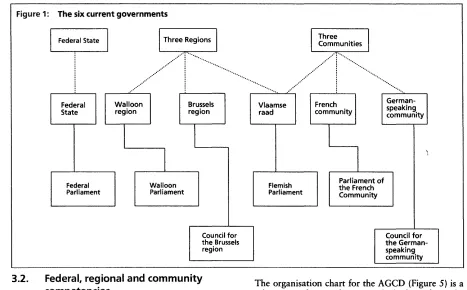
Belgium is a federal state consisting of three regions and three communities. This federal structure is the result of a progressive process, the basis for which was laid down in the 1970 reform which allowed three cultural communities to be recognised: the Flemish, the French, and the German-speaking community. Cultural coun-cils were created at that time and authorised to issue decrees with the force of law. These have evolved into the Councils and Parliaments of the Communities.
The reform of 1980 recognised the principle of Regions. Like the communities in 1970, the regions acquired the right to issue decrees with the same validity as national law. However, only two regions were recognised: the Walloon region and the Flemish region. At this point the Flemish region and the Flemish community merged to form the Vlaamse raad. The reform of 1988-89 created a third region: that of Brussels itself. It also devolved certain state responsi-bilities to the regions and communities. Finally, the reform of 1992-3 put in place a process of direct election to the regional and community councils and parliaments. The 6 current governments are shown in Figure 1.
Figure 1: The six current governments
Federal State
I
I
Three RegionsI
Three CommunitiesI
....
... ···/···
...
···:··· ... .
···
...
... /·r··· ..
Federal State
Federal Parliament
,....---...:....---,
Walloon region
I
I
Walloon Parliament
Brussels region
I
Council for the Brussels region
3.2.
Federal, regional and community
competencies
The federal state remains competent in a series of important areas, in particular development co-operation, monetary policy, justice, social security, foreign policy, some areas of employment, and a large part of public health, national defence and law and order. The regions are competent in the areas of land management, the environment, rural renovation and nature conservation, agriculture, housing, water policy, the economy, energy, some areas of employment policy and the organisation and exercise of supervision over the communes and provinces. The communities have authority in cultural matters and education.
3.3.
Organisation of the aid programme
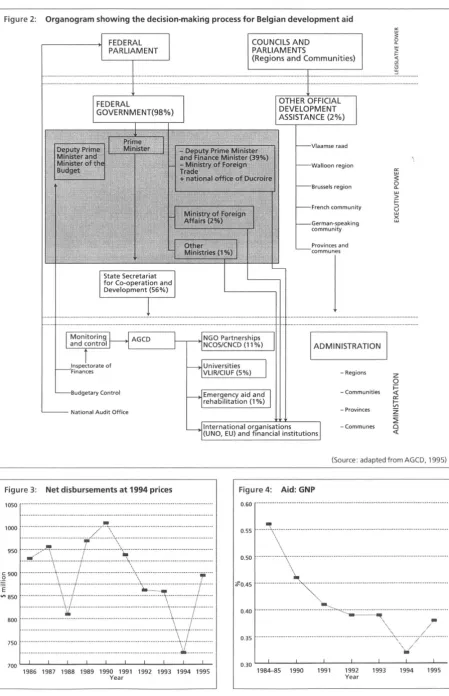
The organogram in Figure 2 shows the decision-making process for Belgian development aid. This aid amounted to BEF 30.4 billion in 1995 (0.38% of GDP). The Secre-tary of State for Development Co-operation has declared the intention of reaching the 0.7% of GDP UN target by the year 2000 or shortly thereafter and stated that net official development assistance disbursements will in-crease significantly from 1998 (OECD, 1997: 130). Figures 3 and 4 indicate the picture for 1985-95.
Co-operation between the different departments (Foreign Affairs, Foreign Trade, Finance, Agriculture, etc.) is organised within the Inter-departmental Working Group for Development Co-operation (GTICD), pre-sided over by the Secretary of State for Development Co-operation. Virtually all (as much as 95%) of Belgian activity in tropical forestry comes under the Office of the Secretary of State for Development Co-operation, currently Mr Reginald Moreels, who is also assistant to the Office of the Prime Minister. The General Adminis-tration for Development Co-operation (AdminisAdminis-tration Generate de Ia Cooperation au Developpement, AGCD, or Algemeen bestuur van de ontwikkelingssamenwerk-ing, ABOS) also comes under the Secretary of State.
Vlaamse raad
Flemish Parliament
,....-____;.:...___--,
French community
I
Parliament of the French CommunityGerman-speaking community
Council for the German-speaking community
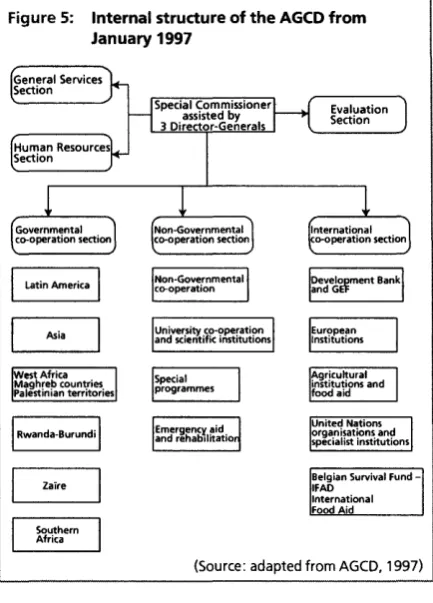
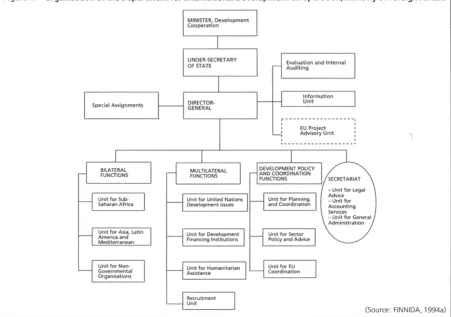
The organisation chart for the AGCD (Figure 5) is a combination of an earlier one which dates from the reform of the AGCD in 1992, and a later one incorporating modifications adopted in January 1997. A key change is that the old terms - bilateral, indirect bilateral and multilateral cooperation respectively -become governmental co-operation, non-governmental co-operation and international co-operation. To this chart should be added the presence of the Co-operation Sections attached to Belgian embassies (in over 30 countries in 1995). These Co-operation Sections are an integral part of the AGCD, but they are dependent on the embassies which alone are authorised to sign documents in Belgium's name. Their role is essentially to provide follow-up on projects financed or co-financed by Belgium.
Among the major changes to the structure of the AGCD, the following should be noted:
(i) the combination of two 'Direct Bilateral Aid Administrations' into the single 'Governmental Co-operation', and the reduction in the number of geographical departments which will henceforth be centred only on the countries with programmes; (ii) a new form of collaboration between the country desk officers and the sector specialists (5 sectors); (iii) the establishment of an 'Evaluation Section' which
formalises the increasing interest in evaluating actions undertaken.