J Rehabil Med 43
ORIGINAL REPORT
© 2011 The Authors. doi: 10.2340/16501977-0893 Objective: To define a sub-set of functional goals and
out-comes relevant to children and families living with cerebral palsy following treatment with botulinum toxin type A using the International Classification of Functioning, Disability and Health for Children and Youth.
Methods: We identified treatment goals and treatment out-comes from medical case records in 2102 assessments of 239 children with cerebral palsy treated with botulinum toxin between 1994 and 2009. Goals were set through assessment and discussion by experienced clinicians, therapists, parents and children.
Results: There were 61 separate goals, mapping to 40 catego-ries, falling mostly within Body Functions: b710 Mobility of joint functions (414 times); b770 Gait pattern functions (374 times); b7351 Tone of muscles of one limb (117 times). A total of 93 separate treatment outcomes were identified, mapping to 51 categories. Two of the 3 most common outcomes corre-spond to the 2 most common goals (gait pattern and mobility of joint functions).
Conclusion: The International Classification of Functioning, Disability and Health for Children and Youth provides a use-ful framework to categorize the reasons for using botulinum toxin in children and focuses the clinical consultation not only on impairments but also functional outcomes.
Key words: ICF; functional goals; outcomes; classification;
botulinum toxin type A; subset. J Rehabil Med 2011; 43: 1010–1015
Correspondence address: Nick Preston, Academic Department of Rehabilitation Medicine, The University of Leeds, D Floor,
Martin Wing, Leeds General Infirmary, West Yorkshire, LS1
3EX, UK. E-mail: [email protected]
Submitted February 2, 2011; accepted August 30, 2011
INTRoduCTIoN
Cerebral palsy (CP) is the most common cause of severe dis-ability in childhood (1) and the cause of more referrals to rehabilitation than any other diagnosis (2). A common clinical feature of CP is spasticity, which has a major impact on daily
personal activities and can restrict participation in social and educational programmes. Botulinum toxin type A (BoNT-A) is an effective treatment for spasticity (3, 4), and has functional
benefits when combined with other rehabilitation treatments (5).
It reduces spasticity by blocking the release of the neurotransmit-ter acetylcholine at the motor endplate (6). Although sprouting of the nerve to make new connections overcomes the effects of BoNT-A over a period of 4–6 months, there is a substantial window of opportunity for orthoses and therapy to address
spe-cific pre-determined goals of rehabilitation. BoNT-A has been
demonstrated to show improvements in functional goals over and above those in a non-BoNT-A treatment group (5). Functional goals included catching a ball, maintaining a grasp on a scooter or cycle handle, activities involved with dressing, maintaining
an eating utensil in the hand. In this paper, goals are defined
as changes in impairment, activity limitation or participation restriction that are expected to be observed as a result of
BoNT-A treatment. Outcomes are defined as those changes that were
observed and recorded following treatment. Given the potential
complexity of the benefits of botulinum toxin treatment, a system
to capture these effects and provide a structure to the clinical consultation process would assist clinical decision-making and provide a formal method of involving parents and children in discussion about treatment objectives.
The International Classification of Functioning, Disability
and Health for Children and Youth (ICF-CY) (7) provides the framework for facilitating accurate and effective communica-tion, a common language for describing and classifying function and development in children and young people (8), both within the multidisciplinary team and for communication between regional health networks. The ICF-CY model describes func-tioning in two components: Body Functions and Structures, and Activities and Participation. Within these components, the ICF has more than 1,400 categories (8), making it somewhat impractical for day-to-day use. In recognition of this, the World Health organization (WHo) has produced two generic ICF as-sessment tools (9), but even commonly used generic tools that
are validated and reliable are not always appropriate for specific
conditions, e.g. CP (10). This is being addressed by the WHo
with the formulation of condition-specific Core Sets to facilitate
develoPMeNT oF A FRAMeWoRk To deFINe THe FuNCTIoNAl GoAlS
ANd ouTCoMeS oF BoTulINuM ToxIN A SPASTICITY TReATMeNT
RelevANT To THe CHIld ANd FAMIlY lIvING WITH CeReBRAl PAlSY
uSING THe INTeRNATIoNAl ClASSIFICATIoN oF FuNCTIoNING,
dISABIlITY ANd HeAlTH FoR CHIldReN ANd YouTH
Nick Preston, BSc (Hons)
1, Michael Clarke, BSc, MB, ChB, MRCP, DCH, FRCPCH
2and
Bipin Bhakta, MD, FRCP
1,2use of the ICF in clinical practice for a dozen common diseases
(11). However, rehabilitation centres still find limitations when
using the ICF in clinical settings (12). The proposed solution is the use of “subsets”, which are more appropriate for each setting (12). As part of a service evaluation, we undertook a retrospective review (over the last 15 years) of the Botulinum Clinic case notes of 239 children in order to identify and review
the goals and benefits of botulinum treatment of spasticity in children with CP. These goals and benefits were formulated by both parents and the medical team. These goals and benefits
were then described in terms of the ICF-CY categories. The aim of the review was to build on existing methods to develop ICF-CY subsets. We propose that the resulting set of ICF-CY categories provides an appropriate subset to categorize goals and outcomes associated with treatment of spasticity using BoNT-A in children with CP.
MeTHodS
In 1994, a botulinum toxin treatment regional service was set up in Yorkshire, uk. Children from hospitals throughout the north of eng-land, an area which included up to 12 district and General Hospitals, attended the clinic through referral from local paediatricians, occu-pational therapists or physiotherapists. The multidisciplinary service consisted of paediatric neurologist, rehabilitation medicine physician, paediatric physiotherapist, nurse and occupational therapist. The goals and outcomes of treatment were therefore the result of a consultation by an experienced multidisciplinary team of specialists in neurological (re)habilitation. Importantly, children with CP and their parents/carers were also involved both in the formulation of treatment goals and in
reporting the outcomes of treatment, defined here as parent-reported
changes in activity, participation, body structure or function, at each hospital clinic attendance.
Children with a confirmed diagnosis of CP first treated with BoNT-A
between 1994 and 2005 were included in the clinical service evaluation. Between 1994 and 2009, 239 children with CP referred for spasticity management received over 2000 clinical assessments, each undertaken with regard to botulinum toxin treatment. As part of a clinical service evaluation of the spasticity management clinic, a retrospective case note review was undertaken using a structured textual search. data was
recorded using a predefined proforma, which captured classification of
CP, age, botulinum toxin treatment details (dose, frequency, muscles
treated), goals statement, patient- and clinician-reported benefits. Goals for treatment and treatment benefits (outcomes) were recorded in the
medical records during consultations with parents and children. Goals were documented as aims of treatment, and were repeated in a letter to both children’s GP and referring consultant after the clinic appointment. outcomes were documented in the notes in follow-up clinics. All data was anonymised for coding and analysis. A standard method for coding
the goals and benefits obtained from the medical records was used. The
quality of the method was assessed in a pilot evaluation by the authors. Firstly, a sample of 10 medical records was examined and the goals and outcomes independently categorized by the authors into impairment (of Body Function and Structure), or function (Activity and Participation). These were mapped to the categories of the ICF-CY. Any differences were resolved through discussion. The pilot test highlighted no differences in the conceptual interpretation of the goals and outcomes into the ICF-CY categories. A full set of data from the rest of the medical notes was then extracted by a paediatric neurophysiotherapist. Frequency of goals and outcomes were presented using descriptive statistics. These were then
further classified in terms of ICF-CY components and categories. A total
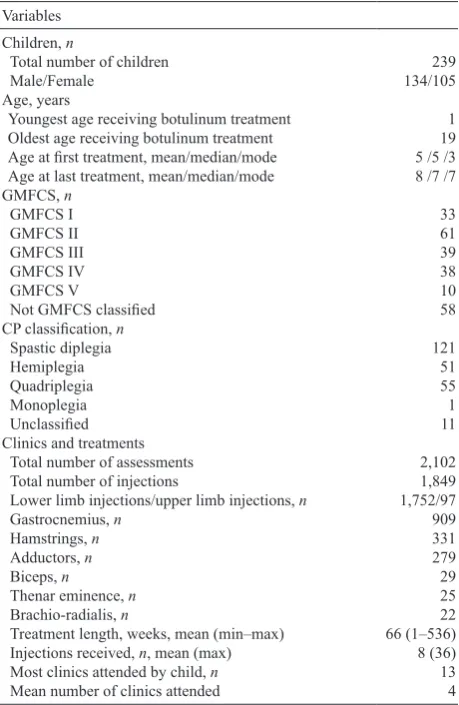
of 239 children’s medical records were examined (Table I).
All data extraction from the medical records was undertaken by a single experienced paediatric neurophysiotherapist. Goals and
treat-ment outcomes were collated and defined by the appropriate category of
the ICF-CY (7). The process was straightforward, but if there was any
uncertainty or ambiguity linking the ICF-CY to the goals or benefits,
these were noted and discussed amongst the authors. For example,
the goal (and benefit) “Improve(d) application of ankle-foot orthoses” might have been defined as d540: Dressing, rather than e1151: Assistive
products and technology for personal use in daily living. This example of “uncertainty or ambiguity” highlights the process. There were no
goals or benefits of treatment that could not directly be linked to the
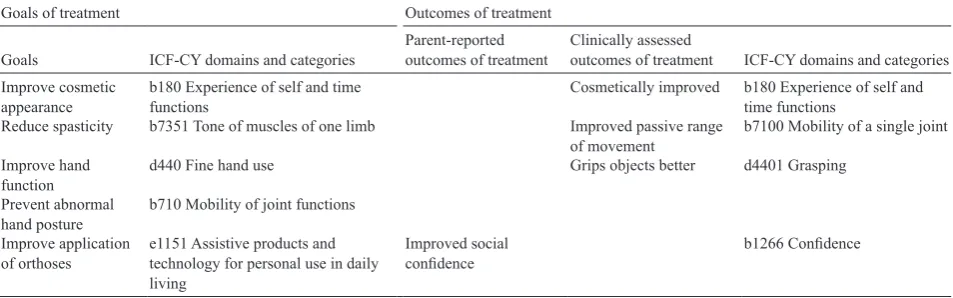
ICF-CY. An example of goals and outcomes, and their corresponding ICF-CY (7) codes, are given in Table II.
As an example of the process, Improve Hand Function was described as a goal of treatment in the medical notes on 19 occasions, and Improved
Hand Function was noted as a benefit of treatment on 15 occasions. This
maps to the second-level ICF-CY domain d440 Fine Hand use (d =
Activi-ties and Participation; Chapter 4 Mobility; d440 Fine Hand Use), defined
by the ICF-CY as “Performing the coordinated actions of handling objects,
picking up, manipulating and releasing them using one’s hand, fingers
and thumb, such as required to lift coins off a table or turn a dial or knob. (Inclusions: picking up, grasping, manipulating and releasing; Exclusion: lifting and carrying objects) (7). Because the ICF-CY tree branches to deeper levels in different domains, dividing some categories into more
component parts and defining these activities in greater detail, some goals and outcomes were defined at greater levels. The example above was at the
[image:2.581.299.529.351.704.2]second level, but the goal of treatment “Maintain gastrocnemius muscle
Table I. Classification of children with cerebral palsy (CP) at initial botulinum toxin treatment episode
variables Children, n
Total number of children 239
Male/Female 134/105
Age, years
Youngest age receiving botulinum treatment 1
oldest age receiving botulinum treatment 19
Age at first treatment, mean/median/mode 5 /5 /3 Age at last treatment, mean/median/mode 8 /7 /7 GMFCS, n
GMFCS I 33
GMFCS II 61
GMFCS III 39
GMFCS Iv 38
GMFCS v 10
Not GMFCS classified 58
CP classification, n
Spastic diplegia 121
Hemiplegia 51
Quadriplegia 55
Monoplegia 1
Unclassified 11
Clinics and treatments
Total number of assessments 2,102
Total number of injections 1,849
lower limb injections/upper limb injections, n 1,752/97
Gastrocnemius, n 909
Hamstrings, n 331
Adductors, n 279
Biceps, n 29
Thenar eminence, n 25
Brachio-radialis, n 22
Treatment length, weeks, mean (min–max) 66 (1–536)
Injections received, n, mean (max) 8 (36)
Most clinics attended by child, n 13
Mean number of clinics attended 4
length” navigates to the 4th level s75012 Muscles of the lower leg. Thus,
the level to which the goals and outcomes are described is not defined by
the study methodology but by the ICF-CY.
ReSulTS
The sample appeared to be broadly representative of the general population, although there was a larger than normal proportion of children with only the lower limbs affected. The ratio of boys to girls was 1.28, which is comparable to the population ratio in europe of 1.33 (13). The proportion of diplegic children was 49.8% compared with 13–25%, but proportions were similar in children with hemiplegia (21.3% compared with 21–40%) or involvement of all 4 limbs (23% compared with 20–43%) (2).
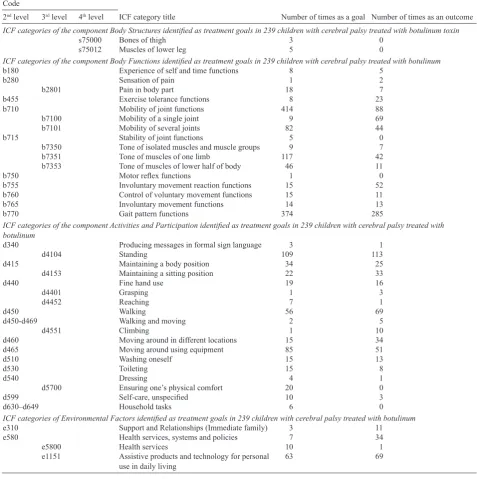
Sixty-one goals of treatment mapped to 40 categories of the ICF. For example, the goals “keep up with peers” and “Reduce falls” both mapped to d450 Walking (Activities and Participa-tion). Table III shows the ICF codes and categories, and the
number of times they were identified as goals, for all 239 children. The most common ICF-classified goal was Mobility
of Joint Functions, ICF Code b710 (414/2102 clinical assess-ments). The most common outcome was Gait Pattern functions b770 (285/2102 assessments – the second most common goal). Ninety-three outcomes of treatment mapped to 51 categories, of which 34 were common categories with the goals. These com-mon goals are shown in Table III, along with the number of times
they were reported as benefits or outcomes of treatment. Table
Iv lists the 17 remaining outcomes mapped to ICF categories.
dISCuSSIoN
This paper uses the ICF-CY to define a comprehensive subset
of functional goals and outcomes for the treatment of spasticity in children with CP using BoNT-A. No ICF Comprehensive Core Set currently exists for children with CP, and we do not propose that our method sets out to address this, but we
be-lieve that this framework of ICF-CY categories forms the first defined subset of the ICF-CY appropriate for use in a specific
clinical setting, as proposed by Huber et al. (12). It serves as a guide for documenting changes at impairment and functional levels, and as a communication aid for referral and assessment. The approach for developing this subset from the ICF-CY differs from the construction of Core Sets commissioned by the WHo (11). The methods used to develop these Core Sets involved: a delphi exercise (expert view); a systematic review
of randomized trials to find the views of researchers; empirical
data collection using the ICF checklist to identify the common patient problems of chronic conditions (11); and the gathering of up to 36 international experts for training in the ICF before undertaking the development of the Core Sets under supervi-sion and guidance of the ICF Research Group (14). The process took place at 3 conferences organized over 13 months, and produced Core Sets for 12 chronic conditions.
Two types of Core Sets for each condition, Brief and Com-prehensive, are described: the first for use in multidisciplinary
assessment and the second for use in assessment of participants in a clinical study.
The Comprehensive Core Set for a specific condition “is a list
of ICF categories that includes as few categories as possible to
be practical, but as many as necessary to be sufficiently com -prehensive to describe in a com-prehensive, multidisciplinary assessment the typical spectrum of problems in functioning of
patients with a specific condition” (11). The use of the ICF is
gaining recognition in rehabilitation centres across europe and
beyond, and other methods to interpret goals and benefits using
the ICF have been described recently (15–17). The approach we have used to develop a subset of the ICF-CY for children with
CP focuses on goals for targeting spasticity using a specific
intervention, and includes established outcomes of the
inter-vention. The benefit of this approach is use of directly reported
patient/parent goals and outcomes of the clinical treatment in a
specific clinical setting and patient group in clinical consulta -tion. This approach may be more practical than those acknowl-edged in terms of time and human resources, as this method involved a single research physiotherapist who collated and organized the data in approximately 100 days. We believe the
[image:3.581.53.530.93.242.2]specific intervention in a defined patient population provides a
Table II. Example of goals and outcomes generated for one child: a girl aged 3 years 11 months at first injection clinic, treated over a period of 1 year 8 months at a total of 3 separate clinics
Goals of treatment outcomes of treatment
Goals ICF-CY domains and categories Parent-reported outcomes of treatment Clinically assessed outcomes of treatment ICF-CY domains and categories Improve cosmetic
appearance b180 experience of self and time functions Cosmetically improved b180 experience of self and time functions Reduce spasticity b7351 Tone of muscles of one limb Improved passive range
of movement b7100 Mobility of a single joint Improve hand
function d440 Fine hand use Grips objects better d4401 Grasping
Prevent abnormal
hand posture b710 Mobility of joint functions Improve application
of orthoses e1151 Assistive products and technology for personal use in daily living
Improved social
confidence b1266 Confidence
focus for the reporting of goals and outcomes in consultation with clinical specialists. We propose that this, combined with
the patient-reported goals and benefits, increases the specificity
of the subset for use in this clinical setting.
There are some limitations of using this approach. First of all, data was extracted from medical records by a single researcher. A second researcher would improve the validity of the subset, as linking the recorded goals and outcomes in medical notes to the ICF-CY categories is prone to the individual researcher’s interpretation. There is also the question of the single-site sam-ple on which the data was drawn. There is the potential for bias in the recording of information within medical notes, as well as
potential for incomplete record of the clinical consultation, as indicated perhaps by the 6 goals of treatment (Table II), which were not reported as an outcome of treatment. There is inher-ent bias involved in any data extraction. A further potinher-ential
for bias in this ICF-CY classifications subset is that, during
the early years of the service, referrals and treatment interven-tions focussed predominantly on lower limb spasticity: there were 100 botulinum treatments injections to the upper limb compared with 1749 injections to the lower limb.
[image:4.581.51.529.96.576.2]Children and their families express needs in terms of the goals to be achieved, and clinicians discuss and add to these goals fol-lowing a clinical assessment. The medical records of 239 children Table III. International Classification of Functioning, Disability and Health (ICF) categories identified as treatment goals in 239 children with cerebral palsy
Code
2nd level 3rd level 4th level ICF category title Number of times as a goal Number of times as an outcome
ICF categories of the component Body Structures identified as treatment goals in 239 children with cerebral palsy treated with botulinum toxin
s75000 Bones of thigh 3 0
s75012 Muscles of lower leg 5 0
ICF categories of the component Body Functions identified as treatment goals in 239 children with cerebral palsy treated with botulinum
b180 experience of self and time functions 8 5
b280 Sensation of pain 1 2
b2801 Pain in body part 18 7
b455 exercise tolerance functions 8 23
b710 Mobility of joint functions 414 88
b7100 Mobility of a single joint 9 69
b7101 Mobility of several joints 82 44
b715 Stability of joint functions 5 0
b7350 Tone of isolated muscles and muscle groups 9 7
b7351 Tone of muscles of one limb 117 42
b7353 Tone of muscles of lower half of body 46 11
b750 Motor reflex functions 1 0
b755 Involuntary movement reaction functions 15 52
b760 Control of voluntary movement functions 15 11
b765 Involuntary movement functions 14 13
b770 Gait pattern functions 374 285
ICF categories of the component Activities and Participation identified as treatment goals in 239 children with cerebral palsy treated with botulinum
d340 Producing messages in formal sign language 3 1
d4104 Standing 109 113
d415 Maintaining a body position 34 25
d4153 Maintaining a sitting position 22 33
d440 Fine hand use 19 16
d4401 Grasping 1 3
d4452 Reaching 7 1
d450 Walking 56 69
d450-d469 Walking and moving 2 5
d4551 Climbing 1 10
d460 Moving around in different locations 15 34
d465 Moving around using equipment 85 51
d510 Washing oneself 15 13
d530 Toileting 15 8
d540 dressing 4 1
d5700 ensuring one’s physical comfort 20 0
d599 Self-care, unspecified 10 3
d630–d649 Household tasks 6 0
ICF categories of Environmental Factors identified as treatment goals in 239 children with cerebral palsy treated with botulinum
e310 Support and Relationships (Immediate family) 3 11
e580 Health services, systems and policies 7 34
e5800 Health services 10 1
e1151 Assistive products and technology for personal
with CP, first treated with BoNT-A over an 11-year period, were
reviewed and the goals and treatment outcomes collated and indexed to categories of the ICF-CY. A total of 57 ICF-CY
cat-egories describe these goals and benefits of treatment, of which 34 were common to goals and benefits. The sample is broadly
representative of the general population in terms of distribution of limb involvement: only diplegic children are over-represented, and this is likely to be a result of the focus on treatment of spastic-ity of the lower limb during the early years of the clinic.
Goals and benefits from the clinics are classified under a total of 57 ICF Domains. The service evaluation identified 17 ICF-CY categories describing benefits of treatment that had never been defined as a goal of treatment, and stresses the
importance of parents in reporting outcomes of treatment. For example: 3 children found it easier to ride their bicycles, and
4 were able to ride for the first time (d4750 Driving
human-powered transportation); 2 children were able to participate more in school activities (d8201 Maintaining an educational programme); 5 children reported that it was easier to play games (d880 engagement in play). one might consider these to be rather ambitious goals of treatment, but they are clearly potential outcomes in the treatment of children with CP that should not be overlooked in the assessment of more able children. on the other hand, 6 ICF-CY categories describing
goals of treatment were not identified as outcomes. This may
indicate that the treatment was unsuccessful, or the goals were not appropriate, but may suggest that the medical notes are not always comprehensive. Given the retrospective nature of this
study it was not possible to use ICF qualifiers or facilitators
to evaluate changes in functional states, as their scales are not sensitive for such purposes (12).
The subset could further be divided up into motor ability
using the Gross Motor Function Classification System (GM -FCS), or alternatively, distribution of spasticity. Although the GMFCS was not used in any of the clinical notes it was pos-sible to classify gross motor function using the GMFCS from information documented in the medical records in 75.7% of children (Table II).
Few domains were present from the environment chapter; this may indicate that the broader aspects of the impact of
mediators and moderators on the clinical benefit were not specifically recorded in the way defined by the ICF, which uses
[image:5.581.51.532.93.287.2]a graded system of whether the environmental factor acts as Table Iv. Additional International Classification of Functioning, Disability and Health (ICF) categories identified as Outcomes of Treatment in 239 children with cerebral palsy
ICF component
ICF Code
ICF domain/category Times reported
2nd level 3rd level
Body functions b1266 Confidence 19
Body functions b4550 General physical endurance 1
Body functions b4552 Fatiguability 7
Body functions b7102 Mobility of joints generalized 3
Body functions b7303 Power of muscles in lower half of the body 2
Body functions b7800 Sensation of muscle stiffness 2
Activities & Participation d4103 Sitting 1
Activities & Participation d4208 Transferring oneself, other specified 1
Activities & Participation d435 Moving objects with lower extremities 2
Activities & Participation d4402 Manipulating 2
Activities & Participation d4408 Fine hand use, other specified 2
Activities & Participation d4552 Running 12
Activities & Participation d4554 Swimming 2
Activities & Participation d4750 driving human-powered transportation 7
Activities & Participation d8201 Maintaining educational programme 2
Activities & Participation d880 engagement in play 5
Activities & Participation d9201 Sports 14
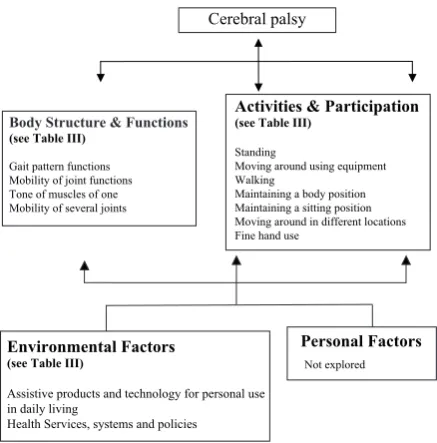
A summary of an ICF-based conceptualizing of the potential clinical impact of botulinum toxin in children with cerebral palsy is given in Fig. 1.
We have illustrated this using the most common International Classification of Functioning, Disability and Health for Children and Youth (ICF-CY) categories identified as goals and benefits combined.
Cerebral palsy
Personal Factors
Not explored
Body Structure & Functions
(see Table III)
Gait pattern functions Mobility of joint functions Tone of muscles of one Mobility of several joints
Activities & Participation (see Table III)
Standing
Moving around using equipment Walking
Maintaining a body position Maintaining a sitting position Moving around in different locations Fine hand use
Environmental Factors (see Table III)
Assistive products and technology for personal use in daily living
Health Services, systems and policies
Fig. 1. International Classification of Functioning, Disability and Health
(ICF) model conceptualizing botulinum toxin A treatment of children with
cerebral palsy using the most common categories of goals and benefits
[image:5.581.56.275.454.676.2]a barrier or a facilitator. The ICF conceptual framework and the use of this ICF-CY subset would aid in improving clinical consultations and medical record-keeping. At follow-up ap-pointments, many families expressed concern about the timing and adequacy of their child’s therapy programmes in relation to BoNT-A treatment: for example, the timing of orthotic appoint-ments following treatment. We believe that using this subset of
ICF-CY classifications as a standardized and consistent means
of communication with local therapists will enhance the plan-ning and delivery of therapy programmes. For example, the most common ICF-CY category from environmental Factors (e1151 Assistive products and technology for personal use in
daily living) describes the improvement in benefits and toler -ance of orthotic devices.
Advantages of the proposed subset include improvement in goal-setting and communication within a clinical consultation, facilitation of coordination of therapy by different healthcare professionals, improved documentation of goals in medi-cal records (18), and allowing the clinimedi-cal consultation and treatment to focus on outcomes that are seen as important to children and their families. The use of a core data set based on ICF categories has the potential to encourage clinicians to seek goals for intervention in the activity and participation domains. This study shows that clinicians using rehabilita-tion/habilitation interventions will often conceptualize their interventions in the function domain, which is not necessarily the most meaningful on a day-to-day basis for a child with CP, whereas goals in the activity/participation domains are those that are most allied to developing independence and lead to consideration of environmental/person factors. A further pos-sible use of this subset is to aid the construction of a Patient Reported outcome Measure (PRoM) (19, 20) for use within a clinical setting but also in the context of clinical trials.
In conclusion, this paper demonstrates that the goals and outcomes of treatment using BoNT-A in children with CP are readily described using the ICF-CY. We recommend the use of these categories both for improved communication between healthcare professionals and for formal clinical documentation. An important factor in the development of this ICF-CY subset is the inclusion of outcomes reported by parents following treatment; these illustrate that clinicians should also target Activity and Participation domains to establish goals that are
more significant for the family. This approach can complement
the existing approach of ICF-Core Set development by using patient- and clinician-generated information arising from “real life” clinical consultations.
ACkNoWledGeMeNTS
We are grateful for the support from the clinical records services within leeds Teaching Hospitals NHS Trust and funding from Ipsen ltd.
ReFeReNCeS
Hagberg B, Hagberg G. origins of cerebral palsy. In: david TJ, 1.
editor. Recent advances in paediatrics. london: Churchill living-stone; 1999; 11, p. 6783.
odding e, Roebroeck M, Stam HJ. The epidemiology of cerebral 2.
palsy: incidence, impairments and risk factors. disabil Rehabil 2006; 28: 183–191.
Hoare BJ, Imms C. upper-limb injections of botulinum toxin-A 3.
in children with cerebral palsy: a critical review of the literature and clinical implications for occupational therapists. Am J occup Ther 2004; 58: 389–397.
lukban MB, Rosales Rl, dressler d. effectiveness of botulinum toxin 4.
A for upper and lower limb spasticity in children with cerebral palsy: a summary of evidence. J Neural Trans 2009; 116: 319–331. Wallen M, o’Flaherty SJ, Waugh MC. Functional outcomes of 5.
intramuscular botulinum toxin type A and occupational therapy in the upper limbs of children with cerebral palsy: a randomized controlled trial. Arch Phys Med Rehabil 2007; 88: 1–10. Barnes M. Botulinum toxin – mechanisms of action and clinical 6.
use in spasticity. J Rehabil Med 2003; Suppl 41: 56–59. ICF Browser [webpage on the internet]. [cited 2011 February 1] Availa-7.
ble from: http://apps.who.int/classifications/icfbrowser/Default.aspx.
Simeonsson RJ, leonardi M, lollar d, Bjorck-Akesson e, Hol-8.
lenweger J, Martinuzzi A. Applying the International Classification
of Functioning, disability and Health (ICF) to measure childhood disability. disabil Rehabil 2003; 25: 602–610.
Üstün TB, Chatterji S, kostanjsek N. Comments from WHo for 9.
the Journal of Rehabilitation Medicine Special supplement on ICF Core Sets. J Rehabil Med 2004; Suppl 44: 7–8.
McCullough N, Parkes J, use of the Child Health Questionnaire in 10.
children with cerebral palsy: a systematic review and evaluation of the psychometric properties. J Pediatr Psychol 2008; 33: 80–90. Cieza A, ewert T, Berdirhan Üstün T, Chatterji S, kostanjsek N, 11.
Stucki G. development of ICF Core Sets for patients with chronic conditions. J Rehabil Med 2004; 36: 9–11.
Huber e, Tobler A, Gloor T, Grill e, Gut B. The ICF as a way to 12.
specify goals and to assess the outcome of physiotherapeutic inter-ventions in the acute hospital. J Rehabil Med 2011; 43: 174–177. Surveillance of Cerebral Palsy in europe (SCPe). Prevalence and 13.
characteristics of children with cerebral palsy in europe. dev Med Child Neurol 2002; 44: 633–640.
Geyh S, Cieza A, Schouten J, dickson H, Frommelt P, omar Z, et 14.
al. ICF Core Sets for stroke. J Rehabil Med 2004; 36: 135–141. Mueller M, Strobl R, Grill e. Goals of patients with rehabilita-15.
tion needs in acute hospitals: goal achievement is an indicator for improved functioning. J Rehabil Med 2011; 43: 145–150. lohmann S, decker J, Mueller M, Strobl R, Grill e. The ICF forms 16.
a useful framework for classifying individual patient goals in post-acute rehabilitation. J Rehabil Med 2011; 43: 151–155. kus S, Mueller M, Strobl R, Grill e. Patient goals in post-acute 17.
geriatric rehabilitation: Goal attainment is an indicator for im-proved functioning. J Rehabil Med 2011; 43: 156–161.
Mittrach R, Grill e. Walchner-Bonjean M, Scheuringer M, Boldt 18.
C, omega Huber e, et al. Goals of physiotherapy interventions can
be described using the International Classification of Functioning
disability and Health. Physiotherapy 2008; 94: 150–157. dawson J, doll H, Fitzpatrick R, Jenkinson C, Carr AJ. Routine 19.
use of patient reported outcome measures in healthcare settings. BMJ 2010; 340: c186.
Stucki G, ewert T, Ciez A. value and application of the ICF in 20.