A43\o2
No 3/78
trade union information
Ll
TRADE
UNION BULLETIN
PUBLISHED BY THE SPOKESMAN'S GROUP AND DIRECTORATE-GENERAL
FOP INFORMATION -
TRADE
UNION DIVISION
1. Meeting of the Standing Committee on Employment in Brussels
on 21 March
2. Proposal for a Council Directive on collaboration between the
Member States to combat illegal migration and employment
3. The tertiary sector and employment
4. Community support for aid measures aimed at promoting the
employment of young people
5.
40-hour working week in European arable farming
6.
Protection of employees in the event of the insolvency of their
employer
7.
European Trade Union Confederation (ETUC) day of action on
5
April
8.
European employment day
g.
Meeting of the European Trade Union Confederation's Executive
Committee in Brussels on 13 and 14 April. (European Summit
-Tripartite Conference - second Lome Convention - Economic and
Social Committee reform European Trade Union Institute
-next ETUC Congress)
10. Union news in brief
11. Recent publications
1. MEETING OF THE STANDING COHMITTEE ON EHPLOYMENT IN BRUSSELS ON 21 JI.1ARCH
At this meeting, chaired by the Danish Minister of Labour, Mr Svend Auken, the Standing Committee on Employment discussed the possibilities of work-sharing as an additional weapon in the fight against unemployment on the basis of a working paper prepared by the Commission (see Trade Union Bulletin No 1/1978 - pages 5 and 6).
Speech by Vice-President VREDELING
The development of the economic situation, both within the Community and in the rest of the world, is a source of great concern to us. One of the direct consequences of this development is the present level of unemployment, which poses great problems not only for each of the Member States but also for the Community as a whole and calls for an approach which is both global and selective. The proposals put before you by the Commission are aimed not only at improving the employment situation as such, since forced unemployment is socially and economically unacceptable, but also at improving the quality of work and working conditions.
For a variety of reasons, it would be unthinkable that these proposals and suggestions should be taken up and implemented by the individual Member States at their own convenience. This would be in conflict with the fundamental idea of the Community. I therefore take this opportunity to state unequivocally that the proposed selective action must be undertaken at Community level.
We must not lose sight of the fact that our work derives from the last Tripartite Conference and that our aim is, by analysing current economic, social and employment problems more thoroughly and realistically, to reach the stage where we can work out both specific measures and an overall policy which will enable the Community to overcome its present difficulties.
In its working paper for the last Tripartite Conference the Commission indicated a number of questions which should, it felt, be the subject of further study, consideration and consultation.
Mr Denis Healey, who presided over the conference, adopted four of these suggestions for further study.
We are examining these questions in the appropriate contexts. The next meeting of the Standing Committee on Employment will study
the question of the public and tertiary sectors and the other two questions are being dealt with at meetings of the Economic Policy Committee and the two sides of industry.
What is so special about the present situation that it
should lead us to believe that work-sharing has a part to play in
solving our problems, when none of us would normally regard this as
the first choice
?The employment situation may not be deteriorating further,
but it is certainly showing little sign of improvement.
The level of
confidence amongst consumers and investors remains low, the outlook
for economic growth in the Community continues to be poor and there
are few indications of a recovery in the world economy outside the
Community.
Faced with a situation in which unemployment does not worsen
but persists at its present level -which we all regard as
unaccepmb~we would be well advised to exploit all available instruments for
regulating working time and direct our efforts entirely to the task of
bringing about a recovery.
Unfortunately, the situation is even more serious than this.
In the current poor economic climate we have somehow to handle a
considerable increase in the number of people in the Community
reaching working age and seeking employment.
Between now and
1985
the number of persons of working age in
the Community will increase by
7
or
8
million.
In a period of healthy
economic growth and full employment, this would be a source of
strength; but in a situation where we are already faced with long-term
unemployment affecting
6.5
million people this prospect raises
additional problems for economic and employment policy since it is
difficult enough to achieve sufficient growth to provide employment
for the existing workforce.
This increase in the number of people of working age does
not imply that without a higher economic growth rate, all these people
will find
thems~lvesunemployed and that the level of unemployment
will therefore automatically double over the next few years.
We know
that the effect of the recession so far has not only been to increase
unemployment but also to reduce employment rates, forcing many people
to leave the labour market - especially amongst those groups whose
links with this market are weaker or who are less likely to find jobs,
e.g. young people, the handicapped, the elderly and women.
This brings me to the problem of the cost of work-sharing measures. This problem is in fact largely imaginary. The cost of implementing work-sharing measures would not be attributable to these measures as such but rather to the inability of our economic system to create sufficient jobs for the working population. Each unemployed person and each person forced to leave the labour market represents a cost since he cannot work and does not produce anything.
The loss of production, or, if you prefer, the cost of this loss, is already shared to a certain extent since the cost of un-employment and other social benefits granted to the jobless is recouped from people in employment and the undertakings employing them.
The real question in relation to work-sharing is how we should share the cost already incurred between employers and employees and between them and the Governments representing society as a whole. Sharing out the cost of a low level of economic activity by means of work-sharing rather than by taxing employers and employees to pay the unemployed is clearly a matter for thorough discussion and negotiation. In my view, this problem should also be considered in the context of a more equitable distribution of incomes. However, as the Commission observed in its working paper, we have been struck in the course of consultations by the fact that the gravity of the situation has been generally recognized: all those concerned are convinced of the need for the costs to be shared out more equitably in order to achieve more balanced adaptation to current levels of economic activity in the Community as a whole.
The Commission is well aware of the need for a uniform approach throughout the Community, in order, in particular, to avoid compromising the competitive position of the individual Member States. The Community has a key role to play here in establishing the frame-work within which action can be taken at national level.
We would like to hear your reactions to the various
Within this strategy we must take account of the specific
problems of the various groups on the labour market.
We have, for
example, discussed - and will continue to discuss - measures aimed
at helping young people to enter working life.
Apart from direct actions of this kind, a number of Member
States have proposed measures permitting older workers to retire
early with a view to freeing jobs for other workers, especially young
people.
We have not given detailed consideration to the possibilities
of early retirement in our working paper (largely because we have
concentrated on those questions in relation to which the two sides of
industry can negotiate directly).
Nevertheless, whilst it is true
that certain financial questions need to be resolved and that support
measures are necessary to meet the social consequences of voluntary
early retirement, such measures can have a major quantitative impact.
All measures require careful evaluation.
Costs must be
estimated and support measures prepared bearing in mind the need for
flexibility on the labour market and the possible need to put the
measures into reverse at some time in the futurP.
We have no miracle
solutions and no-one can predict with certainty exactly what will be
the consequences of the various measures proposed.
However, we are
only too well aware of the repercussions of the present high levels
of unemployment, which create a festering problem not only on the
socio-econom~c
plene but also for the individual families affected.
Until we have overcome our difficulties by establishing a sounder
economic order, we cannot afford to neglect the measures which are
the subject of our discussions today.
DEBATE
In the course _of the debate, a variety of questions were
raised by those taking part.
For the employers, Mr Ochslin wondered about the feasibility
of harmonizing working time in the various Member States and asked the
Commission to undertake a
thorough
analysis of the annual volume of
work per person, overtime working, clandestine work and the flexibility
of the labour market.
Speaking on behalf of the European Trade Union
Confederation, Mr Stidlin listed a series of measures which should be
introduced in the near term: a shorter working week, longer annual
holidays, a higher school-leaving age and a lower retirement age.
The Governments ought, the ETUC spokesman said, to ensure that at
least some of these measures were implemented by 1980.
On behalf
of the CGT (France), Mr Caburol demanded an extra week's holiday
~nda
reduction in working time for particularly arduous and unpleasant
PRESS CONl!"'EHENCE
At a press conference following the meeting, the Chairman,
Mr Auken, stressed the key role of the two sides of industry in a field
such as work-sharing and stated that, whilst they did not regard it as
a panacea, a number of Heads of Government felt that work-sharing
could form "part of the strategy for the fight against unemployment".
He also expressed the hope that the conclusions of this meeting would
stimulate initiatives at national level which would then be coordinated
at Community level.
The Chaiman indicated that discussions on this subject would
continue at Community level as part of the preparatory work for the
Tripartite Conference planned to take place at the beginning of the
coming autumn.
On behalf of the ETUC, Mr Debunne expressed himself
satisfied that the Community had not shut the door on this question
but rather left it "ajar".
He could have wished that the Governments and the Community
institutions had committed themselves more positively instead of
leaving all the responsibility on the shoulders of the two sides of
industry.
He also indicated that the unions would accept "European
outline agreements" if these could be worked out.
For the employers, Mr Lindner expressed the view that the
Commission's working paper had provided a very good basis for
discus-sion.
The employers, he said, regarded the fight against unemployment
and the worsening of the crisis as the main priorities - and the first
objective should therefore be to create new jobs rather than to share
those already available.
As far as the employers' spokesman was concerned, the
decisive factor in this question was the cost of work-sharing measures,
which could in turn slow down economic growth.
2. PROPOSAL F'OR A COUNCIL DIRECTIVE ON COLLABORATION BE'l'vJEEN
THE HE:t-1BER STATES TO COMBAT ILLEGAL MIG RAT ION AND };JvlPLOYHENT
At the end of March, the Commission approved and sent to the
Council an amended proposal for a Directive aimed at the approximation
of the Member States' legislations concerning the prevention and
The Council Resolution of
9
February1976
on an action programme for migrant workers declared that it was important nto strengthen cooperation between Member States in the campaign acainst illegal immigration of workers who are nationals of third countries and ensure that appropriate sanctions are laid down to repress trafficking and abuses linked with illegal immigration and that the obligations of employers are fulfilled and the rights of workers relating to the work they have carried out safeguarded without prejudice to other consequences of the unlawful nature of theirresidence and employmentn.
As a first step towards the attainment of this goal, a proposal for a Directive was approved by the Commission and trans-mitted to the Council on 3rd November
1976.
In subsequent discussions in Parliament and the Economic and Social Committee, whilst there was broad support for the
Commission's proposal, it was considered regrettable and, indeed, unacceptable that the proposed Directive wholly overlooked the fundamental principle of the enforcement of employers' obligations and the correlated protection of the rights of illegal migrant workers relating to work carried out, which had been called for in the Council Hesolution.
For these reasons the Commission amended its initial proposal.
Apart from the original proposals involving measures aimed at:
- informinG potential migrants of the relevant national laws, . re~ulations and administrative provisions to be observed;
- ensuring adequate control, particularly by checks on employers;
- punishing persons who organize, aid or abet or participate in illegal immigration and illegal employment;
- mitigating the wrong suffered by illegal immigrants who acted with-out illegal intent, by ensuring the right of appeal against
deportation;
- strengthening collaboration between Member States,
the Commission's amended proposal is designed to ensure that the responsibilities and obligations of employers are more clearly defined, particularly as regards obligations arising from the act of employing an illegal migrant. The Commission therefore proposes that these obligations - relating to wages, social security, taxations, etc. be the same as if the employment had been legal.
On the other hand, the Commission considers that illegal migrant workers should not benefit from the provisions of the Directive where they are held by the appropriate courts to have acted with
illegal intent.
3.
THE TERTIARY SECTOR AND EMPLOYMENTThe Commission had adopted a working paper on the contribution of the tertiary (services) sector to the creation of jobs. This study, entitled "The role of the tertiary sector (public and private) in the achieve.1ent of growth, stability and full employment 111 , will be sub-mitted to the Standing Committee on Employment as part of the
Commission's preparatory work for the Tripartite Conference.
During the last few decades, the tertiary sector has been one of the main sources of growth and the principal source of job creation. Between 1960 and 1975, the growth recorded for the services sector represented about half the overall growth attained during this period. During the same period, employment in the tertiary sector increased by roughly
3%
per annum, whereas it declined by 4% per annum in agriculture and mining and rose by less than 0.5% per annum in industry. Theservices experiencing the fastest growth are those connected with health, education, commerce, banking and public administration. The slowest growth in the sector (0.5% maximum) has been in the retail trade (see tables).
Can we hold out hope that, in the future1 the growth of the tertiary sector, both private and public, will supply a sufficient number of jobs to meet the demand ?
In the Commission's opinion, the answer to these questions depends on three major factors :
- the present growth of the population of working age (see Memorandum IP( 78) 66);
- the continuing loss of jobs in the primary sector;
- the scale of the needs to be satisfied in the public services area.
These questions are of interest to tho Commission for two reasons :
- the value o¥ a Community-level analysis for Member States;
- the need for an analysis to provide guidelines for the Community's own action.
This is the first time that the situation in the tertiary sector has been tackled at Community level and it is proving difficult to analyse because of its heterogeneous nature and because of the lack of available statistics.
The Commission's working paper does not, therefore, lead directly to any proposals or conclusions. Nevertheless, the Commission believes that an improvement in the employment level within the
Community will not be possible without further growth in the tertiary sector. The first indications are that there is a considerable margin for the creation of further jobs in this sector.
Having completed these deliberations, the Commission offers
the Standing Committee on Employment a number of guidelines for further
reflection on the following topics :
- study of the different branches of activity in the tertiary sector;
- the role of small and medium-sized firms;
- elements of discrimination against the activities of the services
sector which may be implicit in national policies;
- the role of basic public services;
possible methods for reconciling budgetary constraints with the aim
of giving greater access to public services;
- new employment prospects in the public sector and the obstacles to
their development as seen by the Governments;
- evaluation of job-creation programmes;
- the role of investment in the growth of the tertiary sector and the
consequent creation of jobs;
- the improvement of statistics.
THE TERTIARY SECTOR IN FIGURES
'tie
now give some figures to show the development of the
tertiary sector since 1960.
TABLE 1
!e£tiary_s~c!o£:_sha£e_of ~alu~ ~diei
~2Z2-~E~~~~!-~2~~
I<'rance
Germany
Italy
Nether-
UKlands
60
75
60
75
60
75
60
75
60
75
Harket services
27,5
36,6 27,2 28,0 28,5 38,8 27,4 34,0 30,1 33,5
Trade services
13,0
18,7 13,7
12,1 21,0
18,3 13,0
Other market
14,5
17,9 13,5
services
16,4 14,8
15,7 17,1
Non-market
9,1
12,7
7,5 13,0 10,5 10,8 10,7 14,1 11,3 16,4
services
'i'i\BLE 2
Employment in the Community: average annual rates of growth,
1960-1975
Primary sector
Secondary sector
Tertiary sector
Structure of employment in
1975
C~)Trade
Delgium
11,6
Denmark
16,1
France
14,4
Germany
14,5
Ireland
17,3
Italy
7,5
Luxembourg
16,0
Netherlands
15,0
United Kingdom
15,6
COMI'-1UNITY
(in OOO's)
10.993
Agriculture
Mining
Manufacturing
Construction
Public utilities
Transport and communications
+
0.3%
+
0.3%
- 1.3%
+
0.3%
Trade
Banking and insurance
Other services
Public services
':!'ABLE
3
the tertiary sector
Bunking
&
Other
insurance Services
5,8
15,7
6,3
25,3
7,0
17,5
5,4
11,8
5,5
15,0
2,5
16,7
7,2
11,9
7,4
19,7
6,2
19,2
4.516
13.285
+
0.6%
+3.
T7~+
2.1?6
+
3.496
in the Member States:
Public
Total
Services
tertiary
~thou§ands2
10,5
1.262
6,5
942
8,8
8.136
10,2
8.873
7,5
324
7,6
4.480
10,6
53
7,3
1.906
6,4
9·5~36.715
35.509
(
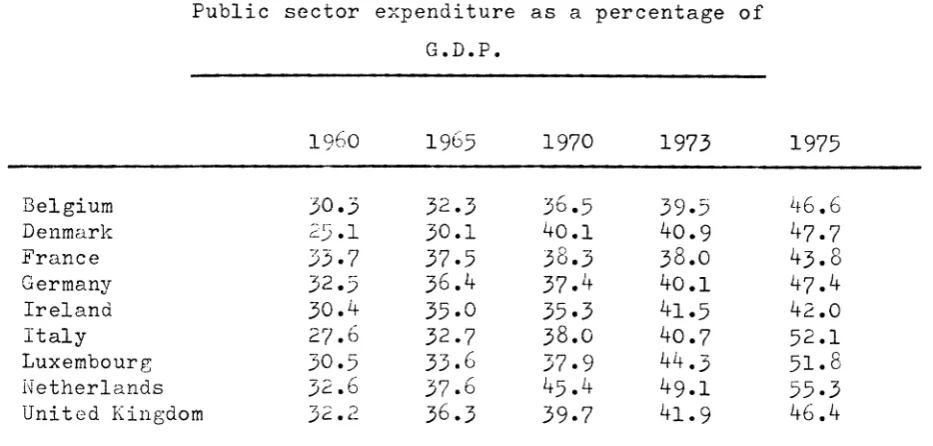
TABLE
4
Public sector expenditure as a percentage of
G.D.P.
1960
1965
1970
1973
1975
Belgium
30.3
32.3
36.5
39-5
Lt6 • 6
Denmark
2!].1
30.1
40.1
40.9
47.7
France
33-7
37-5
38.3
38.0
43.8
Germany
32.5
36.4
37.4
40.1
47.4
Ireland
30.4
35.0
35·3
41.5
42.0
Italy
27.6
32.7
38.0
40.7
52.1
Luxembourg
30.5
33.6
37.9
44.3
51.8
Netherlands
32.6
37.6
45.4
49.1
55-3
United Kingdom
7. ,., "):;c:..c;_
36.3
39.7
41.9
46.4
Source: OECD, National Accounts and Economic Budgets
TABLE
5
Public sector consumption, investment and transfers as a percentage
of GDP
Consum-ption
Investment
Transfers
Other
1960
1975
1960 1975 1960 1975 1960 1975
Belgium
12.8
16.2
1.9
3·3 12.7
C.l.O
2.9 3.7
Denmark
12.7
c-
.:::.j. I0)
3·3
C..i .o)
b.o
(13.~)1.1 (1.0)
France
12.9
13.2
2.3
).4 17.2 23.6 1.2 0.8
Germany
9-9 (14.0)
18.7 (24.0)
-Ireland
12.1
19.5
~ ().::.o
6.0
9.8 22.7 2.8 4.8
Italy
12.0
14.0
3-1
3.2 13.0 22.2 2.2 2.6
Luxembourg
10.1
15.1
4.9
7-9 14.3 27.7 1.2 1.0
netherlands
13.6
18.4
4.0
4.0 12.3 30.2 2.7 2.7
United Kinr:dom
16.4
22.9
3.3
7·9
8.5 14.7 4.0 4.0
)
estimate
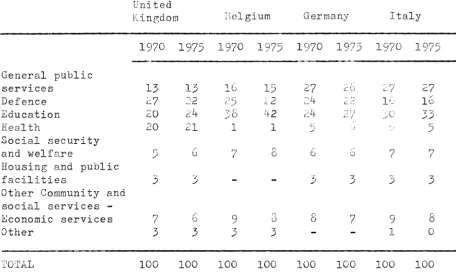
[image:11.565.44.511.90.313.2]TABLE
6
Structure of public sector consumption (percentages of total)
United
l{ingdorn :3el gi urn Germany Italy
1970 1975 1970 1975 1970 1975 1970
General public
services 13 1 __ :;; 'L l /, ~v 15 27 c~.O ;_:,,'(
Defence ~: 7 ~~2
;:·:5
,, c:. ' '"' ~:4 ~:-:.: ]_i~ Education 2.0 ;~458
'+2 c~4:-:. '?
:>u
Health 20 21 1 1 [:~
. / Social security
and welfare 5 -- '7
8
b b7
LJ (
Housing and public
facilities
3
'L5
3
).)
Other Community and social services
-~co nomic services 7 ,. 0 9 () ()
8
7 9Other
3
3
3
3
1TOTAL 100 100 100 100 100 100 100
il'ABLE
7
Employment in the tertiary sector, by sex (Community overall - 1975)
Men Women t-larried 1r1omen
Trade 52 i+(~ ")0
' - / Banking and insurance 55 Lf5 2Lt
Other services 35
o''
_./""7' ( )
_)()
Administration
69
31 181975
2.7 16
33
5
r)
(
3
8
0
100
Total
100;.~
lOOv
100;~
100,~
[image:12.572.71.528.130.405.2]'l'ABLE
8
Structure of hours worked in the tertiary sector
(~
working less than 30 hours per week)
Tcrti::cry sector
All sectors
Belgium
Denmark
France
Germany
Ireland
Italy
Luxembourg
Netherlands
United Kingdom
Community
14
25
18
15
13
ll
10
21
27
19
10
28
15
12
8
0 () 917
lS'
14
---
·
-Source: Labour Force, Sample Survey, Eurostat, 1975
TABLE 9
Employment status in the tertiary sector,
1975
(5;)Employers &.self-employed
Employees
Family
Belgium
19
75
Denmark
10
87
Frnnce
12
85
Germany
ll
86
Ireland
14
84
Italy
'"':'· ~~L;J
70
Luxembourg
13
8lJ.Netherlands
10
87
United Kingdom
10
90
r;u.R-9
(services)
13
[\4
~mR-9
(industry)
7
92.hTII~-9
(agriculture)
47
26
Source: Labour Force, Sample Survey, Eurostat, 1975
Lt. COHNUHITY SUFPORT FOR AID v!EASURES A HIED AT PRmlOTIUG THE EHPLOYMENT OF YOUl·!G PEOPLE
On a proposal by Vice-President Vredeling, the Commission has approved the introduction of a new category of aid designed tc promote the employment of young people under the age of
25,
supplementing the system of aids already available under the European Social Fund.
This proposal by the Commission was made in response to a request by the Council of Social Affairs Ministers at its meeting on 28 October
1977,
in view of the alarming rate of unemployment amongst young people in the Community (see p. 15/.The proposed new category of aid will comprise two types of expenditure:
- premiums for undertakings hiring young workers;
- subsidies for programmes recruiting young people for tasks in the public interest.
Social Fund aid is intended to encourage corresponding action on the part of Member States. The Community may pay up to
50%
of the cost of projects of this kind, or even up to55%
in the case of projects carried out in regions seriously disadvantaged from the economic and social point of view.Assistance from the Social Fund within the context of the new category of aid is calculated on the basis of a wage allowance which will not exceed:
- for employment premiums, jO EUA per person per week for a maximum of 26 weeks;
- for recruitment programmes, 60 EUA per person per week for a maximum of 52 weeks.
Thus the Community's contribution, being restricted to jO·;n of eligible expenditure, is fixed at the foll9wing maxima:
- for employment premiums,
15
EUA per person per week for 26 weeks; - for recruitment programmes, 30 EUA per person per week for)c
weeks.For operations carried out in five regions with special problems, the amount of aid is increased by
10%.
These regions are Greenland, the French overseas departments, Ireland, Northern Ireland and the Mezzogiorno.The Commission estimates that approximately 150 000 young people will benefit from the new category of aid, which should there-fore cost about 110 million EUA per year. This will extend the Social Fund's scope for action beyond its traditional fields of vocational
training and occupational mobility measures for young unemployed people. Since 1975, expenditure on the latter has totalled over 280 million EUA, affecting about 200 000 young people. The overall budget for the European Social Fund for 1978 amounts to 570 million EUA.
The Commission's proposal was accompanied by a communication to the Council in which the Commission identifies a number of measures and actions through which it is contributing to the fight against youth unemployment. The Commission is aware that its new proposal only constitutes a partial contribution to the solution of the problem of youth unemployment, in view of the extent of this problem (2 million young unemployed in the Community).
The Commission is prepared to add to this arsenal of aids as and when the need for further Community financial, legislative or operational intervention is formulated. At the appropriate time, in line with its dynamic policy to encourage the employment of young people, and using all the means available to the Community, it will make suitable proposals.
YOUTH UNEMPLOYMENT IN THE COMMUNITY
Unemployment of young people in the Community has worsened, particularly during the last ten years. Since 1969, the number of young jobless has increased fivefold, from 400 000 to 2 million.
In 1977 young people accounted for 37% of the total number of unemployed, whereas.they represented only 17% of the working population. The unemployment rate among young people under 20 was approximately three times the overall average, whilst the rate for the
~0-~5 age group was almost double this average.
In the course of the last ten years, the effect of the recession was especially apparent in the soaring youth unemployment figures in 1975.
Year
:969
1974
1975
1976
Total number of young people under 25 unemployed (thousands)
412
824
1 512
1 778
Young people unemployed as a percentage of the total
24.0
30.7
35.3
During the next ten years, demographic factors will play an important part in the youth employment situation; the number of young people reaching working age will rise rapidly, to an average of more than 4 million per year. On the other hand, the number of people reaching retirement age will be abnorm~lly low (an annual average of only 2.5 million). The working population of the Community will therefore increase by some 4.5 million people between 1975 and 1980, and by about 5 million between 1980 and 1985.
c·
./
.
40-HOUR \JORKING viEEK Hi EUHOPEAl! AEABLE FAHIHIJGAt the end of March, the European agricultural employers' and workers' organizations (i.e. COFA and the EFA)* agreed on the introduction of a 40-hour working week for agricultural workers in the Community.
This provision forms part of the Community agreement on the harmonization of hours of work for permanent employees in arable farming within the Community, which is the result of negotiations within the Joint Committee on Social Problems of Agricultural Workers.
The agreement takes the form of a recommendation for the introduction of a 40-hour week within four years through appropriate national or regional measures. In addition, European agricultural workers will be entitled to a 4 weeks' paid holiday per year plus payment for public holidays.
With this agreement, European agriculture is coming into line with the Council Recommendation to the Member States of July 1975
advoc<~tine~ the application of a 40-hour vwrking week and ·'t weeks'
annual paid leave in all sectors. According to a Community agreement concluded in 1968, a 48-hour week was previously applied in arable farming.
COPA and the EFA have also agreed to begin negotiations immediately within the fr~mework of the Joint Committee on the introduction of a 40-hour week in stock farming, where the 42-hour week still applies under an agreement concluded in 1973.
The new agreement for arable farming was signed in Brussels on 22 March by employers' and workers' representatives in tte presence of Mr H. Vredeling, Vice-President of the Commission.
(*) COPA -Committee of Agricultural Organizations in the European Community
6.
PROTECTION OF EMPLOYEES IN THE EVENT OF·THE INSOLVENCY OF
THEIR EMPLOYER
The Commission has just adopted a proposal for a Directive intended to improve the protection of employees in the event of the insolvency of their employer. Under this proposal, Member States would set up appropriate institutions to pay outstanding claims of employees in the event of their employer becoming bankrupt or other-wise insolvent. It is also designed to harmonize existing provisions in Member States.
The main feature of the proposal is the creation of
institutions to pay workers' outstanding claims which arose from their employment relationship before the employer ceased to meet his
obligations, without respect to the available assets or the bankruptcy proceedings.
Claims include entitlement to remuneration for work or emoluments due under a training contract, entitlement to any other benefits to be paid by the employer in respect of sickness, holidays or termination of employment and all other gratuities, bonuses or indemnities.
Member States will regulate the organization, financing and operation of these institutions on the basis of a few common
principles, e.g.:
- the institutions must not be financed solely by contributions from employees;
- the assets of the institutions must be entirely independent of employers' business assets.
Member States are authorized to impose only one condition, i.e. that payment by the institutions is contingent on claims being undisputed or substantiated.
The proposal for a Directive allows Member States to place certain limits on the liability of the institutions; these limits are not defined in absolute terms but correspond to a given number of months' remuneration, which ensures a fair income.
In the explanatory memorandum to the proposal, the Commission observes that existing provisions in Member States' bankruptcy legis-lation do not sufficiently protect employees with regard to claims arising from their contracts of employment. This lacuna has been felt in the present difficult economic situation, which has brought about a growing number of bankruptcies - especially in cases where there are no available assets.
assets were insufficient to institute insolvency proceedings.
Annual losses by employees due to bankruptcies before the entry into force of laws on the compensation of employees in cases of bankruptcy (17 July 1974) ranged from DM 20 to 50
million.
In the United Kingdom it was established that such losses amounted to£
4
million per year. The Commission assumes that the situation is similar in the other Member States.Following this proposal for a Directive, all Member States will have to adapt their rules on the protection of employees in the event of the insolvency of their employer to the new provisions.
Member States which have already established suitable institutions may largely maintain their existing system, however. Ireland and Italy -the two Member States which still lack such institutions - will be obliged to set them up.
7.
EUROP~AN THADE UNION CONFEDERATION DAY OF ACTION ON5
APRILOn the basis of the principles set out in the statement* adopted by the Executive Committee on 30 November 1977, the European Trade Union Confederation organized a European day of trade union action on
5
April.On that date the workers affiliated to 31 trade union
confederations representing 40 million members in 18 European countries took part in a day of action for full employment based on the same demands and on aims defined in common for all trade union organiz&tions as regards changes in current economic and social policies.
This unprece~ented operation - the response to an exceptional social situation - was the first of its kind to be launched on this scale at European level by the European Trade Union Confederation. The ETJC's aim was to show the disquiet and determination of its members in the face of the mass unemployment affecting European workers.
Coming as it did on the eve of the summit meeting of the Heads of State and Government of the Member States in Copenhagen, it was natural that the movement should take on international dimensions in the nine countries of the Community.
BELGIUM
A minute's silence surprised Belgian radio and TV audiences before the morning news bulletin. This early morning action was the
radio journalists' and technicians' way of displaying their solidarity with the large number of information meetings and stoppages of work which took place in many different undertakings and regions at the
instigation of the joint union front FGTB-CSC. These meetings, in many cases prec~ded.by large-scale distributions of leaflets, were followed
by approaches to the employers.
"The workers take Europe seriously.
But Europe and the European
Community in particular must become more democratic'', said Mr G. Debunne,
General Secretary of the FGTB, at a meeting in Brussels.
For his part,
the PreHident of the CSC, Mr Houthuys, stressed the importance of
improved coordination between measures taken at national level in
Belgium and those taken at European level.
Mr M. Hinterscheid, General
Secretary of the E'l'UC, denounced "the lack of political will at
European level in the face of the crisis displayed by many of those in
positions of responsibility" and declared that "whilst we do not claim
to have a miracle solution for current problems, we do feel that action
must be taken, since the present free-for-all can only lead to a
relapse into all sorts of selfish policies and thus to an even more
disastrous situation".
The trade union leaders were received by the
Prime Minister, Nr L. Tindemans.
GEHHANY
"The European Community has given a great deal of attention
to the fate of its
6
million farmers - let it do the same for the
'7
million unemployed". This, in substance, 1t1as the message of
Mr Gerhard Schmidt, Member of the Executive of the DGB.
Recalling the recent successful metal workers' strike in
Baden-WUrttemberg, Mr Schmidt stressed the inaccuracy of the belief
that Germans did not know how to strike.
German, French and Luxembourg
workers met in Saarbrlicken, near the frontiers of their three
countries, to hear speeches by Mr Cock, President of the SNV
(Nether-lands), Mr Wagner (DGB) and regional union leaders from France (FO and
CFDT) and Luxembourg.
This demonstration was featured the same
evening on German television (channel
1).
Mr Vetter, President of the
DGB, discussed the objectives of the day of action at length with
Federal Chancellor Helmut Schmidt.
The President of the DGB also held
a press conference which was widely 1'\:.:po.t·ted.
FRANCE
LUXENBOURG
The LCGB and the CGT-Luxembourgeoise called workers to a general assembly at which union leaders described in detail the aims of the day of action.
IJETHE.RLANDS
The meeting between Mr Van Aagt and the trade union
representatives, which had originally been planned to last half an hour only, continued for two and a half hours. The Prime Minister
recognized the validity of the trade unionists' preoccupations and promised to express them at the Copenhagen Summit. Demonstrations were organized in both the Ilorth and the South of the country. Dutch
workers were joined by trade unionists from Germany and Belgium for demonstrations in frontier areas, notably in Geleen (in Dutch Limburg), where hundreds of Belgian and German workers joined their Dutch com-rades. Speeches were given by the President of the DGB and the ETUC, Mr Vetter, and by regional union leaders, laying particular stress on the united action by European workers, which showed a solidarity still in its infancy.
T~c workers of the Chaudfontaine bottle-capping plants, who have been occupying their undertaking for six months, distributed table-top lighters with inscriptions in Dutch, German and French at this meeting. They had made these lighters themselves, specially for the European day of action.
ITALY
Italian workers expressed their anxiety by strikes lasting between three and four hours in the textile, chemical and food
industries, the ·iron and steel industry and even the theatre. Twenty thousand people in Rome and a similar number in Milan demonstrated in support of the stand taken by Italy's three trade union federations.
At a meeting with the Prime Hini.ster, Mr Andreotti, the three union federations called on the Italian Government to ensure that a definite date was set for elections to the European Parliament at the Copenhagen Summit.
UNI'rED KINGDOM
A TUC delegation, which was received at 10 Downing Street, hoped for a revival in the economy, fuelled in particular by increased demand from J~pan and Germany, and called on the Government to exercise constant pressure on these countries. The TUC traditionally makes its show of strsngth on May Day and this year the emphasis will be on
DENHARK
A trade union delegation, hended by l'ir J~ielsen (10), was received by the Danish Prime Minister, Mr Jorgensen, prior to his meeting as President in office of the Council of Ministers of the European Community with a delegation from the European Trade Union Confederation, headed by its President, Mr Vetter. On behalf of the workers of the European Community, Mr Vetter presented two union demands which the ETUC was under no circumstances prepared to relinquish:
income security and a proportional increase in purchasing power for the masses, with higher increases for those on low incomes;
- preservation of existing jobs and the creation of new ones.
Workers also expressed their disquiet in the countries which wish to join the European Community. In Greece a three-hour general strike brought the country to a standstill, whilst in Spain more than eight million workers downed tools in response to a call from the UGT. A UGT delegation was received by the President of the Cortes.
The day of action was widely reported by the daily and trade union press and the mass media (radio and television) in all the
countries. Mention should also be made of the fact that ETUC
delegations were received by Mr Roy Jenkins, President of the Commis-sion, by the President in office of the Council, Mr Jorgensen, in Copenhagen, and by leading figures in UNICE.
STOP PRESS
==========
Following in the footsteps of the action day on
5
April, the Committe of Transport Workers' Unions in the ~uropean Community decided to organize a demonstration in Brussels (at the Rend Point Schuman) on11
Nay1978,
starting at3
p.m., on the theme "European transport pol icy", with special re feren:~8 ·~;o the rail ways.Several thousand participants are expected from the various Member States. The Italian unions will be sending approximately a
WORKERS DEMAND ACTION
At its meeting in Brussels on 29 and 30 November 1977, the Executive Committee of the ETUC concluded that the economic situation in Western Europe, far from improving, was going from bad to worse. There are now well over
7
miliion workers without jobs and unless the policies followed so far by Governments and international organizations which have been both insufficient as a whole and often contradictory -are changed, the number of unemployed will continue to increasethroughout 1978.
It is all the more regrettable that far from being prepared to cooperate to the extent necessary if sound solutions are to be found, the employers, represented by UNICE and the Committe of Small and Medium-Sized Undertakings, are maintaining inflexible and reac-tionary attitudes in order to preserve their privileges~
The Executive Committee is bitterly disappointed that the ETUC's proposals still have not been seriously considered. It is essential that the studies, commenced as a follow-up to the last
Tripartite Conference in the European Community, should not be carried out solely wi~h a view to rejecting and contesting trade union demands in this fiel~.
In this situation, the Executive Committee wishes to stress the following trade union demands once more:
1~ Internationally coordinated measures to expand the economy of
Western Europe must be taken without delay in order to make significant progress next year and in the years immediately following towards
full employment, a better quality of life and higher purchasing power for working people. The scenario proposed by the Commission of the European Communities in its Annual Report is too cautious. By doing too little, Governments generally risk not only failing to secure a sustained economic recovery leading to full employment, but also severely damaging their own credibility, so making the future task of fighting unemployment and other problems such as inflation and low investment much more difficult. It must also be stressed that a
totally negative or excessively reluctant attitude on the part of employers will nullify even the best political intentions.
2. The emphasis of a planned, selected and coordinated expansion
policy should be on supporting and stimulating consumption, particularly
In addition to short-term measures, the ETUC stresses its demand for the adoption and implementation of medium- and long-term strategies to achieve sustained growth and full employment. Such policies must include short-term structural measures designed to overcome regional and sectoral problems. On this issue, the ETUC is very concerned by the negative position adopted so far by the Council of Ministers with regard to the expansion of the Regional Fund and other Funds which could be used to bring about a substantial improvement in the balance between regions.
3.
The European trade union movement itself intends to make a major contribution to the restoration of full employment by opposing the negative wage restraint policies of employers and Governments and working to ensure that workers' living standards and social benefits - and therefore all the levels of demand in our economies - are improved. The ETUC also intends to step up its campaign to reduce working time - by reducing weekly hours, extending annual holidays, raising the school leaving age, lowering the age of retirement, or in other ways.4.
A number of important industrial sectors are facing particularly grave problems. Action is required both nationally and at European level. The ETUC fully supports the specific measures and proposals made by the European trade union industry committees for assistance to and the development of their industries and sectors. In particular, the ETUC supports the demands made by industry committees for regular sectoral meetings between trade unions and employers' organizations at European level.5.
All economic policies, not just labour market policies, must take full account of the need to achieve full employment. Special attention must be given to the needs and rights of those groups which have been hardest hit, particularly female workers, young people and migrant workers.0
0 0
The stronger economies, sectors and companies should certainly give a lead, but it is now essential that those in a weaker position should also take measures to ensure a broadly-based economic recovery.
The Executive Committee is determined to see the above essential worker demands met. It has therefore decided to organize a European worker action day during the first half of
1978
to support these demands.8.
EUROPEAN EMPLOYMENT DAYMr Jenkins, President of the Commission, has taken full note of the countless messages which the workers of the European Community have recently sent him on the occasion of the meetings which have been held in their firms on the problem of unemployment.
President Jenkins, accompanied by Vice-Presiden~ Ortoli and Vredeling and Mr Cheysson, also received a delegation yesterday evening from the European Trade Union Confederation to mark the day of trade union action for full employment in Europe.
Mr Hinterscheid (General Secretary of the ETUC), Mr Debunne (Vice-President) and M r Houthuys (Member of the Executive Committee) stressed the importance which the ETUC attached to real progress being made at the meeting of the European Council in the fight against un-employment.
The members of the Commission underlined the central role of the employment problem in determining the Commission's economic proposals, especially as regards reviving the concept of economic and monetary union.
9.
MEETING OF THE EUROPEAN TRADE UNION CONFEDERATION'S EXECUTIVE
COMMITTEE IN BRUSSELS ON 13 AND 14 APRIL
The Executive Committee met in Brussels on 13 and 14 April
with Mr H.O. Vetter in the chair for discussions concentrating on the
following points:
1) a preliminary review of the European Action Day on
5
April;
2) conclusions on the Copenhagen Summit;
3)
the follow-up to the
1977
Tripartite Conference;
4)
the Lome Convention;
5)
reform of the Economic and Social Committee;
6)
the European Trade Union Institute.
THE EUROPEAN SUMMIT
Briefly analysing the results of the European Council
meeting in Copenhagen on
7
and
8
April, the Executive Committee of the
ETUC noted that the Council had expressed its determination to tackle
the problem of economic recovery in Europe immediately and effectively.
The Executive Committee felt that,althoughtheguidelines were
still very vague and there were practically no indications as to ways
and means, signs of determination to take action to promote a general
economic revival in Europe could be seen in:
1) the intention to set up a "European monetary stability zone" by
extending the use of the European unit of account;
2) the request to the Council (General Affairs) to start preparatory
work straight away for the next European Council meeting, which
would immediately precede the "vJorld Economic Summit" scheduled
for July;
3)
the setting of a new growth target (although the European Trade
Union Confederation considered this target wholly inadequate).
It was felt that the ETUC should exert any pressure necessary
to ensure thatthese good intentions were translated into economic and
social programmes including both general and selective measures.
It should also continue to defend, vigorously and at all levels, the
proposals and claims in support of which it had organized the dny of
action on
5
April.
Other decisions regarding:
1) the fixing of a date for direct elections to the European Parliament;
2) the declaration on democracy;
3)
the declaration on terrorism; and4)
the declaration on the Economic and Social Committee;showed that the Heads of State and of Government intended to strengthen both the cohesion and democratic nHture of the European Community.
The Executive Committee instructed the Secretariat to
continue its activities aimed at ensuring that the substance of forth-coming meetings at both European and international level was in line with its proposals.
THE TRIPARTITE CONFERENCE
The Executive Committee considered a report on the work undertaken by the Commission of the European Communities as a follow-up to the Tripartite Conference, particularly in the context of the Economic Policy Committee and the Standing Committee on Employment. The Executive Committee felt that conclusions which were positive for workers should soon emerge from this work.
It was deciticd that the ETUC would continue its efforts to achieve these objectives.
A SECOND LOME CONVE~TION
The Executive Committee discussed the trade union position regarding the forthcoming negotiations for a second Lorn~ Convention. The definitive ETUC position would, it was agreed, be determined at the Committee's next meeting.
~CONOMIC AND SOCIAL COMMITTEE RLFORM
The following resolution was adopted. The Executive Committee of the European Trade Union Confederation,
having heard the report by the representatives of trade union
organizations which are members of the Economic and Social Committee;
- deplores the fact that the various groups on that Committee have been unable to reach an agreement which would have enabled this, important consultative body to operate more effectively;
- wishes to state that, in view of the present economic difficulties and the rising level of unemployment, it is more necessary than ever before that the various economic and social groups should participate in the planning and decision-making processes of the European
- stresses that the dialogue between these groups and the Council of Ministers and Commission of the Communities is all the more
important if Member States' policies are to be harmonized more closely at European level;
- is convinced that the Economic and Social Committee can be made more effective by a number of essential reforms proposed by the ETUC as early as April
1977;
- notes with satisfaction that at their April
1978
meeting inCopenhagen, the Heads of State and of Government emphasized the need to increase the effectiveness of the Committee.
The members of the Committee are to be reappointed in September
1978
for a term of four years. This opportunity should betaken to adopt new regulations:
- allowing members who have heavy commitments in their own national organizations to be represented by deputies;
- permitting the expression of divergent opinions when it has not been possible to reach a compromise ~ithin the Committee;
designed to improve relations with the other institutions, notably the Council, the Commission and the European PArliament.
The Executive Committee also considers it essential that there should be the same number of worker representatives as there are employer representatives.
The Executive Committee of the ETUC therefore calls on the Commission to draw up proposals for the necessary changes~ and on the Council of Ministers to take the decisions required for the implement-ation of the above reforms.
EUROPEAN TRADE UNION INSTITUTE
The foundation of this Institute w~s reported in our Bulletin No
1/78.
At its April meeting, the Executive Committee unanimously elected Mr G. KBpke, General Secretary of the European Metalworkers Federation (EMF), to be the first Director of the Institute.
NEXT ETUC CONGRESS
The Executive Committee decided that the ETUC Congress
should meet from 11+ to
18
Hay
1979
in Hunich.
10. UNION NEiJS IN BRIEF
THE NGG ( GBREAN FOOD VJOR!CBRS 1 UNION) AND 'l'HE FIGHT AGAHJST UNEMPLOY!'1EHT
The NGG has put forward a new plan designed to contribute to the fight against unemployment by reducing older workers' hours of work without reducing their wages and offering other workers additional free time if they are prepared to accept smaller wage increases.
From the age of
55,
workers would acquire the right to work only35
hours per week, falling to 30 hours from the age of 60.Special arrangements for contributions by workers to this scheme would be laid down by collective agreement. These contributions would be paid into a fund managed jointly by employers and unions in each undertaking. The purpose of this fund would be to make up the difference between the wages corresponding to actual hours of work and the hours of work laid down in collective agreements.
The NGG sees this plan as complementing the State's
employment policy. The Institute for Economic and Social Studies has calculated that if all workers aged over 50 were to work one hour less
per day it would be possible to create 42 000 new jobs.
The proposal to increase the amount of free time at the expense of smaller wage increases is seen as a means of increasing job security and harmonizing working conditions.
INTERNATIONAL CONFEDERATION OF FREE TRADE UNIONS (ICFTU)
In company with a number of trade union federations in
Europe, the ICFTU has expressed its profound horror at the kidnapp1ng of the former Italian Prime Minister Mr Aldo Mora and the murder of five policemen. The ICFTU has pledged its full support to the workers of Italy in their struggle to preserve free democratic institutions. The Italian Trade Union Confederations (CGIL, CISL and UIL) ~ave
11.
RECENT PUBLICA'r IONS
THE EUROPEAN COMMUNITY'S ENVIRONMENTAL POLICY
Pamphlet No
1977/6
in the "European documentation" series, recently
published by the Spokesman's Group and the Directorate-General for
Information, provides an introduction to the Community's environmental
policy and describes its action programme.
THE CONSUHER ORGANIZATIONS AND THE PUBLIC AUTHORITIES IN
1977
This publication describes the activities of consumer organizations
at European and national level in the nine Member States and indicates
the ministers responsible for consumer affairs in the various
countries.
(Distributed by the Office for Official Publications of the European
Communities in Luxembourg, 60 pages, £1.35).
EAGGF - IMPORTANCE AND FUNCTIONING
The purpose of this brochure is to provide a general guide
- as comprehensive as possible - to the importance and functioning
of the European Agricultural Guidance and Guarantee Fund, which alone
accounts for almost two-thirds of the General Budget of the
Communities.
(Distributed by the Office for Official Publications of the European
Communities in Luxembourg- price: £1).
CATALOGUE OF PUBLICA'fiONS OF THE EUROPEAN PARLIAMENT
PRESS AND INFORHA'l'ION OFFICES OF 'l'HE EUROPEAN COMMUNITIES
BELGIUH
1040 BRUXELLES
Rue Archimede 73
Tel. 735 00 40/735 80 40
DENMARK
1004 K¢BENHAVN K
Gammel Torv 4
Postbox 144
Tel. 14/41 40/14 55 12
UNI'rED KINGDOH
LONDON
it/84QQ
20 Kensington Palace Gardens
Tel. 727 80 90
CARDIFF CFl 9SG
4 Cathedral Hoad
Tel. 37 16 31
EDINBURGH EH2 4PH
7 Alva Street
Tel. 225 20 58
l"EDERAL R:bPUBLIC OF GERMANY
5300 BONN
CANADA
OTTAWA, Ont KlR 7S8
Inn of the Provinces
Zitelmannstrasse 22
Tel. 23 80 41
1000 Bl<;nLIN 31
KurfUrstendamm 102
Tel. 892 4o 28
FRANCE
75732 PARIS CEDEX 16
- Office Tower (Suite 1110)
350