R E S E A R C H
Open Access
Mosquito (Diptera: Culicidae) assemblages
associated with
Nidularium
and
Vriesea
bromeliads in Serra do Mar, Atlantic Forest, Brazil
Tatiani C Marques, Brian P Bourke, Gabriel Z Laporta and Maria Anice Mureb Sallum
*Abstract
Background:The most substantial and best preserved area of Atlantic Forest is within the biogeographical sub-region of Serra do Mar. The topographic complexity of the region creates a diverse array of microclimates, which can affect species distribution and diversity inside the forest. Given that Atlantic Forest includes highly heterogeneous
environments, a diverse and medically important Culicidae assemblage, and possible species co-occurrence, we evaluated mosquito assemblages from bromeliad phytotelmata in Serra do Mar (southeastern Brazil).
Methods:Larvae and pupae were collected monthly fromNidulariumandVrieseabromeliads between July 2008 and June 2009. Collection sites were divided into landscape categories (lowland, hillslope and hilltop) based on elevation and slope. Correlations between bromeliad mosquito assemblage and environmental variables were assessed using multivariate redundancy analysis. Differences in species diversity between bromeliads within each category of elevation were explored using the Renyi diversity index. Univariate binary logistic regression analyses were used to assess species co-occurrence.
Results:A total of 2,024 mosquitoes belonging to 22 species were collected. Landscape categories (pseudo-F value = 1.89, p = 0.04), bromeliad water volume (pseudo-F = 2.99, p = 0.03) and bromeliad fullness (Pseudo-F = 4.47, p < 0.01) influenced mosquito assemblage structure. Renyi diversity index show that lowland possesses the highest diversity indices. The presence ofAn. homunculuswas associated withCx. ocellatusand the presence ofAn. cruziiwas associated withCx. neglectus, Cx. inimitabilis fuscatusandCx. worontzowi. Anopheles cruziiandAn. homunculuswere taken from the same bromeliad, however, the co-occurrence between those two species was not statistically significant.
Conclusions:One of the main findings of our study was that differences in species among mosquito assemblages were influenced by landscape characteristics. The bromeliad factor that influenced mosquito abundance and assemblage structure was fullness. The findings of the current study raise important questions about the role ofAn. homunculusin the transmission ofPlasmodiumin Serra do Mar, southeastern Atlantic Forest.
Keywords:Culicidae,Vriesea, Nidularium, bromeliads, species co-occurrence,Anopheles cruzii, Anopheles homunculus, Plasmodiumvectors, Atlantic Forest
Background
The tropical forest of eastern South America, known as Atlantic Forest, is one of the world’s most important biodiversity hotspots [1]. The most substantial and best preserved area of Atlantic Forest is found in the biogeo-graphical sub-region of Serra do Mar [2], which contains approximately 30% of the remaining forest [3]. Although
climatic conditions are relatively uniform across Serra do Mar, the topographic complexity of the region [4] creates a diverse array of microclimates. These topogra-phical differences provide gradients of oxygen, humidity and temperature that can affect species distribution and diversity inside the forest [5,6]. As such, topography is likely to be an important factor in shaping floral [4] and faunal [6] diversity in Atlantic Forest.
A rich diversity of species from the Culicidae family is found in Serra do Mar [7,8]. Many of these mosquito
* Correspondence: [email protected]
Departamento de Epidemiologia, Faculdade de Saúde Pública, Universidade de São Paulo, Av. Dr. Arnaldo 715, CEP 01246-904, São Paulo-SP, Brasil
species appear to have evolved in close association with
bromeliads [9]. For example,Culex ocellatusTheobald
and many species of Culex (Microculex) Theobald
[10,11] and the subgenera Hystatomyia Dyar and
PhoniomyiaTheobald of the genusWyeomyiaare highly dependent upon bromeliads for larval habitat [9]. With
the exception of Anopheles (Kerteszia)bambusicolus
Komp, which is associated with bamboo internodes, the larva and the pupa ofKertesziaTheobald species depend on bromeliad phytotelmata from preserved environ-ments as their primary larval habitat [12]. The larvae of
Anopheles (Kerteszia) cruzii Dyar & Knab, Anopheles
(Kerteszia)bellatorDyar & Knab, andAnopheles( Kertes-zia)homunculusKomp are frequently found in Nidular-iumandVrieseabromeliads in Atlantic Forest [13].
Human malaria is endemic in Serra do Mar [14] where the primary vectors areAn. cruziiandAn. bellator[15].
Anopheles homunculushas also been incriminated as a
vector of humanPlasmodium parasites in Paraná and
Santa Catarina states [16]. Despite the medical importance of these three species, many aspects of their biology are poorly known [15]. Consequently, studying the way in which environmental variables influence the presence and distribution of these species may help to determine the role of vectors in the dynamics of human plasmodium transmission in Serra do Mar.
Considering the existence of environmental determi-nants for mosquito assemblages in larval habitats [17], and a highly heterogeneous environment [4] and diverse medically important Culicidae assemblage in Serra do Mar [7], the main objectives of the study are to: (1) char-acterize bromeliad mosquito assemblage structure; (2) assess correlations between bromeliad mosquito assem-blage structure and various environmental factors; (3) determine correlations between the most abundant spe-cies and various bromeliad characteristics; and (4) assess co-occurrence among species.
Methods
The study area is located in the Aroeira District (25° 0’ 54"S and 47° 55’37"W, SAD 69) of Cananéia, Serra do Mar, São Paulo state (Figure 1). Collection sites were divided into three distinct landscape categories based on elevation, slope and site accessibility. They were: 1) low-land (5-20 m altitude), 2) hillslope (33 to 54 m altitude), and 3) hilltop (81 to 263 m altitude). All three sites were of primary and considerably preserved forest. The lowland area was found adjacent to an estuarine channel and man-grove. The area was very humid, with a high tree density and little light penetration at ground level. Rocky outcrops were scattered in this area, but abundant at higher eleva-tions (hillslope and hilltop), which may have lowered humidity and increased light penetration at the hilltop.
Larvae and pupae were collected from terrestrial, epi-phytic and saxicolousNidularium(Subfamily: Bromelioi-deae) andVriesea(Subfamily: Tillandsioideae) bromeliads in each of the three elevation categories at monthly inter-vals from July 2008 until June 2009. This yielded samples from 36 plants in each category, totaling 108 bromeliads. Monthly sampling sites varied spatially (by approximately 500 m) in order to increase the coverage area. Of the 108 bromeliads sampled, 94 wereNidulariumand 14Vriesea. Plants of both genera were equally sampled among
eleva-tion categories. Thirty Nidularium bromeliads were
sampled on the lowland, 33 on the hillslope and 31 on the hilltop whilst 6Vrieseawere sampled on the lowland, 3 on the hillslope and 5 on the hilltop.
Data taken for each sampled plant were: type of brome-liad (terrestrial, epiphytic and saxicolous), bromebrome-liad height, water pH, tank diameter, tank depth, and water volume. Water from each bromeliad was removed with a manual suction pump and measured for the water volume. Additional fresh water was poured into each plant and the removal was again repeated. Samples from each bromeliad were kept in separate plastic containers and the suction pump was washed with both 70% ethanol and fresh water to avoid cross contamination between plants. Climatic data from the two weeks preceding the collection date were obtained from the Centro Integrado de Informações Agrometeorológicas - CIIAGRO (http://www.ciiagro.sp. gov.br/) station in Cananéia.
Larvae and pupae were taken to the laboratory and raised to adulthood for species identification. Larval and pupal exuviae were mounted on microscopy slides with Canada balsam. Whenever possible, male genitalia were used for species identification. Morphological identifica-tion was based on Lane and Whitman [18], Lane [19], Correa and Ramalho [20], Cotrim and Galati [21] and For-attini [22]. Nine specimens that could not be identified using Lane’s [19] keys were registered asCx. (Mcx.) sp1 according to Marques’et al. [11] informal nomenclature. For the purpose of the present study, we identified larvae with evident subapical swelling asCx. daumasturus[23], a species that was formerly synonymized withCx. imitator imitator[19]. However, the validation of the species needs further investigation. Identification ofAn. cruziiandAn. homunculuswas based on characters of the fourth-instar larva, pupa and adults following the characteristics pro-posed by Forattini [22] and Sallum et al. [24]. Adults asso-ciated with either larval or pupal exuviae were deposited in Coleção Entomológica de Referência da Faculdade de Saúde Pública da Universidade de São Paulo (FSP-USP).
[28] in order to assess the sampling effort. This estimator performs best with respect to accuracy in both even and uneven communities [29]. The multivariate redundancy analysis (RDA) [30] was used to assess correlations between bromeliad mosquito assemblage structure and various environmental variables. These variables included collection site landscape category (m), mean temperature (°C), total precipitation of rain two weeks prior to collec-tion (mm), type of bromeliad (terrestrial, epiphytic and saxicolous), bromeliad height from the ground (m), tank diameter (cm), tank depth (cm), water pH, bromeliad water volume (ml), and an estimate of bromeliad tank fullness (ml/cm; water volume divided by tank height).
The Renyi diversity index [31] was used to explore dif-ferences in species diversity among bromeliads within each category of elevation (lowland, hillslope, and hill-top). This index provided four further diversity indices: Total richness, Shannon-Weiner index, Simpson-Yule index, and the Berger-Parker index. The differences
between landscape categories for each of these indices were then tested for statistical significance using Krus-kal-Wallis test (p < 0.05).
[image:3.595.58.539.89.452.2]Correlations between species abundance and both bromeliad fullness and landscape category were assessed based on the results from the RDA analysis. Univariate Gaussian regression analyses were per-formed to determine whether the bromeliad fullness had either a positive or negative contribution to species abundance (n = 108, p < 0.05). Univariate binomial negative regression analyses were then carried out for landscape categories (n = 108). Relative species abun-dance (prevalence ratio) values for hillslope and hilltop were estimated using the lowland category as the base-line. A prevalence ratio of one indicates the given spe-cies is not associated with any landscape category, whereas values of greater than one and less than one indicate a positive and negative association, respectively (p < 0.05, CI 95%).
Univariate binary logistic regression analyses (n = 108) were used to assess species co-occurrence in bromeliads. Species abundance was transformed into dummy variables (absence = 0, presence = 1), and the analyses of these vari-ables provided one of three possible results; an odds ratio value of one indicates species are associated randomly, whereas odds ratio values of greater than one and less than one indicate a positive and negative association, respectively (p < 0.05, CI 95%).
Results
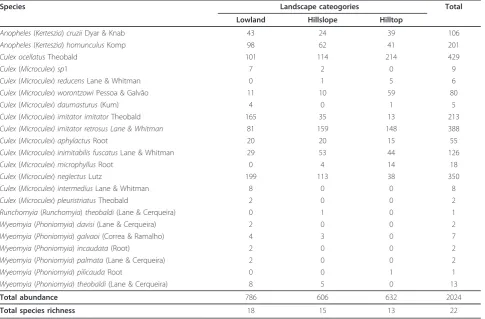
Two thousand and twenty four mosquitoes belonging to 22 species were collected (Table 1).Culex ocellatus(429; 21.20%),Cx. (Mcx.)imitator retrosus(388; 19.17%),Cx. (Mcx.)neglectus(350; 17.29%),Cx. (Mcx.)imitator imita-tor(213; 10.52%),An. homunculus(201; 9.93%),Cx. (Mcx.)
inimitabilis fuscatus(126; 6.23%),An. cruzii(106; 5.24%),
Cx. (Mcx.)worontozowi(80; 3.95%) andCx. (Mcx.) aphy-lactus(55; 2.52%) were the most abundant species.
The extrapolated species richness using the second-order jackknife estimator was 35 species. Of the 22 species collected, two were found to be singletons and four dou-bletons. Results of the RDA showed that landscape
categories, bromeliad water volume and bromeliad fullness had a significant influence on the bromeliad mosquito assemblage structure (pseudo-F value = 1.89, p = 0.04; pseudo-F value = 2.99, p = 0.03; and pseudo-F value = 4.47, p < 0.01, respectively; Table 2).
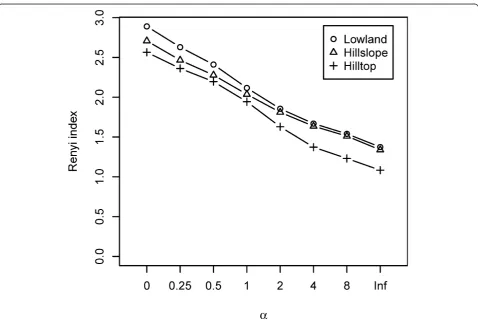
The Renyi diversity curves showed that the lowland possesses the highest diversity indices, and that the values for the hillslope are more similar to those obtained for the hilltop (Figure 2; Additional file 1). The Kruskal-Wallis tests indicated significant difference in the Total richness (= 0) and the Shannon-Weiner diversity index
(= 1; Figure 2) between lowland and hilltop (KWc2=
4.90, p = 0.03 and KWc2 = 5.75, p = 0.02, respectively). Further results are included in Additional file 1.
Univariate Gaussian linear regression analyses found that bromeliad fullness was positively associated with
[image:4.595.57.543.395.714.2]Cx. imitator imitator (b1= 0.90; p < 0.001),An. cruzii(b 1= 0.19; p < 0.01),Cx. neglectus (b 1= 0.68; p < 0.01) andCx. aphylactus (b1= 0.10; p = 0.03).Cx. inimitabilis fuscatus, however, showed a negative association (b1= -0.32; p = 0.04) indicating this species was more asso-ciated with shallow water inside bromeliad tanks (Addi-tional file 2).
Table 1 Species of Culicidae found inNidulariumandVrieseabromeliads.
Species Landscape cateogories Total
Lowland Hillslope Hilltop
Anopheles(Kerteszia)cruziiDyar & Knab 43 24 39 106
Anopheles(Kerteszia)homunculusKomp 98 62 41 201
Culex ocellatusTheobald 101 114 214 429
Culex(Microculex)sp1 7 2 0 9
Culex(Microculex)reducensLane & Whitman 0 1 5 6
Culex(Microculex)worontzowiPessoa & Galvão 11 10 59 80
Culex(Microculex)daumasturus(Kum) 4 0 1 5
Culex(Microculex)imitator imitatorTheobald 165 35 13 213
Culex (Microculex) imitator retrosus Lane & Whitman 81 159 148 388
Culex(Microculex)aphylactusRoot 20 20 15 55
Culex(Microculex)inimitabilis fuscatusLane & Whitman 29 53 44 126
Culex(Microculex)microphyllusRoot 0 4 14 18
Culex(Microculex)neglectusLutz 199 113 38 350
Culex(Microculex)intermediusLane & Whitman 8 0 0 8
Culex(Microculex)pleuristriatusTheobald 2 0 0 2
Runchomyia(Runchomyia)theobaldi(Lane & Cerqueira) 0 1 0 1
Wyeomyia(Phoniomyia)davisi(Lane & Cerqueira) 2 0 0 2
Wyeomyia(Phoniomyia)galvaoi(Correa & Ramalho) 4 3 0 7
Wyeomyia(Phoniomyia)incaudata(Root) 2 0 0 2
Wyeomyia(Phoniomyia)palmata(Lane & Cerqueira) 2 0 0 2
Wyeomyia(Phoniomyia)pilicaudaRoot 0 0 1 1
Wyeomyia(Phoniomyia)theobaldi(Lane & Cerqueira) 8 5 0 13
Total abundance 786 606 632 2024
Total species richness 18 15 13 22
Univariate negative binomial regression analyses found thatAn. homunculus(prevalence ratio = 0.42; CI 95% = 0.18 - 0.95) andCx. neglectus(prevalence ratio = 0.19; CI 95% = 0.07 - 0.5) were more closely associated with
low-land than hilltop, and thatCx. imitator imitatorwas
more closely associated with lowland than either hilltop (prevalence ratio = 0.08; CI 95% = 0.03 - 0.22) or hillslope
(prevalence ratio = 0.21; CI 95% = 0.08 - 0.53) (Addi-tional file 3).
Univariate binary logistic regression analyses for
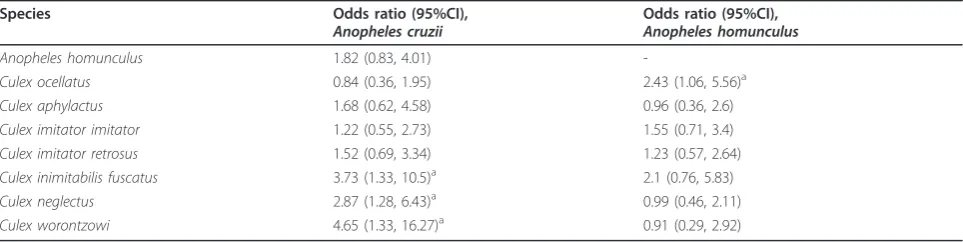
co-occurrence showed thatAn. homunculuswas associated
withCx. ocellatusandAn. cruziiwas associated withCx. neglectus, Cx. inimitabilis fuscatusandCx. worontzowi
[image:5.595.56.539.100.235.2](Table 3). AlthoughAn. cruziiandAn. homunculuswere
Table 2 Correlation between bromeliad mosquito assemblage and environmental variables.
Environmental variable Type of variable Redundancy analysis
Mean temperature Numeric, from 16.9 to 27.5°C Pseudo-F = 0.69, d.f. = 106 (p = 0.63) Total precipitation Numeric, from 0.9 to 155.3 mm Pseudo-F = 0.13, d.f. = 106 (p = 0.99) Bromeliad height Numeric, from 0 to 260 cm Pseudo-F = 0.61, d.f. = 106 (p = 0.68) Type of bromeliad Factor, 3 levels (ground, epiphytic, rocky) Pseudo-F = 1.49, d.f. = 106 (p = 0.13)
Water pH Numeric, from 3.9 to 7.5 Pseudo-F = 0.41, d.f. = 106 (p = 0.86)
Tank diameter Numeric, from 10 to 100 cm Pseudo-F = 0.50, d.f. = 106 (p = 0.75) Tank depth Numeric, from 10 to 140 cm Pseudo-F = 0.98, d.f. = 106 (p = 0.41) Landscape categories Factor, 3 levels (lowland, hillslope, hillside) Pseudo-F = 1.89, d.f. = 106 (p = 0.04)a Bromeliad water volume Numeric, from 7 to 750 ml Pseudo-F = 2.99, d.f. = 106 (p = 0.03)a Bromeliad fullness (water divided by depth) Numeric, from 0.2 to 17.5 ml/cm Pseudo-F = 4.47, d.f. = 106 (p < 0.01)a
Results of the multivariate Redundancy analysis (RDA) showing correlations between bromeliad mosquito assemblage structure and environmental variables. a = Significant result under the null hypothesis: Pseudo-F = 0 (p < 0.05).
[image:5.595.59.538.373.694.2]occasionally found in the same bromeliad, this associa-tion was not statistically significant (1.82, p = 0.14). Con-sidering mosquito frequency distribution among bromeliad genera (Additional file 4), results of co-occur-rence analyses were mainly because ofNidularium. The
number of plants sampled of theNidulariumgenus was
approximately seven times higher than those of the Vrie-sea(94Nidulariumversus 14Vriesea).
Discussion and conclusions
The difference between the observed (n = 22) and extrapo-lated species richness (n = 35) in our study can be explained by the high number of rare species present in the tropical forest of Serra do Mar [4]. According to the second order jackknife estimator, we detected six rare spe-cies in our study, which constitutes approximately one quarter of the observed species. It therefore appears that rarer species were under-represented in our study, which may have affected our ability to detect the significance of some determinants (Table 2). However, those determi-nants that were significant for the assemblage structure were also significant for the most abundant species.
Alves et al. [4] found significant differences in forest structure and biomass variation along a 0-1100 m alti-tude gradient of coastal Atlantic Forest in Serra do Mar. The authors also showed how small changes in elevation in tropical regions can significantly affect various envir-onmental factors such as air temperature, solar radiation, light availability, edaphic discontinuities, both soil moist-ure and temperatmoist-ure, nutrients availability, ground eva-poration and microbial decomposition. Considering that environmental variables may have an impact on the avail-ability and suitavail-ability of mosquito habitats, including lar-val habitats (e.g. bromeliads), one should expect to find differences in Culicidae assemblages in different locations within Atlantic Forest. In the present study, differences in mosquito community structure in a small gradient of alti-tude (0-263 m) were found, showing that the complexity of Serra do Mar and elevational gradient may be consid-ered in ecological studies of Culicidae. This finding is
consistent with that of Navarro et al. [32] who found that elevation is an important landscape determinant for Culi-cidae fauna distribution in Venezuela.
One of the main findings in our study was that differ-ences in species among mosquito assemblages were influ-enced by elevation categories. The higher total species richness found in the lowland (Table 1) is consistent with greater niche availability, and may be related to higher spe-cies abundance because of the decreased probability of local population extinction [33]. Micro-climatic variation could not be evaluated because such data was not available but is likely to be important in influencing mosquito fauna and their distribution. The macro-climatic data that was used in our study could not explain differences in assem-blage structure (Table 2).
Previous studies showed that differences in species among mosquito assemblages can be explained by brome-liad characteristics [34,35]. The quantity and quality of food resources, and physico-chemical properties of the water in bromeliads tanks may determine the species found in them [34]. It is noteworthy that pH, conductivity,
temperature, and O2concentration were found unrelated
to both richness and species diversity of macro-invertebrate fauna inhabitingTillandsia turneriBaker (Bromeliaces) in high altitude forest in Colombia [36]. However, bromeliad water volume and plant area were associated with abun-dance. Machado-Allison et al. [37] found a positive correla-tion between bromeliad structural complexity, habitat persistence, presence of predators and mosquito species richness. In another study, Araújo et al. [38] found that species abundance was positively associated with increased water volume, whereas richness was correlated with plant diameter. In considering that larval mosquito community structure may be influenced by both the volume of water inside a bromeliad tank and depth of the water, another variable named bromeliad fullness was assessed forVriesea
[image:6.595.57.539.100.221.2]andNidulariumplants from Atlantic Forest. This variable was found to have a statistically significant influence on the mosquito community structure. Water fullness may create an array of micro-variation in the physico-chemical Table 3 Co-occurrence between mosquito species inNidulariumandVrieseabromeliads.
Species Odds ratio (95%CI),
Anopheles cruzii Odds ratio (95%CI),Anopheles homunculus
Anopheles homunculus 1.82 (0.83, 4.01)
-Culex ocellatus 0.84 (0.36, 1.95) 2.43 (1.06, 5.56)a
Culex aphylactus 1.68 (0.62, 4.58) 0.96 (0.36, 2.6)
Culex imitator imitator 1.22 (0.55, 2.73) 1.55 (0.71, 3.4)
Culex imitator retrosus 1.52 (0.69, 3.34) 1.23 (0.57, 2.64)
Culex inimitabilis fuscatus 3.73 (1.33, 10.5)a 2.1 (0.76, 5.83)
Culex neglectus 2.87 (1.28, 6.43)a 0.99 (0.46, 2.11)
Culex worontzowi 4.65 (1.33, 16.27)a 0.91 (0.29, 2.92)
characteristics of water content, and thus in food resources and presence of predators that can affect mosquito larval community structure.
Mosquito species abundance may also be influenced by bromeliad taxa [9,39-42]. Navarro et al. [43] found mos-quito taxa association with bromeliad family in Venezuela. Similarly, in Panaquire, Venezuela, Machado-Allison et al. [44] found that some species of mosquitoes were strongly associated with species of bromeliads. In the present study, among the six rarest mosquito species found in
NidulariumandVrieseabromeliads, four belonged to the
Wyeomyia(Phoniomyia). Similarly, Müller and Marcondes [45] collected only a single individual ofWyeomyia( Pho-niomyia) in plants ofNidularium innocentii. However, Mocellin et al. [46] foundWyeomyia(Phoniomyia) to be the most abundant taxa inNeoregelia compacta(Mez) and
Billbergia nanaE. Pereira in the Botanical Garden of Rio de Janeiro. It therefore appears that plants of the genus
Nidulariumdo not represent important larval habitat for
Wyeomyia (Phoniomyia). Given the large numbers of
adult Wyeomyia(Phoniomyia) previously found in the
study area [47], it is likely that this subgenus favors alter-native bromeliad genera, for example,Neoregeliaand Bill-bergia. Moreover, it is noteworthy that at least 21 additional genera of Bromeliaceae can be found in Serra do Mar [48], some of which may provide important larval habitat forWyeomyia(Phoniomyia).
The subgenusKertesziais comprised of 12 species, of which four have been implicated as malaria vectors [12]. Three of these,An. bellator, An. cruzii, andAn. homuncu-lus, are important vectors in the Atlantic Forest. While
An. bellatorandAn. cruziiare widely distributed, the geo-graphical distribution ofAn. homunculusis poorly known [15]. Sallum et al. [24] stated that the lack ofAn. homun-culusrecords in Brazil may be a consequence of an inabil-ity to effectively identify the species based on female morphological characters. Larval and pupal characteristics, on the other hand, are highly effective at resolving this species. Despite the abundance ofAn. cruziiandAn. bella-torfound in the study area by Forattini et al. [49], we only identifiedAn. cruziiandAn. homunculus. The absence of
An. bellatormay be because of a preference for larval habi-tat either in the canopy [13] or restinga [50], but plants
from both environments were not sampled.Anopheles
homunculus, on the other hand, was frequently encoun-tered in our study and made up approximately 65% of all
Kertesziaspecimens collected.Anopheles homunculuswas similarly found to be common in enclosed, humid forests in Serra do Mar in Santa Catarina state [50]. It is note-worthy that Harbach and Navarro [51] reported
An. homunculusin forests at altitudes of up to 1700 m in Auyantepui, Venezuela.
Great importance lies in the ability to effectively identify the presence of malaria vectors, and understand
mechanisms involved in multiple species coexistence. The identification of a surrogate species may be used as a tool to assess the presence of vector species. In our study area, three species from the genusCulexwere found to be indi-cative of the presence ofAn. cruziiand one was found to
be indicative ofAn. homunculus(Table 3), and mostly
withinNidulariumplants (Additional file 4). However, the field observations conducted for the present study do not allow addressing ecological and evolutionary mechanisms of mosquito species coexistence. Consequently, hypotheses of species co-occurrence need further investigations employing an experimental design that combines field investigation and also mathematical modeling.
There are few published accounts ofAn. homunculusin the Atlantic Forest, and this study is the first to include this species in an assessment of diversity among mosquito assemblages.Anopheles homunculusseems to be abundant inNidulariumandVrieseabromeliads, sharing the same plants withAn. cruzii, and presence of both species were found to be associated with distinct categories of elevation and slope. The findings of the current study open
ques-tions about the importance of An. homunculusin the
transmission ofPlasmodiumsp. in Atlantic Forest. The
species was incriminated as a vector on coastal areas of Santa Catarina state [16], but its current role in human malaria transmission is largely unknown. It is noteworthy thatAlouattamonkeys were found infected with Plasmo-dium vivax, P. malariaeandP. falciparumin Serra do Mar, and thus they may act as reservoirs for human Plas-modium[52,53]. In considering thatAn. homunculusis found in areas with dense forest coverage [50] where
Alouattamonkeys are present, it is plausible to propose that either the species, or otherKertesziaspecies, may be involved in the transmission of malaria parasites from
monkeys to humans. The involvement ofAn. homunculus
in the dynamics of malaria transmission in Atlantic Forest requires further investigation, with a particular emphasis on greater sampling and testing for infectivity across the region in different levels within the forest.
Additional material
Additional file 1: Differences between landscape categories for each ofavalue of the Renyi index tested for statistical significance using Kruskal-Wallis test. Results of Kruskal-Wallis test to assess statistical significance of Renyi index values.
Additional file 2: Results of univariate Gaussian regression analyses performed with species abundance against the bromeliad fullness (volume of water divided by depth of bromeliad tank). Results of univariate regression analysis to determine correlation between species abundance and bromeliad fulness defined as volume of water divided by depth of the bromeliad tank.
regression analysis showing correlations between species abundance and elevation.
Additional file 4:Species of Culicidae taken from the genera Nidularium and Vriesea. *Number of plants in which a species was found/number of plants sampled in a specific landscape category. List of species of Culicidae collected from Nidularium and Vriesea showing the number of plants in which a species was found and the number of plants sampled in a specific landscape category.
Acknowledgements and funding
We are in debt to the reviewers for suggestions and comments that greatly improved the first draft of the manuscript; to A. Fernandes for assistance in the specimens identification; to field team from Departamento de Epidemiologia for helping with field collections. To Fundação de Amparo à Pesquisa do Estado de São Paulo, FAPESP (Processo n° 05/53973-0, and 2011/22088-1), and Conselho Nacional de Desenvolvimento Científico e Tecnológico (CNPq BPP 300351/2008-9) for financial support. TCM was a recepient of CNPq fellowship no. 136557/2008-2e.
Authors’contributions
TCM and MAMS conceived and designed the experiments. TCM did the field collections and identified the specimens. GZL performed the statistical analysis in the R package with contributions by BPB, MAMS and TCM. MAMS, TCM, BPB, GZL wrote the paper. All authors read and approved the final manuscript.
Competing interests
The authors declare that they have no competing interests.
Received: 4 August 2011 Accepted: 16 February 2012 Published: 16 February 2012
References
1. Myers N, Mittermeier RA, Mittermeier CG, Fonseca GAB, Kent J:Biodiversity hotspots for conservation priorities.Nature2000,403:853-858.
2. Silva JMC, Casteleti CHM:Status of the biodiversity of the Atlantic Forest of Brazil.InThe Atlantic Forest of South America: biodiversity status, threats, and outlook.Edited by: Galindo-Leal C, Câmara IG. Washington: Island Press; 2003:43-59.
3. Galindo-Leal C, Câmara IG:Atlantic Forest hotspot status: an overview.In
The Atlantic Forest of South America: biodiversity status, threats, and outlook.
Edited by: Galindo-Leal C, Câmara IG. Washington: Island Press; 2003:3-11. 4. Alves LF, Vieira SA, Scaranello MA, Camargo PB, Santos FAM, Joly CA,
Martinelli LA:Forest structure and live aboveground biomass variation along an elevational gradient of tropical Atlantic moist forest (Brazil).For Ecol Manage2010,260:679-691.
5. Carnaval AC, Moritz C:Historical climate modelling predicts patterns of current biodiversity in the Brazilian Atlantic forest.J Biogeogr2008, 35:1187-1201.
6. Fitzpatrick SW, Brasileiro CA, Haddad DFB, Zamudio KR:Geographical variation in genetic structure of an Atlantic Coastal Forest frog reveals regional differences in habitat stability.Mol Ecol2009,18:2877-2896. 7. Forattini OP, Lopes OS, Rabello EX:Investigações sobre o comportamento
de formas adultas de mosquitos silvestres no estado de São Paulo, Brasil.Rev Saude Publica1968,2:111-173.
8. Marques GRAM, Santos RLC, Forattini OP:Aedes albopictusem bromélias de ambiente antrópico no Estado de Säo Paulo, Brasil.Rev Saude Publica
2001,35:243-248.
9. Frank JH:Bromeliad phytotelmata and their biota, especially mosquitoes. InPhytotelmata: Terrestrial Plants as Host for Aquatic Insect Communities.
Edited by: Frank JH, Lounibos LP. New Jersey: Plexus, Meford; 1983:101-128. 10. Müller GA, Marcondes CB:Bromeliad-associated mosquitoes from Atlantic forest in Santa Catarina Island, southern Brazil (Diptera, Culicidae), with new records for the State of Santa Catarina.Iheringia Ser Zool2006, 96:315-319.
11. Marques GRAM, Forattini OP:Culicídeos em bromélias: diversidade de fauna segundo influência antrópica, litoral de São Paulo.Rev Saude Publica2008,42:979-985.
12. Zavortink TJ:Mosquito studies XXIX. A review of the subgenusKerteszia
ofAnopheles.Contrib Amer Entomol Inst1973,9:1-54.
13. Frank JH, Lounibos LP:Insects and allies associated with bromeliads: a review.Terr Arthropod Rev2009,1:125-153.
14. Oliveira-Ferreira J, Lacerda MVG, Brasil P, Ladislau JLB, Tauil PL, Daniel-Ribeiro CT:Malaria in Brazil: an overview.Malar J2010,9:115. 15. Marrelli MT, Malafronte RS, Sallum MAM, Natal D:Kertesziasubgenus
associated with the Brazilian Atlantic forest: current knowledge and future challenges.Malar J2007,6:127.
16. Smith LB:Bromeliad malaria.Ann Rep Smithsonian Inst1952, 385-398. 17. Beketov MA, Yurchenko YA, Belevich OE, Liess M:What environmental
factors are important determinants of structure, species richness, and abundance of mosquito assemblages?J Med Entomol2010,47:129-139. 18. Lane J, Whitman L:The SubgenusMicroculexin Brazil (Diptera, Culicidae).
Rev Bras Biol1951,11:341-366.
19. Lane J:Neotropical Culicidae.São Paulo: USP1953.
20. Correa RR, Ramalho GR:Revisão dePhoniomyia(Theobald, 1903).Folia Clin Biol1956,25:5-176.
21. Cotrim MD, Galati EAB:Revisão da série Pleuristriatus do subgênero
MicroculexTheobald, 1907 (Diptera, Culicidae).Rev Bras Entomol1977, 20:169-205.
22. Forattini OP:Culicidologia Médica.São Paulo: EDUSP2002. 23. Dyar HG, Knab F:The larvae of Culicidae classified as independent
organisms.J New Jersey Entomol Soc1906,14:169-230.
24. Sallum MAM, Santos CLS, Wilkerson RC:Studies onAnopheles(Kertes-zia)
homunculusKomp (Diptera: Culicidae).Zootaxa2009,2299:1-18. 25. Kindt R, Coe R:Tree diversity analysis. A manual and software for
common statistical methods for ecological and biodiversity studies.
Nairobi: World Agroforestry Centre (ICRAF)2005.
26. Venables WN, Ripley BD:Modern applied statistics with S.New York: Springer Science Business Media; 2002.
27. Chongsuvivatwong V:Analysis of epidemiological data using R and Epicalc.Songkhla, Thailand: Chanmuang Press; 2008.
28. Magurran AE:Measuring biological diversity.Oxford: Blackwell Publishing company; 2004.
29. Brose U, Martinez ND, Williams RJ:Estimating species richness: sensitivity to sample coverage and insensitivity to spatial patterns.Ecology2003, 84:2364-2377.
30. Gotelli NJ, Ellison AM:A primer of ecological statistics.Sunderland: Sinauer Associate Publishers; 2004.
31. Henderson PA:Practical methods in ecology.Oxford: Blackwell Publishing Company; 2006.
32. Navarro JC, Del Ventura F, Zorrilla A, Liria J:Registros de mayor altitud para mosquitos (Diptera: Culicidae) en Venezuela.Rev Biol Trop2010, 58:245-254.
33. Yee DA, Juliano SA:Abundance matters: a field experiment testing the more individuals hypothesis for richness-productivity relationships.
Oecologia2007,153:153-162.
34. Ambruster P, Hutchinson RA, Cotgreave P:Factors influencing community structure in a South American tank bromeliad fauna.Oikos2002, 96:225-234.
35. O’Meara GF, Cutwa MM, Evans LF Jr:Bromeliad-inhabiting mosquitoes in south Florida: native and exotic plants differ in species composition.J Vector Ecol2003,28:37-46.
36. Ospina-Bautista F, Estévez-Varón JV, Betancur J, Realpe-Rebolledo E: Estructura y Composición de la comunidad de macro invertebrados acuáticos asociados a Tillandsia turneri Baker (Bromeliaceae) en un bosque Alto Andino Colombiano.Acta Zool Mex2004,20:153-166. 37. Machado-Allison CE, Barrera R, Frank JH, Delgado L, Gomez-Cova C: Mosquito communities in Venezuela phytotelmata.InEcology of mosquitoes: proceedings of a workshop.Edited by: Lounibos LP, Rey JR, Frank JH. Vero Beach: Florida Medical Entomology Laboratory; 1985:79-93. 38. Araújo VA, Melo SK, Araújo APA, Gomes MLM, Carneiro MAA:Relationship
between invertebrate fauna and bromeliad size.Braz J Biol2007, 67:611-617.
39. Fish D:Phytotelmata: Flora and Fauna.InPhytotelmata: terrestrial plants as hosts for aquatic insect communities.Edited by: Frank JH, Lounibos LP. New Jersey: Plexus Publishing; 1983:1-25.
41. Maguire B:Phytotelmata biota and community structure determination in plant-held waters.Annu Rev Ecol Syst1971,2:439-464.
42. Navarro JC, Ingunza J, Fernández Z, Barrera R:Mosquitoes and bromeliads: species-specific selectivity patterns on the northern coast and southern Guiana Shields in Venezuela.J Am Mosq Control Assoc1995,11:345-346. 43. Navarro JC, Liria J, Piñango H, Barrera R:Biogeographic area relationships
in Venezuela: A Parsimony analysis of Culicidae - Phytotelmata distribution in National Parks.Zootaxa2007,1547:1-19.
44. Machado-Allison CE, Barrera R, Delgado L, Gomez-Cova C, Navarro JC: Mosquitos (Diptera: Culicidae) de los Fitotelmata de Panaquire, Venezuela.Acta Biol Ven1986,12:1-12.
45. Müller GA, Marcondes CB:Immature mosquitoes (Diptera: Culicidae) on the bromeliadNidularium innocentiiin ombrophilous dense forest of Santa Catarina Island, Florianópolis, Santa Catarina State, southern Brazil.
Biotemas2007,20:27-31.
46. Mocellin MG, Simões TC, Nascimento TFS do, Teixeira MLF, Lounibos LP, Lourenço-de-Oliveira R:Bromeliad-inhabiting mosquitoes in an urban botanical garden of dengue endemic Rio de Janeiro. Are bromeliads productive habitats for the invasive vectorsAedes aegyptiandAedes albopictus?Mem Inst Oswaldo Cruz2009,104:1171-1176.
47. Forattini OP, Gomes AC, Natal D, Santos JLF:Rev Saude Publica1986, 20:1-20.
48. Martinelli G, Vieira CM, Gonzalez M, Leitman P, Piratininga A, Costa AF da, Forzza RC:Bromeliaceae da Mata Atlântica brasileira: lista de espécies, distribuição e conservação.Rodriguesia2008,59:209-258.
49. Forattini OP, Kakitani I, Massad E, Marucci D:Studies on mosquitoes (Diptera: Culicidae) and anthropic environment. 11 - Biting activity and blood- seeking parity ofAnopheles(Kerteszia) in South-Eastern Brazil.Rev Saude Publica1996,30:107-114.
50. Veloso HP, Moura JV de, Klein RM:Delimitação ecológica dos anofelíneos do subgêneroKertesziana região costeira do sul do Brasil.Mem Inst Oswaldo Cruz1956,54:517-541.
51. Harbach RE, Navarro JC:A new species ofAnophelessubgenusKerteszia
(Diptera: Culicidae) from Venezuela.Entomologica Scandinavica1996, 27:207-216.
52. Curado I, Malafronte RS, Duarte AMRC, Kirchgatter K, Branquinho MS, Galati EAB:Malaria epidemiology in low-endemicity areas of the Atlantic forest in the Vale do Ribeira, Sao Paulo, Brazil.Acta Trop2006,100:54-62. 53. Duarte AMRC, Malafronte RS, Cerutti C Jr, Curado I, Paiva BR, Maeda AY,
Yamasaki T, Summaf MEL, Neves DVDA, Oliveira SG, Gomes AC:Natural
Plasmodiuminfections in Brazilian wild monkeys: Reservoirs for human infections?Acta Trop2008,107:179-185.
doi:10.1186/1756-3305-5-41
Cite this article as:Marqueset al.:Mosquito (Diptera: Culicidae) assemblages associated withNidulariumandVrieseabromeliads in Serra do Mar, Atlantic Forest, Brazil.Parasites & Vectors20125:41.
Submit your next manuscript to BioMed Central and take full advantage of:
• Convenient online submission
• Thorough peer review
• No space constraints or color figure charges
• Immediate publication on acceptance
• Inclusion in PubMed, CAS, Scopus and Google Scholar
• Research which is freely available for redistribution