ISSN 0252-8266
eurostat
%
EUROSTATISTIK
Daten zur Konjunkturanalyse
EUROSTATISTICS
Data for short-term economic analysis
EUROSTATISTIQUES
Données pour l'analyse de la conjoncture
Monatlich D Monthly Π Mensuel
8-9
D
1994
i
Theme / Theme
General statistics / Statistiques générales
Series / Série
Short-term trends / Conjoncture
eurostat
OFICINA ESTADÍSTICA DE LAS COMUNIDADES EUROPEAS
DE EUROPÆISKE FÆLLESSKABERS STATISTISKE KONTOR
STATISTISCHES AMT DER EUROPÄISCHEN GEMEINSCHAFTEN
ΣΤΑΤΙΣΤΙΚΗ ΥΠΗΡΕΣΙΑ ΤΩΝ ΕΥΡΩΠΑΪΚΩΝ ΚΟΙΝΟΤΗΤΩΝ
STATISTICAL OFFICE OF THE EUROPEAN COMMUNITIES
OFFICE STATISTIQUE DES COMMUNAUTÉS EUROPÉENNES
ISTITUTO STATISTICO DELLE COMUNITÀ EUROPEE
BUREAU VOOR DE STATISTIEK DER EUROPESE GEMEENSCHAPPEN
SERVIÇO DE ESTATÍSTICA DAS COMUNIDADES EUROPEIAS
L2920 Luxembourg Tél. 43 011 Télex COMEUR LU 3423
B1049 Bruxelles, rue de la Loi 200 Tél. 299 11 11
Las publicaciones de Eurostat están clasificadas por temas y por series. La clasificación se encuentra al final de
la obra. Para mayor información sobre las publicaciones, rogamos se pongan en contacto con Eurostat.
Para los,pedidos, diríjanse a las oficinas de venta cuyas direcciones figuran en la página interior de la
contracubierta.
Eurostats publikationer er klassificeret efter emne og serie. En oversigt herover findes bag i hæftet. Yderligere
oplysninger om publikationerne kan fås ved henvendelse til Eurostat.
Bestilling kan afgives til de salgssteder, der er anført på omslagets side 3.
Die Veröffentlichungen von Eurostat sind nach Themenkreisen und Reihen gegliedert. Die Gliederung ist hinten in
jedem Band aufgeführt. Genauere Auskünfte über die Veröffentlichungen erteilt Eurostat.
Ihre Bestellungen richten Sie bitte an die Verkaufsbüros, deren Anschriften jeweils auf der dritten Umschlagseite
der Veröffentlichungen zu finden sind.
Οι εκδόσεις της Eurostat ταξινομούνται κατά θέμα και κατά σειρά. Η ακριβής ταξινόμηση αναφέρεται στο
τέλος κάθε έκδοσης. Για λεπτομερέστερες πληροφορίες σχετικά με τις εκδόσεις, μπορείτε να
απευθύ-νεσθε στην Eurostat.
Για τις παραγγελίες μπορείτε να απευθύνεσθε στα γραφεία πώλησης, των οποίων οι διευθύνσεις
αναγράφονται στη σελίδα 3 του εξωφύλλου.
Eurostat's publications are classified according to themes and series. This classification is indicated at the end of
the publication. For more detailed information on publications, contact Eurostat.
Orders are obtainable from the sales offices mentioned on the inside back cover.
Les publications d'Eurostat sont
classées par thème et par série. Cette classification est précisée à la fin
de l'ouvrage. Pour des informations plus détaillées sur les publications, contactez Eurostat.
Pour les commandes, adressez-vous aux bureaux de vente dont les adresses sont indiquées à la page 3
de la couverture.
Le pubblicazioni dell'Eurostat sono classificate per tema e per serie. Tale classificazione è precisata alla fine
dell'opera. Per informazioni più dettagliate sulle pubblicazioni rivolgersi all'Eurostat.
Per eventuali ordinazioni rivolgersi a uno degli uffici di vendita i cui indirizzi figurano nella 3
apagina della
copertina.
De publikaties van Eurostat zijn ingedeeld naar onderwerp en serie. Deze indeling is achter in het boek
opgenomen. Voor nadere informatie over de publikaties kunt u sich wenden tot Eurostat.
Gelieve bestellingen op te geven bij de verkoopbureaus, waarvan de adressen op bladzijde 3 van de omslag zijn
vermeld.
As publicações do Eurostat estão classificadas por tema e por série. Esta classificação está indicada no firn da
obra. Para mais informações sobre as publicações é favor contactar Eurostat.
EUROSTATISTIK
Daten zur Konjunkturanalyse
EUROSTATISTICS
Data for short-term economic analysis
EUROSTATISTIQUES
Données pour l'analyse de la conjoncture
Luxembourg: Office des publications officielles des Communautés européennes, 1994
© EGKS-EG-EAG, Brüssel · Luxemburg, 1994
Nachdruck — ausgenommen zu kommerziellen Zwecken — mit Quellenangabe gestattet.
© ECSC-EC-EAEC, Brussels · Luxembourg, 1994
Reproduction is authorized, except for commercial purposes, provided the source is acknowledged.
© CECA-CE-CEEA, Bruxelles · Luxembourg, 1994
Reproduction autorisée, sauf à des fins commerciales, moyennant mention de la source.
Vorwort
Mit der monatlich erscheinenden Veröffentlichung
Eurostatistik - Daten zur
Konjunkturanalyse
werden innerhalb kürzester Frist die neuesten statistischen Daten
über die Europäische Gemeinschaft als Ganzes (EUR 12), über jedes Mitgliedsland
sowie über die Vereinigten Staaten und Japan bekanntgegeben.
Eurostatistik
enthält nicht die Gesamtheit des bei Eurostat verfügbaren statistischen
Materials, sondern eine Auswahl der relevantesten Reihen über die konjunkturelle
Entwicklung.
Schnelligkeit und Pünktlichkeit sind die wichtigsten Vorzüge dieser Veröffentlichung.
Aus diesem Grunde wurde sie im Umfang bewußt klein gehalten und enthält keine
Anmerkungen zur Methodik, die im übrigen in den spezialisierten Veröffentlichungen
von Eurostat zu finden sind.
Die in
Eurostatistik
veröffentlichten Daten stammen aus dem ICG -Bereich der
On-line-Datenbank Cronos von Eurostat.
Wer Zugang zu Cronos besitzt, kann jederzeit die Tabellen dieser Veröffentlichung
abfragen, wobei die Daten täglich auf den neuesten Stand gebracht werden (Hinweise
zur On-line -Benutzung finden sich auf der letzten Seite). Darüber hinaus sind die
Daten in der Datenbank Eurocron verfügbar, die vom Host Eurobases der
Kommission angeboten wird.
Weitere Informationen über Eurostat und seine Produkte können bei folgender Stelle
angefordert werden:
Eurostat - Informationsbüro Data Shop
L-2920 LUXEMBURG 121, rue Joseph II
Telephon: (352) 4301 34567 Büro 3/235
Telefax: (352) 43 64 04 B-1049 Bruxelles
Inhaltsverzeichnis
Zeichen und Abkürzungen
KURZ NOTIERT
5
KONJUNKTURDATEN
1. Volkswirtschaftliche Gesamtrechnungen . .35
2. Beschäftigung
39
3. Arbeitslosigkeit
44
4. Industrielle Produktion
49
5. Meinungsumfrage in der Industrie
59
6. Industrieerzeugnisse
65
7. Einzelhandel
70
8. Landwirtschaftliche Erzeugnisse
72
9. Außenhandel
75
10. Verbraucherpreise
106
11. Landwirtschaftliche Erzeugerpreise . . . . 111
12. Löhne und Gehälter
113
13. Finanzstatistiken
114
14. Zahlungsbilanz
121
Anmerkung betreffend Grafiken und Tabellen:
(*) Die Daten beziehen sich auf das Gebiet der
Bundesrepublik Deutschland vor dem
3.10.1990 einschließlich WestBerlin.
T/T1%
T/T4%
πτ12%
BALANCE%
1985=100
EUR12=100
1000
MIO
MRD
T
TJ(GCV)
GWH
USD
ECU
SZR
ESVG
NACE
SITC
EUR
UEBL
ACP
Weniger als die Hälfte der verwendeten
Einheit
Prozent
Prozentualer Zuwachs eines
Vierteljahres gegenüber dem vorher
gehenden Vergleichszeitraum
(Monat, Vierteljahr.Jahr)
Prozentualer Zuwachs eines
Vierteljahres gegenüber dem
entsprechenden Vierteljahr des
Vorjahres
Prozentualer Zuwachs eines Monats
gegenüber dem entsprechenden Monat
des Vorjahres
Saldo zwischen den positiven
Antworten (Zunahme.Verbesserung der
Situation)und den negativen Antworten
(Abnahme,Verschlechterung der
Situation)der Konjunkturumfrage bei
den Unternehmern in der Gemeinschaft
Basisjahr
Gemeinschaft der 10 oder 12 (=100)
in 1000
Million
Milliarde
Metrische Tonne
Terajoule = 109KJ
Gigawattstunde = 106kWh
USDollar
Europäische Währungseinheit
Sonderziehungsrechte
Europäisches System
Volkwirtschaftlicher Gesamtrechnungen
Allgemeine Systematik der
Wirtschaftszweige in den Europäischen
Gemeinschaften
Standard International Trade
Classification
Mitgliedstaaten insgesamt
BelgischLuxemburgische
Wirtschaftsunion
EUROSTATISTIK: kurz notiert
Soweit nicht anders angegeben, beziehen sich die Angaben auf den Gebietsstand der Bundesrepublik Deutschland vor dem 3.10.1990; sie schließen Berlin (West) ein.
WECHSELKURSE: Anstieg der Leitzinsen In Italien, Schweden und den
Vereinigten Staaten
Nach monatelangem allgemeinem Nachgeben der europäischen Zinssätze, wurden die Leitzinsen im August in Italien und in Schweden erhöht. Anhaltende Schwäche der Lira führte die Banca d'Italia am 11. August dazu, ihre Leitzinssätze um 0,5 % zu erhöhen; daraus ergab sich z. B. ein Anstieg des Diskontsatzes von 7 auf 7,5 %. Die Riksbank erhöhte ihren Diskontsatz an Banken um 0,5 % auf 8 %, um so der Inflation vorzubauen.
Die gestiegenen Zinsen in Italien hatten unmittelbar die Schwächung der Lira zur Folge, die auf einen Rekordtiefststand gegenüber der deutschen Mark von 1016,6 LIT am 11. August kam und in den nächsten Tagen weiter nachgab bis zu 1026 LIT. Ende August hatte sich die Lira leicht von diesem Tiefststand erholt, doch überstieg ihr Wechselkurs kaum den Stand, den sie vor der Zinserhöhung hatte.
Auch die schwedische Krone gab nach der Erhöhung der schwedischen Zinssätze nach, doch erholte sie sich gegen Ende August.
Alle Währungen, die im vormaligen Wechselkursmechanismus nur innerhalb der engen Bandbreite schwanken konnten, verbleiben weiterhin in diesen engen Band-breiten, außer der dänischen Krone, die jüngst leicht gegen die DM fiel. Der portugiesische Escudo zeige kaum eine Reaktion auf die Senkung des Zinssatzes für die Dauerfazilität der Banco de Portugal um 0,5 % auf 12 % am 26. August; diese Rate war erst im Juli zur Unterstützung des Escudo angehoben worden. Sterling, das nicht am Wechselkursmechanismus teilnimmt, gab über die Sommer-monate nach und fiel Mitte August zum ersten Mal seit März 1993 unter 2,40 DM, und dies trotz der allgemein günstigen Aussichten der britischen Wirtschaft. Die griechische Drachme, ebenfalls nicht am Wechselkursmechanismus beteiligt, verlor das ganze Jahr ständig gegenüber der Mark; während sie Ende 1993 auf 142,58 DR stand, wies sie am 24. August einen Wert von 151,73 DR auf, ein Rückgang um 6,4 %.
Der US-Dollar blieb auch während Juli und August relativ schwach, trotz einer weiteren Erhöhung der kurzfristigen Zinssätze. Die amerikanische Notenbank kündig-te am 16. August an, daß sie ihren Diskontsatz von 3,5 % auf 4 % erhöhen und daß die Zielvorgabe für den Tagesgeldsatz um denselben Betrag auf 4,75 % ansteigen wird; damit wurde diese Rate bereits zum fünften Mal in diesem Jahr erhöht. Der Dollar erreicht einen Tiefststand von 96,81 Y am 12. Juli, erholte sich dann zunächst auf über 100 Y, sank gegen Ende des Monats wieder unter 100 Y und erholte sich erneut etwas, um am 26. August einen Stand von 100,29 Y zu erzielen. Auch gegenüber der Mark war der Dollar schwach, wenn er auch erheblich über seinem absoluten Tiefststand blieb.
RENDITEN VON STAATSANLEIHEN: im Juni weiterhin steigende
Rendi-ten, im Juli Konsolidierung
Die Renditen von Staatsanleihen erhöhten sich im Juni weiter, nachdem sie bereits im Mai angestiegen waren, so daß die Renditen in mehreren Ländern in diesem Jahr schon um mehr als 2 % zugenommen haben. So betrugen die Renditen z. B. in Spanien im Juli durchschnittlich 10,2 %, während sie im Januar nur bei 7,8 % lagen; die Renditen in Portugal betrugen im Juni 10,1 % gegenüber 8,9% im Januar. Einige der Länder dagegen, in denen die Renditen 1994 erheblichen angewachsen waren, wie Dänemark oder das Vereinigte Königreich, sahen im Juli einen leichten Rückgang.
Die Renditen von Staatsanleihen in Japan sind weiterhin gering (4,6 % im Juli), während die Renditen in den Vereinigten Staaten nun etwa 1 % über denjenigen in Deutschland liegen.
Da die Inflationsrate in den meisten Ländern niedrig blieb, sind die realen Renditen in einigen Fällen ausgesprochen hoch. So betrugen die inflationsbereinigten langfri-stigen Renditen von Staatsanleihen im Juli in Belgien, Spanien, Irland und Italien über 5 % und in Dänemark, Frankreich und dem Vereinigten Königreich über 6 %. Diese realen Renditen sind erheblich höher als Ende 1993, als der Durchschnitt der EU-Länder auf 3,9 % standen, verglichen mit dem vorläufigen Wert von 5 % im Juni 1994.
AMTLICHE WAHRUNGSRESERVEN: Japans Reserven steigen weiter an
Nach dem im April 1994 erreichten Rekordstand, sah Japan einen weiteren Zufluß von Reserven im Mai und im Juni und beliefen sich damit Ende Juni auf über 95 Mrd. ECU. Dieser Zufluß von Reserven kann im Lichte der Intervention der Bank von Japan auf den Devisenmärkten zur Stützung des Dollars gesehen werden, der, wie bereits an anderer Stelle gesagt, für den überwiegenden Teil dieses Jahres stetig gegenüber dem Yen nachgab. Zu diesem Zweck hat die Bank von Japan Yen für Dollar verkauft und so ihre amtlichen Währungsreserven erhöht.
In der EG sahen Belgien, Irland und Italien recht große Zuflüsse in den ersten sechs Monaten dieses Jahres, wobei die Reserven der ersten beiden Länder nun etwa dasselbe Niveau wie vor 12 Monaten aufweisen. Im gleichen Zeitraum flössen in Dänemark und Spanien Reserven ab.
Mit etwa 90 Billionen Dollar erreichten die Reserven von Taiwan im Juni 1994 aufgrund des Zulaufs von ausländischen Geldern für Investitionen in taiwanesische Aktien einen absoluten Höchststand. Der zweithöchste Wert war im September 1992 erzielt worden.
VIERTELJÄHRLICHE GESAMTRECHNUNGEN: erstes Quartal 1994:
posi-tive Entwicklung der Wirtschaft der Europäischen Union (BIP +0,7 %)
Im ersten Quartal 1994 wird für die Wirtschaft der Europäischen Union insgesamt eine Zunahme des Wirtschaftswachstums (BIP +0,7 %) verzeichnet, die auf zwei Jahre der Ungewißheit und der Rezession folgt. Das gute Ergebnis des ersten Quartals gewinnt an Bedeutung, wenn man berücksichtigt, daß das erste Quartal in der Regel strukturell recht schwach ist und daß meteorologisch gesehen der Winter 1994 ziemlich hart war, wodurch bestimmte Wirtschaftszweige, z. B. Landwirtschaft, Baugewerbe usw., benachteiligt waren. Dieses Ergebnis könnte auf die tatsächliche Umkehrung der Trends bei den wichtigsten Indikatoren auf makroökonomischer Ebene im ersten Teil des laufenden Jahres hindeuten.Vorsicht ist jedoch angeraten, um die derzeitige wirtschaftliche Lage nicht zu optimistisch zu interpretieren. Tatsächlich ist die wirtschaftliche Lage noch durch mehrere Probleme gekennzeich-net, z. B. Arbeitslosigkeit und die Verringerung der öffentlichen Defizite. Zu diesen Problemen treten in jüngster Zeit auf den Finanz- und Devisenmärkten zu verzeich-nende neue Spannungen, die die Stabilität der Weltwirtschaft zu einem kritischen Zeitpunkt wie dem Ende einer negativen Phase zu gefährden drohen.
Was die Inflation angeht, so liegen aufgrund der Tatsache, daß Frankreich noch keine Daten in jeweiligen Preisen veröffentlicht hat, noch keine Daten für die Europäische Union vor. Dennoch kann auf der Grundlage der vorliegenden Daten die Hypothese aufgestellt werden, daß die Inflation im ersten Quartal 1994 erneut rückläufig sein wird.
Was die Bestandteile des BIP betrifft, so erscheint es angebracht, den starken Anstieg bei den Investitionen (+1,6%) und die positive Entwicklung des privaten Verbrauchs (+0,7 %) gegenüber einer leicht rückläufigen Entwicklung des Kollektiv-verbrauchs (=0,2 %) hervorzuheben.
Bezüglich der Situation in den Mitgliedstaaten muß ferner auf das starke Produk-tionswachstum in Deutschland (+1,2%) und den Niederlanden (+1,0%) hingewie-sen werden. Darüber hinaus weihingewie-sen das Vereinigte Königreich und Spanien ein mehr oder weniger dem gemeinschaftlichen Durchschnitt entsprechendes Wachstum auf (+0,8 % bzw. +0,7 %). In Frankreich und Dänemark dagegen verläuft die Entwick-lung etwas weniger deutlich (+0,5 % bzw. +0,4 %), während Italien nach wie vor noch nicht in der Lage zu sein scheint, die Phase der Ungewißheit zu überwinden (+0,1 %).
In den Vereinigten Staaten geht die positive Entwicklung des Wirtschaftswachstums einher mit einem Anstieg der Inflation (+0,7%). Bei den Bestandteilen der Inlandsnachfrage ist ein starker Anstieg der Investitionen und des privaten Verbrauchs festzustellen (+1,6 % bzw. +1,1 %), während der Kollektiwerbrauch erheblich zurückging (-0,9 %).
In Japan ist der deutliche Produktionsanstieg (BIP +1,0%) mit einer leichten
Deflation (-0,1 %) verbunden. Wa s d i e Verwendung angeht, so ist ein starker
Zuwachs beim privaten Verbrauch (+1,4%) festzustellen, verbunden mit einem erneuten Rückgang bei den Investitionen (-0,8 %). Der Kollektiwerbrauch weist dagegen einen eher schwachen Zuwachs auf (+0,5 %).
GELDVOLUMEN: Das M3-Wachstum in Frankreich bleibt negativ
In den zwölf Monaten bis Mai 1994 fiel das M3 in Frankreich um 4,4 %, wo die rückläufige Tendenz nun seit 8 Monaten anhält. Dies läßt sich noch immer durch die Verlagerung bestimmter Spareinlagen von den in M3 enthaltenen Spareinlagen hin zu denen in größeren Aggregaten erklären. Bei diesen ist ein ausgesprochen rasches Wachstum zu beobachten (zum Teil jährliche Zuwachsraten von über 20 %) und nach Auffassung der Banque de France beträgt der Rückgang von M3 etwa 1 %, wenn die Einlagentransfers ausgeschlossen werden.
Das M3-Wachstum in Deutschland verlangsamte sich in den 12 Monaten bis Juni auf 9,8 %, der zwar niedrigsten Wachstumsrate in diesem Jahr, die jedoch noch über dem Wachstumsziel der Bundesbank von 4 bis 6 % liegt.
PREISE: Die Jahresinflation der EU fällt auf 3,0 % in Juli
Nach dem sie während 4 aufeinanderfolgenden Monaten unverändert auf 3,2% verharrte, fiel die Jahrensinflationsrate der EU - gemessen mit dem Verbraucher-preisindex- im Juni auf 3,0 %, Vor Jahresfrist betrug sie noch 3,5 %. Die Rate von 3,0 % ist die niedrigste seit mehr als 7 Jahren (März 1987 ebenfalls 3,0 %). Zwischen Juni und Juli blieb der Monatsindex für EUR12 unverändert dank der Rückgänge der Indizes Frankreichs (-0,1 %), Dänemarks (-0,2 %), des Vereinigten Königreichs (-0,5%) und Griechenlands (-1,6%), und dank der leichten bis gemässigten Steigerungen in Deutschland (+0,1 %), Portugal (+0,2 %), Italien (+0,3 %), Luxemburg, Spanien und den Niederlanden (alle +0,4 %) und Belgien (+0,6 %).
Frankreich Dänemark Luxemburg Ver. Königreich Niederlande Belgien
Juli '94 Juli '93 1,6 %p 2,0 % 2,2 % 2,3 % 2,7 % 2,7 %
Juli '93 Juli '92 2,1 % 1,2% 3,5 % 1,4% 2,5 % 2,6 %
Irland** Deutschland* Italien Spanien Portugal
Juli '94 Juli '93 2,7 % 2,9 % 3,8 %p 4,7 % 5,1 %
Juli '93 Juli '93 1,0% 4,3 % 4,6 % 4,9 % 5,7 % Griechenland 11,2% 15,7% Der Verbraucherpresindex der Bundesrepublik Deutschland bezieht sich weiterhin auf den Gebietsstand vor dem 3.10.90.
" Mai 94/Mai 93 und Mai 93/Mai 92 ρ vorläufig.
Die Jah reninflationsraten der Beitrittskandidaten sind: Norwegen 1,4 % (2,2%), Finland 1,6 % (2,1 %), Schweden 2,7 % (4,6 %) und Österreich 2,8 % (3,5 %). Die entsprechenden Zahlen für einige weitere Länder sind : Vereinigte Staaten 2,8 % (2,8%), Japan 0,2% (1,9%), Kanada 0,2% (1,6%) und Schweiz 0,6% (3,4 %).
INDUSTRIEPRODUKTION GEWINNT AN FAHRT
Die Industrieproduktion in der Europäischen Gemeinschaft (EU) steigt nunmehr deutlich an. Ein deutlicher Aufschwung ¡st zu verzeichnen, dieser wirkt sich allerdings noch nicht auf die Beschäftigungssituation aus.
Die Veränderungsrate des arbeitstäglich bereinigten Produktionsindex der Industrie betrug im April 1994 gegenüber dem Wert des gleichen Monats ein Jahr zuvor
4,7%, im Mai 4,0%. Betrachtet man für die EU die Veränderungsrate des saisonbereinigten Produktionsindex der letzten drei verfügbaren Monate März bis Mai gegenüber den drei Monaten zuvor, (Dezember bis Februar) so beläuft sie sich auf +2,1 %. Die Beschäftigung in der Industrie war jedoch im April 1994 5 % niedriger als im April 1993.
In Japan beträgt die Veränderungsrate Februar bis April 1994 gegenüber den Vormonaten für die Industrieproduktion +0,8. In den USA ist mit + 1,6 % eine stabile Aufwärtsbewegung zu beobachten.
Für die Hauptgütergruppen ist in der Europäischen Union folgendes Bild zu verzeichnen (Veränderungsrate Februar bis April gegenüber den drei Vormonaten):
Vorleistungsgüterindustrie: 1,6 % Investitionsgüterindustrie: 2,6 % dauerhafte Konsumgüterindustrie: 2,1 % nichtdauerhafte Konsumgüterindustrie: 1,0%
Demnach wird der Aufschwung von der Nachfrage nach Investitionsgütern und nach dauerhaften Konsumgütern getragen, während die Bereiche nichtdauerhafter Kon sumgüter (Nahrungsmittel, Textil, Bekleidung) stagnieren.
Für die einzelnen Mitgliedstaaten der Europäischen Union ergeben sich, soweit vorhanden, für die saisonbereinigte Industrieproduktion folgende Veränderungsraten (Februar bis April gegenüber den drei Vormonaten): Luxemburg +3,6%, Ita lien +3,5 %, Spanien +2,6 %, Deutschland +2,6 % Griechenland +1,7 %, Dänemark +1,6%, Niederlande+1,3 %, Vereinigtes Königreich+0,9 %, Frankreich+0,5 %. Somit ist zumindest in neun Mitgliedstaaten (für Belgien, Irland und Portugal liegen keine aktuellen Zahlen vor) der Abschwung überwunden.
Foreword
Eurostatistics
- dafa
for short-term economic analysis
is a monthly publication aimed
at providing, as rapidly as possible, the latest statistical data on the European
Community as a whole (EUR 12), each Member State, the United States and Japan.
Eurostatistics
does not present all the statistics held by Eurostat, but a selection of the
most relevant series on the economic situation.
Speed of publication and punctuality are the main features of this publication; that is
why it is deliberately streamlined and does not contain any methodological notes,
which are given in Eurostat's specialized publications.
The data published in
Eurostatistics
are taken from the ICG domain of Eurostat's
on-line database, Cronos (instructions regarding on-on-line consultation may be found at the
end of this publication). They are also available via the Commission host Eurobases in
the Eurocron database.
Further information on Eurostat and its products can be obtained from the following
addresses:
Eurostat - Information Office Data Shop
L-2920 Luxembourg 121, Rue Joseph II
Tel. : (352) 4301 -34567 Office 3/235
Fax: (352) 43 64 04 B-1049 Bruxelles
Tel.: (02) 299 66 66
Contents
Symbols and abbreviations
IN BRIEF
9
SHORT-TERM TRENDS
1. National accounts
35
2. Employment
39
3. Unemployment
44
4. Industrial production
49
5. Opinions in industry
59
6. Industrial products
65
7. Retail sales
70
8. Agricultural products
72
9. External trade
75
10. Consumer prices
106
11. Producer prices of agricultural products.
.111
12. Wagesand salaries
113
13. Financial statistics
114
14. Balance of payments
121
Note concerning graphs and tables:
(*) Data for the Federal Republic of Germany,
including West-Berlin, as constituted prior to
3 October 1990.
0
%
T/T-1%
T/T-4%
T/T-12%
BALANCE%
1985=100
EUR 12=100
1000
MIO
MRD
Τ
TJ(GCV)
GWH
USD
ECU
ESA
SDR
NACE
SITO
EUR
UEBL
ACP
Data less than the unit used
Per cent
Percentage increase of one period
(month, quarter, year) on the
corresponding previous period
Percentage increase on the
corresponding quarter of the previous
year
Percentage increase on the
corresponding month of the previous
year
Balance between positive replies
(increase, improvement in the situation)
and negative replies (reduction,
worsening of the situation) in the
short-term-trends enquiry conducted among
heads of enterprises in the Community
Reference year
Data for countries expressed as a
percentage of the Community of 12
(=100)
Thousand
Million
Thousand million
Tonne
Terajoule=109kj
Gigawatt hour (= 106kWh)
US dollar
European currency unit
European system of integrated
economic accounts
Special drawing right
General industrial classification of
economic activities within the European
Communities
Standard international trade
classification
EUROSTATISTICS: in brief
Unless otherwise stated, data for the Federal Republic of Germany, including West Berlin, as constituted prior to 3 October 1990.
EXCHANGE RATES: official interest rates rise in Italy, Sweden and United States
After many months of generally falling European interest rates, official rates were increased in Italy and Sweden in August. Following prolonged weakness of the lira, on August 11 the Banca d'Italia increased its headline rates by 0.5%, which meant that the discount rate, for example, moved from 7 to 7.5%. The Riksbank increased its lending rate to banks by 0.5% to 8%, intended as a preemptive strike against inflation.
The immediate effect of the Italian rate increase was a weakening of the lira, which touched record lows against the Deutschemark of LIT 1016.5 on August 11, before weakening further in the following days, touching LIT 1026 the following day. By the end of August it had strengthened slightly from these very low levels, but hardly above Its levels before the Interest rate increase.
The Swedish krone also weakened after the increase in Swedish interest rates, but recovered towards the end of August.
All former narrow band exchange-rate mechanism currencies remain within their former narrow bands with the exception of the Danish krone, which has recently depreciated slightly against the mark. The Portuguese escudo displayed little reaction to a 0.5% cut to 12% in the Banco de Portugal's standing facility rate on August 26; this rate had been increased in July to support the escudo.
Sterling, which is not a member of the ERM, has weakened over the summer months, falling below DM 2.40 in the middle of August for the first time since March 1993, despite a generally healthy outlook for the UK economy. The Greek drachma, also not an ERM member currency, has weakened steadily against the mark throughout the year: at the end of 1993 it stood at DR 142.58, and had fallen to DR 151.73 by August 24, a depreciation of around 6.4%.
The US dollar continued to be relatively weak throughout July and August, despite another increase in short-term interest rates: the Federal Reserve announced on 16 August that there would be an increase in its discount rate from 3.5% to 4%, and that its target for the level of Fed funds would be increased by the same amount to 4.75%, the fifth time this year that this rate has been increased.
The dollar reached a low of 96.81 on July 12, before appreciating above 100 for part of August, then weakening again below 100 towards the end of the month, before appreciating slightly to stand at 100.29 on August 26. Against the mark it was also weak, although well above its all time lows.
GOVERNMENT BOND YIELDS: further increases in yields in June; some
consolidation in July
Government bond yields continued to rise in June, following the increases that had occurred in May, such that yields in several countries had risen by over 2% so far this year. For example, yields in Spain stood at an average of 10.2% in July, having stood at 7.8% in January, and Portuguese yields were at 10.1 in June, up from 8.9% in January.
However, some of those countries where yields have risen significantly in 1994, such as Denmark and the United Kingdom, experienced a slight reduction in yields in July.
Bond yields remain low in Japan (4.6% in July), but in the United States yields are now around 1% higher than those of Germany.
Since inflation has remained low in most countries, real yields stand at very high levels in certain cases. For example, Inflation-adjusted long-term government bond yields in June stood at over 5% in Belgium, Spain, France, Ireland and Italy and over 6% in Denmark, France and the United Kingdom. These real yields are substantially higher than their levels at the end of 1993, when their average levei in the EU countries was 3.9%, as compared with a provisional figure of 5% in June 1994.
FOREIGN OFFICIAL RESERVES: Japan's reserves increase still further
Following the record levels reached in April 1994, Japan experienced further inflows of reserves in May and June, to stand at over 95 billion ecu at the end of June. This inflow of reserves can be seen In the light of the Bank of Japan's foreign exchange market interventions aimed at providing support for the dollar, which as noted elsewhere has been depreciating steadily against the yen for much of this year. To this end, the Bank of Japan has sold yen for dollars, thus increasing its foreign exchange reserves.
In the EC, Belgium, Ireland and Italy all experienced fairly large inflows in the first six months of 1994, although in the first two cases reserves are now at roughly the same level as 12 months ago. In the same period, Denmark and Spain experienced outflows of reserves.
At around $90 billion, Taiwan's reserves reached an all-time high in June 1994, as a result of inflows of foreign funds intended for investment in Taiwanese shares. The previous high was attained in September 1992.
QUARTERLY ACCOUNTS: economic growth in the European Union (GDP +0.7%)
The first quarter of 1994 saw a promising overall upswing in the economy of the European Union (GDP +0.7%), after two years of uncertainty and recession. The good result in the first quarter is even more significant when one bears in mind that the first quarter of the year is generally fairly weak in structural terms and that the rather severe winter of 1994 adversely affected certain activities such as agriculture, the building industry, etc. This result may well mark a genuine reversal of the trend in most of the macroeconomic indicators for the first part of the current year. On the other hand, some caution is called for before indulging in over-optimistic interpre-tations of the current economic situation, as it is still facing several problems such as unemployment and the reduction of public deficits. To these must be added the recent renewed tensions in the money and foreign exchange markets, which threaten to destabilize the world economy at a moment as critical as its emergence from recession.
No data are available on inflation for the European Union, as France has not yet published its data at current prices. Nevertheless, on the basis of the results available, it can be assumed that inflation will show a further fall in the first quarter of 1994.
For the components of GDP, it is worth stressing the sharp upswing in investment (+1.6%) and the increase in private consumption (+0.7%), while public consumption declined slightly (-0.2%).
In terms of the situation in the Member States, the strong growth in production in Germany (+1.2%) and the Netherlands (+1.0%) are worthy of note. Growth in the United Kingdom and Spain was more or less in line with the Community average (+0.8% and +0.7% respectively). The trend in France and Denmark, on the other hand, is slightly less marked (+0.5% and +0.4% respectively), while Italy appears to be still too exhausted to emerge from the period of uncertainty (+0.1%). In the United States there was an upswing in economic growth (GDP +0.7%) accompanied by higher inflation (+0.7%). Of the components of domestic demand, there was a marked increase in investment and private consumption (+1.6% and +1.1% respectively), whereas public consumption fell considerably (-0.9%). In Japan there was a noticeable growth in output (GDP +1.0%) accompanied by slight deflation (-0.1%). In terms of uses, there was strong growth in private consumption (+1.4%) accompanied by a renewed fall in investment (-0.8%), while public consumption was somewhat weak (+0.5%).
MONEY SUPPLY: France's M3 growth remains negative PRICES: EU annual inflation rate down to 3.0% in July
In the 12 months to May 1994 M3 in France fell by 4.4%, the eighth successive month of contraction. This can still be explained by the movement of certain savings deposits away from deposits included in M3 towards those included in wider aggregates. These wider aggregates are experiencing very fast growth rates (annual growth rates of over 20% in some cases), and the Banque de France estimates that if these transfers of funds are excluded, the contraction in M3 would be of the order of 1% on an annualised basis.
Germany's M3 growth slowed to 9.8% in the 12 months to June, its lowest growth rate this year, although it remains somewhat higher than the Bundesbank's target of 4-6% growth.
After having been unchanged at 3.2% for 4 consecutive months, the EU annual inflation rate as measured by the CPI fell to 3.0% in July. A year ago it was 3.5%.
At 3.0% the rate is the lowest for more than 7 years (March 1987 was also 3.0%).
Between June and July the monthly index for EUR-12 remained unchanged thanks to decreases in the indices of France (-0.1%), Denmark (-0.2%), the UK (-0.5%) and Greece (-1.6%), as well as to low or moderate increases in Germany (+0.1%), Portugal (+0.2%), Italy (+0.3%), Spain, the Netherlands and Luxembourg (all +0.4%) and Belgium (+0.6%).
In ascending order of current inflation the rates for the individual Member States for July 1994-and those for the corresponding period a year ago-are :
July '94
July '93 France 1.6%p Denmark 2.0% Luxembourg 2.2% United Kingdom 2.3% Netherlands 2.7% Belgium 2.7%
July '93
July '92 2.1% 1.2% 3.5% 1.4% 2.5% 2.6%
Irland" Germany* Italy Spain Portugal Greece
July '94 July '93 2.7% 2.9% 3.8% 4.7% 5.1% 11.2%
July '93 July '92 1.0% 4.3% ρ 4.6% 4.9% 5.7% 15.7%
The CPI for the Federal Republic of Germany continues to reflect borders prior to 3 October 1990.
·" May 94/May 93 and May 93/May 92 ρ Provisional.
The rates for the applicant Member States are : Norway 1.4% (2.2%), Finland 1.6% (2.1%), Sweden 2.7% (4.6%), Austria 2.8% (3.5%).
The corresponding rates for other countries are : United States : 2.8% (2.8%), Japan -0.2% (1.9%), Canada 0.2% (1.6%), Switzerland 0.6% (3.4%).
INDUSTRIAL PRODUCTION GAINING PLACE
Industrial production in the European Union (EU) is now clearly on the increase. However, the marked upturn has not yet affected the employment situation. The rate of change in the industrial production index, adjusted for working days, was up 4.7% in April 1994 on the figure for the corresponding month of the previous
year, and in May it was up 4.0%. The rate of change in the EU's seasonally adjusted production index for the last three available months (March to May) was 2.1 % up on the preceding three-month period (December to February). However, employment in industry was 5% lower in April 1994 than in April 1993.
In Japan, the rate of change in industrial production for February to April 1994 was 0.8% up on the preceding months. In the USA there was a steady increase at +1.6%.
The following picture emerges for the main groups of goods in the European Union (rate of change for February to April over the preceding three months):
intermediate goods industry: 1.6% capital goods industry: 2.6% consumer durables industry: 2.1% non-durable consumer goods industry: 1.0%
The upswing is thus fed by demand for capital goods and consumer durables, whilst the non-durable consumer goods sectors (food, textiles, clothing) are stagnating. For the individual Member States of the European Union, figures (where available) for the seasonally-adjusted change in industrial production for February to April over the preceding three-month period are as follows: Luxembourg +3.6%, Italy +3.5%, Spain +2.6%, Germany +2.6%, Greece +1.7%, Denmark +1.6%, the Netherlands +1.3%, the United Kingdom +0.9%, France +0.5%. This means that the downturn is over in at least nine of the Member States (current figures are not available for Belgium, Ireland and Portugal).
However, there is as yet no parallel upturn in the employment situation. Compared with April 1993, April 1994 saw employment in industry down by 2% in Denmark, 8% in Germany, 4% in Spain, 3% in France, 2% in Greece, 5% in Italy and 4% In Luxembourg. There was no change in the United Kingdom at 0%.
Avant-propos
Eurostatistiques - Données pour l'analyse de la conjoncture
est une publication
mensuelle qui a pour but de fournir dans les meilleurs délais les données statistiques
les plus récentes pour la Communauté européenne en tant qu'ensemble (EUR12),
pour les pays membres ainsi que pour leurs principaux partenaires
extra-communautaires (États-Unis d'Amérique et Japon).
Eurostatistiques
ne publie pas d'une manière exhaustive toutes les statistiques
disponibles auprès d'Eurostat, mais les plus importantes parmi celles-ci.
Cette publication se veut rapide et facilement maniable. Pour cette raison, elle ne
comporte pas de notes méthodologiques, qui sont par ailleurs disponibles dans les
publications spécialisées d'Eurostat.
Les données publiées dans
Eurostatistiques
proviennent du domaine ICG de la base
de données Cronos (les instructions pour le mode de consultation on-line se trouvent
à la fin de cette publication). Ces données sont aussi disponibles dans la base de
données Eurocron, accessible par l'intermédiaire du serveur Eurobases de la
Commission.
De plus amples informations concernant Eurostat et ses produits peuvent être
obtenues aux adresses suivantes:
Eurostat - Bureau d'information Data Shop
L-2920 Luxembourg 121, Rue Joseph II
Tél. : (352) 4301 -34567 Bureau 3/235
Fax : (352) 43 64 04 B-1049 Bruxelles
Tél. : (02) 299 66 66
Fax: (02) 295 01 25
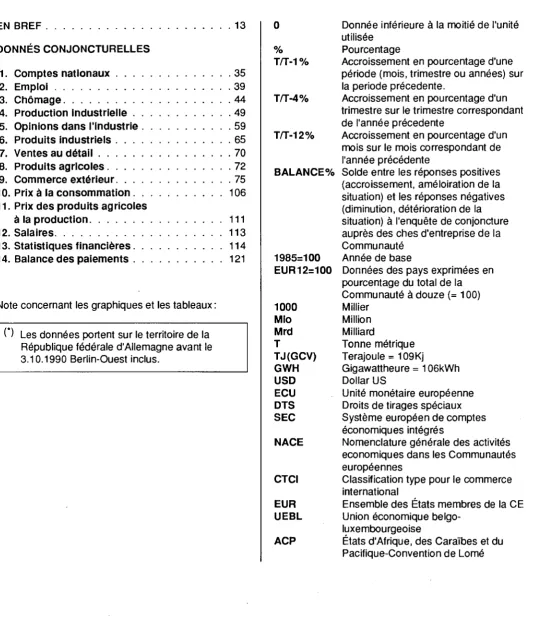
Table des matières
Signes et abréviations
EN BREF
13
DONNÉS CONJONCTURELLES
1. Comptes nationaux
35
2. Emploi
39
3. Chômage
44
4. Production Industrielle
49
5. Opinions dans l'industrie
59
6. Produits industriels
65
7. Ventes au détail
70
8. Produits agricoles
72
9. Commerce extérieur
75
10. Prix à la consommation
106
11. Prix des produits agricoles
à la production
m
12. Salaires
113
13. Statistiques financières
114
14. Balance des paiements
121
Note concernant les graphiques et les tableaux :
( ) Les données portent sur le territoire de la
République fédérale d'Allemagne avant le
3.10.1990 BerlinOuest inclus.
0
%
πτι
%
T/T4%
T/T12%
BALANCE%
1985=100
EUR12=100
1000
Mio
Mrd
Τ
TJ(GCV)
GWH
USD
ECU
DTS
SEC
NACE
CTCI
EUR
UEBL
ACP
Donnée inférieure à la moitié de l'unité
utilisée
Pourcentage
Accroissement en pourcentage d'une
période (mois, trimestre ou années) sur
la periode précédente.
Accroissement en pourcentage d'un
trimestre sur le trimestre correspondant
de l'année précédente
Accroissement en pourcentage d'un
mois sur le mois correspondant de
l'année précédente
Solde entre les réponses positives
(accroissement, améloiration de la
situation) et les réponses négatives
(diminution, détérioration de la
situation) à l'enquête de conjoncture
auprès des ches d'entreprise de la
Communauté
Année de base
Données des pays exprimées en
pourcentage du total de la
Communauté à douze (= 100)
Millier
Million
Milliard
Tonne métrique
Terajoule = 109KJ
Gigawattheure = 106kWh
Dollar US
Unité monétaire européenne
Droits de tirages spéciaux
Système européen de comptes
économiques intégrés
Nomenclature générale des activités
économiques dans les Communautés
européennes
Classification type pour le commerce
international
Ensemble des États membres de la CE
Union économique belgo
luxembourgeoise
États d'Afrique, des Caraïbes et du
PacifiqueConvention de Lomé
EUROSTATISTIQUES: en bref
Sauf indications contraires, les données portent sur le territoire de la République fédérale d'Allemagne avant le 3.10.1990, Berlin-Ouest inclus.
TAUX DE CHANGE: hausse des taux d'intérêt officiels en Italie, Suède
et États-Unis
Après de nombreux mois de baisse généralisée des taux d'intérêt en Europe, les taux officiels ont remonté en Italie et en Suède en août. À la suite de la faiblesse persistante de la lire, la Banque d'Italie a relevé ses taux directeurs de 0,5 % le 11 août, ce qui signifiait que le taux d'escompte, par exemple, passait de 7 à 7,5 %. La Riksbank, à titre d'opération préventive contre l'inflation, a relevé son taux de base aux banques de 0,5 % à 8 %.
L'effet immédiat de la hausse du taux italien a été un affaiblissement de la lire qui a atteint des records de baisse contre le deutsche mark à LIT 1 016,5 le 11 août avant de continuer sa descente les jours suivants, touchant le point LIT 1 026 le lendemain. À la fin d'août, elle s'est légèrement redressée par rapport à ces niveaux très bas, mais pour se retrouver à peine au-dessus des niveaux atteints avant la hausse du taux d'intérêt.
La couronne suédoise s'est également affaiblie après la hausse des taux d'intérêt suédois, mais s'est redressée vers la fin d'août.
Toutes les anciennes monnaies du mécanisme de variation étroite des taux de change sont restées à l'intérieur de leurs anciens couloirs à l'exception de la couronne danoise qui s'est récemment dépréciée légèrement contre le mark. L'escudo portugais a légèrement réagi à une baisse de 0,5% à 12% du taux d'invention sur le marché monétaire de la Banque du Portugal le 26 août; ce taux avait été relevé en juillet pour soutenir l'escudo.
Le sterling qui ne fait pas partie du mécanisme de change, s'est affaibli au cours des mois d'été, tombant au-dessous de DM 2,40 à la mi-août pour la première fois depuis mars depuis 1993, et ce, malgré des perspectives généralement saines pour l'économie du RU. La drachme grecque qui ne fait pas partie non plus du mécanisme de change, s'est affaiblie régulièrement contre le mark tout au cours de l'année: fin 1993, elle valait DR 142,58 et est tombée à DR 151,73 le 24 août, soit une dépréciation d'environ 6,4 %.
Le dollar US a continué d'être relativement faible tout au long des mois de juillet et d'août, et ce, en dépit d'un nouveau relèvement des taux d'intérêt à court terme: la Réserve fédérale a annoncé le 16 août que le taux d'escompte passerait de 3,5 % à 4 %, et que son objectif pour les fonds de la Fed était de remonter leur taux dans les mêmes proportions à 4,75 %, ce qui constitue la cinquième hausse de ce taux depuis le début de l'année.
Le dollar a touché à la baisse le niveau de Y 96,81 le 12 juillet avant de s'apprécier au-dessus de Y 100 pendant un certain temps en août, pour replonger ensuite au-dessous des — 100 à la fin du mois, puis de se réapprécier légèrement à Y 100,29 le 26 août. Il s'est montré également faible contre le mark, bien que nettement au-dessus de ses plus bas historiques.
RENDEMENTS DES OBLIGATIONS D'ETAT: nouvelles hausses des
rendements en juin; consolidation en juillet
Les rendements des obligations d'État ont continué à augmenter en juin à la suite des hausses de mai de sorte que dans plusieurs pays, jusqu'à maintenant, l'augmentation pour l'année est de plus de 2 %. Par exemple, les rendements en Espagne étaient en moyenne à 10,2% en juillet, alors qu'ils étaient à 7,8% en janvier, ceux du Portugal à 10,1 % en juin venant de 8,9 % en janvier.
Cependant, plusieurs de ces pays où les rendements ont fortement augmenté en 1994, tels que le Danemark et le Royaume-Uni, ont vu ceux-ci baisser légèrement en juillet.
Les rendements des obligations demeurent bas au Japon (4,6 % en juillet), mais aux États-Unis, ils sont maintenant environ d'1 % supérieurs à ceux de l'Allemagne. Étant donné que l'inflation est restée faible dans la plupart des pays, les rendements réels étaient dans certains cas à des niveaux très élevés. Par exemple, les rendements des obligations d'État à long terme ajustés de l'inflation en juin se situaient à plus de 5 % en Belgique, Espagne, France, Irlande et Italie et à plus de 6 % au Danemark, France et au Royaume-Uni. Ces taux réels sont nettement plus élevés que ceux de la fin 1993, lorsque leur taux moyen dans les pays de l'UE était de 3,9 % comparé à un chiffre provisoire de 5 % en juin 1994.
MASSE MONÉTAIRE: la croissance de M3 en France reste négative
Au cours des douze mois se terminant en mal 1994, M3 en France s'est réduit de 4,4 %, ce qui constitue la huitième contraction mensuelle successive. Cette situation peut toujours s'expliquer par le mouvement de certains dépôts d'épargne retirés des dépôts inclus dans M3 pour les inclure dans d'autres dépôts d'agrégats plus importants. Ces agrégats plus larges ont des croissances très rapides (taux de croissance de plus de 20 % par an dans certains cas), et la Banque de France estime que si l'on exclut ces transferts de fonds, la contraction de M3 serait de l'ordre de 1 % sur une base annualisée.
La croissance de M3 en Allemagne s'est ralentie à 9,8 % au cours des douze mois se terminant en juin, son plus faible taux de croissance cette année, qui reste cependant quelque peu supérieur à la fourchette de 4-6 % de croissance que s'était fixé la Bundesbank.
RÉSERVES OFFICIELLES SUR L'ÉTRANGER: les réserves du Japon
continuent de s'accroître
Après les niveaux records atteints en avril 1994, les réserves ont continué d'affluer au Japon en mai et juin pour s'établir à plus de 95 milliards d'ECU à la fin de juin. Cet afflux de réserves peut être interprété à la lumière des interventions sur le marché des changes de la Banque du Japon comme un soutien au dollar qui, comme nous l'avons vu, se déprécie régulièrement contre le yen durant la plus grande partie de l'année. C'est pourquoi la Banque du Japon a vendu du yen contre du dollar accroissant ainsi ses réserves de change sur l'étranger.
Dans l'UE, la Belgique, l'Irlande et l'Italie ont enregistré de très fortes rentrées au cours des six premiers mois de 1994, bien que pour les deux premiers pays, les réserves sont maintenant approximativement au même niveau qu'il y a douze mois. Au cours de la même période, le Danemark et l'Espagne ont enregistré des sorties de réserves.
Les réserves de Taïwan, aux alentours de 90 milliards de dollars, ont atteint un plus haut historique en juin 1994 après que des fonds étrangers aient procédé à des investissements en actions taïwanaises. Le précédent record avait été atteint en septembre 1992.
COMPTES TRIMESTRIELS: Premier trimestre 1994: évolution positive de l'économie de l'Union européenne (PIB +0,7 %)
Au cours du premier trimestre 1994, on a constaté, pour l'économie de l'Union européenne dans son ensemble, une bonne reprise de la croissance économique (PIB +0,7 %). Celle-ci se produit après deux années d'incertitude et de récession. Le bon résultat du premier trimestre est encore plus significatif s'il on considère que, en général, le premier trimestre est assez faible sur le plan structurel et que, du point de vue météorologique l'hiver 1994 a été assez dur en défavorisant certaines activités comme, par exemple, l'agriculture, les constructions, etc.. Ce résultat pourrait représenter la vraie inversion des tendances de la plupart des indicateurs guides, au niveau macro-économique, indiqués pour la première partie de l'année en cours. D'autre part, il convient d'être assez prudent avant de se lancer dans des interprétations trop optimistes de le situation économique actuelle. En effet, plusieurs problèmes caractérisent encore la situation économique comme, par exemple, le chômage et la réduction des déficits publics. A ce problème ¡I faut ajouter les nouvelles tensions qui ont caractérisé récemment les marchés financiers et les devises et qui risquent de déstabiliser l'économie mondiale dans un moment critique tel que celui de la sortie d'une phase négative.
En ce qui concerne l'Inflation, nous ne disposons pas de données pour l'Union européenne à cause du fait que la France n'a pas encore publié ses données à prix courant. Malgré tout, sur la base des résultats disponibles on peut émettre l'hypothèse que l'inflation, au cours du premier trimestre 1994, sera caractérisée par une nouvelle baisse.
En ce qui concerne les composantes du PIB, il nous semble utile de mettre en évidence la forte reprise des investissements (+1,6 %) et l'évolution positive de la consommation privée (+0,7 %), tandis que la consommation publique présente un léger fléchissement (-0,2 %).
En ce qui concerne la situation dans les Etats membres, il convient aussi de souligner la forte croissance de la production en Allemagne (+1,2%) et aux Pays-Bas (+1,0%). D'autre part, le Royaume-Uni et l'Espagne présentent des croissances plus ou moins dans la moyenne communautaire (+0,8 % et +0,7 % respectivement). La France et le Danemark se caractérisent, par contre, par des évolutions un peu moins prononcées (+0,5 % et +0,4 % respectivement), tandis que l'Italie semble encore trop fatiguée pour sortir de la phase d'incertitude (+0,1 %). Aux Etats-Unis, évolution positive de la croissance économique (PIB +0,7 %) accompagnée, par une reprise de l'inflation (+0,7 %). Parmi les composantes de la demande interne, on constate la forte augmentation des investissements et de le consommation privée (+1,6 % et +1,1 % respectivement), tandis que la consomma-tion publique fléchit de manière considérable (-0,9 %).
Au Japon, sensible croissance de la production (PIB +1,0 %) accompagnée par une légère déflation (-0,1 %). Du côté des emplois, on constate la forte progression de la consommation privée (+1,4%) qui est accompagnée par un nouveau fléchisse-ment des investissefléchisse-ments (-0,8 %). Par contre, la consommation publique présente une évolution plutôt faible (+0,5 %).
PRIX: l'inflation annuelle de l'UE tombe à 3 , 0 % en juillet
îflatinn Après être resté inchangé à 3,2 % pendant 4 mois consécutifs, le taux d'inflation annuelle pour l'UE — mesuré par l'IPC — est tombé à 3,0 % en juillet. Il y a un an, ce taux était de 3,5 %.
Le taux de 3,0 % est le taux le plus bas depuis plus de 7 ans (mars 1987: également 3,0 %).
Entre juin et juillet, l'indice mensuel pour EUR12 est resté inchangé grâce à des baisses des indices de la France (-0,1 %), du Danemark (-0,2 %), du Royaume-Uni (-0,5 %) et de la Grèce (-1,6 %), ainsi qu'à des accroissements faibles ou modérés en Allemagne (+0,1 %), au Portugal (+0,2 %), en Italie (+0,3 %), au Luxembourg, en Espagne et aux Pays-Bas (tous +0,4 %) et en Belgique (+0,6 %).
Dans l'ordre croissant de l'inflation actuelle, les taux annuels des Etats membres pour les mois de juillet et ceux d'il y a un an sont:
Juillet '94 Juillet '93 France 1,6 %p Danemark 2,0 % Luxembourg 2,2 % RoyaumeUni 2,3 % PaysBas 2,7 % Belgique 2,7 %
Juillet '93 Juillet '92 2,1 % 1,2 % 3,5 % 1,4 % 2,5 % 2,6 %
Irlande** Allemagne* Italie Espagne Portugal Grèce
Juillet '94 Juillet '93 2,7 % 2,9 % 3,8 %p 4,7 % 5,1 % 11,2 %
Juillet '93 Juillet '92 1,0 % 4,3 % 4,6 % 4,9 % 5,7 % 15,7 % L'IPC pour la R.F. d'Allemagne continue à se rapporter à la situation territoriale d'avant le 3 octobre 1990.
· ' Mai 94/Mai 93 et Mai 93/Mai 92 ρ Provisoire
Les taux des Etats candidats à l'adhésion à l'UE sont : Norvège 1,4 % (2,2 %), Finlande 1,6 % (2,1 %), Suède 2,7 % (4,6 %) et Autriche 2,8 % (3,5 %). Les taux correspondants de quelques autres pays sont : EtatsUnis 2.8 % (2,8 %), Japon 0,2 % (1,9 %), Canada 0,2 % (1,6 %) et Suisse 0,6 % (3,4 %).
LA PRODUCTION INDUSTRIELLE PART DE L'AVANT
La production industrielle dans la Communauté européenne (UE) est désormais en nette augmentation. Cet essor ne fait aucun doute, cependant, il n'a encore eu aucun impact sur la situation de l'emploi.
Le taux de variation de l'indice de la production industrielle corrigé des jours ouvrables s'est élevé en avril 1994 par rapport à la valeur du même mois un an auparavant à 4,7 %, en mai à 4,0 %. Si l'on considère le taux de variation de l'indice
de la production désaisonnalisée de l'UE des trois derniers mois disponibles maré à mai par rapport aux trois mois précédents (décembre à février), il s'élève à +2,1 %. L'emploi dans l'industrie marque cependant une baisse de 5 % en avril 1994 par rapport à avril 1993.
Au Japon, le taux de variation de février à avril 1994 par rapport aux mois précédents pour la production industrielle s'est élevé à +0,8. Aux USA, on observe un mouvement stable à la hausse +1,6 %.
Pour les groupes de biens principaux, on observe dans l'Union européenne le tableau suivant (taux de variation février à avril par rapport aux trois mois précédents):
industrie des biens intermédiaires: +1,6 % industrie des biens d'investissement: 2,6 % industrie des biens de consommation durables: 2,1 % industrie des biens de consommation non durables: 1,0%
Ces chiffres montrent que l'essor de la demande de biens d'investissement et de biens de consommation durables est soutenu, tandis qu'il y a stagnation dans les domaines des biens de consommation non durables (alimentation, textile, habille ment).
Pour les différents États membres de l'Union européenne, les taux de variation de la production industrielle désaisonnalisée, dans la mesure où ils sont disponibles pour février à avril par rapport aux trois mois précédents, se présentent comme suit: Luxembourg +3,6%, Italie +3,5%, Espagne +2,6%, Allemagne +2,6%, Grèce +1,7 %, Danemark +1,6 %, PaysBas +1,3 %, RoyaumeUni +0,9 %, France +0,5 %. Ainsi, dans au moins neuf États membres (aucun chiffre actuel n'étant disponible pour la Belgique, l'Irlande et le Portugal), la période de récession a été surmon tée.
Cependant, pour l'emploi, on ne décèle encore aucun retournement. En avril 1994, par rapport à avril 1993, l'emploi dans l'industrie a baissé de 2 % au Danemark, 8 % en Allemagne, 4 % en Espagne, 3 % en France, 2 % en Grèce, 5 % en Italie et 4 % au Luxembourg. Au RoyaumeUni, la situation est inchangée à 0 %.
SCHAUBILDER
GRAPHICS
11
9
8
7
6
5
4
3
2
1
—
+
"'
—
—
,.·
ι I
A R B E I T S L O S E N Q U O T E N
SAISONBEREINIGT
—-.
„ — —
'"
• a , ■ · ' · · · ■ « ■ » ι , ■ ' * ■ '
Ι
ι ι i ι ι Ι ι ι
— —
Ι Ι
EUR
_ ^ - ^ ~
,
( χ,
, ,
Ι < ι Ι ι
U N E M P L O Y M E N T R A T E S
SEASONALLY ADJUSTED
—
""*«..—
-ι Ι -ι ,
USA
ι ι Ι ι ι Ι ι ι Ι ι ι
TAUX D E CHOMAGE
DESAISONNAUSE
JAPAN
■ **·.
ι
ι Ι ι ι Ι ι ι Ι ι
—
—
—
—
—
1
1991
1992
1993
1994
11
10
g
8
7
6
5
4
3
2
1
0
ARBEITSLOSENQUOTEN
MSGESAMT/SAISONBERHNIGT UAEffflER/SAISONBEREDflGT nUUBf/SUSONBEKHNIGT
UNEMPLOYMENT RATES
EUR
TOTAL/SEASONALLY ADJUSTED MEN/SEASONALLY ADJUSTED
TOHEN/SEASONAIXY ADJUSTED
TAUX DE CHOMAGE
TOTAl/DESAISOMNAUSE HOIQIES/DESAISONNAIISE
FEUŒS/DESAISOMNAUSE
ι ι Ι ι ι Ι ι ι 1
1991
J I I I I I I I I I L
1992
J I I I I I L·
1993
_l I I I I I L
1994
Ι ι ι
15
14
13
12
11
10
9
β
7 β
5
ARBEITSLOSENQUOTEN
SAISONBEREINIGT
UNEMPLOYMENT RATES
SEASONALLY ADJUSTED
%
TAUX DE CHOMAGE
DESAISONNALISE
"IRL
E
■I1991
1992
1993
1994
— I I ' ' L _l I I I I I I I I I I I I 1 L
— I 1 2
11
10
— 8
— 7
I . . I .
1991
1992
1993
1994
1991
1992
1993
1994
ARBEITSLOSENQUOTEN
SAISONBEREINIGT
UNEMPLOYMENT RATES
SEASONALLY ADJUSTED
TAUX DE CHOMAGE
DESAISONNALISE
50Γ 40 30 20
io-BELGIQUE - BELGIË
' I n ' l u i l u l l i i n i LulU
1991
1992
1993 1994
DANMARK
¡τ 11 Ι ■ ι ' ■ " a
Ι ι ι Ι ι ι Ι ι ι Ι ι ι Ι ι ι Ι ι ι Ι ι ι Ι ι ι Ι ι ι Ι ι ι Ι Ι
1991
1992
1993 1994
50 40 30 20
ιο-DEUTSCHLAND (*)
Ι Ι ι ι Ι ι ι Ι Ι ι ι Ι ι ι Ι ι
1991
1992
1993
1994
50 40 30 :
20
ιο-0L
ESPANA
i l i i l i i l i i l i i l Ι I n l . i l i i l . i l ,
1991
1992
1993 1994
FRANCE IRELAND
■'■■' I I Ι ι ι Ι ι ι Ι
1991
1992
1993 1994
1991
1992
1993 1994
50 40
30 =
20"
10'
0L
ITALIA NEDERLAND
i l i i l i i l i i l i i l n l i i l i . Ι ι ι Ι ι ι Ι ι ι Ι ι , Ι . ι Ι ι ι Ι . ι Ι ι ι
1991
1992
1993 1994
Q I n ' ' n i l Ι , . Ι ι . Ι , , Ι , ι Ι i l ,
1991
1992
1993 1994
PORTUGAL
I n ' I " l u i n
1991
1992
1993 1994
50
40
30
20
10
0
UNITED KINGDOM
ι ' " ' I I I n i n
1991
1992
1993 1994
USA
i l i l l ι i l l i l l i l n I i l I n i n ι ι 111 1111 11111 1 1 1 1 1
1991
1992
1993 1994
Iloina de 25 ans
INDUSTRIELLE PRODUKTION
TENDENZ 1985=100
INDUSTRIAL PRODUCTION
TREND 1985=100
PRODUCTION INDUSTRIELLE
TENDANCE 1985=100
NACE 1-4
130
125
1 2 0 —
115
110
1 0 5 —
100
EUR
U S Aj i _ l ι ι I ι ι I ι ι I ι ι I ι ι I ι ι I ι ι I ι i _ J ι ι I ι ι Ι ι ι Ι ι L J A P A N
Ι Ι Ι Ι Ι Ι L
130
125
120
115
110
105
100
1991
1992
1993
EDiMCH-LOGASiraiDSCHE SKAU sna-mGuuranc SCAIE
1994
ICHKUI SnU-LOGAHIBMOm
INDUSTRIE HACE 1 - 4
GRUHDST. U. PRODUKTIONSGUETER INYÏSTITIONSGUETER
ÏERBRAUCHSGUBTER
EUR
INDUSTRY NACE 1 - 4 INTERMEDIATE GOODS CAPITAL GOODS CONSUMER GOODS
MDUSTRD! NACE 1 - 4 BIENS DÎTERMEDIADÎES BIENS DTNVESTISSEMENT BDÎNS DE CONSOMMATION
130
1991
1992
1993
1994
EDÍTACH-LOGAKITBMBCBI SKAU SUO-LOGARITHMIC S C i l i ICHOU Snn-U>GAI!nHMQÜK
150
140
130
120
110
100
90
INDUSTRIELLE PRODUKTION
BELGIQUE - BELGLE
Ι ι ι Ι ι ι Ι I n i , i l l u l l
INDUSTRIAL PRODUCTION
NACE 1-4 1985=100
DANMARK
1991
1992
1993
1994
150
140
130
120
HO
100
90
>^*W
. I I I I I I I I I I M I I I ι I , ι Ι ι ι Ι η Ι η Ι ι , Ι ι , Ι η Ι ι
150
140
130
120
110
-PRODUCTION INDUSTRIELLE
DEUTSCHLAND (♦
100-1991
1992
1993
1994
90ι I ' n i
1991
1992
1993
1994
150
140
130
120
110
100
90
ELLADA ESPANA FRANCE
, 1 , i l , i l i , I n i , , Ι ι , I , l i n i , , I n i , , l u l l
1991
1992
1993
1994
150
140
130
120
110
100
90 I n i I I "
150
140
130
120
110
100-1991
1992
1993
1994
90I I n i '
1991
1992
1993
1994
IRELAND
180-
170-
160-150;
140"
130-
120-
110-100 ι t Ι M l i ι t ι ι Ι ι ι Ι ι ι Ι Μ Ι ι ι 1 ι ι ! ι ι Ι ι ι Ι ι ι Ι ι i l ι ι Ι ι ι Ι ι ι
1991
1992
1993
1994
150
140
130
120
110
100
90
ITALIA
11 ι ι 11 ι Ι ι ι 1 ι ι Ι ι ι Ι ι ι Ι ι ι Ι ι i i ι ι Ι ι ι Ι ι ι 1 ι ι Ι ι t Ι ι ι Ι ι ι
1991
1992
1993
1994
150
140
130
120
110
100
90
LUXEMBOURG
I 1 I I l l I i l 1 1 I l i ! I I I 1 I I I I I l l I I I I I I I
1991
1992
1993
1994
150-
140-
130-
120110
-
100-NEDERLAND
90 I . . ' . . I . . I n I I , i l i , I n i ,
1991
1992
1993
1994
150
140
130
120
110
100
90
PORTUGAL UNITED KINGDOM
■ I i i Ι ι ι I H i I ) I t ι 1 ι ι Ι ι ι I n l ι ι Ι ι ι Ι ι ι Ι ι ι ! ι ι Ι ι ι Ι ι
1991
1992
1993
1994
150
140
130
120-
110100
-90 . l u l l i i n i . l u l u I '
1991
1992
1993
1994
nWACB-LOGUBIH)OSCHISÏAU snfl-LOGAHTHUC SCALI (CHILLI Sna-LOGUHTBaQUI