This content has been downloaded from IOPscience. Please scroll down to see the full text.
Download details:
IP Address: 143.167.30.213
This content was downloaded on 02/11/2016 at 10:21
Please note that terms and conditions apply.
You may also be interested in:
Offline Software of RPC Detector System in Daya Bay Reactor Neutrino Experiment Qingmin Zhang, Miao He, Jilei Xu et al.
Conceptual design and simulation of a water Cherenkov muon veto for the XENON1T experiment E. Aprile, F. Agostini, M. Alfonsi et al.
Future perspectives of double beta decay and dark matter search - GENIUS H V Klapdor-Kleingrothaus, J Hellmig and M Hirsch
Cosmogenic Backgrounds in Borexino at 3800 m water-equivalent depth G. Bellini, J. Benziger, D. Bick et al.
A Fluka study of underground cosmogenic neutron production A. Empl, E.V. Hungerford, R. Jasim et al.
Muon and cosmogenic neutron detection in Borexino G Bellini, J Benziger, D Bick et al.
Can muon-induced backgrounds explain the DAMA data?
View the table of contents for this issue, or go to the journal homepage for more 2016 J. Phys.: Conf. Ser. 718 042033
Can muon-induced backgrounds explain the DAMA
data?
Joel Klinger1
and Vitaly A. Kudryavtsev
Department of Physics and Astronomy, University of Sheffield, Sheffield, S3 7RH, UK
E-mail: [email protected]
Abstract. We present an accurate simulation of the muon-induced background in the
DAMA/LIBRA experiment. Muon sampling underground has been performed using the
MUSIC/MUSUN codes and subsequent interactions in the rock around the DAMA/LIBRA detector cavern and the experimental setup including shielding, have been simulated with Geant4.9.6. In total we simulate the equivalent of 20 years of muon data. We have calculated the total muon-induced neutron flux in the DAMA/LIBRA detector cavern as Φµ
n= 1.0×10
−9 cm−2s−1, which is consistent with other simulations. After selecting events which
satisfy the DAMA/LIBRA signal criteria, our simulation predicts 3.49×10
−5 cpd / kg / keV
which accounts for less than 0.3% of the DAMA/LIBRA modulation amplitude. We conclude
from our work that muon-induced backgrounds are unable to contribute to the observed signal modulation.
1. Introduction
The DAMA/LIBRA experiment [1] utilises radiopure NaI(Tl) scintillators to measure the annual modulation signature of dark matter particles and is located at the Gran Sasso National Laboratory (LNGS). Both the DAMA/LIBRA experiment and the first generation DAMA/NaI experiment reported the observation of an annual variation in the number of observed single hit events with 2–6 keV energy depositions, with a combined significance of approximately 9.3σ [2]. The claim was challenged by several other experiments that had achieved superior sensitivity to interactions of Weakly Interacting Massive Particles (WIMPs) (see, for instance [3–6]).
One mechanism that has been proposed to explain the DAMA signal modulation is the production of neutrons due to the scattering of cosmic-ray muons in the materials surrounding the detector [7–9]. The muon flux is expected to have an annual variation related to the mean air temperature in the upper atmosphere. Several papers have focused on the statistical analysis of the phase of the annually modulated signal reported by DAMA/LIBRA [10, 11]. The proposal linking DAMA/LIBRA modulation with neutrons has been disputed for a number of reasons [12], namely as the event rate is expected to be too low, and that the annual variation of cosmic-ray muons is approximately 30 days out of phase with the DAMA signal [11–14].
An extension to this mechanism has also been proposed, which introduces a contribution to the total neutron flux from the interactions of solar neutrinos [15]. The solar neutrino-induced neutron flux, Φν
n, is also expected to have an annual modulation, due the eccentricity of the
Earth’s orbit about the Sun. The combination of muon- and neutrino-induced neutrons were
1
claimed to shift the phase of Φν
nrelative to the muon-induced neutron flux, Φ µ
n, in agreement with
DAMA/LIBRA data while the amplitude of the neutron flux modulation was estimated to be consistent with that measured by DAMA. It was later shown that the expected neutrino-induced neutron flux is at least a factor of 106
too small to explain the DAMA data [16].
We present here an accurate calculation of muon and muon-induced neutron fluxes to show that the DAMA/LIBRA signal modulation cannot be explained by a muon-induced mechanism. We have performed for the first time, a full simulation of the DAMA/LIBRA apparatus and shielding inGeant4.9.6[17], with muons transported to the LNGS underground location using
the MUSIC code [18]. In total, we simulated 20 years of muon-induced data [19].
2. Simulation framework
The simulations of particle transport and detection were carried out in two stages. In the first stage, muons were propagated from the Earth’s surface to the underground location using the MUSIC code [18, 20] while the production and transport of secondary particles were neglected. In the second stage, muons were generated around the underground laboratory according to their energy spectrum and angular distribution with MUSUN [18] and all particles, including those in muon-induced cascades were fully simulated using the Geant4.9.6 toolkit [17] with
the ‘Shielding’ physics list. In total, statistics equivalent to about 20 years of live time were simulated.
A cavern with a height, width and length of 20 m, 10 m and 30 m respectively, was positioned within the box where muons were sampled, such that there was 10 m of LNGS rock overburden, and 5 m of LNGS rock surrounding the cavern walls and floor. The DAMA/LIBRA detector housing was placed halfway along the length of the cavern and adjacent to a cavern wall. The DAMA/LIBRA apparatus and a detector housing were described in detail in Ref. [1]. There are a number of layers of shielding surrounding the DAMA/LIBRA detector. Extending outwards from the detector, we model 10 cm of copper, 15 cm of lead, 1.5 mm of cadmium, 50 cm of polyethylene and 1 m of LNGS concrete.
The DAMA/LIBRA detector is composed of 25 modules arranged in five columns and five rows. Each module was modelled as containing a central cuboidal NaI crystal of size 10.2×10.2×25.4 cm3
and a mass of 9.7 kg, with two trapezoidal quartz light-guides attached to the two ends. The rear of each light-guide was attached to a photomultiplier tube (PMT). Each PMT was made of glass, with a cuboidal ‘head’ which was attached to the light-guide, and a cuboidal ‘base’ which was attached to the PMT head.
3. Muon-induced neutrons: results
Muons and secondary particles were transported through 10 m of LNGS rock above and 5 m on the sides of the DAMA/LIBRA cavern. Integrating over the surface area of the cavern, our simulation predicts a muon-induced neutron flux (excluding back-scattering) of Φµ
n= 1.0×10
−9 cm−2 s−1. We define the back-scattered neutron flux as including independent counts from neutrons that re-enter the corridor after exiting due to scattering in the surrounding rock. These results are consistent with previous simulations [21, 22] within 30% when converted to the same size of the cavern.
A potentially significant enhancement of Φµ
nmay be caused by muons traversing the detector
shielding [7–9, 15] containing a large amount of lead and copper. Figure 1 shows the Φµ n as
a function of neutron energy, as calculated for the LNGS cavern and inside all layers of the DAMA/LIBRA shielding. The neutron flux Φµ
ninside the shielding increases by a factor of 2–40
(depending of the energy) due to the presence of high-A target (Cu and Pb).
All particles depositing energy in a detector module have been included in the analysis. Each detector module has been treated independently and all information due to an energy deposition in the NaI crystal volumes has been recorded. The DAMA/LIBRA experiment categorises events
Neutron kinetic energy [MeV] -1
10 1 10 102 103
/ s / MeV]
2
[n / cm
n µ Φ -14 10 -13 10 -12 10 -11 10 -10 10 -9 10 -8
10 Rock walls
[image:4.595.103.490.113.246.2]Detectors
Figure 1. The energy spectrum of neutrons entering the cavern with DAMA/LIBRA (black dashed line) and entering the DAMA/LIBRA detector modules after all shielding is traversed (solid red line). The back-scattering of neutrons have been included in simulations.
as being single hit or multiple hit events depending on whether the event has an energy deposit in only a single crystal or in several crystals respectively. The DAMA/LIBRA signal region, in which the modulated signal was observed, has then been defined only for single hit events with an energy deposit in the range 2–6 keV.
We model the DAMA/LIBRA experimental resolution by applying a Gaussian smearing to the sum of all energy deposited in each crystal, using resolution parameters provided by Ref. [1]. The quenching of energy depositions associated with nuclear recoils has been corrected for by using values obtained from previous studies [23–27], although the spectral differences and overall effect caused by different quenching factors have been found to be small. An important detail that was neglected in previous attempts to explain the DAMA/LIBRA data [7–9, 15] is the acceptance for single hit events. Figure 2 shows the number of crystals hit in events with energy depositions of at least 2 keV per crystal. About 8% of these events are events with only one crystal hit.
> 2 keV per event
Dep
Number of crystals with E
1 2 3 4 5 6 7 8 910 11 12 13 14 15 16 17 18 19 20 21 22 23 24 25
Percentage of events
0 2 4 6 8 10
Figure 2. Distribution of the number of hit crystals in events with energy depositions of at least 2 keV per crystal, Events in which at least one crystal has a total energy deposition in the range 2–6 keV were considered.
Energy deposition per crystal [keV]
0 2 4 6 8 10 12 14 16 18 20
Crystals with signals
[image:4.595.73.280.501.598.2]0 50 100 150 200 250 300 350 400
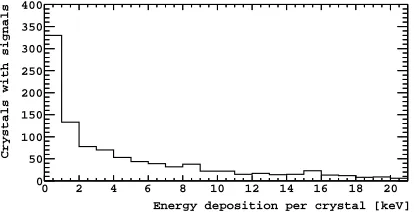
Figure 3. The distribution of the total energy deposition in single hit events. The energy resolution and quenching have been taken into account.
The distribution of the energy deposited in crystals in single hit events is shown in Figure 3. There is a significant fraction of events above 6 keV which are not seen in modulated signal by DAMA/LIBRA. For muon-induced background below 20 keV, the event rate is dominated by isolated neutrons.
[image:4.595.313.520.505.611.2]therefore we predict the rate of muon-induced events in this energy range to be 3.49×10⁻⁵ events / kg / day / keV with a statistical uncertainty of about 6%. The systematic uncertainty can be estimated to be 30% from the observed differences between calculated neutron fluxes at LNGS as mentioned above. Note that previous simulations [21, 22] were carried out with a different Monte Carlo code (FLUKA) or a different version of Geant4. The calculated event
rate accounts for less than 0.3% of the modulation amplitude reported by DAMA/LIBRA of (1.12±0.12)×10−2 cpd / kg / keV [2]. It is clear from this comparison, that muon-induced neutrons can not explain the observed signal modulation, in agreement with [13, 14]. Even if the systematic uncertainty is larger than our estimates, muon-induced background is too low to explain the observed signal modulation. Our simulations also show that, if muon-induced backgrounds were to explain the DAMA data, one should expect a significant modulation of the background above 6 keV, as well as for events with multiple hits, which is not seen by DAMA.
4. Discussion
In fact, the conclusion that muon-induced neutrons cannot explain the DAMA data can be reached before any estimate of Φµ
n is performed.
We can consider any possible source of modulated signal, including dark matter, as has been done in Ref. [28]. The measured rate of events at DAMA/LIBRA is dominated by radioactive background above 6 keV, which imposes a strict limit on any interpretation of the modulated signal. This background, if due to radioactive contamination of the materials around the NaI crystals (electrons caused by the Compton scattering of high-energy gamma rays), is almost flat at low energies [28], with the exception of a peak from 40
K at about 3 keV, which agrees with the DAMA measurements. To preserve the shape (‘flatness’) of the radioactive background in the region 2–6 keV, the total signal should be small and hence, the modulated fraction of the signal should be large. As an example, the measured modulated signal rate of 0.0190 counts / day / kg / keV at 2–3 keV, assumed to be 5% of the total (average) signal, will give the total signal rate of 0.38 counts / day / kg / keV. This is already a significant fraction of the total measured rate at 2-3 keV (about 30%), requiring the radioactive background rate to drop by 30% at this energy whilst maintaining a flat background above 6 keV. No model of radioactivity predicts a dip in the background below 6 keV [28].
Let us now consider muon-induced backgrounds within this context. We assume that Φµ n
and Φµ are modulated in a similar way, linked to the mean muon energy at LNGS [29]. The
LVD [30] and Borexino [31] experiments have observed a muon flux modulation in the range of (1.3-1.5)% of the total Φν
n. If the modulated signal in DAMA is due to a muon-induced effect,
then the total rate of this ‘effect’ at 2-6 keV will be 0.0112/0.014≈0.8 counts / day / kg / keV. This is approximately equal to the total rate of∼1 counts / day / kg / keV observed by DAMA in the 2–6 keV energy range [2]. The effect is more dramatic in the 2-3 keV energy range, where the modulated signal is approximately 0.0190 counts / day / kg / keV [2]. This would imply a total muon-induced background of 0.0190/0.014 ≈1.4 counts / day / kg / keV, which is higher that the total rate of events observed by DAMA. This is excluded by radioactivity models [28]. It is clear that for any explanation of the DAMA signal to be consistent with the measured spectrum of events, it must satisfy the following qualitative criteria:
• The amplitude of the effect must be very small compared to the DAMA event rate.
• The average event rate of the signal should not then be much bigger than the modulation amplitude.
• Any effect not satisfying the latter two criteria implies that there is a new model of suppressed radioactivity in the region 2–6 keV, that does not apply above 6 keV.
• The modulation must only affect single-hit events, whilst disregarding multiple-hit events.
• The explanation must simultaneously predict the phase and the period of the modulation.
An explanation which incorporates muon-induced backgrounds cannot satisfy these criteria. Any other model claiming to explain the DAMA data including the dark matter hypothesis, should also satisfy these criteria, in particular the requirement that the average amplitude of the effect should not be much bigger than the modulation amplitude (see also [28] for details).
5. Conclusions
We have presented an accurate simulation of the muon-induced background in the DAMA/LIBRA experiment, in response to proposals to explain the observed DAMA signal modulation with muon-induced neutrons. We have performed a full simulation of the DAMA/LIBRA apparatus, shielding and detector housing usingGeant4.9.6.
We have calculated the muon-induced neutron flux in LNGS to be Φµ
n= 1.0×10
−9 cm−2 s−1 (without back-scattering), which is consistent with previous simulations. After selecting events which satisfy the DAMA signal region criteria, our simulation predicts a background rate of 3.49×10⁻⁵ counts / day / kg / keV. This accounts for approximately 0.3% of the modulation amplitude and should then be even a smaller fraction of the total signal amplitude. We find that one would expect a non-negligible modulation of muon-induced background above 6 keV, as well as for events with multiple hits, which is not seen by DAMA.
We conclude from our study that muon-induced neutrons are unable explain the DAMA data. Furthermore, a large signal event rate, independently of the source of this signal, is inconsistent with radioactive background models.
References
[1] Bernabei Ret al.2008Nucl. Instrum. Meth. A592297 (Preprint astro-ph/0804.2738) [2] Bernabei Ret al.2013Eur. Phys. J.C732648 (Preprint astro-ph.GA/1308.5109) [3] Armengaud Eet al.2012Phys. Rev. D86(5) 051701 (Preprint astro-ph.CO/1207.1815) [4] Akerib D Set al.2014Phys. Rev. Lett.112091303 (Preprint astro-ph.CO/1310.8214) [5] Agnese Ret al.2014Phys. Rev. Lett.112241302 (Preprint astro-ex/1402.7137) [6] Aprile Eet al.2012 Phys. Rev. Lett.109(18) 181301 (Preprint astro-ph.CO/1207.5988) [7] Blum K 2011 (Preprint astro-ph.HE/1110.0857)
[8] Ralston J 2010 (Preprint astro-ph/1006.5255) [9] Nygren D 2011 (Preprint astro-ph/1102.0815)
[10] Fernandez-Martinez E and Mahbubani R 2012JCAP 07029 (Preprint astro-ph.HE/1204.5180) [11] Chang Set al.2012Phys. Rev. D85(6) 063505 (Preprint hep-ph/1111.4222)
[12] Bernabei Ret al.2013Intern. J. Modern Phys. A281330022 (Preprint astro-ph.GA/1306.1411)
[13] Bernabei Ret al.2012The European Phys. J. C 722064 ISSN 1434-6044 (Preprintastro-ph.GA/1202.4179) [14] Bernabei Ret al.2014The European Phys. J. C 743196 ISSN 1434-6044 (Preprint hep-ph/1409.3516) [15] Davis J H 2014 Phys. Rev. Lett.113(8) 081302 (Preprint hep-ph/1407.1052)
[16] Barbeau P Set al.2014 Phys. Rev. Lett.113(22) 229001 (Preprint hep-ph/1409.3185) [17] Agostinelli Set al.2003Nucl. Instrum. Meth. A506250
[18] Kudryavtsev V A 2009 Computer Physics Communications 180339 (Preprint comp-ph/0810.4635) [19] Klinger J and Kudryavtsev V A 2015Phys. Rev. Lett.114151301
[20] Antonioli Pet al.1997 Astroparticle Physics7356 [21] Wulandari Het al.2004 (Preprint hep-ex/0401032) [22] Persiani R 2011PhD Thesis, University of Bologna
[23] Tovey Det al.1998Phys. Lett. B433150 [24] Spooner Net al.1994 Phys. Lett.B321156
[25] Chagani Het al.2008Journal of Instrumentation 3P06003 (Preprint ins-det/0806.1916) [26] Gerbier Get al.1999Astropart. Phys.11287–302
[27] Simon E et al.2003Nucl.I nstrum. Meth.A507643 (Preprint astro-ph/0212491) [28] Kudryavtsev V Aet al.2010Astropart. Phys.3391
[29] Kudryavtsev V Aet al.2003Nucl. Instrum. Meth.A505688 [30] Selvi M (LVD Collaboration) 2009Proceedings of the 31st ICRC