A Thesis Submitted for the Degree of PhD
at the
University of St Andrews
1968
Full metadata for this item is available in
St Andrews Research Repository
at:
http://research-repository.st-andrews.ac.uk/
Please use this identifier to cite or link to this item:
http://hdl.handle.net/10023/14458
O K B A C T B R I A L
«■— A iv! Y L A S B S
by
William Macdonald Ledingliam, B.Sc
A thesi©
submitted to the University of St#Andrews in application for the Dojiree of Doctor
of Philosophy ■t nn«ii ti inr«mrnn» n- ---■■ iiMiniiinini #m»i* # 'iiM imi i jfim.
Biochemistry Department, Th e Unive rsity,
INFORMATION TO ALL USERS
The qua lity of this reproduction is d e p e n d e n t upon the qua lity of the copy subm itted.
In the unlikely e v e n t that the author did not send a c o m p le te m anuscript and there are missing pages, these will be noted. Also, if m aterial had to be rem oved,
a n o te will in d ica te the deletion.
uest
ProQuest 10166329
Published by ProQuest LLO (2017). C o pyright of the Dissertation is held by the Author.
All rights reserved.
This work is protected against unauthorized copying under Title 17, United States C o d e M icroform Edition © ProQuest LLO.
ProQuest LLO.
789 East Eisenhower Parkway P.Q. Box 1346
is based on work carried out by me, that the thesis is my own composition, that no part of it has been presented previously for a higher degree.
The research i^as carried out in the
Department of Biochemistry of the United College of
C 8 R T I F I C A T B
I hereby certify that William Ledingham has spent nine terme in research work under my direction, and that he has fulfilled the
Andrewe in October 1959, and graduated with the degree of Bachelor of Science, Second Class Honours in Biochemistry in June 1963.
In October 1963, I was awarded an Agricultural Research Council Studentship to study Microbiology under the direction of Professor S. R. Blsden in
the Department of Microbiology, University of Sheffield.
In October 1964, I was appointed Assistant Lecturer in Biochemistry in the University of
ACKKOi’JLBDGMBNTS
Grateful thanks are extended to my supervisor Dr, Stephen Bayne for hie interest and oriticiem throughout this work. I should also like to thank Dr. W. E. Hornby for his helpful advice and encouragement concerning
the CM-C0llulO6e"*amylase experiments. Thanks
1# INTRODUCTION ... ... 1
1,1, General iutroduction ... 1
1.3. Production of amylase by growing
cultures of bacteria 4
1.3. Production of amylase by ivasbed cell
cultures of bacteria 9
1.4. Purification of bacterial amylaees 14 1.4.1 Crude culture filtrates 14 1.4.2 Ammonium eulphate fractionation 15 1.4.3 Organic solvent precipitation 16
1.4.4 Crystallisation of amylase 18 1.4.6 Purification by specific en%ymo"
substrate complex formation 18 1.6. Specificity and action potterne of
a-amylases 24
1.6.1 Action patterns of amylaee with
respect to macromolecular subatrates 25 1.5.2 Action patterns of u-amylaeee with
respect to oligosaccharides 30 1.5.3 Diverse actions of.bacterial
amylases on mucopolysaccharides
and related molecules 35
l.b. The Aims of this present research 39
2. METHODS ... ... 40
8.1. Microbiological methods 40
COKTHKTS ( C o n t t î . )
S
m s
.
2 . MîrniOBS (Cotttd.)
2.1. Microbiological methods
2.1.2 ?3xporimental cultures 40
2.1.3 Large scale culture 41
2.1.4 Horvecting of cells and pro.gration
of ce 3-1-free ©upe m a t ants 42
2.1.5 Continuous culture methods 42 2.1.Ô Growth rate ^neasurements 45
2.2® Biochemical and chemical methods 47
2.9.1 Assay of amylase 47
2.2.2 Estimation of protein 52 2.2.3 Determination of reducing sugars 62 2.2.4 Determination of total carbohydrate 64
2.2.5 Paper chromatography 55
2.2.5 Preparation of amylose 57 2.2.7 Preparation of partial acid
hydrolysate of amylose 57 2.2.8 Preparation of maltosaccharides
by multi^ascent chromatography 58 2.2.9 Purification of maltose 59
2.2.10 Preparation of maltotriose 59
2.3. Preparation of CM-celiulose-^amylase 60 9.3.1 Determination of chemically bound
protein in CA1"«celluloae'^ 62 amylase préparation.
2 e 4 «
3.4.1 The preparation of red deer tendon
collagen 62
9.4.2.Assay of 'collagen-liberating*
activity of bacterial prepEirations 63
3. RESULTS 3.1.
3.1.1 Preliminary experiments with B.
subtilis 66
g.,1.2 Growth expei'iment© with B^_subtilij. and the effect of various carbon
supplements on the characteristics 66
of amylase production
3.1.3 Characteristics of amylase
pro-duetion over a longer period with
1%
starch ss carbon source 673.1.3(a) Characteristics of amylase
pro-. ductiou by weshed cells
oC
in the presence of different carbon
supple me n t s (> 8
3.1.4 The effect of the presence of an exogenous nitrogen source on the production of amylase by washed
cells in the presence and absence
COKTEOT'S ( C o n t d . )
3, RESULTS (Contd.)
£sil£
3.8. Studios of nmyiaeo production by B. subtilis under continuous culture
c o ii d i
t
i on s 7 i5.3. Studies on the purification of amylase
from B. subtill8 74
3.3.1 Ammonium sulphate fractionation
of amylase 76
3.3.2 Fractionation on DBAE-cellulose 75 3.5.3 Specific absorption of amylase to
glycogen and starch 76
3.3.4 Purification factor achieved by
glycogen absorption 77
3.4. Studies on some characteristics of subtilis amylase, its action patterns
and comparisons with other amylases 79 3.4.1 pH-activity profiles ^ 79
3.4.9 Heat stability 79
3.4.3 Multiplicity of action of
0 u b111I.«DU imOtCTO is amy1a be and , for com-" parison, human salivary amylase
and Cambrian bacterial amylase 80 3.4.4 Niehihara activity of various
amylase preparations 81
3.4.5 Hydrolysis of Mytilue glycogen
by B. subtilis amylase 82 3.4.6 Oligosaccharide mapping studios
3.5. Gtudies tfitli amylase chemically attached to CM-collulose and a comparison of some properties of this insoluble atnylase and
the soluble amylase from which it was
derived 86
3.5.1 Degree of protein subetitution
on CM-cellulose 86
3.5.2 Activity of the
CM-cellulose-amylase preparation 87
3.5.3 Comparison of the pH-activity profiles of free amylase and
CM-cellulose-amylase 87
3,5*4 Comparison of heat stability of free amylase and
CM-cellulose-amylase 88
3.5.5 Comparison of the multiplicity of attack of free amylase and
CAI-cellulose-amylase 88
4. DISCUSSION ... ... 89
4.1. Biosynthesis of bacterial amylase and
its release 89
4.2. Purification studies on B. subtilis
amylase 101
4.3. Characteristics and mode of action of
bacterial amylases 105
4.4* The action of bacterial amylases on
VI
COKTBKTS (Cont e l,)
4. DISCUSSION
P a g e
4.6. CM-cellulose-amylase, an insoluble
derivative of amylaee 113
4.5.1 The preparation of
CM-cellulooe-emylaee 113
4.5.9 The properties of
CM-celluloee-amylase U S
4.5.S Future developmente in this work 119
5. SUMMARY ... ... 183
1*1 Amylase activity has been recognised for many
centuries in Japanese fermentation processes and amylases
were amongst the earliest enzymes to be studied from a
biochemical point of view* Their importance today lies
in their ability to convert starch and other amylaceous polymers into fermentable sugars, this conversion being
the basis of the brewing and distilling industries. Amylasds, widely distributed in animals, plants
, and bacteria, fall into three, broad classes* u-Amyloses, ( o( 4*“'3^'*®**nKy4volo.se ^ EG 3,2.. 1.1^
which are calcium metallo-proteins, catalyse a rather random hydrolysis of starch-type polymers causing a rapid
fall in viscosity and iodine-staining power of the polymer.
The intermediate products are oligosaccharides of varying
aises while the final products are maltose, D-glucose and
maltotriose together with branched oligosaccharides
containing the original u-1,6-inter-chain linkages*
p-Amylases are sulphydryl-containing proteins,
found in some plants, which catalyse the stepwise hydrolysis
of the penultimate glycosidic linkages of the outer chains with the production of maltose* This hydrolysis is
interrupted by the presence of u-1,6-linkages leaving a
This thesis is concerned only with the u-amylases and in particular those produced by strains of the
spore-forming aerobic micro-organism Bacillus subtilis.
Peltier and Bechard (1945) isolated over 200 strains of an organism which they classified a© a Bacillus subtills
which were capable of amylase production as shown by their
ability to hydrolyse starch who» grown on etarch-agar plates#
There were wide variations in the nature of their
amylolytic action* One isolate appeared to have greatly
increased saccharifying activity as compared to its
dextrinizing activity# Many isolates were found to be
sensitive to a protein amylase inhibitor found in wheat.
Strains from ropy bread were found to be insensitive to
Be«K«vcL
this inhibitor. Keen — e4f. (1946) attempted a
classification based on these criteria :
(i) B. subtilis saccharifying types - formed by strains
isolated mainly from plant material®
(ii) B . sub tills non-saccharifying types - strains
their charocteri©ticB to commercial amylaseso
(ill) * ' VTfI ■nviïiiiTg-iriMi—TTmrrm-riTifri-ni wrrTnpolymyxa type of? amylase^tiïïTwrr mniTiVi-BrntiT- 'I n-ni- W Ç>*
Bo polymyxa produces a type of amylase which shows characteristics of both a-amylase and p-^amyiase.
(iv) Bacillus mocerans type of amylase «
Bo maceratiB produces on amylase which catalyses the
conversion of starch to cyclic Shardinger dextrin©
(see French, 1967). These dextrins are non-fermentable
but are slowly transformed into fermentable sugars by
the macerans enzymes. It is now known that B. macerans produces a specific cyclodextrinase. [DePinto and
Campbell (1968)]«
1,8 Production of amylase by growing cultures of
bacteria
The synthesis of a-amylase by growing cultures of
B, subtills has been studied by a number of workers and the basic conditions for production in high yields are
known [llagihara (1951); Fukomoto (1957)]. For amylase
amylaceous polymers, starch, amyloee, amylopectln, Nitrogen may be supplied in the form of either an ammonium
salt or a complex organic source.
Coleman and Elliot (1962), studying the formation of a-amylase in growing cells of iU eubtills showed that
in the absence of any added nitrogen source growth was very slow, the logarithmic phase commencing only after some GO hours of incubation. Accumulation of enzyme in the medium began at the beginning of the logarithmic growth phase and paralleled the growth rate from
approximately the middle of this phase. Growth in a
medium containing an oxogen^ous supply of nitrogenous material (nutrient broth in this case) was naturally much
faster. In this case the appearance of extracellular (unylase lagged behind the cell growth rate and reached a maximum only after the termination of the logarithmic phase*
Those findings of Coleman and Elliot (1962) are not at all in agreement with those of Nomura and Hosodn
6
normally ceased, os a type of abnormal cellular biosynthesis.
Hosûict
Nomura and iiis- eolloa-gee-e (1968) suggest that stationary phase synthesis of amylase and a phenomenon knoivn as ^anaerobic lysis' are intimately connected in B. subtilis. They advance the idee that cells of B. subtills producing amylase in the stationery phase
ere highly unstable and rapidly undergo lyeis. Nomura
(1968) states that anaerobic lysis takes place in an amylase-producing culture whenever anaerobic conditions supervene; these are promoted by inhibitors of cellular respiration such no cyanide or azide. Anaerobic lysis is an insignificant phenomenon ivhen cells are grown on media which do not promote amylase formation. From
the lysates, a lytic enzyme, whose site of action is the cell wall, has been isolated.
The action of this lytic enzyme is necessary for
release of amylase molecules into the growth medium,
depolymerisation of the cell wall occurring in stationary {ibafod‘iv\0
phase cells actively producing and cxorot^n'g amylase, causal lysis of the cells. In further support of this hypothesis Nomura, Maruo and Akabori (1956) have studied
of the cell wall etill occurs but the oxpooed protoplasts are protected from osmotic deotruction by the high
concentrations of sucrose and polyethylene glycol
and permit a more prolonged period of amylase synthesis. Similarly the high amylase levels in bacterial colls grown in the presence of high concentrations of otfirch are claimed to be due to the osmotic protective effect
of the starch, which allows the colls to continue producing
amylase over e longer period.
The above hypothesis is not, however, confirmed by the work of Fukomoto (1967), %^ho, supported by Coleman and Elliot (1908) have shot^n that amylase is produced by B. subtills during the logarithmic phase of growth approximately in parallel with cell mass.
enzyme le synthesised and released during the logorlthmlc growth phase. A study of the effect of the addition of various carbon sources lo a basic nitrogen-containing
inorganic salts medium on the levels of enzyme production was made. In the case of certain sugars, glucose and sucrose, there appeared to be an inverse correlation between the rate of growth on the carbon source and the level of' enzyme production. This relationehip did not hold for starch and maltose. The considerably greater levels of enzyme produced in the presence of the latter carbon
sources may have been due to a stimulatory effect, possibly inductive, of trace impurities such as members of the
malto-oligosaccharide series. Pure grades of maltose had reduced stimulatory effects compared with technical grades. Welker and Campbell showed that the addition of pure malto-oligosacOharides to the basal medium did in fact induce amylase formation above the basic level produced in a sucrose medium. Maltopentaose showed
the maximum Inductive effect in this respect with a graduol decrease of inductive effect down the series of oligosaccharides to maltose.
Studies i^ith gratuitous inducers (inducers which are not metabolised) in B. stearothermophilus [Welker and
amount of amylase synthesised. From these studies it appears that while a basic level of amylase production exists on media supplemented with glucose, sucrose or glycerol, it is possible, in B. stearothermophilus, to induce the formation of greater amounts with gratuitous inducers such as the above-mentioned glucosides or
noil-gratuitous inducers such as members of the mal to-
oligosaccharide series. This amylase may then be
regarded as a ' partly constitutive ' en$symee^We&Y
1.3 Production of amylase by washed cell cultures of bacteria
Ovsd
Hosodo,In view of the claims of Nomura &1, (1958)
for bacterial amylase synthesis in stationary phase cells, several authors have studied the synthesis of the enzyme in washed cell preparations harvested in the late
logarithmic phase of growth.
1 0
phoophate buffer released small quantities of amylaee into the medium* The addition of an inducer stimulated
amylase formation and the cells were found to produce it in amounts comparable tfith growing cells in the presence of tlie same inducer. The rate of formation levelled off after about 60 minutes; cello examined at this time were found to have their intracellular amino acid pools depleted of certain amino acids. The addition of casein hydrolysat<
to the cells restored enzyme-forming ability for a further oeriod* The Prior incubation of B* steurothei'mophilus cells %vith fructose, which causes rapid depletion of
intracellular amino acid levels, markedly reduces amylase formation in cells subsequently incubated with an inducer. Similar results were reported by Hisoistadt and Klein
(1961) who studied the synthesis of amylase in washed cell preparations of Pseudomonas aaccharophila* Prior starvation of the cells appeared to deplete aspartic acid and glutamic acid and enzyme synthesis ceased*
The work of Coleman and Elliot (1963) on D. subtilis reveals many similarities in the pattern of induced enzyme svnthesis in that micro-organism and in B. stearothermophil While studies on B* stearothermophilus [Welker and Campbell
gratuitous Inducers, Coloimn and Elliot/otudled the effect of Ü wider range of carbohydrate oourcee on washed cell enzyme synthesis. A number of sugars
stimulate synthesis by factors of up to glucose seems to have voriable effects depending on the
concentration and seemed to stimulote enzyme synthesis most if added in small repeated dosos.
The effect of added nitrogen sources in subtills gives results which are more complex and difficult to interpret. Ammonium ions were found
by Coleman and Elliot (1DG8) to stimulate enzyme synthesis whopeaa, contrary to tUe reeults witii & _ j 3 t o a r o t ^
the addition of casein hydrolysates had inhibitory effects. The addition of individual amino ocids caused lees
inhibition than the mixture of casein amino acids*
Nomura (1959) also found an inhibitory effect of casein hydrolysates on enzyme production. Fukomoto (1957),
however, reported a stimulatory effect but his experiments were carried out over a much longer period of time.
This apparent diversity of results quite possibly stems from membrane transport differences arising from variations in experimental methods used in the preparation, of washed
competition betifeen individual amino ocide for acceptor sites on the amino acid membrane transport oyeterns* This could easily result in an intracellular spectrum
of amino acid concentration quite different from that prevailing extracellularly*
Coleman and Elliot (1963) noted that incubation of washed cell culturee of subtilis in an atmosphere of nitrogen totally inhibited production of amylase, suggesting that a supply of respiratory energy was required for its formation. This they confirmed by shoi^ing that dinitrophenol, an uncouplor of respirator^^ chain phosphorylation, could produce a similar inhibition. Also, chloramphenicol, a specific inhibitor of certain
stages of protein synthesis, inhibits amylase production in both growing cells and stationary washed cells [Coleman and Elliot (1963); Welker and Campbell (1963d)j. Thie, together with Coleman and Elliot's (1963) observations on inhibition by p-fluorophenylalanine (on analogue
It has beea known for a number of years that a
significant fraction of the protein of non-growing bacterial cells undergoes turnover# Rickenberg and Lester (1066)
reported that a %nuta%)t of B. coli induced to form p-galactooidase under non-gro;\ring conditions, produced up to 6% as much enzyme as when induced under logarithmic growth conditionso Thio represented synthesis of the
enzyme from components of other cellular proteins undergoing turnover as there was no net increase in protein,
Bisonstadt and Klein (lOGla) have compared the formation of amylase in cultures of Pseudomonas saccharophila growing in starch with washed cells of the same organism with starch added as inducer. hy measuring the incorporation of
labelled amino acids into amylase protein during growth on starch as carbon source, they found that amylase protein constituted some 0.08^ of ceUular protein in such cultures. A relatively much higher level of label incorporation into
amylase protein was found in the washed suspensions induced with starch. Since the total amylase production was
essentially equal in growing and non-growing cells, general cellular protein synthesis is reduced in non-growing cells while amylase synthesis continues at the same rate as in
1.4 The purification of bacterial amylases 1,4.1 Crude culture filtrates~,r---r-"l^ --- ---- ■ Ilf II • " 'I' I""»''
Early reported work on production of amylase in
quantitles suitable for purification Involved incubation
of cultures for many day©, sometime© even weeks (Tildeii
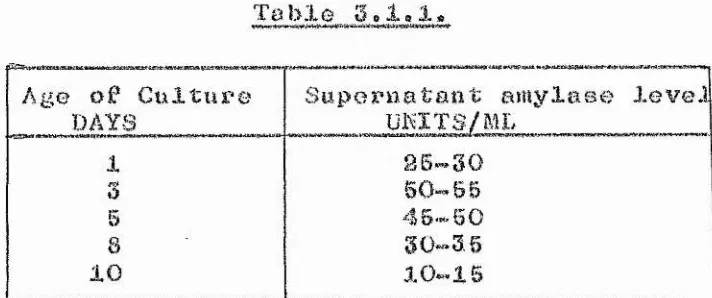
and Hudson, 1942), Frequently amylase lovele ivere
reported to reach maxima in culture fluids only after
10-14 days. In retrospect, such lengthy incubations were probably the result of non-ideal groi^yth media
oatmeal, maize meal suspensions and various other complex
cereal mixtures) and a lack of appreciation of the
physiological needs of the bacteria for rapid growth and
consequently earlier enzyme production.
With the advent of commercially available bacterio logical media and nutritionally-standardised components, media of defined chemical composition have been used and most recent work on amylase-producing bacteria is baaed on
the use of starch in one form or another as the carbon and
energy source and inducer of amylase synthesis* Maximal
levels of enzyme were reported to be reached within 24 to
oO hr86 with such media (Campbell, 1955)*
Most exporimenters consider a-amylase produced by
bacillus species to be a predominately extracellular enzyme
after growth. Bacterial cells are removed either by centrifugation or by filtration using such filter aids a B ce 1 i te ( di a t oma ce ou s u a r t h ). Th e se procès s e a ivi 11
also remove any remaining insoluble amylaceous material derived from the medium itself,
1.4 0 2 A mmo ai u m s u 1 p h a t e f r a c t ;l. o a a t i o a
111 order to reduce amylase-containing culture
filtrates to easily manageable volumes, precipitation
of crude enzyme with ammonium sulphate has been widely
used. Most workers have found that 50% saturation with
ammonium sulphate is a sufficient concentration to
precipitate most of the amylase protein from crude culture
filtrates. Campbell (1966), after precipitating with
ammonium sulphate at 100% saturation, extracted B.
stearothermophilus amylase with 1% I'iaCl, This gave an
amylase preparation with some 100-fold increase in
specific activity over the crude filtrate. In Inter
work, Manning and Cnmpboll (1961) used 20% saturation wi th Ammonium sulpha te together wi th 20% saturation with sodium sulphate and achieved only a 28-fold increase in
specific activity. Robyt and French (19o4) found that
60% saturation with ammonium sulphate yielded a similar
16
of B. polymyxa amylase. Schwlmmer and Balls (1949)
achieved only a 15-fold increase with ammonium sulphate
saturation to 43% in their purification of a-amylase from a commercial malt extract.
An alternative to ammonium sulphate precipitation
preferred by some authors |_Babbnr,;^ (1962)}, [Robyt and French (1964)], is to reduce the culture volume by
as much as 50% by rotary evaporation at a temperature of approximately 30°C.
1.4.3 Organic solvent precipitation
As an alternative to ammonium sulphate precipitation
amylase may be precipitated by a variety of organic solvents. Amylase loses little enzymic activity on precipitation from 60% ethanol provided the temperature
is kept in the range 0-B°C« Campbell (1955) attempted to purify further his ammonium sulphate fraction of B.
stearothermophilus amylase by two precipitations with
volume and precipitated the protein with on unspecified
quantity of ethanol. A later stage involved the
precipitation of the enzyme in 50% ice-cold acetone. Although details are not given of the purification achieved by this particular stage, it could not have
been greater than 2-fold. Robyt and French (1964)
used tertiary butanol to obtain a 2-fold purification
with an ammonium sulphate fraction of B . polymyxei amylase,
while a subsequent fractionation in propanol achieved a
further 6-fold purification.
Caldwell et. (1952) describe a 7-stage
purification of pig pancreatic amylase involving 3 ethaiiol-etheî? or ethanol-phosphate fractionations,
Ko details are given of the purification factor but it is claimed that some 70-80% of the original activity was retained in the final purified enzyme powder.
Fractionation with organic solvents is clearly a less effective procedure . tlian sa 1 1 f m e t i onation.
As an alternative to the latter it is probably justifiable
but, used after salt fractionation, it appears to achieve little additional purification and could be omitted in
favour of earlier crystal11sation attempts or starch-
1
1.4.4 Crystnllisation of amylase
A6 isrell 0 8 being amongst the first enzymes to be
studied from a biochemical point of view, amylaee was one of the earlier enzymes to be crystallised (Meyer, 1947). Meyer, starting with a commercial preparation of B. Gubtilis amylase, purified the enzyme by ammonium sulphate fractionation and solvent precipitation and crystallised the enzyme from distilled water at 4°C overnight. Further re"»crystallisations carried out from sodium acetate solutions at pH S.6 resulted in a
final crystalline material with a specific activity some 60-fold greater than the starting material. A method of Stein and Fischer (1961) for B. subtilis amylase purification involves crystallisation in the cold from calcium acetate solution, pH 6.8, with the addition of a trace of zinc ions (B. subtilis amylase molecules form dimers with the involvement of zinc ions)# Babbar et al$
(1968) report a rapid method of B. subtilis amylase
purification involving crystallisation from O.IM calcium
acetate solution, pH 6.8.
1.4.5 Purification by specific enzyme-substrate complex formation
specific enzyme-substrate complex formation, if
Hrlangor (1968) ouggeets that if a molecule has the structural requiromente to be either a eubetrate or competitive inhibitor for a specific enzyme and can be chemically modified to introduce hydrophobic groupo to render it wnter-inooluble, then it hae potential ae a meane of purifying the enzyme. He demonstrated thie in the cnee of chymotrypoin by studying the interaction of the enzyme with the insoluble competitive inhibitor K-carboxybenzyloxy-L-leucyl-D-phenylalaninebonzyl eater. Other proteolytic enzymes were found to be only minimally abeorbed to thie oubstancew
Amylaeeo and related enzymoo ^ e especially
amenable to thie type of purification while modification of the substrate la unnecessary as the nmylose^polymer
complex can be readily precipitated by 40% aqueous ethanol, at which concentration the enzyme is relatively stable. Some 60 years ago Starkonstein (1910) showed that
* liver amylase* ivas absorbed by a suspension, of insoluble starch from aqueous solution* Later, various authors showed the same effects with amyleees from pancreas»
saliva and malt. Holmberg (1983) showed that a
20
otorch as adsorbent in the presence of maltose# Maltose, the major end-product of p-amylase action, inhibited
(1-amylase binding to the starch. Starches from many sources have been tested for their efficiency as
adsorbents [Schwimmer and Balls, (1949k)]. Results indicate that variations in adsorption efficiency may
depend on a number of factors. With starch granules the surface area of the granule parallels the adsorptive power. Certain treatments of starches, increase adsorptive power mild acid digestion as is used in the
preparation of some * soluble otai'Ches*. Starch fractions (amylose and amylopectin) have greater adsorptive power than do the granules mid this is dependent on the
structure of the fraction (and hence the method of isolation) as %vell as the source. One thing that
adsorption is not effected by is the degree of purity of the amylase preparation, from which adsorption is taking place. Adsorption was also found to be a function of time and adsorption efficiency was measured on the
basis of the amounts of enzyme adsorbed during n period of 3 minutes. Adsorption was found in some cases to continue for as long as half an hour.
nor homogoneouo. Thio preoontG difficulties in
elucidating the nature of the complex formed and the kinetics of ito formation. For this reason later work on complex formation hue been directed to glycogen-amylaee complexée. Binding to glycogen hae boon observed for several different enzymeo. Leloir and Goldonberg (1962) found that, during the purification of glycogen eynthetaee from fractions of rat liver homogenate, the enzyme
bound to 'particulate* glycogen. Similarly bound phOGphorylase could be removed by washing in ooline buffers containing soluble starch. Sutherland and Wnsilait (I960), studying the purification of dog liver phosphorylase, also found that phosphorylase tended to accompany glycogen during purification. Ratios of twenty parts of carbohydrate to one part of protein were still found after several ammonium sulphate fractionations and ethanolic precipitations. These authors separated the two components by adsorption on calcium phosphate gels whence the protein with only minimal traces of carbohydrate could be eluted by
citrate buffer.
tj
and salivary glands and glycogen. Such complex formation requires less polymer than starch-enzyme formation and reaches equilibrium much more rapidly. The complexes are insoluble in 40% ethanol. They
found that a definite ratio of enzyme to glycogen is
optimal for enzyme precipitation. Complexes precipitated in 40% ethanol can be removed by centrifugation at low
temperatures ond then suspended at 30°C in aqueous buffers to allow removal of the glycogen by enzymic
digestion to small oligosaccharides. Such a purification
step should theoretically yield pure amylase as only amylase molecules should bind to the substrate(unless glycogen synthetase and phosphorylase are also present). In practice, amylase so purified has a specific activity equal to that of the best crystalline preparations.
Analysis of the complex revea3.s it to bo 0.6» mg. enzyme/ mg. glycogen. As the molecular weightSof these amylases are around 45,000 this means that one molecule of enzyme is bound by some 650 glucosyl residues. loyter and
(d9fo2)
Schramm/consider that if an amylase contains more than one binding site then a lattice type structure could result from intermolecular linkages between glycogen
macro-complex consisting of many molecules of both
glycogen and enzyme. Levitski, Heller and Schramm
(1964) have more recently ehown that ethanol is not
neceeeary to precipitate amylaee-glycogen ùomplexos. Spontaneous precipitation will occur in the cold in
aqueous solutions® The complex has been shown to
consist of amylase molecules bound to large molecular
weight dextrine formed from slight enzymatic hydrolysis
of the glycogen. Both excess enzyme and excess dextrine were shoi^n to have an inhibitory effect on the formation of an insoluble complex. Again a lattice type of
structure is proposed for the complex, and smaller
dextrine, incapable of multivalent binding, would be expected to inhibit macro-complex formation* The above authors have shown that purified dextrine of
DP (degree of polymerisation) less than 22 do not
themselves form an insoluble complex with amylase and inhibit the formation of such complexes with higher
dextrins,
A point that is of possible significance is
that the removal of calcium from amylase prevents
2d
the aamo Gitee.
1.6 Specificity and action pottorno of a-omylaGoo a-Amylases are generally regarded oe endoenzymes hydrolysing in a eomewhat random manner the a 1,4-links in glucone of the starch or glycogen type or compounds
derived from these polymers. The final products are a mixture of lo%v molecular weight oligosaccharides, D-glucose and occasionally a high molecular weight resistant
a-limit dextrin. Within this rather broad framework there are considerable variations as to fine specificity and action pattern between amylases from different
sources. Prior to the last decade amylase digestion studies were conducted using the polymer substrates, starch and glycogen, the fine structure of which were tlien unknown. The development of paper chromatographic and other methods for the separation of carbohydrate polymers and their degradation products led to the
preparation of pure compounds of the malto-oligosacchnride series of knoi«?n structure, compounds previously referred
1.5.1 Action patterns of amylases with respect to ma
c
romo1ecu1ar aubatrate&
Mmcromolecular substrates comprise the starches and the glycogens. u-Amylases characteristically catalyse rapid hydrolysis of the molecule to oligo saccharides with rapid diminution of viscosity and
iodine-staining po$ver. The outer chains are particularly susceptible to enzyme action and rapidly give oligo
saccharides reflecting both the outer chain length of the polymer and the fine specificity of the particular amylase. Unlike p-amylase the action of which is restricted to the outer chains of the polysaccharide,
a-amylase also attacks the interior linkages of the
molecule. a l,G-links are, however, totally rosistent to amylase action and constitute an impediment to the action of the u-amylaee. Such links persist as
structural features of small branched oligosaccharides,
26
there exists regions of the molecule which ore densely bronched as to prevent totally c-amylaae action. Such structures give rise to high molecular weight limit dextrine (u-mocrodextrins) similar to those occurring after (3-amylolysie of glycogen or amylopectin,
e-Macrodextrins are probably derived from regions of
the polymer molecule where the branch points are separated by less than 8 a 1,4-linked glucosyl residues. Heller and Schramm (1964) have reported that some 11% of a shell fish glycogen remains as an macrodextrin after
a-amylolysis compared with very much smaller amounts, 2-3% in the case of rabbit liver and muscle glycogens, and about 1% in the case of phytoglycogen*.
The presence of such densely-branched regions of
the molecule is not necessarily apparent from determinations of degree of branching in the intact moloculo as the
methods which have been employed (non-roducing and group analysis) give average values for the whole molecule. Similarly, methods for analysis of the dextrins produced by amylase digestion frequently involved thoir elution
from charcoal under conditions in which high moleculor
weight dextrins would not be eluted. Heller and Schramm
Sephadex gel filtration and were able to detect
macrodextrine i^hich had D.P*e of between 30 and 330# These macrodextri%i8 i^ere claeeifiod ae a-amylase limit
HtUcf Ciwd
dextrine by/Schremm because of their extremely elo%^ T y rate of further hydrolysis by a-amylaoe# a-chramm estimate* this ae some 5000 times slower than the initial rate of hydrolysis of glycogen# This is probably because the few remaining linkages that are susceptible to a-amylase action are highly inaccessible
H&Wev a*\i
to the enzyme# /^Schramm*s studios have shown that
branching in glycogens is not evenly distributed throughout the molecule and that densely-branched regions are more frequent in shell-fish glycogens than mammalian liver glycogens#
For a-amylase action on polymeric substrates three distinct action patterns are possible - single chain, multiple attack and multichain attack. In single chain action the e%izyme forms n complex iviuh a
particular chain and reaction is catalysed along that chain in one direction or the other, forming the oligosaccharides
for which the enzyme is product specific until the end of the chain is reached. The enzyme then forms a second complex with another portion of chain and the process is repeated. (See Figure )
J]
Cû*
en
4>— %O g"
>
ozi
o
z
1
]
>
— I
m
%) z m
o
ï
-<>
At the other extreme ie multlchain catalysie i-fhere each effective enzyme anhetrete complex formation reanlta in the hydrolyaia of only one gluooeidic bond* Between these two extremee lies the multiple attack mechanism of hydrolysis where each incident of
enzyme-complex formation may result in the hydrolysis of
several glucosidic bonds before the complex dissociates and a ne%v complex is formed* The of multiple attack has been defined [Robyt and 3?rench, (lUbV)] as
khe average number of catalytic events, after the first, during the lifetime of the individual complex. This
has been studied qualitatively by Kung Jg. (1963),
and also by Robyt and French (19G7), by plotting the fall in blue value (iodine-staining power) against the increase in reducing power as the digestion of amylose by amylases proceeds. Kobyt and French ^(investigated amylases from pig pancreas, human saliva and Aspergillus oryzae and found that the multiplicity of action
decreased in that order at the optimum pH for each
OQ
in a multichain manner. The fact that this enzyme, acting at pH 10.5, showed a lower reducing potver for
a given fall in blue value than acid-catalysed hydrolysis was taken by these authors to mean that acid hydrolysis involves a preferential attack on terminal glycoeidic
linkages producing somewliat more glucose than a purely random process would produce and also that the pancreatic enzyme under these conditions avoids such terminal
linkageo. Kobyt and French (1967) have developed a quantitative method for the determination of the degree of multiplicity of action of amylases. Essentially this is based on the ratio of total reducing groups
appearing during hydrolysis to reducing groups appearing in the polysaccharide fraction. Total reducing groups are the sum of those released by (a) primary attack on a polysaccharide moloculo to give two other polysaccharide fragments and (b) secondary attack on the newly formed end of one of the fragments to give low molecular weight
of multiplicity is numerically equal to this number minus one (as the first bond broken gives a polymer .
fragment). Hobyt ond French (1967) report the
respective multiplicities of action of pig pancreatic human salivary and Aopernillus oryzae amylasee no
A o "i 9
1.5,8 Action patternc of u-amylasos with respect to oligosaccharides
The introduction of such techniques ae multiple aecent paper chromatography and gel filtration separation of uncharged molecules have opened the way to studios of the Interaction of u-amylase and the smaller oligo saccharides which are also substrates. Utilising these
techniques pure maltoeaccharideo of the serieo from maltose to maltoheptaooe can easily be prepared from
partial acid-hydrolysates of starches or starch fractions. These smu.ll oligosaccharides, produced during the initial Stages of amylase hydrolysis of iMacromolèculcs may bo further hydrolysed to smaller fragments* The spectrum of ollgoeocchnrides porsistlng at the end of tliie
o
amylase and its product opecificity* Walker and Whelan (I960) have etndied oligosaccharide digestion
by salivary a-amylaee. Thie enzyme converts amyloee rapidly into maltooe and maltotrioee and other oligo-eaccharidee do not accumulate to any extent. Further secondary phaee hydrolysis of maltotriose taltee place but only very slowly at a rate some thousands of times slower than the initial rate on amylose. Walker and
(i960)
Whelan/were able to establish that maltotriase activity was in fact a function of the amylase ittself and not of a separate enzyme. These authors also described the smallest branched oligosaccharide (a-limit dextrin) which is formed from glycogen or amylopectin. This has the following
structure:-0
.2Ü -o,a-D glucopyranosylmaltotriOGo
0 — - O ~ 0
tmd may include a-macrodextrinu of quite high molecular weight ae previously described. Those species of a-limit dextrins may not represent the completion of C" amylolysis as very high concentrations of enzymo may cause further hydrolysis# Studios with B. subtills amylase [Rohyt and French (196^)] have shown this a-ftMiylase to be quite different from salivary amylase in its action on oligosaccharides. There seems to be a dual product specificity favouring the formation of maltotriose (03) and maltohexaose (06)* Smaller
amounts of iiialtotetruose (G4), maltopentaose (05) and maltoheptaose (07) also occur# Kobyt and French(1%]^ studied the rate of further hydrolysis of these products with 10-fold increases in enzyme concentrations.
Maltose (08), 03 and 05 were not dotectebly hydrolysed at all at this enzyme concentration. 06 was converted slowly into 06 + glucose (01) while 07 was more rapidly converted into 06 ‘■s- 01 and 06 4 08. 06 and 07 appear to come from the exterior chains of the polymer as they are not produced at all when an amylopectin p-limit dextrin is used as substrate.
Using glycogen g-amylase limit dextrin as
33
with Bo subtills amylase. This obviously reflects
Che short interior chain length in the glycogen molecule with insufficient linkage© accessible to amylase action
to permi t fragmen tation to small oligosacchariUee,
This observation is also in support of Heller and Schramm’s (1964) reporte of a-macrodextriii formation by pancreatic amylase digestion of various glycogens as mentioned above. The smallest branched oligo saccharide reported for B. subtiXis amylase digestion
of amylopectin or glycogen is a pentasaccharide of
the following structure :
Q Q 6 % B-maltoeylmaltotrioae
111 contrast to salivary a-amylase» B. ©tibtilie amylase produced from starch or glycogen considerable quantities of glucose, indicating its ability to
hydrolyee terminal linltnges. These differences in
product specificity which result in oligosaccharide
spectrum differences can therefore be used as o means
of classifying amylases. Obviously the period of
hydrolysis allowed is of importance in such investigation©
of much the some products for ail amylases (glucose,
maltose and small branched oligosaccharides).
B. polymyxa produces an interesting type of amylase which has characteristics of both a- and fi-amyXesee,
B. polymyxn amylase produces p-maltose as the major
end-product of polymer digeotion [Rohyt and French (1964)] cf. (u-maltose is the normal product of u-amylase action)
and also catalyses-the degradation of cyclic dextrine, an
activity not associated with normal u or p-omylaso oction. Its action resembles a-emylase in its ability to hydrolyse
internal chains. The most surprising feature of this
enzyme is the high rate of attack on 06, which is
degraded to predominantly G8. The rate of attack on
G6 approaches that of attack on amylose by this enzyme and is greater than that on glycogen or amylopectin.
Rapid G6 hydrolysis by this enzyme is in marked contrast to the slow hydrolysis of G6 by B. subtilla amylase.
Cyclic 08 is hydrolysed to 02 without the appearance
of any intermediate straight chain oligosaccharide ;
this suggests a multiple attack mel^hanism for hydrolysis. De Pinto and Campbell (19681) have recently investigated
35
cyclic dextrine a They have been able to separa te
the enzymic activity into an amylase which degrades starch into these cyclic dextrins but is unable to hydrolyse them and a cyclodextrinase which has no
activity on starch but degrades cyclic G6,
G7
and GSwith equal ease. , ,^ ,v
In view of T)e Pinto and Campbell ’ s worlc,^it may
well be that greater purification of the B. polymyxa
enzyme system would reveal two distinct activities,
that of o p-amylase type resembling sweet potato
p-smylase and a cyclodextrinase. However, Hobyt and
C<L%4‘)
French/^report differential activity of thetr preparation of B. polymyxa amylase between cyclic GS and cyclic 06,
the latter being extremely slow, whereas B'. macera,:^ cyclodextrinase is equally active on both dextrins,
1.6.3 Diverse actions of bacterial amylases on muco-i)Olysaccharides and related molecules
Over the past five years there have appeared a
number of reports of amylase preparations hydrolysixig certain (unspecified) linkages in mucopolysticcharido
described the isolation of a glycosidically-linkod
glucosamine containing dleaecharide following a-amylase
hydrolysis of glycogen isolated from a galactooamine p e r f u 8 © d 1 i ve r.
A recent Japanese patent [t^iehihara (1963 ) ]
describes the isolation of soluble collagen from
ox-hide after pretreatment of the minced tissue with a
bacterial a-amylase preparation followed by extraction
of the protein with dilute acid. Greatly increased
yields were obtained using this technique. Steven
(1964) adapted this technique for the preparation of
collagens from aged and rheumatoid tissues where normally only very small amounts of tropocollagen can be extracted with dilute acid and procedures such as thermal
dénaturation to the derived soluble gelatin or mechanical removal of the non-collagonous material must be resorted to. The reason for increasing difficulty of extraction as the tissue ages is thought to be an increase in the number of covalent linliagos stabilising the collagen
37
.1(3 always associated with collagen [HBrmaon (i960) ], and this amount is found to be less in collagen
solubilised with the aid of a-amylaee treatment, it
was naturally considered possible that a-amylase might be hydrolysing glycoeidic bonds which were in sorno way
involved in insoliibilieing the collagen moleculeo
Glaesor and Me1 (1966) have recently reported
that the treatment of rat erythrocytes with bacterial R"amylase results in reduction of their anodic electro-
phonetic mobility with a concomitant release of a
neuramino-oligosaccharide0 On a re-investigation of
this effect, Seaman, Jackson and Uhlenbruck (1967)
confirmed the mobility change in the erythrocytes but
were able to show that the sialic acid was released
as part of a mucopeptide and not an oligosaccharide®
This latter work highlights a real problem in assessing
the effects of bacterial amylase preparations on complex
structural systems, B® subtills is known to produce a
variety of proteolytic enzymes, the best characterised
being subtilisin, as well as other carbohydrates.
Complete purification of amylases is necessary if
structure of covalent crosslinks in the collagen
molecule, the very slow but nevertheless finite
rate of hydrolysis of maltotrlose to glucose and
maltose [Walker and Whelan (I960)] and the recent
report of Yoshida (1967) of the hydrolysis of phenyl
a-maltoside by amylase may bo of significance when one
interprets the effects of the amylase treatment on
connective tissue, Steven (1964) used a 0.3% w/w
solution of bacterial amylase for a period of 90 hours at room temperature. The amylolytic octivity of such
a preparation would be of the order of hundreds of
thousands of units, quite sufficient to hydrolyse many linkages with an order of substrate affinity for the
amylase akin to maltotriose. On the other hand the
same considerations of time and enzyme concentration
39
1.6 Aims of the présent research
1) To investigate the biosynthesis of amylase by Bacillus subtilis on different media, under the influence of possible inducers, and under
different growth conditions (batch and continuous culture), and its release as an extracellular enzyme. Also +o %e effect of mdac.ts ov, eyfvocellulav Gv^yJase "ftUase ky woWketL cell suS|>ewsîôV)S.
9) To investigate purification techniques for the enzyme, especially glycogen«»amylase complex
formation,
3) To investigate some properties and action patterns of the enzyme and in this connection, the
preparation of properties of CM-cellulose-u-amylase,
an insoluble enzyme derivative.
4) To compare those properties with those of commercially available bacterial a-amylases
MBTHODS
8,1 Microbiological Methodsï
8.1.1. Maintenance of stock cultures
Cultures of Bacillus subtilis 3610 were obtained from the î<ational Collection of Industrial Bacteria
o5
and were maintained on a medium 1%^starch and Difco Yeast Extract, in 8 oz. screw-capped bottles^after
overnight growth at 35^C o%i a metabolic shaker with vigorous shaking. The bacterium was subcultured at intervals of 8 months.
2,1,2® Exp erimenta ■.!■ I'PiJ'lU.-.i 1 XI "HU ^ , r^ln'IMculturesH.iHf unn I. i f i H.II #1,1,,,. ff,r#
Experimental cultures were carried out in 500 ml.
and 100 ml. Orlenmeyer flasks with working volumes of
200 ml. and 40 ml. respectively. The medium used was
of the following basic compositions- 0.4% Difco'Yeast Extract
the following salts each at a final concentration
oe B mg./litre! FeCl„, CaCl„, U IÏ& KCl, M gC^8'
Zi(CII«COO)f. . Co(KO_)^ [This is a simplified salts supplement
based on that used for Bacillus stearothermophilus (Welker
and Campbell, 1963a)].
This basic medium was supplemented with a carbon
were sterilised at 16 psl for 80 minutes, except
supplements of sugars which were sterilised by tyndallisation and added aseptically. Gro$fth was at 36°C on a Gallenkamp metabolic shaker at 150
oscillations per minute. Inocula were 5-10% of the
culture volume from a fresh culture in the same medium excep t whore otherwise stated.
2.1.3. Large scale culture
Largo scale culture, for enzyme production, %^as carried out in 10-litre and 20-litre Quickfit
fermentation vessels with flanged lids fitted with
silicone rubber tubes to permit aeration during growth, The vessels were sterilised by autoclaving at 20 psi
for 2-3 hours. Small quantities of Silicone Antifoam (I.e.I. Ltd.) were added to suppress frothing and the vessels were maintained at 37^C in water-baths.
2®lo4c Harvesting of cells and preparation of cell-free supernatants
Cells and culture supernatants were separated by
centrifugation at 6°C and 2000 g. When only the
supernatant was required, filter aids such as celite (Hyflo) were used in conjunction with Buchner vacuum
filtration. Celite was found relatively unsatisfactory, however, on account of its non-specific absorption of
proteins (including amylase) and consequent reduction in yiolds of supernatant enzyme*
2*1,5® Continuous culture methods
A simplified continuous culture apparatus was constructed based mainly on the range of fermentation glassware available from Quickfit & Quartz Ltd* The
reactor was a 2-litre capacity flat-bottomed fermentation
jar (working volume 1*6 litres).
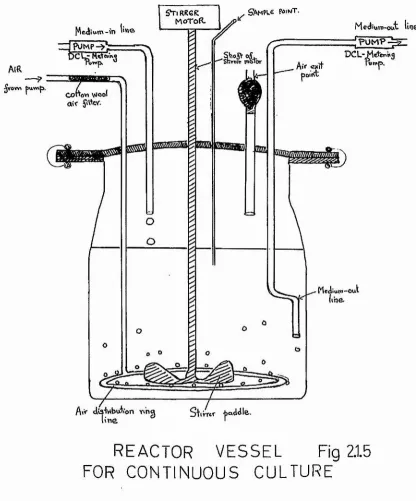
Through o multiple-neeked flanged glass lid the reactor was equipped wi th the following :
1) A glass paddle stirrer with a flexible rubber coupling to a variable speed motor.
2) A multiperforated glass tube aerator arrangement
connected to a Charles Austin Electromagnetic Air Pump
^onn
buvrtb. ' conov» wool/ air ÿ!\W.point
Qssn .% n
Ai'r çi^+vibuion vi’ng line Stirr«r baddle..'
Mc<ii«Ar«i'‘Oul
[image:59.615.114.530.162.663.2]4 4
%rooi IncteriologicBl filter in the air line.
3) A medium entry line permitting,dropwiee,addition of medium to the culture.
4) A medium exit line permitting removal of media by pumping. The media lines were coupled to the two pumping heads of a DCL Micro Pump. The rates of pumi)ing could he independently varied, hence enabling
the working volume in the reactor to he kept constant. 6) A Gterilo sampling point through ivhich email samples
could be withdrawn by syringe from the reactor.
The sterile reservoir for medium and the collection vecsel were 20-litre fermentation jars similarly equipped with flanged lido with provision for media lines and
filtered-air entry or exit.
All pipeline was of either ooft soda-glass or silicone-rubber tubing (blood transfusion grade) which stands repeated sterilisation. The reactor vessel was immersed during use in a large water-bath at 37^C.
This maintained the reactor contents at a temperature of 36^C 1 l^C under conditions of constant aeration.
For sterilisation purposes the apparatus was
was nu toclaved, media and air lines having been, disconnected and soÉîled off and the stirrer shaft
disconnected. The media supply and collection vesoolo were separately oterilieed by autoclaving together with the pumping heado of the DCl Micro Pump at the beginning of each run. Further media eupply vessels i^ere
aseptically connected as necessary.
This apparatus was unconventional in design in that culture fluid was pumped out of the reactor vessel and
not removed via a constant level overflow device. This
permitted the use of a water-bath for temperature control but necessitated u slight differential in pumping rates
to correct for air bubbles in the liquid leaving the
reactor. After initial technical troubles were ovorcomo the apparatus was capable of functioning reliably over periods of a weeic or more. Sterile silicone antifoam was added from a carriage at intermittent intervals & As
this compound was found to remain on the surface of the liquid and was hence not readily removed from the reactor vessel, frequent addition was not necessary;
2,1;b; Growth rate measurements
Bacterial growth was followed by optical density
J'
h t
o ^