www.wjpr.net Vol 7, Issue 8, 2018. 593
SYNTHESIS, CHARACTERISATION AND ANTI MICROBIAL
ACTIVITY OF A NOVEL POLYMERIC COPPER (II) COMPLEX
M. A. Rajalakshmi1,A. Dinesh Karthik2 and Kannappan Geetha3*
1
P.G and Research Department of Chemistry, Kamban College of Arts and Science For
Women, Tiruvannamali.
2
PG and Research Department of Chemistry, Shanmuga Industries Arts and Science College,
Tiruvannamalai -606 603, Tamil Nadu.
3
PG and Research Department of Chemistry, Muthurangam Govt. Arts College
(Autonomous), Vellore - 632 002, Tamil Nadu, India.
ABSTRACT
A novel polymeric Copper (II) complex containing [{Cu2L
(O2CCH2NH2)}]X pentadentate Schiff base ligand has been prepared
from the precursor complex pentadentate Schiff base ligand. The
precursor complex was prepared from 1:2:2 molar ratios of Copper
sulphate, glycine and sodium hydroxide. The synthesized polymeric
Copper (II) complex was characterised by using UV-Visible spectra
and FT-IR spectra. The synthesized Copper (II) complex and the
precursor and the Schiff base ligand were screened for their
antibacterial activity against Staphylococcus aureus, Klebsiella
pneumonial, E-Coli, Pseudomonas aeurginosa and antifungal activity
against Aspergillus niger, Penicillium spp. Candida tropicalis and
Candida albicans. The complex was found to be inhibitory to all the
selected micro organisms except Aspergillus niger and Penicillium spp. Both Schiff base
ligand and precursor didn‟t show any inhibition to all the selected micro organisms.
KEYWORDS: Copper (II) complex, E-Coli, Pseudomonas aeurginosa and Candida albicans.
Volume 7, Issue 8, 593-604. Conference Article ISSN 2277–7105
*Corresponding Author
Kannappan Geetha
PG and Research
Department of Chemistry, Muthurangam Govt. Arts College (Autonomous), Vellore - 632 002, Tamil Nadu, India.
Article Received on 05 March 2018,
Revised on 25 March 2018, Accepted on 15 April 2018
www.wjpr.net Vol 7, Issue 8, 2018. 594 complexes exists Cu(I), Cu(II) and Cu(III) forms, Cu(III), being very easily reduced, is
generally regarded as uncommon but it has now received importance because of its
involvement in some biological processes. K3CuF6 is the only high spin Cu (III) complex, the
rest being low spin diamagnetic.[4-9] Cu(II) forms stable complexes with nitrogen and oxygen
donor ligands. Cu(II) may undergo redox reactions with thiol groups of proteins. The Cu(II)
complexes of nitrogen ligands are generally more stable than Cu(I) complexes.[10-15]
2. MATERIALS AND METHODS
Copper (II) Sulphate and glycine were purchased from S.D. Fine chemicals and 1,3-diamino–
propan-2-ol was purchased from Aldrich. Acetylacetone, sodium hydroxide and piperidine
were purchased from S.D. Fine chemicals. All the solvents and chemicals were of A.R. grade
and used as received.
3. PREPARATION OF PRECURSOR COMPLEX [Cu2 (OOCCH2NH2)4(H2O)2]n
An aqueous solution of 40 mmoles of NaOH was mixed with 40 mmoles of glycine. Then 20
mmoles of CuSO4 was taken in water. The sodium salt of glycine was added to the CuSO4
solution with constant stirring and pale blue precipitate was obtained. Then the precipitate
was filtered through ordinary filter paper and dried. The solubility of tetraarylcarboxylates in
common solvents are generally low, except for dioxan. It has been shown that manganese
carboxylates are more prone to form the binuclear complex of the binuclear complex
probably occurs to an appreciable extent in an alcoholic medium. It was also pointed out
earlier that the larger acid dissociation constant of the carboxylic acid does not favour the
formation of the binuclear molecule. Hence larger the dissociation constant of the carboxylic
acid, the more facile is the dissociation of the binuclear complex in methanol or ethanol.[16-17]
5. PREPARATION OF THE SCHIFF BASE LIGAND
The Schiff base (H3L) was prepared (Nishida et al 1986) by reacting 1,3-diamino propan-2-ol
with acetylacetone in 1:2 molar ratio in an ethanolic medium and stirred well for 15 minutes
www.wjpr.net Vol 7, Issue 8, 2018. 595
6. PREPARATION OF THE COMPLEX [{Cu2L (OOCCH2NH2)}]n
1 mmol of the Schiff base (H3L) was taken in 25 ml of ethanol and 3 mmol of piperidine was
added to that, stirred well. Then 2 mmol of the precursor complex was added and heated up
to 45-50ºC in water bath with constant stirring up to 20 minutes. A bluish green solution was
obtained. The solution was cooled to room temperature, filtered and the filtrate on slow
evaporation gave a bluish green crystalline blocks. Then this precipitate was washed with
chloroform and methanol.[18]
7. RESULTS AND DISCUSSION
1. UV – Visible spectra
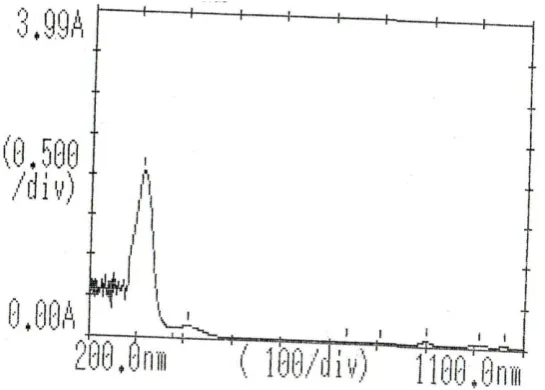
The electronic absorption spectra of the Schiff base ligand (Fig. 1) have been recorded in
ethanol. The max, nm value is at 295 nm. This band corresponds to п→п* transition and the
next band at 410 nm corresponds to n→п* transition in –C=N bond. The electronic
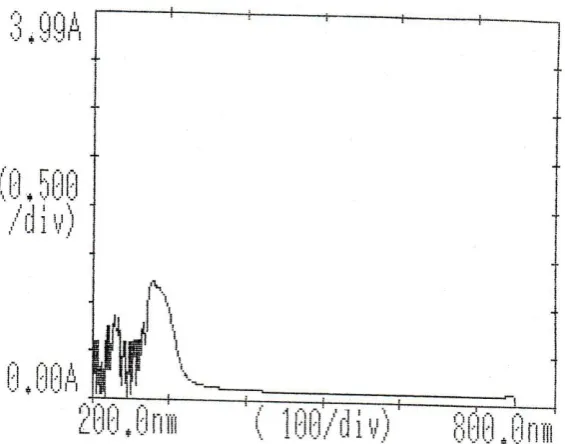
absorption spectra of the precursor (Fig.2) and metal complex [{Cu2L (OOCCH2NH2)}]n
(Fig.3), have been recorded in chloroform. For the Copper complex, the max 230nm value
is at nm. The band corresponds to п→п* transition. There is no change in the max when compared to that of the ligand‟s п→п* transition. The other band in metal complex is at 375
nm which corresponds to n→п* transition in –C=N bond. There is a change when compared
[image:3.595.167.440.476.671.2]with the ligand n→п* transition in –C=N due to the complexation.[19-21]
www.wjpr.net Vol 7, Issue 8, 2018. 596 Fig 2. UV-Visible spectra for Precursor complex.
Fig 3. UV-Visible spectra for Copper complex.
2 FT-IR Spectra
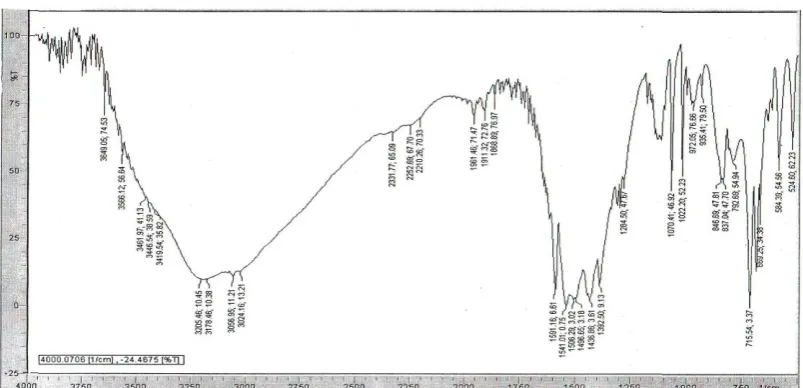
The υs (-CH=N) at 1633 cm-1 for the Schiff base ligand appears at 1583 cm-1 for the complex.
The peak at 1534 cm-1 corresponds to υs (OCO) vibration of bridging carboxylate and at 1607
cm-1 is due to υs (OCO) of the precursor complex and the corresponding peaks for the
complex observed at 1645 cm-1 and 1197 cm-1 respectively. The peak at 3342 cm-1 in the
precursor complex corresponds to the alcoholic –OH (υs) group and at 3375 cm-1 is due to
[image:4.595.159.426.359.532.2]www.wjpr.net Vol 7, Issue 8, 2018. 597 Fig 4. FT IR spectrum of Precursor Complex.
Fig 5. FT IR spectrum of Copper Complex.
3. ZONE OF INHIBITION
ZONE OF INHIBITION (mm) FOR SELECTED BACTERIA
S. No Name of the
Organisms
Antibacterial activity
Schiff base ligand Precursor Complex
1. Staphylococcus aureus - 20 19
2. Klebsiella pheumonial - 17 17
3. E.Coli - 23 24
www.wjpr.net Vol 7, Issue 8, 2018. 598
2 4
0 2 4 6 8 10 12 14 16 18 20 22 24
Zone of inhibition for selected bacteria
S.a E.c K.p P.a
Zone of inhibition(m
m)
Selected Bacteria
Precursor Complex
Zone of inhibition shown for Staphylococcus aureus by precursor.
www.wjpr.net Vol 7, Issue 8, 2018. 599 For the complex the zone of inhibition is equal to 19 mm in the case of Staphylococcus
aureus. The zone of inhibition is 24 mm for the complex in the case of Klebsiella
pneumonial. In E-coli, it was observed that the zone of inhibition is 17 mm for the complex.
The zone of inhibition is 0.9 mm for the complex in Pseudomonial aeurginos.[26-31] The
complex is found to be inhibitory to all the selected micro organisms except Aspergillus niger
and Penicillium spp,. Thus it can be considered as a broad spectrum antimicrobial agent for
the surface sterilization of equipments. The complex has an comparable inhibitory activity
against bacteria chosen and the fungi. The complex can be considered as antimicrobial agent
and its activity can be increased by increasing its concentration.
ZONE OF INHIBITION (mm) FOR SELECTED FUNGI
Zone of inhibition shown for Candida tropicalis by precursor
S. No Name of the
Organisms
Antifungal activity
Schiff base ligand Precursor Complex
1. Aspergillus Niger - - -
2. Penicillium Spp. - - -
3. Candida tropicalis - 18 19
4. Candida albicans - 19 20
2 4 0 2 4 6 8 10 12 14 16 18 20 22 24
Zone of inhibition for selected bacteria
S.a E.c K.p P.a
Zone of i
nhi
biti
on(mm)
Selected Bacteria
www.wjpr.net Vol 7, Issue 8, 2018. 600 Zone of inhibition shown for Candida tropicalis by complex
2 4 0 2 4 6 8 10 12 14 16 18 20
Zone of inhibition for selected fungi
A.n P.s C.t C.a
Zone o f inh ibitio n( mm) Selected Fungi Precursor Complex 2 4 0 2 4 6 8 10 12 14 16 18 20 22
Zone of inhibition for selected fungi
A.n P.s C.t C.a
www.wjpr.net Vol 7, Issue 8, 2018. 601 4 CONCLUSION
A novel polymeric Copper (II) complex containing pentadentate Schiff base ligand has been
prepared. The synthesized polymeric Copper (II) complex was characterised by using
UV-Visible spectra and FT-IR spectra. The synthesized Copper (II) complex and the precursor
and the Schiff base ligand were screened for their antibacterial activity against
Staphylococcus aureus, Klebsiella pneumonial, E-Coli, Pseudomonas aeurginosa and
antifungal activity against Aspergillus niger, Penicillium spp. Candida tropicalis and
Candida albicans. The complex was found to be inhibitory to all the selected micro
organisms except Aspergillus niger and Penicillium spp. Both Schiff base ligand and
precursor didn‟t show any inhibition to all the selected micro organisms.
5 REFERENCES
1. Lever A.B.P, Inorganic electronic spectroscopy, 2nd edition Elsevier, New York, 1984.
2. Nakamoto. K. Infrared and Raman Spectra of inorganic and coordination compounds, 5th
Edn., Part A and B. Wiley, New York, 1997.
3. Revanasiddappa M, Suresh T, Khasim. S, Radhavendray S.C, Basavaraja C, Transition
Metal Complexes of 1, 4(2‟-Hydroxyphenyl-1-yl) di-iminoazine: Synthesis,
Characterization and Antimicrobial Studies. E-Journal of Chemistry, 2008; 5: 395-403.
4. Upadhyay RK, Bajpai AK, Rathore K Chromatographic analysis of binary mixtures of
isomeric complexes. Chromatographia 1984; 18: 618-620.
5. Kannappan R, Mahalakshmy R, Rajendiran. T.M. and Sambasiva Rao, “Magnetic,
catalytic, EPR and electrochemical studies on binuclear Cu(II) complexes derived from
3,4-disubstitute phenol” Indian Acad. Sci (Chem. Sci), 2003; 115: 1-14.
6. Rajendiran. M, Mahalakshmy. R, Venkatesan. R and Pillutla Rao, Transition Metal
Chemistry, “Synthesis of flexible ligands donor assembling two metals in close
proximity. Magnetic, electrochemical and spectral properties of binuclear copper(II)
complexes with different exogeneous bridging motifs” 2008; 280-287.
7. Krishna Murthy Potla, Venkatasubba Naidu N. and Ragavendrakumar, P. Synthesis,
Characterization and Biological activity of Transtion metal complexes of 1,
4-bis(1-napthylmethyl) piperazine, International Journal of Bio-Technology and Research., 2013;
3(1): 91-100.
8. Deacon G.B. and Philips R.J., relationships between the carbon-oxygen stretching
frequencies of carboxylato complexes and the type of carboxylate coordination, Coord.
www.wjpr.net Vol 7, Issue 8, 2018. 602
12. Braunstein A.E, “Amino Group Transfer” Boyer, in P.D.(ed). “The enzymes”, 3rd
edn.Vol. 9, Pt.B, Acad. Press N.Y. and “Definitive review of transammination
reactions”1973; 379.
13. Plakatouras, J.C.; Perlepes, S.P.; Mentzafos, D.; Terzis, A.; Bakas, T.; Papaefthymiou, V.
Coordination Chemistry of Corrosion Inhibitors of the Benzotriazole Type: Preparation
and Characterization of Cobalt(II) Complexes with 1-Methylbenzotriazole (Mebta) and
the Crystal Stucutures of [CoCl2(Mebta)2], Trans-[Co(NCS)2(Mebta)4],
Trans-[Co(NCS)2(MeOH)2(Mebta)2] and Cis- [Co(NO3)2(Mebta)2]. Polyhedron, 1992; 11:
2657-2672.
14. Collen, S.A.J.; Everaerts, F.M.; Huf, F.A. Characterization of 60Co γ-Radiation Induced
Radical Products of Antipyrine by Means of High-Performance Liquid Chromatography,
Mass Spectrometry, Capillary Zone Electrophoresis, Micellar Electrokinetic Capillary
Chromatography and Nuclear Magnetic Resonance Spectrometry. J. Chromatogr. A,
1997; 788: 95-103.
15. Rai, A.; Sengupta, S.K.; Pandey, O.P. Lanthanum(III) and Praseodymium(III) Complexes
with Isatin Thiosemicarbazones. Spectrochim Acta, Part A, 2005; 61: 2761-2765.
16. Gilman, A.G.; Goodman, L.S.; Gilman, A. The Pharmacological Basis of Therapeutics;
Macmillan Publishing Co: New York, USA, 1980.
17. Rosu, T.; Pasculescu, S.; Lazar, V.; Chifiriuc, C.; Cernat, R. Copper(II) Complexes with
Ligands Derived from 4-Amino-2,3-dimethyl-1-phenyl-3-pyrazoline-5-one. Molecules,
2006; 11: 904- 914.
18. Filho, V.C. Corréa, R. Vez, Z. Calixto, J.B. Nunes, R.J. Pinheiro, T.R. Andricopulo, A.D.
Yunes, R.A. Further Studies on Analgesic Activity of Cyclic Imides. Farmaco, 1998; 53:
55-57.
19. Turhan-Zitouni, G.Sivaci, M.; Kilic, F.S.; Erol, K. Synthesis of Some
Triazolyl-antipyrine Derivatives and Investigation of Analgesic Activity. Eur. J. Med. Chem, 2001;
www.wjpr.net Vol 7, Issue 8, 2018. 603 20. Deepa, K. Madhu, N.T.; Radhakrishnan, P.K. Cadmium(II) Complexes of
1,2-Di(imino-4‟- antipyrinyl)ethane. Synth. React. Inorg. Met.-Org. Nano-Met. Chem, 2005; 35:
883-888.
21. Radhakrishnan, T.; Joseph, P.T.; Prabhakaran, C.P. Copper(II) Complexes of
Salicylal-4-aminoantipyrine and 2-Hydroxy naphthal-4-amino antipyrine. J. Inorg. Nucl. Chem,
1976; 1117-2220.
22. Ismail, K.Z. Synthesis, Spectroscopic, Magnetic and Biological Activity Studies of
Copper(II) Complexes of an Antipyrine Schiff Base. Trans. Met. Chem, 2000; 25:
522-528.
23. Agrawal. R.K.; Prakash, B. Studies on the Effect of Various Anions and
Diphenylsulphoxide on the Stereochemistry of Lanthanide(III) Coordination Compounds
of 4[N-(2‟-hydroxy-1‟- naphthalidene)amino] Antipyrine semicarbazone. Trans. Met.
Chem, 2005; 30: 696-705.
24. Geary, W.G. The Use of Conductivity Measurements in Organic Solvents for the
Characterisation of Coordination Compounds. Coord. Chem. Rev, 1971; 7: 81-122.
25. Hamming, M.; Foster, N. Interpretation of Mass Spectra of Organic Compounds;
Academic Press: New York, USA, 1972. Nakamoto, K. Infrared and Raman Spectra of
Inorganic and Coordination Compounds; Wiley Interscience: New York, USA, 1978.
26. Silverstein, R.M.; Webster, F.X. Spectrometric Identification of Organic Compounds;
Wiley: New Delhi, India, 2007 15. Singh, G.S.; Pheko, T. Spectroscopic Characterization
of the 1-Substituted 3,3‟-Diphenyl-4-(2‟-hydroxyphenyl)azetidine-2-ones: Application of
13C NMR, 1H-13C COSY NMR and Mass Spectroscopy. Spectrochim. Acta, Part A,
2008; 70: 595-600.
27. Belaid, S.; Landreau, A.; Djebbar, S.; Benali-Baitich, O.; Bouet, G.; Bouchara, J.-P.
Synthesis, Characterization and Antifungal Activity of a Series of Manganese(II) and
Copper(II) Complexes with Ligands Derived from Reduced
N,N’-O-Phenylenebis(salicylideneimine). J. Inorg. Biochem, 2008; 102: 63-69.
28. Swamy, S.J.; Pola, S. Spectroscopic Studies on Co(II), Ni(II) Cu(II) and Zn(II)
Complexes witha N4-Macrocyclic Ligands. Spectrochim. Acta, Part A, 2008; 70:
929-933.
29. Swamy, S.J.; Veerapratap, B.; Nagaraju, D.; Suresh, K.; Someshwar, P. Non-template Synthesis of „N4‟ Di- and Tetra-amide Macrocyclic Ligands with Variable Ring Sizes.
www.wjpr.net Vol 7, Issue 8, 2018. 604 the Characterization of a Novel 14-Membered [N4] Macrocyclic Ligand and its