Construct validity and reliability of the Practice
Environment Scale of the Nursing Work Index
(PES-NWI) for Queensland Nurses
Parker D. ; Tuckett A.; Eley R.; Hegney D.
ABSTRACT
Aims: This article reports on construct validity and reliability of 30 items of the Practice Environment Scale of the Nursing Work Index (PES-NWI).
Background: Australia, like other countries is experiencing a shortage of nurses and a multifactor approach to retention of nurses is required. One significant factor that has
received increasing attention in the last decade, particularly in the United States is the nursing practice environment.
Design: The reliability of the 30 items of the PES-NWI was assessed by Cronbach’s alpha and factor analysis was performed using principal component analysis.
Setting: The PES-NWI was completed by nurses working in the aged care, private and public sectors in Queensland, Australia.
Participants: A total of 3,000 were distributed to a random sample of members of the Queensland Nurses Union. Of these 1192 surveys were returned, a response rate of 40%.
Results: The PES-NWI was shown to be reliable demonstrating internal consistency with a Cronbach’s alpha of the total scale of 0.948. The 30 items loaded onto 5 factors explaining 57.7% of the variance. The items across the factors differed slightly from those reported by the original author of the PES-NWI.
Conclusion: This study indicates that the PES-NWI has construct validity and reliability in the Australian setting for nurses.
Keywords
factor analysis, job satisfaction, professional practice, reliability
Author Accepted Version of
BACKGROUND
Australia, like other countries is experiencing a shortage of nurses and a multifactor approach to retention of nurses is required. One significant factor that has received increasing attention in the last decade, particularly in the United States is the nursing practice environment defined by Lake (1) as ‘the organizational characteristics of a work setting that facilitate or constrain professional nursing practice’ p178. In the United States, the term Magnet hospitals has been adopted to define workplaces in which organisational features empower nurses with autonomy, authority and control over the environment. A key feature of the Magnet hospital studies was the development of an instrument aimed at measuring the nursing practice
environment, the Nursing Work Index (NWI)(2). Subsequent research has led to refinement of this instrument in addition to the development of other instruments(3), including the Practice Environment Scale of the Nursing Work Index (PES-NWI).
Development of the Practice Environment Scale of the Nursing Work Index (PES - NWI)
The Practice Environment Scale of the Nursing Work Index was developed by Lake (1)
through factor analysis of data from Magnet hospitals that had been used to develop the NWI. The NWI is a scale which is considered to reflect the organisational characteristics of
environments that were attractive to nurses. However, the substantive domains of the NWI had not been empirically identified. Lake’s specific objective in developing the PES based on the original work to develop the NWI was to develop a psychometrically and empirically derived scale and subscale which could discern the contribution of the practice environment to nurse and patient outcomes.
While the Nursing Work Index has 65 items, Lake (1) selected 48 of these items as
specifically describing the nursing practice environment. Exploratory factor analysis using principal axis factoring with varimax rotation of the original 1986 Magnet study hospital data identified five subscales retaining a total of 31 of the 48 items originally selected from the NWI. Naming of subscales was based on the conceptual interpretation of the items. These are:
1. Nurse participation in hospital affairs (9 items) 2. Nursing Foundations for Quality of Care (10 items)
3. Nurse Manager, ability, leadership and support of nurses (5 items) 4. Staffing and resource adequacy (4 items)
5. Collegial Nurse-Physician relations (3 items)
The use of scales to measure the nursing practice environment has increased in popularity. Lake(3) in a recent article provides a systematic evaluation of the utility of published
instruments to measure the nursing practice environment. The author conducted a literature search to identify published instruments to measure the nursing practice environment in the years 1996 to 2005. A total of 203 articles were found identifying seven multidimensional instruments which had been used in 54 research studies. These included the Revised Nursing Work Index (NWI-R) developed from the Nursing Work Index (NWI), the PES-NWI, the Job Characteristics Survey Inventory (JCI), the Ward Organization Features Scale (WOFS), the Work Quality Index (WQI) and the Assessment of Work Environment Schedule (AWES). Using the criteria of theoretical relevance, ease of use and body of evidence published the PES-NWI was considered to be the most useful and recommended for future research.
In addition to psychometric testing the PES-NWI has also been utilised to examine
associations between bed size, community size, teaching intensity and nurse staffing levels. Favourable practice environments as rated by the PES-NWI were found for those with higher nurse-to-bed ratios, but no significant differences were found in regard to community size, hospital bed size or teaching intensity.(6)
The Australian Environment
In Australia concerns regarding the practice environment of nurses have been raised and in 2001 and 2004 studies commissioned by the Queensland Nurses Union (QNU) of enrolled and registered nurse and assistant-in-nursing members (7)were conducted. Both studies sought to identify what factors impact upon nursing work in Queensland and how satisfied were nurses with their work. Key findings indicated that:
Nursing is emotionally challenging and physically demanding
Nurses’ workload is heavy and their skills and experience as a professional nurse are poorly rewarded (renumerated or recognised)
Work stress is high and morale is perceived to be poor and deteriorating
There are insufficient staff in their workplace and that the skill mix is inadequate The majority of nurses are unable to complete their work to their level ofprofessional
satisfaction in the time available.
In light of these findings in 2007 the QNU commissioned the University of Queensland in conjunction with University of Southern Queensland to undertake a follow-up study of 3,000 Queensland enrolled and registered nurse members of the QNU. The aims of this study were:
What factors impact upon nursing work in Queensland?
METHOD Sample
There were 29,789 members in the QNU database in 2007. Of these, 4,359 (14.6%) worked in aged-care, 20,692 (69.5%) were from the public sector and 4,738 (15.9%) from the private sector. The target sample consisted of a stratified random sample of 3,000 financial members of the Queensland Nurses Union in 2007, with 1,000 nurses from each of the three sectors were invited to participate. Randomisation was computer generated and performed by a staff member at the QNU.
The questionnaire contained 74 questions divided into eight areas. The questionnaire was based on the previous QNU surveys conducted in 2001 and 2004.
1. Current employment (10 questions) 2. Working hours (9 questions) 3. Working conditions (20 questions)
4. Responsibilities outside work (8 questions) 5. Professional Development (16 questions) 6. The PES – NWI (1 question – 30 statements) 7. Demographic information (8 questions) 8. Nursing work (2 open ended questions)
The PES-NWI was not included in the two previous studies in which the questionnaire was based. For the current study 30 of the 31 items of the PES-NWI reported by Lake(1) are used. The item – Use of nursing diagnosis which was in the subscale – nursing foundation for quality care was not included as the term nursing diagnosis is not widely used in the Australian practice setting. The study was approved by the University of Queensland Behavioural & Social Sciences Ethical Review Committee (BSSERC).
Data Analysis
Questionnaires were formatted to allow automatic scanning and data entry using Verity Teleform Version 9. All scanned questionnaires were manually checked and adjustments made of any scanning errors.
Practice Environment Scale of the Nursing Work Index
for four or five subscales. Mixed settings had two or three subscales with scores greater than 2.5 and unfavourable settings none or one subscale.
Reliability of the PES-NWI
The reliability of the 30 items of the PES-NWI was assessed by Cronbach’s alpha.
Construct validity of the PES-NWI
The 30 items of the PES-NWI were subjected to principal component analysis (PCA) using SPSS version 14.0.
RESPONDENT CHARACTERISTICS Response rate
Of the 3,000 questionnaires distributed, 36 were returned to sender and 2 individuals contacted the researchers to indicate they were no longer working in nursing and did not complete the questionnaire. A total of 1192 surveys were returned, a response rate of 40%. The strategy was to distribute the surveys equally between the aged-care, private and public sectors. Overall returns in these categories were almost perfect at 31.3% aged-care, 32.2% private and 27.7% public sector and with an additional 7% (80) accounted for by ‘community/agency’ and 6.5% (78)‘not stated’ responses. If QNU membership is taken into consideration, there is an over-representation of nurses from the private and aged-care sectors (who comprise approximately 15% each). Of the 1192 respondents, 1164 (97.7%) were in paid employment at the time of the survey. Of these 94% of respondents were female. The majority and over half were aged between 40 to 60 years of age. The length of time in current job was evenly distributed between 1 – 10 years, with 20% indicating less than 2 years, 21% 2-5 years and 22% 5 – 10 years. However, 37% had been in their current job for more than 10 years.
RESULTS
Subscale analysis of the PES-NWI
A mean composite score of each subscale and an overall composite score was calculated. Lake (1) considers 2.5 is the neutral midpoint for a 4-point response set, with values above 2.5 indicating agreement and a favourable environment and below 2.5 disagreement or an
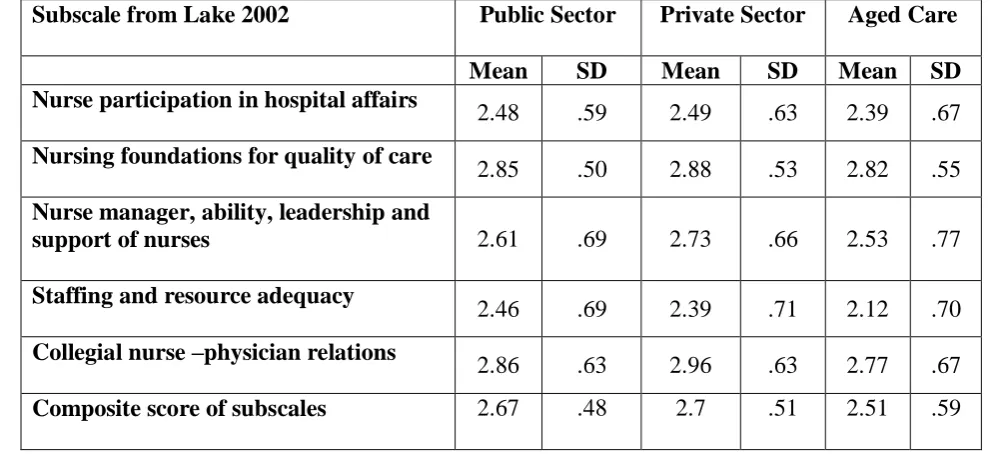
unfavourable environment. The subscales of Nursing foundations for quality of care (2.85), Nurse manager ability (2.64) and collegial nurse physician relations (2.87) were rated as agreement whereas the subscales Nurse participation in hospital affairs (2.46) and Staffing and resource adequacy (2.35) indicated disagreement. That is unfavourable environmental influences concerned the extent to which nurses participate in how their work environments are managed and the resources available to them. The composite subscale score however shows that overall the environment is favourable (2.64).
Analysis by workplace sectors
sector nurses on four of the five subscales - Nurse participation in hospital affairs, Nursing foundations for quality of care, Nurse manager, ability, leadership and support of nurses, Collegial nurse –physician relations and the composite subscale score. Nurses in the public sector scored highest for the remaining subscale – Staffing and resource adequacy. Nurses working in the aged care sector had lower scores on all subscales than those in the private and public sectors (Table 1). There were statistically significant difference in composite subscale score between public and aged care nurses with public nurses ratings higher (t=3.237, df=474, p=0.001). There were statistically significant difference in composite subscale score between private and aged care nurses with private nurses ratings higher (t=4.198, df=485, p=0.00).
CONSTRUCT VALIDITY
The 30 items of the Practice Environment Scale of the Nursing Work Index (PES-NWI) were subjected to principal component analysis (PCA) using SPSS version 14.0. Data screening was undertaken prior to factor analysis. Inspection of the correlation matrix revealed the presence of many coefficients of 0.3 and above. The Kaiser-Meyer-Oklin value was 0.955, exceeding the recommended value of 0.6 (9, 10) and the Bartlett’s Test of Sphericity (11) reached statistical significance, supporting the factorability of the correlation matrix. In addition the 5:1 respondent to item ratio recommended for factor analysis was achieved.(12)
Principal component analysis revealed the presence of 5 components with eigenvalues exceeding 1, explaining 39.23, 5.29, 4.89, 4.29 and 3.95 per cent of the variance respectively and explaining 57.7 percent of total variance. Generation of the scree plot suggested a five factor solution.
Using Catell’s(13)
scree test, it was decided to retain 5 components for further investigation based on eigenvalues exceeding 1 and the scree plot results. This was further supported by the results of the Parallel Analysis, which showed 5 components with eigenvalues exceeding the corresponding criterion values for a randomly generated data matrix of the same size (30 variables 1192 respondents).(14)
Varimax Rotation
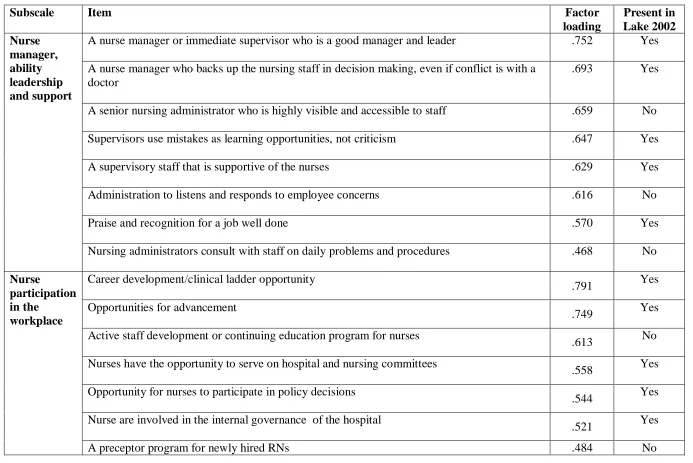
To aid in the interpretation of the 5 components selected, Varimax rotation was performed. The rotated solution revealed the presence of a simple structure(15), with 5 factors. The 5 factor solution explained a total of 57.7 % of the variance, with Factor 1 - contributing 15.18%, Factor 2 - 13.37%, Factor 3 - 11.03%, Factor 4 - 9.8% and Factor 5 - 8.3%.
Nursing foundations for quality of care. Factor 5 has the same three items as Lake’s subscale - Collegial nurse-physician relations .
RELIABILITY OF THE SCALE
The PES-NWI in the present study demonstrated good internal consistency, with a Cronbach alpha coefficient of 0.948. All corrected item-total correlations are above 0.3 and the
Cronbach’s alpha would not increase if any of the items were deleted.
Subscales
Each of the subscales identified by Lake(1) was assessed for internal consistency with Cronbach’s alpha. Each subscale had a Cronbach’s alpha greater than 0.7 which indicates internal consistency and for each subscale corrected item-total correlations are greater than 0.3. Nurse participation in hospital affairs has aCronbach’s alpha of 0.892, nursing foundations for quality of care of 0.808, nurse manager ability, leadership and support of nurses of 0.705, staffing and resource adequacy of 0.772 and collegial nurse-physician relations of 0.846. There is no increase in Cronbach’s alpha by deleting any of the items of each of these subscales.
DISCUSSION
Understanding the practice environment provides opportunity to evaluate areas in which change may be required to retain or attract nurses in the workplace. Results from this survey of Queensland nurses indicates that the nursing practice environment as rated by the PES-NWI was rated overall as favourable in the areas of – Nursing foundation for quality of care, Nurse manager ability, leadership and support of nurses and Collegial nurse-physician relations. However less favourable ratings were found for - Nurse participation in hospital affairs and Staffing resource and adequacy.
These results were not homogenous as analysis comparing across the three main work sectors (public, private and aged care) indicated that nurses working in the private sectors rated their environments more favourable than the public or aged care sector. The exception to this were questions concerning staffing and resource adequacy which was rated higher by the public sector nurses but not those in aged care.
The 30 items of the PES-NWI used in this study was shown to be reliable demonstrating internal consistency with a Cronbach’s alpha of the total scale of 0.948 and for each subscale between 0.705 and 0.892 . On factor analysis using a varimax rotation the 30 items loaded onto 5 factors explaining 57.7% of the variance. Items in the five factors differed slightly from those reported by Lake.(1) Main item differences occurred within the subscales - Nurse manager ability, leadership and support of nurses and Nurse participation in hospital affairs.
cultural differences between Australia and the United States where the original instrument was developed and tested.
Limited comparison data is available on the factor structure of the PES-NWI. However a recent study by Chiang and Lin(16) report the reliability and validity of the Chinese version of the PES-NWI the C-NPES. Surveying 842 nurses from five hospitals in Taiwan, they found a five factor solution containing 30 items explained 47.89% of the variance. Four of the five factors of the PES-NWI were nearly identical - Nurse manager ability, leadership and
support of nurses, Nurse participation in hospital affairs, Staffing and resource adequacy and Nursing foundations for quality care. The fifth factor Nurse-physician working relations was not supported. The fifth factor of the C-NPES was called Professional Development and included 6 items, one from Nurse-physician working relations, three from Nursing
foundations for quality care, two from Nurse participation in hospital affairs. The authors argue that Taiwanese nurses consider professional development an important element in the practice environment.
This study has limitations in that it is confined to one state in Australia and was distributed only to those nurses who are members of the Queensland Nurses Union. However, sample size was large and even by sector was more than adequate to complete factor analysis. Further research to ascertain the applicability of the PES-NWI in different settings should be similar to the process described by Flynn et al(17) where respondents rate each item’s
importance to describing the nursing work environment. Consideration should also be given to the analysis by level of nurse completing the survey.
In conclusion the factor structure of the PES-NWI which was developed using data from hospital nurses in the United States is largely supported for the Queensland nurses in this study. More Australian studies are needed to confirm these findings
ROLE OF THE FUNDING SOURCE
REFERENCES
1. Lake ET. Development of the practice environment scale of the Nursing Work Index. Research in Nursing & Health. 2002 Jun;25(3):176-88.
2. Aiken L, Patrician P. Measuring organizational traits of hospitals: the Revised Nursing Work Index. Nursing Research. 2000 May-Jun;49(3):146-53.
3. Lake ET. The Nursing Practice Environment: Measure and Evidence. Medical Care Research & Review. 2007;64(2):104S-22S.
4. Sochalski JA, Estabrooks CA, Humphrey CK. Nurse staffing and patient outcomes: Evolution of an international study. Canadian Journal of Nursing Research. 1999;31(3):69-88.
5. Leiter MP, Spence Laschinger HK. Relationships of work and practice environment to professional burnout: testing a causal model. Nursing Research. 2006 Mar-Apr;55(2):137-46.
6. Lake ET, Friese CR. Variations in nursing practice environments: relation to staffing and hospital characteristics. Nursing Research. 2006 Jan-Feb;55(1):1-9.
7. Hegney D, Plank A, Buikstra E, Parker V, Eley R. Nurses. Worth listening to. Toowoomba: University of Southern Queensland; 2005 Contract No.: Document Number|. 8. Duffield C, Roche M, O'Brien-Pallas L, Diers D, Aisbett C, Hall J, et al. Glueing it Together: Nurses, their work environment and patient safety. Sydney: Centre for Health Service Management, University of Technology Sydney; 2007 Contract No.: Document Number|.
9. Kaiser H. A second generation Little Jiffy. Psychometrika. 1970;35:401-15. 10. Kaiser H. An index of factorial simplicity. Psychometrika. 1974;39:31-6.
11. Bartlett M. A note on the multiplying factors for various chi square approximations. Journal of the Royal Statistical Society. 1954;16(Series B):296-8.
12. Hair J, Anderson R, Tatham R, Black W. Multiple variate data analysis. Englewood: Prentice-Hall; 1998.
13. Catell R. The scree test for number of factors. Multivariate Behavioural Research. 1966;1:245-76.
14. O'Connor B. SPSS and SAS programs for determining the number of components using parallel analysis and Velicer's MAP test. Behaviour Research Methods, Instrumentation and Computers. 2000;3:396-402.
16. Chiang H-Y, Lin S-Y. Psychometric testing of the Chinese version of nursing practice environment scale. Journal of Clinical Nursing. 2008;18:919-29.
Table 1 – Subscale scores for nurses working in public, private and aged care sector
Subscale from Lake 2002 Public Sector Private Sector Aged Care
Mean SD Mean SD Mean SD Nurse participation in hospital affairs
2.48 .59 2.49 .63 2.39 .67
Nursing foundations for quality of care
2.85 .50 2.88 .53 2.82 .55
Nurse manager, ability, leadership and
support of nurses 2.61 .69 2.73 .66 2.53 .77
Staffing and resource adequacy
2.46 .69 2.39 .71 2.12 .70
Collegial nurse –physician relations
2.86 .63 2.96 .63 2.77 .67
Table 2– Factor loadings for each subscale
Subscale Item Factor
loading
Present in Lake 2002 Nurse
manager, ability leadership and support
A nurse manager or immediate supervisor who is a good manager and leader .752 Yes A nurse manager who backs up the nursing staff in decision making, even if conflict is with a
doctor
.693 Yes
A senior nursing administrator who is highly visible and accessible to staff .659 No Supervisors use mistakes as learning opportunities, not criticism .647 Yes
A supervisory staff that is supportive of the nurses .629 Yes
Administration to listens and responds to employee concerns .616 No
Praise and recognition for a job well done .570 Yes
Nursing administrators consult with staff on daily problems and procedures .468 No
Nurse
participation in the
workplace
Career development/clinical ladder opportunity
.791 Yes
Opportunities for advancement
.749 Yes
Active staff development or continuing education program for nurses
.613 No
Nurses have the opportunity to serve on hospital and nursing committees
.558 Yes
Opportunity for nurses to participate in policy decisions
.544 Yes
Nurse are involved in the internal governance of the hospital
.521 Yes
A senior nursing administration equal in power and authority to other top level hospital
executives .380
Yes
Staffing and resource adequacy
Enough staff to get work done
.765 Yes
Enough registered nurses on staff to provide quality patient/client/resident care
.743 Yes
Adequate support services allow me to spend time with my patients
.707 Yes
Enough time and opportunity to discuss patient/client/resident care problems with other nurses
.649 Yes
Working with nurses who are clinically competent
.442 No
Nursing foundations for quality care
Written, up to date nursing care plans for all patients/clients/residents
.640 Yes
High standards of nursing care are expected by the administration
.594 Yes
Patients/clients/residents care assignments that foster continuity of care
.546 Yes
Nursing care is based on a nursing model, rather than a medical model
.521 Yes
A clear philosophy of nursing that pervades the patients/clients/residents care environment
.506 Yes
An active quality improvement program
.449 Yes
Collegial nurse-physician relations
Doctors and nurses have good working relationships
.810 Yes
A lot of team work between nurses and doctors
.808 Yes
Collaboration between nurses and doctors