UNIVERSITY OF SOUTHERN QUEENSLAND
Faculty of Engineering and Surveying
Problem Based Learning for teams working in virtual
space
A Dissertation Submitted by
Lynette Meryl Brodie
For the Award of
Engineering Doctorate
2010
Principal Supervisor
Professor Frank Bullen
Associate Supervisor
i
Abstract
Australia is facing a critical shortage of engineers at all levels of the profession – associates, technologists and professional engineers. Universities face three main challenges in responding to this predicted shortfall: the impact of technology and the information revolution both on higher education and the profession, the increasing diversity and choices of the student population, and the changing requirements of governments, professional accreditation agencies, industry and society.
Over the last decade, universities have implemented recommendations from accrediting agencies to demonstrate the competencies of graduates in a broad range of key graduate attributes such as teamwork, communication and problem solving, as well as lifelong and self-directed learning. Universities have also strived to open the access pathways to higher education, granting entrance to more students with a wider range of educational backgrounds and ages and who are looking for flexible study patterns, that is, something other than full time on-campus. This trend is likely to continue in the future. Whilst the efforts of universities have resulted in changes to curricula and teaching methodologies, technology and the global economy is beginning to demand, if not new skills, then extensions of the current graduate attributes: working in a multicultural environment; working in interdisciplinary, multi–skilled teams; sharing of work tasks on a global and around–the–clock basis; working with digital communication tools and working in a virtual environment. These attributes are difficult to attain through traditional, didactic educational programs.
The intent of this dissertation is to document the design, implementation and evaluation of an innovative curriculum strategy to respond to these demands. Problem Based Learning (PBL) meets the demands of the profession with respect to technical content and key graduate attributes. The addition of virtual teams1, students working in a team in virtual space with no face–to–face contact, is original and meets future demands of the profession and changes in the higher education sector. The research spans several broad areas including student teams working in
1 Virtual team is a term used in the literature to describe a team working in virtual space,
ii
distance education, engineering education, assessment, staff professional development and problem based learning. It takes an overarching view and develops, through an action research methodology, a model of how to deliver PBL to students studying by distance education and in particular for delivery to a large and diverse student cohort.
The research process identified five key areas for successful delivery of course content, both technical knowledge and graduate attributes, to meet student learning outcomes and requirements. These areas include: staff training and changing staff attitudes, curriculum development beginning with basics of team development, individual learning goals, communication skills, development of a ‗learning community‘ among the students and staff, reflection and reflective practice and effective assessment in line with course objectives.
The dissertation presents a case study of successful design and implementation. Evaluation and confirmation of the strategy has been evidenced by a significant contribution to the current body of knowledge through peer reviewed publications, national awards and the uptake of the concepts and resources by other institutions and academics.
iii
Certification of Dissertation
I certify that the ideas, experimental work, results, analyses and conclusions reported in this dissertation are entirely my own effort, except where otherwise
acknowledged. I also certify that the work is original and has not been previously submitted for any other award, except where otherwise acknowledged.
____________________________________ ______________
Signature of Candidate Date
Endorsement
____________________________________ ______________
v
Acknowledgements
I am greatly indebted to many colleagues and friends for their support, guidance and encouragement over the course of this project, its phases and documentation.
Firstly, thanks to my supervisors Professor Frank Bullen and Professor David Dowling for their excellent contributions and guidance.
Associate Professor Nigel Hancock, Sandra Cochrane and Patrick Danaher provided much support with proof reading.
Many colleagues have been part of the staff team, which implemented and trialled strategies and I am very grateful for their cooperation. Special thanks go to Ron Ayers, Chris Snook, Peter Gibbings, John Worden, Mark Porter and Rod Smith. These colleagues provided inspiration and motivation over many years in the quest to take the Faculty over the rough road to believing in PBL.
vii
Table of Contents
Abstract ... i
Certification of Dissertation ... iii
Acknowledgements ... v
List of Figures ... x
List of Tables ... xii
Summary of Innovations and Original Contributions ... xiv
Recognition of Innovation ... xvi
1
Introduction ... 1
1.1 Organisation of Dissertation ... 10
1.2 List of Papers ... 11
1.2.1 Publications directly related to the Award of Engineering Doctorate (EngD) ... 11
1.2.2 Supporting Publications ... 17
2
Literature Overview... 19
2.1 Problem Based Learning (PBL), Engineering Education & Distance Education . 19 2.1.1 History of Problem Based Learning (PBL) ... 19
2.1.2 Theory of Problem Based Learning ... 22
2.1.3 Problem Based Learning in Engineering Education ... 26
2.1.4 Distance Education and eLearning ... 31
2.2 Nexus between Engineering Education, Teamwork and Virtual Teams ... 35
2.2.1 Virtual Teams – teams in virtual space ... 37
2.2.2 Virtual Teams in Education ... 39
2.2.3 Making Virtual Teams Work in a Learning Environment ... 42
2.3 Assessment – Teams & Problem Based Learning ... 46
2.3.1 Assessment of Teamwork ... 47
2.3.2 Assessment in Problem Based Learning ... 49
2.4 Learning Community – Community of Practice ... 50
2.5 Staff Training ... 51
2.5.1 From Supervisory Role to Facilitator Role ... 52
3
Education Requirement and Context ... 56
3.1 Introduction ... 56
3.2 Student Demographics and Diversity ... 56
3.3 Information Revolution ... 58
3.4 Student, Government and Industry Requirements ... 59
3.5 USQ Context and Responses ... 62
3.6 The Case for PBL ... 65
viii
4
Methodology ... 68
4.1 Introduction ... 68
4.2 The Research Process – a learning journey ... 69
4.3 Research Methods... 77
4.3.1 Surveys ... 79
4.3.2 Interviews ... 79
Staff ... 80
Students ... 80
4.3.3 Use of Learning Management System ... 81
4.3.4 Thematic Analysis of Student Portfolios ... 82
4.4 Summary ... 83
5
Challenging the Boundaries – The Application of PBL to
Distance and Online Education ... 84
5.1 Introduction ... 84
5.2 PBL in a Virtual Teams for Distance Education ... 86
5.3 Phase 1– An Initial Investigation of the First Offers ... 92
5.3.1 Student Profile and Perceptions ... 93
5.3.2 Student Issues ...101
5.3.3 Staff (Facilitator) Perceptions ...102
5.3.4 Summary of Initial Investigations ...107
5.4 Changes to the Course ... 108
5.4.1 Foundations for a Successful Team ...108
5.4.2 Reflective Writing – Helping Students Understand Their Learning ...111
5.5 Phase 2 – Effectiveness of Change ... 112
5.5.1 Teamwork ...117
5.5.2 Independent and Self Directed Learning ...121
5.5.3 Communication Skills ...126
5.5.4 Problem Solving Skills ...128
5.6 Summary ... 131
6
Forming and Supporting Virtual Teams in Higher
Education Using a Learning Management System ... 133
6.1 Introduction ... 133
6.2 PBL and Distance Education – a framework ... 134
6.3 Data from the LMS ... 137
6.4 Overview of Postings to Discussion Forums ... 141
6.4.1 Forming, Storming and Norming ...142
6.4.2 Barriers to Participation and Learning ...144
6.5 Summary ... 148
7
Assessment ... 149
7.1 Introduction ... 149
ix
7.3 Operational Aspects ... 155
7.3.1 Team Project Reports ... 156
7.3.2 Individual Portfolios ... 157
7.4 Analysis of Assessment Scheme ... 159
7.5 Assessment Rubrics ... 162
7.5.1 Background ... 163
7.5.2 Development of Rubrics ... 166
7.5.3 Evaluation of Rubrics ... 169
7.5.4 Results of Evaluation ... 170
7.6 Summary ... 176
8
Developing a Learning Community ... 178
8.1 Introduction ... 178
8.2 A Learning Community in Virtual Space ... 180
8.2.1 Social Learning ... 181
8.2.2 Facilitation Role ... 183
8.3 Developing a Common Goal ... 184
8.4 Recognising and Using Diversity ... 187
8.5 Developing Trust in the Team ... 191
8.6 Summary ... 192
9
Staff Training and Professional Development ... 194
9.1 Introduction ... 194
9.2 Instruction to Facilitation ... 194
9.3 Achievements ... 197
9.4 Summary ... 200
10
Conclusion and Further Work... 202
10.1 Areas for further investigation ... 202
10.2 Conclusions ... 204
References ... 209
x
List of Figures
Figure 1-1 Scaffolding and articulation of the PBL courses in the Problem Solving
Strand ... 6
Figure 1-2 Concept map of major interactions and overlaps in distinct research areas ... 9
Figure 2-1 Mechanisms for entry to undergraduate programs in Australia ... 33
Figure 2-2 Articulation of Faculty programs ... 34
Figure 2-3 Team phases and team outputs ... 43
Figure 3-1 Commencing student age profiles at USQ in the engineering programs . 63 Figure 4-1 Educational experience resulting in change ... 69
Figure 4-2 Research experience ... 71
Figure 4-3 Research contributing to the body of knowledge – a personal synthesis . 72 Figure 4-4 Areas and interactions of investigation ... 73
Figure 4-5 Action Research Strategy ... 78
Figure 5-1 Implementation and initial investigation ... 84
Figure 5-2 Scaffolding in the problem solving strand ... 88
Figure 5-3 Program distribution for the first offers ... 93
Figure 5-4 Students enrolled in each major ... 94
Figure 5-5 Experience in the work force ... 94
Figure 5-6 Student response on preference of lectures for course delivery ... 95
Figure 5-7 Student response to retention of knowledge being less than in traditional subjects. ... 96
Figure 5-8 Student response to the courses increasing learning ability ... 96
Figure 5-9 Student responses to the courses increasing their ability to undertake independent learning ... 97
Figure 5-10 Student response to PBL course enhancing their problem solving skills ... 97
Figure 5-11 Student response to PBL course increasing their appreciation of prior knowledge in problem solving. ... 98
Figure 5-12 Individual facilitator marks for portfolio (semester 1 2002) ... 105
Figure 5-13 Personal research process ... 107
Figure 5-14 Overview of team report 1 ... 109
xi
Figure 5-16 Distribution of discipline majors ... 114
Figure 5-17 Age profile of students ... 115
Figure 5-18 Student perceptions on the use of developing a team code of conduct 116 Figure 5-19 Student perceptions on teamwork ... 118
Figure 5-20 Setting my own goals was helpful to my learning ... 122
Figure 5-21 Survey responses to test student perceptions of independent and self learning skills ... 124
Figure 5-22 Retention of knowledge was less than in traditional courses ... 124
Figure 5-23 Student perceptions on the improvement of communication skills as a result of the course ... 128
Figure 5-24 Student perceptions on problem solving skills ... 129
Figure 5-25 Problem Solving cycle ... 131
Figure 6-1 A model for online teaching and learning ... 136
Figure 6-2 Usage of the LMS for a typical semester ... 138
Figure 6-3 Use of discussion forums ... 139
Figure 6-4 Average number of postings to discussion boards for a typical semester ... 139
Figure 6-5 Average number of postings per student per week ... 140
Figure 6-6 Total average time per student per week for semester 1 2007 ... 140
Figure 6-7 Barriers to student learning in virtual teams ... 144
Figure 7-1 Task 1 of the first individual portfolio ... 156
Figure 7-2 Section of new marking rubric ... 168
Figure 7-3 Summary of final marks for each team ... 172
Figure 7-4 Student survey results relating to assessment over a three year period of development ... 174
Figure 8-1 Student self perceptions of the social aspect of the course – the course helped me to meet other students ... 182
Figure 8-2 Our team discussed and agreed on goal/s ... 186
Figure 8-3 Having a goal kept our team focused ... 186
Figure 8-4 Having a team goal help me participate in the team more effectively ... 186
Figure 8-5 Student responses to ‗my appreciation of how the prior knowledge and skills of my colleagues can be used to solve a problem has been increased‘ ... 187
xii
Figure 8-7 Student usage of the LMS – total average time per student for each week
of semester for two typical semesters ... 190
Figure 8-8 Average mark for reflective portfolio by facilitators ... 198
List of Tables
Table 1-1 Comparison of graduate attributes from Engineers Australia and ABET ... 2Table 1-2 Examples of literature discussing PBL in a virtual environment ... 7
Table 2-1 Requirements for engineers of the 21st century ... 27
Table 2-2 Modes and Functions to describe group activity ... 45
Table 3-2 Undergraduate programs in Engineering and Surveying ... 63
Table 4-1 Publications showing the work of author and contributions to BOK ... 74
Table 4-2 Supporting publications ... 76
Table 5-1 PBL Strand of Courses and team sizes ... 87
Table 5-2 Sample Problem outlines and learning objectives ... 92
Table 5-3 Themes from portfolios and surveys ... 99
Table 5-4 Student unsolicited reflections on main objects of the course ... 100
Table 5-5 Assessment criteria for Team Report 2 ... 110
Table 5-6 Significant difference in student responses between on-campus and distance students ... 113
Table 5-7 Data for on-campus and distance students relating to problem solving and teamwork skills ... 114
Table 5-8 Correlation statistics ... 119
Table 5-9 Short answer response to the course evaluation survey – Teamwork ... 120
Table 5-10 Example of student entry for Portfolio 1 ... 121
Table 5-11 Correlation statistics for problem solving skills and application of prior knowledge ... 130
Table 7-1 Comparison of marks and level of achievement for criterion of ‗experimental methodology‘ ... 171
xiv
Summary of Innovations and Original Contributions
The principal innovation in this work is the integration of four separate areas within the Scholarship of Teaching and Learning, areas which have hitherto been essentially separate. These are Problem Based Learning, reflective practice in engineering education, distance education and virtual teams. The work presented in this dissertation advances some topics and then sets out a unification in the form of a single practical package. The unification also encompasses authentic assessment, community of practice, appropriate staff training and evaluation appropriate to the context. With this unification there have been contributions to the body of knowledge through peer reviewed publications and an uptake of materials developed by the author through the course of this project.
In 2000, when the work underpinning the dissertation began, there were no publications relating to student teams using Problem Based Learning when the teams were constrained to working entirely in virtual space. For practical reasons these teams could use only asynchronous (on–line) communication methods (i.e. not the telephone) and had no opportunity to meet face–to–face. Development of the program and support material has continued, making use of and evaluating new technologies and approaches (e.g. wikis) as they have become readily available. Recognition of student requirements, backgrounds and varying personal access to technology remains critical.
This work has the potential to create truly global engineering graduates by linking students across the world working in virtual teams and sharing tasks on an around– the–clock basis: a requirement for engineering graduates which is just emerging in the engineering education literature.
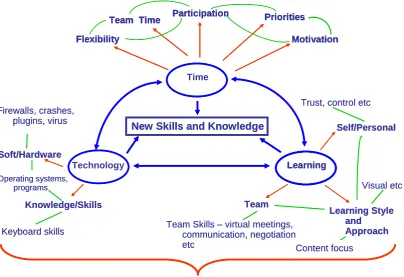
xv of a model, illustrated in Figure I and discussed in detail in Chapter 6, which describes the interactions and barriers to student learning when confronted with the mix of teamwork and technology. Whilst this model was developed and tested for teams working in virtual space, it applies equally well to traditional on–campus teams and provides a structure for curriculum development for team and collaborative learning projects to maximise student learning and minimise the pitfalls and frustrations encountered by academics and students alike.
Figure I Barriers to student participation in teams
It is vital to effectively incorporate key graduate attributes into the engineering curriculum, a fact recognised by educators and industry alike. Outcomes of this work presents not only a development which supports curriculum change and effective delivery of both technical content and graduate attributes but looks to the future to ensure the education of engineers with skills to meet the challenges which lay ahead.
Self/Personal
Visual etc
Operating systems, programs
New Skills and Knowledge Time
Learning Technology
Flexibility
Team Time Participation Priorities
Motivation
Team
Learning Style and Approach Team Skills – virtual meetings,
communication, negotiation etc
Trust, control etc
Content focus Soft/Hardware Knowledge/Skills Firewalls, crashes, plugins, virus Keyboard skills LEARNING COMMUNITY LEARNING COMMUNITY Self/Personal Visual etc Operating systems, programs
New Skills and Knowledge Time Time Learning Learning Technology Flexibility
Team Time Participation Priorities
Motivation Flexibility
Team Time Participation Priorities
Motivation Flexibility
Team Time Participation Priorities
Motivation
Team
Learning Style and Approach Team Skills – virtual meetings,
communication, negotiation etc
Trust, control etc
xvi
Recognition of Innovation
The work represented in this dissertation has been reviewed and its merit recognised by several external bodies in the form of university and national award as listed following. These awards are team awards as they recognise the implementation of the innovation and hence work of the teaching team. The major innovations and core development of the package are that of the author except where noted in the dissertation.
Awards
2008 Australasian Association for Engineering Education – Innovation in Curricula, Learning and Teaching ―Engineering Problem Based Learning Strand” (Team Leader)
2007 Carrick Award for Australian University Teaching (now Australian Learning and Teaching Council ALTC) – Innovation in Curricula, Learning and Teaching ―Engineering Problem Based Learning Strand” (Team Leader)
2006 Carrick Institute Citation (now ALTC) –―Educating Engineers for the 21st Century – Successfully designing and delivering the world's first Problem–Based
Learning course for distance engineering students‖ (Team Leader)
2005 Finalist in Australian Awards for University Teaching (AAUT) Enhancement of the Quality of Teaching and Learning, Institutional Awards Category, ―Educating Engineers and Surveyors for the 21st Century‖ (Team Leader)
2005 Australasian Association of Engineering Educators – Excellence in a Curriculum Team Project in Engineering Education (Team Leader)
2003 USQ Award for Excellence in Design and Delivery of Teaching Materials (Team Leader)
Use and Uptake of Materials
xvii
Reflective Writing Guide:
Used in CDS2002 Independent Project 1 from the Bachelor of Human Services program, Faculty of Business, USQ
Used in Graduate Certificate in Tertiary Teaching and Learning, Faculty of Education, USQ
Adapted for use in ENG8300 Self assessment portfolio from the Master of Engineering Practice program, Faculty of Engineering and Surveying, USQ
Adapted for use in the OBL (Outcomes Based Learning) and Technology Enhanced Assessment Initiative at the Centre for Learning, Teaching and Technology (LTTC), The Hong Kong Institute of Education, Hong Kong
Peer and Self Assessment Resources:
Used in ACC3101 Accounting Information Systems, Faculty of Business, USQ
All course materials have been reviewed and used, with acknowledgement, for the:
2008 ALTC Competitive Grant – ―Business education in the 21st century: Examining the antecedents and consequences of student team virtuality (2008)‖