Copyright C) 1990, American Society for Microbiology
Different
Sites of
Interaction
for Rev, Tev,
and Rex Proteins within
the Rev-Responsive
Element
of Human Immunodeficiency
Virus
Type
1
LUDMILA SOLOMIN, BARBARAK. FELBER, AND GEORGE N. PAVLAKIS*
BasicResearch Program, NationalCancerInstitute-Frederick CancerResearch and Development Center,
Frederick,
Maryland
21702-1201Received 16 July1990/Accepted5 September 1990
We have analyzedthe action of the Rev and Tevproteins ofhumanimmunodeficiency virustype1 (HIV-1)
andof theRexprotein ofhumanT-cellleukemiavirustypeI(HTLV-I)on aseries ofRev-responsive element (RRE) mutants. The minimum continuous RRE region necessary and sufficient for Rev function was
determined to be 204nucleotides. Interestingly, this regionwasnotsufficient forTev orRex function.These
proteins require additional sequences, which may stabilize the structureof theRREor may containadditional sequence-specific elements. Internal RRE deletions revealedthatthetargets forRevand Rexcanbeseparated, sincemutants responding to Rev and not Rex and vice versawereidentified. Tevwasactive on bothtypesof mutants,suggesting thatit hasa morerelaxedspecificitythan dobothRevand Rexproteins. AlthoughRevand
Rex targets within the RRE appear to be distinct, the trans-dominant mutant RevBL prevents the RRE interaction with Rex. RevBL cannot inhibit the function of Rex on RRE deletions that lack theRev-responsive portion. Theseresultsindicatethepresence of distinctsites withinthe RREforinteraction with these proteins. Thebinding sites for thedifferent proteins do not function independentlyandmay interferewith oneanother. MutationsaffectingtheRREmaychange the accessibility andbinding characteristics of the different binding sites.
Both human immunodeficiency virus (HIV) and human T-cell leukemia viruses (HTLV) regulate the expression of their structuralproteins by specificviral factors called Rev and Rex,respectively (for recent reviews, see references 31 and 36). Both Rev and Rex are essential viralfactors. Rev acts via a unique sequence, named the Rev-responsive element (RRE) (17), located in the envregion ofHIV (5, 9, 10, 13, 17, 20, 21, 26, 27, 37). The sequence necessary for
Rexfunction has been named byanalogy the Rex-responsive element andis located at the 3' long terminal repeat (LTR) of HTLV type I (HTLV-I) (11, 15, 22, 41, 43). It was shown that Rexcan also act on HIVtype 1 (HIV-1) via the same
RRE region (15, 22, 35). An additional viral protein named
Tevhasbeenidentified in some HIV-1-infected cells (3, 38).
This protein has been shown to exhibit both Tat and Rev
activities and can replace both of these essential HIV
regulatory factors (3).
The RREis presentonlyin thefull-length and
intermedi-ate-sizemRNAs, some of which encode Gag,Gag-Pol, and
Env proteins. In contrast, the RRE is absent, because of
splicing, from the small multiply spliced mRNAs encoding
regulatory proteins such as Tat and Rev. Rev affects the transportof RRE-containing RNAs from the nucleus to the
cytoplasm(13, 14, 17, 21, 27) and increases their half-lives
(17). This results in high levels of RRE-containing RNAs in the cytoplasm that are translated efficiently into structural viralproteins (17, 20).
Although Rev can be replaced by Rex, the activities of thesefactorsarenotreciprocal, since Rex ofHTLV-Icannot be replaced by Rev (15, 22). This has been interpreted as evidence for direct interaction of these factors with their respectiveRNA elements. It was subsequently shown that
*Correspondingauthor.
Rev binds specifically to the RRE and that binding is
necessary for Rev function (5, 8, 23, 26, 30, 44). Binding
alone is not sufficient for Rev function, since the
trans-dominant Rev mutantRevBL (28) binds specifically to the RRE butdoes not function (D. M. Benko, R. Robinson, L.
Solomin, M. Mellini, B. K. Felber, and G. N. Pavlakis,
submitted for publication). Therefore, interaction with cel-lular factors may be necessary for function. Although the directbindingofRex tothe RREorRex-responsiveelement has notbeendemonstrated, structural and functional data(6, 7, 17, 22,25, 28, 34, 42), suchasthearginine-rich regionsin bothproteins, the nucleolar localization, the similar behav-ior of mutants, and the functional replacement of Rev by
Rex,pointtotheconclusionthat botharedirectlybindingto
specific RNAelements that promote mRNA transport and
utilization(forreviews, seereferences 32 and 36).
Here we define the minimal elements within the RRE
region that are necessary and sufficient for Rev, Rex, and
Tev response. The results indicate that the bindingtargets for these molecules are distinct. The
specificities
of theseproteinsfordifferent structural elements within the RREare
differentandindicatethat specificstructuresmay be
impor-tantfor function. The contribution of theprimary sequence
ofthisregionis unclear. Tev appears to have morerelaxed
specificity comparedwith both RevandRex.
MATERIALS AND METHODS
Constructs. The gagexpression plasmid MVgag has been describedpreviously (20).It wasderived from the infectious
proviral clone HXB2 (18) by removing a viral fragment
from BalI to XhoI (nucleotides [nt] 2165 to 8443) and
replacingit withapolylinker. Variousfragments containing
theRRE were inserted into thepolylinker and assayed for
Gag proteinproductionafterintroduction into human cells.
6010
on November 10, 2019 by guest
http://jvi.asm.org/
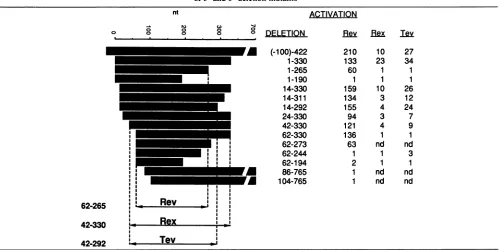
TABLE 1. Identification of the minimal continuous RRE for Rev, Rex, and Tev function (arrows) by a collection of 5' and 3' deletion mutantsa
nt ACTIVATION
rK3 C13
o 3 3 8 DELETION Rev Rex ITe
(-100)-422 1-330 1-265 1-190 14-330 14-311 14-292 24-330 42-330 62-330 62-273 62-244 62-194 86-765 104-765
I
L< Rev
-
Rex
T-, I-0
Tev
,'210 10 27
133 23 34
60 1 1
1 1 1
159 10 26
134 3 12
155 4 24
94 3 7
121 4 9
136 1 1
63 nd nd
1 1 3
2 1 1
1 nd nd
1 nd nd
I
I I I
aFoldactivationobtained bythep249a8 antigencaptureassayin thepresenceof each protein is indicated. Resultsare averagesoftwo tosixexperiments. nd, Notdetermined.
ThepMVgag-RRE plasmidconstructsareshowninTable 1.
For convenience, the numbering system used here for the
various RRE fragments defines asnt1the firstnucleotide of
theStyI siteat nt7266 ofHXB2 (where +1 is the RNAstart
site of the corrected HXB2 sequence). The differences
identified between our sequence and the HXB2 sequence
givenintheacquired immunodeficiency syndrome data base (29, 33)are asfollows: insertion of 3 nts afterposition 223, GAG-226; deletionof 2ntafterposition 260,GCGCCCGCto
GCGCGC, which restores the BssHII site; C-7369 to G; A-7501toG; A-7513toG; A-7549toG; and C-7636toT. The
namesof the differentconstructsindicatethecoordinates of
the RRE inserts. pl-330 and p62-330 containthe StyI
frag-ments (nt 7266 to 7595 and nt 7327 to 7595 in HXB2, respectively) inserted into pMVgag. 3' RREdeletionswere
constructed inp62-330 byBAL31digestionsand resulted in
endpointsat nt273, 244,and 194, respectively. Polymerase
chainreactionamplification wasused togeneratethe other deletionmutants. Theamplified fragmentswerefirstcloned
into theEcoRV site of BluescriptvectorKS(-) (Stratagene)
and then inserted into the pNLgag vector, resulting in
pl-265, pl-190, p14-330, p14-311, p14-292, p14-265, p24-330,
and p42-330. pNLgag is avector similar to pMVgag,
con-structed by insertion of a BssHII-to-XhoI fragment of
pMVgag (nt265to2165 ofHXB2containing thegagregion)
between the LTRs ofa different HIV-1 molecular clone,
pNL43 (1). pNLgag containsthepUC replication originand
grows better in Escherichia coli. Internal deletions in the RREcontained inplasmidpl-330wereconstructedby using
site-directedmutagenesisinM13vectors(Mutator kit;
Stra-tagene); the mutated RREfragmentswerethencloned into
the pNLgag expression vector. The internal RRE deletion mutants lack thefollowingsequences: DL12s, nt 89to155; DL45, nt 183to238; DL345, nt 156to238;and DL345s,nt 147 to 238. All mutations were confirmed by sequencing.
pL3rex contains the HTLV-I rex cDNA (15) from the rex
initiation codon to the ApaI site (nt 7927 in reference 40)
linked to the HIV-1 LTR promoter in pL3pA (28). pNL1.4.6D.7 isan HIV-1 cDNAexpressing only the
p28"ev
proteinof HXB2 (3). pL3rev and pLBLexpress the HIV-1 Rev (17) and the Rev trans-dominant mutant RevBL (28), respectively,from the HIV-1 LTRpromoter. pRSV-L
con-tains the luciferase gene linked to the Rous sarcomavirus LTRpromoter(11).
Transfections. HLtat, a cellline constitutively expressing
HIV-1 Tat (39), was transfected by the calcium phosphate
precipitation techniqueasdescribed previously (16, 19).All transfection mixtures contained 2 ,ug of pRSV-L as an
internalstandard. At20to48 h posttransfection,cells were
washedtwicewithphosphate-buffered saline andscrapedoff the plate in 400 ,ul of 100 mM Tris (pH 7.4)-0.5% Triton X-100. The cell lysate wasfrozen and thawed once,
centri-fuged for5 min in anEppendorfcentrifuge, and used in all
subsequentassays.
Proteinmeasurements.ForWesternimmunoblots,50,ulof celllysatewasadjustedto0.5x RIPAby addition of5 ,lIof
Sx RIPA buffer (20). Proteins were separated on 12.5% denaturing acrylamide gels (24)and blotted onto nitrocellu-lose filters. Gag proteins were visualized by using human
patient serum, followed by incubation with '25N-labeled protein A. For p249ag antigen capture assays (Dupont,
NEN), 50 ,ul oflysate was diluted into 150 ,ul of dilutant solution (provided by the kit; Dupont, NEN), and serial 10-folddilutions thereofwereanalyzed asinstructed bythe manufacturer. For luciferase assays (4, 12), 25 ,ul of cell
lysate was mixed with 1 volume of luciferase lysis buffer
(1.5%TritonX-100, 50 mM glycylglycine [pH 7.8], 30 mM
MgSO4, 8 mM EGTA, 2 mM dithiothreitol) and 180 ,ul of luciferase reaction buffer (25 mM glycylglycine, 15 mM
MgSO4, 4 mM EGTA, 15 mM KPO4 [pH 7.8], 1 mM dithiothreitol, 2 mM ATP). A substrate mixture of 100 ,ul
containing 0.2 mM luciferine dissolved in lx luciferine 62-265
42-330 42-292
on November 10, 2019 by guest
http://jvi.asm.org/
buffer(25 mM
glycylglycine,
15 mMMgSO4,
4 mMEGTA,2 mM
dithiothreitol;
stored in the dark at-70°C
as a lOxstock
solution)
wasaddedtotheabove-described mixtureby
injection,
and luminescence was measured for 20 s in anLKB-Wallac 1251 luminometer. Luciferase assays were
performed
within 1 to 2days
aftercelllysis.
Totalprotein
was measuredfrom 2 to 4
pAl
oflysate,using
the Bio-Radprotein
determination assay.RESULTS
Ithas been
reported
that Rev ofHIV-1 can bereplaced
either
by
RexofHTLV-I(15,
35)orby
Tev, ahybrid protein
with bothTat and Rev activities thatis produced by some
HIV-1strains(3).Itwasalso shown that Rev and Rexact on
HIV-1
through
the same RREregion
(15). To define theminimalRREforRev, Rex,and Tev response,aseries of5',
3', or internal deletion mutants was
generated by
using
convenient restriction
sites,
BAL 31digestion, polymerase
chain reaction
amplification,
or site-directedmutagenesis.
These RRE
fragments
were inserted intoplasmid
pMVgag(or pNLgag),
which containsthe HIV-1 LTRs and the gagregion
(20). After transfections into humancells, pMVgagproduced
verylow levels ofGag
and didnotrespond
toRev.Wehaveshown thatefficient
production
ofGag requires
the presenceofboth the RRE and Rev (17, 20).TheconstructedpMVgag-RRE
plasmids
were transfected either alone or inthe presence of the
Rev-expressing plasmid
pL3crev, theRex-expressing plasmid
pL3rex,ortheTev-expressing
plas-midpl.4.6D.7 intoHLtatcells, which constitutivelyexpress
Tat. One or two days
later,
the cells were harvested andanalyzed
forGag production by immunoblotting,
p24gagantigen
capture assay, orboth. The results ofsomeimmu-noblotting experiments
areshowninFig.
1.Quantitations
ofthe levels of
Gag
were obtainedby
the p24gagantigen
capture assay andare summarized in Table 1. All
transfec-tion mixtures contained 2 ,ug of
pRSV-L
as internalstan-dard. It was found that the presence of
Rev, Tev,
or Rexconsistently
inhibited the levels ofluciferaseexpression by
two- to fivefold.Different
plasmid preparations
gavesimilar results. Additional internal controls wereperformed by
using
a humancytomegalovirus early
promoter-chloram-phenicol acetyltransferase
gene, with similar results. Thisfinding
mayreflectinhibition ofsomenonviralexpression
bythese factors.
Despite this, Gag production
by theRRE-containing plasmids
wasinducedby
upto200-fold,
indicat-ing
thespecific
function ofRev, Tev, orRex. Because ofthese
observations,
the data were not normalized to the luciferase standard.Definition of the minimal continuousRREforRevresponse.
Wehave
previously reported
thatafragment
withinenvfromnt 7242 to 7687 is necessary and sufficient for full Rev function(15). Todefine the5'and 3'borders ofRREforRev
response in more
detail,
two StyIfragments
comprising nt7266to7595 andnt7327to7595ofHXB2wereinsertedinto
pMVgag, generating plasmids
pl-330 and p62-330,respec-tively.
The names of the different constructs indicate thecoordinates of the RRE inserts. Thenumberingsystem used here for the various RREfragmentsdefinesas nt 1 the first nucleotide of the
Styl
siteat nt7266from theRNA startsite of HXB2.Rev inducedGag expressionfrom bothpl-330 and p62-330
to a
high
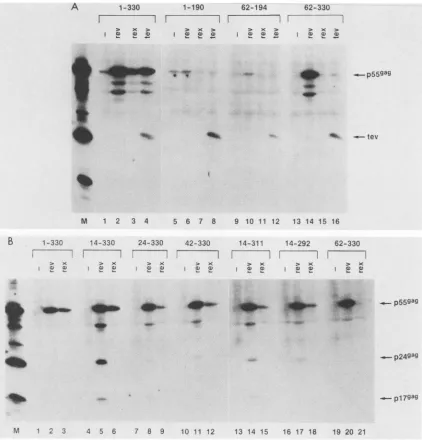
extent(Fig. 1A,lanes2and14).5'deletionmutants to nt 86(pMVgagO12
or p86-765) or 104 (pMVgag218 orp104-765)
have been showntobe inactive in the presence ofRev
(15).
These datadefinethe 5'border of RREat nt62. Toestablish the 3' border, deletions of the RRE in pl-330were
constructed by using either BAL 31 or polymerase chain reaction amplification ofportions of the RRE(see Materials and Methods). RRE fragments 330, 273, 14-265, 62-244, 62-194, and 1-190 were inserted into pMVgag (or
pNLgag) and analyzed as described above. While the 3' deletion to nt 265 resulted in a minor decrease in activation (twofold), further deletions to nt244, 194 (Fig. 1A, lanes 9 and 10), or 190 (Fig. 1A, lanes 5 and 6) completely abolished Revresponsiveness (Table 1). Therefore, the 3' border for full Rev responsewasassigned tont265. These experiments defined the minimal continuous RRE element required for full Rev response as a204-bp fragment from nt 62 to 265 (nt 7327 to 7530 in HXB2). Any further deletions severely affected or abolished Rev response.
Definition of the minimal continuous RRE forRex response.
Ithas been shown thatthe Rexprotein of HTLV-I acts on
HIV-1 via an RRE-containingfragment from -25 to +422 (15). Toinvestigatewhether Rexrequiresaminimal contin-uousRRE fragment similar to Rev, the RRE deletion mu-tants discussed above were cotransfected with the Rex-producing plasmid pL3rex. To define the 5' border of RRE,
plasmids pl-330, p14-330, p24-330, p42-330, and p62-330
were tested (Table 1). Rex activated Gag expression from pl-330 by 23-fold, which was 6-fold less than the activation by Rev. While a 5' deletion to nt 14 lowered the Rex responseabouttwofold, further deletions to nt 24 and 42 led toaseveredropin Rex response. Mutant 62-330 could not be activatedbyRex, while activation by Revwasnotaffected. Todefine the3'border, we analyzed and compared plasmids pl-330,p14-311,p14-292,andpl-265.Whiledeletion fromnt
330 to 311 or 292 reduced Rex activation by 80 to 90%,
deletionto nt265resulted inacomplete loss of Rex function. These results demonstrated that theregion necessary for full Rex responselies within nt14 to330. The smallest element
displayinglowactivitywas nt42 to330. Interestingly, RRE
fragment62-265 couldnotbeactivated by Rex but retained
full Rev response. These experiments demonstrated that
boththe 5'and3'bordersofRRE necessaryforRev or Rex
functionaredistinct (nt62to265 versus nt42to330).
Tev also requires additionalRRE sequences. The
interac-tion ofTevwith the RREwasalsoexamined withuseof the
same RRE mutants by cotransfecting the different gag
constructs containing RRE deletions withaTev-expressing
plasmid and measuringGag expression (Table 1). Tev
acti-vatedGag expression fromconstructscontaining RRE
frag-ments 1-330 and 14-330. Activation by Tev was four- to
eightfoldlower than thatbyRev, whichisin agreement with
previously published studies in which the function ofRev
and Tev was investigated on the complete rev-negative
provirus (3). 5' deletions to nt 24 or 42 lowered the Tev
response, while a further deletion to nt 62 abolished Tev
function. Additional experiments using 3' RRE deletion
mutantsshowed that removalofsequences tont311 or 292 affected activation by Tev only minimally. Removal of additional sequences to nt 265 (pl-265) or 190 resulted in a
completeloss of Tev response. All smallermutants were not
activatedby any of the three proteins (Table 1andFig. 1A). The minimal continuous sequence necessary for Tev func-tionwasthus definedas nt42 to292. Itisinteresting thatTev
and Rex require additional sequences for their function
comparedwith Rev. Revrequiresthe smallest RRE element
forfunction(nt 62to265), whileRexand Tevrequirelarger
continuous RRE fragments (nt 42 to330 and nt 42 to 292,
respectively).
Internal deletions demonstrate that Rev, Rex, and Tev
on November 10, 2019 by guest
http://jvi.asm.org/
> x > > x >
*~~~~~~~~W. 4*-3
_11
_s~~~~~~~NI
s%w
~~~.
~
~
_~~~~~~~*,4
A 1-330 1-190 62-194 62-330
1--- l
----
~--~-~~---~r
---
----> x > >
L- _ _-bK
t_
e
fh -Wtev
M 1 2 3 4 5 6 7 8 9 10 11 12 13 14 15 16
14-311 14-292 62-330 i.
> X > X > X
IE? S Ea ' 5
.4b
1~ ~ 4 ~ ~e ~ a ~ ' -e
4 5 6 7 8 9 10 11 12 13 14 15 16 17 18 19 20 21
FIG. 1. ActivationofpMVgag-RRE constructs by Rev, Rex, and Tev. HLtat cells were transfected with the indicated pMVgag-RRE
constructs intheabsence(-)orpresenceofpL3crev(Rev-producing),pL3rex(Rex-producing),orpl.4.6D.7 (Tev-producing)plasmid,as
indicated. One to two days later, the cells were harvested, and a sample of the lysate was analyzed on a 12.5% sodium dodecyl
sulfate-polyacrylamide geland transferredto nitrocellulose filters. The viral proteins were visualizedby using HIV-1 patientserum and 1251-labeledproteinA.Positions oftheGag proteins (p55, p24, and p17)areindicated. LaneM, CellextractfromaH9/HXB2-infected cell
line.
targetsaredistinct. These results suggested that the sitesof
interaction of the three factors within the RRE may be
different. To further examine whether Rev, Rex, and Tev
interact with different sites within the RRE, we generated
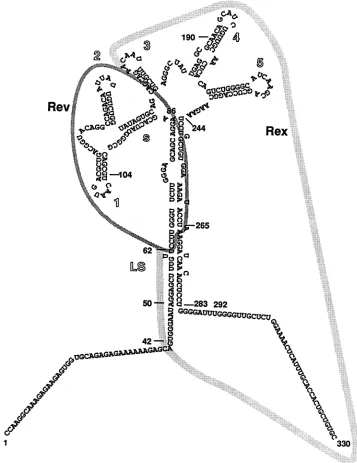
four internaldeletions oftheRRE-containing fragment1-330 and tested their ability to be activated by the different factors.The RREwasproposedtohaveextensivesecondary
structure (27) comprising five hairpin loop structures
num-bered 1 to 5 in Fig. 2, a long-stem (LS) structure, and a
short-stem (s) structure. The plasmid names indicate the deleted hairpin loops as well as the deletion endpoints.
pDL12s(89/155) containsadeletion ofnt 89to 155 compris-ing the firsttwohairpinstructuresand the shortstem(loopII
in reference 27). Plasmids DL345s(147/238), DL345(156/
238),andDL45(183/238) containdeletions fromnt 147, 156, and183, respectively,to nt238. Thesedeletions arelocated
in theregion of theshort-stemandhairpinstructuresIIItoV
(27). Theseconstructs were transfected into HLtat cells as
described above in the absence and presence of the Rev-,
Rex-,orTev-producing plasmids. Gag productionwas
mea-sured by p24"a' antigen capture assay (Table 2) and
com-pared with that ofpl-330. Analysis ofthese RRE deletion mutants also showed that the requirements for Rev, Tev,
and Rex action were distinct. pDL12s was almost
com-pletely refractory to activation by Rev, in agreementwith
previously publisheddata(10, 26, 30).Interestingly,theRex
responsewas minimally affected. pDL12s was activated by
Tevtoalowbutsignificantextent.On the contrary,mutants
p559ag
B
1-330i:
> X 4)0
14-330
>
> X
43 0
24- 330
> x
a)
42-330
I> X
CD ai
a
0m_ p55gag
M 1 2n 3
-p179ag _- p24ga§
on November 10, 2019 by guest
http://jvi.asm.org/
[image:4.612.97.519.73.513.2]Rev,
Rex
1
FIG. 2. Interactions of Rev and RexwiththeRREof HIV-1. Theproposed secondarystructure of theRREisshown, and theregions
important for Rev and Rex interactionareoutlined. TheRREisproposedtocontainfivestem-loopstructuresnumbered1 to5,alongstem (LS), andashortstem(s). Nucleotidenumbering starts attheStyIrestrictionsiteatposition7266of the HIV-1 molecular clone HXB2.
pDL345s, pDL345, and pDL45 were not activated by Rex
but were activated by Rev and Tev. It is interesting that
thesemutantsshowedagradualdecreasein Rev
responsive-ness (50 to 8% of the full response), while Tev was less
affected (100 to47%). Hairpin 3 and the short stem clearly
contributed to the overall Rev activation (compare DL45 with DL345 and DL345s). The analysis of Tev function on
internal RRE deletions revealed that Tev was only
margin-ally affected by deletionsthat removed theRex-responsive
portion
ofRRE(DL345s, DL345,andDL45),suggestingthatthetargetsofTevresemblethose ofRev.On the otherhand,
removal ofthe Rev-responsive portion (DL12s) lowered (by
sevenfold)
but did not abolish Tev function. Activation ofDL12s by Tev was low, while its activation by Rev was
virtually abolished.
Thefunction of Rexcanbeabolished in the presence of the trans-dominant mutant Rev protein. Analysis of the RRE
deletion mutants revealed that Rev and Rex may interact
with different parts of the RRE structure. Wenextexamined whether there is any interference between Rex and Rev
binding to the RRE. We have previously shown that the
presenceoftrans.dominantmutantRevproteinscan abolish both Rev(28)and Tev(3) function. Here,wetestedwhether
thefunction of Rexcanalso beinhibited in the presence of
thetrans-dominant mutantRev(RevBL). pl-330was
trans-fectedinthe presenceof the Rex-producing plasmidpL3rex
on November 10, 2019 by guest
http://jvi.asm.org/
[image:5.612.129.486.77.540.2]TABLE 2. Analysis of the sites of interaction of Rev, Rex, and Tev by using internal RRE deletions"
Rev Rex Tev
132 23 34 RRE
2 14 5 DL12S
11 1 16 DL345
26 1 15 DL345
9
72 2 33 DL45
Fold activation obtained by the p245"" antigen capture assay in the
presenceofeach protein is indicated. Results are averages oftwo tosix
experiments.
or the Rev-producing plasmid pL3crev and increasing
amounts ofpLBL, which expressed RevBL (28). One day later, the cells were harvested and the cell lysates were
subjected to immunoblot analysis (Fig. 3). Transfection of
theRex-producing plasmidpL3rexwithincreasingamounts of RevBL (lanes 1to4)demonstrated that Rexfunctionwas
inhibitedin the presence of RevBL. Similarly, thepresence
ofincreasingamountsof RevBL ledtoagradualdecrease in
Rev-activatedp55-ag production (lanes 5to8).Rexfunction
was abolished in the presence of equimolar amounts of
RevBLprotein. Thisratioislowerthan the fourfoldexcess
of RevBL necessary to abolish Rev function (28). These results suggest that the interaction of Rex with RRE is weakerthan that of Rev. We have made a similar
observa-tion in studies of the interaction of Tev with RRE (3), suggestingthatboth Tev-RRE and Rex-RRE interactionsare
weaker than the Rev-RRE interaction. The inhibition on
Rex-inducedactivationbyRevBLwasquantitatedbyp24a'~
antigen capture assays using plasmids pl-330 and pDL12s.
The resultsof threeexperimentsweresimilar,andthoseofa
+ rex +rev
0 1 2 4 0 1 2 4 Irg mrev
---
p5a591
41*_4M& -_ mrev
M 1 2 3 4 5 6 7 8
FIG. 3. Inhibition of Rex and Rev functionby trans-dominant
mutantRevBL. HLtatcellswerecotransfectedwith pl-330 and 2 jig of theRex-expressing plasmidpL3rex(lanes 1to4)or1 jigofthe Rev-expressing plasmid pL3crev (lanes 5to8). Increasingamounts (1, 2,and 4 ,ug,asindicated) ofaplasmid expressingRevBLwere
included in the transfections (lanes 2to4and 6to8).One daylater, the cellswereharvested and analyzedasdescribed forFig. 1. The
positions ofp555a5 and trans-dominant mutant RevBL (mrev) are
indicated. Lane M, CellextractfromaH9/HXB2-infected cellline.
typicalexperiment are shown in Table 3.Interestingly, while RevBL inhibited Rex function on pl-330, it did not inhibit Rex function on pDL12s, which lacks the binding site for Rev and RevBL. The presence of increasing amounts of RevBL lowered Gagexpression of DL12s by 1.5- to 4-fold (three experiments). This was not considered significant, since a similar decrease in the internal standardexpression (luciferase)wasobserved in the presenceof RevBL.
Therefore, binding of the RevBL mutant appears to be necessary for inhibition ofthe Rex function. These results taken together confirm the conclusion that Rev and Rex targets within the RRE are distinct. However, the interac-tions of the different proteinson thecomplete RRE arenot
independentand mayinterfere with oneanother.
DISCUSSION
Analysisof the activation of RRE mutants by Rev, Rex,
and Tev revealed that their sites ofinteractionare distinct. While Revrequires the shortestcontinuouselement (nt 62 to 265), Tev and Rex needadditional sequences for function (nt 42to294 andnt42 to330, respectively). Itwasshown that the RRE hasapotentialtoformastrongsecondarystructure
including five hairpinstructuresflankedbyalongstem(Fig. 2) (10, 26). The positions ofthe sequencesfrom nt42to62 and from nt 265 to 330 within the proposed model forthe
TABLE 3. Inhibition ofRexfunction bythetrans-dominant mutantRevBLonthecomplete RRE butnot onRRE
deletionDL12s
p245ao(pg/ml)"
Plasmid Rex+RevBL
Rex
Ilg 2jig 4,ug 10,ug
pl-330 1751 (44) 39(1) 18(<1) 10(<1)
pDL12s 416(32) 294(23) 130(10)
"Resultsofarepresentative experimentareshown. Foldactivation inthe
presenceof RexorofRexand RevBLproteinsis shown inparentheses.
Adhm...-
on November 10, 2019 by guest
http://jvi.asm.org/
[image:6.612.57.297.100.476.2] [image:6.612.313.554.640.707.2]RRE structure (26) were examined. A portion of these
sequences(nt50 to 62 and nt 266 to 283) extend the bottom
part ofthe long stem (LS in Fig. 2). We hypothesize that
these sequences could lead to thestabilizationof a structure
withinthe RRE that is necessary for Tev and Rex function. The additionalflankingsequences from nt 14 to 49 and nt 284 to330 couldfurther contributetothe structurestabilization.
Alternatively,these sequences couldcontain
sequence-spe-cificelements that formpartofthebinding sites forTev and
Rex.
Progressive deletionsfrombothendsoftheRREgradually
decreased the responsetoall threeactivators. The biological
significance of the low levels of activation ofsome mutants
should be studied on virus production. It should be noted that Tev is capable of replacing Rev and results in virus
production (3), despite the lower levels ofGag activation
(four- toeightfold lower inourexperiments). Therefore, we
estimate that activation at 10% ofthewild-type Rev levels
mayresult invirus productionandis biologically significant.
Internal RRE mutants revealed that Rev, Tev, and Rex
require different parts of the RRE for function. While
hairpins 1 and 2(Fig. 2) areclearly partoftheRev
recogni-tion signal, hairpins 4 and5 are necessary toallow
interac-tion withRex. Hairpin 3 appears tocontributeto Rev, Tev,
and Rex function. It is interesting that DL345s shows a
severely impaired activation by Rev. This mutant RRE
retains the hairpins 1 and2 necessaryforRev function but
lacks part of the sequence forming the small stem. This
result suggests that the small-stem structure may contribute
to Revfunction. The results obtained forRev activation of
theinternalRRE mutantsare in goodagreement with other
reports (10, 26, 30). The internal deletion mutantsfall into
two classes: one which has lost Rev and retained Rex response, and one which has retained Rev and lost Rex response. Tev, a variant Rev protein produced by some HIV-1 strains, contains all of the functionally necessary
domains ofRev and can replace Rev (3). Interestingly, the
requirements forinteraction with the RREby RevandTev
aredistinct. We hypothesize that the Tat or Envportion at
the amino terminus of Tev may affect the structure and
binding properties of this protein. Therefore,Tevmayhave
arelaxed specificity and may recognize boththe Revtarget
and,to alowextent, the Rextargetwithin the RRE.
Study of the internal RRE mutants revealedthat thesites
for Rev and RevBL binding within RRE were the same (Benko et al., submitted). While the function of Rex on the
complete RRE was abolished in the presence of mutant
RevBL, Rex function on a deletion of the Rev-responsive
partoftheRRE, mutantDL12s,wasnotaffectedbyRevBL.
These datastrongly suggest that thetrans-dominant mutant
RevBLmustbindefficientlyto the RRE toinhibit eitherRev
or Rex function. These results are in agreement with the
observation that Rev and RevBL bind in vitro to the RRE with thesameaffinity(Benko et al., submitted).Competition
experiments using RevBL revealed that although Rev and Rex targets within the RRE are distinct, Rev and Rex
interferewiththebindingof each other.Afterthecompletion
of this work, similarconclusions about the different targets for Rev and Rex within RREwere reported (2). The work
described here identifies further the different minimal
ele-ments necessaryforthe functions of Rev and Rex.
ACKNOWLEDGMENTS
We thank C. Campbell, J. Harrison, and D. Vanderbur for excellenttechnical assistance, D. Derse for rex cDNA, A. Athanas-sopoulos forcontributingtoinitial experiments,andC. M. Drysdale
forhelp with the luciferase assay. We also thankA.ArthurandK. Tomsfor editorial assistance.
This research was sponsored by the National Cancer Institute underPublic HealthService contractN01-CO-74101 withABL.
LITERATURE CITED
1. Adachi, A.,H. E.Gendelman, S. Koenig,T.Folks,R.Willey,A. Rabson,andM. A. Martin. 1986. Production ofacquired
immu-nodeficiencysyndrome-associated retrovirus in human and
non-human cellstransfected withaninfectious molecular clone. J. Virol. 59:284-291.
2. Ahmed, Y. F., S. M. Hanly, M. H. Malim, B. R. Cullen, and W. C. Greene. 1990. Structure-function analysis of the HTLV-I rex and HIV-1 rev RNA responseelements: insights into the mechanismofrex andrevfunction. Genes Dev. 4:1014-1022. 3. Benko, D. M., S. Schwartz, G. N. Paviakis, and B. K. Felber.
1990. A novel humanimmunodeficiency virus type 1 protein, tev,shares sequenceswith tat, env,andrevproteins. J. Virol. 64:2505-2518.
4. Brasier,A. R., J.E.Tate,andJ.F. Habener. 1989. Optimized
useof thefirefly luciferase assayas areporter gene in mamma-lian cell lines. BioTechniques 7:1116-1122.
5. Cochrane, A., C. Chen, andC.Rosen.1990. Specificinteraction of the human immunodeficiency virus Rev protein with a structuredregion inthe env mRNA.Proc.Natl. Acad.Sci. USA 87:1198-1202.
6. Cochrane, A.,A.Perkins,andC.Rosen. 1990.Identification of sequences important in the nucleolar localization of human immunodeficiency virus Rev: relevance of nucleolar localization tofunction. J. Virol. 64:881-885.
7. Cullen, B.R., J.Hauber, K. Campbell, J. G.Sodroski,W. A. Haseltine, and C. A. Rosen. 1988. Subcellularlocalization of the humanimmunodeficiency virus trans-acting art gene product. J. Virol. 62:2498-501.
8. Daly, T., K. Cook, G. Gray, T. Maione, andJ. Rusche. 1989. Specific binding of HIV-1 recombinant Rev protein to the Rev-responsive element in vitro. Nature(London) 342:816-819. 9. Dayton, A. I., E. F. Terwilliger, J. Potz, M. Kowalski, J. G. Sodroski, and W. A. Haseltine. 1988. Cis-acting sequences responsive to the rev gene product of the human immunodefi-ciency virus. J.Acquired Immune Defic. Syndr. 1:441-452. 10. Dayton, E., D.Powell, and A. Dayton. 1989. Functional analysis
ofCAR, the target sequence for the Rev protein of HIV-1. Science 246:1625-1629.
11. Derse, D. 1988.trans-Acting regulation of bovine leukemia virus mRNA processing. J. Virol. 62:1115-1119.
12. de Wet, J. R., K. V. Wood, M. DeLuca, D. R. Helinski, and S. Subramani. 1987. Fireflyluciferase gene: structure and expres-sion in mammalian cells. Mol. Cell. Biol. 7:725-737.
13. Emerman, M., R. Vazeux, and K. Peden. 1989. The rev gene product ofthe humanimmunodeficiency virus affects envelope-specific RNA localization. Cell 57:1155-1165.
14. Felber, B. K., M.Cladaras, C. Cladaras, C. M.Wright, A. Tse, andG. N.Pavlakis. 1988. Regulation of HIV-1 by viral factors, p. 71-77. In B. R. Franza, B. R. Cullen, and F. Wong-Staal (ed.), The control of human retrovirus gene expression. Cold Spring Harbor Laboratory, ColdSpringHarbor, N.Y. 15. Felber, B.K., D. Derse, A.Athanassopoulos, M.Campbell,and
G. N. Pavlakis. 1989. Cross-activation of the rex proteins of HTLV-1 and BLV and of the Rev protein of HIV-1 and nonreciprocal interactions with theirRNAresponsive elements. NewBiol. 1:318-330.
16. Felber, B. K., C. M. Drysdale, and G. N. Pavlakis. 1990. Feedback regulation of human immunodeficiency virustype 1 expressionbyrev protein. J. Virol. 64:3734-3741.
17. Felber,B.K., M.Hadzopoulou-Cladaras, C. Cladaras,T. Cope-land, andG. N. Pavlakis. 1989. rev protein of human immuno-deficiency virus type 1affects the stability and transport of the viralmRNA. Proc. Natl. Acad. Sci. USA 86:1495-1499. 18. Fisher, A. G., E. Collalti, L. Ratner, R. C. Gallo, and F.
Wong-Staal. 1985. Amolecular clone of HTLV-III with biolog-ical activity. Nature (London) 316:262-265.
19. Graham, F. J., and A. J. van der Eb. 1973.Anewtechnique for
on November 10, 2019 by guest
http://jvi.asm.org/
the assay ofinfectivity of human adenovirus 5DNA. Virology 52:456-460.
20. Hadzopoulou-Cladaras, M., B. K. Felber, C. Cladaras,A. Atha-nassopoulos, A. Tse, and G. N. Pavlakis. 1989. Therev(trslart) protein of human immunodeficiency virus type 1 affects viral mRNAand protein expression via a cis-acting sequence in the envregion. J. Virol. 63:1265-1274.
21. Hammarskjold, M. L., J. Heimer, B. Hammarskjold, I. Sang-wan, L. Albert, and D. Rekosh. 1989. Regulation of human immunodeficiency virus env expression by the rev gene product. J. Virol. 63:1959-1966.
22. Hanly, S. M., L. T. Rimsky, M. H. Malim, J. H. Kim, J. Hauber, M.Duc Dodon, S.-Y. Le, J. V. Maizel, B. R. Cullen, and W. C. Greene. 1989. Comparative analysis of the HTLV-1 rex and HIV-1 rev trans-regulatory proteins and their RNA response elements. Genes Dev.3:1534-1544.
23. Heaphy, S., C. Dingwall,I. Ernberg,M.Gait,S.Green, J. Karn, A.Lowe,M.Singh, andM. Skinner. 1990. HIV-1regulatorof virion expression (Rev) protein binds to an RNA stem-loop structurelocated within the Rev response element region. Cell 60:685-693.
24. Laemmli, U. K. 1970. Cleavage of structural proteins during the assembly of the head of bacteriophage T4. Nature (London) 227:680-685.
25. Malim, M. H., S. Bohnlein, J. Hauber, and B. R. Cullen. 1989. Functional dissection of the HIV-1 rev trans-activator- deriva-tion ofatrans-dominant repressor of rev function. Cell 58:205-214.
26. Malim, M., L. Tiley, D. McCarn, J. Rusche, J. Hauber, and B. Cullen. 1990. HIV-1 structural geneexpression requires binding of the Rev trans-activator to its RNA target sequence. Cell 60:675-683.
27. Malim, M. H., J. Hauber, S. Le, J. V. Maizel, and B. R. Cullen. 1989. The HIV-1 rev transactivator acts through a structured target sequence to activate nuclear export of unspliced viral mRNA. Nature(London) 338:254-257.
28. Mermer, B., B. K. Felber, M. Campbell, and G. N. Pavlakis. 1990. Identification of trans-dominant HIV-1 rev protein mu-tants by direct transfer of bacterially produced proteins into humancells. Nucleic Acids Res. 18:2037-2044.
29. Myers, G. 1989. Human retroviruses and AIDS.Acompilation and analysis of nucleic acid and amino acid sequences. Los Alamos NationalLaboratory, Los Alamos,N.M.
30. Olsen, H. S., P. Nelbock, A. W. Cochrane, and C.A. Rosen. 1990. Secondarystructureis themajor determinant for interac-tion ofHIVrev protein with RNA. Science 247:845-848. 31. Pavlakis, G.N.,and B. K. Felber. 1990. Regulation of
expres-sion of humanimmunodeficiency virus.New Biol.2:20-31. 32. Pavlakis, G. N., andB. K. Felber. 1990. Regulation of HIV-1
expression by viral factors, p. 133-146. In T. S. Papas (ed.), Gene regulation and AIDS: transcriptional activation, retrovi-ruses, andpathogenesis. Gulf Publishing Co., Houston. 33. Ratner, L., A. Fisher,L. L.Jagodzinski,R.S. Liou,H.Mitsuya,
R. C. Gallo, and F. Wong-Staal. 1987. Complete nucleotide sequencesof functional clones of the virus associated with the acquired immunodeficiency syndrome, HTLV-III/LAV. Hama-tol. Bluttransfus. 31:404-406.
34. Rimsky, L.,M.D.Dodon,E. P.Dixon,and W.C. Greene. 1989. Trans-dominant inactivation of HTLV-I and HIV-1 gene expression by mutation of the HTLV-I Rex transactivator. Nature(London) 341:453-456.
35. Rimsky, L., J. Hauber,M.Dukovich,M. H.Malim,A.Langlois, B. R. Cullen,and W.C. Greene. 1988. Functional replacement of the HIV-1 rev protein by the HTLV-1 rex protein. Nature (London) 335:738-740.
36. Rosen, C.A.,andG. N.Pavlakis. 1990.Tatand Rev: positive regulators ofHIVgeneexpression. AIDSJ.4:499-509. 37. Rosen, C. A., E. Terwilliger, A. Dayton, J. G. Sodroski, and
W. A. Haseltine.1988. Intragenic cis-actingartgene-responsive sequencesof the human imnmunodeficiency virus. Proc. Natl. Acad.Sci. USA 85:2071-2075.
38. Salfeld, J.,H.Gottlinger,R.Sia,R.Park, J. Sodroski,and W. Haseltine. 1990. A tripartite HIV-1 tat-env-rev fusion protein. EMBO J. 9:965-970.
39. Schwartz, S.,B. K.Felber,D. M.Benko,E. M.Fenyo,andG.N. Pavlakis. 1990. Cloning and functional analysis of multiply spliced mRNAspecies of humanimmunodeficiency virus type 1.J. Virol. 64:2519-2529.
40. Seiki, M., S. Hattori, Y. Hirayama, and M. Yoshida. 1983. Human adult T-cell leukemia virus: complete nucleotide se-quenceof theprovirus genome integrated in leukemia cellDNA. Proc. Natl.Acad.Sci. USA80:3618-3622.
41. Seiki, M., J. Inoue, M. Hidaka, and M. Yoshida. 1988. Two cis-acting elements responsible for posttranscriptional trans-regulation of gene expression of human T-cell leukemia virus type1. Proc. Natl.Acad. Sci. USA 85:124-128.
42. Siomi, H.,H.Shida,S.Hyun Nam,T.Nosaka,M.Maki,and M. Hatanaka. 1988. Sequence requirements for nucleolar localiza-tion ofhuman T-cell leukemia virus type 1 pX protein which regulates viralRNAprocessing. Cell 55:197-209.
43. Toyoshima, H.,M. Itoh, J.-I. Inoue,M. Seiki,F. Takaku,and M. Yoshida. 1990. Secondary structure of the human T-cell leukemia virus type1rex-responsive element is essential forrex regulation ofRNAprocessing and transport of unspliced RNAs. J. Virol. 64:2825-2832.
44. Zapp, M.,and M.Green. 1989.Sequence-specificRNAbinding by theHIV-1 Rev protein. Nature(London) 342:714-716.