Rydberg atom quantum technologies
C. S. Adams1, J. D. Pritchard2, J. P. Shaffer3
1Department of Physics, Durham University, Rochester Building, South Road, Durham DH1 3LE, UK
2Department of Physics, University of Strathclyde, John Anderson Building, 107
Rottenrow East, Glasgow G4 0NG, UK
3Quantum Valley Ideas Laboratories, 485 West Graham Way, Waterloo, ON N2L
0A7, Canada
E-mail: [email protected]
Abstract. This topical review addresses how Rydberg atoms can serve as building blocks for emerging quantum technologies. Whereas the fabrication of large numbers of artificial quantum systems with the uniformity required for the most attractive applications is difficult if not impossible, atoms provide stable quantum systems which, for the same species and isotope, are all identical. Whilst atomic ground-states provide scalable quantum objects, their applications are limited by the range over which their properties can be varied. In contrast, Rydberg atoms offer strong and controllable atomic interactions that can be tuned by selecting states with different principal quantum number or orbital angular momentum. In addition Rydberg atoms are comparatively long-lived, and the large number of available energy levels and their separations allow coupling to electromagnetic fields spanning over 6 orders of magnitude in frequency. These features make Rydberg atoms highly desirable for developing new quantum technologies. After giving a brief introduction to how the properties of Rydberg atoms can be tuned, we give several examples of current areas where the unique advantages of Rydberg atom systems are being exploited to enable new applications in quantum computing, electromagnetic field sensing, and quantum optics.
1. Introduction
Recent efforts to develop quantum technology are motivated by the fact that precisely manipulating systems at a quantum level offers particular advantages over classical techniques [1]. There is widespread belief that fundamentally new types of computers, communications systems and sensors that take advantage of unique quantum properties will revolutionise society. Atoms are important building blocks for quantum technologies because, despite massive research efforts in fabrication, it is still difficult to build artificial quantum systems with the uniformity and ease required for many of the most tantalising applications. Particularly enticing for quantum technologies are Rydberg atoms—where the outer electron is placed in a highly-excited state [2,3]. Rydberg atoms possess unique, exaggerated atomic properties that can be controlled by state selection and the application of external electromagnetic fields [4], making them one of ‘mother nature’s’ most tunable quantum systems. Coupled with precision control of their properties, Rydberg atoms are close to ideal building blocks for quantum engineering.
In this review, after a brief introduction to the properties of Rydberg atoms, we discuss the current state-of-the-art in three applications areas. First we discuss quantum simulation and computing using ultra-cold Rydberg atoms in optical tweezer arrays. Second, we discuss the sensing and imaging of microwave and terahertz fields using Rydberg atoms in room temperature vapour cells. Finally, we discuss the application of Rydberg atoms to quantum optics, including light-matter interfaces including single photon sources and photon gates.
2. Rydberg Atoms and Their Tunability
The measurement of spectral lines by Anders Jonas ˚Angstr¨om (L¨ogd¨o 1814 – Uppsala 1874) revealed patterns that were later explained by Johannes (Janne) Robert Rydberg (Halmstad 1854 – Lund 1919). Rydberg’s interval formula suggested that the energies of states of bound electrons could be written in the form
En =−
RH
n2 ,
where n is an integer known as the principal quantum number and RH is Rydberg’s
sensitivities lead to at least two distinct classes of applications. First, the strong interactions between nearby Rydberg atoms make them attractive candidates for quantum simulators or quantum computing [5], and for quantum non-linear optics [6]. Second the sensitivity of Rydberg atoms to microwave or terahertz fields make them ideal sensors of electromagnetic fields in these regions [7–9]. Building on developments in laser technology needed to prepare Rydberg atoms [4], advances in laser cooling and trapping, real world applications of Rydberg quantum technologies has now become practical.
Rydberg atoms are attractive as building blocks for quantum technologies for a number of reasons. Atoms are stable quantum systems that are always the same, i.e. all atoms of the same species behave the same when placed in the same environment. Their properties can be determined by precision measurements and do not change in time. The ability to access highly-excited Rydberg states that are long-lived on useful experimental timescales is important because it allows the characteristics of the atom to be tuned. Many useful properties, such as the polarisability of the atom, scale strongly with
n [2,10]. Conceptually, Rydberg states resemble the physics of hydrogen, so physicists have a straightforward model to help guide intuition, even for multi-Rydberg electron atoms like strontium. In this section, we describe how some of the most important properties of Rydberg atoms scale withnand are relevant to the applications presented in the remaining sections of this tutorial.
The topics covered in this short tutorial depend on the strong interactions between Rydberg atoms and the use of the strong transitions that occur between Rydberg states. We therefore focus on Rydberg atom transition dipole moments, polarisability, and electron orbital size. These properties determine both the strength of Rydberg atom interactions and transition strengths. We also consider the lifetimes of the Rydberg states because the lifetime can determine the feasibility of some experiments, putting a limit on the coherence time of the Rydberg state. In fact, the strong scaling with n
occurs because asnincreases the binding energy of the electron becomes weaker. We will ignore magnetic effects, since the application of Rydberg atoms to quantum technologies predominantly relies on the core of the Rydberg atom being an electrostatic trap for a weakly bound electron which can be strongly perturbed by an applied electric field, as we implied in the Introduction. The Rydberg electron has spin which couples to a magnetic field, but its interaction with the atomic nucleus is weak because its orbital is large [2]. For applications that concern us here, we take advantage of the fact that the Rydberg electron responds to an electromagnetic field more strongly than a valence state but more weakly than a bare electron.
To understand how a highly-excited Rydberg atom’s properties scale with n it is useful to use hydrogen as a model. The moments of the electron position r, hrsi, where
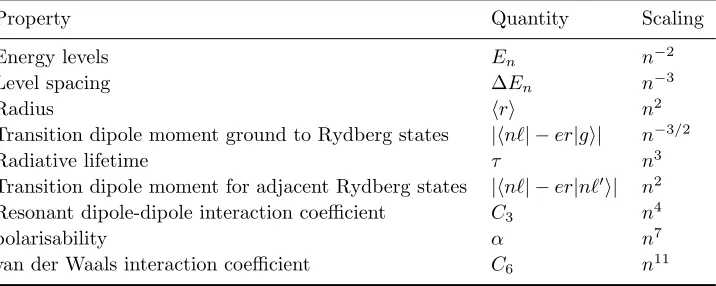
Table 1. Alkali atom principal quantum number (n) scaling of the most important properties of Rydberg states. Thendependence results from the characteristics of the Rydberg atom wavefunctions, as described in the text.
Property Quantity Scaling
Energy levels En n−2
Level spacing ∆En n−3
Radius hri n2
Transition dipole moment ground to Rydberg states |hn`| −er|gi| n−3/2
Radiative lifetime τ n3
Transition dipole moment for adjacent Rydberg states |hn`| −er|n`0i| n2 Resonant dipole-dipole interaction coefficient C3 n4
polarisability α n7
van der Waals interaction coefficient C6 n11
the moment. For s positive, hrsi will be largely independent of l since it is the nodal structure at larger that dominates the integral that gives the expectation value. For s
negative, lower l states have a larger probability to be found near the nucleus because the centrifugal barrier ‘pushes’ the wave function of higher l states out to largerr. The high l states are often referred to as circular states since the probability of finding the electron near the nucleus is practically negligible. The leading order scaling with n for positive s is hrsi ∝n2s while for negative s <−1 the scaling is hrsi ∝n−3. s=−1 is a
special case where hr−1i ∝n−2.
For an alkali atom, the scaling of hrsi with n can be used with some modification. The inner electrons of an alkali atom form a closed shell, leaving a single electron in an unfilled outer shell, making the central field approximation highly accurate. Nevertheless, alkali atoms are multi-electron atoms. Low l states penetrate into the core of the Rydberg atom and interact with the core electrons. The interaction of the Rydberg electron and the core electrons can be handled using quantum defect theory [2]. As far as the scaling laws are concerned, we can replace n with n∗ = n−δl, where δl is the quantum defect for an electron with orbital angular momentum l. δl decreases with increasing l since the wave function is pushed to larger r asl grows in magnitude. Typically, if l > 4 the Rydberg states of alkali atoms are hydrogenic, although this depends on the accuracy one needs for a particular application. Asl increases, n∗ →n. Using these concepts, the average radius of a Rydberg atom can be seen to scale
∝ n2. The transition dipole between neighboring states µ = heri ∝ n2 and the
polarisability α ∝n7. The n dependence for some of the more important properties of
Rydberg atoms are shown in Table 1. As numerical examples, the average radius of the electron is 69 nm for the 40s1/2 state of cesium. The polarisability of the cesium 40s1/2
separation. The resulting inter-atomic potential energy is U(R) = C3/R3. The C3
coefficient is proportional to the transition dipole moment between the resonant levels squared. The resonant dipole interaction then scales asn4. Thisn-scaling also holds for
two Rydberg atoms polarised in a weak background electric field since the electric field creates a pair of static dipoles. A van der Waals potential, U(R) = C6/R6, arises
from non-resonant exchange of virtual photons between the atoms in second order perturbation theory. Here then-scaling is proportional ton11becauseC
6 is proportional
to the transition dipole moments to the fourth power divided by the energy defects which scale as ∆∝n−3. ForC6, a similar argument can be recognised by observing thatC6 can
be calculated by considering the atomic polarisability, where the atomic polarisability,
α ∝ n7, and the energy separations between the Rydberg levels, ∝ n−3. C6 can be
obtained by integrating the dynamic polarisabilities over energy [11].
The primary decay processes for Rydberg states are radiative decay and blackbody decay. The lifetime of a Rydberg state is given by,
τR = 1
τr
+ 1
τbb −1
, (1)
where τbb is the inverse of the blackbody decay rate and τr is the inverse of the
spontaneous emission rate. The spontaneous emission rate is typically dominated by the highest frequency, allowed transition because of the cubic dependence of the decay rate on the transition frequency, Γs=e2µijωij3/3π0c3. Hereeis the electron charge,µij is the dipole moment between statesiandj, andωij is the transition frequency. The exception to this principle happens when n is very large. In the case of large n, the transition frequencies become more and more similar and the radial matrix elements between the states determine the decay rates. For the case where the radiative decay rate is dominated by the highest frequency allowed transition, the lifetime can be conveniently parameterised by,
τr =τ0n∗δ. (2)
In this equation δ ≈ 3. Both τ0 and δ depend on species and l. Tables of τ0 and δ for
the alkali species can be found in Ref. [2].
Unlike valence states, transitions between Rydberg states can take place at frequencies which are thermally populated, due to thermal radiation from the environment. The thermal background radiation can couple Rydberg states and modify their lifetimes. The blackbody radiation induced decay rate can also be parameterised so that it can be calculated in a straightforward manner,
1
τbb
= A
n∗D[exp(B/(n∗CT))−1]. (3)
Here, A, B, C and D are parameters while T is the environmental temperature. The parameters A, B, C and D for different Rydberg series can be found in Ref. [12]. The
n dependence is not polynomial here.
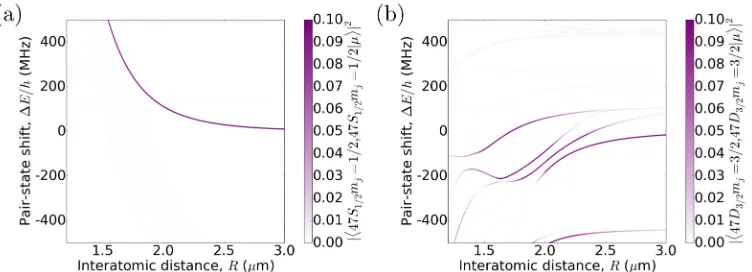
Figure 1. Interaction potentials for pairs of Rb Rydberg atoms in the n= 47 state with either (a)`= 0 (s-states) or (b) `= 2 (d-states) calculated usingARC[15]. The frequency to excite two Rb atoms separated by 2 microns to the 47s state is shifted 100 MHz off-resonance. This interaction induced shift gives rise to Rydberg blockade. In contrast, for d-states the blockade effect is less clear-cut.
properties. Scaling laws are not a substitute for calculations for quantitative analysis of experiments, but they can provide guidance, particularly, since the atomic state properties are not changed independently of one another. Rydberg atom interactions [13] play a particularly important part in contemporary Rydberg atom physics and are an example of where the physics can be more complicated and deviations from simple scaling laws quite significant, particularly when electric fields are involved [14]. There are publicly available calculators for Rydberg properties such as ARC [15] or
Pairinteraction [16]. Many of the properties of Rydberg atoms are readily calculated if one wants to develop one’s own programs. An example, for the case of Rb, is shown in Fig. 1. We see that states with different angular moment behave very differently, and often s states with zero angular momentum are favoured due to their simple pair potentials. For example, the van der Waals interaction between ns Rb atoms shifts the energy for double excitation off-resonance, such that only one excitation potential plays a role. The distance where the excitation of further Rydberg atoms is detuned from resonance due to Rydberg atom interactions is known as the blockade radius,
Rb = (C6/∆νL)1/6, where ∆νL is the bandwidth of the excitation laser.
In this section, we have attempted to highlight the large range over which Rydberg atom properties can be varied in support of our assertion that these states are stable quantum systems that can be engineered for applications.
3. Quantum Computing
Random Loading
Reconfigure & Initialise
Run Quantum Algorithm
Qubit Readout
0〉 |
1〉 |
[image:7.612.88.503.89.211.2]R〉 |
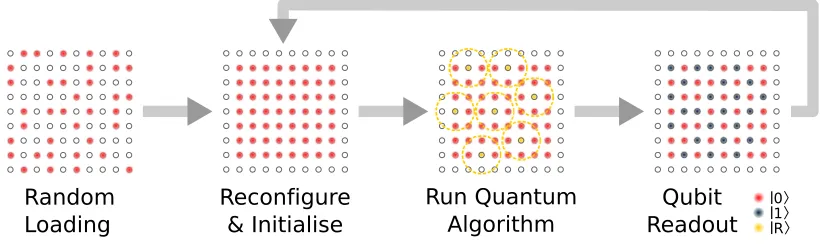
Figure 2. Schematic of a Rydberg array quantum computer. Atoms are initially loaded stochastically, followed by rearrangement to achieve a defect free qubit register. Coherent excitation to Rydberg states allows implementation of quantum algorithms exploiting long-range interactions to couple neighbouring qubits, followed by state-selective readout which is repeated many times to tomographically reconstruct the output state.
to encode the problem are still pending. Whilst large scale applications will require over a million qubits [17], in the near term small quantum processors offer significant advantages for use in hybrid quantum-classical computation [18], also known as a quantum co-processor, with applications in quantum chemistry [19,20], electronic structure calculations for complex correlated materials [21,22] as well as quantum optimal control [23] and classical optimisation problems [24].
Scaling of quantum systems remains a major experimental challenge, with fault-tolerant performance demonstrated for trapped ion and superconductor systems but with significant technical challenges in extending this performance to hundreds of qubits. Rydberg atoms offer a unique advantage to overcome the limitations of scalability and connectivity of competing technologies and provide a route to creating a platform of up to 1000 identical and long-coherence qubits in arrays of arbitrary geometry and dimensionality [25–27]. These arrays are ideally suited for either high-fidelity digital quantum computation using the Rydberg blockade effect to engineer conditional multi-qubit gates [5,28], or for analog quantum computation of classical optimisation problems [29] and quantum simulation of complex many-body systems [30,31]. Here the exquisite control over the atom-atom interaction potential offered through the choice of Rydberg state and tuning using external static [32], microwave [33] or optical [34] electric fields allow engineering of highly anisotropic interactions with variable length scales.
Figure 2 illustrates the principal of Rydberg atom quantum computing using tweezer arrays, where atoms are loaded, and sorted before performing quantum algorithms and reading out the state of the system. Below, we consider the different regimes of digital and analog quantum computing that can be performed on this architecture.
be created using lenslet arrays [35] or fixed diffractive optical elements [36], whilst reconfigurable geometries are possible using either an acousto-optic deflector (AOD) [37,38] or holographic projection from a spatial light modulator [25] able to create complex arrays in up to 3 dimensions [27]. This versatility provides complete control over qubit connectivity whilst allowing dynamic programming of analog quantum simulators through choice of qubit geometry.
Single atom tweezer traps are formed using micron-scale focused beams to create a tight trapping volume that enhances atom-light interactions, leading to pairs of atoms being ejected from the trap resulting in loading of either 1 or 0 atoms in each tweezer with just over 50 % success probability through the process of collisional blockade, as first demonstrated in 2001 by Schlosser et al . [39]. This probabilistic loading limits creation of large, defect-free qubit arrays through stochastic loading alone, however recently a number of techniques have been demonstrated to overcome this limitation and create deterministically assembled arrays either using dynamic trap reconfiguration using an AOD [38] or spatial light modulator (SLM) [40], or via real-time sorting of atoms in 2D [41] and 3D [27] with a controllable tweezer beam to move atoms between trap sites following an initial image of a randomly loaded trap array. Alternatively, by engineering the atom-light interactions it is possible to greatly increase the probability of loading single atoms to over 90 % [37,42,43]. Combining these techniques enables reduction of trap redundancy to enable scaling to many 100s of single atom traps on timescales around two orders of magnitude faster than is possible using alternative approaches such as preparation of a Mott-insulator state within an optical lattice [44]. Whilst initial demonstrations of these tweezer traps have involved alkali atoms, these techniques have recently been extended to include both divalent atoms [45–48] and molecules [49].
A drawback of the red-detuned tweezer traps is the strong repulsive AC Stark shift experienced by the Rydberg states, for which the polarisability is dominated by that of a free electron leading to anti-trapping. Commonly this is circumvented by turning the traps off during Rydberg excitation, leading to a finite experiment duration typically around 10 µs limited by the finite temperature of the atoms in the trap. For scalable processing longer hold times are required, which can be achieved using blue-detuned optical traps that simultaneously trap both ground and Rydberg states and can be engineered to be magic for a given transition for enhanced coherence [50,51]. Blue-detuned trap arrays have been demonstrated using both projected traps [36] and using a 3D optical lattice [52].
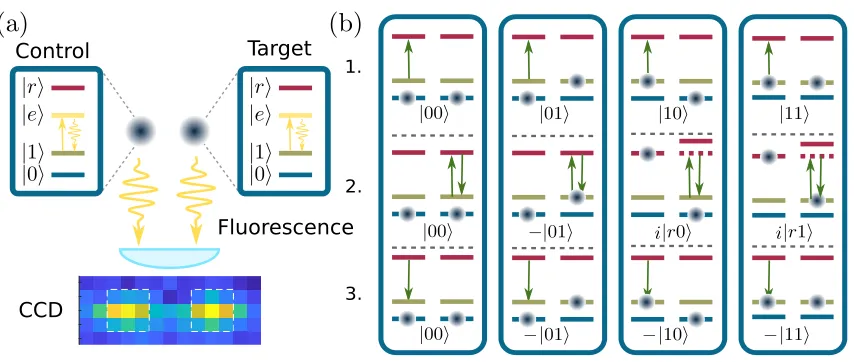
Stark shifts in the trap. Non-destructive state selection using an intermediate shelving state as used routinely for ions is possible for divalent atomic species [45,59], however for the alkali’s there is no easily accessible long-lived state. This has been overcome using both state-selective scattering in an optical tweezer [60] and spatial separation in a state-selective optical lattice [61], providing a route to enable rapid measurement of atomic qubits without requiring reloading of the array, as illustrated in Fig. 3(a).
Digital quantum computing utilises a series of sequential gates applied onto a qubit register followed by a state-selective measurement to project atoms into the |0iand |1i
logical output states. For atomic qubits, information can be encoded using hyperfine ground states with a microwave-scale energy separation, or for divalent atoms using the long-lived triplet states to allow information to be encoded between ground and excited states resulting in an optical energy spacing. A complete set of single-qubit rotations can be applied by driving the two-level system using microwaves for hyperfine qubits, or optically to allow single-site resolution allowing local pulses on individual qubits, with evolution controlled by the amplitude, detuning and phase of the applied control field. To leverage the power of quantum computing to permit speed-up however, it is necessary to extend this set of single-qubit rotations to include two-qubit gates that allow entanglement generation between pairs of atoms. Using this universal gate set, all quantum algorithms can then be decomposed onto single and two-qubit gates, creating a fully programmable universal quantum computer [62].
Neutral atoms experience extremely weak interactions in the ground states, providing excellent ground state coherence times but making two-qubit gate entanglement challenging unless traps are merged to exploit collisional interactions [63] or using post-selected interference [64]. Coupling qubits to Rydberg atoms overcomes this limitation by allowing strong, controllable long-range interactions between atoms [5,28,65,66]. For qubits separated below the blockade radius, typically 10 µm, the strong dipole-dipole interactions induce a conditional excitation process that allows a controlled phase-gate to be applied [65], as shown in Fig.3(b). This gate requires three laser pulses, first a π-pulse on the control qubit mapping |1ic → |ric followed by a 2π-pulse on the target qubit from |1it → |rit. If the control qubit is in state |ric then blockade detunes this pulse from resonance on the target qubit and no phase is acquired, however if the control is in state |0ic then the target executes a complete rotation and acquires the phase shift of eiπ. A final pulse returns the control qubit to |1ic leading to the realisation of a controlled phase gate. Adding single qubit Hadamard gates to the control qubit before and after the gate allows conversion to a controlled-NOT gate, as first demonstrated by Isenhoweret al . [67].
Control Target 1.
2.
3.
1 2
Fluorescence
[image:10.612.83.510.83.264.2]CCD
Figure 3. (a) State-selective fluorescence for qubit-state readout using high numerical aperture lenses to collect light onto camera (b) Schematic of the controlled-phase (Cz)
gate using Rydberg blockade to prevent both control and target atoms being in the Rydberg state simultaneously, leading to a conditional phase shift acquired on the output state.
of decomposition into sequential two-qubit gates. This approach enables high efficiency realisation of Grover’s search algorithm [72,73] and is capable of achieving fault-tolerant computing using surface codes [74].
The intrinsic limitations in Rydberg quantum gates arise from the finite Rydberg state lifetime and off-resonant excitation of non-blockaded Rydberg states [5,66]. Operation at cryogenic temperatures allows suppression of black-body limited lifetimes [12], whilst off-resonant excitation can be suppressed using shaped pulses based on the Derivative Removal by Adiabatic Gate (DRAG) technique [75]. DRAG allows increased gate speed (minimising the error associated with finite Rydberg lifetime) while avoiding excitation of anti-blockaded states by tailoring the spectral properties of the light. A Rydberg-DRAG scheme using the single photon transition provides a 50 ns gate protocol with a theoretical fidelity ofF > 0.9999 at 300 K [76], competitive with speeds of solid-state qubits and well in excess of the threshold for fault-tolerant computing [74].
As well as enabling digital computing, the Rydberg array platform also functions as a powerful analog quantum simulator for spin-models [84]. These provide a simplified many-body Hamiltonian describing highly-correlated condensed-matter systems enabling studies of out-of-equilibrium dynamics and quantum magnetism on system sizes greatly exceeding what can be simulated classically.
For atoms in the ground state |gi coupled to a Rydberg level |ri via a laser with detuning ∆ and Rabi frequency Ω, the system can be described by a transverse Ising Hamiltonian of the form [30,85]
H ¯ h = X i Ω 2σ i x− X i
∆ini+ X
i6=j
Vijninj, (4)
whereσi
x =|giihri|+|riihgi|describes the coupling between ground and Rydberg levels,
ni = |riihri| and Vij = C6/R6ij is the van der Waals coupling between atoms in the array. Through coherent control of the laser coupling strength Ωi and detuning ∆i for each atom, atoms can be prepared into the many-body ground states of the strongly interacting systems allowing studies of quantum phase transitions and symmetry breaking, as well as studying out-of-equilibrium dynamics following quenches when rapidly changing system parameters. This has been implemented for a 1D chain of 51 qubits [30] and a variety of 2D geometries with up to 49 spins [86], allowing observation of transitions to ordered anti-ferromagnetic phases [31] and experimental demonstration of the quantum Kibble-Zurek mechanism governing critical scalings associated with quantum phase transitions [87].
Alternatively, by encoding qubits within the Rydberg manifold a microwave field can be used to drive resonant couplings between Rydberg states|riand |r0i, leading to interactions in the resonant dipole-dipole regime with highly anisotropic couplings of the formC3(θ)/R3ij [32]. This mitigates technical limitations present in laser driving [83,88] and enables realisation of an XY or spin-exchange Hamiltonian of the form
H ¯ h = 1 2 X
i6=j
Vij(θ)(σi+σ − j +σ
− i σ
+
j ), (5)
where σi± = σx i ±iσ
y
i which has been used to study excitation transfer along a spin-chain [89] and excitation decay in an isolated atomic ensemble [90]. Exploiting the reconfigurable geometry and strongly anisotropic interactions to introduce asymmetric couplings, the XY Hamiltonian allows engineering of topologically-protected edge states that are robust to external perturbations as recently demonstrated for a 2D spin-chain [91]. Extending this approach to more complex geometries, for example a honeycomb lattice, provides topological protection for robust quantum information storage [92].
quantum approximate optimisation algorithms (QAOA) [97] using a classical optimiser to drive the parameters controlling the quantum hardware. Recent studies have shown the transverse Ising model above allows direct encoding of NP-complete problems using geometric arrangement of the atoms alone [98], enabling an efficient solution to the maximum independent set (MIS) problem even using current near-term hardware [29].
4. Electromagnetic Field Sensing with Rydberg States
The use of atoms and atom-like systems for sensing is advantageous because many kinds of atoms are stable quantum objects. The properties of atoms can also be known very accurately by making precision measurements in specialised laboratories. In this sense, atoms can be used to make self-calibrated sensors because these properties are fixed for all atoms of the same isotopic species. Stability and self-calibration are advantageous because measurements can be traced back to precision measurements of the atomic characteristics and fundamental constants. Unlike man-made sensors, atoms are inherently stable and always the same so issues associated with manufacturing variations and aging can be eliminated, in principle. Rydberg atoms also have a large range of transition frequencies that can be exploited for conversion of hard to detect and generate frequencies to those which are more conventional, such as visible light.
Because the Coulomb potential supports an infinite number of electronic states, there are an infinite number of Rydberg transitions. In alkali atoms, these transitions span over 6 orders of magnitude in frequency, ranging from less than 1 MHz to approximately 1 THz. For many of these transitions, the dipole matrix elements are large, some of which are 100−1000 times that of the D2 transition in alkali atoms. These properties make Rydberg atoms sensitive to electromagnetic radiation throughout the frequency range of their transitions, most notably from the microwave (MW) to terahertz regions of the electromagnetic spectrum. Although the sensitivity to electromagnetic fields has been understood for a long time [2], it was only recently appreciated that, coupled with atoms in small vapor cells [99] and sub-Doppler spectroscopy [4,100], Rydberg levels can be a useful atom-based electromagnetic field sensing technology [7,8]. The fact that the atoms are contained in a dielectric vapor cell is important because the electromagnetic field can be perturbed less than in the presence of a metal antenna [101]. Rydberg atom electromagnetic field sensing qualifies as a quantum technology in the broader sense of the concept. Many of the advantages of the method are rooted in the fact that the atom is a quantum object. As part of a broader theme, these types of sensors use weakly bound (trapped) electrons. Such systems possess exaggerated properties that can be easily manipulated and addressed. Other examples of related physics can be found in Refs. [102–106].
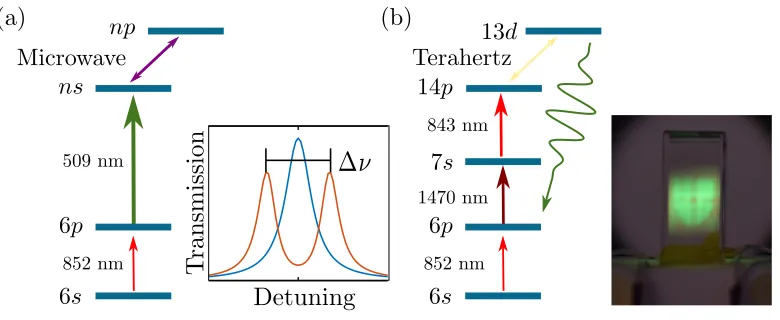
Figure 4. Level schemes for microwave electric field sensing and terahertz imaging. (a) A typical laser configuration for microwave electric field sensing using cesium. A probe laser at 852 nm and a coupling laser at 509 nm are used to setup electromagnetically induced transparency (EIT). The transmission of the probe laser is used to determine the effect that a resonant or quasi-resonant microwave field has on the upper state of the EIT system, which for strong fields appears as a splitting ∆ν as shown in the inset. The concept can be generalised to use more laser fields as referenced in the text in order to overcome technical challenges such as the Doppler effect caused by the motion of the atoms in the vapor cell used as the sensor. (b) For the terahertz imaging scheme described in the text, several laser transitions are used to excite a low lying Rydberg state. The terahertz radiation couples two Rydberg states which leads to fluorescence which is detected and used to image the terahertz radiation. Inset: Example image of a terahertz field transmitted through an aperture with the shape of a shield. Courtesy of Lucy Downes, Durham University.
that has a Rydberg state component that is in resonance, or near-resonance, with the electromagnetic field that is targeted for detection. Either the transmission of a probe laser is monitored to determine the electromagnetic field, Fig 4(a), or the fluorescence from a Rydberg state is collected to sense the presence of the electromagnetic field, Fig. 4(b).
fields interaction with the Rydberg transition,
∆ν = E~0 ·~µ
h . (6)
∆ν is the frequency interval between the transmission peaks caused by the MW electric field. E~0 is the electric field vector and ~µ is the corresponding transmission dipole
moment for the Rydberg transition. h is Planck’s constant. One only needs to know the transition dipole moment, a property of the atom that can be measured using precision spectroscopy, to determine the electromagnetic field amplitude. The range of MW electric fields that can be measured can be extended beyond the Autler-Townes regime by measuring the MW electric field induced change in transmission when the coupling and probe lasers are tuned to resonance [7]. The sensitivity of the method as used to date is determined by shot noise in the probe laser; dephasing mechanisms, such as collisions, transit time broadening and blackbody decay; and the residual Doppler shifts of the EIT scheme. Photon shot-noise limited performance has been achieved [109,110]. The residual Doppler shifts can be overcome using a 3-photon scheme in cesium [111]. The limitations of photon shot noise have prevented the projection noise limit, which can reach better than pV cm−1Hz−1/2 depending on geometry, from being
realised. The accuracy is limited by several factors including the vapor cell material and geometry [101] and how well the transition dipole moments are known, i.e. the atomic spectrum. For small fields, where changes in amplitude of the probe transmission signal are used, the Rabi frequency of the coupling laser must be known in order for the absolute field to be determined. To date, amplitude modulation [7], frequency modulation [109], homodyne [110], dispersive detection [112] and heterodyne [113–115] schemes for detecting the light signal have been demonstrated. Frequency modulation, homodyne and heterodyne detection all achieved photon shot-noise, or near photon shot noise, limited performance for realistic measurement parameters. These works suggested that the sensor is photon shot noise limited.
the Rabi frequency of the terahertz electromagnetic field interacting with the atom; the decay rate into the detection channel compared to competing processes, like blackbody decay; and the fluorescence collection efficiency.
Minimum detectable electric field amplitudes of < 1µV cm−1 with a sensitivity of ∼ 1µV cm−1Hz−1/2 and accuracy of < 1% have been demonstrated for Rydberg
atom-based electric field sensing. The exact numbers depend on the geometry of the vapor cell and the Rabi frequencies of the laser fields. Microwave electric fields in the mm-wave regime have been measured [108]. The method can be sensitive to the vector electric field [117]. Phase retrieval using Rydberg atoms has been investigated in both imaging [113] and single microwave electromagnetic field point detection [114,115]. Imaging of electric fields near MW devices was first demonstrated in Ref. [118]. These results produced sub-wavelength imaging of the target fields determined by the optical imaging resolution. Similarly, imaging inside a vapor cell was demonstrated in Ref. [119]. Strong field detection has been investigated in Ref. [120]. Rydberg atoms have also been studied as a receiver, first in Ref. [121], including an interesting follow-up study on the ’smallness’ of the atom as an antenna [122]. Several recent works on receivers have appeared recently [123–125]. A guitar was even recorded using the atoms in the vapor cell [126]. For terahertz imaging, the sensitivity that has been demonstrated is
∼200 fW Hz−1/2 [116]. There has been less work done on the terahertz imaging scheme described here.
5. Rydberg Quantum Optics
In Rydberg quantum optics [6], the goal is to exploit the strongly-interacting properties of Rydberg atoms to control light at the level of single photons, examples include single photon sources, single photon transistors, and photonic phase gates. In this section we shall discuss some of these applications, but first we introduce some physics concepts that allow us to understand how Rydberg interactions affect light propagation inside a medium. We are interested in how light, at the few quanta level, propagates through a medium. We can assume that the medium is an ensemble of two-level atoms with ground and excited states labelled |0i and |1i, respectively. A single photon localised inside the medium at time t= 0 can be described by a polaritonic wave function of the form
|ψi= √1
N
X
j
cjeik·rj|0. . .01j0. . .0i, (7)
the same as the one that entered. If the phases evolve, eik·rj →eik·rj+φj in a way that is
different for different atoms then the photon leaving the medium is in a different mode, i.e., scattered. For example, if the atoms move due to finite temperature this causes a motional-induced dephasing of the polariton, and the photon is scattered. For room temperature atoms this dephasing occurs on a time scale of order nanoseconds [127].
In examples of multi-level light-atom interactions like EIT, two-photon excitation or four-wave mixing, the excited state|1iis typically coupled to another state|2iusing a classical control field with Rabi frequency Ωc. In the case of EIT, the polariton becomes
a dark-state polariton where the |1i in eqn (7) can be replaced by |2i [128]. For a coupling Rabi frequency greater than the excited state decay rate, ΩcΓ, the medium
is transparent to light resonant with the|0ito|1itransition and the dark-state polariton is equivalent to a photon that propagates at the speed of light. For Ωc∼Γ, the medium
is still transparent but now the dark-state polariton is a mixture of photon and atomic excitation and propagates at a speed equal to c/ng, where the group index depends on
the slope of the dispersion and can be very large > 106 giving rise to slow light [128].
Reducing Ωc narrows the width of the transparency window and increases the group
index. In the limit Ωc→0 the dark-state polariton becomes a purely atomic excitation
and is stored inside the medium. If the control field is turned back on then the stored polariton is converted back into a photon and exits the medium. Using the control field to write and read an excitation is the basis of some quantum memory schemes.
In Rydberg quantum optics, a ladder-type excitation scheme is used [4,6], similar to Fig. 4. In this case the excited state |1i is coupled to a highly-excited Rydberg state |ri, and we can replace the |1i in eqn (7) by |ri and refer to this state as a Rydberg polariton. As the polariton contains Rydberg character it has similar strongly-interacting properties to individual Rydberg atoms. For example, there is a blockade effect preventing the excitation of two Rydberg polaritons within a blockade radius. Consequently if the ensemble is smaller than the blockade volume then only one excitation is possible. By reading out this excitation, by turning on the control field, it is possible to generate a single photon. Below we discuss two experiments that exploit this idea.
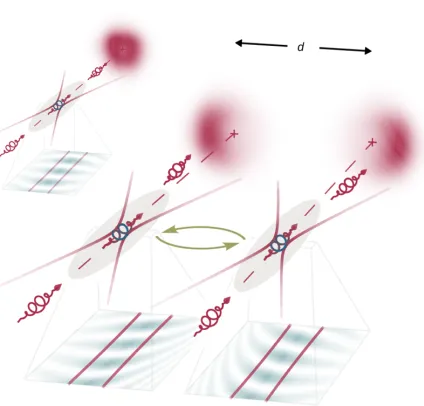
In applications such as a photonic phase gate we would like a controlled phase shift, e.g. φj =π, that is the same for all atoms. This can be achieved experimentally using blockade [129]. However, in addition to blockade, there is also an interaction-induced phase shift [130] which can give rise to non-uniform phase shifts. Consider two ensembles side by side as shown in Fig. 5. Two photons entering the two ensembles create two Rydberg polaritons, initially with a uniform phase gradient, like the single channel case shown in the inset. The combined state is given by the product of two individual polaritons. The Rydberg components interact via a van der Waals interaction, V, such that terms involving atom i in ensemble 1 and atom j in ensemble 2 pick up a phase
Figure 5. The effect on an interaction-induced phase shift on the propagation of photons. The inset shows a single polariton propagation through a medium. The phase is preserved and the output mode matches the input mode. The main figure shows two neighbouring polaritons which interact via a repulsive van der Waals potential. In this case the interaction-induced phase change leads to a deflection of the outgoing photons. Figure courtesy of Paul Huillery.
below the ensembles in Fig. 5. In this example, the non-uniform phase shift leads to a deflection of the outgoing photons—as if the photon were a particle moving in the potential created by the van der Waal interaction of another photon. The effective force between the photons may be either repulsive or attractive depending on the sign of the van der Waals shift.
If the two channels in Fig.5are moved closer then the phase shifts increase. If they are overlapped then the phase shift of the doubly-excited polariton mode becomes so distorted that there is very little overlap between the outgoing two-photon mode and the unperturbed mode. In this case, any two, or more, photon components are completely dephased and scattered out of the forward propagation mode. For a coherent state input, only the zero and one photon components survive leading to strong anti-bunching of the forward transmitted light. This anti-bunching effect was first demonstrated in a series of experiments in 2012 [33,131,132]. The two-channel photon deflection effect illustrated in Fig. 5 was demonstrated by Busche et al. in 2017 [133]. This interaction-induced dephasing effect can be used to realise a single-photon source.
Figure 6. Principle of a Rydberg single-photon source: A single excitation is excited to a highly-excited Rydberg state |riusing a two-photon transition as shown on the left. This writes a Rydberg polariton into the medium with a phase pattern determined by the wave vector of the excitation light, shown schematically on the right. A read pulse maps the polariton onto the intermediate state |1i which emits a photon in a direction determined by the polariton phase pattern, see also Fig.5.
state in an atomic ensemble with size less than the blockade volume such that only one polariton is excited, as illustrated in Fig.6. Subsequently the polariton is read-out using the coupling laser to transfer the excitation into the excited state |1iwhich emits a photon in a direction determined by the phase pattern. This type of single-photon source was demonstrated using laser-cooled atoms in an optical dipole trap by Dudin an Kuzmich in 2012 [131]. In practice, the interaction-induced dephasing effect discussed above can be as important as blockade in determining the performance of the source. In principle, it is possible to implement the above scheme using thermal atoms in a room temperature vapour, however, in this case the motional dephasing is much faster and the coherence time is on the order of nanoseconds, consequently Rabi frequencies in the gigahertz range are needed [137].
In addition to single-photon sources and detectors, the third basic building block of an all-optical quantum network is a photon switch or photon-photon gate, where a ‘control‘ photon either redirects or shifts the phase of a ‘target‘ photons. A variant of a photon switch is a photon transistor where the control photon modifies the ’flow’ of a target photons similar to how the gate in an electronic transition controls the flow of current between the source and drain. All-optical photonic transistor using Rydberg blockade where first demonstrated in 2014 [138,139].
Figure 7. Principle of the photon-photon gate reported in [129]: First a control photon is localised inside the medium as a Rydberg polariton (indicated by the yellow line). Next, a target photon (red line) is sent through the same medium with a coupling to another Rydberg state such that the control and target interact via a dipole-dipole interaction leading to aπ phase shift. The phase of the outgoing target photon when the control photon is not present is shown in grey.
principle is convert the incoming photons into polaritons using EIT and subsequently use blockade to implement a condition phase shift similar to the Rydberg atom gate [65]. The first experimental demonstration of a photonic phase gate with a π phase shift based on Rydberg EIT was reported in 2019 [129]. The scheme is illustrated schematic in Fig. 7. A control photon is localised inside the medium as a Rydberg polariton (indicated by the yellow line). Next, a target photon (red line) is sent through the same medium with a coupling to another Rydberg state such that the control and target interact via a dipole-dipole interaction leading to a π phase shift.
In summary, Rydberg quantum optics has made tremendous advances in only ten years, and Rydberg ensembles have become established as the only known medium with a non-linearity sufficiently large to not require a cavity in order to implement an all-optical quantum gate. In future, research is likely to focus on interfacing the deterministic single-photon sources discussed above with quantum gates and repeater protocols to realise an all-optical quantum network, and provide quantum communication channels between Rydberg quantum computers.
6. Outlook
The use of Rydberg atoms for quantum technology is currently evolving at a faster pace than ever, and it may be dangerous to speculate on what might happen next. However we can be sure that as the field matures, more and more of the concepts outlined above will be translated from laboratory demonstrators into commercial systems that will increasingly help to solve a wide range of societal problems.
Acknowledgments
CSA acknowledges financial support from EPSRC Grant Ref. Nos. EP/M014398/1, EP/P012000/1, EP/R002061/1, EP/R035482/1, and EP/S015973/1. JDP acknowl-edges financial support from EPSRC Grant Ref. Nos. EP/N003527/1 and EP/S015973/1. JPS acknowledges financial support from the Air Force Office of Sci-entific Research grant FA9550-12-1-0282 and the National Science Foundation research grant PHY-1607296.
References
[1] Dowling J and Milburn G 2003Phil. Trans.3611655 [2] Gallagher T F 2005Rydberg Atoms (New York: CUP)
[3] ˘Sibali´c N and Adams C S 2018Rydberg Physics (IOP Publishing) ISBN 978-0-7503-1635-4 [4] Mohapatra A K, Jackson T R and Adams C S 2007Phys. Rev. Lett.98113003
[5] Saffman M, Walker T G and Mølmer K 2010Rev. Mod. Phys.822313 [6] Firstenberg O, Adams C S and Hofferberth S 2016J. Phys. B 49152003
[7] Sedlacek J A, Schwettmann A, K¨ubler H, L¨ow R, Pfau T and Shaffer J P 2012 Nature Phys.8 819
[8] Fan H, Kumar S, Sedlacek J, K¨ubler H, Karimkashi S and Shaffer J P 2015J. Phys. B 48202001 [9] Wade C G, ˘Sibali´c N, de Melo N R, Kondo J M, Adams C S and Weatherill K J 2016 Nature
Photonics 1140
[10] Bethe H A and Salpeter E E 1957Quantum Mechanics of One- and Two-Electron Systems(Berlin, Heidelberg: Springer Berlin Heidelberg)
[11] Craig D and Thirunamachandran T 1998 Molecular Quantum Electrodynamics (New York: Dover)
[12] Beterov I I, Ryabtsev I I, Tretyakov D B and Entin V M 2009 Phys. Rev. A79052504
[13] Marcassa L G and Shaffer J P 2014 Interactions in Ultracold Rydberg Gases (Advances In Atomic, Molecular, and Optical Physics vol 63) ed Arimondo E, Berman P R and Lin C C (Academic Press) pp 47 – 133
[14] Cabral J S, Kondo J M, Gon¸calves L F, Nascimento V A, Marcassa L G, Booth D, Tallant J, Schwettmann A, Overstreet K R, Sedlacek J and Shaffer J P 2011J. Phys. B 44184007 [15] ˘Sibali´c N, Pritchard J D, Adams C S and Weatherill K J 2017Comp. Phys. Comm.220319 [16] Weber S, Tresp C, Menke H, Urvoy A, Firstenberg O, B¨uchler H P and Hofferberth S 2017 J.
Phys. B 50133001
[17] O’Gorman J and Campbell E T 2017Phys. Rev. A95 032338 [18] Bravyi S, Smith G and Smolin J A 2016Phys. Rev. X 6021043
[19] Aspuru-Guzik A, Dutoi A D, Love P J and Head-Gordon M 2005 Science 3091704
[22] Barends R, Lamata L, Kelly J, Garc´ıa- ´Alvarez L, Fowler A G, Megrant A, Jeffrey E, White T C, Sank D, Mutus J Y, Campbell B, Chen Y, Chen Z, Chiaro B, Dunsworth A, Hoi I C, Neill C, O’Malley P J J, Quintana C, Roushan P, Vainsencher A, Wenner J, Solano E and Martinis J M 2015Nat. Comm.67654
[23] Li J, Yang X, Peng X and Sun C P 2017Phys. Rev. Lett.118150503
[24] Moll N, Barkoutsos P, Bishop L S, Chow J M, Cross A, Egger D J, Filipp S, Fuhrer A, Gambetta J M and Ganzhorn M 2018Quantum Sci. Technol. 3030503
[25] Nogrette F, Labuhn H, Ravets S, Barredo D, B´eguin L, Vernier A, Lahaye T and Browaeys A 2014Phys. Rev. X 4021034
[26] Barredo D, Ravets S, Labuhn H, B´eguin L, Vernier A, Nogrette F, Lahaye T and Browaeys A 2014Phys. Rev. Lett.112183002
[27] Barredo D, Lienhard V, de L´es´eleuc S, Lahaye T and Browaeys A 2018Nature 56179
[28] Lukin M D, Fleischhauer M, Cote R, Duan L M, Jaksch D, Cirac J I and Zoller P 2001 Phys. Rev. Lett.87037901
[29] Pichler H, Wang S T, Zhou L, Choi S and Lukin M D 2018 Quantum Optimization for Maximum Independent Set Using Rydberg Atom Arrays (Preprint 1808.10816)
[30] Bernien H, Schwartz S, Keesling A, Levine H, Omran A, Pichler H, Choi S, Zibrov A S, Endres M, Greiner M, Vuleti´c V and Lukin M D 2017Nature 551579
[31] Lienhard V, de L´es´eleuc S, Barredo D, Lahaye T, Browaeys A, Schuler M, Henry L P and L¨auchli A M 2018Phys. Rev. X 8021070
[32] Ravets S, Labuhn H, Barredo D, Lahaye T and Browaeys A 2015Phys. Rev. A92 020701 [33] Maxwell D, Szwer D J, Paredes-Barato D, Busche H, Pritchard J D, Gauguet A, Weatherill K J,
Jones M P A and Adams C S 2013Phys. Rev. Lett.110103001
[34] de L´es´eleuc S, Barredo D, Lienhard V, Browaeys A and Lahaye T 2017 Phys. Rev. Lett. 119 053202
[35] Ohl de Mello D, Sch¨affner D, Werkmann J, Preuschoff T, Kohfahl L, Schlosser M and Birkl G 2019Phys. Rev. Lett.122203601
[36] Piotrowicz M J, Lichtman M, Maller K, Li G, Zhang S, Isenhower L and Saffman M 2013Phys. Rev. A88013420
[37] Lester B J, Luick N, Kaufman A M, Reynolds C M and Regal C A 2015 Phys. Rev. Lett. 115 073003
[38] Endres M, Bernien H, Keesling A, Levine H, Anschuetz E R, Krajenbrink A, Senko C, Vuleti´c V, Greiner M and Lukin M D 2016Science 3541024
[39] Schlosser N, Reymond G, Protsenko I and Grangier P 2001Nature 4111024 [40] Kim H, Lee W, Lee H g, Jo H, Song Y and Ahn J 2016 Nature Comms.713317
[41] Barredo D, de L´es´eleuc S, Lienhard V, Lahaye T and Browaeys A 2016Science 3541021 [42] Carpentier A V, Fung Y H, Sompet P, Hilliard A J, Walker T G and Andersen M F 2013 Laser
Phys. Lett.10125501
[43] Brown M O, Thiele T, Kiehl C, Hsu T W and Regal C A 2019 Phys. Rev. X 9011057 [44] Greiner M, Mandel O, Esslinger T, H¨ansch T W and Bloch I 2002Nature 41539 [45] Norcia M A, Young A W and Kaufman A M 2018Phys. Rev. X 8041054
[46] Cooper A, Covey J P, Madjarov I S, Porsev S G, Safronova M S and Endres M 2018 Phys. Rev. X 8041055
[47] Saskin S, Wilson J T, Grinkemeyer B and Thompson J D 2019Phys. Rev. Lett.122143002 [48] Jackson N C, Hanley R K, Hill M, Adams C S and Jones M P A 2019 Number-resolved imaging
of 88Sr atoms in a long working distance optical tweezers (Preprint 1904.03233)
[49] Anderegg L, Cheuk L W, Bao Y, Burchesky S, Ketterle W, Ni K K and Doyle J M An optical tweezer array of ultracold molecules (Preprint 1902.00497)
[50] Dutta S K, Guest J R, Feldbaum D, Walz-Flannigan A and Raithel G 2000 Phys. Rev. Lett.85 5551
[52] Nelson K D, Li X and Weiss D 2007 Nature Phys.3556
[53] Kaufman A M, Lester B J and Regal C A 2012Phys. Rev. X 2041014
[54] Thompson J D, Tiecke T G, Zibrov A S, Vuleti´c V and Lukin M D 2013 Phys. Rev. Lett.110 133001
[55] Sompet P, Fung Y H, Schwartz E, Hunter M D J, Phrompao J and Andersen M F 2017 Phys. Rev. A95031403
[56] Lundblad N, Schlosser M and Porto J V 2010 Phys. Rev. A81 031611 [57] Dudin Y O, Li L and Kuzmich A 2013Phys. Rev. A87031801
[58] Yang J, He X, Guo R, Xu P, Wang K, Sheng C, Liu M, Wang J, Derevianko A and Zhan M 2016
Phys. Rev. Lett.117123201
[59] Covey J P, Madjarov I S, Cooper A and Endres M 2019Phys. Rev. Lett.122173201 [60] Kwon M, Ebert M F, Walker T G and Saffman M 2017Phys. Rev. Lett.119180504 [61] Wu T Y, Kumar A, Giraldo F and Weiss D S 2019 Nature Phys.15538
[62] Nielsen M A and Chuang I L 2005Quantum Computation and Quantum Information(Cambridge: CUP)
[63] Kaufman A M, Lester B J, Foss-Feig M, Wall M L, Rey A M and Regal C A 2015 Nature 527 208
[64] Lester B J, Lin Y, Brown M O, Kaufman A M, Ball R J, Knill E, Rey A M and Regal C A 2018
Phys. Rev. Lett.120193602
[65] Jaksch D, Cirac J I, Zoller P, Rolston S L, Cˆot´e R and Lukin M D 2000Phys. Rev. Lett.852208 [66] Saffman M 2016J. Phys. B 49202001
[67] Isenhower L, Urban E, Zhang X L, Gill A T, Henage T, Johnson T A, Walker T G and Saffman M 2010Phys. Rev. Lett.104010503
[68] Zeng Y, Xu P, He X, Liu Y, Liu M, Wang J, Papoular D J, Shlyapnikov G V and Zhan M 2017
Phys. Rev. Lett.119160502
[69] Beterov I I and Saffman M 2015 Phys. Rev. A92042710
[70] Isenhower L, Saffman M and Mølmer K 2011Quantum Information Processing 10755 [71] Shi X F 2018 Phys. Rev. Applied 9051001
[72] Mølmer K, Isenhower L and Saffman M 2011J. Phys. B 44184016 [73] Petrosyan D, Saffman M and Mølmer K 2016 J. Phys. B 49 094004 [74] Auger J M, Bergamini S and Browne D E 2017Phys. Rev. A96052320
[75] Motzoi F, Gambetta J M, Rebentrost P and Wilhelm F K 2009 Phys. Rev. Lett.103110501 [76] Theis L S, Motzoi F, Wilhelm F K and Saffman M 2016 Phys. Rev. A94032306
[77] Wilk T, Ga¨etan A, Evellin C, Wolters J, Miroshnychenko Y, Grangier P and Browaeys A 2010
Phys. Rev. Lett.104010502
[78] Zhang X L, Isenhower L, Gill A T, Walker T G and Saffman M 2010Phys. Rev. A82030306 [79] Maller K M, Lichtman M T, Xia T, Sun Y, Piotrowicz M J, Carr A W, Isenhower L and Saffman
M 2015Phys. Rev. A92022336
[80] Jau Y Y, Hankin A M, Keating T, Deutsch I H and Biedermann G W 2016 Nat. Phys.1271 [81] Picken C J, Legaie R, McDonnell K and Pritchard J D 2018Quantum Sci. Technol.4015011 [82] de L´es´eleuc S, Barredo D, Lienhard V, Browaeys A and Lahaye T 2018Phys. Rev. A97053803 [83] Levine H, Keesling A, Omran A, Bernien H, Schwartz S, Zibrov A S, Endres M, Greiner M,
Vuleti´c V and Lukin M D 2018Phys. Rev. Lett.121123603 [84] Schauss P 2018 Quantum Sci. Technol.3023001
[85] Labuhn H, Barredo D, Ravets S, de L´es´eleuc S, Macr`ı T, Lahaye T and Browaeys A 2016Nature
534667
[86] de L´es´eleuc S, Weber S, Lienhard V, Barredo D, B¨uchler H P, Lahaye T and Browaeys A 2018
Phys. Rev. Lett.120113602
[89] Barredo D, Labuhn H, Ravets S, Lahaye T, Browaeys A and Adams C S 2015Phys. Rev. Lett.
114113002
[90] Orioli A P n, Signoles A, Wildhagen H, G¨unter G, Berges J, Whitlock S and Weidem¨uller M 2018Phys. Rev. Lett.120063601
[91] de L´es´eleuc S, Lienhard V, Scholl P, Barredo D, Weber S, Lang N, Buchler H, Lahaye T, and Browaeys A 2018 Experimental realization of a symmetry protected topological phase of interacting bosons with Rydberg atoms (Preprint 1810.13286)
[92] Weber S, de L´es´eleuc S, Lienhard V, Barredo D, Lahaye T, Browaeys A and B¨uchler H P 2018
Quantum Sci. Technol. 3044001 [93] Lucas A 2014 Frontiers in Physics 25
[94] Farhi E, Goldstone J, Gutmann S, Lapan J, Lundgren A and Preda D 2001Science 292472 [95] Lechner W, Hauke P and Zoller P 2015 Science Advances 1
[96] Glaetzle A W, van Binjen R M W, Zoller P and Lechner W 2017 Nature Comms.815813 [97] Farhi E, Goldstone J and Gutmann S 2014 A Quantum Approximate Optimization Algorithm
(Preprint 1411.4028)
[98] Pichler H, Wang S T, Zhou L, Choi S and Lukin M D 2018 Computational complexity of the Rydberg blockade in two dimensions (Preprint 1809.04954)
[99] K¨ubler H, Shaffer J P, Baluktsian T, L¨ow R and Pfau T 2010Nature Photon. 4112 [100] Fleischhauer M, Imamoglu A and Marangos J P 2005Rev. Mod. Phys. 77633
[101] Fan H, Kumar S, Sheng J, Shaffer J P, Holloway C L and Gordon J A 2015Phys. Rev. Appl. 4 044015
[102] Sedlacek J A, Kim E, Rittenhouse S T, Weck P F, Sadeghpour H R and Shaffer J P 2016Phys. Rev. Lett.116133201
[103] Kouwenhoven L P, Austing D G and Tarucha S 2001Rep. Prog. Phys.64701 [104] Wrachtrup J and Jelezko F 2006Journal of Physics: Condensed Matter 18S807
[105] Kleinbach K S, Engel F, Dieterle T, L¨ow R, Pfau T and Meinert F 2018Phys. Rev. Lett. 120 193401
[106] O’Brien J, Furusawa A and Vuckovic J 2009Nature Photon. 3687
[107] Holloway C, Gordon J, Jefferts S, Schwarzkopf A, Anderson D, Miller S, Thaicharoen N and Raithel G 2014IEEE Transactions on Antennas and Propagation 616169
[108] Gordon J A, Holloway C L, Schwarzkopf A, Anderson D A, Miller S, Thaicharoen N and Raithel G 2014App. Phys. Lett.105024104
[109] Kumar S, Fan H, K¨ubler H, Jahangiri A J and Shaffer J P 2017Opt. Express 25 8625 [110] Kumar S, Fan H, K¨ubler H, Sheng J and Shaffer J P 2017Scientific Reports 742981 [111] Shaffer J P and K¨ubler H 2018Proceeding SPIE 10674
[112] Fan H Q, Kumar S, K¨ubler H and Shaffer J P 2016 J. Phys. B 49 104004 [113] Shaffer J 2018 US Patent and PCT filing
[114] Jing M, Hu Y, Ma J, Zhang H, Zhang L, Xiao L and Jia S 2019 Quantum superhet based on microwave-dressed Rydberg atoms (Preprint 1902.11063)
[115] Simons M T, Haddab A H, Gordon J A and Holloway C L 2019App. Phys. Lett. 114114101 [116] Downes L A, MacKellar A R, Whiting D J, Bourgenot C, Adams C S and Weatherill K J 2019
Ultra-high-speed Terahertz Imaging Using Atomic Vapour (Preprint 1903.01308) [117] Sedlacek J A, Schwettmann A, K¨ubler H and Shaffer J P 2013Phys. Rev. Lett.111063001 [118] Fan H Q, Kumar S, Daschner R, K¨ubler H and Shaffer J P 2014 Opt. Lett.393030
[119] Holloway C L, Gordon J A, Schwarzkopf A, Anderson D A, Miller S A, Thaicharoen N and Raithel G 2014App. Phys. Lett. 104244102
[120] Anderson D A, Miller S A, Raithel G, Gordon J A, Butler M L and Holloway C L 2016Phys. Rev. Applied 5034003
[124] Song Z, Liu H, Liu X, Zhang W, Zou H, Zhang J and Qu J 2019Opt. Express 278848–8857 [125] Anderson D A, Sapiro R E and Raithel G 2018 An atomic receiver for AM and FM radio
communication (Preprint 1808.08589)
[126] Holloway C L, Simons M T, Haddab A H, Williams C J and Holloway M W 2019AIP Advances
9065110
[127] Whiting D J, ˇSibali´c N, Keaveney J, Adams C S and Hughes I G 2017 Phys. Rev. Lett. 118 253601
[128] Fleischhauer M and Lukin M D 2000Phys. Rev. Lett.84 5094
[129] Tiarks D, Schmidt-Eberle S, Stolz T, Rempe G and D¨urr S 2019Nature Phys.15124
[130] Bariani F, Dudin Y O, Kennedy T A B and Kuzmich A 2012Phys. Rev. Lett.108030501 URL http://link.aps.org/doi/10.1103/PhysRevLett.108.030501
[131] Dudin Y O and Kuzmich A 2012Science 336887
[132] Peyronel T, Firstenberg O, Liang Q Y, Hofferberth S, Gorshkov A V, Pohl T, Lukin M D and Vuleti´c V 2012Nature 48857
[133] Busche H, Huillery P, Ball S W, Ilieva T, Jones M P A and Adams C S 2017 Nature Phys.13 655
[134] Darquie B, Jones M P A, Dingjan J, Beugnon J, Bergamini S, Sortais Y, Messin G, Browaeys A and Grangier P 2005Science 309454–456
[135] Senellart P, Solomon G and White A 2017Nature Nano.121026 [136] Saffman M and Walker T G 2002Phys. Rev. A66065403
[137] Ripka F, K¨ubler H, L¨ow R and Pfau T 2018Science 362446 ISSN 0036-8075 [138] Tiarks D, Schmidt S, Rempe G and D¨urr S 2016Sci. Adv. 2
[139] Gorniaczyk H, Tresp C, Bienias P, Paris-Mandoki A, Li W, Mirgorodskiy I, B¨uchler H P, Lesanovsky I and Hofferberth S 2016Nature Comms.712480
[140] Knill E, Laflamme R and Milburn G J 2001Nature 40946
[141] Friedler I, Petrosyan D, Fleischhauer M and Kurizki G 2005Phys. Rev. A72043803 [142] O’Brien J L 2007Science 3181567
[143] Pritchard J D, Maxwell D, Gauguet A, Weatherill K J, Jones M P A and Adams C S 2010Phys. Rev. Lett.105193603
[144] Gorshkov A V, Otterbach J, Fleischhauer M, Pohl T and Lukin M D 2011Phys. Rev. Lett.107 133602