City, University of London Institutional Repository
Citation
: Smith-Spark, J. H., Henry, L., Messer, D. J. and Zięcik, A. P. (2017). Verbal and
non-verbal fluency in adults with developmental dyslexia: Phonological processing or executive control problems?. Dyslexia, 23(3), pp. 234-250. doi: 10.1002/dys.1558This is the accepted version of the paper.
This version of the publication may differ from the final published
version.
Permanent repository link:
http://openaccess.city.ac.uk/17329/Link to published version
: http://dx.doi.org/10.1002/dys.1558
Copyright and reuse:
City Research Online aims to make research
outputs of City, University of London available to a wider audience.
Copyright and Moral Rights remain with the author(s) and/or copyright
holders. URLs from City Research Online may be freely distributed and
linked to.
City Research Online: http://openaccess.city.ac.uk/ [email protected]
1 Running Head: Executive fluency in adult dyslexia
Verbal and non-verbal fluency in adults with developmental dyslexia: Phonological
processing or executive control problems?
James H. Smith-Spark a, Lucy A. Henry b, David J. Messer c, and Adam P. Zięcik a
a
London South Bank University, London, United Kingdom
b
City University, London, United Kingdom
c
The Open University, Milton Keynes, United Kingdom
Author Contact
James H. Smith-Spark,Division of Psychology, School of Applied Sciences, London South
Bank University, 103 Borough Road, London, SE1 0AA, United Kingdom
Email [email protected]
Telephone +44 (0)20 7815 5884
2 Abstract
The executive function of fluency describes the ability to generate items according to
specific rules. Production of words beginning with a certain letter (phonemic fluency) is
impaired in dyslexia, whilst generation of words belonging to a certain semantic category
(semantic fluency) is typically unimpaired. However, in dyslexia, verbal fluency has
generally been studied only in terms of overall words produced. Furthermore, performance
of adults with dyslexia on non-verbal design fluency tasks has not been explored but would
indicate whether deficits could be explained by executive control, rather than phonological
processing, difficulties. Phonemic, semantic, and design fluency tasks were presented to
adults with dyslexia and without dyslexia, using fine-grained performance measures and
controlling for IQ. Hierarchical regressions indicated that dyslexia predicted lower
phonemic fluency, but not semantic or design fluency. At the fine-grained level, dyslexia
predicted a smaller number of switches between subcategories on phonemic fluency, whilst
dyslexia did not predict the size of phonemically-related clusters of items. Overall, the
results suggested that phonological processing problems were at the root of dyslexia-related
fluency deficits; however, executive control difficulties could not be completely ruled out
as an alternative explanation. Developments in research methodology, equating executive
demands across fluency tasks, may resolve this issue.
Keywords:
Developmental Dyslexia; Naming Fluency; Verbal Fluency; Design Fluency; Adult
3 Verbal and non-verbal fluency in adults with developmental dyslexia:
Phonological processing or executive control problems?
Developmental dyslexia (henceforth, dyslexia) is typically characterized by a
persistent difficulty with decoding the written word (e.g., Lyon, Shaywitz & Shaywitz,
2003; Siegel, 2006). The severity of the phonological processing deficits associated with
dyslexia has led to theoretical explanations placing such problems at the core of the
condition (e.g., Vellutino, 1979; Vellutino, Fletcher, Snowling & Scanlon, 2004; see
Castles & Friedmann, 2014, for a recent review). However, dyslexia-related problems in a
broad range of executive functioning (EF) tasks have also been found in children (see
Booth, Boyle & Kelly, 2010, for a meta-analysis) and adults (e.g., Brosnan et al., 2002;
Smith-Spark, Henry, Messer, Edvardsdottir & Zięcik, 2016). Executive functioning refers
to higher-order cognitive processes such as planning, problem solving, inhibiting habitual
responses in favour of more novel task-appropriate behaviour, self-monitoring
performance, adapting responses in the light of changing task or environmental demands,
organizing and sequencing behaviour, and shifting between different cognitive operations
or representational sets (e.g., Andrés, 2003; Fisk & Sharp, 2004; Miyake & Friedman,
2012; Miyake et al., 2000; Pennington & Ozonoff, 1996; Rabbitt, 1997; Stuss & Benson,
1997).
Whilst a broad range of EFs have been found to be impaired in dyslexia, the current
paper focused on one particular EF, namely fluency, in adults with dyslexia. Fluency is
well-recognized as a measure of EF (e.g., Luo, Luk & Bialystok, 2010; Pennington &
Ozonoff, 1996) and describes the ability to generate verbal or non-verbal items according to
4 referring to the production of verbal items) should be distinguished from reading fluency,
which involves the smooth coordinated flow of reading. Although measures of executive
fluency have been obtained previously in dyslexia (e.g., Kinsbourne, Rufo, Gamzu, Palmer
& Berliner, 1991; Snowling, Nation, Moxham, Gallagher & Frith, 1997), the multifaceted
nature of the task (e.g., Troyer, Moscovitch & Winocur, 1997) underlines the need for
finer-grained analyses of performance to be undertaken (e.g., Henry, Messer & Nash, 2015;
Luo et al., 2010). The current research was designed to provide more detailed analyses than
previously employed, by exploring subcomponents of performance and measuring both
verbal and non-verbal fluency in the same sample of adults.
In verbal fluency tasks, participants are asked to generate as many words as they
can in a set time (usually 60 seconds) whilst adhering to specific rules. Phonemic fluency
tasks require participants to produce words beginning with a certain letter, such as F, A, or
S (e.g., Benton, 1968; Borkowski, Benton & Spreen, 1967), whilst semantic fluency tasks
ask participants to name words that belong to a particular semantic category, such as
animals or vegetables (Newcombe, 1969).
The rule-based nature of performance means that controlled access of information
held in long-term memory is required to carry out the task successfully (e.g., Fisk & Sharp,
2004). As a result, verbal fluency tasks make considerable demands on higher-order
cognitive abilities such as cognitive flexibility, strategic planning, the production of
non-habitual responses, the suppression of previously generated responses, and error-monitoring
(e.g., Phillips, 1997; Rosen & Engle, 1997; Ruff, Light, Parker & Levin, 1997). Of the two
types of verbal fluency task, lower demands are placed on higher-order cognitive processes
5 Generating semantic category members is a more usual activity than generating words
beginning with a certain letter, as people have existing schemata to deploy when generating
semantically-associated items and easier access to subcategories (Shao, Janse, Visser &
Meyer, 2014; Troyer et al., 1997). Semantic fluency, thus, entails a lesser degree of task
novelty (an important component of any EF task; e.g., Phillips, 1997; Shallice & Burgess,
1991) and, consequently, is likely to require fewer executive resources than phonemic
fluency (e.g., Shao et al., 2014).
Reduced rates of production on phonemic fluency tasks have been reported in
individuals with dyslexia. This has been found to be the case in both children (e.g., Brosnan
et al., 2002; Cohen, Morgan, Vaughn, Riccio & Hall, 1999; Felton & Wood, 1989; Frith,
Landerl & Frith, 1995; Landerl, Fussenegger, Moll & Willburger, 2009; Menghini et al.,
2010; Miller-Shaul, 2005; Moura, Simões & Pereira, 2014; Plaza, Cohen &
Chevrie-Muller, 2002; Reiter, Tucha & Lange, 2005; Varvara, Varuzza, Sorrentino, Vicari &
Menghini, 2014) and adults (e.g., Hatcher, Snowling & Griffiths, 2002; Kinsbourne et al.,
1991; Marzocchi et al., 2008; Miller-Shaul, 2005; Moore, Brown, Markee, Theberge & Zvi,
1995; Snowling et al., 1997; Wilson & Lesaux, 2001). Furthermore, non-significant trends
towards lower phonemic fluency scores in adults with dyslexia have also been reported
(Brosnan et al., 2002; Brunswick, McCrory, Price, Frith & Frith, 1999; Felton, Naylor &
Wood, 1990). Another verbal fluency task involving phonological processing, rhyme
fluency (in which participants are asked to produce words which rhyme with a target word),
has also been found to be significantly worse in adult students with dyslexia (Hatcher et al.,
6 In contrast to phonemic fluency, the study of semantic fluency in dyslexia has not
resulted in such consistent findings. In children, a number of studies have failed to find
dyslexia-related differences (Frith et al. 1995; Griffiths, 1991; Hatcher et al., 2002; Landerl
et al., 2009; Marzocchi et al., 2008; Mielnik, Lockiewicz & Bogdanowicz, 2015; Plaza &
Guitton, 1997), with a similar pattern of null results being reported in adults by several
authors (Frith et al., 1995; Reid, Szczerbinski, Iskierka-Kasperek & Hansen, 2007).
However, set against this evidence, some studies have found deficits in both children
(Levin, 1990; Menghini et al., 2010; Moura et al., 2014; Plaza et al., 2002; Reiter et al.,
2005; Varvara et al., 2014) and in adults (Snowling et al., 1997).
Nearly all investigations of verbal fluency in dyslexia have been limited to
recording the number of stimuli correctly generated in the time allotted. However, Frith et
al. (1995) explored performance at a finer-grained level in children, addressing both
phonemic and semantic fluency. They measured the number of new words generated on
four successive 10-item trials. The children with dyslexia and age- and IQ-matched controls
did not differ in the number of new words produced on later trials of either the phonemic or
semantic fluency tasks. Frith et al. argued that children with dyslexia had a mental lexicon
that was of equivalent size to that of controls, with group differences in phonemic fluency
being due to the difficulties that children with dyslexia had in accessing these words by
their initial phoneme.
Differences in strategy use between children with and without dyslexia when
performing verbal fluency tasks have been suggested by several authors (Frith et al., 1995;
Reiter et al., 2005; Reid et al., 2007; although see Mielnik et al., 2015, for an opposing
7 impairments. Possible disparities in strategy use in verbal fluency performance resonate
with a broader literature on dyslexia and strategy generation and utilization. Relative to
controls, people with dyslexia show deficits in organized performance, manifesting
problems with generating strategies and applying them efficiently to the task at hand (e.g.,
Levin, 1990; Torgeson, 1977). More recently, Bacon, Parmentier, and Barr (2013) have
argued that adults with dyslexia do not have the cognitive flexibility to shift from one
strategy to another unless they are told explicitly to do so.
Collecting new and more detailed data about executive fluency performance and
strategy use in individuals with dyslexia can provide information relevant to these issues. In
the current study, this was achieved by following the lead of Troyer et al. (1997). They
emphasized the importance of studying two components of verbal fluency performance,
known as clustering and switching, in addition to obtaining total output measures.
Clustering refers to the successive generation of words belonging to a particular
phonemic or semantic subcategory (usually in spurts or temporal clusters with short
intervals between items; e.g., Bousfield & Sedgewick, 1944; Henry & Crawford, 2004),
until all items belonging to that particular subcategory are exhausted and the individual
searches for a new subcategory from which to generate items. Clustering is argued to draw
on verbal memory and word storage processes mediated by the temporal lobe of the brain
(Troyer et al., 1997). Clustering can proceed relatively automatically even in individuals
with low working memory spans (e.g., Rosen & Engle, 1997).
Switching refers to the ability to switch from one subcategory to another in an
efficient manner. On a phonemic fluency task, an individual might switch from producing
8 phoneme) to continue with “fat, fan, far, fad” (a cluster with different phonemically-related
members). Similarly, on a semantic fluency task, an individual might switch from “oranges,
pears, apples, cherries” (a cluster of four semantically-related members, i.e., fruits which
grow on trees) to continue “grapes, tomatoes” (fruits that grow on the vine, with a cluster
size of two). Troyer et al. (1997) argued that switching involves EF processes to a greater
extent than clustering, linking it to frontal lobe function. Switching is an effortful process,
requiring strategic search, conscious control, and cognitive flexibility to shift between
representational sets (e.g., Mayr, 2002; Troyer, 2000).
Research on switching and clustering within verbal fluency tasks in dyslexia is
almost entirely lacking. To the authors’ knowledge, this measure has only been examined
by Mielnik et al. (2015), who reported no group differences in the number of switches
between clusters in children with and without dyslexia on a phonemic fluency task.
However, they did find that children with dyslexia generated fewer clusters and switched
fewer times on a semantic fluency task. Whilst these results are consistent with other
research on verbal fluency in Polish (Reid et al., 2007), the findings do not fit the typical
pattern of phonemic fluency impairment associated with dyslexia in the English language,
the focus of the vast majority of the research literature and the current study.
A further detailed measure of verbal fluency is provided by measuring response
output rate over the four 15s quartiles of a one-minute task (e.g., Crowe, 1998; Hurks et al.,
2006). Response output rate tends to decline over the 60s trial, especially after the initial
15s have elapsed (e.g., Crowe, 1998; Hurks et al., 2006). Hurks et al. proposed that initial
performance relies on automatic processes to access common or prototypical items,
9 these initial items have been exhausted, effortful, controlled processes which draw on
executive resources are required to access further items (e.g., Crowe, 1998).
Executive fluency can also be assessed using non-verbal tasks (e.g., Ruff, Light &
Evans, 1987) and these provide an opportunity to explore (and separate) phonological
processes from executive control processes. Non-verbal (or figural/design fluency) tasks
require individuals to draw straight lines between constellations of printed dots to form as
many novel patterns as they can within a set time limit. Existing research on design fluency
in dyslexia is limited, but Griffiths (1991) found no significant difference in output between
children with and without dyslexia. However, Reiter et al. (2005) criticized this study for
presenting participants with templates to form patterns, thereby reducing novelty and, thus,
the EF resources demanded by the task (c.f., Shallice & Burgess, 1991). Instead, Reiter et
al. used the Five-point test (Regard, Strauss & Knapp, 1982). Participants were presented
with a sheet of paper containing squares, each of which consisted of a fixed pattern of five
dots arranged symmetrically. They created as many different patterns as possible in two
minutes by joining dots in each square using one or more straight lines. Reiter et al. found a
design fluency decrement in children with dyslexia and arged that this deficit was the result
of reduced productivity related to the effective use of strategies. Reiter et al. further claimed
that their design fluency task required greater levels of creativity and was more abstract
than that used by Griffiths.
The current study investigated the performance of university students with and
without dyslexia on three types of executive fluency task (phonemic, semantic, and design).
As has been argued by McLoughlin, Fitzgibbon and Young (1994), it is important to
10 extrapolating from evidence obtained from children with dyslexia. The cognitive challenges
of adults with the condition are likely to be different to those experienced by children with
dyslexia and, thus, need to be documented in order to highlight areas of weakness which
require support. Recently, Smith-Spark et al. (2016) identified problems in adults with
dyslexia across a range of different EF domains in both the laboratory setting and under
everyday conditions. However, whilst that paper was more wide-ranging in its coverage of
EFs than previous research, it could not cover all domains of EF. The current paper,
therefore, built upon this work to extend recent research on adults into the EF domain of
fluency.
Performance on the verbal fluency tasks was expected to follow the typical pattern
reported in the previous literature on both adults and children, such that dyslexia-related
deficits would be apparent on phonemic fluency (e.g., Kinsbourne et al., 1991; Moore et al.,
1995; Wilson & Lesaux, 2001), and not semantic fluency (e.g., Frith et al., 1995; Griffiths,
1991; Hatcher et al., 2002; Plaza et al., 2002; Plaza & Guitton, 1997). Measures of
switching, clustering, and performance over time presented more nuanced and novel
methods of exploring verbal fluency in dyslexia that allowed an understanding of the role
of executive control, as well as language processes. Additionally, the inclusion of a
non-verbal task allowed fluency performance to be divorced from phonological processes,
permitting the isolation of EF as a contributory factor to poorer fluency in dyslexia. It was
hypothesized that, if there are general EF weaknesses in dyslexia, impairments on the
design fluency task would be found, whereas if only phonological processing difficulties
were to underlie poorer fluency performance in dyslexia, no impairments should emerge
11 Method
Participants
Fifty-six university students took part in the study (44 females, 12 males, mean age
= 24 years, SD = 5, range = 18-34 years). All spoke English as their first language and received either a small honorarium or course credit for participating. Participants were
allocated to one of two groups on the basis of their self-declared dyslexia status, resulting in
a group of 28 individuals with dyslexia and a control group of 28 individuals without
dyslexia (22 females, 6 males in each group). The two groups did not differ significantly in
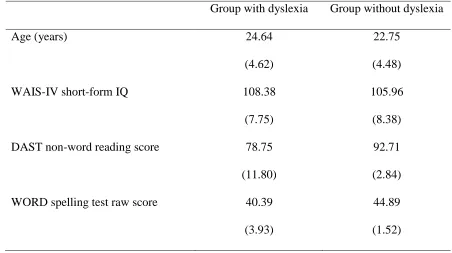
age, t(54) = 1.56, p = .125. Checks of the dyslexia status of both groups were performed and are described below. Table 1 shows the demographic characteristics of the two groups,
together with their mean scores on the IQ and screening measures reported in this section.
TABLE 1 ABOUT HERE
All 28 participants in the group with dyslexia had been independently diagnosed by
an educational psychologist and showed the experimenter documentation to this effect prior
to testing. None of the participants in the control group reported reading or writing
problems when questioned verbally. Self-reports of not having dyslexia are accurate
(Nicolson & Fawcett, 1997), but measures of reading and spelling ability were administered
to support the validity of the two participant groups.
The ability to decode novel words is impaired even in compensated adult readers
with dyslexia (Brachacki, Fawcett & Nicolson, 1994; Finucci, Guthrie, Childs, Abbey &
Childs, 1976), making nonsense word reading performance highly sensitive to the presence
of dyslexia (see also Hatcher et al., 2002). Reading ability was, therefore, assessed using
12 (DAST; Fawcett & Nicolson, 1998). This task required the timed reading of a passage
containing both real words and orthographically legal nonsense words. Reading speed and
accuracy were combined to produce a composite measure of performance. Scoring
penalties were incurred if a participant’s reading proved to be slow or error-prone. The
control group performed significantly better than the group with dyslexia on the DAST
nonsense passage, t(30.119) = 6.09, p < .001, d = 1.26. All the control participants scored above the normative age-specific cut-off point for identifying an individual as being “at
risk” of dyslexia.
Spelling was assessed using the spelling component of the Wechsler Objective
Reading Dimensions (WORD; Wechsler, 1993). Participants were presented with a series
of words to spell within the context of a sentence. Testing was terminated after six
successive incorrect spelling responses. The control group spelt significantly more words
correctly on the WORD spelling test than the group with dyslexia, t(34.943) = 5.65, p < .001, d = 1.21. The raw spelling scores were also used to calculate a spelling age for each participant. Raw scores of 42/50 and above indicated that the participant had a spelling age
of greater than 17 years (the ceiling on the task) and, therefore, his or her performance fell
in the typical adult range. Seventeen of the participants with dyslexia had a spelling age of
less than 17 years, whilst all the control participants had spelling ages in the adult range.
The Block Design, Picture Completion, Vocabulary, and Comprehension subtests of
the Wechsler Adult Intelligence Scale – Fourth UK Edition (WAIS-IV; Wechsler, 2010)
were administered in order to calculate a short-form IQ for each participant. None of these
measures is sensitive to the presence of dyslexia, meaning that they provide a good estimate
13 statistically significant difference in short-form IQ between the participant groups, t(54) = 1.12, p = .267. However, short-form IQ was statistically controlled in all of the analyses reported subsequently. This statistical control was exerted for two reasons: firstly, a p-value
of greater than .50 has been recommended to ensure that groups are adequately matched for
IQ in developmental studies (Mervis & Klein-Tasman, 2004) and, secondly, a positive
relationship has been reported between IQ and verbal fluency performance (e.g. Ardila,
Pineda, & Rosselli, 2000).
Materials
The Letter Fluency, Category Fluency, and Design Fluency subscales from the
Delis-Kaplan Executive Function System (D-KEFS; Delis, Kaplan & Cramer, 2001)
standardized battery of tests were employed to assess the EF of fluency.
Design
Separate hierarchical multiple regression analyses were used to determine whether
the presence of dyslexia was a significant predictor of total responses generated, valid
responses, number of errors, number of switches, words per cluster, and the total number of
items generated in each quartile of Letter and Category Fluency. However, in the case of
Category Fluency, it was not possible to assess the data on boys’ names for each individual
participant since these might be highly subjective and idiosyncratic (e.g., classmates, family
members). Thus, in line with Henry et al. (2015; see also Troyer et al., 1997), the boys’
names trial was omitted from the finer-grained analyses conducted on the number of
switches, cluster size, and quartiles data gathered from Category Fluency. In all hierarchical
regressions, short-form IQ was entered as a predictor in Block 1 and participant group in
14 Cluster size is often counted from the second word of a cluster but, in accordance
with Henry et al.’s (2015) argument that this could lead to misleading results if there are
many single word clusters relative to the number of multiword clusters, single words were
counted as separate clusters as well as multiword groups of phonemically or semantically
words.
Due to the nature of the task and responses, Design Fluency could only be analyzed
in terms of total responses generated, total valid responses, and total number of errors.
For both the Category Fluency Switching and Design Fluency Switching trials,
measures were taken of total number of correct trials and total number of correct switching
responses.
Procedure
Full ethical approval was granted by the appropriate University Research Ethics
Committee. Participants gave informed consent to take part. The IQ and screening
measures were administered in a preliminary session held on a separate day to the
administration of the fluency tasks.
For both D-KEFS Verbal Fluency tasks, the participants carried out a series of 60s
trials. Letter Fluency required the participants to name verbally as many different words
beginning with a particular letter of the alphabet as they could, with the restriction that none
of the words could be numbers or the names of places or people. There were three trials,
requiring responses to the letters F, A, and S respectively. The second task, Category
Fluency, required participants to produce as many different words that belonged to a
particular semantic category as possible. One trial required the names of animals to be
15 wherein participants were given 60s to generate words as quickly as possible, alternating
between two different semantic categories (fruits and furniture).
The D-KEFS Design Fluency subtest was also made up of three tasks. The
participants were presented with an answer booklet with rows of boxes each containing a
number of dots. In the first task (Filled Dots), the participants were asked to draw a
different design in each box, by connecting dots and using only four straight lines. They
were also told that each line that they drew must join at least one other line at a dot (i.e. no
line could be drawn in isolation from the remaining lines). They were asked to draw as
many different patterns as possible in 60 seconds. The second task (Empty Dots Only)
followed the same rules as the first task except that the boxes contained both empty and
filled dots and the participants were instructed only to use the empty dots to make different
patterns within an array of filled and empty dots. For scoring purposes, performance on
these two tasks was combined. The third task, Switching, was based on the same principles,
but the participants were asked to switch alternately between empty and filled dots in each
design.
A debriefing followed the completion of the second session.
Results
Letter Fluency
Table 2 summarizes the results of the separate hierarchical regression analyses
carried out on each of the dependent variables generated on Letter Fluency.
16 In Step 1, the total number of responses, the total number of valid responses, the
number of switches, and performance on Quartiles 1, 2, and 3 were all significantly
predicted by short-form IQ.
In Step 2, the presence of dyslexia was found significantly to predict total responses
generated, valid responses, the number of switches, and performance on Quartiles 1, 2, and
4. Dyslexia did not significantly predict the number of words generated per cluster.
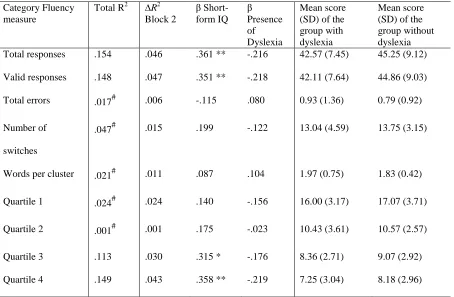
Category Fluency
In Step 1, short-form IQ significantly predicted the total number of responses, the
number of valid responses, and performance in Quartiles 3 and 4.
In Step 2, the presence of dyslexia did not predict significantly any measure of
Category Fluency (see Table 3).
TABLE 3 ABOUT HERE
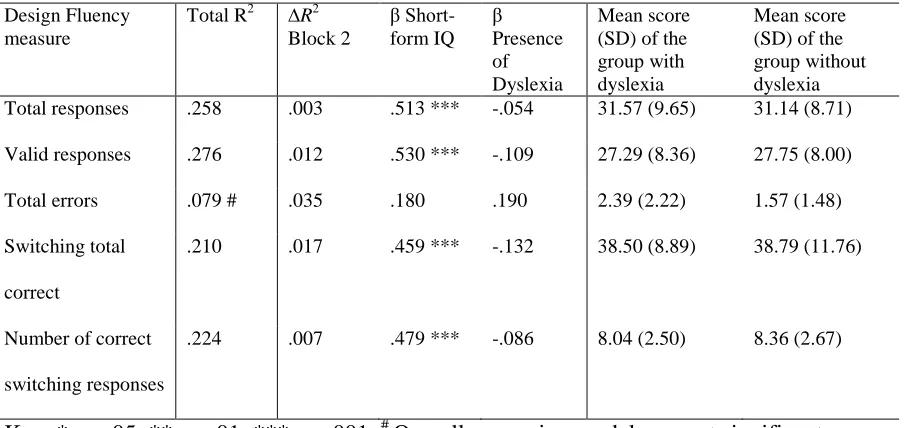
Design Fluency
In Step 1, short-form IQ was a significant predictor of total number of responses
and total number of valid responses generated on Design Fluency.
In Step 2, the presence of dyslexia did not significantly predict Design Fluency
performance in terms of either the total number of designs produced or the total number of
correct designs generated (see Table 4).
TABLE 4 ABOUT HERE
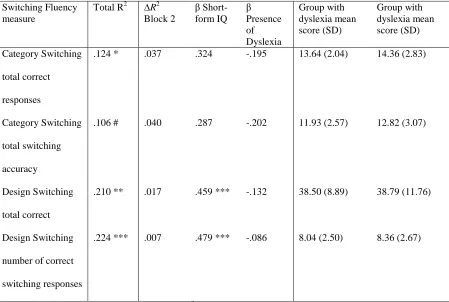
Switching Fluency
Hierarchical multiple regressions were also performed on total correct responses
and total switching accuracy on the Category Switching and Design Switching fluency
17 TABLE 5 ABOUT HERE
For Category Switching, total correct responses and total switching accuracy were
found to be predicted significantly by short-form IQ. However, the presence of dyslexia did
not significantly predict performance on any of the measures.
For Design Switching, total correct responses and total switching accuracy were
significantly predicted by short-form IQ. Again, the presence of dyslexia was not predictive
of scores on either measure.
Discussion
The Letter, Category, and Design Fluency performance of adults with and without
dyslexia was investigated using the D-KEFS (Delis et al., 2001). Hierarchical regression
models were used to determine whether the presence of dyslexia was a significant predictor
of executive fluency. After controlling for short-form IQ, adults with dyslexia performed
significantly more poorly on nearly every measure of Letter Fluency, but did not differ
significantly from controls on measures of Category Fluency or Design Fluency (or for the
respective Switching conditions within these tasks).
On Letter Fluency, the presence of dyslexia was found to be related to fewer items
being generated overall and fewer valid responses being produced. Group membership did
not significantly predict the number of errors made by the participants. The finding of
reduced phonemic fluency output is in accordance with previous studies in both children
(e.g., Brosnan et al., 2002; Cohen et al., 1999; Felton & Wood, 1989; Frith et al., 1995;
Moura et al., 2014; Reiter et al., 2005; Varvara et al., 2014) and adults with dyslexia (e.g.,
18 However, as highlighted in the Introduction, the current study extended previous
research by also providing much finer-grained analyses of performance. In the case of
Letter Fluency, a smaller number of switches was associated with the presence of dyslexia,
suggesting that some degree of EF deficit in dyslexia may contribute to poorer phonemic
fluency performance. The number of words generated per cluster was not, however,
associated with the presence of dyslexia. Although non-significant results should be
interpreted cautiously, the absence of a relationship between dyslexia and cluster size is
consistent with Frith et al.’s (1995) argument that dyslexia-related verbal fluency problems
are due to difficulties with accessing words based on their phonological characteristics
rather than differences in vocabulary size.
For both groups, response output declined progressively over the four quartiles of
the Letter Fluency task, with the drop in the number of items generated being most notable
between the first and second quartiles. As mentioned previously, Hurks et al. (2006) have
argued that once the relatively automatic access to prototypical items has been exhausted,
more controlled, effortful searching is required in verbal fluency tasks. These controlled
searches draw more heavily on executive resources and, thus, a dyslexia-related executive
deficit in phonemic fluency (rather than a phonological processing deficit) should manifest
itself in a greater effect of dyslexia in later quartiles than in earlier ones; instead, the
analyses of the individual 15s divisions of the 60s task suggested that there was a pervasive
phonological processing problem affecting their phonemic fluency performance across
most quartiles; the presence of dyslexia significantly predicted the number of valid
responses being made in Quartiles 1, 2, and 4. The performance of the group with dyslexia
19 this quartile was found to have the strongest relationship to short-form IQ. However, it
should be acknowledged that there is uncertainty about the extent to which the contribution
of EF increases across the four quartiles, so it is still possible that part of the impaired
performance of the group with dyslexia could be due to EF difficulties within each quartile.
In addition, while the group with dyslexia produced clusters of a similar size to the group
without dyslexia, they produced fewer such clusters, and it is possible that this is a result of
EF impairments which limit the production of later clusters (c.f., Crowe, 1998).
A further point can be made about the finding that switching was significantly
affected by dyslexia, whereas clustering was unaffected. Of the two processes, switching is
argued to draw on executive processes whilst clustering does not (Troyer, 2000). Further to
this, Troyer proposes that clustering on phonemic fluency tasks draws on phonemic
analysis to generate items within a phonemically-related cluster. Under this view, the
phonological processing difficulties of the group with dyslexia should have manifested
themselves in lowered cluster scores, but this was not found to be the case. The results of
the current study would, thus, argue against Reiter et al.’s (2005) proposition that
phonemically-based strategies within clusters are reduced in dyslexia. However, it should
be noted that at the inter-cluster level, the results also indicate that adults with dyslexia are
poorer at the phonological retrieval process and are less able to identify additional clusters,
thereby limiting performance. Taken together, the findings concerning Letter Fluency
provide suggestive, rather than clear, evidence of an EF impairment in adults with dyslexia.
This strengthens the hypothesis that a phonological-related deficit in adults with dyslexia
20 Whilst Category Fluency performance was numerically lower in the group with
dyslexia, group membership did not significantly predict scores on any of the measures
taken. These findings are consistent with much of the previous literature on semantic
fluency in dyslexia (e.g., Frith et al., 1995; Griffiths, 1991; Hatcher et al., 2002; Plaza &
Guitton, 1997) in terms of failing to find reduced overall output. Further to this, they also
extend the previous work in indicating no group-related relationships at a finer-grained
level either.
The presence of dyslexia was also not a significant predictor of performance on
Design Fluency. Design fluency has only previously been studied in children with dyslexia
(Griffiths, 1991; Reiter et al., 2005). The current findings suggest that design fluency is not
affected by dyslexia in adulthood, consistent with the results of Griffiths (1991) with
children. Given that no phonological processing is required on the task and its high novelty
in terms of task demands, the non-significant results would again support the argument that
it is phonological processing deficits, and not EFs, that are responsible for dyslexia-related
difficulties on fluency tasks. According to this interpretation, phonological impairments are
the cause of lower performance on phonemic fluency tasks alone and have no effect on the
semantic and design fluency tasks.
However, there is another interpretation which can also explain the findings. As
noted in the Introduction, performance on phonemic fluency tasks is generally worse than
on semantic fluency tasks (e.g., Ardila et al., 2006). This is likely to be because of the
higher cognitive demands including EF processes (e.g., Ardila et al., 2006). It is, thus,
conceivable that the increased EF demands associated with phonemic fluency are
21 problems per se. Accordingly, executive dysfunction could be claimed to be at the root of
the dyslexia-related deficits found on phonemic fluency tasks. However, one potential
problem with this explanation is that the Design Fluency task was even more novel (joining
dots together in novel patterns tending not to be a common everyday activity) and difficult
(as indexed by its higher standardized-βcorrelations with short-form IQ) than the Letter
Fluency task. Given this, differences in the performance of the two groups might be
expected, yet none were detected. Therefore, in the absence of an experimental design
equating EF demands across the phonemic, semantic, and design fluency tasks, it is not
possible fully to separate out the effects of executive dysfunction from phonological
processing impairments as the underlying cause of the poorer performance of individuals
with dyslexia on phonemic fluency tasks. Future research, adopting just such a design,
would fully resolve this matter.
It also should be pointed out that the finer-grained analyses indicated that the group
with dyslexia made significantly fewer switches when phonemic analysis was required, but
there was no difference in the size of the clusters. The pattern of these difficulties was, thus,
suggestive of an EF impairment. The absence of an influence of dyslexia on cluster size
suggests that phonological representations and/or basic phonological retrieval processes
were intact in the current sample of adults with dyslexia. On the other hand, when an
attentional orienting response was required to identify and move to a different phonemic
cluster, a dyslexia-related difficulty emerged. Whilst switching requires conscious control,
attentional resources, and executive involvement (e.g., Mayr, 2002; Troyer et al., 1997),
clustering can proceed relatively automatically even in individuals with low working
22 associated with adults with dyslexia (e.g., Smith-Spark & Fisk, 2007; Smith-Spark, Fisk,
Fawcett & Nicolson, 2003; Smith-Spark et al., 2016).
The prediction of executive fluency from short-form IQ scores was not the focus of
the paper, but the findings deserve review. Overall, short-form IQ was a good predictor of
fluency performance, having a moderate positive relationship with the total number of
responses and the number of valid responses on all three fluency tasks. However,
short-form IQ only predicted the number of switches made by participants on Letter Fluency.
Furthermore, there was no significant relationship between short-form IQ and cluster size
on either task. Short-form IQ was a stronger predictor of performance on Letter Fluency
than it was on Category Fluency, perhaps reflecting the former’s greater cognitive
complexity (e.g., Ardila et al., 2006). Performance over Quartiles 1, 2, and 3 of Letter
Fluency were all significantly predicted by short-form IQ, with the strongest correlation
being found in Quartile 3. The strength of the associations is broadly equivalent to the weak
to moderate positive relationships found by Ardila et al. (2000) between IQ measures and
both phonemic and semantic fluency in children. There was also a stronger positive
relationship between short-form IQ and performance on Design Fluency than on the two
verbal fluency measures, as highlighted previously in this section.
Conclusions
Executive fluency has been explored more comprehensively and in more depth in
this paper than in previous dyslexia research. The findings indicate widespread
dyslexia-related difficulties with phonemic fluency, but no impairments on any of the measures
taken of either semantic or design fluency. However, whilst lowered performance was
23 pervasive, since the number of words produced within phonemic clusters was not predicted
by the presence of dyslexia. These more nuanced measures of executive fluency suggest a
possible role for EF in explaining the poorer performance of people with dyslexia on
phonemic fluency tasks. Whilst the weight of the evidence obtained in the present paper
points, at a general level, towards a phonologically-related explanation of the
dyslexia-associated deficits, the present use of more nuanced measures of phonemic fluency
continues to raise questions about what is the appropriate interpretation of findings relating
to EF, fluency, and dyslexia. Further research is needed to answer these remaining
questions about executive fluency in dyslexia and to consider the important theoretical
24
References
Andrés, P. (2003). Frontal cortex as the central executive of working memory: Time to
revise our view. Cortex, 39, 871-895.
Ardila, A., Ostrosky-Solís, F., & Bernal, B. (2006). Cognitive testing toward the future:
The example of Semantic Verbal Fluency (ANIMALS). International Journal of Psychology, 41, 324-332.
Ardila, A., Pineda, D., & Rosselli, M. (2000). Correlations between intelligence test scores
and executive function measures. Archives of Clinical Neuropsychology, 15, 31-36.
Bacon, A. M., Parmentier, F. B. R., & Barr, P. (2013). Visuospatial memory in dyslexia:
Evidence for strategic deficits. Memory, 21, 189-209.
Benton, A. L. (1968). Differential behavioural effects in frontal lobe disease.
Neuropsychologia, 6, 53-60.
Booth, J. N., Boyle, J. M. E., & Kelly, S. W. (2010). Do tasks make a difference?
Accounting for heterogeneity of performance of children with reading difficulties
on tasks of executive function: Findings from a meta-analysis. British Journal of Developmental Psychology, 28, 133-176.
Borkowski, J. G., Benton, A. L., & Spreen, O. (1967). Word fluency and brain damage.
Neuropsychologia, 5, 135-140.
Bousfield, W. A., & Sedgewick, C. H. W. (1944). An analysis of restricted associative
responses. Journal of General Psychology, 30, 149-165.
Brachacki, G. W. Z., Fawcett, A. J., & Nicolson, R. I. (1994). Adults with dyslexia have a
deficit in voice recognition. Perceptual and Motor Skills, 78, 304-306.
25
Executive functioning in adults and children with developmental dyslexia.
Neuropsychologia, 40, 2144-2155.
Brunswick, N., McCrory, E., Price, C. J., Frith, C. D., & Frith, U. (1999). Explicit and
implicit processing of words and pseudowords by adult developmental dyslexics: A
search for Wernicke’s Wortschatz? Brain, 122, 1901–1917.
Castles, A., & Friedmann, N. (2014). Developmental Dyslexia and the Phonological Deficit
Hypothesis. Mind and Language, 29, 270-285.
Cohen, M. J., Morgan, A. M., Vaughn, M., Riccio, C. A., & Hall, J. (1999). Verbal fluency
in children: Developmental issues and differential validity in distinguishing children
with attention-deficit hyperactivity disorder and two subtypes of dyslexia. Archives of Clinical Neuropsychology, 14, 433-443.
Crowe, S.F. (1998). Decrease in performance on the verbal fluency test as a function of
time: Evaluation in a young healthy sample. Journal of Clinical and Experimental Neuropsychology, 20, 391–401.
Delis, D. C., Kaplan, E., & Kramer, J. (2001). Delis-Kaplan Executive Function System. San Antonio, TX: Psychological Corporation.
Fawcett, A. J., & Nicolson, R. I. (1998). The Dyslexia Adult Screening Test (DAST). London: The Psychological Corporation.
Felton, R. H., Naylor, C. E., & Wood, F. B. (1990). The neuropsychological profile of adult
dyslexics. Brain and Language, 39, 485-497.
Felton, R. H., & Wood, F. B. (1989). Cognitive deficits in reading disability and attention
deficit disorder. Journal of Learning Disabilities, 22, 3-13.
26 specific reading disability. Annals of Human Genetics, 50, 1-23.
Fisk, J. E., & Sharp, C. A. (2004). Age-related impairment in executive functioning:
updating, inhibition, shifting, and access. Journal of Clinical and Experimental Neuropsychology, 26, 874-890.
Frith, U., Landerl, K., & Frith, C. (1995). Dyslexia and verbal fluency: More evidence for a
phonological deficit. Dyslexia, 1, 2-11.
Griffiths, P. (1991). Word-finding ability and design fluency in developmental dyslexia.
British Journal of Clinical Psychology, 30, 47-60.
Hatcher, J., Snowling, M. J., & Griffiths, Y. M. (2002). Cognitive assessment of dyslexic
students in higher education. British Journal of Educational Psychology, 72, 119-133.
Henry, J. D., & Crawford, J. R. (2004). A meta-analytic review of verbal fluency
performance following focal cortical lesions. Neuropsychology, 18, 284-295. Henry, L. A., Messer, D. J., & Nash, G. (2015). Executive functioning and verbal fluency
in children with language difficulties. Learning & Instruction, 39, 137-147. Hurks, P. P. M., Vles, J. S. H., Hendriksen, J. G. M., Kalff, A. C., Feron, F. J. M., Kroes,
M., et al. (2006). Semantic category fluency versus initial letter fluency over 60
seconds as a measure of automatic and controlled processing in healthy school-aged
children. Journal of Clinical & Experimental Neuropsychology, 28, 684-695.
Kinsbourne, M., Rufo, D. T., Gamzu, E., Palmer, R. L., & Berliner, A. K. (1991).
Neuropsychological deficits in adults with dyslexia. Developmental Medicine and
Child Neurology, 33, 763-775.
27 Two learning disorders with different cognitive profiles. Journal of Experimental Child Psychology, 103, 309-324.
Levin, B. E. (1990). Organisational deficits in dyslexia: Possible frontal lobe dysfunction.
Developmental Neuropsychology, 6, 95-110.
Luo, L., Luk, G. & Bialystok, E. (2010). Effect of language proficiency and executive
control on verbal fluency performance in bilinguals. Cognition, 114, 29-41.
Lyon, G. R., Shaywitz, S. E., & Shaywitz, B. A. (2003). A definition of dyslexia. Annals of Dyslexia, 53, 1–14.
Marzocchi, G. M., Oosterlaan, J., Zuddas, A., Cavolina, P., Geurts, H., Redigolo, D., Vio,
C. & Sergeant, J. A. (2008). Contrasting deficits on executive functions between
ADHD and reading disabled children. Journal of Child Psychology and Psychiatry, 49, 543–552.
Mayr, U. (2002). On the dissociation between clustering and switching in verbal fluency:
Comment on Troyer, Moscovitch, Winocur, Alexander and Stuss.
Neuropsychologia, 40, 562-566.
McLoughlin, D., Fitzgibbon, G., & Young, V. (1994). Adult dyslexia: Assessment, counselling and training. London: Whurr.
Menghini, D., Finzi, A., Benassi, M., Bolzani, R., Facoetti, A., Giovagnoli, S., Ruffino, M.,
& Vicari, S. (2010). Different underlying neurocognitive deficits in developmental
dyslexia: A comparative study. Neuropsychologia, 48, 863-872.
Mervis, C. B., & Klein-Tasman, B. P. (2004). Methodological issues in group-matching
designs: α levels for control variable comparisons and measurement characteristics
28
7-17.
Mielnik, A., Lockiewicz, M., & Bogdanowicz, M. (2015). Semantic and phonological
verbal fluency in students with dyslexia. Acta Neuropsychologica, 13, 253-266. Miller-Shaul, S. (2005). The characteristics of young and adult dyslexic readers on reading
and reading related cognitive tasks as compared to normal readers. Dyslexia, 11,
132–151.
Miyake A., & Friedman N. P. (2012). The nature and organization of individual differences
in executive functions: Four general conclusions. Current Directions in Psychological Science, 21, 8-14.
Miyake A., Friedman N. P., Emerson M. J., Witzki A. H., Howerter A., & Wager T. D.
(2000). The unity and diversity of executive functions, and their contributions to
complex “frontal lobe” tasks: A latent variable analysis. Cognitive Psychology, 41,
49-100.
Moore, L.H., Brown, W.S., Markee, T.E., Theberge, D.C., & Zvi, J.C. (1995). Bimanual
coordination in dyslexic adults. Neuropsychologia, 33, 781-793.
Moura, O., Simões, M. R., & Pereira, M. (2014). Executive functioning in children with
developmental dyslexia. The Clinical Neuropsychologist, 28, S20-S41.
Newcombe, F. (1969). Missile wounds of the brain. London: Oxford University Press. Nicolson, R. I., & Fawcett, A. J. (1997). Development of objective procedures for
screening and assessment of dyslexic students in higher education. Journal of Research in Reading, 20, 77-83.
Pennington, B. F., & Ozonoff, S. (1996). Executive functions and developmental
29 Phillips, L. H. (1997). Do “frontal tests” measure executive function? Issues of assessment
and evidence from fluency tests. In P. M. A. Rabbitt (Ed.), Methodology of frontal and executive function (pp. 191-213). Hove, East Sussex: Psychology Press. Plaza, M., Cohen, H., & Chevrie-Muller, C. (2002). Oral language deficits in dyslexic
children: weaknesses in working memory and verbal planning. Brain & Cognition, 48, 505-512.
Plaza, M. & Guitton, C. (1997). Working memory limitation, phonological deficit,
sequential disorder and syntactic impairment in a child with a severe developmental
dyslexia. Dyslexia, 3, 93-108.
Rabbitt, P. (1997). Introduction: Methodologies and models in the study of executive
function. In P. Rabbitt (Ed.), Methodology of frontal and executive function (pp. 1-38). Hove, UK: Psychology Press.
Regard, M., Strauss, E., & Knapp, P. (1982). Children’s production on verbal and non-
verbal fluency tasks. Perceptual and Motor Skills, 55, 839-844.
Reid, A. A., Szczerbinski, M., Iskierka-Kasperek, E., & Hansen, P. (2007). Cognitive
profiles of adult developmental dyslexics: Theoretical implications. Dyslexia, 13,
1-24.
Reiter, A., Tucha, O., & Lange, K. W. (2005). Executive functions in children with
dyslexia. Dyslexia, 11,116-131.
Rosen, V. M., & Engle, R. W. (1997). The role of working memory capacity in retrieval.
Journal of Experimental Psychology: General, 126, 211-227.
Ruff, R.M., Light, R.H., & Evans, R.W. (1987). The Ruff Figural Fluency Test: A
30 Ruff, R. M., Light, R. H., Parker, S. B., & Levin, H. S. (1997). The psychological construct
of word fluency. Brain and Language, 57, 394-405.
Shallice, T., & Burgess, P. W. (1991). Deficits in strategy application following frontal
lobe damage in man. Brain, 114, 727-741.
Shao, Z., Janse, E., Visser, K., & Meyer, A. S. (2014). What do verbal fluency tasks
measure? Predictors of verbal fluency performance in older adults. Frontiers in Psychology, 5, Article 772.
Siegel, L. S. (2006). Perspectives on dyslexia. Paediatrics & Child Health, 11, 581-587. Smith-Spark, J. H., & Fisk, J. E. (2007). Working memory functioning in developmental
dyslexia. Memory, 15, 34-56.
Smith-Spark, J. H., Fisk, J. E., Fawcett, A. J., & Nicolson, R. I. (2003). Central executive
impairments in adult dyslexics: Evidence from visuospatial working memory
performance. European Journal of Cognitive Psychology, 15, 567-587.
Smith-Spark, J. H., Henry, L. A., Messer, D. J., Edvardsdottir, E., & Zięcik, A. P. (2016).
Executive functions in adults with developmental dyslexia. Research in Developmental Disabilities, 53-54, 323-341.
Snowling, M. J., Nation, K., Moxham, P., Gallagher, A., & Frith, U. (1997). Phonological
processing skills of dyslexic students in higher education: A preliminary report.
Journal of Research in Reading, 20, 31-41.
Stuss, D. T., & Benson, D. F. (1997). The frontal lobes and the control of cognition and
memory. In E. Perecman (Ed.), The frontal lobes revisited (pp. 141-158). New York: IRBN Press.
31
disabled children: A theoretical assessment. Child Development, 48, 56-60.
Troyer, A. K. (2000). Normative data for clustering and switching on verbal fluency tasks.
Journal of Clinical and Experimental Neuropsychology, 22, 370-378.
Troyer, A. K., Moscovitch, M., & Winocur, G. (1997). Clustering and switching as two
components of verbal fluency: Evidence from younger and older healthy adults.
Neuropsychology, 11, 138-146.
Turner, M. (1997). Psychological assessment of dyslexia. London: Whurr.
Varvara, P., Varuzza, C., Sorrentino, A. C. P., Vicari, S., & Menghini, D. (2014).
Executive functions in developmental dyslexia. Frontiers in Human Neuroscience, 8(120).
Vellutino, F. R. (1979). Dyslexia: Theory and research. Cambridge, MA: MIT Press.
Vellutino, F. R., Fletcher, J. M., Snowling, M. J., & Scanlon, D. M. (2004). Specific
reading disability (dyslexia): What have we learned in the past four decades?
Journal of Child Psychology and Psychiatry, 45, 2-40.
Wechsler, D. (1993). The Wechsler Objective Reading Dimensions. London: The Psychological Corporation.
Wechsler, D. (2010). Wechsler Adult Intelligence Scale – Fourth UK Edition. San Antonio, TX: The Psychological Corporation.
Wilson, A.M., & Lesaux, N.K. (2001). Persistence of phonological processing deficits
32 Author note
Correspondence concerning this article should be addressed to James H.
Smith-Spark,Division of Psychology, School of Applied Sciences, London South Bank
University, 103 Borough Road, London, SE1 0AA, United Kingdom.
33
Table 1:
Mean scores for the background measures. Standard deviations in parentheses.
Group with dyslexia Group without dyslexia
Age (years) 24.64
(4.62)
22.75
(4.48)
WAIS-IV short-form IQ 108.38
(7.75)
105.96
(8.38)
DAST non-word reading score 78.75
(11.80)
92.71
(2.84)
WORD spelling test raw score 40.39
(3.93)
44.89
34 Table 2
Summaries of the hierarchical multiple regression analyses conducted on the Letter Fluency task. For each regression, short-form IQ was entered at Block 1 and participant group was entered at Block 2 (without dyslexia = 0, with dyslexia = 1).For Block 2, information is provided on the total variance accounted for by the model (total R2), change in R2 (ΔR2), and the standardized β-values for the two predictor variables. Significance values are given where they are relevant. Means and SDs for the two participant groups are also presented.
Letter Fluency measure
Total R2 ∆R2
Block 2 β Short-form IQ β Presence of Dyslexia Mean score (SD) of the group with dyslexia
Mean score (SD) of the group without dyslexia
Total responses .257 .147 ** .391 ** -.388 ** 36.07 (9.91) 43.21 (10.95)
Valid responses .265 .140 ** .410 ** -.379 ** 35.50 (9.55) 42.07 (10.47)
Total errors .038 .035 -.027 -.190 0.54 (0.80) 1.07 (1.78)
Number of
switches
.198 .095 * .368 ** -.311 * 29.18 (8.81) 33.54 (7.94)
Words per cluster .013# .013 .057 -.112 1.26 (0.18) 1.29 (0.12)
Quartile 1 .184 .087 * .356 ** -.259 * 15.04 (3.61) 16.71 (3.15)
Quartile 2 .128 .128 ** .300 * -.358 ** 8.36 (2.47) 10.64 (3.51)
Quartile 3 .221 .039 .457 *** -.218 6.50 (2.94) 7.32 (3.40)
Quartile 4 .077 .077 .216 -.277 * 5.71 (2.90) 7.54 (3.50)
35 Table 3:
Summaries of the hierarchical multiple regression analyses conducted on the Category Fluency task. See Table 2 for explanations of the analyses.
Category Fluency measure
Total R2 ∆R2
Block 2
β Short-form IQ
β Presence of Dyslexia
Mean score (SD) of the group with dyslexia
Mean score (SD) of the group without dyslexia
Total responses .154 .046 .361 ** -.216 42.57 (7.45) 45.25 (9.12)
Valid responses .148 .047 .351 ** -.218 42.11 (7.64) 44.86 (9.03)
Total errors .017# .006 -.115 .080 0.93 (1.36) 0.79 (0.92)
Number of
switches
.047# .015 .199 -.122 13.04 (4.59) 13.75 (3.15)
Words per cluster .021# .011 .087 .104 1.97 (0.75) 1.83 (0.42)
Quartile 1 .024# .024 .140 -.156 16.00 (3.17) 17.07 (3.71)
Quartile 2 .001# .001 .175 -.023 10.43 (3.61) 10.57 (2.57)
Quartile 3 .113 .030 .315 * -.176 8.36 (2.71) 9.07 (2.92)
Quartile 4 .149 .043 .358 ** -.219 7.25 (3.04) 8.18 (2.96)
36 Table 4:
Summaries of the hierarchical multiple regression analyses conducted on the Design Fluency task. See Table 2 for explanations of the analyses.
Design Fluency measure
Total R2 ∆R2
Block 2
β Short-form IQ
β Presence of Dyslexia
Mean score (SD) of the group with dyslexia
Mean score (SD) of the group without dyslexia
Total responses .258 .003 .513 *** -.054 31.57 (9.65) 31.14 (8.71)
Valid responses .276 .012 .530 *** -.109 27.29 (8.36) 27.75 (8.00)
Total errors .079 # .035 .180 .190 2.39 (2.22) 1.57 (1.48)
Switching total
correct
.210 .017 .459 *** -.132 38.50 (8.89) 38.79 (11.76)
Number of correct
switching responses
.224 .007 .479 *** -.086 8.04 (2.50) 8.36 (2.67)
37 Table 5:
Summaries of the hierarchical multiple regression analyses conducted on the Swiching Fluency trials of the Category and Design Fluency tasks. See Table 2 for explanations of the analyses.
Switching Fluency measure
Total R2 ∆R2
Block 2 β Short-form IQ β Presence of Dyslexia Group with dyslexia mean score (SD) Group with dyslexia mean score (SD) Category Switching total correct responses
.124 * .037 .324 -.195 13.64 (2.04) 14.36 (2.83)
Category Switching
total switching
accuracy
.106 # .040 .287 -.202 11.93 (2.57) 12.82 (3.07)
Design Switching
total correct
.210 ** .017 .459 *** -.132 38.50 (8.89) 38.79 (11.76)
Design Switching
number of correct
switching responses
.224 *** .007 .479 *** -.086 8.04 (2.50) 8.36 (2.67)