City, University of London Institutional Repository
Citation
: Galanis, S. ORCID: 0000-0003-4286-7449 (2018). Speculation under
unawareness. Games and Economic Behavior, 109, pp. 598-615. doi:10.1016/j.geb.2018.03.001
This is the accepted version of the paper.
This version of the publication may differ from the final published
version.
Permanent repository link:
http://openaccess.city.ac.uk/id/eprint/21285/Link to published version
: http://dx.doi.org/10.1016/j.geb.2018.03.001
Copyright and reuse:
City Research Online aims to make research
outputs of City, University of London available to a wider audience.
Copyright and Moral Rights remain with the author(s) and/or copyright
holders. URLs from City Research Online may be freely distributed and
linked to.
City Research Online: http://openaccess.city.ac.uk/ [email protected]
Speculation Under Unawareness
∗
Spyros Galanis
†March 15, 2018
Abstract
“No trade” theorems establish that, in various trading environments, investors who share a common prior will not engage in speculation, as long as expected util-ity, Bayesian updating and full awareness are imposed. We relax the last assumption by allowing for asymmetric unawareness and examine under which conditions spec-ulative behavior emerges. We find that if common knowledge is assumed (as in the settings ofAumann[1976] andMilgrom and Stokey[1982]), unawareness cannot gener-ate speculation. This is not true, however, in settings where no common knowledge is assumed, such as speculation in equilibrium (Geanakoplos [1989]) and betting that is always beneficial (Morris[1994]), unless stronger conditions on awareness are imposed.
JEL-Classifications: C70, C72, D80, D82.
Keywords: unawareness, trade, speculation, knowledge, common knowledge, bounded perception, awareness.
1
Introduction
A well established behavioral implication of the common prior assumption (Harsanyi
[1968]) is that it precludes speculation, a result which is robust to the particular de-tails of the trading environment and stems from the no-agreeing-to-disagree result of
Aumann[1976]. To focus on just four,Morris[1994],Samet[1998] andFeinberg[2000] show that there cannot be a bet that makes everyone strictly better off and this is com-mon knowledge (we henceforth call this speculative betting) or it is true at all states (always beneficial bet). Geanakoplos [1989] shows that there cannot be trade from a Pareto efficient allocation in a Bayesian Nash equilibrium (speculation in equilibrium)
∗Some of the results in this paper also appear in a much earlier form in Galanis [2011b]. I am
grate-ful to two anonymous referees, Paulo Barelli, Piero Gottardi, Larry G. Epstein, Martin Meier, Herakles Polemarchakis, Marzena Rostek, David Rahman, Fernando Vega-Redondo, Marek Weretka, Xiaojian Zhao, seminar participants at the European University Institute, the University of Southampton, the Summer in Birmingham workshop and the International Workshop on Unawareness, University of Queensland.
†Department of Economics, School of Social Sciences, University of Southampton, Southampton, UK,
and Milgrom and Stokey [1982] show that if an allocation is ex ante Pareto efficient it cannot be common knowledge in the interim stage that there is another allocation that Pareto dominates it (speculative trade).1
One reason why the details of these trading environments do not matter is that several idealised assumptions are imposed, such as expected utility, Bayesian updating (implying Dynamic Consistency) and full awareness of the relevant dimensions of the environment. In this paper we examine whether and how speculation occurs when the last assumption is relaxed, so that some investors might be partially aware. We find that the details of the trading environment matter for speculation and, in particular, unawareness is compensated only by the property of common knowledge, which is sufficient to ensure no speculation.
Specifically, we show that common priors imply the absence of speculative betting. This result was also established in Heifetz et al. [2013a], however they also impose an additional property in their framework, Projections Preserve Posteriors, which is not needed.2 We also show that the converse is true. In particular, we identify a condition, Enlargements Preserve Common Priors (EPCP), which requires that whenever there is a “local” common prior generating beliefs within all public or self evident events at each state space, there is also a common prior across all state spaces. This condition is automatically satisfied in the standard model without unawareness and a unique state space. We then show that no common priors and EPCP are equivalent to speculative betting.
Second, as long as the payoff relevant state space, where allocations depend on, coincides with the “common” state space, which is the most expressive state space that it is common knowledge that everyone is aware of, speculative trade (which also imposes common knowledge) cannot occur. This assumption would be true, for example, in the case where the payoff relevant state space describes the prices of all possible stocks, and this coincides with the common state space.
Unawareness, however, does break the connection between common priors and no speculation in environments where common knowledge is not assumed. Examples 1
and2show that no common priors are neither sufficient nor necessary for the existence of an always beneficial bet.3 However, under Conditional Independence, an always beneficial bet implies no common priors. This property requires that investors do not misunderstand the signal created by the information revealed by their varying awareness.4 Moreover, under the stronger condition of Projections Preserve Posteriors, no common “local” priors (in the state space where the bet is formulated) imply an always beneficial bet. Finally, we show that speculation does not occur in equilibrium
1Although common priors are not required for the speculative trade theorem, a Pareto efficient allocation
necessitates some form of common priors, as we explain in footnote23. Also, the setting is slightly different from that ofMilgrom and Stokey[1982], as we do not employ a signal structure but a type or belief structure.
2This property requires that posterior beliefs do not change as we project down to a state space describing
lower awareness.
3Note that, under unawareness, what is always true may not always be common knowledge, because some
unaware investors may fail to deduce it, due to their limited perception. As a result, an always beneficial bet does not imply speculative betting, as in the standard setting.
4It was first studied by Galanis [2015, 2016a] in the context of analysing the value of information in
if each investor’s information structure either satisfies Conditional Independence or path-independence. This last property specifies that each attained level of awareness specifies a unique path of successively lower levels of awareness that the investor has attained in other states.
When common knowledge is not assumed, an always beneficial bet can occur with a common prior because investors cannot reason properly about the information of others, as their awareness may be too low. This forces them to take information at face value, without being able to completely comprehend why others are selling when they are buying. This “bias” in reasoning is consistent with empirical evidence in psychology which shows that individuals are in general slow to incorporate additional information because of their confidence in their existing assumptions and opinions (Fischhoff et al.
[1977]).5 Related is also the confirmatory bias, which suggests that once investors form strong hypotheses, they tend to ignore new information that contradicts them (Rabin
[1998]).
These and other psychological biases have inspired a large literature in finance, which generates speculative behavior with overconfident investors who overestimate the precision of some signals and underestimate the precision of others.6 For example,
Scheinkman and Xiong [2003] explain speculative bubbles and large trading volumes using two groups of investors and two signals that are publicly available. Each group is overconfident about one signal, regarding the other signal (and the fact that the other group is overconfident about it) as noise.
Most of these models assume that investors have a “wrong” perception of the signal structure, which can be formalised by having different priors over it. The main differ-ence of the present paper is that it endogenizes the investors’ speculative behavior by explicitly modelling their awareness, without altering the common prior assumption, thus providing an insight into why certain types of speculation occur whereas other do not. Moreover, as we argue in Section 3.5, at least in some settings (e.g. correlated equilibria), static models with different priors can always be reinterpreted as models with common priors and investors with significant information processing errors. This means that a model with different priors, which does not provide foundations for the investors’ errors or limited perception, may nevertheless have implications about them which are not clear.
Finally, examining speculation under various trading environments allows us to differentiate, in terms of behavioral implications, between unawareness models, differ-ent priors models (such as models with overconfidence) and models with information processing errors represented by non-partitional structures (e.g. Geanakoplos[1989]).
1.1
Related Literature
The literature on no trade theorems stems from Aumann [1976], who shows that a common prior implies that it cannot be common knowledge that the posteriors are different. Investors trade because they have different priors, they have no common
5See alsoOskamp[1965], Mahajan[1992] andPaese and Kinnaly[1993] in the psychology literature. 6SeeDaniel and Hirshleifer [2015] for a survey. I thank a referee for pointing out the connection to the
knowledge or they make information processing errors, for example by being unaware. In the context of the standard model where investors make no mistakes,Morris[1994],
Bonanno and Nehring [1996], Samet [1998], Feinberg [2000], Ng [2003] and Heifetz
[2006] show that a necessary and sufficient condition for the existence of a common prior is that there is no bet for which all investors expect a positive gain always.7 Milgrom and Stokey[1982] andSebenius and Geanakoplos[1983] show that common priors imply that there cannot be speculative trade in a two-period model. Ma [2001] and Halevy
[2004] generalize this result for general preferences that satisfy Dynamic Consistency, whereas Galanis[2016c] shows that Dynamic Consistency can be weakened.
Although there are several explanations of why investors trade (e.g. liquidity shocks) the consensus is that they cannot account for the great magnitude of trad-ing that we observe, unless we allow for investors to agree to disagree or speculate.8
Harrison and Kreps [1978] generate excessive trading in a model without common priors and no short sales. Scheinkman and Xiong [2003] use the same framework to model trading in an environment where each investor is overconfident, overestimating the informational content of some signals. Similarly, Daniel et al. [1998, 2001] show how overconfidence increases trading volume. Eyster et al.[2015] show that disagree-ment neglect, the inability to properly account for the informational content of prices or others’ trades, is key in generating trading volume in large markets with dispersed private information.
Geanakoplos[1989] examines speculation in an environment where investors share a common prior but make information processing errors, modelled in a single state space and non-partitional information structures.9 Dekel et al.[1998] argue that mistakes due to unawareness cannot be modelled in the one state space framework of Geanakoplos
[1989]. Galanis[2013],Heifetz et al.[2013a] andMeier and Schipper[2014b] generalize the no-agreeing-to-disagree result ofAumann[1976] in a model with unawareness, using multiple state spaces.10
The paper implicitly assumes that investors are unaware of their own unawareness. That is, they do not entertain the possibility that they might be missing something, which could lead them, for example, to not trade even if their posterior beliefs specify that this is beneficial, or conversely to trade when it is not. This assumption is made in most of the unawareness literature. However, there are some papers (e.g. Halpern and Rˆego[2009],Board and Chung[2011a,b]) which explicitly model agents who are aware of their own unawareness. Board and Chung [2011b] show that there is no trade if, either everyone believes that there is nothing they are unaware of, or everyone believes that there is something that they are unaware of. In a more applied setting and without
7Note that in the standard model without unawareness, what is always true is also always common
knowledge. Conversely, if something is common knowledge, it is always true within this common knowledge event.
8See discussion inHong and Stein[2007] andDaniel and Hirshleifer[2015], for example. 9We compare his model with ours in more detail in Section3.5.
10There is now a large literature on unawareness, beginning withFagin and Halpern[1988]. For interactive
providing a formal model of unawareness,Tirole[2009] examines contracting between a seller and a buyer who are aware that they are unaware. Gabaix and Laibson[2006] show that firms will optimally shroud high-priced add ons from unaware consumers, a fact which is exploited by fully aware consumers. Moreover, informational shrouding occurs even in highly competitive markets or markets with costless advertising.
The paper proceeds as follows. Section 2 presents the model. In Section 3 we ex-amine speculative behavior in four different environments, namely speculative betting, always beneficial bet, speculation in equilibrium and speculative trade. Section 3.5
compares our approach with models that generate speculation through different priors or non-partitional information structures. Section 4 concludes. Proofs are contained in the Appendix.
2
The model
2.1
Preliminaries
Different levels of awareness are represented by disjoint state spaces. LetS={Sa}a∈A
be the finite collection of all these state spaces. We assume thatS is a complete lattice and endow it with a partial order .11 If S S0, we say that S0 is (weakly) more expressive than S or, equivalently, that an investor whose state space is S0 is more
aware than an investor whose state space is S. By construction, there is a top and a bottom state space, which we call the full state spaceS∗ and the payoff relevant state space S0, respectively. That is, for all S∈ S,S0SS∗.
A state sis an element of some state spaceS. Let Σ = S
S∈S
Sbe the set of all states.
We assume that every state space S ∈ S has finitely many states. An event E is a subset of some state space S∈ S, which we denote byS(E).
If S S0, so that S0 is more expressive than S, we require that each states0 ∈S0
can be mapped to its “restricted” image in the less expressiveS. Formally, we require that there is a surjective projectionrS0
S :S0 →S. Projections are required to commute:
ifSS0S00, then rS00 S =rS
0 S ◦rS
00
S0.
LetE, E0 ⊆Σ and suppose that for eachs∈E,s0∈E0, wheres∈Sands0 ∈S0, we haveS0 S. We then writeE0 E, because all states inE0 describe higher awareness
than all states in E. We denote the projection of set E0 S to the less expressive S
by ES0 =S
{rS0 S (s
0)∈S :s0∈E0}. We denote the enlargement ofE0 S00 to the more
expressiveS00 by E0S00
=S{
s00∈S00 :rS00
S0 (s00)∈E0}.
2.2
Type structures
Let Sµ be the state space S ∈ S such that µ ∈∆S. If µ∈∆S and S0 S then µ|S0
is the marginal of µ on S0, so that µ|S0(E) = µ(ES), where E ⊆ S0. For all events E, F ⊆S withµ(F)>0, let µ(E|F) = µ(µE(∩FF)) be the probability ofE conditional on
F.
11A complete lattice is a partially ordered set in which all subsetsG ⊆ S have both a supremum (or join,
denotedW
Definition 1. For each investor i ∈ I, there is a type mapping ti : Σ → S
S∈S
∆S, satisfying the following properties:
0. Confinement: If s∈S thenti(s)∈∆S0 for some S0 S.
1. If S00S0 S, s∈S00, and ti(s)∈∆S thenti(s
S0) =ti(s).
2. If S00S0 S, s∈S00, s0 ∈S0 and ti(s) =ti(s0)∈∆S0 then ti(s
S) =ti(s0S).
3. If S00S0 S, s∈S00, and ti(s
S0)∈∆S thenSti(s) S.
4. If S00S0 S, s∈S00, and ti(s)∈∆S0 thenS ti(s
S)=S.
Properties 0,1 and 3 are identical to the respective properties in Definition 1 of
Heifetz et al. [2013a]. Property 2 specifies that if s and s0 specify the same type for
i and therefore are indistinguishable by him, their projection to a lower state space will also specify that the projections are indistinguishable. In other words, projections preserve ignorance, which is a property first proposed by Heifetz et al. [2006] and adopted by Galanis [2013]. Similarly, 4 corresponds to the property that projections preserve awareness.12
Properties 2 and 4 are implied by Property 2 in Definition 1 ofHeifetz et al.[2013a], which we call Projections Preserve Posteriors.13
Definition 2 (Projections Preserve Posteriors). If S00 S0 S, s∈S00, ti(s)∈∆S0
thenti(s
S) =ti(s)|S.
The requirement thatti(s
S) =ti(s)|S is twofold. First, sinceti(s)|S is the marginal
ofti(s) onS, it is specified thatti(s
S)∈∆S, or equivalentlySti(s
S) =S. This is exactly
Property 4 of Definition1. Second, if bothsand its projection to S,sS, describe that
investor i is aware of event E ⊆ S, then both s and sS specify the same posterior
beliefs about E. This is stronger than Property 2 of Definition 1, as the latter only requires that the support of ti(s) (projected on S) cannot be larger than the support
of ti(s S).
LetSi(s) denote investori’s state space ats∈Σ. In particular,Si : Σ→ S is such
that for anys∈Σ, Si(s) =S ifti(s)∈∆S. IfSi(s)Sj(s) then we say thatinvestor iis more aware than investor j at s.
Let
Pi(s) ={s
1 ∈Si(s) :ti(s) =ti(s1)}
be the event inSi(s) describing thatihas the same beliefs as ins. This is the standard
possibility correspondence that here is not a primitive but derived by the type mapping. The following Assumption allows us to interpret Pi(s) as the event that i considers
possible ats.14
Assumption 1. If Pi(s)⊆E for some event E, then ti(s)(E) = 1.
12Proposition 1 in the Appendix shows how properties about types translate to properties of possibility
correspondences, which are the primitives inHeifetz et al.[2006] andGalanis[2013].
Definition 3. An interactive unawareness belief structure is a tupleS =hS,{rSα
Sβ}SβSα,{t
i} i∈Ii,
where S and each S∈ S are finite.
We say that S is a positive belief structure if s0 ∈Pi(s) implies ti(s)(s0) >0, for
all s∈ Σ and i∈ I. A similar assumption is made by Morris [1994] in his Definition 2.1, where all possible signals are given a positive posterior belief by each investor. For simplicity, in all of our results we require a positive belief structure, which implies that each investor considers the true state (up to his awareness) to be possible.
2.3
Events, belief and common knowledge
For state spaceS ∈ S and eventE⊆S(E)S, define
AiS(E) ={s∈S:Si(s)S(E)}
to be the event “investor iis aware of E”, expressed in the language or vocabulary of state space S. Define
BSi(E) ={s∈AiS(E) :ti(s)(ES) = 1}
to be the event “investor i believes (with probability 1) event E”, expressed in the language or vocabulary of state spaceS.
The mutual belief operator of order 1 givenS and eventE⊆S(E)S is
BS1(E) =\
i∈I
BiS(E).
It expresses the event “up to order 1, everyone believes event E”, using the language of state space S. The event “investor ibelieves that, up to order 1, everyone believes eventE”, using the language ofS is given by operator
BSi,1(E) ={s∈S :s∈Bi
S(BS1i(s)(E))}.
EventB1
Si(s)(E) specifies that there is mutual belief of order 1 (that is, everyone believes
E), expressed in Si(s), which is the highest or most expressive state space that i is
aware of ats. Ifs∈Bi
S(BS1i(s)(E)), then ibelieves that there is mutual belief of order
1 at s.
Inductively, for every n >1 we define
BnS(E) =BSn−1(E)\
i∈I
BSi,n−1(E)
to be the event “up to order n, everyone believes eventE”, using the language of state spaceS. In other words, everyone believesE, everyone believes that everyone believes
E, everyone believes that everyone believes that everyone believes E, up to order n, where
is the event “investor i believes that, up to order n−1, everyone believes event E”, using the language of S.
The common knowledge operator given S and eventE⊆S(E)S is
CBS(E) = ∞
\
n=1
Bn S(E).
Definition 4. Event E⊆S(E)S is common knowledge ats∈S if s∈CBS(E).15
Although investors may have different awareness at a states, there is a well defined notion of a “common” state space, which is the “highest” state space that everyone is aware of and this is common knowledge. Define
S∧(s) =_{S0 ∈ S :s∈CBS(S0)}
to be the join of all state spaces that are common knowledge ats∈S. Galanis[2013] shows thatS∧(s) is the most expressive state space that it is common knowledge ats
that everyone is aware of.16
2.4
Common priors
In this section we define the notions of a positive, local and common prior. Let tuple
π={πS}S∈S ∈ ×
S∈S∆S be a generalized prior if it is projective, so that for allS 00 S0
the marginal of πS00 on S0 is πS0. It is a local prior for i given S if πS is a convex
combination of i’s beliefs in S, so that it generates i’s posterior beliefs for types that some state inS describes they are aware of S. It is a prior givenS if it is a local prior for all less expressiveS0 S. It is positive given S if it assigns positive probability to
all eventsPi(s), where s∈S specifies that iis aware ofS.17
Definition 5. Generalized prior π={πS}S∈S is a local prior fori∈I given S∈ S if,
for every eventE ⊆S, E∩Ai
S(E)6=∅ implies πS(E∩AiS(E)) =
X
s∈Ai S(E)
ti(s)(E)πS({s}).
It is a positive local prior forigiven S if, additionally, s∈Ai
S(S) impliesπS(Pi(s))>
0. It is a (positive) prior forigivenS if it is a local (positive) prior given everyS0 S.
A common prior π givenS generates the posterior beliefs of each investor, for each statesthat belongs toS or to a less expressive stateS0S.
15As explained in the previous section, we require a positive belief structure for all of our results, implying
that every investor considers the true state (up to his awareness) to be possible. Because of this property, we define the common knowledge, rather than the common belief, operator.
16Proposition1in the Appendix shows that the interactive unawareness belief structure implies possibility
correspondences with the properties assumed inGalanis[2013], so we can use his results.
Definition 6. Belief structureS has a (positive) common (local) prior givenS if there exists π that is a (positive, local) prior given S for each i∈I.
An nonempty eventE ⊆S is public (or self evident) ifs∈E impliesPi(s)⊆E for
all i∈I. We say thatE is a smallest public event if there does not exist public event
E0 6= E such that E0 ⊆ E. The following property, Enlargements Preserve Common Priors (EPCP), specifies that if there exist common local priors that can generate the posterior beliefs within each smallest public event in common state space S∧(s), for any s∈S, then there exists a positive common prior given S.
Definition 7 (Enlargements Preserve Common Priors (EPCP) given S ∈ S). If, for eachs∈S and smallest public eventE⊆S∧(s)withsS∧(s)∈E, there exists a common
local prior πE given S∧(s) with supp πE
S∧(s)=E, then there exists a positive common
prior given S.
2.5
Awareness
In this section we group properties that describe different patterns of awareness.
Definition 8. Awareness foriis path-independent givenS ∈ S if, for alls1, s2, s3 ∈S,
if Si(s
3)Si(s1) andSi(s3)Si(s2) thenSi(s1)Si(s2) or Si(s2)Si(s1).
To interpret this property, consider the following example. Suppose that Si(s
3)
denotes that investoriis aware of the theory of relativity ats3, whereasSi(s1) denotes
being aware of basic math ats1 andSi(s2) denotes being aware of basic physics ats2.
Path-independence specifies that if all three states of awareness are possible fori and being aware of the theory of relativity implies being aware of basic math and basic physics, then either being aware of basic math implies being aware of basic physics or vice versa. In other words, it is not possible of being aware of basic math but not basic physics (or vice versa), yet there exists a higher state of awareness (relativity theory) that encompasses both math and physics.
For the next property, let
ESi(s) ={s1 ∈S :Si(s) =Si(s1)}
be the event in S describing that the investor has the same awareness as in s ∈ S. Operator Ei
S provides a partition of state space S, where each partition cell contains
all states inS that describe the same awareness fori. Hence, we can interpretEi S as an
awareness signal structure ofi, givenS, where signalkreveals the level ofi’s awareness. Note that if an investor is unaware ofS, he is also unaware ofEi
S and therefore cannot
comprehend this signal structure. We call Ei
S the awareness signal ofi, givenS.
The next property, Conditional Independence, specifies that beliefs, conditional on the information signal Pi, do not change when we also condition on the awareness
signalEi S.
Definition 9. Investor i satisfies Conditional Independence given S ∈ S and prior π
if, for anys∈S withπS(s)>0, for any E⊆Si(s),
Galanis [2016a] shows that if S satisfies Projections Preserve Posteriors and π is a prior given S fori, thenisatisfies Conditional Independence given S and π.
3
Results
Speculation is examined in four different settings. First, we characterize speculative betting with respect to no common priors and EPCP. Second, under Conditional In-dependence an always beneficial bet implies no common priors, whereas no common local priors and Projections Preserve Posteriors imply no such trade. Third, under either Conditional Independence or path-independence, there cannot be speculation in equilibrium. Finally, in a dynamic setting, there can be no speculative trade if, ei-ther the common and the payoff relevant state spaces coincide, or Projections Preserve Posteriors is assumed.
3.1
Speculative betting
We first characterize speculative betting in terms of no common priors and EPCP. A bet given S generates, at each state s∈S, gains or losses for each investor, that add up to zero.
Definition 10. A betb={bi}
i∈I given S ∈ S is a collection of functions bi :S →R,
such that P
i∈I
bi(s) = 0 for each s∈S.
Fix a bet b given S0. Investor i is aware of b at s∈ S if his state space, Si(s), is
more expressive thanS0, so that Si(s)S0. Investoriexpects positive gains from bet bats∈S if he is aware of it and P
s0∈Si(s)
ti(s)(s0)bi(s0
S0)>0.
Let
BSb ={s∈S :Si(s)S0 and X
s0∈Si(s)
ti(s)(s0)bi(s0S0)>0,∀i∈I}
be the event, expressed in S, specifying that all investors are aware of and expect positive gains from bet bgiven S0.
Recall that in the standard model without unawareness speculative betting char-acterizes no positive common priors. The following theorem shows that speculative betting characterizes no positive common priorsandEPCP.18
Theorem 1. Positive belief structure S has no positive common prior and satisfies EPCP given S if and only if Bb
S∧(s) is common knowledge at some s ∈ S and bet b
given S∧(s).
18Property EPCP is automatically satisfied in the standard environment without unawareness and a unique
Heifetz et al. [2013a] show that speculative betting implies no positive common priors, but they assume Projections Preserve Posteriors.19 This assumption is not needed here but has behavioral implications. For example,Galanis[2015,2016a] shows that without Conditional Independence (and therefore without Projections Preserve Posteriors), the value of information can be negative (positive) in single-investor (multi-investor) environments with unawareness, which is the opposite of what is true in an environment without unawareness.
Moreover, Heifetz et al. [2013a] do not provide a characterization of speculative betting. In their Example 1, they show that no common prior does not imply the existence of speculative betting. This is not inconsistent with Theorem 1, because their example fails EPCP, hence Theorem 1does not apply.
3.2
Betting that is always beneficial
What are the implications on beliefs if, instead of speculative betting, we assume that there is a bet that always provides all investors with positive expected gains? We call this an always beneficial bet. In the standard model where everyone is always fully aware, an always beneficial bet implies speculative betting, because what is always true is always common knowledge. Moreover, an always beneficial bet is equivalent to no common priors (e.g. Samet[1998]).
With unawareness, however, what is always true may not be common knowledge. As we illustrate in Example 1 below, the reason is that if an investor is not fully aware, he may fail to realize that something is always true, as he can only reason up to his awareness. Together with Example2, we establish that in an environment with unawareness no common priors are neither sufficient nor necessary for the existence of a bet that makes all investors better off always.
We say that there is an always beneficial bet given S if there exists bet bgiven S0
such thatBb
S =S. Note that we define a bet given the lowest state spaceS0, rather
than state space S∧(s) which is common knowledge at s, as in the previous section. The reason is that, as we do not invoke common knowledge, the “lowest” state space that everyone is aware of may be S0. The results would be the same if, instead ofS0,
we defined the bet on any other state space that all investors are always aware of.
Example 1. We show that the existence of an always beneficial bet does not imply no common priors. The information structure is depicted in Figure 1. There are two investors and four state spaces, S0,S1, S2 andS3, whereS3 S1, S2S0. Each state
space Si has three states, s1i, s2i and s3i. The projections are given by the thin arrows,
so that for k = 1,2,3, sk
3 projects to sk1 and to sk2, whereas both project to sk0. The
common prior on S3 is (1/3,1/3,1/3).
Investor 1’s information structure specifies that P1(sj
k) = Sk, where k, j = 1,2,3.
It is depicted in Figure 1 by the discontinuous lines, so that at each state he is com-pletely uninformed. Investor 2’s information structure, depicted by the solid lines,
19They refer to speculative betting as speculative trade in their Theorem 1. They also show that the
S
0S
1S
2S
3s13 s23 s
3 3
s11 s21 s31 s12 s22 s32
s10 s20 s30
Figure 1: Investors have common priors but bet always
specifies that P2(s1
3) ={s11, s21}=P2(s11) =P2(s21), P2(s23) ={s23}, P2(s33) ={s22, s32}=
P2(s2
2) =P2(s32), P2(s31) =P2(s12) =P2(s
j
0) =S0, where j = 1,2,3. The thick straight
arrows specify that at a state s∈S the investor 2’s awareness is at a lower state space
S0 ≺S, whereas the curved arrows show that S0=S. Consider bet b = {bi}
1,2 given S0 such that b1(s10) = 1, b1(s20) = −1.5, b1(s30) = 1,
whereas b2 =−b1. It is an always beneficial bet given S
3 if for all states in S3, each
investor expects a strictly positive payoff from b. At each sk
3, k = 1,2,3, investor 1 is fully aware but completely uninformed. His
posterior onS0is(1/3,1/3,1/3). His expected payoff fromb1 is1/6. Ats13, investor 2 is
aware ofS1 and he considers{s11, s21}to be possible. His posterior onS0 is(1/2,1/2,0).
His expected payoff from b2 is 1/4. At s2
3, investor 2 is fully aware and knows that s23
has occurred. His expected payoff is 1.5. At s3
3, he is aware of S2 and he considers {s2
2, s32}to be possible. His posterior onS0is(0,1/2,1/2)and his expected payoff is1/4.
Hence, both investors always expect a strictly positive payoff from b. Theorem2 shows that such a bet cannot exist, as long as all investors satisfy Conditional Independence. Although there exists a bet that always makes everyone strictly better off, such a fact cannot be common knowledge. The only event that can be common knowledge is the least expressive state space, S0. To see this, note that at s13, investor 2 is aware of S1
and thinks that investor 1 is aware of S1 and his information is S1. Because investor
1 is completely uninformed at all states in S1, he does not know whether investor 2 is
aware of S1. In fact, he only knows that 2 is aware of S0. Investor 2 also knows that
investor 1 is aware of (and knows) S0.
[image:13.612.161.447.72.306.2]the converse does not hold. As we show in Example2, even if Conditional Independence and EPCP are satisfied, no common priors do not imply an always beneficial bet. However, if we strengthen Conditional Independence to Projections Preserve Posteriors and no common priors to no common local priors givenS0, then all state spaces describe
that there is an always beneficial bet. In other words, if the investors’ posteriors in the payoff relevant state space S0 are not common, then all state spaces describe an
always beneficial bet.
Theorem 2. Suppose there is a state space S and a bet b given S0 such that BSb = S. Then, positive belief structure S has no common prior π given S such that each
i∈ I satisfies Conditional Independence given S and π. Conversely, if positive belief structureS satisfies Projections Preserve Posteriors, then no common local prior given
S0 implies that there is a betb given S0 such that BSb =S, for allS ∈ S.
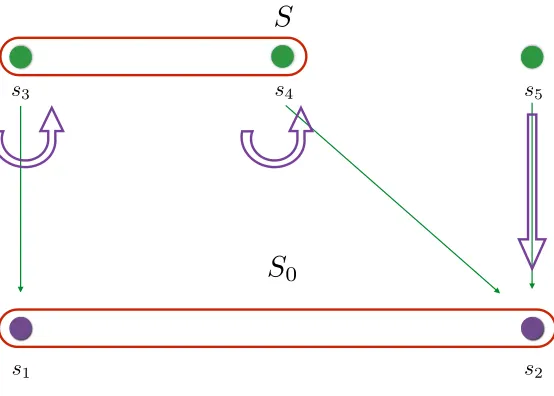
Example 2. We show that the non existence of an always beneficial bet does not imply common priors, even if Conditional Independence and EPCP are satisfied. The information structure is depicted in Figure 2. There are two investors who have no common local priors given S0 and therefore no common prior, but there is no bet that
ensures positive expected gains at each full state, for both. However, there is speculative betting.
There are two state spaces, S={s1, s2, s3, s4}andS0 ={s5, s6}, such thatS0 S,
s1S0 =s2S0 =s5 ands3S0 =s4S0 =s6. Investor 1 is always fully aware and P
1(s) =S
for all s∈ S. For all s0 ∈S0, P1(s0) = S0. His information structure is depicted by
the discontinuous lines. His prior π1 on S is (1/8,1/2,2/8,1/8). In fact, this is the
only prior that can generate his posteriors. Investor 2’s possibility correspondence is as follows: P2(s
1) = P2(s4) = S0, P2(s2) = {s2}, P2(s3) = {s3}. For all s0 ∈ S0,
P2(s
0) =S0. His information structure is depicted by the solid lines. His prior assigns
1/4 to each s ∈ S. Since π1 cannot generate 2’s posteriors, the investors have no
common priors. Moreover, the investors’ priors satisfy Conditional Independence. The thick straight arrows specify that at a state s ∈ S the investor 2’s awareness is at a lower state space S0≺S, whereas the curved arrows show thatS0 =S.
Suppose there is a bet b={bi}
1,2 givenS0 such that P
s0∈Si(s)
ti(s)(s0)bi(s0
S0)>0, for
eachs∈S, i= 1,2. For investor 2 this means that b2(s
5), b2(s6)>0, because at s2, s3
he knows exactly which state in S is true. But since P
i∈I
bi(s) = 0 for each s∈S
0, we
have b1(s
5), b1(s6) < 0, which implies P
s0∈S1(s)
t1(s)(s0)b1(s0
S0) <0. Hence, there is no
betb given S0 such that BSb =S.
Note that the only public event is S0 and that there is no common local prior given
S∧(s
1) =S0, because 1’s unique prior on S0 is (5/8,3/8), whereas 2’s unique prior is
(1/2,1/2). If we set b1(s
5) = 1, b1(s6) =−1.1 and b2 =−b1, thenBbS∧(s
1) is common
knowledge ats1.
s1 s2 s3 s4
s5 s6
S
0S
Figure 2: Investors have no common priors but do not bet always
consequences not only on the properties of interactive unawareness, but also on the preferences that an investor might have. For example, the case for having preferences represented by expected utility is less compelling when the investor knows that he is missing some relevant dimensions that he cannot conceptualise. Although there are some papers on interactive unawareness which formally model investors being aware that they are unaware of “something” (e.g. Halpern and Rˆego[2009],Board and Chung
[2011a,b]) and there is also a decision theoretic literature on coarse contingencies (e.g.
Epstein et al.[2007]), there is still no model that combines both approaches.20
3.3
Speculation in equilibrium
We now consider speculation in a game, adapting the framework ofGeanakoplos[1989]. With unawareness, investors might speculate in equilibrium because they have an in-complete understanding of other investors’ information and therefore of their actions. As a result, they might be playing best response against a fictitious opponent that, in reality, does not exist. However, we show that under Conditional Independence or path-independence, if investors have a correct understanding of their payoffs at each strategy profile, speculation cannot occur.
Definition 11. A Bayesian game with unawareness is a tuple (S, C, π,(ui)
i∈I), where
S is a positive belief structure, I is the finite set of investors, C = ×
i∈IC
i is the set of
all action profiles, π is the common prior given S∗ and ui : C×Σ →
R denotes i’s
payoff function.
[image:15.612.160.446.79.271.2]We require that investor i’s strategy is measurable with respect to his type.
Definition 12. A strategy for investor i∈I is a function fi : Σ→ Ci such that for
alls, s0 ∈Σ, ti(s) =ti(s0) implies fi(s) =fi(s0).
A strategy profile is a tuple f = {fi}
i∈I, where f(s) = × i∈I
fi(s) and f−i(s) =
×
j∈I\i
fj(s) for each s ∈ Σ. When choosing a best response at state s ∈ S and given f−i, investori who is unaware of S may have a wrong perception about what others
will play, because he is only aware of the less expressive state sS0, where S0 ≺ S.
If he chooses action ci and thinks he will get payoff ui(ci, f−i(s
S0), sS0) at sS0 but
receives a different payoffui(ci, f−i(s), s), then he may be surprised, realising that he
is unaware of something. Such a surprise cannot be part of an equilibrium, as the investor understands that he may have played suboptimally. We therefore require in equilibrium thatui(ci, f−i(s
S0), sS0) =ui(ci, f−i(s), s). In other words, awareness does
not lead to a wrong perception of one’s payoffs in equilibrium.
Definition 13 (Projections Preserve Own Payoffs). A strategy profile f = {fi} i∈I
satisfies PPOP if for alli∈I, for alls∈Σ, ui(ci, f−i(s), s) =ui(ci, f−i(s
S0), sS0), for
allci ∈Ci.
We emphasise that PPOP does not require that an unaware investor can reason correctly about what his opponents are really playing, asf−i(s)6=f−i(s
S0) is allowed. It only requires that if his opponents play f−i(s) at s ∈ S, then his payoff from
playing ci is the same, irrespective of whether his state space is S and reasons that
his opponents play f−i(s) at s, or if his state space isS0 ≺S and reasons that they
play f−i(s
S0) at sS0.21 Hence, an investor may have a wrong theory of how others
are playing, however in equilibrium this does not influence his payoffs. This means that the Bayesian Nash equilibrium which we define below cannot be interpreted as a “self-confirming” equilibrium or as a result of a learning process.22 A Bayesian Nash equilibrium with unawareness is required to satisfy PPOP.
Definition 14. Strategy profile f = {fi}
i∈I constitutes a Bayesian Nash equilibrium
with unawareness if it satisfies PPOP and for alls∈Σ, all i∈I and all ci ∈Ci,
X
s0∈Si(s)
ui(fi(s0), f−i(s0), s0)ti(s)(s0)≥ X
s0∈Si(s)
ui(ci, f−i(s0), s0)ti(s)(s0).
Investor i’s ex ante expected utility from strategy profilef ={fj} j∈I is
Ui(f) = X
s∗∈S∗
πS∗(s∗)ui(f(s∗), s∗).
Note that if investor i’s state space in the ex ante stage is S ≺S∗, his view of his ex
ante expected utility isUi S(f) =
P
s∈S
πS(s)ui(f(s), s). Because of PPOP,USi(f) =Ui(f)
21Note that PPOP is automatically satisfied inGeanakoplos[1989], because nondelusion is assumed. 22Similar issues arise and are discussed in Feinberg[2012], Rˆego and Halpern[2012], Grant and Quiggin
if f is an equilibrium. Hence, we can interpretUi
S(f) as what the investor thinks ex
post his ex ante expected utility had been.
Suppose that in the interim stage, when the investors have formulated their aware-ness and beliefs, they realise that they had been at an ex ante Pareto efficient allocation and have now an action to unilaterally stick to it. This means that each investor can stick to his allocation and can guarantee for himself an ex ante payoff of ¯ui, irrespective
of what everyone else is doing, by picking an action zi. Let z= × i∈Iz
i be the resulting
action profile and [zi] the strategy that plays zi always. Moreover, there is no strategy
profile that ex ante can make everyone weakly better off and at least one strictly better off. That is, if Ui(f) ≥u¯i for all i∈I, then f(s∗) =z for all s∗ ∈S∗. Will they be
willing to speculate in equilibrium or stick to the Pareto optimal allocation? As the fol-lowing theorem shows, they will not speculate, as long as eitherPiis path-independent
orisatisfies Conditional Independence, for each i∈I.
Theorem 3. Consider Bayesian game with unawareness (S, C, π,(ui)
i∈I) such that
either Pi is path-independent ori satisfies Conditional Independence given π and S∗,
for each i∈I. Moreover, suppose there exists an action profile z= ×
i∈Iz
i such that for
all f ={fi}
i∈I, Ui([zi], f−i) = ¯ui and if Ui(f) ≥ u¯i for all i∈I, then f(s∗) =z for
alls∗ ∈S∗. Then, there is a unique Bayesian Nash equilibrium with unawareness, and it has the property that f(s∗) =z for all s∗∈S∗.
3.4
Speculative trade
Milgrom and Stokey [1982] showed that if an allocation is ex ante Pareto efficient it cannot be common knowledge in the interim stage that there is a mutually beneficial trade. In this section we examine under which conditions this no speculative trade result holds in an environment with unawareness. Contrary to previous sections, the current setting is dynamic, not static. More importantly, there is no common prior assumption.23
There are two periods, the ex ante period 1 in which there is symmetric informa-tion and awareness and the interim period 2 where there is differential awareness and information.24 In period 1, types are described by positive belief structureS
1, where
all investors are only aware of a payoff relevant state space S1
0 and have no
informa-tion. That is, S1 = {S1
0} and the belief structure S1 specifies a unique type ki(·),
so that ki(s) = ki(s0) ∈ ∆S1
0 for all s, s0 ∈ S01. Moreover, supp ki(·) = S10. We set
23Note that an initial allocation is Pareto efficient if and only if there is a common subjective belief, as
shown byRigotti et al.[2008] in the context of convex preferences. In their terminology, a subjective belief is different from a prior, as it is the normal (normalized to be a probability) of the supporting hyperplane of the indifference curve at the initial allocation. If the allocation is not a full insurance one, a subjective belief is not equal to the agent’s prior in the expected utility model, as it depends also on the derivatives of the Bernoulli utilities. The result ofRigotti et al. [2008] is a generalization of the results ofBillot et al. [2000, 2002], who characterize ex ante trading from a full insurance allocation, in terms of disjoint sets of priors, using the Maxmin and Choquet expected utility models, which contain expected utility as a special case.
24There is also an unmodelled period 3 where all payoff relevant information is revealed and trades are
ki(·) =πi
1 ∈∆S01 and note that, by construction,πi1 is a positive local prior forigiven
S1 0.
There is a single consumption good, which we interpret as money, and investors trade state contingent claims. Each investori∈I is equipped with a strictly increasing utility functionui :
R+→R+over monetary outcomes. His endowment in period 1 is a
state contingent claimfi :S1
0 →R+, whereS01 is the payoff relevant, or bottom, state
space. The aggregate endowment of the economy in period 1 is given bye:S1
0 →R++.
An allocation is a tuple f = (f1, . . . , fm), where fi : S1
0 → R+. It is feasible if
Pm
i=1fi ≤e.
In period 2, types are described by positive belief structureS2 and investors receive differential information and awareness. CollectionS2contains multiple state spaces and
belief structureS2 allows for multiple types, whereS2
0 is the bottom, or payoff relevant
state space. We assume that the payoff relevant state spaces in periods 1 and 2 are identical, S1
0 = S02, so that there is no ambiguity on how state contingent claims are
defined across periods. We also assume that, for each i ∈ I, there exists a positive prior πi for i given S ∈ S such that its marginal on S2
0 is equal to π1i, i’s local prior
given S1
0 in period 1.
An economy is a tuple C = hS1,S2,{ui}
i∈I,Θ, ei where S1, S2 are positive belief
structures. Ex ante Pareto efficiency is defined in the standard way.
Definition 15. Feasible allocationf of economy C is ex ante Pareto efficient if there does not exist another feasible allocationgsuch that P
s∈S1 0
πi
1(s)ui(gi(sS1 0))≥
P
s∈S1 0
πi
1(s)ui(fi(sS1 0))
for alli∈I, with strict inequality for some j.
We say that in the interim period 2 there is speculative trade in economy C at
s∈S ∈ S2, if an allocation is ex ante Pareto efficient but it is common knowledge at
sthat there exists a Pareto improvement. Let
HS,jg,f =
s∈S ∈ S2 :
X
s0∈Si(s)
ti(s)(s0)ui(gi(s0S2 0)≥
X
s0∈Si(s)
ti(s)(s0)ui(fi(s0S2
0)∀i∈I, >forj
be the event in S which specifies that each i weakly prefers gi over fi and j strictly
prefersgj overfj.
Definition 16. There is speculative trade in economy C at s∈ S ∈ S2 if there is an
ex ante Pareto efficient allocation f, an investor j ∈I and feasible allocation g such that eventHSg,f∧(s),j is common knowledge at s.
Note that HSg,f∧(s),j is a subset of state spaceS∧(s), which is defined in Section2.3
to be the common state space ats, the most expressive state space that it is common knowledge atsthat everyone is aware of.
Theorem 4. There is no speculative trade in economy C = hS1,S2,{ui}
i∈I,Θ, ei at
anys∈S∈ S2 if eitherS∧(s) =S02 or S2 satisfies Projections Preserve Posteriors.
payoff relevant state space S2
0. In other words, even though the investors receive
differential awareness and information in period 2, it cannot be common knowledge that everyone has more awareness than in period 1. Second, Projections Preserve Posteriors is assumed.25
To provide some intuition on why either of these conditions is needed, consider the following sketch of the proof of the theorem. Suppose that allocationf is Pareto optimal in period 1 but in period 2 it is common knowledge at state sthat allocation
g Pareto dominates f, so that everyone weakly prefers g over f and at least one investor strictly prefers it. A property of common knowledge, which is also true with unawareness, implies that there is a public eventE⊆S∧(s), wheregPareto dominates
f at all s0 ∈ E and, for all i, Pi provides a partition of E. The law of iterated
expectations implies thatg Pareto dominates f within E also if we replace posterior with prior beliefs.
The last step requires defining a new allocation h that is identical to g within E
and identical tof outside ofE. But then, allocationhPareto dominatesf in period 1, which is a contradiction. However, this last step may be impossible in an environment with unawareness if event E ⊆S∧(s) is not the enlargement of some event of payoff relevant state space S2
0, where allocations are defined. If that is the case, we cannot
find an allocation h that separates, in terms of payoffs, E from its complement.26
If S∧(s) = S2
0, the payoff relevant state space coincides with the state space where
common knowledge is expressed, so separation is possible. Alternatively, Projections Preserve Posteriors implies that the posterior about an event in S2
0, specified by s0 ∈
S∧(s), is identical to the posterior specified by the projection of s0 to S2
0, so again
separation is feasible.
The following speculative trade example shows how separation fails if S∧(s) 6= S2
0, Conditional Independence (and therefore Projections Preserve Posteriors) is not
assumed and the public event E is not an enlargement of an event in S2 0.
Example 3. In period 1,S1contains state spaceS01 ={s1, s2}. In period 2,S2contains
state spaces S2
0 and S = {s3, s4, s5}, where S02 is identical to S01 and we denote it in
Figure3 asS0. Moreover,SS20 and s3 projects to s1,s4 and s5 project tos2, where
the projections are denoted by the thin arrows. There are two investors, i and j, with identical utility over monetary outcomes u(x) = log(x). Information and awareness are symmetric. In particular,P(s1) =P(s2) =P(s5) =S0, P(s3) =P(s4) ={s3, s4}.
The aggregate endowment is 1 in s1 and 1 in s2. Investor i’s prior over S is
(1/2,1/8,3/8) and j’s prior is (1/2,1/4,1/4). Note that the marginals of both priors onS0 are(1/2,1/2). In period 1, where both investors are only aware of S0, they have
the same beliefs(1/2,1/2). Because they are risk averse, the full insurance allocationf, giving each investor 0.5 ats1ands2, is Pareto optimal. In period 2 and at states3, both
investors increase their awareness and consider s3 and s4 to be possible. Investor i’s
posterior beliefs are (4/5,1/5)j’s are(2/3,1/3). Because beliefs are different, the full
25This means that whereas Heifetz et al. [2013a] do not allow for speculative trade (as they assume
Projections Preserve Posteriors), the current paper does.
26In settings without unawareness but with non expected utility preferences, some separation property
s1 s2
s3 s4 s5
S
0S
Figure 3: Speculative trade
insurance allocation is no longer Pareto optimal. For example, consider the allocation
gwhich specifies {0.56,1/3}for iand{0.44,2/3}for j. Then, it is common knowledge at s3 that g Pareto dominates f and there is speculative trade.
3.5
Speculation with different priors or information
pro-cessing errors
In this section we briefly examine the behavioral implications in the four trade settings, of models with different priors or information processing errors with non-partitional structures.
Several of the overconfidence models which generate trade assume some form of different priors. For example, Scheinkman and Xiong [2003] model two groups of investors and two signals that are publicly available. Each group is overconfident about one signal, regarding the other signal (and the fact that the other group is overconfident about it) as noise. This can be modelled as having different priors over the signal structure. In the first three settings that we examined, common priors are necessary for a no trade result, hence models similar to Scheinkman and Xiong
[2003] with different priors do not preclude speculation. However, Scheinkman and Xiong[2003] preclude the speculative trade of Section3.4, which means that as long as investors correctly apply Bayes’ rule to their subjective prior, there cannot be common knowledge in the interim that there is a Pareto improvement of an ex ante Pareto optimal allocation.
[image:20.612.164.441.77.275.2]is the top or full state space, we can define a possibility correspondence P∗(s∗) =
P(s∗)S∗ for all s∗ ∈ S∗. That is, we enlarge to S∗ the event P(s∗) that the investor considers possible ats∗, thus generating a non-partitional information structureP∗ on S∗. However, the two models differ in that the definition of common knowledge in the present model is not the same as the definition of common knowledge inGeanakoplos
[1989], because the former incorporates information about the investors’ awareness, which the latter ignores.
The following example examines the behavioral implication of Geanakoplos [1989] in three of the four trade settings.
Example 4. Let S ={s1, s2, s3} be the unique state space and (1/4,1/2,1/4) be the
common prior. There are two investors, i and j. Investor i has the trivial partition
Pi(s) =S for all s∈S. Investor j has a non-partitional information structure, so that Pj(s
1) = Pj(s2) = {s1, s2} and Pj(s3) = {s2, s3}. Investor i’s posterior beliefs are
always (1/4,1/2,1/4), whereas j’s are(1/3,2/3,0)ats1 ands2 and (0,2/3,1/3)ats3.
Consider the trade bi(s
1) =bi(s3) = 1/4, bi(s2) =−3/16, bj =−b1. At each state
both investors expect positive gains, so that Bb
S =S, which implies thatBSb is common
knowledge at all states. Because both investors expect positive gains at all states, this is also an always beneficial bet.
Consider now a two-period model, like the one of Section 3.4, where in period 1 both investors have no information and consider all states inS to be possible. Suppose that both investors are risk averse withu(x) =logx. The economy has a full insurance allocation f ={1,1}, giving 1 to each investor at all states. Then, the common prior
(1/4,1/2,1/4) and risk aversion imply that this allocation is ex ante Pareto optimal, yielding a utility of 0 for both. In period 2, i’s information is given by Pi and j’s is
given by Pj, with the same posterior beliefs as described above. Then, the allocation g = {bi + 1, bj + 1} Pareto dominates f at all states, hence it is always common
knowledge thatf is not Pareto optimal.
This example shows that the model ofGeanakoplos[1989] allows for speculative bet-ting (Section 3.1) and for betting that is always beneficial (Section3.2), with common priors. In the present model, speculative betting cannot occur with common priors. Moreover, an always beneficial bet is not consistent with a common prior that satisfies Conditional Independence. There is no natural analogue of Conditional Independence in a single state space model, because the information about the investor’s awareness is suppressed.
The example also shows that speculative trade can occur, even with common priors. In Section3.4 we show that speculative trade cannot occur if the payoff relevant and the common state space coincide, a condition which is trivially satisfied in the single state space model ofGeanakoplos [1989].
Speculation in equilibrium (Section 3.3) is allowed in both models, unless some related conditions are imposed. Geanakoplos [1989] imposes three conditions for no speculation in equilibrium, namely non-delusion, Knowing that You Know (KTYK) and nested. As shown in Galanis [2015], the first two are satisfied by operator P∗, whereas nested is implied by path-independence.
correlated equilibrium with different priors can be generated as a correlated equilibrium with common priors but non-partitional information structures, and vice versa. The authors point out that equilibria with different priors can be generated with common priors andsignificant informational processing errors. This means that a model with different priors, which does not provide foundations for the investors’ errors or limited perception, may nevertheless have implications about them which are not clear.
4
Concluding remarks
This paper examines speculation in four different trading environments, relaxing the assumption that all investors are always fully aware of all relevant dimensions. We find that what matters for no speculation is whether some form of common knowledge is assumed, which compensates for the lack of awareness.
We also compare our approach with models that generate speculation through dif-ferent priors (e.g. models with overconfident investors) or information processing errors (e.g. Geanakoplos[1989]). We argue that the main advantage of the current approach is that it endogenizes speculative behavior by explicitly modelling their awareness, with-out altering the common prior assumption, thus providing an insight into why certain types of speculation occur whereas other do not. On the other hand, the advantage of the overconfidence literature is that it generates several well known empirical findings about speculation, such as large trading volume or value-growth effects (e.g. Daniel et al.[2001]). For future research, it would be interesting to examine whether insights from the unawareness literature could be incorporated in those models so as to provide sharper explanations of these findings.
A
Appendix
For an event E ⊆ S, denote by E↑ = S
S0∈g(S)ES 0
the enlargements of E to all state spaces which are at least as expressive as S. The following Proposition collects properties thatPi satisfies. Note that properties 0-4 are assumed in Galanis[2013].
Proposition 1. Consider an interactive unawareness belief structureS=hS,{rSα
Sβ}SβSα,{t
i} i∈Ii.
The possibility correspondence Pi satisfies the following properties.
(0) Confinedness: If s∈S thenPi(s)⊆S0 for some S0 S.
(1) Generalized Reflexivity: s∈(Pi(s))↑ for every s∈Σ.
(2) Stationarity: s0 ∈Pi(s) implies Pi(s0) =Pi(s).
(3) Projections Preserve Ignorance: If s∈S0 and S S0 then(Pi(s))↑ ⊆(Pi(s S))↑.
(4) Projections Preserve Awareness: If s ∈ S0, s ∈ Pi(s) and S S0 then s S ∈ Pi(s
S).
(5) For all s ∈ Σ, suppti(s) ⊆ Pi(s). If S is a positive belief structure, then