Optimal Array Filtering
for
Seismic Inversion
Phillip Musumeci
B.E. Hons. M.Eng.Sc. (JCUNQ)
April 1989
A thesis submitted for the degree of Doctor of Philosophy of the Australian National University
These doctoral studies were conducted under the supervision of Dr. D.
Williamson.
The content of this thesis, except as otherwise explicitly stated, is the
result of original research, and has not been submitted for a degree at any
other university or institution.
Much of the work in this thesis has been published as academic papers
(see [20, 21, 22, 23]).
Canberra, April 1989.
Phillip Musumeci,
Department of Systems Engineering,
Research School of Physical Sciences,
The Australian National University,
Science is at no moment quite right, but it is seldom quite wrong,
and has, as a rule, a better chance of being right than the
the-ories of the unscientific. It is, therefore, rational to accept it
hypothetically.
Acknowledgements
I wish to thank my main supervisor, Dr. Darrell Williamson, for having
kept my project exciting for its 3 year duration. I have been particularly
lucky in this regard as my supervisor would not have been at ANU unless
the conditions were right to encourage him to take up his current fixed term
appointment (and to therefore discard his previously tenured position and to
take a cut in salary).
I also wish to thank the members of the Department of Systems
Engi-neering at ANU for giving me the opportunity for an Electrical EngiEngi-neering
education available at probably only a handful of places (one other located
in Australia). Unlike some Engineering Departments in Australia, this one
takes as one of its main aims the postgraduate education of students in
min-imum time. I am glad to have been part of this (time) efficient system.
My signal processing knowledge has been extended by Bon Clarke and
Panos Agathoklis, and my limited geological knowledge has been helped
con-siderably (i.e. created) by Steve Edwards and Greg Turner. I also
acknowl-edge assistance from Kok-Lay Teo.
I am grateful to the Australian National University for having managed
to keep in Australia (for the duration of this degree) my academic advisors
and the other members of the Department. This has been quite an
achieve-ment considering the opening overseas salary of PhD Electrical Engineering
Engineering at ANU (this salary is based on standard Australian Tertiary
Institution levels).
My funding has been provided primarily by an Australian Government
Postgraduate Award, with a supplementary scholarship originating from
BHP Pty. Ltd. While there appear to be few sectors of the Australian
community even vaguely aware that Engineering is connected to wealth
cre-ation as contrasted to its shuffling, I think that BHP in this instance deserve
special recognition for having sponsored this researchwithoutproprietary
re-strictions on publication and I hope that they are able to use the results to
commercial advantage. Optimal Array Filtering software has already been
shipped to BHP Central Research Laboratories for evaluation and as part of
the technology transfer associated with this project.
Canberra is a good place in which to live and work. A few people
de-serve special recognition for making it even better: Monty, Troy, and Grace
from ANU sports union for keeping the body fit; and Michael Frater, Lisa
Hamilton, and Alan Freeth for keeping the mind active with respect to a
broad range of topics by engaging in interesting and humorous argument.
Bob Bitmead and Jan Bitmead have been good friends. Thank you also to
my family.
My education has been positively influenced by a few people that I wish
to now mention: Osmond, Ridd, Close, Bitmead, and Williamson. The most
I think.
This Thesis is dedicated to the two-part dream that Australia should
have: (a) a National University; and (b) an Engineering School at our
Na-tional University designed specifically to improve the standards of
Under-graduate Education and Research in Australian Engineering. Unfortunately,
in 1989, the word ‘dream’ is used advisedly.
Abstract
This thesis considers two aspects within the broad seismic signal
process-ing field.
Optimal array filtering is studied in the context of seismic signal
analy-sis where off-line processing allows identification of signal parameters. The
filtering problem is formulated in the discrete time domain rather than the
frequency domain. It is shown that complete nulling of coherent
interfer-ence in the absinterfer-ence of sensor noise is generally possible with an array of FIR
filters. The order of each filter is determined from signal arrival times and
not duration. The filter design may also be optimised for operation in the
presence of random noise.
After the coherent interference is removed or attenuated, the resulting
sig-nals are used to identify the acoustic impedance profile between the source
and sensor. This problem is formulated as an identification problem
con-cerned with a one-dimensional lossy wave equation.
An analytic solution to the lossy wave equation is used to develop a
discrete space/discrete time model of seismic signal propagation through a
nonhomogeneous medium. The use of a finite spatial domain allows boundary
conditions to be explicitly included in the input-state-output model. A
one-step ahead recursive algorithm is presented for identification of the acoustic
impedance given finite data records. Given input/output information at
the transient period thus allowing identification based on the complete data
Contents
1 Introduction 1
1.1 Motivation . . . 2
1.2 Preliminaries . . . 3
1.3 Seismic Signal Processing Techniques . . . 12
1.4 Approach . . . 31
1.5 Thesis Outline . . . 32
1.6 Contribution . . . 32
2 Array Filtering of Coherent Interference 35 2.1 Introduction . . . 35
2.2 Signal Model . . . 35
2.3 Beamforming to Attenuate Monochromatic Interference . . . . 39
2.4 Nulling of Broadband Seismic Interference . . . 42
2.5 Optimal Array Filter Design . . . 48
2.6 ‘Rank’ considerations for optimal filtering . . . 70
2.7 Optimal Filtering Examples . . . 74
2.8 Conclusion . . . 82
3 Optimal Array Filtering 87 3.1 Attenuation of random sensor noise . . . 89
3.1.1 Signal Model . . . 89
3.1.3 Optimal Filtering in the presence of random sensor noise 93
3.1.4 Synthetic Example . . . 95
3.2 Multiple Coherent Interference . . . 99
3.2.1 Signal Model . . . 100
3.2.2 Derivation of Objective Function . . . 100
3.2.3 Optimal filter for nulling multiple coherent sources . . 102
3.3 Mixed Optimal and Suboptimal Array Filtering . . . 104
3.4 Minimum Complexity Optimal Array Filters . . . 107
3.5 Optimal Two-Dimensional Array Filtering . . . 110
3.5.1 Signal Model and Problem Formulation . . . 111
3.5.2 ‘Rank’ loss for Two-Dimensional Arrays . . . 114
3.6 Conclusion . . . 118
4 Discrete Model for One-Dimensional Inversion 122 4.1 Introduction . . . 122
4.2 Modelling for Inversion . . . 123
4.3 Propagation in an Elastic Medium . . . 134
4.4 Discrete Realisation . . . 144
4.5 Modelling Examples . . . 151
4.6 Response dependence on parameters . . . 154
4.7 Discrete ARMA Model . . . 161
5 Conclusion 172
5.1 Further Work . . . 177
5.2 Summary . . . 179
List of Figures
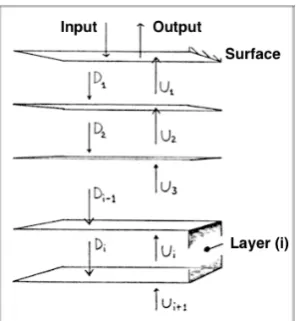
1.1 U and Dwaves in a layered media. . . 71.2 Seismic Data Acquisition. . . 14
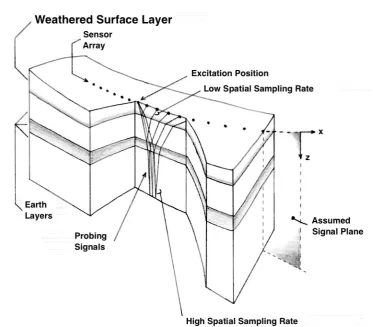
1.3 2D wave propagation. . . 25
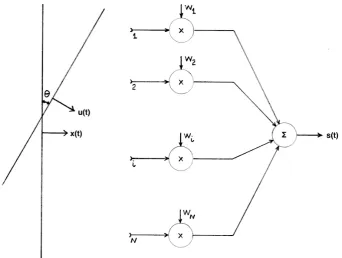
2.1 Narrowband Beamformer. . . 40
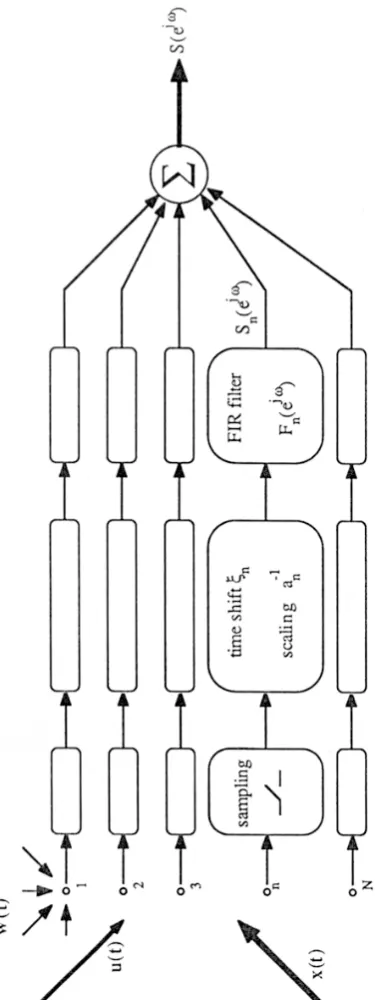
2.2 Array processing structure for absolutely optimal array filters. 44 2.3 Optimal Array Filters. . . 49
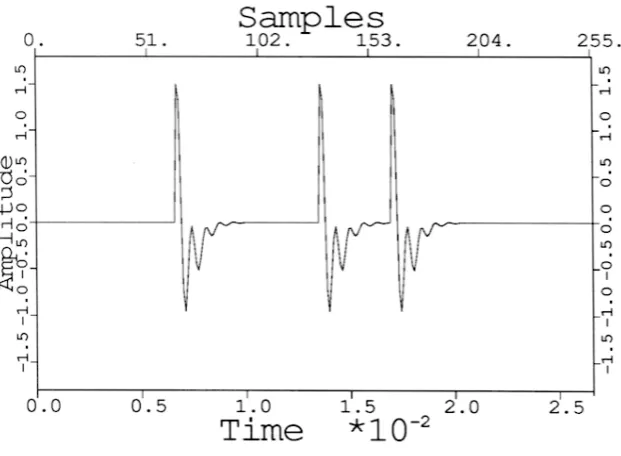
2.4 Wavelet x. . . 75
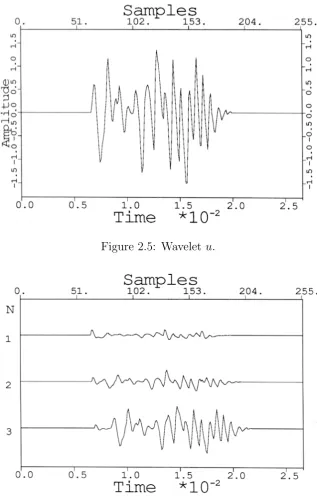
2.5 Wavelet u. . . 76
2.6 Test data for example 2.1. . . 76
2.7 Output (‘delay-and-sum’) for example 2.1(a). . . 77
2.8 Output (optimal) for example 2.1(b). . . 79
2.9 Output (suboptimal) for example 2.1(c). . . 79
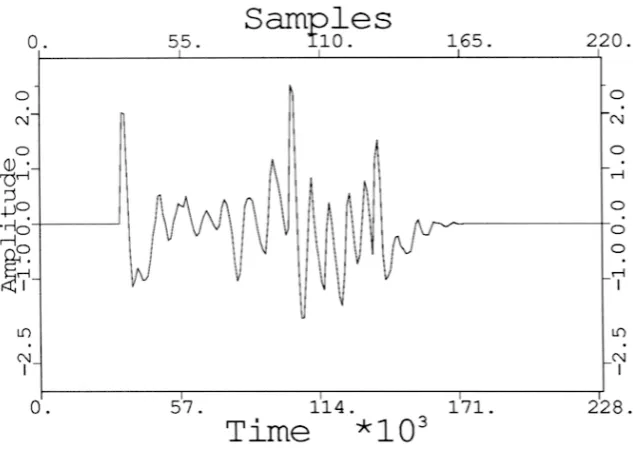
2.10 Seismic data set for example 2.2. . . 83
2.11 Windowed input data traces for example 2.2. . . 84
2.12 Output from optimal filter of example 2.2. . . 85
3.1 Test data set using u and w. . . 96
3.3 Array Filter (b) Output: designed using{x, u, w} data. . . 97
3.4 Output from 4 minimal optimal array filters. . . 109
3.5 Two-Dimensional Sensor Arrays. . . 112
3.6 Planar wavefront arrival producing rank(R) loss. . . 116
4.1 Seismic Mapping Problem. . . 129
4.2 System State with Recursion Integrals. . . 139
4.3 Discrete (ξ, t) and (µ, σ) meshes. . . 146
4.4 Response y0 given r(·) containing narrow spikes. . . 151
4.5 Response y0 and reflectivity r(·). . . 152
4.6 Response y0 given r(·) containing broad spikes. . . 153
4.7 Modelr(k/2) and recovered ‘impulsive’ ¯r(k/2) given measure-ment noise variances {0.0,0.0004,0.04}. . . 159
4.8 Model r(k/2) and recovered ¯r(k/2) given measurement noise variances{0.0,0.0004,0.04}. . . 159
4.9 Modelr(k/2) and recovered ‘broad’ ¯r(k/2) given measurement noise variances{0.0,0.0004,0.04}. . . 160
4.10 Model A(k/2) and recovered ‘impulsive’ ¯A(k/2) given mea-surement noise variances{0.0,0.0004,0.04}. . . 160
4.11 Model A(k/2) and recovered ‘broad’ ¯A(k/2) given measure-ment noise variances {0.0,0.0004,0.04}. . . 161
List of Tables
1.1 Typical data acquisition parameters. . . 8
2.1 Matrix Dimension Summary. . . 57
2.2 Synthetic data set for example 2.1. . . 75
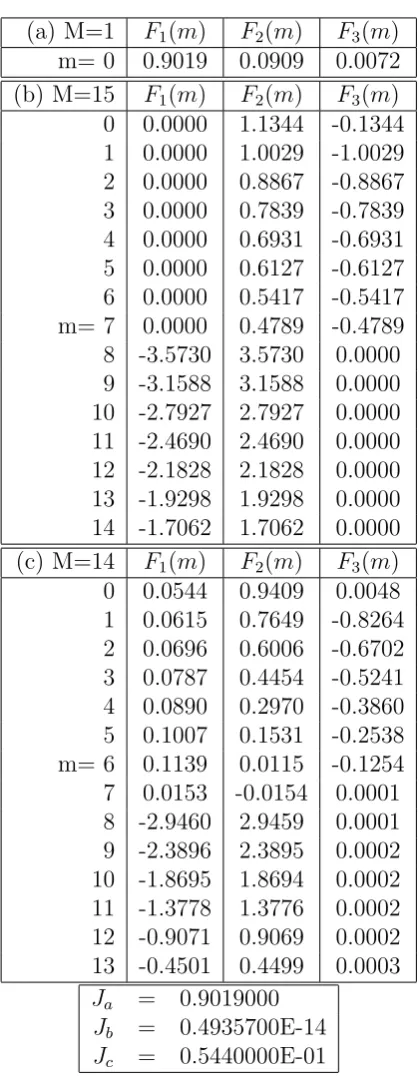
2.3 Filter coefficients and costs for example 2.1(a,b,c). . . 78
2.4 Measured signal parameters for example 2.2. . . 82
2.5 Filter coefficients and cost for example 2.2. . . 85
3.1 Synthetic data set for example 3.1 (ratios in dB). . . 98
1
Introduction
Seismic signal processing of acoustic waves is concerned with the analysis of
signals reflected from or transmitted through different rock layers beneath
the earth’s surface. Assuming an initial ‘layer-cake’ earth model, the seismic
energy is artificially induced into the sub-layers and is partially reflected back
to the sensor array when it encounters discontinuities between (or within)
the layers. After processing this reflection seismology data, information for
use in the earth sciences and the search for hydrocarbons is interpreted.
An additional use for seismic signal processing is the study of global scale
events where the excitation signal is not usually a controlled element of the
experiment e.g. nuclear weapons test verification and earth quakes.
This thesis describes research conducted in two related areas within the
broad field of seismic signal processing (SSP):
• Optimal Array Filtering, and
• discrete modellingof lossy wave propagation as part of Seismic Inver-sion.
In order to establish both the overall context within which this work fits and
also its motivation, a brief description of some important aspects of current
seismic analysis is given. The approach and contribution of this research,
1.1
Motivation
The search for hydrocarbon reserves is becoming more difficult with
eas-ily recovered supplies more scarce. This tendency has led to an increase in
sophistication of search techniques including higher resolution field data
ac-quisition and more intensive SSP as target zones have become deeper and
smaller. Recovery efficiency is also being increased through use of more
ac-curate reserve information, e.g. some coal mining now uses cross borehole
tomography to map seams and plan overburden removal. Improvements in
signal processing algorithms and implementation platforms have resulted in
regions being periodically searched as resolution improves allowing smaller
reserves to be found.
This work brings array filtering techniques to seismic data processing
aimed at suppressing (or preferably nulling completely) interference that
re-duces data integrity. Current sensor array signal processing for the
suppres-sion of interference is equivalent to ‘delay and sum’ methods. This may work
well on random noise but performance is poor when interference components
possess structure such as when the interference is a delayed version of the
desired signal.
While techniques to image the earth’s subsurface have been used in
in-dustry for some time, the recovery of fine detail describing earth properties
withineach earth layer (previously assumed constant) is an area of active
the partial differential equations which describe seismic energy propagation
given only input and output measurements.
Motivation of this research then is two-fold:
1. the development of optimal array filtering algorithms to suppress
co-herent noise in trace data more effectively. This improves the
effec-tiveness of layer identification techniques while also ensuring that
one-dimensional inversion algorithms process data from a specific region.
2. the development of a more exact algorithm for wave propagation
mod-elling based on an analytic recursive solution of a lossy wave equation.
This new model incorporates input and output signals at each end of
the finite length one-dimensional spatial region. It thus removes the
nexus which has existing signal propagation modelling based on a
lay-ered homogeneous media model forming part of identification schemes
for determining properties of inhomogeneous media.
1.2
Preliminaries
The seismic signals propagating through the earth consist of longitudinal
pressure waves (P-waves) and transverse shear waves (S-waves). Knowledge
of the velocities of these waves can provide all elastic properties of an isotropic
solid. At present, S-waves have been largely ignored both in industry and in
research1 and this work considers only P-waves. The possibility, then, that
1[3] gives some reasons for this including the difficulty of relating P-wave based and
propagation mode conversion might also occur is excluded.
The one-dimensional wave equation used in this work is
ρ(z)∂
2ψ
∂t2 =
∂
∂z µ(z) ∂ψ ∂z
!
(1.1)
where ψ(z, t) is the (longitudinal) particle displacement, ρ(z) is the density, and µ(z) is the shear modulus. ψ(z, t) is measured in the direction of prop-agationz and gives rise to pressure variations. Some assumptions regarding material properties allow (1.1) to be simplified for this preliminary
discus-sion. If shear modulus and density are consideredconstant, perhaps inspired
by an earth model based on layers2of constant physical properties, then (1.1)
may be written as
∂2
∂t2 −v 2 ∂2
∂z2
!
ψ(z, t) = 0 (1.2)
where velocity v =4 qµ/ρ. Equation (1.2) is the acoustic wave equation and may be solved for each layer in the earth model.
Ignoring external inputs and boundary constraints during solution, and
taking the one-dimensional Fourier transform F {·} of (1.2) with respect to the spatial variable z gives
d2V dt2 +ω
2
V = 0 (1.3)
where V(kz, t)
4
= F {ψ(z, t)} and ω2 =4 −v2(−ik
z)2. Equation (1.3) has a
sinusoidal solution containing the two components
U =4 ei(ωt+kzz) (1.4)
D =4 e−i(ωt−kzz) (1.5)
where (1.4) corresponds to an upgoing wave and (1.5) corresponds to a
down-going wave. In (1.4,1.5), the temporal frequency is ω (called ‘frequency’) and the transform of the spatial variablez is the spatial frequencykz (called ‘wavenumber’). The assumption that pressure wave propagation can be
mod-elled as up- and downgoing waves in constant property earth layers is very
popular in seismic analysis. This is not surprising given that many
computa-tional methods rely on some form of finite element analysis with a common
inherent assumption of constant parameters over some discretised element.
For z measured from the earth’s surface, direct access to the surface layer’s system (1.2) is possible at the end point z= 0. An input ψx(z = 0, t) is applied and the response ψ(z = 0, t) is recorded. The identification task is to first relate this input/output data to the model, and then to derive
geophysical information.
The valid use of a model must be subject to issues such as the model’s
internal consistency, the scope of any (simplifying) assumptions upon which
it is based, and the external consistency of its input/output characteristics
when compared to observed behaviour. Identified earth parameters, such
as the velocity profile, are subject to geophysical constraints which restrain
the class of admissible models. Much analysis in seismic signal processing is
based on a relatively simple signal/media model of up- and downgoing waves
mod-els is that, with care, they can be made to work. As noted by Robinson[1],
the ultimate aim of signal processing is to provide useful information about
the subsurface region and not necessarily to describe accurately wave
prop-agation. However, it is generally believed that a better understanding of
the geophysical principles involved leads to more effective and economical
computer implementations of numerical methods. It is important to limit
computational load and the principle of parsimony does suggest
considera-tion of less complex models if adequate accuracy can be obtained.
The multi-layer earth model permits wave propagation along linear ray
paths within each layer with no scattering effects. No magnitude changes
occur within a layer, i.e. propagation is not subject to absorption, and at
layer interfaces signal continuity arguments lead to reflection and
transmis-sion coefficients describing magnitude results3 (see Figure 1.1). The lack of
lateral variation in media properties plus the essentially vertical propagation
of signals in this earth model justify the use of a one-dimensional wave
equa-tion. In typical land seismic data acquisition, a seismic source (explosive
or vibrating) is triggered and the resultant compressional waves observed
by several sensors. The sensors are usually positioned at regular (spatial)
intervals with no sensor so close to the source that nonlinear effects4 occur.
If the sensor array lies along a straight line, the implicit assumption is
3Snell’s law can describe incident and transmission angles if media impedances are
available.
4A sensor located too close to an explosive source could be subject to signal overload,
Figure 1.1: U and D waves in a layered media.
that the earth probed is two dimensional i.e. all reflected signals received
by the array originate from earth property variations located in the plane
beneath the array. After each shot, the excitation source and the sensors are
moved forward horizontally by 1 or 2 spatial samples. If the earth really was
accurately modelled by a ‘layer-cake’ in which there was no lateral variation
in earth properties, no extra information would be gained by repeating the
experiment at the new location. However, this particular earth model (like
many others) should be seen as a tool upon which useful seismic analysis
may be based.
Seismic field recordings generate vast amounts of raw data. Table 1.1
contains some typical recording parameters. The data collected from the
sensor array after each shot is called a ‘gather’. There may be from 96 to
distance between adjacent shot positions 50m
distance between adjacent sensors 25m
length of a seismic data trace 6s
time sampling interval 2ms
data samples per shot from 256 sensors 768000
Table 1.1: Typical data acquisition parameters.
i.e. a data trace received from a sensor co-located with the seismic source,
so that the down- and upgoing waves sample the same region. However, this
is not possible (especially with explosive shots) and so data is recorded at
regular non-zero offsets of the sensor array.
The data contains considerable redundancy both within a single gather
and across gathers. At shallow depths where the horizontal sampling interval
is small relative to the lateral variation rate of earth parameters, multiple
sensors receive signals which have probed essentially the same media during
a data gather. This redundancy can also occur between consecutive data
gathers if the seismic source produces a sufficiently constant shot. This
is because the incremental method of moving the signal sensors and the
seismic source allows many of the signal paths to overlap. At greater depths,
the signal paths for a gather can converge towards a reflector so that a
relatively small media region is probed by many signals. Various algorithms
take advantage of the redundancy present and have the welcome side effect
of data reduction. The possibility of data loss at this stage should not be
A linear convolutional model [1, 2] may be proposed to assist in
under-standing how the received signals are generated from a layered earth model.
The seismic source is ideally a sharp spike or impulsive function especially if
subsequent deconvolution processing is envisaged. However, the non-linear
effects5 around the shot point give rise to an oscillatory waveform of some
length. This signal is called the source wavelet6. It is transmitted into the
earth giving rise to sensor data traces which may be viewed as
(field trace) = (source wavelet)?(absorption)?
(reflection response)?
(instrument response) + (noise)
(1.6)
where ? denotes convolution. For an earth model of constant layer parame-ters, the field trace would represent some linear filtered version of the source
wavelet. The reflection response would be a series of impulses corresponding
to layer reflection coefficients convolved with some model for the multiple
reflections i.e.
(field trace) = (source wavelet)?(absorption)?
(reflection coefficient impulse series)?
(multiple reflection component)?
(instrument response) + (noise)
(1.7)
In marine seismic studies, it is possible to record the wavelet between the
source and the surface below, and after correcting for various propagation
effects, to estimate the shape of the source wavelet. However, for land based
studies, such recordings are not possible.
5If the non-linear effects are ignored, then excitation may be viewed as an actual sharp
spike giving rise to the ‘travellingδ(·) functions’ model.
6[2] justifies viewing excitation and return signals as wavelets. Note that excitation
Excitation phase uncertainty suggests the use of correlation based
analy-sis. By careful design of the seismic source, it is possible to ‘front end load’
the energy content of the excitation wavelet. A minimum delay waveform is
defined [2, 18] as the waveform that has the largest concentration of energy
in the early part of the waveform in the class of all waveforms with the same
magnitude spectrum. It can be shown that this characteristic of minimum
delay energy delivery corresponds to the minimum phase waveform given an
autocorrelation constraint. Hence, it appears reasonable to postulate that
the source wavelet is minimum phase.
The reflection coefficients which are part of the layered earth model7 are
observed to possess magnitude less than 1 so the more times that a seismic
pulse is reflected and transmitted, the more it is delayed and attenuated.
From a lattice filter modelling viewpoint, this reflection coefficient
observa-tion suggests that thereflection responseis also minimum phase. The
absorp-tionandinstrument responseare adequately known so, in general, processing
of only correlation or spectral information can give a valid reconstruction of
the input waveforms because the overall system may be viewed as minimum
phase.
It is possible to formulate a least squares filter to solve for an all-zero
equivalent inverse system for the unknown source wavelet. In terms of the
auto-correlation matrix {ri} of the received wavelet, this problem may be
expressed as
r0 r1 r2 . . .
r1 r0 r1 . . .
r2 r1 r0 . . .
.. . ... ... . .. a0 a1 a2 .. . = b 0 0 .. . (1.8)
where the time seriesa0 = [a0, a1, a2, . . .] is the best prediction of the (negative
of the) wavelet, subject to a scaling constant b. As the appropriate order of the wavelet is not known at this stage, a recursive approach is advantageous
instead of immediately inverting the Toeplitz matrix. An incremental method
of solving (1.8) may be thought of as a predictor of the wavelet w because, aftera0, each subsequent ai is chosen to set 0 =Pji=1wjai−j.
The approach of Burg [2, 18] to solving (1.8) reduces the end effect bias
in estimates ofrk;k > 0 by ensuring the filter does not run off the end of the data. Since both the forward and reverse time series share the same
autocor-relation, the predictor cost may be expressed in terms of both forward and
reverse prediction errors and by using the Levinson [2] recursion, a minimum
phase solution for the wavelet may be derived. The selection of wavelet
dura-tion is not resolved here but it should be recalled that the excitadura-tion seismic
wavelet possesses a finite time property.
Because the multiple reflection component of (1.7) may be regarded as
a random sequence of impulses8, it contributes a scaling factor to the
auto-correlation analysis of (1.7) for suitable windowed data and an estimate of
the seismic wavelet may be obtained. To discover the earth’s structure (and
8A small number of regions in the world achieve notoriety because the depths of the
target area parameters), given inexact knowledge of the excitation signal, is
the aim of much seismic analysis.
Many signal processing techniques are employed in order to present trace
data to the geophysicist so that it may be visually interpreted. Processing
may also be directed towards improving the match of various models
under-lying the study with the actual data, and also the reduction of interference.
An overview of some of these techniques is now given.
1.3
Seismic Signal Processing Techniques
After surface studies or, in the case of prospecting, a reconnaissance stage,
a generalised picture of the subsurface may be obtained in selected areas
via gravity and magnetic exploration methods. An investigation may then
proceed to greater depths where the gravity and magnetic methods lose
res-olution [4]. Drilling can occur and core samples and well logging provide
additional information which brings focus to the developing earth model.
Since drilling is relatively expensive, reflection seismology9 can be invoked
to provide structural information. It is important to order this information
according to scale, i.e. the presence and location of layers, referred to here
as macro level information, and fine detail describing the properties within
a layer, referred to here as micro level information.
At the macro level, the data is processed to improve resolution and signal
9By placing sensors and/or excitation sources in boreholes, it is also possible to conduct
to noise ratio (SNR), and returning reflections are detected. The strengths
and arrival times of the reflected seismic wavelets are determined and used
to extend the subsurface earth model with wave propagation details such as
averagevelocity (see [5]) andaverageabsorption. The presence of reflections
not predicted by the earth model naturally leads to further analysis and
subsequent extension of the subsurface model where necessary. The aim of
this seismic imaging is to construct an accurate earth model in terms of
(spatial) depth.
The major macro level processing techniques are now described in relation
to Figure 1.2. This discussion will introduce some wave propagation concepts,
but more importantly it will provide some indication of the complexity of
signal processing already implemented.
(a) Amplitude Correction - The spherical spreading of the excitation wave
produces an attenuation proportional to the reciprocal of distance
trav-elled in the far field. All return signals are recorded referenced to a two
way time10 (TWT). Because of the earth’s inhomogeneity, a velocity
profilev(z), either estimated or measured if near a borehole, is used to relate TWT to the distance between the surface and the region probed
before a corrective travel time dependent amplification may be applied
i.e.
Gain ∝Distance
where
TWT = 2
Z Distance
0
dz v(z)
(b) Frequency Filtering - Acoustic waves travelling in the earth experience
absorption which may be viewed as a frictional loss. This loss is
es-sentially proportional to the number of cycles travelled thus giving rise
to the concept of the earth as a ‘low pass filter’. Appropriate band
pass filters are applied in a subjective manner to the return signal
pro-gressively reducing the bandwidth as travel time (and hence distance
travelled) increases. This helps to maintain the SNR by suppressing
high frequency noise components that are no longer masked by
infor-mation bearing components.
The travel time dependent corrections (a) and (b) therefore attempt to undo
normal propagation losses (and preserve the validity of a lossless model).
(c) Muting - The upper layers of the earth usually include a weathered layer.
This layer can produce reflections that are uninteresting with respect
to the construction (or refinement) of a depth based earth model and so
this section of the return signal may be windowed out. As mentioned
earlier, the multiple receivers provide some return signal redundancy
which can be exploited when retrieving a desired signal. At short travel
times however, the differences in probing path can render invalid the
same region. Note also that the very early sections of the data trace
before the seismic source arrives provide an opportunity to estimate
the statistical characteristics of the background noise. This noise can
be attributed to sources such as the signal sensors, the field recording
equipment, and micro-seismic activity.
(d) Statics - Variations in the elevation of the earth’s surface where the
sensor array is usually located, plus lateral variations in the depth
and velocity characteristics of the weathered layer, make the
estab-lishment of a global time reference point across multiple data gathers
non-trivial. One approach is to locate the excitations (usually
explo-sive) in a shot-hole drilled into bedrock. Corrections can then be made
involving measured (or estimated) uphole velocity estimates obtained
from a number of sample holes drilled into the weathered layer near
the receiver sensors. If the excitation signals cannot be induced into
the bedrock, use must be made of wave refraction theory and
redun-dancy in the data although this method could fail in regions where the
bedrock is undulating.
Another method which can lead to automatic statics correction involves
calculating the cross correlations of adjacent traces after they have
un-dergone Normal Move Out (NMO) correction (described in 1.3(e)).
Assuming that the surface-located sensors have an adequate (lateral)
across one data gather would line up exactly with its seismic images
present in an adjacent data gather. By cross correlating only the
rel-evant time (and depth) sections of two adjacent traces belonging to
different data gathers, the relative time offset of the main correlation
peak can be used as a correction measure. Static corrections within
data gathers and between data gathers can be fixed or dynamic with
respect to the trace number.
(e) Normal Move Out- As shown in Figure 1.2, data traces received at
dif-fering offsets from the application point of excitation travel different
distances. The zero-offset travel time t0 is defined as the travel time
required for a seismic signal to travel vertically down to a horizontal
reflector and then reflect back up (via the same ray path) to the sensor.
When the sensor is located at an offset x measured horizontally from the excitation point, a seismic signal travelling at velocityv will record a travel time t which has a hyperbolic relationship with x i.e.
t2 =t20+ x
2
v2 (1.9)
To extend this relationship for multiple layers,vbecomes an RMS value calculated using individual layer travel time weights (see [4]). In order
to correct for this hyperbolic time distortion in the data, some idea of
the velocity profile is required. By analysing t2 and x2 relationships
for specific reflectors chosen at increasing depths, it is possible to
effect. A number of other approaches exist [2, 4] with some designed to
minimise computation. Automatic methods also exist to find a best fit
(usually in a least squares sense) using signal processing similar to the
correlation based method discussed earlier. Corrections are calculated
for various velocities (or velocity profiles) and cross correlation used
to determine the best correction across traces at various depths. The
actual correction applied is to compress time for data traces which have
travelled laterally further. In this way, time referenced (and depth
ref-erenced) features from traces which have undergone differing amounts
of lateral travel align. The correction will be time varying for regions
with complex velocity profiles and iteration may be required.
The effectiveness of cross correlation analysis in identifying similar wavelets
is influenced by the signal shapes. Reflections received by adjacent sensors
that have originated from the same reflector will have closely related shapes
especially when contrasted with reflections from different reflectors that have
travelled along different paths. In this way, the attenuation and dispersion
effects help to ensure more reliable feature tracking across data traces via
correlation based methods.
Sections (a)-(e) can be seen to correct for effects associated with the
target region’s geometry and wave propagation characteristics. They may
also be used to ensure better matching between some of the less complex
techniques attempt to process reflection wavelets into a form more useful for
visually and numerically interpreting the data.
(f ) Spiking - The identification of wavelet travel times is considerably easier
and more reliable if the observed wavelets possess a short time
dura-tion. If one assumes that the original excitation wavelet was minimum
delay, then it is possible to build a deconvolution11 filter of
appro-priate length which, when applied to a data trace, converts wavelets
into more impulsive functions or ‘spikes’. Propagation through rock
for long distances results in attenuation and low pass filtering effects
(noted earlier) plus dispersive effects due to the wavelength dependence
of velocity. Interpretation of the data traces becomes even more
diffi-cult when closely located reflectors give rise to overlapping images of
the excitation wavelet.
One approach is to design a least squares filter to convert received
wavelets into some form more suited to subsequent analysis such as
travel time determination. Defining the vectors
filter coefficients f = (f0, f1, f2, . . . fm) measured (or estimated) wavelet x= (x0, x1, x2, . . . xm) desired wavelet d= (d0, d1, d2, . . . dm+n+1)
(1.10)
11The term deconvolution is used in the sense of (1.7), i.e. that it ‘undoes’ the result of
then
f
x0 x1 . . . xn 0 . . . 0 0 x0 x1 . . . xn 0 . . . 0
..
. . .. . .. ...
0 . . . 0 x0 x1 . . . xn
=d (1.11)
Denoting the (m+ 1)×(m+n+ 1) matrix containing rows of mea-sured data as B, the standard form of (1.11) may be obtained by post multiplying by B0 i.e.
f R0 =dB0 (1.12)
where R is the autocorrelation matrix of the wavelet, and techniques similar to those used to solve (1.8) are again appropriate. Design
is-sues include first estimating the time duration (n+ 1) of the original wavelet, and then selecting a filter order (m+ 1) and a new wavelet shape (see [2]). It is possible to design some measure of output wavelet
‘performance’ possibly related to narrowness of pulse. A number of
filters may then be designed and compared, making use of the
avail-able flexibility to choose various output energy lags and filter duration
values.
Note that estimation of wavelet shape is an important area of current
research (see [9], [6] in the context of seismic inversion, or [8] where no
minimum phase assumption is made). Because of the time dependent
wavelet shaping effects of dispersion in the time domain and low pass
filtering in the frequency domain, the deconvolution filter required may
The conversion of a finite time wavelet into a short duration impulsive
signal corresponds to enhancing the original wavelet’s high frequency
components so that it obtains a broad spectrum. Since the low pass
fil-ter effects of wave propagation in the earth compromise high frequency
SNR, only signal components with magnitude greater than the noise
spectrum can be enhanced thus whitening the signal spectrum to give
a spike.
As the spikes are presented to geologists and geophysicists for interpretation,
the final wavelet shape may be chosen subjectively. One common shape
to aim for is a zero-phase wavelet possessing centrally located peaks from
which it is easier to view and estimate arrival times and signal magnitudes.
Similarly, in the case of automated ‘picking’, a shape may be chosen to
improve the robustness of wavelet magnitude and arrival time estimation
algorithms. Also, the ideas in (f) may be applied towards obtaining better
wavelet shape matching between traces from separate data gathers for which
seismic source repeatability was less than desired.
(g) Dereverbation - The excitation wavelet gives rise to primary reflections
at each intra-layer media property discontinuity. These primary
re-flections produce multiply reflected signals. Assuming the absence of
esoteric stratigraphic structures, the first excitation on a reflector is due
to the excitation wavelet and the first return signal received from such
it is possible to construct a time series model [2, 4] for the reverberant
signals within the previously excited (and identified) structure. The
differences between the output of the model and the measured return
signal (the innovations) are then used to further identify deeper
struc-ture (and also to extend the model).
It should be recognised that many of the signal processing ideas overlap, e.g.
wavelet estimation and shaping, Wiener filtering, inversion, and time varying
filtering. In practice, the application of these techniques is dependent on the
region tested. Figuring out which techniques to apply and in what order
constitutes part of the ‘art’ of seismic analysis. Since in some instances little
a priori information may be available, the ability of processing algorithms to
‘self boot’ is useful.
(h) Stacking - After alignment of trace features, the coherence of signals
propagating over spatially close paths is used to advantage through
summing adjacent traces. An SNR improvement is obtained as
sig-nals aligned in time add constructively while other sigsig-nals add
destruc-tively. For N trace signals, an improvement of 1/√N is obtained for random noise however the improvement is reduced substantially when
the undesired signal includes structured components which are
corre-lated with the desired signal. This simple form of array processing
does not make full use of additional available information regarding
planar waves- direction of arrival), and motivates a major direction of
this thesis. Techniques such as slant stacking [7] and tau-p transform
[17] filtering exist which attempt to use linearly related arrival time
data to advantage when reducing coherent interference. One method
of directing the array’s response peak towards an illuminated reflector
in order to obtain more detailed information at some common depth
point (CDP) is beamforming12.
(i) Migration - The process of transforming information recorded by the
sensor array into a description of the illuminated reflecting surface is
known as migration. It can range in complexity from relatively simple
geometric analysis of signal arrival times based on ray path models
to quite complex so called wave depropagation techniques which can
be necessary when locating reflection sources in structurally complex
regions, e.g. convex dips in layer interfaces which produce a lense effect.
The depropagation techniques (also called backward projection) are
based on the assumption that illuminated reflectors may be regarded
as excitation sources, and that depropagation of a field measured on
the surface will converge to the reflecting surface of interest.
One example of reverse-time propagation is f-k migration. Equation
(1.2) may be extended to include propagation in the horizontal x
rection i.e.
"
∂2
∂t2 −v 2( ∂2
∂x2 +
∂2
∂z2)
#
ψ(z, x, t) = 0 (1.13) Taking a two-dimensional Fourier transform of (1.13) with respect to
the spatial coordinatesz, xgives an equation of the form of (1.3) where now the solution contains components
(a) U =ei(ωt+kzz−kxx) and (b)D=e−i(ωt−kzz−kxx) (1.14)
The characteristics of these waves are
cu = (ωt+kzz−kxx) and cd= (ωt−kzz−kxx) (1.15)
and it can be observed that a wavefront expands in thex direction for both wave components. After a reflector is illuminated by a downgoing
wave, upgoing waves result. If it is assumed that the surface
measure-ments ψ(z = 0, x, t) result from this upgoing wave13, then shifting this
wave field back to its launch time will locate its source. This shifting
is called reverse-time propagation.
The two-dimensional Fourier transform ofψ(z, x, t) with respect to the spatial variablex and time t is
V(z, kx, ω) =
Z ∞
−∞
Z ∞
−∞ψ(z, x, t)e
−i(ωt−kxx)dx dt (1.16) 13Stacking, Beamforming, and the Optimal Array Filtering presented in this thesis allow
Figure 1.3: 2D wave propagation.
The data measured by the surface sensors ψ(z = 0, x, t) is used as a boundary condition when transforming a shifted form of (1.16) back to
z, x, t coordinates.
A time shift operator is required in terms of wavenumber kx and tem-poral frequency ω. The travel time has differential
dt = ∂t
∂xdx+ ∂t
∂zdz (1.17)
and dt must therefore be expressed in terms of kx and ω. Figure 1.3 shows a sinusoidal plane wave of wavelength λ travelling towards the surface at angle θ to the vertical z axis. Frequencies and periods are related by
k= 2π
λ , kx =
2π λx
, ω = 2π
T (1.18)
and T is time period. Velocity and wavelength are related by
v =f λ (1.19)
and using (1.18) gives
v = ω 2π
2π k =
ω
k or k= ω
v (1.20)
For a stationary point travelling on an upgoing wavefront, cu = 0 in (1.15), and so
0 = ωt+kzz−kxx (1.21)
giving apparent velocities
dz dt = −ω kz , dx dt = ω kx (1.22)
Defining kz =
q
k2−k2
x, (1.17) may be written
dt= kx
ω dx−
1
ω
r
(ω
v)
2−k2
x (1.23)
Assuming that the original signal travelled from the reflector at (z, x= 0) to sensors at (z = 0, x) in time 0. . . t0, integration of (1.23) gives
Z t0
0
dt= 1
ω
Z x
0
kxdx−
Z 0
z
r
(ω
v)
2−k2
xdz
(1.24)
or
t0 =
1
ω
kxx+
r
(ω
v)
2−k2
xz
(1.25)
Applying the t0 time shift and taking the two-dimensional inverse
Fourier transform gives the depropagated wavefield
ψ(z, x, t) =
Z ∞
−∞
Z ∞
−∞V(z, kx, ω)e
iω(t+√(ωv)2−k2
which enables ψ reconstruction at space-time points of interest in the subsurface region. This result can be extended for a multi-layer earth
model, and also for signals measured on a 2 dimensional sensor array.
By reconstructing the wavefield at arbitrary space-time points (x, z, t), imaging of the signal source may be achieved where the wave converges.
A number of other migration schemes exist including time migration
and WKBJ14 migration. The ability to select directionally the signals originating from a particular region of interest is critical for a
migra-tion scheme to identify a particular reflector. Note that migramigra-tion can
also be performed before stacking operations (for example, see [14] for
synthetic examples).
After the macro parameters of the subsurface model are determined,
at-tention may be directed to analysis within a layer i.e. the micro level. At
this stage, a change in earth model is appropriate. Instead of using a lumped
parameter model with earth changes represented only at layer interfaces, a
view of the subsurface consisting of continuously varying parameters is taken.
To obtain micro level information about the earth is to invertfor these
con-tinuously varying parameters.
(j) Inversion - This element of seismic signal processing is still a very active
14From [1], named after Wentzel, Kramers, and Brillouin who developed it in 1926
area of current research. Of many different approaches available, two
major groups are briefly described here.
The work earlier this century directed to solving the inverse problem
of quantum scattering has led to the following approach. Recall (1.1)
where now the space-time region of interest is specified.
ρ(z)∂
2ψ
∂t2 =
∂
∂z µ(z) ∂ψ
∂z
!
; t >0, z≥0 (1.27)
The system is assumed to be quiescent initially i.e.
ψ(z, t) = 0, t <0 (1.28)
An impulsive input is applied at z = 0
∂ψ(z = 0, t)
∂z =
δ(t)
µ(0), (1.29)
and an output measured
g(t)=4 ψ(z = 0, t) (1.30)
As indicated in [10], it is not possible to reconstruct both ρ(z) and
µ(z). Instead, the acoustical impedance A = 1/√ρµ is recovered. By defining the transformation from spatial cordinatez to travel time ξ
ξ(z) =
Z z 0 v u u t
ρ(s)
µ(s)ds (1.31)
then (1.27) may be written
A(ξ)∂
2ψ(ξ, t)
∂t2 =
∂
∂z A(ξ)
∂ψ(ξ, t)
∂z
!
and the input (1.29) is
∂ψ(ξ = 0, t)
∂ξ =
δ(t)
A(0) . (1.33)
The method is to first recoverA(ξ) and then to obtainA(z) by inverting (1.31). It is assumed that the macro level imaging has provided an
initial velocity profile used in (1.31)15.
The Gelfand-Levitan and Marchenko methods are introduced by
defin-ing φ =√A ψ. Equation (1.32) then reduces to
∂2φ
∂t2 −
∂2φ
∂ξ2 +q(ξ)φ = 0 (1.34)
where
q(ξ) = ∂
2√A
∂ξ2 /
√
A . (1.35)
Taking the time Fourier transform of (1.34) gives the Schr¨odinger
equa-tion
d2φ¯
dξ2 +k
2φ¯=q(ξ) ¯φ (1.36)
where ¯φ = F {φ}. The Gelfand-Levitan and Marchenko methods [10] solve (1.36) via a related Sturm-Liouville problem. A number of
vari-ations are possible including a non-linear version by Symes [12]
specif-ically for the geophysical problem. While the problem formulation is
15As noted in Chapter 4, [13] showed results implying that the map from g tov is not
uniformly continuous, and that it is best to phrase the problem in terms of reflectivity
analytic, its solution still requires evaluation of integral equations for
which general solutions are not known [11].
An alternative approach is to model the propagation of energy
prob-ing the unknown subsurface region. Methods similar to the predictive
deconvolution have been studied and demonstrated in [6] to invert for
constant reflectivity ‘layers’ on a fine scale. As noted in [16], such
iden-tification schemes can be extremely unstable and various additional
constraints, such as incorporating measured geophysical information16
and minimising the difference between measured data and modelled
signals, are included in order to obtain a ‘unique’ solution. Models also
vary according to whether 2nd order or coupled 1st order differential
equations are used to form the model.
Models using an exact solution to the one-dimensional wave equation
(1.2) are expected to improve inversion when compared to current
approx-imate models. When one-dimensional analysis provides subsurface region
data sampled along multiple paths, tomographic17imaging provides a means
of obtaining information for the two-dimensional region.
16Well logging can provide point estimates of acoustical impedance and velocity. 17A distinctive property of geophysical tomography is the relatively large ratio between
1.4
Approach
Although SSP problems are often ill-posed [11], the data does contain much
redundancy. The actual quantity of data coupled with its measurement in
noisy field conditions leads to inconsistency. Statistical methods are often
used to formulate optimisation procedures in which the degree of
inconsis-tency is minimised or in which some likelihood function is maximised as part
of the solution.
The approach of this thesis into additional SSP tools is deterministic.
The partial differential equation which describes the physics of lossy wave
propagation isanalyticallysolved to give a recursive model for use in seismic
inversion. This can be compared favourably with other techniques using
approximate models based on up- and downgoing waves.
The optimal array filtering problem is formulated in the discrete domain
where all known temporal and spatial information is readily represented.
In contrast, current alternative array filtering techniques derived in the
fre-quency domain do not provide any insight into minimum sufficient sampling
requirements.
It is a fundamental premise of this thesis that known physical laws should
form the basis of solution schemes. This is not to say that statistical
tech-niques do not have a place especially in the implementation stage where data
inconsistency will always be a serious problem. Rather, this work attempts
1.5
Thesis Outline
In Chapter 2, a signal model is introduced for the sensor array data to be
processed. Previous array processing results are surveyed and the approach
leading to the Optimal Array Filters of this thesis is introduced. The
opti-mal array filter which is capable of completely nulling coherent interference
is derived. These results are extended in Chapter 3 to include more adverse
interference conditions and also special cases featuring minimum
computa-tion requirements. In Chapter 4, the problem of propagacomputa-tion modelling for
Seismic Inversion is introduced and a result from [25] is used to develop
an analytic recursive solution to (1.1). This result is discretised and
inter-pretation provides insight into the linearity of this and other identification
schemes. A conclusion is presented in Chapter 5.
1.6
Contribution
The summing of return signals (i.e. stacking) to enhance desired signals
is fundamental to much current seismic signal processing. Because some
unwanted signal components (noise) may be reflecting from regions other
than the one of interest, quite a large number of traces may need to be stacked
in order to smear these structured and correlated signals in the time domain.
The optimal array processing developed in this thesis allows unwanted copies
of the desired signal originating from directions other than the desired ‘look’
Further, a minimum trace count can be assigned to null a given number
of coherent noises as explained in Chapter 2. Methods such as stacking
relying on sensor diversity and the associated assumption that all sensors are
receiving the same signal. When a large number of traces are required to
smear unwanted signal components, there is an increased possibility of the
assumption that all traces represent a spatial sampling of essentially the same
region being false. A known minimum trace count allows one to minimise
errors which might occur if some traces did not contain a copy of the same
desired signal.
An advantage of the methods based on solutions of Schr¨odinger’s wave
equation is that they are exact. Unfortunately, boundary condition
con-straints are ignored and the numerical computation of the solution integrals
cannot be directly related to the input/output measurements. The other
approach described earlier uses only approximate models (of varying
com-plexity) as part of an identification scheme for micro level earth parameters.
The significance of the work in this thesis is that it provides an exact
input-state-output model of wave propagation for use as part of an identification
scheme. Discretisation is only necessary for implementation on a digital
com-puter.
Further, this analytic solution is obtained over a finite spatial domain
thus creating the possibility of better merging of results from the macro and
may be cascaded. The exact Schr¨odinger solutions are usually concerned
2
Array Filtering of Coherent Interference
2.1
Introduction
In this chapter, array processing is introduced as an alternative to the
stack-ing or ‘delay-and-sum’ stage of seismic signal processstack-ing described in section
1.3(h). Optimal Array Filters are derived where the term optimal refers to
an ability to null an interference and provide superior performance to the
stacking method of enhancing a desired signal.
As a precursor to addressing the processing of sensor array signals, the
signal environment in which the processor operates is discussed. The special
case of nulling a monochromatic (i.e. narrowband) interference signal is
described. Previous array processing techniques relevant to seismic analysis
are reviewed before Optimal Array Filters are derived with which to null
a broadband coherent interference. A synthetic data example is presented
in order that accurate SNR measurements may be made, and an example
processing data collected from a transmission seismology application is also
presented to verify operation of the filters.
2.2
Signal Model
In this chapter, it is assumed that there are two components present in the
recorded signal - the desired component x and one coherent interference u. In existing SSP procedures, stacking is performed to take advantage of
In reflection seismology, an image of the subsurface region is built up by
enhancing and interpreting reflected components at increasing depths. As
outlined in section 1.3, the redundancy necessary for stacking is due to low
lateral variation rate for earth parameters combined with the relatively high
spatial sampling rate of the sensors.
The generation of seismology data from survey work is considered to be
deterministic. If the same excitation wavelet is applied in consecutive
ex-periments, the same return signals containing componentsx, uare produced. This must be the case for redundancy to be possibly useful across separate
data gathers. While the received signals have undergone a frequency
selec-tive attenuation which is dependent on travel time (i.e. distance), the spatial
oversampling amongst sufficiently few sensor groups combined with large
sig-nal travel distances allows one to argue that the effects of propagation are
the same for adjacent traces. If this did not occur, relatively unsophisticated
methods such as stacking could not work. Although the waveform of the
ex-citation signal is unknown, various methods are currently in use to estimate
it. Statistical signal models have been proposed as a means of encapsulating
uncertainty in algorithms to estimate time delay (see for example [28, 29])
and wavelet shape ([9] gives an overview of some approaches). In general,
waveform shape and time delay estimation is a non-trivial task and there is
much current research activity.
modelled by x and u are assumed to have been previously estimated. As the spectral content or time domain waveform may not be precisely known
for x, u, this work makes no assumptions other than that x, u possess a finite bandwidth and can therefore be sampled and accurately represented
in discrete time18. Within the limits of the Nyquist rate, the signals are
considered to be broadband. Arguments in support of these assumptions
include the fact that current seismic imaging techniques already depend on
accurately determining the arrival times of reflections in order to locate the
position of layer boundaries. Wavelet processing of original traces facilitates
concentration of the wavelet energy into a smaller temporal region thereby
allowing accurate ‘time picking’ and magnitude measurement at the ‘picked’
time because of the very high SNR present. Some cross checking of this
information is also possible as any seismic imaging must be consistent with
other geophysical information available.
The success of wavelet processing techniques also illustrates the validity of
these assumptions. Recall from Chapter 1 that NMO correction can involve
cross correlation analysis to determine relative arrival time delays between
traces collected from adjacent sensors. The cross correlation of trace data
that has undergone wavelet processing of individual traces (or spiking) is
an example of Generalised Cross Correlation where the wavelet processing
may be regarded as a frequency weighting operation of each channel. As
18Recall from Chapter 1 that wavelets possess finite time duration / finite energy
mentioned earlier, the filtering of each wavelet can assist visual measurement
of trace parameters or enhance the effectiveness of automatic methods.
Existing stacking can also be used to enhance the coherent interference
providing yet another method of refining magnitude and arrival time
infor-mation. In a similar way, the array processing techniques to be presented
here are also able to ‘self boot’, i.e. approximate signal parameter estimates
allow array filtering to enhance the interference u and obtain data for the design of a final array filter to null u.
In summary, the signal environment for the signal processing presented
in this chapter will include a desired signal x and a coherent interference19
u, both possessing a known magnitude and arrival time. Signals x, u are baseband and broadband, i.e. all energy exists within a fixed bandwidth
(usually in the 5Hz to 100Hz range), and energy is spread across all
frequen-cies within the band. When u results from multipath propagation effects such as reflection, it may share the same waveform as x.
For an array sensor n= 1. . . N, the received signal will be written
yn(t) =anx(t−ξn) +bnu(t−ρn) (2.1)
where{an, bn}will be referred to as signal magnitudes20 and{ξn, ρn}will be referred to as signal arrival times. This possible lack of spectral difference
19In Chapter 3, this noise model is extended to multiple coherent interferences and
random noise.
20Strictly, these quantities are gains. Although no reference magnitude is known forx
between the interference and the desired signal, in combination with a desire
to assume as little as possible about the actual waveforms present, suggests
that directional source diversity be utilised. As an aid in developing Optimal
Array Processing, narrowband beamforming is now introduced.
2.3
Beamforming to Attenuate Monochromatic
Inter-ference
The array shown in Figure 2.1 is receiving a wavefrontx(t) from the forward ‘look’ direction. After weighting and summing, the component of the output
s(t) resulting from the input signal x is
sx(t) = N
X
i=1
wix(t) (2.2)
where wi is the weighting coefficient for each channel. When a monochro-matic source21 m(t) of wavelengthλ is incident at angle θ, the component of the array output due to this source is
sm(t) = N
X
i=1
wimi(t) (2.3)
where mi(t) represents m(t) received at sensor i. Given a sensor spacing d
and a wavelengthλ, the phase of themi(t) components may be expressed in terms of sensor number i as
sm(t) = N
X
i=1
wie−i(d sinθ)/λm(t) (2.4)
21In this work, broadband coherent interferences are denoteduand narrowband coherent
Nulling of the array output due to m(t) requires that N
X
i=1
wie−i(d sinθ)/λ= 0 (2.5)
Define
w0 = [w1w2. . . wN]
Bθ0 = [e−iφe−2iφ. . . e−N iφ]
where φ= (d sinθ)/λ. Equation (2.5) may be written
w0Bθ = 0 (2.6)
Given an initial weighting wI satisfying some desired response of the beam-former to x(t), a weighting w is required which satisfies (2.6). This may be obtained by perturbing wI in the direction ofBθ i.e.
w=wI+µBθ (2.7)
Solving for µin (2.7) subject to (2.6) gives
µ=−B 0
θwI
Bθ0Bθ
(2.8)
and hence
w= I− BθB 0
θ
B0
θBθ
!
wI (2.9)
The matrix
PB =I−
BθBθ0
Bθ0Bθ
is a projection matrix which operates on weighting vector wI to give a new weighting w that is orthogonal to the interference m(t).
Projection matrices occur frequently in beamforming analysis. Note that
this steered null is dependent on the wavelength λ. If another distinct monochromatic interference was co-located withm(t), equation (2.10) would no longer provide complete nulling as the geometry of the beamformer’s nulls
depend on wavelength.
One approach to nulling an interference composed of a number of distinct
frequencies is to separate the input signal into a number of (narrow) bands
and steer a beamformer towards each interference and recover it. The
recov-ered interferences from each extra beamformer may then be subtracted from
the output of the beamformer steered towards the desired signal.
Since the vector w is complex in order for (2.6) to be satisfied, quadra-ture signal components are necessary for the complex multiplication by w. For baseband applications, the generation of quadrature components is an
extra processing step which may increase total processor complexity further
if Hilbert Transform filters are also required in the case of broadband signals.
2.4
Nulling of Broadband Seismic Interference
Texts such as [30, 31] give a current treatment of the use of filtering sections
in place of complex multipliers when pursuing the attenuation of a broadband
interference. The classical papers [35, 36, 37] introduce the signal processing
coherent interference encountered in seismic analysis. The array processing,
which now includes linear FIR filters, can be viewed as a generalisation of
the complex weighting of (2.9). As the seismic problem uses recorded data,
the need for algorithms which can adapt, perhaps even in real-time, does not
arise. Further, the data may be reprocessed until accurate signal parameter
estimates are obtained. This latter freedom has led to the use of a signal
model (described earlier) in formulation and development of ‘Optimum Array
Filters’ (OAF) and ‘Absolutely Optimum Array Filters’ (AOAF) presented
respectively in [40, 41]. The more recent work on ‘Absolutely Optimum Array
Filters’ [41] is briefly described.
For each of N sensors, the output signal is modelled by
yn(t) =anx(t−ξn) +bnu(t−ρn) +wn(t) (2.11)
where x(t) is the desired signal with magnitude an and arrival time ξn, u(t) is the coherent interference with magnitudebnand arrival timeρn, andwn(t) is random sensor noise received at the nth sensor. The signals are then time shifted and amplitude normalised so as to align x(t) giving
sn(t) = x(t) +αnu(t−τn) +vn(t) (2.12)
where αn = bn/an, τ = ρn − ξn, and vn(t) = wn(t +ξn)/an. The array processor is now steered towards x(t). The noise component vn(t) is not included in any further analysis although in [41], a simulation is shown in
Figure 2.2: Array processing structure for absolutely optimal array filters.
The signalsyn(t) are passed through filtersFn(ω) and summed (see Figure 2.2) to give
S(ω) = N
X
n=1
Fn(ω)X(ω) + N
X
n=1
αne−jωτnFn(ω)U(ω) . (2.13)
In this description, the response of the array to the desired signal is denoted
D(ω) i.e.
D(ω) = N
X
n=1
Fn(ω) (2.14)
while the response of the array to the coherent interference is given as
R(ω) = N
X
n=1
where
Rn(ω) =αne−jωτnFn(ω) (2.16) In [40], a problem formulation based on minimisingkR(ω)k2gave an
underde-termined system of equations. This problem was then avoided by minimising
PN
i=1kR(ω)−Ri(ω)k2 instead. Note however that there is no guarantee that minimising the difference between each individual filter response and the
overall filtering response will necessarily attenuate the interference response.
However, examples were presented in [40] demonstrating such effect. The
dif-ficulties of [40] in minimisingkR(ω)k2 were solved in [41] by generalising the
cost function using the parameter γ in (2.17). The filter transfer functions22
are adjusted to minimise
J(γ, ω) = 1 2
N
X
n=1
|γR(ω)−(1−γ)Rn(ω)|2 (2.17)
subject to the desired signal all-pass constraint
D(ω) = 1 (2.18)
The filter coefficients for the AOAF are solved in ([41], equation (26) when
γ = 1) as
Fn(ω) =
1/|an|2 −δ(1/a∗n)
PN
m=1(1/am)
PN
m=1(1/|am|2)−δ|PNm=1(1/am)|2
(2.19)
where
δ =N−1 ; an=an(ω) = anejωτn (2.20)
22Setting γ = 1/2 corresponds to what was initially called ‘Optimum Array Filters’,
and settingγ = 1 corresponds to minimisation ofkR(ω)k2 giving what was then termed