UNIVERSITI TEKNIKAL MALAYSIA MELAKA
MOBILE ROBOT MOTION PLANNING BASED ON MOTION
OF ARTIFICIAL POTENTIAL FIELD (APF)
This report submitted in accordance with requirement of the Universiti Teknikal Malaysia Melaka (UTeM) for the Bachelor Degree of Manufacturing Engineering
(Robotics and Automations) (Hons.)
by
FARIS ADAM BIN MOHD GHAZALI B050910217
900730065185
MOBILE ROBOT MOTION PLANNING BASED ON
NOTION OF ARTIFICIAL POTENTIAL FIELD (APF)
FARIS ADAM BIN MOHD GHAZALI
B050910217
UNIVERSITI TEKNIKAL MALAYSIA MELAKA
ABSTRAK
ABSTRACT
DEDICATION
This “Projek Sarjana Muda” is lovingly dedicated to my respective parents, Mohd Ghazali bin Abdul Aziz and Anisahnor binti Abdul Jalil who are from the start give a lot
of inspiration and motivation. They also give me the guide and increase my spirit to fight against any task and problems. Without their love and support, the project would
ACKNOWLEDGEMENT
In the name of Allah, the Most Gracious and the Most Merciful, Alhamdulillah, all praises to Allah for the strengths and His blessing in completing this “Projek Sarjana Muda” (PSM). Special appreciation goes to my supervisor, Dr. Omid Reza Esmaeili Motlagh, for his supervision and constant support either in the project or others. His invaluable help, constructive comments,motivation, suggestions throughout the research have contributed to the success of full report of PSM 2.
Sincere thanks to all of my friends especially Nurizati Syakirin, Nurfadzylah, Zikrul Hakiem, Farkhan, Nazrul, Auni, and other friends for their kindness and moral support during my study. A lot of memories that we built together and I will appreciate the memories and the friendship.
TABLE OF CONTENT
Abstrak i
Abstract ii
Dedication iii
Acknowledgement iv
Table of Content v
List of Figures vii
List of Abbreviations, Symbols and Nomenclature ix
CHAPTER 1: INTRODUCTION 1
1.1 Introduction 1
1.2 Problems Statement 2
1.3 Objective 3
1.4 Scope 3
CHAPTER 2: LITERATURE REVIEW 4
2.1 Mobile Robot 4
2.2 The Potential Field Method 5
2.3 Local versus global path planning 8
2.4 Trap Situations Due to Local Minima 11
2.5 Fuzzy logic 12
2.6 MobotSim Software 16
2.7 Virtual Target 17
2.9 Virtual force field (VFF) 20 2.10 The Vector Field Histogram (VFH) Method 22
CHAPTER 3: METHODOLOGY 23
3.1 Study of robot behavior 27
3.2 Fuzzy logic 28
3.3 MobotSim Software 28
3.4 Experimental Preparation 29
3.4.1 Running the Simulation 29
3.4.2 Fuzzifying the System 36
3.4.3 Dead end 42
3.5 Summary 43
CHAPTER 4: RESULTS AND ANALYSIS 44
4.1 Target Seeking and Obstacles Avoidance Behavior 45
4.2 Fuzzification Analysis 45
4.3 Dead end 49
4.4 Summary 52
CHAPTER 5: CONCLUSION 53
REFERENCES 54
APPENDICES 56
A 56
B 59
LIST OF FIGURES
Figure 1: APF target concept (Hani, 2007) 6
Figure 2: APF obstacle concept (Hani, 2007) 6 Figure 3: APF of obstacle and goal (Hani, 2007) 7 Figure 4: Mobile robot path in APF (Hani, 2007) 7
Figure 5: Global path planning 9
Figure 6: Local path planning 10
Figure 7 application of local and global path planning in a robot (Haojie et al., 2012). 11 Figure 8 Characteristic Function of a Crisp Set 13 Figure 9 Characteristic Function of a Fuzzy Set (Hellmann, 2001) 13 Figure 10 Example of two different fuzzy sets (Hellmann, 2001) 14 Figure 11 Example of fuzzy AND set (Hellmann, 2001) 14 Figure 12 Example of fuzzy OR (Hellmann, 2001) 14 Figure 13 Example of Fuzzy NEGATION (Hellmann, 2001) 14 Figure 14 Example: Linguistic Variables performance. 16 Figure 15: virtual target design (Xu, 1999) 17
Figure 16: Design of wall following robot 19
Figure 17: The concept of VFF 20
Figure 18: Active window of the histogram grid 21
Figure 19: The polar histogram grid 22
Figure 20: Project flow chart 24
Figure 21: Flowchart of mobile robot 27
Figure 22: 1st mobot configuration 30
Figure 23: 2nd mobot configuration 30
Figure 25: Tested environment 32 Figure 26: Mobot Rotational difference angle 33 Figure 27: Fuzzifying of the obstacle position Note that ON= no obstacle, OL= object at left, OF= object at front, OR=object at right. 37 Figure 28: Fuzzy rules for the wheel control 37 Figure 29: Designing new algorithms for the angle of the obstacles 38 Figure 30: Design extract from the situation in Figure 29 39
Figure 31: Triangle 1 39
Figure 32: Triangle 2 40
Figure 33: finding the distance and the angle of the red line 41 Figure 34: one sensor detecting the obstacle 42
Figure 35: Concave obstacle 43
LIST OF ABBREVIATIONS, SYMBOLS AND
NOMENCLATURE
APF -Artificial Potential Field PFM -Potential Field Method VFF -Virtual Force Field VFH -Vector Fied Histogram IR -InfraRed
CHAPTER 1
INTRODUCTION
1.1Introduction
Mobile robot is come from two terms. One is mobile and the other one is robot. According to the free dictionary website, mobile mean capable of moving or of being moved readily from place to place. While robot is define as a mechanical device that sometimes resembles a human and is capable of performing a variety of often complex human task on command or by being programmed in advanced. Mobile robot is defined by Firat (2004) as an autonomous system capable of traversing a terrain with natural or artificial obstacles. Its chassis is equipped with wheels/tacks or legs and possibly a manipulator setup mounted on the chassis for handling of work pieces, tools or special devices.
it enable to complete the task given. The behaviors are about to seek and search for the given target and avoid any obstacles that it faces on its way towards the target.
However, in developing a mobile robot, there are few challenges and problems that need to face by the developers. One of them is to develop suitable mechanical structure based on the task that will be given to it and another one is to develop an algorithm that is suit with any kind of environment. The developing of the algorithm that can enable the robot to seek for the target while avoiding any obstacles it meets are quite a challenge to the robot developers. By developing the robot behavior using the mobile robot simulation with variety of obstacles can make the developers have more knowledge on the mobile robot behavior in real environment because it is simpler to modify the mobile robot in simulation rather than in real world. This is due to real mobile robot will take a lot of time, energy and money if the developers want to make changes to it behavior or modification. By using mobile robot simulation in early stage of development will reduce the time, energy, and cost of modification of real mobile robot.
1.2Problems Statement
1.3Objective
From the problem statement above, the main objective is to develop a mobile robot that can achieve a specific goal with avoiding the multiples object on the floor. There are also other objectives that need to be achieved at the end of this report. They are:-
i. To develop a motion algorithm for local path planning of mobile robots, ii. To make the motion algorithm to be fuzzy,
iii. To test the algorithm in environment with variety of obstacles.
1.4Scope
CHAPTER 2
LITERATURE REVIEW
2.1Mobile Robot
servant robots that can help to ease human life. It is not a dream that, in near future robots will be a part of our daily life. (Dudek and Jenkin, 2000)
2.2The Potential Field Method
Potential field idea is actually taken from the natural for instance, a charged particle navigating a magnetic field, and a small ball rolling down a hill. Potential field methods (PFM) for obstacle avoidance have gained increased popularity among researchers in the field of robots and mobile robots during past few years. The idea of virtual forces acting on a robot has been suggested by Andrews and Hogan (1983), and Khatib (1985). In these approaches obstacles exert repulsive forces onto the robot, while the target applies an attractive force to the robot. The sum of all forces, the resultant force R, determines the subsequent direction and speed of travel (Koren and Borenstien, 1991).
They all move according on how strength the field or how high the hill. This situation also can be applied to the robot behavior by creating an artificial potential field. When apply it to the robot, it will attract the robot towards the goal.
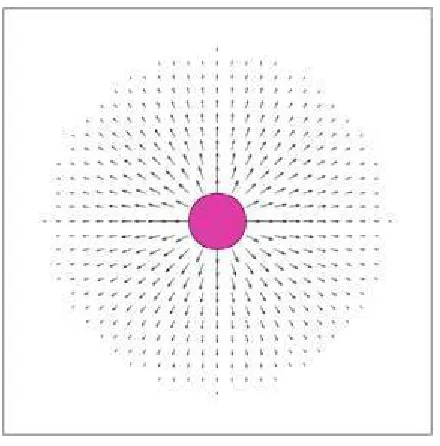
For instance, let’s assume that the robot operates in an environment without any obstacle and what it needs to do is just seek for the goal. To do that in conventional planning, one should calculate the relative position of the robot to the goal, and then apply the suitable forces that will drive the robot to the goal.
Figure 1: APF target concept (Hani, 2007)
The potential field method also can be applied to the environment that has obstacles. In potential field method, the obstacles will act as the repulsive field. If the robot approaches the obstacle, a repulsive force will act on it, and it will push away the robot.
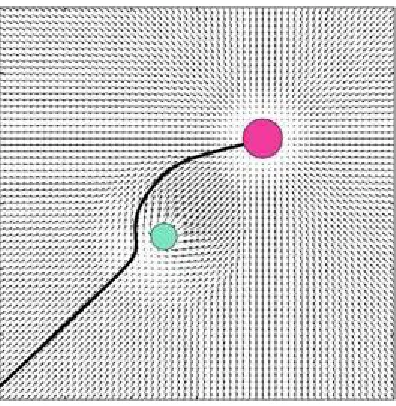
[image:17.612.219.439.420.643.2]Both seeking and avoiding behavior can be combining in the robot behavior. The robot will act repelling when near repulsive field which identically an obstacle and attracting to the attractive force known as the goal. Figure below illustrate the robot behavior when apply both seeking and avoiding theory.
Figure 3: APF of obstacle and goal (Hani, 2007)
[image:18.612.229.427.396.599.2]2.3Local versus Global Path Planning
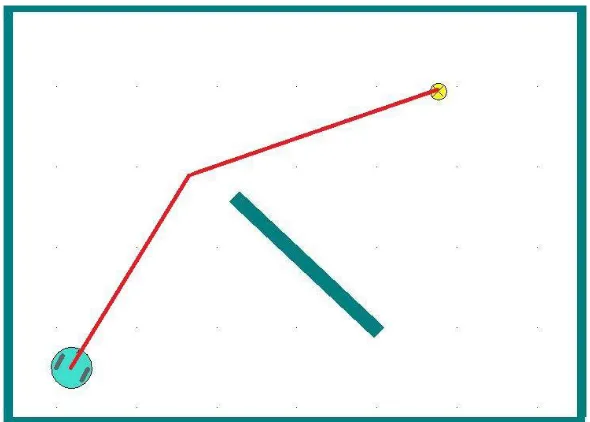
Path planning, or motion planning, is the act of finding a path to go from a location to another location. Path planning is important for a mobile robot to plan its way to the target in an identical or unknown environment with the obstacles as a challenge. There are many approaches to solving path planning, but usually it involves a local and global path planner (psurobotics, 2012). One of the priorities for a mobile robot that can perform tasks without human supervision is to have a plan of collision-free path is to. Path planning involves the problem of finding a continuous path from the initial position to the target that avoids obstacles in the environment. The path planning problem is well known in mobile robotics (Hwang and Ahuja, 1992) and has been typically approached in two different ways; local and global path planning method. (Dieguez et al., 2002) Local path planning concept is like a blind person with his white cane walk into his kitchen. He might know his destination but he did not know the obstacles that he will face to reach his destination. The blind person will wave his white cane (sensors for mobile robot) along his way to his destination in order to protect him from hitting any objects placed in the kitchen. He will face with the unknown obstacles and need to avoid it. In addition, the blind person actually needs to be near to the objects in order to feel it existence. Same with the mobile robot which is technically blind due to limited sensor range that can only detect any obstacles when the obstacles is entering the sensors range (white cane for blind person). This is what the local path planning concept that require the robot to be near the obstacles and simultaneously avoid it.
algorithms have been developed assuming that a detailed map of the environment is available, which cannot be defined in most applications. Indeed, practical autonomous mobile robot applications need to be able to deal with unpredictable changes in the environment (Dieguez et al., 2002).
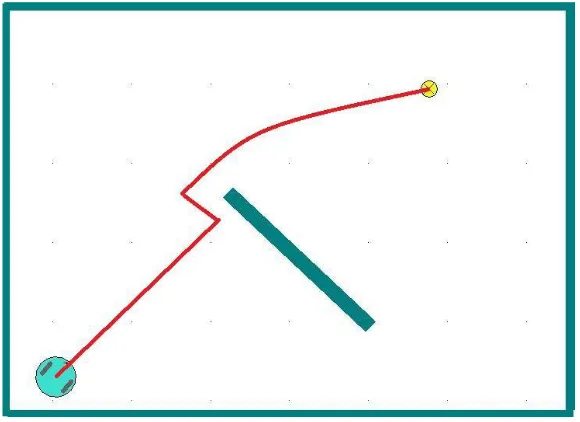
[image:20.612.180.475.326.537.2]In scientific means, local path planning is usually gives a high-resolution low-level path only over a segment from global path A to B, avoiding small obstacles and dealing with motion planning: angles of turn, and also appropriate velocities. While a global path planner usually generates a low-resolution high-level path from A to B, avoiding large obstacles and dealing with navigation around the arena. Below are both local path planning and global path planning concepts that been illustrated using mobile robot.
Figure 6: Local path planning
Local path planning gives a useful manner to solve many types of navigation problems by constructing a local map of the environment in real time. But, these approaches are a little bit slow in responding to real time contingencies. On the other hand, this mixed scheme requires certain intelligent decisions that assure the correct operation of the whole system. These might be the reason why local path planning modules is not very frequent in be implement in mobile robot behavior. (Dieguez et al., 2002)
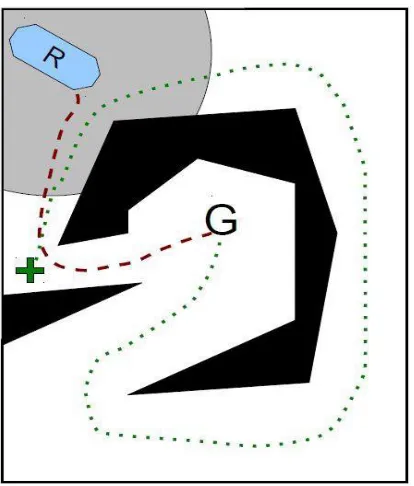
Figure 7 application of local and global path planning in a robot (Haojie et al., 2012).
Figure show that a robot behavior toward its goal. In this situation the short path is develop by the local planning is available, but due to the sharp turn initially being located outside of the range of the local high dimensional planner, which make the robot could not pass through that path. As the robot approaches the impassable area, the sharp turn enters the range of the local controller. At this point the system will recognize that the current path which is local path is no longer executable. Thus, the mobile robot using both local and global path planning will plan and produces a path that goes to the other side of path. At this time the robot will try to use global path planning to ensure it reach the goal (Haojie et al., 2012).
2.4Trap Situations Due to Local Minima
will have a non- optimal path towards the target. That is why the heuristic recovery is always being abandoned while integrated global path planning is always being used. When using this method, the local path planning will monitors the robot's path and when a trap-situation is detected the Global path planning is invoked to plan a new path based on the available information.
2.5Fuzzy Logic
Fuzzy Logic was founded by Lotfi A. Zadeh, a professor for computer science at the University of California in Berkeley in 1965. Basically, Fuzzy Logic is a multivalued logic that can define the intermediate values between conventional evaluations like true/false, yes/no, high/low, and others. Notions like rather high or very cold can be formulated mathematically and processed by computers. Implementations of fuzzy in a system will results on human-like robot response. A fuzzy system is an alternative to traditional notions of set membership and logic that has its origins in ancient Greek philosophy. Fuzzy Logic has being widely used and it is profitable tool for the controlling and steering of systems and complex industrial processes. Fuzzy logic also has been implementing in household and entertainment electronics, as well as for other expert systems and applications like the classification of SAR data.